EP0472348A2 - Wirtschaftliches Videokonferenzsystem - Google Patents
Wirtschaftliches Videokonferenzsystem Download PDFInfo
- Publication number
- EP0472348A2 EP0472348A2 EP91307472A EP91307472A EP0472348A2 EP 0472348 A2 EP0472348 A2 EP 0472348A2 EP 91307472 A EP91307472 A EP 91307472A EP 91307472 A EP91307472 A EP 91307472A EP 0472348 A2 EP0472348 A2 EP 0472348A2
- Authority
- EP
- European Patent Office
- Prior art keywords
- site
- sites
- dominant
- signal
- video
- Prior art date
- Legal status (The legal status is an assumption and is not a legal conclusion. Google has not performed a legal analysis and makes no representation as to the accuracy of the status listed.)
- Withdrawn
Links
Images

Classifications
-
- H—ELECTRICITY
- H04—ELECTRIC COMMUNICATION TECHNIQUE
- H04M—TELEPHONIC COMMUNICATION
- H04M3/00—Automatic or semi-automatic exchanges
- H04M3/42—Systems providing special services or facilities to subscribers
- H04M3/56—Arrangements for connecting several subscribers to a common circuit, i.e. affording conference facilities
- H04M3/567—Multimedia conference systems
-
- H—ELECTRICITY
- H04—ELECTRIC COMMUNICATION TECHNIQUE
- H04N—PICTORIAL COMMUNICATION, e.g. TELEVISION
- H04N7/00—Television systems
- H04N7/14—Systems for two-way working
- H04N7/15—Conference systems
-
- H—ELECTRICITY
- H04—ELECTRIC COMMUNICATION TECHNIQUE
- H04M—TELEPHONIC COMMUNICATION
- H04M2203/00—Aspects of automatic or semi-automatic exchanges
- H04M2203/20—Aspects of automatic or semi-automatic exchanges related to features of supplementary services
- H04M2203/205—Broadcasting
Definitions
- This invention relates to videoconferencing systems, and more particularly, to an improved method and apparatus for controlling a multisite videoconference.
- a videoconference is a multiple party call linking voice and video among a plurality of sites.
- Each site includes an audio receiver for listening to the audio from other sites, and a video monitor for wiewing a selected one of the sites.
- the videoconference may be arranged for fully interactive audio, where each room hears the audio originating from each of the other rooms, or, in more restricted embodiments, each room may hear only the audio of the room it views.
- videoconference services have become available to effectuate business meetings between multiple sites nationwide, and even worldwide.
- each site includes a video monitor, similar to a large television screen, a video camera, and audio transmitter, and an audio receiver.
- the sites are usually connected via some switching arrangement, which is denoted herein a videoconference bridge (VCB).
- VCB videoconference bridge
- each audio transmitter transmits its signal to the VCB, which sums various combinations of the incoming audio signals, and transmits an audio signal to the audio receiver at each site.
- the audio signal transmitted to each site from the VCB is the sum of all other audio signals from all other sites.
- each site hears everyone else talking, but does not hear its own voice echo.
- the transmission of video signals is slightly more complex. Specifically, since the video monitor at each site can only display one image at a time, the network of sites must include some control mechanism for determining which site is to have its own image transmitted to all other sites, and further, what image is to be displayed on the video monitor at the transmitting site. Unlike voice, the video signals cannot simply be summed, since the sum of the video signals would be incomprehensible.
- each site includes a communications link for conveying voice and video to the VCB.
- the VCB determines which voice is "dominant” and routes the video from that site to all other sites.
- the dominant site sees the video signal from the previous dominant site.
- the user can preselect which site is to have ist video routed to all other sites.
- each site must include a high bandwidth communications link to transmit the video signal in digital form, to the VCB.
- the incoming video signal from the dominant site is routed to all other sites, and the video signal from the previous dominant site is routed to the current dominant site. The video signals from all remaining sites are simply discarded.
- each digital video signal depends upon the desired picture quality and the coding technique used for encoding the video signal, and typically is approximately .768 megabits/second. Considering, for example, a video conference of eight sites, it can be appreciated that a substantial amount of bandwidth is wasted. Specifically, there are always six sites, each transmitting a video signal at .768 megabits/second, whose video signal is discarded. Since the communications links used to transmit the video signals from the sites to the VCB must be paid for by the customer, substantial expence is incurred.
- Another problem with the CLI arrangement is that the digital audio and video signals are transmitted as one high speed bit stream.
- the VCB in order for the VCB to determine which of the sites is the dominant site, it must decode the bit stream and extract the audio signal therefrom. Consequently, the particular code used at the sites to encode the video signal must be compatible with the VCB, and updating of encoding equipment at the sites requires updating of the VCB.
- the problems remaining in the prior art are to provide a technique whereby the amount of bandwidth required to implement videoconferencing may be reduced, and further, wherein the bandwidth may be utilized in a more efficient manner than that described above. Further, it is also desirable to implement a videoconference bridge which is independent of the particular encoding technology used at each site.
- a plurality of sites are interconnected by a VCB which monitors incoming audio signals to determine which of the sites is the dominant site, and then superimposes a separate control signal onto each of the outgoing audio signals.
- the control signals received by each site designate one site as the dominant site, and all other sites as passive.
- a site When a site is designated as dominant, that site turns on a transmitter which transmits its video signal to all other sites via a broadcast medium; e.g. via a satellite.
- a new site becomes dominant the previous dominant site turns off its satellite transmitter, and begins receiving video transmissions from the new dominant site.
- the video transmitters turn off and on at the appropriate times; i.e. based upon which site is dominant, to effectively share that channel, thereby resulting in significant bandwidth and cost savings.
- the VCB design is independent of the particular video encoding technology used.
- FIG. 1 there is shown a videoconference bridge (VCB) for use in implementing the invention.
- VVB videoconference bridge
- the arrangement shown in FIG. 1 is intended to provide conferencing among four sites, however, it is to be understood that the concepts embodied therein extend in a straighforward manner to any arbitrary number of sites.
- FIG. 1 comprises audio bridge 122, delay elements 118-121, electromagnetic couplers 105-108, detectors 109-112, decision logic 113, and tone generators 114-117.
- the VCB of FIG. 1 also includes four ports 101-104 for interfacing to the site equipment, which is not show in FIG. 1 but shown and described later herein.
- Audio bridge 122 In operation, and after call setup, audio signals arrive from the user equipment via ports 101-104, and are routed concurrently to audio bridge 122. Audio bridge 122 then combines the signals and routes, to each port, the sum of the arriving audio signals from all other ports. For example, audio bridge 122 would send the sum of the audio signals from ports 101, and 103-104 to the output portion of port 102, and would send the sum of the audio signals from ports 102-104 to the output portion of port 101. As is shown in FIG. 1, each of the audio signals sent to the sites from the VCB is delayed by a separate one of delay elements 118-121, the purpose of which will be described later herein.
- each of detectors 109-112 is arranged to monitor the energy level of its associated incoming audio signal, and to periodically output a signal which is indicative of such energy level. Techniques for doing this are well known in the art and can be used to practise this invention. For example, one possible desing for detectors 109-112, no be construed as limiting the scope of the invention, is to implement each detector as an integrator, which integrates the signal power over a specified time span to compute the signal energy, and outputs a digital signal representative of the value of that energy. The digital signals output from detectors 109-112 would then each represent the energy in a separate one of the arriving audio signals.
- Decision logic 113 is designed to compare the output signals from detectors 109-112 to determine the largest such output signal thereby determining which site is currently speaking. Such a comparison may be done at periodic intervals, say every 1 second. The decision logic then determines which site is dominant in accordance with some algorithm. The algorithm should ideally be immune to a short and sudden burst of audio which could be emitted from any particular site. Algorithms for accomplishing this task are in wide use, and are well known in the art. For purposes herein, the dominant site is that site is that whose video signal is to be received by other sites, regardless of how such designation is made.
- Each of tone generators 114-117 is associated with a separate one of the sites, as can be seen from FIG. 1; that is, the output of each of to generators is coupled to different one of ports 101-104, each of which is connected to a different one of sites A-D.
- decision logic 113 outputs a digital signal to each of tone generators 114-117, where the digital signal designates each tone generator as dominant or passive, depending upon the status of the associated site as calculated by decision logic 113.
- the frequency at which these tones are output, f1 is usually less than the frequency at which decision logic 113 calculates the dominant speaker, designated f2, however, f1 may be shortened in order to provide protection against noise and to allow for changes in the dominant speaker at any time during the videoconference. This technique is best understood by way of example.
- tone generators 114-117 output the proper tone to designate site D as dominant. After one second has elapsed, decision logic 113 determines that site D is still dominant, and consequently, no tones are transmitted to the sites. The same determinatation is made after two, three, and four seconds, with no tones being transmitted either. However, after five seconds, when decision logic 113 determines D to be the dominant site, the proper signals are output by decision logic 113 to tone generators 114-117, and each of the tone generators transmits tone to ist associated site indicating its status. Thus, every five seconds, each site receives a reaffirmation of its status, even if such status hasn't changed, thereby providing protection against the site not receiving its tones due to noise, etc.
- decision logic 113 again determines that site D is dominant, however, no tones are output since the next tone output will normally be after ten seconds; i.e. at five second intervals. However, one second thereafter, when site A becomes dominant, decision logic 113 will determine that although no tone outputs are due for two more seconds, the dominant speaker has changed. Consequently, decision logic 113 will output proper signals and cause the tones to be transmitted back to the sites in order to change their status. Thus, a change in dominant site may occur at any time, rather than at only five second interval.
- the periodic tones provide robust protection against transmission errors, either to the VCB from the sites or vice versa, while allowing the dominant site to change at any time during the videoconference.
- decison logic 113 determines that the site presently determined to be dominant is different from the site determined to be dominant one second ago, then the proper tones are output to correctly signal all sites. Only when a site is designated as dominant, it is associated video signal transmitted to the other sites. Since only one site at a time is designated as dominant, only one video broadcast channel is required. The operation of the equipment located at the individual sites for implementing the technique is now described.
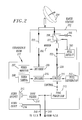
- FIG. 2 shows a block diagram of an exemplary arrangement which may be employed at the individual sites.
- Earth station 201 and conference room 217 may be colocated, or may be geographically separated but linked together via any standard type of communications media.
- audio signals to be transmitted are received by audio transmitter 216, which would normally be a microphone disposed at a convenient central location in the site conference room.
- the audio signal to be transmitted is sent via port 218, and is always transmitted to the VCB, regardless of which site is dominant at any time. This transmission is preferably accomplished via a four wire telephone line, since this requires no echo canceler circuitry.
- Tone filter 214 serves to remove the superimposed tones so that the audible output from speaker 215 does not include these tones.
- Tone filter 214 may be implemented by simply blanking the audio at the tone arrival times, resulting in a several millesecond silence in the speech, a silence which is hardly detectable.
- Tone filter 214 could also be implemented as a narrowband notch filter which would remove energy at the tone frequency, but allow all other energy to pass. While this implementation eliminates the periodic silence in the speech output, it also eliminates from the audio outputt all speech at the tone frequency, a result which may be undesirable. Many other implementations of tone filter 214 may be employed in the arrangement without departing from the scope of the invention.
- Tone processor 213 also receives the incoming tones and determines whether the site is dominant or passive, based upon the tones. Tone processor 213 may be implemented using standard circuitry that is well known in the art. Tone processor 213 would decode the incoming tones and determine whether the dominant tone sequence or the passive tone sequence is present. The determination will result in an output to switch 211 which could be, for example, a binary 1 if dominant, and a binary zero if passive.
- Switch 211 includes two inputs, one of which is for receiving encoded video signals, and one of which is for receiving a null signal from null generator 212. If the signal received by switch 211 from tone processor 213 indicates that the site is to be in the dominant mode, the switch 211 will route the encoded video from encoder 210 to switch output 220. Alternatively, if tone processor 213 informs switch 211 that the site is in the passive mode, switch 211 will route a null signal from null generator 212 to switch output 220.
- video signals from video camera 208 are encoded 210, which may be any of the standard types well known in the art.
- the encoded video signals are then transmitted to switch 211, and routed to earth station 201, as shown in FIG. 2.
- the encoded signals are modulated by modem 202, and are then output onto modem output 221.
- Switch 206 which connects modem output 221 to antenna 204 when the site is in the dominant mode, serves to route the modulated video signal to antenna 204, which may be, for example, a satellite antenna.
- the modulated signal is then transmitted to the other sites over the satellite.
- One possibility is to route the dominant site's own video signal back to the video monitor of the dominant site. This could be accomplished, for example, by installing an extra connection in switch 211 which could route the output of encoder 210 to the input of decoder 209 when the site is designated as dominant.
- an extra connection could be employed at switch 206, which, in addition to connecting modem output 221 to antenna 204, would connect modem output 221 to modem input 223 and disconnect antenna 204 from modem input 223 when the site is designated as dominant.
- switch 211 In operation during the passive mode, switch 211 would transmit a null signal from null generator 212 to modem 202 via switch output 220.
- Null detector 203 at earth station 201 detects this null signal, which may be a predetermined sequence of bits, and causes switch 206 to route modem output 221 to ground through resistor 205. Thus, no video signal is transmitted from antenna 204.
- null generator 212 may no be required, it will prevent modem 202 from detecting a fault as may be the case if the signal on modem input 222 simply vanished.
- modem 202 During the passive mode, video signals received from another site that is in the dominant mode are conveyed from atenna 204 to modem 202 for demodulation. Modem output 202 then sends the demodulated video signal to decoder 209 for decoding and display on video monitor 207.
- video signals from the dominant site are transmitted to other sites via antenna 204 while during the passive mode video signals are received from other sites via antenna 204.
- satellite channel over which antenna 204 transmits the video signal is shared by the plurality of sites in the entire videoconference. More particularly, since only one site is designated as dominant in any given time, the requirement for separate high bandwidth connections from each site to the VCB is eliminated. Rather, only the voice from each site need be transmitte to the VCB.
- any broadcast channel may be shared among the plurality of sites in the system.
- superimposed tones have been used to designate active and passive sites, other types of signals, such as a periodic out of band control signal may be used or a switch at each site could allow that site to 'capture' the video channel and override the decision logic 113.
- Other embodiments include transmitting the audio signal in digital form as opposed to analog and superimposing the tone sequences either inside or outside the VCB.
- more than one video broadcast channel may be utilized and as long as the number of video broadcast channels is less than the number of conference sites, significant bandwidth will be saved.
Landscapes
- Engineering & Computer Science (AREA)
- Multimedia (AREA)
- Signal Processing (AREA)
- Two-Way Televisions, Distribution Of Moving Picture Or The Like (AREA)
- Interconnected Communication Systems, Intercoms, And Interphones (AREA)
Applications Claiming Priority (2)
| Application Number | Priority Date | Filing Date | Title |
|---|---|---|---|
| US57168290A | 1990-08-22 | 1990-08-22 | |
| US571682 | 1990-08-22 |
Publications (2)
| Publication Number | Publication Date |
|---|---|
| EP0472348A2 true EP0472348A2 (de) | 1992-02-26 |
| EP0472348A3 EP0472348A3 (en) | 1992-07-22 |
Family
ID=24284635
Family Applications (1)
| Application Number | Title | Priority Date | Filing Date |
|---|---|---|---|
| EP19910307472 Withdrawn EP0472348A3 (en) | 1990-08-22 | 1991-08-13 | Economical videoconference system |
Country Status (3)
| Country | Link |
|---|---|
| EP (1) | EP0472348A3 (de) |
| JP (1) | JPH04234285A (de) |
| CA (1) | CA2047373A1 (de) |
Cited By (1)
| Publication number | Priority date | Publication date | Assignee | Title |
|---|---|---|---|---|
| DE19510737A1 (de) * | 1995-03-24 | 1996-10-02 | Thomson Brandt Gmbh | Kommunikationsendgerät |
Families Citing this family (1)
| Publication number | Priority date | Publication date | Assignee | Title |
|---|---|---|---|---|
| JP6372156B2 (ja) * | 2014-05-13 | 2018-08-15 | 株式会社リコー | 接続制御システム、通信端末、通信システム、プログラム、及び接続制御方法 |
Family Cites Families (6)
| Publication number | Priority date | Publication date | Assignee | Title |
|---|---|---|---|---|
| US3519744A (en) * | 1967-06-16 | 1970-07-07 | Bell Telephone Labor Inc | Apparatus for connecting visual telephone sets in a conference arrangement |
| FR2312904A1 (fr) * | 1975-05-27 | 1976-12-24 | Poirier Alain | Perfectionnements aux systemes et aux dispositifs de teleconference par visiophonie |
| US4004084A (en) * | 1976-03-03 | 1977-01-18 | Bell Telephone Laboratories, Incorporated | Video conferencing system using spatial reduction and temporal resolution |
| US4360827A (en) * | 1981-06-02 | 1982-11-23 | Darome, Inc. | Method and means for interactive audio and video conferencing |
| JPH01128685A (ja) * | 1987-11-13 | 1989-05-22 | Fujitsu Ltd | テレビ会議システムにおける画面切替方式 |
| JP2666317B2 (ja) * | 1988-01-22 | 1997-10-22 | 沖電気工業株式会社 | 多地点間映像会議システムの映像画面切替え方法 |
-
1991
- 1991-07-18 CA CA 2047373 patent/CA2047373A1/en not_active Abandoned
- 1991-08-13 EP EP19910307472 patent/EP0472348A3/en not_active Withdrawn
- 1991-08-22 JP JP23376291A patent/JPH04234285A/ja active Pending
Cited By (3)
| Publication number | Priority date | Publication date | Assignee | Title |
|---|---|---|---|---|
| DE19510737A1 (de) * | 1995-03-24 | 1996-10-02 | Thomson Brandt Gmbh | Kommunikationsendgerät |
| US5940119A (en) * | 1995-03-24 | 1999-08-17 | Deutsche Thomson-Brandt Gmbh | Communications terminal |
| CN1094290C (zh) * | 1995-03-24 | 2002-11-13 | 德国汤姆逊-布朗特公司 | 通讯终端设备 |
Also Published As
| Publication number | Publication date |
|---|---|
| EP0472348A3 (en) | 1992-07-22 |
| JPH04234285A (ja) | 1992-08-21 |
| CA2047373A1 (en) | 1992-02-23 |
Similar Documents
| Publication | Publication Date | Title |
|---|---|---|
| US5473363A (en) | System, method and multipoint control unit for multipoint multimedia conferencing | |
| US4360827A (en) | Method and means for interactive audio and video conferencing | |
| EP0882359B1 (de) | Multimediakommunikation mit vom system abhängigen adaptiven verzögerungen | |
| EP0523626B1 (de) | Multipoint-Telekonferenz-System mit Anwendung von Kommunikationskanälen in Ringkonfiguration | |
| US5970054A (en) | Multipoint teleconference system employing H. 221 frames | |
| US5684527A (en) | Adaptively controlled multipoint videoconferencing system | |
| US6181693B1 (en) | High speed video transmission over telephone lines | |
| US5278889A (en) | Video telephony dialing | |
| US6008838A (en) | Multi-point video conference system | |
| US7245710B1 (en) | Teleconferencing system | |
| JP2713883B2 (ja) | 時分割交換機 | |
| EP1298904A2 (de) | Verfahren zur Unterdrückung des Hintergrundgeräusches und Verbesserung der Leistung in Sprachkonferenzen über Paketnetzwerken | |
| MXPA03005691A (es) | Distribucion de video a traves de una red de modo de transferencia asincronica//linea de suscriptor digital utilizando un sistema de codificacion de video configurado en multiples capas. | |
| US6643297B1 (en) | Network service provider architecture in communications network | |
| EP0472348A2 (de) | Wirtschaftliches Videokonferenzsystem | |
| WO1999018728A1 (en) | Interconnecting multimedia data streams having different compressed formats | |
| US6522633B1 (en) | Conferencing arrangement for use with wireless terminals | |
| US6707829B1 (en) | Enhanced automatic timing adjustment for alternate routing of HFC systems | |
| Brown | Transmission Plan | |
| KR19980073015A (ko) | 화상회의 시스템 | |
| GB2238691A (en) | Multi-party videoconferencing configuration | |
| WO1997004577A1 (en) | Loudspeaking telephone systems | |
| JPH0662398A (ja) | 画像通信端末装置 | |
| JPS63309034A (ja) | 衛星利用テレビ会議システム | |
| CA2261180A1 (en) | Method of providing an access point into a video data stream, and apparatus for carrying out the method |
Legal Events
| Date | Code | Title | Description |
|---|---|---|---|
| PUAI | Public reference made under article 153(3) epc to a published international application that has entered the european phase |
Free format text: ORIGINAL CODE: 0009012 |
|
| AK | Designated contracting states |
Kind code of ref document: A2 Designated state(s): DE FR GB IT |
|
| PUAL | Search report despatched |
Free format text: ORIGINAL CODE: 0009013 |
|
| AK | Designated contracting states |
Kind code of ref document: A3 Designated state(s): DE FR GB IT |
|
| 17P | Request for examination filed |
Effective date: 19930107 |
|
| RAP3 | Party data changed (applicant data changed or rights of an application transferred) |
Owner name: AT&T CORP. |
|
| 17Q | First examination report despatched |
Effective date: 19941031 |
|
| STAA | Information on the status of an ep patent application or granted ep patent |
Free format text: STATUS: THE APPLICATION HAS BEEN WITHDRAWN |
|
| 18W | Application withdrawn |
Withdrawal date: 19950202 |