EP0472476A2 - Procédé de fabrication d'une membrane minérale ultra-mince et asymétrique - Google Patents
Procédé de fabrication d'une membrane minérale ultra-mince et asymétrique Download PDFInfo
- Publication number
- EP0472476A2 EP0472476A2 EP91420268A EP91420268A EP0472476A2 EP 0472476 A2 EP0472476 A2 EP 0472476A2 EP 91420268 A EP91420268 A EP 91420268A EP 91420268 A EP91420268 A EP 91420268A EP 0472476 A2 EP0472476 A2 EP 0472476A2
- Authority
- EP
- European Patent Office
- Prior art keywords
- resin
- support
- layer
- water
- process according
- Prior art date
- Legal status (The legal status is an assumption and is not a legal conclusion. Google has not performed a legal analysis and makes no representation as to the accuracy of the status listed.)
- Granted
Links
Images
Classifications
-
- B—PERFORMING OPERATIONS; TRANSPORTING
- B01—PHYSICAL OR CHEMICAL PROCESSES OR APPARATUS IN GENERAL
- B01D—SEPARATION
- B01D69/00—Semi-permeable membranes for separation processes or apparatus characterised by their form, structure or properties; Manufacturing processes specially adapted therefor
- B01D69/02—Semi-permeable membranes for separation processes or apparatus characterised by their form, structure or properties; Manufacturing processes specially adapted therefor characterised by their properties
-
- B—PERFORMING OPERATIONS; TRANSPORTING
- B01—PHYSICAL OR CHEMICAL PROCESSES OR APPARATUS IN GENERAL
- B01D—SEPARATION
- B01D71/00—Semi-permeable membranes for separation processes or apparatus characterised by the material; Manufacturing processes specially adapted therefor
- B01D71/02—Inorganic material
- B01D71/0215—Silicon carbide; Silicon nitride; Silicon oxycarbide
-
- C—CHEMISTRY; METALLURGY
- C04—CEMENTS; CONCRETE; ARTIFICIAL STONE; CERAMICS; REFRACTORIES
- C04B—LIME, MAGNESIA; SLAG; CEMENTS; COMPOSITIONS THEREOF, e.g. MORTARS, CONCRETE OR LIKE BUILDING MATERIALS; ARTIFICIAL STONE; CERAMICS; REFRACTORIES; TREATMENT OF NATURAL STONE
- C04B41/00—After-treatment of mortars, concrete, artificial stone or ceramics; Treatment of natural stone
- C04B41/009—After-treatment of mortars, concrete, artificial stone or ceramics; Treatment of natural stone characterised by the material treated
-
- C—CHEMISTRY; METALLURGY
- C04—CEMENTS; CONCRETE; ARTIFICIAL STONE; CERAMICS; REFRACTORIES
- C04B—LIME, MAGNESIA; SLAG; CEMENTS; COMPOSITIONS THEREOF, e.g. MORTARS, CONCRETE OR LIKE BUILDING MATERIALS; ARTIFICIAL STONE; CERAMICS; REFRACTORIES; TREATMENT OF NATURAL STONE
- C04B41/00—After-treatment of mortars, concrete, artificial stone or ceramics; Treatment of natural stone
- C04B41/45—Coating or impregnating, e.g. injection in masonry, partial coating of green or fired ceramics, organic coating compositions for adhering together two concrete elements
- C04B41/4582—Porous coatings, e.g. coating containing porous fillers
-
- C—CHEMISTRY; METALLURGY
- C04—CEMENTS; CONCRETE; ARTIFICIAL STONE; CERAMICS; REFRACTORIES
- C04B—LIME, MAGNESIA; SLAG; CEMENTS; COMPOSITIONS THEREOF, e.g. MORTARS, CONCRETE OR LIKE BUILDING MATERIALS; ARTIFICIAL STONE; CERAMICS; REFRACTORIES; TREATMENT OF NATURAL STONE
- C04B41/00—After-treatment of mortars, concrete, artificial stone or ceramics; Treatment of natural stone
- C04B41/80—After-treatment of mortars, concrete, artificial stone or ceramics; Treatment of natural stone of only ceramics
- C04B41/81—Coating or impregnation
-
- B—PERFORMING OPERATIONS; TRANSPORTING
- B01—PHYSICAL OR CHEMICAL PROCESSES OR APPARATUS IN GENERAL
- B01D—SEPARATION
- B01D2325/00—Details relating to properties of membranes
- B01D2325/02—Details relating to pores or porosity of the membranes
- B01D2325/022—Asymmetric membranes
-
- B—PERFORMING OPERATIONS; TRANSPORTING
- B01—PHYSICAL OR CHEMICAL PROCESSES OR APPARATUS IN GENERAL
- B01D—SEPARATION
- B01D2325/00—Details relating to properties of membranes
- B01D2325/04—Characteristic thickness
-
- B—PERFORMING OPERATIONS; TRANSPORTING
- B01—PHYSICAL OR CHEMICAL PROCESSES OR APPARATUS IN GENERAL
- B01D—SEPARATION
- B01D2325/00—Details relating to properties of membranes
- B01D2325/12—Adsorbents being present on the surface of the membranes or in the pores
-
- C—CHEMISTRY; METALLURGY
- C04—CEMENTS; CONCRETE; ARTIFICIAL STONE; CERAMICS; REFRACTORIES
- C04B—LIME, MAGNESIA; SLAG; CEMENTS; COMPOSITIONS THEREOF, e.g. MORTARS, CONCRETE OR LIKE BUILDING MATERIALS; ARTIFICIAL STONE; CERAMICS; REFRACTORIES; TREATMENT OF NATURAL STONE
- C04B2111/00—Mortars, concrete or artificial stone or mixtures to prepare them, characterised by specific function, property or use
- C04B2111/00474—Uses not provided for elsewhere in C04B2111/00
- C04B2111/00793—Uses not provided for elsewhere in C04B2111/00 as filters or diaphragms
Definitions
- the subject of the invention is the manufacture of porous and permeable mineral membranes, usable on porous and permeable mineral supports. These membranes are intended to be used in separation techniques and, more particularly, in microfiltration and ultrafiltration.
- mineral membranes is meant essentially ceramic membranes or carbon membranes.
- Ceramic membranes can be obtained by depositing on a porous support a slip layer loaded with fine grains of mineral material, deposit followed by drying and firing at a temperature high enough to sinter the grains of mineral material. Such a process is described in European application No. 092 840.
- Carbon membranes can be obtained according to European patent No 250 346 by depositing, by coating on a porous support, an emulsion comprising carbon particles and a thermosetting resin giving a high coke content to the coking, the deposit being followed by a treatment. polycondensation of the resin and then coking.
- the essential defect of the membranes of the prior art resides in the thickness of the membrane which limits its permeability. These high thicknesses result from the need to have a membrane with sufficient mechanical characteristics, or else from the limits of the deposition techniques which do not make it possible to obtain a layer of low and constant thickness. Solutions have been provided to improve the permeability of the membranes, in particular by producing asymmetrical membranes by depositing, on a porous support, successive layers comprising mineral particles of decreasing particle size, as indicated for example in European patent No 250 346.
- the active layer of the membrane has thicknesses greater than 2 ⁇ m, the active layer of an asymmetric membrane being that of smaller porous diameter.
- the primary object of the invention is a method for manufacturing an asymmetric mineral membrane having an active layer of considerably reduced thickness compared to the prior art and therefore of very high permeability.
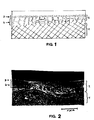
- the membrane (2) deposited on a porous mineral support (1), does not have a uniform porous diameter along the filtration axis perpendicular to the membrane. It comprises an external part (3) with very fine pores and of small thickness, and an internal part (4) of greater thickness and with coarse pores.
- the invention makes it possible to solve the problem posed in a particularly simple manner by taking up the deposition techniques of the prior art but by implementing particular physico-chemical phenomena.
- solvents of the invention which are soluble in water
- solvents which are completely miscible with water will preferably be chosen, and among these, preferably, dioxane and dimethylformamide (DMF).
- DMF dioxane and dimethylformamide
- the choice of solvent and that of the resin are linked, the resin having to be soluble in the solvent but not in water, and preferably completely soluble in the solvent.
- Tests have shown that thermosetting resins such as phenolic or furan resins are not suitable because they are soluble in water.
- thermoplastic resins such as polyacrylonitrile, soluble in DMF, polyvinylidene chloride soluble in hot in dioxane are preferred according to the invention, but it is also possible to use other thermoplastic resins, for example a resin of styrene-acrylonitrile copolymer or of methyl methacrylate soluble in acetone. Not all resins soluble in a water-soluble solvent lead to exactly the same result, probably because of the physicochemical differences between the resins, for example the more or less polar nature, which can influence the way in which the resin will precipitate in contact with water by forming a structure which will approximate more or less that of the membrane (2) of FIG. 1.
- the inorganic materials used as filler and constituting the dispersion according to the invention are not specific to the invention. These are fine powders of ceramic materials (zirconia, alumina, silicon carbide etc ...), or carbonaceous materials (coke powders, carbon black, graphite, finely ground carbon fibers, etc ...) , with an average particle size of between 0.1 and 10 ⁇ m.
- the preparation of the dispersion of inorganic materials in the resin solution in the water-soluble solvent is carried out in a manner known per se by optionally using adjuvants making it possible to control the properties of the dispersion, for example, its viscosity, its stability in time.
- the proportions of the various constituents of the dispersion are not critical, but for obvious reasons of economy, the highest possible content of resin and inorganic material is chosen, compatible with sufficient fluidity. However, the weight ratio between the inorganic material and the resin must be between 0.5 and 15 and preferably between 2 and 10 so that the membrane has sufficient mechanical strength.
- the dispersion obtained according to the invention is deposited by any known means on a porous support, which may be made of ceramic, of polygranular carbon, of sintered metals, but preferably of carbon-carbon composite, the subject of European patent No 208 629.
- This last support has the advantage of being thin (1 mm) and high mechanical characteristics.
- its adjustable porosity is particularly suited to the invention.
- the dispersion layer After depositing on the porous support, the dispersion layer is brought into contact with water 4e so as to precipitate the resin by forming the asymmetrical structure shown diagrammatically in FIG. 1 (layer 2). It is important that the quantity of water is sufficient (washing with water) so that the resulting water-solvent mixture practically no longer dissolves the resin.
- the layer deposited, at this stage is impregnated with water containing only small amounts of organic solvent, amounts sufficiently small so that there is no reconcentration during heating of the heat treatment. solvent which would eventually redissolve the resin.
- the heat treatment to which the porous support is subjected, provided with its layer of precipitated resin loaded with inorganic material, comprises a drying step to remove the water and the residual solvents, a possible oxidation step arranged around 200-300 ° C. , a coking step in a neutral atmosphere at a temperature ranging from 700 to 1300 ° C.
- the asymmetrical structure has been preserved and that the membrane obtained has an active part (3) whose thickness is very small, less than 0.1 ⁇ m, while the total thickness of the membrane is much greater, and for example of the order of 2 ⁇ m.
- the method according to the invention does not entail any significant additional cost compared to the prior art and may even in certain cases be less expensive, in particular when a single thermal treatment common to the membrane and its support is carried out. in carbon-carbon composite.
- Figure 1 shows schematically in cross section a membrane (2) on its support (1), with an active part (3) of small thickness and with small diameter pores and a part (4) of thickness and comparatively higher porosity .
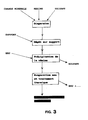
- FIG. 2 is a photo of a membrane on its support obtained according to example 1.
- FIG. 3 shows schematically all the steps of the method according to the invention.
- This dispersion is deposited on the interior surface of a porous tube made of composite material, by filling the tube and then emptying it so as to form an adherent layer. Water is first introduced gradually into the tube, then once the deposited layer has flocculated, it is washed with water. The tube is dried in an oven and brought to 250 ° C., the temperature at which the resin undergoes mild oxidation by the oxygen in the ambient air. The tube is then placed under a neutral atmosphere and coked at 800 ° C. A membrane with high permeability is obtained, the active part of which has a thickness of the order of 0.1 ⁇ m.
Landscapes
- Chemical & Material Sciences (AREA)
- Engineering & Computer Science (AREA)
- Ceramic Engineering (AREA)
- Materials Engineering (AREA)
- Structural Engineering (AREA)
- Organic Chemistry (AREA)
- Chemical Kinetics & Catalysis (AREA)
- Inorganic Chemistry (AREA)
- Separation Using Semi-Permeable Membranes (AREA)
- Inorganic Compounds Of Heavy Metals (AREA)
- Silicates, Zeolites, And Molecular Sieves (AREA)
- Application Of Or Painting With Fluid Materials (AREA)
- Moulding By Coating Moulds (AREA)
- Manufacture Of Macromolecular Shaped Articles (AREA)
- Porous Artificial Stone Or Porous Ceramic Products (AREA)
- Physical Or Chemical Processes And Apparatus (AREA)
- Carbon And Carbon Compounds (AREA)
Abstract
- on prépare une dispersion fluide comprenant une charge, un solvant soluble dans l'eau, une résine insoluble dans l'eau mais soluble dans le solvant organique et donnant après cokéfaction un taux de coke supérieur à 20 % en poids
- on la dépose sur ledit support minéral
- on déplace tout ou partie dudit solvant pour précipiter la résine
- on cokéfie la résine et éventuellement le support.
Description
- L'invention a pour objet la fabrication de membranes minérales poreuses et perméables, utilisables sur supports minéraux poreux et perméables. Ces membranes sont destinées à être employées en techniques séparatives et, plus particulièrement, en microfiltration et ultrafiltration. Par membranes minérales, on entend essentiellement des membranes céramiques ou des membranes carbonées.
- Les membranes minérales, par opposition aux membranes organiques, ou à matrice organique, permettent de réaliser la filtration de fluides chauds et corrosifs. C'est là leur intérêt essentiel.
On connaît des procédés de fabrication de membranes céramiques ou carbonées :
Des membranes céramiques peuvent être obtenues par dépôt sur un support poreux d'une couche de barbotine chargée en grains fins de matière minérale, dépôt suivi d'un séchage et d'une cuisson à un température assez haute pour fritter les grains de matière minérale. Un tel procédé est décrit dans la demande européenne No 092 840.
Des membranes carbonées peuvent être obtenues selon le brevet européen No 250 346 en déposant par engobage sur un support poreux, une émulsion comprenant des particules carbonées et une résine thermodurcissable donnant un taux de coke élevé à la cokéfaction, le dépôt étant suivi d'un traitement de polycondensation de la résine puis de cokéfaction. - Le défaut essentiel des membranes de l'art antérieur réside dans l'épaisseur de la membrane qui limite sa perméabilité. Ces fortes épaisseurs résultent de la nécessité d'avoir une membrane de caractéristiques mécaniques suffisantes, ou encore des limites des techniques de dépôt qui ne permettent pas d'obtenir une couche d'épaisseur faible et constante. Des solutions ont été apportées pour améliorer la perméabilité des membranes, notamment en réalisant des membranes asymétriques par dépôt, sur un support poreux, de couches successives comportant des particules minérales de granulométrie décroissante, comme indiqué par exemple dans le brevet européen No 250 346.
- Dans le meilleur des cas, la couche active de la membrane présente des épaisseurs supérieures à 2 µm, la couche active d'une membrane asymétrique étant celle de plus petit diamètre poreux.
- L'objet premier de l'invention est un procédé permettant de fabriquer une membrane minérale asymétrique ayant une couche active d'épaisseur considérablement réduite par rapport à l'art antérieur et donc de très grande perméabilité.
- Le procédé de fabrication d'une membrane minérale selon l'invention comporte la préparation d'une dispersion fluide comprenant une charge 4e matériaux inorganiques finement divisés et une résine cokéfiable, le dépôt de cette dispersion sur un support minéral éventuellement non-poreux, mécaniquement solide, de manière à former une couche, le traitement thermique dudit support revêtu de ladite couche de manière à cokéfier la résine, et est caractérisé en ce que, de manière à obtenir, en un seul dépôt, une membrane asymétrique ayant une couche active de faible épaisseur,
- on prépare une dispersion fluide comprenant un matériau inorganique finement divisé, un solvant organique soluble dans l'eau, une résine insoluble dans l'eau mais soluble dans le solvant organique et donnant après cokéfaction un taux de coke supérieur à 20 % en poids,
- on dépose une couche de ladite dispersion sur ledit support minéral,
- on met ladite couche en contact avec de l'eau de manière à déplacer tout ou partie dudit solvant organique de la couche par de l'eau et à précipiter la résine,
- on traite thermiquement de manière à cokéfier la résine, et éventuellement le support.
- L'invention sera mieux comprise en considérant la figure 1 qui schématise le résultat obtenu : la membrane (2), déposée sur un support minéral poreux (1), n'a pas un diamètre poreux uniforme selon l'axe de filtration perpendiculaire à la membrane. Elle comprend une partie externe (3) à pores très fins et de faible épaisseur, et une partie interne (4) de plus grande épaisseur et à pores plus grossiers.
Ainsi, l'invention permet de résoudre le problème posé d'une manière particulièrement simple en reprenant les techniques de dépôt de l'art antérieur mais en mettant en oeuvre des phénomènes physico-chimiques particuliers. - Parmi les solvants de l'invention solubles dans l'eau, on choisira de préférence des solvants totalement miscibles à l'eau, et parmi ceux-ci, de préférence, le dioxane et le diméthylformamide (DMF). Le choix du solvant et celui de la résine sont liés, la résine devant être soluble dans le solvant mais non dans l'eau, et de préférence totalement soluble dans le solvant.
Des essais ont montré que des résines thermodurcissables telles que les résine phénoliques ou furaniques ne convenaient pas car solubles dans l'eau. Par contre des résines thermoplastiques telles que la polyacrylonitrile, soluble dans le DMF, le chlorure de polyvinylidène soluble à chaud dans le dioxane sont préférées selon l'invention, mais on peut aussi utiliser d'autres résines thermoplastiques, par exemple une résine de copolymère styrène-acrylonitrile ou de méthacrylate de méthyle solubles dans l'acétone. Toutes les résines solubles dans un solvant hydrosoluble ne conduisent pas exactement au même résultat, sans doute à cause des différences physico-chimiques entre les résines, par exemple le caractère plus ou moins polaire, qui peut influencer la manière dont la résine précipitera au contact de l'eau en formant une structure qui se rapprochera plus ou moins de celle de la membrane (2) de la figure 1. - Les matériaux inorganiques utilisés comme charge et constituant de la dispersion selon l'invention ne sont pas spécifiques à l'invention. Ce sont de fines poudres de matériaux céramique (zircone, alumine, carbure de silicium etc...), ou de matériaux carbonés (poudres de coke, de noir de carbone, de graphite, fibres de carbone finement broyées, etc...), de taille particulaire moyenne comprise entre 0,1 et 10 µm.
- La préparation de la dispersion de matériaux inorganiques dans la solution de résine dans le solvant hydrosoluble est réalisée de manière connue en elle-même en faisant éventuellement appel à des adjuvants permettant de contrôler les propriétés de la dispersion, par exemple, sa viscosité, sa stabilité dans le temps.
- On peut utiliser des mélanges de solvants, des mélanges de résines, sous réserve que les conditions de solubilité soient respectées, ainsi que des mélanges de matériaux inorganiques.
Les proportions des différents constituants de la dispersion ne sont pas critiques, mais pour des raisons évidentes d'économie, on choisit une teneur en résine et en matériau inorganique la plus élevées possible compatible avec une fluidité suffisante. Cependant, le rapport pondéral entre le matériau inorganique et la résine doit être compris entre 0,5 et 15 et de préférence compris entre 2 et 10 afin que la membrane ait une tenue mécanique suffisante.
La dispersion obtenue selon l'invention est déposée par tout moyen connu sur un support poreux, qui pourra être en céramique, en carbone polygranulaire, en métaux frittés, mais de préférence en composite carbone-carbone, objet du brevet européen No 208 629. Ce dernier support présente l'avantage d'être lui-même mince (1 mm) et de hautes caractéristiques mécaniques. En outre, sa porosité ajustable est particulièrement adaptée à l'invention.
Il est également possible de déposer une couche de la dispersion sur un support non-poreux précurseur d'un support poreux : en effet, le support poreux décrit dans le brevet européen No 208 629 est obtenu par imprégnation d'un substrat fibreux par une résine de type phénolique, suivie d'une mise en forme, d'une polymérisation et d'une carbonisation, la porosité n'apparaissant qu'au cours de cette dernière étape. Il est donc intéressant d'un point de vue économique de déposer une couche de dispersion selon l'invention sur un support à substrat carboné et à matrice polymérisée et de réaliser ultérieurement un traitement thermique comportant une carbonisation commune de la membrane et de son support. - Après dépôt sur le support poreux, la couche de dispersion est mise en contact avec de l'eau 4e manière à faire précipiter la résine en formant la structure asymétrique schématisée à la figure 1 (couche 2). Il importe que la quantité d'eau soit suffisante (lavage à l'eau) pour que le mélange eau-solvant résultant ne dissolve pratiquement plus la résine.
En pratique, la couche déposée, à ce stade, est imprégnée d'eau ne contenant plus que de faibles quantités de solvant organique, quantités suffisamment faibles pour qu'il n'y ait pas, lors du chauffage du traitement thermique, une reconcentration en solvant qui redissoudrait éventuellement la résine. - Le traitement thermique auquel est soumis le support poreux, muni de sa couche de résine précipitée chargée de matériau inorganique, comporte une étape de séchage pour éliminer l'eau et les solvants résiduels, une étape éventuelle d'oxydation ménagée vers 200-300°C, une étape de cokéfaction en atmosphère neutre à une température allant de 700 à 1300°C.
- Il est surprenant de constater qu'après ce traitement thermique qui aurait du "effondrer" la couche (2) à cause de la nature thermoplastique de la résine, la structure asymétrique a été conservée et que la membrane obtenue comporte une partie active (3) dont l'épaisseur est très faible, inférieure à 0,1 µm, alors que l'épaisseur totale de la membrane est bien supérieure, et par exemple de l'ordre de 2 µm.
On obtient ainsi des membranes minérales ultra-minces asymétriques de grande perméabilité particulièrement intéressantes en microfiltration et en ultrafiltration.
Par ailleurs, le procédé selon l'invention n'entraîne pas de surcoût significatif par rapport à l'art antérieur et peut même dans certains cas être moins onéreux, notamment lorsqu'on effectue un seul traitement thermique commun à la membrane et à son support en composite carbone-carbone. - La figure 1 schématise en coupe transversale une membrane (2) sur son support (1), avec une partie active (3) de faible épaisseur et à pores de petit diamètre et une partie (4) d'épaisseur et de porosité comparativement plus élevés.
- La figure 2 est une photo d'une membrane sur son support obtenue selon l'exemple 1.
- La figure 3 schématise l'ensemble des étapes du procédé selon l'invention.
- On prépare une dispersion fluide, dans le diméthylformamide (DMF), de poudre de carbone 0,5 µm de taille particulaire moyenne et de polyacrylonitrile dans le rapport pondéral poudre de carbone/ polyacrylonitrile = 9.
On dépose cette dispersion sur la surface intérieure d'un tube poreux en matériau composite, en remplissant le tube puis en le vidant de manière à former une couche adhérente. On introduit d'abord progressivement de l'eau dans le tube, puis une fois que la couche déposée a flocculé, on lave à l'eau.
On sèche le tube en étuve et on le porte à 250°C, température à laquelle la résine subit une oxydation ménagée par l'oxygène de l'air ambiant. On met le tube ensuite sous atmosphère neutre et on le cokéfie à 800°C.
On obtient une membrane de grande perméabilité dont la partie active a une épaisseur de l'ordre de 0,1 µm. - Cet exemple est analogue au précédent, sauf en ce que :
- la résine est le chlorure de polyvinylidène,
- le solvant est le dioxane,
- le matériau minéral est une poudre de zircone de taille particulaire moyenne de 0,1 µm,
- le rapport pondéral poudre de zircone/chlorure de polyvinylidène est de 4,
- le traitement thermique ne comporte pas d'oxydation ménagée à 250°C.
- On obtient une membrane semblable à celle de l'exemple 1.
Claims (11)
Applications Claiming Priority (2)
| Application Number | Priority Date | Filing Date | Title |
|---|---|---|---|
| FR9009999A FR2665087B1 (fr) | 1990-07-24 | 1990-07-24 | Procede de fabrication d'une membrane minerale ultra-mince et asymetrique. |
| FR9009999 | 1990-07-24 |
Publications (3)
| Publication Number | Publication Date |
|---|---|
| EP0472476A2 true EP0472476A2 (fr) | 1992-02-26 |
| EP0472476A3 EP0472476A3 (fr) | 1992-03-04 |
| EP0472476B1 EP0472476B1 (fr) | 1994-12-07 |
Family
ID=9399436
Family Applications (1)
| Application Number | Title | Priority Date | Filing Date |
|---|---|---|---|
| EP91420268A Expired - Lifetime EP0472476B1 (fr) | 1990-07-24 | 1991-07-23 | Procédé de fabrication d'une membrane minérale ultra-mince et asymétrique |
Country Status (8)
| Country | Link |
|---|---|
| US (1) | US5190654A (fr) |
| EP (1) | EP0472476B1 (fr) |
| JP (1) | JPH07144907A (fr) |
| AT (1) | ATE115005T1 (fr) |
| DE (1) | DE69105668T2 (fr) |
| DK (1) | DK0472476T3 (fr) |
| ES (1) | ES2064966T3 (fr) |
| FR (1) | FR2665087B1 (fr) |
Cited By (4)
| Publication number | Priority date | Publication date | Assignee | Title |
|---|---|---|---|---|
| EP0650759A1 (fr) * | 1993-10-29 | 1995-05-03 | VLAAMSE INSTELLING VOOR TECHNOLOGISCH ONDERZOEK, afgekort V.I.T.O., onderneming van openbaar nut onder de vorm van een n.v. | Procédé pour la formation d'une membrane asymétrique en céramique |
| US6916666B1 (en) | 1997-12-30 | 2005-07-12 | Pharmacia Diagnostics Ag | Method using a new calibrator and a device and test kit including the calibrator |
| US7405084B1 (en) | 1997-12-30 | 2008-07-29 | Phadia Ab | Analytical method using particles and test kit for performing the method |
| CN106390763A (zh) * | 2016-11-30 | 2017-02-15 | 佛山市高明区诚睿基科技有限公司 | 一种不锈钢过滤膜管的制备方法 |
Families Citing this family (26)
| Publication number | Priority date | Publication date | Assignee | Title |
|---|---|---|---|---|
| US5387378A (en) * | 1993-04-21 | 1995-02-07 | Tulane University | Integral asymmetric fluoropolymer pervaporation membranes and method of making the same |
| FR2713512B1 (fr) * | 1993-12-14 | 1996-01-19 | Lorraine Carbone | Eléments diffuseurs facilitant le transfert de matière dans des réactions solide-gaz. |
| FR2715590B1 (fr) * | 1994-02-01 | 1996-04-12 | Rhone Poulenc Chimie | Procédé d'épuration d'un milieu contenant des déchets organiques. |
| US5789024A (en) * | 1996-05-15 | 1998-08-04 | New Jersey Institute Of Technology | Subnanoscale composite, N2-permselective membrane for the separation of volatile organic compounds |
| EP1032546A4 (fr) * | 1997-09-04 | 2002-03-20 | Pall Corp | Structures ceramiques poreuses et procedes de fabrication correspondants |
| FR2850588B1 (fr) * | 2003-01-31 | 2007-08-03 | Inst Francais Du Petrole | Membrane inorganique poreuse contenant du carbone, son procede de preparation et son utilisation |
| US7282148B2 (en) * | 2003-10-30 | 2007-10-16 | International Business Machines Corporation | Porous silicon composite structure as large filtration array |
| US20050133949A1 (en) * | 2003-12-19 | 2005-06-23 | Pragtech, Inc. | Polymer solidification and coating process |
| EP1866064A4 (fr) * | 2005-03-09 | 2009-08-19 | Univ California | Membranes nanocomposites et procedes de fabrication et d'utilisation associes |
| WO2007007343A2 (fr) * | 2005-07-14 | 2007-01-18 | Ben Gurion University Of The Negev Research And Development Authority | Membranes composites et procedes de preparation de celles-ci |
| EP2067523B1 (fr) * | 2006-09-28 | 2015-04-29 | NGK Insulators, Ltd. | Structure comprenant une membrane de séparation de liquide |
| CA2667579A1 (fr) * | 2006-10-27 | 2008-05-15 | The Regents Of The University Of California | Structures de support micro- et nanocomposites pour membranes a couches minces d'osmose inverse |
| JP2010540215A (ja) * | 2007-09-21 | 2010-12-24 | ザ リージェンツ オブ ザ ユニバーシティ オブ カリフォルニア | ナノ複合膜ならびにその作製および使用方法 |
| US8177978B2 (en) | 2008-04-15 | 2012-05-15 | Nanoh20, Inc. | Reverse osmosis membranes |
| WO2011008549A2 (fr) * | 2009-06-29 | 2011-01-20 | NanoH2O Inc. | Membranes perfectionnées d'osmose inverse, composites à couches minces, hybrides, avec des additifs azotés |
| KR101810238B1 (ko) | 2010-03-31 | 2017-12-18 | 엘지전자 주식회사 | 탄소/탄소 복합재료의 내산화 코팅방법, 카본 히터 및 조리기기 |
| EP2637773B1 (fr) | 2010-11-10 | 2019-10-30 | NanoH2O Inc. | Membranes tfc hybrides pour osmose inverse améliorées contenant des additifs non métalliques |
| US9861940B2 (en) | 2015-08-31 | 2018-01-09 | Lg Baboh2O, Inc. | Additives for salt rejection enhancement of a membrane |
| US9737859B2 (en) | 2016-01-11 | 2017-08-22 | Lg Nanoh2O, Inc. | Process for improved water flux through a TFC membrane |
| US10155203B2 (en) | 2016-03-03 | 2018-12-18 | Lg Nanoh2O, Inc. | Methods of enhancing water flux of a TFC membrane using oxidizing and reducing agents |
| CN110494206B (zh) * | 2017-04-06 | 2022-03-18 | 陶氏环球技术有限责任公司 | 不对称聚偏二氯乙烯隔膜和由其制备的碳分子筛隔膜 |
| CN107162320B (zh) * | 2017-05-24 | 2020-09-04 | 广西碧清源环保科技有限公司 | 一种有机氮废水处理工艺 |
| CN107055875B (zh) * | 2017-05-24 | 2020-09-04 | 广西碧清源环保科技有限公司 | 一种有机磷废水处理工艺 |
| DE102021117025A1 (de) | 2021-07-01 | 2023-01-05 | Nippon Kornmeyer Carbon Group Gmbh | Verfahren zur Herstellung von karbonisierten oder graphitierten Formteilen |
| CN114053884B (zh) * | 2021-11-23 | 2023-05-26 | 浙江机电职业技术学院 | 纳滤膜及其制备方法和应用 |
| JP7685618B2 (ja) | 2022-10-28 | 2025-05-29 | ニッポン・コルンマイヤー・カーボン・グループ・ゲゼルシャフト・ミト・ベシュレンクテル・ハフツング | 少ない水量を用いて紙から黒鉛を製造する方法 |
Family Cites Families (9)
| Publication number | Priority date | Publication date | Assignee | Title |
|---|---|---|---|---|
| FR604826A (fr) * | 1925-10-16 | 1926-05-14 | Boîte de dérivation et coupe-circuit combinés pour installations électriques | |
| JPS4919999B1 (fr) * | 1970-10-30 | 1974-05-21 | ||
| US4412921A (en) * | 1978-02-21 | 1983-11-01 | Union Carbide Corporation | Dry, particulate, inorganic ultrafiltration membranes and the production thereof |
| US4175153A (en) * | 1978-05-16 | 1979-11-20 | Monsanto Company | Inorganic anisotropic hollow fibers |
| FR2582956B1 (fr) * | 1985-06-10 | 1987-07-31 | Lorraine Carbone | Support de membrane minerale pour techniques separatives et procedes de fabrication de ce support |
| FR2585965A1 (fr) * | 1985-08-12 | 1987-02-13 | Fabrication Elements Catalythi | Module d'ultrafiltration ou de microfiltration monolithique en carbone ou en graphite poreux et son procede de fabrication |
| FR2600266B1 (fr) * | 1986-06-19 | 1990-08-24 | Lorraine Carbone | Procede de fabrication d'une membrane minerale poreuse sur un support mineral |
| CA1269404A (fr) * | 1987-11-03 | 1990-05-22 | Mukesh K. Jain | Membrane poreuse d'oxydes de metal ou de silice frittable(s) |
| US4992485A (en) * | 1988-10-11 | 1991-02-12 | The Dow Chemical Company | Microporous peek membranes and the preparation thereof |
-
1990
- 1990-07-24 FR FR9009999A patent/FR2665087B1/fr not_active Expired - Lifetime
-
1991
- 1991-07-17 US US07/731,340 patent/US5190654A/en not_active Expired - Lifetime
- 1991-07-22 JP JP3181286A patent/JPH07144907A/ja active Pending
- 1991-07-23 EP EP91420268A patent/EP0472476B1/fr not_active Expired - Lifetime
- 1991-07-23 DK DK91420268.4T patent/DK0472476T3/da active
- 1991-07-23 DE DE69105668T patent/DE69105668T2/de not_active Expired - Fee Related
- 1991-07-23 ES ES91420268T patent/ES2064966T3/es not_active Expired - Lifetime
- 1991-07-23 AT AT91420268T patent/ATE115005T1/de not_active IP Right Cessation
Cited By (6)
| Publication number | Priority date | Publication date | Assignee | Title |
|---|---|---|---|---|
| EP0650759A1 (fr) * | 1993-10-29 | 1995-05-03 | VLAAMSE INSTELLING VOOR TECHNOLOGISCH ONDERZOEK, afgekort V.I.T.O., onderneming van openbaar nut onder de vorm van een n.v. | Procédé pour la formation d'une membrane asymétrique en céramique |
| BE1008230A3 (nl) * | 1993-10-29 | 1996-02-20 | Vito | Werkwijze voor het vormen van een asymmetrisch keramisch membraan. |
| US6916666B1 (en) | 1997-12-30 | 2005-07-12 | Pharmacia Diagnostics Ag | Method using a new calibrator and a device and test kit including the calibrator |
| US7405084B1 (en) | 1997-12-30 | 2008-07-29 | Phadia Ab | Analytical method using particles and test kit for performing the method |
| CN106390763A (zh) * | 2016-11-30 | 2017-02-15 | 佛山市高明区诚睿基科技有限公司 | 一种不锈钢过滤膜管的制备方法 |
| CN106390763B (zh) * | 2016-11-30 | 2018-12-28 | 佛山市高明区诚睿基科技有限公司 | 一种不锈钢过滤膜管的制备方法 |
Also Published As
| Publication number | Publication date |
|---|---|
| ATE115005T1 (de) | 1994-12-15 |
| EP0472476A3 (fr) | 1992-03-04 |
| DE69105668T2 (de) | 1995-04-27 |
| FR2665087A1 (fr) | 1992-01-31 |
| EP0472476B1 (fr) | 1994-12-07 |
| US5190654A (en) | 1993-03-02 |
| ES2064966T3 (es) | 1995-02-01 |
| DE69105668D1 (de) | 1995-01-19 |
| DK0472476T3 (da) | 1995-02-13 |
| JPH07144907A (ja) | 1995-06-06 |
| FR2665087B1 (fr) | 1992-10-09 |
Similar Documents
| Publication | Publication Date | Title |
|---|---|---|
| EP0472476B1 (fr) | Procédé de fabrication d'une membrane minérale ultra-mince et asymétrique | |
| EP0956276B2 (fr) | Element de friction en materiau composite carbone/carbone-carbure de silicium et procede pour sa fabrication | |
| EP2253604B1 (fr) | Piece à base de matériau composite c/c et procédé pour sa fabrication | |
| EP2340238B1 (fr) | Procede de fabrication de pieces en materiau composite thermostructural. | |
| EP0495700B1 (fr) | Procédé de densification d'un substrat poreux par une matrice contenant du carbone | |
| WO1997018176A1 (fr) | Procede pour l'introduction dans des substrats poreux d'une composition en fusion a base de silicium | |
| EP1587773B1 (fr) | Procede pour le traitement de surface d une piece en materiau composite thermostructural et application au brasage de pieces en materiau composite thermostructural | |
| WO1994015888A1 (fr) | Procede de fabrication d'articles en materiau composite carbone-carbure de silicium et materiau composite carbone-carbure de silicium | |
| EP0288380B1 (fr) | Membrane semi-perméable organominérale et procédés pour sa fabrication | |
| EP0555130B1 (fr) | Procédé de fabrication de pièces en matériau composite à matrice céramique | |
| EP0250346B1 (fr) | Procédé de fabrication d'une membrane minérale poreuse sur un support minéral | |
| EP0032097A1 (fr) | Procédé de fabrication d'une structure en carbure de silicium | |
| EP1007207A1 (fr) | Mousse de carbure de silicium a surface specifique elevee et a caracteristiques mecaniques ameliorees | |
| EP0558417B1 (fr) | Procédé de fabrication d'une pièce en matériau composite carbone/carbone utilisant de la poudre de mésophase | |
| EP0467806A1 (fr) | Support poreux de membrane filtrante en composite carbone-carbone à substrat en mat de fibres de carbone et son procédé de fabrication | |
| FR2556713A1 (fr) | Composites carbone/carbone a haute resistance mecanique et resistant a l'oxydation | |
| EP1888813B1 (fr) | Procede de densification rapide d'un substrat fibreux poreux par formation d'un depot solide au sein de la porosite du substrat | |
| WO2019175501A1 (fr) | Composite a matrice ceramique oxyde/oxyde | |
| FR2606009A1 (fr) | Procede de fabrication de structures carbonisables, a partir de fibres carbonees pre-oxydees (brai en particulier) et les structures ainsi obtenues | |
| EP0612597B1 (fr) | Procédé et dispositif pour la fabrication d'un semi-produit en bande utilisable dans la fabrication de matériaux ou produits composites à matrice céramique renforcée par des fibres | |
| EP4284612A1 (fr) | Procede de sechage d'une ebauche impregnee et procede de fabrication et systeme et ensemble associes | |
| FR2758146A1 (fr) | Materiau composite a renfort carbone dans une matrice mixte carbone-metal et son procede de fabrication | |
| FR3016305A1 (fr) | Comblement des macropores d'un substrat fibreux par nucleation en phase homogene | |
| FR2667059A1 (fr) | Composite a matrice carbure de silicium utilisable comme couche pare-flamme. |
Legal Events
| Date | Code | Title | Description |
|---|---|---|---|
| PUAI | Public reference made under article 153(3) epc to a published international application that has entered the european phase |
Free format text: ORIGINAL CODE: 0009012 |
|
| PUAL | Search report despatched |
Free format text: ORIGINAL CODE: 0009013 |
|
| AK | Designated contracting states |
Kind code of ref document: A2 Designated state(s): AT BE CH DE DK ES GB IT LI LU NL SE |
|
| AK | Designated contracting states |
Kind code of ref document: A3 Designated state(s): AT BE CH DE DK ES GB IT LI LU NL SE |
|
| 17P | Request for examination filed |
Effective date: 19920316 |
|
| 17Q | First examination report despatched |
Effective date: 19930916 |
|
| GRAA | (expected) grant |
Free format text: ORIGINAL CODE: 0009210 |
|
| AK | Designated contracting states |
Kind code of ref document: B1 Designated state(s): AT BE CH DE DK ES GB IT LI LU NL SE |
|
| REF | Corresponds to: |
Ref document number: 115005 Country of ref document: AT Date of ref document: 19941215 Kind code of ref document: T |
|
| ITF | It: translation for a ep patent filed | ||
| REF | Corresponds to: |
Ref document number: 69105668 Country of ref document: DE Date of ref document: 19950119 |
|
| EAL | Se: european patent in force in sweden |
Ref document number: 91420268.4 |
|
| REG | Reference to a national code |
Ref country code: ES Ref legal event code: FG2A Ref document number: 2064966 Country of ref document: ES Kind code of ref document: T3 |
|
| REG | Reference to a national code |
Ref country code: DK Ref legal event code: T3 |
|
| GBT | Gb: translation of ep patent filed (gb section 77(6)(a)/1977) |
Effective date: 19950117 |
|
| PLBE | No opposition filed within time limit |
Free format text: ORIGINAL CODE: 0009261 |
|
| STAA | Information on the status of an ep patent application or granted ep patent |
Free format text: STATUS: NO OPPOSITION FILED WITHIN TIME LIMIT |
|
| 26N | No opposition filed | ||
| PGFP | Annual fee paid to national office [announced via postgrant information from national office to epo] |
Ref country code: GB Payment date: 20010618 Year of fee payment: 11 |
|
| PGFP | Annual fee paid to national office [announced via postgrant information from national office to epo] |
Ref country code: AT Payment date: 20010622 Year of fee payment: 11 |
|
| PGFP | Annual fee paid to national office [announced via postgrant information from national office to epo] |
Ref country code: DE Payment date: 20010625 Year of fee payment: 11 |
|
| PGFP | Annual fee paid to national office [announced via postgrant information from national office to epo] |
Ref country code: DK Payment date: 20010626 Year of fee payment: 11 |
|
| PGFP | Annual fee paid to national office [announced via postgrant information from national office to epo] |
Ref country code: SE Payment date: 20010627 Year of fee payment: 11 Ref country code: CH Payment date: 20010627 Year of fee payment: 11 |
|
| PGFP | Annual fee paid to national office [announced via postgrant information from national office to epo] |
Ref country code: LU Payment date: 20010710 Year of fee payment: 11 |
|
| PGFP | Annual fee paid to national office [announced via postgrant information from national office to epo] |
Ref country code: ES Payment date: 20010713 Year of fee payment: 11 |
|
| PGFP | Annual fee paid to national office [announced via postgrant information from national office to epo] |
Ref country code: NL Payment date: 20010731 Year of fee payment: 11 |
|
| PGFP | Annual fee paid to national office [announced via postgrant information from national office to epo] |
Ref country code: BE Payment date: 20010904 Year of fee payment: 11 |
|
| REG | Reference to a national code |
Ref country code: GB Ref legal event code: IF02 |
|
| PG25 | Lapsed in a contracting state [announced via postgrant information from national office to epo] |
Ref country code: LU Free format text: LAPSE BECAUSE OF NON-PAYMENT OF DUE FEES Effective date: 20020723 Ref country code: GB Free format text: LAPSE BECAUSE OF NON-PAYMENT OF DUE FEES Effective date: 20020723 Ref country code: AT Free format text: LAPSE BECAUSE OF NON-PAYMENT OF DUE FEES Effective date: 20020723 |
|
| PG25 | Lapsed in a contracting state [announced via postgrant information from national office to epo] |
Ref country code: SE Free format text: LAPSE BECAUSE OF NON-PAYMENT OF DUE FEES Effective date: 20020724 Ref country code: ES Free format text: LAPSE BECAUSE OF NON-PAYMENT OF DUE FEES Effective date: 20020724 |
|
| PG25 | Lapsed in a contracting state [announced via postgrant information from national office to epo] |
Ref country code: LI Free format text: LAPSE BECAUSE OF NON-PAYMENT OF DUE FEES Effective date: 20020731 Ref country code: DK Free format text: LAPSE BECAUSE OF NON-PAYMENT OF DUE FEES Effective date: 20020731 Ref country code: CH Free format text: LAPSE BECAUSE OF NON-PAYMENT OF DUE FEES Effective date: 20020731 Ref country code: BE Free format text: LAPSE BECAUSE OF NON-PAYMENT OF DUE FEES Effective date: 20020731 |
|
| BERE | Be: lapsed |
Owner name: *LE CARBONE LORRAINE Effective date: 20020731 |
|
| PG25 | Lapsed in a contracting state [announced via postgrant information from national office to epo] |
Ref country code: NL Free format text: LAPSE BECAUSE OF NON-PAYMENT OF DUE FEES Effective date: 20030201 Ref country code: DE Free format text: LAPSE BECAUSE OF NON-PAYMENT OF DUE FEES Effective date: 20030201 |
|
| EUG | Se: european patent has lapsed | ||
| REG | Reference to a national code |
Ref country code: DK Ref legal event code: EBP |
|
| GBPC | Gb: european patent ceased through non-payment of renewal fee |
Effective date: 20020723 |
|
| REG | Reference to a national code |
Ref country code: CH Ref legal event code: PL |
|
| NLV4 | Nl: lapsed or anulled due to non-payment of the annual fee |
Effective date: 20030201 |
|
| REG | Reference to a national code |
Ref country code: ES Ref legal event code: FD2A Effective date: 20030811 |
|
| PG25 | Lapsed in a contracting state [announced via postgrant information from national office to epo] |
Ref country code: IT Free format text: LAPSE BECAUSE OF NON-PAYMENT OF DUE FEES;WARNING: LAPSES OF ITALIAN PATENTS WITH EFFECTIVE DATE BEFORE 2007 MAY HAVE OCCURRED AT ANY TIME BEFORE 2007. THE CORRECT EFFECTIVE DATE MAY BE DIFFERENT FROM THE ONE RECORDED. Effective date: 20050723 |