EP0472963A2 - Lichtemittierende Diode für Lichtsensor und diese Diode verwendender Lichtsensor - Google Patents
Lichtemittierende Diode für Lichtsensor und diese Diode verwendender Lichtsensor Download PDFInfo
- Publication number
- EP0472963A2 EP0472963A2 EP91113213A EP91113213A EP0472963A2 EP 0472963 A2 EP0472963 A2 EP 0472963A2 EP 91113213 A EP91113213 A EP 91113213A EP 91113213 A EP91113213 A EP 91113213A EP 0472963 A2 EP0472963 A2 EP 0472963A2
- Authority
- EP
- European Patent Office
- Prior art keywords
- light emitting
- light
- led2
- emitting diode
- transparent layer
- Prior art date
- Legal status (The legal status is an assumption and is not a legal conclusion. Google has not performed a legal analysis and makes no representation as to the accuracy of the status listed.)
- Withdrawn
Links
Images



Classifications
-
- H—ELECTRICITY
- H10—SEMICONDUCTOR DEVICES; ELECTRIC SOLID-STATE DEVICES NOT OTHERWISE PROVIDED FOR
- H10H—INORGANIC LIGHT-EMITTING SEMICONDUCTOR DEVICES HAVING POTENTIAL BARRIERS
- H10H20/00—Individual inorganic light-emitting semiconductor devices having potential barriers, e.g. light-emitting diodes [LED]
- H10H20/80—Constructional details
- H10H20/85—Packages
- H10H20/852—Encapsulations
- H10H20/854—Encapsulations characterised by their material, e.g. epoxy or silicone resins
-
- H—ELECTRICITY
- H10—SEMICONDUCTOR DEVICES; ELECTRIC SOLID-STATE DEVICES NOT OTHERWISE PROVIDED FOR
- H10W—GENERIC PACKAGES, INTERCONNECTIONS, CONNECTORS OR OTHER CONSTRUCTIONAL DETAILS OF DEVICES COVERED BY CLASS H10
- H10W90/00—Package configurations
-
- A—HUMAN NECESSITIES
- A61—MEDICAL OR VETERINARY SCIENCE; HYGIENE
- A61B—DIAGNOSIS; SURGERY; IDENTIFICATION
- A61B5/00—Measuring for diagnostic purposes; Identification of persons
- A61B5/02—Detecting, measuring or recording for evaluating the cardiovascular system, e.g. pulse, heart rate, blood pressure or blood flow
- A61B5/024—Measuring pulse rate or heart rate
- A61B5/02416—Measuring pulse rate or heart rate using photoplethysmograph signals, e.g. generated by infrared radiation
-
- H—ELECTRICITY
- H10—SEMICONDUCTOR DEVICES; ELECTRIC SOLID-STATE DEVICES NOT OTHERWISE PROVIDED FOR
- H10F—INORGANIC SEMICONDUCTOR DEVICES SENSITIVE TO INFRARED RADIATION, LIGHT, ELECTROMAGNETIC RADIATION OF SHORTER WAVELENGTH OR CORPUSCULAR RADIATION
- H10F55/00—Radiation-sensitive semiconductor devices covered by groups H10F10/00, H10F19/00 or H10F30/00 being structurally associated with electric light sources and electrically or optically coupled thereto
- H10F55/20—Radiation-sensitive semiconductor devices covered by groups H10F10/00, H10F19/00 or H10F30/00 being structurally associated with electric light sources and electrically or optically coupled thereto wherein the electric light source controls the radiation-sensitive semiconductor devices, e.g. optocouplers
- H10F55/25—Radiation-sensitive semiconductor devices covered by groups H10F10/00, H10F19/00 or H10F30/00 being structurally associated with electric light sources and electrically or optically coupled thereto wherein the electric light source controls the radiation-sensitive semiconductor devices, e.g. optocouplers wherein the radiation-sensitive devices and the electric light source are all semiconductor devices
- H10F55/255—Radiation-sensitive semiconductor devices covered by groups H10F10/00, H10F19/00 or H10F30/00 being structurally associated with electric light sources and electrically or optically coupled thereto wherein the electric light source controls the radiation-sensitive semiconductor devices, e.g. optocouplers wherein the radiation-sensitive devices and the electric light source are all semiconductor devices formed in, or on, a common substrate
Definitions
- the present invention relates generally to light emitting diodes for photosensors and, more particularly, to an improved light emitting diode for a photosensor which enables correction of changes in the amount of light from a light emitting element in accordance with changes in ambient temperature.
- the invention further relates to a photosensor using such a light emitting diode.
- an apparatus which transmits light from one side to the other side of a finger tip and detects changes in the transmittance (reflectance) of the transmitted light, thereby to examine the amount of blood flowing in the finger, process a resultant detection signal and then evaluate pulsation, blood pressure and the like by calculation.
- a photosensor for use in such an apparatus is disclosed in Japanese Utility Model Laying-Open No. 60-158803.
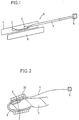
- Fig. 1 is a perspective view of a conventional photosensor
- Fig. 2 is a cross-sectional view of the photosensor of Fig. 1 attached to a finger.
- Photosensor 8 serves to transmit light from one side to the other side of the finger, so as to detect changes in the transmittance of the light.
- a light emitting element 2 and a light receiving element 3 are disposed with a predetermined spacing therebetween corresponding to the size of the finger, on an easily bendable film substrate 1.
- a transparent and easily bendable transparent film 6 is placed or attached to film substrate 1 to cover light emitting element 2 and light receiving element 3.
- Photosensor 8 is wound around a finger 7 to interpose the tip of finger 7 between light emitting element 2 and light receiving element 3.
- a fixing tape 30 e.g., a so-called magic tape
- Photosensor 8 is securely fixed on finger 7 by winding fixing tape 30 around photosensor 8 and overlapping the surface of one end of fixing tape 30 and the reverse surface of the other end thereof.
- Light receiving element 3 receives the light and transmits a resultant signal via lead 4 and connector 5 to the main body of the signal processing unit.
- the signal processing unit detects a change in the transmittance of the light provided at this time, processes a detection signal thereof and then evaluates pulsation and a blood pressure value by calculation.
- a light emitting diode is used for light emitting element 2 employed in the above-described photosensor 8.
- the light emitting diode has, however, an undesirable property that its output power and a wavelength of light emitted from the diode vary depending on ambient temperatures. If photosensor 8 is attached to a living body, e.g., finger 7, then finger 7 becomes ischemic or hemostatic, resulting in a decrease in the body temperature of finger 7, or an increase in the body temperature thereof due to an increase in blood pressure. Thus, the ambient temperature of light emitting element 2 varies, and its output power and its measured wavelength of light also vary. However, it is desirable that the output power of light emitting element 2 and the wavelength of the light emitted from light emitting element 2 are kept constant in order to accurately measure a pulse value or a blood pressure value.
- a light emitting diode 10 includes two LED chips LED1 and LED2 disposed on a substrate 12.
- a photodiode PD is provided in the vicinity of LED chips LED1 and LED2. Photodiode PD directly receives light emitted from LED chips LED1 and LED2.
- Photodiode PD serves to detect a change in the amount of the light emitted from LED chips LED1 and LED2 in accordance with a change in ambient temperatures.
- a transparent epoxy resin 13 is applied onto substrate 12 to cover LED chips LED1 and LED2 and photodiode PD.
- Photodiode PD (which is a light receiving element provided separately from the light receiving element of Fig. 1) is disposed near LED chips LED1 and LED2. Photodiode PD detects a change in the amount of the light from the light emitting diode in accordance with a change in ambient temperature. A current flowing through LED chips LED1 and LED2 is controlled so as to correct the change in the amount of the light. This makes it possible to keep output power of and a wavelength of the light emitted from LED chips LED1 and LED2 constant and thus to obtain accurate information as to a living body.
- the light emitting diode thus structured has, however, the following disadvantages.
- a light beam designated by the dotted line 1 which is emitted from LED chip LED2 and is directly incident on photodiode PD
- a light beam designated by the dotted line 2 which undergoes a total reflection from an inner surface of epoxy resin 13 and enters into photodiode PD
- a light beam designated by the dotted line 3 which once enters into living body 20 and is then scattered or reflected by living body 20, entering into photodiode PD.
- the amount of the scattered light or the reflected light denoted by the dotted line 3 is not constant.
- One object of the present invention is therefore to provide an improved light emitting diode for a photosensor which is immune to influence caused by a drift of temperatures.
- Another object of the present invention is to provide an improved light emitting diode for a photosensor which enables the amount of light from a light emitting element to be precisely kept constant.
- a further object of the present invention is to provide an improved light emitting diode for a photosensor which enables an accurate monitor of the amount of light from a light emitting element.
- a still further object of the present invention is to provide an easily manufacturable light emitting diode for a photosensor.
- a still further object of the present invention is to provide a photosensor including an improved light emitting diode immune to influence caused by a drift of temperatures.
- a light emitting diode for a photosensor in accordance with the present invention includes a substrate and a light emitting element provided on the substrate.
- a light receiving element for receiving light emitted from the light emitting element to detect a change in the amount of the light from the light emitting element in accordance with a change in ambient temperature is disposed on the substrate and in the vicinity of the light emitting element.
- a first transparent layer is formed on the substrate to cover the light emitting element and the light receiving element.
- a second transparent layer is formed on the first transparent layer.
- At least one of the first and second transparent layers is formed of a material which intercepts light other than the wavelength of a spectrum emitted from the light emitting element.
- an interface between the first and second transparent layers is hemispherical.
- a light emitting diode for a photosensor includes a substrate and a light emitting element provided on the substrate.
- a light receiving element which receives light emitted from the light emitting element to detect a change in the amount of the light from the light emitting element in accordance with a change in ambient temperatures is disposed on the substrate and near the light emitting element.
- a first transparent layer is formed on the substrate to cover the light emitting element and the light receiving element.
- a second transparent layer is formed on the first transparent layer.
- a refractive index n1 of the first transparent layer and a refractive index n2 of the second transparent layer satisfy the following inequality: n1 ⁇ n2.
- a photosensor according to still another aspect of the present invention includes a light emitting diode for a photosensor having the foregoing characteristics.
- a second transparent layer is formed on a first transparent layer.
- a very thin air layer is formed at an interface between the first and second transparent layers in formation of the second transparent layer on the first transparent layer.
- a refractive index of air is smaller than those of the first and second transparent layers.
- refractive index n1 of the first transparent layer is larger than that n2 of the second transparent layer.
- the photosensor since the photosensor includes a light emitting diode having the foregoing characteristics, a precise measurement immune to influence caused by a drift of temperatures can be made in the photosensor.
- Fig. 1 is a perspective view of a conventional photosensor.
- Fig. 2 is a cross-sectional view of the photosensor of Fig. 1 attached to a finger.
- Fig. 3A is a plan view showing one example of a conventional light emitting diode; and Fig. 3B is a side view of the light emitting diode of Fig. 3A.
- Fig. 4 is a diagram for use in explaining disadvantages of the conventional light emitting diode.
- Fig. 5 is a side view of a light emitting diode for a photosensor according to one embodiment of the present invention.
- Fig. 6 is a side view for use in explaining an operation of the light emitting diode for a photosensor according to the one embodiment.
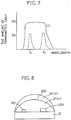
- Fig. 7 is a diagram showing a transparence property of an epoxy resin of the type which limits a wavelength band, used in the present invention.
- Fig. 8 is a side view of a light emitting diode for a photosensor according to another embodiment of the present invention.
- Fig. 9 is a side view for use in explaining an operation of the light emitting diode shown in Fig. 8.
- Fig. 5 is a side view of a light emitting diode for a photosensor according to the one embodiment of the present invention.
- the light emitting diode for a photosensor includes a substrate 12.
- LED chips LED1 (not shown) and LED2 serving as light emitting elements are disposed on substrate 12.
- a photodiode PD serving as a light receiving element which receives light emitted from LED chips LED1 and LED2, thereby to detect a change in the amount of the light from these LED chips in accordance with a change in ambient temperatures is provided on substrate 12 and in the vicinity of the LED chips.
- At least one of the first and second transparent layers 21 and 22 is preferably formed of a material which intercepts light other than a wavelength of a spectrum emitted from LED chips LED1 and LED2.
- first transparent layer 21 employs an epoxy resin of the type which has a transparence property shown in Fig. 7 and limits a wavelength band. Referring to Fig.
- the curve (1) represents the transparence property of the epoxy resin for limiting the wavelength band; ⁇ 1 designates a wavelength of a spectrum emitted from LED1; and ⁇ 2 designates a wavelength of a spectrum emitted from LED2.
- the above-described epoxy resin for use is appropriately selected from resins, for example, Toray Hysol THL-5000A/B, HL3000 (S), EX-012/HX-021-3 and the like manufactured by Toray Hysol Co., Ltd.
- a very thin air layer is formed at an interface between first and second transparent layers 21 and 22 in formation of second transparent layer 22 on first transparent layer 21.
- a refractive index of this air layer is smaller than those of both first and second transparent layers 21 and 22.
- the light emitting diode for a photosensor is made contact with a living body 20. Since an air layer with a small refractive index is formed at an interface 200 between first and second transparent layers 21 and 22, a portion of light emitted from LED chips LED1 and LED2 undergoes a total reflection at interface 200 and then reaches photodiode PD, as shown by the dotted line 5. In the embodiment, since the amount of the light subjected to the total reflection increases, the amount of the light emitted from LED chips LED1 and LED2, which is directly received by photodiode PD, increases.
- first transparent layer 21 employs the epoxy resin, which has the transparence property shown in Fig. 7 and limits a wavelength band, other light designated by the solid line 7 than the wavelength of the light emitted from LED chips LED1 and LED2 cannot be incident on first transparent layer 21 and are thus intercepted at interface 200.
- the light emitting diode for a photosensor Since the light emitting diode for a photosensor according to the embodiment is thus structured, the amount of the light which is emitted from the LED chips and is directly incident on the photodiode increases, thereby enabling a neglect of the amount of the light which is reflected from the living body and enters into the photodiode. This enables a precise feedback and consequently a precise measurement immune to influence caused by a drift of temperatures.
- first and second transparent layers 21 and 22 While such a case is illustrated that an epoxy resin is used for first and second transparent layers 21 and 22 in the foregoing embodiment, the present invention is not limited to this, and any transparent body, for example, glass or elastomer may also be employed.
- the air layer may have a thickness which is naturally grown in molding of the second transparent layer on the first transparent layer.
- the thickness of the air layer may merely be larger than the wavelength of the light emitted from the LED chips.
- first and second transparent layers 21 and 22 are hemispherical
- the present invention is not limited to this.
- the formation of transparent layers 21 and 22 in a hemispherical shape provides the advantage of facilitating the manufacture of such transparent layers.
- Fig. 8 is a side view of a light emitting diode for a photosensor according to another embodiment of the present invention.
- the light emitting diode for a photosensor includes a substrate 12. LED chips LED1 (not shown) and LED2 serving as light emitting elements are provided on substrate 12.
- a photodiode PD which receives light emitted from LED chips LED1 and LED2 to thereby detect a change in the amount of the light from the LED chips in accordance with a change in ambient temperature is provided on substrate 12 and near the LED chips.
- a hemispherical transparent molding material such as of a glass epoxy or the like, which is a first transparent layer 21, is formed on substrate 12 to cover LED chips LED1 and LED2 and photodiode PD.
- a refractive index n1 of the first transparent layer is larger than a refractive index n2 of the second transparent layer.
- the above-described clear epoxy resin for use is appropriately selected from resins, for example, Toray Hysol THL-5000A/B, HL3000 (S) and EX-012/HX-021-3 manufactured by Toray Hysol Co., Ltd. Adjustment of the refractive indexes is made by changing compositions of those resins or by changing mixing ratios of the resins.
- a method for hardening first transparent layer 21 being a clear epoxy and then hardening second transparent layer 22 being also a clear epoxy is adopted.
- a very thin air layer not shown in Fig. 8 is formed at an interface 200 between first and second transparent layers 21 and 22 in the step of forming second transparent layer 22 on first transparent layer 21.
- the light emitting diode for a photosensor is made contact with a living body 20. Since refractive index n1 of first transparent layer 21 is larger than that n2 of second transparent layer 22, a portion of the light emitted from LED chips LED1 and LED2 undergoes a total reflection at interface 200 and reaches photodiode PD, as shown by the dotted line 5. In the embodiment, since the amount of the light subjected to the total reflection increases, the amount of the light emitted from the LED chips, which is directly received by photodiode PD, increases.
- the light emitting diode for a photosensor according to the present invention since the light emitting diode for a photosensor according to the present invention is thus structured, the amount of the light emitted from the light emitting element, which is directly received by the photodiode, increases, thereby enabling a neglect of the amount of the light reflected from the living body. This makes it possible to retain a constant amount of light and make a precise feedback, thereby enabling a precise measurement under no influence caused by a drift of temperatures.
- a photosensor including the above-described light emitting diode enables a precise measurement immune to influence caused by a drift of temperatures.
Landscapes
- Health & Medical Sciences (AREA)
- Life Sciences & Earth Sciences (AREA)
- Cardiology (AREA)
- Medical Informatics (AREA)
- Surgery (AREA)
- Biophysics (AREA)
- Pathology (AREA)
- Engineering & Computer Science (AREA)
- Biomedical Technology (AREA)
- Heart & Thoracic Surgery (AREA)
- Physiology (AREA)
- Molecular Biology (AREA)
- Physics & Mathematics (AREA)
- Animal Behavior & Ethology (AREA)
- General Health & Medical Sciences (AREA)
- Public Health (AREA)
- Veterinary Medicine (AREA)
- Led Device Packages (AREA)
- Measurement Of The Respiration, Hearing Ability, Form, And Blood Characteristics Of Living Organisms (AREA)
- Measuring Pulse, Heart Rate, Blood Pressure Or Blood Flow (AREA)
- Investigating Or Analysing Materials By Optical Means (AREA)
- Photo Coupler, Interrupter, Optical-To-Optical Conversion Devices (AREA)
- Photometry And Measurement Of Optical Pulse Characteristics (AREA)
Applications Claiming Priority (4)
| Application Number | Priority Date | Filing Date | Title |
|---|---|---|---|
| JP89656/90U | 1990-08-27 | ||
| JP1990089656U JPH0446563U (de) | 1990-08-27 | 1990-08-27 | |
| JP1990089655U JPH0446562U (de) | 1990-08-27 | 1990-08-27 | |
| JP89655/90U | 1990-08-27 |
Publications (2)
| Publication Number | Publication Date |
|---|---|
| EP0472963A2 true EP0472963A2 (de) | 1992-03-04 |
| EP0472963A3 EP0472963A3 (en) | 1992-07-08 |
Family
ID=26431074
Family Applications (1)
| Application Number | Title | Priority Date | Filing Date |
|---|---|---|---|
| EP19910113213 Withdrawn EP0472963A3 (en) | 1990-08-27 | 1991-08-06 | Light emitting diode for photosensor and photosensor using such light emitting diode |
Country Status (6)
| Country | Link |
|---|---|
| US (1) | US5151628A (de) |
| EP (1) | EP0472963A3 (de) |
| KR (1) | KR950004597B1 (de) |
| CN (1) | CN1024748C (de) |
| CA (1) | CA2049210A1 (de) |
| RU (1) | RU2069418C1 (de) |
Cited By (6)
| Publication number | Priority date | Publication date | Assignee | Title |
|---|---|---|---|---|
| EP0825432A3 (de) * | 1996-08-23 | 1998-04-08 | Kyoto Daiichi Kagaku Co., Ltd. | Leuchtdiode und optische Vorrichtung |
| WO2000057177A1 (en) * | 1999-03-11 | 2000-09-28 | Technical Chemicals & Products, Inc. | Noninvasive transdermal systems and methods for detecting an analyte in a biological fluid |
| EP1204370A4 (de) * | 2000-05-10 | 2005-09-28 | Motorola Inc | Optischer sensor zur nicht-invasiven blutdruckmessung und entsprechendes verfahren |
| EP1624542A3 (de) * | 2004-07-16 | 2008-09-17 | Avago Technologies Fiber IP (Singapore) Pte. Ltd. | Optoelektronische Anordnung und Verfahren zur Regelung der Ausgangsleistung eines Sendebauelementes |
| DE102007032275B4 (de) * | 2006-07-13 | 2010-03-18 | Avago Technologies Ecbu Ip (Singapore) Pte. Ltd. | Verbundanordnung, die mehrere Vorrichtungen eingliedert, die unterschiedliche Lichtwellenlängen verwenden, und Verfahren zum Herstellen derselben |
| US7681491B2 (en) | 2004-11-11 | 2010-03-23 | Nestec S.A. | Self-cleaning mixing head for producing a milk-based mixture |
Families Citing this family (15)
| Publication number | Priority date | Publication date | Assignee | Title |
|---|---|---|---|---|
| JP3548309B2 (ja) * | 1996-01-09 | 2004-07-28 | キヤノン株式会社 | フォトセンサ |
| US5994835A (en) * | 1997-01-13 | 1999-11-30 | Xerox Corporation | Thin film organic light emitting diode with edge emitter waveguide and electron injection layer |
| JP4288553B2 (ja) * | 2000-07-25 | 2009-07-01 | 富士フイルム株式会社 | カメラのストロボ装置 |
| WO2005117497A1 (de) * | 2004-05-14 | 2005-12-08 | Target Systemelectronic Gmbh | Verfahren zur stabilisierung der temperaturabhängigkeit der lichtemission einer led |
| KR20060125340A (ko) * | 2005-06-02 | 2006-12-06 | 에이프로시스템즈 (주) | 광학적 매개물을 포함하는 발광 다이오드 |
| SG139570A1 (en) * | 2006-07-13 | 2008-02-29 | Avago Technologies General Ip | A miniature composite assembly that incorporates multiple devices that use different wavelengths of light and a method for making the composite assembly |
| SG139568A1 (en) * | 2006-07-13 | 2008-02-29 | Avago Technologies General Ip | Remote control receiver device and ambient light photosensor device incoporated into a single composite assembly |
| CN101392896A (zh) * | 2007-09-21 | 2009-03-25 | 富士迈半导体精密工业(上海)有限公司 | 发光二极管 |
| CN101996983B (zh) * | 2009-08-21 | 2013-01-23 | 深圳华映显示科技有限公司 | 一种发光二极管封装结构和支架结构 |
| RU2402110C1 (ru) * | 2009-09-08 | 2010-10-20 | Закрытое акционерное общество "Светлана-Оптоэлектроника" | Светодиодный модуль с полимерным покрытием |
| RU2402109C1 (ru) * | 2009-09-08 | 2010-10-20 | Закрытое акционерное общество "Светлана-Оптоэлектроника" | Полупроводниковый источник света с полимерным покрытием |
| CN102054829A (zh) * | 2010-11-05 | 2011-05-11 | 深圳市华星光电技术有限公司 | 发光二极管封装构造 |
| CN102683103B (zh) * | 2011-03-09 | 2015-11-18 | 上海朗骏机电科技发展有限公司 | 环保型双金属式光控器 |
| JP6500474B2 (ja) * | 2015-02-09 | 2019-04-17 | 株式会社島津製作所 | 光学分析装置 |
| JP6996860B2 (ja) * | 2017-03-29 | 2022-01-17 | 株式会社キーエンス | 光電センサ |
Family Cites Families (6)
| Publication number | Priority date | Publication date | Assignee | Title |
|---|---|---|---|---|
| US4182977A (en) * | 1978-06-01 | 1980-01-08 | Trw Inc. | Constant output light emitting device |
| DE3483065D1 (de) * | 1983-05-11 | 1990-10-04 | Nellcor Inc | Sensor mit an die hautoberflaeche angepasster form. |
| US4586273A (en) * | 1983-12-28 | 1986-05-06 | Bernard Chapnick | Shoe insert construction |
| JPS6426007U (de) * | 1987-08-07 | 1989-02-14 | ||
| KR930004897B1 (ko) * | 1989-01-17 | 1993-06-09 | 스미도모덴기고오교오 가부시기가이샤 | 광센서 |
| JPH02295542A (ja) * | 1989-05-10 | 1990-12-06 | Sumitomo Electric Ind Ltd | 光センサ |
-
1991
- 1991-08-06 EP EP19910113213 patent/EP0472963A3/en not_active Withdrawn
- 1991-08-14 CA CA002049210A patent/CA2049210A1/en not_active Abandoned
- 1991-08-15 US US07/745,152 patent/US5151628A/en not_active Expired - Fee Related
- 1991-08-26 RU SU915001543A patent/RU2069418C1/ru active
- 1991-08-27 CN CN91105988A patent/CN1024748C/zh not_active Expired - Fee Related
- 1991-08-27 KR KR1019910014832A patent/KR950004597B1/ko not_active Expired - Fee Related
Cited By (7)
| Publication number | Priority date | Publication date | Assignee | Title |
|---|---|---|---|---|
| EP0825432A3 (de) * | 1996-08-23 | 1998-04-08 | Kyoto Daiichi Kagaku Co., Ltd. | Leuchtdiode und optische Vorrichtung |
| US5910663A (en) * | 1996-08-23 | 1999-06-08 | Kyoto Daiichi Kagaku Co., Ltd. | Optical system and light emitting diode having a light dividing surface portion |
| WO2000057177A1 (en) * | 1999-03-11 | 2000-09-28 | Technical Chemicals & Products, Inc. | Noninvasive transdermal systems and methods for detecting an analyte in a biological fluid |
| EP1204370A4 (de) * | 2000-05-10 | 2005-09-28 | Motorola Inc | Optischer sensor zur nicht-invasiven blutdruckmessung und entsprechendes verfahren |
| EP1624542A3 (de) * | 2004-07-16 | 2008-09-17 | Avago Technologies Fiber IP (Singapore) Pte. Ltd. | Optoelektronische Anordnung und Verfahren zur Regelung der Ausgangsleistung eines Sendebauelementes |
| US7681491B2 (en) | 2004-11-11 | 2010-03-23 | Nestec S.A. | Self-cleaning mixing head for producing a milk-based mixture |
| DE102007032275B4 (de) * | 2006-07-13 | 2010-03-18 | Avago Technologies Ecbu Ip (Singapore) Pte. Ltd. | Verbundanordnung, die mehrere Vorrichtungen eingliedert, die unterschiedliche Lichtwellenlängen verwenden, und Verfahren zum Herstellen derselben |
Also Published As
| Publication number | Publication date |
|---|---|
| US5151628A (en) | 1992-09-29 |
| CN1059271A (zh) | 1992-03-11 |
| CA2049210A1 (en) | 1992-02-28 |
| CN1024748C (zh) | 1994-06-01 |
| KR950004597B1 (ko) | 1995-05-02 |
| KR920005416A (ko) | 1992-03-28 |
| RU2069418C1 (ru) | 1996-11-20 |
| EP0472963A3 (en) | 1992-07-08 |
Similar Documents
| Publication | Publication Date | Title |
|---|---|---|
| EP0472963A2 (de) | Lichtemittierende Diode für Lichtsensor und diese Diode verwendender Lichtsensor | |
| EP3566075B1 (de) | Vcsel-näherungssensor mit enger konvergenz | |
| JP4053106B2 (ja) | 一体化レーザ・ベース光源 | |
| US4986671A (en) | Three-parameter optical fiber sensor and system | |
| US4790620A (en) | Optical coupling device for a photo-semiconductor element and an optical fiber | |
| US7482612B2 (en) | Optical moisture sensor and method of making the same | |
| TW201432917A (zh) | 包含特徵以幫助減少雜光及/或光學串擾之光電模組 | |
| JPH05196528A (ja) | 光ファイバ圧力センサ装置 | |
| KR930004897B1 (ko) | 광센서 | |
| JP3223936B2 (ja) | 光学的な測定系のための較正用反射体装置 | |
| US5349181A (en) | Fiber optic chemical sensor having specific channel connecting design | |
| JP4477151B2 (ja) | 一体化レーザ・ベース光源 | |
| JPS6044806A (ja) | 物体の位置検出装置 | |
| US20240234621A1 (en) | Detection device and measurement device | |
| JPS5814021A (ja) | 光学的温度計 | |
| US7250590B2 (en) | Optoelectronic arrangement and a method for controlling the output power of a transmission component | |
| JP2524128B2 (ja) | カ−ブプリズム式液体屈折率計 | |
| JPH0726842B2 (ja) | 光センサ | |
| JP4400643B2 (ja) | 脈波センサ | |
| JPH0231811B2 (de) | ||
| JP2004147787A (ja) | 光式皮下脂肪厚測定方法及びそれに用いる装置 | |
| JP2024180323A (ja) | 反射型光センサ | |
| JPH07107566B2 (ja) | 光ファイバ光学センサ装置 | |
| JPH03229461A (ja) | 固体撮像装置 | |
| CN116211262A (zh) | 壳体、壳体的制备方法及电子设备 |
Legal Events
| Date | Code | Title | Description |
|---|---|---|---|
| PUAI | Public reference made under article 153(3) epc to a published international application that has entered the european phase |
Free format text: ORIGINAL CODE: 0009012 |
|
| AK | Designated contracting states |
Kind code of ref document: A2 Designated state(s): DE FR GB IT |
|
| PUAL | Search report despatched |
Free format text: ORIGINAL CODE: 0009013 |
|
| AK | Designated contracting states |
Kind code of ref document: A3 Designated state(s): DE FR GB IT |
|
| 17P | Request for examination filed |
Effective date: 19920917 |
|
| 17Q | First examination report despatched |
Effective date: 19940328 |
|
| GRAH | Despatch of communication of intention to grant a patent |
Free format text: ORIGINAL CODE: EPIDOS IGRA |
|
| STAA | Information on the status of an ep patent application or granted ep patent |
Free format text: STATUS: THE APPLICATION IS DEEMED TO BE WITHDRAWN |
|
| 18D | Application deemed to be withdrawn |
Effective date: 19960326 |