EP0473924A2 - Ziegler-Natta-Katalysatorsysteme mit metallorganischen Verbindungen - Google Patents
Ziegler-Natta-Katalysatorsysteme mit metallorganischen Verbindungen Download PDFInfo
- Publication number
- EP0473924A2 EP0473924A2 EP91112288A EP91112288A EP0473924A2 EP 0473924 A2 EP0473924 A2 EP 0473924A2 EP 91112288 A EP91112288 A EP 91112288A EP 91112288 A EP91112288 A EP 91112288A EP 0473924 A2 EP0473924 A2 EP 0473924A2
- Authority
- EP
- European Patent Office
- Prior art keywords
- component
- titanium
- group
- electron donor
- alkyl group
- Prior art date
- Legal status (The legal status is an assumption and is not a legal conclusion. Google has not performed a legal analysis and makes no representation as to the accuracy of the status listed.)
- Granted
Links
- 150000001875 compounds Chemical class 0.000 title claims description 24
- 230000003197 catalytic effect Effects 0.000 title 1
- RTAQQCXQSZGOHL-UHFFFAOYSA-N Titanium Chemical compound [Ti] RTAQQCXQSZGOHL-UHFFFAOYSA-N 0.000 claims abstract description 48
- 229910052719 titanium Inorganic materials 0.000 claims abstract description 46
- 239000010936 titanium Substances 0.000 claims abstract description 46
- 239000003054 catalyst Substances 0.000 claims abstract description 38
- 239000007787 solid Substances 0.000 claims abstract description 38
- 229920000642 polymer Polymers 0.000 claims abstract description 23
- 229910052749 magnesium Inorganic materials 0.000 claims abstract description 20
- 239000011777 magnesium Substances 0.000 claims abstract description 20
- 229910052782 aluminium Inorganic materials 0.000 claims abstract description 17
- 150000002902 organometallic compounds Chemical class 0.000 claims abstract description 17
- FYYHWMGAXLPEAU-UHFFFAOYSA-N Magnesium Chemical compound [Mg] FYYHWMGAXLPEAU-UHFFFAOYSA-N 0.000 claims abstract description 15
- XAGFODPZIPBFFR-UHFFFAOYSA-N aluminium Chemical compound [Al] XAGFODPZIPBFFR-UHFFFAOYSA-N 0.000 claims abstract description 12
- 229910052736 halogen Inorganic materials 0.000 claims abstract description 12
- 150000002367 halogens Chemical class 0.000 claims abstract description 12
- 125000000753 cycloalkyl group Chemical group 0.000 claims abstract description 9
- 125000003710 aryl alkyl group Chemical group 0.000 claims abstract description 8
- 125000004209 (C1-C8) alkyl group Chemical group 0.000 claims abstract description 7
- 125000000008 (C1-C10) alkyl group Chemical group 0.000 claims abstract description 5
- 230000000737 periodic effect Effects 0.000 claims abstract description 5
- 239000004480 active ingredient Substances 0.000 claims abstract description 4
- 125000003262 carboxylic acid ester group Chemical class [H]C([H])([*:2])OC(=O)C([H])([H])[*:1] 0.000 claims abstract 3
- 238000000034 method Methods 0.000 claims description 14
- QQONPFPTGQHPMA-UHFFFAOYSA-N propylene Natural products CC=C QQONPFPTGQHPMA-UHFFFAOYSA-N 0.000 claims description 13
- 125000004805 propylene group Chemical group [H]C([H])([H])C([H])([*:1])C([H])([H])[*:2] 0.000 claims description 13
- 238000004519 manufacturing process Methods 0.000 claims description 11
- 238000006116 polymerization reaction Methods 0.000 claims description 10
- 238000002360 preparation method Methods 0.000 claims description 7
- 125000000217 alkyl group Chemical group 0.000 claims description 6
- 125000006539 C12 alkyl group Chemical group [H]C([H])([H])C([H])([H])C([H])([H])C([H])([H])C([H])([H])C([H])([H])C([H])([H])C([H])([H])C([H])([H])C([H])([H])C([H])([H])C([H])([H])* 0.000 claims description 4
- XUIMIQQOPSSXEZ-UHFFFAOYSA-N Silicon Chemical compound [Si] XUIMIQQOPSSXEZ-UHFFFAOYSA-N 0.000 claims description 4
- 125000004432 carbon atom Chemical group C* 0.000 claims description 4
- 239000000203 mixture Substances 0.000 claims description 4
- 238000000465 moulding Methods 0.000 claims description 4
- 229910052710 silicon Inorganic materials 0.000 claims description 4
- 239000010703 silicon Substances 0.000 claims description 4
- 125000004400 (C1-C12) alkyl group Chemical group 0.000 claims 2
- 125000001424 substituent group Chemical group 0.000 claims 2
- 125000003118 aryl group Chemical group 0.000 claims 1
- 239000000428 dust Substances 0.000 abstract description 7
- -1 aluminum halides Chemical class 0.000 description 20
- IMNFDUFMRHMDMM-UHFFFAOYSA-N N-Heptane Chemical compound CCCCCCC IMNFDUFMRHMDMM-UHFFFAOYSA-N 0.000 description 17
- 229920001155 polypropylene Polymers 0.000 description 11
- MZRVEZGGRBJDDB-UHFFFAOYSA-N N-Butyllithium Chemical compound [Li]CCCC MZRVEZGGRBJDDB-UHFFFAOYSA-N 0.000 description 10
- 239000004743 Polypropylene Substances 0.000 description 9
- XJDNKRIXUMDJCW-UHFFFAOYSA-J titanium tetrachloride Chemical compound Cl[Ti](Cl)(Cl)Cl XJDNKRIXUMDJCW-UHFFFAOYSA-J 0.000 description 9
- ZAMOUSCENKQFHK-UHFFFAOYSA-N Chlorine atom Chemical compound [Cl] ZAMOUSCENKQFHK-UHFFFAOYSA-N 0.000 description 8
- 239000000460 chlorine Substances 0.000 description 8
- 229910052801 chlorine Inorganic materials 0.000 description 8
- VLKZOEOYAKHREP-UHFFFAOYSA-N n-Hexane Chemical compound CCCCCC VLKZOEOYAKHREP-UHFFFAOYSA-N 0.000 description 8
- YXFVVABEGXRONW-UHFFFAOYSA-N Toluene Chemical compound CC1=CC=CC=C1 YXFVVABEGXRONW-UHFFFAOYSA-N 0.000 description 6
- 150000001733 carboxylic acid esters Chemical class 0.000 description 5
- VXNZUUAINFGPBY-UHFFFAOYSA-N 1-Butene Chemical compound CCC=C VXNZUUAINFGPBY-UHFFFAOYSA-N 0.000 description 4
- LFQSCWFLJHTTHZ-UHFFFAOYSA-N Ethanol Chemical compound CCO LFQSCWFLJHTTHZ-UHFFFAOYSA-N 0.000 description 4
- 239000007788 liquid Substances 0.000 description 4
- 239000002245 particle Substances 0.000 description 4
- 229920000098 polyolefin Polymers 0.000 description 4
- 239000000047 product Substances 0.000 description 4
- UHOVQNZJYSORNB-UHFFFAOYSA-N Benzene Chemical compound C1=CC=CC=C1 UHOVQNZJYSORNB-UHFFFAOYSA-N 0.000 description 3
- VGGSQFUCUMXWEO-UHFFFAOYSA-N Ethene Chemical compound C=C VGGSQFUCUMXWEO-UHFFFAOYSA-N 0.000 description 3
- 239000005977 Ethylene Substances 0.000 description 3
- 239000011954 Ziegler–Natta catalyst Substances 0.000 description 3
- 150000001298 alcohols Chemical class 0.000 description 3
- 150000001335 aliphatic alkanes Chemical class 0.000 description 3
- AZDRQVAHHNSJOQ-UHFFFAOYSA-N alumane Chemical class [AlH3] AZDRQVAHHNSJOQ-UHFFFAOYSA-N 0.000 description 3
- 150000002170 ethers Chemical class 0.000 description 3
- 238000012685 gas phase polymerization Methods 0.000 description 3
- 239000012442 inert solvent Substances 0.000 description 3
- 150000002576 ketones Chemical class 0.000 description 3
- 150000002596 lactones Chemical class 0.000 description 3
- 150000002681 magnesium compounds Chemical class 0.000 description 3
- 239000000155 melt Substances 0.000 description 3
- 150000003961 organosilicon compounds Chemical class 0.000 description 3
- 150000003021 phthalic acid derivatives Chemical class 0.000 description 3
- 150000003377 silicon compounds Chemical class 0.000 description 3
- 239000002904 solvent Substances 0.000 description 3
- 238000003756 stirring Methods 0.000 description 3
- 150000003609 titanium compounds Chemical class 0.000 description 3
- ZGEGCLOFRBLKSE-UHFFFAOYSA-N 1-Heptene Chemical compound CCCCCC=C ZGEGCLOFRBLKSE-UHFFFAOYSA-N 0.000 description 2
- LIKMAJRDDDTEIG-UHFFFAOYSA-N 1-hexene Chemical compound CCCCC=C LIKMAJRDDDTEIG-UHFFFAOYSA-N 0.000 description 2
- KWKAKUADMBZCLK-UHFFFAOYSA-N 1-octene Chemical compound CCCCCCC=C KWKAKUADMBZCLK-UHFFFAOYSA-N 0.000 description 2
- WSSSPWUEQFSQQG-UHFFFAOYSA-N 4-methyl-1-pentene Chemical compound CC(C)CC=C WSSSPWUEQFSQQG-UHFFFAOYSA-N 0.000 description 2
- XKRFYHLGVUSROY-UHFFFAOYSA-N Argon Chemical compound [Ar] XKRFYHLGVUSROY-UHFFFAOYSA-N 0.000 description 2
- IJGRMHOSHXDMSA-UHFFFAOYSA-N Atomic nitrogen Chemical compound N#N IJGRMHOSHXDMSA-UHFFFAOYSA-N 0.000 description 2
- WKBOTKDWSSQWDR-UHFFFAOYSA-N Bromine atom Chemical compound [Br] WKBOTKDWSSQWDR-UHFFFAOYSA-N 0.000 description 2
- YNQLUTRBYVCPMQ-UHFFFAOYSA-N Ethylbenzene Chemical compound CCC1=CC=CC=C1 YNQLUTRBYVCPMQ-UHFFFAOYSA-N 0.000 description 2
- VEXZGXHMUGYJMC-UHFFFAOYSA-N Hydrochloric acid Chemical compound Cl VEXZGXHMUGYJMC-UHFFFAOYSA-N 0.000 description 2
- TWRXJAOTZQYOKJ-UHFFFAOYSA-L Magnesium chloride Chemical compound [Mg+2].[Cl-].[Cl-] TWRXJAOTZQYOKJ-UHFFFAOYSA-L 0.000 description 2
- 229910004298 SiO 2 Inorganic materials 0.000 description 2
- VYPSYNLAJGMNEJ-UHFFFAOYSA-N Silicium dioxide Chemical compound O=[Si]=O VYPSYNLAJGMNEJ-UHFFFAOYSA-N 0.000 description 2
- GDTBXPJZTBHREO-UHFFFAOYSA-N bromine Substances BrBr GDTBXPJZTBHREO-UHFFFAOYSA-N 0.000 description 2
- 229910052794 bromium Inorganic materials 0.000 description 2
- 150000001244 carboxylic acid anhydrides Chemical class 0.000 description 2
- 150000001735 carboxylic acids Chemical class 0.000 description 2
- 239000000470 constituent Substances 0.000 description 2
- DOIRQSBPFJWKBE-UHFFFAOYSA-N dibutyl phthalate Chemical compound CCCCOC(=O)C1=CC=CC=C1C(=O)OCCCC DOIRQSBPFJWKBE-UHFFFAOYSA-N 0.000 description 2
- 238000009826 distribution Methods 0.000 description 2
- 238000001914 filtration Methods 0.000 description 2
- 150000004820 halides Chemical class 0.000 description 2
- 229910000041 hydrogen chloride Inorganic materials 0.000 description 2
- IXCSERBJSXMMFS-UHFFFAOYSA-N hydrogen chloride Substances Cl.Cl IXCSERBJSXMMFS-UHFFFAOYSA-N 0.000 description 2
- 239000000463 material Substances 0.000 description 2
- 150000002903 organophosphorus compounds Chemical class 0.000 description 2
- YWAKXRMUMFPDSH-UHFFFAOYSA-N pentene Chemical compound CCCC=C YWAKXRMUMFPDSH-UHFFFAOYSA-N 0.000 description 2
- 229920005606 polypropylene copolymer Polymers 0.000 description 2
- 239000011148 porous material Substances 0.000 description 2
- 239000011541 reaction mixture Substances 0.000 description 2
- 239000000126 substance Substances 0.000 description 2
- 239000000725 suspension Substances 0.000 description 2
- PNEYBMLMFCGWSK-UHFFFAOYSA-N Alumina Chemical class [O-2].[O-2].[O-2].[Al+3].[Al+3] PNEYBMLMFCGWSK-UHFFFAOYSA-N 0.000 description 1
- CAQWNKXTMBFBGI-UHFFFAOYSA-N C.[Na] Chemical compound C.[Na] CAQWNKXTMBFBGI-UHFFFAOYSA-N 0.000 description 1
- ISZKKWKBYKPCSI-UHFFFAOYSA-N CC(C)C[Na] Chemical compound CC(C)C[Na] ISZKKWKBYKPCSI-UHFFFAOYSA-N 0.000 description 1
- DFGLZFZXSHRQEA-UHFFFAOYSA-N CC(C)[K] Chemical compound CC(C)[K] DFGLZFZXSHRQEA-UHFFFAOYSA-N 0.000 description 1
- HQPSKTOGFFYYKN-UHFFFAOYSA-N CC(C)[Na] Chemical compound CC(C)[Na] HQPSKTOGFFYYKN-UHFFFAOYSA-N 0.000 description 1
- QOUHPCHHSFSDJW-UHFFFAOYSA-N CCCCCC[K] Chemical compound CCCCCC[K] QOUHPCHHSFSDJW-UHFFFAOYSA-N 0.000 description 1
- CVZKGBSAERIRCK-UHFFFAOYSA-N CCCCCC[Na] Chemical compound CCCCCC[Na] CVZKGBSAERIRCK-UHFFFAOYSA-N 0.000 description 1
- XGWPQXSLRXAAAA-UHFFFAOYSA-N CCCCC[K] Chemical compound CCCCC[K] XGWPQXSLRXAAAA-UHFFFAOYSA-N 0.000 description 1
- RWVPJOOMBGGPKS-UHFFFAOYSA-N CCCCC[Na] Chemical compound CCCCC[Na] RWVPJOOMBGGPKS-UHFFFAOYSA-N 0.000 description 1
- KCMZYCFSSYXEQR-UHFFFAOYSA-N CCCC[K] Chemical compound CCCC[K] KCMZYCFSSYXEQR-UHFFFAOYSA-N 0.000 description 1
- IRDQNLLVRXMERV-UHFFFAOYSA-N CCCC[Na] Chemical compound CCCC[Na] IRDQNLLVRXMERV-UHFFFAOYSA-N 0.000 description 1
- ZJGPGQJYWPRTFO-UHFFFAOYSA-N CCC[K] Chemical compound CCC[K] ZJGPGQJYWPRTFO-UHFFFAOYSA-N 0.000 description 1
- AHCDZZIXAMDCBJ-UHFFFAOYSA-N CCC[Na] Chemical compound CCC[Na] AHCDZZIXAMDCBJ-UHFFFAOYSA-N 0.000 description 1
- ZCUFTCUMEDALHC-UHFFFAOYSA-N CC[K] Chemical compound CC[K] ZCUFTCUMEDALHC-UHFFFAOYSA-N 0.000 description 1
- NTZRDKVFLPLTPU-UHFFFAOYSA-N CC[Na] Chemical compound CC[Na] NTZRDKVFLPLTPU-UHFFFAOYSA-N 0.000 description 1
- 125000003545 alkoxy group Chemical group 0.000 description 1
- 150000004996 alkyl benzenes Chemical class 0.000 description 1
- 229910052786 argon Inorganic materials 0.000 description 1
- QVGXLLKOCUKJST-UHFFFAOYSA-N atomic oxygen Chemical compound [O] QVGXLLKOCUKJST-UHFFFAOYSA-N 0.000 description 1
- WPYMKLBDIGXBTP-UHFFFAOYSA-N benzoic acid Chemical class OC(=O)C1=CC=CC=C1 WPYMKLBDIGXBTP-UHFFFAOYSA-N 0.000 description 1
- 150000004651 carbonic acid esters Chemical class 0.000 description 1
- 239000000969 carrier Substances 0.000 description 1
- 238000006243 chemical reaction Methods 0.000 description 1
- 150000001805 chlorine compounds Chemical class 0.000 description 1
- 230000000052 comparative effect Effects 0.000 description 1
- 230000007797 corrosion Effects 0.000 description 1
- 238000005260 corrosion Methods 0.000 description 1
- 239000003599 detergent Substances 0.000 description 1
- JWCYDYZLEAQGJJ-UHFFFAOYSA-N dicyclopentyl(dimethoxy)silane Chemical compound C1CCCC1[Si](OC)(OC)C1CCCC1 JWCYDYZLEAQGJJ-UHFFFAOYSA-N 0.000 description 1
- 150000005690 diesters Chemical class 0.000 description 1
- RIAWHSGONJRETM-UHFFFAOYSA-N diethoxy-(2-methylpropyl)-propan-2-ylsilane Chemical compound CCO[Si](CC(C)C)(OCC)C(C)C RIAWHSGONJRETM-UHFFFAOYSA-N 0.000 description 1
- MYBJXSAXGLILJD-UHFFFAOYSA-N diethyl(methyl)alumane Chemical compound CC[Al](C)CC MYBJXSAXGLILJD-UHFFFAOYSA-N 0.000 description 1
- XFAOZKNGVLIXLC-UHFFFAOYSA-N dimethoxy-(2-methylpropyl)-propan-2-ylsilane Chemical compound CO[Si](C(C)C)(OC)CC(C)C XFAOZKNGVLIXLC-UHFFFAOYSA-N 0.000 description 1
- NHYFIJRXGOQNFS-UHFFFAOYSA-N dimethoxy-bis(2-methylpropyl)silane Chemical compound CC(C)C[Si](OC)(CC(C)C)OC NHYFIJRXGOQNFS-UHFFFAOYSA-N 0.000 description 1
- VHPUZTHRFWIGAW-UHFFFAOYSA-N dimethoxy-di(propan-2-yl)silane Chemical compound CO[Si](OC)(C(C)C)C(C)C VHPUZTHRFWIGAW-UHFFFAOYSA-N 0.000 description 1
- DJHZCODYPWIDNC-UHFFFAOYSA-N dimethyl-(2-methylpropyl)-propan-2-ylsilane Chemical compound CC(C)C[Si](C)(C)C(C)C DJHZCODYPWIDNC-UHFFFAOYSA-N 0.000 description 1
- 238000005516 engineering process Methods 0.000 description 1
- 238000005886 esterification reaction Methods 0.000 description 1
- 150000002148 esters Chemical class 0.000 description 1
- BLHLJVCOVBYQQS-UHFFFAOYSA-N ethyllithium Chemical compound [Li]CC BLHLJVCOVBYQQS-UHFFFAOYSA-N 0.000 description 1
- 125000005843 halogen group Chemical group 0.000 description 1
- 229920001519 homopolymer Polymers 0.000 description 1
- 239000001257 hydrogen Substances 0.000 description 1
- 229910052739 hydrogen Inorganic materials 0.000 description 1
- 150000002431 hydrogen Chemical class 0.000 description 1
- 229910000039 hydrogen halide Inorganic materials 0.000 description 1
- 239000012433 hydrogen halide Substances 0.000 description 1
- 150000002440 hydroxy compounds Chemical class 0.000 description 1
- 239000011261 inert gas Substances 0.000 description 1
- CCZVEWRRAVASGL-UHFFFAOYSA-N lithium;2-methanidylpropane Chemical compound [Li+].CC(C)[CH2-] CCZVEWRRAVASGL-UHFFFAOYSA-N 0.000 description 1
- LTVBQYKXPQPFBJ-UHFFFAOYSA-N lithium;heptane Chemical compound [Li+].CCCCCC[CH2-] LTVBQYKXPQPFBJ-UHFFFAOYSA-N 0.000 description 1
- CETVQRFGPOGIQJ-UHFFFAOYSA-N lithium;hexane Chemical compound [Li+].CCCCC[CH2-] CETVQRFGPOGIQJ-UHFFFAOYSA-N 0.000 description 1
- IQIWJEAPUNWDLC-UHFFFAOYSA-N lithium;octane Chemical compound [Li+].CCCCCCC[CH2-] IQIWJEAPUNWDLC-UHFFFAOYSA-N 0.000 description 1
- SZAVVKVUMPLRRS-UHFFFAOYSA-N lithium;propane Chemical compound [Li+].C[CH-]C SZAVVKVUMPLRRS-UHFFFAOYSA-N 0.000 description 1
- XBEREOHJDYAKDA-UHFFFAOYSA-N lithium;propane Chemical compound [Li+].CC[CH2-] XBEREOHJDYAKDA-UHFFFAOYSA-N 0.000 description 1
- OTCKOJUMXQWKQG-UHFFFAOYSA-L magnesium bromide Chemical compound [Mg+2].[Br-].[Br-] OTCKOJUMXQWKQG-UHFFFAOYSA-L 0.000 description 1
- 235000011147 magnesium chloride Nutrition 0.000 description 1
- KXDANLFHGCWFRQ-UHFFFAOYSA-N magnesium;butane;octane Chemical compound [Mg+2].CCC[CH2-].CCCCCCC[CH2-] KXDANLFHGCWFRQ-UHFFFAOYSA-N 0.000 description 1
- 230000007257 malfunction Effects 0.000 description 1
- BHGADZKHWXCHKX-UHFFFAOYSA-N methane;potassium Chemical compound C.[K] BHGADZKHWXCHKX-UHFFFAOYSA-N 0.000 description 1
- DVSDBMFJEQPWNO-UHFFFAOYSA-N methyllithium Chemical compound C[Li] DVSDBMFJEQPWNO-UHFFFAOYSA-N 0.000 description 1
- 150000004780 naphthols Chemical class 0.000 description 1
- 229910052757 nitrogen Inorganic materials 0.000 description 1
- 150000002901 organomagnesium compounds Chemical class 0.000 description 1
- 239000001301 oxygen Substances 0.000 description 1
- 229910052760 oxygen Inorganic materials 0.000 description 1
- 150000002989 phenols Chemical class 0.000 description 1
- 239000000843 powder Substances 0.000 description 1
- 229920001384 propylene homopolymer Polymers 0.000 description 1
- 229920005653 propylene-ethylene copolymer Polymers 0.000 description 1
- 150000003254 radicals Chemical class 0.000 description 1
- 230000035484 reaction time Effects 0.000 description 1
- 229910002027 silica gel Inorganic materials 0.000 description 1
- 239000000741 silica gel Substances 0.000 description 1
- 229910052814 silicon oxide Inorganic materials 0.000 description 1
- 239000007790 solid phase Substances 0.000 description 1
- 239000012265 solid product Substances 0.000 description 1
- 230000000707 stereoselective effect Effects 0.000 description 1
- 238000003860 storage Methods 0.000 description 1
- 238000010557 suspension polymerization reaction Methods 0.000 description 1
- 229920001897 terpolymer Polymers 0.000 description 1
- VOITXYVAKOUIBA-UHFFFAOYSA-N triethylaluminium Chemical compound CC[Al](CC)CC VOITXYVAKOUIBA-UHFFFAOYSA-N 0.000 description 1
- 238000005406 washing Methods 0.000 description 1
- 239000004711 α-olefin Substances 0.000 description 1
Classifications
-
- C—CHEMISTRY; METALLURGY
- C08—ORGANIC MACROMOLECULAR COMPOUNDS; THEIR PREPARATION OR CHEMICAL WORKING-UP; COMPOSITIONS BASED THEREON
- C08F—MACROMOLECULAR COMPOUNDS OBTAINED BY REACTIONS ONLY INVOLVING CARBON-TO-CARBON UNSATURATED BONDS
- C08F10/00—Homopolymers and copolymers of unsaturated aliphatic hydrocarbons having only one carbon-to-carbon double bond
Definitions
- the invention relates to the production of such catalyst systems, the production of polymers of propylene with the aid of these catalyst systems, the polymers obtainable hereafter, and films and moldings made from these polymers.
- Catalyst systems of the Ziegler-Natta type include known from EP-B 14523, EP-A-23425, EP-A 45975, EP-A 195 497 and US-A 4 857 613. These systems are used in particular for the polymerization of ⁇ -olefins and contain, among other things.
- a catalyst system is known from EP-A 86473, in which carbonic acid esters are used as electron donor compounds as constituents of the titanium-containing solid component and, among other things, as cocatalyst. Silicon compounds are used which, although they have a satisfactorily high productivity, leave something to be desired in terms of the stereospecificity of the resulting polymers.
- EP-A 171 200 also describes a Ziegler-Natta catalyst system which, among other things, is a component of the titanium-containing solid component. Contains carboxylic acid esters, and silicon and aluminum compounds as cocatalysts. This catalyst system enables the production of polypropylenes with a high stereospecificity, but in addition to a productivity which is no longer satisfactory, has the further disadvantage that the particle size distribution of the polymer obtainable here is too wide.
- a low halogen content in the polyolefin is also important in order to enable the use of such materials in combination with substances at risk of corrosion. For this it is above all necessary to significantly reduce the halogen content in the polymer.
- US Pat. No. 4,857,613 describes a catalyst system which, as components of the titanium-containing solid component, has a benzene carboxylic acid derivative in addition to titanium, magnesium, halogen and silica gel.
- aluminum compounds and organic silicon compounds are used as cocatalysts.
- This catalyst system enables the production of polyolefins with high stereospecificity and low catalyst residues and also has high productivity.
- the polymers obtained in this way are sometimes not completely free of a certain amount of very fine dust, which can lead to malfunctions, for example to blockages in the system parts downstream of the reactor, in particular in the case of continuous operation.
- the present invention was based on the task of developing a new catalyst system with which the disadvantages described can largely be remedied and with which it is possible to produce polymers of propylene with high productivity, which are characterized by high crystallinity, a low proportion of catalyst residues and particularly characterized by a low proportion of very fine dust.
- Halides or alcoholates of trivalent or tetravalent titanium are generally used as titanium compounds for the preparation of the titanium-containing solid component a), the chlorides of titanium, in particular titanium tetrachloride, being preferred.
- the titanium-containing solid component advantageously contains a finely divided support, silicon and aluminum oxides and aluminum silicates of the gross formula SiO 2 'aAl 2 O 3 , where a stands for a value from 0.001 to 2, in particular from 0.01 to 0.5, good have proven.
- the carriers preferably used have a particle diameter of 0.1 to 1000 ⁇ m, in particular of 1 to 500 ⁇ m, a pore volume of 0.1 to 10 cm 3 / g, in particular of 1.0 to 5.0 cm 3 / g and a specific surface area from 10 to 1000 m 2 / g, in particular from 100 to 500 m 2 / g.
- titanium-containing solid component examples include Compounds of magnesium.
- magnesium alkyls and magnesium aryls, magnesium alkoxy and magnesium aryloxy compounds are also suitable, magnesium dichloride, magnesium dibromide and magnesium di (Ci-Cio-alkyl) compounds being used in particular.
- the titanium-containing solid component contains a halogen, preferably chlorine or bromine.
- the titanium-containing solid component also contains electron donor compounds, for example mono- or polyfunctional carboxylic acids, carboxylic anhydrides and carboxylic esters, furthermore ketones, ethers, alcohols, lactones, and organophosphorus and organosilicon compounds.
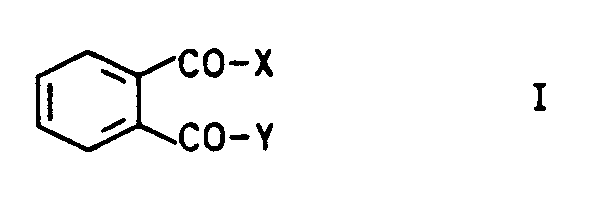
- electron donor compounds within the titanium-containing solid component are phthalic acid derivatives of the general formula I used, where X and Y each represent chlorine or a Ci to C 10 alkoxy radical or together represent oxygen.
- Particularly preferred electron donor compounds are phthalic acid esters, where X and Y represent a C 1 -C 8 alkoxy radical, for example a methoxy, ethoxy, propyloxy or a butyloxy radical.
- Further preferred electron donor compounds within the titanium-containing solid component include diesters of 3- or 4-membered, optionally substituted cycloalkyl-1,2-dicarboxylic acids and monoesters of optionally substituted benzophenone-2-carboxylic acids.
- the hydroxy compounds used in these esters are the alcohols customary in esterification reactions, including Ci to C 15 alkanols, C to C 7 cycloalkanols, which in turn can carry C 1 to C 10 alkyl groups, furthermore phenols, naphthols and the C 1 -C 1 o-alkyl derivatives of these compounds.
- the titanium-containing solid component can be produced by methods known per se. Examples include: in EP-A 45 975, EP-A 45 977, EP-A 86 473, EP-A 171 200, GB-A 2 111 066 and US-A 4 857 613.
- the following two-stage process is preferably used in the production of the titanium-containing solid component.
- a finely divided carrier preferably silicon oxide or SiO 2 'aAl 2 O 3 - where a stands for a number in the range from 0.001 and 2, in particular in the range from 0.01 and 0.5 - is first mixed with a Solution of a magnesium-containing compound in a liquid alkane, after which this mixture is stirred for 0.5 to 5 hours at a temperature between 10 and 120 ° C.
- a magnesium-containing compound preferably silicon oxide or SiO 2 'aAl 2 O 3 - where a stands for a number in the range from 0.001 and 2, in particular in the range from 0.01 and 0.5 -
- a solution of a magnesium-containing compound in a liquid alkane Preferably 0.1 to 1 mol of the magnesium compound is used per mole of the carrier.
- a halogen or a hydrogen halide in particular chlorine or hydrogen chloride
- a C 1 - to C 8 -alkanol in particular ethanol, a halide or an alcoholate of trivalent or tetravalent titanium, in particular titanium tetrachloride, and an electron donor compound, in particular a phthalic acid derivative of the general formula I, are added.
- the solid obtained from the first stage is extracted for a few hours at temperatures between 100 and 150 ° C with excess titanium tetrachloride or an excess solution of titanium tetrachloride in an inert solvent, preferably an alkylbenzene, the solvent being at least 5% by weight .-% contains titanium tetrachloride.
- the product is then washed with a liquid alkane until the titanium tetrachloride content of the washing liquid is less than 2% by weight.
- the titanium-containing solid component a) obtainable in this way is used together with cocatalysts, i.e. Aluminum compounds and electron donor compounds, used as the Ziegler-Natta catalyst system.
- suitable aluminum components are also those compounds in which an alkyl group is replaced by an alkoxy group or by a halogen atom, for example by chlorine or bromine.
- Trialkylaluminum compounds are preferably used, the alkyl groups of which each have 1 to 8 carbon atoms, for example trimethyl, triethyl or methyldiethylaluminum.
- dimethoxydiisopropylsilane, dimethoxyisobutylisopropylsilane, dimethoxydiisobutylsilane, dimethoxydicyclopentylsilane and diethoxyisobutylisopropylsilane are particularly suitable.
- Catalyst systems are preferably used in which the atomic ratio between aluminum from the aluminum compound b) and titanium from the titanium-containing solid component a) 10: 1 to 800: 1, in particular 20: 1 to 200: 1, and the molar ratio between the aluminum compound b) and the electron donor compound c) is 1: 1 to 100: 1, in particular 2: 1 to 80: 1.
- the catalyst systems according to the invention additionally contain an organometallic compound d) of the general formula (A) or (B) in which M 1 is an element of main group I and M 2 is an element of main group II of the Periodic Table and R 1 and R 2 are identical or different and, for a C 1 -C 10 alkyl group, a C 6 -C 12 - Aryl or arylalkyl group, or a 5- to 7-membered cycloalkyl group, which in turn can carry C 1 -C 8 -alkyl groups.
- compounds of the general formula (A) are preferably used, and of these in particular those which contain, as radicals R 1 is a C 1 -C 1 o alkyl group.
- organometallic compounds examples include Methyl lithium, ethyl lithium, n-propyllithium, iso-propyllithium, n-butyllithium, iso-butyllithium, n-pentyllithium, n-hexyllithium, n-heptyllithium, n-octyllithium, methyl sodium, ethyl sodium, n-propyl sodium, iso-propyl sodium, Butyl sodium, iso-butyl sodium, n-pentyl sodium, n-hexyl sodium, methyl potassium, ethyl potassium, n-propyl potassium, iso-propyl potassium, n-butyl potassium, n-pentyl potassium and n-hexyl potassium.
- n-butyllithium is used as a particularly preferred organometallic compound.
- the organometallic compound d) is added to the titanium-containing solid component a), usually before being combined with the aluminum component b) and the further electron donor component c) in the form of a solution in an inert solvent, for example in n-hexane, n-heptane, benzene or toluene .
- an inert solvent for example in n-hexane, n-heptane, benzene or toluene .
- 0.005 to 0.5 mmol, in particular 0.01 to 0.5 mmol, of the organometallic compound are used per gram of the titanium-containing solid component a).
- the organometallic compound of the titanium-containing solid component a) is added to a storage vessel at the entrance to the polymerization reactor and the suspension obtained is then introduced continuously into the reactor.
- the catalyst systems according to the invention are particularly suitable for the preparation of polymers of propylene.
- the production of propylene polymers can be carried out either batchwise or, preferably, continuously, in the conventional reactors used for the polymerization of propylene, among others. as a suspension polymerization or preferably as a gas phase polymerization.
- Suitable reactors include continuously operated stirred reactors which contain a fixed bed of finely divided polymer which is usually kept in motion by suitable stirring devices.
- the reaction can also be carried out in a series of several reactors connected in series.
- the reaction time depends crucially on the chosen polymerization conditions. It is usually between 0.2 and 20 hours, usually between 0.5 and 10 hours.
- copolymers of propylene are also understood to mean copolymers of propylene with minor amounts of other alk-1-enes having 2 to 12 carbon atoms, e.g. of ethylene, but-1-ene, pent-1-ene, 4-methylpent-1-ene, hex-1-ene, hept-1-ene and oct-1-ene.
- Particularly suitable comonomers are ethylene and but-1-ene.
- the catalyst system according to the invention is particularly suitable for the production of propylene homopolymers, of random, alternating or block-like propylene-ethylene copolymers with up to 20% by weight of copolymerized ethylene and of terpolymers of propylene with up to 20% by weight of copolymerized comonomers.
- the polymerization reaction is advantageously carried out at temperatures from 20 to 160 ° C and pressures from 1 to 100 bar. Temperatures of 40 to 120 ° C. and pressures of 10 to 80 bar are preferred.
- the molar mass of the polyolefins formed in this way can be controlled by adding regulators customary in polymerization technology, for example hydrogen, and adjusted to a narrower distribution. It is also possible to use inert solvents such as toluene or hexane, inert gases such as nitrogen or argon and smaller amounts of polypropylene powder.
- the polymers obtainable with the aid of the catalyst system according to the invention generally have average molecular weights M w between 10,000 and 1,000,000 and melt flow indices in the range from 0.1 to 500 g / 10 min, preferably in the range from 0.2 to 250 g / 10 min, each measured according to DIN 53 735 at 230 ° C and 2.16 kg.
- the melt flow index corresponds to the amount of polymer which is pressed out within 10 minutes from the test device standardized according to DIN 53 735 at a temperature of 230 ° C. and under a weight of 2.16 kg.
- the polymers obtainable in this way have a low content of catalyst residues, for example chlorine, a high bulk density and, in particular, significantly reduced proportions of fine dust (particle size ⁇ 125 ⁇ m).
- the propylene polymers produced using the catalyst system according to the invention are particularly suitable as materials for films and moldings.
- Si0 2 which had a particle diameter of 20 to 45 ⁇ m, a pore volume of 1.75 cm 3 / g and a surface area of 320 m 2 / g, was mixed with butyl octyl magnesium dissolved in n-heptane, wherein 0.3 mol of the magnesium compound were used per mole of Si0 2 '.
- the reaction mixture was stirred at 90 ° C. for 1.5 hours, then cooled to 20 ° C. and then 10 times the molar amount, based on the organomagnesium compound, of hydrogen chloride was introduced. After 30 minutes, the solid phase product was separated from the solvent.
- the product obtainable from the first stage was mixed with n-heptane and then 3 mol of ethanol, based on 1 mol of magnesium, was added with constant stirring. This mixture was stirred for 1.5 hours at 80 ° C. and then mixed with 6 mol of titanium tetrachloride and 0.5 mol of di-n-butyl phthalate, in each case based on 1 mol of magnesium. The reaction mixture was stirred for a further two hours after which the solid was separated from the solvent by filtration.
- the product so obtained was extracted for two hours at 125 ° C. with a 15% by weight solution of titanium tetrachloride in ethylbenzene.
- the solid product was then removed from the extract by filtration Detergent separated and washed with n-heptane until it contained only 0.3 wt .-% titanium tetrachloride.
- the resulting titanium-containing solid component contained 3.1% by weight of titanium, 7.5% by weight of magnesium and 28.3% by weight of chlorine.
- gaseous propylene was introduced at a pressure of 32 bar and a temperature of 80 ° C. and this was polymerized continuously with the aid of a Ziegler-Natta catalyst system with an average residence time of 3 hours.
- 3.3 g of the titanium-containing solid component a) prepared according to 1, 300 mmol of triethylaluminum and 6 mmol of dimethylisobutylisopropylsilane were used as catalyst constituents per hour and these were metered into the reactor separately in each case.
- the titanium-containing solid component a) was previously mixed with a 0.1 molar solution of n-butyllithium in n-heptane, this solution being added in such an amount to the titanium-containing solid component a) that the resulting suspension per gram of the titanium-containing solid component a ) Contained 0.025 mmol n-butyllithium.
- a polypropylene with a melt flow index of 8 g / 10 min, at 230 ° C. and 2.16 kg was obtained.
- the productivity of the catalyst system used i.e. the quantitative ratio between the polypropylene produced per g of titanium-containing solid component a), the crystallinity, i.e. the proportion of xylene-insoluble polymers, the fine dust fraction ⁇ 125 ⁇ m), as well as the chlorine content and the bulk density of the polypropylene obtained are listed in the table below.
- Propylene was polymerized under the conditions of the example according to the invention, but the addition of the organometallic compound n-butyllithium to the titanium-containing solid component a) was dispensed with.
Landscapes
- Chemical & Material Sciences (AREA)
- Health & Medical Sciences (AREA)
- Chemical Kinetics & Catalysis (AREA)
- Medicinal Chemistry (AREA)
- Polymers & Plastics (AREA)
- Organic Chemistry (AREA)
- Transition And Organic Metals Composition Catalysts For Addition Polymerization (AREA)
Abstract
- a) eine titanhaltige Feststoffkomponente mit Titan, Magnesium, Halogen und einem Carbonsäureester als Elektronendonor,
- b) eine Aluminiumkomponente,
- c) eine weitere Elektronendonorkomponente, sowie als zusätzliche Komponente
- d) eine metallorganische Verbindung der allgemeinen Formel A oder B

Description
- Die vorliegende Erfindung betrifft Katalysatorsysteme vom Typ der Ziegler-Natta-Katalysatoren, enthaltend als aktive Bestandteile
- a) eine titanhaltige Feststoffkomponente mit Titan, Magnesium, Halogen und einem Carbonsäureester als Elektronendonor,
- b) eine Aluminiumkomponente,
- c) eine weitere Elektronendonorkomponente, sowie als zusätzliche Komponente
- d) eine metallorganische Verbindung der allgemeinen Formel A oder B

- Außerdem betrifft die Erfindung die Herstellung solcher Katalysatorsysteme, die Herstellung von Polymerisaten des Propylens mit Hilfe dieser Katalysatorsysteme, die hiernach erhältlichen Polymerisate sowie Folien und Formkörper aus diesen Polymerisaten.
- Katalysatorsysteme vom Typ der Ziegler-Natta-Katalysatoren sind u.a. aus der EP-B 14523, der EP-A-23425, der EP-A 45975, der EP-A 195 497 und der US-A 4 857 613 bekannt. Diese Systeme werden insbesondere zur Polymerisation von a-Olefinen verwendet und enthalten u.a. Verbindungen des mehrwertigen Titans, Aluminiumhalogenide und/oder -alkyle, sowie Elektronendonorverbindungen, insbesondere Siliciumverbindungen, Ether, Carbonsäureester, Ketone und Lactone, die einerseits in Verbindung mit der Titanverbindung und andererseits als Cokatalysator verwendet werden.
- Um eine wirtschaftliche Polyolefinproduktion zu gewährleisten, müssen solche Katalysatorsysteme u.a. eine hohe Produktivität aufweisen. Darunter versteht man das Verhältnis der gebildeten Menge Polymerisat zur Menge des eingesetzten Katalysators. Weiterhin ist es erforderlich, daß die dabei erhältlichen Polymerisate möglichst kristallin und stereospezifisch sind, d.h. der Anteil von xylollöslichem Polypropylen sollte möglichst niedrig liegen.
- Diese beiden Zielvorgaben lassen sich nach dem Stand der Technik zusammen nur bedingt verwirklichen. So ist beispielsweise aus der EP-A 86473 ein Katalysatorsystem bekannt, bei dem als Elektronendonorverbindungen als Bestandteile der titanhaltigen Feststoffkomponente Carbonsäureester und als Cokatalysator u.a. Siliciumverbindungen verwendet werden, das zwar eine befriedigend hohe Produktivität aufweist, im Hinblick auf die Stereospezifität der entstehenden Polymerisate aber zu wünschen übrig läßt. In der EP-A 171 200 wird ferner ein Ziegler-Natta-Katalysatorsystem beschrieben, das als Bestandteil der titanhaltigen Feststoffkomponente u.a. Carbonsäureester, sowie Silicium- und Aluminiumverbindungen als Cokatalysatoren enthält. Dieses Katalysatorsystem ermöglicht die Herstellung von Polypropylenen mit hoher Stereospezifität, weist aber neben einer nicht mehr befriedigenden Produktivität den weiteren Nachteil auf, daß die Kornverteilung des hierbei erhältlichen Polymerisats zu breit ist.
- Neben diesen, insbesondere für die Verarbeitung der Polymerisate wichtigen Eigenschaften ist auch ein niedriger Halogengehalt im Polyolefin von Bedeutung, um die Verwendung derartiger Materialien in Kombination mit korrosionsgefährdeten Stoffen zu ermöglichen. Dazu ist es vor allem notwendig, den Halogengehalt im Polymerisat deutlich zu reduzieren.
- In der US-A-4 857 613 wird ein Katalysatorsystem beschrieben, das als Bestandteile der titanhaltigen Feststoffkomponente neben Titan, Magnesium, Halogen und Kieselgel ein Benzolcarbonsäurederivat aufweist. Daneben werden dabei Aluminiumverbindungen und organische Siliciumverbindungen als Cokatalysatoren verwendet. Dieses Katalysatorsystem ermöglicht die Herstellung von Polyolefinen mit hoher Stereospezifität und geringen Katalysatorresten und weist zudem eine hohe Produktivität auf. Die dabei erhaltenen Polymerisate sind jedoch gelegentlich nicht ganz frei von einem gewissen Feinststaubanteil, was insbesondere bei kontinuierlichem Betrieb zu Störungen, beispielsweise zu Verstopfungen in den, dem Reaktor nachgeschalteten Anlageteilen führen kann.
- Der vorliegenden Erfindung lag als Aufgabe die Entwicklung eines neuen Katalysatorsystems zugrunde, mit dem den geschilderten Nachteilen weitgehend abgeholfen werden kann und mit dem es möglich ist, Polymerisate des Propylens mit hoher Produktivität herzustellen, die sich durch eine hohe Kristallinität, einen geringen Anteil an Katalysatorresten und insbesondere einen geringen Feinststaubanteil auszeichnen.
- Demgemäß wurden die in den Patentansprüchen angeführten neuen Katalysatorsysteme gefunden.
- Zur Herstellung der titanhaltigen Feststoffkomponente a) werden als Titanverbindungen im allgemeinen Halogenide oder Alkoholate des drei- oder vierwertigen Titans verwendet, wobei die Chloride des Titans, insbesondere Titantetrachlorid, bevorzugt sind. Vorteilhaft enthält die titanhaltige Feststoffkomponente einen feinteiligen Träger, wobei sich Silicium- und Aluminiumoxide, sowie Aluminiumsilicate der Bruttoformel SiO2'aAl2O3, wobei a für einen Wert von 0,001 bis 2, insbesondere von 0,01 bis 0,5 steht, gut bewährt haben.
- Die bevorzugt verwendeten Träger weisen einen Teilchendurchmesser von 0,1 bis 1000 um, insbesondere von 1 bis 500 um, ein Porenvolumen von 0,1 bis 10 cm3/g, insbesondere von 1,0 bis 5,0 cm3/g und eine spezifische Oberfläche von 10 bis 1000 m2/g, insbesondere von 100 bis 500 m2/g auf.
- Weitere Bestandteile der titanhaltigen Feststoffkomponente sind u.a. Verbindungen des Magnesiums. Als solche kommen neben Magnesiumhalogeniden, Magnesiumalkylen und Magnesiumarylen auch Magnesiumalkoxy- und Magnesiumaryloxyverbindungen in Betracht, wobei insbesondere Magnesiumdichlorid, Magnesiumdibromid und Magnesiumdi-(Ci-Cio-alkyl)-Verbindungen verwendet werden. Daneben enthält die titanhaltige Feststoffkomponente ein Halogen, bevorzugt Chlor oder Brom.
- Neben den drei- oder vierwertigen Titanverbindungen, dem Träger, der Magnesiumverbindung und dem Halogen enthält die titanhaltige Feststoffkomponente noch Elektronendonorverbindungen, beispielsweise mono- oder polyfunktionelle Carbonsäuren, Carbonsäureanhydride und Carbonsäureester, ferner Ketone, Ether, Alkohole, Lactone, sowie phosphor- und siliciumorganische Verbindungen. Bevorzugt werden als Elektronendonorverbindungen innerhalb der titanhaltigen Feststoffkomponente Phthalsäurederivate der allgemeinen Formel I
- Weiter bevorzugte Elektronendonorverbindungen innerhalb der titanhaltigen Feststoffkomponente sind u.a. Diester von 3- oder 4-gliedrigen, gegebenenfalls substituierten Cycloalkyl-1,2-dicarbonsäuren sowie Monoester von gegebenenfalls substituierten Benzophenon-2-carbonsäuren. Als Hydroxyverbindungen werden bei diesen Estern die bei Veresterungsreaktionen üblichen Alkohole verwendet, u.a. Ci- bis C15-Alkanole, Cs- bis C7-Cycloalkanole, die ihrerseits C1- bis C10-Alkylgruppen tragen können, ferner Phenole, Naphthole sowie die C1-C1o-Alkylderivate dieser Verbindungen.
- Die titanhaltige Feststoffkomponente kann nach an sich bekannten Methoden hergestellt werden. Beispiele dafür sind u.a. in der EP-A 45 975, der EP-A 45 977, der EP-A 86 473, der EP-A 171 200, der GB-A 2 111 066 und der US-A 4 857 613 beschrieben.
- Bei der Herstellung der titanhaltigen Feststoffkomponente wird bevorzugt folgendes zweistufige Verfahren angewandt.
- In der ersten Stufe versetzt man zunächst einen feinteiligen Träger, bevorzugt Siliciumoxid oder SiO2'aAl2O3 - wobei a für eine Zahl im Bereich von 0,001 und 2, insbesondere im Bereich von 0,01 und 0,5 steht -, mit einer Lösung einer magnesiumhaltigen Verbindung in einem flüssigen Alkan, wonach man dieses Gemisch 0,5 bis 5 Stunden lang bei einer Temperatur zwischen 10 und 120°C rührt. Vorzugsweise setzt man pro Mol des Trägers 0,1 bis 1 mol der Magnesiumverbindung ein. Anschließend fügt man unter ständigem Rühren ein Halogen oder einen Halogenwasserstoff, insbesondere Chlor oder Chlorwasserstoff im wenigstens zweifachen, bevorzugt im wenigstens fünffachen molaren überschuß, bezogen auf die magnesiumhaltige Verbindung, ein. Danach gibt man ein C1- bis C8-Alkanol, insbesondere Ethanol, ein Halogenid oder ein Alkoholat des drei- oder vierwertigen Titans, insbesondere Titantetrachlorid, sowie eine Elektronendonorverbindung, insbesondere ein Phthalsäurederivat der allgemeinen Formel I hinzu. Dabei setzt man pro Mol Magnesium des aus der ersten Stufe erhaltenen Feststoffs 1 bis 5 mol, insbesondere 2 bis 4 mol, Alkanol, 2 bis 20 mol, insbesondere 4 bis 10 mol, des drei- oder vierwertigen Titans und 0,01 bis 1 mol, insbesondere 0,1 bis 1,0 mol, der Elektronendonorverbindung ein. Die Lösung wird mindestens eine Stunde lang bei einer Temperatur zwischen 10 und 150°C gerührt, der so erhaltene feste Stoff anschließend abfiltriert und mit einem flüssigen Alkan, bevorzugt mit Hexan oder Heptan, gewaschen.
- In der zweiten Stufe extrahiert man den aus der ersten Stufe erhaltenen Feststoff einige Stunden lang bei Temperaturen zwischen 100 und 150°C mit überschüssigem Titantetrachlorid oder einer im überschuß vorliegenden Lösung von Titantetrachlorid in einem inerten Lösungsmittel, vorzugsweise einem Alkylbenzol, wobei das Lösungsmittel mindestens 5 Gew.-% Titantetrachlorid enthält. Danach wäscht man das Produkt solange mit einem flüssigen Alkan, bis der Gehalt der Waschflüssigkeit an Titantetrachlorid geringer ist als 2 Gew.-%.
- Die auf diese Weise erhältliche titanhaltige Feststoffkomponente a) wird zusammen mit Cokatalysatoren, d.h. Aluminiumverbindungen und Elektronendonorverbindungen, als Ziegler-Natta-Katalysatorsystem verwendet.
- Als Aluminiumkomponente kommen neben Trialkylaluminium auch solche Verbindungen in Betracht, bei denen eine Alkylgruppe durch eine Alkoxygruppe oder durch ein Halogenatom, beispielsweise durch Chlor oder Brom, ersetzt ist. Bevorzugt werden Trialkylaluminiumverbindungen verwendet, deren Alkylgruppen jeweils 1 bis 8 C-Atome aufweisen, beispielsweise Trimethyl-, Triethyl- oder Methyldiethylaluminium.
- Neben der titanhaltigen Feststoffkomponente und der Aluminiumverbindung enthalten die erfindungsgemäßen Katalysatorsysteme bevorzugt ferner noch weitere Elektronendonorverbindungen wie mono- oder polyfunktionelle Carbonsäuren, Carbonsäureanhydride und Carbonsäureester, ferner Ketone, Ether, Alkohole, Lactone, sowie phosphor- und siliciumorganische Verbindungen. Bevorzugte Elektronendonoren sind siliciumorganische Verbindungen der Formel II

- R3 eine Ci- bis C12-Alkylgruppe, eine 5- bis 7-gliedrige Cycloalkylgruppe, die ihrerseits eine Ci- bis C8-Alkylgruppe tragen kann, oder eine C6- bis C12-Aryl- oder Arylalkylgruppe, R4 eine C1- bis C12-Alkylgruppe bedeutet und n für die Zahlen 1, 2 oder 3 steht. Besonders bevorzugt werden dabei solche Verbindungen, in denen R3 eine Ci- bis C8-Alkylgruppe oder eine 5- bis 7-gliedrige Cycloalkylgruppe, sowie R4 eine Cibis C4-Alkylgruppe bedeutet und n für die Zahlen 1 oder 2 steht.
- Unter diesen Verbindungen sind Dimethoxydiisopropylsilan, Dimethoxyisobutylisopropylsilan, Dimethoxydiisobutylsilan, Dimethoxydicyclopentylsilan und Diethoxyisobutylisopropylsilan besonders geeignet.
- Bevorzugt werden solche Katalysatorsysteme verwendet, bei denen das Atomverhältnis zwischen Aluminium aus der Aluminiumverbindung b) und Titan aus der titanhaltigen Feststoffkomponente a) 10:1 bis 800:1, insbesondere 20:1 bis 200:1, und das Molverhältnis zwischen der Aluminiumverbindung b) und der Elektronendonorverbindung c) 1:1 bis 100:1, insbesondere 2:1 bis 80:1 beträgt.
- Die erfindungsgemäßen Katalysatorsysteme enthalten zusätzlich noch eine metallorganische Verbindung d), der allgemeinen Formel (A) oder (B)

- Beispiele für vorzugsweise eingesetzte metallorganische Verbindungen sind u.a. Methyllithium, Ethyllithium, n-Propyllithium, iso-Propyllithium, n-Butyllithium, iso-Butyllithium, n-Pentyllithium, n-Hexyllithium, n-Heptyllithium, n-Octyllithium, Methylnatrium, Ethylnatrium, n-Propylnatrium, iso-Propylnatrium, n-Butylnatrium, iso-Butylnatrium, n-Pentylnatrium, n-Hexylnatrium, Methylkalium, Ethylkalium, n-Propylkalium, iso-Propylkalium, n-Butylkalium, n-Pentylkalium und n-Hexylkalium. Als besonders bevorzugte metallorganische Verbindung wird n-Butyllithium verwendet.
- Die metallorganische Verbindung d) wird der titanhaltigen Feststoffkomponente a), üblicherweise vor der Vereinigung mit der Aluminiumkomponente b) und der weiteren Elektronendonorkomponente c) in Form einer Lösung in einem inerten Lösungsmittel, beispielsweise in n-Hexan, n-Heptan, Benzol oder Toluol hinzugefügt. Bevorzugt werden pro Gramm der titanhaltigen Feststoffkomponente a) 0,005 bis 0,5 mmol, insbesondere 0,01 bis 0,5 mmol, der metallorganischen Verbindung verwendet. In einer besonders bevorzugten Ausführungsform setzt man die metallorganische Verbindung der titanhaltigen Feststoffkomponente a) in einem Vorratsgefäß am Eingang des Polymerisationsreaktors zu und führt die dabei erhaltene Suspension anschließend kontinuierlich in den Reaktor ein.
- Die erfindungsgemäßen Katalysatorsysteme sind für die Herstellung von Polymerisaten des Propylens besonders geeignet.
- Die Herstellung von Polymerisaten des Propylens kann in den üblichen, für die Polymerisation von Propylen verwendeten Reaktoren entweder absatzweise oder bevorzugt kontinuierlich u.a. als Suspensionspolymerisation oder bevorzugt als Gasphasenpolymerisation, durchgeführt werden. Geeignete Reaktoren sind u.a. kontinuierlich betriebene Rührreaktoren, die ein Festbett aus feinteiligem Polymerisat enthalten, welches üblicherweise durch geeignete Rührvorrichtungen in Bewegung gehalten wird. Selbstverständlich kann die Reaktion auch in einer Reihe von mehreren, hintereinander geschalteten Reaktoren durchgeführt werden. Die Reaktiondauer hängt entscheidend von den jeweils gewählten Polymerisationsbedingungen ab. Sie liegt üblicherweise zwischen 0,2 und 20 Stunden, meistens zwischen 0,5 und 10 Stunden.
- Unter Polymerisaten des Propylens werden neben Homopolymerisaten des Propylens auch Copolymerisate des Propylens mit untergeordneten Mengen anderer Alk-1-ene mit 2 bis 12 C-Atomen verstanden, z.B. von Ethylen, But-1-en, Pent-1-en, 4-Methylpent-1-en, Hex-1-en, Hept-1-en und Oct-1-en. Besonders geeignete Comonomere sind Ethylen und But-1-en.
- Das erfindungsgemäße Katalysatorsystem eignet sich insbesondere zur Herstellung von Propylenhomopolymerisaten, von statistisch, alternierend oder blockartig aufgebauten Propylen-Ethylen-Copolymerisaten mit bis zu 20 Gew.-% von einpolymerisiertem Ethylen und von Terpolymerisaten des Propylens mit bis zu 20 Gew.-% einpolymerisierten Comonomeren.
- Die Polymerisationsreaktion wird zweckmäßigerweise bei Temperaturen von 20 bis 160°C und Drücken von 1 bis 100 bar durchgeführt. Bevorzugt sind dabei Temperaturen von 40 bis 120°C und Drücke von 10 bis 80 bar. Die Molmasse der dabei gebildeten Polyolefine kann durch Zugabe von in der Polymerisationstechnik gebräuchlichen Reglern, beispielsweise von Wasserstoff kontrolliert und auf eine engere Verteilung eingestellt werden. Weiterhin ist es möglich, inerte Lösungsmittel wie beispielsweise Toluol oder Hexan, Inertgase wie Stickstoff oder Argon und kleinere Mengen Polypropylenpulver mitzuverwenden.
- Die mit Hilfe des erfindungsgemäßen Katalysatorsystems erhältlichen Polymerisate weisen im allgemeinen mittlere Molmassen Mw zwischen 10.000 und 1.000.000 und Schmelzflußindizes im Bereich von 0,1 bis 500 g/10 min, vorzugsweise im Bereich von 0,2 bis 250 g/10 min, jeweils gemessen nach DIN 53 735 bei 230 ° C und 2,16 kg, auf. Der Schmelzflußindex entspricht dabei der Menge an Polymerisat, die innerhalb von 10 Minuten aus der nach DIN 53 735 genormten Prüfvorrichtung bei einer Temperatur von 230 ° C und unter einem Gewicht von 2,16 kg ausgepreßt wird.
- Mit dem erfindungsgemäßen Katalysatorsystem wird sowohl die Produktivität als auch die Kristallinität bei der Polymerisation von Propylen verbessert. Die auf diese Weise erhältlichen Polymerisate weisen einen geringen Gehalt an Katalysatorresten, beispielsweise an Chlor, eine hohe Schüttdichte, sowie insbesondere deutlich verminderte Anteile an Feinststaub (Korngröße < 125 um) auf.
- Aufgrund ihrer guten mechanischen Eigenschaften eignen sich die mit dem erfindungsgemäßen Katalysatorsystem hergestellten Polymerisate des Propylens vor allem als Materialien für Folien und Formkörper.
- Dabei versetzte man in einer ersten Stufe Si02, welches einen Teilchendurchmesser von 20 bis 45 um, ein Porenvolumen von 1,75 cm3/g und eine Oberfläche von 320 m2/g aufwies, mit in n-Heptan gelöstem Butyl-octylmagnesium, wobei pro Mol Si02'0,3 mol der Magnesiumverbindung eingesetzt wurden. Die Reaktionsmischung wurde 1,5 Stunden lang bei 90°C gerührt, danach auf 20°C abgekühlt und anschließend wurde die 10-fache molare Menge, bezogen auf die magnesiumorganische Verbindung, an Chlorwasserstoff eingeleitet. Nach 30 Minuten trennte man das festphasige Produkt vom Lösungsmittel ab.
- Das aus der ersten Stufe erhältliche Produkt wurde mit n-Heptan versetzt und anschließend wurde unter ständigem Rühren 3 Mol Ethanol, bezogen auf 1 Mol Magnesium, hinzugefügt. Dieses Gemisch wurde 1,5 Stunden bei 80 ° C gerührt und danach mit 6 Mol Titantetrachlorid und 0,5 Mol Phthalsäuredi-n-butylester, jeweils bezogen auf 1 Mol Magnesium, versetzt. Das Reaktionsgemisch wurde weitere zwei Stunden gerührt, wonach der Feststoff vom Lösungsmittel durch Filtration abgetrennt wurde.
- Das so erhaltene Produkt extrahierte man zwei Stunden lang bei 125°C mit einer 15 gew.-%igen Lösung von Titantetrachlorid in Ethylbenzol. Danach wurde das Festprodukt durch Filtration vom Extraktionsmittel getrennt und so lange mit n-Heptan gewaschen, bis dieses nur mehr 0,3 Gew.-% Titantetrachlorid enthielt.
- Die daraus resultierende titanhaltige Feststoffkomponente enthielt 3,1 Gew.-% Titan, 7,5 Gew.-% Magnesium und 28,3 Gew.-% Chlor.
- In einem mit einem Rührer versehenen 800 I-Reaktor wurde bei einem Druck von 32 bar und einer Temperatur von 80 ° C gasförmiges Propylen eingeleitet und dieses bei einer mittleren Verweilzeit von 3 Stunden mit Hilfe eines Ziegler-Natta-Katalysatorsystems kontinuierlich polymerisiert. Dabei wurden pro Stunde 3,3 g der nach 1, hergestellten titanhaltigen Feststoffkomponente a), 300 mmol Triethylaluminium und 6 mmol Dimethylisobutylisopropylsilan als Katalysatorbestandteile verwendet und diese jeweils getrennt in den Reaktor eindosiert. Die titanhaltige Feststoffkomponente a) wurde vorher mit einer 0,1 molaren Lösung von n-Butyllithium in n-Heptan versetzt, wobei diese Lösung in einer solchen Menge der titanhaltigen Feststoffkomponente a) zugesetzt wurde, daß die daraus resultierende Suspension pro Gramm der titanhaltigen Feststoffkomponente a) 0,025 mmol n-Butyllithium enthielt.
- Nach Beendigung der Gasphasenpolymerisation erhielt man ein Polypropylen mit einem Schmelzflußindex von 8 g/10 min, bei 230 °C und 2,16 kg (nach DIN 53 735). Die Produktivität des eingesetzten Katalysatorsystems, d.h. das Mengenverhältnis zwischen dem produzierten Polypropylen pro g titanhaltige Feststoffkomponente a), die Kristallinität, d.h. der Anteil xylolunlöslicher Polymerisate, der Feinststaubanteil « 125 um), sowie der Chlorgehalt und die Schüttdichte des erhaltenen Polypropylens sind in der nachstehenden Tabelle aufgeführt.
- Unter den Bedingungen des erfindungsgemäßen Beispieles wurde Propylen polymerisiert, jedoch auf die Zugabe der metallorganischen Verbindung n-Butyllithium zur titanhaltigen Feststoffkomponente a) verzichtet.
- Nach Beendigung der Gasphasenpolymerisation erhielt man ein Polypropylen mit einem Schmelzflußindex von 8 g/10 min, bei 230°C und 2,16 kg (nach DN 53 735). Die Produktivität des eingesetzten Katalysatorsystems, sowie die Kristallinität, der Feinststaubanteil, der Chlorgehalt und die Schüttdichte des erhaltenen Polypropylens sind der nachstehenden Tabelle zu entnehmen.

Claims (17)

R3 nSi(OR4)4-n (11)
verwendet wird, in der R3 für eine C1-C12-Alkylgruppe, eine 5- bis 7-gliedrige Cycloalkylgruppe, die ihrerseits eine C1- bis C8-Alkylgruppe tragen kann, oder eine C6- bis C12-Aryl- oder Arylalkylgruppe steht, R4 einer C1- bis C12-Alkylgruppe entspricht und n für die Zahlen 1, 2 oder 3 steht.

R3 nSi(OR4)4-n (11)
verwendet, in der R3 für eine C1-C12-Alkylgruppe, eine 5- bis 7-gliedrige Cycloalkylgruppe, die ihrerseits eine C1- bis C8-Alkylgruppe tragen kann, oder eine C6- bis C12-Aryl- oder Arylalkylgruppe steht, R4 einer C1- bis C12-Alkylgruppe entspricht und n für die Zahlen 1, 2 oder 3 steht.
Applications Claiming Priority (2)
| Application Number | Priority Date | Filing Date | Title |
|---|---|---|---|
| DE4024421 | 1990-08-01 | ||
| DE4024421A DE4024421A1 (de) | 1990-08-01 | 1990-08-01 | Ziegler-natta-katalysatorsysteme mit metallorganischen verbindungen |
Publications (3)
| Publication Number | Publication Date |
|---|---|
| EP0473924A2 true EP0473924A2 (de) | 1992-03-11 |
| EP0473924A3 EP0473924A3 (en) | 1992-07-08 |
| EP0473924B1 EP0473924B1 (de) | 1995-09-27 |
Family
ID=6411444
Family Applications (1)
| Application Number | Title | Priority Date | Filing Date |
|---|---|---|---|
| EP91112288A Expired - Lifetime EP0473924B1 (de) | 1990-08-01 | 1991-07-23 | Ziegler-Natta-Katalysatorsysteme mit metallorganischen Verbindungen |
Country Status (4)
| Country | Link |
|---|---|
| US (1) | US5296431A (de) |
| EP (1) | EP0473924B1 (de) |
| DE (2) | DE4024421A1 (de) |
| ES (1) | ES2077121T3 (de) |
Cited By (1)
| Publication number | Priority date | Publication date | Assignee | Title |
|---|---|---|---|---|
| WO1995018160A1 (de) * | 1993-12-27 | 1995-07-06 | Basf Aktiengesellschaft | Verfahren zur herstellung von polymerisaten des ethylens durch suspensionspolymerisation |
Families Citing this family (3)
| Publication number | Priority date | Publication date | Assignee | Title |
|---|---|---|---|---|
| DE19545499A1 (de) * | 1995-12-06 | 1997-06-12 | Basf Ag | Verbesserte statistische Propylencopolymerisate |
| DE19623226A1 (de) * | 1996-06-11 | 1997-12-18 | Basf Ag | Katalysatorsysteme vom Typ der Ziegler-Natta-Katalysatoren |
| US9676876B2 (en) | 2012-09-24 | 2017-06-13 | Indian Oil Corporation Limited | Catalyst for polymerization of olefins and process thereof |
Family Cites Families (7)
| Publication number | Priority date | Publication date | Assignee | Title |
|---|---|---|---|---|
| US4383938A (en) * | 1977-02-11 | 1983-05-17 | Exxon Research And Engineering Co. | Catalyst system for olefinic polymerization |
| IT1190683B (it) * | 1982-02-12 | 1988-02-24 | Montedison Spa | Componenti e catalizzatori per la polimerizzazione di olefine |
| US4567154A (en) * | 1983-06-27 | 1986-01-28 | Chevron Research Company | Mixed metal alkyl catalyst for olefin polymerization |
| JPH0655780B2 (ja) * | 1984-07-09 | 1994-07-27 | 東燃株式会社 | オレフイン重合用触媒成分 |
| DE3631534A1 (de) * | 1986-09-17 | 1988-03-24 | Basf Ag | Verfahren zum herstellen von ethenpolymerisaten mittels eines ziegler-katalysatorsystems |
| DE3730022A1 (de) * | 1987-09-08 | 1989-03-16 | Basf Ag | Verfahren zum herstellen von homo- und copolymerisaten des propens mittels eines ziegler-natta-katalysatorsystems |
| JP2752404B2 (ja) * | 1989-01-10 | 1998-05-18 | 三菱化学株式会社 | オレフィン重合用触媒 |
-
1990
- 1990-08-01 DE DE4024421A patent/DE4024421A1/de not_active Withdrawn
-
1991
- 1991-07-23 EP EP91112288A patent/EP0473924B1/de not_active Expired - Lifetime
- 1991-07-23 ES ES91112288T patent/ES2077121T3/es not_active Expired - Lifetime
- 1991-07-23 DE DE59106581T patent/DE59106581D1/de not_active Expired - Fee Related
- 1991-07-30 US US07/737,741 patent/US5296431A/en not_active Expired - Lifetime
Cited By (1)
| Publication number | Priority date | Publication date | Assignee | Title |
|---|---|---|---|---|
| WO1995018160A1 (de) * | 1993-12-27 | 1995-07-06 | Basf Aktiengesellschaft | Verfahren zur herstellung von polymerisaten des ethylens durch suspensionspolymerisation |
Also Published As
| Publication number | Publication date |
|---|---|
| DE4024421A1 (de) | 1992-02-06 |
| US5296431A (en) | 1994-03-22 |
| DE59106581D1 (de) | 1995-11-02 |
| EP0473924B1 (de) | 1995-09-27 |
| EP0473924A3 (en) | 1992-07-08 |
| ES2077121T3 (es) | 1995-11-16 |
Similar Documents
| Publication | Publication Date | Title |
|---|---|---|
| EP0480190B1 (de) | Polymerwachse des Propylens mit hoher Härte und Kristallinität | |
| EP0515855B1 (de) | Hochfliessfähige Propylen-Ethylen-Copolymerisate | |
| EP0463406A2 (de) | Verfahren zur Herstellung von Homopolymerisaten des Propylens mit breitem Molmassenverhältnis | |
| EP0450456B1 (de) | Copolymerisate des Propylens mit anderen Alk-1-enen | |
| EP0761696B1 (de) | Katalysatorsysteme vom Typ der Ziegler-Natta-Katalysatoren | |
| EP0778295B1 (de) | Verbesserte statistische Propylenpolymerisate | |
| EP0812861B1 (de) | Katalysatorsysteme vom Typ der Ziegler-Natta-Katalysatoren | |
| EP0642537B1 (de) | Ziegler-natta-katalysatorsysteme mit speziellen siliciumorganischen verbindungen | |
| EP0795566B1 (de) | Ziegler-Natta-Katalysatorsysteme mit speziellen siliciumorganischen Verbindungen | |
| EP0829489B1 (de) | Bei ihrer Herstellung modifizierte Ziegler-Natta-Katalysatorsysteme | |
| EP0421197B1 (de) | Katalysatorsysteme vom Typ der Ziegler-Natta-Katalysatoren | |
| EP0473924B1 (de) | Ziegler-Natta-Katalysatorsysteme mit metallorganischen Verbindungen | |
| DE4114833A1 (de) | Ziegler-natta-katalysatorsysteme mit siliciumorganischen verbindungen | |
| EP0829490B1 (de) | Bei ihrer Herstellung modifizierte Ziegler-Natta-Katalysatorsysteme | |
| EP0427080B1 (de) | Katalysatorsysteme vom Typ der Ziegler-Natta-Katalysatoren | |
| EP0655466B1 (de) | Katalysatorsysteme vom Typ der Ziegler-Natta-Katalysatoren | |
| EP0427060B1 (de) | Katalysatorsysteme vom Typ der Ziegler-Natta-Katalysatoren | |
| EP0670349B1 (de) | Hochsteifes Polypropylenpolymerisat | |
| EP0529377B1 (de) | Mit Aluminiumphosphat geträgerte Ziegler-Natta-Katalysatorsysteme | |
| EP0558981A2 (de) | Verfahren zur Herstellung von Propylen-Ethylen-Copolymerisaten | |
| DE4027809A1 (de) | Katalysatorsysteme vom typ der ziegler-natta-katalysatoren | |
| EP0775713A2 (de) | Copolymerisate des Propylens mit C2-C10-Alk-1-enen | |
| EP0531835A1 (de) | Zweizentrige Katalysatorsysteme zur Polymerisation von Propylen |
Legal Events
| Date | Code | Title | Description |
|---|---|---|---|
| PUAI | Public reference made under article 153(3) epc to a published international application that has entered the european phase |
Free format text: ORIGINAL CODE: 0009012 |
|
| AK | Designated contracting states |
Kind code of ref document: A2 Designated state(s): BE DE ES FR GB IT NL |
|
| PUAL | Search report despatched |
Free format text: ORIGINAL CODE: 0009013 |
|
| AK | Designated contracting states |
Kind code of ref document: A3 Designated state(s): BE DE ES FR GB IT NL |
|
| 17P | Request for examination filed |
Effective date: 19920704 |
|
| 17Q | First examination report despatched |
Effective date: 19940211 |
|
| GRAA | (expected) grant |
Free format text: ORIGINAL CODE: 0009210 |
|
| AK | Designated contracting states |
Kind code of ref document: B1 Designated state(s): BE DE ES FR GB IT NL |
|
| REF | Corresponds to: |
Ref document number: 59106581 Country of ref document: DE Date of ref document: 19951102 |
|
| GBT | Gb: translation of ep patent filed (gb section 77(6)(a)/1977) |
Effective date: 19951009 |
|
| REG | Reference to a national code |
Ref country code: ES Ref legal event code: FG2A Ref document number: 2077121 Country of ref document: ES Kind code of ref document: T3 |
|
| ITF | It: translation for a ep patent filed | ||
| ET | Fr: translation filed | ||
| PLBE | No opposition filed within time limit |
Free format text: ORIGINAL CODE: 0009261 |
|
| STAA | Information on the status of an ep patent application or granted ep patent |
Free format text: STATUS: NO OPPOSITION FILED WITHIN TIME LIMIT |
|
| 26N | No opposition filed | ||
| PGFP | Annual fee paid to national office [announced via postgrant information from national office to epo] |
Ref country code: NL Payment date: 20010717 Year of fee payment: 11 |
|
| PGFP | Annual fee paid to national office [announced via postgrant information from national office to epo] |
Ref country code: BE Payment date: 20010816 Year of fee payment: 11 |
|
| REG | Reference to a national code |
Ref country code: GB Ref legal event code: IF02 |
|
| PG25 | Lapsed in a contracting state [announced via postgrant information from national office to epo] |
Ref country code: BE Free format text: LAPSE BECAUSE OF NON-PAYMENT OF DUE FEES Effective date: 20020731 |
|
| BERE | Be: lapsed |
Owner name: *BASF A.G. Effective date: 20020731 |
|
| PG25 | Lapsed in a contracting state [announced via postgrant information from national office to epo] |
Ref country code: NL Free format text: LAPSE BECAUSE OF NON-PAYMENT OF DUE FEES Effective date: 20030201 |
|
| NLV4 | Nl: lapsed or anulled due to non-payment of the annual fee |
Effective date: 20030201 |
|
| PGFP | Annual fee paid to national office [announced via postgrant information from national office to epo] |
Ref country code: FR Payment date: 20050718 Year of fee payment: 15 |
|
| PGFP | Annual fee paid to national office [announced via postgrant information from national office to epo] |
Ref country code: GB Payment date: 20050720 Year of fee payment: 15 |
|
| PGFP | Annual fee paid to national office [announced via postgrant information from national office to epo] |
Ref country code: DE Payment date: 20050811 Year of fee payment: 15 |
|
| REG | Reference to a national code |
Ref country code: FR Ref legal event code: TP |
|
| PG25 | Lapsed in a contracting state [announced via postgrant information from national office to epo] |
Ref country code: GB Free format text: LAPSE BECAUSE OF NON-PAYMENT OF DUE FEES Effective date: 20060723 |
|
| PG25 | Lapsed in a contracting state [announced via postgrant information from national office to epo] |
Ref country code: DE Free format text: LAPSE BECAUSE OF NON-PAYMENT OF DUE FEES Effective date: 20070201 |
|
| GBPC | Gb: european patent ceased through non-payment of renewal fee |
Effective date: 20060723 |
|
| REG | Reference to a national code |
Ref country code: FR Ref legal event code: ST Effective date: 20070330 |
|
| REG | Reference to a national code |
Ref country code: ES Ref legal event code: PC2A |
|
| PG25 | Lapsed in a contracting state [announced via postgrant information from national office to epo] |
Ref country code: FR Free format text: LAPSE BECAUSE OF NON-PAYMENT OF DUE FEES Effective date: 20060731 |
|
| PGFP | Annual fee paid to national office [announced via postgrant information from national office to epo] |
Ref country code: ES Payment date: 20100813 Year of fee payment: 20 |
|
| PGFP | Annual fee paid to national office [announced via postgrant information from national office to epo] |
Ref country code: IT Payment date: 20100722 Year of fee payment: 20 |
|
| REG | Reference to a national code |
Ref country code: ES Ref legal event code: FD2A Effective date: 20140826 |
|
| PG25 | Lapsed in a contracting state [announced via postgrant information from national office to epo] |
Ref country code: ES Free format text: LAPSE BECAUSE OF EXPIRATION OF PROTECTION Effective date: 20110724 |