EP0474297A2 - Maschine mit sehr langem Befehlswört für leistungsfähige Durchführung von Programmen mit bedingten Verzweigungen - Google Patents
Maschine mit sehr langem Befehlswört für leistungsfähige Durchführung von Programmen mit bedingten Verzweigungen Download PDFInfo
- Publication number
- EP0474297A2 EP0474297A2 EP91202217A EP91202217A EP0474297A2 EP 0474297 A2 EP0474297 A2 EP 0474297A2 EP 91202217 A EP91202217 A EP 91202217A EP 91202217 A EP91202217 A EP 91202217A EP 0474297 A2 EP0474297 A2 EP 0474297A2
- Authority
- EP
- European Patent Office
- Prior art keywords
- operations
- branch
- instruction
- path
- jump
- Prior art date
- Legal status (The legal status is an assumption and is not a legal conclusion. Google has not performed a legal analysis and makes no representation as to the accuracy of the status listed.)
- Granted
Links
Images


Classifications
-
- G—PHYSICS
- G06—COMPUTING OR CALCULATING; COUNTING
- G06F—ELECTRIC DIGITAL DATA PROCESSING
- G06F9/00—Arrangements for program control, e.g. control units
- G06F9/06—Arrangements for program control, e.g. control units using stored programs, i.e. using an internal store of processing equipment to receive or retain programs
- G06F9/30—Arrangements for executing machine instructions, e.g. instruction decode
- G06F9/38—Concurrent instruction execution, e.g. pipeline or look ahead
- G06F9/3885—Concurrent instruction execution, e.g. pipeline or look ahead using a plurality of independent parallel functional units
-
- G—PHYSICS
- G06—COMPUTING OR CALCULATING; COUNTING
- G06F—ELECTRIC DIGITAL DATA PROCESSING
- G06F9/00—Arrangements for program control, e.g. control units
- G06F9/06—Arrangements for program control, e.g. control units using stored programs, i.e. using an internal store of processing equipment to receive or retain programs
- G06F9/30—Arrangements for executing machine instructions, e.g. instruction decode
- G06F9/30003—Arrangements for executing specific machine instructions
- G06F9/3005—Arrangements for executing specific machine instructions to perform operations for flow control
- G06F9/30061—Multi-way branch instructions, e.g. CASE
-
- G—PHYSICS
- G06—COMPUTING OR CALCULATING; COUNTING
- G06F—ELECTRIC DIGITAL DATA PROCESSING
- G06F9/00—Arrangements for program control, e.g. control units
- G06F9/06—Arrangements for program control, e.g. control units using stored programs, i.e. using an internal store of processing equipment to receive or retain programs
- G06F9/30—Arrangements for executing machine instructions, e.g. instruction decode
- G06F9/30003—Arrangements for executing specific machine instructions
- G06F9/30072—Arrangements for executing specific machine instructions to perform conditional operations, e.g. using predicates or guards
-
- G—PHYSICS
- G06—COMPUTING OR CALCULATING; COUNTING
- G06F—ELECTRIC DIGITAL DATA PROCESSING
- G06F9/00—Arrangements for program control, e.g. control units
- G06F9/06—Arrangements for program control, e.g. control units using stored programs, i.e. using an internal store of processing equipment to receive or retain programs
- G06F9/30—Arrangements for executing machine instructions, e.g. instruction decode
- G06F9/30098—Register arrangements
- G06F9/30105—Register structure
- G06F9/30112—Register structure comprising data of variable length
-
- G—PHYSICS
- G06—COMPUTING OR CALCULATING; COUNTING
- G06F—ELECTRIC DIGITAL DATA PROCESSING
- G06F9/00—Arrangements for program control, e.g. control units
- G06F9/06—Arrangements for program control, e.g. control units using stored programs, i.e. using an internal store of processing equipment to receive or retain programs
- G06F9/30—Arrangements for executing machine instructions, e.g. instruction decode
- G06F9/30098—Register arrangements
- G06F9/3012—Organisation of register space, e.g. banked or distributed register file
-
- G—PHYSICS
- G06—COMPUTING OR CALCULATING; COUNTING
- G06F—ELECTRIC DIGITAL DATA PROCESSING
- G06F9/00—Arrangements for program control, e.g. control units
- G06F9/06—Arrangements for program control, e.g. control units using stored programs, i.e. using an internal store of processing equipment to receive or retain programs
- G06F9/30—Arrangements for executing machine instructions, e.g. instruction decode
- G06F9/30098—Register arrangements
- G06F9/30141—Implementation provisions of register files, e.g. ports
-
- G—PHYSICS
- G06—COMPUTING OR CALCULATING; COUNTING
- G06F—ELECTRIC DIGITAL DATA PROCESSING
- G06F9/00—Arrangements for program control, e.g. control units
- G06F9/06—Arrangements for program control, e.g. control units using stored programs, i.e. using an internal store of processing equipment to receive or retain programs
- G06F9/30—Arrangements for executing machine instructions, e.g. instruction decode
- G06F9/38—Concurrent instruction execution, e.g. pipeline or look ahead
-
- G—PHYSICS
- G06—COMPUTING OR CALCULATING; COUNTING
- G06F—ELECTRIC DIGITAL DATA PROCESSING
- G06F9/00—Arrangements for program control, e.g. control units
- G06F9/06—Arrangements for program control, e.g. control units using stored programs, i.e. using an internal store of processing equipment to receive or retain programs
- G06F9/30—Arrangements for executing machine instructions, e.g. instruction decode
- G06F9/38—Concurrent instruction execution, e.g. pipeline or look ahead
- G06F9/3836—Instruction issuing, e.g. dynamic instruction scheduling or out of order instruction execution
- G06F9/3842—Speculative instruction execution
-
- G—PHYSICS
- G06—COMPUTING OR CALCULATING; COUNTING
- G06T—IMAGE DATA PROCESSING OR GENERATION, IN GENERAL
- G06T1/00—General purpose image data processing
- G06T1/20—Processor architectures; Processor configuration, e.g. pipelining
-
- G—PHYSICS
- G11—INFORMATION STORAGE
- G11C—STATIC STORES
- G11C8/00—Arrangements for selecting an address in a digital store
- G11C8/16—Multiple access memory array, e.g. addressing one storage element via at least two independent addressing line groups
Definitions
- the above-described problems are overcome by incorporating in the computer central processor a branch control unit that provides an encoded representation of the condition evaluation outcome of all those branches that have issued but whose branch delay has not yet expired.
- This encoded representation is called the "path information" and is distributed to all functional units in the processor, including the branch control unit itself.
- the path information is matched against a path expression field associated with each selected operation to enable or disable the effect of that operation.
- the programmer or the compiler by appropriate use of this path expression field, can ensure that only operations on the correct program path have their effect on the state of the machine.
- useful operations can now be placed in the branch delay interval of conditional branches, still ensuring the correct program behaviour, since only those operations that match the conditions under which they should be executed are allowed to proceed.
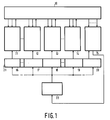
- Fig. 1 shows a general block diagram of a central processing unit for a very long instruction word (VLIW) computer architecture.
- the central processing unit of Fig. 1 comprises a multiport register file 10 used to communicate between a plurality of processor functional units 11 through 15.
- Register-file 10 is a universal access interconnection device for units 11-15 having storage capability for storing values between machine cycles.
- Such register files are well-known in the art, one being shown by S. Borkar et al in "iWarp: Integrated Solution to High Speed Parallel Computing", IEEE Proceedings on Supercomputing , pages 330-339, 1988 (IEEE Catalog #88CH2617-9).
- a Very Long Instruction Word instruction register 21 provides control fields to control the operation of each of functional units 11-15.
- the instructions placed in instruction register 21 are derived from an instruction issue pipeline 22.
- the functional units 11-15 comprise a plurality N of arithmetic and logic units (ALUs) 11, ... 12.
- the number of such ALUs is determined by the amount of parallelism which can be accommodated by the particular application but is typically on the order of between two and eight.
- a control field for each of the N ALUs is contained in each instruction in instruction register 21.
- control field 16 controls ALU 11
- control field 17 controls ALU 12.
- Each of ALUs 11-12 comprise standard and well-known circuits for performing a plurality of different arithmetic and logical operations on operands supplied to the ALU from register file 10. Since the structure and operation of such ALUs are well known and form no part of the present invention, they will not be further described here.
- DMI data memory interface
- a control field for each of the K DMI circuits is contained in each instruction in instruction register 21.
- control field 18 controls data memory interface 13
- control field 19 controls DMI 14.
- DMIs 13-14 represent access ports to random access memory (RAM) units used to store data outside of the central processor of Fig. 1.
- Each of DMIs 13-14 may interface with a different data RAM, each may interface with a different port of a single data RAM, or the DMIs 13-14 may share access to single or multiple RAMs in common with the instruction issue pipeline 22.
- Each of these RAM memories can comprise a complex, high performance computer memory system organization using well-known memory techniques such as multi-banking, interleaving, etc., none of which are part of this invention. All that is necessary is that each instruction in instruction register 21 may contain up to K operations which reference a data memory for storing or accessing data. The operation of such data memory interfaces will be described in detail below in connection with Figs. 6 and 7.
- Branch control unit 15 responds to jump operations in the jump control field 20 of the instruction in instruction register 21. Jump operations contained in the jump control field 20 of a VLIW instruction are sent to branch control unit 15 where they are used, as will be described below in connection with Fig. 5, to control conditional branching to alternative paths of instructions in the program executing in the central processor of Fig. 1. To this end, branch control unit 15 generates the address entered into instruction issue pipeline 22 by determining which of a plurality of alternative instruction paths the central processor of Fig. 1 will follow, as determined by the conditions expressed in a conditional jump operation. Branch control unit 15 will be described in detail below in connection with Fig. 5.
- the central processing unit of Fig. 1 is a very long instruction word (VLIW) processor because it includes a plurality of functional units 11-15, all of which are simultaneously controlled by the contents of a single instruction register 21. This has a plurality of fields 16-20 corresponding to and controlling the actions of unit 11-15, respectively.
- the multiport register file 10 permits interactions between the units 11-15 and provides buffer storage for operand values when necessary. If no operation can be scheduled for a particular functional unit 11-15 during a particular machine cycle, a NOP (no operation) code is entered in the control field for that functional unit.
- VLIW processor architectures such as that shown in Fig. 1 are programmed by compilers which generate the very long instruction words in such a manner as to optimize the overall throughput of the computer.
- compilers which generate the very long instruction words in such a manner as to optimize the overall throughput of the computer.
- Such prior art includes "An Efficient Algorithm for Exploiting Multiple Arithmetic Units", by R.M. Tomasulo, IBM Journal of Research and Development , Vol. 11, pp. 25-33, January 1967.
- conditional branch delay inherent in such architectures. If a condition (say a > b ) is to determine the choice between two paths in a program, such as STATEMENT1 and STATEMENT2, the central processing unit must execute a conditional jump to the stored code for STATEMENT1 or STATEMENT2. Inherently, such a jump involves two delays in series, 1) evaluating the condition a > b ) and, once the outcome of the decision is known, 2) sending the instruction address of STATEMENT1 or STATEMENT2 into the instruction issue pipeline 22, where a certain instruction issue latency is incurred. Modern integrating chip implementations evaluate the conditions very quickly.
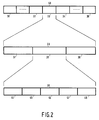
- the PATH EXPRESSION subfield 45 of Fig. 2 specifies the path or paths on which this jump operation should be enabled. That is, the jump operation will be executed and the jump specified will actually take place only when the OPCODE condition is met and the PATH EXPRESSION field 45 matches the path information to be described in connection with Fig. 5. If none of the three jump operations in fields 37-39 has both conditions fulfilled, no jump occurs and the next sequential instruction is executed. Thus, each branching operation which specifies j explicit branch destinations actually determines a (j+1)-way branch, where the extra destination is the next sequential instruction.
- VLIW instruction word organization shown in Figs. 2-4 as well as the VLIW architecture shown in Fig. 1, have been chosen to illustrate the present invention because they are simple and readily understood.
- alternative organizations are possible, such as sharing fields between ALU operations and DMI operations and adding different types of functional units such as barrel shifters and multiplier units.
- Such alternative organizations are just as readily adaptable to the use of the present invention, but would unduly complicate this description.
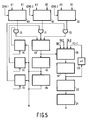
- Fig. 5 is a detailed block diagram of the branch control unit 15 of Fig. 1. It performs all of the control functions necessary to execute a conditional jump operation such as that shown in Fig. 2. It is assumed, for the purposes of simplicity, that the same four-way branches of Fig. 2 are accommodated and that the "branch delay" is again two machine cycles.
- the coded conditions are applied to the comparators 60-62 to select the appropriate comparisons for this particular conditional branch path.
- the results of all three comparisons are fed through AND gates 70, 71 and 72, respectively, to priority encoder circuit 63.
- AND gates 70-12 combine the result of the jump condition evaluation with the outcome of the path information match, to be discussed below.
- a TRUE output on one (or more) of the gates 70-72 results in a jump being taken. It would be possible to design the compiler such that the three jump conditions are always mutually exclusive. In the present embodiment, however, the jump conditions are not mutually exclusive, and priority encoder 63 chooses the highest priority jump.
- Encoder 63 generates a 2-bit output signal which instructs the multiplexer 66 to connect the appropriate input to the program counter register 67.
- the new value loaded into the program counter 67 is the desired result.
- the highest priority jump whose conditions evaluate true, and whose path information matches, has its address latched in the program counter register 67. If none of the jumps satisfy the comparison condition, program counter 67 is loaded with the next sequential address.
- the output of program counter 67 is applied to the instruction issue pipeline 22 (also shown in Fig. 1) and, after the two cycle latency period, results in the appropriate instruction being loaded into instruction register 21.
- Element 22 is pipelined in the sense that an address can be sent into element 22 every cycle, and the corresponding instruction comes out of the combination of elements 22 and 23 after a latency of two cycles.
- the instruction issue pipeline 22 can be a specialized instruction-only memory consisting of higher Read Only Memory (ROM) or Random Access Memory (RAM) components, or it can be another port to a memory system shared in common with ports used in data memory interfaces 13-14 of Fig. 1.
- the "EQUALS" comparators 73-75 implement the matching operation according to the first embodiment of the present invention (where an operation is allowed to specify a path expression code for a single program path) for the three jump control operations of Fig. 2.
- the equality comparators 73-75 will produce a TRUE output if (and only if) the path information output of registers 64 and 65 matches the path expression field 45 (Fig. 2) of the corresponding jump control subfield.
- the circuit consisting of equality comparators can be modified to handle matching according to the second embodiment of the present invention (where an operation can specify a set of paths on which it should be executed) by using three 16-to-1 multiplexers instead of the comparators 73-75, as described below with reference to Fig. 7.
- the branch control unit of Fig. 5 performs all of the necessary comparisons to determine the outcome of every conditional jump operation and to encode the result of such comparisons as path information. At the same time, the branch control unit generates appropriate addresses in the program counter to permit access to the appropriate "next" instruction following a conditional jump operation.
- the mechanism for ensuring the execution of operations in exactly one of the program branch paths will be described in connection with Figs. 6 and 7. The mechanism, however, is similar to that of Fig. 5 for conditioning the execution of the conditional jump operation itself.
- conditional branch operations may directly follow each other in successive instruction cycles of the program, either as a result of failure to jump or as a result of a jump actually taking place. If conditional jump operations do follow each other in successive instruction cycles, the possible number of destinations after the two instruction cycle branch delay is the product of the number of possible destinations in the first conditional jump operation multiplied by the number of possible destinations in the second conditional jump operation.
- the path information from registers 64 and 65 encodes all of these possibilities since this path information represents the results of jump outcomes of the two most recent instructions.
- the path information from the branch control unit of Fig. 5 is used to condition the execution of operations in all of the possible paths which might be selected by the jump operations. It is only necessary, however, to condition the execution of operations which produce a result visible to the programmer.
- Memory storage operations such as that shown in Fig. 4, are the most obvious ones of such operations and hence each such memory store operation includes a path expression field (subfield 122 in Fig. 4).
- Other conditional jump operations can also affect the programmer-visible state of the computations and hence also include a path expression subfield 45, as shown in Fig. 2.
- exception raising operations such as arithmetic overflow, which may also change the program control flow.
- the ALU operations include a path expression subfield 53 to permit path selection, as shown in Fig. 3.
- the path information code is used to enable only those operations which correspond to the program path selected by conditional jump operations that have issued but whose effect has not yet passed through the instruction issue pipeline.
- Fig. 6 is a graphical representation of the memory access circuitry of data memory interfaces 13-14 of Fig. 1.
- write operations executed on the data memory interfaces 13-14 of Fig. 1 are capable of modifying the state of the system which is visible to the programmer. The execution of these write operations must therefore be enabled (or disabled) by path information collected from the previous two machine cycles.
- Fig. 6 shows the fields 121-124 of instructions in instruction register 21 associated with a data memory interface functional unit such as units 13-14 of Fig. 1.
- Fig. 6 the port to an actual RAM memory is shown as data memory 87.
- An address is supplied to memory 87 by way of leads 91 while data is supplied to or taken from memory 87 at the top of the box 87.
- a control input on line 89 determines whether a read operation is to take place from the memory or a write operation to the memory.
- the path information from Fig. 5 is supplied on leads 88 to an equality compare circuit 86. Also supplied to equality circuit 86 is the content of the path expression subfield 122 of the memory control operation in instruction register 21. If the content of the path expression field is equal to the path information, then a memory write operation is to be enabled.
- control logic circuit 81 the output of compare circuit 86 is applied to one input of control logic circuit 81, the other input of which is the operation code from field 121 of the memory control operation in instruction register 21.
- One output of control logic circuit 81 is the read or write enable signal on lead 89.
- Control logic circuit 81 also supplies a control signal on lead 90 which controls the direction of data movement to the multiport register file 10. The details of the control logic circuit 81 depend on the timing requirements for the control signals on leads 90 and 91 and hence are not shown in Fig. 6.
- FIG. 6 can be expanded to utilize other memory addressing techniques.
- the operation of the circuit of Fig. 6 is such that memory write operations (and, if desired, also memory read operations) are conditioned by the match of the path expression field 122 of the read or write operation and the path information supplied from the branch control unit of Fig. 5 on leads 88.
- Fig. 7 shows the same circuitry as that of Fig. 6 except that the equality comparator 86 has been replaced by a multiplexer 94.
- the pathset field 122 is a sixteen bit field that can specify an arbitrary subset of paths on which the memory operation should be enabled. The circuit operates to accomplish this result by the multiplexer 94 connecting one of sixteen inputs from the pathset field 122 to the output of multiplexer 94, depending on the code on path information leads 88. The presence of a "1" bit at the particular location in the pathset field 122 will determine whether or not the operation is enabled for that particular pathset code. By selectively setting the bits of the pathset code, any subset of all possible active paths (including the empty subset and the full set) can be chosen.
- an operation scheduled in cycle i can be conditioned to execute only if the jump in cycle ( i -2) went in direction "1" (binary "01") and the jump in cycle ( i -1) went in direction "3" (binary "11") by assigning it the binary path expression value "0111” (the binary code for direction "1” followed by the binary code for direction "3").
Landscapes
- Engineering & Computer Science (AREA)
- Theoretical Computer Science (AREA)
- Software Systems (AREA)
- Physics & Mathematics (AREA)
- General Physics & Mathematics (AREA)
- General Engineering & Computer Science (AREA)
- Microelectronics & Electronic Packaging (AREA)
- Advance Control (AREA)
- Multi Processors (AREA)
Applications Claiming Priority (2)
| Application Number | Priority Date | Filing Date | Title |
|---|---|---|---|
| US57897690A | 1990-09-05 | 1990-09-05 | |
| US578976 | 1990-09-05 |
Publications (3)
| Publication Number | Publication Date |
|---|---|
| EP0474297A2 true EP0474297A2 (de) | 1992-03-11 |
| EP0474297A3 EP0474297A3 (en) | 1993-09-01 |
| EP0474297B1 EP0474297B1 (de) | 1998-06-10 |
Family
ID=24315095
Family Applications (1)
| Application Number | Title | Priority Date | Filing Date |
|---|---|---|---|
| EP91202217A Expired - Lifetime EP0474297B1 (de) | 1990-09-05 | 1991-09-02 | Maschine mit sehr langem Befehlswort für leistungsfähige Durchführung von Programmen mit bedingten Verzweigungen |
Country Status (5)
| Country | Link |
|---|---|
| US (1) | US5450556A (de) |
| EP (1) | EP0474297B1 (de) |
| JP (1) | JP3098071B2 (de) |
| KR (1) | KR100242617B1 (de) |
| DE (1) | DE69129569T2 (de) |
Cited By (9)
| Publication number | Priority date | Publication date | Assignee | Title |
|---|---|---|---|---|
| WO1998037485A1 (en) * | 1997-02-21 | 1998-08-27 | Richard Byron Wilmot | Method and apparatus for forwarding of operands in a computer system |
| US5924128A (en) * | 1996-06-20 | 1999-07-13 | International Business Machines Corporation | Pseudo zero cycle address generator and fast memory access |
| GB2343270A (en) * | 1998-07-17 | 2000-05-03 | Sun Microsystems Inc | Branch instruction processing in a processor |
| US6076157A (en) * | 1997-10-23 | 2000-06-13 | International Business Machines Corporation | Method and apparatus to force a thread switch in a multithreaded processor |
| US6105051A (en) * | 1997-10-23 | 2000-08-15 | International Business Machines Corporation | Apparatus and method to guarantee forward progress in execution of threads in a multithreaded processor |
| US6212544B1 (en) | 1997-10-23 | 2001-04-03 | International Business Machines Corporation | Altering thread priorities in a multithreaded processor |
| US6314493B1 (en) | 1998-02-03 | 2001-11-06 | International Business Machines Corporation | Branch history cache |
| US6567839B1 (en) | 1997-10-23 | 2003-05-20 | International Business Machines Corporation | Thread switch control in a multithreaded processor system |
| US6697935B1 (en) | 1997-10-23 | 2004-02-24 | International Business Machines Corporation | Method and apparatus for selecting thread switch events in a multithreaded processor |
Families Citing this family (40)
| Publication number | Priority date | Publication date | Assignee | Title |
|---|---|---|---|---|
| US6370623B1 (en) * | 1988-12-28 | 2002-04-09 | Philips Electronics North America Corporation | Multiport register file to accommodate data of differing lengths |
| US5832202A (en) * | 1988-12-28 | 1998-11-03 | U.S. Philips Corporation | Exception recovery in a data processing system |
| JPH05233281A (ja) * | 1992-02-21 | 1993-09-10 | Toshiba Corp | 電子計算機 |
| US5721854A (en) * | 1993-11-02 | 1998-02-24 | International Business Machines Corporation | Method and apparatus for dynamic conversion of computer instructions |
| JP3212213B2 (ja) * | 1994-03-16 | 2001-09-25 | 株式会社日立製作所 | データ処理装置 |
| JP3547482B2 (ja) * | 1994-04-15 | 2004-07-28 | 株式会社日立製作所 | 情報処理装置 |
| US5581776A (en) * | 1995-02-03 | 1996-12-03 | Nokia Mobile Phones Limited | Branch control system for rom-programmed processor |
| KR100325658B1 (ko) * | 1995-03-17 | 2002-08-08 | 가부시끼가이샤 히다치 세이사꾸쇼 | 프로세서 |
| US5699536A (en) * | 1995-04-13 | 1997-12-16 | International Business Machines Corporation | Computer processing system employing dynamic instruction formatting |
| US5815701A (en) * | 1995-06-29 | 1998-09-29 | Philips Electronics North America Corporation | Computer method and apparatus which maintains context switching speed with a large number of registers and which improves interrupt processing time |
| KR100445542B1 (ko) * | 1995-09-01 | 2004-11-20 | 필립스 일렉트로닉스 노쓰 아메리카 코포레이션 | 프로세서의커스텀오퍼레이션들을위한방법및장치 |
| US5774737A (en) * | 1995-10-13 | 1998-06-30 | Matsushita Electric Industrial Co., Ltd. | Variable word length very long instruction word instruction processor with word length register or instruction number register |
| JP3442225B2 (ja) * | 1996-07-11 | 2003-09-02 | 株式会社日立製作所 | 演算処理装置 |
| US5742804A (en) * | 1996-07-24 | 1998-04-21 | Institute For The Development Of Emerging Architectures, L.L.C. | Instruction prefetch mechanism utilizing a branch predict instruction |
| US6055628A (en) * | 1997-01-24 | 2000-04-25 | Texas Instruments Incorporated | Microprocessor with a nestable delayed branch instruction without branch related pipeline interlocks |
| US6374346B1 (en) | 1997-01-24 | 2002-04-16 | Texas Instruments Incorporated | Processor with conditional execution of every instruction |
| JP3412462B2 (ja) * | 1997-07-30 | 2003-06-03 | 松下電器産業株式会社 | プロセッサ |
| US6170051B1 (en) | 1997-08-01 | 2001-01-02 | Micron Technology, Inc. | Apparatus and method for program level parallelism in a VLIW processor |
| US7272703B2 (en) * | 1997-08-01 | 2007-09-18 | Micron Technology, Inc. | Program controlled embedded-DRAM-DSP architecture and methods |
| US5974537A (en) * | 1997-12-29 | 1999-10-26 | Philips Electronics North America Corporation | Guard bits in a VLIW instruction control routing of operations to functional units allowing two issue slots to specify the same functional unit |
| US6112299A (en) * | 1997-12-31 | 2000-08-29 | International Business Machines Corporation | Method and apparatus to select the next instruction in a superscalar or a very long instruction word computer having N-way branching |
| US6216223B1 (en) | 1998-01-12 | 2001-04-10 | Billions Of Operations Per Second, Inc. | Methods and apparatus to dynamically reconfigure the instruction pipeline of an indirect very long instruction word scalable processor |
| US6076154A (en) * | 1998-01-16 | 2000-06-13 | U.S. Philips Corporation | VLIW processor has different functional units operating on commands of different widths |
| US6366999B1 (en) * | 1998-01-28 | 2002-04-02 | Bops, Inc. | Methods and apparatus to support conditional execution in a VLIW-based array processor with subword execution |
| US6178495B1 (en) * | 1998-04-30 | 2001-01-23 | International Business Machines Corporation | Processor E-unit to I-unit interface instruction modification with E-unit opcode computer logic in the unit |
| US6453407B1 (en) | 1999-02-10 | 2002-09-17 | Infineon Technologies Ag | Configurable long instruction word architecture and instruction set |
| US6405300B1 (en) * | 1999-03-22 | 2002-06-11 | Sun Microsystems, Inc. | Combining results of selectively executed remaining sub-instructions with that of emulated sub-instruction causing exception in VLIW processor |
| US6654870B1 (en) * | 1999-06-21 | 2003-11-25 | Pts Corporation | Methods and apparatus for establishing port priority functions in a VLIW processor |
| US7007156B2 (en) * | 2000-12-28 | 2006-02-28 | Intel Corporation | Multiple coprocessor architecture to process a plurality of subtasks in parallel |
| AU2002329475A1 (en) * | 2001-10-12 | 2003-04-28 | Pts Corporation | Late resolving instructions |
| US7200738B2 (en) | 2002-04-18 | 2007-04-03 | Micron Technology, Inc. | Reducing data hazards in pipelined processors to provide high processor utilization |
| JP4283131B2 (ja) * | 2004-02-12 | 2009-06-24 | パナソニック株式会社 | プロセッサ及びコンパイル方法 |
| EP1751655A2 (de) * | 2004-05-13 | 2007-02-14 | Koninklijke Philips Electronics N.V. | Laufzeitauswahl von rückkopplungsverbindungen in einem mehrfachanweisungs-wort-prozessor |
| US8190669B1 (en) | 2004-10-20 | 2012-05-29 | Nvidia Corporation | Multipurpose arithmetic functional unit |
| US8037119B1 (en) | 2006-02-21 | 2011-10-11 | Nvidia Corporation | Multipurpose functional unit with single-precision and double-precision operations |
| JP2007272353A (ja) * | 2006-03-30 | 2007-10-18 | Nec Electronics Corp | プロセッサ装置及び複合条件処理方法 |
| US8051123B1 (en) | 2006-12-15 | 2011-11-01 | Nvidia Corporation | Multipurpose functional unit with double-precision and filtering operations |
| US8106914B2 (en) * | 2007-12-07 | 2012-01-31 | Nvidia Corporation | Fused multiply-add functional unit |
| US7818552B2 (en) * | 2007-12-20 | 2010-10-19 | The United States Of America As Represented By The Secretary Of The Army | Operation, compare, branch VLIW processor |
| US9928074B2 (en) * | 2013-09-06 | 2018-03-27 | Huawei Technologies Co., Ltd. | System and method for an asynchronous processor with token-based very long instruction word architecture |
Family Cites Families (11)
| Publication number | Priority date | Publication date | Assignee | Title |
|---|---|---|---|---|
| US3611306A (en) * | 1969-02-05 | 1971-10-05 | Burroughs Corp | Mechanism to control the sequencing of partially ordered instructions in a parallel data processing system |
| US3781814A (en) * | 1971-10-07 | 1973-12-25 | Raytheon Co | Method and apparatus for applying source language statements to a digital computer |
| US4920538A (en) * | 1985-06-28 | 1990-04-24 | International Business Machines Corporation | Method of checking the execution of microcode sequences |
| US5179680A (en) * | 1987-04-20 | 1993-01-12 | Digital Equipment Corporation | Instruction storage and cache miss recovery in a high speed multiprocessing parallel processing apparatus |
| US4833599A (en) * | 1987-04-20 | 1989-05-23 | Multiflow Computer, Inc. | Hierarchical priority branch handling for parallel execution in a parallel processor |
| US4943912A (en) * | 1987-10-13 | 1990-07-24 | Hitachi, Ltd. | Parallel processor system having control processor and array control apparatus for selectively activating different processors |
| US5050068A (en) * | 1988-10-03 | 1991-09-17 | Duke University | Method and apparatus for using extracted program flow information to prepare for execution multiple instruction streams |
| US5313551A (en) * | 1988-12-28 | 1994-05-17 | North American Philips Corporation | Multiport memory bypass under software control |
| US5127092A (en) * | 1989-06-15 | 1992-06-30 | North American Philips Corp. | Apparatus and method for collective branching in a multiple instruction stream multiprocessor where any of the parallel processors is scheduled to evaluate the branching condition |
| US5203002A (en) * | 1989-12-27 | 1993-04-13 | Wetzel Glen F | System with a multiport memory and N processing units for concurrently/individually executing 2N-multi-instruction-words at first/second transitions of a single clock cycle |
| CA2038264C (en) * | 1990-06-26 | 1995-06-27 | Richard James Eickemeyer | In-memory preprocessor for a scalable compound instruction set machine processor |
-
1991
- 1991-09-02 EP EP91202217A patent/EP0474297B1/de not_active Expired - Lifetime
- 1991-09-02 DE DE69129569T patent/DE69129569T2/de not_active Expired - Lifetime
- 1991-09-05 JP JP03226149A patent/JP3098071B2/ja not_active Expired - Lifetime
- 1991-09-05 KR KR1019910015485A patent/KR100242617B1/ko not_active Expired - Lifetime
-
1993
- 1993-10-25 US US08/142,648 patent/US5450556A/en not_active Expired - Lifetime
Cited By (13)
| Publication number | Priority date | Publication date | Assignee | Title |
|---|---|---|---|---|
| US5924128A (en) * | 1996-06-20 | 1999-07-13 | International Business Machines Corporation | Pseudo zero cycle address generator and fast memory access |
| WO1998037485A1 (en) * | 1997-02-21 | 1998-08-27 | Richard Byron Wilmot | Method and apparatus for forwarding of operands in a computer system |
| GB2337142A (en) * | 1997-02-21 | 1999-11-10 | Richard Byron Wilmot | Method and apparatus for forwarding of operands in a computer system |
| GB2337142B (en) * | 1997-02-21 | 2002-04-17 | Richard Byron Wilmot | Method and apparatus for forwarding of operands in a computer system |
| US6697935B1 (en) | 1997-10-23 | 2004-02-24 | International Business Machines Corporation | Method and apparatus for selecting thread switch events in a multithreaded processor |
| US6076157A (en) * | 1997-10-23 | 2000-06-13 | International Business Machines Corporation | Method and apparatus to force a thread switch in a multithreaded processor |
| US6105051A (en) * | 1997-10-23 | 2000-08-15 | International Business Machines Corporation | Apparatus and method to guarantee forward progress in execution of threads in a multithreaded processor |
| US6212544B1 (en) | 1997-10-23 | 2001-04-03 | International Business Machines Corporation | Altering thread priorities in a multithreaded processor |
| US6567839B1 (en) | 1997-10-23 | 2003-05-20 | International Business Machines Corporation | Thread switch control in a multithreaded processor system |
| US6314493B1 (en) | 1998-02-03 | 2001-11-06 | International Business Machines Corporation | Branch history cache |
| US6260138B1 (en) | 1998-07-17 | 2001-07-10 | Sun Microsystems, Inc. | Method and apparatus for branch instruction processing in a processor |
| GB2343270B (en) * | 1998-07-17 | 2001-05-30 | Sun Microsystems Inc | Method and apparatus for branch instruction processing in a processor |
| GB2343270A (en) * | 1998-07-17 | 2000-05-03 | Sun Microsystems Inc | Branch instruction processing in a processor |
Also Published As
| Publication number | Publication date |
|---|---|
| EP0474297B1 (de) | 1998-06-10 |
| US5450556A (en) | 1995-09-12 |
| DE69129569D1 (de) | 1998-07-16 |
| JPH04245540A (ja) | 1992-09-02 |
| KR100242617B1 (ko) | 2000-08-01 |
| DE69129569T2 (de) | 1999-02-04 |
| KR920006845A (ko) | 1992-04-28 |
| JP3098071B2 (ja) | 2000-10-10 |
| EP0474297A3 (en) | 1993-09-01 |
Similar Documents
| Publication | Publication Date | Title |
|---|---|---|
| EP0474297B1 (de) | Maschine mit sehr langem Befehlswort für leistungsfähige Durchführung von Programmen mit bedingten Verzweigungen | |
| EP0450658B1 (de) | Parallelfliessband-Befehlsverarbeitungssystem für sehr lange Befehlswörter | |
| US5752074A (en) | Data processing system and method thereof | |
| US7028170B2 (en) | Processing architecture having a compare capability | |
| US5530817A (en) | Very large instruction word type computer for performing a data transfer between register files through a signal line path | |
| US5299321A (en) | Parallel processing device to operate with parallel execute instructions | |
| US5692139A (en) | VLIW processing device including improved memory for avoiding collisions without an excessive number of ports | |
| JPH06318155A (ja) | コンピュータシステム | |
| EP0479390A2 (de) | Verarbeitungsgerät mit Speicherschaltung und eine Gruppe von Funktionseinheiten | |
| KR100346515B1 (ko) | 수퍼파이프라인된수퍼스칼라프로세서를위한임시파이프라인레지스터파일 | |
| US4541045A (en) | Microprocessor architecture employing efficient operand and instruction addressing | |
| US7308559B2 (en) | Digital signal processor with cascaded SIMD organization | |
| WO1992009968A1 (en) | VECTOR WORD SHIFT BY Vo SHIFT COUNT IN VECTOR SUPERCOMPUTER PROCESSOR | |
| US5771377A (en) | System for speculatively executing instructions using multiple commit condition code storages with instructions selecting a particular storage | |
| JP2001500641A (ja) | 並列データプロセッサにおけるアクティブ命令を回転させる方法および装置 | |
| US6061367A (en) | Processor with pipelining structure and method for high-speed calculation with pipelining processors | |
| EP1261914B1 (de) | Datenverarbeitungsarchitektur mit bereichsprüfung für matrix | |
| US5274777A (en) | Digital data processor executing a conditional instruction within a single machine cycle | |
| EP0942359B1 (de) | Vorrichtung zur Ausführung von Programmbefehlen | |
| JPS60167028A (ja) | マルチデ−タ路のcpuア−キテクチヤ | |
| KR102704028B1 (ko) | True/false 벡터 인덱스 레지스터 | |
| US6023751A (en) | Computer system and method for evaluating predicates and Boolean expressions | |
| US5907693A (en) | Autonomously cycling data processing architecture | |
| WO2000068783A2 (en) | Digital signal processor computation core | |
| KR100431975B1 (ko) | 분기에의한중단이없는파이프라인방식의마이크로프로세서를위한다중명령디스패치시스템 |
Legal Events
| Date | Code | Title | Description |
|---|---|---|---|
| PUAI | Public reference made under article 153(3) epc to a published international application that has entered the european phase |
Free format text: ORIGINAL CODE: 0009012 |
|
| AK | Designated contracting states |
Kind code of ref document: A2 Designated state(s): DE FR GB |
|
| PUAL | Search report despatched |
Free format text: ORIGINAL CODE: 0009013 |
|
| AK | Designated contracting states |
Kind code of ref document: A3 Designated state(s): DE FR GB |
|
| 17P | Request for examination filed |
Effective date: 19940228 |
|
| 17Q | First examination report despatched |
Effective date: 19960913 |
|
| GRAG | Despatch of communication of intention to grant |
Free format text: ORIGINAL CODE: EPIDOS AGRA |
|
| GRAG | Despatch of communication of intention to grant |
Free format text: ORIGINAL CODE: EPIDOS AGRA |
|
| GRAH | Despatch of communication of intention to grant a patent |
Free format text: ORIGINAL CODE: EPIDOS IGRA |
|
| GRAH | Despatch of communication of intention to grant a patent |
Free format text: ORIGINAL CODE: EPIDOS IGRA |
|
| GRAA | (expected) grant |
Free format text: ORIGINAL CODE: 0009210 |
|
| AK | Designated contracting states |
Kind code of ref document: B1 Designated state(s): DE FR GB |
|
| REF | Corresponds to: |
Ref document number: 69129569 Country of ref document: DE Date of ref document: 19980716 |
|
| RAP4 | Party data changed (patent owner data changed or rights of a patent transferred) |
Owner name: KONINKLIJKE PHILIPS ELECTRONICS N.V. |
|
| ET | Fr: translation filed | ||
| PLBE | No opposition filed within time limit |
Free format text: ORIGINAL CODE: 0009261 |
|
| STAA | Information on the status of an ep patent application or granted ep patent |
Free format text: STATUS: NO OPPOSITION FILED WITHIN TIME LIMIT |
|
| 26N | No opposition filed | ||
| REG | Reference to a national code |
Ref country code: GB Ref legal event code: 732E |
|
| REG | Reference to a national code |
Ref country code: FR Ref legal event code: TP Ref country code: FR Ref legal event code: CD |
|
| REG | Reference to a national code |
Ref country code: GB Ref legal event code: IF02 |
|
| REG | Reference to a national code |
Ref country code: GB Ref legal event code: 732E |
|
| REG | Reference to a national code |
Ref country code: GB Ref legal event code: 732E |
|
| REG | Reference to a national code |
Ref country code: FR Ref legal event code: TP |
|
| PGFP | Annual fee paid to national office [announced via postgrant information from national office to epo] |
Ref country code: FR Payment date: 20100921 Year of fee payment: 20 |
|
| PGFP | Annual fee paid to national office [announced via postgrant information from national office to epo] |
Ref country code: GB Payment date: 20100901 Year of fee payment: 20 |
|
| PGFP | Annual fee paid to national office [announced via postgrant information from national office to epo] |
Ref country code: DE Payment date: 20100825 Year of fee payment: 20 |
|
| REG | Reference to a national code |
Ref country code: DE Ref legal event code: R071 Ref document number: 69129569 Country of ref document: DE |
|
| REG | Reference to a national code |
Ref country code: DE Ref legal event code: R071 Ref document number: 69129569 Country of ref document: DE |
|
| REG | Reference to a national code |
Ref country code: GB Ref legal event code: PE20 Expiry date: 20110901 |
|
| PG25 | Lapsed in a contracting state [announced via postgrant information from national office to epo] |
Ref country code: GB Free format text: LAPSE BECAUSE OF EXPIRATION OF PROTECTION Effective date: 20110901 |
|
| PG25 | Lapsed in a contracting state [announced via postgrant information from national office to epo] |
Ref country code: DE Free format text: LAPSE BECAUSE OF EXPIRATION OF PROTECTION Effective date: 20110903 |