EP0474316A2 - Alimentation pour une source lumineuse alimentée en hyperfréquences - Google Patents
Alimentation pour une source lumineuse alimentée en hyperfréquences Download PDFInfo
- Publication number
- EP0474316A2 EP0474316A2 EP91202578A EP91202578A EP0474316A2 EP 0474316 A2 EP0474316 A2 EP 0474316A2 EP 91202578 A EP91202578 A EP 91202578A EP 91202578 A EP91202578 A EP 91202578A EP 0474316 A2 EP0474316 A2 EP 0474316A2
- Authority
- EP
- European Patent Office
- Prior art keywords
- voltage
- magnetron
- circuit
- transformer
- coupled
- Prior art date
- Legal status (The legal status is an assumption and is not a legal conclusion. Google has not performed a legal analysis and makes no representation as to the accuracy of the status listed.)
- Granted
Links
Images






Classifications
-
- H—ELECTRICITY
- H01—ELECTRIC ELEMENTS
- H01J—ELECTRIC DISCHARGE TUBES OR DISCHARGE LAMPS
- H01J65/00—Lamps without any electrode inside the vessel; Lamps with at least one main electrode outside the vessel
- H01J65/04—Lamps in which a gas filling is excited to luminesce by an external electromagnetic field or by external corpuscular radiation, e.g. for indicating plasma display panels
-
- H—ELECTRICITY
- H01—ELECTRIC ELEMENTS
- H01J—ELECTRIC DISCHARGE TUBES OR DISCHARGE LAMPS
- H01J65/00—Lamps without any electrode inside the vessel; Lamps with at least one main electrode outside the vessel
- H01J65/04—Lamps in which a gas filling is excited to luminesce by an external electromagnetic field or by external corpuscular radiation, e.g. for indicating plasma display panels
- H01J65/042—Lamps in which a gas filling is excited to luminesce by an external electromagnetic field or by external corpuscular radiation, e.g. for indicating plasma display panels by an external electromagnetic field
- H01J65/044—Lamps in which a gas filling is excited to luminesce by an external electromagnetic field or by external corpuscular radiation, e.g. for indicating plasma display panels by an external electromagnetic field the field being produced by a separate microwave unit
-
- H—ELECTRICITY
- H05—ELECTRIC TECHNIQUES NOT OTHERWISE PROVIDED FOR
- H05B—ELECTRIC HEATING; ELECTRIC LIGHT SOURCES NOT OTHERWISE PROVIDED FOR; CIRCUIT ARRANGEMENTS FOR ELECTRIC LIGHT SOURCES, IN GENERAL
- H05B41/00—Circuit arrangements or apparatus for igniting or operating discharge lamps
- H05B41/14—Circuit arrangements
- H05B41/24—Circuit arrangements in which the lamp is fed by high frequency AC, or with separate oscillator frequency
Definitions
- the present invention relates to a microwave generating system including a magnetron and a power supply circuit therefor, which is adapted to supply microwave energy to a microwave discharge light source, including an electrodeless bulb.
- Fig. 1 a shows one of such microwave discharge light source apparatus disclosed in Japanese Laid-Open Patent Application 56-126250; Fig. 1 shows a modification thereof disclosed in Japanese Laid-Open Patent Application 57-55091.
- a magnetron 1 having an antenna 1 a is disposed at the end of a waveguide 2 having ventilating holes 2a which supplies the microwave generated by the magnetron 1 to a resonance cavity 3 through a microwave supply port 3a;
- the cavity 3 is formed by a paraboloidal wall 3b having a light reflecting rotationally symmetric inner surface and a metallic mesh 3c forming the front face of the cavity 3, which opaque to microwave but transparent to light.
- the apparatuses further comprise a fan 5 at the end wall of the housing 6 for cooling the magnetron 1 and the bulb 4.
- Microwave discharge light source apparatuses similar to those described above are also disclosed in U.S. Patent Nos. 4,498,029 and 4,673,846, both issued to Yoshizawa et al.
- the first of these U.S. Patents teach an apparatus in which the bulb is sufficiently small to act substantially as a point light source; the second teach an apparatus in which the wall surface of the microwave resonance cavity having the electrodeless bulb disposed therein is mostly constituted by a mesh, wherein the wires constituting the mesh are electrically connected each other without any contact resistance.
- a conventional power supply circuit for a magnetron is disclosed in Japanese Laid-Open Utility Model Application 56-162899, or in the first of the above mentioned U.S. Patents, according to which a commercial voltage source at 50 to 60 Hz is coupled to a step-up transformer, and the resulting stepped-up high- voltage AC current is rectified by a full-wave rectifier circuit to obtain pulsing unidirectional current which is supplied to the magnetron.
- the rectification is effected by a full-wave rectifier circuit
- the resulting high voltage rectified current pulsates at 100 to 120 Hz; consequently, the magnetron generates a microwave pulsing at 100 to 120 Hz.
- the discharge in the bulb 4 is caused by the microwave pulsing at 100 to 120 Hz.
- the disadvantage of this type of conventional power supply circuit is as follows. First, as the commercial AC voltage of relatively low frequency, i.e., 50 to 60 Hz, is directly supplied to the primary winding of the step-up transformer to obtain a high voltage needed to supply the magnetron, the transformer should be provided with a heavy iron core; the weight of the transformer is equal to or greater than 10 kg when the input power to the magnetron is 1.5 kW.
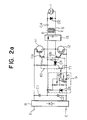
- Fig. 2a shows an inverter type power supply circuit for a magnetron taught in Japanese Patent Publication 60-189889, wherein the magnetron 1 is supplied by the circuit as described in what follows.
- a rectifier circuit 8 is coupled across the lines of a commercial AC voltage source E; a pair of series-connected capacitors C1 and C2 are coupled across the output terminals of the rectifier circuit 8 to obtain a substantially constant voltage DC power.
- An oscillator circuit 9 which comprises a Zener diode Zn, a capacitor C3, a plurality of resistors, and an amplifier A, is coupled across the capacitor C2 to output a rectangular waveform signal having a frequency substantially higher than that of the commercial AC voltage source E to a control circuit 10 comprising a transistor T1, a diode D1, and a plurality of resistors; the frequency of the rectangular waveform signal of the oscillator circuit 9 is determined by the values of the resistors and the capacitor C3 thereof.
- the control circuit 10 controls the alternate switching actions of a switching circuit comprising the power transistors 11 and 12 and the controlling transistors 11 a and 12a therefor.
- the circuit 10 alternately turns on and off the power transistors 11 and 12 in response to the output signal of the oscillator circuit 9.
- a high frequency rectangular waveform AC current is supplied to the primary winding P of the transformer T through a filter circuit 13.
- the AC voltage induced in the secondary winding S of the transformer T is rectified by a voltage doubler rectifier circuit consisting of a capacitor C4 and a diode D2, and is supplied therefrom to the magnetron 1.
- the inverter type power supply for a magnetron as described above also suffers disadvantages. Namely, as the magnetron 1 constitutes a non-linear load, the output power and current thereof and the inverter current supplied to the step-up transformer become unstable when the voltage level of the voltage source E fluctuates; the over-current resulting therefrom may destroy the power transistors 11 and 12.
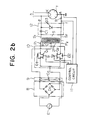
- Fig. 2b shows another inverter type power supply circuit for a magnetron taught in Japanese Laid-Open Patent Application 62-113395, wherein the magnetron 1 is supplied by the circuit as follows.
- a diode bridge rectifier circuit 8 comprising four diodes Do is coupled across the commercial AC voltage source E; a smoothing filter circuit 9 consisting of a capacitor Co is coupled across the output terminals of the rectifier circuit 8 to output a substantially constant DC voltage therefrom.
- the switching circuit 10 comprises switching transistors Q1 and Q2 and diodes D1 and D2 for reverse currents coupled across the source and the drain thereof, respectively, the transistors Q1 and Q2 being coupled across the negative output terminal of the filter circuit 9 and the terminals P1 and P2 of the primary winding P of the transformer T, respectively.
- the positive output terminal of the filter circuit 9 is coupled to the center tap 0 of the primary winding P of the transformer T.
- the gate terminals g1 and g2 of the transistors Q1 and Q2, respectively, is coupled to the center tap 0 of the primary winding P of the transformer T.
- the gate terminals g1 and g2 of the transistors Q1 and Q2, respectively, are coupled to the output terminals of a control circuit 11.
- the voltage doubler rectifier circuit 12 consisting of series-connected capacitor C1 and a diode D3 is coupled across the terminals S1 and S2 of the secondary winding S of the transformer T; the negative output terminal d of the rectifier circuit 12 is coupled to the cathode K of the magnetron 1, which is heated by a filament current supplied thereto from a commercial AC voltage source through an electrically insulating transformer (not shown) and the lines h; the positive output terminal f of the rectifier circuit 12, on the other hand, is coupled to the anode A of the magnetron 1 through a resistor R, the terminals of the resistor R being coupled to the input terminals of the control circuit 11.
- the control circuit 11 outputs pulses to the transistors Q1 and Q2 at a varying frequency centered around a fixed frequency, to alternately turn on and off the transistors Q1 and Q2.
- the current flows alternately from the center tap 0 to the terminal P1 and to the terminal P2 of the primary winding P of the transformer T to induce an AC voltage in the secondary winding S thereof, which is rectified by the rectifier circuit 12 and supplied therefrom to the magnetron 1.
- the pulse signals of the control circuit 11 at the fixed frequency are subjected to frequency modulation utilizing a modulating signal having a frequency which is lower than the frequency of the fixed frequency of the output pulse signals, to prevent flickering of the discharge in an electrodeless bulb such as those shown in Figs.
- the flickering of the discharge is caused by an acoustic resonance in the bulb due to the ripple or fluctuation of the microwave energy.
- the circuit 11 varies the length of time during which the transistors Q1 and Q2 are turned on, so that the output power of the magnetron is held constant irrespective of the fluctuation in the voltage source level; this can be effected by detecting the magnetron current by means of the voltage drop across the resistor R, thanks to the substantially constant voltage characteristic of the magnetron 1.
- the inverter type power supply circuit for a magnetron described just above is small-sized and is effective to a certain degree to prevent the flickering of the discharge arc of the electrodeless discharge bulb, thanks to the adoption of the high frequency inverter in the circuit.
- the flickering of the discharge arc may persist even in the apparatuses supplied by the circuit, depending on the kind and amount of the material encapsulated in the bulb and on the microwave energy level radiated into the bulb: the flickering of the arc is particularly manifest when a metal halide compound such as sodium iodide is encapsulated in the bulb in addition to mercury and a starter rare gas, or when the microwave energy supplied to the bulb is at a high level.
- the controlling circuit 11 thereof has a complicated structure, because the pulse signals thereof are subjected to frequency modulation and the length of the turning-on time of the switching is varied to maintain the output power of the mangetron 1 at a constant level.
- Japanese Laid-Open Patent Application 62-290098 teaches a microwave discharge light source apparatus including an inverter type power supply circuit for the magnetron, wherein the inverter frequency is set at a few tens kHz, for example, thereby maintaining parameters of the plasma in the bulb at a substantially constant level to prevent the flickering of the discharge in the bulb.
- an object of the present invention is to provide a power supply circuit including a magnetron adapted to supply microwave energy to a microwave discharge light source apparatus including an electrodeless discharge bulb, wherein the circuit is small in size and light in weight; more particularly, an object of the present invention is to reduce the size and weight of the step-up transformer comprised in the circuit.
- Another object of the present invention is to provide such power supply circuit including a magnetron which supplies microwave energy that is capable of sustaining stable discharge in the electrodeless bulb of the light source apparatus; namely, it is an object of the present invention to provide a power supply circuit which does not cause flickering in the discharge in the bulb and which is capable of sustaining the discharge in the bulb without any fear of extinguishment.
- a circuit system adapted to supply microwave energy to a microwave discharge light source apparatus including an electrodeless discharge bulb comprising:
- the power supply circuit for the magnetron 1 comprises a diode bridge full-wave rectifier circuit 2, the input terminals of which are coupled across a commercially available AC voltage source E, typically on the order of 100 to 220 volts RMS at 50 to 60 Hz.
- a voltage divider consisting of a pair of resistors R1 and R2 connected in series is coupled across the output terminals of the rectifier circuit 2.
- a capacitor C1 constituting a smoothing filter circuit is coupled across the output terminals of the rectifier circuit 2 to supply a substantially constant DC voltage therefrom.
- the input terminals of the inverter switching circuit comprising four MOSFETs (metal oxide semiconductor field effect transistors) Q1 through Q4 connected in bridge circuit relationship are coupled across the output terminals of the filter circuit, the capacitor C1; the output terminals of the switching circuit is coupled across the primary or input winding P of the step-up transformer T having a step-up ratio of 1 to n, a reactor L being inserted in series with the primary winding P.
- the inverter switching circuit further comprises four diodes D1 through D4 for reverse currents, which are coupled across the source and the drain terminal of the MOSFETs Q1 through Q4, respectively, the gate terminals of the MOSFETs being coupled to the output terminals of the PWM (pulse width modulation) control circuit 3.
- a voltage doubler half-wave rectifier circuit consisting of a capacitor C2 and a diode D5 connected in series is coupled across the secondary or output winding S of the transformer T; the output terminals of the rectifier circuit, i.e., the terminals across the diode D5, are coupled across the cathode K and the anode An of the magnetron 1 to supply a pulsating DC current I M g thereto.
- the output terminals of a current detector 4 for detecting the current flowing through the secondary winding S of the transformer T are coupled to the PWM control circuit 3 to output a voltage Vf corresponding to the current flowing through the secondary winding S.
- the control circuit 3 comprises a half-wave rectifier 3a rectifying the output Vf of the current detector 4, a smoothing filter 3b coupled to the output of the rectifier 3a to output a smoothed voltage Vf corresponding to the mean value of the voltage Vf;
- the error detector or subtractor 3d is coupled to the outputs of the filter 3b and a variable resistor 3c outputting a pre-set reference voltage Vr, and outputs the difference: between the reference Vr and the mean voltage Vr'.
- the amplifier 3e amplifies the error or the difference Ve by a factor A, and outputs an amplified error signal:
- the output terminal of the voltage devider consisting of the resistors R1 and R2 i.e., the terminal at the intermediate position between the two resistors R1 and R2, which outputs a voltage Vin corresponding to the output voltage Vo of the smoothing filter capacitor C1
- another amplifier 3g which amplifies the signal Vin by a factor of B to output a signal:
- the subtractor 3f coupled to the outputs of the amplifiers 3e and 3g outputs the difference to the modulator 3h.
- the modulator 3h outputs pulses Vw at a predetermined fixed frequency which is substantially higher than that of the AC voltage source E, the width of the pulses Vw being modulated, i.e., varied with respect to a predetermined fixed pulse width, in proportion to the value of the signal Vp.
- the driver circuit 3i coupled to the output of the modulator 3h outputs gate signals to the MOSFETs Q1 through Q4 of the inverter switching circuit in response to the signal Vw, and alternately turns on and off the MOSFETs Q1 and Q4 and the MOSFETs Q2 and Q3.
- high frequency AC current flows through the primary winding P of the transformer T to induce an AC voltage in the secondary winding S thereof, which is rectified and supplied to the magnetron 1 through the rectifier circuit consisting of the capacitor C2 and the diode D5.
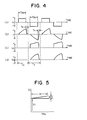
- the duration T ON of the positive voltage V1 i.e., the pulse width thereof corresponds to the pulse width of the gate signal outputted from the driver 3i and that of the signal Vw outputted from the PWM modulator 3h of the control circuit 3; the height of the pulse V1 is substantially equal to the output voltage Vo of the filtering capacitor C1. Due to the inductance of the reactor L connected in series with the primary winding P of the transformer T, the current ii flowing through the primary winding P in the direction shown by the arrow in Fig. 3a increases gradually from zero to a maximum during the time in which the voltage V1 is maintained at the positive level, as shown in Fig.
- the current ii in the primary winding P of the transformer persists during a short time Tx, due to the existance of the inductance of the reactor L connected in series with the primary winding P. During this short time period Tx, the current ii flows through the diodes D2 and D3 to charge the capacitor C1.
- the current induced in the secondary winding S of the transformer during this positive half-cycle Tp of the inverter has a polarity corresponding to the conducting direction of the diode D5; thus, no currents i M g flows through the magnetron 1 and the voltage V2 across the cathode K and the anode An of the magnetron 1 is equal to zero, as shown in Fig. 4 (c) and (d), the capacitor C2 being charged by the current induced in the secondary winding S during the positive half-cycle Tp.
- the operation of the power supply circuit during the negative half-cycle Tn of the inverter is as follows.
- the MOSFETs Q2 and Q3 are turned on by the control circuit 3; thus, the polarities of the output voltage V1 of the inverter switching circuit and the current ii flowing through the primary winding P of the transformer T are reversed, as shown in Fig. 4 (a) and (b).
- the operation of the circuit electrically coupled to the primary winding P of the transformer T during the negative half cycle Tn is similar to the operation thereof in the positive half-cycle Tp.
- the voltage induced in the secondary winding S by the current ii flowing through the primary winding P in the direction opposite to that shown by the arrow in Fig.
- the induced voltage in the secondary winding S is superposed on the voltage developed across the capacitor C2 which is already charged in the preceding positive half-cycle Tp; thus, as shown in Fig. 4(c), the voltage V2 applied across the magnetron 1 jumps to the voltage level to which the capacitor C2 has been charged in the previous half-cycle Tp, when the MOSFETs Q2 and Q3 are turned on and the output voltage V1 goes down from zero to a negative level as shown in Fig. 4(a).
- the voltage V2 applied across the mangetron 1 increases gradually during the time T ON in which the MOSFETs Q2 and Q3 are turned on and the output voltage V1 of the switching circuit is kept at the negative level, due to the gradual decrease of the voltage developed across the reactor L during the same time period T ON .
- the current i M g flowing through the magnetron 1 increases gradually from Zero to a maximum, as shown in Fig. 4(d) during the time T ON , due to the current-voltage characteristic of the magnetron 1. Namely, as shown in Fig.
- the voltage V2 across the magnetron 1 plotted along the ordinate is at a finite voltage level Vz when the magnetron current i M g plotted along the abscissa begins to flow through the magnetron 1.
- the magnetron voltage V2 increases linearly from this cut-off voltage Vz to a maximum Vz + AVz, as the magnetron current i M g increases from zero to i R , exhibiting the equivalent series resistance in the linear relationship range.
- the current ii in the primary winding P of the transformer T persists in the short length of time Tx due to the reactor L, during which the magnetron voltage V2 and the magnetron current i M g decreases and returns to the zero level at the end thereof, as shown in Fig. 4 (c) and (d).
- the output power of the magnetron 1 is held at a constant level by the modulation of the pulse width T ON of the gate signals applied to the MOSFETs Q1 through Q4 from the control circuit 3. Detailed explanation thereof is as follows.
- the output power PouT of the magnetron 1 is approximately given by the product of the mean value of the magnetron current i M g shown in Fig. 4(d) and the magnetron voltage V2, because the rise AVz in the voltage V2 is small compared to the magnitude of the cut-off voltage Vz, as shown in Fig. 5, when the magnetron 1 is operated within the rated current and voltage range.
- PouT is approximated as follows: wherein, the meanings of the symbols are as follows:
- the value Y increases as the pulse width T ON increases; provided that the frequency f of the inverter is about 100 kHz and the operating range of the pulse width T ON is approximately from 4 to 5 microseconds, the value Y is approximately in linear relationship with the pulse width T ON .
- the increase in the output power PouT given by equation (1) above is approximately proportional to the increase in the pulse width T ON .
- the mean voltage signal Vf' which is obtained from the voltage Vf corresponding to the magnetron current i M g byrectifying and smoothing it by the rectifier 3a and the smoothing filter 3b as shown in Fig. 3b, is proportional to the magnetron output power Pour.
- the magnetron output power PouT decreases, the error signal Ve, the increase of which corresponds to the decrease in the magnetron output power Pour, increases, because the decrease in the output power PouT increases, the mean voltage signal Vf' increases, thereby decreasing the error signal Ve.
- the pulse with T ON also decreases to decrease the output power Pour. Therefore, the magnetron output power PouT is maintained at a constant level determined by the setting of the variable resistor 3c.
- the value X is proportional to the pulse width T ON when the inductance L of the reactor L is large enough; for example, in the case where the frequency f of the inverter is around 100 kHz and the pulse width T ON is limited within the range from about 4 to 5 microseconds, the magnetron peak current i M g max can be represented by a linear equation if the value of L is selected at 8 miceohenries at which the value of X is approximately proportional to the pulse width T ON ; namely, i M g max is approximated by: wherein K is the proportionality constant determined by the relationship between X and T ON .
- the output voltage Vo of the filtering capacitor C1 appearing in the right hand side of expression (3) above is subject to variation due to the variation in the AC voltage source E: wherein V Dc represents the pure DC, i.e., constant, component of the voltage Vo and AV represents the AC component, i.e., variation, of the voltage Vo.
- V Dc represents the pure DC, i.e., constant
- AV represents the AC component, i.e., variation, of the voltage Vo.
- T ON should be varied to satisfy the following equation: wherein K1 represents an arbitrary proportionality constant.
- the pulse width T ON is approximately expressed as follows: wherein K2 and K3 are constants determined by the values of K1, Vo, V DC , and n.
- the pulse width TON of the signal Vw outputted from the modulator 3h, or that of the gate signals outputted from the driver 3i can be expressed as follows: wherein K4 is a constant determined by the magnitude of the amplified error signal Ve' and the constant voltage component V DC of the voltage Vo, and K5 is a constant determined by the voltage signal Vin and the amplifying factor B of the amplifier 3g.
- the peak current i M g max of the magnetron 1 can be maintained at a constant level irrespective of the variation ⁇ V in the smoothed DC voltage Vo outputted from the filtering capacitor C1.
- the magnetron peak current i M g max is held substantially constant even when the AC line voltage source E fluctuates. In other words, the inverter current flowing through the MOSFETs Q1 through Q4 is stabilized, thereby eliminating the danger of failures thereof.
- Figs. 8 and 9 show a second and a third embodiment according to the invention of EP 0326619, respectively, both of which have a structure and operation similar to that of the first embodiment of that invention, except for the inverter switching circuit and the position of the reactor.
- a full-wave diode bridge rectifier circuit 2 is coupled across the commercial AC voltage source E, the output terminals of the rectifier circuit 2 being coupled across the series connected resistors R1 and R2 constituting a voltage devider and across the capacitor C1 constituting a smoothing filter.
- the inverter switching circuit consists of a pair of MOSFETs Q1 and Q2, and diodes D1 and D2 coupled across the source and the drain terminal thereof for reverse currents.
- the source and the drain terminal of the MOSFETs Q1 and Q2 are coupled across the negative terminal of the capacitor C1 and the terminals of the primary winding P of the step-up transformer T, respectively, the positive output terminal of the capacitor C1 being coupled to the center tap 0 of the primary winding P of the transformer T.
- the reactor L having a function corresponding to that of the reactor L of the first embodiment is inserted in series with the secondary winding S of the transformer T, the capacitor C2 and the diode D3 being coupled in series with the secondary winding S and the reactor L to form a rectifier circuit corresponding to the rectifier current consisting of the capacitor C2 and the diode D5, as in the case of the first embodiment.
- the primary winding of the transformer T is devided into two portions P1 and P2; a mutual inductance M having a pair of magnetically coupled coils M1 and M2 is coupled across the terminals 01 and 02 without dot marks in the figure, the mutual inductance M effecting a function corresponding to that of the reactor L of the first embodiment.
- the MOSFETs 01 and Q2 are coupled across the negative terminal of the capacitor C1 and the dotted terminals 03 and 04 of the windings P1 and P2, respectively; the positive terminal of the capacitor C1 is coupled to the terminal between the two coils M1 and M2 of the mutual inductance M.
- the circuit coupled to the secondary winding S of this third embodiment is similar to that of the first embodiment.
- the voltage devider consisting of the series connected resistors R1 and R2 outputs a voltage Vin corresponding to the output voltage Vo of the capacitor C1 to the PWM control circuit 3;
- the current detector 4 detects the current flowing through the secondary winding S of the transformer T and output a voltage Vf corresponding thereto to the control circuit 3.
- the control circuit 3, which has a structure and an operation similar to those of the control circuit 3 of the first embodiment, outputs gate signals alternately to the MOSFETs 01 and Q2, and alternately turns them on and off, modulating the pulse width thereof.
- the induced voltage in the secondary winding S of the transformer T has a polarity agreeing with that of the diode D3; consequently, the induced current in the secondary winding S charges the capacitor C2 during the positive half-cycle.
- the MOSFET Q2 is turned on, while the MOSFET 01 is turned off; thus, the polarity of the induced voltage in the secondary winding S is reversed, and is applied across the magnetron 1 together with the voltage developed across the capacitor C2.
- the resulting voltage V2 causing the current i M g to flow from the anode An to the cathode K of the Magnetron 1.
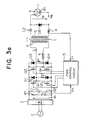
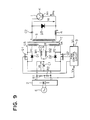
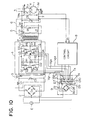
- the embodiment shown in Fig. 10 has a structure and an operation similar to those of the arrangement shown in Figs. 3a and 3b.
- the input terminals of a diode bridge full-wave rectifier circuit 2 consisting of four diodes Do connected in bridge circuit are coupled across a commercial AC voltage source E;
- a smoothing filter circuit 3 consisting of a choke coil Lo and a smoothing capacitor Co connected in series is coupled across the output terminals of the rectifier circuit 2.
- the output terminals of the filter circuit 3 are coupled to the input terminals of the inverter switching circuit 4 comprising four MOSFETs 01 through Q4 connected in bridge circuit relationship; the switching circuit 4 further comprises four diodes D1 through D4 coupled across the source and the drain of the MOSFETs 01 through Q4 to allow currents in reverse direction, respectively, and a series connection of a capacitor and a resistors C1 and R1 through C4 and R4 coupled across each one of the MOSFETs 01 through Q4, in parallel with the diodes D1 through D4, respectively.
- the output terminals of the switching circuit 4 are coupled across the primary winding P of the step-up transformer T.
- a half-wave rectifier circuit 5 consisting of a capacitor C5 and a diode D5 connected in series is coupled across the secondary winding S of the transformer T; a capacitor-diode circuit 6 is coupled across the diode D5 of the rectifier circuit to reduce high frequency components of the output of the rectifier circuit 5, the capacitor-diode circuit 6 consisting of a capacitor C6 and a diode D6 connected in series.
- the diode D6 has a forward direction that agrees with the direction of the magnetron current i M g and supresses the current in reverse direction therethrough; the capacitor C6 is coupled across the cathode K and the anode An of the magnetron 1 to reduce high frequency components of the current flowing through the magnetron 1.
- the magnetron 1 is provided with a filament (or heater) voltage supply lines h having noise-filtering capacitors Cf and inductors Lf.
- the control circuit 8 has a structure similar to that of the control circuit 3 of the first embodiment shown in Fig. 3b, and outputs gate signals Vg1 through Vg4 to the gate terminals g1 through g4 of the MOSFETs Q1 through Q4, respectively, of the inverter switching circuit 4, through an operation interruption circuit 9.
- the circuit interruption circuit 9 comprises: a diode bridge full-wave rectifier circuit 9a having input terminals coupled across the AC voltage source E, a Zener diode Zn coupled across the output terminals of the rectifier circuit 9a through a resistor R; four series-connected diodes D7 through D10 in parallel circuit with the Zener Zn; and four transistors T1 through T4.
- the operation interruption circuit 9 detects the zero phases of the commercial AC voltage source E, and suppress the gate signals Vg1 through Vg4 in the neighborhoods of the zero phases of the AC voltage E to interrupt the switching operation of the inverter switching circuit 4 in the same time intervals; thus, the circuit 9 excepts the neighborhoods of the zero phases of the AC voltage E as the operation interrupting periods of the magnetron 1.
- the rectifier circuit 2 When the rectifier circuit 2 is electrically coupled to the voltage source E through a switch, etc., the AC voltage E is rectified by the rectifier circuit 2 into a pulsating DC voltage; this pulsating DC voltage outputted by rectifier circuit 2 is smoothed into a substantially constant voltage by the filter circuit 3 and outputted therefrom to the switching circuit 4.
- the control circuit 8 alternately outputs gate pulse signals Vg1 and Vg4 and gate pulse signals Vg2 and Vg3 at a predetermined frequency, e.g., at 100 kHz, the pulse width of these gate signals Vg1 through Vg4 being modulated to maintain the output power of the magnetron 1 at a predetermined level.
- the MOSFETs Q1 and Q4 and the MOSFETs Q2 and Q3 are alternately turned on and off; as a result, the current ii flowing through the primary winding P of the transformer T changes its direction at the switching frequency of the MOSFETs 01 through Q4, thereby inducing a square waveform AC voltage of the same frequency in the secondary winding S of the transformer T.
- the voltage doubler half-wave rectifier circuit 5 coupled across the secondary winding S outputs a pulse-shaped voltage in each half-cycle of the switching circuit 4 in which the MOSFETs 01 and Q4 are returned on, the magnitude of the voltage outputted by the rectifier circuit 5 being substantially two times as great as the voltage induced in the secondary winding S.
- This pulsating voltage outputted in said half-cycles of the inverter switching circuit 4 by the rectifier circuit 5 is applied across the capacitor C6 through the diode D6; when this voltage outputted from the rectifier circuit 5 charges the capacitor C6 to the operating (or cut-off) voltage of the magnetron 1, the magnetron driving current i M g begins to flow through the magnetron 1.
- microwave is generated by the magnetron 1, and is supplied to an electrodeless bulb (not shown) to cause a discharge and luminescence therein.
- the length of the operation interruption intervals is set at about 0.5 milliseconds.
- the purpose of establishing these operation interruption intervals of about 0.5 milliseconds in each half-cycle of the AC voltage source E is as follows: the magnetron 1 may fall into an abnormal operation, such as an abnormal oscillation; if this happens, the magnetron 1 does not recover the normal stable operation by itself; thus, it is desirable to establish certain time intervals in which the operation of the magnetron 1 is stopped.
- the gate signals Vg1 through Vg4 have waveforms as shown in Fig. 11 (a) and (b); the pulses Vg2 and Vg3 are outputted by the control circuit 8 in the half-cycle Tp to turn on the MOSFETs Q2 and Q3; the pulses Vg1 and Vg4 are outputted by the control circuit 8 in the half-cycle Tn to turn on the MOSFETs 01 and Q4.
- the pulse width T ON of these pulses Vg1 through Vg4 are modulated in PWM (pulse width modulation) control by the control circuit 8 to maintain the mean output power of the magnetron 1 substantially at a predetermined level.
- the frequency f of these pulses Vg1 through Vg4 typically about 100 kHz, which is referred to as the inverter switching frequency, is equal to the reciprocal 1/To of the period To of these pulse signals Vg1 through Vg4.
- the pulse width T ON is modulated in a range of from about 3 microseconds about 4 microseconds.
- the operation of the circuit in the half-cycle Tp shown in Fig. 11 is as follows.
- the MOSFETs Q2 and Q3 are turned on by the pulses Vg2 and Vg3 in the half-cycle Tp, the current ii in the primary winding P of the transformer T flows in the direction opposite to that shown by the arrow in Fig. 10.
- the voltage Vs induced in the secondary winding S of the transformer T has a polarity shown by the arrow in Fig. 10.
- the induced voltage Vs rises rapidly substantially to the level n Vo determined by the step-up ratio n of the transformer T and the voltage Vo supplied by the filter circuit 3, as shown in Fig. 11 (d).
- the current is, however, rises gradually from substantial zero to a maximum during the time T ON in which the MOSFETs Q2 and Q3 are turned on, due, for example, to leakage inductance, i.e., self-inductances of the primary and the secondary winding P and S, of the transformer T, as shown in Fig. 11 (c).
- this induced current is in the secondary winding S rapidly returns to substantial zero as shown in Fig. 11 (c).
- the voltage Vs across the secondary winding S is kept substantially at the level n ' Vo to which the capacitor C5 has been charged during the time interval T ON , as shown in Fig. 11 (d).
- the circuit of Fig. 10 operates as follows.
- the MOSFETs Q1 and Q4 are turned on.
- the current ii flows in the primary winding P in the direction shown by the arrow in Fig. 10; the polarities of the induced current is and voltage Vs are reversed with respect to those of the preceding half-cycle Tp, as shown in Fig.11 (c) and (d).
- the output voltage of the rectifier circuit 5 rises to the sum of the induced voltage Vs in the secondary winding S and the voltage to which the capacitor C5 thereof is charged in the preceding cycle Tp; this output voltage of the rectifier circuit 5 is applied across the capacitor C6, which is already charged in the polarity shown in Fig. 11 in preceding half-cycles Tn.
- the voltage V M g across the magnetron 1, which is substantially equal to the voltage developed across the capacitor C6, has a waveform shown in a solid curve in Fig. 11 (e); the maximum voltage level Vmax of the magnetron voltage V M g is attained near the end of the time period T ON .
- the magnetron current i M g begins to flow through the magnetron 1, and is maintained during the time in which the voltage V M g is above the operating voltage level Vz, as shown in a solid curve in Fig. 11 (f).
- the magnetron current i M g attains its maximum i max corresponding to the maximum voltage Vmax of the magnetron voltage V M g.
- the dotted curve in Fig. 11 (f) shows the magnetron current having the same mean value i o in the case of the conventional circuit according to Fig. 2b, the maximum value thereof being indicated by i' max .
- the maximum or peak values Vmax and i max of the magnetron voltage V M g and the magnetron current i M g of the circuit of Fig. 10 is reduced compared with those V'max and i' max of the conventional circuit according to Fig. 2b; this is primarily due to the presence of the capacitor C6.
- the magnetron current waveforms shown in solid and dotted curves in Fig. 11 (f) both have the same mean value i o , the ratio imax / io of the peak to the mean value of the magnetron current i M g in the circuit of Fig.
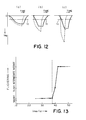
- Fig. 12 shows further illustrative examples showing the reduction of the ratio of the peak to the mean value of the magnetron current in the circuit of Fig. 10 according to the present invention.
- the solid and the dotted curves in Figs. 12 (a) through (c) show the waveforms of the magnetron current having the same mean value i o ; the cases of the circuit of Fig. 10 are shown in solid curves; those of the conventional circuit of Fig. 2b are shown in dotted curves.
- the pulse width T ON has been modulated to keep the mean value of the magnetron currents i M g shown in Figs. 12 (a) through (c) at the same level i o .
- the same ratio i max /i o in the case of the conventional circuit according to Fig. 2b is equal to 7.0, 4.2, and 2.6, when the voltage E is 10 % under, equal to, and 10 % above the rated level, respectively, as shown in dotted curves in Figs. 12 (a) through (c), respectively.
- the magnetron current shown in solid curve according to the present invention causes no flickering in the discharge in the electrodeless bulb; the magnetron current in the case of the conventional circuit shown in dotted curve, however, causes flickering in the discharge therein.
- the magnetron currents shown in solid curves in Figs. 12 (a) through (c) according to the present invention cause no flickering in the discharge; those in dotted curves of the conventional circuit shown in Fig. 12 (a) through (c) all cause flickering; that shown in (c) causes intense flickering in the discharge.
- Fig. 13 shows a result of an experiment which shows the critical meaning of inequality (9) above. Namely the curve of Fig. 13 shows the change observed in the intensity of flickering in the arc of the discharge in the electrodeless bulb, with respect to the peak to the mean magnetron current ratio i max /i o , plotted along the abscissa, wherein the inverter switching frequency f has been set at 100 kHz, and the mean microwave output power at 850 W in the circuit according to Fig. 10. From the experimental result shown in Fig.
- Fig. 14 shows the relationships of the frequency f (plotted along the abscissa in kHz) and the capacity of the capacitor C6 (plotted along the ordinate in microfarads) which is effective in supressing the occurrence of flickering in the discharge, i.e, in reducing the ratio i max /i o to a level satisfying inequality (10) above; the three curves correspond to the cases in which the mean magnetron output power Po is equal to 680 W, 850 W, and 940 W, respectively.
- the results shown in Figure 14 were obtained by an experiment in which the circuit according to Figure 10 was used to supply microwave to a spherical electrodeless discharge bulb 30mm across, in which sodium iodide, mercury, and argon were encapsulated.
- the inverter switching circuit may be constituted by a half bridge circuit or monolithic forward circuit instead of full bridge circuit or push-pull circuit.
- the switching circuit may comprise, instead of the MOSFETs utilized in the embodiments described above, power transistors SIT or GTO, SI thyristors, or magnetic amplifiers.
- the capacitor C6 an inductance may be inserted in series with magnetron to suppress the high frequency components in the magnetron current; alternatively, a combination of an inductance and a capacitance may be used for the same purpose.
Landscapes
- Physics & Mathematics (AREA)
- Engineering & Computer Science (AREA)
- Plasma & Fusion (AREA)
- Electromagnetism (AREA)
- Control Of High-Frequency Heating Circuits (AREA)
- Inverter Devices (AREA)
- Circuit Arrangements For Discharge Lamps (AREA)
- Discharge-Lamp Control Circuits And Pulse- Feed Circuits (AREA)
- Discharge Lamps And Accessories Thereof (AREA)
Applications Claiming Priority (3)
| Application Number | Priority Date | Filing Date | Title |
|---|---|---|---|
| JP62188256A JPH07111918B2 (ja) | 1987-07-28 | 1987-07-28 | マイクロ波放電光源装置 |
| JP188256/87 | 1987-07-28 | ||
| EP88906879A EP0326619B1 (fr) | 1987-07-28 | 1988-07-27 | Alimentation pour source lumineuse a decharge fonctionnant a micro-ondes |
Related Parent Applications (1)
| Application Number | Title | Priority Date | Filing Date |
|---|---|---|---|
| EP88906879.7 Division | 1989-02-14 |
Publications (3)
| Publication Number | Publication Date |
|---|---|
| EP0474316A2 true EP0474316A2 (fr) | 1992-03-11 |
| EP0474316A3 EP0474316A3 (en) | 1992-07-01 |
| EP0474316B1 EP0474316B1 (fr) | 1995-02-22 |
Family
ID=16220502
Family Applications (3)
| Application Number | Title | Priority Date | Filing Date |
|---|---|---|---|
| EP88906879A Expired - Lifetime EP0326619B1 (fr) | 1987-07-28 | 1988-07-27 | Alimentation pour source lumineuse a decharge fonctionnant a micro-ondes |
| EP91202578A Expired - Lifetime EP0474316B1 (fr) | 1987-07-28 | 1988-07-27 | Alimentation pour une source lumineuse alimentée en hyperfréquences |
| EP91202577A Revoked EP0474315B1 (fr) | 1987-07-28 | 1988-07-27 | Appareil àvec source lumineuse à décharge à micro ondes |
Family Applications Before (1)
| Application Number | Title | Priority Date | Filing Date |
|---|---|---|---|
| EP88906879A Expired - Lifetime EP0326619B1 (fr) | 1987-07-28 | 1988-07-27 | Alimentation pour source lumineuse a decharge fonctionnant a micro-ondes |
Family Applications After (1)
| Application Number | Title | Priority Date | Filing Date |
|---|---|---|---|
| EP91202577A Revoked EP0474315B1 (fr) | 1987-07-28 | 1988-07-27 | Appareil àvec source lumineuse à décharge à micro ondes |
Country Status (7)
| Country | Link |
|---|---|
| US (3) | US4988922A (fr) |
| EP (3) | EP0326619B1 (fr) |
| JP (1) | JPH07111918B2 (fr) |
| KR (1) | KR920001875B1 (fr) |
| CA (1) | CA1304773C (fr) |
| DE (3) | DE3853169T2 (fr) |
| WO (1) | WO1989001234A1 (fr) |
Cited By (1)
| Publication number | Priority date | Publication date | Assignee | Title |
|---|---|---|---|---|
| US5438242A (en) * | 1993-06-24 | 1995-08-01 | Fusion Systems Corporation | Apparatus for controlling the brightness of a magnetron-excited lamp |
Families Citing this family (51)
| Publication number | Priority date | Publication date | Assignee | Title |
|---|---|---|---|---|
| JPH07111918B2 (ja) | 1987-07-28 | 1995-11-29 | 三菱電機株式会社 | マイクロ波放電光源装置 |
| JPH0482191A (ja) * | 1990-07-25 | 1992-03-16 | Matsushita Electric Ind Co Ltd | 高周波加熱装置 |
| KR940008029B1 (ko) * | 1991-06-28 | 1994-08-31 | 삼성전자 주식회사 | 마그네트론 구동용 전원장치 |
| DE9305236U1 (de) * | 1992-04-11 | 1993-09-02 | Segor GmbH & Co KG, 55765 Birkenfeld | Wechselverkehrszeichengeber |
| US5558806A (en) * | 1992-07-23 | 1996-09-24 | Osi Specialties, Inc. | Surfactant blend of a polyalkleneoxide polysiloxane and an organic compound having a short chain hydrophobic moiety |
| DE4238198A1 (de) * | 1992-11-12 | 1994-05-19 | Abb Patent Gmbh | Schaltungsanordnung für ein Schaltnetzteil |
| US6075331A (en) * | 1993-03-18 | 2000-06-13 | Imra America, Inc. | Systems and methods for managing energy of electric power supply systems |
| US5495209A (en) * | 1995-04-14 | 1996-02-27 | Hughes Missile Systems Company | Switched-inverter modulator for producing modulated high voltage pulses |
| US5777867A (en) * | 1995-09-14 | 1998-07-07 | Suitomo Electric Industries, Ltd. | Electric discharge method and apparatus |
| US5838114A (en) * | 1996-03-08 | 1998-11-17 | Fusion Systems Corporation | Plural ferro-resonant power supplies for powering a magnetron where the aray lies in these power supplies being independent from each other and not utilizing any common components |
| US5909086A (en) * | 1996-09-24 | 1999-06-01 | Jump Technologies Limited | Plasma generator for generating unipolar plasma |
| DE19801711A1 (de) * | 1998-01-17 | 1999-07-22 | Aixcon Elektrotechnik Gmbh | Magnetronstromversorgung |
| WO2000040056A1 (fr) * | 1998-12-23 | 2000-07-06 | United Automation Limited | Unite de commande de magnetron a transformateur agissant sur l'appel de courant |
| US6958063B1 (en) | 1999-04-22 | 2005-10-25 | Soring Gmbh Medizintechnik | Plasma generator for radio frequency surgery |
| JP3087752B1 (ja) * | 1999-06-15 | 2000-09-11 | 松下電器産業株式会社 | マグネトロンの駆動電源 |
| US7126450B2 (en) * | 1999-06-21 | 2006-10-24 | Access Business Group International Llc | Inductively powered apparatus |
| KR100766534B1 (ko) * | 2000-09-27 | 2007-10-15 | 마쯔시다덴기산교 가부시키가이샤 | 마그네트론 구동용 전원 |
| KR100407045B1 (ko) * | 2001-03-12 | 2003-11-28 | 삼성전자주식회사 | 고출력 전환수단을 구비한 전자레인지 |
| JP2002367768A (ja) * | 2001-06-04 | 2002-12-20 | Matsushita Electric Ind Co Ltd | マグネトロン駆動用電源 |
| GB0120993D0 (en) * | 2001-08-30 | 2001-10-24 | Quay Technologies | Pulsed UV light source |
| DE10149827A1 (de) * | 2001-10-09 | 2003-04-30 | Siemens Ag | Stabilisierungsschaltung |
| KR100419204B1 (ko) * | 2001-12-24 | 2004-02-21 | 삼성전자주식회사 | 전자렌지 |
| KR100438619B1 (ko) * | 2002-01-25 | 2004-07-02 | 엘지전자 주식회사 | 마이크로 웨이브 조명장치 및 방법 |
| US6963267B2 (en) * | 2002-03-15 | 2005-11-08 | Wayne-Dalton Corporation | Operator for a movable barrier and method of use |
| KR20030079546A (ko) * | 2002-04-04 | 2003-10-10 | 엘지전자 주식회사 | 전자레인지 구동회로 |
| JP2003339164A (ja) | 2002-05-22 | 2003-11-28 | Hitachi Industrial Equipment Systems Co Ltd | スイッチング電源回路、及びインバータ装置 |
| TW569651B (en) * | 2002-07-05 | 2004-01-01 | Delta Electronics Inc | High-frequency heating device |
| WO2004095886A1 (fr) * | 2003-04-22 | 2004-11-04 | Matsushita Electric Industrial Co. Ltd. | Dispositif de chauffe dielectrique a haute frequence et carte de circuits imprimes a thermistance |
| KR100565343B1 (ko) * | 2003-08-14 | 2006-03-30 | 엘지전자 주식회사 | 무전극 조명기기의 구동장치 |
| KR100575665B1 (ko) | 2003-09-25 | 2006-05-03 | 엘지전자 주식회사 | 마이크로웨이브 조명장치 |
| JP4204505B2 (ja) * | 2004-03-31 | 2009-01-07 | 日本高周波株式会社 | マグネトロン発振装置 |
| US7109669B2 (en) * | 2004-04-08 | 2006-09-19 | Nordson Corporation | Microwave lamp power supply that can withstand failure in high voltage circuit |
| GB2415785B (en) * | 2004-07-02 | 2006-11-22 | Ohm Ltd | Electromagnetic surveying |
| KR100677277B1 (ko) * | 2005-05-11 | 2007-02-02 | 엘지전자 주식회사 | 무전극 램프 시스템 |
| US20070096657A1 (en) * | 2005-10-31 | 2007-05-03 | Lg Electronics Inc. | Plasma lighting system and driving control method thereof |
| US9378930B2 (en) * | 2009-03-05 | 2016-06-28 | Applied Materials, Inc. | Inductively coupled plasma reactor having RF phase control and methods of use thereof |
| KR101106409B1 (ko) * | 2009-07-10 | 2012-01-17 | 엘지전자 주식회사 | 무전극 조명기기 및 제어 방법 |
| JP2011060566A (ja) * | 2009-09-10 | 2011-03-24 | Panasonic Corp | 高周波加熱装置 |
| WO2011050306A1 (fr) * | 2009-10-23 | 2011-04-28 | Kaonetics Technologies, Inc. | Dispositif, système et procédé pour générer des formes d'onde électromagnétiques, des particules subatomiques, des particules sensiblement dépourvues de charge et/ou des ondes magnétiques sensiblement exemptes de champ électrique |
| EP2827360A1 (fr) * | 2010-03-22 | 2015-01-21 | Robe Lighting, Inc | Luminaire automatisé avec source de lumière à plasma |
| US8269190B2 (en) | 2010-09-10 | 2012-09-18 | Severn Trent Water Purification, Inc. | Method and system for achieving optimal UV water disinfection |
| JP5776496B2 (ja) * | 2011-10-31 | 2015-09-09 | 富士電機株式会社 | 電力変換装置 |
| DE102012007450B4 (de) * | 2012-04-13 | 2024-02-22 | Tridonic Gmbh & Co Kg | Wandler für ein Leuchtmittel, LED-Konverter und Verfahren zum Betreiben eines LLC-Resonanzwandlers |
| WO2014010226A1 (fr) * | 2012-07-09 | 2014-01-16 | 東芝ホクト電子株式会社 | Dispositif d'émission de plasma et générateur d'ondes électromagnétiques utilisé en son sein |
| US9316038B2 (en) | 2013-03-15 | 2016-04-19 | Overhead Door Corporation | Factory programming of paired authorization codes in wireless transmitter and door operator |
| JP6793192B2 (ja) * | 2016-06-27 | 2020-12-02 | シャープ株式会社 | 高周波加熱装置 |
| US11432732B2 (en) | 2016-06-28 | 2022-09-06 | Chiscan Holdings, Llc | System and method of measuring millimeter wave of cold atmospheric pressure plasma |
| US11166762B2 (en) * | 2016-06-28 | 2021-11-09 | Chiscan Holdings, L.L.C. | Non-thermal plasma generator for detection and treatment of maladies |
| US10230296B2 (en) * | 2016-09-21 | 2019-03-12 | Express Imaging Systems, Llc | Output ripple reduction for power converters |
| CA3077229C (fr) * | 2017-11-03 | 2023-08-01 | Heraeus Noblelight America Llc | Systemes de lampe a ultraviolets et leurs procedes de fonctionnement et de configuration |
| CN114025664A (zh) | 2019-05-06 | 2022-02-08 | 智像控股有限责任公司 | 使用非热等离子体阵列的推定的能量场分析 |
Citations (10)
| Publication number | Priority date | Publication date | Assignee | Title |
|---|---|---|---|---|
| US3973165A (en) | 1975-04-28 | 1976-08-03 | Litton Systems, Inc. | Power supply for a microwave magnetron |
| JPS56126250A (en) | 1980-03-10 | 1981-10-03 | Mitsubishi Electric Corp | Light source device of micro wave discharge |
| JPS56162899U (fr) | 1980-05-07 | 1981-12-03 | ||
| JPS5755091A (en) | 1980-09-19 | 1982-04-01 | Mitsubishi Electric Corp | Power source for microwave discharge light source |
| JPS60189889A (ja) | 1984-03-12 | 1985-09-27 | 松下電器産業株式会社 | 高周波加熱装置 |
| US4593167A (en) | 1982-08-02 | 1986-06-03 | Nilssen Ole K | Electronic microwave oven power supply |
| JPS62113395A (ja) | 1985-11-11 | 1987-05-25 | 三菱電機株式会社 | マイクロ波光源装置用電源装置 |
| US4673846A (en) | 1984-03-02 | 1987-06-16 | Mitsubishi Denki Kabushiki Kaisha | Microwave discharge light source apparatus |
| JPS62290098A (ja) | 1987-04-24 | 1987-12-16 | 三菱電機株式会社 | マイクロ波放電光源装置 |
| EP0326619A1 (fr) | 1987-07-28 | 1989-08-09 | Mitsubishi Denki Kabushiki Kaisha | Alimentation pour source lumineuse a decharge fonctionnant a micro-ondes |
Family Cites Families (23)
| Publication number | Priority date | Publication date | Assignee | Title |
|---|---|---|---|---|
| US4005370A (en) * | 1974-09-10 | 1977-01-25 | Matsushita Electric Industrial Co., Ltd. | Power supply means for magnetron |
| GB1542662A (en) * | 1975-09-12 | 1979-03-21 | Matsushita Electric Industrial Co Ltd | Power supply |
| US4356431A (en) * | 1978-02-21 | 1982-10-26 | Advance Transformer Company | Magnetron energizing circuit |
| DE3008143C2 (de) * | 1980-03-04 | 1982-04-08 | Ruwel-Werke Spezialfabrik für Leiterplatten GmbH, 4170 Geldern | Verfahren zum Herstellen von gedruckten Leiterplatten mit Lochungen, deren Wandungen metallisiert sind |
| US4463286A (en) * | 1981-02-04 | 1984-07-31 | North American Philips Lighting Corporation | Lightweight electronic ballast for fluorescent lamps |
| US4532456A (en) * | 1982-07-12 | 1985-07-30 | Gte Products Corporation | Output circuit for an electronic ballast system |
| US4484108A (en) * | 1982-08-02 | 1984-11-20 | North American Philips Corporation | High frequency ballast-ignition system for discharge lamps |
| JPS59114795A (ja) * | 1982-12-21 | 1984-07-02 | 三菱電機株式会社 | マイクロ波放電光源装置用電源装置 |
| US4585974A (en) * | 1983-01-03 | 1986-04-29 | North American Philips Corporation | Varible frequency current control device for discharge lamps |
| JPS59203399A (ja) * | 1983-05-06 | 1984-11-17 | 三菱電機株式会社 | マイクロ波放電光源装置 |
| US4609850A (en) * | 1983-06-01 | 1986-09-02 | Intent Patents A.G. | Current driven gain controlled electronic ballast system |
| US4544863A (en) * | 1984-03-22 | 1985-10-01 | Ken Hashimoto | Power supply apparatus for fluorescent lamp |
| GB8419373D0 (en) * | 1984-07-30 | 1984-09-05 | Westinghouse Brake & Signal | Power control circuit |
| US4885506A (en) * | 1984-12-06 | 1989-12-05 | Nilssen Ole K | Electronic magnetron power supply |
| US4644459A (en) * | 1985-02-04 | 1987-02-17 | Nilssen Ole K | Electronic inverter having magnitude-controllable output |
| JPS61185887A (ja) * | 1985-02-13 | 1986-08-19 | 株式会社デンソー | 自動車用電磁波加熱装置 |
| KR900004338B1 (ko) * | 1985-03-25 | 1990-06-22 | 가부시기가이샤 히다찌 세이사구쇼 | 마그네트론 필터장치 |
| JPS61259488A (ja) * | 1985-05-14 | 1986-11-17 | 松下電器産業株式会社 | 高周波加熱装置 |
| JPS6273598A (ja) * | 1985-09-27 | 1987-04-04 | 株式会社日立製作所 | マイクロ波光源 |
| JPS6290899A (ja) * | 1985-10-16 | 1987-04-25 | 三菱電機株式会社 | マイクロ波放電光源装置用電源装置 |
| NL8503008A (nl) * | 1985-11-04 | 1987-06-01 | Philips Nv | Gelijkstroom-wisselstroomomzetter voor het ontsteken en voeden van een ontladingslamp. |
| US4700112A (en) * | 1986-07-08 | 1987-10-13 | Chang Ming J | Fluorescent lamp lighting circuit |
| US4851629A (en) * | 1988-06-20 | 1989-07-25 | Matsushita Electric Industrial Co., Ltd. | High-frequency heating device |
-
1987
- 1987-07-28 JP JP62188256A patent/JPH07111918B2/ja not_active Expired - Lifetime
-
1988
- 1988-07-27 DE DE3853169T patent/DE3853169T2/de not_active Expired - Fee Related
- 1988-07-27 EP EP88906879A patent/EP0326619B1/fr not_active Expired - Lifetime
- 1988-07-27 EP EP91202578A patent/EP0474316B1/fr not_active Expired - Lifetime
- 1988-07-27 WO PCT/JP1988/000753 patent/WO1989001234A1/fr not_active Ceased
- 1988-07-27 US US07/329,786 patent/US4988922A/en not_active Expired - Fee Related
- 1988-07-27 DE DE3853835T patent/DE3853835T2/de not_active Revoked
- 1988-07-27 KR KR1019890700491A patent/KR920001875B1/ko not_active Expired
- 1988-07-27 EP EP91202577A patent/EP0474315B1/fr not_active Revoked
- 1988-07-27 CA CA000573179A patent/CA1304773C/fr not_active Expired - Lifetime
- 1988-07-27 DE DE8888906879T patent/DE3874721T2/de not_active Expired - Fee Related
-
1990
- 1990-11-20 US US07/616,244 patent/US5115168A/en not_active Expired - Fee Related
- 1990-11-20 US US07/616,257 patent/US5053682A/en not_active Expired - Fee Related
Patent Citations (11)
| Publication number | Priority date | Publication date | Assignee | Title |
|---|---|---|---|---|
| US3973165A (en) | 1975-04-28 | 1976-08-03 | Litton Systems, Inc. | Power supply for a microwave magnetron |
| JPS56126250A (en) | 1980-03-10 | 1981-10-03 | Mitsubishi Electric Corp | Light source device of micro wave discharge |
| US4498029A (en) | 1980-03-10 | 1985-02-05 | Mitsubishi Denki Kabushiki Kaisha | Microwave generated plasma light source apparatus |
| JPS56162899U (fr) | 1980-05-07 | 1981-12-03 | ||
| JPS5755091A (en) | 1980-09-19 | 1982-04-01 | Mitsubishi Electric Corp | Power source for microwave discharge light source |
| US4593167A (en) | 1982-08-02 | 1986-06-03 | Nilssen Ole K | Electronic microwave oven power supply |
| US4673846A (en) | 1984-03-02 | 1987-06-16 | Mitsubishi Denki Kabushiki Kaisha | Microwave discharge light source apparatus |
| JPS60189889A (ja) | 1984-03-12 | 1985-09-27 | 松下電器産業株式会社 | 高周波加熱装置 |
| JPS62113395A (ja) | 1985-11-11 | 1987-05-25 | 三菱電機株式会社 | マイクロ波光源装置用電源装置 |
| JPS62290098A (ja) | 1987-04-24 | 1987-12-16 | 三菱電機株式会社 | マイクロ波放電光源装置 |
| EP0326619A1 (fr) | 1987-07-28 | 1989-08-09 | Mitsubishi Denki Kabushiki Kaisha | Alimentation pour source lumineuse a decharge fonctionnant a micro-ondes |
Cited By (1)
| Publication number | Priority date | Publication date | Assignee | Title |
|---|---|---|---|---|
| US5438242A (en) * | 1993-06-24 | 1995-08-01 | Fusion Systems Corporation | Apparatus for controlling the brightness of a magnetron-excited lamp |
Also Published As
| Publication number | Publication date |
|---|---|
| JPH07111918B2 (ja) | 1995-11-29 |
| US5115168A (en) | 1992-05-19 |
| DE3853169D1 (de) | 1995-03-30 |
| EP0326619A1 (fr) | 1989-08-09 |
| WO1989001234A1 (fr) | 1989-02-09 |
| EP0474316A3 (en) | 1992-07-01 |
| DE3874721T2 (de) | 1993-04-22 |
| EP0474316B1 (fr) | 1995-02-22 |
| DE3853835D1 (de) | 1995-06-22 |
| DE3853169T2 (de) | 1995-10-26 |
| EP0474315A3 (en) | 1992-07-01 |
| CA1304773C (fr) | 1992-07-07 |
| US4988922A (en) | 1991-01-29 |
| JPS6433896A (en) | 1989-02-03 |
| KR890702238A (ko) | 1989-12-23 |
| DE3874721D1 (de) | 1992-10-22 |
| DE3853835T2 (de) | 1996-02-15 |
| EP0474315A2 (fr) | 1992-03-11 |
| US5053682A (en) | 1991-10-01 |
| EP0326619B1 (fr) | 1992-09-16 |
| KR920001875B1 (ko) | 1992-03-06 |
| EP0474315B1 (fr) | 1995-05-17 |
Similar Documents
| Publication | Publication Date | Title |
|---|---|---|
| EP0474316B1 (fr) | Alimentation pour une source lumineuse alimentée en hyperfréquences | |
| US7825609B2 (en) | Electronic ballast having a flyback cat-ear power supply | |
| KR100306194B1 (ko) | 고주파 가열장치용 스위칭 전원공급장치 | |
| US4704674A (en) | Power feed apparatus for load having reverse blocking characteristics | |
| GB2367196A (en) | Microwave oven having a switching power supply Microwave oven having a switching power supply | |
| EP0271850B1 (fr) | Appareil d'alimentation en puissance | |
| JP3206521B2 (ja) | 高周波加熱装置 | |
| KR950005284B1 (ko) | 메탈할라이드 램프용 전자식 안정기 | |
| US5117157A (en) | Ballast circuits for discharge lamps | |
| JPH063991B2 (ja) | マグネトロン駆動用電源 | |
| JPH0415599B2 (fr) | ||
| EP0580257B1 (fr) | Dispositif de commutation pour la modulation en carré du courant haute-fréquence dans un ballast de lampe à décharge | |
| JP3888066B2 (ja) | 無電極放電灯点灯装置 | |
| JP2719746B2 (ja) | X線電源の制御回路 | |
| KR100347303B1 (ko) | 메탈핼라이드 램프의 음향 공명 현상 감소 장치 | |
| JP4186787B2 (ja) | 無電極放電灯点灯装置及び照明装置 | |
| JPH01112697A (ja) | マイクロ波放電光源装置用電源装置 | |
| JPH09167694A (ja) | 放電灯用電源装置 | |
| JPH0824065B2 (ja) | 高周波加熱装置 | |
| JPH0773981A (ja) | 放電ランプ点灯装置 | |
| KR20030042742A (ko) | 마그네트론 구동장치 | |
| HK1138716A (en) | Electronic ballast having a flyback cat-ear power supply | |
| JPH11299267A (ja) | 電源制御回路 |
Legal Events
| Date | Code | Title | Description |
|---|---|---|---|
| PUAI | Public reference made under article 153(3) epc to a published international application that has entered the european phase |
Free format text: ORIGINAL CODE: 0009012 |
|
| 17P | Request for examination filed |
Effective date: 19911025 |
|
| AC | Divisional application: reference to earlier application |
Ref document number: 326619 Country of ref document: EP |
|
| AK | Designated contracting states |
Kind code of ref document: A2 Designated state(s): DE FR GB IT NL |
|
| PUAL | Search report despatched |
Free format text: ORIGINAL CODE: 0009013 |
|
| AK | Designated contracting states |
Kind code of ref document: A3 Designated state(s): DE FR GB IT NL |
|
| K1C3 | Correction of patent application (complete document) published |
Effective date: 19920311 |
|
| 17Q | First examination report despatched |
Effective date: 19940627 |
|
| GRAA | (expected) grant |
Free format text: ORIGINAL CODE: 0009210 |
|
| AC | Divisional application: reference to earlier application |
Ref document number: 326619 Country of ref document: EP |
|
| AK | Designated contracting states |
Kind code of ref document: B1 Designated state(s): DE FR GB IT NL |
|
| ITF | It: translation for a ep patent filed | ||
| REF | Corresponds to: |
Ref document number: 3853169 Country of ref document: DE Date of ref document: 19950330 |
|
| REG | Reference to a national code |
Ref country code: GB Ref legal event code: 727 |
|
| REG | Reference to a national code |
Ref country code: GB Ref legal event code: 727A |
|
| ET | Fr: translation filed | ||
| PGFP | Annual fee paid to national office [announced via postgrant information from national office to epo] |
Ref country code: FR Payment date: 19950711 Year of fee payment: 8 |
|
| PGFP | Annual fee paid to national office [announced via postgrant information from national office to epo] |
Ref country code: GB Payment date: 19950717 Year of fee payment: 8 |
|
| PGFP | Annual fee paid to national office [announced via postgrant information from national office to epo] |
Ref country code: NL Payment date: 19950727 Year of fee payment: 8 |
|
| REG | Reference to a national code |
Ref country code: GB Ref legal event code: 727B |
|
| PLBI | Opposition filed |
Free format text: ORIGINAL CODE: 0009260 |
|
| REG | Reference to a national code |
Ref country code: GB Ref legal event code: SP |
|
| PLBF | Reply of patent proprietor to notice(s) of opposition |
Free format text: ORIGINAL CODE: EPIDOS OBSO |
|
| 26 | Opposition filed |
Opponent name: FUSION SYSTEM CORPORATION Effective date: 19951122 |
|
| NLR1 | Nl: opposition has been filed with the epo |
Opponent name: FUSION SYSTEM CORPORATION |
|
| PLBF | Reply of patent proprietor to notice(s) of opposition |
Free format text: ORIGINAL CODE: EPIDOS OBSO |
|
| PG25 | Lapsed in a contracting state [announced via postgrant information from national office to epo] |
Ref country code: GB Effective date: 19960727 |
|
| PG25 | Lapsed in a contracting state [announced via postgrant information from national office to epo] |
Ref country code: NL Effective date: 19970201 |
|
| APAC | Appeal dossier modified |
Free format text: ORIGINAL CODE: EPIDOS NOAPO |
|
| APAE | Appeal reference modified |
Free format text: ORIGINAL CODE: EPIDOS REFNO |
|
| APAE | Appeal reference modified |
Free format text: ORIGINAL CODE: EPIDOS REFNO |
|
| GBPC | Gb: european patent ceased through non-payment of renewal fee |
Effective date: 19960727 |
|
| PG25 | Lapsed in a contracting state [announced via postgrant information from national office to epo] |
Ref country code: FR Effective date: 19970328 |
|
| NLV4 | Nl: lapsed or anulled due to non-payment of the annual fee |
Effective date: 19970201 |
|
| REG | Reference to a national code |
Ref country code: FR Ref legal event code: ST |
|
| APAE | Appeal reference modified |
Free format text: ORIGINAL CODE: EPIDOS REFNO |
|
| APAC | Appeal dossier modified |
Free format text: ORIGINAL CODE: EPIDOS NOAPO |
|
| PLBO | Opposition rejected |
Free format text: ORIGINAL CODE: EPIDOS REJO |
|
| PLBN | Opposition rejected |
Free format text: ORIGINAL CODE: 0009273 |
|
| STAA | Information on the status of an ep patent application or granted ep patent |
Free format text: STATUS: OPPOSITION REJECTED |
|
| 27O | Opposition rejected |
Effective date: 19991008 |
|
| PGFP | Annual fee paid to national office [announced via postgrant information from national office to epo] |
Ref country code: DE Payment date: 20030807 Year of fee payment: 16 |
|
| PG25 | Lapsed in a contracting state [announced via postgrant information from national office to epo] |
Ref country code: DE Free format text: LAPSE BECAUSE OF NON-PAYMENT OF DUE FEES Effective date: 20050201 |
|
| APAH | Appeal reference modified |
Free format text: ORIGINAL CODE: EPIDOSCREFNO |
|
| PGFP | Annual fee paid to national office [announced via postgrant information from national office to epo] |
Ref country code: IT Payment date: 20060731 Year of fee payment: 19 |
|
| PG25 | Lapsed in a contracting state [announced via postgrant information from national office to epo] |
Ref country code: IT Free format text: LAPSE BECAUSE OF NON-PAYMENT OF DUE FEES Effective date: 20070727 |