EP0474880A1 - Aluminium-chrom-legierung und verfahren zur herstellung - Google Patents
Aluminium-chrom-legierung und verfahren zur herstellung Download PDFInfo
- Publication number
- EP0474880A1 EP0474880A1 EP91906271A EP91906271A EP0474880A1 EP 0474880 A1 EP0474880 A1 EP 0474880A1 EP 91906271 A EP91906271 A EP 91906271A EP 91906271 A EP91906271 A EP 91906271A EP 0474880 A1 EP0474880 A1 EP 0474880A1
- Authority
- EP
- European Patent Office
- Prior art keywords
- aluminum
- chromium
- amorphous
- based alloy
- powder
- Prior art date
- Legal status (The legal status is an assumption and is not a legal conclusion. Google has not performed a legal analysis and makes no representation as to the accuracy of the status listed.)
- Granted
Links
Images


Classifications
-
- B—PERFORMING OPERATIONS; TRANSPORTING
- B22—CASTING; POWDER METALLURGY
- B22F—WORKING METALLIC POWDER; MANUFACTURE OF ARTICLES FROM METALLIC POWDER; MAKING METALLIC POWDER; APPARATUS OR DEVICES SPECIALLY ADAPTED FOR METALLIC POWDER
- B22F3/00—Manufacture of workpieces or articles from metallic powder characterised by the manner of compacting or sintering; Apparatus specially adapted therefor ; Presses and furnaces
- B22F3/006—Amorphous articles
- B22F3/007—Amorphous articles by diffusion starting from non-amorphous articles prepared by powder metallurgy
-
- B—PERFORMING OPERATIONS; TRANSPORTING
- B22—CASTING; POWDER METALLURGY
- B22F—WORKING METALLIC POWDER; MANUFACTURE OF ARTICLES FROM METALLIC POWDER; MAKING METALLIC POWDER; APPARATUS OR DEVICES SPECIALLY ADAPTED FOR METALLIC POWDER
- B22F9/00—Making metallic powder or suspensions thereof
- B22F9/002—Making metallic powder or suspensions thereof amorphous or microcrystalline
- B22F9/004—Making metallic powder or suspensions thereof amorphous or microcrystalline by diffusion, e.g. solid state reaction
-
- B—PERFORMING OPERATIONS; TRANSPORTING
- B22—CASTING; POWDER METALLURGY
- B22F—WORKING METALLIC POWDER; MANUFACTURE OF ARTICLES FROM METALLIC POWDER; MAKING METALLIC POWDER; APPARATUS OR DEVICES SPECIALLY ADAPTED FOR METALLIC POWDER
- B22F9/00—Making metallic powder or suspensions thereof
- B22F9/002—Making metallic powder or suspensions thereof amorphous or microcrystalline
- B22F9/008—Rapid solidification processing
-
- C—CHEMISTRY; METALLURGY
- C22—METALLURGY; FERROUS OR NON-FERROUS ALLOYS; TREATMENT OF ALLOYS OR NON-FERROUS METALS
- C22C—ALLOYS
- C22C1/00—Making non-ferrous alloys
- C22C1/04—Making non-ferrous alloys by powder metallurgy
- C22C1/0408—Light metal alloys
- C22C1/0416—Aluminium-based alloys
-
- C—CHEMISTRY; METALLURGY
- C22—METALLURGY; FERROUS OR NON-FERROUS ALLOYS; TREATMENT OF ALLOYS OR NON-FERROUS METALS
- C22C—ALLOYS
- C22C45/00—Amorphous alloys
- C22C45/08—Amorphous alloys with aluminium as the major constituent
Definitions
- the present invention relates to an aluminum-chromium based alloy and a method of preparing the same, and more particularly, it relates to an aluminum-chromium based alloy which has high strength and is excellent in heat resistance, corrosion resistance and the like, and a method of preparing the same.
- Amorphous aluminum alloys are disclosed in Japanese Patent Laying-Open Gazette No. 1-275732, Japanese Patent Publication Gazette No. 64-47831 and Japanese Patent Publication Gazette No. 1-127641, for example.
- the amorphous aluminum alloys disclosed in these gazettes contain La, or Nb, Ta, Hf, Y and the like as essential alloy contents.
- An Al-Si-X alloy and an Al-Ce-X alloy are described in Transactions of the Japan Institute of Metals, Vol. 28, No. 12, p. 968.
- the amorphous alloys disclosed in the aforementioned prior art examples are prepared by a super-rapid solidification method in most cases.
- an amorphous alloy can be prepared also by a mechanical alloying method.
- a vapor phase deposition method, an electrolytic deposition method, an electron beam irradiation method, an extra-high pressure method and the like are known as methods for obtaining amorphous alloys.
- these methods have not yet been industrialized due to considerable restriction in practice.
- An amorphous alloy prepared by the super-rapid solidification method or the mechanical alloying method has not satisfied both mechanical and economical properties.
- an amorphous alloy having excellent mechanical properties contains high-priced elements.
- An amorphous alloy containing only low-priced elements has inferior mechanical properties.
- An amorphous alloy is crystallized by heating. If the crystallization temperature of the amorphous alloy is too low, it is impossible to perform sufficient warm solidification of alloy powder. Also in view of actual employment, it is difficult to use such an amorphous alloy having a low crystallization temperature since the upper limit of available temperatures is lowered.
- An object of the present invention is to provide an aluminum-chromium based alloy which can satisfy both mechanical and economical properties.
- Another object of the present invention is to provide an aluminum-chromium based alloy which has a high crystallization temperature.
- Still another object of the present invention is to provide a method of preparing an aluminum-chromium based alloy which can satisfy both mechanical and economical properties.
- a further object of the present invention is to provide a method of preparing an aluminum-chromium based alloy which has a high crystallization temperature.
- an aluminum-chromium based alloy containing an amorphous phase can be obtained by preparing an Al-Cr-X based alloy by a novel method. They have further found that the above described aluminum-chromium based alloy containing an amorphous phase has a high crystallization temperature, and is excellent in material characteristics. Such an Al-Cr-X based alloy is also excellent in economical property since low-priced Cr is employed as a raw material.
- An aluminum-chromium based alloy according to the present invention contains 10 to 25 atomic percent of Cr, and 0.1 to 5.0 atomic percent of at least one element selected from a group of Fe and Ni. The total content of Cr, and Fe and/or Ni is not more than 30 atomic percent. The rest substantially consists of aluminum.
- This aluminum-chromium based alloy partially or entirely exhibits an amorphous structure by X-ray diffraction or electron beam diffraction.
- the aforementioned aluminum-chromium based alloy is prepared by the following method:
- the method of preparing an aluminum-chromium based alloy comprises a step of obtaining a foil or powder raw material from a melt by a rapid solidification method, a step of obtaining powder, which is converted to an amorphous state, by performing a mechanical grinding treatment or a mechanical working treatment equivalent thereto on the raw material, and a step of performing warm solidification of the amorphous powder.
- the method of preparing an aluminum-chromium based alloy comprises a step of obtaining aluminum-chromium binary system alloy powder from a melt of an aluminum-chromium binary system alloy by a rapid solidification method, and a step of alloying remaining elements other than aluminum and chromium in the aluminum-chromium binary system alloy powder by a mechanical alloying method.
- the method of preparing an aluminum-chromium based alloy comprises a step of obtaining crystalline powder by alloying industrial pure aluminum powder, pure chromium or an aluminum mother alloy containing chromium, and remaining elements other than aluminum and chromium or mother alloys of the elements by a mechanical alloying method, a step of partially or entirely converting the crystalline powder to an amorphous state by a thermal activation annealing treatment, and a step of performing warm solidification of the amorphous powder.
- the additional element groups described in the item (1) are adapted to facilitate formation of an amorphous phase when an aluminum-chromium based alloy is prepared by the method described in the item (2).
- Fe and Ni of the first group are essential elements for converting the aluminum-chromium based alloy to an amorphous state.
- Ti, Zr, Si, V, Nb, Mo, W, Mn, Co and Hf of the second group are elements for improving various characteristics of the alloy without much inhibiting amorphous conversion of the aluminum-chromium based alloy.
- the elements of the first group While no clarification has been made as to what metallurgical action the elements of the first group have on the aluminum-chromium based alloy, it is conceivable that presence of Fe and Ni hinders immediate transition from a simply mixed state, which is thermodynamically most instable, or a supercooled liquid, which is in a next instable state, to a crystalline phase, which is an equilibrium stable phase, and provides an opportunity for remaining in a metastable amorphous phase.
- the upper limit of the content of the first group elements is 5 atomic percent, since amorphous conversion may be hindered if the content exceeds this limit.
- the lower limit of the content of the first group elements is 0.1 atomic percent, since no effect of amorphous conversion is attained if the content is less than this limit.
- a preferable content of Cr is 10 to 25 atomic percent. If the content of Cr is not more than 10 atomic percent, mechanical properties of the aluminum-chromium based alloy are deteriorated and amorphous conversion is hard to occur. If the Cr content exceeds 25 atomic percent, lightweightness is damaged and characteristics for serving as a practical material are also deteriorated in view of toughness and the like. Further, amorphous conversion is hard to occur.
- the total content of Cr, and Fe and/or Ni must be not more than 30 atomic percent.
- X-ray diffraction is the simplest method for deciding whether or not a material is amorphous.
- a sharp diffraction peak appears from a crystal plane if the alloy is crystalline. If no such sharp diffraction peak appears but something like a trace of an extremely spread diffraction peak is recognized, it is possible to decide that the material is macroscopically amorphous.
- Electron beam diffraction is a method for more macroscopically confirming presence of an amorphous phase.
- a structure specified by observation with a transmission electron microscope is diffracted with electron beams, it is possible to decide this structure as being amorphous if the so-called halo pattern, which is not recognized in a crystalline material, vaguely appears with appearance of no regular diffraction line nor diffraction point group.
- DSC differential scanning calorimeter
- this analysis method is not suitable for state analysis of the inventive alloy since it requires heating.
- an amorphous phase can be identified by electron beam diffraction with extremely good sensitivity since it is possible to specify the structure in nanometer units.
- the essential condition of the present invention has been set in that the aluminum-chromium based alloy has an amorphous structure which is identified by X-ray diffraction or electron beam diffraction.
- a method of preparing an amorphous phase according to the present invention is different from conventional methods, and classified into the following two methods. It is possible to obtain an amorphous phase by either method.
- the first method is adapted to produce an amorphous phase by performing a mechanical grinding treatment on powder or foil which is obtained by a rapid solidification method.
- the rapid solidification method has frequently been used as a method of obtaining an amorphous phase.
- an Al-Cr based alloy however, only a quasi-crystalline phase, which is close to an amorphous phase, has been obtained even if the same was rapidly solidified under the best conditions.
- the inventors have found that it is possible to thermodynamically convert this quasi-crystalline phase to an amorphous phase by mechanically grinding the same.
- the material may not necessarily have a quasi-crystalline structure before the same is subjected to a mechanical grinding treatment.
- the material to be subjected to mechanical grinding treatment by the rapid solidification method.
- the rapid solidification method it is possible to implement such a state that Al atoms and Cr atoms, which are principal elements, are homogeneously mixed as primitively as possible without forming coarse intermetallic compounds or the like.
- rapid solidification means that the solidification rate is at least 103 K/sec., which is a solidification rate attained by a general atomizing method, a splat cooling method or the like.
- the solidified structure of the Al-Cr based alloy is refined and super-saturated dissolution of elements such as Cr in Al progresses to cause refinement of intermetallic compounds, and finally a quasi-crystalline structure starts to appear, so that the entire alloy enters a quasi-crystalline state in the end.
- Amorphous conversion by mechanical grinding is facilitated with increase of the solidification rate. This is because the thermodynamic state of an intermediate product gradually approaches the state of an amorphous phase with increase of the solidification rate.
- the inventors have found that a remarkable effect is attained by performing mechanical grinding in an Al-Cr based alloy. Namely, milling, mixing and adhesion/aggregation of powder are repeated by mechanical working so that the interior of the powder is homogeneously mixed not only in macroscopic units but also in atomic units and thermodynamically activated into an extremely instable state by increase of grain boundary energy caused by refinement and lamination as the result, and phase transition from such an instable state to a metastable amorphous phase is further enabled.
- the first group elements and/or the second group elements may be added in rapid solidification or in mechanical grinding.
- the first group elements are preferably added in mechanical grinding since it is easier to add the same in mechanical grinding than in rapid solidification. It is also preferable to add a high-melting point element or an oxidizable element in mechanical grinding, in order to avoid a problem of dissolution.
- Mechanical alloying is a treatment which is adapted to perform complex working processes such as mechanical mixing, pulverization and aggregation on at least one type of raw material powder containing elements for forming the composition of the target alloy so that individual particles have the target alloy composition as well as microscopically homogeneous structures.
- mechanical grinding is a treatment which is adapted to perform complex working processes such as mechanical working, pulverization and aggregation on alloy powder having the composition of the target alloy, thereby introducing distortion, lattice defects etc. into the alloy powder. While mechanical alloying changes the alloy components of the powder, mechanical grinding is not mainly directed to change the alloy components. Although contamination of unavoidable impurities may be caused also in mechanical grinding, such contamination is not a principal object.
- the second method according to the present invention is a novel method of obtaining an amorphous phase, which cannot be obtained by mechanical alloying alone, by preparing crystalline powder which is microscopically and atomically homogeneously mixed as an intermediate raw material by mechanical alloying and thereafter performing a thermal activation annealing treatment on this powder.
- an amorphous phase can be produced by mechanical alloying alone depending on alloy components, the composition range thereof is extremely restricted.
- This crystalline phase which is a mixture of a compound group having compositions displaced from those of stoichiometric compounds, is in a thermodynamically high free energy state as compared with a stable stoichiometric compound having the lowest thermodynamic free energy, and at a level slightly higher than the free energy level of an amorphous phase.
- the inventors have found that it is possible to slightly reduce the free energy level of such a crystalline phase to convert the same to a metastable amorphous phase by performing a thermal activation annealing treatment after mechanical alloying.
- the thermal activation annealing treatment may be performed during a warm solidification process, or independently of such a warm solidification process. It is preferable to perform the thermal activation annealing treatment in the powder state in view of a further homogeneous treatment, while the thermal activation annealing treatment is preferably performed during the warm solidification process in view of the economical property. In either case, it is necessary for this thermal activation annealing treatment to set an optimum temperature in a temperature range of 400 to 800 K as well as to select an optimum holding time, in response to the alloy to be treated.
- an amorphous phase it is possible to obtain an amorphous phase.
- Either method may be arbitrarily selected. It is preferable to select either method in response to easiness of preparation of the raw material powder as well as preparation of the intermediate raw material powder.
- it is preferable to obtain alloy powder having a desired composition by preparing the powder not by a rapid solidification method but by a mechanical alloying method.
- a mechanical alloying method When an extremely long time is required for homogenization or a composition is oxidized by mechanical alloying, or a quasi-crystalline structure is obtained by rapid solidification, it is preferable to prepare alloy powder by rapid solidification.
- 500 to 5000 p.p.m. of oxygen is unavoidably contained. While it has not yet been clarified as to whether or not the contained oxygen contributes to formation of the amorphous phase, there is no evidence which is deniable of such contribution.
- a powder solidification method of the present invention it is possible to employ warm powder extrusion, powder welding, powder forging or the like, which has been used in general. More preferably, a warm solidification treatment is performed at a temperature which is higher than the glass transition point of the amorphous phase and lower than its crystallization temperature, in view of characteristics of the amorphous phase. When the treatment is performed under this temperature condition, glass fluidity is utilized and it is possible to effectively solidify/form the powder into a precise/complicated configuration.
- the aluminum-chromium based alloy maybe used as a matrix, to contain second phase reinforcing materials such as particles, whiskers and short fibers in dispersed states.
- An aluminum-chromium based alloy containing a reinforcing dispersed layer will have more excellent composite functions. In this case, it is possible to improve strength of boundary by performing compounding through solidification utilizing glass fluidization, in particular.
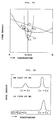
- Figs. 1A and 1B are typical diagrams showing free energy levels of binary system based alloys at arbitrary temperatures TK.
- Fig. 2 shows X-ray photographs showing the crystal structure of Al-15%Cr powder which was annealed at 740 K after the same was subjected to mechanical alloying for 1000 hours.
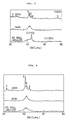
- Fig. 3 shows an X-ray diffraction pattern of Al-15%Cr powder which was annealed at 740 K and 920 K after the same was subjected to mechanical alloying for 1000 hours.
- Fig. 4 is an X-ray diffraction patten of pulverized powder of rapidly solidified Al-20at.%Cr foil, which was subjected to mechanical grinding for 300 hours, around heating.
- Fig. 5 is a DSC (differential scanning calorimeter) analysis diagram of pulverized powder of rapidly solidified Al-20at.%Cr foil, which was subjected to mechanical grinding, in continuous heating.
- DSC differential scanning calorimeter
- Table 2 shows the processes and characteristics of the as-obtained alloys. The contents of the processes described in the columns of steps 1 and 2 in Table 2 are as follows:
- the inventive amorphous alloy has characteristics which are further excellent as compared with those of a conventional crystalline type aluminum-transition element dispersion-strengthened heat resisting alloy.
- Figs. 1A and 1B showing free energy levels of binary system alloys.
- quasi-crystals etc. are activated from a level of C4 to a C2 level by mechanical grinding, and thereafter converted to a C3 level.
- the second method of the present invention the same enter the C1 to C2 levels in a mechanical alloying state, and converted to the C3 level by subsequent heating.
- the levels of C1 to C 2 are present as the result of a mixture of non-stoichiometric compounds (A n-x B m+x ) of crystalline materials having displaced compositions of C6 and C7, and the composition of A n B m is changed and distributed as A n-x B m+x in a partial view.
- the peak of the higher temperature side shows transition from the C3 level to the C5 level, i.e., energy release following crystallization.
- X-ray photographs of Fig. 2 show the crystal structure of Al-15%Cr powder, which was subjected to mechanical alloying for 1000 hours and thereafter annealed at 740 K.
- Fig. 3 shows an X-ray diffraction diagram of Al-15%Cr powder, which was subjected to mechanical alloying for 1000 hours and thereafter annealed at 740 K and 920 K.
- Fig. 4 shows an X-ray diffraction diagram of pulverized powder of rapidly solidified Al-20at.%Cr foil, which was subjected to mechanical grinding for 30 hours, around heating.
- Fig. 5 shows a DSC (scanning differential thermal capacity) analysis diagram of pulverized powder of rapidly solidified Al-20at.%Cr foil, which was subjected to mechanical grinding for each time, in continuous heating.
- DSC scanning differential thermal capacity
- the aluminum-chromium based alloy according to the present invention which has strength, heat resistance and wear resistance of iron and steel materials and lightweightness of an aluminum alloy as well as corrosion resistance of an amorphous alloy, is applicable to various uses such as an automobile, a domestic electric apparatus, an industrial apparatus, an aircraft, an electronic apparatus, a chemical apparatus, and the like.
Landscapes
- Chemical & Material Sciences (AREA)
- Engineering & Computer Science (AREA)
- Mechanical Engineering (AREA)
- Materials Engineering (AREA)
- Metallurgy (AREA)
- Organic Chemistry (AREA)
- Crystallography & Structural Chemistry (AREA)
- Manufacturing & Machinery (AREA)
- Chemical Kinetics & Catalysis (AREA)
- Powder Metallurgy (AREA)
- Manufacture Of Metal Powder And Suspensions Thereof (AREA)
Applications Claiming Priority (3)
| Application Number | Priority Date | Filing Date | Title |
|---|---|---|---|
| JP2065650A JPH03267355A (ja) | 1990-03-15 | 1990-03-15 | アルミニウム―クロミウム系合金およびその製法 |
| JP65650/90 | 1990-03-15 | ||
| PCT/JP1991/000336 WO1991014013A1 (fr) | 1990-03-15 | 1991-03-13 | Alliage d'aluminium et de chrome et production de cet alliage |
Publications (3)
| Publication Number | Publication Date |
|---|---|
| EP0474880A1 true EP0474880A1 (de) | 1992-03-18 |
| EP0474880A4 EP0474880A4 (en) | 1992-08-12 |
| EP0474880B1 EP0474880B1 (de) | 1996-02-07 |
Family
ID=13293098
Family Applications (1)
| Application Number | Title | Priority Date | Filing Date |
|---|---|---|---|
| EP91906271A Expired - Lifetime EP0474880B1 (de) | 1990-03-15 | 1991-03-13 | Aluminium-chrom-legierung und verfahren zur herstellung |
Country Status (5)
| Country | Link |
|---|---|
| US (1) | US5242513A (de) |
| EP (1) | EP0474880B1 (de) |
| JP (1) | JPH03267355A (de) |
| DE (1) | DE69116962T2 (de) |
| WO (1) | WO1991014013A1 (de) |
Cited By (3)
| Publication number | Priority date | Publication date | Assignee | Title |
|---|---|---|---|---|
| EP0532038B1 (de) * | 1991-09-13 | 1997-12-10 | Tsuyoshi Masumoto | Verfahren zur Herstellung von amorphen, metallischen Werkstoffe |
| EP0821072A1 (de) * | 1996-07-23 | 1998-01-28 | Akihisa Inoue | Hochverschleissfester Verbundwerkstoff auf Aluminium-basis und verschleissfeste Teile |
| WO2008050099A1 (en) * | 2006-10-24 | 2008-05-02 | Isis Innovation Limited | Metal matrix composite material |
Families Citing this family (7)
| Publication number | Priority date | Publication date | Assignee | Title |
|---|---|---|---|---|
| JP2911672B2 (ja) * | 1992-02-17 | 1999-06-23 | 功二 橋本 | 高耐食アモルファスアルミニウム合金 |
| US5494541A (en) * | 1993-01-21 | 1996-02-27 | Kabushiki Kaisha Toyota Chuo Kenkyusho | Production of aluminum alloy |
| GB2274656B (en) * | 1993-01-29 | 1996-12-11 | London Scandinavian Metall | Alloying additive |
| US5451377A (en) * | 1993-09-29 | 1995-09-19 | Rockwell International Corp. | Composite structures and methods of manufacturing such structures |
| RU2324753C2 (ru) * | 2005-08-18 | 2008-05-20 | Институт физики Дагестанского научного центра РАН | Способ легирования хромом алюминия |
| DE102009051147A1 (de) * | 2008-10-30 | 2010-05-06 | Zoz Gmbh | Verfahren zur Herstellung von Metall-Flakes |
| DE102018115815B4 (de) * | 2018-06-29 | 2025-07-17 | Amorphous Metal Solutions GmbH | Vorrichtung und Verfahren zur Herstellung eines aus einem amorphen oder teilamorphen Metall gebildeten Gussteils |
Family Cites Families (11)
| Publication number | Priority date | Publication date | Assignee | Title |
|---|---|---|---|---|
| GB1476589A (en) * | 1974-08-07 | 1977-06-16 | Allied Chem | Amorphous metal alloys |
| JPS5524949A (en) * | 1978-08-11 | 1980-02-22 | Hitachi Ltd | Manufacture of graphite-containing aluminium alloy |
| US4347076A (en) * | 1980-10-03 | 1982-08-31 | Marko Materials, Inc. | Aluminum-transition metal alloys made using rapidly solidified powers and method |
| FR2529909B1 (fr) * | 1982-07-06 | 1986-12-12 | Centre Nat Rech Scient | Alliages amorphes ou microcristallins a base d'aluminium |
| JPS6237335A (ja) * | 1985-08-09 | 1987-02-18 | Yoshida Kogyo Kk <Ykk> | 高耐食高強度アルミニウム合金 |
| JPS62240727A (ja) * | 1986-04-11 | 1987-10-21 | Toyota Motor Corp | 短繊維及びチタン酸カリウムホイスカ強化金属複合材料 |
| JPS63153237A (ja) * | 1986-08-27 | 1988-06-25 | Masumoto Takeshi | アルミニウム基非晶質合金 |
| JPS6447831A (en) * | 1987-08-12 | 1989-02-22 | Takeshi Masumoto | High strength and heat resistant aluminum-based alloy and its production |
| JPH01127641A (ja) * | 1987-11-10 | 1989-05-19 | Takeshi Masumoto | 高力、耐熱性アルミニウム基合金 |
| JPH0621326B2 (ja) * | 1988-04-28 | 1994-03-23 | 健 増本 | 高力、耐熱性アルミニウム基合金 |
| JP2987704B2 (ja) * | 1988-07-15 | 1999-12-06 | 財団法人鉄道総合技術研究所 | 高速鉄道車両用ブレーキディスク材 |
-
1990
- 1990-03-15 JP JP2065650A patent/JPH03267355A/ja active Pending
-
1991
- 1991-03-13 WO PCT/JP1991/000336 patent/WO1991014013A1/ja not_active Ceased
- 1991-03-13 US US07/773,636 patent/US5242513A/en not_active Expired - Fee Related
- 1991-03-13 EP EP91906271A patent/EP0474880B1/de not_active Expired - Lifetime
- 1991-03-13 DE DE69116962T patent/DE69116962T2/de not_active Expired - Fee Related
Non-Patent Citations (1)
| Title |
|---|
| See references of WO9114013A1 * |
Cited By (4)
| Publication number | Priority date | Publication date | Assignee | Title |
|---|---|---|---|---|
| EP0532038B1 (de) * | 1991-09-13 | 1997-12-10 | Tsuyoshi Masumoto | Verfahren zur Herstellung von amorphen, metallischen Werkstoffe |
| EP0821072A1 (de) * | 1996-07-23 | 1998-01-28 | Akihisa Inoue | Hochverschleissfester Verbundwerkstoff auf Aluminium-basis und verschleissfeste Teile |
| US6074497A (en) * | 1996-07-23 | 2000-06-13 | Akihisa Inoue | Highly wear-resistant aluminum-based composite alloy and wear-resistant parts |
| WO2008050099A1 (en) * | 2006-10-24 | 2008-05-02 | Isis Innovation Limited | Metal matrix composite material |
Also Published As
| Publication number | Publication date |
|---|---|
| WO1991014013A1 (fr) | 1991-09-19 |
| EP0474880A4 (en) | 1992-08-12 |
| EP0474880B1 (de) | 1996-02-07 |
| JPH03267355A (ja) | 1991-11-28 |
| US5242513A (en) | 1993-09-07 |
| DE69116962T2 (de) | 1997-03-06 |
| DE69116962D1 (de) | 1996-03-21 |
Similar Documents
| Publication | Publication Date | Title |
|---|---|---|
| US20200149144A1 (en) | High Entropy Alloy Having Composite Microstructure and Method of Manufacturing the Same | |
| US11603583B2 (en) | Ribbons and powders from high strength corrosion resistant aluminum alloys | |
| EP0675209B1 (de) | Hochfeste Aluminiumlegierung | |
| US11807927B2 (en) | Complex copper alloy including high-entropy alloy and method of manufacturing same | |
| US4582536A (en) | Production of increased ductility in articles consolidated from rapidly solidified alloy | |
| EP0587186B1 (de) | Hochfeste, wärmeresistente Legierung auf Aluminiumbasis | |
| KR102663387B1 (ko) | 스피노달 분해를 이용한 경량 중엔트로피 합금 | |
| US4676829A (en) | Cold worked tri-nickel aluminide alloy compositions | |
| US20190017150A1 (en) | Cr Filament-Reinforced CrMnFeNiCu(Ag)-Based High-Entropy Alloy and Method for Manufacturing the Same | |
| EP0584596A2 (de) | Rostfeste und hochfeste Aluminiumlegierung | |
| EP0474880B1 (de) | Aluminium-chrom-legierung und verfahren zur herstellung | |
| EP0905268A1 (de) | Hochfeste amorphe Legierung und Verfahren zu deren Herstellung | |
| JP2749761B2 (ja) | 高耐力・高靭性アルミニウム合金粉末の粉末鍛造方法 | |
| US5000910A (en) | Method of manufacturing intermetallic compound | |
| EP0540055B1 (de) | Hochfeste Legierung auf Aluminiumbasis mit hoher Zähigkeit | |
| EP0875593B1 (de) | Aluminium-Legierung und Verfahren zu ihrer Herstellung | |
| JP2807374B2 (ja) | 高強度マグネシウム基合金およびその集成固化材 | |
| EP0534155B1 (de) | Kompaktierter und verstärkter Werkstoff aus Aluminium-Legierung und Verfahren zur Herstellung | |
| JPH073375A (ja) | 高強度マグネシウム合金及びその製造方法 | |
| JP3626507B2 (ja) | 高強度高延性TiAl系金属間化合物 | |
| JP3203564B2 (ja) | アルミニウム基合金集成固化材並びにその製造方法 | |
| JP3485961B2 (ja) | 高強度アルミニウム基合金 | |
| EP0643145B1 (de) | Hochfeste Werkstoffe auf Legierungen auf Magnesiumbasis und Verfahren zur Herstellung dieser Werkstoffe | |
| US4523950A (en) | Boron containing rapid solidification alloy and method of making the same | |
| JP3299404B2 (ja) | 高強度アルミニウム合金およびその製造方法 |
Legal Events
| Date | Code | Title | Description |
|---|---|---|---|
| PUAI | Public reference made under article 153(3) epc to a published international application that has entered the european phase |
Free format text: ORIGINAL CODE: 0009012 |
|
| 17P | Request for examination filed |
Effective date: 19911112 |
|
| AK | Designated contracting states |
Kind code of ref document: A1 Designated state(s): DE FR GB |
|
| A4 | Supplementary search report drawn up and despatched |
Effective date: 19920623 |
|
| AK | Designated contracting states |
Kind code of ref document: A4 Designated state(s): DE FR GB |
|
| 17Q | First examination report despatched |
Effective date: 19940609 |
|
| GRAA | (expected) grant |
Free format text: ORIGINAL CODE: 0009210 |
|
| AK | Designated contracting states |
Kind code of ref document: B1 Designated state(s): DE FR GB |
|
| PGFP | Annual fee paid to national office [announced via postgrant information from national office to epo] |
Ref country code: GB Payment date: 19960223 Year of fee payment: 6 |
|
| PGFP | Annual fee paid to national office [announced via postgrant information from national office to epo] |
Ref country code: FR Payment date: 19960318 Year of fee payment: 6 |
|
| REF | Corresponds to: |
Ref document number: 69116962 Country of ref document: DE Date of ref document: 19960321 |
|
| ET | Fr: translation filed | ||
| PGFP | Annual fee paid to national office [announced via postgrant information from national office to epo] |
Ref country code: DE Payment date: 19960530 Year of fee payment: 6 |
|
| PLBE | No opposition filed within time limit |
Free format text: ORIGINAL CODE: 0009261 |
|
| STAA | Information on the status of an ep patent application or granted ep patent |
Free format text: STATUS: NO OPPOSITION FILED WITHIN TIME LIMIT |
|
| 26N | No opposition filed | ||
| PG25 | Lapsed in a contracting state [announced via postgrant information from national office to epo] |
Ref country code: GB Effective date: 19970313 |
|
| GBPC | Gb: european patent ceased through non-payment of renewal fee |
Effective date: 19970313 |
|
| PG25 | Lapsed in a contracting state [announced via postgrant information from national office to epo] |
Ref country code: FR Free format text: LAPSE BECAUSE OF NON-PAYMENT OF DUE FEES Effective date: 19971128 |
|
| PG25 | Lapsed in a contracting state [announced via postgrant information from national office to epo] |
Ref country code: DE Effective date: 19971202 |
|
| REG | Reference to a national code |
Ref country code: FR Ref legal event code: ST |