EP0475266B2 - Schrumpfbeutel mit integralem Handgriff und Verfahren zur Herstellung desselben - Google Patents
Schrumpfbeutel mit integralem Handgriff und Verfahren zur Herstellung desselben Download PDFInfo
- Publication number
- EP0475266B2 EP0475266B2 EP91114949A EP91114949A EP0475266B2 EP 0475266 B2 EP0475266 B2 EP 0475266B2 EP 91114949 A EP91114949 A EP 91114949A EP 91114949 A EP91114949 A EP 91114949A EP 0475266 B2 EP0475266 B2 EP 0475266B2
- Authority
- EP
- European Patent Office
- Prior art keywords
- bag
- heat
- heat seal
- panels
- Prior art date
- Legal status (The legal status is an assumption and is not a legal conclusion. Google has not performed a legal analysis and makes no representation as to the accuracy of the status listed.)
- Expired - Lifetime
Links
Images

Classifications
-
- B—PERFORMING OPERATIONS; TRANSPORTING
- B65—CONVEYING; PACKING; STORING; HANDLING THIN OR FILAMENTARY MATERIAL
- B65D—CONTAINERS FOR STORAGE OR TRANSPORT OF ARTICLES OR MATERIALS, e.g. BAGS, BARRELS, BOTTLES, BOXES, CANS, CARTONS, CRATES, DRUMS, JARS, TANKS, HOPPERS, FORWARDING CONTAINERS; ACCESSORIES, CLOSURES, OR FITTINGS THEREFOR; PACKAGING ELEMENTS; PACKAGES
- B65D75/00—Packages comprising articles or materials partially or wholly enclosed in strips, sheets, blanks, tubes or webs of flexible sheet material, e.g. in folded wrappers
- B65D75/52—Details
- B65D75/54—Cards, coupons or other inserts or accessories
- B65D75/56—Handles or other suspension means
- B65D75/563—Integral handles or suspension means
-
- B—PERFORMING OPERATIONS; TRANSPORTING
- B65—CONVEYING; PACKING; STORING; HANDLING THIN OR FILAMENTARY MATERIAL
- B65B—MACHINES, APPARATUS OR DEVICES FOR, OR METHODS OF, PACKAGING ARTICLES OR MATERIALS; UNPACKING
- B65B25/00—Packaging other articles presenting special problems
- B65B25/06—Packaging slices or specially-shaped pieces of meat, cheese, or other plastic or tacky products
- B65B25/064—Packaging slices or specially-shaped pieces of meat, cheese, or other plastic or tacky products of poultry
-
- B—PERFORMING OPERATIONS; TRANSPORTING
- B65—CONVEYING; PACKING; STORING; HANDLING THIN OR FILAMENTARY MATERIAL
- B65D—CONTAINERS FOR STORAGE OR TRANSPORT OF ARTICLES OR MATERIALS, e.g. BAGS, BARRELS, BOTTLES, BOXES, CANS, CARTONS, CRATES, DRUMS, JARS, TANKS, HOPPERS, FORWARDING CONTAINERS; ACCESSORIES, CLOSURES, OR FITTINGS THEREFOR; PACKAGING ELEMENTS; PACKAGES
- B65D75/00—Packages comprising articles or materials partially or wholly enclosed in strips, sheets, blanks, tubes or webs of flexible sheet material, e.g. in folded wrappers
- B65D75/002—Packages comprising articles or materials partially or wholly enclosed in strips, sheets, blanks, tubes or webs of flexible sheet material, e.g. in folded wrappers in shrink films
-
- B—PERFORMING OPERATIONS; TRANSPORTING
- B31—MAKING ARTICLES OF PAPER, CARDBOARD OR MATERIAL WORKED IN A MANNER ANALOGOUS TO PAPER; WORKING PAPER, CARDBOARD OR MATERIAL WORKED IN A MANNER ANALOGOUS TO PAPER
- B31B—MAKING CONTAINERS OF PAPER, CARDBOARD OR MATERIAL WORKED IN A MANNER ANALOGOUS TO PAPER
- B31B70/00—Making flexible containers, e.g. envelopes or bags
- B31B70/74—Auxiliary operations
- B31B70/86—Forming integral handles or mounting separate handles
- B31B70/874—Forming integral handles or mounting separate handles involving punching or cutting
Definitions
- the present invention relates generally to shrink bags as may be used for packaging food products and more specifically to a heat shrinkable bag having an integral carrying handle.
- the poultry carcass is generally the shape of a tear drop having a broad rounded breast portion tapering to the tail of the bird.
- the tear drop shape is accentuated by the customary practice of folding the legs of the bird close to the body and binding the end of the legs to the tail of the bird. This tear drop shape does not lend itself to formation of a substantially wrinkle free package even when using shrink film.
- a bag fabricated to accommodate a whole bird generally has front and rear panels composed of a heat shrinkable plastic film which are heat sealed together at the closed end of the bag. It is common to have the closed end of the bag convex to accommodate the broad rounded breast of the bird. The opposite open end of the bag must be wide enough to receive the bird which is inserted breast first into the bag. If the wide bag opening is stretched to a flat width and heat sealed straight across the bag, a considerable amount of unfilled bag material remains extended across the tail of the bird. On heat shrinking, only a portion of this material conforms to the tapered contour of the bird whereas the remainder forms an unattractive flange which increases in width towards the tail of the bird.
- Another problem related to packaging turkeys and the like in shrink bags is that the resulting packaged product is bulky, relatively heavy, usually frozen, and difficult to manually grasp and lift. Therefore it is desirable to provide a carrying handle to facilitate handling the vacuum packaged product. For this purpose a separate handle is attached to the packaged product at the clip closure or the product is inserted into a netting which is gathered and dipped to provide a carrying handle. Both arrangements add to the packaging costs.
- the handle should be formed integral with the bag to avoid the added expense and processing steps of attaching a handle to the packaged product.
- a handle located at the tail of the bird is preferred as this leaves the package over the breast area of the bird free to receive printed information such as a decorative design, corporate logo or other identifying product information.
- a handle at the tail of the bird provides a desirable weight distribution in that the heavier breast portion of the bird is carried below the lighter tail portion.
- GB-A-2 189 220 already discloses a flexible packaging container formed of shrinkable plastic film and comprising a product-enclosing space having a margin defined by a transverse heat seal, and film material between said heat seal margin and an edge of the container, with at least one hole having a closed periphery formed in the material between the edge of the margin, to define suspension means for a finished package formed from the container.
- the at least one hole is disposed at the end of the container remote from the open end of the container through which the product is inserted.
- US-A-4 555 025 discloses a heat shrinkable bag comprising: front and rear panels of a thermoplastic heat shrinkable material defining the front and rear of a bag pocket, the panels being joined leak-tight along side edges and having common ends including a first end and an opposite end; and a continuous transverse heat seal connecting said front and rear panels adjacent to said first end, said heat seal defining the closed bottom of said bag pocket for containing an article to be packaged which is inserted into said bag through said opposite open end.
- This patent also discloses a method of making a shrink bag comprising: providing front and rear bag panels of a thermosetting heat sealable material in a layflat condition, said panels joined leak-tight along side edges to form a bag pocket and having common ends including a first end and an opposite end; and heat sealing said bag panels together adjacent to said first end thereby forming a continuous transverse heat seal which defines a leak-tight bag pocket closed bottom.
- the prior bag is a so called "extended lip bag” wherein one bag panel extends beyond the bag open end.
- a handle is formed in the extended lip portion by punching a hot die through the lip to provide an opening having a fused bead extending continuously about the opening. Formation of the opening in the lip is essential because inserting the hot die through the bag at any other location will fuse the bag panels together thereby partly occluding the bag.
- the extended lip thickens and forms a handle which protrudes longitudinally from the resulting package.
- an object of the present invention is to provide a shrink bag having an integral handle positioned so as not to occlude any portion of the bag opening.
- Yet another object of the present invention is to provide a shrink bag with an integral carrying handle wherein the bag is especially adapted for packaging whole body poultry such as turkeys and the like.
- a further object of the present invention is to provide a shrink bag having an integral handle portion located at the end of the bag opposite its open end.
- a still further object is to provide a shrink bag having an integral handle which lies close to the surface of the resulting package.
- the subject invention relates to a heat shrinkable bag as defined in claim 1 and a method of making a shrink bag as defined in claim 12.
- a shrink bag according to the present invention has an open end for loading a product into the bag and a closed end wherein a handle forming portion of the bag is adjacent the closed end.
- the bag of the present invention is particularly adapted for use in packaging whole body poultry such as turkeys and the like. For this reason the bag is described in reference to a preferred packaging use as a turkey or a whole body poultry bag.
- the shrink bag of the present invention has a closed end formed to receive the tapered configuration of the tail portion of the bird.
- the closed end of the bag preferably is formed by heat sealing wherein the heat seal is generally concave across the bag to form a deep bag pocket for receiving the tapered tail end of the bird.
- a skirt portion extending from this heat seal contains a slit which forms a handle opening.
- the bag handle is formed from portion of the material of the skirt at the closed end of the bag and to a large extent is formed of the excess bag material heretofore pulled or gathered around the tail to prepare the bag for a clip closure.
- the bird is loaded tail first through the bag opening.
- the bag is evacuated and then the bag opening is then closed, preferably by stretching it to a flat width and heat sealing around the breast of the bird. Closing the bag about the breast of the bird in this fashion requires significantly less gathering than if the bag is closed about the tail. On subsequent heat shrinking, the resulting flange of bag material around the breast of the bird is considerably reduced from the flange created when heat sealing straight across the bag at the tail end of the bird.
- the bag is formed to accommodate the tapered, tear drop-shaped configuration of the tail end of the bird so the area of bag material subject to heat shrinking about the tail is reduced.
- the result, on heat shrinking, is a more aesthethically appealing package in that the bag material around the entire bird is smooth, taut and substantially wrinkle-free.
- Figure 1 shows a bag of the present invention generally indicated at 10 in its lay-flat condition prior to its packaging use.
- the bag is made of any suitable heat shrinkable thermoplastic packaging film commonly used for vacuum packaging food products.
- a suitable film is an oriented heat shrinkable film as disclosed for example in U.S. Patent No. 4,863,769.
- such films are formed as blown tubes.
- the tube is collapsed to a lay-flat condition to provide superimposed front and rear bag panels having seamless side edges.
- the laid-flat tube is then heat-sealed across its width to form a dosed bag end and then it is severed at a location spaced from the heat seal to provide an open bag end.
- Figure 1 shows the bag 10 to have superimposed front and rear panels 12 and 14 respectively.
- the front and rear panels are congruent and lay flat one against the other.
- the panels are joined along lateral side edges 16, 18. If the bag is made of a collapsed tube as noted above, the side edges 16, 18 are seamless. Otherwise one or both side edges 16, 18 contain a seam such as is formed by heat sealing or an adhesive for connecting the panels.
- the congruent bag panels 12, 14 have common ends 20 and 22 wherein end 22 is the open end of the bag.
- the panels at end 20 are optionally connected such as by heat sealing the panels together.
- the front and rear panels 12, 14 are connected by a heat seal generally indicated at 24 which extends across the bag inboard of the end 20.
- This heat seal 24 defines the closed bottom of a bag pocket for containing an article to be packaged which is inserted into the bag through the open end 22.
- the sides of the bag pocket are formed by bag panels 12, 14.
- the heat seal 24 forming the bottom of a bag pocket may extend straight across the bag.
- the heat seal is shaped to conform generally with an end of an article to be inserted into the bag pocket and against the bottom of the bag.
- the heat seal provides a deep cavity shape able to accommodate the tapered configuration of the tail end of a bird such as a turkey or the like.
- Figure 1 shows that the heat seal 24 has generally linear side portions 30, 32 which extend from each side edge 16, 18 respectively and angle inward toward the longitudinal axis of the bag in the direction away from the open end 22. These two side portions 30, 32 converge toward each other and merge with an arcuate transverse base portion 34 so there is a smooth continuous transition from one angled side portion 30, 32 to the other.
- the result is that the closed bottom of a bag pocket as defined by heat seal 24 provides a deep concave pocket able to accommodate the tail end portion of a turkey or the like when the bag is open from its lay-flat condition.
- the portion of the bag panels 12, 14 between heat seal 24 and end 20 defines a skirt 26 at the end of the bag opposite open end 22.
- the skirt includes the bag end 20 and contains a generally centrally oriented slit 28.
- the slit can be formed by any suitable means which cuts through both bag panels.
- the slit is formed by a hot knife which burns through the bag panels and in the process welds the panels together at the slit margins.
- the slit forms an opening to facilitate use of the skirt as a bag handle for carrying an article sealed within the bag.
- the placement and configuration of the slit is important to a proper functioning of the skirt as a bag handle.
- the ends 36, 38 of the slit should be angled towards the bag side edges 16, 18 in the direction of the bag opening 22. This will help to avoid stress concentrations at the end of the slit that might cause the skirt to tear when lifting an article sealed in the bag.
- the distance between the slit and the heat seal 24 in the region indicated at 23 must be sufficient to avoid the propagation of stress concentration into the heat seal 24 which might cause the heat seal to tear.
- the distance between the slit and the end 20 of the bag in the region indicated at 25 must be sufficient to provide a handle to support the product packaged within the bag. The adjustment of these parameters to provide an appropriate configuration and location for the slit in order to provide a handle able to support the weight of the packaged product is well within the skill of the art.
- FIG 2 shows a package generally indicated at 41 formed using the bag of Figure 1.
- a bird such as a turkey or the like is loaded tail first into the bag of Figure 1 through its open end 22.
- the tail portion of the bird generally fits and is received into the concave bottom of the bag pocket defined by heat seal 24.
- the bag is evacuated and the open end of the bag is stretched to a flat width and is sealed, preferably by a heat seal 40, as shown in Figure 2, around the breast portion of the bird.
- the sealed bag is then immersed in hot water or otherwise heated to shrink the bag about the bird (or other product) contained within the bag.
- the bag material becomes tight to the bird to provide a smooth generally wrinkle-free package.
- wrinkles or other stretch lines at the tail end portion of the bird are eliminated since the deep cavity of the bag pocket provided by the contour of heat seal 24 conforms to the shape of the tail end portion.
- any printing on the bag is not obscured or truncated by creases and folds otherwise produced if the bag open end is gathered around the tail end of the bird.
- the portion 25 ( Figure 1) of the skirt material between the slit 28 and bag end 20 shrinks and pulls away from the slit.
- the shrink of the skirt material 23 between the slit and heat seal 24 is restrained somewhat by the product within the bag.
- the result as shown in Figure 2, is that the skirt portion 25 of Figure 1 shrinks inward towards heat seal 24 and draws over and across the bag pocket formed by the congruent panels 12, 14.
- the handle may extend and locate either over the top of the bag package 41 as shown in solid line ( Figures 2 and 3) or it can extend and locate across the back of the package as shown in dotted line in Figure 3. If the skirt portion 25 does not initially shrink and draw to a desired location (front or back of package 41), it is easily stretched and pulled over the end of the package (now defined by heat seal 24) to a desired position (front or back).
- slit 28 provides sufficient clearance between the handle and the surface of the package 41 to permit the insertion of one's hand to grasp the handle. Subsequently, when the handle is gripped and the package lifted, the handle will stretch from the package as shown in Figure 4. However, prior to gripping and lifting, the handle is located substantially within the general perimeter of the package. This facilitates locating the handle when a plurality of the packages are heaped together as in a frozen foods case.
- the heat shrunk bag package 41 as shown in Figures 2-4 is preferred for poultry such as turkeys and the like.
- the handle 42 is located at the tail of the bird which provides a desirable weight distribution when lifting and handling the bag package in that the heavier breast portion 44 is lowermost.
- the broad area of the bag around the breast of the bird, as indicated at 44, is unobstructed and available for receiving printed matter.
- Figure 5 shows another embodiment having the bag handle forming slit in the form of perforations 50. These perforations weaken the connection of the skirt portion 25 to the bag but maintains a connection so the skirt portion 25 remains associated with the bag.
- the spacing of the perforations 50 is such that upon heat shrinking, the shrink induced stresses are sufficient to separate the skirt portion 25 by tearing along the line of the perforations. Otherwise, the separation can be accomplished by manually tearing along the line of perforations.
- Figure 5 shows a heat seal 52 which connects the front and rear panels 12, 14 and circumscribes the line of perforations 50.
- the heat seal 52 adjoining the front and rear panels can have a width sufficient to accommodate the line of perforations 50 so these perforations are made in the heat sealed material.
- FIG. 6 shows one embodiment wherein a tag 54 is attached to the bag pocket forming heat seal 24.
- the tag preferably is of a heat sealable plastic film which has little or no heat shrink properties. This allows the entire area of the as-attached tag to be used for later-applied information such as the weight and price of the product contained in the shrink bag package.
- a suitable plastic film for this purpose has been found to be a sheet of spun bonded linear polyethylene fiber as sold by DuPont under the brand name TYVEK.
- the tag should be oriented so it overlaps a bag pocket forming portion of the front and rear panels 12, 14 and does not overlay the skirt portion 26. This is to avoid mistaking the tag for a handle because it is possible that if a bag containing a turkey is lifted by the tag the tag could tear out and break open the sealed package.
- the tag 54 also can be located at the terminal end 20 of the bag in cases where this end is formed by heat sealing as shown in Figure 7.
- a second heat seal 56 longitudinally spaced and generally parallel to heat seal 24 defines the end 20 of the bag and the tag 54 is attached to the bag by this second heat seal.
- the tag 54 is positioned near a lateral side edge of the bag to minimize the possibility of mistaking the tag for a handle.
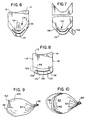
- Figure 8 illustrates another embodiment of the invention wherein the closed bottom of the bag pocket is formed by a heat seal 58 which is curved across the bag.
- This shape accommodates the rounded breast portion of a turkey or the like inserted breast first through the open bag end (not shown) opposite bottom 58.
- Adjacent the curved heat seal 58 is a skirt 126 formed by the portion of the congruent front and rear panels 112, 114 which extend from the heat seal to the end 120 of the bag.
- Skirt has a slit 128 which forms a bag handle opening. This slit is arcuate so it extends generally parallel with the heat seal 58 wherein the end portions 136, 138 of the slit are angled towards the lateral edges 116, 118 respectively.
- This shape acts to relieve stress concentrations at the ends of the slit so as to reduce the likelihood of tearing when lifting a heat shrunk bag containing a heavy bird or another food product.
Landscapes
- Engineering & Computer Science (AREA)
- Mechanical Engineering (AREA)
- Packages (AREA)
- Bag Frames (AREA)
- Making Paper Articles (AREA)
- Purses, Travelling Bags, Baskets, Or Suitcases (AREA)
Claims (15)
- Wärmeschrumpfbarer Beutel zum Verpacken von sperrigen Nahrungsmittelartikeln mit:(a) einer vorderen und einer hinteren Lage (12, 14, 112, 114) aus einem thermoplastischen, wärmeschrumpfbaren Werkstoff, welche die Vorderseite und die Rückseite einer Beuteltasche bilden, wobei die Lagen entlang Seitenrändern (16, 18, 116, 118) leckdicht verbunden sind und gemeinsame Enden aufweisen, zu denen ein erstes Ende (20, 120) und ein gegenüberliegendes offenes Ende (22) gehören; und(b) einer durchgehenden, querverlaufenden Heißversiegelung (24, 58), welche die vordere und die hintere Lage (12, 14, 112, 114) benachbart dem ersten Ende (20, 120) miteinander verbindet, wobei die Heißversiegelung (24, 58) den geschlossenen Boden der Beuteltasche zur Aufnahme eines zu verpackenden Artikels bildet, der in den Beutel durch das gegenüberliegende offene Ende (22) hindurch eingebracht wird; wobei die querverlaufende Heißversiegelung (24, 58) in Abstand von dem ersten Ende (20, 120) liegt; und(c) einem von der vorderen und der hinteren Lage (12, 14, 112, 114) zwischen dem ersten Ende (20, 120) und der Heißversiegelung (24, 58) an dem geschlossenen Boden der Beuteltasche gegenüber dem offenen Ende (22) gebildeten Saum (26, 126), wobei der Saum (26, 126) mit einem durch die Lagen (12, 14, 112, 114) hindurchgehenden Querschlitz (28, 50, 128) versehen ist und einen zwischen diesen, Schlitz und dem ersten Ende (20, 120) liegenden Teil aufweist, der nach Evakuieren, Versiegeln und Wärmeschrumpfen des einen Artikel enthaltenden Beutels (10) einen Griffteil (42, 142) zum Fassen und Tragen des den Artikel enthaltenden Beutels (10) bildet, wobei(d) sich die Heißversiegelung (24, 58) in einem Bogen über den Beutel (10) erstreckt, so daß die Beuteltasche einen im wesentlichen konkaven geschlossenen Boden erhält;(e) der Schlitz (28, 50, 128) im wesentlichen bogenförmig ausgebildet ist und parallel zu der Heißversiegelung (24, 58) verläuft;(f) der Schlitz (28, 50, 128) Endabschnitte (36, 38, 136, 138) aufweist, die sich mit divergierenden Winkeln in Richtung auf jeden Seitenrand (16, 18, 116, 118) des Beutels (10) in Richtung des offenen Endes (22) erstrecken, um Spannungskonzentrationen an den Schlitzendabschnitten zu minimieren, wenn der Beutel angehoben wird, nachdem ein Artikel in der Beuteltasche versiegelt ist; und(g) sich ein zwischen dem Schlitz (28, 50, 128) und dein ersten Ende (20, 120) liegender Saumteil (25, 125) beim Wärmeschrumpfen des einen Artikel enthaltenden Beutels (10) in Richtung auf die querverlaufende Heißversiegelung (24, 58) zieht und einen Beutelhandgriff (42, 142) bildet, der quer über die Beuteltasche reicht.
- Wärmeschrumpfbarer Beutel nach Anspruch 1 mit einer zweiten querverlaufenden Heißversiegelung (56), welche die Lagen (12, 14) an dein ersten Ende (20) verbindet.
- Wärmeschrumpfbarer Beutel nach Anspruch 2 mit einen, Anhänger (54) aus heißsiegelbarem, nicht wärmeschrumpfbarem Werkstoff, der an dem Beutel an dein ersten Ende (20) mittels der zweiten Heißversiegelung (56) angebracht ist.
- Wärmeschrumpfbarer Beutel nach einem der Ansprüche 1 oder 2 mit einem Anhänger (54) aus heißsiegelbarem, nicht wärmeschrumpfbarem Werkstoff, der an dem Beutel (10) mittels der querverlaufenden Heißversiegelung (24) angebracht ist.
- Wärmeschrumpfbarer Beutel nach einem der vorhergehenden Ansprüche, bei dem die Seitenränder (16, 18, 116, 118) nahtlos sind.
- Wärmeschrumpfbarer Beutel nach einem der Ansprüche 1 bis 4, bei dem die Seitenränder Heißversiegelungen sind, welche die vordere und die hintere Lage miteinander verbinden.
- Wärmeschrumpfbarer Beutel nach einem der vorhergehenden Ansprüche, bei dem die erste Heißversiegelung (24) versehen ist mit:(a) linearen Seitenteilen (30, 32), die sich von jedem Lagenseitenrand (16, 18) in einem Winkel in einer Richtung weg von dem offenen Ende (22) erstrecken; und(b) einem gekrümmten, querverlaufenden Basisteil (34), der einen glatten Übergang von dem einen abgewinkelten Seitenteil zu dein anderen bildet, so daß die Heißversiegelung (24) die Beuteltasche mit einem konkaven, geschlossenen Boden versieht, der zur Aufnahme der sich verjüngenden Schwanz- und Schenkelteile eines ganzen Federviehs eignet, das mit dem Schwanz zuerst durch das offene Ende (22) hindurch eingebracht wird.
- Wärmeschrumpfbarer Beutel nach Anspruch 7, bei dem der Schlitz (28) Endabschnitte (36, 38) aufweist, die im wesentlichen in der gleichen Richtung abgewinkelt sind, wie die linearen Seitenteile (30, 32) der Heißversiegelung.
- Wärmeschrumpfbarer Beutel nach einem der vorhergehenden Ansprüche, bei dem der Schlitz eine Mehrzahl von in Abstand voneinander liegenden Perforationen (50) aufweist.
- Wärmeschrumpfbarer Beutel nach Anspruch 9, bei den, die Lagen (12, 14) in einem Bereich miteinander heißversiegelt sind, der benachbart dem Schlitz liegt und sich um diesen herum erstreckt.
- Wärmeschrumpfbarer Beutel nach Anspruch 1, bei dem(a) das erste Ende (20) geschlossen ist;(b) das geschlossene Ende (20) von der innenliegenden Heißversiegelung (24) und einer in Längsabstand davon angeordneten außenliegenden Heißversiegelung (56) gebildet ist, wobei beide Heißversiegelungen (24, 56) die Beutellagen (12, 14) verbinden und sich quer über die Lagen von dem einen Seitenrand (16) zum anderen (18) erstrecken;(c) die innenliegende Heißversiegelung (24) eine im wesentlichen konkave Tasche bildet, die eine solche Form hat, daß sie die sich im wesentlichen verjüngenden Schwanz- und Schenkelteile eines ganzen Federviehs aufnimmt, das mit dem Schwanz zuerst durch das offene Ende (22) hindurch eingebracht wird;(d) die außenliegende Heißversiegelung (56) zusammen mit der innenliegenden Heißversiegelung (24) den Saum (26) an dem dem offenen Ende (22) gegenüberliegenden Ende des Beutels (10) bildet; und(e) ein Teil (25) des Saums (26) zwischen dem den Handgriff bildenden Schlitz (28) und der außenliegenden Heißversiegelung (56) sich in Richtung auf die innenliegende Heißversiegelung (24) zieht und über die Beuteltasche legt, wenn der Beutel uni ein in der Beuteltasche eingesiegeltes ganzes Federvieh herum wärmegeschrumpft wird, wodurch der Handgriff (42) gebildet wird.
- Verfahren zum Herstellen eines Schrumpfbeutels, bei dem(a) eine vordere und eine hintere Beutellage (12, 14, 112, 114) aus einem wärmehärtbaren, heißsiegelbaren Werkstoff in flach liegendem Zustand vorgesehen werden, wobei diese Lagen entlang Seitenrändern (16, 18, 116, 118) unter Bildung einer Beuteltasche leckdicht verbunden sind und gemeinsame Enden aufweisen, zu denen ein erstes Ende (20, 120) und ein gegenüberliegendes Ende (22) gehören;(b) die Beutellagen(12, 14, 112, 114) benachbart zu in Abstand von dem ersten Ende (20, 120) miteinander heißversiegelt werden wodurch eine durchgehende, querverlaufende Heißversiegelung (24, 58) entsteht, die einen leckdichten, geschlossenen Beuteltaschenboden bildet und die sich in einem Bogen über den Beutel (10) erstreckt, so daß die Beuteltasche einen im wesentlichen konkaven geschlossenen Boden erhält;(c) durch den ersten zwischen dem leckdichten, geschlossenen Beuteltaschenboden und dem ersten Ende (20, 120) liegenden Teil der Lagen (12, 14, 112, 114) ein Querschlitz (28, 50, 128) geschnitten wird, der im wesentlichen bogenförmig ausgebildet ist und parallel zu der Heißversiegelung (24, 58) verläuft und der Endabschnitte (36, 38, 136, 138) aufweist, die sich mit divergierenden Winkeln in Richtung aufjeden Seitenrand (16, 18, 116, 118) des Beutels (10) in Richtung des offenen Endes (22) erstrecken, um Spannungskonzentration an den Schlitzendabschnitten zu minimieren, wenn der Beutel angehoben wird, nachdem ein Artikel in der Beuteltasche versiegelt ist, und das erste Ende (20, 120) und dieser Schlitz (28, 50, 128) einen Saumteil (25, 125) bestimmen, der sich beim Wärmeschrumpfen des Beutels (10) um ein in dem Beutel leckdicht versiegeltes Produkt in Richtung auf die querverlaufende Heißversiegelung zieht und einen integralen Beutelhandgriff (42, 142) bildet, der sich benachbart dem Beuteltaschen-Bodenende öffnet und der quer über die Beuteltasche reicht.
- Verfahren nach Anspruch 12, bei dem die Heißversiegelung für ein leckdichtes, geschlossenes Beuteltaschen-Bodenende sorgt, das versehen ist mit:(a) linearen Seitenteilen (30, 32), die von jedem Lagenseitenrand (16, 18) in einer von dem offenen Ende (22) wegführenden Richtung abgewinkelt sind; und(b) einem gekrümmten, querverlaufenden Basisteil (34), das für einen glatten Übergang von einem abgewinkelten Teil zu dem anderen sorgt, so daß die Heißversiegelung den Beutel (10) beim Öffnen der Lagen (12, 14) von dem flachliegenden Zustand mit einer relativ tiefen, konkaven Beuteltasche versieht.
- Verfahren nach Anspruch 12 oder 13, bei dem die Lagen (12, 14) an den, ersten Ende (20) durch Heißversiegelung entlang einer querverlaufenden Linie verbunden werden, die sich im wesentlichen parallel zu dem geschlossenen Beuteltaschenboden erstreckt.
- Geflügelpackung (41) gekennzeichnet durch die Verwendung eines wärmeschrumpfbaren Beutels nach einem der Ansprüche 1 bis 11.
Priority Applications (1)
| Application Number | Priority Date | Filing Date | Title |
|---|---|---|---|
| AT91114949T ATE99629T1 (de) | 1990-09-05 | 1991-09-04 | Schrumpfbeutel mit integralem handgriff und verfahren zur herstellung desselben. |
Applications Claiming Priority (2)
| Application Number | Priority Date | Filing Date | Title |
|---|---|---|---|
| US577702 | 1990-09-05 | ||
| US07/577,702 US5120553A (en) | 1990-09-05 | 1990-09-05 | Shrink bag with integral handle |
Publications (3)
| Publication Number | Publication Date |
|---|---|
| EP0475266A1 EP0475266A1 (de) | 1992-03-18 |
| EP0475266B1 EP0475266B1 (de) | 1994-01-05 |
| EP0475266B2 true EP0475266B2 (de) | 1996-03-27 |
Family
ID=24309808
Family Applications (1)
| Application Number | Title | Priority Date | Filing Date |
|---|---|---|---|
| EP91114949A Expired - Lifetime EP0475266B2 (de) | 1990-09-05 | 1991-09-04 | Schrumpfbeutel mit integralem Handgriff und Verfahren zur Herstellung desselben |
Country Status (7)
| Country | Link |
|---|---|
| US (1) | US5120553A (de) |
| EP (1) | EP0475266B2 (de) |
| AT (1) | ATE99629T1 (de) |
| AU (1) | AU648101B2 (de) |
| CA (1) | CA2050267C (de) |
| DE (1) | DE69100933T2 (de) |
| NZ (1) | NZ239653A (de) |
Families Citing this family (27)
| Publication number | Priority date | Publication date | Assignee | Title |
|---|---|---|---|---|
| US5286503A (en) * | 1992-05-14 | 1994-02-15 | Viskase Corporation | Food containing package with integral handle and method of making same |
| USD345907S (en) | 1992-07-29 | 1994-04-12 | Viskase Corporation | Food containing package with integral handle |
| CA2086477A1 (en) * | 1992-08-03 | 1994-02-04 | Donald B. Moore, Jr. | Shrink bag with integral handle |
| US5346708A (en) * | 1992-10-08 | 1994-09-13 | W. R. Grace & Co.-Conn. | Thermoplastic bag with separate handle and method of making same |
| US5332094A (en) * | 1993-07-23 | 1994-07-26 | Viskase Corporation | Heat shrinkable handle bag article |
| US6586026B1 (en) * | 1999-03-18 | 2003-07-01 | Cryovac, Inc. | Package with contoured seal |
| US6660983B2 (en) * | 2001-08-31 | 2003-12-09 | General Mills, Inc. | Easily expandable, nontrapping, flexible paper, microwave package |
| US6733807B2 (en) | 1999-07-15 | 2004-05-11 | General Mills, Inc. | Easily expandable, nontrapping, flexible paper, microwave package |
| US6306448B1 (en) * | 1999-07-15 | 2001-10-23 | General Mills, Inc. | Easily expandable, nontrapping, flexible paper, microwave package |
| SE519754C2 (sv) * | 2001-08-22 | 2003-04-08 | Eco Lean Res & Dev As | Bärorgan |
| US20030208991A1 (en) * | 2002-05-08 | 2003-11-13 | Cad Industries, Inc. | Method and apparatus for product packaging |
| US20070026111A1 (en) * | 2002-08-10 | 2007-02-01 | Shelly Leann Cook | Method for Obtaining a Fluid From a Bag Containing a Cooked Food Item |
| US20060134287A1 (en) * | 2003-08-20 | 2006-06-22 | Vimini Robert J | Packaging and cooking bag and method for packaging and preparing a meat product |
| US20050069227A1 (en) * | 2003-09-29 | 2005-03-31 | Mark Steele | Flexible package having integrated slit member |
| MXPA06014675A (es) * | 2004-06-15 | 2007-06-22 | Tipper Tie Inc | Aparato de empaque engrapado automatizado y dispositivos, metodos, sistemas y productos de programa de computo asociados. |
| US20050118315A1 (en) * | 2004-10-28 | 2005-06-02 | Leitch Steven D. | Method of cooking a frozen turkey |
| CN101107175B (zh) * | 2004-11-05 | 2011-11-02 | 马克·斯蒂尔 | 具有流体促动关闭装置的包装件 |
| US8613547B2 (en) * | 2004-11-05 | 2013-12-24 | Mark Steele | Packages having bubble-shaped closures |
| EP1984277A1 (de) * | 2006-01-31 | 2008-10-29 | Cryovac, Inc. | Hermetisch abdichtbarer, leicht zu öffnender, flexibler behälter aus wärmeschrumpfbarem, thermoplastischem material |
| US20090180716A1 (en) * | 2007-10-31 | 2009-07-16 | Mark Steele | Package handle |
| US20100142859A1 (en) * | 2008-12-10 | 2010-06-10 | Com-Pac International, Inc. | Reclosable food preparation bag with integral shaker handles |
| USD737050S1 (en) | 2013-11-04 | 2015-08-25 | Christopher Rice Ferguson | Expandable multipurpose tote bag |
| WO2016085441A1 (en) * | 2014-11-24 | 2016-06-02 | Bemis Company, Inc. | Manually openable flexible film package |
| WO2016164185A1 (en) | 2015-04-09 | 2016-10-13 | Mark Steele | Package valve closure system and method |
| US10183782B2 (en) * | 2016-02-06 | 2019-01-22 | Baldwin Barlow + Baring, Inc. | Bottom-handled bag having integral ergonomic handle formed from deflected weld line |
| US11718449B2 (en) | 2019-08-29 | 2023-08-08 | Amcor Flexibles North America, Inc. | Bag having integral handle |
| US20250041576A1 (en) * | 2023-08-02 | 2025-02-06 | David Hoffer | Tattoo machine cover device |
Family Cites Families (14)
| Publication number | Priority date | Publication date | Assignee | Title |
|---|---|---|---|---|
| US43567A (en) * | 1864-07-19 | Improvement in grain-bags | ||
| US2664358A (en) * | 1951-01-26 | 1953-12-29 | Edwin H Eichler | Canning whole food articles |
| US3441198A (en) * | 1968-01-08 | 1969-04-29 | Union Carbide Corp | Flexible bag for packaging food items |
| US3516537A (en) * | 1968-06-27 | 1970-06-23 | Grace W R & Co | Opening device on bags and the like |
| USRE32065E (en) * | 1974-11-21 | 1986-01-14 | Baxter Travenol Laboratories, Inc. | Molded collapsible solution container |
| US4244408A (en) * | 1978-12-28 | 1981-01-13 | Yamatoya Company Limited | Utility bag |
| US4247005A (en) * | 1979-03-30 | 1981-01-27 | Bemis Company, Inc. | Package and packaging method |
| US4277859A (en) * | 1979-07-20 | 1981-07-14 | Florence Seaman | Travel pillow |
| DE3020009A1 (de) * | 1980-05-24 | 1981-12-03 | Hans 5216 Niederkassel Lehmacher | Vorrichtung fuer die herstellung von beuteln aus einer kunststoffolien-schlauchbahn |
| US4555025A (en) * | 1983-07-01 | 1985-11-26 | W. R. Grace & Co., Cryovac Div. | Shrink bag with integral handle |
| US4764028A (en) * | 1985-05-15 | 1988-08-16 | W. R. Grace & Co. | Hang bags having hanger portion of reinforcing member of non-shrink film laminated between two layers of shrink film |
| US4958735A (en) * | 1985-06-28 | 1990-09-25 | W. R. Grace & Co.-Conn. | Easy open, hemetically sealed, display package made from heat shrinkable film |
| US4765381A (en) * | 1987-11-06 | 1988-08-23 | Castle Michael C | Sign carrier and storage bag |
| US4785934A (en) * | 1988-02-01 | 1988-11-22 | Hogle Hugh H | Arrow fletch cover |
-
1990
- 1990-09-05 US US07/577,702 patent/US5120553A/en not_active Expired - Lifetime
-
1991
- 1991-08-29 CA CA002050267A patent/CA2050267C/en not_active Expired - Lifetime
- 1991-09-03 NZ NZ239653A patent/NZ239653A/xx not_active IP Right Cessation
- 1991-09-04 EP EP91114949A patent/EP0475266B2/de not_active Expired - Lifetime
- 1991-09-04 DE DE69100933T patent/DE69100933T2/de not_active Expired - Lifetime
- 1991-09-04 AT AT91114949T patent/ATE99629T1/de not_active IP Right Cessation
- 1991-09-04 AU AU83564/91A patent/AU648101B2/en not_active Expired
Also Published As
| Publication number | Publication date |
|---|---|
| EP0475266B1 (de) | 1994-01-05 |
| ATE99629T1 (de) | 1994-01-15 |
| DE69100933D1 (de) | 1994-02-17 |
| DE69100933T2 (de) | 1994-06-09 |
| AU8356491A (en) | 1992-03-12 |
| EP0475266A1 (de) | 1992-03-18 |
| CA2050267A1 (en) | 1992-03-06 |
| AU648101B2 (en) | 1994-04-14 |
| NZ239653A (en) | 1993-07-27 |
| US5120553A (en) | 1992-06-09 |
| CA2050267C (en) | 1997-08-12 |
Similar Documents
| Publication | Publication Date | Title |
|---|---|---|
| EP0475266B2 (de) | Schrumpfbeutel mit integralem Handgriff und Verfahren zur Herstellung desselben | |
| US5576037A (en) | Shrink bag with integral handle and method of making same | |
| CA1248060A (en) | Thermoplastic bag pack | |
| US5882117A (en) | Carrier bag | |
| US4555025A (en) | Shrink bag with integral handle | |
| EP0569972B1 (de) | Lebensmittel enthaltende Packung mit integralem Handgriff; Vorrichtung und Verfahren für ihre Herstellung | |
| US5332094A (en) | Heat shrinkable handle bag article | |
| US5346708A (en) | Thermoplastic bag with separate handle and method of making same | |
| US20010049903A1 (en) | Bouquet container | |
| EP0749908A1 (de) | Beutel mit integralem Handgriff | |
| US20050111765A1 (en) | POM PT one step with a cross directional ripping-strip | |
| US5009515A (en) | Plastic film bag with a multi-layered bight through which a hanger extends and related methods | |
| US5083413A (en) | Method of making plastic film bag with a multi-layered bight through which a hanger extends | |
| JP2507719Y2 (ja) | 盤状物用手提げ袋 | |
| US20110249918A1 (en) | Bag with liner and method of forming same | |
| JPH0986512A (ja) | サンドイッチ等の食品包装方法 | |
| NZ299525A (en) | Apparatus and method of forming a handle in a heat shrinkable thermoplastic bag - a segment at each end of a cold cut slit is hot cut | |
| CA2477641A1 (en) | Pom pt one step with a cross directional ripping-strip |
Legal Events
| Date | Code | Title | Description |
|---|---|---|---|
| PUAI | Public reference made under article 153(3) epc to a published international application that has entered the european phase |
Free format text: ORIGINAL CODE: 0009012 |
|
| AK | Designated contracting states |
Kind code of ref document: A1 Designated state(s): AT BE CH DE DK ES FR GB GR IT LI NL SE |
|
| 17P | Request for examination filed |
Effective date: 19920414 |
|
| 17Q | First examination report despatched |
Effective date: 19920623 |
|
| GRAA | (expected) grant |
Free format text: ORIGINAL CODE: 0009210 |
|
| AK | Designated contracting states |
Kind code of ref document: B1 Designated state(s): AT BE CH DE DK ES FR GB GR IT LI NL SE |
|
| PG25 | Lapsed in a contracting state [announced via postgrant information from national office to epo] |
Ref country code: IT Free format text: LAPSE BECAUSE OF FAILURE TO SUBMIT A TRANSLATION OF THE DESCRIPTION OR TO PAY THE FEE WITHIN THE PRE;WARNING: LAPSES OF ITALIAN PATENTS WITH EFFECTIVE DATE BEFORE 2007 MAY HAVE OCCURRED AT ANY TIME BEFORE 2007. THE CORRECT EFFECTIVE DATE MAY BE DIFFERENT FROM THE ONE RECORDED.SCRIBED TIME-LIMIT Effective date: 19940105 Ref country code: NL Effective date: 19940105 Ref country code: LI Effective date: 19940105 Ref country code: GR Free format text: LAPSE BECAUSE OF FAILURE TO SUBMIT A TRANSLATION OF THE DESCRIPTION OR TO PAY THE FEE WITHIN THE PRESCRIBED TIME-LIMIT Effective date: 19940105 Ref country code: BE Effective date: 19940105 Ref country code: AT Effective date: 19940105 Ref country code: CH Effective date: 19940105 Ref country code: DK Effective date: 19940105 Ref country code: SE Effective date: 19940105 Ref country code: ES Free format text: THE PATENT HAS BEEN ANNULLED BY A DECISION OF A NATIONAL AUTHORITY Effective date: 19940105 |
|
| REF | Corresponds to: |
Ref document number: 99629 Country of ref document: AT Date of ref document: 19940115 Kind code of ref document: T |
|
| REF | Corresponds to: |
Ref document number: 69100933 Country of ref document: DE Date of ref document: 19940217 |
|
| REG | Reference to a national code |
Ref country code: CH Ref legal event code: PL |
|
| ET | Fr: translation filed | ||
| NLV1 | Nl: lapsed or annulled due to failure to fulfill the requirements of art. 29p and 29m of the patents act | ||
| PLBI | Opposition filed |
Free format text: ORIGINAL CODE: 0009260 |
|
| 26 | Opposition filed |
Opponent name: W.R. GRACE & CO.-CONN. Effective date: 19941005 |
|
| PUAH | Patent maintained in amended form |
Free format text: ORIGINAL CODE: 0009272 |
|
| STAA | Information on the status of an ep patent application or granted ep patent |
Free format text: STATUS: PATENT MAINTAINED AS AMENDED |
|
| 27A | Patent maintained in amended form |
Effective date: 19960327 |
|
| AK | Designated contracting states |
Kind code of ref document: B2 Designated state(s): AT BE CH DE DK ES FR GB GR IT LI NL SE |
|
| REG | Reference to a national code |
Ref country code: CH Ref legal event code: AEN Free format text: AUFRECHTERHALTUNG DES PATENTES IN GEAENDERTER FORM |
|
| ET3 | Fr: translation filed ** decision concerning opposition | ||
| REG | Reference to a national code |
Ref country code: GB Ref legal event code: 732E |
|
| REG | Reference to a national code |
Ref country code: FR Ref legal event code: TP |
|
| REG | Reference to a national code |
Ref country code: GB Ref legal event code: IF02 |
|
| PGFP | Annual fee paid to national office [announced via postgrant information from national office to epo] |
Ref country code: FR Payment date: 20100930 Year of fee payment: 20 |
|
| PGFP | Annual fee paid to national office [announced via postgrant information from national office to epo] |
Ref country code: GB Payment date: 20100927 Year of fee payment: 20 |
|
| PGFP | Annual fee paid to national office [announced via postgrant information from national office to epo] |
Ref country code: DE Payment date: 20100929 Year of fee payment: 20 |
|
| REG | Reference to a national code |
Ref country code: DE Ref legal event code: R071 Ref document number: 69100933 Country of ref document: DE |
|
| REG | Reference to a national code |
Ref country code: DE Ref legal event code: R071 Ref document number: 69100933 Country of ref document: DE |
|
| REG | Reference to a national code |
Ref country code: GB Ref legal event code: PE20 Expiry date: 20110903 |
|
| PG25 | Lapsed in a contracting state [announced via postgrant information from national office to epo] |
Ref country code: GB Free format text: LAPSE BECAUSE OF EXPIRATION OF PROTECTION Effective date: 20110903 |
|
| PG25 | Lapsed in a contracting state [announced via postgrant information from national office to epo] |
Ref country code: DE Free format text: LAPSE BECAUSE OF EXPIRATION OF PROTECTION Effective date: 20110905 |