EP0475763A2 - Glasfrontplatte für Kathodenstrahlröhre und Herstellungsverfahren - Google Patents
Glasfrontplatte für Kathodenstrahlröhre und Herstellungsverfahren Download PDFInfo
- Publication number
- EP0475763A2 EP0475763A2 EP91308343A EP91308343A EP0475763A2 EP 0475763 A2 EP0475763 A2 EP 0475763A2 EP 91308343 A EP91308343 A EP 91308343A EP 91308343 A EP91308343 A EP 91308343A EP 0475763 A2 EP0475763 A2 EP 0475763A2
- Authority
- EP
- European Patent Office
- Prior art keywords
- panel
- glass
- glass front
- surface layer
- flange portion
- Prior art date
- Legal status (The legal status is an assumption and is not a legal conclusion. Google has not performed a legal analysis and makes no representation as to the accuracy of the status listed.)
- Granted
Links
Images



Classifications
-
- C—CHEMISTRY; METALLURGY
- C03—GLASS; MINERAL OR SLAG WOOL
- C03C—CHEMICAL COMPOSITION OF GLASSES, GLAZES OR VITREOUS ENAMELS; SURFACE TREATMENT OF GLASS; SURFACE TREATMENT OF FIBRES OR FILAMENTS MADE FROM GLASS, MINERALS OR SLAGS; JOINING GLASS TO GLASS OR OTHER MATERIALS
- C03C15/00—Surface treatment of glass, not in the form of fibres or filaments, by etching
-
- C—CHEMISTRY; METALLURGY
- C03—GLASS; MINERAL OR SLAG WOOL
- C03C—CHEMICAL COMPOSITION OF GLASSES, GLAZES OR VITREOUS ENAMELS; SURFACE TREATMENT OF GLASS; SURFACE TREATMENT OF FIBRES OR FILAMENTS MADE FROM GLASS, MINERALS OR SLAGS; JOINING GLASS TO GLASS OR OTHER MATERIALS
- C03C21/00—Treatment of glass, not in the form of fibres or filaments, by diffusing ions or metals in the surface
- C03C21/001—Treatment of glass, not in the form of fibres or filaments, by diffusing ions or metals in the surface in liquid phase, e.g. molten salts, solutions
- C03C21/002—Treatment of glass, not in the form of fibres or filaments, by diffusing ions or metals in the surface in liquid phase, e.g. molten salts, solutions to perform ion-exchange between alkali ions
-
- H—ELECTRICITY
- H01—ELECTRIC ELEMENTS
- H01J—ELECTRIC DISCHARGE TUBES OR DISCHARGE LAMPS
- H01J29/00—Details of cathode-ray tubes or of electron-beam tubes of the types covered by group H01J31/00
- H01J29/86—Vessels; Containers; Vacuum locks
- H01J29/863—Vessels or containers characterised by the material thereof
-
- H—ELECTRICITY
- H01—ELECTRIC ELEMENTS
- H01J—ELECTRIC DISCHARGE TUBES OR DISCHARGE LAMPS
- H01J29/00—Details of cathode-ray tubes or of electron-beam tubes of the types covered by group H01J31/00
- H01J29/92—Means forming part of the tube for the purpose of providing electrical connection to it
-
- H—ELECTRICITY
- H01—ELECTRIC ELEMENTS
- H01J—ELECTRIC DISCHARGE TUBES OR DISCHARGE LAMPS
- H01J9/00—Apparatus or processes specially adapted for the manufacture, installation, removal, maintenance of electric discharge tubes, discharge lamps, or parts thereof; Recovery of material from discharge tubes or lamps
- H01J9/24—Manufacture or joining of vessels, leading-in conductors or bases
- H01J9/241—Manufacture or joining of vessels, leading-in conductors or bases the vessel being for a flat panel display
-
- H—ELECTRICITY
- H01—ELECTRIC ELEMENTS
- H01J—ELECTRIC DISCHARGE TUBES OR DISCHARGE LAMPS
- H01J2329/00—Electron emission display panels, e.g. field emission display panels
Definitions
- This invention relates generally to a cathode ray tube for an electronic display, on which a pictorial image is produced, and more particularly is directed to a glass front-panel for a cathode ray tube, which is available for a thin image-display apparatus.
- a glass front-panel for a cathode ray tube available for an image display apparatus comprises an image displaying portion with a flat surface, a side wall portion contiguous to the image displaying portion, and a flange portion crookedly contiguous to the side wall portion, for example, as disclosed in Japanese Laid-open Patent Publication No. 62-153148.
- the glass front-panel is stuck, with glass frit or the like, to a rear panel made of, for example, a metal plate to form a vacuum vessel.
- an electron beam is emitted by an electron gun unit comprising a group of electron-beam-controlling electrodes with a matrix array, and irradiates a phosphor provided on the inner surface of the image displaying portion of the glass front-panel to display an image.
- an electron gun unit comprising a group of electron-beam-controlling electrodes with a matrix array, and irradiates a phosphor provided on the inner surface of the image displaying portion of the glass front-panel to display an image.
- a line connecting the electron gun unit to an external terminal is provided. The line passes, for example, through a joint portion, that is, the glass frit lying between the glass front-panel and the rear panel.
- Another object of this invention is to provide a production method of the glass front-panel described above.
- a glass front-panel for a cathode ray tube comprising: an electron gun unit for emitting an electron beam in response to an input video signal under a condition of reduced pressure; phosphor means emitting light when exposed to the electron beam from the electron gun unit; a glass front-panel having an image displaying portion, on the inside of which the phosphor means is disposed, a side wall portion contiguous to the image displaying portion, and a flange portion contiguous to the side wall portion, and having a surface layer containing more potassium ions than those in the interior thereof so as to be resistive to coloring action of the electron beam, as a result of the surface layer undergoing an ion exchanging treatment in molten salt that contains the potassium ions; a rear panel stuck to and forming a vessel together with the glass front-panel to accommodate the electron gun unit; and an external terminal electrically connected to the electron gun unit, the surface layer of the flange portion thereof is substantially removed.
- the surface layer resistive to the coloring action of the electron beam according to the present invention will be obtained by means of dipping the glass front-panel, for a predetermined period of time, into a molten salt containing potassium nitrate as a main component, as disclosed in Japanese Laid-open Patent Publication Nos. 62-153148 and 1203244 for example.
- a mol ratio of K2O/(K2O + Na2O) may be 0.2 or more, preferably, 0.3 to 0.6, concerning the alkaline ions in the surface layer.
- At least the image displaying portion of the glass front-panel will have the surface layer containing more potassium ions than those in the interior thereof to a depth of about 15 ⁇ m, so that the surface layer is not easily blackened if irradiated by the electron beam. Further, compressive stresses are produced in the surface layer, so that the mechanical strength of the glass front-panel can be improved.
- the flange portion of the glass front-panel substantially has no surface layer which contains more potassium ions than those in the interior thereof.
- the potassium-rich surface layer may be present on the whole glass front-panel except for the flange portion, or only on the image displaying portion exposed to the electron beam.
- the glass front-panel of this invention is made of glass whose electric resistivity is lower than 1010 ⁇ cm at temperature of 150°C, the damages due to dielectric breakdown can be considerably reduced.
- Such glass is, for example, soda-lime-silica glass manufactured through the float method, or well-known glass for cathode ray tube, containing BaO or alkaline earth metal oxide. Since the soda-lime-silica glass manufactured through the float method is not expensive, it is preferable ' from the economical viewpoint.
- the existing method such as press forming, in which a glass plate is heated and formed in a mold of predetermined shape, or direct forming from a glass gob.
- a glass front-panel for a cathode ray tube comprising: an electron gun unit for emitting an electron beam in response to an input video signal under a condition of reduced pressure; phosphor means emitting light when exposed to the electron beam from the electron gun unit; a glass front-panel having an image displaying portion, on the inside of which the phosphor means is disposed, a side wall portion contiguous to the image displaying portion, and a flange portion contiguous to the side wall portion, and having a surface layer containing more potassium ions than those in the interior thereof so as to be resistive to coloring action of the electron beam, as a result of the surface layer undergoing an ion exchanging treatment in molten salt that contains the potassium ions; a rear panel stuck-to and forming a vessel together with the glass front-panel to accommodate the electron gun unit; and an external terminal electrically connected to the electron gun unit, a belt-like electrode for making a gradient of electric potential easier is provided at least on one side
- semiconductor materials or a mixture of semiconductor material and conductive material can be used.
- semiconductor material fine powder of silicon carbide, tungsten carbide, a mixture of zinc oxide and bismuth oxide, cupric oxide, or the like may be suitable, and as the conductive material, fine powder of carbon, silver, copper, or the like may be available. It is preferable to mix the semiconductor materials, or to mix the semiconductor material with the conductive material, in order that the electric resistivity of the mixture is adjusted within the range of 105 to 109 ⁇ cm on its dried condition.
- the belt-like electrode having such electric resistivity is secured to either or both of the outer and inner surfaces of the side wall portion of the glass front-panel, and thereafter, dried up.
- the electric resistivity lower than 105 ⁇ cm is undesirable because electrons emitted by the electron gun unit, which pass through a space near the side wall portion within the vessel and impinge on the phosphor on the image displaying portion, are deflected by an effect of space potential existing in the vicinity of the side wall portion, and thereby, the image produced in a circumferential portion of the image plane is distorted. Further, the electric resistivity higher than 109 ⁇ cm is also undesirable because it becomes insufficient to make the gradient of electric potential easier.
- the electric resistivity of the belt-like electrode is kept within the range of 105 to 109 ⁇ cm, no image distortion is produced, and the cathode ray tube is prevented from being damaged due to local high-voltage discharging.
- a second belt-like electrode made of a conductor may be secured to the side wall portion near the rear panel and brought into contact with the first belt-like electrode having the electric resistivity of 105 to 109 ⁇ cm. At that time, to prevent the image distortion, it is preferable to place the boundary between the second belt-like electrode and the first electrode in a position farther from the image displaying portion than the portion, nearest to the image displaying portion, of the electron gun unit.
- a conductive paint whose electric resistivity is within a range of 102 to 10 ⁇ 4 ⁇ cm can be used.
- a paint obtained by mixing fine powder of silver in an organic or inorganic binder may be used.
- a production method of the previously stated two kinds of glass front-panels comprises steps of: heating a glass plate to form a glass front-panel having an image displaying portion of a predetermined shape, a side wall portion crookedly contiguous to said image displaying portion, and a flange portion crookedly contiguous to said side all portion; exchanging sodium ions in the whole surface layer of the shaped glass front-panel into potassium ions in a molten salt so as to make the surface layer contain more potassium ions than those in the interior of the shaped glass front-panel and, thereby, make the surface layer resistive to coloring action of the electron beam; and substantially removing only the surface layer of the flange portion by means of immersing the flange portion into an etching liquid containing hydrofluoric acid or into an eluate of alkaline ions containing inorganic acid.
- the mol ratio K2O/(K2O + Na2O) is set to be 0.2 or more, and preferably, 0.3 to 0.6.
- a solution obtained by diluting hydrogen fluoride with water can be used as the etching liquid of acid, including hydrogen fluoride, for dissolving and then removing the surface layer of the flange portion after the whole surface of the glass front-panel is changed to such a layer as to be resistive to the coloring action of the electron beam.
- concentration of a water solution of hydrogen fluoride is set in a range of 1 to 20%.
- a solution containing 3 to 10% of hydrogen fluoride, or a solution obtained by adding 5 to 20% of sulfuric acid to the above solution is preferably used in view of speeding up the dissolution and removal of the surface layer, in view of reproducibility of the removed thickness of the surface layer, and in view of the surface smoothness after removing.
- the water solution may contain acid such as nitric acid, hydrochloric acid, or the like.
- acid such as nitric acid, hydrochloric acid, or the like.
- a liquid containing an inorganic acid can be used as the eluent used for eluting alkaline ions included in the surface layer.
- a solution containing sulfuric acid as its main component is preferable because, when it is used, the surface of the flange portion after eluting is smooth, the process can be performed in a short time, and , there is a good reproducibility.
- the concentration of sulfuric acid is desired to be 30% or more, and nitric acid or hydrochloric acid may be added to the sulfuric acid. Further, the etching liquid and the eluent may be heated up when used.
- the surface layer of the flange portion is removed by mechanical grinding and, then, by the above etching or eluting, it is preferable for the surface roughness of the flange portion to be under R MAX 8 ⁇ m after mechanical grinding.
- the surface layer of the glass front-panel containing more potassium ions than those in the interior thereof, and having higher electric resistivity and resistance to the coloring action of the electron beam is formed on the image displaying portion but not substantially formed on the flange portion. Accordingly, at a time of image displaying, the blackening of the image displaying portion due to bombardment of the electron beam can be suppressed. Further, the electric resistivity of the surface of the flange portion is made equal to that in the interior thereof, so that an electric charge is not imparted on the flange portion at the time of image displaying. Thus, small cracks will scarcely initiate in the joint layer, or the surface of the flange portion due to abnormal discharging accompanied by an instantaneous large current.
- the belt-like electrode provided on the side wall portion of the glass front-panel can control the electric resistivity of the side wall portion, so that no distortion is produced in the displayed image.
- the electric charge imparted on the surface of the front panel due to application of high voltage is prevented from being abnormally discharged along the surface of the front panel or the flange portion, as accompanied by an instantaneous large current.
- the surface layer of the flange portion is dissolved and removed with the water solution of hydrogen fluoride, or from the surface layer of the flange portion, the alkaline ions that cause an increase of the electric resistivity are eluted.
- the surface of the flange portion is made smooth and hardly has such small projections as to cause dielectric breakdown at the time of image displaying.
- the difference in the electric resistivity between the surface and the interior of the flange portion is reduced, so that the amount of electric charge imparted on the surface of the flange portion decreases.
- a glass front-panel 1 has a flat image displaying portion 1a, a side wall portion 1b crookedly contiguous to the image displaying portion 1a, and a flange portion 1c crookedly contiguous to the side wall portion.
- the surface layer, indicated in dotted lines, of the image displaying portion 1a and side wall portion 1b contains more potassium ions than those in the interior thereof, so as to be resistive to coloring action of an electron beam, and have compressive stresses for improving the mechanical strength of the glass front-panel 1.
- the flange portion 1c has no such surface layer.
- the flange portion is indicated by oblique lines in Fig. 1C.
- a belt-like electrode 2 for making a gradient of electric potential easier, and another belt-like electrode 3 made of conductive material are provided respectively on one side, near to the image display portion 1a, of the outer surface of the side wall portion 1b and on the other side, near to the flange portion 1c, of the outer surface of the side wall portion 1b.
- the two electrodes partly overlap each other.
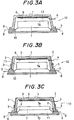
- Figs. 3A to 3C are sectional views of some cathode ray tubes, to which the glass front-panels 1 shown in Figs. 1A to 2 are respectively applied.
- a phosphor 5 is applied to the inner side of the glass front-panel 1, and covered with an aluminum foil 6, to which an external anode terminal 4 is connected.
- a rear panel 10 made of metal sheet is stuck to the back of the glass front-panel 1 with a glass frit 9 so as to cover the opening of the glass front-panel 1.
- the space 11 closed by the glass front-panel 1 and the rear panel 10 is brought to a predetermined degree of vacuum by suction.
- An external terminal 8 is connected to the electron gun unit 7 through the glass frit 9.
- the glass front-panels 1 shown in Figs. 1A - 1C and Fig. 2 substantially correspond to respective glass front-panels applied to the cathode ray tubes 12 shown in Figs. 3A and 3B.
- a modified one of the glass front-panel shown in Fig. 3B is applied to a cathode ray tube 12 shown in Fig. 3C, in which another electrode 2 for making the gradient of electric potential easier is provided on the inner surface of the side wall portion 1b.
- the glass for the front-panel can be treated by ion exchange process in a molten salt containing potassium ions so that the surface layer of the front panel may be resistive to coloring due to electron beam bombardment, and compressive stresses for improving mechanical strength may be produced in the surface layer of the front panel 1.
- the function of the cathode ray tube arranged as described above will be briefly described below.
- the electron gun unit 7 is put in action when a source voltage and television signals are impressed through the external terminal 8.
- the electron beam emitted by the electron gun unit 7 in response to the television signal is accelerated by a high voltage applied to the aluminum foil 6 through the anode electrode 4.
- the electron beam then impinges on the phosphor 5 provided on the image displaying portion 1a of the glass front-panel 1, so as to cause the phosphor 5 to emit light and, thereby, form an image.
- the glass front-panel becomes charged, and in case of the previously proposed glass front-panel, dielectric breakdown often occurs in the flange portion or in the side wall portion of the front panel due to high electric potential.
- the present invention since the electric charge is uniformly cleared by the electrode provided on the side wall portion, no instantaneous discharging takes place. Thus, the side wall portion is protected from dielectric breakdown. Further, since the flange portion is strengthened against a dielectric breakdown, damages such as small flaws are not produced in the surface of the flange portion even if an abnormal discharging occurs between the flange portion and the external terminal 8.
- a gradient of electric potential along the surface of the side wall portion 1b of the glass front-panel 1 markedly changes in the vicinity of one end of the conductive electrode 3, when electrons, which are emitted by the electron gun unit 7 and thereafter accelerated, impinge on the aluminum foil 6 of the image displaying portion 1a.
- the electrode 2 is provided as shown in Fig. 4A, the gradient of electric potential along the surface of the side wall portion 1b gently changes, so that no creeping discharge occurs.
- a solution 15 for etching or eluting is filled into a pan 14 provided with a heater 13, and only the flange portion 1c of the glass front-panel 1 is immersed in the solution 15. Thus, only the surface layer of the flange portion 1c is substantially removed.
- a glass plate manufactured by a float method being 5 mm thick and of soda-lime-silica contents as shown in the column Glass A of Table 1 was cut into a predetermined shape.
- the cut surface of the glass plate was ground with a diamond wheel of roughness #400, so that surface roughness R MAX 7.5 ⁇ m was obtained.
- the glass plate was heated and formed by a known press forming method into a glass front-panel 40 mm deep, the image displaying portion thereof being diagonally 25 cm long, and the joining surface of the flange portion thereof being 15 mm wide.
- the front panel was immersed in a molten salt of potassium nitrate heated to 460°C for 3 hours and thereafter taken out to be washed in water and dried.
- Resistivity p at a temperature of 150°C has a value satisfying log p ⁇ 11.
- the flange portion of the glass front-panel provided with resistance to coloring action of an electron beam and an increased mechanical strength was immersed in a 5% water solution of hydrogen fluoride as shown in Fig. 5 to thereby dissolve and remove a thickness of approximately 5 ⁇ m from the surface of the glass so that the surface layer containing many potassium ions were removed in substance.
- the obtained glass front-panel was stuck to a metal rear-panel with glass frit (tradename "IWF-029B" manufactured by Iwaki Glass Co.) and, thereby, a cathode ray tube as shown in Fig. 3A was fabricated.
- the cathode ray tube was placed in an atmosphere at 150°C and a voltage of 10 kV was continuously applied to the image displaying portion for 300 hours, but no crack was initiated in the glass front-panel or the glass frit.
- a glass plate manufactured by a float method being 5 mm thick and of soda-lime-silica contents as shown in the column Glass A of Table 1 was cut into a predetermined shape.
- the cut surface of the glass plate was ground with a diamond wheel of roughness #400, so that surface roughness R MAX 7.5 ⁇ m was obtained.
- the glass plate was heated and formed by a known press forming method into a glass front-panel 40 mm deep, the image displaying portion thereof being diagonally 25 cm long, and the joining surface of the flange portion thereof being 15 mm wide.
- the front panel was immersed in a molten salt of potassium nitrate heated to 460 °C for 3 hours and thereafter taken out to be washed in water and dried.
- the flange portion of the glass front-panel provided with resistance to coloring action of an electron beam and an increased mechanical strength was immersed in a 30% water solution of sulfuric acid as shown in Fig. 5 to thereby elute sodium ions and potassium ions existing to a depth of approximately 4.5 ⁇ m from the surface so that the surface layers containing many alkaline ions were removed in substance.
- the obtained glass front-panel was stuck to a metal rear-panel with glass frit (tradename IWF-029B" manufactured by Iwaki Glass Co.) and, thereby, a cathode ray tube as shown in Fig. 3A was fabricated.
- the cathode ray tube was placed in an atmosphere at 120°C and a voltage of 10 kV was continuously applied to the image displaying portion for 500 hours, but no crack was initiated in the glass front-panel or the glass frit.
- a glass plate manufactured by a float method being 5 mm thick and with the contents as shown in the column Glass B of Table 1 was cut into a predetermined shape.
- the cut surface of the glass plate was ground with a diamond wheel of roughness #400, so that surface roughness R MAX 7.5 ⁇ m was obtained.
- the glass plate was heated and formed by a known press forming method into a glass front-panel 40 mm deep, the image displaying portion thereof being diagonally 25 cm long, and the joining surface of the flange portion thereof being 15 mm wide.
- the front panel was immersed in a molten salt of potassium nitrate heated to 460 °C for 7 hours and thereafter taken out to be washed in water and dried.
- the flange portion of the glass front-panel provided with resistance to coloring action of an electron beam and an increased mechanical strength was immersed in a water solution of the mixed acid containing 5% of hydrogen fluoride and 10% of sulfuric acid as shown in Fig. 5 to thereby dissolve and remove a thickness of approximately 8 ⁇ m from the surface so that the surface layers containing many potassium ions were removed in substance.
- the obtained glass front-panel was stuck to a metal rear-panel with glass frit (tradename "IWF-029B" manufactured by Iwaki Glass Co.) and, thereby, a cathode ray tube as shown in Fig. 3A was fabricated.
- the cathode ray tube was placed in an atmosphere at 150°C and a voltage of 10 kV was continuously applied to the image displaying portion for 300 hours, but no crack was initiated in the glass front-panel or the glass frit.
- a glass plate being 5 mm thick and with the components as shown in the column Glass B of Table 1 was manufactured by a float method.
- the glass plate was heated and formed by a known press forming method into a glass front-panel 40 mm deep, the image displaying portion thereof being diagonally 25 cm long, and the joining surface of the flange portion thereof being 15 mm wide.
- the front panel was immersed in a molten salt of potassium nitrate heated to 460 °C for 7 hours, and thereafter, the surface layers containing potassium ions were removed.
- the obtained glass front-panel was stuck to a metal rear-panel with glass frit (tradename IWF-029B" manufactured by Iwaki Glass Co.) and, thereby, a cathode ray tube as shown in Fig. 3A was fabricated.
- the cathode ray tube was placed in an atmosphere at 150°C and a voltage of 10 kV was continuously applied to the image displaying portion for 300 hours, but no dielectric breakdown phenomenon was observed and no crack was initiated in the glass front-panel or the glass frit.
- a glass plate being 5 mm thick and of soda-lime-silica contents as shown in the column Glass A of Table 1 manufactured by a float method was heated and formed by a known press forming method into a glass front-panel 40 mm deep, the image displaying portion thereof being diagonally 25 cm long, and the joining surface of the flange portion thereof being 15 mm wide. Then, the front panel was immersed in a molten salt of potassium nitrate heated to 460 °C for 3 hours and thereafter taken out to be washed in water and dried.
- the flange portion of the glass front-panel provided with resistance to coloring action of an electron beam and an increased mechanical strength was immersed in a 5% water solution of hydrogen fluoride as shown in Fig. 5 to thereby dissolve and remove a thickness of approximately 10 ⁇ m from the surface, so that the surface layers containing many potassium ions were removed.
- the obtained glass front-panel was stuck to a metal rear-panel with glass frit (tradename "IWF-029B" manufactured by Iwaki Glass Co.) and, thereby, a cathode ray tube as shown in Fig. 3A was fabricated.
- the cathode ray tube was placed in an atmosphere at 150°C and a voltage of 10 kV was continuously applied to the image displaying portion for 300 hours, but no crack was initiated in the glass front-panel or the glass frit.
- a glass plate being 5 mm thick and of soda-lime-silica contents as shown in the column Glass A of Table 1 manufactured by a float method was heated and formed by a vacuum forming method with a press process, into a glass front-panel 40 mm deep, the image displaying portion thereof being diagonally 25 cm long, and the joining surface of the flange portion thereof being 15 mm wide. Then, the front panel was immersed in a molten salt of potassium nitrate heated to 460°C for 3 hours and thereafter taken out to be washed in water and dried.
- the flange portion of the glass front-panel provided with resistance to coloring action of an electron beam and an increased mechanical strength was immersed in a 5% water solution of hydrogen fluoride as shown in Fig. 5 to thereby dissolve a thickness of approximately 10 ⁇ m from the surface of the glass so that the surface layer containing many potassium ions were removed.
- a belt-like electrode was formed so as to cover the side wall portion of the obtained glass front-panel by applying a liquid composed of 50% by weight of fine silicon-carbide powder and 50% by weight of alumina sol.
- the electrode was laid in a band form around the whole side wall portion, from the level approximately 35 mm above the position of the rear panel to the level where the front surface 7a of the electron gun unit is projected on the side wall portion.
- a conductive electrode was laid in a band form near to the flange portion with a width of approximately 13 mm around the whole side wall portion.
- the conductive electrode covered a part of the former electrode by approximately 3 mm.
- the carbon electrode was obtained by means of applying a mixture of fine carbon powder and alumina sol.
- the cathode ray tube shown in Fig. 3B was fabricated by using the above front panel.
- the belt-like electrode of carbon was connected with an external ground terminal and the aluminum foil of the image displaying portion was continuously subjected to a bombardment of the electron beam accelerated by a voltage of 10 kV in a thermostatic chamber at approximately 80°C for 10,000 hours.
- a voltage of 10 kV in a thermostatic chamber at approximately 80°C for 10,000 hours.
- no crack due to abnormal discharging was initiated in any of the side wall portion and flange portion of the front panel and the joint portion.
- a cathode ray tube was fabricated in a similar manner to that described in Example 6, except that a belt-like electrode made of a mixture of fine powder of carbon and fine powder titanium, and having approximately 1 x 10⁹ ⁇ cm of electric resistivity was additionally provided on the inner surface of the side wall portion as shown in Fig. 3C.
- the cathode ray tube was subjected to a continuous bombardment of the electron beam in the same manner as that described in Example 6 for 10,000 hours. However, no crack due to abnormal discharging was initiated in any of the side wall portion and flange portion of the front panel and the joint portion.
- a glass plate being 5 mm thick and of soda-lime-silica contents as shown in the column Glass A of Table 1 manufactured by a float method was heated and formed by a known press forming method into a glass front-panel 40 mm deep, the image displaying portion thereof being diagonally 25 cm long, and the joining surface of the flange portion thereof being 15 mm wide. Then, the front panel was immersed in a molten salt of potassium nitrate heated to 460 °C for 2 hours and thereby, the surface layer having more potassium ions than those in the interior were obtained.
- a belt-like electrode was formed so as to cover the side wall portion of the obtained glass front-panel by means of applying a liquid composed of 50% by weight of fine silicon-carbide powder and 50% by weight of alumina sol.
- the electrode was laid in a band form around the whole side wall portion, from the level approximately 35 mm above the position of the rear panel to the level where the front surface 7a of the electron gun unit is projected on the side wall portion.
- a conductive electrode was laid in a band form near to the flange portion with a width of approximately 13 mm around the whole side wall portion.
- the conductive electrode covered a part of the former electrode by approximately 3 mm.
- the carbon electrode was obtained by means of applying a mixture of fine carbon powder and alumina sol.
- the cathode ray tube shown in Fig. 3B was fabricated by using the above front panel.
- the belt-like electrode of carbon was connected with an external ground terminal and the aluminum foil of the image displaying portion was continuously subjected to a bombardment of the electron beam accelerated by a voltage of 10 kV in a thermostatic chamber at approximately 80°C for 10,000 hours, However, no crack due to abnormal discharging was initiated in any of the side wall portion and flange portion of the front panel and the joint portion.
- a glass plate being 5 mm thick and of soda-lime-silica contents as shown in the column Glass A of Table 1 manufactured by a float method was heated and formed by a known press forming method into a glass front-panel 40 mm deep, the image displaying portion thereof being diagonally 25 cm long, and the joining surface of the flange portion thereof being 15 mm wide. Then, the front panel was immersed in a molten salt of potassium nitrate heated to 460 °C for 2 hours and, thereby, the surface layers having more potassium ions than those in the interior were obtained.
- a glass front-panel was fabricated using a glass plate with the components as shown in the column Glass B of Table 1 in a similar manner to that described in Example 4 and, thereby, a glass front-panel having surface layers containing more potassium ions than those in the interior were formed on the whole glass surface was obtained.
- a cathode ray tube as shown in Fig. 3A was fabricated.
- the cathode ray tube was placed in an atmosphere at 150°C and a voltage of 10 kV was continuously applied to the image displaying portion for 100 hours, a large number of traces of abnormal discharging were observed on the joined surface of the flange portion and a large number of small cracks were initiated in the glass frit. Further, lead oxide, a constituent of the frit glass, was observed to have been reduced and acted as the source wherefrom the dielectric breakdown started.
Landscapes
- Chemical & Material Sciences (AREA)
- Engineering & Computer Science (AREA)
- Life Sciences & Earth Sciences (AREA)
- Chemical Kinetics & Catalysis (AREA)
- General Chemical & Material Sciences (AREA)
- Geochemistry & Mineralogy (AREA)
- Materials Engineering (AREA)
- Organic Chemistry (AREA)
- Manufacturing & Machinery (AREA)
- Vessels, Lead-In Wires, Accessory Apparatuses For Cathode-Ray Tubes (AREA)
- Manufacture Of Electron Tubes, Discharge Lamp Vessels, Lead-In Wires, And The Like (AREA)
Priority Applications (1)
| Application Number | Priority Date | Filing Date | Title |
|---|---|---|---|
| EP95100535A EP0651423B1 (de) | 1990-09-13 | 1991-09-12 | Glasfrontplatte und damit versehene Kathodenstrahlröhre |
Applications Claiming Priority (2)
| Application Number | Priority Date | Filing Date | Title |
|---|---|---|---|
| JP24342590A JP2956177B2 (ja) | 1990-01-26 | 1990-09-13 | ガラス製フロントパネル |
| JP243425/90 | 1990-09-13 |
Related Child Applications (2)
| Application Number | Title | Priority Date | Filing Date |
|---|---|---|---|
| EP95100535.4 Division-Into | 1991-09-12 | ||
| EP95100535A Division EP0651423B1 (de) | 1990-09-13 | 1991-09-12 | Glasfrontplatte und damit versehene Kathodenstrahlröhre |
Publications (3)
| Publication Number | Publication Date |
|---|---|
| EP0475763A2 true EP0475763A2 (de) | 1992-03-18 |
| EP0475763A3 EP0475763A3 (en) | 1992-07-22 |
| EP0475763B1 EP0475763B1 (de) | 1996-08-21 |
Family
ID=17103681
Family Applications (1)
| Application Number | Title | Priority Date | Filing Date |
|---|---|---|---|
| EP19910308343 Expired - Lifetime EP0475763B1 (de) | 1990-09-13 | 1991-09-12 | Glasfrontplatte für Kathodenstrahlröhre und Herstellungsverfahren |
Country Status (2)
| Country | Link |
|---|---|
| EP (1) | EP0475763B1 (de) |
| DE (2) | DE69121497T2 (de) |
Cited By (1)
| Publication number | Priority date | Publication date | Assignee | Title |
|---|---|---|---|---|
| EP2202208A1 (de) | 2008-12-26 | 2010-06-30 | Hoya Corporation | Glassubstrat und Herstellungsverfahren dafür |
Family Cites Families (3)
| Publication number | Priority date | Publication date | Assignee | Title |
|---|---|---|---|---|
| CA1043413A (en) * | 1974-12-17 | 1978-11-28 | Hiroji Sumiyoshi | Implosion-resistant cathode ray tube with protective assembly for its face plate |
| AT342673B (de) * | 1976-04-16 | 1978-04-10 | Saelzle Erich | Vorrichtung zum polieren der passflache von frontplatte und konus bei der herstellung von elektronenrohrenkolben |
| US4897371A (en) * | 1987-02-03 | 1990-01-30 | Nippon Sheet Glass Co., Ltd. | Glass article protected from coloring by electron rays and method of using |
-
1991
- 1991-09-12 EP EP19910308343 patent/EP0475763B1/de not_active Expired - Lifetime
- 1991-09-12 DE DE1991621497 patent/DE69121497T2/de not_active Expired - Fee Related
- 1991-09-12 DE DE1991629046 patent/DE69129046T2/de not_active Expired - Fee Related
Cited By (6)
| Publication number | Priority date | Publication date | Assignee | Title |
|---|---|---|---|---|
| EP2202208A1 (de) | 2008-12-26 | 2010-06-30 | Hoya Corporation | Glassubstrat und Herstellungsverfahren dafür |
| CN101928110A (zh) * | 2008-12-26 | 2010-12-29 | Hoya株式会社 | 玻璃基材及其制造方法 |
| US8642175B2 (en) | 2008-12-26 | 2014-02-04 | Hoya Corporation | Glass substrate and method for manufactring the same |
| US8813520B2 (en) | 2008-12-26 | 2014-08-26 | Hoya Corporation | Glass substrate and method for manufacturing the same |
| TWI485121B (zh) * | 2008-12-26 | 2015-05-21 | Hoya Corp | 玻璃基材及其製造方法 |
| US9096463B2 (en) | 2008-12-26 | 2015-08-04 | Hoya Corporation | Glass substrate |
Also Published As
| Publication number | Publication date |
|---|---|
| DE69129046T2 (de) | 1998-09-24 |
| DE69129046D1 (de) | 1998-04-09 |
| DE69121497D1 (de) | 1996-09-26 |
| EP0475763A3 (en) | 1992-07-22 |
| EP0475763B1 (de) | 1996-08-21 |
| DE69121497T2 (de) | 1997-02-20 |
Similar Documents
| Publication | Publication Date | Title |
|---|---|---|
| KR100254479B1 (ko) | 플라즈마 디스플레이판넬 및 그 제조방법 | |
| EP1418608B1 (de) | Plasmaanzeige und verfahren zu ihrer herstellung | |
| US5357165A (en) | Glass front-panel | |
| US5252112A (en) | Method of producing a glass front-panel protected from coloring by electron rays | |
| JP2918524B2 (ja) | プラズマディスプレイパネル保護層およびその形成方法 | |
| EP0475763A2 (de) | Glasfrontplatte für Kathodenstrahlröhre und Herstellungsverfahren | |
| EP0651423B1 (de) | Glasfrontplatte und damit versehene Kathodenstrahlröhre | |
| US3862831A (en) | Glass fabrication process | |
| JP2956177B2 (ja) | ガラス製フロントパネル | |
| US20030129415A1 (en) | Method for binding phosphor particles in a field emission display device | |
| US3961114A (en) | Glass composition | |
| US6758062B2 (en) | Plasma display panel production method | |
| KR19980014731A (ko) | Crt용 대전방지 코팅 | |
| JPS59167941A (ja) | 陰極線管 | |
| US3814970A (en) | Gas discharge display panels | |
| CN1237570C (zh) | 阴极射线管用的玻璃壳及其制造方法 | |
| CA1074852A (en) | Method of manufacturing a post-deflection focusing colour selection electrode | |
| JPH0643253B2 (ja) | 薄型ディスプレイ用ガラス容器 | |
| JPH0719078Y2 (ja) | 薄型陰極線管 | |
| KR100270417B1 (ko) | 가스 방전형 표시 패널, 그것을 이용한 표시 장치및 그 제조 방법 | |
| JP3846636B2 (ja) | プラズマディスプレイパネル及びその製造方法 | |
| JP3946241B2 (ja) | プラズマディスプレイパネル及びその製造方法 | |
| KR100234040B1 (ko) | 브라운관용 음극 히터의 코팅방법 | |
| JP2002015664A (ja) | プラズマディスプレイパネルの製造方法 | |
| JPH10273341A (ja) | セラミックリブの形成方法 |
Legal Events
| Date | Code | Title | Description |
|---|---|---|---|
| PUAI | Public reference made under article 153(3) epc to a published international application that has entered the european phase |
Free format text: ORIGINAL CODE: 0009012 |
|
| AK | Designated contracting states |
Kind code of ref document: A2 Designated state(s): DE FR GB |
|
| PUAL | Search report despatched |
Free format text: ORIGINAL CODE: 0009013 |
|
| AK | Designated contracting states |
Kind code of ref document: A3 Designated state(s): DE FR GB |
|
| 17P | Request for examination filed |
Effective date: 19920924 |
|
| 17Q | First examination report despatched |
Effective date: 19940919 |
|
| GRAH | Despatch of communication of intention to grant a patent |
Free format text: ORIGINAL CODE: EPIDOS IGRA |
|
| GRAH | Despatch of communication of intention to grant a patent |
Free format text: ORIGINAL CODE: EPIDOS IGRA |
|
| GRAA | (expected) grant |
Free format text: ORIGINAL CODE: 0009210 |
|
| AK | Designated contracting states |
Kind code of ref document: B1 Designated state(s): DE FR GB |
|
| XX | Miscellaneous (additional remarks) |
Free format text: TEILANMELDUNG 95100535.4 EINGEREICHT AM 12/09/91. |
|
| REF | Corresponds to: |
Ref document number: 69121497 Country of ref document: DE Date of ref document: 19960926 |
|
| ET | Fr: translation filed |
Free format text: CORRECTIONS |
|
| PLBE | No opposition filed within time limit |
Free format text: ORIGINAL CODE: 0009261 |
|
| STAA | Information on the status of an ep patent application or granted ep patent |
Free format text: STATUS: NO OPPOSITION FILED WITHIN TIME LIMIT |
|
| 26N | No opposition filed | ||
| REG | Reference to a national code |
Ref country code: GB Ref legal event code: IF02 |
|
| PGFP | Annual fee paid to national office [announced via postgrant information from national office to epo] |
Ref country code: GB Payment date: 20060906 Year of fee payment: 16 |
|
| PGFP | Annual fee paid to national office [announced via postgrant information from national office to epo] |
Ref country code: DE Payment date: 20060907 Year of fee payment: 16 |
|
| PGFP | Annual fee paid to national office [announced via postgrant information from national office to epo] |
Ref country code: FR Payment date: 20060908 Year of fee payment: 16 |
|
| GBPC | Gb: european patent ceased through non-payment of renewal fee |
Effective date: 20070912 |
|
| PG25 | Lapsed in a contracting state [announced via postgrant information from national office to epo] |
Ref country code: DE Free format text: LAPSE BECAUSE OF NON-PAYMENT OF DUE FEES Effective date: 20080401 |
|
| REG | Reference to a national code |
Ref country code: FR Ref legal event code: ST Effective date: 20080531 |
|
| PG25 | Lapsed in a contracting state [announced via postgrant information from national office to epo] |
Ref country code: FR Free format text: LAPSE BECAUSE OF NON-PAYMENT OF DUE FEES Effective date: 20071001 |
|
| PG25 | Lapsed in a contracting state [announced via postgrant information from national office to epo] |
Ref country code: GB Free format text: LAPSE BECAUSE OF NON-PAYMENT OF DUE FEES Effective date: 20070912 |