EP0476202B1 - Barriereüberzug für organische Polymerfolien - Google Patents
Barriereüberzug für organische Polymerfolien Download PDFInfo
- Publication number
- EP0476202B1 EP0476202B1 EP90312068A EP90312068A EP0476202B1 EP 0476202 B1 EP0476202 B1 EP 0476202B1 EP 90312068 A EP90312068 A EP 90312068A EP 90312068 A EP90312068 A EP 90312068A EP 0476202 B1 EP0476202 B1 EP 0476202B1
- Authority
- EP
- European Patent Office
- Prior art keywords
- films
- film
- polymer films
- coating
- silane
- Prior art date
- Legal status (The legal status is an assumption and is not a legal conclusion. Google has not performed a legal analysis and makes no representation as to the accuracy of the status listed.)
- Expired - Lifetime
Links
- 238000000576 coating method Methods 0.000 title claims abstract description 63
- 230000004888 barrier function Effects 0.000 title claims abstract description 62
- 229920000620 organic polymer Polymers 0.000 title description 3
- -1 polyethylene Polymers 0.000 claims abstract description 54
- 239000011248 coating agent Substances 0.000 claims abstract description 52
- 229920006254 polymer film Polymers 0.000 claims abstract description 25
- 238000000034 method Methods 0.000 claims abstract description 19
- 150000004756 silanes Chemical class 0.000 claims abstract description 16
- BLRPTPMANUNPDV-UHFFFAOYSA-N Silane Chemical compound [SiH4] BLRPTPMANUNPDV-UHFFFAOYSA-N 0.000 claims description 30
- 229910000077 silane Inorganic materials 0.000 claims description 30
- 239000000203 mixture Substances 0.000 claims description 23
- XLYOFNOQVPJJNP-UHFFFAOYSA-N water Substances O XLYOFNOQVPJJNP-UHFFFAOYSA-N 0.000 claims description 16
- 229920001577 copolymer Polymers 0.000 claims description 13
- 229920000219 Ethylene vinyl alcohol Polymers 0.000 claims description 11
- 229920001328 Polyvinylidene chloride Polymers 0.000 claims description 11
- 239000000178 monomer Substances 0.000 claims description 11
- 229920001296 polysiloxane Polymers 0.000 claims description 10
- 238000010894 electron beam technology Methods 0.000 claims description 7
- 239000004715 ethylene vinyl alcohol Substances 0.000 claims description 7
- 239000002904 solvent Substances 0.000 claims description 7
- NLHHRLWOUZZQLW-UHFFFAOYSA-N Acrylonitrile Chemical compound C=CC#N NLHHRLWOUZZQLW-UHFFFAOYSA-N 0.000 claims description 5
- 239000004677 Nylon Substances 0.000 claims description 4
- 238000001704 evaporation Methods 0.000 claims description 4
- 229920001778 nylon Polymers 0.000 claims description 4
- 230000015572 biosynthetic process Effects 0.000 claims description 3
- 238000003851 corona treatment Methods 0.000 claims description 3
- 230000003301 hydrolyzing effect Effects 0.000 claims description 3
- 230000008020 evaporation Effects 0.000 claims description 2
- 239000004698 Polyethylene Substances 0.000 abstract description 23
- 229920000573 polyethylene Polymers 0.000 abstract description 23
- 239000003921 oil Substances 0.000 abstract description 7
- 238000004132 cross linking Methods 0.000 abstract description 5
- 239000000796 flavoring agent Substances 0.000 abstract description 5
- 235000019634 flavors Nutrition 0.000 abstract description 5
- 239000003205 fragrance Substances 0.000 abstract description 4
- 239000004743 Polypropylene Substances 0.000 abstract description 3
- 229920001155 polypropylene Polymers 0.000 abstract description 3
- 239000000126 substance Substances 0.000 abstract description 3
- 238000001179 sorption measurement Methods 0.000 abstract description 2
- 239000004519 grease Substances 0.000 abstract 1
- OKKJLVBELUTLKV-UHFFFAOYSA-N Methanol Chemical compound OC OKKJLVBELUTLKV-UHFFFAOYSA-N 0.000 description 39
- 229920000642 polymer Polymers 0.000 description 26
- KPUWHANPEXNPJT-UHFFFAOYSA-N disiloxane Chemical class [SiH3]O[SiH3] KPUWHANPEXNPJT-UHFFFAOYSA-N 0.000 description 22
- QVGXLLKOCUKJST-UHFFFAOYSA-N atomic oxygen Chemical compound [O] QVGXLLKOCUKJST-UHFFFAOYSA-N 0.000 description 21
- 239000001301 oxygen Substances 0.000 description 21
- 229910052760 oxygen Inorganic materials 0.000 description 21
- LFQSCWFLJHTTHZ-UHFFFAOYSA-N Ethanol Chemical compound CCO LFQSCWFLJHTTHZ-UHFFFAOYSA-N 0.000 description 17
- 239000007789 gas Substances 0.000 description 16
- 239000003570 air Substances 0.000 description 11
- XMGQYMWWDOXHJM-UHFFFAOYSA-N limonene Chemical compound CC(=C)C1CCC(C)=CC1 XMGQYMWWDOXHJM-UHFFFAOYSA-N 0.000 description 10
- 239000000463 material Substances 0.000 description 9
- 230000035699 permeability Effects 0.000 description 9
- 239000002987 primer (paints) Substances 0.000 description 9
- BVWUEIUNONATML-UHFFFAOYSA-N n-benzylethenamine Chemical compound C=CNCC1=CC=CC=C1 BVWUEIUNONATML-UHFFFAOYSA-N 0.000 description 8
- 230000000052 comparative effect Effects 0.000 description 7
- 238000012360 testing method Methods 0.000 description 7
- 230000005540 biological transmission Effects 0.000 description 6
- BFXIKLCIZHOAAZ-UHFFFAOYSA-N methyltrimethoxysilane Chemical compound CO[Si](C)(OC)OC BFXIKLCIZHOAAZ-UHFFFAOYSA-N 0.000 description 6
- 238000006116 polymerization reaction Methods 0.000 description 6
- 239000011324 bead Substances 0.000 description 5
- 230000006872 improvement Effects 0.000 description 5
- 229940087305 limonene Drugs 0.000 description 5
- 235000001510 limonene Nutrition 0.000 description 5
- 239000005026 oriented polypropylene Substances 0.000 description 5
- 239000011148 porous material Substances 0.000 description 5
- CURLTUGMZLYLDI-UHFFFAOYSA-N Carbon dioxide Chemical compound O=C=O CURLTUGMZLYLDI-UHFFFAOYSA-N 0.000 description 4
- 238000001125 extrusion Methods 0.000 description 4
- 230000007062 hydrolysis Effects 0.000 description 4
- 238000006460 hydrolysis reaction Methods 0.000 description 4
- 125000001436 propyl group Chemical group [H]C([*])([H])C([H])([H])C([H])([H])[H] 0.000 description 4
- WYTZZXDRDKSJID-UHFFFAOYSA-N (3-aminopropyl)triethoxysilane Chemical compound CCO[Si](OCC)(OCC)CCCN WYTZZXDRDKSJID-UHFFFAOYSA-N 0.000 description 3
- VGGSQFUCUMXWEO-UHFFFAOYSA-N Ethene Chemical group C=C VGGSQFUCUMXWEO-UHFFFAOYSA-N 0.000 description 3
- 239000005977 Ethylene Substances 0.000 description 3
- KFZMGEQAYNKOFK-UHFFFAOYSA-N Isopropanol Chemical compound CC(C)O KFZMGEQAYNKOFK-UHFFFAOYSA-N 0.000 description 3
- VKEQBMCRQDSRET-UHFFFAOYSA-N Methylone Chemical group CNC(C)C(=O)C1=CC=C2OCOC2=C1 VKEQBMCRQDSRET-UHFFFAOYSA-N 0.000 description 3
- 125000000217 alkyl group Chemical group 0.000 description 3
- 150000001412 amines Chemical class 0.000 description 3
- 125000003277 amino group Chemical group 0.000 description 3
- RZXDTJIXPSCHCI-UHFFFAOYSA-N hexa-1,5-diene-2,5-diol Chemical compound OC(=C)CCC(O)=C RZXDTJIXPSCHCI-UHFFFAOYSA-N 0.000 description 3
- 239000000155 melt Substances 0.000 description 3
- 229920006280 packaging film Polymers 0.000 description 3
- 239000012785 packaging film Substances 0.000 description 3
- 238000004806 packaging method and process Methods 0.000 description 3
- 238000012856 packing Methods 0.000 description 3
- 229920000098 polyolefin Polymers 0.000 description 3
- 229920002451 polyvinyl alcohol Polymers 0.000 description 3
- 230000009467 reduction Effects 0.000 description 3
- XDLMVUHYZWKMMD-UHFFFAOYSA-N 3-trimethoxysilylpropyl 2-methylprop-2-enoate Chemical compound CO[Si](OC)(OC)CCCOC(=O)C(C)=C XDLMVUHYZWKMMD-UHFFFAOYSA-N 0.000 description 2
- 239000006087 Silane Coupling Agent Substances 0.000 description 2
- 150000001298 alcohols Chemical class 0.000 description 2
- 125000003118 aryl group Chemical group 0.000 description 2
- 230000002146 bilateral effect Effects 0.000 description 2
- 229910002092 carbon dioxide Inorganic materials 0.000 description 2
- 239000001569 carbon dioxide Substances 0.000 description 2
- 150000001875 compounds Chemical class 0.000 description 2
- 229920006037 cross link polymer Polymers 0.000 description 2
- JJQZDUKDJDQPMQ-UHFFFAOYSA-N dimethoxy(dimethyl)silane Chemical compound CO[Si](C)(C)OC JJQZDUKDJDQPMQ-UHFFFAOYSA-N 0.000 description 2
- 238000001035 drying Methods 0.000 description 2
- 229920001684 low density polyethylene Polymers 0.000 description 2
- 239000004702 low-density polyethylene Substances 0.000 description 2
- 230000014759 maintenance of location Effects 0.000 description 2
- 238000005259 measurement Methods 0.000 description 2
- 230000007246 mechanism Effects 0.000 description 2
- 125000001997 phenyl group Chemical group [H]C1=C([H])C([H])=C(*)C([H])=C1[H] 0.000 description 2
- 239000002985 plastic film Substances 0.000 description 2
- 229920006255 plastic film Polymers 0.000 description 2
- 238000012643 polycondensation polymerization Methods 0.000 description 2
- 229920000728 polyester Polymers 0.000 description 2
- 239000005033 polyvinylidene chloride Substances 0.000 description 2
- 230000008569 process Effects 0.000 description 2
- 238000001878 scanning electron micrograph Methods 0.000 description 2
- 239000000758 substrate Substances 0.000 description 2
- 238000010998 test method Methods 0.000 description 2
- 125000000391 vinyl group Chemical group [H]C([*])=C([H])[H] 0.000 description 2
- 229920002554 vinyl polymer Polymers 0.000 description 2
- 238000009736 wetting Methods 0.000 description 2
- XMNIXWIUMCBBBL-UHFFFAOYSA-N 2-(2-phenylpropan-2-ylperoxy)propan-2-ylbenzene Chemical compound C=1C=CC=CC=1C(C)(C)OOC(C)(C)C1=CC=CC=C1 XMNIXWIUMCBBBL-UHFFFAOYSA-N 0.000 description 1
- 125000003903 2-propenyl group Chemical group [H]C([*])([H])C([H])=C([H])[H] 0.000 description 1
- UNIYDALVXFPINL-UHFFFAOYSA-N 3-(2-methylprop-2-enoyloxy)propylsilicon Chemical compound CC(=C)C(=O)OCCC[Si] UNIYDALVXFPINL-UHFFFAOYSA-N 0.000 description 1
- 229920002799 BoPET Polymers 0.000 description 1
- 239000004215 Carbon black (E152) Substances 0.000 description 1
- 239000004593 Epoxy Substances 0.000 description 1
- 239000005041 Mylar™ Substances 0.000 description 1
- 229920002367 Polyisobutene Polymers 0.000 description 1
- 229910002808 Si–O–Si Inorganic materials 0.000 description 1
- BOTDANWDWHJENH-UHFFFAOYSA-N Tetraethyl orthosilicate Chemical compound CCO[Si](OCC)(OCC)OCC BOTDANWDWHJENH-UHFFFAOYSA-N 0.000 description 1
- 238000000441 X-ray spectroscopy Methods 0.000 description 1
- SHCHCHQAWASKSM-UHFFFAOYSA-N [SiH4].C(=C)NCC1=CC=CC=C1 Chemical compound [SiH4].C(=C)NCC1=CC=CC=C1 SHCHCHQAWASKSM-UHFFFAOYSA-N 0.000 description 1
- 239000002253 acid Substances 0.000 description 1
- 150000004703 alkoxides Chemical group 0.000 description 1
- 238000004458 analytical method Methods 0.000 description 1
- 239000012298 atmosphere Substances 0.000 description 1
- 125000001797 benzyl group Chemical group [H]C1=C([H])C([H])=C(C([H])=C1[H])C([H])([H])* 0.000 description 1
- 238000009835 boiling Methods 0.000 description 1
- 125000000484 butyl group Chemical group [H]C([*])([H])C([H])([H])C([H])([H])C([H])([H])[H] 0.000 description 1
- 229920005549 butyl rubber Polymers 0.000 description 1
- 239000003990 capacitor Substances 0.000 description 1
- 125000003178 carboxy group Chemical group [H]OC(*)=O 0.000 description 1
- 239000000805 composite resin Substances 0.000 description 1
- 239000007822 coupling agent Substances 0.000 description 1
- 125000000113 cyclohexyl group Chemical group [H]C1([H])C([H])([H])C([H])([H])C([H])(*)C([H])([H])C1([H])[H] 0.000 description 1
- 238000000354 decomposition reaction Methods 0.000 description 1
- 230000003247 decreasing effect Effects 0.000 description 1
- 238000003795 desorption Methods 0.000 description 1
- 239000004205 dimethyl polysiloxane Substances 0.000 description 1
- 230000000694 effects Effects 0.000 description 1
- FWDBOZPQNFPOLF-UHFFFAOYSA-N ethenyl(triethoxy)silane Chemical compound CCO[Si](OCC)(OCC)C=C FWDBOZPQNFPOLF-UHFFFAOYSA-N 0.000 description 1
- 125000001495 ethyl group Chemical group [H]C([H])([H])C([H])([H])* 0.000 description 1
- 238000002474 experimental method Methods 0.000 description 1
- 239000007888 film coating Substances 0.000 description 1
- 238000009501 film coating Methods 0.000 description 1
- 235000013305 food Nutrition 0.000 description 1
- 239000005003 food packaging material Substances 0.000 description 1
- 238000009499 grossing Methods 0.000 description 1
- 238000010438 heat treatment Methods 0.000 description 1
- 229930195733 hydrocarbon Natural products 0.000 description 1
- 150000002430 hydrocarbons Chemical class 0.000 description 1
- 239000001257 hydrogen Substances 0.000 description 1
- 229910052739 hydrogen Inorganic materials 0.000 description 1
- 125000002887 hydroxy group Chemical group [H]O* 0.000 description 1
- 229910052500 inorganic mineral Inorganic materials 0.000 description 1
- 239000004816 latex Substances 0.000 description 1
- 229920000126 latex Polymers 0.000 description 1
- 238000004519 manufacturing process Methods 0.000 description 1
- POPACFLNWGUDSR-UHFFFAOYSA-N methoxy(trimethyl)silane Chemical compound CO[Si](C)(C)C POPACFLNWGUDSR-UHFFFAOYSA-N 0.000 description 1
- 125000002496 methyl group Chemical group [H]C([H])([H])* 0.000 description 1
- 230000005012 migration Effects 0.000 description 1
- 238000013508 migration Methods 0.000 description 1
- 239000011707 mineral Substances 0.000 description 1
- 239000002557 mineral fiber Substances 0.000 description 1
- 125000000740 n-pentyl group Chemical group [H]C([H])([H])C([H])([H])C([H])([H])C([H])([H])C([H])([H])* 0.000 description 1
- 125000001624 naphthyl group Chemical group 0.000 description 1
- 229920006284 nylon film Polymers 0.000 description 1
- 150000001282 organosilanes Chemical class 0.000 description 1
- 235000021485 packed food Nutrition 0.000 description 1
- 230000000149 penetrating effect Effects 0.000 description 1
- 230000035515 penetration Effects 0.000 description 1
- 125000000538 pentafluorophenyl group Chemical group FC1=C(F)C(F)=C(*)C(F)=C1F 0.000 description 1
- 150000002978 peroxides Chemical class 0.000 description 1
- 229920000435 poly(dimethylsiloxane) Polymers 0.000 description 1
- 239000012462 polypropylene substrate Substances 0.000 description 1
- 238000002360 preparation method Methods 0.000 description 1
- 230000005855 radiation Effects 0.000 description 1
- 150000003254 radicals Chemical class 0.000 description 1
- 238000004626 scanning electron microscopy Methods 0.000 description 1
- 230000035945 sensitivity Effects 0.000 description 1
- 150000004819 silanols Chemical class 0.000 description 1
- 229920002379 silicone rubber Polymers 0.000 description 1
- PXQLVRUNWNTZOS-UHFFFAOYSA-N sulfanyl Chemical class [SH] PXQLVRUNWNTZOS-UHFFFAOYSA-N 0.000 description 1
- 238000005979 thermal decomposition reaction Methods 0.000 description 1
- 229920002397 thermoplastic olefin Polymers 0.000 description 1
- 238000002834 transmittance Methods 0.000 description 1
- CPUDPFPXCZDNGI-UHFFFAOYSA-N triethoxy(methyl)silane Chemical compound CCO[Si](C)(OCC)OCC CPUDPFPXCZDNGI-UHFFFAOYSA-N 0.000 description 1
- 125000000725 trifluoropropyl group Chemical group [H]C([H])(*)C([H])([H])C(F)(F)F 0.000 description 1
Images


Classifications
-
- C—CHEMISTRY; METALLURGY
- C09—DYES; PAINTS; POLISHES; NATURAL RESINS; ADHESIVES; COMPOSITIONS NOT OTHERWISE PROVIDED FOR; APPLICATIONS OF MATERIALS NOT OTHERWISE PROVIDED FOR
- C09D—COATING COMPOSITIONS, e.g. PAINTS, VARNISHES OR LACQUERS; FILLING PASTES; CHEMICAL PAINT OR INK REMOVERS; INKS; CORRECTING FLUIDS; WOODSTAINS; PASTES OR SOLIDS FOR COLOURING OR PRINTING; USE OF MATERIALS THEREFOR
- C09D4/00—Coating compositions, e.g. paints, varnishes or lacquers, based on organic non-macromolecular compounds having at least one polymerisable carbon-to-carbon unsaturated bond ; Coating compositions, based on monomers of macromolecular compounds of groups C09D183/00 - C09D183/16
-
- C—CHEMISTRY; METALLURGY
- C08—ORGANIC MACROMOLECULAR COMPOUNDS; THEIR PREPARATION OR CHEMICAL WORKING-UP; COMPOSITIONS BASED THEREON
- C08J—WORKING-UP; GENERAL PROCESSES OF COMPOUNDING; AFTER-TREATMENT NOT COVERED BY SUBCLASSES C08B, C08C, C08F, C08G or C08H
- C08J7/00—Chemical treatment or coating of shaped articles made of macromolecular substances
- C08J7/04—Coating
- C08J7/0427—Coating with only one layer of a composition containing a polymer binder
-
- C—CHEMISTRY; METALLURGY
- C08—ORGANIC MACROMOLECULAR COMPOUNDS; THEIR PREPARATION OR CHEMICAL WORKING-UP; COMPOSITIONS BASED THEREON
- C08J—WORKING-UP; GENERAL PROCESSES OF COMPOUNDING; AFTER-TREATMENT NOT COVERED BY SUBCLASSES C08B, C08C, C08F, C08G or C08H
- C08J7/00—Chemical treatment or coating of shaped articles made of macromolecular substances
- C08J7/04—Coating
- C08J7/043—Improving the adhesiveness of the coatings per se, e.g. forming primers
-
- C—CHEMISTRY; METALLURGY
- C08—ORGANIC MACROMOLECULAR COMPOUNDS; THEIR PREPARATION OR CHEMICAL WORKING-UP; COMPOSITIONS BASED THEREON
- C08J—WORKING-UP; GENERAL PROCESSES OF COMPOUNDING; AFTER-TREATMENT NOT COVERED BY SUBCLASSES C08B, C08C, C08F, C08G or C08H
- C08J7/00—Chemical treatment or coating of shaped articles made of macromolecular substances
- C08J7/04—Coating
- C08J7/048—Forming gas barrier coatings
-
- C—CHEMISTRY; METALLURGY
- C08—ORGANIC MACROMOLECULAR COMPOUNDS; THEIR PREPARATION OR CHEMICAL WORKING-UP; COMPOSITIONS BASED THEREON
- C08J—WORKING-UP; GENERAL PROCESSES OF COMPOUNDING; AFTER-TREATMENT NOT COVERED BY SUBCLASSES C08B, C08C, C08F, C08G or C08H
- C08J2323/00—Characterised by the use of homopolymers or copolymers of unsaturated aliphatic hydrocarbons having only one carbon-to-carbon double bond; Derivatives of such polymers
- C08J2323/02—Characterised by the use of homopolymers or copolymers of unsaturated aliphatic hydrocarbons having only one carbon-to-carbon double bond; Derivatives of such polymers not modified by chemical after treatment
-
- C—CHEMISTRY; METALLURGY
- C08—ORGANIC MACROMOLECULAR COMPOUNDS; THEIR PREPARATION OR CHEMICAL WORKING-UP; COMPOSITIONS BASED THEREON
- C08J—WORKING-UP; GENERAL PROCESSES OF COMPOUNDING; AFTER-TREATMENT NOT COVERED BY SUBCLASSES C08B, C08C, C08F, C08G or C08H
- C08J2483/00—Characterised by the use of macromolecular compounds obtained by reactions forming in the main chain of the macromolecule a linkage containing silicon with or without sulfur, nitrogen, oxygen, or carbon only; Derivatives of such polymers
-
- Y—GENERAL TAGGING OF NEW TECHNOLOGICAL DEVELOPMENTS; GENERAL TAGGING OF CROSS-SECTIONAL TECHNOLOGIES SPANNING OVER SEVERAL SECTIONS OF THE IPC; TECHNICAL SUBJECTS COVERED BY FORMER USPC CROSS-REFERENCE ART COLLECTIONS [XRACs] AND DIGESTS
- Y10—TECHNICAL SUBJECTS COVERED BY FORMER USPC
- Y10T—TECHNICAL SUBJECTS COVERED BY FORMER US CLASSIFICATION
- Y10T428/00—Stock material or miscellaneous articles
- Y10T428/26—Web or sheet containing structurally defined element or component, the element or component having a specified physical dimension
- Y10T428/269—Web or sheet containing structurally defined element or component, the element or component having a specified physical dimension including synthetic resin or polymer layer or component
-
- Y—GENERAL TAGGING OF NEW TECHNOLOGICAL DEVELOPMENTS; GENERAL TAGGING OF CROSS-SECTIONAL TECHNOLOGIES SPANNING OVER SEVERAL SECTIONS OF THE IPC; TECHNICAL SUBJECTS COVERED BY FORMER USPC CROSS-REFERENCE ART COLLECTIONS [XRACs] AND DIGESTS
- Y10—TECHNICAL SUBJECTS COVERED BY FORMER USPC
- Y10T—TECHNICAL SUBJECTS COVERED BY FORMER US CLASSIFICATION
- Y10T428/00—Stock material or miscellaneous articles
- Y10T428/31504—Composite [nonstructural laminate]
- Y10T428/31652—Of asbestos
- Y10T428/31663—As siloxane, silicone or silane
-
- Y—GENERAL TAGGING OF NEW TECHNOLOGICAL DEVELOPMENTS; GENERAL TAGGING OF CROSS-SECTIONAL TECHNOLOGIES SPANNING OVER SEVERAL SECTIONS OF THE IPC; TECHNICAL SUBJECTS COVERED BY FORMER USPC CROSS-REFERENCE ART COLLECTIONS [XRACs] AND DIGESTS
- Y10—TECHNICAL SUBJECTS COVERED BY FORMER USPC
- Y10T—TECHNICAL SUBJECTS COVERED BY FORMER US CLASSIFICATION
- Y10T428/00—Stock material or miscellaneous articles
- Y10T428/31504—Composite [nonstructural laminate]
- Y10T428/31652—Of asbestos
- Y10T428/31667—Next to addition polymer from unsaturated monomers, or aldehyde or ketone condensation product
Definitions
- the present invention relates to methods for organic polymer films, wherein the coated films become imbued with reduced permeability to gases, such as oxygen, air and carbon dioxide, as well as to greases and oils.
- silane primer coatings can provide remarkable barrier properties in and of themselves, and without additional coatings thereupon, to render the polymer film to which the coating has been applied strikingly less permeable to gases, such as oxygen, and to aroma and flavor transmission, and to such a degree of impermeability that the coated film is admirably useful for such purposes as food packaging and shelf life extension thereof and the like.
- improvement in the haze reduction, clarity and appearance of the film fortuitously concurrently occurs, matching the surface quality of high grade "Mylar" film and the like, and also providing improved dielectric performance for electrical uses, as well, as in electrical capacitors, for example.
- the invention While thus useful to transform polymer films and the like that ordinarily do not have oxygen or related gas barrier properties to films that do have such properties, the invention has also been found to be extremely useful in providing a surprisingly high degree of improvement in oxygen barrier characteristics to current films of the type that already possess quite good oxygen barrier properties. The invention is therefore extremely useful also to upgrade the degree of oxygen barrier characteristics of present day or related oxygen barrier films, as well.
- An object of the invention is to provide a method for making barrier-coated polymer films, involving the use of appropriate coatings of polysiloxane, and preferably the grafting of the same to the film surface.
- a further object is to provide a method for producing food packaging materials of polysiloxane-coated polymer films with improved gas impermeability, reduced aroma and flavour transmission properties and improved surface appearance and clarity, as well.
- An additional object of the invention is to improve significantly the oxygen or other barrier characteristics of organic or polymer films that already have excellent oxygen barrier properties.
- a method of improving the gas barrier properties of gas barrier polymer films that comprises hydrolysing silane monomers or mixtures of silane monomers in a solvent miscible with water and that solubilizes silanes and is evaporable, and equilibrating the same; coating the same upon gas barrier polymer films selected from ethylene vinyl alcohol copolymer (EVOH) films, polyvinylidene dichloride copolymer (PVDC) films, acrylonitrile (AN) copolymer films and amorphous nylon barrier films (MXD); evaporating the solvent and water to complete the formation of silicon-oxygen-silicon bonds and to cross-link the silane, thereby to improve the gas barrier properties of the films by the polysiloxane layer adhered to the surface(s) of the film.
- EVOH ethylene vinyl alcohol copolymer
- PVDC polyvinylidene dichloride copolymer
- AN acrylonitrile copolymer films
- MXD amorph
- the useful siloxane polymers are prepared by hydrolysis of silane monomers, and mixture of monomers when a copolymer film is desired, in an aqueous alcohol solution.
- the mixture is allowed to stand for about 24 hours at 25 degrees C to equilibrate the oligomeric siloxane structures, whereupon the alcohol solution containing the oligomeric siloxane structures is coated on the polymer film surface and is dried, preferably in a stream of warm air, to evaporate the alcohol and water to complete the formation of the Si-O-Si bonds of the polymer coating, highly cross-linking the same.
- the siloxane polymer may be grafted to the film surface when the siloxane polymer or copolymer contains a double bond, by using either a conventional promoted peroxide cure, (of course, added to the siloxane primer prior to coating on the polymer film surface), or by electron-beam initiated grafting as described in my said prior patent.
- the groups R1, R2, R3 and R4 may be the same or different and they are selected from the following groups:
- the mechanism of gas permeation through a plastic film is a complex process involving adsorption on a surface, migration through the bulk of the film through pores in the film, and desorption from the other side. While the total mechanism by which the siloxane polymers and copolymers of this invention improve the barrier properties of the plastic films on which they are deposited is not fully understood, and applicant does not wish to be bound by the following theoretical explanation (it being sufficient to teach how to obtain the results of the invention), it is believed that the siloxane polymers and copolymers of the invention wet the surface of the polymer film smoothly and uniformly and mostly fill in the openings of the pores on the surface of the film. This keeps the gas molecules out of the pores so that even though the pores are still there, the gas molecules cannot get into the pores to pass through the bulk of the film.
- the ethylene units included in the ethylene-vinyl alcohol copolymer tend to lower the melt viscosity of the vinyl alcohol polymer and allow extrusion at temperatures below the decomposition temperature of the polyvinyl alcohol polymer.
- This polymer also suffers from the disadvantage that it is hygroscopic; and water plasticizes the polymer and seriously degrades the performance of ethylene-vinyl alcohol polymers as barrier coatings.
- the hydrolyzed oligomers are soluble in alcohol solution, so they are easily applied to the surface of the base film by a simple coating technique.
- the polymerization and cross-linking of the siloxane coating is completed by drying the coating, preferably at a slightly elevated temperature, to remove alcohol and water.
- This alcohol technique enables the generation of a highly cross-linked film coating structure, and no high temperature extrusion is required.
- the degree of crosslinking is controlled by the monomers that are selected.
- hydrolyzed dimethyl dimethoxy silane will polymerize to a linear polymer.
- the length of the polymer chain can be controlled by copolymerizing with trimethyl methoxy silane. This compound has only one site which is reactive in the condensation polymerization and it will "cap" the growing polymer chain.
- methyl trimethoxy silane has three reactive sites during the condensation polymerization and will crosslink between growing polymer chains as well as branch when it is cohydrolyzed with dimethyl dimethoxy silane.
- tetraethoxy silane has four reactive sites and will produce a very highly crosslinked polymer when it is included in the polymerization mixture.
- a 10 ml quantity of a silane or a mixture of silanes is dissolved in 90 ml of methyl alcohol and 1 ml of water is added and carefully mixed in. The solution is allowed to stand at about 25 degrees C for 24 hours.
- a piece of test film, for example low density polyethylene film if the coating is to be used on polyolefin films, is immersed briefly in the methanol solution of the hydrolyzed silanes, and the alcohol is allowed to dry slowly in dry air. The coating is then warmed gently in a stream of air to complete the polymerization by driving off the water.
- silanes and mixtures of silanes that are useful in the practice of the present invention form a smooth and uniform coating on the surface of the organic film on which they are tested. These coatings also reduce the haze of the film.
- silanes and mixtures of silanes that are not useful in the practice of the invention have been found to form beads and droplets of siloxane on the surface of the film on which they are tested as the alcohol dries off the surface of the film and thus fail to wet the same. These materials thus do not form useful barrier coatings on organic polymer films.
- silanes and silane mixtures that are useful in the practice of this invention generally contain a silane with an amino group.
- the vinylbenzylamine silane when hydrolyzed in alcohol solution and applied to a polyethylene film surface, formed a smooth continuous film which was useful as both a barrier to oxygen and oil.
- silanes which include an amino group containing silane are to be used as barrier polymers on polyethylene or polypropylene film, it has been found that the monomers should be mixed and then cohydrolyzed in order that the resulting oligomers will wet the surface.
- a 10ml quantity of gamma aminopropyl triethoxy silane was dissolved in 90 ml of methyl alcohol and one ml of water was added and carefully mixed in. The solution was allowed to stand for about 24 hours at about 25 degrees C. A piece of polyethylene film was briefly immersed in the solution and allowed to dry slowly in dry air. The coating was warmed gently in a stream of warm air to complate the polymerization. A smooth, uniform coating was formed on the polyethylene film surface.
- a mixture of 2 ml of gamma-aminopropyl tri-ethoxy silane and 8 ml of vinyl triethoxy silane was dissolved in 90 ml of methanol and 1 ml of water was added and carefully mixed in. The solution was allowed to stand for 24 hours at 25 degrees C.
- a piece of polyethylene film was immersed in the solution and allowed to dry slowly in dry air.
- the coating was warmed gently in a stream of warm air to complete the polymerization.
- a smooth, uniform coating was formed on the polyethylene film surface.
- a piece of polyethylene film was immersed in the solution and allowed to dry slowly in dry air.
- the coating was warmed gently in a stream of air to complete the polymerization.
- a smooth, uniform coating was formed on the polyethylene film surface.
- the coating phenomenon herein described is generally a surface-coating effect.
- Cross-sectional analysis of the LDPE coated film for example, by scanning electron microscopy and electron-dispersive X-ray spectroscopy has revealed the few micron coating to be attached to the film surface with no apparent penetration into the film.
- the surface and barrier properties of the barrier coating are controlled by the nature of the monomers that are used to form the oligomers.
- the critical surface tension of a polyethylene film that has been coated with hydrolyzed vinyl benzyl amine silane is about 55 dynes/cm.
- the critical surface tension of the coating on polyethylene film which was prepared by hydrolyzing a mixture of 9 parts of methyl trimethoxy silane and one part of the vinyl benzyl amine silane is only about 23 dynes/cm.
- a drop of hydrocarbon oil on the coated surface has a large contact angle and did not spread. In contrast, the oil spread slowly and wet the surface of the uncoated film.
- the adhesion of the coating on the film can be improved by incorporating monomers with vinyl unsaturation into the siloxane mixture before hydrolysis and grafting the resulting coating to the film surface.
- the grafting can be accomplished by incorporating a conventional promoted free radical generator in the coating (such as dicumyl peroxide, for example) that will react upon gentle heating, or by use of electron beam-initiated grafting, as described in my said patent, subsequent to drying of the coating.
- the improved adhesion of the barrier coating to the substrate may, as before explained, be achieved by grafting the siloxane coating to the film.
- the "Scotch tape test” (described in my said prior patent) removed some of the ungrafted coating from the polypropylene, but did not remove any of the grafted coating. This experiment demonstrates the greatly improved adhesion of the coating to the substrate that can be acheived by eb grafting.
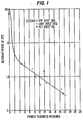
- the graph of the before-mentioned Fig 1 demonstrates the efficacy of siloxane coatings applied to polymer films in accordance with the invention, plotting O 2 permeability in cc/100in 2 /24 hours (cc/m 2 /24 hours) at 23°C along the ordinate, and siloxane primer thickness in microns along the abscissa for 38 ⁇ m oriented polypropylene (OPP), 135 ⁇ m low density polyethylene film (LDPE) and 13 ⁇ m polyester (PET), with and without a coating derived from hydrolyzed 60% methanol and 40% Dow Corning Z-6032 silane, prepared as above-described and applied in various thicknesses to the film and electron-beam grafted with about 175KV and doses up to 5 Megarads as detailed in my prior patent.
- OPP ⁇ m oriented polypropylene
- LDPE low density polyethylene film
- PET 13 ⁇ m polyester
- the uncoated films were quite permeable (approximately 70-95cc/100in 2 /24 hours (1100-1500cc/m 2 /24 hours)); whereas coatings of from 5 to 22 ⁇ m provided excellent 02-permeable barriers under approximately 2.5-0.5cc/100in 2 /24 hours (40-8cc/m 2 /24 hours) at one atmosphere of pressure.
- Each of these coated films provided low haze appearance as well, and outstanding aroma or fragrance retention of products packaged therewith as later described in connection with the Limonene Transmission tests of Table 2; the coated films having apparently reduced solubility of aroma and flavour compounds in such packaged food or other products-so-called "scalping" of such.
- the Limonene Transmission test (D-1653) is an accepted measure of aroma or fragrance or flavour transmission as used in the food-packaging industry, involving gas chromatograph measurement of limonene solubility in film. Table 2 demonstrates that for the LDPE film with siloxane coating above described, the limonene loss was only 6mg/100in 2 /24 hours (93mg/m 2 /24 hours) as contrasted with the more than thousand times greater loss (8014.9) for the uncoated or virgin LDPE. Similar tremendous fragrance retention was achieved with the coated OPP film.
- the invention is useful to up-grade or improve the barrier characteristics of films or materials that already have barrier characteristics.
- the conventional oxygen barrier polymer films are the ethylene vinyl alcohol copolymer (EVOH), polyvinylidene dichloride copolymers (PVDC), acryonitrile (AN) copolymer films and amorphous nylon barrier films (MXD). Such materials are considered to be the standard oxygen and other barrier materials.
- the siloxane coating solution is prepared in alcohol by the following technique: 50 milliliters of the Dow-Corning Z6032 (40% vinyl benzyl siloxane and alcohol), for example, is placed in a container and 42.5 milliliters of methyl alcohol is added followed by 7.5 milliliters of water. The mixture is stirred until it becomes clear, then it is allowed to stand for 24 hours at 20-25°C temperature to allow the hydrolysis to become complete and the silanols to equilibrate.
- Dow-Corning Z6032 50% vinyl benzyl siloxane and alcohol
- the barrier coating films such as the ethylene vinyl alcohol, polyvinylidene dichloride, the acrylonitrile copolymer film and the amorphous nylon film are prepared for coating by corona treatment on both sides. This serves to clean the film and partially to oxydize the surface, thereby improving the wettability of the film.
- the corona-treated films are then dipped briefly into the hydrolized siloxene coating solution as described above, allowed to drain and dried to a tack-free state in a stream of warm air.
- the dried films are then preferably treated with an electron beam at 165 kilovolts with a total dose of 2.5 to 3 megarads bilateral treatment.
- the substantial improvement in the barrier properties is demonstrated by measuring the oxygen permeability of the uncoated film and comparing it with the oxygen permeability of the film which has been coated by the practice of the invention. In all cases, about a 2 order of magnitude improvement in oxygen barrier properties is achieved.
- the ethylene vinyl alcohol film can range in thickness from 15 ⁇ m to about 60 ⁇ m; the thickness of the polyvinylidene dichloride film can range from 12 ⁇ m to about 25 ⁇ m; the acrylonitrile copolymer film can vary from 25 to 50 ⁇ m and the thickness of the amorphous nylon can vary from about 10 to about 60 ⁇ m.
Landscapes
- Chemical & Material Sciences (AREA)
- Organic Chemistry (AREA)
- Health & Medical Sciences (AREA)
- Chemical Kinetics & Catalysis (AREA)
- Medicinal Chemistry (AREA)
- Polymers & Plastics (AREA)
- Materials Engineering (AREA)
- Engineering & Computer Science (AREA)
- Life Sciences & Earth Sciences (AREA)
- Wood Science & Technology (AREA)
- Laminated Bodies (AREA)
- Coating Of Shaped Articles Made Of Macromolecular Substances (AREA)
- Paints Or Removers (AREA)
- Application Of Or Painting With Fluid Materials (AREA)
- Silicon Polymers (AREA)
- Treatments Of Macromolecular Shaped Articles (AREA)
Claims (5)
- Verfahren zur Verbesserung der Gasbarrieren-Eigenschaften von als Gasbarriere dienenden Polymer-Folien, wobei das Verfahren umfaßt das Hydrolisieren von Silanmonomeren oder Mischungen von Silanmonomeren in einem Lösungsmittel, welches mit Wasser mischbar ist, die Silane löst und verdampfbar ist, Herstellung eines Gleichgewichtes für das erhaltene Zwischenprodukt, Auftragen desselben auf Gasbarrieren bildende Polymerfilme, die aus Äthylen-Vinylalkohol-Copolymer-(EVOH)-Filmen, Polyvinylidendichlorid-Copolymer (PVDC)-Filmen, Acrylonitril (AN)-Copolymer-Filmen und amorphen Nylon-Barriere-Filmen (MXD) ausgewählt sind, Verdampfen des Lösungsmittels und des Wassers, um die Bildung von Silikon-Oxygen-Silikon-Verbindungen zu vervollständigen und um das Silan zu vernetzen, um hierbei die Gasbarriere-Eigenschaften der Folien durch die Polysiloxan-Schicht zu verbessern, die an der oder den Oberflächen des Filmes haftet.
- Verfahren zur Verbesserung der Gasbarrieren-Eigenschaften von als Gasbarriere dienenden Polymer-Folien nach Anspruch 1, dadurch gekennzeichnet, daß die die Barriere bildenden Polymer-Folien für die Beschichtung mit der Polysiloxan-Schicht durch eine Corona-Behandlung an beiden Seiten vorbereitet werden.
- Verfahren zur Verbesserung der Gasbarrieren-Eigenschaften von als Gasbarriere dienenden Polymer-Folien nach Anspruch 1 oder 2, dadurch gekennzeichnet, daß auf die Verdampfung des Lösungsmittels und des Wassers folgend die beschichteten Polymer-Barriere-Folien mit einem Elektronenstrahl bestrahlt werden.
- Verfahren zur Verbesserung der Gasbarrieren-Eigenschaften von als Gasbarriere dienenden Polymer-Folien nach Anspruch 3, dadurch gekennzeichnet, daß die Elektronenstrahlbestrahlung bei 165 Kilovolt mit einer Gesamtdosis von 2,5 - 3 Megarad durchgeführt wird.
- Verfahren zur Verbesserung der Gasbarrieren-Eigenschaften von als Gasbarriere dienenden Polymer-Folien nach einem der vorhergehenden Ansprüche, dadurch gekennzeichnet, daß die Dicke der Polysiloxan-Schicht im Bereich von 5 - 6 µm liegt.
Applications Claiming Priority (6)
| Application Number | Priority Date | Filing Date | Title |
|---|---|---|---|
| US07/336,848 US5077135A (en) | 1989-04-12 | 1989-04-12 | Siloxane polymers and copolymers as barrier coatings and method of producing barrier coating properties therewith |
| CA 2018198 CA2018198A1 (en) | 1989-04-12 | 1990-06-04 | Siloxane polymers and copolymers as barrier coatings and method of producing barrier coating properties therewith |
| US07/557,521 US5096738A (en) | 1989-04-12 | 1990-07-24 | Siloxane polymers and copolymers as barrier, coatings and method of producing barrier coating properties therewith |
| US557521 | 1990-07-24 | ||
| AU60969/90A AU634565B2 (en) | 1989-04-12 | 1990-08-14 | Siloxane polymers and copolymers as barrier coatings and method of producing barrier coating properties therewith |
| CN90107235A CN1059534A (zh) | 1989-04-12 | 1990-09-03 | 硅氧烷聚合物和共聚物阻挡层涂料及阻挡涂层制备方法 |
Publications (2)
| Publication Number | Publication Date |
|---|---|
| EP0476202A1 EP0476202A1 (de) | 1992-03-25 |
| EP0476202B1 true EP0476202B1 (de) | 1997-05-07 |
Family
ID=27507120
Family Applications (2)
| Application Number | Title | Priority Date | Filing Date |
|---|---|---|---|
| EP89310497A Expired - Lifetime EP0392115B1 (de) | 1989-04-12 | 1989-10-12 | Siloxan-Polymere und -Copolymere als Schutzbeschichtungen |
| EP90312068A Expired - Lifetime EP0476202B1 (de) | 1989-04-12 | 1990-11-02 | Barriereüberzug für organische Polymerfolien |
Family Applications Before (1)
| Application Number | Title | Priority Date | Filing Date |
|---|---|---|---|
| EP89310497A Expired - Lifetime EP0392115B1 (de) | 1989-04-12 | 1989-10-12 | Siloxan-Polymere und -Copolymere als Schutzbeschichtungen |
Country Status (9)
| Country | Link |
|---|---|
| US (2) | US5077135A (de) |
| EP (2) | EP0392115B1 (de) |
| JP (2) | JP2667921B2 (de) |
| CN (1) | CN1059534A (de) |
| AT (1) | ATE152750T1 (de) |
| AU (1) | AU634565B2 (de) |
| CA (2) | CA2018198A1 (de) |
| DE (2) | DE68928031T2 (de) |
| ES (1) | ES2104564T3 (de) |
Families Citing this family (47)
| Publication number | Priority date | Publication date | Assignee | Title |
|---|---|---|---|---|
| US5077135A (en) * | 1989-04-12 | 1991-12-31 | Energy Sciences Inc. | Siloxane polymers and copolymers as barrier coatings and method of producing barrier coating properties therewith |
| US5215822A (en) * | 1991-03-01 | 1993-06-01 | Energy Sciences, Inc. | Method of imbuing organic polymer films with improved gas impermeability characteristics and improved barrier coatings therefor |
| SE9200353L (sv) * | 1992-02-07 | 1993-06-28 | Tetra Laval Holdings & Finance | Foerpackningslaminat, innefattande ett gas- och arombarriaerskikt innehaallande kisel, jaemte saett att framstaella laminatet och av laminatet framstaellda foerpackningsbehaallare |
| JPH06182935A (ja) * | 1992-12-18 | 1994-07-05 | Bridgestone Corp | ガスバリア性ゴム積層物及びその製造方法 |
| US5434007A (en) * | 1993-09-20 | 1995-07-18 | Dow Corning Corporation | Silane coated flavor/aroma barrier film |
| NO941448D0 (no) * | 1993-05-14 | 1994-04-21 | Dow Corning | Barrierefilm for emballasje og framgangsmåte for framstilling av samme |
| US5372880A (en) * | 1993-05-14 | 1994-12-13 | Dow Corning Corporation | Barrier film for packaging |
| CH685755A5 (de) * | 1993-06-03 | 1995-09-29 | Tetra Pak Suisse Sa | Verfahren zur Herstellung eines Schichtstoffes. |
| US5340620A (en) * | 1993-09-13 | 1994-08-23 | International Paper Company | Process for producing an improved oxygen barrier structure on paper |
| US5858543A (en) * | 1993-09-20 | 1999-01-12 | Dow Corning Corporation | Silane coated flavor/aroma barrier film |
| WO1995009211A1 (en) * | 1993-09-29 | 1995-04-06 | Nippon Shokubai Co., Ltd. | Surface treatment composition and surface-treated resin molding |
| US5348771A (en) * | 1993-11-19 | 1994-09-20 | Dow Corning Corporation | Method of producing an oxygen barrier coating containing trimethoxysilyl functional pentadienoate |
| JPH07171930A (ja) * | 1993-12-20 | 1995-07-11 | Bridgestone Corp | ゴム複合体及びその製造方法 |
| CH687614A5 (de) * | 1994-02-04 | 1997-01-15 | Tetra Pak Suisse Sa | Verfahren zum Versehen einer Verpackung mit hervorragenden Sperreigenschaften in bezug auf Gase. |
| CH687601A5 (de) * | 1994-02-04 | 1997-01-15 | Tetra Pak Suisse Sa | Verfahren zur Herstellung von im Innern sterilen Verpackungen mit hervorragenden Sperreigenschaften. |
| FR2718143B1 (fr) * | 1994-03-29 | 1996-11-29 | Saint Gobain Vitrage | Composition pour un revêtement non mouillable. |
| US5510155A (en) * | 1994-09-06 | 1996-04-23 | Becton, Dickinson And Company | Method to reduce gas transmission |
| CA2161712A1 (en) * | 1994-11-03 | 1996-05-04 | Ketan N. Shah | Silane modified elastomeric compositions and articles made therefrom |
| US5510147A (en) * | 1995-03-03 | 1996-04-23 | International Paper Company | Sol gel barrier films |
| JP3343106B2 (ja) * | 1995-04-27 | 2002-11-11 | 株式会社日本触媒 | 表面被覆用組成物 |
| US5728224A (en) * | 1995-09-13 | 1998-03-17 | Tetra Laval Holdings & Finance S.A. | Apparatus and method for manufacturing a packaging material using gaseous phase atmospheric photo chemical vapor deposition to apply a barrier layer to a moving web substrate |
| DE19615192A1 (de) * | 1996-04-17 | 1997-10-23 | Fraunhofer Ges Forschung | Verbundsystem mit einer Aromabarriere- oder einer Riechstoffbarriereschicht |
| DE19637912A1 (de) * | 1996-09-18 | 1998-03-19 | Basf Ag | Verfahren zur Beschichtung von Kunststofformkörpern |
| US5776565A (en) * | 1996-12-04 | 1998-07-07 | International Paper Company | Hybrid sol-gel barrier coatings |
| DE19708162A1 (de) * | 1997-02-28 | 1998-09-03 | Brock Werner Dr Ing | Verfahren zur Erzeugung von Beschichtungsmaterialien als Diffusionsbarriere für Schwermetalle |
| US6203898B1 (en) * | 1997-08-29 | 2001-03-20 | 3M Innovatave Properties Company | Article comprising a substrate having a silicone coating |
| EP0951947A1 (de) * | 1998-03-26 | 1999-10-27 | Getratex S.A. | Strahlenvernetzte Sperrbeschichtung und Verfahren zu ihrer Herstellung |
| JP2000109726A (ja) * | 1998-09-30 | 2000-04-18 | Dow Corning Toray Silicone Co Ltd | ガスバリア用組成物および樹脂成形体 |
| US6423416B1 (en) | 2000-03-03 | 2002-07-23 | Dow Corning Corporation | Barrier coating compositions from bis-aminosilanes and phenolic compounds |
| AU2001238615A1 (en) * | 2000-03-03 | 2001-09-17 | Dow Corning Corporation | Barrier coating compositions from amino functional silanes and phenolic compounds |
| DE10036434A1 (de) * | 2000-07-26 | 2002-04-18 | Graf Papiere Gmbh I K | Verfahren zur Herstellung einer Barriereschicht auf einer Oberfläche und damit hergestellter Gegenstand |
| EP1417097B8 (de) | 2001-08-08 | 2005-09-21 | Lanxess Deutschland GmbH | Evoh und evm in ein- oder mehrschichtigen erzeugnissen |
| DE10206831A1 (de) * | 2002-02-18 | 2003-08-28 | Basf Ag | Beschichtungen für Trägermaterialien zur Erreichung einer Sauerstoffbarriere |
| DE10362060B4 (de) * | 2003-10-21 | 2009-07-09 | Altana Coatings & Sealants Gmbh | Verpackungsmaterial mit einer Barriereschicht für Gase |
| US20060012079A1 (en) * | 2004-07-16 | 2006-01-19 | Gun-Young Jung | Formation of a self-assembled release monolayer in the vapor phase |
| US20060062947A1 (en) * | 2004-09-21 | 2006-03-23 | Scott Huffer | Packaging material with energy cured, hotmelt-receptive coating and package made therefrom |
| JP5164364B2 (ja) | 2006-05-12 | 2013-03-21 | 株式会社ブリヂストン | 流体輸送用チューブ |
| PT2487033E (pt) * | 2011-02-09 | 2014-01-29 | Amcor Flexibles Kreuzlingen | Saqueta de embalagem com propriedades de escoamento de alimentos |
| JP5610536B2 (ja) * | 2011-03-17 | 2014-10-22 | 麒麟麦酒株式会社 | 被覆プラスチック成形体及びその製造方法 |
| US20120288697A1 (en) * | 2011-05-13 | 2012-11-15 | Xerox Corporation | Coating methods using silver nanoparticles |
| JP5885568B2 (ja) * | 2012-04-11 | 2016-03-15 | 株式会社カネカ | イソブチレン系熱可塑性エラストマーシート |
| CN105307853A (zh) * | 2013-06-28 | 2016-02-03 | 陶氏环球技术有限责任公司 | 具有改良封装剂粘着性的背板/前板和由其制成的光伏模块 |
| CN104910403B (zh) * | 2015-06-04 | 2017-11-03 | 东南大学 | 一种透气式聚丁二烯橡胶聚合物、其薄膜的制备及应用 |
| CN105355721B (zh) * | 2015-12-09 | 2017-09-29 | 苏州徕士达新材料科技有限公司 | 一种太阳能电池扩散阻挡隔离层的合成制备方法 |
| CN107349792B (zh) * | 2016-05-10 | 2019-12-17 | 中国科学院宁波材料技术与工程研究所 | 一种再生膜器件及其制造方法 |
| KR102480803B1 (ko) * | 2017-10-09 | 2022-12-22 | 히타치 에너지 스위처랜드 아게 | 유전체 필름 및 유전체 필름을 포함하는 전력 캐패시터 |
| US11901153B2 (en) | 2021-03-05 | 2024-02-13 | Pct Ebeam And Integration, Llc | X-ray machine |
Family Cites Families (7)
| Publication number | Priority date | Publication date | Assignee | Title |
|---|---|---|---|---|
| US4532185A (en) * | 1982-03-31 | 1985-07-30 | Minnesota Mining And Manufacturing Company | Antistatic films |
| JPS60236651A (ja) * | 1984-05-11 | 1985-11-25 | テルモ株式会社 | 薬剤容器 |
| DE3584188D1 (de) * | 1984-05-11 | 1991-10-31 | Terumo Corp | Verfahren zur herstellung eines behaelters aus syntetischem harz. |
| JPS62112635A (ja) * | 1985-11-11 | 1987-05-23 | Terumo Corp | 合成樹脂製包装袋 |
| IT1204006B (it) * | 1987-05-05 | 1989-02-23 | Eniricerche Spa | Procedimento per la preparazione di film poliolefinici metallizzabili |
| US4803126A (en) * | 1987-10-19 | 1989-02-07 | Energy Sciences Inc. | Process to permit improvement of functional properties of polyolefin articles by electron-beam initiated polymerization |
| US5077135A (en) * | 1989-04-12 | 1991-12-31 | Energy Sciences Inc. | Siloxane polymers and copolymers as barrier coatings and method of producing barrier coating properties therewith |
-
1989
- 1989-04-12 US US07/336,848 patent/US5077135A/en not_active Expired - Lifetime
- 1989-10-12 DE DE68928031T patent/DE68928031T2/de not_active Expired - Fee Related
- 1989-10-12 AT AT89310497T patent/ATE152750T1/de not_active IP Right Cessation
- 1989-10-12 ES ES89310497T patent/ES2104564T3/es not_active Expired - Lifetime
- 1989-10-12 EP EP89310497A patent/EP0392115B1/de not_active Expired - Lifetime
-
1990
- 1990-02-22 JP JP2042328A patent/JP2667921B2/ja not_active Expired - Fee Related
- 1990-06-04 CA CA 2018198 patent/CA2018198A1/en not_active Abandoned
- 1990-07-24 US US07/557,521 patent/US5096738A/en not_active Expired - Fee Related
- 1990-08-14 AU AU60969/90A patent/AU634565B2/en not_active Ceased
- 1990-09-03 CN CN90107235A patent/CN1059534A/zh active Pending
- 1990-11-02 EP EP90312068A patent/EP0476202B1/de not_active Expired - Lifetime
- 1990-11-02 DE DE69030662T patent/DE69030662T2/de not_active Expired - Fee Related
- 1990-12-13 CA CA 2032215 patent/CA2032215A1/en not_active Abandoned
-
1991
- 1991-07-23 JP JP3206560A patent/JPH04233952A/ja active Pending
Non-Patent Citations (1)
| Title |
|---|
| U.S. Patent Application S.N. 07/336 848 filed on 12.04.89 * |
Also Published As
| Publication number | Publication date |
|---|---|
| JPH02286331A (ja) | 1990-11-26 |
| CA2032215A1 (en) | 1992-01-25 |
| AU6096990A (en) | 1992-02-27 |
| DE69030662D1 (de) | 1997-06-12 |
| JP2667921B2 (ja) | 1997-10-27 |
| ATE152750T1 (de) | 1997-05-15 |
| EP0476202A1 (de) | 1992-03-25 |
| ES2104564T3 (es) | 1997-10-16 |
| CA2018198A1 (en) | 1991-12-04 |
| US5077135A (en) | 1991-12-31 |
| DE69030662T2 (de) | 1998-01-02 |
| CN1059534A (zh) | 1992-03-18 |
| AU634565B2 (en) | 1993-02-25 |
| DE68928031T2 (de) | 1998-01-08 |
| DE68928031D1 (de) | 1997-06-12 |
| EP0392115A2 (de) | 1990-10-17 |
| JPH04233952A (ja) | 1992-08-21 |
| EP0392115B1 (de) | 1997-05-07 |
| EP0392115A3 (de) | 1992-03-04 |
| US5096738A (en) | 1992-03-17 |
Similar Documents
| Publication | Publication Date | Title |
|---|---|---|
| EP0392115B1 (de) | Siloxan-Polymere und -Copolymere als Schutzbeschichtungen | |
| EP0502274B1 (de) | Verfahren zur Verbesserung der Eigenschaften von organischen Polymerfolien | |
| EP1263889B1 (de) | Bis-silane enthaltende sperrschichten | |
| JP3654534B2 (ja) | アルキレンイミン/有機バリヤコーティング製造方法とその応用 | |
| CA2401395C (en) | Barrier coatings using polyacids | |
| JP3851354B2 (ja) | 反応性シリコーン/アルキレンイミンバリヤ積層接着剤とその応用分野 | |
| AU728150B2 (en) | Silicone containing laminate adhesive | |
| KR960004142B1 (ko) | 차단피막으로서의 실록산 중합체 및 공중합체와, 상기 물질로 차단피막특성을 생성하는 방법 | |
| CN1308650A (zh) | 预涂了底涂层的聚烯烃薄膜的涂覆方法 | |
| JPH0621173B2 (ja) | ラテツクスフイルムをポリマ−支持体に付着させる方法 | |
| JPS62266037A (ja) | 減圧採血管 | |
| JP2000109581A (ja) | バリア被覆および高出力プラズマ化学気相成長法によってプラスチック物体上にバリア被覆を堆積する方法 | |
| GB2360525A (en) | Barrier coatings | |
| JP3545168B2 (ja) | 耐摩耗薄膜形成方法 | |
| KR20240042034A (ko) | 가스 배리어성 다층 필름 | |
| Rangwalla et al. | Electron grafted barrier coatings for packaging film modification | |
| JPH03109439A (ja) | ポリマー表面の改質方法 |
Legal Events
| Date | Code | Title | Description |
|---|---|---|---|
| PUAI | Public reference made under article 153(3) epc to a published international application that has entered the european phase |
Free format text: ORIGINAL CODE: 0009012 |
|
| AK | Designated contracting states |
Kind code of ref document: A1 Designated state(s): AT BE CH DE DK ES FR GB GR IT LI LU SE |
|
| RBV | Designated contracting states (corrected) |
Designated state(s): DE FR GB IT SE |
|
| 17P | Request for examination filed |
Effective date: 19920914 |
|
| RAP1 | Party data changed (applicant data changed or rights of an application transferred) |
Owner name: E.G. TECHNOLOGY PARTNERS, L.P. |
|
| 17Q | First examination report despatched |
Effective date: 19940127 |
|
| GRAG | Despatch of communication of intention to grant |
Free format text: ORIGINAL CODE: EPIDOS AGRA |
|
| GRAH | Despatch of communication of intention to grant a patent |
Free format text: ORIGINAL CODE: EPIDOS IGRA |
|
| GRAH | Despatch of communication of intention to grant a patent |
Free format text: ORIGINAL CODE: EPIDOS IGRA |
|
| GRAA | (expected) grant |
Free format text: ORIGINAL CODE: 0009210 |
|
| AK | Designated contracting states |
Kind code of ref document: B1 Designated state(s): DE FR GB IT SE |
|
| REF | Corresponds to: |
Ref document number: 69030662 Country of ref document: DE Date of ref document: 19970612 |
|
| ITF | It: translation for a ep patent filed | ||
| ET | Fr: translation filed | ||
| PGFP | Annual fee paid to national office [announced via postgrant information from national office to epo] |
Ref country code: SE Payment date: 19971117 Year of fee payment: 8 |
|
| PLBE | No opposition filed within time limit |
Free format text: ORIGINAL CODE: 0009261 |
|
| STAA | Information on the status of an ep patent application or granted ep patent |
Free format text: STATUS: NO OPPOSITION FILED WITHIN TIME LIMIT |
|
| 26N | No opposition filed | ||
| PG25 | Lapsed in a contracting state [announced via postgrant information from national office to epo] |
Ref country code: SE Free format text: LAPSE BECAUSE OF NON-PAYMENT OF DUE FEES Effective date: 19981103 |
|
| PGFP | Annual fee paid to national office [announced via postgrant information from national office to epo] |
Ref country code: GB Payment date: 19981106 Year of fee payment: 9 Ref country code: DE Payment date: 19981106 Year of fee payment: 9 |
|
| PGFP | Annual fee paid to national office [announced via postgrant information from national office to epo] |
Ref country code: FR Payment date: 19981110 Year of fee payment: 9 |
|
| EUG | Se: european patent has lapsed |
Ref document number: 90312068.1 |
|
| PG25 | Lapsed in a contracting state [announced via postgrant information from national office to epo] |
Ref country code: GB Free format text: LAPSE BECAUSE OF NON-PAYMENT OF DUE FEES Effective date: 19991102 |
|
| GBPC | Gb: european patent ceased through non-payment of renewal fee |
Effective date: 19991102 |
|
| PG25 | Lapsed in a contracting state [announced via postgrant information from national office to epo] |
Ref country code: FR Free format text: LAPSE BECAUSE OF NON-PAYMENT OF DUE FEES Effective date: 20000731 |
|
| PG25 | Lapsed in a contracting state [announced via postgrant information from national office to epo] |
Ref country code: DE Free format text: LAPSE BECAUSE OF NON-PAYMENT OF DUE FEES Effective date: 20000901 |
|
| REG | Reference to a national code |
Ref country code: FR Ref legal event code: ST |
|
| PG25 | Lapsed in a contracting state [announced via postgrant information from national office to epo] |
Ref country code: IT Free format text: LAPSE BECAUSE OF NON-PAYMENT OF DUE FEES;WARNING: LAPSES OF ITALIAN PATENTS WITH EFFECTIVE DATE BEFORE 2007 MAY HAVE OCCURRED AT ANY TIME BEFORE 2007. THE CORRECT EFFECTIVE DATE MAY BE DIFFERENT FROM THE ONE RECORDED. Effective date: 20051102 |