EP0476302B1 - Verfahren und Vorrichtung zur automatischen Steuerung der Verstärkung eines Verstärkers und die Verwendung dieses Verfahrens und dieser Vorrichtung bei der Verstärkungssteuerung eines Tuners, insbesondere eines Tuners für ein Videokommunikationsnetz - Google Patents
Verfahren und Vorrichtung zur automatischen Steuerung der Verstärkung eines Verstärkers und die Verwendung dieses Verfahrens und dieser Vorrichtung bei der Verstärkungssteuerung eines Tuners, insbesondere eines Tuners für ein Videokommunikationsnetz Download PDFInfo
- Publication number
- EP0476302B1 EP0476302B1 EP91113574A EP91113574A EP0476302B1 EP 0476302 B1 EP0476302 B1 EP 0476302B1 EP 91113574 A EP91113574 A EP 91113574A EP 91113574 A EP91113574 A EP 91113574A EP 0476302 B1 EP0476302 B1 EP 0476302B1
- Authority
- EP
- European Patent Office
- Prior art keywords
- value
- level
- control signal
- amplifier
- signal
- Prior art date
- Legal status (The legal status is an assumption and is not a legal conclusion. Google has not performed a legal analysis and makes no representation as to the accuracy of the status listed.)
- Expired - Lifetime
Links
- 238000000034 method Methods 0.000 title claims abstract description 29
- 238000001514 detection method Methods 0.000 claims abstract description 12
- 238000005259 measurement Methods 0.000 claims abstract description 10
- 230000015654 memory Effects 0.000 claims description 35
- 230000007257 malfunction Effects 0.000 claims description 2
- 238000012545 processing Methods 0.000 description 45
- 238000012937 correction Methods 0.000 description 14
- 238000012360 testing method Methods 0.000 description 12
- 230000006870 function Effects 0.000 description 7
- XDLMVUHYZWKMMD-UHFFFAOYSA-N 3-trimethoxysilylpropyl 2-methylprop-2-enoate Chemical compound CO[Si](OC)(OC)CCCOC(=O)C(C)=C XDLMVUHYZWKMMD-UHFFFAOYSA-N 0.000 description 6
- 230000005540 biological transmission Effects 0.000 description 5
- 230000003321 amplification Effects 0.000 description 4
- 238000003199 nucleic acid amplification method Methods 0.000 description 4
- 230000011664 signaling Effects 0.000 description 4
- 238000004422 calculation algorithm Methods 0.000 description 3
- 238000004891 communication Methods 0.000 description 3
- 230000006641 stabilisation Effects 0.000 description 3
- 241001080024 Telles Species 0.000 description 2
- 238000010586 diagram Methods 0.000 description 2
- 235000021183 entrée Nutrition 0.000 description 2
- 230000014509 gene expression Effects 0.000 description 2
- 239000013307 optical fiber Substances 0.000 description 2
- 244000045947 parasite Species 0.000 description 2
- 230000004044 response Effects 0.000 description 2
- 230000017105 transposition Effects 0.000 description 2
- 238000012795 verification Methods 0.000 description 2
- 230000006978 adaptation Effects 0.000 description 1
- 238000004364 calculation method Methods 0.000 description 1
- 239000000969 carrier Substances 0.000 description 1
- 230000007547 defect Effects 0.000 description 1
- 239000006185 dispersion Substances 0.000 description 1
- 238000012886 linear function Methods 0.000 description 1
- 238000007620 mathematical function Methods 0.000 description 1
- 230000003071 parasitic effect Effects 0.000 description 1
- 238000012546 transfer Methods 0.000 description 1
- 238000011144 upstream manufacturing Methods 0.000 description 1
- 230000003936 working memory Effects 0.000 description 1
Images

Classifications
-
- H—ELECTRICITY
- H03—ELECTRONIC CIRCUITRY
- H03G—CONTROL OF AMPLIFICATION
- H03G3/00—Gain control in amplifiers or frequency changers
- H03G3/20—Automatic control
- H03G3/30—Automatic control in amplifiers having semiconductor devices
- H03G3/3052—Automatic control in amplifiers having semiconductor devices in bandpass amplifiers (H.F. or I.F.) or in frequency-changers used in a (super)heterodyne receiver
-
- H—ELECTRICITY
- H03—ELECTRONIC CIRCUITRY
- H03G—CONTROL OF AMPLIFICATION
- H03G3/00—Gain control in amplifiers or frequency changers
- H03G3/001—Digital control of analog signals
Definitions
- the present invention as defined in the claims relates to a method and an automatic gain control device of a variable gain amplifier, intended more particularly to maintain the level of the output signal of this amplifier at a desired value.
- the present invention is particularly applicable to a video communication network, more particularly to so-called distribution equipment of such a network, which receive from a so-called transmission equipment a set of N television signals, or channels, frequency multiplexed. and each transmitted by amplitude modulation of a carrier of determined frequency, and which ensure the transmission, on different optical fibers respectively serving different subscribers of this network, of the different channels respectively selected at all times by these subscribers.
- This distribution equipment comprises a tuner which itself performs on the one hand a function of channel selection and transposition at intermediate frequency of the selected channel, and on the other hand an amplification function.
- the need to carry out an automatic gain control of the amplifier carrying out this amplification is due in particular to the fact that the level of the carrier of the various channels received at the input of the tuner is variable over time as well as from one channel to the other, such variation from one channel to another can also be induced by the frequency response of this tuner.
- This method has the particular disadvantage of having a relatively long convergence time, incompatible with certain applications such as the application to a network of videocommunication mentioned above, where it is indeed necessary to find almost instantaneously the same image quality at a subscriber of the network, in particular during a change of channel.
- the values of the second correction signal are stored in a read only memory and have been determined experimentally so as to compensate for the imperfections of the amplification and measurement chain.
- the values of the second correction signal make it possible to obtain the desired output level, although the gain of the amplifier, in decibels, is not a perfectly linear function of the gain control signal, and although the gain of the device measurement is not perfectly logarithmic.
- This method has the disadvantage of requiring a read only memory storing very numerous values for the second correction signal. Indeed, it must include a plurality of zones corresponding to a plurality of values of the control signal, each zone storing a plurality of values of the second correction signal, because a different correction law is required for each value of the signal of ordered. In other words, when the channel changes, the value memorized for the gain control signal changes, and a new correction law must be used to correct imperfections in the amplification and measurement chain around this operating point.
- the object of the invention is to propose a method making it possible to avoid storing a different correction law for each value of the gain control signal.
- the invention also relates to a device for implementing this method.
- the method thus characterized has the advantage of being more
- the method thus characterized has the advantage of being easier to implement because it requires the memorization of only two laws of variation, while the known device described in the document EP 0 086 514 requires memorizing a number of laws always clearly greater than two.
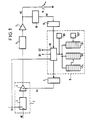
- variable gain amplifier included in a tuner 2 also comprising, upstream of the amplifier 1, a selector 3 of one channel from N channels forming a frequency multiplex received at an input E of this selector , the latter being furthermore provided with a channel selection input S to which a signal SC for channel selection control is applied.
- the number N is for example equal to 30 and each channel is transmitted by amplitude modulation of a carrier specific to this channel, the all of these carriers occupying a frequency band of 136 to 360 MHz with steps of 8 MHz.
- the selector 3 also performs a frequency transposition intermediate of the selected channel, this intermediate frequency being, for the same application, equal to 38.9 MHz.
- the tuner 2 is, in this application, followed by a filter 4 making it possible to delimit the bandwidth of the channel selected and transposed, itself followed by an amplifier 5 at intermediate frequency, followed in its turn by a light-emitting diode 6 which supplies the signal transmitted by optical fiber to a subscriber of the network considered.
- variable gain amplifier 1 is provided with a gain control input C to which is applied a setpoint voltage Vc obtained at the output of a digital-analog converter 7 which itself receives a signal 8 corresponding numeric.
- the processor 8 itself receives on the one hand the channel selection signal SC and on the other hand, via an analog-digital converter 9, the output signal of a measurement means, or detector, 10, which has in this case a non-linear transfer function which converts the signal applied to its input into a DC voltage Vd representing the level of this signal.
- the signal applied to the input of the detector 10 is the output signal of the complete chain formed by the tuner 2, the filter 4 and the intermediate frequency amplifier 5, and not directly the output signal of the tuner , in order to also integrate into this automatic gain control any drifts in the output level of the chain due to elements 4 and 5.
- the detector 10 in this case performs a detection of the level of the line synchronization signals transmitted during the corresponding synchronization periods of the television signals, that is to say of the corresponding unmodulated carrier transmitted during these periods , and therefore has both a speed and a storage capacity sufficient to carry out such a detection, these synchronization periods being very brief, of a duration of the order of ten microseconds, and of periodicity ranging from up to a few tens of milliseconds depending on the code used (D2MAC, SECAM, ).
- the processor 8 comprises a processing unit 81 associated with read-only memories 82,83, 83 ′ and random access memories 84,85, the read-only memories 82 and 83 being said to be memory respectively setpoint voltages and memory of detected voltages, and containing respectively a table called setpoint voltages and a table called detected voltages, established during a prior calibration phase.
- the automatic gain control of amplifier 1 is intended to maintain the output level N S of this chain at a desired value N SO equal for example to -3dBm, whatever the channel selected and whatever whatever the possible variations in time of the signal level N E of this channel at the input of the tuner, the signal level dispersions at the input of the channel being in this case in a range of ⁇ 4 dB around a nominal value N EO equal for example to - 37 dBm.
- the setpoint voltage table is obtained in this case by varying the input level N E in steps of "n" dB, in the range of variations considered, and by noting each time the setpoint voltage value Vc that it is necessary to apply to the gain control input C of amplifier 1 to maintain, for any given selected channel, the output level N S at the desired value N SO .
- the value "n" can be chosen equal to 0.5.
- the setpoint voltage table could also be obtained by applying a constant input level N E and noting the different setpoint voltage values Vc, in the range of variation thereof, which, applied to the input of command C of amplifier 1, make it possible to obtain an output level N S varying in steps of "n" dB.
- the table of detected voltages is in this case obtained by noting the different detected voltages Vd obtained at the output of the detector 10 for different input levels of this detector varying in steps of "n" dB in the range of variation of the output level N S.
- a tuner input signal consisting of a continuous sinusoid of frequency corresponding to the carrier frequency of a selected channel can be used during this calibration phase.
- This calibration phase also advantageously comprises a prior adjustment of the gain of the chain formed by the tuner 2, the filter 4 and the intermediate frequency amplifier 5, in this case a prior adjustment of the gain of the frequency amplifier intermediate 5, so as to adapt the dynamic variation of the level of the input signal of this chain to the dynamic variation of the gain of the variable gain amplifier 1.
- this adaptation is done so as to obtain the desired value N SO at the output of this chain for a maximum setpoint voltage value, for example 10 Volts, and for the most unfavorable conditions at input, ie a channel selected corresponding to the maximum attenuation provided by the amplitude frequency response of the tuner and a signal level for this channel at the input of this channel equal to the minimum value N Em (ie in the example considered - 4 dB compared to the nominal value N Eo ).
- the different setpoint voltage values obtained in this case for an increasing input level in steps of 0.5 dB, and converted to digital, are stored at successive addresses of the setpoint voltage memory 82, each address being defined by adding to the previous address a fixed addressing step "p", for example equal to 1 in decimal value.
- the reference voltage memory 82 is also associated with a pointer, corresponding in this case to one of the memory boxes of the random access memory 84, called pointer memory, and indicating, as symbolized by an arrow in FIG. 1, that of the addresses of the reference voltage memory 82 containing the current value of the reference voltage to be applied, in the operating phase, that is to say in closed loop , at the gain control input of amplifier 1 to obtain the desired output value N SO .
- Each of the memory boxes of the pointer memory 84 is associated with a determined channel and thus indicates the address of the reference voltage memory 82 containing the reference voltage value to be applied, in closed loop, to the amplifier 1 , to obtain, for the channel considered, the desired output value N SO .
- the content of the pointer memory 84 is constantly updated, during the operating phase, as will be seen later and its initial content is advantageously determined, at the initialization of this operating phase, by implementation. , in a closed loop, of the processing algorithm characteristic of this operational phase, as described later, and on the basis of an a priori arbitrary content of this pointer memory 84.
- the detected voltage values Vd obtained for an input level of the detector increasing in this case in steps of 0.5 dB, and converted to digital, are stored at successive addresses of the memory of detected voltages 83, each address also being defined by adding to the previous address a fixed addressing step "p", equal to that chosen for the reference voltage memory 82, equal for example to 1 in decimal value.
- the memory of detected voltages 83 is also associated with a pointer, constituted by a register 83 ′ and indicating, in the manner symbolized by an arrow in FIG. 1, that of its addresses, referenced ADR Vd o , which corresponds to a detected voltage Vd o corresponding itself to an output level N S of this value chain equal to the desired value N SO .
- the law of variation of the setpoint voltage being moreover capable of varying from one tuner to another, it may be necessary to determine the table or the corresponding mathematical function for each tuner. It is the same for the law of variation of the detected voltage likely to vary from one detector to another.
- the setpoint voltage VCx thus applied therefore makes it possible to obtain the value N SO output required.
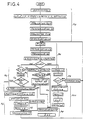
- a processing step P4 is then implemented, consisting of a test making it possible to compare, to a nearest unit (more or less) to take account of any accuracy flaws, the address difference thus obtained to that ⁇ PREC obtained for the previous value of I, in this case the value 2, in which case, if an identity (to within one unit) is observed, the processing step P3 is again implementation, and if a non-identity (to the nearest unit) is observed, the processing step P5 is at new implementation.
- phase P4 makes it possible to avoid immediately carrying out a correction of the reference voltage when the observed evolution is perhaps due to the presence of parasitic signals, or even to the fact that the entire chain is not yet perfectly stabilized after a first correction of this setpoint voltage, taking into account the speed of repetition of the measurements required.
- a test T1 carried out during step P2 directs towards a processing step P6 comprising an accounting of three successive cycles of six such successive steps, by incrementing the variable DEFAULT of one unit for each six-step cycle, then compare this variable to the value 3.
- a processing step P7 comprising signaling of this state, then a processing step P8 comprising a return to the processing step P1 after triggering of a time delay t3, for example 3s, and reset of the variable I to zero.
- the above-mentioned signage may include a simple transmission, by the processing unit 81, of a binary signal, referenced D1 in FIG. 1, the value of which passes for example to "1" when the variable DEFAULT becomes equal to 3.
- this signaling advantageously comprises a transmission of a digital signal referenced D2 in FIG. 1, representative of the address difference ⁇ ADR in question, or a simultaneous transmission of the signals D1 and D2, which corresponds to the case illustrated in the figure 1.
- a processing step P9 is implemented, comprising a test on the realization of such detection on two successive processing steps P1, by incrementing the variable C d ' a unit at each orientation to this processing step P9 then comparison of this variable to the value 2.
- the address ADRVCx of the current setpoint voltage value VCx is recorded in the pointer memory 84, at the address thereof corresponding to the channel "x" considered, during a processing step P10, then comprising a return to step P1 by step P8.
- the MEMO variable is set to 1 during the processing step P10, and the condition described above, defining the test To carried out during step P2 and making it possible to orient either towards step P3 or towards step P4 according to the value of I is also supplemented by a second condition, on the variable MEMO, so that step P2 is followed directly by step P3 only when the variable MEMO is equal to O and the variable I equal to 1, otherwise is followed by step P4.
- the variable MEMO is also reset to zero each time a new reference voltage value is calculated during step P3.
- step P1 If such detection is carried out on two successive processing steps P1, a return to step P1 is made, after triggering of a time delay t4 of the order of 300 ms.
- variable C is reset to zero during processing steps P2 and P10.
- the processing steps P3 and P9 also include a reset to zero of the variable ⁇ PREC.
- the DEFAULT variable is also reset to zero during the processing step P10 because, the output level having then become correct again, a value other than the DEFAULT variable has no longer any reason to be.
- the method according to the invention therefore makes it possible to automatically apply the setpoint voltage value necessary to immediately obtain, unless there is a change in the processing chain considered, the desired value at the output of this chain .
- the method according to the invention also makes it possible, in the event of a deviation detected with respect to this desired value, to automatically determine the setpoint voltage value to be applied to immediately compensate for this deviation, resulting in a reduced convergence time with respect to the so-called increment method.
- the method according to the invention also makes it possible to detect any impossibility of compensation, reflecting a malfunction which should be reported.
Landscapes
- Control Of Amplification And Gain Control (AREA)
- Amplifiers (AREA)
Claims (13)
- Verfahren zur automatischen Verstärkungssteuerung für einen Verstärker (2, 4, 5) mit variablem Verstärkungsgrad, der den Pegel des Ausgangssignals dieses Verstärkers auf einem gewünschten Pegel (NSO) halten soll, wobei das Verfahren folgende Schritte aufweist:- an den Verstärker wird ein laufender Wert des Verstärkungsgrad-Steuersignals angelegt,- der Ausgangspegel des Verstärkers wird von einer Meßvorrichtung mit einer nicht-linearen Kennlinie gemessen, so daß ein gemessener Ausgangspegelwert geliefert wird,- man erfaßt einen eventuellen Abstand (ΔADR) zwischen dem gemessenen Ausgangspegel (Vd) und einem festgelegten Pegel (VdO), der dem Ausgangspegel gleicht, welcher gemessen würde, wenn der Ausgang des Verstärkers den gewünschten Ausgangspegel liefern würde,- man korrigiert das Steuersignal, um diesen Abstand zu verringern, wenn er nicht vernachlässigbar ist,dadurch gekennzeichnet, daß zur Korrektur des Steuersignals, mit der dieser Abstand verringert werden soll, das Verfahren darin besteht:- gemäß einer ersten Beziehung, die durch Eichung vorher festgelegt wurde, einen Eingangspegel (VE) oder einen ersten theoretischen Wert des Steuersignals (Vc) zu suchen, der am Ausgang des Verstärkers einem gemessenen Ausgangspegel gleich dem tatsächlich gemessenen Pegel entspricht,- dann gemäß einer zweiten, durch Eichung vorher festgelegten Beziehung einen zweiten theoretischen Wert des Steuersignals (Vc) zu suchen, der dem Eingangspegel (VE) bzw. dem ersten theoretischen Wert des so bestimmten Steuersignals (Vc) entspricht,- den laufenden Wert des Steuersignals (Vc) unter Verwendung des zweiten so bestimmten theoretischen Werts zu aktualisieren.
- Verfahren nach Anspruch 1, dadurch gekennzeichnet, daß es darin besteht, außerdem den Verstärkungsgrad des Verstärkers (2, 4, 5) so zu regeln, daß die Dynamik des Verstärkungssteuersignals des Verstärkers mit variabler Verstärkung an die Dynamik des Eingangssignals angepaßt wird.
- Verfahren nach einem der Ansprüche 1 und 2, dadurch gekennzeichnet, daß der laufende und ggf. aktualisierte Wert gespeichert wird.
- Verfahren nach einem der Ansprüche 1 bis 3, dadurch gekennzeichnet, daß, wenn das Eingangssignal zahlreiche Kanäle besitzt, deren Pegelveränderungen von einem Kanal zum anderen unabhängig sind, der laufende Wert des Steuersignals für jeden Kanal zur ursprünglichen Anwendung bei jedem Kanalwechsel gespeichert wird.
- Verfahren nach einem der Ansprüche 1 bis 4, dadurch gekennzeichnet, daß die Operationen der Suche und Aktualisierung nach einer Erfassungsoperation nur durchgeführt werden, wenn diese das Vorliegen eines Abstands erfaßt, der im wesentlichen dem bei der für denselben angewendeten laufenden Wert durchgeführten Operation erfaßten Wert gleicht, während ansonsten eine neue Meßoperation und eine neue Erfassungsoperation mit dem gleichen laufenden Wert wiederholt werden.
- Verfahren nach einem der Ansprüche 3 und 4, dadurch gekennzeichnet, daß bei der Aktualisierung die Speicherung erst nach mehreren aufeinanderfolgenden Feststellungen eines nicht vorhandenen Abstands für den aktualisierten laufenden Wert erfolgt.
- Verfahren nach einem der Ansprüche 1 bis 6, dadurch gekennzeichnet, daß es eine Signalisierung eines Betriebsfehlers nach einer vorbestimmten Anzahl von aufeinanderfolgenden Erfassungen des Vorliegens eines Abstands enthält.
- Vorrichtung zur Durchführung des Verfahrens nach einem der Ansprüche 1 bis 7, dadurch gekennzeichnet, daß sie einen Prozessor (8) enthält, der über einen Analog-Digital-Wandler (9) das von einem Mittel (10) zur Messung des Ausgangssignalpegels des Verstärkers mit variablem Verstärkungsgrad (2, 4, 5) gelieferte Signal empfängt und über einen Digital-Analog-Wandler (7) das an den Verstärkungssteuereingang (C) des Verstärkers mit variablem Verstärkungsgrad anzulegende Signal liefert, und daß der Prozessor die zweite Beziehung gespeichert hält, die die Veränderungen des Verstärkungssteuersignals und des laufenden Werts des Steuersignals liefert.
- Vorrichtung nach Anspruch 8, dadurch gekennzeichnet, daß der Prozessor weiter im Speicher (83, 83') die erste Beziehung enthält, die die Veränderungen des gemessenen Ausgangspegels und den gewünschten Wert des gemessenen Ausgangspegels liefert.
- Vorrichtung nach Anspruch 8, dadurch gekennzeichnet, daß die zweite Beziehung, die die Veränderungen des Verstärkungssteuersignals liefert, in diskreter Form gegeben ist und in einem Speicher (82) abgespeichert ist, wobei die Speicherung des laufenden Werts des-Steuersignals mit Hilfe eines Zeiger (84) erhalten wird, der die Adresse dieses Speichers mit diesem laufenden Wert angibt.
- Vorrichtung nach Anspruch 9, dadurch gekennzeichnet, daß die zweite Beziehung, die die Veränderungen des gemessenen Ausgangspegels liefert, in diskreter Form vorliegt und in einem Speicher (83) enthalten ist und daß die Speicherung des gewünschten Werts des gemessenen Ausgangspegels mit Hilfe eines Zeiger (83') erhalten wird, der die Adresse dieses Speichers angibt, der diesen gewünschten Wert enthält.
- Vorrichtung nach Anspruch 11, dadurch gekennzeichnet, daß der Abstand zwischen dem Ergebnis der Messung und dem gewünschten Wert durch den Abstand zwischen der vom Zeiger (83') gelieferten Adresse und der Adresse gebildet wird, die dem diskreten und im Speicher (83) enthaltenen Wert entspricht, der dem Ergebnis der Messung am nächsten kommt.
- Anwendung des Verfahrens nach einem der Ansprüche 1 bis 7 oder der Vorrichtung nach einem der Ansprüche 8 bis 12 auf die automatische Verstärkungssteuerung eines Tuners, insbesondere für ein Fernsehprogramm-Verteilungsnetz, wobei der Tuner (2) am Eingang (E) ein Multiplexsystem von N Fernsehsignalen empfängt, die je durch Amplitudenmodulation einer bestimmten Trägerfrequenz übertragen werden und je zeitlich und von einem Kanal zum anderen variable Pegel besitzen.
Applications Claiming Priority (2)
| Application Number | Priority Date | Filing Date | Title |
|---|---|---|---|
| FR9010331 | 1990-08-14 | ||
| FR9010331A FR2665988B1 (fr) | 1990-08-14 | 1990-08-14 | Procede et dispositif de commande automatique de gain d'un amplificateur a gain variable, et leur application a la commande de gain d'un syntoniseur, notamment pour reseau de videocommunication. |
Publications (2)
| Publication Number | Publication Date |
|---|---|
| EP0476302A1 EP0476302A1 (de) | 1992-03-25 |
| EP0476302B1 true EP0476302B1 (de) | 1997-11-05 |
Family
ID=9399661
Family Applications (1)
| Application Number | Title | Priority Date | Filing Date |
|---|---|---|---|
| EP91113574A Expired - Lifetime EP0476302B1 (de) | 1990-08-14 | 1991-08-13 | Verfahren und Vorrichtung zur automatischen Steuerung der Verstärkung eines Verstärkers und die Verwendung dieses Verfahrens und dieser Vorrichtung bei der Verstärkungssteuerung eines Tuners, insbesondere eines Tuners für ein Videokommunikationsnetz |
Country Status (8)
| Country | Link |
|---|---|
| US (1) | US5194822A (de) |
| EP (1) | EP0476302B1 (de) |
| JP (1) | JP3170314B2 (de) |
| AT (1) | ATE160062T1 (de) |
| CA (1) | CA2049101C (de) |
| DE (1) | DE69128115T2 (de) |
| ES (1) | ES2110422T3 (de) |
| FR (1) | FR2665988B1 (de) |
Families Citing this family (23)
| Publication number | Priority date | Publication date | Assignee | Title |
|---|---|---|---|---|
| JP2918388B2 (ja) * | 1992-04-24 | 1999-07-12 | オリオン電機株式会社 | アナログ制御部の自動調整回路 |
| US5410363A (en) * | 1992-12-08 | 1995-04-25 | Lightwave Communications, Inc. | Automatic gain control device for transmitting video signals between two locations by use of a known reference pulse during vertical blanking period so as to control the gain of the video signals at the second location |
| JP2966226B2 (ja) * | 1993-02-17 | 1999-10-25 | 三菱電機株式会社 | 電力増幅器自動制御回路 |
| US5410265A (en) * | 1993-09-30 | 1995-04-25 | Vimak Corporation | Amplifier calibration apparatus and method therefor |
| US5500626A (en) * | 1994-10-11 | 1996-03-19 | Crown International, Inc. | Independent amplifier control module |
| JPH08125469A (ja) * | 1994-10-21 | 1996-05-17 | Nec Corp | 電力増幅器の出力制御装置 |
| JP3316351B2 (ja) * | 1995-09-27 | 2002-08-19 | シャープ株式会社 | Agc装置 |
| GB2310330B (en) * | 1996-02-15 | 2000-11-29 | Motorola Gmbh | Amplifying circuit and method for determining and programming power control levels therein |
| DE19615842A1 (de) * | 1996-04-20 | 1997-10-23 | Bosch Gmbh Robert | Verfahren zur Steuerung der Leistung eines Sendeverstärkers eines Funkgerätes |
| US6530088B1 (en) | 1996-06-03 | 2003-03-04 | Scientific-Atlanta, Inc. | Apparatus for automatic sensing of line amplifier configuration for status monitoring |
| US6191653B1 (en) * | 1998-11-18 | 2001-02-20 | Ericsson Inc. | Circuit and method for linearizing amplitude modulation in a power amplifier |
| US6480061B2 (en) * | 1999-01-13 | 2002-11-12 | Nortel Networks Limited | Amplifier having digital micro processor control apparatus |
| US6377117B2 (en) * | 1999-07-27 | 2002-04-23 | Conexant Systems, Inc. | Method and system for efficiently transmitting energy from an RF device |
| US6493657B1 (en) * | 1999-08-20 | 2002-12-10 | Glp Partnership | Amplitude range matching system |
| US6307429B1 (en) * | 2000-01-12 | 2001-10-23 | National Semiconductor Corporation | Extended power ramp table for power amplifier control loop |
| US6424221B1 (en) * | 2000-06-19 | 2002-07-23 | Advanced Micro Devices, Inc. | Programmable gain amplifier for use in data network |
| JP4625192B2 (ja) * | 2001-02-06 | 2011-02-02 | マスプロ電工株式会社 | 双方向増幅装置及び双方向catvシステム |
| US6766153B2 (en) | 2001-04-02 | 2004-07-20 | Itran Communications Ltd. | Dynamic automatic gain control circuit employing kalman filtering |
| US7499508B2 (en) * | 2001-04-03 | 2009-03-03 | Agere Systems Inc. | Method and apparatus for adjusting the gain of an if amplifier in a communication system |
| EP1639815A1 (de) * | 2003-06-20 | 2006-03-29 | Koninklijke Philips Electronics N.V. | Empfänger zum empfang von radiofrequenzsignalen |
| US7148744B2 (en) | 2004-06-07 | 2006-12-12 | Agere Systems Inc. | Calibration technique for variable-gain amplifiers |
| FR2871629A1 (fr) * | 2004-06-09 | 2005-12-16 | Thomson Licensing Sa | Dispositif de conversion de frequences, procede d'etalonnage dudit dispositif et systeme d'emission/reception de signaux electromagnetiques comportant un tel dispositif |
| EP2040470A1 (de) * | 2007-09-20 | 2009-03-25 | FAGOR, S.Coop | Programmierbarer aktiver Verteiler für ein Fernseh-Kopfende |
Family Cites Families (8)
| Publication number | Priority date | Publication date | Assignee | Title |
|---|---|---|---|---|
| US4112384A (en) * | 1977-05-24 | 1978-09-05 | Morgan Industries | Controlled recovery automatic gain control amplifier |
| FR2448193B1 (fr) * | 1979-02-01 | 1985-12-06 | Michel Andre | Attenuateur electronique multivoies a reglages memorises et a visualisation par diodes electroluminescentes |
| US4334185A (en) | 1980-12-18 | 1982-06-08 | Motorola, Inc. | Circuit for automatic gain control with constant response time |
| FR2520952A1 (fr) * | 1982-02-03 | 1983-08-05 | Trt Telecom Radio Electr | Dispositif de controle automatique de gain (cag) a action rapide |
| DE3461505D1 (en) * | 1983-03-08 | 1987-01-15 | Victor Company Of Japan | Circuit arrangement for correcting frequency response in accordance with frequency response of a sound field |
| GB8322440D0 (en) * | 1983-08-19 | 1983-09-21 | Gen Electric Co Plc | Frequency division multiplex transmission equipment |
| DE3346678A1 (de) * | 1983-12-23 | 1985-07-11 | Grundig E.M.V. Elektro-Mechanische Versuchsanstalt Max Grundig holländ. Stiftung & Co KG, 8510 Fürth | Verfahren zur verzoegerten verstaerkungsregelung und anordnung zur durchfuehrung des verfahrens |
| US4704584A (en) * | 1986-06-25 | 1987-11-03 | Fairfield Industries | Instantaneous floating point amplifier |
-
1990
- 1990-08-14 FR FR9010331A patent/FR2665988B1/fr not_active Expired - Fee Related
-
1991
- 1991-08-13 AT AT91113574T patent/ATE160062T1/de not_active IP Right Cessation
- 1991-08-13 ES ES91113574T patent/ES2110422T3/es not_active Expired - Lifetime
- 1991-08-13 DE DE69128115T patent/DE69128115T2/de not_active Expired - Lifetime
- 1991-08-13 EP EP91113574A patent/EP0476302B1/de not_active Expired - Lifetime
- 1991-08-13 CA CA002049101A patent/CA2049101C/fr not_active Expired - Fee Related
- 1991-08-14 JP JP20435891A patent/JP3170314B2/ja not_active Expired - Lifetime
- 1991-08-14 US US07/744,721 patent/US5194822A/en not_active Expired - Lifetime
Also Published As
| Publication number | Publication date |
|---|---|
| DE69128115T2 (de) | 1998-03-05 |
| JPH04349706A (ja) | 1992-12-04 |
| US5194822A (en) | 1993-03-16 |
| EP0476302A1 (de) | 1992-03-25 |
| ES2110422T3 (es) | 1998-02-16 |
| DE69128115D1 (de) | 1997-12-11 |
| ATE160062T1 (de) | 1997-11-15 |
| CA2049101A1 (fr) | 1992-02-15 |
| CA2049101C (fr) | 1995-03-07 |
| JP3170314B2 (ja) | 2001-05-28 |
| FR2665988A1 (fr) | 1992-02-21 |
| FR2665988B1 (fr) | 1996-11-22 |
Similar Documents
| Publication | Publication Date | Title |
|---|---|---|
| EP0476302B1 (de) | Verfahren und Vorrichtung zur automatischen Steuerung der Verstärkung eines Verstärkers und die Verwendung dieses Verfahrens und dieser Vorrichtung bei der Verstärkungssteuerung eines Tuners, insbesondere eines Tuners für ein Videokommunikationsnetz | |
| EP0086514B1 (de) | Schnell wirkende automatische Verstärkungsregelung | |
| EP0041882B1 (de) | Einrichtung zum Voreinstellen der Frequenz einer indirekten Frequenzsyntheseschaltung und eine solche Einrichtung enthaltende Frequenzsyntheseschaltung | |
| EP2173029B1 (de) | Selbstkalibrierverfahren eines Frequenzgenerators mit Zweipunkt-FSK-Modulation | |
| EP0041429B1 (de) | Verfahren und Einrichtung zur Synchronisierung digitaler Signale | |
| WO1994029971A1 (fr) | Paquet de signalisation pour systeme de communication avec reference modulee suivant une loi fonction du temps | |
| FR2533094A1 (fr) | Methode de controle d'un systeme de transmission numerique, systeme et repeteurs appliquant cette methode | |
| EP0091339A1 (de) | Digitale Klemmschaltung für ein analoges Signal | |
| EP0632310A1 (de) | Vorrichtung zur Vorspannungssteuerung einer optischen Quelle | |
| FR2759790A1 (fr) | Convertisseur de longueur d'onde de signaux optiques binaires | |
| CH661394A5 (fr) | Circuit et procede pour detecter un mot de correlation numerique donne. | |
| FR2512545A1 (fr) | Procede et dispositif photometrique pour mesurer et regler l'epaisseur de couches a effet optique pendant leur formation sous vide | |
| EP0696392B1 (de) | Verfahren und vorrichtung zur automatischer verstarkungsregelung von empfangerschaltungen | |
| FR2514598A1 (fr) | Systeme de reglage de l'accentuation d'un signal video avec possibilite de reglage automatique et manuel | |
| EP0598651B1 (de) | Optisches Übertragungssystem, insbesondere für ein Videokommunikationskabelnetzwerk | |
| EP0637147B1 (de) | Abstimmungsvorrichtung eines optischen abstimmbaren Filters insbesondere zur Anwendung beim Empfang in einem optischen Übertragungssystem | |
| FR2859054A1 (fr) | Controle dynamique de perte de puissance dans une fibre optique par contrapropagation d'un canal de supervision | |
| EP1289177B1 (de) | Vorrichtung zur Polarisationsdispersionskompensation in einem optischen Übertragungssystem | |
| FR2880222A1 (fr) | Dispositif de conversion analogique-numerique avec circuit de decision et seuil de decision optimise | |
| BE1006423A3 (fr) | Procede de regulation d'un processus continu comportant une phase d'optimisation et une phase de regulation. | |
| EP0848547B1 (de) | Schnittstellenschaltung für Videokamera | |
| EP0996240B1 (de) | Methode zur Steuerung der Leistung welche in einem Telekommunikationssystem von einem Empfänger empfangen und von einem Sender gesendet wird, mit einem geschlossenen Regelkreis | |
| FR2513467A1 (fr) | Agencement de blocage d'un systeme d'accentuation de signaux video | |
| EP0465300B1 (de) | Verfahren zur Regelung der Sendeleistung von Endstationen in einem Zeitgetrenntlage-Übertragungsnetzwerk | |
| FR2604583A1 (fr) | Dispositif de conditionnement de signaux video de transmission d'images |
Legal Events
| Date | Code | Title | Description |
|---|---|---|---|
| PUAI | Public reference made under article 153(3) epc to a published international application that has entered the european phase |
Free format text: ORIGINAL CODE: 0009012 |
|
| AK | Designated contracting states |
Kind code of ref document: A1 Designated state(s): AT BE CH DE ES FR GB IT LI NL SE |
|
| 17P | Request for examination filed |
Effective date: 19920921 |
|
| 17Q | First examination report despatched |
Effective date: 19940919 |
|
| GRAG | Despatch of communication of intention to grant |
Free format text: ORIGINAL CODE: EPIDOS AGRA |
|
| GRAH | Despatch of communication of intention to grant a patent |
Free format text: ORIGINAL CODE: EPIDOS IGRA |
|
| GRAH | Despatch of communication of intention to grant a patent |
Free format text: ORIGINAL CODE: EPIDOS IGRA |
|
| GRAA | (expected) grant |
Free format text: ORIGINAL CODE: 0009210 |
|
| AK | Designated contracting states |
Kind code of ref document: B1 Designated state(s): AT BE CH DE ES FR GB IT LI NL SE |
|
| REF | Corresponds to: |
Ref document number: 160062 Country of ref document: AT Date of ref document: 19971115 Kind code of ref document: T |
|
| REG | Reference to a national code |
Ref country code: CH Ref legal event code: NV Representative=s name: GEC ALSTHOM SALES NETWORK SA Ref country code: CH Ref legal event code: EP |
|
| GBT | Gb: translation of ep patent filed (gb section 77(6)(a)/1977) |
Effective date: 19971106 |
|
| REF | Corresponds to: |
Ref document number: 69128115 Country of ref document: DE Date of ref document: 19971211 |
|
| ITF | It: translation for a ep patent filed | ||
| REG | Reference to a national code |
Ref country code: ES Ref legal event code: FG2A Ref document number: 2110422 Country of ref document: ES Kind code of ref document: T3 |
|
| PLBE | No opposition filed within time limit |
Free format text: ORIGINAL CODE: 0009261 |
|
| STAA | Information on the status of an ep patent application or granted ep patent |
Free format text: STATUS: NO OPPOSITION FILED WITHIN TIME LIMIT |
|
| 26N | No opposition filed | ||
| PGFP | Annual fee paid to national office [announced via postgrant information from national office to epo] |
Ref country code: CH Payment date: 19990719 Year of fee payment: 9 Ref country code: NL Payment date: 19990719 Year of fee payment: 9 |
|
| PGFP | Annual fee paid to national office [announced via postgrant information from national office to epo] |
Ref country code: AT Payment date: 19990720 Year of fee payment: 9 |
|
| PGFP | Annual fee paid to national office [announced via postgrant information from national office to epo] |
Ref country code: BE Payment date: 19990818 Year of fee payment: 9 |
|
| PG25 | Lapsed in a contracting state [announced via postgrant information from national office to epo] |
Ref country code: AT Free format text: LAPSE BECAUSE OF NON-PAYMENT OF DUE FEES Effective date: 20000813 |
|
| PG25 | Lapsed in a contracting state [announced via postgrant information from national office to epo] |
Ref country code: BE Free format text: LAPSE BECAUSE OF NON-PAYMENT OF DUE FEES Effective date: 20000831 Ref country code: CH Free format text: LAPSE BECAUSE OF NON-PAYMENT OF DUE FEES Effective date: 20000831 Ref country code: LI Free format text: LAPSE BECAUSE OF NON-PAYMENT OF DUE FEES Effective date: 20000831 |
|
| BERE | Be: lapsed |
Owner name: ALCATEL CIT Effective date: 20000831 |
|
| PG25 | Lapsed in a contracting state [announced via postgrant information from national office to epo] |
Ref country code: NL Free format text: LAPSE BECAUSE OF NON-PAYMENT OF DUE FEES Effective date: 20010301 |
|
| REG | Reference to a national code |
Ref country code: CH Ref legal event code: PL |
|
| NLV4 | Nl: lapsed or anulled due to non-payment of the annual fee |
Effective date: 20010301 |
|
| REG | Reference to a national code |
Ref country code: GB Ref legal event code: IF02 |
|
| PGFP | Annual fee paid to national office [announced via postgrant information from national office to epo] |
Ref country code: SE Payment date: 20040809 Year of fee payment: 14 |
|
| PGFP | Annual fee paid to national office [announced via postgrant information from national office to epo] |
Ref country code: ES Payment date: 20040818 Year of fee payment: 14 |
|
| PG25 | Lapsed in a contracting state [announced via postgrant information from national office to epo] |
Ref country code: SE Free format text: LAPSE BECAUSE OF NON-PAYMENT OF DUE FEES Effective date: 20050814 |
|
| PG25 | Lapsed in a contracting state [announced via postgrant information from national office to epo] |
Ref country code: ES Free format text: LAPSE BECAUSE OF NON-PAYMENT OF DUE FEES Effective date: 20050816 |
|
| EUG | Se: european patent has lapsed | ||
| REG | Reference to a national code |
Ref country code: ES Ref legal event code: FD2A Effective date: 20050816 |
|
| PGFP | Annual fee paid to national office [announced via postgrant information from national office to epo] |
Ref country code: DE Payment date: 20100823 Year of fee payment: 20 Ref country code: FR Payment date: 20100901 Year of fee payment: 20 Ref country code: IT Payment date: 20100824 Year of fee payment: 20 |
|
| PGFP | Annual fee paid to national office [announced via postgrant information from national office to epo] |
Ref country code: GB Payment date: 20100819 Year of fee payment: 20 |
|
| REG | Reference to a national code |
Ref country code: DE Ref legal event code: R071 Ref document number: 69128115 Country of ref document: DE |
|
| REG | Reference to a national code |
Ref country code: DE Ref legal event code: R071 Ref document number: 69128115 Country of ref document: DE |
|
| REG | Reference to a national code |
Ref country code: GB Ref legal event code: PE20 Expiry date: 20110812 |
|
| PG25 | Lapsed in a contracting state [announced via postgrant information from national office to epo] |
Ref country code: GB Free format text: LAPSE BECAUSE OF EXPIRATION OF PROTECTION Effective date: 20110812 |
|
| PG25 | Lapsed in a contracting state [announced via postgrant information from national office to epo] |
Ref country code: DE Free format text: LAPSE BECAUSE OF EXPIRATION OF PROTECTION Effective date: 20110814 |