EP0476338A2 - Electrode modifiée par un polyviologène; leur utilisation - Google Patents
Electrode modifiée par un polyviologène; leur utilisation Download PDFInfo
- Publication number
- EP0476338A2 EP0476338A2 EP91113986A EP91113986A EP0476338A2 EP 0476338 A2 EP0476338 A2 EP 0476338A2 EP 91113986 A EP91113986 A EP 91113986A EP 91113986 A EP91113986 A EP 91113986A EP 0476338 A2 EP0476338 A2 EP 0476338A2
- Authority
- EP
- European Patent Office
- Prior art keywords
- electrode
- polyviologen
- modified
- electrolyte
- film
- Prior art date
- Legal status (The legal status is an assumption and is not a legal conclusion. Google has not performed a legal analysis and makes no representation as to the accuracy of the status listed.)
- Granted
Links
- 239000000178 monomer Substances 0.000 claims abstract description 31
- 150000001450 anions Chemical class 0.000 claims abstract description 10
- 230000009467 reduction Effects 0.000 claims abstract description 10
- 125000002947 alkylene group Chemical group 0.000 claims abstract description 5
- 125000000732 arylene group Chemical group 0.000 claims abstract description 5
- 125000002993 cycloalkylene group Chemical group 0.000 claims abstract description 5
- 238000004070 electrodeposition Methods 0.000 claims abstract description 4
- 239000003792 electrolyte Substances 0.000 claims description 30
- 238000006116 polymerization reaction Methods 0.000 claims description 15
- 238000000034 method Methods 0.000 claims description 13
- 239000011521 glass Substances 0.000 claims description 10
- -1 salt sulfonate Chemical class 0.000 claims description 9
- 150000003839 salts Chemical class 0.000 claims description 9
- 239000003115 supporting electrolyte Substances 0.000 claims description 7
- 229920000447 polyanionic polymer Polymers 0.000 claims description 6
- 239000011244 liquid electrolyte Substances 0.000 claims description 5
- AMGQUBHHOARCQH-UHFFFAOYSA-N indium;oxotin Chemical compound [In].[Sn]=O AMGQUBHHOARCQH-UHFFFAOYSA-N 0.000 claims description 4
- 229910052751 metal Inorganic materials 0.000 claims description 4
- 239000002184 metal Substances 0.000 claims description 4
- XOLBLPGZBRYERU-UHFFFAOYSA-N tin dioxide Chemical compound O=[Sn]=O XOLBLPGZBRYERU-UHFFFAOYSA-N 0.000 claims description 3
- 229920003023 plastic Polymers 0.000 claims description 2
- 239000004033 plastic Substances 0.000 claims description 2
- 229910001887 tin oxide Inorganic materials 0.000 claims 2
- XLYOFNOQVPJJNP-UHFFFAOYSA-N water Substances O XLYOFNOQVPJJNP-UHFFFAOYSA-N 0.000 abstract description 21
- 238000000137 annealing Methods 0.000 abstract description 6
- 239000003960 organic solvent Substances 0.000 abstract description 6
- ZMXDDKWLCZADIW-UHFFFAOYSA-N N,N-Dimethylformamide Chemical compound CN(C)C=O ZMXDDKWLCZADIW-UHFFFAOYSA-N 0.000 description 42
- 239000010408 film Substances 0.000 description 36
- CSCPPACGZOOCGX-UHFFFAOYSA-N Acetone Chemical compound CC(C)=O CSCPPACGZOOCGX-UHFFFAOYSA-N 0.000 description 18
- BASFCYQUMIYNBI-UHFFFAOYSA-N platinum Chemical compound [Pt] BASFCYQUMIYNBI-UHFFFAOYSA-N 0.000 description 18
- 238000002360 preparation method Methods 0.000 description 16
- WEVYAHXRMPXWCK-UHFFFAOYSA-N Acetonitrile Chemical compound CC#N WEVYAHXRMPXWCK-UHFFFAOYSA-N 0.000 description 15
- WCUXLLCKKVVCTQ-UHFFFAOYSA-M Potassium chloride Chemical compound [Cl-].[K+] WCUXLLCKKVVCTQ-UHFFFAOYSA-M 0.000 description 14
- GPHQHTOMRSGBNZ-UHFFFAOYSA-O pyridin-1-ium-4-carbonitrile Chemical compound N#CC1=CC=[NH+]C=C1 GPHQHTOMRSGBNZ-UHFFFAOYSA-O 0.000 description 14
- GPHQHTOMRSGBNZ-UHFFFAOYSA-N pyridine-4-carbonitrile Chemical class N#CC1=CC=NC=C1 GPHQHTOMRSGBNZ-UHFFFAOYSA-N 0.000 description 13
- 239000000203 mixture Substances 0.000 description 12
- 229920000642 polymer Polymers 0.000 description 12
- 238000006243 chemical reaction Methods 0.000 description 8
- 238000004040 coloring Methods 0.000 description 8
- 230000003287 optical effect Effects 0.000 description 8
- 238000005160 1H NMR spectroscopy Methods 0.000 description 7
- 238000001914 filtration Methods 0.000 description 7
- 239000001103 potassium chloride Substances 0.000 description 7
- 235000011164 potassium chloride Nutrition 0.000 description 7
- 239000002244 precipitate Substances 0.000 description 7
- OKKJLVBELUTLKV-UHFFFAOYSA-N Methanol Chemical compound OC OKKJLVBELUTLKV-UHFFFAOYSA-N 0.000 description 6
- WYURNTSHIVDZCO-UHFFFAOYSA-N Tetrahydrofuran Chemical compound C1CCOC1 WYURNTSHIVDZCO-UHFFFAOYSA-N 0.000 description 6
- JFDZBHWFFUWGJE-UHFFFAOYSA-N benzonitrile Chemical compound N#CC1=CC=CC=C1 JFDZBHWFFUWGJE-UHFFFAOYSA-N 0.000 description 6
- 239000008151 electrolyte solution Substances 0.000 description 6
- 239000002904 solvent Substances 0.000 description 6
- IPDRRKNAIFXMDR-UHFFFAOYSA-L 1-[4-(4-cyanopyridin-1-ium-1-yl)butyl]pyridin-1-ium-4-carbonitrile;dibromide Chemical compound [Br-].[Br-].C1=CC(C#N)=CC=[N+]1CCCC[N+]1=CC=C(C#N)C=C1 IPDRRKNAIFXMDR-UHFFFAOYSA-L 0.000 description 5
- LFQSCWFLJHTTHZ-UHFFFAOYSA-N Ethanol Chemical compound CCO LFQSCWFLJHTTHZ-UHFFFAOYSA-N 0.000 description 5
- 238000010521 absorption reaction Methods 0.000 description 5
- 230000015572 biosynthetic process Effects 0.000 description 5
- 229920000831 ionic polymer Polymers 0.000 description 5
- 230000033116 oxidation-reduction process Effects 0.000 description 5
- HEDRZPFGACZZDS-UHFFFAOYSA-N Chloroform Chemical compound ClC(Cl)Cl HEDRZPFGACZZDS-UHFFFAOYSA-N 0.000 description 4
- 239000000758 substrate Substances 0.000 description 4
- 239000011248 coating agent Substances 0.000 description 3
- 238000000576 coating method Methods 0.000 description 3
- 125000004093 cyano group Chemical group *C#N 0.000 description 3
- 239000004744 fabric Substances 0.000 description 3
- 230000004048 modification Effects 0.000 description 3
- 238000012986 modification Methods 0.000 description 3
- 229910052697 platinum Inorganic materials 0.000 description 3
- RUOJZAUFBMNUDX-UHFFFAOYSA-N propylene carbonate Chemical compound CC1COC(=O)O1 RUOJZAUFBMNUDX-UHFFFAOYSA-N 0.000 description 3
- 238000006479 redox reaction Methods 0.000 description 3
- YLQBMQCUIZJEEH-UHFFFAOYSA-N tetrahydrofuran Natural products C=1C=COC=1 YLQBMQCUIZJEEH-UHFFFAOYSA-N 0.000 description 3
- NQQUGKKTJLAUHC-UHFFFAOYSA-N 1-methylpyridin-1-ium-4-carbonitrile Chemical compound C[N+]1=CC=C(C#N)C=C1 NQQUGKKTJLAUHC-UHFFFAOYSA-N 0.000 description 2
- OISVCGZHLKNMSJ-UHFFFAOYSA-N 2,6-dimethylpyridine Chemical compound CC1=CC=CC(C)=N1 OISVCGZHLKNMSJ-UHFFFAOYSA-N 0.000 description 2
- 0 CC(C)(*(CC1)=CC=C1[Zn])N Chemical compound CC(C)(*(CC1)=CC=C1[Zn])N 0.000 description 2
- CTQNGGLPUBDAKN-UHFFFAOYSA-N O-Xylene Chemical group CC1=CC=CC=C1C CTQNGGLPUBDAKN-UHFFFAOYSA-N 0.000 description 2
- URLKBWYHVLBVBO-UHFFFAOYSA-N Para-Xylene Chemical group CC1=CC=C(C)C=C1 URLKBWYHVLBVBO-UHFFFAOYSA-N 0.000 description 2
- NBIIXXVUZAFLBC-UHFFFAOYSA-N Phosphoric acid Chemical compound OP(O)(O)=O NBIIXXVUZAFLBC-UHFFFAOYSA-N 0.000 description 2
- ZLMJMSJWJFRBEC-UHFFFAOYSA-N Potassium Chemical compound [K] ZLMJMSJWJFRBEC-UHFFFAOYSA-N 0.000 description 2
- JUJWROOIHBZHMG-UHFFFAOYSA-N Pyridine Chemical compound C1=CC=NC=C1 JUJWROOIHBZHMG-UHFFFAOYSA-N 0.000 description 2
- FAPWRFPIFSIZLT-UHFFFAOYSA-M Sodium chloride Chemical compound [Na+].[Cl-] FAPWRFPIFSIZLT-UHFFFAOYSA-M 0.000 description 2
- QAOWNCQODCNURD-UHFFFAOYSA-N Sulfuric acid Chemical compound OS(O)(=O)=O QAOWNCQODCNURD-UHFFFAOYSA-N 0.000 description 2
- GPWHDDKQSYOYBF-UHFFFAOYSA-N ac1l2u0q Chemical compound Br[Br-]Br GPWHDDKQSYOYBF-UHFFFAOYSA-N 0.000 description 2
- 239000002585 base Substances 0.000 description 2
- 238000005859 coupling reaction Methods 0.000 description 2
- 238000002848 electrochemical method Methods 0.000 description 2
- 239000012789 electroconductive film Substances 0.000 description 2
- IVSZLXZYQVIEFR-UHFFFAOYSA-N m-xylene Chemical group CC1=CC=CC(C)=C1 IVSZLXZYQVIEFR-UHFFFAOYSA-N 0.000 description 2
- 238000004519 manufacturing process Methods 0.000 description 2
- 239000012528 membrane Substances 0.000 description 2
- VLTRZXGMWDSKGL-UHFFFAOYSA-N perchloric acid Chemical compound OCl(=O)(=O)=O VLTRZXGMWDSKGL-UHFFFAOYSA-N 0.000 description 2
- 239000008363 phosphate buffer Substances 0.000 description 2
- 239000002798 polar solvent Substances 0.000 description 2
- 229920001467 poly(styrenesulfonates) Polymers 0.000 description 2
- 239000005518 polymer electrolyte Substances 0.000 description 2
- 230000000379 polymerizing effect Effects 0.000 description 2
- 229910052700 potassium Inorganic materials 0.000 description 2
- 239000011591 potassium Substances 0.000 description 2
- 230000004044 response Effects 0.000 description 2
- BAZAXWOYCMUHIX-UHFFFAOYSA-M sodium perchlorate Chemical compound [Na+].[O-]Cl(=O)(=O)=O BAZAXWOYCMUHIX-UHFFFAOYSA-M 0.000 description 2
- 229910001488 sodium perchlorate Inorganic materials 0.000 description 2
- 239000001488 sodium phosphate Substances 0.000 description 2
- 229910001495 sodium tetrafluoroborate Inorganic materials 0.000 description 2
- 239000000243 solution Substances 0.000 description 2
- GTQHJCOHNAFHRE-UHFFFAOYSA-N 1,10-dibromodecane Chemical compound BrCCCCCCCCCCBr GTQHJCOHNAFHRE-UHFFFAOYSA-N 0.000 description 1
- ULTHEAFYOOPTTB-UHFFFAOYSA-N 1,4-dibromobutane Chemical compound BrCCCCBr ULTHEAFYOOPTTB-UHFFFAOYSA-N 0.000 description 1
- SOYPUUFPUFRXRI-UHFFFAOYSA-N 1,5-dibromo-2,4-dimethylbenzene Chemical group CC1=CC(C)=C(Br)C=C1Br SOYPUUFPUFRXRI-UHFFFAOYSA-N 0.000 description 1
- LVWSZGCVEZRFBT-UHFFFAOYSA-N 1,7-dibromoheptane Chemical compound BrCCCCCCCBr LVWSZGCVEZRFBT-UHFFFAOYSA-N 0.000 description 1
- OZLOCQFUKXVPBC-UHFFFAOYSA-M 1-(2,4-dinitrophenyl)pyridin-1-ium-4-carbonitrile;chloride Chemical compound [Cl-].[O-][N+](=O)C1=CC([N+](=O)[O-])=CC=C1[N+]1=CC=C(C#N)C=C1 OZLOCQFUKXVPBC-UHFFFAOYSA-M 0.000 description 1
- ZUSZPUNTECJHJZ-UHFFFAOYSA-N 2,3-dibromo-1,4-dimethylbenzene Chemical group CC1=CC=C(C)C(Br)=C1Br ZUSZPUNTECJHJZ-UHFFFAOYSA-N 0.000 description 1
- LBLYYCQCTBFVLH-UHFFFAOYSA-N 2-Methylbenzenesulfonic acid Chemical compound CC1=CC=CC=C1S(O)(=O)=O LBLYYCQCTBFVLH-UHFFFAOYSA-N 0.000 description 1
- RYGMFSIKBFXOCR-UHFFFAOYSA-N Copper Chemical compound [Cu] RYGMFSIKBFXOCR-UHFFFAOYSA-N 0.000 description 1
- RWSOTUBLDIXVET-UHFFFAOYSA-N Dihydrogen sulfide Chemical class S RWSOTUBLDIXVET-UHFFFAOYSA-N 0.000 description 1
- VYZAHLCBVHPDDF-UHFFFAOYSA-N Dinitrochlorobenzene Chemical compound [O-][N+](=O)C1=CC=C(Cl)C([N+]([O-])=O)=C1 VYZAHLCBVHPDDF-UHFFFAOYSA-N 0.000 description 1
- GRYLNZFGIOXLOG-UHFFFAOYSA-N Nitric acid Chemical compound O[N+]([O-])=O GRYLNZFGIOXLOG-UHFFFAOYSA-N 0.000 description 1
- PMZURENOXWZQFD-UHFFFAOYSA-L Sodium Sulfate Chemical compound [Na+].[Na+].[O-]S([O-])(=O)=O PMZURENOXWZQFD-UHFFFAOYSA-L 0.000 description 1
- 238000000862 absorption spectrum Methods 0.000 description 1
- 239000002253 acid Substances 0.000 description 1
- 230000002378 acidificating effect Effects 0.000 description 1
- 239000003513 alkali Substances 0.000 description 1
- 229910052782 aluminium Inorganic materials 0.000 description 1
- XAGFODPZIPBFFR-UHFFFAOYSA-N aluminium Chemical compound [Al] XAGFODPZIPBFFR-UHFFFAOYSA-N 0.000 description 1
- 229910000147 aluminium phosphate Inorganic materials 0.000 description 1
- 125000004202 aminomethyl group Chemical group [H]N([H])C([H])([H])* 0.000 description 1
- 125000003118 aryl group Chemical group 0.000 description 1
- 239000007853 buffer solution Substances 0.000 description 1
- 238000005266 casting Methods 0.000 description 1
- 230000008859 change Effects 0.000 description 1
- 150000001875 compounds Chemical class 0.000 description 1
- 239000000470 constituent Substances 0.000 description 1
- 238000007796 conventional method Methods 0.000 description 1
- 229910052802 copper Inorganic materials 0.000 description 1
- 239000010949 copper Substances 0.000 description 1
- 238000004132 cross linking Methods 0.000 description 1
- 125000004956 cyclohexylene group Chemical group 0.000 description 1
- 238000000151 deposition Methods 0.000 description 1
- 230000008021 deposition Effects 0.000 description 1
- 238000011161 development Methods 0.000 description 1
- ZOMNIUBKTOKEHS-UHFFFAOYSA-L dimercury dichloride Chemical class Cl[Hg][Hg]Cl ZOMNIUBKTOKEHS-UHFFFAOYSA-L 0.000 description 1
- HPYNZHMRTTWQTB-UHFFFAOYSA-N dimethylpyridine Natural products CC1=CC=CN=C1C HPYNZHMRTTWQTB-UHFFFAOYSA-N 0.000 description 1
- 238000003618 dip coating Methods 0.000 description 1
- BNIILDVGGAEEIG-UHFFFAOYSA-L disodium hydrogen phosphate Chemical compound [Na+].[Na+].OP([O-])([O-])=O BNIILDVGGAEEIG-UHFFFAOYSA-L 0.000 description 1
- 229910000397 disodium phosphate Inorganic materials 0.000 description 1
- 235000019800 disodium phosphate Nutrition 0.000 description 1
- 238000000840 electrochemical analysis Methods 0.000 description 1
- SAVROPQJUYSBDD-UHFFFAOYSA-N formyl(dimethyl)azanium;chloride Chemical compound [Cl-].C[N+](C)=CO SAVROPQJUYSBDD-UHFFFAOYSA-N 0.000 description 1
- 125000000524 functional group Chemical group 0.000 description 1
- PCHJSUWPFVWCPO-UHFFFAOYSA-N gold Chemical compound [Au] PCHJSUWPFVWCPO-UHFFFAOYSA-N 0.000 description 1
- 229910052737 gold Inorganic materials 0.000 description 1
- 239000010931 gold Substances 0.000 description 1
- 229910052736 halogen Inorganic materials 0.000 description 1
- 150000002367 halogens Chemical class 0.000 description 1
- 238000010438 heat treatment Methods 0.000 description 1
- 239000004009 herbicide Substances 0.000 description 1
- 229910017053 inorganic salt Inorganic materials 0.000 description 1
- 238000011835 investigation Methods 0.000 description 1
- 150000002500 ions Chemical class 0.000 description 1
- 230000002427 irreversible effect Effects 0.000 description 1
- 239000007788 liquid Substances 0.000 description 1
- 239000000463 material Substances 0.000 description 1
- 229910017604 nitric acid Inorganic materials 0.000 description 1
- 229940078552 o-xylene Drugs 0.000 description 1
- 150000007530 organic bases Chemical class 0.000 description 1
- 125000000962 organic group Chemical group 0.000 description 1
- 239000006174 pH buffer Substances 0.000 description 1
- INFDPOAKFNIJBF-UHFFFAOYSA-N paraquat Chemical compound C1=C[N+](C)=CC=C1C1=CC=[N+](C)C=C1 INFDPOAKFNIJBF-UHFFFAOYSA-N 0.000 description 1
- 125000005010 perfluoroalkyl group Chemical group 0.000 description 1
- 229920000172 poly(styrenesulfonic acid) Polymers 0.000 description 1
- 229920000867 polyelectrolyte Polymers 0.000 description 1
- 229960002796 polystyrene sulfonate Drugs 0.000 description 1
- 239000011970 polystyrene sulfonate Substances 0.000 description 1
- 229940005642 polystyrene sulfonic acid Drugs 0.000 description 1
- 230000008569 process Effects 0.000 description 1
- UMJSCPRVCHMLSP-UHFFFAOYSA-N pyridine Natural products COC1=CC=CN=C1 UMJSCPRVCHMLSP-UHFFFAOYSA-N 0.000 description 1
- JUJWROOIHBZHMG-UHFFFAOYSA-O pyridinium Chemical compound C1=CC=[NH+]C=C1 JUJWROOIHBZHMG-UHFFFAOYSA-O 0.000 description 1
- 239000002824 redox indicator Substances 0.000 description 1
- 230000002441 reversible effect Effects 0.000 description 1
- 229910052709 silver Inorganic materials 0.000 description 1
- 239000004332 silver Substances 0.000 description 1
- 239000011780 sodium chloride Substances 0.000 description 1
- CSMWJXBSXGUPGY-UHFFFAOYSA-L sodium dithionate Chemical compound [Na+].[Na+].[O-]S(=O)(=O)S([O-])(=O)=O CSMWJXBSXGUPGY-UHFFFAOYSA-L 0.000 description 1
- 229940075931 sodium dithionate Drugs 0.000 description 1
- 229910000162 sodium phosphate Inorganic materials 0.000 description 1
- 235000011008 sodium phosphates Nutrition 0.000 description 1
- 229940006186 sodium polystyrene sulfonate Drugs 0.000 description 1
- 229910052938 sodium sulfate Inorganic materials 0.000 description 1
- 235000011152 sodium sulphate Nutrition 0.000 description 1
- GGCZERPQGJTIQP-UHFFFAOYSA-N sodium;9,10-dioxoanthracene-2-sulfonic acid Chemical compound [Na+].C1=CC=C2C(=O)C3=CC(S(=O)(=O)O)=CC=C3C(=O)C2=C1 GGCZERPQGJTIQP-UHFFFAOYSA-N 0.000 description 1
- 239000007784 solid electrolyte Substances 0.000 description 1
- 238000004528 spin coating Methods 0.000 description 1
- 238000012360 testing method Methods 0.000 description 1
- 239000012780 transparent material Substances 0.000 description 1
- RYFMWSXOAZQYPI-UHFFFAOYSA-K trisodium phosphate Chemical compound [Na+].[Na+].[Na+].[O-]P([O-])([O-])=O RYFMWSXOAZQYPI-UHFFFAOYSA-K 0.000 description 1
- 230000002747 voluntary effect Effects 0.000 description 1
Images

Classifications
-
- C—CHEMISTRY; METALLURGY
- C08—ORGANIC MACROMOLECULAR COMPOUNDS; THEIR PREPARATION OR CHEMICAL WORKING-UP; COMPOSITIONS BASED THEREON
- C08G—MACROMOLECULAR COMPOUNDS OBTAINED OTHERWISE THAN BY REACTIONS ONLY INVOLVING UNSATURATED CARBON-TO-CARBON BONDS
- C08G61/00—Macromolecular compounds obtained by reactions forming a carbon-to-carbon link in the main chain of the macromolecule
- C08G61/12—Macromolecular compounds containing atoms other than carbon in the main chain of the macromolecule
Definitions
- the present invention relates to a polyviologen modified electrode provided with a polyviologen film on the surface insoluble in any solvent prepared by means of electrochemical polymerization, and an electrochemical cell containing said electrode.
- Viologen is a generic term to define 4,4'-dipyridinium salts represented by the formula (A): wherein R is an organic group and X- is a counter anion, and known to proceed in the following sequential redox reactions;
- the first redox reaction between the dication and the monocation radical proceeds in a reversible way and a cation radical provides strong coloring or color development.
- the reaction can easily be achieved by an electrochemical or a photochemical reduction, so that it can be utilized in a wide variety of industrial applications. Typical examples are electochromic displays, wet solar batteries, secondary batteries, silver or non-silver salt photography, redox indicators, photochromic materials, etc.
- JP-A-57-10122 discloses a viologen branched with another high molecular weight backbone chain.
- polymers are known, in which the backbone chain constitutes a viologen such as polyxylidylviologens and polyarylviologens (JP-A-59-217789), etc.
- a viologen modified electrode i.e. an electrode the surface of which is coated with a viologen
- a dip method a casting method for coating an electrode with a polyviologen solution because the conventional polyviolygen is soluble in water and any polar solvent.
- the resultant electrode is used as an electrode of an electrochemical cell, the modified polyviologen is soluble in the cell electrolyte and detached from the electrode, so that stable performance is not obtained.
- This method in which the resultant polyion complex film is insoluble in water or other organic solvents is advantageous in that an irreversible coloring (annealing phenomenon) caused by repeated redox reactions is avoided, but is disadvantageous in that a solvent of concentrated hydrochloric acid-dimethylformamide on spin-coating of polyviologen is used, so that it is impossible to use an electrode corroded by the above solvent.
- the first object of the present invention is to provide a polyviologen modified electrode which has no performance problem in connection with the solubility in water and an organic solvent and the annealing phenomenon.
- the second object of the present invention is to provide a method far preparing the polyviologen modified electrode with ease by a single step contrary to the conventional method which comprises two steps; whereby the first one is a step of preparing a soluble polyviologen and the second one is a step of forming the same on a surface of the electrode.
- the third object of the present invention is to provide an electrochemical cell which comprises at least one of the polyviologen modified electrodes.
- a polyviologen modified electrode which comprises an insoluble film of polyviologen polymerized on an electrode by electrochemical reduction and deposition of a monomer represented by the formula wherein R 1 is a divalent group selected from the groups consisting of alkylene, cycloalkylene, arylene and arylalkylene or a trivalent group selected from the groups consisting of alkanetriyl, cycloalkanetriyl, arylalkanetriyl and aryltriyl; X- is a counter anion; m is 2 or 3.
- a method for preparing a polyviologen modified electrode in which cathodic potential is applied to an electrode to reduce electrochemically a monomer represented by the formula (I) in a liquid electrolyte at a controlled pH of 7 to 10, whereby the monomer is polymerized and deposited on the electrode to form a film of polyviologen attached to the surface of the electrode.
- an electrochemical cell as use of the polyviologen modified electrode.
- a monomer having two or three 4-cyanopyridinium groups can be prepared to a viologen unit and also directly polymerized and deposited on an electrode by electrochemical reduction to form an insoluble polymer fixed and modified electrode.
- the monomer represented by the general formula (I) used in the present invention is synthesized by subjecting a corresponding dihalide or trihalide with surplus amount of 4-cyanopyridine to the Menshutkin reaction.
- a monomer in which a 4-cyanopyridinium group is bonded to aromatic group firstly 4-cyanopyridine and 2,4-dinitro phenylchloride are subjected to the Menshutkin reaction to give N-(2',4'-dinitrophenyl)-4-cyanopyridinium chloride and then the resultant compound is subjected to substituted reaction to give a desired 4-cyanopyridinium compound.
- the Menshutkin reaction is carried out in such a polar solvent as dimethylformamide, acetonitrile or tetrahydrofuran or in a non-solvent with heating.
- R 1 in the formula (I) is a divalent group such as alkylene, cycloalkylene, arylene and arylalkylene, which have C1 to C14; a trivalent group such as alkanetriyl, cycloalkanetriyl, arylalkanetriyl and aryltriyl, which have C3 to C9.
- Examples of X- of the formula (I) include anions of halogen, perchloric acid, tetrafluoroboric acid, phosphoric acid, toluenesulfonic acid, nitric acid, sulfuric acid and so on, but X- is not limited to these anions.
- the monomer is dissolved into water to give a concentration of 1 to 1000m mol/I and to the mixture is added a supporting electrolyte to adjust the pH to 7-10.
- an electrode to be modified is electrochemically reduced by cathodic potential, whereby the following polymerization reaction electrodeposition proceeds to give a desired polyviologen modified electrode provided with an uniform film of polyviologen at its surface, which film is insoluble in water and any organic solvent and can not be melted by heat.
- the desired thickness of the film may be selected according to usage and purposes of the modified electrode. Generally, a thickness of 0.01 to 100 ⁇ m is suitable for use. The thickness can be controlled by electric quantity.
- n is the degree of polymerization, X, is defined as X- of the formula (I) or a counter anion from a supporting electrolyte.
- the resultant viologen polymer is colored blue to purple peculiar to a viologen cation radical.
- the reduction potential is different depending on the monomer to be polymerized and is usually in a range of -0.6 to -0.8 V (vs.SCE).
- vs.SCE -0.6 to -0.8 V
- the viologen coloring disappears and non-color or light yellow of the modified film appears.
- an electrolyte such as a salt corresponding to X- of the formula (I), which is usually used in a water-electrochemical system, especially, it is preferable to use an electrolyte, such as sodium perchlorate, sodium tetrafluoro borate and so on in which the synthesized viologen polymer has a low solubility. Further, it is more preferable to use a polyanion electrolyte. The reason is that, if the above low molecular weight electrolyte is used, a polyviologen film modified on the electrode is insolvably fixed by a voluntary crosslinking.
- an oligomer in which polymerization does not proceed is not deposited on the surface of the electrode and is dispersed into the liquid electrolyte, so that the deposited volume on the electrode becomes small.
- an oligomer and/or a polyviologen synthesized on the electrode immediately form(s) a polyion complex as shown in the following figure and a modified film of a polyion complex is deposited. Thereby modification efficiency of polyviologen can be improved and thus a highly modified electrode is obtained.
- a resultant polyion complex is in the form of crosslinked structure by ion-bonding, thereby current efficiency on polymerizing being improved to increase a modified volume and also on the electrode there being formed a strong and uniform film which is very superior in physical strength.
- the preferred examples or the polymer electrolyte include a polymer sulfonium salt with an alkaline metal such as polystyrenesulfonium salt, polyvinylsulfonium salt, perfluoroalkyl polysulfonium salt and so on, and a polymer carboxylium salt with an alkaline metal such as polyacrylium salt, polymethacrylium salt and so on. It is desired that the low and high molecular molar quantity electrolytes are used by 1 to 10 times equivalent weight of the monomer of the formula (I).
- a weak basic condition at pH 7 to 10 is satisfactory for the polymerization. Under an acidic condition less than pH 7 a cyano group is predominantly reduced to an amino methyl group. On the other hand, under an alkali condition with a pH higher than 10, the pyridinium monomer is decomposed and thus the solution is colored black.
- the control of pH is effectively made by using a pH buffer of inorganic salt such as phosphate buffer or an organic base such as pyridine, and so on.
- a base electrode to be modified by polyviologen examples include a metal electrode made of platinum, gold, aluminum, copper and so on, a transparent glass electrode nude of Indium-Tin-Oxide coating glass (hereinafter referred to as ITO) and Sn0 2 coating glass (nesa glass), and a plastic electrode coated with them.
- ITO Indium-Tin-Oxide coating glass
- Sn0 2 coating glass nesa glass
- the polyviologen polymerized by electrochemical reduction according to the present invention is insoluble in water and organic solvents such as dimethylformamide, tetrahydrofuran, acetonitrile, aceton, chloroform, methanol, ethanol and so on.
- crosslinked structure can be presumed by the insolubility of the polyviologen according to the present invention. That is, it is presumed that, a resultant viologen unit is reduced to a cation radical, which is reacted with unreacted 4-cyanopyridinium radical to partly form the crosslinked structure as shown in the following formula.
- the polyviologen modified electrode according to the present invention its modified film is insoluble in any organic solvent such as dimethylformamide, propylene carbonate, acetonitrile, benzonitrile and so on which is often used as electrolyte. Further, the film is formed by electrochemical methods, so that passages for the ion of the supporting electrolyte to freely move in and out for required to electrochemical reacting are automatically fabricated in the film, thereby the modified electrode is very useful for usage in electrochemical cells. Especially, it is found that the present modified electrode has a superior performance as a working electrode of electrochromic display. Further, an electrochemical cell constituted of the modified electrode according to the present invention can be used for a secondary battery and a wet solar cell.
- any organic solvent such as dimethylformamide, propylene carbonate, acetonitrile, benzonitrile and so on which is often used as electrolyte.
- the film is formed by electrochemical methods, so that passages for the ion of the supporting electrolyte to freely
- the electrochemical cell is constituted of an operating electrode, a counter electrode, a reference electrode and an electrolyte (or liquid), but in some cases, the reference electrode may be not provided.
- the modified electrode according to the present invention is applicable to any electrode of the cell.
- an electrochromic display device wherein for example an operating electrode is made of polyviologen modified one and at least one of a base plate for supporting the operating electrode and a counter electrode is made of a transparent one, coloring variation can be observed by applying potential between the two electrodes.
- Any liquid electrolyte such as water, acetonitrile, benzonitrile, dimethylformamide, propylene carbonate is available in the present invention, because the polyviologen film is insoluble in such a electrolyte.
- Solid electrolytes may also be used in the present invention.
- the modified electrode according to the present invention is superior in the reversibility of the redox cycle and shows a stable oxidation-reduction potential, so that it is useful for a redox sensor and a reference electrode.
- the polyviologen modified electrode of the present invention as the polyviologen film modified on the surface can be formed easily and effectively by means of electrochemical method, the modification amount of the insoluble film can be controlled with ease by the quantity in the electrochemical reduction and thus a desired electrode with a controlled modification amount according to the purposes can be provided.
- an electrochromic cell provided with the modified electrode according to the present invention give a good display performance without annealing and is superior in resistance to repeated use.
- Tetramethylenebis(4-cyanopyridinium)dibromide (75.2 mg) as obtained in Preparation Example 4 and sodium chloride (118 mg) as a supporting electrolyte were dissolved in water (20 ml) to make an electrolyte solution of pH 7.
- An electrochemical cell was set up with an ITO ((indium tin oxide) glass electrode (electrode area, 2 cm 2 ) as a working electrode, a platinum (Pt) wire as a counter electrode and a saturated calomel electrode (SCE) as a reference electrode. Then the monomer was electrolysed potentiostatically at -0.9 V (SCE) with 0.3 c/cm 2 to perform electrochemical polymerization.
- the color at the working electrode surface could be seen as purple due to formation of polyviologen film thereon.
- the electrode potential changed to 0 V, the color disappeared, and the work electrode was confirmed to be modified with a pale yellowish polyviologen film in a thickness of 0.01 ⁇ m.
- the polyviologen modified electrode shows two redox potentials at -0.59 V and -0.9 V identified with viologen.
- cathodic potential at -0.8 V was applied the electrode assumed a purple color and showed an optical density (O.D.) of 0.045 at x max 545 nm.
- Example 4 In the same manner as in Example 1 but using sodium sulfate (284 mg) (Example 2), sodium tetrafluoroborate (219 mg) (Example 3) and sodium perchlorate (145 mg) (Example 4) as the support electrolyte, viologen modified electrodes as shown in Table 1 were prepared.
- Tetramethylenebis(4-cyanopyridinium)dibromide (128 mg, 20 mol/I) as obtained in Preparation Example 4 and potassium polyvinylsulfonate (324 mg; 0.1 mol/I as sulfonic anion) (Nakarai Tesk K.K.) as a supporting electrolyte wore dissolved in water (20 ml) to make an electrolytic solution at pH 8.2,
- the monomer was electrolysed potentiostatically at -0.8 V with 0.1 c/cm 2 using an ITO glass electrode as a work electrode, by using a Pt wire as a counter electrode and a SCE as a reference electrode to perform electrochemical polymerization.
- the color at the work electrode surface could be seen as purple due to formation of a polyviologen film thereon.
- the potential changed at 0 V the color disappeared, and the work electrode was confirmed to be modified with an extremely uniform pale yellowish polyviologen film in a thickness of 0.6 /1.m. This film was excellent in mechanical strength and hardly peeled off even by rubbing with a cloth.
- the electrochemical property and spectroscopic property were measured with the polyviologen modified electrode thus obtained as working electrode and a Pt wire as a counter electrode in an water electrolyte containing 0.1 mol/I of potassium chloride as a support electrolyte to make a cell.
- the polyviologen modified electrode shows two oxidation-reduction potentials at -0.59 V and -0.9 V identified with viologen.
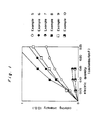
- the optical density of the viologen modified electrode at ⁇ max 550 nm was increased according to electric quantity of potentiostatic electropolymerization at -0.8 V (SCE).
- Example 5 electrochemical and optical properties were measured in the same manner as in Example 5.
- the first redox potential and the maximum absorption are shown in Table 2 therein.
- the optical density of polyviologen modified electrode at each absorption maximam was shown in Figure 1 in comparison with electric quantity of potentiostatic electropolymerization at -0.8 V. 550 nm is shown in Fig. 1.
- the monomer was electropolymerized potentiostatically at -0.8 V with 0.1 c/cm 2 of electrical quantity using an ITO glass electrode as a work electrode, a Pt wire as a counter electrode and a SCE as a reference electrode.
- the color at the work electrode surface could be seen as purple due to formation of a polyviologen film thereon.
- the electrode potential changed to 0 V, the color disappeared, and the work electrode was confirmed to be modified with an extremely uniform pale yellowish polyviologen film in a thickness of 1.1 am. This film was excellent in mechanical strength and hardly peeled off even by rubbing with a cloth.
- the electrochemical and spectroscopic properties were measured with the polyviologen modified work electrode thus obtained using a Pt wire as a counter electrode in an water electrolyte containing 0.1 mol/I potassium chloride as a support electrolyte.
- the polyviologen modified electrode shows two redox potentials at -0.59 V and -0.9 V identified with viologen. When applied at -0.8 V, the electrode showed an optical density (O.D.) of 1.01 at ⁇ max 550 nm.
- the electrochemical property and spectroscopic poperty of the polyviologen modified work electrode thus obtained was measured using a Pt wire as a counter electrode in an water electrolyte containing 0.1 mol/I potassium chloride as a support electrolyte to make a cell.
- the cell shows two oxidation reduction potentials at -0.56 V and -0.88 V identified with viologen.
- the electrode When applied at -0.8 V, the electrode showed an optical density (O.D.) of 0.27.
- the electrochemical and spectroscopic properties of the polyviologen modified work electrode thus obtained were measured using a Pt wire as a counter electrode in an water electrolyte containing 0.1 mol/I potassium chloride as a support electrolyte to make a cell.
- the cell shows two oxidation reduction potentials at -0.57 V and -0.88 V identified with viologen.
- the electrode When applied at -0.0 V, the electrode showed an optical density (O.D.) of 0.24.
- the polyviologen electrodes obtained in Examples 1 to 13 were immersed in water, dimethylformamide, acetone, acetonitrile, methanol, ethanol, chloroform, propylene carbonate or tetrahydrofuran at 60 ° C for 1 hour, but no peeling of the polyviologen film was observed. Also, the electrodes were completely insoluble in these solvents.
- the cathodic potential was applied at -0.8 V. After retaining the colored state at the modified electrodes for 1 hour, the potential was raised to 0 V. Coloring disappeared immediately and completely, and no annealing was recognized on the modified electrodes.
- 640mg of tetramethylene bis(4-cyanopyridinium) dibromide and 1.62g of potassium polyvinylsulfonate (made by aNAKARAI TESK Co. Ltd.) is dissolved in 100ml of water to give a liquid electrolyte adjusted to pH8.2.
- the monomer was electropolymerized potentiostatically at -0.8 V (SCE) with 0.1 c/cm 2 electrolytic quantity using a 20 x 40 mm 2 ITO electrode as an operating electrode and a 20 x 20 mm 2 platinum electrode as a counter electrode and thereby an insoluble viologen film is electrochemically formed on the operating electrode to prepare a polyviologen modified electrode.
- the resultant modified electrode and a new ITO electrode are oppositely positioned with a distance of 4 mm and a space there between is filled with a water electrolyte containing 0.1 mol/I potassium chloride to prepare an electrochemical test cell.
- potential of 2 second pulse with -0.8 V to 0 V v.s. SCE
- a change of absorption degree is observed. Coloring and discoloring are completed within about 1 second. The shorter distance between the electrodes, the larger area and the more applied voltage the cell has, the faster response the cell has.
Landscapes
- Chemical & Material Sciences (AREA)
- Health & Medical Sciences (AREA)
- Chemical Kinetics & Catalysis (AREA)
- Medicinal Chemistry (AREA)
- Polymers & Plastics (AREA)
- Organic Chemistry (AREA)
- Electrolytic Production Of Non-Metals, Compounds, Apparatuses Therefor (AREA)
- Electrochromic Elements, Electrophoresis, Or Variable Reflection Or Absorption Elements (AREA)
- Macromolecular Compounds Obtained By Forming Nitrogen-Containing Linkages In General (AREA)
Applications Claiming Priority (3)
| Application Number | Priority Date | Filing Date | Title |
|---|---|---|---|
| JP2220795A JPH0795170B2 (ja) | 1990-08-21 | 1990-08-21 | ポリビオロゲン修飾電極およびその用途 |
| JP22079590 | 1990-08-21 | ||
| JP220795/90 | 1990-08-21 |
Publications (3)
| Publication Number | Publication Date |
|---|---|
| EP0476338A2 true EP0476338A2 (fr) | 1992-03-25 |
| EP0476338A3 EP0476338A3 (en) | 1993-03-10 |
| EP0476338B1 EP0476338B1 (fr) | 1999-11-03 |
Family
ID=16756689
Family Applications (1)
| Application Number | Title | Priority Date | Filing Date |
|---|---|---|---|
| EP91113986A Expired - Lifetime EP0476338B1 (fr) | 1990-08-21 | 1991-08-21 | Electrode modifiée par un polyviologène; leur utilisation |
Country Status (4)
| Country | Link |
|---|---|
| US (1) | US5232574A (fr) |
| EP (1) | EP0476338B1 (fr) |
| JP (1) | JPH0795170B2 (fr) |
| DE (1) | DE69131765T2 (fr) |
Cited By (1)
| Publication number | Priority date | Publication date | Assignee | Title |
|---|---|---|---|---|
| US12040489B2 (en) * | 2018-11-09 | 2024-07-16 | Commissariat A L'energie Atomique Et Aux Energies Alternatives | Use of a battery with polyviologen active material |
Families Citing this family (19)
| Publication number | Priority date | Publication date | Assignee | Title |
|---|---|---|---|---|
| IL102930A (en) * | 1992-08-25 | 1997-03-18 | Yissum Res Dev Co | Electrobiochemical analytical method and electrodes |
| IL108726A (en) * | 1994-02-22 | 1999-12-31 | Yissum Res Dev Co | Electrobiochemical method and system for the determination of an analyte which is a member of a recognition pair in a liquid medium and electrodes therefor |
| US5538687A (en) * | 1994-12-16 | 1996-07-23 | Behringer Mannheim Gmbh | Apparatus for generating optically detectable signals by applying electrical potentials to sample liquids |
| JP3369439B2 (ja) * | 1997-06-05 | 2003-01-20 | 科学技術振興事業団 | 光応答電極および湿式太陽電池 |
| JPH11142891A (ja) * | 1997-11-05 | 1999-05-28 | Nippon Oil Co Ltd | エレクトロクロミックミラー |
| US6122092A (en) * | 1999-05-20 | 2000-09-19 | Telcordia Technologies, Inc. | Reversible inorganic electrochromic solution device |
| US7045054B1 (en) | 1999-09-20 | 2006-05-16 | Roche Diagnostics Corporation | Small volume biosensor for continuous analyte monitoring |
| SG99865A1 (en) * | 2000-07-04 | 2003-11-27 | Univ Singapore | Photoinduced coversion of polyaniline from an insulating state to a conducting state |
| US6946015B2 (en) * | 2003-06-26 | 2005-09-20 | The Regents Of The University Of California | Cross-linked polybenzimidazole membrane for gas separation |
| WO2005062110A1 (fr) | 2003-12-22 | 2005-07-07 | Lg Chem, Ltd. | Matiere electrochromique a duree de vie prolongee |
| US6997971B1 (en) * | 2004-07-28 | 2006-02-14 | The Regents Of The University Of California | Cross-linked polybenzimidazole membrane for gas separation |
| US20090040589A1 (en) * | 2005-07-11 | 2009-02-12 | Siemens Aktiengesellschaft | Polymer 4,4'-bipyridinium structures, formulations for an electrochromic active layer, and application therefor |
| JP4946222B2 (ja) * | 2006-07-11 | 2012-06-06 | ソニー株式会社 | エレクトロクロミック装置 |
| JP5112228B2 (ja) * | 2008-09-04 | 2013-01-09 | 株式会社東芝 | 表示装置及び表示装置の駆動方法 |
| JP5894372B2 (ja) * | 2010-11-01 | 2016-03-30 | パナソニック株式会社 | 光電気素子、及び光電気素子の製造方法 |
| JP6738679B2 (ja) * | 2016-07-25 | 2020-08-12 | スタンレー電気株式会社 | 電気化学装置 |
| JP7258350B2 (ja) * | 2019-04-03 | 2023-04-17 | 国立研究開発法人産業技術総合研究所 | 規則構造を有する高水溶性、高エネルギー密度化有機系活物質を用いた電気化学デバイス |
| CN115745881A (zh) * | 2022-12-05 | 2023-03-07 | 浙江工业大学 | 一种线性紫罗精聚合物及其制备方法 |
| CN115745880B (zh) * | 2022-12-05 | 2025-10-31 | 浙江工业大学 | 一种交联紫罗精聚合物及其制备方法 |
Family Cites Families (7)
| Publication number | Priority date | Publication date | Assignee | Title |
|---|---|---|---|---|
| US3694384A (en) * | 1971-01-11 | 1972-09-26 | Gen Electric | Redox polymers |
| US3856714A (en) * | 1973-09-07 | 1974-12-24 | Polaroid Corp | Polyviologens |
| EP0078636B2 (fr) * | 1981-10-23 | 1997-04-02 | MediSense, Inc. | Senseur pour composants d'un mélange liquide |
| US4439302A (en) * | 1981-11-24 | 1984-03-27 | Massachusetts Institute Of Technology | Redox mediation and hydrogen-generation with bipyridinium reagents |
| GB8417301D0 (en) * | 1984-07-06 | 1984-08-08 | Serono Diagnostics Ltd | Assay |
| AU596946B2 (en) * | 1984-07-10 | 1990-05-24 | F. Hoffmann-La Roche Ltd | Methods of assay |
| US4895705A (en) * | 1984-11-23 | 1990-01-23 | Massachusetts Institute Of Technology | Molecule-based microelectronic devices |
-
1990
- 1990-08-21 JP JP2220795A patent/JPH0795170B2/ja not_active Expired - Fee Related
-
1991
- 1991-08-21 EP EP91113986A patent/EP0476338B1/fr not_active Expired - Lifetime
- 1991-08-21 US US07/748,077 patent/US5232574A/en not_active Expired - Fee Related
- 1991-08-21 DE DE69131765T patent/DE69131765T2/de not_active Expired - Fee Related
Cited By (1)
| Publication number | Priority date | Publication date | Assignee | Title |
|---|---|---|---|---|
| US12040489B2 (en) * | 2018-11-09 | 2024-07-16 | Commissariat A L'energie Atomique Et Aux Energies Alternatives | Use of a battery with polyviologen active material |
Also Published As
| Publication number | Publication date |
|---|---|
| DE69131765T2 (de) | 2000-06-21 |
| US5232574A (en) | 1993-08-03 |
| JPH04102831A (ja) | 1992-04-03 |
| EP0476338B1 (fr) | 1999-11-03 |
| EP0476338A3 (en) | 1993-03-10 |
| DE69131765D1 (de) | 1999-12-09 |
| JPH0795170B2 (ja) | 1995-10-11 |
Similar Documents
| Publication | Publication Date | Title |
|---|---|---|
| EP0476338B1 (fr) | Electrode modifiée par un polyviologène; leur utilisation | |
| Hsiao et al. | Electrochemical synthesis of electrochromic polycarbazole films from N-phenyl-3, 6-bis (N-carbazolyl) carbazoles | |
| KR960009685B1 (ko) | 자기 도우프된 중합체의 제조방법 | |
| AU2004207696A1 (en) | Electrochromic compounds | |
| US8586702B2 (en) | Substituted 3,4-propylenedioxythiophene monomers and 3,4-propylenedioxythiophene-based crosslinkers and polymers thereof | |
| US5367041A (en) | Self-doped zwitterionic polymers | |
| Nad et al. | Fully organic electroactive monomers for electrochromic behaviors having high coloration efficiency and long cycle stability towards flexible Solid-State electrochromic device | |
| US5342912A (en) | Self-doped zwitterionic aniline polymers | |
| US5891968A (en) | Method of making self-doped zwitterionic heterocyclic polymers | |
| JPH075716B2 (ja) | N,n’―ジフェニルベンジジン重合体の製造方法 | |
| US5310781A (en) | Self-doped polymers from polyaniline with bronsted acid groups | |
| US5500474A (en) | Stable conducting polymer and processes for the preparation thereof | |
| JP2942710B2 (ja) | 水溶性自己ドープ型導電性ポリマー複合体及びその製造方法 | |
| JPS60233125A (ja) | 有機電気発色材料及びその製造方法 | |
| US4816536A (en) | Polymers of 3,4-substituted pyrrole compounds and their preparation method | |
| US5310829A (en) | Quaternary poly(iso) quinolinediyl and preparation thereof | |
| JPS62164730A (ja) | ポリアニリン膜の製造方法 | |
| JP2960859B2 (ja) | 自己ドープ型導電性ポリマー水溶液及びその製造方法 | |
| JPS6337119A (ja) | 新規な電解重合体およびそれを用いたエレクトロミツク表示素子 | |
| JP2001206938A (ja) | 酸性基を有する可溶性導電性ポリマーの製造方法 | |
| Merz et al. | Preparation and electrochemistry of modified polypyrrole films by anodic copolymerization techniques | |
| JP2770259B2 (ja) | 電極およびそれを用いた電気化学表示素子 | |
| JPH06199935A (ja) | ポリビニルアルコール系共重合体、その製造方法及び該重合体よりなる発色・変色材料 | |
| JPH06199934A (ja) | ポリビニルアルコール系3成分共重合体、その製造方法及び該重合体よりなる発色・変色材料 | |
| JPS63132990A (ja) | エレクトロクロミツク表示素子及びその製造方法 |
Legal Events
| Date | Code | Title | Description |
|---|---|---|---|
| PUAI | Public reference made under article 153(3) epc to a published international application that has entered the european phase |
Free format text: ORIGINAL CODE: 0009012 |
|
| AK | Designated contracting states |
Kind code of ref document: A2 Designated state(s): DE FR GB IT NL |
|
| PUAL | Search report despatched |
Free format text: ORIGINAL CODE: 0009013 |
|
| AK | Designated contracting states |
Kind code of ref document: A3 Designated state(s): DE FR GB IT NL |
|
| 17P | Request for examination filed |
Effective date: 19930712 |
|
| 17Q | First examination report despatched |
Effective date: 19951116 |
|
| GRAG | Despatch of communication of intention to grant |
Free format text: ORIGINAL CODE: EPIDOS AGRA |
|
| GRAG | Despatch of communication of intention to grant |
Free format text: ORIGINAL CODE: EPIDOS AGRA |
|
| GRAH | Despatch of communication of intention to grant a patent |
Free format text: ORIGINAL CODE: EPIDOS IGRA |
|
| GRAG | Despatch of communication of intention to grant |
Free format text: ORIGINAL CODE: EPIDOS AGRA |
|
| GRAH | Despatch of communication of intention to grant a patent |
Free format text: ORIGINAL CODE: EPIDOS IGRA |
|
| GRAA | (expected) grant |
Free format text: ORIGINAL CODE: 0009210 |
|
| AK | Designated contracting states |
Kind code of ref document: B1 Designated state(s): DE FR GB IT NL |
|
| PG25 | Lapsed in a contracting state [announced via postgrant information from national office to epo] |
Ref country code: IT Free format text: LAPSE BECAUSE OF FAILURE TO SUBMIT A TRANSLATION OF THE DESCRIPTION OR TO PAY THE FEE WITHIN THE PRE;WARNING: LAPSES OF ITALIAN PATENTS WITH EFFECTIVE DATE BEFORE 2007 MAY HAVE OCCURRED AT ANY TIME BEFORE 2007. THE CORRECT EFFECTIVE DATE MAY BE DIFFERENT FROM THE ONE RECORDED.SCRIBED TIME-LIMIT Effective date: 19991103 Ref country code: NL Free format text: LAPSE BECAUSE OF FAILURE TO SUBMIT A TRANSLATION OF THE DESCRIPTION OR TO PAY THE FEE WITHIN THE PRESCRIBED TIME-LIMIT Effective date: 19991103 |
|
| REF | Corresponds to: |
Ref document number: 69131765 Country of ref document: DE Date of ref document: 19991209 |
|
| ET | Fr: translation filed | ||
| NLV1 | Nl: lapsed or annulled due to failure to fulfill the requirements of art. 29p and 29m of the patents act | ||
| PG25 | Lapsed in a contracting state [announced via postgrant information from national office to epo] |
Ref country code: GB Free format text: LAPSE BECAUSE OF NON-PAYMENT OF DUE FEES Effective date: 20000821 |
|
| PLBE | No opposition filed within time limit |
Free format text: ORIGINAL CODE: 0009261 |
|
| STAA | Information on the status of an ep patent application or granted ep patent |
Free format text: STATUS: NO OPPOSITION FILED WITHIN TIME LIMIT |
|
| 26N | No opposition filed | ||
| GBPC | Gb: european patent ceased through non-payment of renewal fee |
Effective date: 20000821 |
|
| PGFP | Annual fee paid to national office [announced via postgrant information from national office to epo] |
Ref country code: FR Payment date: 20020828 Year of fee payment: 12 |
|
| PGFP | Annual fee paid to national office [announced via postgrant information from national office to epo] |
Ref country code: DE Payment date: 20020830 Year of fee payment: 12 |
|
| PG25 | Lapsed in a contracting state [announced via postgrant information from national office to epo] |
Ref country code: DE Free format text: LAPSE BECAUSE OF NON-PAYMENT OF DUE FEES Effective date: 20040302 |
|
| PG25 | Lapsed in a contracting state [announced via postgrant information from national office to epo] |
Ref country code: FR Free format text: LAPSE BECAUSE OF NON-PAYMENT OF DUE FEES Effective date: 20040430 |
|
| REG | Reference to a national code |
Ref country code: FR Ref legal event code: ST |