EP0477938A2 - Halbleiterspeicheranordnung - Google Patents
Halbleiterspeicheranordnung Download PDFInfo
- Publication number
- EP0477938A2 EP0477938A2 EP91116443A EP91116443A EP0477938A2 EP 0477938 A2 EP0477938 A2 EP 0477938A2 EP 91116443 A EP91116443 A EP 91116443A EP 91116443 A EP91116443 A EP 91116443A EP 0477938 A2 EP0477938 A2 EP 0477938A2
- Authority
- EP
- European Patent Office
- Prior art keywords
- source
- word line
- interconnection
- memory device
- semiconductor memory
- Prior art date
- Legal status (The legal status is an assumption and is not a legal conclusion. Google has not performed a legal analysis and makes no representation as to the accuracy of the status listed.)
- Granted
Links
Images





Classifications
-
- G—PHYSICS
- G11—INFORMATION STORAGE
- G11C—STATIC STORES
- G11C16/00—Erasable programmable read-only memories
- G11C16/02—Erasable programmable read-only memories electrically programmable
- G11C16/06—Auxiliary circuits, e.g. for writing into memory
-
- G—PHYSICS
- G11—INFORMATION STORAGE
- G11C—STATIC STORES
- G11C16/00—Erasable programmable read-only memories
- G11C16/02—Erasable programmable read-only memories electrically programmable
- G11C16/06—Auxiliary circuits, e.g. for writing into memory
- G11C16/08—Address circuits; Decoders; Word-line control circuits
-
- G—PHYSICS
- G11—INFORMATION STORAGE
- G11C—STATIC STORES
- G11C16/00—Erasable programmable read-only memories
- G11C16/02—Erasable programmable read-only memories electrically programmable
- G11C16/04—Erasable programmable read-only memories electrically programmable using variable threshold transistors, e.g. FAMOS
- G11C16/0408—Erasable programmable read-only memories electrically programmable using variable threshold transistors, e.g. FAMOS comprising cells containing floating gate transistors
- G11C16/0416—Erasable programmable read-only memories electrically programmable using variable threshold transistors, e.g. FAMOS comprising cells containing floating gate transistors comprising cells containing a single floating gate transistor and no select transistor, e.g. UV EPROM
-
- G—PHYSICS
- G11—INFORMATION STORAGE
- G11C—STATIC STORES
- G11C16/00—Erasable programmable read-only memories
- G11C16/02—Erasable programmable read-only memories electrically programmable
- G11C16/06—Auxiliary circuits, e.g. for writing into memory
- G11C16/30—Power supply circuits
Definitions
- This invention relates to a semiconductor memory device using transistors as memory cells, and more particularly to a semiconductor memory device employing with memory cells capable of erasing and rewriting data.
- a basic memory cell is composed of a stacked-gate MOS transistor, where data is written by injection of hot electrons from the drain, while it is erased by applying high voltage to the source to cause tunnel current.
- Memory cells of this type are usually known as EPROM tunnel oxide memory cells (hereinafter, referred to as ETOX cells), whose cross section is shown in Fig. 1A.
- numeral 101 indicates a substrate, 102 a source, 103 a drain, 104 a floating gate, and 105 a control gate.
- Data is written into an ETOX cell of such a structure in the same way as an ordinary EPROM cell.
- a low voltage of, for example, 0 V as the source voltage V S is applied to the source 102; a high voltage as the drain voltage V D to the drain 103; and a high voltage as the control gate voltage V CG to the control gate 105.
- ON current flows between the source and drain, generating pairs of hot electrons and holes in the vicinity of the drain.
- the hot electrons are injected into the floating gate 104, which raises the threshold of the transistor, thereby completing the write operation.
- the holes flow into the substrate 101 as substrate current.
- the erasing of data is done by applying a high voltage to the source 102 and a low voltage of, for example, 0 V to the control gate 105, which sets the drain 103 to a floating state, as shown in Fig. 1C.
- the floating gate potential depends on the source voltage and the capacitance ratio of the capacitance between the control gate 105 and floating gate 104 and the capacitance between the floating gate 104 and source 102. With this floating gate potential, Fowler-Nordheim tunnel current flows between the floating gate 104 and source 102, which extracts electrons from the floating gate 104, thereby completing the erase operation.
- Figure 2 is a circuit diagram of a memory cell array section in a conventional EEPROM employing the Fig. 1A memory cell.
- numeral 11, ..., 11 indicate ETOX cells arranged in matrix, 12, ..., 12 word lines connected to the gates of ETOX cells 11 on a row basis, 13, ..., 13 common source diffused interconnections composed of diffused regions and connected to the sources of the ETOX cells 11 on a two adjacent row basis, 14, ..., 14 source interconnections made of a metal such as aluminum electrically connecting the individual common source diffused interconnections 13 to one another, and 15, ..., 15 bit lines made of a metal such as aluminum connected to the drains of the ETOX cells 11 on a column basis.
- the EEPROM is assumed to allow a plurality of bits to be read from or written into in parallel simultaneously. Therefore, the ETOX cells 11 are divided into groups of a specified number of parallel bits on a bit line basis, and the bit lines 15 are each connected to sense amplifiers via column select transistors 16.
- Figure 3 is a pattern layout for an integrated circuit of the memory cell array of Fig. 2.
- Fig. 4 is a sectional view through line A-A a of Fig. 3.
- a p-type silicon substrate 21 is used as semiconductor substrate, and the ETOX cells are of the n-channel type.
- numeral 22 indicates a first gate insulating film of an ETOX cell; 23 a floating gate; 24 a second gate insulating film; 25 a control gate composed of, for example, a layer of polysilicon, and constituting the word line 12; 26 an n+-type diffused region constituting the common source and the common source diffused interconnection 13; 27 an n+-type diffused region serving as the common drain of two adjacent ETOXs in the column direction; 28 a metal interconnection serving as the source interconnection 14 made of, for example, aluminum, and connected to the n+-type diffused region 26; 29 a contact hole connecting the metal interconnection 28 to the n+-type diffused region 26; 30 an interlayer insulating film covering the control gate; 31 a metal inter connection made of, for example, aluminum, serving as the bit line 15, and connected to the n+-type diffused region 27 serving as the common drain; and 32 a contact hole connecting the metal interconnection 31 to the n+-type diffused region 27.
- the drain potential of each ETOX cell is normally applied via the aluminum bit line 15; the gate potential (control gate potential) is applied via the word line 12 extending in the direction crossing the bit line 15; and the source potential is applied via the common source diffused line 13 extending in the direction parallel with the word line 12.
- the resistance of the common source diffused interconnection 13 is higher than that of a metal interconnection such as aluminum, which has the same effect of inserting resistance R in the common source interconnection 13 as shown in Fig. 2.
- source interconnections 14 of low-resistance aluminum are connected to the source diffused interconnection 13 at a suitable number of places in order to apply the source potential to the common source diffused interconnection 13 in a distributed manner.
- write operation is based on the same principle as that explained in Fig. 1B with a high voltage selectively applied to one bit line 15 and one word line 12, and the ground potential to the common source diffused interconnection 13.
- Erase operation is based on the same principle as that explained in Fig. 1C by grounding all the word lines 12 and putting the column select transistor 16 in the off state to put all the bit lines 15 in a floating state while applying a high voltage to the common source diffused interconnection. That is, because of memory layout restrictions, all bits are erased simultaneously (flush erasure).
- the minimum unit will be considered for a case where the memory cells are divided into blocks, in which blocks data is erased.
- Ordinary 1-megabit memory arrays have a rectangular matrix of 1 kilo rows ⁇ 1 kilo columns.
- a bit string to be written or read has a length of 8 bits or 16 bits like ordinary EPROMs. Since the sense amplifiers for data read are located on the column side, the memory cell array has a structure of 1 kilo rows ⁇ 128 columns ⁇ 8 bits or 1 kilo rows ⁇ 64 columns ⁇ 16 bits.
- the source potential previously applied to the common source diffused interconnection 13 shared by all bits is applied to the individual aluminum source interconnections 14 independently.
- the common source diffused line 13 shared by the sources in the column direction is divided into blocks at intervals of, for example, eight bit lines, and each block is independently applied with the source potential.
- flush-erase-type EEPROMs are also based on 512-byte units.
- OS operating systems
- flush-erase-type EEPROMs Another problem with flush-erase-type EEPROMs is the time required to rewrite data.
- the time required to write one megabits of data is generally approximately 15 seconds, provided that the write time per bit is 100 ⁇ s.
- to rewrite only a small amount of data involves first erasing all bits and then writing the data spending 15 seconds, which would have an adverse effect on applications.
- the object of the present invention is to provide a semiconductor memory device capable of erasing data in smaller blocks without increasing the chip size in integration.
- a semiconductor memory device comprising: a plurality of memory cells having a common source diffused region extending in a specified direction; a word line that contains at least one polysilicon layer connected to the gates of the plurality of memory cells and extends in parallel with the common source diffused region; a first source interconnection composed of a first metal interconnection layer electrically connected to the common source diffused region; and a second source interconnection that is composed of a second layer of a metal interconnection layer electrically connected to the first source interconnection and extends in parallel with the word line.
- data in the memory cells is erased in blocks by connecting the second source interconnection to a suitable number of first source interconnections and selectively applying a voltage to a plurality of second source interconnections. Because the first source interconnection is composed of a different metal interconnection layer from that of the second source interconnection, it is possible to lay out the second source interconnection freely, which allows the erasing of data in smaller blocks without increasing chip size.
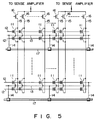
- Figure 5 is a circuit diagram for a memory cell array in an EEPROM according to an embodiment of the present invention. Parts corresponding to those in a conventional equivalent of Fig. 2 are indicated by the same reference characters.
- numerals 11, ..., 11 each indicate ETOX cells, 12, ..., 12 word lines at least one of whose layers is composed of, for example, only a polysilicon layer, a silicide layer, or a polycide layer and which are connected to and shared by the gates of ETOX cells 11 on a row basis, 13, ..., 13 common source diffused interconnections connected to and shared by the sources of the ETOX cells 11 on a two adjacent row basis, 14, ..., 14 first source interconnections made of a metal such as aluminum electrically connecting the individual common source diffused interconnections 13 to one another, and 15, ..., 15 bit lines made of a metal such as aluminum connected to and shared by the drains of the ETOX cells 11 on a column basis.
- the EEPROM is assumed to allow a plurality of bits to be read or written in parallel simultaneously.
- the ETOX cells 11 are divided into groups of a specified number of parallel bits on a bit line basis, and the bit lines 15 are each connected to sense amplifiers via column select transistors 16.
- Numerals 17, ..., 17 indicate second source interconnections that are composed of metal interconnections belonging to a layer different from that of the source interconnections 14, and electrically connected to the source interconnections 14 connected to the common source diffused interconnections 13.
- Figure 6 is a pattern layout for an integrated circuit of the memory cell array of Fig. 5.
- Fig. 7 is a sectional view taken along line A-A a of Fig. 6. Parts corresponding to those of the conventional equivalent in Figs. 3 and 4 are indicated by the same reference characters. In Figs.
- numeral 21 indicates a p-type silicon substrate 21; 22 a first gate insulating film of an ETOX cell; 23 a floating gate; 24 a second gate insulating film; 25 a control gate composed of, for example, a layer of polysilicon, and constituting the word line 12; 26 an n+-type diffused region constituting the common source and the common source diffused interconnection 13; 27 an n+-type diffused region serving as the common drain of two adjacent ETOXs in the column direction; 28 a metal interconnection serving as the source interconnection 14 made of, for example, aluminum, and connected to the n+-type diffused region 26; 29 a contact hole connecting the metal interconnection 28 to the n+-type diffused region 26; 30 an interlayer insulating film covering the control gate; 31 a metal interconnection made of, for example, aluminum, serving as the bit line 15, and connected to the n+-type diffused region 27 serving as the common drain; and 32 a contact hole connecting the metal interconnection 31 to the n+
- an interlayer insulating film 33 is formed, on which a metal interconnection 34 composed of a second aluminum layer constituting the second source interconnection 17 is formed.
- the metal interconnection 34 extends in the direction parallel with the extension of the word line so as to partially go beyond toward the n+-type diffused region 27 to serve as the common drain as shown in Fig. 6. This protrusion is electrically connected to the metal interconnection 28 via the through hole 35.
- the memory cell array is divided into blocks for each second source interconnection 17, and each block has two rows of memory cells.
- the ground voltage is applied to all word lines 12 to set the bit lines 15 to a floating state, while a high voltage is selectively applied via the second source interconnection 17 and first source interconnection 14 to only the common source diffused interconnection 13 within the selected block.
- a low voltage or the 0-V ground voltage is applied, in parallel, to the common source diffused interconnections in the remaining blocks. This enables the erasing of the selected block only.
- the decoder circuit applies a potential to the second source interconnection extending in parallel with the word line, it is desirable to position the decoder circuit next to or in the vicinity of the memory cell array. Because the source of the memory cell corresponding to the same row address as that of the word line is selected, the most efficient layout is such that the decoder circuit is positioned in the same place where the row decoder that selects word lines is located.
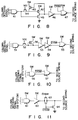
- source decoders which selectively supply a high or low voltage to the second source interconnection 17.
- V CC is a supply voltage for data read of, for example, 5 V
- SW is an internal supply voltage, which is obtained from V CC inside the integrated circuit and during erase/write operations, is at a high voltage of, for example, 12 V, while during read operation, it is at 5 V.
- V CC-system row decode signal is decoded at a NAND gate 41 and then converted into an SW-system voltage at a circuit composed of p-channel MOS transistors 42 and 43, n-channel MOS transistors 44 and 45, and an inverter 46.
- the converted signal, together with the erase-mode signal Erase ⁇ is supplied to a NOR gate 47 that operates on the SW-system voltage.
- the erase-mode signal Erase ⁇ is an SW-system signal, which is low (L) in an erase operation, and during other operations, high.
- the output of the NOR gate 47 is supplied to the corresponding second source interconnection.
- source decoders are provided as many as the number of the second source interconnections, and the input of each NAND gate has a different combination of row decode signals.
- the p-channel MOS transistor is provided for the purpose of putting the transistor 42 in a sufficiently off state by setting the gate potential of the p-channel MOS transistor 42 to the gate potential when the input of the inverter 46 is low or when the transistor 42 turns off and the transistor 45 turns on.
- the n-channel MOS transistor 44 with the gate applied with V CC is provided to prevent current leakage from SW to the output of the NAND gate 41 when the gate potential of the transistor 42 is set to SW.
- a V CC -system row decode signal is decoded at a NAND gate 51 and supplied to an inverter 53, which operates on the SW-system voltage, via an n-channel MOS transistor 52 with the gate applied with V CC .
- the output of the inverter 53 is supplied to an inverter 54, which also operates on the SW-system voltage.
- the output of the inverter 54, together with the erase-mode signal Erase ⁇ is supplied to a NOR gate 55 that operates on the SW voltage.
- the output of the NOR gate 55 is supplied to the corresponding second source interconnection.
- a depletion-mode MOS transistor 56 acting as an SW-system load is connected to the input of the inverter 53.
- the row decode signal to the NAND gate 41 or 51 is a V CC -system signal, it may be converted into an SW-system signal at the stage of the row decode signal.
- the source decoder of Fig. 10 is an example of using an SW-system row decode signal, in which case the SW-system row decode signal is decoded at a NAND gate 56 and then supplied, together with the SW-system erase-mode signal Erase ⁇ , to a NOR gate 57.
- the source decoder of Fig. 11 is also an example of using an SW-system row decode signal.
- the SW-system row decode signal is decoded at a NAND gate 61 and then inverted at an SW-system inverter 62.
- This signal passes through a CMOS transfer gate 63, which is composed of p-channel and n-channel MOS transistors and provides on-off control according to the erase-mode signal Erase ⁇ and its inverted signal, to produce the output to the corresponding second source interconnection.
- CMOS transfer gate 63 which is composed of p-channel and n-channel MOS transistors and provides on-off control according to the erase-mode signal Erase ⁇ and its inverted signal, to produce the output to the corresponding second source interconnection.
- an n-channel MOS transistor 64 is connected which is on during the time other than erase operation with the gate supplied with the erase-mode signal Erase ⁇ .
- the CMOS transfer gate 63 is conductive, which makes the transistor 64 off. At this time, if the logic of the NAND gate holds and its output is low, then the output of the inverter 62 will be high. This signal is supplied to the second source interconnection via the CMOS transfer gate 63. On the other hand, the periods of time other than erase operation, the CMOS transfer gate 63 is non-conductive, which causes the transistor 64 to be on, thereby allowing the ground potential to be supplied to the second source interconnection.
- Figure 12 is a circuit diagram of an entire semiconductor memory device, which contains a row decoder and a source decoder, according to the present invention.
- the word line 12 is composed of a main word line MWL and section word lines SWL, and is based on the double word line system. That is, selection of these two word lines are made through two stages of the main row decoder and section row decoder.
- the main word line select signal undergoes the decoding operation and voltage conversion at the main row decoder MRD, which is made up of a NAND gate 71 and two SW-system inverters 72 and 73, and then is supplied to the main word line MWL.
- the signal on the main word line MWL, together with the section word line select signal, is decoded at the section row decoder made up of NOR gates 74, ..., 74, and then is supplied to the section word lines SWL.
- the signal on the main word line MWL, together with the erase-mode signal Erase is also decoded at a NOR gate 75 serving as the source decoder and then is supplied to the second source interconnection 76.
- the signal on the second source interconnection 76 is supplied to the common source diffused interconnection within the block via each first source interconnection 77.
- the section word line select signal, together with the erase-mode signal Erase ⁇ is supplied to the section row decoder SRD so that all section word lines SWL may be low when the erase-mode signal Erase ⁇ is low (in erase operation).
- Figure 13 is a pattern layout for the integrated circuit of Fig. 12. As shown in Fig. 13, the memory cells in the memory cell array are divided into sections, in each of which each memory cell shares the source diffused region.
- the output of the main row decoder MRD is supplied to each section via the main word line MWL.
- the section word lines SWL each receive signals via the NOR gates 74 in the section row decoder SRD.
- the signal to the second source interconnection 76 is supplied via the NOR gate 75 (not shown in Fig. 13) in the same circuit block where the main row decoder MRD exists.
- the main row decoder MRD also performs voltage conversion from V CC -system to SW system, but other approaches may be possible. For example, if the signal to be decoded is already converted into an SW-system signal, the main row decoder of the arrangement shown in Fig. 10 may be used. While NOR gates are used in the section row decoder, AND gates may be used to construct a similar section row decoder.
- the memory cells controlled by the same main word line form each block, and data is erased in blocks.
- the signal decoded at the main row decoder is used as it is for a decoding operation on the source side, so that there is almost no increase in the area occupied by the decoder in comparison with a conventional equivalent with no signal decoding on the source side.
- the main word line and second source interconnection are formed in the direction of the word line.
- main word lines may be provided at a rate of a plurality of section word lines per main word line, for example, 4 or 6 lines per main word line, which allows sufficient spacing between the main word line and second source interconnection.
- Figure 14 is a circuit diagram of an entire semiconductor memory device different from that of Fig. 12, which contains a row decoder and a source decoder, according to the present invention.
- data is erased simultaneously by each main word line, but as the memory capacity increases, the number of memory cells per main word line increases accordingly. This creates the necessity to erase data in even smaller units. Therefore, in this embodiment, the memory cells sharing the same main word line are further divided into smaller groups by the section, and each second interconnection is also divided further.
- the inverted signal of the erase-mode signal Erase ⁇ is decoded using the section select signal. This decoded signal, together with the main word line MWL, is supplied to the NOR gate 75 acting as the source decoder, the output of which is in turn supplied to the second source interconnection 76 in the corresponding section.
- Figure 15 is a pattern layout for the integrated circuit of Fig. 14. As shown in Fig. 15, the second source interconnection 76 is divided into sections. The signal decoded at the main row decoder MRD is supplied to the section row decoder SRD in each section via the main word line MWL. The section row decoder SRD further decodes the signal and supplies it to the section word lines SWL divided by the section. In the section row decoder SRD in each section, the signal on the source side is also decoded. The decoded signal is supplied to the common source diffused interconnection via the second source interconnection 76 in each section.
- FIG. 16 is a circuit diagram of an ordinary semiconductor memory device such as EPROM or EEPROM to which the present invention is applied.
- the output of the NAND gate 81 which receives the decoder select signal (such as a part of the row address signal), is supplied to each SW-system inverter 83 via each MOS transistor 82, whose gate receives the word line select signal (the signal obtained by decoding the rest of the row address signal).
- each inverter 83 is supplied to the corresponding word line.
- the output of the NAND gate 81, together with the erase-mode signal Erase ⁇ is supplied to an SW-system NOR gate 85 via a MOS transistor 84 whose gate receives the supply voltage V CC .
- the output of the NOR gate 85 is supplied to the corresponding source interconnection.
- the memory cells are divided into sections and the source region of each memory cell shares a single source interconnection (second source interconnection) for each section.
- Depletion-mode MOS transistors 86 are connected to the input of each inverter 83 and to one input of the NOR gate 85 the other input of which is connected to the erase-mode signal.
- This invention may be applied to other types of EPROMs and SRAMs (Static Random Access Memories) as well as EEPROMs using ETOX cells.
- data is erased independently in blocks, which are obtained by dividing the memory cells suitably, all memory cells may be erased simultaneously. That is, overall erase operation can be achieved by specifying addresses so that all second source interconnections may be selected. By adding an overall erase function, it is possible to select either block erase mode or overall erase mode as required.
Landscapes
- Engineering & Computer Science (AREA)
- Microelectronics & Electronic Packaging (AREA)
- Read Only Memory (AREA)
- Semiconductor Memories (AREA)
- Non-Volatile Memory (AREA)
Applications Claiming Priority (2)
| Application Number | Priority Date | Filing Date | Title |
|---|---|---|---|
| JP259041/90 | 1990-09-28 | ||
| JP25904190A JP2635810B2 (ja) | 1990-09-28 | 1990-09-28 | 半導体記憶装置 |
Publications (3)
| Publication Number | Publication Date |
|---|---|
| EP0477938A2 true EP0477938A2 (de) | 1992-04-01 |
| EP0477938A3 EP0477938A3 (en) | 1994-09-28 |
| EP0477938B1 EP0477938B1 (de) | 1997-08-06 |
Family
ID=17328516
Family Applications (1)
| Application Number | Title | Priority Date | Filing Date |
|---|---|---|---|
| EP91116443A Expired - Lifetime EP0477938B1 (de) | 1990-09-28 | 1991-09-26 | Halbleiterspeicheranordnung |
Country Status (5)
| Country | Link |
|---|---|
| US (1) | US5295105A (de) |
| EP (1) | EP0477938B1 (de) |
| JP (1) | JP2635810B2 (de) |
| KR (1) | KR960001320B1 (de) |
| DE (1) | DE69127155T2 (de) |
Cited By (6)
| Publication number | Priority date | Publication date | Assignee | Title |
|---|---|---|---|---|
| EP0618586A1 (de) * | 1993-03-31 | 1994-10-05 | Sony Corporation | Nichtflüchtige Speicheranordnung |
| EP0676816A1 (de) * | 1994-03-28 | 1995-10-11 | STMicroelectronics S.r.l. | Flash-EEPROM-Speicher-Matrix und Verfahren zur Vorspannung |
| US5751038A (en) * | 1996-11-26 | 1998-05-12 | Philips Electronics North America Corporation | Electrically erasable and programmable read only memory (EEPROM) having multiple overlapping metallization layers |
| EP0823117A4 (de) * | 1995-04-28 | 1999-06-02 | Intel Corp | Architektur für das blockweise aufteilen eines nichtflüchtigen speichers |
| EP1227499A1 (de) * | 2001-01-24 | 2002-07-31 | STMicroelectronics S.r.l. | Nichtflüchtiger elektrisch veränderbarer Halbleiterspeicher |
| US7993957B2 (en) | 2002-02-20 | 2011-08-09 | Micron Technology, Inc. | Phase change memory cell and manufacturing method thereof using minitrenches |
Families Citing this family (16)
| Publication number | Priority date | Publication date | Assignee | Title |
|---|---|---|---|---|
| JP2816062B2 (ja) * | 1992-10-05 | 1998-10-27 | 株式会社東芝 | メモリセルの情報の消去方法 |
| EP0594920B1 (de) * | 1992-10-29 | 1999-07-28 | STMicroelectronics S.r.l. | Verfahren zur Bewertung des Gatteroxids nicht-flüchtiger EPROM, EEPROM und flash-EEPROM-Speicher |
| EP0595775B1 (de) * | 1992-10-29 | 1999-07-28 | STMicroelectronics S.r.l. | Verfahren zur Bewertung der dielektrischen Schicht nicht-flüchtiger EPROM, EEPROM und flash-EEPROM-Speicher |
| JPH06215590A (ja) * | 1993-01-13 | 1994-08-05 | Nec Ic Microcomput Syst Ltd | フラッシュ消去型不揮発性メモリ |
| JP3105109B2 (ja) * | 1993-05-19 | 2000-10-30 | 株式会社東芝 | 不揮発性半導体記憶装置 |
| US5583808A (en) * | 1994-09-16 | 1996-12-10 | National Semiconductor Corporation | EPROM array segmented for high performance and method for controlling same |
| US5646886A (en) * | 1995-05-24 | 1997-07-08 | National Semiconductor Corporation | Flash memory having segmented array for improved operation |
| US5631864A (en) * | 1995-07-28 | 1997-05-20 | Micron Quantum Devices, Inc. | Memory array having a reduced number of metal source lines |
| KR100228424B1 (ko) * | 1996-06-29 | 1999-11-01 | 김영환 | 반도체 메모리 장치의 엑스 디코더 회로 |
| US6212103B1 (en) * | 1999-07-28 | 2001-04-03 | Xilinx, Inc. | Method for operating flash memory |
| JP2002100689A (ja) * | 2000-09-22 | 2002-04-05 | Toshiba Corp | 不揮発性半導体記憶装置 |
| JP2003051197A (ja) * | 2001-08-06 | 2003-02-21 | Matsushita Electric Ind Co Ltd | 半導体記憶装置 |
| KR100568872B1 (ko) * | 2004-11-29 | 2006-04-10 | 삼성전자주식회사 | 반도체 메모리 장치에서의 회로 배선 배치구조 |
| US7606057B2 (en) * | 2006-05-31 | 2009-10-20 | Arm Limited | Metal line layout in a memory cell |
| US7719919B2 (en) * | 2007-03-20 | 2010-05-18 | Kabushiki Kaisha Toshiba | Semiconductor memory device in which word lines are driven from either side of memory cell array |
| JP2009158094A (ja) * | 2009-04-14 | 2009-07-16 | Renesas Technology Corp | 不揮発性記憶装置 |
Family Cites Families (5)
| Publication number | Priority date | Publication date | Assignee | Title |
|---|---|---|---|---|
| US4366555A (en) * | 1980-08-01 | 1982-12-28 | National Semiconductor Corporation | Electrically erasable programmable read only memory |
| US4949309A (en) * | 1988-05-11 | 1990-08-14 | Catalyst Semiconductor, Inc. | EEPROM utilizing single transistor per cell capable of both byte erase and flash erase |
| JP2507576B2 (ja) * | 1988-12-28 | 1996-06-12 | 株式会社東芝 | 半導体不揮発性メモリ |
| JPH0376098A (ja) * | 1989-08-18 | 1991-04-02 | Hitachi Ltd | 半導体不揮発性記憶装置 |
| US5126808A (en) * | 1989-10-23 | 1992-06-30 | Advanced Micro Devices, Inc. | Flash EEPROM array with paged erase architecture |
-
1990
- 1990-09-28 JP JP25904190A patent/JP2635810B2/ja not_active Expired - Lifetime
-
1991
- 1991-09-24 US US07/764,633 patent/US5295105A/en not_active Expired - Lifetime
- 1991-09-26 DE DE69127155T patent/DE69127155T2/de not_active Expired - Lifetime
- 1991-09-26 EP EP91116443A patent/EP0477938B1/de not_active Expired - Lifetime
- 1991-09-27 KR KR1019910016878A patent/KR960001320B1/ko not_active Expired - Lifetime
Cited By (9)
| Publication number | Priority date | Publication date | Assignee | Title |
|---|---|---|---|---|
| EP0618586A1 (de) * | 1993-03-31 | 1994-10-05 | Sony Corporation | Nichtflüchtige Speicheranordnung |
| EP0676816A1 (de) * | 1994-03-28 | 1995-10-11 | STMicroelectronics S.r.l. | Flash-EEPROM-Speicher-Matrix und Verfahren zur Vorspannung |
| US5638327A (en) * | 1994-03-28 | 1997-06-10 | Sgs-Thomson Microelectronics S.R.L. | Flash-EEPROM memory array and method for biasing the same |
| EP0823117A4 (de) * | 1995-04-28 | 1999-06-02 | Intel Corp | Architektur für das blockweise aufteilen eines nichtflüchtigen speichers |
| US5751038A (en) * | 1996-11-26 | 1998-05-12 | Philips Electronics North America Corporation | Electrically erasable and programmable read only memory (EEPROM) having multiple overlapping metallization layers |
| EP1227499A1 (de) * | 2001-01-24 | 2002-07-31 | STMicroelectronics S.r.l. | Nichtflüchtiger elektrisch veränderbarer Halbleiterspeicher |
| US6618315B2 (en) | 2001-01-24 | 2003-09-09 | Stmicroelectronics S.R.L. | Non-volatile, electrically alterable semiconductor memory |
| US7993957B2 (en) | 2002-02-20 | 2011-08-09 | Micron Technology, Inc. | Phase change memory cell and manufacturing method thereof using minitrenches |
| US9876166B2 (en) | 2002-02-20 | 2018-01-23 | Micron Technology, Inc. | Phase change memory cell and manufacturing method thereof using minitrenches |
Also Published As
| Publication number | Publication date |
|---|---|
| JP2635810B2 (ja) | 1997-07-30 |
| DE69127155D1 (de) | 1997-09-11 |
| EP0477938B1 (de) | 1997-08-06 |
| EP0477938A3 (en) | 1994-09-28 |
| DE69127155T2 (de) | 1998-01-15 |
| KR920007193A (ko) | 1992-04-28 |
| US5295105A (en) | 1994-03-15 |
| KR960001320B1 (ko) | 1996-01-25 |
| JPH04137298A (ja) | 1992-05-12 |
Similar Documents
| Publication | Publication Date | Title |
|---|---|---|
| EP0477938B1 (de) | Halbleiterspeicheranordnung | |
| US5646886A (en) | Flash memory having segmented array for improved operation | |
| KR100273927B1 (ko) | 비휘발성 메모리 블로킹 구조 및 리던던시 | |
| US5109361A (en) | Electrically page erasable and programmable read only memory | |
| US4377857A (en) | Electrically erasable programmable read-only memory | |
| JP2685770B2 (ja) | 不揮発性半導体記憶装置 | |
| KR100323970B1 (ko) | 비휘발성메모리구조 | |
| KR100453673B1 (ko) | 반도체 기억 장치 | |
| US6252801B1 (en) | Nonvolatile semiconductor memory device | |
| JP3180165B2 (ja) | ブロック化したフラッシュ・メモリ・デバイス | |
| KR100301932B1 (ko) | 불 휘발성 반도체 메모리 장치 | |
| JP2565104B2 (ja) | 仮想接地型半導体記憶装置 | |
| KR970029865A (ko) | Nand구조 셀을 갖는 플레시 eeprom | |
| US5978263A (en) | Negative voltage switch architecture for a nonvolatile memory | |
| KR20010069183A (ko) | 채널 소거형 불휘발성 반도체 기억 장치 | |
| KR20000058001A (ko) | 메인 비트 라인과 서브 비트 라인을 갖는 반도체 기억 장치 | |
| US20030189858A1 (en) | Method and apparatus for emulating an electrically erasable programmable read only memory (EEPROM) using non-volatile floating gate memory cells | |
| US5182725A (en) | Nonvolatile semiconductor memory device with reduced variation in source potential of floating gate type memory transistor and operating method therefor | |
| US5105386A (en) | Nonvolatile semiconductor memory device with reduced variation in source potential of floating gate type memory transistors and operating method therefor | |
| US6141255A (en) | 1 transistor cell for EEPROM application | |
| US5197029A (en) | Common-line connection for integrated memory array | |
| KR100629987B1 (ko) | 3층 금속 배선을 이용한 플래시 메모리 아키텍처 | |
| JP2024001222A (ja) | 半導体記憶装置 | |
| KR100242099B1 (ko) | 반도체 메모리장치 및 그 제어방법 | |
| JPH0660679A (ja) | 不揮発性半導体記憶装置 |
Legal Events
| Date | Code | Title | Description |
|---|---|---|---|
| PUAI | Public reference made under article 153(3) epc to a published international application that has entered the european phase |
Free format text: ORIGINAL CODE: 0009012 |
|
| 17P | Request for examination filed |
Effective date: 19910926 |
|
| AK | Designated contracting states |
Kind code of ref document: A2 Designated state(s): DE FR GB |
|
| PUAL | Search report despatched |
Free format text: ORIGINAL CODE: 0009013 |
|
| AK | Designated contracting states |
Kind code of ref document: A3 Designated state(s): DE FR GB |
|
| 17Q | First examination report despatched |
Effective date: 19960110 |
|
| GRAG | Despatch of communication of intention to grant |
Free format text: ORIGINAL CODE: EPIDOS AGRA |
|
| GRAH | Despatch of communication of intention to grant a patent |
Free format text: ORIGINAL CODE: EPIDOS IGRA |
|
| GRAH | Despatch of communication of intention to grant a patent |
Free format text: ORIGINAL CODE: EPIDOS IGRA |
|
| GRAA | (expected) grant |
Free format text: ORIGINAL CODE: 0009210 |
|
| AK | Designated contracting states |
Kind code of ref document: B1 Designated state(s): DE FR GB |
|
| REF | Corresponds to: |
Ref document number: 69127155 Country of ref document: DE Date of ref document: 19970911 |
|
| ET | Fr: translation filed | ||
| PLBE | No opposition filed within time limit |
Free format text: ORIGINAL CODE: 0009261 |
|
| STAA | Information on the status of an ep patent application or granted ep patent |
Free format text: STATUS: NO OPPOSITION FILED WITHIN TIME LIMIT |
|
| 26N | No opposition filed | ||
| REG | Reference to a national code |
Ref country code: GB Ref legal event code: 746 Effective date: 19980915 |
|
| REG | Reference to a national code |
Ref country code: FR Ref legal event code: D6 |
|
| REG | Reference to a national code |
Ref country code: GB Ref legal event code: IF02 |
|
| PGFP | Annual fee paid to national office [announced via postgrant information from national office to epo] |
Ref country code: FR Payment date: 20100921 Year of fee payment: 20 |
|
| PGFP | Annual fee paid to national office [announced via postgrant information from national office to epo] |
Ref country code: GB Payment date: 20100922 Year of fee payment: 20 |
|
| PGFP | Annual fee paid to national office [announced via postgrant information from national office to epo] |
Ref country code: DE Payment date: 20100922 Year of fee payment: 20 |
|
| REG | Reference to a national code |
Ref country code: DE Ref legal event code: R071 Ref document number: 69127155 Country of ref document: DE |
|
| REG | Reference to a national code |
Ref country code: DE Ref legal event code: R071 Ref document number: 69127155 Country of ref document: DE |
|
| REG | Reference to a national code |
Ref country code: GB Ref legal event code: PE20 Expiry date: 20110925 |
|
| PG25 | Lapsed in a contracting state [announced via postgrant information from national office to epo] |
Ref country code: GB Free format text: LAPSE BECAUSE OF EXPIRATION OF PROTECTION Effective date: 20110925 |
|
| PG25 | Lapsed in a contracting state [announced via postgrant information from national office to epo] |
Ref country code: DE Free format text: LAPSE BECAUSE OF EXPIRATION OF PROTECTION Effective date: 20110927 |