EP0478182A1 - Verfahren und Vorrichtung zur Herstellung eines Kissens - Google Patents
Verfahren und Vorrichtung zur Herstellung eines Kissens Download PDFInfo
- Publication number
- EP0478182A1 EP0478182A1 EP91308369A EP91308369A EP0478182A1 EP 0478182 A1 EP0478182 A1 EP 0478182A1 EP 91308369 A EP91308369 A EP 91308369A EP 91308369 A EP91308369 A EP 91308369A EP 0478182 A1 EP0478182 A1 EP 0478182A1
- Authority
- EP
- European Patent Office
- Prior art keywords
- carrier
- screen
- particulate material
- forming
- wad
- Prior art date
- Legal status (The legal status is an assumption and is not a legal conclusion. Google has not performed a legal analysis and makes no representation as to the accuracy of the status listed.)
- Granted
Links
- 238000000034 method Methods 0.000 title claims description 20
- 239000011236 particulate material Substances 0.000 claims abstract description 33
- 230000035699 permeability Effects 0.000 claims abstract description 21
- 239000012530 fluid Substances 0.000 claims description 11
- 239000004745 nonwoven fabric Substances 0.000 claims description 8
- 238000000151 deposition Methods 0.000 claims description 3
- 239000002657 fibrous material Substances 0.000 claims description 2
- 239000007788 liquid Substances 0.000 abstract description 3
- 239000000835 fiber Substances 0.000 abstract 2
- 230000002745 absorbent Effects 0.000 description 6
- 239000002250 absorbent Substances 0.000 description 6
- 239000002131 composite material Substances 0.000 description 5
- 239000000463 material Substances 0.000 description 5
- 238000010438 heat treatment Methods 0.000 description 3
- 229920000573 polyethylene Polymers 0.000 description 3
- 239000011230 binding agent Substances 0.000 description 2
- 239000002245 particle Substances 0.000 description 2
- 229920003023 plastic Polymers 0.000 description 2
- 239000004033 plastic Substances 0.000 description 2
- 229920000742 Cotton Polymers 0.000 description 1
- 206010021639 Incontinence Diseases 0.000 description 1
- 229920001131 Pulp (paper) Polymers 0.000 description 1
- 229920000297 Rayon Polymers 0.000 description 1
- 229920005822 acrylic binder Polymers 0.000 description 1
- 210000001124 body fluid Anatomy 0.000 description 1
- 239000010839 body fluid Substances 0.000 description 1
- 210000000481 breast Anatomy 0.000 description 1
- 238000004132 cross linking Methods 0.000 description 1
- 238000001035 drying Methods 0.000 description 1
- 230000000474 nursing effect Effects 0.000 description 1
- 229920000728 polyester Polymers 0.000 description 1
- 239000002964 rayon Substances 0.000 description 1
- 239000007787 solid Substances 0.000 description 1
- 239000007921 spray Substances 0.000 description 1
- 229920001169 thermoplastic Polymers 0.000 description 1
- 239000004416 thermosoftening plastic Substances 0.000 description 1
- 230000007704 transition Effects 0.000 description 1
Images
Classifications
-
- D—TEXTILES; PAPER
- D04—BRAIDING; LACE-MAKING; KNITTING; TRIMMINGS; NON-WOVEN FABRICS
- D04H—MAKING TEXTILE FABRICS, e.g. FROM FIBRES OR FILAMENTARY MATERIAL; FABRICS MADE BY SUCH PROCESSES OR APPARATUS, e.g. FELTS, NON-WOVEN FABRICS; COTTON-WOOL; WADDING ; NON-WOVEN FABRICS FROM STAPLE FIBRES, FILAMENTS OR YARNS, BONDED WITH AT LEAST ONE WEB-LIKE MATERIAL DURING THEIR CONSOLIDATION
- D04H1/00—Non-woven fabrics formed wholly or mainly of staple fibres or like relatively short fibres
- D04H1/70—Non-woven fabrics formed wholly or mainly of staple fibres or like relatively short fibres characterised by the method of forming fleeces or layers, e.g. reorientation of fibres
- D04H1/72—Non-woven fabrics formed wholly or mainly of staple fibres or like relatively short fibres characterised by the method of forming fleeces or layers, e.g. reorientation of fibres the fibres being randomly arranged
-
- A—HUMAN NECESSITIES
- A61—MEDICAL OR VETERINARY SCIENCE; HYGIENE
- A61F—FILTERS IMPLANTABLE INTO BLOOD VESSELS; PROSTHESES; DEVICES PROVIDING PATENCY TO, OR PREVENTING COLLAPSING OF, TUBULAR STRUCTURES OF THE BODY, e.g. STENTS; ORTHOPAEDIC, NURSING OR CONTRACEPTIVE DEVICES; FOMENTATION; TREATMENT OR PROTECTION OF EYES OR EARS; BANDAGES, DRESSINGS OR ABSORBENT PADS; FIRST-AID KITS
- A61F13/00—Bandages or dressings; Absorbent pads
- A61F13/15—Absorbent pads, e.g. sanitary towels, swabs or tampons for external or internal application to the body; Supporting or fastening means therefor; Tampon applicators
- A61F13/15577—Apparatus or processes for manufacturing
- A61F13/15617—Making absorbent pads from fibres or pulverulent material with or without treatment of the fibres
- A61F13/15626—Making fibrous pads without outer layers
-
- A—HUMAN NECESSITIES
- A61—MEDICAL OR VETERINARY SCIENCE; HYGIENE
- A61F—FILTERS IMPLANTABLE INTO BLOOD VESSELS; PROSTHESES; DEVICES PROVIDING PATENCY TO, OR PREVENTING COLLAPSING OF, TUBULAR STRUCTURES OF THE BODY, e.g. STENTS; ORTHOPAEDIC, NURSING OR CONTRACEPTIVE DEVICES; FOMENTATION; TREATMENT OR PROTECTION OF EYES OR EARS; BANDAGES, DRESSINGS OR ABSORBENT PADS; FIRST-AID KITS
- A61F13/00—Bandages or dressings; Absorbent pads
- A61F13/15—Absorbent pads, e.g. sanitary towels, swabs or tampons for external or internal application to the body; Supporting or fastening means therefor; Tampon applicators
- A61F13/15577—Apparatus or processes for manufacturing
- A61F13/15617—Making absorbent pads from fibres or pulverulent material with or without treatment of the fibres
- A61F13/15634—Making fibrous pads between sheets or webs
Definitions
- THIS INVENTION relates to wads of particulate material. It relates in particular to a method of forming a wad of particulate material and to apparatus for forming such a wad. The invention extends to a wad formed by the method or apparatus.
- Absorbent pads for use in absorbing body fluids are well-known. Such pads include baby diapers, sanitary napkins, incontinence pads, wound dressings, breast pads for nursing mothers and the like. They are commonly made of absorbent cellulosic pulp fibres in the form of a batt or wad sandwiched between at least two layers of material. One layer is fluid-permeable and forms the layer adapted to face the wearer's body. The other layer conveniently is liquid-impervious and forms the side which faces away from the person's body and protects the person's clothing from soiling. This invention thus more specifically relates to a method and apparatus for forming a wad of particulate material suitable for use as a component of such an absorbent pad.
- a method of forming a wad of particulate material which includes providing a permeable carrier which has first and second opposed surfaces; providing a forming screen which also has first and second opposed surfaces and which is substantially impermeable except for a forming zone which has the said shape and which is permeable; positioning the carrier and the screen adjacent one another with the second surface of the carrier adjacent the first surface of the screen; generating a pressure differential across the carrier and the screen, there being a higher pressure at the first surface of the carrier such that a stream of fluid is caused to flow through the carrier substantially only in an area defined by the forming zone; introducing the particulate material into the space adjacent the first surface of the carrier, which particulate material is carried by the fluid stream and is deposited on the first surface of the carrier; and separating the carrier and the screen.
- an apparatus for forming a wad of particulate material having a predetermined shape, which includes a forming screen which has first and second opposed surfaces and which is substantially impermeable except for a forming zone which has the said shape and which is permeable; a supply means for supplying a permeable carrier, which also has first and second opposed surfaces, with the second surface of the carrier adjacent the first surface of the screen; a presssure differential generating means for generating, in use, a pressure differential across the carrier and the screen, there being a higher pressure at the first surface of the carrier, such that a stream of fluid is caused to flow through the carrier substantially only in an area defined by the forming zone; introducing means for introducing the particulate material, in use, into the space adjacent the first surface of the carrier, such that the particulate material is carried by the fluid stream to be deposited on the first surface of the carrier; and separating means for separating, in use, the carrier and the screen.
- the apparatus may include the carrier.
- the forming zone may be an aperture in the screen, so that the whole forming zone has the same permeability.
- the forming zone may have a region of substantially high permeability and a region of intermediate permeability, with more particulate material being deposited on an area of the carrier in alignment with the high permeability region and less being deposited on an area in alignment with the intermediate permeability region.
- the forming zone may have an opening that is fairly large and which defines the region of high permeability with the region of low permeability being defined by a number of fairly small holes.
- the screen may have a plurality of forming zones that are spaced apart, and the carrier and the screen may be moved together through a pressurizing and introducing station where the fluid stream is caused to flow through the carrier only in those areas that are aligned with forming zones, thereby depositing the particulate material on the carrier and successively forming the wads thereon.
- the apparatus may thus have a suitable moving means for moving the carrier and screen.
- the carrier and the screen are moved continuously through the pressurizing and introducing station. It will be appreciated that a plurality of forming zones may be located together in the pressurizing and introducing station at the same time.
- the carrier is preferably a strip of non-woven fabric
- the particulate material may be fibrous and may be of a cellulosic material such as wood pulp, cotton, rayon or the like. Non-cellulosic materials may also be used such as polyolefinic or polyester fibres, etc.
- the screen may be endless and may comprise a cylindrical wall of a drum or a belt which is supported, in the pressurizing and introducing station, by a drum having a sieve-like cylindrical wall.
- the carrier and screen are in contact with one another.
- the pressure differential generating means may comprise a vacuum generating means located adjacent the second surface of the screen.
- the apparatus may also include a shredder for shredding a sheet of fibrous material.
- the invention extends further to a wad of particulate material which has been formed using the method, or by apparatus, in accordance with the invention.
- Such a wad may be stabilised and bonded to the carrier and a liquid impervious backing may be laminated to the wad and the carrier, to provide a panty liner or the like.
- the wad and carrier can be applied over an absorbent layer, eg. a peatmoss layer, as a transition layer, with the absorbent layer being laminated to a liquid impervious backing to form a sanitary pad or the like.
- the wad is sandwiched directly between the carrier and the backing, it can be relatively thick, eg. it may have a basis weight of the order of about 120 grams/m2, while, when it is used as a transitiion layer, it is envisaged that it will have a basis weight of about 35 grams/m2.
- the apparatus further has a simple forming station and, because the wad is not removed or transferred from one carrier to another after it is formed it is possible to produce the wads efficiently in multiple lanes.
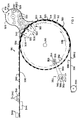
- reference numeral 310 generally indicates apparatus according to one embodiment of the invention, for producing wads of particulate material.
- the apparatus 310 includes a circular cylindrical drum, generally indicated by reference numeral 312.
- the drum 312 has a cylindrical wall 314.
- the drum 312 is adapted to be driven about a rotational axis 316 by means of suitable drive means generally indicated by reference numeral 350.
- the drive means 350 comprises a plurality of radially inwardly protruding circumferentially spaced teeth 352 on the drum 312. Two sets of teeth 352, located respectively at the ends of the drum 312, areprovided.
- the drum 312 is rotatably supported by two side plates (not shown) which have raised circular portions (also not shown) on their inner surfaces. The internal diameter of these portions is slightly larger than the outer diameter of the drum and are lined with a suitable non-slip material or with bearings.
- each set of teeth 352 is associated a toothed cog 354, with the cogs 354 being mounted on a single shaft or axle 356.
- a pulley 358 which is aligned with a pulley 360 mounted to the output shaft 362 of an electric motor 366.
- An endless belt 364 connects the pulleys 358, 360.
- the cylindrical wall 314 of the drum 312 is generally imperforate, (ie. solid) with forming zones 320 in the form of apertures of predetermined shape, being provided therein.
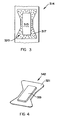
- the apertures 320 are described in more detail below with reference to Figure 3.
- the apparatus 310 also includes a vacuum generating means for applying a vacuum to the inside of the drum wall 314, at a forming station 322.
- the vacuum generating means includes a vacuum box 308 with a duct 306 communicating with a vacuum source (not shown).
- the box 308 is located within the drum 312, in contact with its wall 314. A pressure differential is formed across the drum wall with a higher pressure being present on the outside and a lower pressure on the inside.
- the apparatus 310 also includes a supply means, generally indicated by reference numeral 324, for supplying shredded defiberized pulp fibres to the outside of the drum wall 314, at the station 322.
- the supply means 324 comprises a housing 326, a pulp sheet inlet 328 leading into the housing 326, a rotatable shredder 330 located within the housing, drive means (not shown) for driving the shredder 330 to rotate it, and an air inlet 331 so that air can enter the housing.
- the required air flow inside the housing is generated by the movement of the shredder and the vacuum generating means.
- the shredder 330 rotates, it shreds pulp sheet entering the inside of the housing via the inlet 328 into defiberized pulp fibres 332 which are entrained in the air.
- the apparatus 310 still further includes a driven bobbin or roll 334 of non-woven fabric located such that a strip 336 of the nonwoven fabric can be fed therefrom directly onto the outside of the drum wall 314, ahead of the supply means 324, as the drum 312 rotates in the direction indicated by arrow 338.
- the apparatus 310 still further includes drawing off means (not shown) for drawing off the strip 336 from the drum wall 314 on the other side of the supply means 324.
- the drawing off means typically comprises a driven wind-up unit, and driven rollers for supporting the strip 336, as required.
- the apparatus 310 also includes a spray nozzle 340 for applying a foamed acrylic binder to wads 342 of shredded fibrous pulp formed on the strip 336.
- a vacuum-generating means 344 generates a vacuum below the strip 336 downstream of the nozzle 340 to spread the foamed binder through the wad and onto the strip 336
- Heating means generally indicated by reference numeral 346, is located above the strip 336, downstream of the vacuum generating means 344 for drying and chemically cross-linking the binder to stabilize the wads 342 and bond them to the strip 336.
- the heating means 346 can be steam heated cans.
- the nozzle 340 and vacuum generating means 340 can be dispensed with, with the wads 342 then being stabilized and bonded directly by passing through or over the heating means 346.
- a continuous strip 336 of non-woven fabric is unwound directly from the bobbin 334 so that its surface 336.1 abuts against the outside surface of the drum wall 314.
- air passes through the strip 336 only in those areas in alignment with the apertures 320.
- the fibres 332 are entrained in the air, the fibres 332 are deposited on surface 336.2 of the strip 336 in the said areas to form the wads 342, while no fibres are deposited elsewhere on that portion of the strip 336 in the forming station 322.
- the strip 336 with the wads 342 located thereon then pass to the nozzle 340 where the wads 342 are stabilized as hereinbefore described.
- composite products comprising the stabilized wads 342 attached to the strip 336, they can be laminated to a plastics film backing, eg a polythene film backing, whereafter the polythene film backing and the non-woven fabric can be cut to the same shape (but larger) as the wads.
- a plastics film backing eg a polythene film backing
- the polythene film backing and the non-woven fabric can be cut to the same shape (but larger) as the wads.
- soft panty-liners, and the like can be formed.
- they can be laminated onto an absorbent layer, eg a peatmoss layer, as hereinbefore described, which can then in turn be laminated onto a polythene film backing layer, to form sanitary pads or the like.
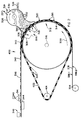
- reference numeral 400 generally indicates apparatus according to another embodiment of the invention, for forming wads
- the apparatus 400 also has a drum 312 having a sieve-like, perforated circular cylindrical wall 314.
- the drum 312 of the apparatus 400 can be driven by the same drive means as the drum 312 of the apparatus 310.
- the apertures 320 are not provided in the drum wall itself.
- the apparatus 400 includes a continuous imperforate belt 402 which passes around the drum 312 as well as around a pulley, idler or roller 404. The position of the idler 404 can be adjusted, thereby to vary the tension in the belt 402.
- the apertures 320 are provided in the belt 402.
- the belt 402 continually engages a portion of the drum wall. After the strip 336, with the wads 342 deposited thereon, has been drawn off, the belt disengages from the drum wall 314, and passes around the pulley 404.
- the Applicant believes that use of the belt 402 can have advantages.
- the desired shape of the wads 342 can be varied easily, by merely selecting a belt 402 having apertures 320 of different shapes or sizes.
- the apparatus is not restricted to sizes and shapes of apertures 320 being selected such that they fit exactly into the drum wall 314.
- the Applicant further believes that drum blockages on extended runs can be avoided or reduced with the apparatus 400.
- the apertures 320 can be of any desired shape, depending on the end use. For example, they may be dogbone-shaped or butterfly-shaped if it is desired to provide panty-liners or sanitary pads respectively.
- the aperture 320 has a relatively large, rectangular opening 315 with a surrounding "bow-tie" portion 317 with holes 319 therein.
- the opening 315 provides a region with unrestricted permeability and the portion 317 with its holes 319 provides a region with intermediate permeability.
- a wad 342 that is produced with an aperture 320 as shown in Figure 3, is shown in Figure 4.
- the wad 342 has a substantially "bow-tie" external profile with a central rectangular portion 319 and a border 321.
- the central portion 319 is thicker than the border 321, as more air passes through that area of the strip 336 in alignment with the opening 315 than that in alignment with the portion 317, and therefore more fibres are collected in the middle than on the sides.
- the drum 312 can be made of any desired length, so that a number of wads can be formed side-by-side simultaneously.
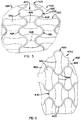
- the apertures 320 need then naturally not be aligned with each other along the length of the drum wall 314, but can be staggered so that rows 420 (see Figures 5 and 6) of composite products, each comprising a layer of non-woven fabric and wads 342 of stabilized defiberized pulp particles located thereon as described, and a layer 422 of fluid-impervious material, eg a plastics film backing, laminated thereto, are produced.
- these rows can then be separated from one another by cutting along more-or-less sinusoidal, generally longitudinally extending, cut lines 424, into strips 426 of composite product.
- the strips 426 can then be cut along transversely extending cut lines 428 to produce individual composite products 430 comprising pads with side flaps.
- the individual composite products 430 are formed once the cuts along the cut lines 424 have been effected, so that the additional cuts along transverse cut lines are not required.
Landscapes
- Health & Medical Sciences (AREA)
- Engineering & Computer Science (AREA)
- Life Sciences & Earth Sciences (AREA)
- Animal Behavior & Ethology (AREA)
- Epidemiology (AREA)
- Biomedical Technology (AREA)
- Heart & Thoracic Surgery (AREA)
- Vascular Medicine (AREA)
- Veterinary Medicine (AREA)
- Manufacturing & Machinery (AREA)
- General Health & Medical Sciences (AREA)
- Public Health (AREA)
- Textile Engineering (AREA)
- Absorbent Articles And Supports Therefor (AREA)
- Filtering Materials (AREA)
- Mattresses And Other Support Structures For Chairs And Beds (AREA)
- Bedding Items (AREA)
- Nonwoven Fabrics (AREA)
Applications Claiming Priority (2)
| Application Number | Priority Date | Filing Date | Title |
|---|---|---|---|
| ZA907272 | 1990-09-12 | ||
| ZA907272 | 1990-09-12 |
Publications (2)
| Publication Number | Publication Date |
|---|---|
| EP0478182A1 true EP0478182A1 (de) | 1992-04-01 |
| EP0478182B1 EP0478182B1 (de) | 1995-01-04 |
Family
ID=25580294
Family Applications (1)
| Application Number | Title | Priority Date | Filing Date |
|---|---|---|---|
| EP91308369A Expired - Lifetime EP0478182B1 (de) | 1990-09-12 | 1991-09-12 | Verfahren und Vorrichtung zur Herstellung eines Kissens |
Country Status (8)
| Country | Link |
|---|---|
| EP (1) | EP0478182B1 (de) |
| AU (1) | AU650046B2 (de) |
| BR (1) | BR9103913A (de) |
| CA (1) | CA2051149C (de) |
| DE (1) | DE69106468T2 (de) |
| ES (1) | ES2066365T3 (de) |
| NZ (1) | NZ239726A (de) |
| ZA (2) | ZA917282B (de) |
Cited By (9)
| Publication number | Priority date | Publication date | Assignee | Title |
|---|---|---|---|---|
| WO1996017574A3 (en) * | 1994-12-07 | 1996-08-29 | Mcneil Ppc Inc | Process for forming laminated absorbent structure |
| WO1997019659A1 (en) * | 1995-11-27 | 1997-06-05 | SCA Mölnlycke AB | Apparatus for air-laying fibre bodies on a moving air-permeable conveyor path |
| EP0958801A1 (de) * | 1998-05-12 | 1999-11-24 | Uni-Heartous Corporation | Verfahren zur Herstellung von Saugkörpern |
| EP1048276A1 (de) | 1999-04-28 | 2000-11-02 | The Procter & Gamble Company | Verfahren zum Aufbringen einer schäumbaren Dichtmasse auf ein absorbierendes Element |
| EP0605015B2 (de) † | 1992-12-31 | 2002-05-15 | McNEIL-PPC, INC. | Verfahren und System zur Herstellung von dreidimensionalen Stoffen |
| US7906065B1 (en) | 2009-08-18 | 2011-03-15 | The Procter & Gamble Company | Method and apparatus for forming a batt of particulate material for use as a component in an absorbent core assembly |
| US7935299B2 (en) | 2005-08-17 | 2011-05-03 | The Procter & Gamble Company | Method and apparatus for forming a batt of particulate material for use as a component in an absorbent core assembly |
| EP3097895A1 (de) * | 2015-05-28 | 2016-11-30 | The Procter and Gamble Company | Verfahren zur herstellung nicht verbundener faserstrukturen |
| JP2019208874A (ja) * | 2018-06-05 | 2019-12-12 | 花王株式会社 | 吸収体の製造方法 |
Families Citing this family (3)
| Publication number | Priority date | Publication date | Assignee | Title |
|---|---|---|---|---|
| US7687012B2 (en) | 2005-08-30 | 2010-03-30 | Kimberly-Clark Worldwide, Inc. | Method and apparatus to shape a composite structure without contact |
| US7682554B2 (en) | 2005-08-30 | 2010-03-23 | Kimberly-Clark Worldwide, Inc. | Method and apparatus to mechanically shape a composite structure |
| CN115105301A (zh) * | 2022-05-24 | 2022-09-27 | 山东爸爸的选择健康科技有限公司 | 一种扩散快、防堆积的吸收芯体的制造方法 |
Citations (3)
| Publication number | Priority date | Publication date | Assignee | Title |
|---|---|---|---|---|
| US3882216A (en) * | 1973-08-09 | 1975-05-06 | Int Paper Co | Disposable diaper |
| FR2521003A1 (fr) * | 1982-02-05 | 1983-08-12 | Schickedanz Ver Papierwerk | Procede et dispositif pour la fabrication de garnitures hygieniques pour dames et garnitures ainsi obtenues |
| US4761258A (en) * | 1985-12-10 | 1988-08-02 | Kimberly-Clark Corporation | Controlled formation of light and heavy fluff zones |
Family Cites Families (1)
| Publication number | Priority date | Publication date | Assignee | Title |
|---|---|---|---|---|
| AU650902B2 (en) * | 1990-09-12 | 1994-07-07 | Mcneil-Ppc, Inc. | Process and apparatus for forming a composite product |
-
1991
- 1991-09-09 NZ NZ239726A patent/NZ239726A/en not_active IP Right Cessation
- 1991-09-11 CA CA002051149A patent/CA2051149C/en not_active Expired - Lifetime
- 1991-09-11 BR BR919103913A patent/BR9103913A/pt not_active IP Right Cessation
- 1991-09-11 AU AU83838/91A patent/AU650046B2/en not_active Expired
- 1991-09-12 ZA ZA917282A patent/ZA917282B/xx unknown
- 1991-09-12 EP EP91308369A patent/EP0478182B1/de not_active Expired - Lifetime
- 1991-09-12 DE DE69106468T patent/DE69106468T2/de not_active Expired - Lifetime
- 1991-09-12 ES ES91308369T patent/ES2066365T3/es not_active Expired - Lifetime
- 1991-09-12 ZA ZA917283A patent/ZA917283B/xx unknown
Patent Citations (3)
| Publication number | Priority date | Publication date | Assignee | Title |
|---|---|---|---|---|
| US3882216A (en) * | 1973-08-09 | 1975-05-06 | Int Paper Co | Disposable diaper |
| FR2521003A1 (fr) * | 1982-02-05 | 1983-08-12 | Schickedanz Ver Papierwerk | Procede et dispositif pour la fabrication de garnitures hygieniques pour dames et garnitures ainsi obtenues |
| US4761258A (en) * | 1985-12-10 | 1988-08-02 | Kimberly-Clark Corporation | Controlled formation of light and heavy fluff zones |
Cited By (14)
| Publication number | Priority date | Publication date | Assignee | Title |
|---|---|---|---|---|
| EP0605015B2 (de) † | 1992-12-31 | 2002-05-15 | McNEIL-PPC, INC. | Verfahren und System zur Herstellung von dreidimensionalen Stoffen |
| US5766388A (en) * | 1994-12-07 | 1998-06-16 | Mcneil-Ppc, Inc. | Process for forming laminated absorbent structures having reduced delamination tendencies |
| WO1996017574A3 (en) * | 1994-12-07 | 1996-08-29 | Mcneil Ppc Inc | Process for forming laminated absorbent structure |
| WO1997019659A1 (en) * | 1995-11-27 | 1997-06-05 | SCA Mölnlycke AB | Apparatus for air-laying fibre bodies on a moving air-permeable conveyor path |
| EP0958801A1 (de) * | 1998-05-12 | 1999-11-24 | Uni-Heartous Corporation | Verfahren zur Herstellung von Saugkörpern |
| EP1048276A1 (de) | 1999-04-28 | 2000-11-02 | The Procter & Gamble Company | Verfahren zum Aufbringen einer schäumbaren Dichtmasse auf ein absorbierendes Element |
| US7935299B2 (en) | 2005-08-17 | 2011-05-03 | The Procter & Gamble Company | Method and apparatus for forming a batt of particulate material for use as a component in an absorbent core assembly |
| US7906065B1 (en) | 2009-08-18 | 2011-03-15 | The Procter & Gamble Company | Method and apparatus for forming a batt of particulate material for use as a component in an absorbent core assembly |
| US8221672B2 (en) | 2009-08-18 | 2012-07-17 | The Procter & Gamble Company | Method and apparatus for forming a batt of particulate material for use as a component in an absorbent core assembly |
| US8616867B2 (en) | 2009-08-18 | 2013-12-31 | The Procter & Gamble Company | Method and apparatus for forming a batt of particulate material for use as a component in an absorbent core assembly |
| EP3097895A1 (de) * | 2015-05-28 | 2016-11-30 | The Procter and Gamble Company | Verfahren zur herstellung nicht verbundener faserstrukturen |
| WO2016191440A1 (en) * | 2015-05-28 | 2016-12-01 | The Procter & Gamble Company | Method for forming unbonded fibrous structures |
| JP2019208874A (ja) * | 2018-06-05 | 2019-12-12 | 花王株式会社 | 吸収体の製造方法 |
| JP7118752B2 (ja) | 2018-06-05 | 2022-08-16 | 花王株式会社 | 吸収体の製造方法 |
Also Published As
| Publication number | Publication date |
|---|---|
| ZA917283B (en) | 1993-03-12 |
| NZ239726A (en) | 1994-05-26 |
| ZA917282B (en) | 1993-03-12 |
| DE69106468T2 (de) | 1995-06-14 |
| EP0478182B1 (de) | 1995-01-04 |
| CA2051149C (en) | 2002-02-26 |
| DE69106468D1 (de) | 1995-02-16 |
| AU8383891A (en) | 1992-03-19 |
| CA2051149A1 (en) | 1992-03-13 |
| AU650046B2 (en) | 1994-06-09 |
| BR9103913A (pt) | 1992-05-26 |
| ES2066365T3 (es) | 1995-03-01 |
Similar Documents
| Publication | Publication Date | Title |
|---|---|---|
| US7094373B2 (en) | Process and apparatus for air forming an article having a plurality of reinforced superimposed fibrous layers | |
| EP1920743B1 (de) | Luftgeformtes Fasernetz | |
| US7204682B2 (en) | Apparatus for making a reinforced fibrous absorbent member | |
| EP0394274B9 (de) | Absorbierende unterlage | |
| US4016628A (en) | Method and apparatus for forming absorbent articles | |
| EP0605015B1 (de) | Verfahren und System zur Herstellung von dreidimensionalen Stoffen | |
| EP0159630A2 (de) | Selektive Niederlegung von superabsorbierenden Materialien in Substraten aus geschmolzenen geblasenen Fasern | |
| EP0478182B1 (de) | Verfahren und Vorrichtung zur Herstellung eines Kissens | |
| EP0479442B1 (de) | Verfahren und Vorrichtung zur Herstellung eines zusammengesetzten Produktes | |
| WO2004049991A1 (en) | Controlled placement of a reinforcing web within a fibrous absorbent | |
| RU2666104C1 (ru) | Способ изготовления впитывающих структур с перемычками | |
| WO2011111397A1 (en) | Laminated product treating apparatus | |
| AU650902B2 (en) | Process and apparatus for forming a composite product | |
| JP6255232B2 (ja) | 吸収体の製造装置 | |
| US20250143932A1 (en) | Apparatus for forming and applying a pleated core wrap | |
| WO2004028426A1 (en) | Process and apparatus for air forming an article having a plurality of reinforced superimposed fibrous layers |
Legal Events
| Date | Code | Title | Description |
|---|---|---|---|
| PUAI | Public reference made under article 153(3) epc to a published international application that has entered the european phase |
Free format text: ORIGINAL CODE: 0009012 |
|
| AK | Designated contracting states |
Kind code of ref document: A1 Designated state(s): DE ES FR |
|
| 17P | Request for examination filed |
Effective date: 19920908 |
|
| 17Q | First examination report despatched |
Effective date: 19940318 |
|
| GRAA | (expected) grant |
Free format text: ORIGINAL CODE: 0009210 |
|
| AK | Designated contracting states |
Kind code of ref document: B1 Designated state(s): DE ES FR |
|
| REF | Corresponds to: |
Ref document number: 69106468 Country of ref document: DE Date of ref document: 19950216 |
|
| REG | Reference to a national code |
Ref country code: ES Ref legal event code: FG2A Ref document number: 2066365 Country of ref document: ES Kind code of ref document: T3 |
|
| ET | Fr: translation filed | ||
| PLBI | Opposition filed |
Free format text: ORIGINAL CODE: 0009260 |
|
| PLAB | Opposition data, opponent's data or that of the opponent's representative modified |
Free format text: ORIGINAL CODE: 0009299OPPO |
|
| 26 | Opposition filed |
Opponent name: THE PROCTER & GAMBLE COMPANY Effective date: 19951004 |
|
| R26 | Opposition filed (corrected) |
Opponent name: THE PROCTER & GAMBLE COMPANY Effective date: 19951004 |
|
| PLBF | Reply of patent proprietor to notice(s) of opposition |
Free format text: ORIGINAL CODE: EPIDOS OBSO |
|
| PLBF | Reply of patent proprietor to notice(s) of opposition |
Free format text: ORIGINAL CODE: EPIDOS OBSO |
|
| PLBO | Opposition rejected |
Free format text: ORIGINAL CODE: EPIDOS REJO |
|
| APAC | Appeal dossier modified |
Free format text: ORIGINAL CODE: EPIDOS NOAPO |
|
| APAE | Appeal reference modified |
Free format text: ORIGINAL CODE: EPIDOS REFNO |
|
| APAC | Appeal dossier modified |
Free format text: ORIGINAL CODE: EPIDOS NOAPO |
|
| PLBQ | Unpublished change to opponent data |
Free format text: ORIGINAL CODE: EPIDOS OPPO |
|
| PLAB | Opposition data, opponent's data or that of the opponent's representative modified |
Free format text: ORIGINAL CODE: 0009299OPPO |
|
| R26 | Opposition filed (corrected) |
Opponent name: THE PROCTER & GAMBLE COMPANY Effective date: 19951004 |
|
| APAC | Appeal dossier modified |
Free format text: ORIGINAL CODE: EPIDOS NOAPO |
|
| PLBN | Opposition rejected |
Free format text: ORIGINAL CODE: 0009273 |
|
| STAA | Information on the status of an ep patent application or granted ep patent |
Free format text: STATUS: OPPOSITION REJECTED |
|
| 27O | Opposition rejected |
Effective date: 19980707 |
|
| APAH | Appeal reference modified |
Free format text: ORIGINAL CODE: EPIDOSCREFNO |
|
| PGFP | Annual fee paid to national office [announced via postgrant information from national office to epo] |
Ref country code: FR Payment date: 20100921 Year of fee payment: 20 |
|
| PGFP | Annual fee paid to national office [announced via postgrant information from national office to epo] |
Ref country code: DE Payment date: 20100908 Year of fee payment: 20 |
|
| PGFP | Annual fee paid to national office [announced via postgrant information from national office to epo] |
Ref country code: ES Payment date: 20101018 Year of fee payment: 20 |
|
| REG | Reference to a national code |
Ref country code: DE Ref legal event code: R071 Ref document number: 69106468 Country of ref document: DE |
|
| REG | Reference to a national code |
Ref country code: DE Ref legal event code: R071 Ref document number: 69106468 Country of ref document: DE |
|
| PG25 | Lapsed in a contracting state [announced via postgrant information from national office to epo] |
Ref country code: DE Free format text: LAPSE BECAUSE OF EXPIRATION OF PROTECTION Effective date: 20110913 |
|
| REG | Reference to a national code |
Ref country code: ES Ref legal event code: FD2A Effective date: 20130725 |
|
| PG25 | Lapsed in a contracting state [announced via postgrant information from national office to epo] |
Ref country code: ES Free format text: LAPSE BECAUSE OF EXPIRATION OF PROTECTION Effective date: 20110913 |