EP0478183A2 - Aufzeichnungsgerät für Tonsignale und Verfahren zur Verwendung mit Videobandgeräten - Google Patents
Aufzeichnungsgerät für Tonsignale und Verfahren zur Verwendung mit Videobandgeräten Download PDFInfo
- Publication number
- EP0478183A2 EP0478183A2 EP91308370A EP91308370A EP0478183A2 EP 0478183 A2 EP0478183 A2 EP 0478183A2 EP 91308370 A EP91308370 A EP 91308370A EP 91308370 A EP91308370 A EP 91308370A EP 0478183 A2 EP0478183 A2 EP 0478183A2
- Authority
- EP
- European Patent Office
- Prior art keywords
- recording
- signal
- signals
- video
- audio signals
- Prior art date
- Legal status (The legal status is an assumption and is not a legal conclusion. Google has not performed a legal analysis and makes no representation as to the accuracy of the status listed.)
- Granted
Links
Images




Classifications
-
- G—PHYSICS
- G11—INFORMATION STORAGE
- G11B—INFORMATION STORAGE BASED ON RELATIVE MOVEMENT BETWEEN RECORD CARRIER AND TRANSDUCER
- G11B20/00—Signal processing not specific to the method of recording or reproducing; Circuits therefor
-
- H—ELECTRICITY
- H04—ELECTRIC COMMUNICATION TECHNIQUE
- H04N—PICTORIAL COMMUNICATION, e.g. TELEVISION
- H04N9/00—Details of colour television systems
- H04N9/79—Processing of colour television signals in connection with recording
- H04N9/797—Processing of colour television signals in connection with recording for recording the signal in a plurality of channels, the bandwidth of each channel being less than the bandwidth of the signal
- H04N9/7973—Processing of colour television signals in connection with recording for recording the signal in a plurality of channels, the bandwidth of each channel being less than the bandwidth of the signal by dividing the luminance or colour component signal samples or frequency bands among a plurality of recording channels
-
- G—PHYSICS
- G11—INFORMATION STORAGE
- G11B—INFORMATION STORAGE BASED ON RELATIVE MOVEMENT BETWEEN RECORD CARRIER AND TRANSDUCER
- G11B20/00—Signal processing not specific to the method of recording or reproducing; Circuits therefor
- G11B20/10—Digital recording or reproducing
- G11B20/12—Formatting, e.g. arrangement of data block or words on the record carriers
- G11B20/1201—Formatting, e.g. arrangement of data block or words on the record carriers on tapes
- G11B20/1207—Formatting, e.g. arrangement of data block or words on the record carriers on tapes with transverse tracks only
- G11B20/1208—Formatting, e.g. arrangement of data block or words on the record carriers on tapes with transverse tracks only for continuous data, e.g. digitised analog information signals, pulse code modulated [PCM] data
-
- H—ELECTRICITY
- H04—ELECTRIC COMMUNICATION TECHNIQUE
- H04N—PICTORIAL COMMUNICATION, e.g. TELEVISION
- H04N5/00—Details of television systems
- H04N5/76—Television signal recording
- H04N5/78—Television signal recording using magnetic recording
- H04N5/782—Television signal recording using magnetic recording on tape
- H04N5/7824—Television signal recording using magnetic recording on tape with rotating magnetic heads
- H04N5/7826—Television signal recording using magnetic recording on tape with rotating magnetic heads involving helical scanning of the magnetic tape
- H04N5/78263—Television signal recording using magnetic recording on tape with rotating magnetic heads involving helical scanning of the magnetic tape for recording on tracks inclined relative to the direction of movement of the tape
- H04N5/78266—Television signal recording using magnetic recording on tape with rotating magnetic heads involving helical scanning of the magnetic tape for recording on tracks inclined relative to the direction of movement of the tape using more than one track for the recording of one television field or frame, i.e. segmented recording
-
- H—ELECTRICITY
- H04—ELECTRIC COMMUNICATION TECHNIQUE
- H04N—PICTORIAL COMMUNICATION, e.g. TELEVISION
- H04N5/00—Details of television systems
- H04N5/76—Television signal recording
- H04N5/91—Television signal processing therefor
- H04N5/92—Transformation of the television signal for recording, e.g. modulation, frequency changing; Inverse transformation for playback
- H04N5/928—Transformation of the television signal for recording, e.g. modulation, frequency changing; Inverse transformation for playback the sound signal being pulse code modulated and recorded in time division multiplex with the modulated video signal
-
- H—ELECTRICITY
- H04—ELECTRIC COMMUNICATION TECHNIQUE
- H04N—PICTORIAL COMMUNICATION, e.g. TELEVISION
- H04N9/00—Details of colour television systems
- H04N9/79—Processing of colour television signals in connection with recording
- H04N9/80—Transformation of the television signal for recording, e.g. modulation, frequency changing; Inverse transformation for playback
- H04N9/81—Transformation of the television signal for recording, e.g. modulation, frequency changing; Inverse transformation for playback the individual colour picture signal components being recorded sequentially only
Definitions
- This invention relates to audio signal recording apparatus and methods for use with video tape recorders (VTRs).
- VTRs video tape recorders
- VTRs record and reproduce high definition television (HDTV) signals of wideband, high frequency types. These VTRs record an HDTV signal in units of time (for example over one field) by dividing it into a plurality of serpents in a plurality of channels. The purpose of this method is to lower the frequency of the recorded signal and to narrow the frequency band thereof.
- HDTV high definition television
- Figure 7 shows a typical rotating head device for use with such a method.
- An A channel head 1A having a first azimuth and a B channel head 1B having a second azimuth different from the first are located at the same rotational angle position of a rotating drum 3, the heads 1A and 1B being one track width apart in the rotating axis direction.
- another A channel head 2A having the first azimuth and another B channel head 2B having the second azimuth are located at a rotational angle position of a rotating drum 3, the heads 1A and 1B being one track width apart in the rotating axis direction.
- a channel head 2A having the first azimuth and another B channel head 2B having the second azimuth are located at a rotational angle position 180 degrees away from that of the heads 1A and 1B, the heads 2A and 2B also being one track width apart in the rotating axis direction of the drum 3.
- a magnetic tape 4 is wound obliquely around the drum 3 within a 180-degree-plus angular range.
- the heads 1A, 1B, 2A and 2B are rotated at a rotary speed of 60 Hz.
- one pair of rotating heads 1A, 1B and the other pair of rotating heads 2A, 2B alternately record the HDTV signal in oblique recording tracks shown in Figure 8 on the tape 4, each pair recording the signal over a tape contact segment corresponding to a 180-degree rotation angle.
- the first half of one rotation of the drum 3 is a 180-degree rotation during which the heads 1A and 1B contact the tape 4.
- the heads 1A and 1B simultaneously form an A channel track TA1 and a B channel track TB1.
- the heads 2A and 2B simultaneously form an A channel track TA2 and a B channel track TB2.
- These operations are alternated by the two pairs of rotating heads.
- two tracks formed simultaneously by each pair of rotating heads, 1A and 1B or 2A and 2B constitute one segment. Recorded in this one segment is a signal comprising a half-field video signal and a corresponding half-field PCM audio signal.
- Four tracks, TA1, TB1, TA2 and TB2 are used to record one signal field, and four segments are employed to record one signal frame.
- the video signal is recorded in an analogue format comprising a luminance signal and two colour difference signals
- the audio signal is recorded as a PCM signal in a digital format over four channels each representing sixteen bits of audio data.
- the video and audio signals are accommodated in different recording areas arranged longitudinally.
- VA is a video signal recording area
- PA is a PCM audio signal recording area
- a PCM audio signal recording area PA is located at the start of each of the tracks TA1, TB1, TA2 and TB2 scanned by the heads 1A, 1B, 2A and 2B, respectively.
- a PCM audio signal recording area is located at the end of each track scanned by each head.
- two PCM audio signal recording areas are located at the start and end of each track scanned by each head.
- the head scan starting or ending part of any track is vulnerable to scratches or other damage because of its location. The damage tends to produce drop-outs in the reproduced signal. Because the head scan start part of the tape is a part where a head starts contacting the tape, a snug contact has yet to be achieved between head and tape. This can cause the RF reproduction output to fluctuate and can lead to signal drop-outs. This problem is more likely to occur the closer the position of contact to a longitudinal edge of the tape.
- the interleaving process generally involves distributing PCM audio data samples within recording areas according to a predetermined set of rules. When recorded, the audio signal on each channel is distributed to two tracks of each segment. In an interleaving set-up, if the data from one of the two tracks contain a signal drop-out that cannot be corrected by an error correction code, another sample left intact near the dropped sample is interpolated so as approximately to reconstruct the missing audio signal for reproduction.
- an audio signal recording method for use with video tape recorders, said method comprising the steps of: having a plurality of rotating heads simultaneously scan a tape consecutively to form as many oblique recording tracks on said tape as said plurality of rotating heads with no guard band between said tracks, said plurality of oblique recording tracks constituting one segment; recording, for each segment, a video signal corresponding to unit time in a video signal recording area; and recording, for each segment, the PCM audio signal of at least four channels corresponding to said video signal in an audio signal recording area separate from said video signal recording area; said video and said audio signals being recorded in the longitudinal direction of each of said recording tracks; said PCM audio signals of at least four channels being clustered into a plurality of groups each associated with a plurality of channels; said audio signal recording area being divided into as many areas as said plurality of channel groups in the longitudinal direction of each of said tracks; and the audio data for each of said channel groups being recorded in a distributed manner across said plurality of oblique recording tracks of each
- an audio signal recording apparatus for recording main PCM audio signals, sub PCM audio signals and video signals
- said apparatus comprising: a video signal processing circuit for processing incoming video signals into suitable signal form for recording; a main audio PCM processing circuit for processing incoming main audio signals into said main PCM audio signals; a sub audio PCM processing circuit for processing said incoming sub audio signals into said sub PCM audio signals; and rotary magnetic head means for recording oblique recording tracks on a video tape; wherein said main PCM audio signals are positioned between said video signals and said sub PCM audio signals of each of the recording tracks.
- Embodiments of the present invention can provide an audio signal recording apparatus and method for minimizing the degradation of audio signals on primary channels when audio signals associated with at least four channels are each recorded in recording areas separate from those for video signals.
- Multichannel audio signals carried by at least four channels do not necessarily take on the same degree of importance on every channel. For example, consider a four audio channel set-up that provides a stereo sound and dual language capability. In this set-up, the first and the second channels are typically assigned the primary language transmission or the primary stereo sound signals (say on two front channels), while the third and the fourth channels accommodate the secondary language transmission or the secondary stereo sound signals (on two rear channels). Thus not all channels assume the same importance.
- the higher the priority for a channel group the farther the audio signal corresponding to that channel group is recorded away from either tape edge in the longitudinal direction of each track. The farther away from the tape edge, the more stabilized the contact between tape and rotating head. Thus the audio signal for a channel of higher priority is picked up by the corresponding head in a more stable manner and hence entails less degradation in sound quality during reproduction.
- the embodiment involves applying the invention to an HDTV VTR that turns 4 -channel audio signals into PCM audio signals and records them onto a magnetic tape along with the corresponding video signals.
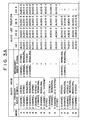
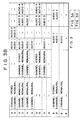
- Figure 3 shows how the audio modes are typically arranged in the MUSE (multiple sub-nyquist sampling encoding) method, a representative method of HDTV broadcasting.
- the audio data broadcast using the MUSE method is a main source of audio data for HDTV VTRs.
- the primary audio data are concentrated on a first channel CH1 and a second channel CH2.
- the primary audio data are also assigned to the first and the second channels CH1 and CH2 (front right and left channels).
- the primary audio data are carried by the first and the second channels CH1 and CH2.
- the primary audio data on the first and the second channels CH1 and CH2 are recorded in recording areas away from both ends of each track in the longitudinal direction. Those recording areas are characterized by their low error rates in the track pattern on the tape.
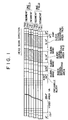
- Figure 1 depicts a typical recording track pattern on the tape, the pattern being produced by the rotating device of Figure 7 in the apparatus on which the invention is practised.
- the example of Figure 1 involves having the rotating head device form PCM audio signal recording areas on the track scan starting side of the tape.
- two separate audio signal recording areas are provided.
- One PCM audio signal recording area PA12 is associated with the first and the second channels CH1 and CH2, and the other CPM audio recording area PA34 with the third and fourth channels CH3 and CH4.
- the PCM audio signal recording area PA12 for the first and the second channels is assigned a tape region farther away from the head scan starting end of tracks than the PCM audio signal recording area PA34 for the third and the fourth channels. This allows the contact between head and tape to be more stable in the recording area PA12 than in the area PA34.
- Both ends of the tracks TA1, TB1, TA2 and TB2 corresponding to a rotation angle of four degrees constitute blocks each for overlapping track scan by the rotating heads 1A, 1B, 2A and 2B.
- a head switching point SWP between the pair of rotating heads 1A, 1B, and the pair of rotating heads 2A, 2B.
- a 1H* block (H* is the horizontal portion of a recording signal ) represents a margin block for head switchover.
- a 9.1H* block that follows stands for the PCM audio signal recording area PA34 for the third and fourth channels. After the recording area PA34 illustratively comes a guard band of 1.7H*.
- the guard band is in turn followed by the PCM audio signal recording area PA12 for the first and the second channels.
- the recording area PA12 comes another guard band of 1.7H* followed by an index signal recording area of 2.7H*.
- a 135H* area following the preamble block is a video signal recording area VA.
- the preamble block at least accommodates a CW signal (continuous wave signal for PLL synchronization), a segment synchronization signal, a reference level signal and a ramp signal.
- FIG. 4 is a block diagram of a typical HDTV signal recording apparatus on which the invention is practised.
- a luminance signal Y coming in through an input terminal 11Y is supplied to an A/D converter 13Y via a low-pass filter 12Y.
- the luminance signal Y is converted from analogue to digital format at a sampling frequency of 4.55 MHz before being supplied to a time division multiplex (TDM) encoder 14.
- TDM time division multiplex
- a blue colour difference signal P B and a red colour difference signal P R come in through input terminals 11B and 11R, respectively.
- the colour difference signals P B and P R are supplied to A/D converters 13B and 13R via low-pass filters 12B and 12R.
- the two signals are converted from analogue to digital format at a sampling frequency of 11.1375 MHz before being supplied to the TDM encoder 14.
- the TDM encoder 14 provides digital signal processing such as time base handling and linear sequencing of colour signals. In doing so, the TDM encoder 14 arranges the incoming signals onto two channels A and B. Adders 15A and 15B supply the signal on each channel with a synchronizing signal SYNC (different from that contained in the video signal) and a burst signal SB.
- the synchronizing signal SYNC and burst signal SB are generated by a timing signal generating circuit 102 that comprises a phase locked loop (PLL) arrangement.
- a synchronizing separating circuit 101 supplies the timing signal generating circuit 102 with a synchronizing signal that was separated from the input luminance signal Y.
- the pLL output clock of the timing signal generating circuit 102 maintains a constant phase relation with this synchronizing signal.
- the timing signal generating circuit 102 supplies the TDM encoder 14 with clock pulses and sends a timing signal to a servo control and switching signal generating circuit 103, to be described later.
- the outputs of the adders 15A and 15B are fed to D/A converters 16A and 16B for conversion from digital to analogue format.
- the D/A converters 16A and 16B each generate a TDM waveform signal that contains the synchronizing signal SYNC, the burst signal SB, a colour signal C′ and a luminance signal Y′, as shown in Figure 5.
- the symbol H* represents one horizontal period of the recording signal, that is, the TDM signal.
- the TDM waveform signals are supplied via low-pass filters 17A and 17B to analogue processing circuits 18A and 18B for pre-emphasis and other processing. Thereafter, the signals are supplied to FM circuits 19A and 19B for frequency modulation.
- the FM circuit 19A supplies an FM video signal Va (see Figure 2A) on the A channel to a first input terminal "a" of a switching circuit 20A.
- the FM circuit 19B supplies an FM video signal Vb (see Figure 2A) on the B channel to the first input terminal of a switching circuit 20B.
- the audio signals on four channels are arranged into a first and a second group.
- the first group is associated with the first and the second channels, and the second group with the third and the fourth channels.
- the first and the second channel audio signals are supplied to A/D converters 331 and 332 via input terminals 311 and 312 and low-pass filters 321 and 322, respectively.
- Each audio signal is converted to digital audio data of sixteen bits per second.
- the digital audio data are supplied to an ECC encoder 34.
- the ECC encoder 34 subjects the first and the second channel audio signals as a whole to interleaving and error correction encoding. For the processing, sixteen bits of data per sample are divided into high-order eight bits and low-order eight bits. It is in units of the 8-bit sample data that the first and the second channel audio signals are handled.
- the output of the ECC encoder 34 passes through a RAM 35 and divides into A channel data and B channel data.
- the A and the B channel data are supplied respectively to 8-10 modulating circuits 36A and 36B for 8-to-10 bit conversion.
- the data are supplied to NRZI modulating circuits 37A and 37B which generate NRZI signals.
- the A channel signal Sa(1, 2) (see Figure 2B) of the first and the second channel PCM audio data from the modulating circuit 37A is supplied to an input terminal "b" of the switching circuit 20A;
- the B channel signal sb(1, 2) (see Figure 2B) of the first and the second channel PCM audio data from the modulating circuit 37B is fed to the input terminal "b" of the switching circuit 20B.
- the third and the fourth channel audio signals of the second group are supplied respectively to A/D converters 323 and 434 via input terminals 413 and 414 and low-pass filters 423 and 424.
- Each audio signal is converted to digital audio data of sixteen bits per sample.
- the digital audio data are supplied to an ECC encoder 44.
- the ECC encoder 44 subjects the third and the fourth channel audio signals as a whole to interleaving and error correction encoding, as in the case of the first and the second channel audio signals.
- the output of the ECC encoder 44 passes through a RAM 45 and divides into A channel data and B channel data.
- the A and the B channel data are supplied respectively to 8-10 modulating circuits 46A and 46B for 8-to-10 bit conversion. After the conversion, the data are supplied to NRZI modulating circuits 47A and 47B which generate NRZI signals.
- the A channel signal Sa(3, 4) (see Figure 2C) of the third and the fourth channel PCM audio data from the modulating circuit 47A is supplied to an input terminal "c" of the switching circuit 20A;
- the B channel signal Sb(3, 4) (see Figure 2C) of the first and the second channel PCM audio data from the modulating circuit 47B is fed to the input terminal "c" of the switching circuit 20B.
- a switching signal from the servo control and switching signal generating circuit 103 operates the switching circuits 20A and 20B within a 180-degree area (corresponding to a half-field period) on the tape scanned by the pair of rotating heads 1A, 1B or 2A, 2B.
- the switching operation takes place as follows:
- a period tc in Figure 2 corresponds to the tape area scanned by the rotating heads 1A, 1B or 2A, 2B from a track scan start point to the end of the PCM audio signal recording area PA34.
- the switching circuits 20A and 20B are each set to the input terminal "c".
- the switching circuits 20A and 20B yield the PCM audio data Sa(3, 4) and Sb(3, 4) for the third and the fourth channels.
- a period tb in Figure 2 corresponds to the tape area scanned by the rotating heads 1A, 1B or 2A, 2B throughout the PCM audio signal recording area PA12.
- the switching circuits 20A and 20B are each set to the input terminal "b".
- the switching circuits 20A and 20B provides the PCM audio data Sa(1, 2) and Sb(1, 2) for the first and the second channels.
- a period ta in Figure 2 corresponds to the tape area scanned by the rotating heads 1A, 1B or 2A, 2B following the PCM audio signal recording area PA12.
- the switching circuits 20A and 20B are each set to the input terminal "a".
- the switching circuits 20A and 20B produce the recording video signals Va and Vb for the A and the B channels.
- the output signals from the switching circuits 20A and 20B pass through respective recording amplifiers 21A and 21B and through head switching circuits 22A and 22B before being supplied to the rotating heads 1A, 1B or 2A, 2B.
- the head switching circuits 22A and 22B are each set to a terminal H1 over a 180-degree area where the heads 1A and 1B contact the tape; the switching circuits 22A and 22B are each set to a terminal H2 over a 180-degree area where the heads 2A and 2B contact the tape.
- the third and the fourth channel audio data are recorded in the PCM audio signal recording area PA34 across the two tracks TA1 and TB1.
- the first and the second channel audio data Sa(1, 2) are recorded in the PCM audio signal recording area PA12 across the tracks TA1 and TB1.
- the video signal recording area Va the recording video signal of a half field is recorded across the tracks TA1 and TB1
- the heads 2A and 2B record the first to fourth channel PCM audio data and the recording video signal of another half field across the tracks TA2 and TB2.
- the first and the second channel audio data of primary importance are recorded in the recording area PA12, farther away longitudinally from the ends of the recording tracks TA1, TB1, TA2 and TB2 than the third and the fourth channel audio data of secondary importance. Since the rotating heads 1A, 1B, 2A and 2B maintain more stable contact with the tape in the recording area PA12 than in the recording area PA34, the error rate is the lower in the area PA12. Thus, during reproduction, the degradation in sound quality on the first and the second channels is minimized.
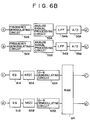
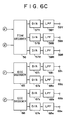
- FIG. 6 is a block diagram of a reproducing apparatus on which the invention is practised. This apparatus reproduces video and audio signals from the tape on which the video and audio data were recorded as described above.
- a head switching circuit 23A alternately selects the rotating head 1A or 2A for each 180-degree rotation angle block in which the current head contacts the tape. This operation allows the head switching circuit 23A to produce an A channel reproduced signal which is supplied to a reproducing amplifier 51A. Similarly, a head switching circuit 23B alternately selects the rotating head 1B or 2B. The switching circuit 23A then produces a B channel reproduced signal which is supplied to a reproducing amplifier 51B.
- the reproducing amplifier 51A produces an A channel reproduced video signal PBVa and an A channel reproduced PCM audio signal PBSa.
- the signal PBVa comes from the video area VA of the tracks TA1 and TA2, and the signal PBSa from the PCM audio signal recording areas PA34 and PA12.
- the reproducing amplifier 51B provides a B channel reproduced video signal PBVb and a B channel reproduced PCM audio signal PBSb.
- the signal PBVb comes from the video area VA of the tracks TB1 and TB2, and the signal PBSb from the PCM audio signal recording areas PA34 and PA12 of the same tracks TB1 and TB2.
- the A and the B channel reproduced video signals PBVa and PBVb from the reproducing amplifiers 51A and 51B are frequency demodulated by frequency demodulating circuits 52A and 52B.
- the demodulated signals are supplied to analogue processing circuits 53A and 53B for de-emphasis and other analogue processing.
- the output signals from the analogue processing circuits 53A and 53B pass respectively through low-pass filters 54A and 54B to A/D converters 55A and 55B for conversion to digital format.
- the converted signals are supplied to a TDM decoder 56.
- the TDM decoder 56 converts the received TDM signals back to the initially input set of the luminance signal and the blue and red colour difference signals.
- the luminance signal from the TDM decoder 56 is converted back to the initial analogue format by a D/A converter 57Y and a low-pass filter 58Y. Then the reproduced luminance signal appears at an output terminal 59Y.
- the blue and red colour signals from the PCM decoders 56 are converted back to their initial analogue format by D/A converters 57B and 57R and low-pass filters 58B and 58R, respectively.
- the reproduced blue and red colour difference signals appear at output terminals 59B and 59R, respectively.
- the A and the B channel reproduced PCM audio data PBSa and PBSb from the reproducing amplifiers 51A and 51B pass respectively through reproducing equalizers 61A and 61B and enter NRZI decoding circuits 62A and 62B for decoding.
- the decoded data are demodulated by 10-8 demodulating circuits 63A and 63B for conversion to eight bits per sample.
- the output data of the 10-8 demodulating circuits 63A and 63B pass through a RAM 64 and divide into two groups of audio data; one for the first and the second channels, and the other for the third and the fourth channels.
- the first and the second channel audio data are supplied to an ECC decoder 65, and the third and the fourth channel audio data are fed to an ECC decoder 66.
- the ECC decoders 65 and 66 decode the respective audio data back to their initial first to fourth channel data in the initial sampling order. Errors found in the data are corrected by the ECC decoders 65 and 66. If any error is found to be uncorrectable, the matching correct data are used to bypass the error through interpolation. In this case, the first and the second channel audio data come from the area PA12 where the contact between tape and rotating head is relatively stable. Thus the first and the second channel audio data contain far fewer errors than the third and the fourth channel audio data.
- the ECC decoder 65 generates the first and the second channel audio data that are converted back to their initial analogue format by D/A converters 671 and 672 and by low-pass filters 681 and 682. After conversion, the analogue audio signals appear at output terminals 691 and 692.
- the ECC decoder 66 produces the third and the fourth channel audio data that are converted back to their initial analogue format by D/A converters 673 and 674 and by low-pass filters 683 and 684. After conversion, the analogue audio signals appear at output terminals 693 and 694.
- the recording track pattern of Figure 1 need not be obtained with the rotating head device of Figure 7. Any other suitable device may be used to form the necessary track pattern.
- the above set-up involves handling audio signals on four channels.
- Alternative set-ups may handle audio signals on more than four channels.
- audio signals carried by at least four channels are given priorities for preferential recording onto tape blocks starting from the tape end.
- the higher the priority of audio data the farther away is the recording position therefor from the tape end; the farther away from the tape end, the more stable is the contact between tape and rotating head.
- This arrangement permits significantly fewer errors to occur in the audio data of high priority channels than in the data of other channels, whereby audio signals of higher sound quality are made available as a whole.
Landscapes
- Engineering & Computer Science (AREA)
- Signal Processing (AREA)
- Multimedia (AREA)
- Signal Processing For Digital Recording And Reproducing (AREA)
- Television Signal Processing For Recording (AREA)
- Signal Processing Not Specific To The Method Of Recording And Reproducing (AREA)
- Recording Or Reproducing By Magnetic Means (AREA)
Applications Claiming Priority (2)
| Application Number | Priority Date | Filing Date | Title |
|---|---|---|---|
| JP245111/90 | 1990-09-14 | ||
| JP2245111A JPH04123677A (ja) | 1990-09-14 | 1990-09-14 | Vtrの音声信号記録方法 |
Publications (3)
| Publication Number | Publication Date |
|---|---|
| EP0478183A2 true EP0478183A2 (de) | 1992-04-01 |
| EP0478183A3 EP0478183A3 (en) | 1993-02-24 |
| EP0478183B1 EP0478183B1 (de) | 1996-05-22 |
Family
ID=17128787
Family Applications (1)
| Application Number | Title | Priority Date | Filing Date |
|---|---|---|---|
| EP91308370A Expired - Lifetime EP0478183B1 (de) | 1990-09-14 | 1991-09-13 | Aufzeichnungsgerät für Tonsignale und Verfahren zur Verwendung mit Videobandgeräten |
Country Status (5)
| Country | Link |
|---|---|
| US (1) | US5315445A (de) |
| EP (1) | EP0478183B1 (de) |
| JP (1) | JPH04123677A (de) |
| KR (1) | KR100236365B1 (de) |
| AT (1) | ATE138523T1 (de) |
Families Citing this family (8)
| Publication number | Priority date | Publication date | Assignee | Title |
|---|---|---|---|---|
| JP2766919B2 (ja) * | 1991-06-07 | 1998-06-18 | 三菱電機株式会社 | ディジタル信号記録再生装置、ディジタル信号記録装置、ディジタル信号再生装置 |
| CN1060905C (zh) * | 1993-02-26 | 2001-01-17 | 三星电子株式会社 | 用于盒式磁带录像机音频信号的记录格式、方法及装置 |
| JPH06338142A (ja) * | 1993-05-28 | 1994-12-06 | Sony Corp | ディジタル・オーディオ信号記録方法とその装置、および、その記録媒体 |
| US5625570A (en) * | 1994-06-07 | 1997-04-29 | Technicolor Videocassette, Inc. | Method and system for inserting individualized audio segments into prerecorded video media |
| TW305043B (de) * | 1995-09-29 | 1997-05-11 | Matsushita Electric Industrial Co Ltd | |
| KR100791239B1 (ko) | 2000-04-24 | 2008-01-03 | 록히드 마틴 코포레이션 | 수동 코히런트 위치지정 시스템 및 방법 |
| KR100767205B1 (ko) * | 2000-10-20 | 2007-10-17 | 록히드 마틴 코포레이션 | 물체 상태 인식 향상 시스템, 수동 코히런트 위치 시스템, 물체에 대한 갱신된 상태 추정 결정 방법 및 시스템, 및 물체 추적 방법 및 시스템 |
| US8046792B2 (en) * | 2002-03-20 | 2011-10-25 | Tvworks, Llc | Multi-channel audio enhancement for television |
Family Cites Families (5)
| Publication number | Priority date | Publication date | Assignee | Title |
|---|---|---|---|---|
| GB2164479B (en) * | 1984-09-10 | 1988-09-07 | Sony Corp | Recording audio signals |
| US5012352A (en) * | 1987-08-10 | 1991-04-30 | Canon Kabushiki Kaisha | Digital signal recording apparatus time-division multiplexing video and audio signals |
| JP2615788B2 (ja) * | 1988-03-29 | 1997-06-04 | ソニー株式会社 | デイジタルオーデイオ信号再生装置 |
| GB2220521B (en) * | 1988-06-07 | 1993-04-28 | Mitsubishi Electric Corp | Digital signal recording method a digital video tape recorder and a recorded tape |
| JPH0254673A (ja) * | 1988-08-19 | 1990-02-23 | Nec Corp | 画像データ送受信装置 |
-
1990
- 1990-09-14 JP JP2245111A patent/JPH04123677A/ja active Pending
-
1991
- 1991-09-05 US US07/757,653 patent/US5315445A/en not_active Expired - Fee Related
- 1991-09-10 KR KR1019910015735A patent/KR100236365B1/ko not_active Expired - Fee Related
- 1991-09-13 EP EP91308370A patent/EP0478183B1/de not_active Expired - Lifetime
- 1991-09-13 AT AT91308370T patent/ATE138523T1/de not_active IP Right Cessation
Also Published As
| Publication number | Publication date |
|---|---|
| US5315445A (en) | 1994-05-24 |
| KR920006945A (ko) | 1992-04-28 |
| ATE138523T1 (de) | 1996-06-15 |
| EP0478183A3 (en) | 1993-02-24 |
| JPH04123677A (ja) | 1992-04-23 |
| KR100236365B1 (ko) | 2000-01-15 |
| EP0478183B1 (de) | 1996-05-22 |
Similar Documents
| Publication | Publication Date | Title |
|---|---|---|
| EP0090582B1 (de) | Gerät zum Aufnehmen/Wiedergeben | |
| US5479299A (en) | Method of transmitting digital video and audio signals between bit rate reduction encoded signal recording and reproducing systems | |
| EP0303450B2 (de) | Digital-Signal-Übertragungseinrichtung | |
| JP3237152B2 (ja) | ディジタル情報信号の記録装置 | |
| EP0548887B1 (de) | Digitales Videobandaufzeichnungsgerät mit Datenblock ID-Signal Fehlerkorrektur | |
| KR960001284B1 (ko) | 비데오 및 오디오 신호 기록 장치 | |
| US5404248A (en) | Video data recording/reproducing apparatus with efficient error correction | |
| US5621578A (en) | Method of transmitting digital video and audio signals between bit rate reduction encoded signal recording and reproducing systems | |
| KR890003496B1 (ko) | 회전헤드형 pcm 레코더 | |
| EP0478183B1 (de) | Aufzeichnungsgerät für Tonsignale und Verfahren zur Verwendung mit Videobandgeräten | |
| US4768108A (en) | Magnetic recording and reproducing system | |
| US5072316A (en) | Recording apparatus | |
| US5287196A (en) | Method and apparatus for recording video information signals to avoid interference during after-recording | |
| JP2521967B2 (ja) | ディジタル信号記録装置 | |
| JP2508497B2 (ja) | ビデオ信号記録装置 | |
| JP2895865B2 (ja) | デジタル記録再生装置 | |
| JPH04212594A (ja) | ハイビジョン信号の記録方式 | |
| JPH0377564B2 (de) | ||
| JPH04302294A (ja) | 映像信号記録再生装置 | |
| JP2004112826A (ja) | 情報記録装置,情報記録方法,情報再生装置及び情報再生方法 | |
| JPH04138788A (ja) | 音声制御信号の変換装置 | |
| JPS6238681A (ja) | 映像信号用直流再生回路 | |
| JPH04302293A (ja) | 映像信号記録再生装置 | |
| JPH0495267A (ja) | Vtr | |
| JP2001143389A (ja) | 記録再生装置 |
Legal Events
| Date | Code | Title | Description |
|---|---|---|---|
| PUAI | Public reference made under article 153(3) epc to a published international application that has entered the european phase |
Free format text: ORIGINAL CODE: 0009012 |
|
| AK | Designated contracting states |
Kind code of ref document: A2 Designated state(s): AT GB NL |
|
| PUAL | Search report despatched |
Free format text: ORIGINAL CODE: 0009013 |
|
| AK | Designated contracting states |
Kind code of ref document: A3 Designated state(s): AT GB NL |
|
| 17P | Request for examination filed |
Effective date: 19930721 |
|
| 17Q | First examination report despatched |
Effective date: 19950811 |
|
| GRAH | Despatch of communication of intention to grant a patent |
Free format text: ORIGINAL CODE: EPIDOS IGRA |
|
| GRAA | (expected) grant |
Free format text: ORIGINAL CODE: 0009210 |
|
| AK | Designated contracting states |
Kind code of ref document: B1 Designated state(s): AT GB NL |
|
| REF | Corresponds to: |
Ref document number: 138523 Country of ref document: AT Date of ref document: 19960615 Kind code of ref document: T |
|
| PLBE | No opposition filed within time limit |
Free format text: ORIGINAL CODE: 0009261 |
|
| STAA | Information on the status of an ep patent application or granted ep patent |
Free format text: STATUS: NO OPPOSITION FILED WITHIN TIME LIMIT |
|
| 26N | No opposition filed | ||
| PGFP | Annual fee paid to national office [announced via postgrant information from national office to epo] |
Ref country code: GB Payment date: 20010912 Year of fee payment: 11 Ref country code: AT Payment date: 20010912 Year of fee payment: 11 |
|
| PGFP | Annual fee paid to national office [announced via postgrant information from national office to epo] |
Ref country code: NL Payment date: 20010927 Year of fee payment: 11 |
|
| REG | Reference to a national code |
Ref country code: GB Ref legal event code: IF02 |
|
| PG25 | Lapsed in a contracting state [announced via postgrant information from national office to epo] |
Ref country code: GB Free format text: LAPSE BECAUSE OF NON-PAYMENT OF DUE FEES Effective date: 20020913 Ref country code: AT Free format text: LAPSE BECAUSE OF NON-PAYMENT OF DUE FEES Effective date: 20020913 |
|
| PG25 | Lapsed in a contracting state [announced via postgrant information from national office to epo] |
Ref country code: NL Free format text: LAPSE BECAUSE OF NON-PAYMENT OF DUE FEES Effective date: 20030401 |
|
| GBPC | Gb: european patent ceased through non-payment of renewal fee |
Effective date: 20020913 |