EP0478206A2 - Procédé pour créer des files d'attente en traitement d'appel - Google Patents
Procédé pour créer des files d'attente en traitement d'appel Download PDFInfo
- Publication number
- EP0478206A2 EP0478206A2 EP91308474A EP91308474A EP0478206A2 EP 0478206 A2 EP0478206 A2 EP 0478206A2 EP 91308474 A EP91308474 A EP 91308474A EP 91308474 A EP91308474 A EP 91308474A EP 0478206 A2 EP0478206 A2 EP 0478206A2
- Authority
- EP
- European Patent Office
- Prior art keywords
- scp
- switches
- calls
- call
- telecommunications
- Prior art date
- Legal status (The legal status is an assumption and is not a legal conclusion. Google has not performed a legal analysis and makes no representation as to the accuracy of the status listed.)
- Granted
Links
- 238000000034 method Methods 0.000 title claims description 8
- 230000008859 change Effects 0.000 claims description 2
- 238000013507 mapping Methods 0.000 claims 1
- 230000006870 function Effects 0.000 abstract description 4
- 230000005540 biological transmission Effects 0.000 abstract 1
- 238000010586 diagram Methods 0.000 description 1
- 230000003993 interaction Effects 0.000 description 1
- 230000002093 peripheral effect Effects 0.000 description 1
- 230000008439 repair process Effects 0.000 description 1
- 230000004044 response Effects 0.000 description 1
Images

Classifications
-
- H—ELECTRICITY
- H04—ELECTRIC COMMUNICATION TECHNIQUE
- H04M—TELEPHONIC COMMUNICATION
- H04M3/00—Automatic or semi-automatic exchanges
- H04M3/42—Systems providing special services or facilities to subscribers
- H04M3/50—Centralised arrangements for answering calls; Centralised arrangements for recording messages for absent or busy subscribers ; Centralised arrangements for recording messages
- H04M3/51—Centralised call answering arrangements requiring operator intervention, e.g. call or contact centers for telemarketing
- H04M3/523—Centralised call answering arrangements requiring operator intervention, e.g. call or contact centers for telemarketing with call distribution or queueing
-
- H—ELECTRICITY
- H04—ELECTRIC COMMUNICATION TECHNIQUE
- H04Q—SELECTING
- H04Q3/00—Selecting arrangements
- H04Q3/0016—Arrangements providing connection between exchanges
-
- H—ELECTRICITY
- H04—ELECTRIC COMMUNICATION TECHNIQUE
- H04Q—SELECTING
- H04Q3/00—Selecting arrangements
- H04Q3/0016—Arrangements providing connection between exchanges
- H04Q3/0029—Provisions for intelligent networking
-
- H—ELECTRICITY
- H04—ELECTRIC COMMUNICATION TECHNIQUE
- H04M—TELEPHONIC COMMUNICATION
- H04M7/00—Arrangements for interconnection between switching centres
-
- H—ELECTRICITY
- H04—ELECTRIC COMMUNICATION TECHNIQUE
- H04Q—SELECTING
- H04Q2213/00—Indexing scheme relating to selecting arrangements in general and for multiplex systems
- H04Q2213/13512—800 - freefone
-
- H—ELECTRICITY
- H04—ELECTRIC COMMUNICATION TECHNIQUE
- H04Q—SELECTING
- H04Q2213/00—Indexing scheme relating to selecting arrangements in general and for multiplex systems
- H04Q2213/13526—Indexing scheme relating to selecting arrangements in general and for multiplex systems resource management
-
- H—ELECTRICITY
- H04—ELECTRIC COMMUNICATION TECHNIQUE
- H04Q—SELECTING
- H04Q2213/00—Indexing scheme relating to selecting arrangements in general and for multiplex systems
- H04Q2213/13541—Indexing scheme relating to selecting arrangements in general and for multiplex systems routing
Definitions
- This invention relates to telecommunications switching equipment, and more particularly, to an improved method and apparatus for providing intelligent network (IN) services.
- I intelligent network
- Intelligent Network (IN) services is a generic term used to refer to any services in a telephone switch other than routing the call to a fixed physical location based upon the telephone number dialed.
- a telephone switch could be programmed such that calls are forwarded to a different telephone number at particular times of the day, or such that multiple incoming calls to the same telephone number are each routed to different telephones.
- the switch could be programmed to bill the called party rather than the calling party (800 service), or to bill at a different rate (900 service).
- IN services can be appreciated by considering a large hotel chain which provides a nationwide, toll free number for customers desiring reservations.
- the hotel chain may have offices around the country, and each office may only be staffed at certain selected times or days. Further, busy hours at one office may occur simultaneously with relatively idle hours at another office, requiring that calls be rerouted depending upon the time of day. Nonetheless, it is desirable that all customers have one telephone number for all reservations, regardless of where the customer is located, what time of day it is, or which day of the week it is.
- Techniques to allow such a service are in existence currently, and are normally referred to as intelligent network (IN) services.
- FIG. 1 shows a high level block diagram of an IN system including an exemplary corporate office 104, six telephones 105-110, two exemplary telephone switches 102-103, a local router 113, which may be a Private Branch Exchange (PBX) of the type well known in the art, and a service control processor (SCP) 101.
- PBX Private Branch Exchange
- SCP service control processor
- each switch includes a set of software programs which recognize that an incoming call is the result of an 800 number being dialed, and send an appropriate query to SCP 101 via the appropriate one of communications links 111-112.
- SCP 101 is a computer based system which stores information relating to the customer's routing requirements and sends messages in response to each query to switches 102-103 in order to implement those customer requirements.
- SCP 101 may be programmed such that all calls arriving for the particular 800 number be routed to a Los Angeles office on Monday and Tuesday, but to the New York office all other days.
- the SCP can be programmed to route calls to specific locations based upon the time of day, for example, or any other parameter.
- an incoming call to the 800 number causes telephone switches 102 or 103 to query the SCP, after which the SCP sends a message to the appropriate switch to effectuate call routing.
- the call may be routed to one of the telephones 105-110, or may be routed to one of the "other switches" indicated but not shown in Fig. 1.
- different switches may be programmed to route the same 800 number to different places.
- callers on the east and west coasts can dial the same number, yet the east coast call will be routed to a New York office, while the west coast call will be routed to a Los Angeles office.
- the SCP translates the logical number dialed by the caller, into the physical number, to which the call should be routed.
- the SCP also provides other intelligent network services. For example, assume that SCP 101 is programmed to route the calls to one of telephones 105-110. In such a case, another function which must be included in SCP 101 is to keep track of how many of telephones 105-110 are available for incoming calls. Thus, each time SCP 101 routes a call, it updates an associated counter to reflect the fact that another one of the telephones 105-110 is in use and is thus unavailable to accept incoming calls. Each time one of the calls is disconnected via the service representative hanging up, the counter is also updated to reflect this fact.
- switches 102 and 103 communicate in a similar manner to SCP 101, it is evident that SCP 101 should always be able to determine the total number telephones 105-110 which are available to accept incoming calls. If the SCP 101, in attempting to route a call to the corporate office 104, determines that all the telephones 105-110 are currently being used, than the appropriate one of switches 102-103 is instructed to queue that call until one of the telephones becomes available. The switches may be programmed to play a message while the call is awaiting service in the queue, so that rather than hearing a busy signal, the caller is informed that his call will be serviced shortly. In other arrangements, the call is routed to a PBX, located on the customer's premises, and the PBX either routes the call or queues it, depending upon whether or not there are any available telephone lines.
- PBX located on the customer's premises
- the second problem with the system described above is that, in addition to routing and queuing the toll free 800 calls, the switches 102-103 and telephones 105-110 are normally also used for regular telephone calls; i.e. caller billed calls. These calls arrive at the switches 102-103 at random times and are routed by the switches to other telephones or other switches, with no interaction by the SCP.
- the SCP can count how many 800 calls arrive and are terminated, the counter in the SCP may not reflect the actual number of telephones 106-110 which are available, because some of these telephones may be occupied with telephone traffic that the SCP is unaware of. Consequently, the SCP may order calls queued when there are telephones available, and may order calls to be routed when there are no available telephones to route them to.
- the problem remaining in the prior art is to provide IN services in a reliable and efficient manner to telecommunications customers who may also need to use regular network services.
- the novel SCP informs the switch that a telephone is available only if the SCP's counter indicates that N or more telephones are available, where N is greater than 1.
- N is greater than 1.
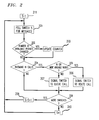
- FIG. 2 shows a flow chart of an algorithm which may be implemented in the inventive SCP.
- the algorithm of FIG. 2 could be programmed into the SCP of FIG. 1 in order to implement the invention, or could be implemented by means of a separate peripheral device connected to the SCP of FIG. 1, with the latter implementation minimizing software changes required to the currently existing SCPs.
- the flow chart of FIG. 2 is a series of operational blocks and branch points which can each be implemented by ordinarily skilled programmers as a relatively simple software module.
- the flow chart is intended to run as a continuing loop which executes constantly during operation of the SCP, altough other implementations may be employed without departing from the scope of the invention.
- Operational block 201 then polls switch s to read any messages arriving therefrom.
- switch s may have an incoming IN type call, and may be querying SCP 101 for instructions as to what to do with the call, or switch s may simply be informing the SCP that another telephone has been taken off-hook.
- the incoming message is processed by branch point 202, which determines if the number of available telephones for incoming calls has changed. For example, if the message received during operational block 201 indicates that a telephone has been taken off-hook, or that a call has been terminated, the number of available telephones would change. Other things which could affect the number of available telephones would be a fault in the system, or one of the lines being taken out of service for repair. If any of these conditions occur, operational block 203 would update the counter in the SCP which reflects the number of available input lines.
- branch point 204 After the counter is updated if necessary, the messages from the switch will be parsed by branch point 204 to determine if any incoming IN calls need be routed. If there are incoming IN calls to be routed, control is transferred to branch point 205 as shown in FIG. 2. Branch point 205 determines if there are at least N available telephones, such determination being based upon the counter previously discussed and included within within the SCP.
- the variable N is a function of many parameters in the system and is best determined empirically. For example, referring to FIG. 1, assume all of telephones 105-110 of FIG. 1 are used for outgoing as well as incoming calls. In this case, there is a substantial probability that from the time the SCP signals the telephone switch 102 or 103 to route the call, until the telephone switch 102 or 103 actually routes that call, one of the telephones may be taken off hook. Therefore, when the telephones are all used for outgoing calls as well as incoming IN services, N should be, say three.
- the SCP counter shows that three or more lines are available, it will cause the telephone switch to route the call to corporate office 104, whereas if the SCP counter currently indicates that only one telephone is available, the switch 102 or 103 will be instructed to queue the call.
- N may be set to one or two. This is because during the time between the SCP determining that their is an available one of telephones 106-110 and the time the call actually gets routed to that telephone, the telephone will not be taken off hook since none of the telephones are used for outgoing calls. Consequently, N can be a smaller number than in the prior situation, when all of the telephones are also used for outgoing calls.
- branch point 205 determines that N or more of telephones 106-110 are available for incoming IN calls, control is transferred to operational block 206. Operational block 206 will send an appropriate message to the proper one of switches 102-103 in order to route the IN call to one of the telephones at corporate office 104.
- branch point 205 determines that there are not enough available telephones to handle the incoming IN call, control is transferred to operational block 207. Operational block 207 will then signal the appropriate one of switches 102-103 to queue the call until such time as a telephone becomes available. As described previously, when such a call is queued, a message is played to the caller telling him, for example, that his call will be answered shortly. When a telephone becomes available, the appropriate one of switches 102-103 will route the call accordingly.
- control is transferred to branch point 208 as shown in FIG. 2. Further, even if there are no incoming calls to switch or to queue, control will still be transferred to branch point 208 as indicated in FIG. 2 by the connection from branch point 204 to branch point 208.
- Branch point 208 determines if all of the switches connected to the SCP have been polled during the current polling cycle. If so, the parameter s is reset to 1 by operational block 210, thereby causing a new polling cycle to begin. If there are other switches to be polled, control is transferred to operational block 209, which increments the parameter s so that the next switch can be polled. Thereafter, control returns to operational block 201, in order to continue polling the switches for messages.
- the invention provides a way of allowing IN services to coexist with regular network services, yet avoids the disadvantages present in prior arrangements.
- the invention avoids delaying calls for which there is an available telephone and routing calls when there is no available telephone.
- each of telephones 106-110 could be connected to one of switches 102-103 via a separate telephone line.
- any of telephones 106-110 may be replaced with other types of telecommunications equipment, such a computers, modems, etc.
- the functions of the SCP may even be implemented in the telephone switches themselves, thereby eliminating the extra hardware required for the SCP.
Landscapes
- Engineering & Computer Science (AREA)
- Computer Networks & Wireless Communication (AREA)
- Business, Economics & Management (AREA)
- Marketing (AREA)
- Signal Processing (AREA)
- Telephonic Communication Services (AREA)
- Sub-Exchange Stations And Push- Button Telephones (AREA)
- Monitoring And Testing Of Exchanges (AREA)
Applications Claiming Priority (2)
| Application Number | Priority Date | Filing Date | Title |
|---|---|---|---|
| US07/589,724 US5212727A (en) | 1990-09-26 | 1990-09-26 | Queuing trigger in call processing |
| US589724 | 1990-09-26 |
Publications (3)
| Publication Number | Publication Date |
|---|---|
| EP0478206A2 true EP0478206A2 (fr) | 1992-04-01 |
| EP0478206A3 EP0478206A3 (en) | 1993-04-14 |
| EP0478206B1 EP0478206B1 (fr) | 1999-12-01 |
Family
ID=24359229
Family Applications (1)
| Application Number | Title | Priority Date | Filing Date |
|---|---|---|---|
| EP91308474A Expired - Lifetime EP0478206B1 (fr) | 1990-09-26 | 1991-09-17 | Procédé pour créer des files d'attente en traitement d'appel |
Country Status (3)
| Country | Link |
|---|---|
| US (1) | US5212727A (fr) |
| EP (1) | EP0478206B1 (fr) |
| ES (1) | ES2141087T3 (fr) |
Cited By (5)
| Publication number | Priority date | Publication date | Assignee | Title |
|---|---|---|---|---|
| EP0687096A2 (fr) | 1994-06-09 | 1995-12-13 | Siemens Aktiengesellschaft | Méthode de distribution des appels dans un réseau de communication |
| EP0689367A1 (fr) * | 1994-06-09 | 1995-12-27 | Siemens Aktiengesellschaft | Procédé pour la distribution d'appels dans un réseau de communication |
| US5995610A (en) * | 1997-05-06 | 1999-11-30 | Telefonaktiebolaget Lm Ericsson | Cooperative call processing across public and private intelligent networks |
| US6044142A (en) * | 1997-05-06 | 2000-03-28 | Telefonaktiebolaget L M Ericsson | Method and arrangement for integrating intelligent network services with operator assisted services |
| US6094479A (en) * | 1997-05-06 | 2000-07-25 | Telefonaktiebolaget Lm Ericsson | Computer telephony integration gateway |
Families Citing this family (36)
| Publication number | Priority date | Publication date | Assignee | Title |
|---|---|---|---|---|
| JPH0497645A (ja) * | 1990-08-15 | 1992-03-30 | Fujitsu Ltd | インテリジェントネットワークにおけるscpのサービス制御方式 |
| US5583920A (en) * | 1992-04-17 | 1996-12-10 | Bell Atlantic | Intelligent peripheral in video dial tone network |
| US5864614A (en) * | 1992-04-17 | 1999-01-26 | Bell Atlantic Network Services, Inc. | Intelligent peripheral and network control |
| US5572583A (en) * | 1992-04-17 | 1996-11-05 | Bell Atlantic | Advanced intelligent network with intelligent peripherals interfaced to the integrated services control point |
| US5430719A (en) * | 1993-06-28 | 1995-07-04 | Bellsouth Corporation | Mediation of open advanced intelligent network interface by shared execution environment |
| AU691509B2 (en) * | 1993-06-28 | 1998-05-21 | Bellsouth Intellectual Property Corporation | Mediation of open advanced intelligent network interface for public switched telephone network |
| US5467388A (en) * | 1994-01-31 | 1995-11-14 | Bell Atlantic Network Services, Inc. | Method and apparatus for selectively blocking incoming telephone calls |
| US5583976A (en) * | 1994-02-18 | 1996-12-10 | Bellsouth Corporation | Telecommunications network configuration model for data management and allocation |
| US5579318A (en) * | 1994-06-30 | 1996-11-26 | Bellsouth Corporation | Processes and apparatus for maintaining data concurrence between databases in telecommunications networks |
| US5546574A (en) * | 1994-06-30 | 1996-08-13 | At&T Corporation | Peer-to-peer data concurrence processes and apparatus |
| US5600710A (en) * | 1994-07-08 | 1997-02-04 | Bellsouth Corporation | Method for providing a recorded message to a telephone caller when called number is busy |
| US5570410A (en) * | 1994-10-13 | 1996-10-29 | Bellsouth Corporation | Dynamic resource allocation process for a service control point in an advanced intelligent network system |
| US5787160A (en) * | 1994-12-08 | 1998-07-28 | Mci Communications Corporation | Intelligent routing of special service calls |
| US5579384A (en) * | 1995-02-17 | 1996-11-26 | Bellsouth Corporation | Telecommunications network service central management system interfacing with protocol specific regional stations providing services to subscribers |
| US5781620A (en) * | 1995-07-19 | 1998-07-14 | Bell Atlantic Network Services, Inc. | Method and system for toll carrier selection |
| US5802146A (en) * | 1995-11-22 | 1998-09-01 | Bell Atlantic Network Services, Inc. | Maintenance operations console for an advanced intelligent network |
| US5692033A (en) * | 1996-01-22 | 1997-11-25 | Bell Atlantic Network Services, Inc. | AIN queuing for call-back system |
| US5812640A (en) * | 1996-01-26 | 1998-09-22 | Bellsouth Corporation | System and method for using alternative switch announcements in advanced intelligent network services |
| US5952409A (en) * | 1996-01-31 | 1999-09-14 | 3M Innovative Properties Company | Compositions and methods for imparting stain resistance and stain resistant articles |
| GB2315635B (en) | 1996-07-19 | 2000-10-11 | Ericsson Telefon Ab L M | Dynamic load limiting |
| US5905954A (en) * | 1997-01-14 | 1999-05-18 | Telefonaktiebolaget Lm Ericsson (Publ) | Method and system for transferring subscriber information in a radio telecommunications network |
| US6480600B1 (en) | 1997-02-10 | 2002-11-12 | Genesys Telecommunications Laboratories, Inc. | Call and data correspondence in a call-in center employing virtual restructuring for computer telephony integrated functionality |
| US6104802A (en) | 1997-02-10 | 2000-08-15 | Genesys Telecommunications Laboratories, Inc. | In-band signaling for routing |
| US7031442B1 (en) | 1997-02-10 | 2006-04-18 | Genesys Telecommunications Laboratories, Inc. | Methods and apparatus for personal routing in computer-simulated telephony |
| US6044274A (en) * | 1997-02-13 | 2000-03-28 | Telefonaktiebolaget Lm Ericsson | Handling of mobile originated intelligent network calls from a non-intelligent capable mobile switching center |
| US5878129A (en) * | 1997-02-20 | 1999-03-02 | Ameritech Corporation | Method and system for distributing messages from a signal transfer point to a plurality of service control points |
| US6985943B2 (en) | 1998-09-11 | 2006-01-10 | Genesys Telecommunications Laboratories, Inc. | Method and apparatus for extended management of state and interaction of a remote knowledge worker from a contact center |
| US6711611B2 (en) | 1998-09-11 | 2004-03-23 | Genesis Telecommunications Laboratories, Inc. | Method and apparatus for data-linking a mobile knowledge worker to home communication-center infrastructure |
| USRE46528E1 (en) | 1997-11-14 | 2017-08-29 | Genesys Telecommunications Laboratories, Inc. | Implementation of call-center outbound dialing capability at a telephony network level |
| US7907598B2 (en) | 1998-02-17 | 2011-03-15 | Genesys Telecommunication Laboratories, Inc. | Method for implementing and executing communication center routing strategies represented in extensible markup language |
| US6332154B2 (en) | 1998-09-11 | 2001-12-18 | Genesys Telecommunications Laboratories, Inc. | Method and apparatus for providing media-independent self-help modules within a multimedia communication-center customer interface |
| USRE46153E1 (en) | 1998-09-11 | 2016-09-20 | Genesys Telecommunications Laboratories, Inc. | Method and apparatus enabling voice-based management of state and interaction of a remote knowledge worker in a contact center environment |
| US7929978B2 (en) | 1999-12-01 | 2011-04-19 | Genesys Telecommunications Laboratories, Inc. | Method and apparatus for providing enhanced communication capability for mobile devices on a virtual private network |
| US7142852B2 (en) * | 2003-11-13 | 2006-11-28 | Motorola, Inc. | Method and gateway for controlling call routing |
| US9008075B2 (en) | 2005-12-22 | 2015-04-14 | Genesys Telecommunications Laboratories, Inc. | System and methods for improving interaction routing performance |
| CN112311938B (zh) * | 2020-10-30 | 2022-02-01 | 上海淇玥信息技术有限公司 | 一种智能呼叫方法、装置和电子设备 |
Family Cites Families (4)
| Publication number | Priority date | Publication date | Assignee | Title |
|---|---|---|---|---|
| US4737983A (en) * | 1985-10-02 | 1988-04-12 | American Telephone And Telegraph Company Communications, Inc. | Automatic call distributor telephone service |
| US4788715A (en) * | 1986-10-16 | 1988-11-29 | American Telephone And Telegraph Company At&T Bell Laboratories | Announcing waiting times in queuing systems |
| US4907260A (en) * | 1987-10-05 | 1990-03-06 | Ambassador College | Telephone line communications control system |
| US5025468A (en) * | 1989-05-04 | 1991-06-18 | Harris Corporation | Computerized system for incoming calls |
-
1990
- 1990-09-26 US US07/589,724 patent/US5212727A/en not_active Expired - Lifetime
-
1991
- 1991-09-17 EP EP91308474A patent/EP0478206B1/fr not_active Expired - Lifetime
- 1991-09-17 ES ES91308474T patent/ES2141087T3/es not_active Expired - Lifetime
Non-Patent Citations (4)
| Title |
|---|
| CONFERENCE RECORD, IEEE GLOBAL TELECOMMUNICATIONS CONFERENCE, GLOBECOM'85, 2-5 DEC. 1985, PAGES 1429-1433, NEW ORLEANS US N. SHIGEMATSU ET AL 'The Advanced Network Service System' * |
| CONFERENCE RECORD, IEEE INTERNATIONAL CONFERENCE ON COMMUNICATIONS '86, 22 -25 JUNE1986, VOL. 1 PAGES 28-32, TORONTO CN A.FRIEDES ET AL 'ISDN Opportunities for Large Business - 800 Service Customers' * |
| PROCEEDINGS OF THE NATIONAL COMMUNICATIONS FORUM vol. 43, no. 1, 2 October 1989, OAK BROOK, ILLINOIS US pages 291 - 298 , XP220378 K. KRUSINSKI ET AL 'Switching and Network Capabilities to Support 1991 Intelligent Networks' * |
| SECOND IEE NATIONAL CONFERENCE ON TELECOMMUNICATIONS, 2-5 APRIL 1989, PAGES 407-410, YORK GB , XP130168 O.J. O'BRIEN ET AL 'Intelligent Networks: British Telecom's First Realisation' * |
Cited By (6)
| Publication number | Priority date | Publication date | Assignee | Title |
|---|---|---|---|---|
| EP0687096A2 (fr) | 1994-06-09 | 1995-12-13 | Siemens Aktiengesellschaft | Méthode de distribution des appels dans un réseau de communication |
| EP0689367A1 (fr) * | 1994-06-09 | 1995-12-27 | Siemens Aktiengesellschaft | Procédé pour la distribution d'appels dans un réseau de communication |
| US5563941A (en) * | 1994-06-09 | 1996-10-08 | Siemens Aktiengesellschaft | Method for the distribution of calls in a communication network |
| US5995610A (en) * | 1997-05-06 | 1999-11-30 | Telefonaktiebolaget Lm Ericsson | Cooperative call processing across public and private intelligent networks |
| US6044142A (en) * | 1997-05-06 | 2000-03-28 | Telefonaktiebolaget L M Ericsson | Method and arrangement for integrating intelligent network services with operator assisted services |
| US6094479A (en) * | 1997-05-06 | 2000-07-25 | Telefonaktiebolaget Lm Ericsson | Computer telephony integration gateway |
Also Published As
| Publication number | Publication date |
|---|---|
| EP0478206B1 (fr) | 1999-12-01 |
| US5212727A (en) | 1993-05-18 |
| ES2141087T3 (es) | 2000-03-16 |
| EP0478206A3 (en) | 1993-04-14 |
Similar Documents
| Publication | Publication Date | Title |
|---|---|---|
| US5212727A (en) | Queuing trigger in call processing | |
| EP0424015B1 (fr) | Système de file d'attente à une pluralité de position pour appels téléphoniques | |
| US5369695A (en) | Method of redirecting a telephone call to an alternate destination | |
| US5253288A (en) | Alternate destination call redirection for telecommunications systems | |
| US5185786A (en) | Automatic call center overflow retrieval system | |
| US5020095A (en) | Interactive call distribution processor | |
| US5475737A (en) | Toll saver for centralized messaging systems | |
| US5844896A (en) | System and method for routing telephone calls | |
| USRE37001E (en) | Interactive call processor to facilitate completion of queued calls | |
| US5633924A (en) | Telecommunication network with integrated network-wide automatic call distribution | |
| EP0993170B1 (fr) | Méthode pour informer un distributeur d'appels de changements d'état | |
| US5949869A (en) | Called party control of incoming calls | |
| EP0498593A2 (fr) | Système de détournement d'appel | |
| US6301349B1 (en) | Method and system to connect an unanswered forwarded communication directly to a voice mail service | |
| US4527012A (en) | Communications switching system with modular switching communications peripheral and host computer | |
| JPS6298846A (ja) | 自動呼分配電話サ−ビスの呼負荷均衡法 | |
| JPS62206995A (ja) | 着信呼を分配する方法及び電話交換機 | |
| JPH08214059A (ja) | 競合的な環境内でのローカル及び市外電話通信呼の接続 | |
| CN1112344A (zh) | 可逆呼叫的自动呼叫分配器 | |
| EP0908042B1 (fr) | Gestion de fuseaux horaires dans un systeme de telecommunications | |
| EP0924919A2 (fr) | Système et méthode de conversion pour centrex | |
| US7231031B2 (en) | AIN call queuing | |
| EP0224212B1 (fr) | Disposition de détection de la tonalité de numérotation avec une caractéristique d'avertissement | |
| KR20000071801A (ko) | 내부 전화 교환기 네트워크 시스템 | |
| US20050089155A1 (en) | Technique for dynamically prioritizing communication calls to information/call centers |
Legal Events
| Date | Code | Title | Description |
|---|---|---|---|
| PUAI | Public reference made under article 153(3) epc to a published international application that has entered the european phase |
Free format text: ORIGINAL CODE: 0009012 |
|
| 17P | Request for examination filed |
Effective date: 19911008 |
|
| AK | Designated contracting states |
Kind code of ref document: A2 Designated state(s): ES GB IT |
|
| PUAL | Search report despatched |
Free format text: ORIGINAL CODE: 0009013 |
|
| AK | Designated contracting states |
Kind code of ref document: A3 Designated state(s): ES GB IT |
|
| RAP3 | Party data changed (applicant data changed or rights of an application transferred) |
Owner name: AT&T CORP. |
|
| 17Q | First examination report despatched |
Effective date: 19940720 |
|
| GRAG | Despatch of communication of intention to grant |
Free format text: ORIGINAL CODE: EPIDOS AGRA |
|
| GRAG | Despatch of communication of intention to grant |
Free format text: ORIGINAL CODE: EPIDOS AGRA |
|
| GRAH | Despatch of communication of intention to grant a patent |
Free format text: ORIGINAL CODE: EPIDOS IGRA |
|
| GRAH | Despatch of communication of intention to grant a patent |
Free format text: ORIGINAL CODE: EPIDOS IGRA |
|
| GRAA | (expected) grant |
Free format text: ORIGINAL CODE: 0009210 |
|
| AK | Designated contracting states |
Kind code of ref document: B1 Designated state(s): ES GB IT |
|
| ITF | It: translation for a ep patent filed | ||
| REG | Reference to a national code |
Ref country code: ES Ref legal event code: FG2A Ref document number: 2141087 Country of ref document: ES Kind code of ref document: T3 |
|
| PLBE | No opposition filed within time limit |
Free format text: ORIGINAL CODE: 0009261 |
|
| STAA | Information on the status of an ep patent application or granted ep patent |
Free format text: STATUS: NO OPPOSITION FILED WITHIN TIME LIMIT |
|
| 26N | No opposition filed | ||
| PGFP | Annual fee paid to national office [announced via postgrant information from national office to epo] |
Ref country code: GB Payment date: 20010807 Year of fee payment: 11 |
|
| PGFP | Annual fee paid to national office [announced via postgrant information from national office to epo] |
Ref country code: ES Payment date: 20010919 Year of fee payment: 11 |
|
| REG | Reference to a national code |
Ref country code: GB Ref legal event code: IF02 |
|
| PG25 | Lapsed in a contracting state [announced via postgrant information from national office to epo] |
Ref country code: GB Free format text: LAPSE BECAUSE OF NON-PAYMENT OF DUE FEES Effective date: 20020917 |
|
| PG25 | Lapsed in a contracting state [announced via postgrant information from national office to epo] |
Ref country code: ES Free format text: LAPSE BECAUSE OF NON-PAYMENT OF DUE FEES Effective date: 20020918 |
|
| GBPC | Gb: european patent ceased through non-payment of renewal fee |
Effective date: 20020917 |
|
| REG | Reference to a national code |
Ref country code: ES Ref legal event code: FD2A Effective date: 20031011 |
|
| PG25 | Lapsed in a contracting state [announced via postgrant information from national office to epo] |
Ref country code: IT Free format text: LAPSE BECAUSE OF NON-PAYMENT OF DUE FEES Effective date: 20050917 |