EP0689367A1 - Procédé pour la distribution d'appels dans un réseau de communication - Google Patents
Procédé pour la distribution d'appels dans un réseau de communication Download PDFInfo
- Publication number
- EP0689367A1 EP0689367A1 EP94108897A EP94108897A EP0689367A1 EP 0689367 A1 EP0689367 A1 EP 0689367A1 EP 94108897 A EP94108897 A EP 94108897A EP 94108897 A EP94108897 A EP 94108897A EP 0689367 A1 EP0689367 A1 EP 0689367A1
- Authority
- EP
- European Patent Office
- Prior art keywords
- server
- call
- capacity
- calls
- scp
- Prior art date
- Legal status (The legal status is an assumption and is not a legal conclusion. Google has not performed a legal analysis and makes no representation as to the accuracy of the status listed.)
- Granted
Links
- 238000000034 method Methods 0.000 title claims abstract description 15
- 238000004891 communication Methods 0.000 title claims description 8
- 230000001960 triggered effect Effects 0.000 claims description 17
- 238000012937 correction Methods 0.000 claims description 4
- 230000000977 initiatory effect Effects 0.000 abstract 1
- 238000001514 detection method Methods 0.000 description 7
- 230000000694 effects Effects 0.000 description 4
- 238000010998 test method Methods 0.000 description 3
- 230000036962 time dependent Effects 0.000 description 2
- 101000597193 Homo sapiens Telethonin Proteins 0.000 description 1
- 102100035155 Telethonin Human genes 0.000 description 1
- 230000007423 decrease Effects 0.000 description 1
- 238000012544 monitoring process Methods 0.000 description 1
- 238000012545 processing Methods 0.000 description 1
- 238000011084 recovery Methods 0.000 description 1
- 238000012360 testing method Methods 0.000 description 1
- 230000001052 transient effect Effects 0.000 description 1
Images





Classifications
-
- H—ELECTRICITY
- H04—ELECTRIC COMMUNICATION TECHNIQUE
- H04Q—SELECTING
- H04Q3/00—Selecting arrangements
- H04Q3/0016—Arrangements providing connection between exchanges
-
- H—ELECTRICITY
- H04—ELECTRIC COMMUNICATION TECHNIQUE
- H04M—TELEPHONIC COMMUNICATION
- H04M3/00—Automatic or semi-automatic exchanges
- H04M3/42—Systems providing special services or facilities to subscribers
- H04M3/50—Centralised arrangements for answering calls; Centralised arrangements for recording messages for absent or busy subscribers ; Centralised arrangements for recording messages
- H04M3/51—Centralised call answering arrangements requiring operator intervention, e.g. call or contact centers for telemarketing
- H04M3/523—Centralised call answering arrangements requiring operator intervention, e.g. call or contact centers for telemarketing with call distribution or queueing
-
- H—ELECTRICITY
- H04—ELECTRIC COMMUNICATION TECHNIQUE
- H04M—TELEPHONIC COMMUNICATION
- H04M3/00—Automatic or semi-automatic exchanges
- H04M3/42—Systems providing special services or facilities to subscribers
- H04M3/50—Centralised arrangements for answering calls; Centralised arrangements for recording messages for absent or busy subscribers ; Centralised arrangements for recording messages
- H04M3/51—Centralised call answering arrangements requiring operator intervention, e.g. call or contact centers for telemarketing
- H04M3/523—Centralised call answering arrangements requiring operator intervention, e.g. call or contact centers for telemarketing with call distribution or queueing
- H04M3/5237—Interconnection arrangements between ACD systems
-
- H—ELECTRICITY
- H04—ELECTRIC COMMUNICATION TECHNIQUE
- H04M—TELEPHONIC COMMUNICATION
- H04M2207/00—Type of exchange or network, i.e. telephonic medium, in which the telephonic communication takes place
- H04M2207/12—Type of exchange or network, i.e. telephonic medium, in which the telephonic communication takes place intelligent networks
Definitions
- the invention relates to a method for distributing calls in a communication network according to the preamble of claim 1.
- European patent EP-0 424 015 A2 describes a method for realizing call queues in the architecture of the intelligent network (IN), in which the service control point (SCP) tries indirectly to determine the capacity reserve of a server in which he counters the active calls (IN calls) sent via the intelligent network to the servers.
- SCP service control point
- EP-0 478 206 A2 it is proposed to only deliver calls to a server if it could serve more than one call after the display status of a counter. This leaves the server a "reserve” for the special cases mentioned above, but considerably reduces the average server load.
- the invention has for its object to solve the problems mentioned.
- the quality of a service is increased by the method according to the invention, since a server that has rejected or triggered a call allocated by the central instance due to insufficient capacity ensures that fewer or no more calls are allocated to the same server for a certain period of time.
- the method according to the invention furthermore reduces the dynamic load on the communication network, since calls no longer have to be triggered as often and thus a connection establishment has to take place less frequently because of a renewed call from a subscriber.
- An embodiment of the invention is specified by claim 2. This embodiment further increases the quality of a service, since a call rejected by a server due to insufficient capacity is not triggered towards the subscriber, but is instead distributed to another server.
- the dynamic distribution of the communication network is further reduced by the redistribution, since calls no longer have to be triggered as often and thus a connection establishment has to take place less frequently because of a renewed call from a subscriber.
- An embodiment of the invention is specified by claim 3.
- the capacity reserve of a server is determined indirectly. The allocation of a call to a server is therefore not left to chance and there is therefore a high probability of an initial successful allocation of a call to a server.
- Another embodiment of the invention is specified by claim 4.
- the likelihood of a call being allocated over a period of time is greatly reduced.
- another call is triggered properly after the unsuccessful allocation and the associated reduction in the capacity reserve display and the display value of the capacity reserve is increased again, it can already be within of the specified period to be reallocated to this server.
- This embodiment also ensures that even after a failure in the SCP, which results in a loss of the display values of the capacity reserves, the newly formed display values quickly adapt again to the real values of the capacity reserves.
- the service control point is not forced to initiate a call if it cannot immediately assign it to a server.
- Another embodiment of the invention is specified by claim 6. This embodiment is optimally suited for servers that can handle calls in parallel and therefore do not have to maintain a local queue. With these servers, the displayed value of the capacity reserve is immediately increased to the indirectly determined capacity reserve after the specified period.
- Another embodiment of the invention is specified by claim 7. This embodiment is optimally suited for servers that can only handle calls sequentially and therefore have to maintain their own local queue themselves. In this case, the capacity reserve or available server capacity is only increased step by step.
- Incoming calls are to be distributed to several servers using the call distribution mentioned, one call to one Server should only be delivered if it can also handle the call, for example the server is not fully occupied.
- the capacity reserve of a server e.g. the number of calls that it could also handle in parallel
- the capacity reserve in such communication systems must be determined indirectly by counting the number of calls controlled by the Service Control Point that are currently active for this server and inferring the remaining capacity reserve from this.
- the indirectly determined capacity reserve can deviate from the actual capacity reserve, because at the time of the determination the server can receive calls that have not been transferred via the intelligent network and are therefore not registered by the service control point.
- the server can also initiate calls, which cannot be registered by the service control point either.
- a service control point can route a call to a server that has no free capacity (e.g. due to a call received by that server that was not transferred via the intelligent network).
- the server now triggers the assigned call due to insufficient capacity reserve, this is registered by evaluating the triggering reason in the trigger message from the SCP and the call is redistributed so that the triggering of the call by the server is not visible to the subscriber.
- the SCP reduces the display value of the capacity reserve for a certain period of time (relaxation period) or applies a correction factor in order to rule out a redistribution of a call to this server within the specified period or to reduce the probability of this.
- the SCP assumes that the server has returned to its original state or its original capacity reserve and increases the display value of the capacity reserve accordingly.
- the above-mentioned method for correcting the displayed value of the capacity reserve also ensures that, in the event of a failure (e.g. after a recovery of the SSP or SCP), the contents of the capacity reserve counters still have correct values of the capacity reserve after the relaxation time.
- the SCP does not have to initiate a registered call, which it cannot distribute immediately due to the lack of a receptive server, the SCP maintains a queue in which it temporarily stores the registered calls until they have been successfully distributed. "Successful distribution" means that a server actually serves the assigned call and does not trigger it because of a lack of capacity.
- such a queue represents a special destination within the traffic management program (routing tree) of a service subscriber, which activates a special program of the service control point, which is referred to below as the queue program.
- At least one server is assigned to each queue. Furthermore, a server can serve more than one queue.
- the queue program also implements a call distribution strategy that determines how incoming calls are distributed to the assigned servers and which queue is served first when a server becomes free and more than one queue is assigned to that server.
- the queue Q1 has a capacity of five, i.e. it can take a maximum of five calls.
- the server S1 is capable of two calls in parallel, i.e. to accept at the same time, while the server S2 has only a maximum capacity of one, i.e. only able to take a single call at a time.
- the two servers have no residual capacity (no capacity reserve) because they are both occupied with IN calls A, B and C.
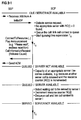
- FIG. 2 shows the message flow between SSP and SCP in the case of a successfully operated call, a successfully operated call being understood as a call which is distributed by the SCP to a server and which server does not trigger the call distributed to it because of a lack of capacity.
- the access switching center SSP which represents a subscriber's access to the intelligent network, from the originating exchange of a subscriber A the initialization message IAM, which triggers the call against the IN.
- the access switching center then sends the initialization message "Initial DP" to the SCP, on the basis of which the SCP registers a service request and the queue program then starts.
- the queue program is now looking for a suitable server i whose capacity reserve counter RC (i) is greater than 0, ie which is still available.
- the queue program does not find an available server at this time, which is expressed in FIG. 2 by the status description "Server not available".
- the expression “IDLE” further expresses that the call or the service request has not yet been processed by the queuing program.
- the queue program Since in the present case no available server was found by the queue program, the queue program puts the call into the queue by depending on the call context on the data structure "queue". At the same time, it starts a queue timer T Q , which defines a maximum dwell time of the call in the queue. The value for the timer T Q depends on the service requested by the call.
- the queue timer continues to run even if the call assigned to server i is rejected by the server and in this case the call has to be put back into the queue by the queue program. In this case, the entire maximum waiting time must not be monitored again. In addition, the re-queued call should be given priority when redistributed.
- a call is allocated to a server i via the "Connect” and "Request_Report_BCSM_Event” operations, by means of which the SCP instructs the access switching center SSP to forward the call to the server i and the detection point "User Busy” as an event detection point of the type " Request "(ie the call processing is suspended when the detection point is hit).
- the detection point "No answer" can also be reinforced.
- the SCP uses the "Call_Information_Request" operation to request the access switching center to send a message about the triggering reason and a time stamp about the call, which represents the triggering reason. This ensures that the SCP is informed when a call is triggered and that it receives corresponding data via the time stamp in order to keep a corresponding statistic about the server performance.
- the access switching center uses the routing number of the server i to establish the connection to the server i via the message IAM and arm the above-mentioned detection points.
- the server i serves the call after the connection is established and after a certain time this is answered either by the server i or by subscriber A, e.g. in Fig. 2, triggered again.
- the queue timer T Q is designed such that it normally expires during the servicing of the call by the server i. After this timer has expired, an activity test timer T AT is set. If this expires, ie if its expiration is not prevented by the arrival of the end message "Call_Information_Report", the SCP triggers an activity test procedure which checks whether the server is actually still busy with the handling of the call.
- the access switching center informs the SCP of the "Call_Information_Report" message about the triggering of the call.
- the SCP looks into the call context and the data structure "Server i" with which this call context is linked.
- the SCP increases the capacity reserve counter RC (i) accordingly, stores the call data relevant for the performance analysis and resolves the call context for the call mentioned.
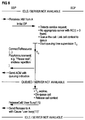
- Figure 3 shows how the SCP adjusts its server state model when it discovers a discrepancy between the expected server state ("Available”) and the actual server state ("Not available”).
- a backward triggering i.e. a trigger by the server i
- the trigger reason "User Busy” registered by the access switching point SSP.
- This case can occur, for example, when the server i can also not handle calls transferred via the intelligent network or can even initiate calls.
- the access switching center notifies the SCP of this triggering of the server i via the message "Event_Report_BCSM".
- the SCP looks first into the call context and then into the server i to which this call context is linked and sets the display value of the capacity reserve of the server i or the capacity reserve counter RC (i) to zero.
- the SCP then starts the relaxation timer T rlx (i) of the server i, which is therefore a server-related timer and not a call-related timer.
- the call is put back into the queue and the link between the call context and the server i is released. This only happens if the queue timer T Q has not yet expired.
- the access switching center is instructed by the SCP to use the "Connect_to_Resource” and "Play_Announcement" commands to connect subscriber A with an announcement which, for example, prompts him to wait.
- the capacity reserve counter of the server that triggers the relaxation timer is activated has increased.
- the amount by which the capacity payer is increased depends on the relaxation strategy that is assigned to a respective server.
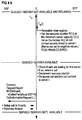
- FIGS. 4a and 4b illustrate two different relaxation strategies.
- 4a shows the pessimistic relaxation strategy, in which the capacity reserve counter is increased by only one after each expiry of the relaxation timer. If after a respective increase by one it is still lower than the indirectly determined capacity reserve C (i, t) - N (i), the relaxation timer is started again. With the pessimistic relaxation strategy, the capacity reserve counter is thus gradually adapted to the indirectly determined capacity reserve of the server.
- FIG. 4b shows an optimistic relaxation strategy in which the capacity reserve counter is immediately set to the indirectly determined capacity reserve C (i, t) - N (i) after the relaxation timer has expired.
- the pessimistic relaxation strategy is best suited for cases in which the server itself maintains an additional local queue and has to serve calls to this queue sequentially. In this case, the server capacity will only be available step by step.
- the optimistic relaxation strategy is suitable, for example, for cases in which the server (e.g. attendant group) can handle calls in parallel and therefore does not have to queue locally.
- the time in which the capacity of such a server is blocked by non-IN calls will therefore mostly not depend on the number of such non-IN calls.
- server capacity becomes available, it is checked whether calls are waiting to be operated by this server. If so so, the next call to be serviced is selected from a queue according to a queuing strategy. The selected call is disconnected from the announcement and connected to the server. In order to take precautions in the event that the server is still occupied, the corresponding detection points already mentioned are equipped.
- Figure 5 shows another example of the data held by the queue program at a particular time.
- the server S1 has triggered a call A and then immediately accepted a call that is not handled by the intelligent network, so that the intelligent network, or more precisely the queue program, cannot register that the server S1 is occupied again.
- the data-based reflection of this situation is shown in FIG. 5.
- the queue program of the service control point will assign call D to server S1.
- Figure 8 shows the handling of a case where the queue timer expires and the call is still queued.
- the call context is queued and released.
- the access switching center is then given the instruction "Release_Call" to initiate the call, specifically because of the reason for triggering "User Busy".
- a call data record is also generated for the purpose of performance analysis.
- the call context is then released.
- the access switching center triggers the call with the ISUP command "Release", which is sent to the corresponding facilities of subscriber A.
Landscapes
- Engineering & Computer Science (AREA)
- Business, Economics & Management (AREA)
- Marketing (AREA)
- Signal Processing (AREA)
- Computer Networks & Wireless Communication (AREA)
- Telephonic Communication Services (AREA)
- Data Exchanges In Wide-Area Networks (AREA)
- Exchange Systems With Centralized Control (AREA)
Priority Applications (6)
| Application Number | Priority Date | Filing Date | Title |
|---|---|---|---|
| AT94108897T ATE213893T1 (de) | 1994-06-09 | 1994-06-09 | Verfahren zum verteilen von anrufen in einem kommunikationsnetz |
| EP94108897A EP0689367B1 (fr) | 1994-06-09 | 1994-06-09 | Procédé pour la distribution d'appels dans un réseau de communication |
| DE59410062T DE59410062D1 (de) | 1994-06-09 | 1994-06-09 | Verfahren zum Verteilen von Anrufen in einem Kommunikationsnetz |
| ES94108897T ES2173100T3 (es) | 1994-06-09 | 1994-06-09 | Procedimiento para la distribucion de llamadas en una red de comunicacion. |
| US08/488,496 US5563941A (en) | 1994-06-09 | 1995-06-09 | Method for the distribution of calls in a communication network |
| CN95107117A CN1082307C (zh) | 1994-06-09 | 1995-06-09 | 在通信网络内呼叫分配的方法 |
Applications Claiming Priority (1)
| Application Number | Priority Date | Filing Date | Title |
|---|---|---|---|
| EP94108897A EP0689367B1 (fr) | 1994-06-09 | 1994-06-09 | Procédé pour la distribution d'appels dans un réseau de communication |
Publications (2)
| Publication Number | Publication Date |
|---|---|
| EP0689367A1 true EP0689367A1 (fr) | 1995-12-27 |
| EP0689367B1 EP0689367B1 (fr) | 2002-02-27 |
Family
ID=8216005
Family Applications (1)
| Application Number | Title | Priority Date | Filing Date |
|---|---|---|---|
| EP94108897A Expired - Lifetime EP0689367B1 (fr) | 1994-06-09 | 1994-06-09 | Procédé pour la distribution d'appels dans un réseau de communication |
Country Status (6)
| Country | Link |
|---|---|
| US (1) | US5563941A (fr) |
| EP (1) | EP0689367B1 (fr) |
| CN (1) | CN1082307C (fr) |
| AT (1) | ATE213893T1 (fr) |
| DE (1) | DE59410062D1 (fr) |
| ES (1) | ES2173100T3 (fr) |
Cited By (1)
| Publication number | Priority date | Publication date | Assignee | Title |
|---|---|---|---|---|
| DE10360276A1 (de) * | 2003-12-20 | 2005-07-28 | Deutsche Telekom Ag | Öffentliches Kommunikationsnetz und vermittelnder Netzknoten mit einer Warteschlangenfunktion |
Families Citing this family (7)
| Publication number | Priority date | Publication date | Assignee | Title |
|---|---|---|---|---|
| US5717745A (en) * | 1995-04-24 | 1998-02-10 | Mci Communications Corporation | System and method of efficiently evaluating different messages by a server in a telecommunications environment |
| EP0830039A1 (fr) * | 1996-09-16 | 1998-03-18 | BRITISH TELECOMMUNICATIONS public limited company | Réseau de télécommunication intelligent |
| GB2347832B (en) * | 1999-03-09 | 2001-04-04 | Marconi Comm Ltd | Communications system |
| US7480733B2 (en) * | 2004-07-15 | 2009-01-20 | International Business Machines Corporation | Routing incoming call requests |
| DE102005011882A1 (de) * | 2005-03-15 | 2006-09-21 | Siemens Ag | Verfahren zum Sicherstellen der Erreichbarkeit von Teilnehmern von Kommunikationsnetzen |
| CN101924842B (zh) * | 2009-06-10 | 2013-03-20 | 中兴通讯股份有限公司 | 计算机电信集成设备及资源管理和呼入控制方法 |
| CN102118521B (zh) * | 2010-01-05 | 2013-12-04 | 华为技术有限公司 | 一种呼叫路由方法,装置和系统 |
Citations (7)
| Publication number | Priority date | Publication date | Assignee | Title |
|---|---|---|---|---|
| US4191860A (en) * | 1978-07-13 | 1980-03-04 | Bell Telephone Laboratories, Incorporated | Data base communication call processing method |
| US4737983A (en) * | 1985-10-02 | 1988-04-12 | American Telephone And Telegraph Company Communications, Inc. | Automatic call distributor telephone service |
| US4858120A (en) * | 1987-03-18 | 1989-08-15 | International Telesystems Corp. | System for regulating arrivals of customers to servers |
| US4953204A (en) * | 1989-10-17 | 1990-08-28 | At&T Bell Laboratories | Multilocation queuing for telephone calls |
| EP0478206A2 (fr) * | 1990-09-26 | 1992-04-01 | AT&T Corp. | Procédé pour créer des files d'attente en traitement d'appel |
| EP0490446A1 (fr) * | 1990-12-11 | 1992-06-17 | Koninklijke KPN N.V. | Système de routage dynamique d'appels |
| US5291550A (en) * | 1990-12-26 | 1994-03-01 | At&T Bell Laboratories | Dynamic network call distributor |
Family Cites Families (1)
| Publication number | Priority date | Publication date | Assignee | Title |
|---|---|---|---|---|
| US4510351A (en) * | 1982-10-28 | 1985-04-09 | At&T Bell Laboratories | ACD Management information system |
-
1994
- 1994-06-09 AT AT94108897T patent/ATE213893T1/de not_active IP Right Cessation
- 1994-06-09 ES ES94108897T patent/ES2173100T3/es not_active Expired - Lifetime
- 1994-06-09 EP EP94108897A patent/EP0689367B1/fr not_active Expired - Lifetime
- 1994-06-09 DE DE59410062T patent/DE59410062D1/de not_active Expired - Fee Related
-
1995
- 1995-06-09 CN CN95107117A patent/CN1082307C/zh not_active Expired - Fee Related
- 1995-06-09 US US08/488,496 patent/US5563941A/en not_active Expired - Fee Related
Patent Citations (7)
| Publication number | Priority date | Publication date | Assignee | Title |
|---|---|---|---|---|
| US4191860A (en) * | 1978-07-13 | 1980-03-04 | Bell Telephone Laboratories, Incorporated | Data base communication call processing method |
| US4737983A (en) * | 1985-10-02 | 1988-04-12 | American Telephone And Telegraph Company Communications, Inc. | Automatic call distributor telephone service |
| US4858120A (en) * | 1987-03-18 | 1989-08-15 | International Telesystems Corp. | System for regulating arrivals of customers to servers |
| US4953204A (en) * | 1989-10-17 | 1990-08-28 | At&T Bell Laboratories | Multilocation queuing for telephone calls |
| EP0478206A2 (fr) * | 1990-09-26 | 1992-04-01 | AT&T Corp. | Procédé pour créer des files d'attente en traitement d'appel |
| EP0490446A1 (fr) * | 1990-12-11 | 1992-06-17 | Koninklijke KPN N.V. | Système de routage dynamique d'appels |
| US5291550A (en) * | 1990-12-26 | 1994-03-01 | At&T Bell Laboratories | Dynamic network call distributor |
Non-Patent Citations (3)
| Title |
|---|
| CHAU ET AL: "Intelligent network routing using CCS7 and ISDN", IEEE GLOBAL TELECOMMUNICATIONS CONFERENCE & EXHIBITION, vol. 3, 2 December 1990 (1990-12-02), SAN DIEGO (US), pages 1640 - 1644, XP000218850 * |
| F.K. LIU ET AL: "An ISDN Application - Simulation modeling of NACD", PROCEEDINGS OF THE THIRTEENTH TELETRAFFIC CONGRESS, 19 June 1991 (1991-06-19), COPENHAGEN (DK), pages 279 - 284, XP000303041 * |
| WOLF: "Advanced Techniques For Managing Telecommunications Networks", IEEE COMMUNICATIONS MAGAZINE, vol. 28, no. 10, October 1990 (1990-10-01), NEWYORK (US), pages 76 - 81, XP000165758 * |
Cited By (1)
| Publication number | Priority date | Publication date | Assignee | Title |
|---|---|---|---|---|
| DE10360276A1 (de) * | 2003-12-20 | 2005-07-28 | Deutsche Telekom Ag | Öffentliches Kommunikationsnetz und vermittelnder Netzknoten mit einer Warteschlangenfunktion |
Also Published As
| Publication number | Publication date |
|---|---|
| US5563941A (en) | 1996-10-08 |
| CN1082307C (zh) | 2002-04-03 |
| ES2173100T3 (es) | 2002-10-16 |
| CN1123983A (zh) | 1996-06-05 |
| ATE213893T1 (de) | 2002-03-15 |
| DE59410062D1 (de) | 2002-04-04 |
| EP0689367B1 (fr) | 2002-02-27 |
Similar Documents
| Publication | Publication Date | Title |
|---|---|---|
| DE19752614C2 (de) | Verfahren und Kommunikationssystem zur Behandlung von Alarmen durch ein mehrere Managementebenen aufweisendes Managementnetz | |
| DE69528213T2 (de) | Verfahren und Vorrichtung zur Vorrangabfertigung eines Telefonanrufes entsprechend der Dienstklasse eines Anrufers | |
| DE69233147T2 (de) | Verteiltes Netzwerküberwachungssystem zur Zustandsüberwachung von Knoten und Verbindungen | |
| DE69829759T2 (de) | Verteilung von nachrichten zu dienststeuereinrichtungen | |
| EP0607493A2 (fr) | Système de commande en temps réel | |
| DE602005004334T2 (de) | Nms zur Verarbeitung von Multi-Server Ereignissen | |
| EP0732861A2 (fr) | Procédé de communication de données d'abonnés entre des noeuds du réseau dans au moins une des structures du réseau intelligent supportant le réseau de communication | |
| EP0941619A1 (fr) | Procede et systeme d'organisation dynamique du trafic dans un reseau de communication | |
| EP0689367B1 (fr) | Procédé pour la distribution d'appels dans un réseau de communication | |
| DE60002825T2 (de) | Reservierung voon Ressourcen für erwartete Arbeitseinheiten anhand von simulierten Arbeitseinheiten | |
| DE69834221T2 (de) | Verbindung und Vorrichtung für eine vermittlungsunabhängige Leitwegsteuerungstechnik | |
| DE4415172C1 (de) | Programmgesteuerte Einrichtung, insbesondere Breitband-ISDN-Kommunikationseinrichtung, mit mindestens einem in dieser ablaufenden vermittlungstechnischen Prozeß | |
| EP0687096A2 (fr) | Méthode de distribution des appels dans un réseau de communication | |
| EP0466948B1 (fr) | Système de communication avec un système multiprocesseur servant comme contrÔle central | |
| DE112004001819T5 (de) | Endpunkt-Registrierung mit lokaler Verzögerungszeit in einem Rufabwicklungssystem | |
| EP0735786A2 (fr) | Procédé pour défense de surcharge dans un réseau de communication | |
| DE10311697B4 (de) | Verfahren zum Abbrechen von Management-Operationen in einem Managementnetz und Kommunikationssystem | |
| EP1460798B1 (fr) | Procédé et système de communication pour arrêter des opérations de gestion dans un réseau de gestion | |
| WO2005032094A1 (fr) | Verification de la disponibilite d'un serveur | |
| EP1317150B1 (fr) | Procédé pour transmettre une identification d'une unité de noeud de réseau, dispositif associé et programme associé | |
| WO2001091430A1 (fr) | Procede et systeme de communication pour distribuer des relations de communication a des raccordements d'abonnes disposes dans au moins un reseau de communication et affectes a au moins un groupe | |
| EP1225753B1 (fr) | Système distribué de distribution d'appel automatique avec mode d'urgance | |
| DE10046311B4 (de) | Verfahren für eine Zuweisung von Knotennummern zu Netzknoten eines Netzwerks | |
| EP1261168B1 (fr) | Méthode et agents pour le traitement de messages d'événements | |
| DE19516195C2 (de) | Verfahren zur impliziten Registrierung angerufener Bündelfunkendgeräte in einem Bündelfunknetz |
Legal Events
| Date | Code | Title | Description |
|---|---|---|---|
| PUAI | Public reference made under article 153(3) epc to a published international application that has entered the european phase |
Free format text: ORIGINAL CODE: 0009012 |
|
| 17P | Request for examination filed |
Effective date: 19941216 |
|
| AK | Designated contracting states |
Kind code of ref document: A1 Designated state(s): AT BE CH DE ES FR GB IT LI NL SE |
|
| 17Q | First examination report despatched |
Effective date: 19990929 |
|
| GRAG | Despatch of communication of intention to grant |
Free format text: ORIGINAL CODE: EPIDOS AGRA |
|
| GRAG | Despatch of communication of intention to grant |
Free format text: ORIGINAL CODE: EPIDOS AGRA |
|
| GRAH | Despatch of communication of intention to grant a patent |
Free format text: ORIGINAL CODE: EPIDOS IGRA |
|
| GRAH | Despatch of communication of intention to grant a patent |
Free format text: ORIGINAL CODE: EPIDOS IGRA |
|
| REG | Reference to a national code |
Ref country code: GB Ref legal event code: IF02 |
|
| GRAA | (expected) grant |
Free format text: ORIGINAL CODE: 0009210 |
|
| AK | Designated contracting states |
Kind code of ref document: B1 Designated state(s): AT BE CH DE ES FR GB IT LI NL SE |
|
| PG25 | Lapsed in a contracting state [announced via postgrant information from national office to epo] |
Ref country code: NL Free format text: LAPSE BECAUSE OF FAILURE TO SUBMIT A TRANSLATION OF THE DESCRIPTION OR TO PAY THE FEE WITHIN THE PRESCRIBED TIME-LIMIT Effective date: 20020227 |
|
| REF | Corresponds to: |
Ref document number: 213893 Country of ref document: AT Date of ref document: 20020315 Kind code of ref document: T |
|
| REG | Reference to a national code |
Ref country code: CH Ref legal event code: EP |
|
| REF | Corresponds to: |
Ref document number: 59410062 Country of ref document: DE Date of ref document: 20020404 |
|
| PG25 | Lapsed in a contracting state [announced via postgrant information from national office to epo] |
Ref country code: SE Free format text: LAPSE BECAUSE OF FAILURE TO SUBMIT A TRANSLATION OF THE DESCRIPTION OR TO PAY THE FEE WITHIN THE PRESCRIBED TIME-LIMIT Effective date: 20020527 |
|
| GBT | Gb: translation of ep patent filed (gb section 77(6)(a)/1977) |
Effective date: 20020502 |
|
| PG25 | Lapsed in a contracting state [announced via postgrant information from national office to epo] |
Ref country code: AT Free format text: LAPSE BECAUSE OF NON-PAYMENT OF DUE FEES Effective date: 20020609 |
|
| PG25 | Lapsed in a contracting state [announced via postgrant information from national office to epo] |
Ref country code: LI Free format text: LAPSE BECAUSE OF NON-PAYMENT OF DUE FEES Effective date: 20020630 Ref country code: CH Free format text: LAPSE BECAUSE OF NON-PAYMENT OF DUE FEES Effective date: 20020630 Ref country code: BE Free format text: LAPSE BECAUSE OF NON-PAYMENT OF DUE FEES Effective date: 20020630 |
|
| NLV1 | Nl: lapsed or annulled due to failure to fulfill the requirements of art. 29p and 29m of the patents act | ||
| ET | Fr: translation filed | ||
| REG | Reference to a national code |
Ref country code: ES Ref legal event code: FG2A Ref document number: 2173100 Country of ref document: ES Kind code of ref document: T3 |
|
| BERE | Be: lapsed |
Owner name: *SIEMENS A.G. Effective date: 20020630 |
|
| PLBE | No opposition filed within time limit |
Free format text: ORIGINAL CODE: 0009261 |
|
| STAA | Information on the status of an ep patent application or granted ep patent |
Free format text: STATUS: NO OPPOSITION FILED WITHIN TIME LIMIT |
|
| REG | Reference to a national code |
Ref country code: CH Ref legal event code: PL |
|
| 26N | No opposition filed |
Effective date: 20021128 |
|
| PGFP | Annual fee paid to national office [announced via postgrant information from national office to epo] |
Ref country code: GB Payment date: 20060613 Year of fee payment: 13 |
|
| PGFP | Annual fee paid to national office [announced via postgrant information from national office to epo] |
Ref country code: FR Payment date: 20060623 Year of fee payment: 13 |
|
| PGFP | Annual fee paid to national office [announced via postgrant information from national office to epo] |
Ref country code: IT Payment date: 20060630 Year of fee payment: 13 |
|
| PGFP | Annual fee paid to national office [announced via postgrant information from national office to epo] |
Ref country code: ES Payment date: 20060713 Year of fee payment: 13 |
|
| PGFP | Annual fee paid to national office [announced via postgrant information from national office to epo] |
Ref country code: DE Payment date: 20060821 Year of fee payment: 13 |
|
| GBPC | Gb: european patent ceased through non-payment of renewal fee |
Effective date: 20070609 |
|
| REG | Reference to a national code |
Ref country code: FR Ref legal event code: ST Effective date: 20080229 |
|
| PG25 | Lapsed in a contracting state [announced via postgrant information from national office to epo] |
Ref country code: DE Free format text: LAPSE BECAUSE OF NON-PAYMENT OF DUE FEES Effective date: 20080101 |
|
| PG25 | Lapsed in a contracting state [announced via postgrant information from national office to epo] |
Ref country code: GB Free format text: LAPSE BECAUSE OF NON-PAYMENT OF DUE FEES Effective date: 20070609 |
|
| REG | Reference to a national code |
Ref country code: ES Ref legal event code: FD2A Effective date: 20070611 |
|
| PG25 | Lapsed in a contracting state [announced via postgrant information from national office to epo] |
Ref country code: FR Free format text: LAPSE BECAUSE OF NON-PAYMENT OF DUE FEES Effective date: 20070702 |
|
| PG25 | Lapsed in a contracting state [announced via postgrant information from national office to epo] |
Ref country code: ES Free format text: LAPSE BECAUSE OF NON-PAYMENT OF DUE FEES Effective date: 20070611 |
|
| PG25 | Lapsed in a contracting state [announced via postgrant information from national office to epo] |
Ref country code: IT Free format text: LAPSE BECAUSE OF NON-PAYMENT OF DUE FEES Effective date: 20070609 |