EP0479033A2 - Méthode pour la détermination de la concentration des gaz convertibles d'une manière électrochimique - Google Patents
Méthode pour la détermination de la concentration des gaz convertibles d'une manière électrochimique Download PDFInfo
- Publication number
- EP0479033A2 EP0479033A2 EP91115750A EP91115750A EP0479033A2 EP 0479033 A2 EP0479033 A2 EP 0479033A2 EP 91115750 A EP91115750 A EP 91115750A EP 91115750 A EP91115750 A EP 91115750A EP 0479033 A2 EP0479033 A2 EP 0479033A2
- Authority
- EP
- European Patent Office
- Prior art keywords
- analyte
- potential
- electrode
- concentration
- adsorption
- Prior art date
- Legal status (The legal status is an assumption and is not a legal conclusion. Google has not performed a legal analysis and makes no representation as to the accuracy of the status listed.)
- Withdrawn
Links
Images

Classifications
-
- G—PHYSICS
- G01—MEASURING; TESTING
- G01N—INVESTIGATING OR ANALYSING MATERIALS BY DETERMINING THEIR CHEMICAL OR PHYSICAL PROPERTIES
- G01N27/00—Investigating or analysing materials by the use of electric, electrochemical, or magnetic means
- G01N27/26—Investigating or analysing materials by the use of electric, electrochemical, or magnetic means by investigating electrochemical variables; by using electrolysis or electrophoresis
- G01N27/416—Systems
- G01N27/42—Measuring deposition or liberation of materials from an electrolyte; Coulometry, i.e. measuring coulomb-equivalent of material in an electrolyte
-
- G—PHYSICS
- G01—MEASURING; TESTING
- G01N—INVESTIGATING OR ANALYSING MATERIALS BY DETERMINING THEIR CHEMICAL OR PHYSICAL PROPERTIES
- G01N27/00—Investigating or analysing materials by the use of electric, electrochemical, or magnetic means
- G01N27/26—Investigating or analysing materials by the use of electric, electrochemical, or magnetic means by investigating electrochemical variables; by using electrolysis or electrophoresis
- G01N27/416—Systems
- G01N27/48—Systems using polarography, i.e. measuring changes in current under a slowly-varying voltage
Definitions
- the invention is based on a method for determining the concentration of electrochemically convertible gases according to the preamble of claim 1.
- Polarographic or comparable gas sensors are based on a current measurement between an electrode configuration consisting of two or three electrodes, the current amplitude being a measure of is the partial pressure of the sample gas.
- the current amplitude being a measure of is the partial pressure of the sample gas.
- amperometric gas detection cells It is also common to operate amperometric gas detection cells with a fixed potential, and the current resulting under these circumstances can be limited to membrane diffusion. It then depends linearly on the concentration of the electroactive analyte, which is converted at a specific working potential (sensor of the so-called "type 1"). However, since each species is now converted, provided that it is electroactive at the applied working potential, such known amperometric gas detection cells usually only result in a relatively low selectivity, even if the aim is to operate the corresponding electrochemical sensors only at such potentials which at least a larger number of other existing substances does not react electroactive.
- Another way of dealing with the problem of low selectivity is to arrange different sensors with different selectivities by choosing work potential and / or electrode material, for example in the form of a whole row of sensors, and to use appropriate techniques to differentiate the respective substances (type 2 sensor ).
- the analyte is preferably adsorbed, while there are high overpotentials for species or gases that also react in this area.
- electrolytic effects can best be exploited by using the voltammetric techniques mentioned, by first working with a fixed potential and a controlled adsorption resulting therefrom and then applying a ramp-shaped voltage rise to the working electrode. This process is referred to below as the so-called LPSV process and is derived from the English term "linear potential sweep voltammetry".
- the LPSV method is based on the fact that the working electrode is initially operated with a fixed potential (E2; for example zero potential), during a predetermined adsorption time t ads , so as to adsorb the analyte under thermodynamically and diffusion- controlled conditions.
- E2 a fixed potential
- the adsorbed species is then electrochemically converted in a linear voltage increase at the working electrode that follows the adsorption time.
- the object of the present invention is to remedy this and to provide a possibility for the correct determination of a background or zero signal value, in which any change in the measuring environment becomes superfluous and, above all, on all other necessary mechanical aids such as valves, sensor exchange or the like . can be dispensed with.
- the invention solves this problem with the characterizing features of claim 1 and has the advantage that another potential sequence can be carried out easily and immediately following a measuring cycle or a measuring sequence, which gives the desired zero signal with high accuracy, without mechanical on the measuring apparatus at all something needs to be changed and without first of all removing the analyte from the measuring environment.
- the invention is based on the knowledge that sufficiently short adsorption times can be set, during which only so little analyte can adsorb that the amount of charge correlated therewith is negligible.
- the invention makes use of this knowledge and therefore proposes to initiate a new potential sweep immediately after the measurement cycle (adsorption potential during t ads with subsequent potential sweep ), which can be assigned to a reference sequence and whose current response is necessarily as if the analyte was not at all is present in the solution or in the gas mixture to be examined, precisely because it did not have time to attach or adsorb on the working electrode.
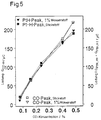
- an activity determination of the sensor surface is possible by comparing the resulting current curve profiles, also as a sum signal, if several test gases to be investigated are involved, over time, by comparing the initial peak heights or peak areas (characteristic double peak formation; PtH), which The beginning of the potential sweep occurs, is evaluated accordingly and observed over time. From this, an indication of the long-term stability of the sensor can be determined, with the course of the reference cycle preferably being selected, since in this case the sensor surface is occupied by hydrogen, resulting from the aqueous environment, and these hydrogen peaks are higher the more active the sensor surface ( still).
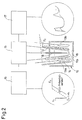
- an electrochemical cell 10 thermostatically controlled to a predetermined temperature contains a working electrode 11, a reference electrode 12, further electrodes 13a, 13b for pre-electrolysis, and a gas inlet line 14, which are not of particular interest here.
- the construction of the electrochemical cell can yourself through complete a stirring rod 15 driven from the outside, for example by electromagnetic coupling.
- the working electrode comprises a polished polycrystalline platinum sheet 11b on which the adsorption and conversion processes take place;
- the reference electrode 12 can be a conventional standard hydrogen electrode or another conventional reference system, it being possible for both the platinum surface and the reference electrode to be separated from the cell electrolyte via diaphragms. All the potentials specified below refer to the reference signal supplied by the reference electrode.
- a voltage curve and current evaluation circuit 15 which is electrically connected to the connections of the working electrode and the reference electrode, is supplied by a function generator 16 for carrying out the LPSV method, a potential profile which is given as an example in the circuit located under the function generator 16;
- An evaluation circuit 17 evaluating the data supplied by the voltage control circuit 15 then detects at least the two voltage profiles of the measurement and reference sequence in the area of the current response and derives an indication of the concentration of the analyte to be examined from these two signals.
- E 1 1400 mV
- This specifically specified adsorption (specified by the duration of the adsorption time t ads , as a result of which a specific selectivity behavior on different species can also be realized) is then followed by the linear potential sweep in accordance with the curve profile A, i.e. a comparatively steep ramp-shaped potential increase at the working electrode up to one
- Final potential E3 here again numerical values, but not limiting the scope of the invention, are given with E3, for example 1600 mV.
- the sweep rate ie the time for the ramp-shaped voltage rise, is, for example, 1000 mV / s; the sweep rates must be so fast that the diffusion of species in the solution to the electrode can be neglected. Under these circumstances, for example, a 2 eV sweep has ended before further species can diffuse through the Nernst layer.
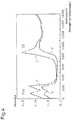
- Such a forced voltage curve on the working electrode in accordance with a measurement sequence leads to a current curve curve as shown in Fig. 4 at I, i.e. initially there are two lower peaks, which are around 80 and 220 mV, with a subsequent reaction peak, depending on the concentration of the analytes (CO), at around 880 mV.
- the initial peaks in the course of the current are due to a residual occupation of the adsorption sites not occupied by the analyte with hydrogen; they are increasingly weakened in proportion to the concentration of the sample gas; accordingly, depending on the concentration, the subsequent peak shape (at 880 mV) is the higher and more pronounced, the stronger the concentration of the analyte in the measuring medium - in FIG.
- maintaining the upper constant potential E3 for a predetermined period of time, for example t3 ⁇ 2 seconds, can follow the ramp-shaped voltage rise.
- the current curve profile I does not give an absolute value for the concentration of the analyte, since the integration of the current surfaces must necessarily be related to the background, that is to say to a zero signal profile.
- the measuring sequence is followed by a reference sequence, which in its general voltage course may be identical to the measurement sequence, with the exception that an adsorption time t ads in which the species present can adsorb markedly is not permitted; this is so small or disappears completely that any adsorption of both the analyte and other interfering species in the measurement environment is excluded. Therefore, in a typical embodiment, the time period in which the working electrode remains at the lower constant potential of E2 can be less than or equal to 1 sec. (T2 ⁇ 1 s).
- the analyte concentration is then reached by subtracting the current curves of the measurement and reference sweep from one another and then integrating the resulting difference curve in the area where the analyte is converted.
- curve profiles shown relate specifically to CO adsorption as analytes, where such curves also apply qualitatively to other gases of interest that can be converted electrochemically, the peaks of which then only occur at other potential values.
- reaction potential can be expected in the range from 800 to 1100 mV.
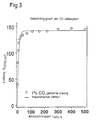
- FIG. 3 shows the time dependence of the CO adsorption (charge via t ads ). 3 therefore shows typical results for different adsorption times for a better understanding of the adsorption kinetics. It should be added that the adsorption rate is strongly influenced by geometric influences and stirring processes in the vessel and of course is also dependent on the free enthalpy of adsorption.
- Another essential aspect of the present invention is that an estimation of the electrode quality is possible by observing the current curves shown in FIG. 4, so that a possible decrease in the electrode sensitivity over time is detected and introduced as a correction parameter for the sensor sensitivity or used as a measure can be when a replacement of the electrode makes sense.
- the initial peaks in the current curve which can be attributed to hydrogen conversion, are a good measure of the electrode aging, since a high electrode surface activity is combined with correspondingly high peaks, as they occur in particular when determining the background.
Landscapes
- Chemical & Material Sciences (AREA)
- Life Sciences & Earth Sciences (AREA)
- Health & Medical Sciences (AREA)
- Physics & Mathematics (AREA)
- Chemical Kinetics & Catalysis (AREA)
- Electrochemistry (AREA)
- Molecular Biology (AREA)
- Analytical Chemistry (AREA)
- Biochemistry (AREA)
- General Health & Medical Sciences (AREA)
- General Physics & Mathematics (AREA)
- Immunology (AREA)
- Pathology (AREA)
- Investigating Or Analyzing Materials By The Use Of Electric Means (AREA)
Applications Claiming Priority (2)
| Application Number | Priority Date | Filing Date | Title |
|---|---|---|---|
| DE19904030873 DE4030873C2 (de) | 1990-09-29 | 1990-09-29 | Verfahren zur Konzentrationsbestimmung von elektrochemisch umsetzbaren Gasen |
| DE4030873 | 1990-09-29 |
Publications (2)
| Publication Number | Publication Date |
|---|---|
| EP0479033A2 true EP0479033A2 (fr) | 1992-04-08 |
| EP0479033A3 EP0479033A3 (en) | 1993-03-17 |
Family
ID=6415259
Family Applications (1)
| Application Number | Title | Priority Date | Filing Date |
|---|---|---|---|
| EP19910115750 Withdrawn EP0479033A3 (en) | 1990-09-29 | 1991-09-17 | Method for the determination of the concentration of electrochemically convertible gases |
Country Status (2)
| Country | Link |
|---|---|
| EP (1) | EP0479033A3 (fr) |
| DE (1) | DE4030873C2 (fr) |
Cited By (2)
| Publication number | Priority date | Publication date | Assignee | Title |
|---|---|---|---|---|
| EP0735364A3 (fr) * | 1995-03-27 | 1998-12-09 | Eckehart Schirmer | Procédé et dispositif pour mesurer la concentration d'un gaz A dans un mélange gazeux |
| WO2006030170A1 (fr) * | 2004-08-17 | 2006-03-23 | Oxford Biosensors Limited | Detecteur electrochimique |
Families Citing this family (2)
| Publication number | Priority date | Publication date | Assignee | Title |
|---|---|---|---|---|
| JPH07253411A (ja) * | 1994-03-14 | 1995-10-03 | Ngk Insulators Ltd | 一酸化炭素センサ及び一酸化炭素濃度の検出方法 |
| DE4425135C2 (de) * | 1994-07-15 | 1996-05-02 | Draegerwerk Ag | Amperometrischer Sensor |
Family Cites Families (13)
| Publication number | Priority date | Publication date | Assignee | Title |
|---|---|---|---|---|
| US4302315A (en) * | 1980-06-18 | 1981-11-24 | Becton, Dickinson And Company | Gas sensing unit |
| DE3033796A1 (de) * | 1980-09-09 | 1982-04-22 | Bayer Ag, 5090 Leverkusen | Elektrochemischer sensor zum nachweis reduzierender gase, insbesondere von kohlenmonoxid, hydrazin und wasserstoff in luft |
| DE3108889A1 (de) * | 1981-03-09 | 1982-09-16 | Kernforschungsanlage Jülich GmbH, 5170 Jülich | Elektrochemischer gasanalysator |
| US4508598A (en) * | 1982-05-11 | 1985-04-02 | Giner, Inc. | Gas sensor and method of using same |
| US4729824A (en) * | 1982-05-11 | 1988-03-08 | Giner, Inc. | Gas sensor and method of using same |
| DE3228542A1 (de) * | 1982-07-30 | 1984-02-02 | Siemens AG, 1000 Berlin und 8000 München | Verfahren zur bestimmung der konzentration elektrochemisch umsetzbarer stoffe |
| JPS59228159A (ja) * | 1983-06-09 | 1984-12-21 | Hitachi Ltd | ポ−ラログラフ電極の異常・劣化検出方法および測定装置 |
| US4500391A (en) * | 1983-10-13 | 1985-02-19 | Allied Corporation | Method of and system for real time differential pulse detection |
| DE3401405A1 (de) * | 1984-01-17 | 1985-07-25 | Institut elektrochimii Akademii Nauk SSSR, Moskva | Verfahren und einrichtung zur bestimmung des gehaltes an organischem kohlenstoff im wasser oder in einer waessrigen loesung |
| US4591414A (en) * | 1984-08-27 | 1986-05-27 | The United States Of America As Represented By The United States Department Of Energy | Method of determining methane and electrochemical sensor therefor |
| US4824551A (en) * | 1985-06-11 | 1989-04-25 | Gas Research Institute | Cell for measuring gas levels |
| EP0269794A3 (fr) * | 1986-11-07 | 1989-08-30 | Environmental Technologies Group, Inc. | Procédé d'opération d'une cellule électrochimique à laquelle un potential redox est appliqué |
| US4921582A (en) * | 1987-09-04 | 1990-05-01 | Wang Henry Y | Dissolved oxygen measuring method |
-
1990
- 1990-09-29 DE DE19904030873 patent/DE4030873C2/de not_active Expired - Fee Related
-
1991
- 1991-09-17 EP EP19910115750 patent/EP0479033A3/de not_active Withdrawn
Cited By (4)
| Publication number | Priority date | Publication date | Assignee | Title |
|---|---|---|---|---|
| EP0735364A3 (fr) * | 1995-03-27 | 1998-12-09 | Eckehart Schirmer | Procédé et dispositif pour mesurer la concentration d'un gaz A dans un mélange gazeux |
| WO2006030170A1 (fr) * | 2004-08-17 | 2006-03-23 | Oxford Biosensors Limited | Detecteur electrochimique |
| US7545148B2 (en) | 2004-08-17 | 2009-06-09 | Oxford Biosensors Limited | Electrochemical sensor |
| CN101002086B (zh) * | 2004-08-17 | 2010-11-10 | 牛津生物传感器有限公司 | 电化学传感器 |
Also Published As
| Publication number | Publication date |
|---|---|
| EP0479033A3 (en) | 1993-03-17 |
| DE4030873A1 (de) | 1992-04-02 |
| DE4030873C2 (de) | 2000-05-04 |
Similar Documents
| Publication | Publication Date | Title |
|---|---|---|
| EP0101880B1 (fr) | Procédé pour déterminer la concentration d'éléments transformables électrochimiquement | |
| EP0540974B1 (fr) | Appareil pour la détermination simultanée de composants différents d'un gaz | |
| DE69019088T2 (de) | Verfahren und Apparat zur Erneuerung einer Elektrode eines Biosensors. | |
| DE19622931C2 (de) | Elektrochemischer Mehrgassensor | |
| DE10359173B4 (de) | Messvorrichtung mit mehreren auf einem Substrat angeordneten potentiometrischen Elektrodenpaaren | |
| DE3689539T2 (de) | Verfahren und Vorrichtung zur Betätigung einer elektrochemischen Messzelle. | |
| DE102010040147A1 (de) | Verfahren und Vorrichtung zur Erfassung mindestens einer Eigenschaft eines Gases | |
| DE69318932T2 (de) | Verfahren zur selektiven Überwachung von Spurenbestandteilen in Plattierungsbädern | |
| DE10048240B4 (de) | Gassensorelement und Verfahren zur Bestimmung der Konzentration einer Gaskomponente in einem Gasgemisch | |
| DE19780491B4 (de) | CO-Gassensor und Verfahren zur Messung der Konzentration von CO-Gas | |
| EP0581081A1 (fr) | Méthode pour la détermination des péracides | |
| DE2929387C3 (de) | Elektronische Kalibrierung elektrochemischer Sensoren | |
| DE102007029154A1 (de) | Mischpotenzialsensor mit beschleunigtem Ansprechverhalten zur Detektion verschiedener Gase in Gasgemischen, sowie Verfahren zum Betrieb desselben | |
| DE102005024394A1 (de) | Verfahren zur Konzentrationsmessung von Gasen | |
| DE69122807T2 (de) | Methode zur Geschmackserkennung für die detaillierte Unterscheidung von Substanzen mit guter Reproduzierbarkeit unter Verwendung von künstlichen Lipidmembranen | |
| EP0395927B1 (fr) | Détecteur électrochimique pour la mesure d'ammoniac ou hydrazine | |
| EP2246694B1 (fr) | Procédé et dispositif de mesure de la concentration d'un analyte dans un liquide échantillon | |
| DE69321686T2 (de) | Verfahren zur Feststellung von Bestandteilen in Plattierungsbädern | |
| DE69322850T2 (de) | Sauerstoffanalysegerät | |
| DE4030873C2 (de) | Verfahren zur Konzentrationsbestimmung von elektrochemisch umsetzbaren Gasen | |
| WO2002079769A2 (fr) | Procede et dispositif de detection de la concentration d'un compose contenant de l'oxygene dans un gaz de mesure | |
| DE3042504A1 (de) | Ph-unabhaengiges verfahren zur messung und ueberwachung der gesamtkonzentration einer reihe von ionenarten in einem probenstrom | |
| DE1773958A1 (de) | Verfahren zum Messen des Wassergehaltes von fluessigen Kohlenwasserstoffen | |
| DE10330704B3 (de) | Elektrochemischer Gassensor mit Filter | |
| EP1489408A1 (fr) | Procédé et appareil pour la détermination d'un élément chimique |
Legal Events
| Date | Code | Title | Description |
|---|---|---|---|
| PUAI | Public reference made under article 153(3) epc to a published international application that has entered the european phase |
Free format text: ORIGINAL CODE: 0009012 |
|
| AK | Designated contracting states |
Kind code of ref document: A2 Designated state(s): AT BE CH DE DK ES FR GB GR IT LI LU NL SE |
|
| PUAL | Search report despatched |
Free format text: ORIGINAL CODE: 0009013 |
|
| AK | Designated contracting states |
Kind code of ref document: A3 Designated state(s): AT BE CH DE DK ES FR GB GR IT LI LU NL SE |
|
| STAA | Information on the status of an ep patent application or granted ep patent |
Free format text: STATUS: THE APPLICATION IS DEEMED TO BE WITHDRAWN |
|
| 18D | Application deemed to be withdrawn |
Effective date: 19930918 |