EP0480119B1 - Méthode et dispositif de contrôle des stores vénitiens - Google Patents
Méthode et dispositif de contrôle des stores vénitiens Download PDFInfo
- Publication number
- EP0480119B1 EP0480119B1 EP91104133A EP91104133A EP0480119B1 EP 0480119 B1 EP0480119 B1 EP 0480119B1 EP 91104133 A EP91104133 A EP 91104133A EP 91104133 A EP91104133 A EP 91104133A EP 0480119 B1 EP0480119 B1 EP 0480119B1
- Authority
- EP
- European Patent Office
- Prior art keywords
- slats
- angle
- slat
- photodiodes
- photocell
- Prior art date
- Legal status (The legal status is an assumption and is not a legal conclusion. Google has not performed a legal analysis and makes no representation as to the accuracy of the status listed.)
- Expired - Lifetime
Links
- 229920003023 plastic Polymers 0.000 claims description 2
- 239000000463 material Substances 0.000 claims 1
- 230000005855 radiation Effects 0.000 claims 1
- 230000001419 dependent effect Effects 0.000 abstract description 4
- 238000012216 screening Methods 0.000 abstract description 2
- 241000446313 Lamella Species 0.000 description 9
- 230000037072 sun protection Effects 0.000 description 4
- 230000008878 coupling Effects 0.000 description 2
- 238000010168 coupling process Methods 0.000 description 2
- 238000005859 coupling reaction Methods 0.000 description 2
- 230000001960 triggered effect Effects 0.000 description 2
- 230000001154 acute effect Effects 0.000 description 1
- 238000004378 air conditioning Methods 0.000 description 1
- 230000001276 controlling effect Effects 0.000 description 1
- 238000013500 data storage Methods 0.000 description 1
- 238000010586 diagram Methods 0.000 description 1
- 230000000694 effects Effects 0.000 description 1
- 230000004313 glare Effects 0.000 description 1
- 230000003760 hair shine Effects 0.000 description 1
- 238000010438 heat treatment Methods 0.000 description 1
- 238000009434 installation Methods 0.000 description 1
- 230000003993 interaction Effects 0.000 description 1
- 238000005259 measurement Methods 0.000 description 1
- 229920003229 poly(methyl methacrylate) Polymers 0.000 description 1
- 239000004926 polymethyl methacrylate Substances 0.000 description 1
- 230000001105 regulatory effect Effects 0.000 description 1
- 230000002441 reversible effect Effects 0.000 description 1
- 239000013589 supplement Substances 0.000 description 1
Images

Classifications
-
- E—FIXED CONSTRUCTIONS
- E06—DOORS, WINDOWS, SHUTTERS, OR ROLLER BLINDS IN GENERAL; LADDERS
- E06B—FIXED OR MOVABLE CLOSURES FOR OPENINGS IN BUILDINGS, VEHICLES, FENCES OR LIKE ENCLOSURES IN GENERAL, e.g. DOORS, WINDOWS, BLINDS, GATES
- E06B9/00—Screening or protective devices for wall or similar openings, with or without operating or securing mechanisms; Closures of similar construction
- E06B9/24—Screens or other constructions affording protection against light, especially against sunshine; Similar screens for privacy or appearance; Slat blinds
- E06B9/26—Lamellar or like blinds, e.g. venetian blinds
- E06B9/28—Lamellar or like blinds, e.g. venetian blinds with horizontal lamellae, e.g. non-liftable
- E06B9/30—Lamellar or like blinds, e.g. venetian blinds with horizontal lamellae, e.g. non-liftable liftable
- E06B9/32—Operating, guiding, or securing devices therefor
-
- Y—GENERAL TAGGING OF NEW TECHNOLOGICAL DEVELOPMENTS; GENERAL TAGGING OF CROSS-SECTIONAL TECHNOLOGIES SPANNING OVER SEVERAL SECTIONS OF THE IPC; TECHNICAL SUBJECTS COVERED BY FORMER USPC CROSS-REFERENCE ART COLLECTIONS [XRACs] AND DIGESTS
- Y02—TECHNOLOGIES OR APPLICATIONS FOR MITIGATION OR ADAPTATION AGAINST CLIMATE CHANGE
- Y02A—TECHNOLOGIES FOR ADAPTATION TO CLIMATE CHANGE
- Y02A30/00—Adapting or protecting infrastructure or their operation
- Y02A30/24—Structural elements or technologies for improving thermal insulation
-
- Y—GENERAL TAGGING OF NEW TECHNOLOGICAL DEVELOPMENTS; GENERAL TAGGING OF CROSS-SECTIONAL TECHNOLOGIES SPANNING OVER SEVERAL SECTIONS OF THE IPC; TECHNICAL SUBJECTS COVERED BY FORMER USPC CROSS-REFERENCE ART COLLECTIONS [XRACs] AND DIGESTS
- Y02—TECHNOLOGIES OR APPLICATIONS FOR MITIGATION OR ADAPTATION AGAINST CLIMATE CHANGE
- Y02B—CLIMATE CHANGE MITIGATION TECHNOLOGIES RELATED TO BUILDINGS, e.g. HOUSING, HOUSE APPLIANCES OR RELATED END-USER APPLICATIONS
- Y02B80/00—Architectural or constructional elements improving the thermal performance of buildings
Definitions
- the invention relates to a device for controlling at least one venetian blind with a curtain consisting of slats, which can be moved between a gathered position and a shading position and whose slats are reversible by a motor and adjustable in the shielding angle by means of a photo sensor connected to a slat, the photosensor consists of two photodiodes arranged one behind the other in relation to the window in the direction from the outside to the inside in such a way that, due to uneven irradiation, they register a certain deviation of the angle of inclination of the incident sun rays from a normal on the base of the lamella.
- sun protection plays an important role in preventing excessive heating of the work rooms, saving energy in the presence of an air conditioning system and providing glare protection at monitor work stations. It has so far been customary to centrally control the external venetian blinds of an office building facade using sensors installed on the roof of the building.
- the disadvantage arises that, depending on the circumstances of the individual case, different windows of a facade are fully exposed to sunlight, while other windows of the same facade lie in the shadow of other buildings or parts of buildings.
- the problem of different lighting of the windows of a facade is made even more difficult by the fact that the situation changes with the movement of the sun over the course of a day depending on the season.
- Another shortcoming of centrally controlled external venetian blinds is that after triggering the lowering movement at a certain basic brightness, the low command for all external venetian blinds remains for a predetermined time before a slat opening pulse is triggered after this predetermined downtime. If curtains of different lengths are on a facade, the run-down time of the longest curtain must generally be set. The rooms with shorter runtimes remain darkened for an unnecessarily long time until the opening impulse comes. The opening angle of the slats then set can be completely wrong depending on the time of day and the season and the special position of a window.
- EP-A1-0199931 also describes a sun protection device consisting of a plurality of transparent slats provided with prisms on the underside, in which the inclination of the slats is controlled by a photo sensor attached to a slat.
- the photosensor is also provided with a towering, shadow-forming web, it can be attached directly to a slat because the slats are not gathered.
- two photodiodes are mounted on different inclined prism surfaces on the underside of a lamella, the reflective effect of the prisms being used to determine the correct position of the lamella.
- this design cannot be applied to blinds with opaque slats.
- the invention has for its object to provide a control device of the type mentioned, which can be installed in a space-saving manner and by means of which, in particular in buildings whose window surfaces in a facade are exposed to different incidence of light, the most uniform possible shading of the rooms is achieved.
- the photo sensor sits in an opening in the lamella and the photo diodes form an angle with one another, and that a further photo sensor is present which, when a certain basic brightness is reached, a control signal for moving the curtain by means of the motor the gathered position in a shading position.
- the new control device can also be realized in the presence of a central control device, which ensures a uniform appearance of a facade and in a known manner, for. B. interacts with a wind sensor to pull up the venetian blind at a certain wind speed.
- the invention does not affect these higher-level tasks of a central control device, but advantageously supplements them by individually regulating the incidence of light in the shading position.
- the new device can be used both for external venetian blinds (blinds) with horizontal as well as those with vertical slats (vertical blinds).
- the optimal control of the shielding angle can begin because of the proposed individual control of the individual venetian blinds immediately after the lower position has been reached, regardless of the fact that longer curtains on the same facade still take a longer time to reach the lower position and then in the shielding angle to be set.
- the proposal according to the invention is also to be understood in the sense that the external venetian blinds of a facade normally move up and down in a centrally controlled manner, but a single external venetian blind can also be lowered or raised individually if the basic brightness exceeds or falls below certain threshold values.
- the photosensor tracks the sun when the position of the sun changes, and the necessary movement of the photosensor can be brought about by the reversing drive of the slats.
- a special feature is the proposed fastening of the photosensor in an opening in a lamella and the arrangement of two photodiodes which form an angle with one another. These can be arranged approximately roof-shaped or V-shaped with respect to the base area of the lamella, so that the ones of them generated control voltages are only the same size if they are both exposed to the same angle with sun rays, d. H. the sun shines perpendicular to the base of the slat. Due to this fact, the current position of the sun can be determined by swiveling the slat and the slat can be set in the optimal shielding angle.
- the proposed control device permits automatic control of the curtain, since according to the invention there is a further photo sensor which generates a control pulse when a certain basic brightness is reached.
- the further photosensor is in front of or next to the curtain, e.g. B. on a housing or guide part of the venetian blind, to fasten and has several, expediently three, aligned to different directions photo diodes, which together detect the incidence of light over the angular range of 180 ° in front of the venetian blind.
- control devices are used in the last-mentioned embodiment, one can in principle without a central control device get along.
- the lowering and raising of the venetian blind is controlled in this case by the additional photo sensor according to the respective basic brightness, and in the lowered state, the sun search sensor mounted on a slat takes over the control of the shielding angle of the slats.
- the lowering and pulling up of all external venetian blinds of a facade is controlled centrally.
- the additional photo sensors installed there only ensure that the relevant venetian blinds are raised or lowered depending on the situation, if certain window brightness values are exceeded or undershot.
- the said sun search sensor already registers small angular deviations of the incident sun rays from the normal on the base of the slat and then ensures a change in the shielding angle in the direction that the sun rays practically always fall perpendicular to the base of the slat .
- the invention can also be carried out in such a way that a certain height angle between the incident sun rays and the normal is constantly maintained on the base of the lamella in order to let in a little more light than in the case of lamellae directed perpendicular to the incident sun rays.
- the correction movement controlled by the control device serves to maintain the predetermined angle between the incident sun rays and the base area of the slat despite the changing position of the sun.
- the base area is the maximum projection area of a slat.
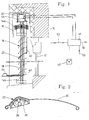
- a photosensor 22 is attached to one of the slats 18, which is able to determine whether the sunlight falling obliquely from above is perpendicular to the Base area of the slats or in which direction the incident sun rays in a vertical transverse plane through the slats deviate from the normal on the base area of the slats.
- the basic structure of the photo sensor 22 is discussed in more detail below in connection with FIG. 2.
- a further photo sensor 24 is mounted. He can e.g. B. on the masonry next to the fixed opening, on a guide of the slats 18 or on the housing 16. This further photo sensor 24 determines the basic brightness and controls the lowering and raising of the venetian blind 14. It is explained in more detail in connection with FIG. 3.
- the photosensor 22 is preferably inserted into an opening in the vicinity of the outer longitudinal edge of a lamella 18. It consists in the embodiment of FIG. 2 of two in transparent plastic, for. B. acrylic glass, enclosed photodiodes 26, 28, which are arranged roof-shaped at a certain gable angle. It can be seen that the control voltage of the two photodiodes 26, 28 is only of the same magnitude if both are struck by the sun's rays with the same intensity, and this in turn is only the case if the sun's rays are parallel to the bisector of the gable arrangement of the photodiodes 26 , 28 come up.
- the control voltage of one of the two photodiodes 26, 28 is lower than that of the other, it can be concluded that the sun's rays are incident at an acute angle to the said bisector and that the photodiode, which generates the smaller control voltage, is directed towards that must be pivoted towards the other photodiode in order to achieve the equilibrium state again, in which both photodiodes are irradiated uniformly and preferably the bases of the parallel slats 18 are aligned perpendicular to the incident sun rays.
- the further photo sensor 24 for determining the basic brightness shown in FIG. 3 A in plan view and in cross section in FIG. 3 B, consists of three photodiodes 34, 36, 38 arranged next to one another, each pointing at different angles and at an intermediate angle of 60 ° 3 B are inclined at an angle of 35 ° to the vertical. Since each of the photodiodes 34, 36, 38 according to FIG. 3 C each has a recording area of approximately 60 °, the total the basic brightness is recorded over the entire area of 180 ° in front of a building facade.
- the connecting lines, designated 40, of the photo sensor 22 and the connecting lines 42 of the photo sensor 24 are guided along the guide rails or the curtain of the external venetian blind to a distribution box 44 installed in or on its upper box. This is connected by means of a plug coupling to a motor control unit 46, which is installed in a suitable place in the building, preferably not too far from the venetian blind 14.
- a conventional button 48 for individual operation is also connected to the engine control unit 46. It allows the slats of the external venetian blind to be adjusted by hand, e.g. B. completely darken a room because of a film screening.
- connection 50 to a central control device a serial interface 50 for connection to a computer and data storage device and a mains connection 52 for supplying the motor 20 with an operating voltage of 220 volts and that interacting with the photo sensors 22 and 24 are also indicated on the motor control unit 46
- Control device with a control voltage of 24 volts.
- the engine control unit 46 is connected to the engine 20 via a plug coupling in order to control it in accordance with the various control inputs of the engine control unit 46.
- a trigger signal for lowering the venetian blind can come either from the connection 50 from a central control device or, given a certain basic brightness, from the photo sensor 24.
- the control of the shielding angle of the slats takes place 18 by means of the photo sensor 22, regardless of whether other external venetian blinds of the same facade, which were lowered at the same time, have not yet reached their low position because their curtain is longer.
- the control of the shielding angle of the slats 18 by means of the photo sensor 22 then remains permanently effective and changes the position of the slats in accordance with the changing position of the sun until the Venetian blind is pulled up and gathered again by a start-up signal triggered by the central control device or the photo sensor 24.
- the described control device offers, through the interaction of the direction-dependent photo sensor 22 and the further photo sensor 24 for the basic brightness, the possibility that a number of venetian blinds in the lowered state, in which they are normally controlled by the direction-dependent photo sensor 22, temporarily by the photo sensor 24 in a horizontal Slat position can be reversed when they reach the shadow of a cloud.
- the direction-dependent photo sensor 22 again takes over the control of the shielding angle of the slats 18 and ensures the adjustment from the horizontal position to the optimal shielding position corresponding to the position of the sun.
- the manual adjustment of the slat angle by means of the button 48 can be integrated into the control described above in such a way that the automatic adjustment of the shielding angle by means of the photo sensor 22 does not occur if the curtain has been manually lowered by pressing the button 48 twice and the slats in the closed position were brought.
- the automatic system then assumes that it is a deliberate obscuration, e.g. B. for a slide show. If, on the other hand, the curtain had been manually lowered by pressing the button 48 once, the slats are set to a certain angle from Z. B. 38 ° and the optimum angle is only adjusted by the sun search sensor 22 when a certain brightness is exceeded. Even if the slat position is intervened manually after the automatic search function has been activated, the automatic sun search function switches itself off. It only comes back into action when a main direction of travel is briefly activated and then stopped.
- the control device has been described above in connection with the control of a single venetian blind. It is understood that if a plurality of windows of a facade are basically exposed to the same lighting conditions at any time of the year and day and also in the assigned rooms of the building essentially the same lighting requirements are imposed, a single sun sensor 22 on a slat 18 one of the external venetian blinds and a single further photo sensor 24 next to one of the windows are sufficient to control all external venetian blinds connected in parallel in their controls.
- the measurement and control signals can be transmitted wirelessly from the photo sensors to the engine control unit and from there to the engine.
- a radio connection can also exist to the central control device. Messages via the interface 50 can also be error messages that enable the error to be identified and localized. If necessary, phototransistors could also replace photodiodes.
Landscapes
- Engineering & Computer Science (AREA)
- Structural Engineering (AREA)
- Architecture (AREA)
- Civil Engineering (AREA)
- Blinds (AREA)
- Selective Calling Equipment (AREA)
Claims (7)
- Dispositif pour commander au moins un store vénitien (14) avec une tenture constituée de lamelles (18), qui est mobile entre une position remontée (14a) et une position d'ombrage et dont on peut faire tourner les lamelles (18) à l'aide d'un moteur (20), et dont on peut régler l'angle d'ombrage au moyen d'un capteur photosensible (22) solidaire d'une lamelle, le capteur photosensible (22) est constitué de deux photodiodes (26, 28) disposées l'une derrière l'autre par rapport à la fenêtre (12) dans le sens de l'extérieur vers l'intérieur de sorte que par suite d'une irradiation inégale elles puissent enregistrer une variation définie de l'angle d'inclinaison des rayons solaires incidents par rapport à la normale sur la surface de base de la lamelle, caractérisé en ce que le capteur photosensible (22) est placé dans une échancrure de lamelle (18) et que les photodiodes (26, 28) forment un angle entre elles et qu'il existe un autre capteur photosensible (24), qui, lorsqu'une certaine clarté de base est atteinte, émet un signal de commande pour déplacer la tenture au moyen du moteur (20) de la position remontée (14a) en une position d'ombrage.
- Dispositif selon la revendication 1, caractérisé en ce que les photodiodes (26, 28) sont incluses dans de la matière plastique transparente.
- Dispositif selon la revendication 1 ou 2, caractérisé en ce que le capteur photosensible (22) est fixé à l'extérieur de la lamelle (18).
- Dispositif selon l'une des revendications 1 à 3, caractérisé en ce que l'autre capteur photosensible (24) peut être fixé sur un boîtier (16) ou une pièce de guidage du store vénitien (14).
- Dispositif selon l'une des revendications 1 à 4, caractérisé en ce que l'autre capteur photosensible (24) présente plusieurs, de préférence trois photodiodes (24, 36, 38) dirigées vers différentes directions du ciel (24, 36, 38) qui saisissent globalement l'incidence de lumière sur l'espace angulaire de 180° en avant du store vénitien (14).
- Dispositif selon l'une des revendications 1 à 5, caractérisé en ce que les fils de connexion des capteurs photosensibles (22, 24) sont placés dans ou sur les rails de guidage des lamelles (18).
- Dispositif selon l'une des revendications 1 à 6, caractérisé en ce qu'il est relié à un anémomètre.
Priority Applications (1)
| Application Number | Priority Date | Filing Date | Title |
|---|---|---|---|
| AT91104133T ATE97990T1 (de) | 1990-10-11 | 1991-03-18 | Verfahren und vorrichtung zum steuern von raffstores. |
Applications Claiming Priority (2)
| Application Number | Priority Date | Filing Date | Title |
|---|---|---|---|
| DE4032221A DE4032221A1 (de) | 1990-10-11 | 1990-10-11 | Verfahren und vorrichtung zum steuern von raffstores |
| DE4032221 | 1990-10-11 |
Publications (2)
| Publication Number | Publication Date |
|---|---|
| EP0480119A1 EP0480119A1 (fr) | 1992-04-15 |
| EP0480119B1 true EP0480119B1 (fr) | 1993-12-01 |
Family
ID=6416052
Family Applications (1)
| Application Number | Title | Priority Date | Filing Date |
|---|---|---|---|
| EP91104133A Expired - Lifetime EP0480119B1 (fr) | 1990-10-11 | 1991-03-18 | Méthode et dispositif de contrôle des stores vénitiens |
Country Status (4)
| Country | Link |
|---|---|
| US (1) | US5142133A (fr) |
| EP (1) | EP0480119B1 (fr) |
| AT (1) | ATE97990T1 (fr) |
| DE (2) | DE4032221A1 (fr) |
Families Citing this family (61)
| Publication number | Priority date | Publication date | Assignee | Title |
|---|---|---|---|---|
| US5467266A (en) * | 1991-09-03 | 1995-11-14 | Lutron Electronics Co., Inc. | Motor-operated window cover |
| US5275219A (en) * | 1991-12-12 | 1994-01-04 | Giacomel Jeffrey A | Environmentally interactive automatic closing system for blinds and other louvered window coverings |
| US5698958A (en) * | 1993-06-11 | 1997-12-16 | Harmonic Design, Inc. | Head rail-mounted actuator for window coverings |
| US5495153A (en) * | 1993-06-11 | 1996-02-27 | Harmonic Design, Inc. | Head rail-mounted mini-blind actuator for vertical blinds and pleated shades |
| US6060852A (en) * | 1993-06-11 | 2000-05-09 | Harmonic Design, Inc. | Head rail-mounted actuator for window covering |
| US5729103A (en) * | 1993-06-11 | 1998-03-17 | Harmonic Design, Inc. | Head rail-mounted actuator for window coverings |
| US5816306A (en) * | 1993-11-22 | 1998-10-06 | Giacomel; Jeffrey A. | Shape memory alloy actuator |
| WO1995014843A1 (fr) * | 1993-11-22 | 1995-06-01 | Giacomel Jeffrey A | Mecanisme de commande interactif de dispositifs de couverture de fenetre a volets |
| DE4443733A1 (de) * | 1994-12-08 | 1996-06-27 | Karl Albert Krieger | Verfahren und Vorrichtung zur Steuerung einer Sonnenschutzeinrichtung |
| DE4446920A1 (de) * | 1994-12-28 | 1996-07-11 | Werner Gruschinski | Verdunkelungseinrichtung |
| DE29506785U1 (de) * | 1995-04-21 | 1995-06-14 | Ingenhoven Overdiek und Partner, 40474 Düsseldorf | Profilelement |
| US5663621A (en) * | 1996-01-24 | 1997-09-02 | Popat; Pradeep P. | Autonomous, low-cost, automatic window covering system for daylighting applications |
| US5598000A (en) * | 1996-02-22 | 1997-01-28 | Popat; Pradeep P. | Dual-mode automatic window covering system responsive to AC-induced flicker in ambient illumination |
| DE19733381A1 (de) * | 1996-08-01 | 1998-03-26 | Geze Gmbh & Co | Flügel für ein Fenster, eine Tür o. dgl. sowie Trage- und/oder Randabschlußelement für einen Flügel |
| US6369530B2 (en) | 1996-09-06 | 2002-04-09 | Hunter Douglas Inc. | Battery-powered wireless remote-control motorized window covering assembly having controller components |
| US5793174A (en) * | 1996-09-06 | 1998-08-11 | Hunter Douglas Inc. | Electrically powered window covering assembly |
| US6084231A (en) * | 1997-12-22 | 2000-07-04 | Popat; Pradeep P. | Closed-loop, daylight-sensing, automatic window-covering system insensitive to radiant spectrum produced by gaseous-discharge lamps |
| DE19904226B4 (de) * | 1999-02-03 | 2013-08-08 | Carmelo D'Angelo | Sonnenschutzsteuerung |
| DE19932731A1 (de) * | 1999-07-14 | 2001-03-22 | Warema Renkhoff Gmbh & Co Kg | Sonnenschutzanlage mit sich dem Lichteinfall anpassender Behangeinstellung |
| DE10037556A1 (de) * | 2000-08-02 | 2002-02-21 | Warema Renkhoff Gmbh & Co Kg | Sensoreinrichtung |
| FI4918U1 (fi) * | 2001-02-20 | 2001-05-16 | Simo Jaervinen | Auringonsäteilysuoja |
| GB0124284D0 (en) * | 2001-10-10 | 2001-11-28 | Slotronic Ltd | Automatic blind opener |
| DE10202830A1 (de) * | 2002-01-24 | 2003-08-14 | Colt Internat Holdings Ag Baar | Vorrichtung zum Verstellen von Lichttechnikelementen |
| US20030159355A1 (en) * | 2002-02-28 | 2003-08-28 | Dave Froerer | Multiple louver control system |
| US8890456B2 (en) | 2004-05-06 | 2014-11-18 | Mechoshade Systems, Inc. | Automated shade control system utilizing brightness modeling |
| US8723467B2 (en) | 2004-05-06 | 2014-05-13 | Mechoshade Systems, Inc. | Automated shade control in connection with electrochromic glass |
| US7977904B2 (en) * | 2004-05-06 | 2011-07-12 | Mechoshade Systems, Inc. | Automated shade control method and system |
| US8125172B2 (en) * | 2004-05-06 | 2012-02-28 | Mechoshade Systems, Inc. | Automated shade control method and system |
| WO2014074308A1 (fr) * | 2012-11-07 | 2014-05-15 | Mechoshade Systems, Inc. | Système de commande de store automatique utilisant une modélisation de luminosité |
| US7417397B2 (en) * | 2004-05-06 | 2008-08-26 | Mechoshade Systems, Inc. | Automated shade control method and system |
| GB2462755B (en) * | 2004-05-06 | 2010-08-25 | Mechoshade Systems Inc | Automated shade control method and system |
| US8120292B2 (en) | 2004-05-06 | 2012-02-21 | Mechoshade Systems, Inc. | Automated shade control reflectance module |
| US8836263B2 (en) | 2004-05-06 | 2014-09-16 | Mechoshade Systems, Inc. | Automated shade control in connection with electrochromic glass |
| US10619415B2 (en) | 2004-05-06 | 2020-04-14 | Mechoshade Systems, Llc | Sky camera system utilizing circadian information for intelligent building control |
| US10253564B2 (en) | 2004-05-06 | 2019-04-09 | Mechoshade Systems, Llc | Sky camera system for intelligent building control |
| US11187035B2 (en) | 2004-05-06 | 2021-11-30 | Mechoshade Systems, Llc | Sky camera virtual horizon mask and tracking solar disc |
| DE102004023185B3 (de) * | 2004-05-11 | 2005-12-08 | Michael Dr.-Ing. Laar | Abschattungsvorrichtung |
| US7537041B2 (en) * | 2004-11-24 | 2009-05-26 | Paralign Llc | Layered blinds |
| US20060162877A1 (en) * | 2005-01-24 | 2006-07-27 | Jame-San Chou | Automatic remote-controlled curtain |
| US8525462B2 (en) * | 2005-03-08 | 2013-09-03 | Mechoshade Systems, Inc. | Automated shade control method and system |
| US8319956B2 (en) | 2006-06-14 | 2012-11-27 | Mechoshade Systems, Inc. | System and method for shade selection using a fabric brightness factor |
| US7941245B1 (en) | 2007-05-22 | 2011-05-10 | Pradeep Pranjivan Popat | State-based system for automated shading |
| FR2922938B1 (fr) * | 2007-10-31 | 2009-12-11 | Somfy Sas | Procede de commande automatisee d'une installation d'ecran de protection solaire comportant des lames de type retro-reflechissant. |
| FR2923854B1 (fr) | 2007-11-16 | 2009-12-25 | Somfy Sas | Procede de commande automatisee d'une installation de protection solaire |
| US8288981B2 (en) | 2008-09-25 | 2012-10-16 | Lutron Electronics Co., Inc. | Method of automatically controlling a motorized window treatment while minimizing occupant distractions |
| KR20100072941A (ko) * | 2008-12-22 | 2010-07-01 | 삼성전자주식회사 | 태양전지를 구비한 블라인드 및 그 제어방법 |
| JP5647622B2 (ja) * | 2008-12-30 | 2015-01-07 | コーニンクレッカ フィリップス エヌ ヴェ | 姿勢調節可能なソーラー採光ウインドウブラインド |
| EP2417320B1 (fr) | 2009-04-07 | 2018-07-25 | Philips Lighting Holding B.V. | Commande d'un store venitien par reconnaissance d'images |
| EP2438350A1 (fr) | 2009-06-02 | 2012-04-11 | Koninklijke Philips Electronics N.V. | Appareil et système pour séparer un espace |
| US8456729B2 (en) * | 2009-07-07 | 2013-06-04 | The State Of Oregon Acting By And Through The State Board Of Higher Education On Behalf Of The University Of Oregon | Weather-responsive shade control system |
| US20120261079A1 (en) * | 2011-03-11 | 2012-10-18 | Chambers Samuel F | Method of controlling a motorized window treatment to save energy |
| US9933761B2 (en) * | 2012-11-30 | 2018-04-03 | Lutron Electronics Co., Inc. | Method of controlling a motorized window treatment |
| US9447635B2 (en) * | 2013-05-23 | 2016-09-20 | Crestron Electronics, Inc. | Motorized roller shade system with a sun angle sensor |
| US10017985B2 (en) | 2013-08-14 | 2018-07-10 | Lutron Electronics Co., Inc. | Window treatment control using bright override |
| JP6347503B2 (ja) * | 2013-08-27 | 2018-06-27 | 東洋熱工業株式会社 | ブラインド制御システム |
| US9670725B2 (en) | 2013-12-23 | 2017-06-06 | Lutron Electronics Co., Inc. | Method of automatically controlling motorized window treatments |
| NL2013304C2 (nl) * | 2014-02-07 | 2015-08-10 | Solarswing Holding B V | Richtinrichting, zonnevolgsysteem en werkwijze daarvoor. |
| US10538959B2 (en) | 2014-09-12 | 2020-01-21 | SerraLux Inc. | Window louver control system |
| WO2016187590A1 (fr) | 2015-05-21 | 2016-11-24 | SerraLux Inc. | Ensemble à lames |
| US10464412B2 (en) | 2017-06-19 | 2019-11-05 | Ford Global Technologies, Llc | Methods and system for diagnosing a position of active grille shutters of a vehicle |
| CN112878890A (zh) * | 2021-01-26 | 2021-06-01 | 广东奥科伟业科技发展有限公司 | 光角度感应模块、窗帘系统及其控制方法 |
Citations (1)
| Publication number | Priority date | Publication date | Assignee | Title |
|---|---|---|---|---|
| US4773733A (en) * | 1987-11-05 | 1988-09-27 | John A. Murphy, Jr. | Venetian blind having prismatic reflective slats |
Family Cites Families (12)
| Publication number | Priority date | Publication date | Assignee | Title |
|---|---|---|---|---|
| US3478219A (en) * | 1968-01-17 | 1969-11-11 | Bendix Corp | Optical prism with multiple photocells |
| US3646985A (en) * | 1970-04-13 | 1972-03-07 | Justin Huppe Kg | Venetian blind with automatic control of room brightness |
| CH554996A (de) * | 1972-06-22 | 1974-10-15 | Staefa Control System Ag | Storeneinrichtung. |
| DK275975A (da) * | 1975-06-19 | 1976-12-20 | P J Pedersen | Trinlos varibel solafskering |
| DE2931956A1 (de) * | 1979-08-07 | 1981-02-26 | Mfb Neuwerk Mech Fenster | Waechtersteuerung fuer bewegliche sonnenschutzeinrichtungen an gebaeuden, insbesondere markisen |
| US4273999A (en) * | 1980-01-18 | 1981-06-16 | The United States Of America As Represented By The Secretary Of The Navy | Equi-visibility lighting control system |
| US4429952A (en) * | 1981-12-28 | 1984-02-07 | Dominguez Richard L | Tracking reflector assembly for a skylight |
| ATE39724T1 (de) * | 1985-04-30 | 1989-01-15 | Siemens Ag | Sonnenschutzeinrichtung. |
| US4644990A (en) * | 1985-09-03 | 1987-02-24 | William F. Dunn | Automatic closing system for window blinds |
| US4841672A (en) * | 1986-07-04 | 1989-06-27 | Siemens Aktiengesellschaft | Device for protection from the sun |
| DE3801560A1 (de) * | 1988-01-20 | 1989-08-03 | Warema Renkhoff Gmbh & Co Kg | Betaetigungsvorrichtung fuer eine raffbare lamellenjalousie mit elektromotor |
| JPH0712637Y2 (ja) * | 1988-02-12 | 1995-03-29 | ワイケイケイ株式会社 | 電動遮閉装置の太陽電池パネル取付装置 |
-
1990
- 1990-10-11 DE DE4032221A patent/DE4032221A1/de not_active Withdrawn
-
1991
- 1991-03-18 DE DE91104133T patent/DE59100663D1/de not_active Expired - Fee Related
- 1991-03-18 AT AT91104133T patent/ATE97990T1/de active
- 1991-03-18 EP EP91104133A patent/EP0480119B1/fr not_active Expired - Lifetime
- 1991-04-23 US US07/689,350 patent/US5142133A/en not_active Expired - Fee Related
Patent Citations (1)
| Publication number | Priority date | Publication date | Assignee | Title |
|---|---|---|---|---|
| US4773733A (en) * | 1987-11-05 | 1988-09-27 | John A. Murphy, Jr. | Venetian blind having prismatic reflective slats |
Also Published As
| Publication number | Publication date |
|---|---|
| DE59100663D1 (de) | 1994-01-13 |
| US5142133A (en) | 1992-08-25 |
| EP0480119A1 (fr) | 1992-04-15 |
| ATE97990T1 (de) | 1993-12-15 |
| DE4032221A1 (de) | 1992-04-16 |
Similar Documents
| Publication | Publication Date | Title |
|---|---|---|
| EP0480119A1 (fr) | Méthode et dispositif de contrôle des stores vénitiens | |
| DE2009372C3 (de) | Abdeckvorrichtung für Lichtöffnungen | |
| DE4302883A1 (de) | Beschattungsvorrichtung für mit einer Verglasung versehene Fassaden- oder Dachelemente | |
| DE1946093U (de) | Vorrichtung zum abschirmen eines raumes gegen sonneneinstrahlung. | |
| EP0251311B1 (fr) | Dispositif de protection solaire | |
| DE2701779A1 (de) | Mehrwandiges fenster mit einstellbarer lichtdurchlaessigkeit | |
| DE2615379A1 (de) | Abschirmung fuer lichtoeffnungen, fenster und dergleichen | |
| DE3408396A1 (de) | Autarkes sonnenschutzsystem | |
| DE19611060A1 (de) | Sonnen- und Blendschutzvorrichtung | |
| EP0615049B1 (fr) | Système de protection solaire, doseur à lamelles | |
| DE19929138A1 (de) | Sonnenschutz-Jalousieanlage zur entblendeten Lichtumlenkung | |
| DE3743366A1 (de) | Waermerollo mit seitlicher magnetbandfuehrung | |
| DE9320324U1 (de) | Bedachung | |
| DE2405350B1 (de) | Steuerung einer elektromotorisch betaetigbaren Sonnenschutzanlage | |
| EP1172514A2 (fr) | Protection solaire située à l'extérieur | |
| DE4443733A1 (de) | Verfahren und Vorrichtung zur Steuerung einer Sonnenschutzeinrichtung | |
| DE3626688C2 (fr) | ||
| DE3106928A1 (de) | "fugenloser rolladen" | |
| EP1096098B1 (fr) | Volet roulant | |
| EP2115262B1 (fr) | Procédé de commande d'un dispositif occultant en fonction du moment de la journée et système de commande correspondant | |
| AT398804B (de) | Sonnenschutzgitter | |
| DE2729871A1 (de) | Lichtschutz | |
| DE7535340U (de) | Lichtkuppel | |
| DE102011078079A1 (de) | Tageslichtrolladen V | |
| DE2842476C2 (de) | Innenschattierung für Gewächshäuser |
Legal Events
| Date | Code | Title | Description |
|---|---|---|---|
| PUAI | Public reference made under article 153(3) epc to a published international application that has entered the european phase |
Free format text: ORIGINAL CODE: 0009012 |
|
| AK | Designated contracting states |
Kind code of ref document: A1 Designated state(s): AT BE CH DE DK ES FR GB GR IT LI LU NL SE |
|
| 17P | Request for examination filed |
Effective date: 19921005 |
|
| 17Q | First examination report despatched |
Effective date: 19930427 |
|
| RAP1 | Party data changed (applicant data changed or rights of an application transferred) |
Owner name: WAREMA RENKHOFF GMBH |
|
| GRAA | (expected) grant |
Free format text: ORIGINAL CODE: 0009210 |
|
| AK | Designated contracting states |
Kind code of ref document: B1 Designated state(s): AT BE CH DE DK ES FR GB GR IT LI LU NL SE |
|
| PG25 | Lapsed in a contracting state [announced via postgrant information from national office to epo] |
Ref country code: SE Effective date: 19931201 Ref country code: GR Free format text: LAPSE BECAUSE OF FAILURE TO SUBMIT A TRANSLATION OF THE DESCRIPTION OR TO PAY THE FEE WITHIN THE PRESCRIBED TIME-LIMIT Effective date: 19931201 Ref country code: GB Effective date: 19931201 Ref country code: ES Free format text: THE PATENT HAS BEEN ANNULLED BY A DECISION OF A NATIONAL AUTHORITY Effective date: 19931201 Ref country code: DK Effective date: 19931201 |
|
| REF | Corresponds to: |
Ref document number: 97990 Country of ref document: AT Date of ref document: 19931215 Kind code of ref document: T |
|
| REF | Corresponds to: |
Ref document number: 59100663 Country of ref document: DE Date of ref document: 19940113 |
|
| ITF | It: translation for a ep patent filed | ||
| ET | Fr: translation filed | ||
| EPTA | Lu: last paid annual fee | ||
| GBV | Gb: ep patent (uk) treated as always having been void in accordance with gb section 77(7)/1977 [no translation filed] |
Effective date: 19931201 |
|
| ET1 | Fr: translation filed ** revision of the translation of the patent or the claims | ||
| PLBE | No opposition filed within time limit |
Free format text: ORIGINAL CODE: 0009261 |
|
| STAA | Information on the status of an ep patent application or granted ep patent |
Free format text: STATUS: NO OPPOSITION FILED WITHIN TIME LIMIT |
|
| 26N | No opposition filed | ||
| PGFP | Annual fee paid to national office [announced via postgrant information from national office to epo] |
Ref country code: LU Payment date: 19960301 Year of fee payment: 6 |
|
| PGFP | Annual fee paid to national office [announced via postgrant information from national office to epo] |
Ref country code: AT Payment date: 19960305 Year of fee payment: 6 |
|
| PGFP | Annual fee paid to national office [announced via postgrant information from national office to epo] |
Ref country code: FR Payment date: 19960329 Year of fee payment: 6 |
|
| PGFP | Annual fee paid to national office [announced via postgrant information from national office to epo] |
Ref country code: NL Payment date: 19960331 Year of fee payment: 6 |
|
| PGFP | Annual fee paid to national office [announced via postgrant information from national office to epo] |
Ref country code: BE Payment date: 19960401 Year of fee payment: 6 |
|
| PGFP | Annual fee paid to national office [announced via postgrant information from national office to epo] |
Ref country code: CH Payment date: 19960530 Year of fee payment: 6 |
|
| PG25 | Lapsed in a contracting state [announced via postgrant information from national office to epo] |
Ref country code: LU Free format text: LAPSE BECAUSE OF NON-PAYMENT OF DUE FEES Effective date: 19970318 Ref country code: AT Effective date: 19970318 |
|
| PG25 | Lapsed in a contracting state [announced via postgrant information from national office to epo] |
Ref country code: LI Effective date: 19970331 Ref country code: CH Effective date: 19970331 Ref country code: BE Effective date: 19970331 |
|
| BERE | Be: lapsed |
Owner name: WAREMA RENKHOFF G.M.B.H. Effective date: 19970331 |
|
| PG25 | Lapsed in a contracting state [announced via postgrant information from national office to epo] |
Ref country code: NL Effective date: 19971001 |
|
| REG | Reference to a national code |
Ref country code: CH Ref legal event code: PL |
|
| PG25 | Lapsed in a contracting state [announced via postgrant information from national office to epo] |
Ref country code: FR Free format text: LAPSE BECAUSE OF NON-PAYMENT OF DUE FEES Effective date: 19971128 |
|
| NLV4 | Nl: lapsed or anulled due to non-payment of the annual fee |
Effective date: 19971001 |
|
| REG | Reference to a national code |
Ref country code: FR Ref legal event code: ST |
|
| PGFP | Annual fee paid to national office [announced via postgrant information from national office to epo] |
Ref country code: DE Payment date: 20000524 Year of fee payment: 10 |
|
| PG25 | Lapsed in a contracting state [announced via postgrant information from national office to epo] |
Ref country code: DE Free format text: LAPSE BECAUSE OF NON-PAYMENT OF DUE FEES Effective date: 20020101 |
|
| PG25 | Lapsed in a contracting state [announced via postgrant information from national office to epo] |
Ref country code: IT Free format text: LAPSE BECAUSE OF NON-PAYMENT OF DUE FEES;WARNING: LAPSES OF ITALIAN PATENTS WITH EFFECTIVE DATE BEFORE 2007 MAY HAVE OCCURRED AT ANY TIME BEFORE 2007. THE CORRECT EFFECTIVE DATE MAY BE DIFFERENT FROM THE ONE RECORDED. Effective date: 20050318 |