EP0480145A1 - Etage modulateur et mélangeur - Google Patents
Etage modulateur et mélangeur Download PDFInfo
- Publication number
- EP0480145A1 EP0480145A1 EP19910113801 EP91113801A EP0480145A1 EP 0480145 A1 EP0480145 A1 EP 0480145A1 EP 19910113801 EP19910113801 EP 19910113801 EP 91113801 A EP91113801 A EP 91113801A EP 0480145 A1 EP0480145 A1 EP 0480145A1
- Authority
- EP
- European Patent Office
- Prior art keywords
- modulator
- carrier
- modulator stage
- signal
- phase delay
- Prior art date
- Legal status (The legal status is an assumption and is not a legal conclusion. Google has not performed a legal analysis and makes no representation as to the accuracy of the status listed.)
- Granted
Links
- 239000004065 semiconductor Substances 0.000 claims abstract description 23
- 230000010363 phase shift Effects 0.000 claims abstract 2
- 230000005540 biological transmission Effects 0.000 abstract description 8
- 238000005516 engineering process Methods 0.000 description 8
- 238000004804 winding Methods 0.000 description 7
- 239000003990 capacitor Substances 0.000 description 6
- 230000001629 suppression Effects 0.000 description 5
- 230000008878 coupling Effects 0.000 description 3
- 238000010168 coupling process Methods 0.000 description 3
- 238000005859 coupling reaction Methods 0.000 description 3
- 238000004519 manufacturing process Methods 0.000 description 3
- 230000003071 parasitic effect Effects 0.000 description 3
- 238000010586 diagram Methods 0.000 description 2
- 230000000903 blocking effect Effects 0.000 description 1
- 238000011960 computer-aided design Methods 0.000 description 1
- 239000004020 conductor Substances 0.000 description 1
- 238000010276 construction Methods 0.000 description 1
- 230000001934 delay Effects 0.000 description 1
- 230000000694 effects Effects 0.000 description 1
- 238000005457 optimization Methods 0.000 description 1
Images


Classifications
-
- H—ELECTRICITY
- H03—ELECTRONIC CIRCUITRY
- H03C—MODULATION
- H03C1/00—Amplitude modulation
- H03C1/52—Modulators in which carrier or one sideband is wholly or partially suppressed
- H03C1/54—Balanced modulators, e.g. bridge type, ring type or double balanced type
- H03C1/56—Balanced modulators, e.g. bridge type, ring type or double balanced type comprising variable two-pole elements only
-
- H—ELECTRICITY
- H03—ELECTRONIC CIRCUITRY
- H03C—MODULATION
- H03C7/00—Modulating electromagnetic waves
- H03C7/02—Modulating electromagnetic waves in transmission lines, waveguides, cavity resonators or radiation fields of antennas
- H03C7/025—Modulating electromagnetic waves in transmission lines, waveguides, cavity resonators or radiation fields of antennas using semiconductor devices
- H03C7/027—Modulating electromagnetic waves in transmission lines, waveguides, cavity resonators or radiation fields of antennas using semiconductor devices using diodes
-
- H—ELECTRICITY
- H03—ELECTRONIC CIRCUITRY
- H03D—DEMODULATION OR TRANSFERENCE OF MODULATION FROM ONE CARRIER TO ANOTHER
- H03D9/00—Demodulation or transference of modulation of modulated electromagnetic waves
- H03D9/06—Transference of modulation using distributed inductance and capacitance
- H03D9/0608—Transference of modulation using distributed inductance and capacitance by means of diodes
- H03D9/0633—Transference of modulation using distributed inductance and capacitance by means of diodes mounted on a stripline circuit
-
- H—ELECTRICITY
- H03—ELECTRONIC CIRCUITRY
- H03D—DEMODULATION OR TRANSFERENCE OF MODULATION FROM ONE CARRIER TO ANOTHER
- H03D2200/00—Indexing scheme relating to details of demodulation or transference of modulation from one carrier to another covered by H03D
- H03D2200/0001—Circuit elements of demodulators
- H03D2200/0023—Balun circuits
-
- H—ELECTRICITY
- H03—ELECTRONIC CIRCUITRY
- H03D—DEMODULATION OR TRANSFERENCE OF MODULATION FROM ONE CARRIER TO ANOTHER
- H03D7/00—Transference of modulation from one carrier to another, e.g. frequency-changing
- H03D7/14—Balanced arrangements
- H03D7/1408—Balanced arrangements with diodes
Definitions
- the invention relates to a modulator stage according to the preamble of claim 1 and its use as a mixer stage.
- the signals are modulated on a carrier using a modulator.
- a known principle of a direct modulator that operates in transmission has a carrier and signal input and a signal output, which are linked as follows.
- the carrier input and the signal output are connected to one another via two paths, one phase delay element being arranged on one path.
- a nonlinear semiconductor component is arranged on each of the two paths in such a way that the nonlinear semiconductor components switch in common mode with respect to the carrier due to their polarity and the arrangement of the phase delay element, which causes a phase delay by 180. This suppresses the carrier at the signal output.
- a modulator can also be used as a mixer.
- a special structure of a modulator operating according to the above principle and its use as a mixer is described in DE-PS 29 44 642.
- the phase delay element of the modulator described consists of a length of conductor the center frequency of the carrier.
- the known amplitude modulator Due to the fixed length of the phase delay element, the known amplitude modulator now has a predetermined length, namely 'of the carrier.
- the invention has for its object to provide a modulator stage in which the length and shape of the phase delay element can be geometrically and electrically flexibly adapted to the remaining part of the modulator circuit.
- a particular advantage of the invention is that parasitic components can also be taken into account when designing the low pass.
- the modulator stage 70 shown in FIG. 1 is constructed using planar stripline technology and has a carrier input 2, a signal input 4 and a signal output 3.
- the carrier with the voltage U e is present at the carrier input 2, the modulated carrier with the voltage urn at the signal output 3 and a digital signal with the modulation voltage Um at the signal input 4.
- Two paths lead from the carrier input 2 to the signal output 3 of the modulator stage 70, an electrically short path 7 and a phase delay path 6, on which there is a phase delay element which ideally moves the phase of the carrier U e by 180 ° or an odd, whole multiple of 180 ° causes.
- the same power with the same phase position is supplied from the carrier input 2 to each of the two paths.
- a semiconductor diode Di, D 2 is arranged on each of the two paths and has opposite polarity with respect to the signal output 3.
- the semiconductor diode D 2 on the phase delay path 7 is arranged behind the phase delay element in relation to the direction of propagation of the carrier, so that the two semiconductor diodes D 1 and D 2 switch in common mode with respect to the carrier.
- carrier voltage suppression is ideal, since the circuit acts like a bridge. In the real case, an optimization of the carrier voltage suppression is necessary.
- the modulator stage 70 has a controllable resistance R R for adjustment in the unmodulated state, which is present at the potential Ug and is connected to the signal input 4 (not shown).
- the signal input 4 is connected to the phase delay path 6, via which the modulation voltage Um is applied, which causes the two semiconductor diodes D 1 and D 2 to switch in push-pull mode. How to achieve such an effect will be clarified from the description of the exemplary embodiments.
- the signal input 4 is provided with a low-pass filter 18, 19 and the signal output 3 with a high-pass filter 20.
- the amount of the modulated carrier voltage U mc depends on the amount of the modulation voltage Um and the phase on the sign of the modulation voltage Um. If, for example, a positive modulation voltage Um is present at the signal input 4, the semiconductor diode D 1 is more conductive than the semiconductor diode D 2 , as a result of which the electrically short path 7 is less resistive than the phase delay path 6 and the transmission via the electrically short path 7 dominates. If the modulation voltage has a negative amount, it is the other way round.
- the phase delay element is designed as a low-pass filter 39.
- the low-pass filter 39 shown in FIG. 1 consists of three inductors 50, 51, 52 which are connected in series and two capacitors 53, 54 which are each connected between two inductors and are coupled to ground potential, as is also the equivalent circuit diagram from FIG. 2 can be seen.
- the low-pass filter 39 described above has proven to be advantageous for a carrier frequency of 1 to 10 GHz.
- a cut-off frequency f G in the region of the second harmonic of the carrier frequency is particularly advantageous.
- the five-stage low-pass filter 39 described above still has the particular advantage that, on the one hand, the frequency dependence of the low-pass filter is relatively low due to the small number of components and, on the other hand, the flexibility of the geometric design leaves enough leeway, the electrically short path 7 and the phase delay path 6 with the Low pass 39 to connect.
- the circuit construction of the modulator stage is carried out using planar stripline technology
- the circuit is dimensioned with the aid of a computer (computer aided design: CAD).
- CAD computer aided design
- the circuit structure is also suitable for production using MMIC technology (monolithic microwave integrated circuit).
- MMIC technology monolithic microwave integrated circuit.
- the exemplary embodiments of the technology must be modified accordingly.
- the low-pass filter will be dimensioned such that there is a delay of 180 compared to the electrically short path 7 in the phase delay path 6.
- the phase delay only results in the ideal case exclusively via the low-pass filter 39.
- the low-pass filter can also be constructed with discrete parts; this will preferably be the case for carrier frequencies in the upper MHz range.
- the described modulator stage 70 thus represents a simple phase switch operated in transmission mode, which is operated as part of a digital direct modulator.
- the double modulator stage 1 is composed of two identical modulator stages 1 'and 1 ", which are constructed in principle like the modulator stage 70 and which are linked to one another as follows. Identical parts of the modulator stages are provided with the same reference symbols.
- the reference symbol of a feature additionally has a dash , this feature belongs to modulator level 1 ', if the reference number of a feature has two dashes, it belongs to modulator level 1 ".
- the two carrier inputs 2 ', 2 " are combined via a 0 ° power divider 37 to form a common carrier input 2 of the double modulator stage 1 and galvanically decoupled by the capacitors C K1 ', C K i".
- the two signal outputs 3 ', 3 " are combined in a power combiner, for example a transformer 11, whose secondary winding forms the output 3 of the push-pull modulator stage 1.
- the two signal inputs 4', 4" are supplied with the same modulation signal, with one of the two signal inputs in front 4 'or 4 "a signal inverter (not shown) is arranged, which ensures that a modulation voltage Um with the same amount and opposite sign is applied to each of the two signal inputs.
- the carrier input 2 of the double modulator stage 1 is in accordance with the amount of the modulation voltage Um, e.g. with positive modulation voltage Um at signal input 4 'and negative modulation voltage Um at signal input 4 "connected via electrical short path 7' of submodulator stage 1 'and via phase delay path 6" of submodulator stage 1 "and transformer 11 to signal output 3. If the sign is opposite the modulation voltage Um at the signal inputs 4 ', 4 ", the connection is made via the phase delay path 6' of the partial modulator stage 1 'and the electrically short path 7" of the partial modulator stage 1 ".
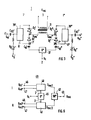
- a second exemplary embodiment, a double modulator stage 1, is shown in FIG. 4. It has the same functional units as the double modulator stage 1 shown in FIG. 3, but is specifically designed for a carrier U e with a frequency in the gigahertz range and for a modulation voltage Um with a frequency in the megahertz range using planar stripline technology.
- the arrangement of the functional units corresponds to that of FIG. 3. Compared to FIG. 3, the same functional units are also provided with the same reference numerals.
- the double modulator stage 1 has two submodulator stages 1 ', 1 "with a common carrier input 2 and a common signal output 3.
- the carrier voltage U e is present at the carrier input 2', 2" of the two submodulator stages 1 ', 1 "via a so-called Wilkinson coupler 12.
- the two carrier inputs 2 ', 2 are each electrically isolated from the Wilkinson coupler 12', 12" via a capacitor C K1 ', C K1 ".
- the signal outputs 3 ', 3 " are brought together via a 180 ° power combiner 50 in the form of a so-called rate race ring.
- the Rate Race Ring 50 has as input the two signal outputs 3 ', 3 "of the partial modulator stages 1', 1", as an output the output 3 of the double modulator stage 1 and a 50 ohm termination 13 to ground, it causes the phases of the from the partial modulator 1 'outgoing modulated carrier voltage U mc' towards the "outgoing carrier voltage U mc" of the partial modulator 1 of 180 ° and this thus leads together in phase.
- the two partial modulator stages 1 ', 1 are constructed like the modulator stage 70, the partial modulator stage 1' being mirror-symmetrical with respect to the partial modulator stage 1".
- the second embodiment is constructed in planar stripline technology and equipped with diodes D 1 ', Di ", D 2 ', D 2 ".
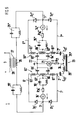
- FIG. 5 A third embodiment is shown in FIG. 5.
- the double modulator stage 1 shown as for the double modulator stage from FIG. 4, it applies that it has the same functional units as that shown in FIG. 3.
- the same features are therefore provided with the same reference numerals. Specifically, it is designed for a carrier U e with a wavelength in the upper megahertz range and a correspondingly lower frequency of the modulation signal Um.
- the double modulator stage 1 has two partial modulator stages 1 ', 1 "with a common signal output 3.
- the carrier U e is generated in the oscillator 21, which is connected to ground 22 on one side and to the carrier inputs 2', 2" on the other side. connected is.
- An autotransformer 23 is located between the oscillator 21 and the carrier inputs 2 ′ and 2 ′′.
- the oscillator 21 bears against the tap 24 and the two winding ends 25 ′ and 25 ′′ are connected to the carrier inputs 2 via coupling capacitors C K1 ′ and C K1 ′′ ', 2 "connected.
- the autotransformer 23 provides a 0 ° power divider and the resistance R 2 represents the internal resistance of the oscillator 21.
- the signal outputs 3 ', 3 are connected to the two winding ends of the primary winding 26 of a transformer 27, which serves as a transformer 11.
- the winding ends of the secondary winding represent the signal output 3 of the double modulator stage 1.
- Each of the two submodulator stages 1 ', 1 has a phase delay path 6', 6" and an electrically short path 7 ', 7 ".
- the phase delay path 6', 6" has a low pass 60 ', 60 "and a semiconductor diode D 2 ' , D 2 "on.
- the low pass 60 ', 60 is made up of discrete components and consists of three inductors 61', 61", 62 ', 62 “, 63', 63” connected in series and capacitors 64 ', 64 "between the inductors, 65 ', 65 ", which are coupled to ground.
- the middle inductance 62 ', 62 has a tap 66', 66" for feeding in the modulation signal U m ', Um ".
- the electrically short path 7', 7" has a semiconductor diode Di 'D,. The polarity of the diodes corresponds to that of the other versions.
- the modulation signal is generated in a generator 34 ', 34 "which is present at the output 3', 3” and via a parallel resonant circuit 35 ', 35 "with the tap 33 ', 33 “is connected.
- the resistors R 34 ', R 34 represent the internal resistances of the oscillators 34', 34".
- the parallel resonant circuit 35 ', 35 has a high resistance for the carrier U e .
- a modulation voltage Um is present, the equilibrium of the bridge is removed and the modulated carrier voltage U mc is present at the output 3 ', 3 ".
- a low-pass filter 39 ', 39 ", 60', 60" as a phase delay element is of particular importance, since it allows many degrees of freedom in the arrangement and design as part of this more complex circuit.
- FIG. 6 shows the known schematic representation of a 16 QAM modulator 49 (Quadrature Amplitude Modulation) for a bit repetition frequency of 140 Mbit / s. It essentially consists of two double modulator stages 40, 41, the one double modulator stage 40 supplying the signal for the I component and the double modulator stage 41 providing the signal for the Q component. The two components are brought together orthogonally in the power combiner 42.
- the output 43 of the power combiner 42 forms the output of the 16 QAM modulator 49.
- the carrier U e is applied to the carrier inputs 2 of the two modulator stages 40, 41 via a so-called Wilkinson coupler 45.
- At the signal inputs 46, 47 of the two double modulator stages 40, 41 are the modulation signals for the I and Q components, respectively, with a modulation signal Um with the same amount and at a double modulator stage 40, 41 for the I and Q components opposite sign is present.
- Schottky diodes are particularly suitable as semiconductor diodes Di ', Di ", D 2 ', D 2 ", which, for example, have shorter delay times compared to pin diodes.
- the temperature dependence of the diodes is compensated for by the arrangement in pairs in the bridge circuit. Differences in the production of the diodes can be compensated for, for example, by applying a DC voltage via the adjustable resistor at the signal input and thus optimizing the carrier suppression.
- the described modulator stage 1 can also be operated as a transmit or receive mixer stage (not shown).
- the use of modulator stage 1 of the first exemplary embodiment is used as a transmission mixer stage.
- the signal inputs 4 'and 4 "described in the first exemplary embodiment are provided for coupling in the frequency of the signal to be converted.
- the frequency of the signal to be converted must be inverted at one of the two signal inputs.
- the two signal inputs can be connected directly to one another.
- the 16 QAM modulator 49 as a mixer, which can be operated on the receiving side as a mirror-suppressing mixer and on the transmitting side as a single-sideband mixer.
- the 16 QAM modulator 49 when using both coupling branches I and Q, it is necessary to use these via a 90 ° power combiner to connect each other.
Landscapes
- Physics & Mathematics (AREA)
- Electromagnetism (AREA)
- Engineering & Computer Science (AREA)
- Power Engineering (AREA)
- Digital Transmission Methods That Use Modulated Carrier Waves (AREA)
- Transmitters (AREA)
- Networks Using Active Elements (AREA)
Applications Claiming Priority (2)
| Application Number | Priority Date | Filing Date | Title |
|---|---|---|---|
| DE4028371 | 1990-09-07 | ||
| DE4028371A DE4028371A1 (de) | 1990-09-07 | 1990-09-07 | Modulator- und mischstufe |
Publications (2)
| Publication Number | Publication Date |
|---|---|
| EP0480145A1 true EP0480145A1 (fr) | 1992-04-15 |
| EP0480145B1 EP0480145B1 (fr) | 1995-06-14 |
Family
ID=6413769
Family Applications (1)
| Application Number | Title | Priority Date | Filing Date |
|---|---|---|---|
| EP91113801A Expired - Lifetime EP0480145B1 (fr) | 1990-09-07 | 1991-08-17 | Etage modulateur et mélangeur |
Country Status (6)
| Country | Link |
|---|---|
| US (1) | US5214397A (fr) |
| EP (1) | EP0480145B1 (fr) |
| JP (1) | JP3188734B2 (fr) |
| CA (1) | CA2050756C (fr) |
| DE (2) | DE4028371A1 (fr) |
| ES (1) | ES2076431T4 (fr) |
Cited By (1)
| Publication number | Priority date | Publication date | Assignee | Title |
|---|---|---|---|---|
| EP0432674A3 (en) * | 1989-12-14 | 1992-11-25 | Alcatel Sel Aktiengesellschaft | Qam modulator with improved carrier suppression |
Families Citing this family (4)
| Publication number | Priority date | Publication date | Assignee | Title |
|---|---|---|---|---|
| FI90165C (fi) * | 1991-12-13 | 1993-12-27 | Nokia Mobile Phones Ltd | I/q-modulator och demodulator |
| GB2281830B (en) * | 1993-09-11 | 1998-08-12 | Nokia Mobile Phones Ltd | I/q-modulator and i/q-demodulator |
| GB2282287B (en) * | 1993-09-25 | 1998-01-28 | Nokia Mobile Phones Ltd | A mixer |
| US6759742B2 (en) * | 1999-10-12 | 2004-07-06 | The Whitaker Corporation | Interchangeable bond-wire interconnects |
Citations (2)
| Publication number | Priority date | Publication date | Assignee | Title |
|---|---|---|---|---|
| DE2944642A1 (de) * | 1978-11-06 | 1980-05-08 | Hitachi Ltd | Mischstufe |
| EP0063819A2 (fr) * | 1981-04-29 | 1982-11-03 | Siemens Aktiengesellschaft | Circuit mélangeur symétrique à micro-onde réalisé en micro-bande |
Family Cites Families (3)
| Publication number | Priority date | Publication date | Assignee | Title |
|---|---|---|---|---|
| US4528526A (en) * | 1983-05-31 | 1985-07-09 | Motorola, Inc. | PSK modulator with noncollapsable output for use with a PLL power amplifier |
| US4607394A (en) * | 1985-03-04 | 1986-08-19 | General Electric Company | Single balanced planar mixer |
| US4612518A (en) * | 1985-05-28 | 1986-09-16 | At&T Bell Laboratories | QPSK modulator or demodulator using subharmonic pump carrier signals |
-
1990
- 1990-09-07 DE DE4028371A patent/DE4028371A1/de not_active Withdrawn
-
1991
- 1991-08-17 EP EP91113801A patent/EP0480145B1/fr not_active Expired - Lifetime
- 1991-08-17 ES ES91113801T patent/ES2076431T4/es not_active Expired - Lifetime
- 1991-08-17 DE DE59105701T patent/DE59105701D1/de not_active Expired - Fee Related
- 1991-09-05 CA CA002050756A patent/CA2050756C/fr not_active Expired - Fee Related
- 1991-09-06 JP JP25457791A patent/JP3188734B2/ja not_active Expired - Fee Related
- 1991-09-06 US US07/756,183 patent/US5214397A/en not_active Expired - Fee Related
Patent Citations (2)
| Publication number | Priority date | Publication date | Assignee | Title |
|---|---|---|---|---|
| DE2944642A1 (de) * | 1978-11-06 | 1980-05-08 | Hitachi Ltd | Mischstufe |
| EP0063819A2 (fr) * | 1981-04-29 | 1982-11-03 | Siemens Aktiengesellschaft | Circuit mélangeur symétrique à micro-onde réalisé en micro-bande |
Non-Patent Citations (3)
| Title |
|---|
| PATENT ABSTRACTS OF JAPAN vol. 6, no. 136 (E-120)(1014) 23. Juli 1982 & JP-A-57 061 311 ( TOKYO SHIBAURA DENKI K.K. ) 13. April 1982 * |
| PATENT ABSTRACTS OF JAPAN vol. 6, no. 72 (E-105)(950) 7. Mai 1982 & JP-A-57 011 506 ( HITACHI SEISAKUSHO K.K. ) 21. Januar 1982 * |
| Proceedings of the 32nd Midwest Symposium on Circuits and Systems, August 14-16,1989, pages 1046-1049, New York, USA. Nassef et al. : "Practical design of microstrip mixer circuits" * |
Cited By (1)
| Publication number | Priority date | Publication date | Assignee | Title |
|---|---|---|---|---|
| EP0432674A3 (en) * | 1989-12-14 | 1992-11-25 | Alcatel Sel Aktiengesellschaft | Qam modulator with improved carrier suppression |
Also Published As
| Publication number | Publication date |
|---|---|
| EP0480145B1 (fr) | 1995-06-14 |
| DE59105701D1 (de) | 1995-07-20 |
| ES2076431T3 (es) | 1995-11-01 |
| JPH04257147A (ja) | 1992-09-11 |
| JP3188734B2 (ja) | 2001-07-16 |
| CA2050756A1 (fr) | 1992-03-08 |
| DE4028371A1 (de) | 1992-03-12 |
| ES2076431T4 (es) | 1997-01-16 |
| CA2050756C (fr) | 1994-05-03 |
| US5214397A (en) | 1993-05-25 |
Similar Documents
| Publication | Publication Date | Title |
|---|---|---|
| DE4420377C2 (de) | Verfahren zum Erzeugen von Quadratursignalen | |
| DE69623292T2 (de) | Bipolarer analogmultiplizierer für niederspannungsanwendungen | |
| DE102006017189B4 (de) | Integrierte Oszillatorschaltung mit wenigstens zwei Schwingkreisen | |
| DE102014103329A1 (de) | System und Verfahren für einen Frequenzverdoppler | |
| DE69219742T2 (de) | I/Q Modulator und Demodulator | |
| EP0432674B1 (fr) | Modulateur d'amplitude en quadrature à suppression améliorée de la porteuse | |
| EP0360916A1 (fr) | Atténuateur à micro-ondes monolithique en circuit intégré | |
| DE102013013521A1 (de) | Leistungsverstärkerschaltung | |
| EP0480145B1 (fr) | Etage modulateur et mélangeur | |
| DE10344876B3 (de) | Signalverarbeitungseinrichtung, insbesondere für den Mobilfunk | |
| DE4430314C2 (de) | HF-Mischstufe | |
| EP0728391B1 (fr) | Circuit d'extraction de signal d'horloge | |
| DE3246295C2 (de) | Frequenzmodulierbarer Oszillator | |
| DE2611712C3 (de) | Breitband-Wellenführungs-Mischstufe | |
| DE3324540C2 (de) | Breitbandiger Mikrowellenverstärker | |
| EP0400425B1 (fr) | Oscillateur à sortie différentielle | |
| DE2646035C3 (de) | Wechselspannungsschaltung mit mehreren in Basis-(Gate-) Schaltung betriebenen Halbleiterverstärkerelementen | |
| EP0133618A1 (fr) | Circuit oscillateur haute fréquence à quartz sous forme de circuit intégré monolithique | |
| EP0101612B1 (fr) | Oscillateur comportant un dipôle comme élément actif | |
| DE102007019745A1 (de) | Kaskadierter Phasenschieber | |
| EP0687062A1 (fr) | Déphaseur analogue pour petites tensions de commande | |
| DE19807255B4 (de) | Steuerbarer LC-Oszillator | |
| DE2240859C3 (de) | Mikrowellen-Reflexionsverstärker | |
| DE102004002826B4 (de) | Schaltung zur Änderung einer Frequenz | |
| DE102021125084A1 (de) | Technik zur erweiterung des oszillatorabstimmbereichs |
Legal Events
| Date | Code | Title | Description |
|---|---|---|---|
| PUAI | Public reference made under article 153(3) epc to a published international application that has entered the european phase |
Free format text: ORIGINAL CODE: 0009012 |
|
| AK | Designated contracting states |
Kind code of ref document: A1 Designated state(s): DE ES FR GB IT NL SE |
|
| 17P | Request for examination filed |
Effective date: 19920819 |
|
| RAP3 | Party data changed (applicant data changed or rights of an application transferred) |
Owner name: ALCATEL N.V. Owner name: ALCATEL SEL AKTIENGESELLSCHAFT |
|
| 17Q | First examination report despatched |
Effective date: 19940425 |
|
| GRAA | (expected) grant |
Free format text: ORIGINAL CODE: 0009210 |
|
| AK | Designated contracting states |
Kind code of ref document: B1 Designated state(s): DE ES FR GB IT NL SE |
|
| ITF | It: translation for a ep patent filed | ||
| REF | Corresponds to: |
Ref document number: 59105701 Country of ref document: DE Date of ref document: 19950720 |
|
| GBT | Gb: translation of ep patent filed (gb section 77(6)(a)/1977) |
Effective date: 19950703 |
|
| ET | Fr: translation filed | ||
| REG | Reference to a national code |
Ref country code: ES Ref legal event code: FG2A Ref document number: 2076431 Country of ref document: ES Kind code of ref document: T4 |
|
| PLBE | No opposition filed within time limit |
Free format text: ORIGINAL CODE: 0009261 |
|
| STAA | Information on the status of an ep patent application or granted ep patent |
Free format text: STATUS: NO OPPOSITION FILED WITHIN TIME LIMIT |
|
| 26N | No opposition filed | ||
| PGFP | Annual fee paid to national office [announced via postgrant information from national office to epo] |
Ref country code: NL Payment date: 19990719 Year of fee payment: 9 |
|
| PG25 | Lapsed in a contracting state [announced via postgrant information from national office to epo] |
Ref country code: NL Free format text: LAPSE BECAUSE OF NON-PAYMENT OF DUE FEES Effective date: 20010301 |
|
| NLV4 | Nl: lapsed or anulled due to non-payment of the annual fee |
Effective date: 20010301 |
|
| PGFP | Annual fee paid to national office [announced via postgrant information from national office to epo] |
Ref country code: SE Payment date: 20010802 Year of fee payment: 11 |
|
| PGFP | Annual fee paid to national office [announced via postgrant information from national office to epo] |
Ref country code: ES Payment date: 20010803 Year of fee payment: 11 |
|
| REG | Reference to a national code |
Ref country code: GB Ref legal event code: IF02 |
|
| PG25 | Lapsed in a contracting state [announced via postgrant information from national office to epo] |
Ref country code: SE Free format text: LAPSE BECAUSE OF NON-PAYMENT OF DUE FEES Effective date: 20020818 Ref country code: ES Free format text: LAPSE BECAUSE OF NON-PAYMENT OF DUE FEES Effective date: 20020818 |
|
| EUG | Se: european patent has lapsed | ||
| PGFP | Annual fee paid to national office [announced via postgrant information from national office to epo] |
Ref country code: GB Payment date: 20030728 Year of fee payment: 13 |
|
| PGFP | Annual fee paid to national office [announced via postgrant information from national office to epo] |
Ref country code: DE Payment date: 20030805 Year of fee payment: 13 |
|
| PGFP | Annual fee paid to national office [announced via postgrant information from national office to epo] |
Ref country code: FR Payment date: 20030813 Year of fee payment: 13 |
|
| REG | Reference to a national code |
Ref country code: ES Ref legal event code: FD2A Effective date: 20030912 |
|
| PG25 | Lapsed in a contracting state [announced via postgrant information from national office to epo] |
Ref country code: GB Free format text: LAPSE BECAUSE OF NON-PAYMENT OF DUE FEES Effective date: 20040817 |
|
| PG25 | Lapsed in a contracting state [announced via postgrant information from national office to epo] |
Ref country code: DE Free format text: LAPSE BECAUSE OF NON-PAYMENT OF DUE FEES Effective date: 20050301 |
|
| GBPC | Gb: european patent ceased through non-payment of renewal fee |
Effective date: 20040817 |
|
| PG25 | Lapsed in a contracting state [announced via postgrant information from national office to epo] |
Ref country code: FR Free format text: LAPSE BECAUSE OF NON-PAYMENT OF DUE FEES Effective date: 20050429 |
|
| REG | Reference to a national code |
Ref country code: FR Ref legal event code: ST |
|
| PG25 | Lapsed in a contracting state [announced via postgrant information from national office to epo] |
Ref country code: IT Free format text: LAPSE BECAUSE OF NON-PAYMENT OF DUE FEES;WARNING: LAPSES OF ITALIAN PATENTS WITH EFFECTIVE DATE BEFORE 2007 MAY HAVE OCCURRED AT ANY TIME BEFORE 2007. THE CORRECT EFFECTIVE DATE MAY BE DIFFERENT FROM THE ONE RECORDED. Effective date: 20050817 |