EP0480339A2 - Sohlenkonstruktion für orthopädische Therapieschuhe - Google Patents
Sohlenkonstruktion für orthopädische Therapieschuhe Download PDFInfo
- Publication number
- EP0480339A2 EP0480339A2 EP91117004A EP91117004A EP0480339A2 EP 0480339 A2 EP0480339 A2 EP 0480339A2 EP 91117004 A EP91117004 A EP 91117004A EP 91117004 A EP91117004 A EP 91117004A EP 0480339 A2 EP0480339 A2 EP 0480339A2
- Authority
- EP
- European Patent Office
- Prior art keywords
- heel
- shell
- sole
- shell frame
- frame ring
- Prior art date
- Legal status (The legal status is an assumption and is not a legal conclusion. Google has not performed a legal analysis and makes no representation as to the accuracy of the status listed.)
- Granted
Links
- 238000010276 construction Methods 0.000 title claims abstract description 25
- 230000000399 orthopedic effect Effects 0.000 claims abstract description 26
- 239000000463 material Substances 0.000 claims abstract description 14
- 238000007789 sealing Methods 0.000 claims abstract description 14
- 238000005299 abrasion Methods 0.000 claims abstract description 8
- 239000013013 elastic material Substances 0.000 claims abstract description 7
- 230000000284 resting effect Effects 0.000 claims abstract 2
- 229910000679 solder Inorganic materials 0.000 claims description 7
- 238000002560 therapeutic procedure Methods 0.000 claims description 3
- 230000000087 stabilizing effect Effects 0.000 claims description 2
- 230000008439 repair process Effects 0.000 abstract description 7
- 230000002093 peripheral effect Effects 0.000 abstract description 3
- 230000001225 therapeutic effect Effects 0.000 abstract description 3
- 210000002683 foot Anatomy 0.000 description 10
- 230000006978 adaptation Effects 0.000 description 3
- 238000009423 ventilation Methods 0.000 description 2
- 208000025865 Ulcer Diseases 0.000 description 1
- 238000004140 cleaning Methods 0.000 description 1
- 230000000694 effects Effects 0.000 description 1
- 210000004744 fore-foot Anatomy 0.000 description 1
- 208000007427 heel spur Diseases 0.000 description 1
- 238000004519 manufacturing process Methods 0.000 description 1
- 231100000915 pathological change Toxicity 0.000 description 1
- 230000036285 pathological change Effects 0.000 description 1
- 239000004033 plastic Substances 0.000 description 1
- 238000009417 prefabrication Methods 0.000 description 1
- 230000001681 protective effect Effects 0.000 description 1
- 230000000717 retained effect Effects 0.000 description 1
- 231100000397 ulcer Toxicity 0.000 description 1
- 239000004636 vulcanized rubber Substances 0.000 description 1
- XLYOFNOQVPJJNP-UHFFFAOYSA-N water Substances O XLYOFNOQVPJJNP-UHFFFAOYSA-N 0.000 description 1
Images


Classifications
-
- A—HUMAN NECESSITIES
- A43—FOOTWEAR
- A43B—CHARACTERISTIC FEATURES OF FOOTWEAR; PARTS OF FOOTWEAR
- A43B3/00—Footwear characterised by the shape or the use
- A43B3/14—Moccasins, opanken, or like shoes
-
- A—HUMAN NECESSITIES
- A43—FOOTWEAR
- A43B—CHARACTERISTIC FEATURES OF FOOTWEAR; PARTS OF FOOTWEAR
- A43B13/00—Soles; Sole-and-heel integral units
- A43B13/14—Soles; Sole-and-heel integral units characterised by the constructive form
-
- A—HUMAN NECESSITIES
- A43—FOOTWEAR
- A43B—CHARACTERISTIC FEATURES OF FOOTWEAR; PARTS OF FOOTWEAR
- A43B13/00—Soles; Sole-and-heel integral units
- A43B13/14—Soles; Sole-and-heel integral units characterised by the constructive form
- A43B13/22—Soles made slip-preventing or wear-resisting, e.g. by impregnation or spreading a wear-resisting layer
- A43B13/24—Soles made slip-preventing or wear-resisting, e.g. by impregnation or spreading a wear-resisting layer by use of insertions
- A43B13/26—Soles made slip-preventing or wear-resisting, e.g. by impregnation or spreading a wear-resisting layer by use of insertions projecting beyond the sole surface
-
- A—HUMAN NECESSITIES
- A43—FOOTWEAR
- A43B—CHARACTERISTIC FEATURES OF FOOTWEAR; PARTS OF FOOTWEAR
- A43B9/00—Footwear characterised by the assembling of the individual parts
Definitions
- the invention relates to a sole construction in the manner of a shell sole for orthopedic therapeutic shoes according to the preamble of claim 1.
- DE-U-90 13 985 discloses a further solution for the production of orthopedic made-to-measure or therapeutic shoes with a shell sole.
- a shell frame ring with an angular cross section was used, which can be attached to the circumferential edge of the shoe bottom.
- This shell frame ring has an assembly and sealing lip that rests on the shoe bottom.
- a prefabricated, frameless outsole is placed on the shell frame ring limited part of the shoe bottom and the mounting and sealing lip glued on.
- the shell frame ring itself consists of a stable, preferably tough-stiff and abrasion-resistant material, its outer surfaces are functional and fashionably profiled.
- the shell frame ring is extended and kept open on the inside, so that the orthopedic shoe manufacturer can adapt the shell frame ring to shoe shapes and sizes that deviate from the normal shape. So there is no need to cut back on the adaptation of the shoe shape to the sick foot. The cleaning work is omitted or is limited to a minimum, so that the time advantage achievable through the standard prefabrication is fully retained.
- Orthopedic made-to-measure shoes are pinched and assembled using dimension strips that are provided with the respective custom-made beds. So that the standardized prefabricated sole joint and heel areas fit during and after assembly, they are shaped according to the standardized joint part of the SOLOR insoles (see EP 0 338 351 A1)
- the present invention has for its object to develop this from construction prefabricated parts module-like sole construction in the manner of a shell sole for orthopedic therapy shoes so that the processing by the orthopedic shoemaker further simplifies and accelerates, increases the functionality and usability of the orthopedic shoe thus produced and walking comfort for the patient is improved.
- the heel pad can be made of different materials, for example soft-elastic, cushioned-elastic, and with different shapes, adapted to pathological changes in the heel, for example as a result of a heel spur, ulcer, etc.
- a soft-elastic insole can be glued inside the shell frame ring. This is particularly recommended when an air cushion construction with active foot ventilation is desired.
- the outsole is provided with air channels on the inside, the insole with corresponding air holes that are open to the sole of the foot.
- the paragraph mark itself can consist of several parts. It preferably has a front part made of an abrasion-resistant and non-slip material and a back part made of a soft-elastic material. The latter ensures a particularly pleasant, soft and subdued appearance when walking.
- one or more marking grooves are formed in the outside of the shoulder.
- a first groove is located at the bottom of the bowl. This helps the orthopedic shoemaker to accurately remove an expired heel stain, i.e. H. cut off or grind off. After putting on a repair stain, the outer surface of which is covered with a corresponding replacement edge, the look is again like that of a new shoe.
- a second groove is located at the level of the sole / heel interface. This helps the orthopedic shoemaker to remove the molded heel precisely, i.e. H. to cut off or grind off, and to replace it with a prefabricated, plumbed paragraph for the care of statically disturbed feet.
- the running surface and the edge of the shell of the shell frame ring are made separately from one another in the joint area.
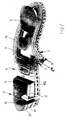
- Fig. 1 shows only slight lines indicated an orthopedic made-to-measure or therapy shoe 1, which is provided with a sole construction composed of various, prefabricated individual parts in the manner of a shell sole.
- An essential element of the sole construction is a shell frame ring 2, which is prefabricated in the form of a shoe and has an angular cross section, with a tread 14, on which an assembly and sealing lip 3 is formed, and shell edge 16.
- the shell frame ring 2 is fastened to the peripheral edge of the shoe bottom.
- the assembly and sealing lip 3 lies on the shoe bottom.
- Paragraph 5 and joint 6 are integrally formed on the shell frame ring 2.
- the one in Forefoot area forming a shell frame ring 2 is extended at one point, especially in the inner joint area. Suitable cut or separating markings are formed to adapt to any orthopedic bespoke shoes that differ from the normal shape and to adapt to different shoe sizes.
- the mounting and sealing lip 3 is integrally formed on the shell frame ring 2 and is glued to the shoe bottom.
- a frameless outsole 4 is fitted into the surface area enclosed by the shell frame ring 2 and glued to the shell frame ring 2, the assembly and sealing lip 3 and possibly the shoe bottom. Thanks to this construction, dirt and moisture cannot enter.
- the outsole 4 is made of a soft, elastic material. It is shaped as a cushion. As shown in FIG. 1, it is provided with air channels 10 on its inside facing the foot. These are in connection with air holes 9 in a likewise soft and elastic insole 8 which is inserted or glued into the shell frame ring 2 from above. In this way, an orthopedic air cushion sole with foot ventilation is also created for insole-free shoes according to DE-C-32 01 488.
- the hinge area 6 of the sole construction is essentially conventional and reinforced with an hinge spring 7.
- Paragraph 5 is specifically designed with regard to the orthopedic requirements on the one hand and to optimally facilitate the work of the orthopedic shoemaker on the other.
- a large chamber 15 into which a heel pad is inserted.
- This heel pad can vary depending on the Orthopedic requirements consist of different materials. Its top can also be shaped according to orthopedic requirements.
- the essential function of the heel, to absorb the weight of the shoe carrier without deformation and to transfer it to the floor, is ensured by the heel parts connected in one piece to the shell frame ring 2; the heel pad is essentially freed from this function.
- the underside of the heel 5 which can be seen in FIG. 2 is equipped with a peripheral shell edge 13. This creates a bowl-like depression in which a heel mark is inserted.
- this heel spot consists of two parts, a front part 11 made of abrasion-resistant, tough-elastic material and a back part 12 made of a soft-elastic material that dampens the heel strike.
- a non-vulcanized rubber for example TR, is preferably used as the material for the outsole cushion 4 and the heel spot back part 12.
- a marking groove 17 On the outside of the heel 5, approximately at the level of the bottom of the bowl-shaped heel recess, a marking groove 17 can be seen all around. This groove 17 indicates to the orthopedic shoemaker to what depth he has cut or sanded the expired heel mark 11, 12 including the heel cup edge 13 must, in order to subsequently stick on a repair sales mark. This repair sales mark is pasted with a material strip corresponding to the sales tray frame 13. The marking groove 17 then serves as a shadow gap that optically conceals the repair.
- Fig. 3 shows a prefabricated, plumbed paragraph 19 for the care of statically disturbed feet.
- This solder shoulder 19 replaces the molded shoulder 5 by separating it at the level of the second marking groove 22.
- the orthopedic solder shoulder 19 contains a vertically cast-in stabilizing strip 20 in the solder side, which makes it impossible to give in to the incorrect position due to statically disturbed feet. This ensures absolute stability and security in every case.
- solder shoulder 19 On the outside of the solder shoulder 19 there is also a material strip corresponding to the heel shell frame 13, into which the two grooves 17, 22 are also molded, on the one hand to maintain the appearance, but on the other hand also to carry out the aforementioned repair by removing the expired heel spot 11, 12 by a suitable repair stain.
- the solder heels 19 are made to match the soles.
- Fig. 4 shows a section of the heel and joint area 5, 6 of the sole. It can be seen that the tread 14 and the shell edge 16 are separated from one another in regions. This makes it possible to optimally conceal different forms of heel, as outlined by the different lines 5 '.
- the specially corrugated contour of the sealing lip 3 ' effectively supports the adaptation even to strong curvatures.
Landscapes
- Footwear And Its Accessory, Manufacturing Method And Apparatuses (AREA)
- Orthopedics, Nursing, And Contraception (AREA)
Abstract
Description
- Die Erfindung betrifft eine Sohlenkonstruktion nach Art einer Schalensohle für orthopädische Therapieschuhe gemäß dem Oberbegriff des Anspruchs 1.
- Schuhe mit Schalensohlen sind wegen ihres attraktiven, modischen Aussehens, ihres relativ geringen Gewichtes und ihrer Wasser- und Schmutzunempfindlichkeit am Schuhmarkt sehr gefragt. Die Träger orthopädischer Maßschuhe dagegen mußten auf die Vorteile solcher Schalensohlen lange Zeit verzichten, da mit serienmäßig vorgefertigten Schalensohlen ihre individuellen Sohlen- und Schuhformen nicht zu versorgen sind. Die Maßanfertigung einzelner Schalensohlen dagegen ist unbezahlbar.
- Aus der DE-U-88 05 244 war erstmals ein Vorschlag bekannt geworden, der dieses Problem optisch löst. Hierzu wurde ein herkömmlich gefertigter orthopädischer Maßschuh abschließend mit einem serienmäßig vorgefertigten, jedoch flachen Schalenrahmenring umkleidet. Dieser Schalenrahmenring ist in einer dem Schuhboden angepaßten Form aus Kunststoffmaterial gegossen und erlaubt es, unteren Schaftrand, Sohle, Absatz und Absatzfleck in einem Arbeitsgang zu verkleiden. Diese erste Lösung ermöglichte das gewünschte modische Aussehen, ohne daß bei der Anpassung der Schuhform an den kranken Fuß irgendwelche Abstriche gemacht werden mußten.
- Aus der DE-U-90 13 985 ist eine weitere Lösung zur Herstellung von orthopädischen Maß- oder Therapieschuhen mit Schalensohle bekannt. Dabei wurde ein im Querschnitt winkelförmiger Schalenrahmenring verwendet, der an der umlaufenden Kante des Schuhbodens befestigbar ist. Dieser Schalenrahmenring besitzt eine Montage- und Dichtungslippe, die auf dem Schuhboden aufliegt. Eine vorgefertigte, rahmenlose Laufsohle wird auf den vom Schalenrahmenring begrenzten Teil des Schuhbodens und die Montage- und Dichtungslippe aufgeklebt. Der Schalenrahmenring selbst besteht aus einem stabilen, vorzugsweise zäh-steifen und abriebfesten Material, seine Außenflächen sind funktionsgerecht und modisch profiliert. An einer Stelle, insbesondere im Gelenkbereich, ist der Schalenrahmenring an der Innenseite verlängert und offen gehalten, so daß der Orthopädie-Schuhfertiger den Schalenrahmenring auch an beliebig von der Normalform abweichende Schuhformen und -größen anpassen kann. Es müssen also keine Abstriche bezüglich der Anpassung der Schuhform an den kranken Fuß gemacht werden. Die Ausputzarbeiten entfallen oder sind auf ein Minimum beschränkt, so daß der durch die serienmäßige Vorfertigung erreichbare Zeitvorteil voll erhalten bleibt. Orthopädische Maßschuhe werden über Maßleisten, die mit den jeweiligen Maßbettungen versehen sind, gezwickt und montiert. Damit die genormt vorgefertigten Sohlengelenk- und Absatzbereiche während und nach der Montage passen, werden sie nach der genormten Gelenkpartie der SOLOR-Brandsohlen geformt (siehe EP 0 338 351 A1)
- Der vorliegenden Erfindung liegt die Aufgabe zugrunde, diese aus serienmäßig vorgefertigten Teilen modulartig zusammensetzbare Sohlenkonstruktion nach Art einer Schalensohle für orthopädische Therapieschuhe so weiterzubilden, daß die Verarbeitung durch den Orthopädie-Schuhmacher weiter vereinfacht und beschleunigt, die Funktionalität und Brauchbarkeit des damit hergestellten orthopädischen Schuhs erhöht und der Gehkomfort für den Patienten verbessert wird.
- Diese Aufgabe wird gelöst durch eine gattungsgemäße Sohlenkonstruktion mit den Merkmalen gemäß Kennzeichen des Anspruchs 1.
- Damit ergeben sich die Vorteile, daß der Fuß des Patienten quasi auf einem Polster läuft, wobei dieses Polster gleichzeitig die Laufsohle darstellt, so daß ein maximaler Polstereffekt erreicht wird, ohne daß der Schuh unförmig hoch wird, besonders in Verbindung mit einer Brandsohle gemäß DE-C-32 01 488, während gleichzeitig Abriebbeständigkeit und Rutschfestigkeit, insbesondere bei Nässe, durch den aus einem entsprechenden Material bestehenden, außen umlaufenden Schalenrahmenring gewährleistet sind. Auch im Absatzbereich kann jetzt ein gesonderter Absatzfleck verwendet werden, der aus für diesen Zweck optimal geeignetem Material besteht.
- Weitere Vorteile sind mit der im Absatz vorgesehenen Kammer verbunden. Hierdurch wird zunächst einmal das Gewicht insgesamt verringert. Weiterhin ergibt sich die Möglichkeit, auch im Absatzbereich allen orthopädischen Erfordernissen Rechnung zu tragen. So läßt sich das Fersenpolster aus unterschiedlichen Materialien, beispielsweise weich-elastisch, gedämpft-elastisch, und mit unterschiedlichen Formen, angepaßt an krankhafte Veränderungen der Ferse, beispielsweise infolge eines Fersensporns, Ulkus usw., herstellen.
- Insgesamt besteht also die Möglichkeit, für den Schalenrahmenring, die Laufsohle und den Absatzfleck unterschiedliche, jeweils optimal angepaßte Materialien zu verwenden.
- Gemäß einer vorteilhaften Weiterbildung kann in den Schalenrahmenring innen eine weich-elastische Innensohle eingeklebt werden. Dies empfiehlt sich insbesondere dann, wenn eine Luftpolsterkonstruktion mit aktiver Fußbelüftung gewünscht wird. In diesem Fall wird die Laufsohle innen mit Luftkanälen versehen, die Innensohle mit korrespondierenden Luftlöchern, die zur Fußsohle hin offen sind.
- Der Absatzfleck selbst kann aus mehreren Teilen bestehen. Vorzugsweise besitzt er ein aus einem abriebbeständigen und rutschfesten Material bestehendes Vorderteil und ein aus einem weich-elastischen Material bestehendes Rückteil. Letzteres sorgt für einen besonders angenehmen, weichen und gedämpften Auftritt beim Gehen.
- Gemäß einer vorteilhaften Weiterbildung sind in die Außenseite des Absatzes eine oder mehrere Markierungsnuten eingeformt.
- Eine erste Nut befindet sich in Höhe des Schalenbodens. Diese hilft dem Orthopädie-Schuhmacher, einen abgelaufenen Absatzfleck maßgenau zu entfernen, d. h. abzuschneiden oder abzuschleifen. Nach dem Aufsetzen eines Reparaturflecks, dessen Außenfläche mit einem entsprechenden Ersatz-Rand beklebt ist, ergibt sich wieder die Optik wie bei einem neuen Schuh.
- Eine zweite Nut befindet sich in Höhe der Trennfläche Sohle/Absatz. Diese hilft dem Orthopädie-Schuhmacher, den angeformten Absatz maßgenau zu entfernen, d. h. abzuschneiden oder abzuschleifen, und durch einen vorgefertigten, ins Lot gestellten Absatz für die Versorgung statisch gestörter Füße zu ersetzen.
- Um unterschiedliche Absatzformen kaschieren zu können, sind im Gelenkbereich die Lauffläche und der Schalenrand des Schalenrahmenrings bereichsweise voneinander getrennt gefertigt.
- Eine verbesserte Anpassung der Dichtlippe an unterschiedliche Krümmungen der Unterlage, insbesondere im Bereich des Absatzes oder der Schutzspitze wird möglich, wenn ihre freie Kante wellenförmig gestaltet wird.
- Somit sind dem Einsatz der erfindungsgemäßen Sohlenkonstruktion für die orthopädischen Belange keine Grenzen gesetzt.
- Weitere Ausgestaltungen der Erfindung ergeben sich aus den restlichen Unteransprüchen.
- Die Erfindung soll anhand der Zeichnung in Form von Ausführungsbeispielen näher erläutert werden. Es zeigen jeweils in Perspektive
- Fig. 1 eine Draufsicht auf die Oberseite einer Sohlenkonstruktion, mehrfach geschnitten,
- Fig. 2 eine Draufsicht auf die Unterseite der Sohlenkonstruktion, ebenfalls mehrfach geschnitten,
- Fig. 3 einen dazu passenden orthopädischen Lotabsatz und
- Fig. 4 ausschnittsweise den Absatz- und Gelenkbereich einer variierten Sohlenkonstruktion.
- Fig. 1 zeigt nur mit leichten Strichen angedeutet einen orthopädischen Maß- oder Therapieschuh 1, der mit einer aus verschiedenen, serienmäßig vorgefertigten Einzelteilen modulartig zusammengesetzten Sohlenkonstruktion nach Art einer Schalensohle versehen ist.
- Wesentliches Element der Sohlenkonstruktion ist ein in Form eines Schuhs vorgefertigter, im Querschnitt winkelförmiger Schalenrahmenring 2 mit Lauffläche 14, an der eine Montage- und Dichtungslippe 3 angeformt ist, und Schalenrand 16. Der Schalenrahmenring 2 wird an der umlaufenden Kante des Schuhbodens befestigt. Die Montage- und Dichtungslippe 3 liegt auf dem Schuhboden auf. Absatz 5 und Gelenk 6 sind am Schalenrahmenring 2 einstückig angeformt. Der im Vorfußbereich einen Ring bildende Schalenrahmenring 2 ist an einer Stelle, insbesondere im inneren Gelenkbereich, verlängert gefertigt. Zur Anpassung an beliebig von der Normalform abweichende orthopädische Maßschuhe sowie zur Anpassung an unterschiedliche Schuhgrößen sind geeignete Schnitt- oder Trennmarkierungen angeformt.
- Am Schalenrahmenring 2 ist innen die Montage- und Dichtungslippe 3 angeformt, die auf dem Schuhboden festgeklebt wird. Eine rahmenlose Laufsohle 4 wird in den vom Schalenrahmenring 2 umschlossenen Flächenbereich eingepaßt und mit dem Schalenrahmenring 2, der Montage- und Dichtungslippe 3 und gegebenenfalls dem Schuhboden verklebt. Dank dieser Konstruktion ist ein Eindringen von Straßenschmutz und Feuchtigkeit ausgeschlossen.
- Die Laufsohle 4 besteht aus einem weich-elastischen Material. Sie ist als Polster geformt. Wie Fig. 1 zeigt, ist sie auf ihrer dem fuß zugewandten Innenseite mit Luftkanälen 10 versehen. Diese stehen in Verbindung mit Luftlöchern 9 in einer ebenfalls weich-elastischen Innensohle 8, die von oben in den Schalenrahmenring 2 eingelegt bzw. eingeklebt wird. Auf diese Weise entsteht eine orthopädische Luftpolstersohle mit Fußbelüftung auch für brandsohlenlose Schuhe gemäß DE-C-32 01 488.
- Der Gelenkbereich 6 der Sohlenkonstruktion ist im wesentlichen herkömmlich aufgebaut und mit einer Gelenkfeder 7 verstärkt.
- Der Absatz 5 dagegen ist speziell im Hinblick auf die orthopädischen Anforderungen einerseits und auf eine optimale Erleichterung der Arbeit des Orthopädieschuhmachers andererseits ausgelegt. In der Oberseite des Absatzes 5 erkennt man eine große Kammer 15, in die ein Fersenpolster eingelegt wird. Dieses Fersenpolster kann je nach den orthopädischen Anforderungen aus unterschiedlichen Materialien bestehen. Auch kann seine Oberseite den orthopädischen Anforderungen entsprechend geformt werden. Die wesentliche Funktion des Absatzes, das Gewicht des Schuhträgers ohne Deformation aufzunehmen und auf den Boden zu übertragen, wird von den mit dem Schalenrahmenring 2 einstückig verbundenen Absatzteilen gewährleistet; das Fersenpolster ist von dieser Funktion im wesentlichen befreit.
- Die in Fig. 2 erkennbare Unterseite des Absatzes 5 ist mit einem umlaufenden Schalenrand 13 ausgerüstet. Es entsteht so eine schalenartige Vertiefung, in die ein Absatzfleck eingesetzt ist. Dieser Absatzfleck besteht im vorliegenden Beispiel aus zwei Teilen, einem Vorderteil 11 aus abriebbeständigem, zäh-elastischem Material und einem Rückteil 12 aus einem weich-elastischen, den Fersenauftritt dämpfenden Material.
- Als Material für das Laufsohlenpolster 4 und das Absatzfleckrückteil 12 kommt vorzugsweise ein nicht vulkanisierter Kautschuk, beispielsweise TR, in Betracht.
- An der Außenseite des Absatzes 5, etwa in Höhe des Bodens der schalenförmigen Absatzvertiefung, erkennt man umlaufend eine Markierungsnut 17. Diese Nut 17 gibt dem Orthopädieschuhmacher an, bis in welche Tiefe er den abgelaufenen Absatzfleck 11, 12 einschließlich des Absatzschalenrandes 13 abschneiden bzw. abschleifen muß, um anschließend einen Reparaturabsatzfleck aufzukleben. Dieser Reparaturabsatzfleck ist außen mit einem dem Absatzschalenrahmen 13 entsprechenden Materialstreifen beklebt. Die Markierungsnut 17 dient dann als Schattenfuge, die die Reparatur optisch kaschiert.
- Fig. 3 zeigt einen vorgefertigten, ins Lot gestellten Absatz 19 zur Versorgung statisch gestörter Füße. Dieser Lotabsatz 19 ersetzt den angeformten Absatz 5, indem dieser in Höhe der zweiten Markierungsnut 22 abgetrennt wird. Der orthopädische Lotabsatz 19 enthält in der Lotseite einen senkrecht eingegossenen Stabilisierungsstreifen 20, der ein durch die einseitige Überbelastung statisch gestörter Füße bedingtes Nachgeben in die Fehlstellung unmöglich macht. Somit ist in jedem Fall eine absolute Standfestigkeit und Sicherheit gegeben.
- An der Außenseite des Lotabsatzes 19 befindet sich ebenfalls ein dem Absatzschalenrahmen 13 entsprechender Materialstreifen, in den die beiden Nuten 17, 22 ebenfalls eingeformt sind, einmal um die Optik beizubehalten, zum anderen aber auch um die bereits erwähnte Reparatur durch Entfernen des abgelaufenen Absatzflecks 11, 12 durch einen passenden Reparaturfleck zu ermöglichen.
- Die Lotabsätze 19 werden zu den Sohlen passend gefertigt.
- Fig. 4 zeigt ausschnittsweise den Absatz- und Gelenkbereich 5, 6 der Sohle. Man erkennt, daß die Lauffläche 14 und der Schalenrand 16 bereichsweise voneinander getrennt sind. Dadurch wird es möglich, unterschiedliche Absatzformen, wie sie durch die unterschiedlichen Linien 5' skizziert sind, optimal zu kaschieren. Die speziell gewellte Kontur der Dichtlippe 3' unterstützt wirksam die Anpassung auch an starke Krümmungen.
Claims (10)
- Sohlenkonstruktion nach Art einer Schalensohle für orthopädische Therapieschuhe (1), modulartig bestehend aus einem in Form eines Schuhs vorgefertigten, im Querschnitt winkelförmigen Schalenrahmen (2), der an der umlaufenden Kante des Schuhbodens befestigbar ist und eine auf dem Schuhboden aufliegende Montage- und Dichtungslippe (3) aufweist, aus einer vorgefertigten, rahmenlosen Laufsohle (4), die auf der Montage- und Dichtungslippe (3) und dem vom Schalenrahmenring (2) begrenzten Teil des Schuhbodens befestigbar ist, aus einem am Schalenrahmenring (2) angeformten Absatz (5) und aus einem am Schalenrahmenring (2) angeformten Gelenk (6), dadurch gekennzeichnet, daß der Schalenrahmenring (2) aus einem abriebbeständigen, rutschfesten Material besteht, daß die Laufsohle (4) aus einem weich-elastischen Material besteht und als Polster ausgebildet ist und daß der Absatz (5) außen mit einem Schalenrand (13) zur Aufnahme eines Absatzflecks (11, 12) und innen mit einer Kammer (15) zur Aufnahme eines Fersenpolsters ausgerüstet ist.
- Sohlenkonstruktion nach Anspruch 1, dadurch gekennzeichnet, daß eine weichelastische Innensohle (8) in den Schalenrahmenring (2) eingelegt bzw. eingeklebt ist.
- Sohlenkonstruktion nach Anspruch 2, dadurch gekennzeichnet, daß die Laufsohle (4) und/oder die Innensohle (8) innen Luftkanäle (10) und die Innensohle (8) damit korrespondierende Luftlöcher (9) aufweisen.
- Sohlenkonstruktion nach einem der Ansprüche 1 bis 3, dadurch gekennzeichnet, daß der Absatzfleck ein aus einem abriebbeständigen und rutschfesten Material bestehendes Vorderteil (11) und ein aus einem weich-elastischen Material bestehendes Rückteil (12) besitzt.
- Sohlenkonstruktion nach einem der Ansprüche 1 bis 4, dadurch gekennzeichnet, daß die Lauffläche (14) des Schalenrahmenrings (2) rutschhemmend profiliert ist.
- Sohlenkonstruktion nach einem der Ansprüche 1 bis 5, dadurch gekennzeichnet, daß in die Außenseite des Schalenrandes (13) des Absatzes (5) eine erste Markierungsnut (17) in Höhe des Schalenbodens und gegebenenfalls eine zweite Markierungsnut (22) in Höhe der Trennfläche Sohle-Absatz eingeformt ist.
- Sohlenkonstruktion nach einem der Ansprüche 1 bis 6, dadurch gekennzeichnet, daß Lauffläche (14) und Schalenrand (16) des Schalenrahmenrings (2) im Gelenkbereich (6) abschnittsweise voneinander getrennt sind.
- Sohlenkonstruktion nach einem der Ansprüche 1 bis 7, dadurch gekennzeichnet, daß der Rand der Dichtlippe (3,) gewellt ist.
- Sohlenkonstruktion nach einem der Ansprüche 1 bis 8, dadurch gekennzeichnet, daß ein spezieller Lotabsatz (19) vorgesehen ist mit einem Stabilisierungsstreifen (20) und einem verlängerten Absatzflügel (21).
- Sohlenkonstruktion nach einem der Ansprüche 1 bis 9, dadurch gekennzeichnet, daß Laufsohle (4) und/oder Rückteil (12) des Absatzflecks aus nicht vulkanisiertem Kautschuk, insbesondere TR, bestehen.
Applications Claiming Priority (4)
| Application Number | Priority Date | Filing Date | Title |
|---|---|---|---|
| DE9013985U | 1990-10-08 | ||
| DE9013985U DE9013985U1 (de) | 1990-10-08 | 1990-10-08 | Ortopädischer Maßschuh |
| DE9107836U | 1991-06-26 | ||
| DE9107836U DE9107836U1 (de) | 1990-10-08 | 1991-06-26 | Sohlenkonstruktion für orthopädische Therapieschuhe |
Publications (3)
| Publication Number | Publication Date |
|---|---|
| EP0480339A2 true EP0480339A2 (de) | 1992-04-15 |
| EP0480339A3 EP0480339A3 (en) | 1992-12-09 |
| EP0480339B1 EP0480339B1 (de) | 1997-07-23 |
Family
ID=25957278
Family Applications (1)
| Application Number | Title | Priority Date | Filing Date |
|---|---|---|---|
| EP91117004A Expired - Lifetime EP0480339B1 (de) | 1990-10-08 | 1991-10-05 | Orthopädischer Mass- und Therapieschuhe |
Country Status (2)
| Country | Link |
|---|---|
| EP (1) | EP0480339B1 (de) |
| AT (1) | ATE155656T1 (de) |
Family Cites Families (3)
| Publication number | Priority date | Publication date | Assignee | Title |
|---|---|---|---|---|
| GB232095A (en) * | 1924-08-11 | 1925-04-16 | Lawrence Emery Scrannage | Improvements in combined heel, sole and arch supporter |
| CH453132A (de) * | 1967-06-08 | 1968-05-31 | Bally Schuhfab Ag | Brandsohlenfreier Schuh |
| US4967750A (en) * | 1987-10-28 | 1990-11-06 | Cherniak Jaime G | Modular orthopedic sandal |
-
1991
- 1991-10-05 EP EP91117004A patent/EP0480339B1/de not_active Expired - Lifetime
- 1991-10-05 AT AT91117004T patent/ATE155656T1/de not_active IP Right Cessation
Also Published As
| Publication number | Publication date |
|---|---|
| ATE155656T1 (de) | 1997-08-15 |
| EP0480339B1 (de) | 1997-07-23 |
| EP0480339A3 (en) | 1992-12-09 |
Similar Documents
| Publication | Publication Date | Title |
|---|---|---|
| DE102014213366B4 (de) | Schuh mit einer Fersenkappe sowie Schuh mit einem Knöchelkragen | |
| EP0410077B1 (de) | Schuh, insbesondere Kinderschuh, mit einem durchsichtigen Bereich | |
| EP0048965B1 (de) | Polstersohle mit orthopädischen Eigenschaften | |
| DE2908019C3 (de) | Fußstützende Sohle | |
| DE2458674C2 (de) | ||
| CH668683A5 (de) | Schuhwerk mit einlagesohle. | |
| DD294627B5 (de) | Sportschuh mit elastischer Einlage im Absatz | |
| EP0815758A1 (de) | Schuh- bzw. Laufsohle und Schuh mit dieser Sohle | |
| EP1175161B1 (de) | Dämpfungseinsatz für einen schuh und schuh mit einem derartigen dämpfungseinsatz | |
| EP1189527A1 (de) | Brandsohle und verwendung derselben zur herstellung eines schuhs | |
| DE19904887B4 (de) | Schuh | |
| DE8304272U1 (de) | Fußbekleidung | |
| EP0707803B1 (de) | Verfahren zur Herstellung einer Einlage in Schuhe | |
| DE2914309A1 (de) | Naturformschuh | |
| DE29810518U1 (de) | Baukastensystem für eine Schuheinlage | |
| EP0480339B1 (de) | Orthopädischer Mass- und Therapieschuhe | |
| DE102013110851B4 (de) | Prothesenfuß | |
| DE8900237U1 (de) | Innensohle mit einer die Fußsohlen belüftenden Oberseite | |
| DE9107836U1 (de) | Sohlenkonstruktion für orthopädische Therapieschuhe | |
| DE10015240A1 (de) | Brandsohle und Verwendung derselben zur Herstellung eines Schuhs | |
| EP0408793A1 (de) | Schuhsohle aus gummielastischem Material | |
| AT398025B (de) | Schuh | |
| DE1913755C3 (de) | Fußbett | |
| EP0674857B1 (de) | Schuhwerk, bei dem ein Schaft entlang seines Randes mit einer Brandsohle verbunden ist | |
| EP0236545A1 (de) | Kinderschuh, insbesondere Lauflernschuh |
Legal Events
| Date | Code | Title | Description |
|---|---|---|---|
| PUAI | Public reference made under article 153(3) epc to a published international application that has entered the european phase |
Free format text: ORIGINAL CODE: 0009012 |
|
| AK | Designated contracting states |
Kind code of ref document: A2 Designated state(s): AT BE CH DE DK ES FR GB GR IT LI LU NL SE |
|
| PUAL | Search report despatched |
Free format text: ORIGINAL CODE: 0009013 |
|
| AK | Designated contracting states |
Kind code of ref document: A3 Designated state(s): AT BE CH DE DK ES FR GB GR IT LI LU NL SE |
|
| 17P | Request for examination filed |
Effective date: 19930324 |
|
| 17Q | First examination report despatched |
Effective date: 19950425 |
|
| GRAG | Despatch of communication of intention to grant |
Free format text: ORIGINAL CODE: EPIDOS AGRA |
|
| GRAH | Despatch of communication of intention to grant a patent |
Free format text: ORIGINAL CODE: EPIDOS IGRA |
|
| GRAH | Despatch of communication of intention to grant a patent |
Free format text: ORIGINAL CODE: EPIDOS IGRA |
|
| GRAA | (expected) grant |
Free format text: ORIGINAL CODE: 0009210 |
|
| AK | Designated contracting states |
Kind code of ref document: B1 Designated state(s): AT BE CH DE DK ES FR GB GR IT LI LU NL SE |
|
| PG25 | Lapsed in a contracting state [announced via postgrant information from national office to epo] |
Ref country code: GR Free format text: LAPSE BECAUSE OF FAILURE TO SUBMIT A TRANSLATION OF THE DESCRIPTION OR TO PAY THE FEE WITHIN THE PRESCRIBED TIME-LIMIT Effective date: 19970723 Ref country code: GB Effective date: 19970723 Ref country code: FR Effective date: 19970723 Ref country code: ES Free format text: THE PATENT HAS BEEN ANNULLED BY A DECISION OF A NATIONAL AUTHORITY Effective date: 19970723 Ref country code: DK Effective date: 19970723 |
|
| REF | Corresponds to: |
Ref document number: 155656 Country of ref document: AT Date of ref document: 19970815 Kind code of ref document: T |
|
| REG | Reference to a national code |
Ref country code: CH Ref legal event code: EP |
|
| REF | Corresponds to: |
Ref document number: 59108793 Country of ref document: DE Date of ref document: 19970828 |
|
| ITF | It: translation for a ep patent filed | ||
| REG | Reference to a national code |
Ref country code: CH Ref legal event code: NV Representative=s name: PATENTANWAELTE SCHAAD, BALASS, MENZL & PARTNER AG |
|
| PGFP | Annual fee paid to national office [announced via postgrant information from national office to epo] |
Ref country code: AT Payment date: 19971021 Year of fee payment: 7 |
|
| PGFP | Annual fee paid to national office [announced via postgrant information from national office to epo] |
Ref country code: CH Payment date: 19971022 Year of fee payment: 7 |
|
| PG25 | Lapsed in a contracting state [announced via postgrant information from national office to epo] |
Ref country code: SE Effective date: 19971023 |
|
| EN | Fr: translation not filed | ||
| GBV | Gb: ep patent (uk) treated as always having been void in accordance with gb section 77(7)/1977 [no translation filed] |
Effective date: 19970723 |
|
| PGFP | Annual fee paid to national office [announced via postgrant information from national office to epo] |
Ref country code: LU Payment date: 19980210 Year of fee payment: 7 |
|
| PLBE | No opposition filed within time limit |
Free format text: ORIGINAL CODE: 0009261 |
|
| STAA | Information on the status of an ep patent application or granted ep patent |
Free format text: STATUS: NO OPPOSITION FILED WITHIN TIME LIMIT |
|
| 26N | No opposition filed | ||
| PG25 | Lapsed in a contracting state [announced via postgrant information from national office to epo] |
Ref country code: LU Free format text: LAPSE BECAUSE OF NON-PAYMENT OF DUE FEES Effective date: 19981005 Ref country code: AT Free format text: LAPSE BECAUSE OF NON-PAYMENT OF DUE FEES Effective date: 19981005 |
|
| PG25 | Lapsed in a contracting state [announced via postgrant information from national office to epo] |
Ref country code: LI Free format text: LAPSE BECAUSE OF NON-PAYMENT OF DUE FEES Effective date: 19981031 Ref country code: CH Free format text: LAPSE BECAUSE OF NON-PAYMENT OF DUE FEES Effective date: 19981031 |
|
| REG | Reference to a national code |
Ref country code: CH Ref legal event code: PL |
|
| PGFP | Annual fee paid to national office [announced via postgrant information from national office to epo] |
Ref country code: DE Payment date: 20010919 Year of fee payment: 11 |
|
| PGFP | Annual fee paid to national office [announced via postgrant information from national office to epo] |
Ref country code: BE Payment date: 20011023 Year of fee payment: 11 |
|
| PGFP | Annual fee paid to national office [announced via postgrant information from national office to epo] |
Ref country code: NL Payment date: 20011026 Year of fee payment: 11 |
|
| PG25 | Lapsed in a contracting state [announced via postgrant information from national office to epo] |
Ref country code: BE Free format text: LAPSE BECAUSE OF NON-PAYMENT OF DUE FEES Effective date: 20021031 |
|
| BERE | Be: lapsed |
Owner name: *SOLOR SCHUHFORSCHUNG UND ENTWICKLUNG G.M.B.H. Effective date: 20021031 |
|
| PG25 | Lapsed in a contracting state [announced via postgrant information from national office to epo] |
Ref country code: NL Free format text: LAPSE BECAUSE OF NON-PAYMENT OF DUE FEES Effective date: 20030501 Ref country code: DE Free format text: LAPSE BECAUSE OF NON-PAYMENT OF DUE FEES Effective date: 20030501 |
|
| NLV4 | Nl: lapsed or anulled due to non-payment of the annual fee |
Effective date: 20030501 |
|
| PG25 | Lapsed in a contracting state [announced via postgrant information from national office to epo] |
Ref country code: IT Free format text: LAPSE BECAUSE OF NON-PAYMENT OF DUE FEES Effective date: 20051005 |