EP0480363B1 - Résine durcissable et composition la contenant - Google Patents
Résine durcissable et composition la contenant Download PDFInfo
- Publication number
- EP0480363B1 EP0480363B1 EP91117111A EP91117111A EP0480363B1 EP 0480363 B1 EP0480363 B1 EP 0480363B1 EP 91117111 A EP91117111 A EP 91117111A EP 91117111 A EP91117111 A EP 91117111A EP 0480363 B1 EP0480363 B1 EP 0480363B1
- Authority
- EP
- European Patent Office
- Prior art keywords
- group
- curable resin
- formula
- integer
- carbon atoms
- Prior art date
- Legal status (The legal status is an assumption and is not a legal conclusion. Google has not performed a legal analysis and makes no representation as to the accuracy of the status listed.)
- Expired - Lifetime
Links
Images
Classifications
-
- C—CHEMISTRY; METALLURGY
- C08—ORGANIC MACROMOLECULAR COMPOUNDS; THEIR PREPARATION OR CHEMICAL WORKING-UP; COMPOSITIONS BASED THEREON
- C08G—MACROMOLECULAR COMPOUNDS OBTAINED OTHERWISE THAN BY REACTIONS ONLY INVOLVING UNSATURATED CARBON-TO-CARBON BONDS
- C08G63/00—Macromolecular compounds obtained by reactions forming a carboxylic ester link in the main chain of the macromolecule
- C08G63/91—Polymers modified by chemical after-treatment
-
- C—CHEMISTRY; METALLURGY
- C08—ORGANIC MACROMOLECULAR COMPOUNDS; THEIR PREPARATION OR CHEMICAL WORKING-UP; COMPOSITIONS BASED THEREON
- C08G—MACROMOLECULAR COMPOUNDS OBTAINED OTHERWISE THAN BY REACTIONS ONLY INVOLVING UNSATURATED CARBON-TO-CARBON BONDS
- C08G18/00—Polymeric products of isocyanates or isothiocyanates
- C08G18/06—Polymeric products of isocyanates or isothiocyanates with compounds having active hydrogen
- C08G18/08—Processes
- C08G18/10—Prepolymer processes involving reaction of isocyanates or isothiocyanates with compounds having active hydrogen in a first reaction step
-
- C—CHEMISTRY; METALLURGY
- C08—ORGANIC MACROMOLECULAR COMPOUNDS; THEIR PREPARATION OR CHEMICAL WORKING-UP; COMPOSITIONS BASED THEREON
- C08G—MACROMOLECULAR COMPOUNDS OBTAINED OTHERWISE THAN BY REACTIONS ONLY INVOLVING UNSATURATED CARBON-TO-CARBON BONDS
- C08G18/00—Polymeric products of isocyanates or isothiocyanates
- C08G18/06—Polymeric products of isocyanates or isothiocyanates with compounds having active hydrogen
- C08G18/28—Polymeric products of isocyanates or isothiocyanates with compounds having active hydrogen characterised by the compounds used containing active hydrogen
- C08G18/67—Unsaturated compounds having active hydrogen
- C08G18/671—Unsaturated compounds having only one group containing active hydrogen
- C08G18/672—Esters of acrylic or alkyl acrylic acid having only one group containing active hydrogen
- C08G18/6725—Esters of acrylic or alkyl acrylic acid having only one group containing active hydrogen containing ester groups other than acrylate or alkylacrylate ester groups
-
- C—CHEMISTRY; METALLURGY
- C08—ORGANIC MACROMOLECULAR COMPOUNDS; THEIR PREPARATION OR CHEMICAL WORKING-UP; COMPOSITIONS BASED THEREON
- C08G—MACROMOLECULAR COMPOUNDS OBTAINED OTHERWISE THAN BY REACTIONS ONLY INVOLVING UNSATURATED CARBON-TO-CARBON BONDS
- C08G18/00—Polymeric products of isocyanates or isothiocyanates
- C08G18/06—Polymeric products of isocyanates or isothiocyanates with compounds having active hydrogen
- C08G18/28—Polymeric products of isocyanates or isothiocyanates with compounds having active hydrogen characterised by the compounds used containing active hydrogen
- C08G18/67—Unsaturated compounds having active hydrogen
- C08G18/68—Unsaturated polyesters
-
- C—CHEMISTRY; METALLURGY
- C08—ORGANIC MACROMOLECULAR COMPOUNDS; THEIR PREPARATION OR CHEMICAL WORKING-UP; COMPOSITIONS BASED THEREON
- C08G—MACROMOLECULAR COMPOUNDS OBTAINED OTHERWISE THAN BY REACTIONS ONLY INVOLVING UNSATURATED CARBON-TO-CARBON BONDS
- C08G18/00—Polymeric products of isocyanates or isothiocyanates
- C08G18/06—Polymeric products of isocyanates or isothiocyanates with compounds having active hydrogen
- C08G18/70—Polymeric products of isocyanates or isothiocyanates with compounds having active hydrogen characterised by the isocyanates or isothiocyanates used
- C08G18/71—Monoisocyanates or monoisothiocyanates
- C08G18/718—Monoisocyanates or monoisothiocyanates containing silicon
-
- C—CHEMISTRY; METALLURGY
- C08—ORGANIC MACROMOLECULAR COMPOUNDS; THEIR PREPARATION OR CHEMICAL WORKING-UP; COMPOSITIONS BASED THEREON
- C08G—MACROMOLECULAR COMPOUNDS OBTAINED OTHERWISE THAN BY REACTIONS ONLY INVOLVING UNSATURATED CARBON-TO-CARBON BONDS
- C08G18/00—Polymeric products of isocyanates or isothiocyanates
- C08G18/06—Polymeric products of isocyanates or isothiocyanates with compounds having active hydrogen
- C08G18/83—Chemically modified polymers
- C08G18/837—Chemically modified polymers by silicon containing compounds
-
- C—CHEMISTRY; METALLURGY
- C08—ORGANIC MACROMOLECULAR COMPOUNDS; THEIR PREPARATION OR CHEMICAL WORKING-UP; COMPOSITIONS BASED THEREON
- C08G—MACROMOLECULAR COMPOUNDS OBTAINED OTHERWISE THAN BY REACTIONS ONLY INVOLVING UNSATURATED CARBON-TO-CARBON BONDS
- C08G63/00—Macromolecular compounds obtained by reactions forming a carboxylic ester link in the main chain of the macromolecule
- C08G63/68—Polyesters containing atoms other than carbon, hydrogen and oxygen
- C08G63/695—Polyesters containing atoms other than carbon, hydrogen and oxygen containing silicon
-
- C—CHEMISTRY; METALLURGY
- C08—ORGANIC MACROMOLECULAR COMPOUNDS; THEIR PREPARATION OR CHEMICAL WORKING-UP; COMPOSITIONS BASED THEREON
- C08L—COMPOSITIONS OF MACROMOLECULAR COMPOUNDS
- C08L67/00—Compositions of polyesters obtained by reactions forming a carboxylic ester link in the main chain; Compositions of derivatives of such polymers
Definitions
- the present invention relates to a curable resin and a composition containing the same, and more particularly to a curable resin whose main chain consists essentially of an aliphatic polyester chain and which has on the polymer chain end at least two hydrolyzable silyl groups, and the composition containing the same.
- the present invention provides a curable resin which is excellent in flexibility, solvent resistance, resistance to acid rain (acid rain resistance), resistance to scratch (scratch resistance), and is low in viscosity, and a composition containing the above-mentioned resin.
- the curable resin of the present invention is suitable for use as a base resin used in coatings, adhesives, sealing agents and potting agents, or as a polymer to be blended with a cellulose such as nitrocellulose or cellulose acetate butyrate, another polymer such as an epoxy resin, a polyester, an alkyd resin or an acrylic polyol, particularly a hydrolyzable silyl group-containing vinyl resin disclosed in, for instance, Japanese Unexamined Patent Publication No. 54-36395.
- qualities to top coatings required in the market particularly as to qualities of coatings for automobiles, it is desired to obtain an improved appearance, scratch resistance, so that outside parts of the automobile are not scratched in a car washer, as well as improved resistance to acid rain, derived from the environmental pollution.
- Melamine coatings are generally used for this purpose at the present time.
- the acid resistance and scratch resistance of melamine coatings of a regular solid type are not necessarily satisfactory.
- some efforts have been exerted.
- the content of the melamine resin component having a low viscosity is increased in the coating composition in order to obtain a high solid coating, the acid resistance and scratch resistance are lowered.
- An object of the present invention is to provide a curable resin which is improved in flexibility, solvent resistance, acid rain resistance and scratch resistance and is low in viscosity, and which is suitable for use of a blend with another resin.
- a further object of the present invention is to provide a composition containing the above-mentioned resin which is improved in flexibility, solvent resistance, acid rain resistance and scratch resistance.
- a curable resin having a number average molecular weight of 600 to 6000 and at least two hydrolyzable silyl groups in one molecule, which is obtainable by
- a composition comprising 95 to 5 parts by weight of the above-mentioned curable resin (b) and 5 to 95 parts by weight of a silyl group-containing vinyl polymer (a) having, in one molecule, at least one silyl group having the formula (IV): wherein R 6 and R 7 are the same or different and each is a hydrogen atom or a monovalent hydrocarbon group having 1 to 10 carbon atoms selected from an alkyl group, an aryl group and aralkyl group, each Y is a halogen atom, an alkoxy group, an acyloxy group, an aminoxy group, a phenoxy group, a thioalkoxy group or an amino group, and at least one Y is an alkoxy group or a phenoxy group, and a is 1, 2 or 3, the total amount of the curable resin (b) and the vinyl polymer (a) being 100 parts by weight.
- the aliphatic polyester resin (A) having both an acryloyl group and an alcoholic hydroxyl group in one molecule is reacted with the isocyanate silane compound (B).
- any aliphatic polyester resins can be used as the component (A) without any limitation, so long as the aliphatic polyester resin has both an acryloyl group and an alcoholic hydroxyl group at the polymer ends and has a number average molecular weight of preferably 200 to 5,000, more preferably from 300 to 3,000.
- polyester chain of the aliphatic polyester resin (A) are, for instance, a polyester such as polyethylene adipate, polydiethylene adipate, polypropylene adipate, polytetramethylene adipate, polyneopentylene adipate, polymethylpentanediol adipate, poly- ⁇ -caprolactone or a polyvalerolactone such as polymethylvalerolactone, a copolyester containing components of these polyesters or a polyhexamethylene carbonate.
- poly- ⁇ -caprolactone and polymethylvalerolactone are preferable from the viewpoint of weatherability, and polymethylvalerolactone is preferable from the viewpoint of acid rain resistance.
- Examples of the aliphatic polyester resin (A) are, for instance, poly- ⁇ -caprolactone acrylates such as "Placcel FA-1” commercially available from Daicel Chemical Industries, Ltd., "Placcel FA-2", “Placcel FA-3", “Placcel FA-4", “Placcel FA-8", or polymethylvalerolactone acrylates commercially available from Kabushiki Kaisha Kuraray.
- poly- ⁇ -caprolactone acrylates such as "Placcel FA-1" commercially available from Daicel Chemical Industries, Ltd., "Placcel FA-2", “Placcel FA-3", “Placcel FA-4", “Placcel FA-8", or polymethylvalerolactone acrylates commercially available from Kabushiki Kaisha Kuraray.
- the isocyanate silane compound (B) has the formula (I):
- R 1 is a bivalent hydrocarbon group having 1 to 10 carbon atoms, concretely, a linear or branched alkylene group having 1 to 10 carbon atoms such as a trimethylene group, hexamethylene group, a cycloalkylene group having 6 to 10 carbon atoms such as cyclohexylene group, an arylene group having 6 to 10 carbon atoms such as a phenylene group or an aralkylene group having 7 to 10 carbon atoms such as a xylylene group, R 2 is an alkyl group having 1 to 10 carbon atoms such as a methyl group or ethyl group, each X 1 is a hydrolyzable group, and m is 1, 2 or 3.
- Examples of the hydrolyzable group X 1 are, for instance, a halogen atom, an alkoxy group such as a methoxy group, ethoxy group or butoxy group, an acyloxy group such as an acetoxy group, an aminoxy group, a phenoxy group, a thioalkoxy group or an amino group.
- the alkoxy group and the acyloxy group are preferable from the viewpoints of the safety and smelling.
- Examples of the isocyanate silane compound (B) are, for instance, 3-isocyanatopropyltrimethoxysilane, 3-isocyanatopropyltriethoxysilane and 3-isocyanatopropylmethyldimethoxysilane.
- the isocyanate silane compound (B) is reacted with the aliphatic polyester resin (A) in an amount of 0.3 to 1.0 mole, more preferably from 0.6 to 1.0 mole, per mole of the alcoholic hydroxyl groups in the aliphatic polyester resin (A).
- the amount of the isocyanate silane compound (B) is less than 0.3 mole per mole of the alcoholic hydroxyl groups in the polyester resin (A), many non-reacted hydroxyl groups remain, thus the storage stability tends to lower.
- the amount of isocyanate silane compound (B) is more than 1.0 mole, there remains non-reacted isocyanate silane compound (B).
- the reaction of the aliphatic polyester resin (A) and the isocyanate silane compound (B) can be conducted at a temperature of room temperature to 200°C for 0.5 to 5 hours in the substantial absence of water, and the reaction can easily proceed under the above-mentioned reaction conditions.
- an organotin catalyst such as dibutyltin dilaurate, tin octoate or stannous octoate can be used.
- a polymerization inhibitor such as hydroquinone, hydroquinone monomethyl ether or 2,6-di-tert-butyl-4-methylphenol (BHT) prior to the reaction.
- reaction product (i) having urethane bonds formed by the reaction of hydroxyl groups in the component (A) with isocyanato groups in the component (B) is obtained (urethane bond formation).
- reaction product (i) is reacted with the aminosilane compound (C) having the formula (II):
- the acryloyl groups in the reaction product (i) are reacted with the amino group in the aminosilane compound (C).
- R 3 is a bivalent hydrocarbon group having 1 to 10 carbon atoms, concretely, is a linear or branched alkylene group having 1 to 10 carbon atoms such as a trimethylene group or hexamethylene group, a cycloalkylene group having 6 to 10 carbon atoms such as a cyclohexylene group, an arylene group having 6 to 10 carbon atoms such as a phenylene group or an aralkylene group having 7 to 10 carbon atoms such as a xylylene group, R 4 is an alkyl group having 1 to 10 carbon atoms such as a methyl group or ethyl group, each X 2 is a hydrolyzable group, and n is 1, 2 or 3.
- hydrolyzable group X 2 examples are, for instance, a halogen atom, an alkoxy group such as a methoxy group, ethoxy group or butoxy group, an acyloxy group such as an acetoxy group, an aminoxy group, a phenoxy group, a thioalkoxy group, or an amino group.
- the alkoxy group and the acyloxy group are preferable from the viewpoints of the safety and smelling.
- aminosilane compound (C) examples are, for instance 3-aminopropyltrimethoxysilane, 3-aminopropyltriethoxysilane and 3-aminopropylmethyldimethoxysilane.
- the aminosilane compound (C) is reacted with the reaction product (i) in an amount of 0.7 to 1 mole, more preferably from 0.8 to 1 mole, per mole of acryloyl groups in the reaction product (i).
- the amount of the aminosilane compound (C) is less than 0.7 mole per mole of acryloyl groups in the reaction product (i)
- remaining non-reacted acryloyl groups tend to lower the curability of the curable resin.
- the amount of the aminosilane compound (C) is more than 1 mole, there remains non-reacted aminosilane compound.
- the reaction is conducted, for instance, at a temperature of 10° to 100°C for 0.5 to 2 hours.
- 5 to 90 % by mole of the aminosilane compound (C) can be replaced by a mercaptosilane compound such as ⁇ -mercaptopropyltrimethoxysilane.
- the aminosilane-modified resin (ii) is obtained by an addition reaction of the amino groups in component (C) to acryloyl groups in the reaction product (i) (Michael addition reaction).
- the monofunctional organic isocyanate compound (D-1) has the formula (III): OCN-R 5 (III)
- R 5 is a linear or branched alkyl group having 1 to 25 carbon atoms such as a hexyl group, octyl group, dodecyl group or stearyl group, a cycloalkyl group having 6 to 25 carbon atoms such as a cyclohexyl group, an aryl group having 6 to 25 carbon atoms such as a phenyl group, an aralkyl group having 6 to 25 carbon atoms such as a benzyl group, the group of the formula: or the group of the formula:
- Examples of the monofunctional isocyanate compound (D-1) are, for instance, n-butyl isocyanate, n-dodecyl isocyanate, stearyl isocyanate, cyclohexyl isocyanate, phenyl isocyanate, benzyl isocyanate, 3-isocyanatopropyltrimethoxysilane, 3-isocyanatopropyltriethoxysilane and 3-isocyanatopropylmethyldimethoxysilane.
- Any polyfunctional organic isocyanate compound (D-2) can be used without particular limitations so long as the isocyanate compound (D-2) has at least two isocyanato groups in one molecule.
- the preferable polyfunctional isocyanate compounds (D-2) are isocyanate compound having 2 to 3 isocyanato groups in the molecule.
- Typical examples of the polyfunctional organic isocyanate compound (D-2) are, for instance, hexamethylene diisocyanate, isophorone diisocyanate, 2, 4-toluylene diisocyanate, diphenylmethane-4,4'-diisocyanate, dicyclohexylmethane-4,4 '-diisocyanate, xylylene diisocyanate, lysine methyl ester diisocyanate, and a trimer of isophorone diisocyanate (isocyanurate).
- the curable resin of the present invention When the curable resin of the present invention is used in exterior coatings, use of an aliphatic isocyanate or alicyclic isocyanate is preferable to the use of an aromatic isocyanate, from the viewpoints of weatherability and yellowing resistance.
- a hydrolyzable silyl group-containing monofunctional isocyanate such as 3-isocyanatopropyltrimethoxysilane is used as the component (D-1)
- the polyfunctional organic isocyanate compound (D-2) such as a difunctional isocyanate is used, two molecules of the aminosilane-modified resin (ii) are linked. Accordingly, the monofunctional organic isocyanate compound (D-1) and the polyfunctional organic isocyanate compound (D-2) can be suitably used alone or as a mixture thereof depending on the purposes.
- the isocyanate compound (D-1) or (D-2) is reacted with the aminosilane-modified resin (ii) in an amount of 0.7 to 1 gram-equivalent, more preferably from 0.8 to 1 gram-equivalent, of active hydrogen of amino groups in the aminosilane-modified resin (ii).
- the amount of the isocyanate compound is less than 0.7 gram-equivalent of active hydrogen of amino groups in the aminosilane-modified resin (ii)
- the storage stability increase of viscosity due to moisture
- the yellowing resistance tend to lower.
- the amount of the isocyanate compound is more than 1.0 gram-equivalent, free isocyanate will remain.
- the reaction is conducted in the substantial absence of water, and it can easily and exothermically proceed by only adding the monofunctional isocyanate (D-1) and/or the polyfunctional isocyanate (D-2) to the aminosilane-modified resin (ii) or a solution containing the resin (ii) at a temperature of room temperature to 60°C.
- the curable resin of the present invention is prepared by a series of addition reactions (urethane bond formation ⁇ Michael addition reaction ⁇ urea bond formation). It is not necessary to isolate the product of each addition reaction from the reaction mixture, and the desired curable resin can be easily obtained by controlling the amounts of the reactants and the reaction temperature.
- a solvent In order to control the reaction temperature or the viscosity, a solvent can be used.
- a solvent having no active hydrogen such as heptane, toluene, xylene, butyl acetate or methyl ethyl ketone is used.
- heptane toluene
- xylene xylene
- butyl acetate methyl ethyl ketone
- the thus obtained curable resin has, in one molecule, an aliphatic polyester chain, at least one, preferably from 1 to 3, urethane bonds and at least one, preferably from 1 to 3, N,N,N'-trisubstituted urea bonds in its backbone and has at least two, preferable from 2 to 6, more preferably from 2 to 4, hydrolyzable silyl groups at the polymer ends.
- the curable resin has a number average molecular weight of 600 to 6000, preferably from 700 to 4000. When the number average molecular weight is less than 600, the flexibility becomes poor. On the other hand, when the number average molecular weight is more than 6000, the acid resistance and the scratch resistance become poor.
- the curable resin of the present invention is excellent in flexibility due to the aliphatic polyester chain, is excellent in solvent resistance due to the urethane bonds and the N,N,N'-trisubstituted urea bonds, is low in resin viscosity, and is excellent in compatibility with other polymers. Accordingly, the curable resin of the present invention is most useful as a high solids top coating used for automobiles. Also the top coating containing the curable resin of the present invention is more excellent in acid rain resistance and scratch resistance, which have recently become of more importance for automobile top coatings than the acrylic-melamine coatings which have been generally and widely used.
- the reason why the curable resin of the present invention is excellent in acid rain resistance is that the coating is not cured (crosslinked) by the formation of ether bonds like in the case of the acrylic-melamine coatings, but cured by the formation of siloxane bonds which are excellent in chemical resistance. Also, though the reason for a good scratch resistance of the curable resin is not clear, it can be considered that the backbone of the curable resin is excellent in elastic restoration.
- compositions of the present invention comprise a vinyl polymer (a) containing in one molecule at least one, preferably from 2 to 10, silyl groups having the formula (IV): and the curable resin (b) as mentioned above.
- R 6 and R 7 are the same or different and each is a hydrogen atom or a hydrocarbon group having 1 to 10 carbon atoms selected from an alkyl group such as a methyl group or ethyl group, an aryl group such as a phenyl group and an aralkyl group such as a benzyl group; each Y is a halogen atom or an alkoxy group such as a methoxy group, ethoxy group or butoxy group, an acyloxy group such as an acetoxy group, a thioalkoxy group, an aminoxy group, a phenoxy group or an amino group, and at least one Y is an alkoxy group or phenoxy group; and a is 1, 2 or 3.
- vinyl monomer constituting the vinyl polymer (a) are for instance, methacrylic monomers such as methyl methacrylate, n-butyl methacrylate or iso-butyl methacrylate, acrylic monomers such as n-butyl acrylate or 2-ethylhexyl acrylate, hydrolyzable silyl group-containing vinyl monomers such as ⁇ -trimethoxysilylpropyl methacrylate, styrene and acrylamide.
- methacrylic monomers such as methyl methacrylate, n-butyl methacrylate or iso-butyl methacrylate
- acrylic monomers such as n-butyl acrylate or 2-ethylhexyl acrylate
- hydrolyzable silyl group-containing vinyl monomers such as ⁇ -trimethoxysilylpropyl methacrylate, styrene and acrylamide.
- the vinyl polymer having at least one silyl group (a) can be prepared for instance, as described in Japanese Unexamined Patent Publication No. 54-36395.
- the composition of the present invention comprises 5 to 95 parts by weight, preferably from 10 to 70 parts by weight, of the vinyl polymer (a) and 95 to 5 parts by weight, preferably from 30 to 90 parts by weight, of the curable resin (b), the total amount of the curable resin (b) and the vinyl polymer (a) being 100 parts by weight.
- the amount of the vinyl polymer is less than 5 parts by weight, it tends to lower the effect for improving the acid resistance.
- the amount of the vinyl polymer (a) is more than 95 parts by weight, it tends to lower the effect for improving the scratch resistance.
- the composition of the present invention can further contain other resins or can be blended with other paints.
- resins for instance, when an epoxy resin, a polyester alkyd resin or an acrylic polyol resin is blended with the composition of the present invention, flexibility and solvent resistance are improved.
- a melamine-alkyd coating composition or a melamine-acrylic coating composition is blended with the composition of the present invention, acid rain resistance and scratch resistance are improved.
- the other component is blended with the composition of the present invention in an amount of not more than 50 parts by weight, based on 100 parts by weight of the total resin solids from the viewpoints of the characteristic physical properties of the composition of the present invention.
- composition of the present invention can further contain known additives such as solvents, dehydrating agents, antoxidants, levelling agents or pigments.
- the curable resin or the composition containing the resin of the present invention can be cured by using a known curing catalyst.
- the curing catalyst are, for instance, organotin compounds such as dibutyltin dilaurate or tin octoate, and acid compounds such as p-toluenesulfonic acid or acid phosphoric esters, amine compounds such as ethylene diamine, isophorone diamine or N,N-dimethyldodecylamine.
- the amount of the curing catalyst is from 0.005 to 10 parts by weight, more preferably from 0.1 to 8 parts by weight, based on 100 parts by weight of the curable resin (b).
- the curing of the curable resin (b) proceeds rapidly at room temperature even without using a curing catalyst.
- the curable resin (b) can be cured more rapidly by heating to 80° to 160°C.
- the curable resin (b) and the composition of the present invention are excellent in acid rain resistance, scratch resistance, flexibility and weatherability and are particularly suitable for use as exterior coating agents.
- a reactor equipped with a stirrer, a thermometer, a nitrogen inlet tube and a condenser was charged with 200 g of "Solvesso 100" commercially available from Exxon Company and the temperature was elevated to 110°C. Then, a mixture of 177 g of n-butyl methacrylate, 177 g of methyl methacrylate, 240 g of trimethoxysilylpropyl methacrylate, 6 g of acrylamide, 32 g azobisisobutyronitrile and 64 g of xylene was continuously added to the reactor for 5 hours with stirring under nitrogen gas. Then, a mixture of 4 g of azobisisobutyronitrile and 40 g of xylene was continuously added for 2 hours, and the post-polymerization was conducted for 1 hour.
- the obtained reaction mixture was diluted with xylene to give a hydrolyzable silyl group-containing acrylic copolymer solution (1) having a solid concentration of 60 %.
- the obtained silyl group-containing acrylic copolymer had a number average molecular weight of 3,000 and a solution viscosity of 200 cps (at 23°C ).
- a reactor equipped with a stirrer, a thermometer, a nitrogen inlet tube and a condenser was charged with 284 g of Placcel FA-3 (commercially available from Daicel Chemical Industries, Ltd., polycaprolactone acrylate, M ⁇ n: 458), 127 g of 3-isocyanatopropyltrimethoxysilane and 200 g of xylene and the mixture was reacted at 100°C for 2 hours with stirring under nitrogen gas.
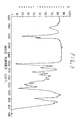
- the IR spectrum of the curable resin is shown in Fig. 3.
- the curable resin had a number average molecular weight of 1000, measured by gel permeation chromatography (GPC).
- a black melamine-acrylic enamel was spray-coated on a plate (30 cm x 10 cm x 0.08 mm) coated with an electrodeposition intermediate coating so as to give a dry film thickness of 10 to 15 ⁇ m, the film was allowed to stand for 1 minute, then the clear coating was spray-coated on the film so as to give a dry film thickness of 40 to 50 ⁇ m. The film was allowed to stand for 5 minutes, it was baked at 140°C for 30 minutes, and it was allowed to stand at room temperature for one day.
- the viscosity of the curable resin solution having a solid concentration of 60 % was measured at 23°C by using a Brookfield viscometer.
- the pencil hardness of the film was measured according to Japanese Industrial Standards (JIS) K 5400.
- the 20°-gloss of the film was measured.
- the test piece was dipped in a 1 % solution of sulfuric acid for 24 hours, and then the 20°-gloss of the film was measured again.
- the test piece was horizontally set, and an abrasive composed of 1.2 % of a loam having an abrasive grain size of # 8 provided in JIS, 1.2 % of a loam having an abrasive grain size of # 11 provided in JIS, 0.6 % of kaoline, 1.0 % of a neutral detergent and 96.0 % of water was applied onto the coating film of the test piece.
- a weight (diameter of contact surface: 5 cm a load: 22 g/cm 2 ) covered with a craft paper was stroked against the surface of the coating film.
- the lightness of the film was measured before stroking and after 12 strokes and 100 strokes by using a differential colorimeter.
- the scratch resistance is estimated according to the difference ( ⁇ L) between the lightness of the film which was not stroked and the lightness of the film which was stroked 12 times or 100 times. The smaller the ⁇ L, the more excellent the scratch resistance.
- a test piece (30 cm x 10 cm x 0.08 mm) is prepared by coating a mild steel plate with the curable resin or composition so as to get a dry film thickness of 50 ⁇ m.
- the test piece is bended by using a mandrel tester commercially available from Ericksen Corp. and the length (cm) of crack is measured.
- Example 2 The procedure of Example 1 was repeated except that 49 g of hexamethylene diisocyanate was used instead of 73 g of cyclohexyl isocyanate to give a curable resin solution (2) containing a solid concentration of 60 %.
- the curable resin had a number average molecular weight of 1500 measured by GPC.
- Example 1 The procedure of Example 1 was repeated except that 98 g of tri(6-isocyanatohexyl)isocyanurate was used instead of 73 g of cyclohexyl isocyanate to give a curable resin solution (3) having a solid concentration of 60 %.
- the curable resin had a number average molecular weight of 3,000 measured by GPC.
- test piece was prepared in the same manner as in Example 1.
- reaction temperature was dropped to 30°C, 70.9 g of 3-aminopropyltrimethoxysilane were added, and the reaction was conducted for 1 hour and then was continued at 60°C for 30 minutes.
- reaction temperature was dropped to 30°C, and 44.6 g of cyclohexylisocyanate were gradually added through a dropping funnel to the reaction system.
- the reaction was conducted at 60°C for 30 minutes and the reaction product was diluted with xylene to give a curable resin solution (4) having a solids concentration of 60 %.
- the curable resin had a number average molecular weight of 1600 measured by GPC.
- test piece was prepared in the same manner as in Example 1.
- a test price was prepared in the same manner as in Example 1 except that a commercial melamine-acrylic clear coating was used instead of the clear coating obtained in Example 1.
- the curable resin solution (1) was mixed with the hydrolyzable silyl group-containing acrylic copolymer obtained in Reference Example 1 in amounts shown in Table 2 to give a composition.
- test piece was prepared in the same manner as in Example 1 except that the obtained composition was used instead of the curable resin.
Landscapes
- Chemical & Material Sciences (AREA)
- Health & Medical Sciences (AREA)
- Chemical Kinetics & Catalysis (AREA)
- Medicinal Chemistry (AREA)
- Polymers & Plastics (AREA)
- Organic Chemistry (AREA)
- General Chemical & Material Sciences (AREA)
- Polyurethanes Or Polyureas (AREA)
- Paints Or Removers (AREA)
- Compositions Of Macromolecular Compounds (AREA)
Claims (10)
- Résine durcissable ayant une masse moléculaire moyenne en nombre de 600 à 6000 et au moins deux groupes silyle hydrolysables dans une molécule,
susceptible d'être obtenue par :(i) réaction d'une résine polyester aliphatique (A) ayant, dans une molécule à la fois un groupe acryloyle et un groupe hydroxyle alcoolique sur les extrémités du polymère, avec un composé isocyanate/silane (B) répondant à la formule (I) (ii) réaction du produit de réaction obtenu (i) avec un composé aminosilane (C) répondant à la formule (II) :
et(iii) réaction de la résine aminosilane-modifiée (ii) avec un composé isocyanate organique monofonctionnel (D-1) répondant à la formule (III)
OCN-R5 (III)
dans laquelle R5 est un groupe hydrocarbure monovalent ayant de 1 à 25 atomes de carbone choisi parmi un groupe alkyle, un groupe cycloalkyle en C6-25, un groupe aryle et un groupe aralkyle, un groupe de formule :

- Résine durcissable selon la revendication 1, dans laquelle l'édifice de base de ladite résine durcissable est principalement la polycaprolactone.
- Résine durcissable selon la revendication 1, dans laquelle l'édifice de base de ladite résine durcissable est principalement la polyvalérolactone.
- Résine durcissable selon la revendication 1, dans laquelle, dans la formule (I), le groupe X1 est un groupe méthoxy et le nombre entier m est 3.
- Résine durcissable selon la revendication 1, dans laquelle, dans la formule (II), le groupe X2 est un groupe méthoxy et le nombre entier n est 3.
- Résine durcissable selon la revendication 1, dans laquelle, dans la formule (I), le groupe X1 est un groupe méthyle et le nombre entier m est 3 et, dans la formule (II), le groupe X2 est un groupe méthoxy et le nombre entier n est 3.
- Résine durcissable selon la revendication 1, dans laquelle, dans la formule (I), le groupe R2 est un groupe méthyle, le groupe X1 est un groupe méthoxy et le nombre entier m est 2.
- Résine durcissable selon la revendication 1, dans laquelle, dans la formule (II), le groupe R4 est un groupe méthyle, le groupe X2 est un groupe méthoxy et le nombre entier n est 2.
- Résine durcissable selon la revendication 1, dans laquelle, dans la formule (I), le groupe R2 est un groupe méthyle, le groupe X1 est un groupe méthoxy et le nombre entier m est 2 et, dans la formule (II), le groupe R4 est un groupe méthyle, le groupe X2 est un groupe méthoxy et le nombre entier n est 2.
- Composition comprenant :(a) 5 à 95 parties en poids d'un polymère vinylique contenant un groupe silyle ayant, dans une molécule, au moins un groupe silyle représenté par la formule (IV) :
 b) 95 à 5 parties en poids d'une résine durcissable selon la revendication 1, la quantité totale de la résine durcissable (b) et du polymère vinylique (a) étant de 100 parties en poids.
Applications Claiming Priority (2)
| Application Number | Priority Date | Filing Date | Title |
|---|---|---|---|
| JP27190390 | 1990-10-09 | ||
| JP271903/90 | 1990-10-09 |
Publications (3)
| Publication Number | Publication Date |
|---|---|
| EP0480363A2 EP0480363A2 (fr) | 1992-04-15 |
| EP0480363A3 EP0480363A3 (en) | 1992-11-19 |
| EP0480363B1 true EP0480363B1 (fr) | 1997-01-08 |
Family
ID=17506499
Family Applications (1)
| Application Number | Title | Priority Date | Filing Date |
|---|---|---|---|
| EP91117111A Expired - Lifetime EP0480363B1 (fr) | 1990-10-09 | 1991-10-08 | Résine durcissable et composition la contenant |
Country Status (5)
| Country | Link |
|---|---|
| US (1) | US5241000A (fr) |
| EP (1) | EP0480363B1 (fr) |
| AU (1) | AU639608B2 (fr) |
| CA (1) | CA2052842C (fr) |
| DE (1) | DE69124053T2 (fr) |
Families Citing this family (16)
| Publication number | Priority date | Publication date | Assignee | Title |
|---|---|---|---|---|
| GB9023522D0 (en) * | 1990-10-30 | 1990-12-12 | Ici Plc | Curable composition |
| GB9023979D0 (en) * | 1990-11-05 | 1990-12-19 | Ici Plc | Curable composition |
| DE69301158T2 (de) * | 1992-01-17 | 1996-05-30 | Kanegafuchi Chemical Ind | Härtbare Lackzusammensetzung |
| EP0671450B1 (fr) * | 1993-09-29 | 2002-08-21 | Nippon Shokubai Co., Ltd. | Utilisation d'une composition de traitement de surface comme revetement pour reduire la permeabilite aux gaz |
| JP2742041B2 (ja) * | 1996-05-10 | 1998-04-22 | 日本エヌエスシー株式会社 | 複合水分散体の製法及び複合皮膜形成可能な水分散体 |
| US6080816A (en) * | 1997-11-10 | 2000-06-27 | E. I. Du Pont De Nemours And Company | Coatings that contain reactive silicon oligomers |
| US6046270A (en) * | 1998-10-14 | 2000-04-04 | Bayer Corporation | Silane-modified polyurethane resins, a process for their preparation and their use as moisture-curable resins |
| DE19910905A1 (de) * | 1999-03-11 | 2000-09-21 | Fraunhofer Ges Forschung | Verwendung von makromolekularen Zusammensetzungen auf Silanbasis als gegenüber konzentrierten oxidierenden Säuren widerstandsfähige Werkstoffe |
| DE10053545A1 (de) * | 2000-10-27 | 2002-05-08 | Henkel Kgaa | Polymere mit Harnstoffgruppen und Silylgruppen, deren Herstellung und Verwendung |
| ES2316066T3 (es) * | 2005-03-11 | 2009-04-01 | The Sherwin-Williams Company | Composicion de revestimiento curable resistente al rayado. |
| US20090111912A1 (en) * | 2006-09-21 | 2009-04-30 | Ppg Industries Ohio, Inc. | Low temperature, moisture curable coating compositions and related methods |
| US7868120B2 (en) * | 2006-09-21 | 2011-01-11 | Ppg Industries Ohio, Inc. | Low temperature, moisture curable coating compositions and related methods |
| DE102007023197A1 (de) | 2007-05-22 | 2008-11-27 | Bayer Materialscience Ag | Polyester-Prepolymere |
| JP5701297B2 (ja) | 2009-08-31 | 2015-04-15 | ビック−ケミー ゲゼルシャフト ミット ベシュレンクテル ハフツング | 種々の基板表面へのコーティング用接着促進剤 |
| CN102260455A (zh) * | 2010-05-29 | 2011-11-30 | 比亚迪股份有限公司 | 一种涂层及含有该涂层的光学元件 |
| AU2012253936B2 (en) * | 2011-05-10 | 2016-02-18 | Dow Global Technologies Llc | Curable composition for use as lost circulation material |
Family Cites Families (10)
| Publication number | Priority date | Publication date | Assignee | Title |
|---|---|---|---|---|
| JPS5436395A (en) * | 1977-08-25 | 1979-03-17 | Kanegafuchi Chem Ind Co Ltd | Novel vinyl type resins, their preparation, and coatings containing the same |
| US4334036A (en) * | 1978-08-24 | 1982-06-08 | Kanegafuchi Kagaku Kogyo Kabushiki Kaisha | Process for producing curable vinyl polymer having silyl group |
| JPS5643364A (en) * | 1979-09-19 | 1981-04-22 | Kanegafuchi Chem Ind Co Ltd | Coating composition |
| US4429082A (en) * | 1982-05-10 | 1984-01-31 | Ppg Industries, Inc. | Film-forming resins containing alkoxy silane groups |
| US4430486A (en) * | 1982-11-29 | 1984-02-07 | Ppg Industries, Inc. | Film-forming urethane resins containing alkoxy silane groups and acrylyl groups |
| US4652610A (en) * | 1986-01-03 | 1987-03-24 | Ppg Industries, Inc. | Compositions based on silicon-containing resins having hydrolyzable groups |
| JPS62249992A (ja) * | 1986-04-24 | 1987-10-30 | Nippon Kayaku Co Ltd | 新規なシリコンウレタン(メタ)アクリレ−ト,これを用いた樹脂組成物およびコ−テイング剤 |
| DE3786328T2 (de) * | 1986-09-30 | 1993-10-21 | Kanegafuchi Chemical Ind | Härtbare Zusammensetzung auf der Basis eines silikonfunktionellen organischen Polymers. |
| JPH0618866B2 (ja) * | 1986-12-22 | 1994-03-16 | 鐘淵化学工業株式会社 | 常温硬化性樹脂の製造法 |
| US5068304A (en) * | 1988-12-09 | 1991-11-26 | Asahi Glass Company, Ltd. | Moisture-curable resin composition |
-
1991
- 1991-10-04 CA CA002052842A patent/CA2052842C/fr not_active Expired - Fee Related
- 1991-10-07 US US07/772,291 patent/US5241000A/en not_active Expired - Lifetime
- 1991-10-08 EP EP91117111A patent/EP0480363B1/fr not_active Expired - Lifetime
- 1991-10-08 DE DE69124053T patent/DE69124053T2/de not_active Expired - Fee Related
- 1991-10-08 AU AU85679/91A patent/AU639608B2/en not_active Ceased
Also Published As
| Publication number | Publication date |
|---|---|
| AU639608B2 (en) | 1993-07-29 |
| US5241000A (en) | 1993-08-31 |
| AU8567991A (en) | 1992-04-16 |
| EP0480363A3 (en) | 1992-11-19 |
| DE69124053T2 (de) | 1997-07-03 |
| CA2052842C (fr) | 1999-08-24 |
| DE69124053D1 (de) | 1997-02-20 |
| CA2052842A1 (fr) | 1992-04-10 |
| EP0480363A2 (fr) | 1992-04-15 |
Similar Documents
| Publication | Publication Date | Title |
|---|---|---|
| US4491650A (en) | Acrylic resin having pendant silane groups thereon, and methods of making and using the same | |
| US5241000A (en) | Curable resin and composition containing the same | |
| AU647089B2 (en) | Star polymer of tri to octafunctional thiol with addition polymers having hydrolysable group-bearing silicon atoms | |
| RU2502769C2 (ru) | Покровное средство с высокой стойкостью к царапанью и устойчивостью к атмосферным воздействиям | |
| US7122599B2 (en) | Coating compositions and polymeric moulding compounds having anti-adhesion and dirt repellency properties | |
| EP0274112B1 (fr) | Procédé de préparation de résines durcissant à la température ambiante | |
| US4567107A (en) | Acrylic resin having pendant silane groups thereon, and methods of making and using the same | |
| EP0158893A1 (fr) | Prépolymères d'isocyanate contenant des silanes | |
| CA2041060A1 (fr) | Melanges reactionnels et compositions de revetement a base de polyurethane | |
| JP2018524418A (ja) | ポリウレタンコーティング組成物 | |
| GB2197325A (en) | Acrylic polymer curing composition | |
| US4222909A (en) | Coating compositions comprising isocyanate-functional polymers containing a terminal thioalkyl group | |
| JPH06279586A (ja) | ポリメチルシルセスキオキサン系重合体およびポリメチルシルセスキオキサン構造を有するポリマー | |
| EP0554684B1 (fr) | Composition durcissable pour peinture | |
| EP0354378B1 (fr) | Résine durcissable et procédé pour sa préparation | |
| US4446175A (en) | Coatings formed from isocyanate-functional polymers containing a terminal monosulfide group | |
| US4351755A (en) | Isocyanate-functional polymers containing a terminal monosulfide group | |
| JP3086737B2 (ja) | 塗料用硬化性組成物 | |
| JP3144852B2 (ja) | 硬化性樹脂およびそれを含有する組成物 | |
| JPH0525245B2 (fr) | ||
| KR970009327B1 (ko) | 자체-가교결합수지 | |
| CZ128496A3 (en) | Low-molecular hydroxyfunctional copolymers with high branching of side chains, process of their preparation and use | |
| JP3124360B2 (ja) | 塗料用硬化性組成物 | |
| CA1274933A (fr) | Composes a base de resines a atomes de silicium lies a des groupes hydrolysables derives de vinylsilanes et de composes a groupes fonctionnels mercapto | |
| US4436885A (en) | Preparation of isocyanate-functional polymers containing a terminal monosulfide group |
Legal Events
| Date | Code | Title | Description |
|---|---|---|---|
| PUAI | Public reference made under article 153(3) epc to a published international application that has entered the european phase |
Free format text: ORIGINAL CODE: 0009012 |
|
| AK | Designated contracting states |
Kind code of ref document: A2 Designated state(s): BE DE FR GB IT NL SE |
|
| PUAL | Search report despatched |
Free format text: ORIGINAL CODE: 0009013 |
|
| AK | Designated contracting states |
Kind code of ref document: A3 Designated state(s): BE DE FR GB IT NL SE |
|
| 17P | Request for examination filed |
Effective date: 19930511 |
|
| 17Q | First examination report despatched |
Effective date: 19950512 |
|
| GRAG | Despatch of communication of intention to grant |
Free format text: ORIGINAL CODE: EPIDOS AGRA |
|
| GRAH | Despatch of communication of intention to grant a patent |
Free format text: ORIGINAL CODE: EPIDOS IGRA |
|
| GRAH | Despatch of communication of intention to grant a patent |
Free format text: ORIGINAL CODE: EPIDOS IGRA |
|
| GRAA | (expected) grant |
Free format text: ORIGINAL CODE: 0009210 |
|
| AK | Designated contracting states |
Kind code of ref document: B1 Designated state(s): BE DE FR GB IT |
|
| REF | Corresponds to: |
Ref document number: 69124053 Country of ref document: DE Date of ref document: 19970220 |
|
| ET | Fr: translation filed | ||
| ITF | It: translation for a ep patent filed | ||
| PLBE | No opposition filed within time limit |
Free format text: ORIGINAL CODE: 0009261 |
|
| STAA | Information on the status of an ep patent application or granted ep patent |
Free format text: STATUS: NO OPPOSITION FILED WITHIN TIME LIMIT |
|
| 26N | No opposition filed | ||
| REG | Reference to a national code |
Ref country code: GB Ref legal event code: IF02 |
|
| PGFP | Annual fee paid to national office [announced via postgrant information from national office to epo] |
Ref country code: GB Payment date: 20021002 Year of fee payment: 12 |
|
| PGFP | Annual fee paid to national office [announced via postgrant information from national office to epo] |
Ref country code: FR Payment date: 20021008 Year of fee payment: 12 |
|
| PGFP | Annual fee paid to national office [announced via postgrant information from national office to epo] |
Ref country code: BE Payment date: 20021219 Year of fee payment: 12 |
|
| PG25 | Lapsed in a contracting state [announced via postgrant information from national office to epo] |
Ref country code: GB Free format text: LAPSE BECAUSE OF NON-PAYMENT OF DUE FEES Effective date: 20031008 |
|
| PG25 | Lapsed in a contracting state [announced via postgrant information from national office to epo] |
Ref country code: BE Free format text: LAPSE BECAUSE OF NON-PAYMENT OF DUE FEES Effective date: 20031031 |
|
| PGFP | Annual fee paid to national office [announced via postgrant information from national office to epo] |
Ref country code: DE Payment date: 20040226 Year of fee payment: 13 |
|
| BERE | Be: lapsed |
Owner name: *KANEGAFUCHI KAGAKU KOGYO K.K. Effective date: 20031031 |
|
| GBPC | Gb: european patent ceased through non-payment of renewal fee |
Effective date: 20031008 |
|
| PG25 | Lapsed in a contracting state [announced via postgrant information from national office to epo] |
Ref country code: FR Free format text: LAPSE BECAUSE OF NON-PAYMENT OF DUE FEES Effective date: 20040630 |
|
| REG | Reference to a national code |
Ref country code: FR Ref legal event code: ST |
|
| PG25 | Lapsed in a contracting state [announced via postgrant information from national office to epo] |
Ref country code: DE Free format text: LAPSE BECAUSE OF NON-PAYMENT OF DUE FEES Effective date: 20050503 |
|
| PG25 | Lapsed in a contracting state [announced via postgrant information from national office to epo] |
Ref country code: IT Free format text: LAPSE BECAUSE OF NON-PAYMENT OF DUE FEES;WARNING: LAPSES OF ITALIAN PATENTS WITH EFFECTIVE DATE BEFORE 2007 MAY HAVE OCCURRED AT ANY TIME BEFORE 2007. THE CORRECT EFFECTIVE DATE MAY BE DIFFERENT FROM THE ONE RECORDED. Effective date: 20051008 |