EP0480449A2 - Méthode et dispositif pour la préparation d'un article de communication tel qu'une carte postale et une eveloppe - Google Patents
Méthode et dispositif pour la préparation d'un article de communication tel qu'une carte postale et une eveloppe Download PDFInfo
- Publication number
- EP0480449A2 EP0480449A2 EP19910117366 EP91117366A EP0480449A2 EP 0480449 A2 EP0480449 A2 EP 0480449A2 EP 19910117366 EP19910117366 EP 19910117366 EP 91117366 A EP91117366 A EP 91117366A EP 0480449 A2 EP0480449 A2 EP 0480449A2
- Authority
- EP
- European Patent Office
- Prior art keywords
- sheet
- continuous sheet
- film
- communication
- forming
- Prior art date
- Legal status (The legal status is an assumption and is not a legal conclusion. Google has not performed a legal analysis and makes no representation as to the accuracy of the status listed.)
- Withdrawn
Links
Images






Classifications
-
- B—PERFORMING OPERATIONS; TRANSPORTING
- B42—BOOKBINDING; ALBUMS; FILES; SPECIAL PRINTED MATTER
- B42D—BOOKS; BOOK COVERS; LOOSE LEAVES; PRINTED MATTER CHARACTERISED BY IDENTIFICATION OR SECURITY FEATURES; PRINTED MATTER OF SPECIAL FORMAT OR STYLE NOT OTHERWISE PROVIDED FOR; DEVICES FOR USE THEREWITH AND NOT OTHERWISE PROVIDED FOR; MOVABLE-STRIP WRITING OR READING APPARATUS
- B42D15/00—Printed matter of special format or style not otherwise provided for
- B42D15/02—Postcards; Greeting, menu, business or like cards; Letter cards or letter-sheets
- B42D15/04—Foldable or multi-part cards or sheets
- B42D15/08—Letter-cards or letter-sheets, i.e. cards or sheets each of which is to be folded with the message inside and to serve as its own envelope for mailing
-
- B—PERFORMING OPERATIONS; TRANSPORTING
- B42—BOOKBINDING; ALBUMS; FILES; SPECIAL PRINTED MATTER
- B42D—BOOKS; BOOK COVERS; LOOSE LEAVES; PRINTED MATTER CHARACTERISED BY IDENTIFICATION OR SECURITY FEATURES; PRINTED MATTER OF SPECIAL FORMAT OR STYLE NOT OTHERWISE PROVIDED FOR; DEVICES FOR USE THEREWITH AND NOT OTHERWISE PROVIDED FOR; MOVABLE-STRIP WRITING OR READING APPARATUS
- B42D5/00—Sheets united without binding to form pads or blocks
- B42D5/02—Form sets
- B42D5/023—Continuous form sets
- B42D5/025—Mailer assemblies
-
- B—PERFORMING OPERATIONS; TRANSPORTING
- B42—BOOKBINDING; ALBUMS; FILES; SPECIAL PRINTED MATTER
- B42D—BOOKS; BOOK COVERS; LOOSE LEAVES; PRINTED MATTER CHARACTERISED BY IDENTIFICATION OR SECURITY FEATURES; PRINTED MATTER OF SPECIAL FORMAT OR STYLE NOT OTHERWISE PROVIDED FOR; DEVICES FOR USE THEREWITH AND NOT OTHERWISE PROVIDED FOR; MOVABLE-STRIP WRITING OR READING APPARATUS
- B42D15/00—Printed matter of special format or style not otherwise provided for
- B42D15/02—Postcards; Greeting, menu, business or like cards; Letter cards or letter-sheets
- B42D15/04—Foldable or multi-part cards or sheets
- B42D15/08—Letter-cards or letter-sheets, i.e. cards or sheets each of which is to be folded with the message inside and to serve as its own envelope for mailing
- B42D15/085—Letter-cards or letter-sheets, i.e. cards or sheets each of which is to be folded with the message inside and to serve as its own envelope for mailing with special means hiding information
-
- Y—GENERAL TAGGING OF NEW TECHNOLOGICAL DEVELOPMENTS; GENERAL TAGGING OF CROSS-SECTIONAL TECHNOLOGIES SPANNING OVER SEVERAL SECTIONS OF THE IPC; TECHNICAL SUBJECTS COVERED BY FORMER USPC CROSS-REFERENCE ART COLLECTIONS [XRACs] AND DIGESTS
- Y10—TECHNICAL SUBJECTS COVERED BY FORMER USPC
- Y10T—TECHNICAL SUBJECTS COVERED BY FORMER US CLASSIFICATION
- Y10T156/00—Adhesive bonding and miscellaneous chemical manufacture
- Y10T156/10—Methods of surface bonding and/or assembly therefor
- Y10T156/1002—Methods of surface bonding and/or assembly therefor with permanent bending or reshaping or surface deformation of self sustaining lamina
- Y10T156/1007—Running or continuous length work
- Y10T156/1008—Longitudinal bending
- Y10T156/1011—Overedge bending or overedge folding
-
- Y—GENERAL TAGGING OF NEW TECHNOLOGICAL DEVELOPMENTS; GENERAL TAGGING OF CROSS-SECTIONAL TECHNOLOGIES SPANNING OVER SEVERAL SECTIONS OF THE IPC; TECHNICAL SUBJECTS COVERED BY FORMER USPC CROSS-REFERENCE ART COLLECTIONS [XRACs] AND DIGESTS
- Y10—TECHNICAL SUBJECTS COVERED BY FORMER USPC
- Y10T—TECHNICAL SUBJECTS COVERED BY FORMER US CLASSIFICATION
- Y10T156/00—Adhesive bonding and miscellaneous chemical manufacture
- Y10T156/10—Methods of surface bonding and/or assembly therefor
- Y10T156/1002—Methods of surface bonding and/or assembly therefor with permanent bending or reshaping or surface deformation of self sustaining lamina
- Y10T156/1007—Running or continuous length work
- Y10T156/1015—Folding
-
- Y—GENERAL TAGGING OF NEW TECHNOLOGICAL DEVELOPMENTS; GENERAL TAGGING OF CROSS-SECTIONAL TECHNOLOGIES SPANNING OVER SEVERAL SECTIONS OF THE IPC; TECHNICAL SUBJECTS COVERED BY FORMER USPC CROSS-REFERENCE ART COLLECTIONS [XRACs] AND DIGESTS
- Y10—TECHNICAL SUBJECTS COVERED BY FORMER USPC
- Y10T—TECHNICAL SUBJECTS COVERED BY FORMER US CLASSIFICATION
- Y10T83/00—Cutting
- Y10T83/788—Tool pair comprises rotatable anvil and fixed-type tool
- Y10T83/793—Anvil has motion in addition to rotation [i.e., traveling anvil]
-
- Y—GENERAL TAGGING OF NEW TECHNOLOGICAL DEVELOPMENTS; GENERAL TAGGING OF CROSS-SECTIONAL TECHNOLOGIES SPANNING OVER SEVERAL SECTIONS OF THE IPC; TECHNICAL SUBJECTS COVERED BY FORMER USPC CROSS-REFERENCE ART COLLECTIONS [XRACs] AND DIGESTS
- Y10—TECHNICAL SUBJECTS COVERED BY FORMER USPC
- Y10T—TECHNICAL SUBJECTS COVERED BY FORMER US CLASSIFICATION
- Y10T83/00—Cutting
- Y10T83/929—Tool or tool with support
- Y10T83/9309—Anvil
Definitions
- the present invention relates to a method and apparatus for producing communication articles such as postcards, envelopes or the like.
- the present invention relates to a method and apparatus for producing communication articles such as postcards, envelopes or the like in which display surfaces for information or the like are separably bonded by heating them through a synthetic resin film or the like in order to conceal information such as correspondence or a print display medium, and then mail it.
- a continuous sheet is used for both the upper and lower sheets and is cut to each sheet's predetermined size after the upper and lower sheets are bonded with the intermediate sheet therebetween to produce communication article such as postcards or the like.
- one continuous sheet is cut by a cutter into sheet portions which are used as the upper and lower sheets, and the intermediate sheet is then interposed between the upper and lower sheets.
- the position of the intermediate sheet interposed between the two sheets is easily deviated. This results in the danger of producing defective products.
- the present invention has been achieved to solve the above problems, and it is an object of the present invention to provide a method and apparatus for producing communication articles such as postcards, envelopes or the like which are capable of easily and smoothly cutting sheets with a film therebetween and accurately interposing the film between the sheets.
- the present invention provides a method of producing communication articles such as postcards, envelopes or the like in which a sheet for forming a communication article such as a postcard, envelope or the like is formed so that it can be folded at least once, and a synthetic resin film is interposed between sheet portions into which the sheet for forming a communication article is folded so that the two sheet portions are separably bonded with the film therebetween, the method comprising folding at least double a continuous sheet having a plurality of sheets for forming communication articles which are connected in series while conveying the continuous sheet, interposing a continuous film between the sheet portions into which the sheet is folded to form a film-containing continuous sheet, heating the film-containing continuous sheet, pressing the film-containing continuous sheet so as to bond the sheet portions of the continuous sheet with the film therebetween, and then hitting the portions between the respective sheets for forming communication articles of the continuous sheet while pulling the film-containing continuous sheet so as to separate the continuous sheet into the sheets for forming communication articles.
- the present invention also provides an apparatus for producing communication articles such as postcards, envelopes or the like in which a sheet for forming communicatin articles such as postcards, envelopes or the like is formed so that it can be folded into at least two, and a synthetic resin film is interposed between the sheet portions into which the sheet for forming communication articles is folded so that the two sheet portions are separably bonded with the film therebetween,
- the apparatus comprising a folding device for folding a continuous sheet having a plurality of communication article-forming sheets which are connected in series into at least two while conveying the continuous sheet, a film inserting device for inserting a continuous film between the sheet portions into which the continuous sheet is folded by the folding device to form a film-containing continuous sheet, a heating device for heating the film-containing continuous sheet having the film inserted therebetween by the film inserting device, a press device for pressing the film-containing continuous sheet which is heated by the heating device so as to bond the sheet portions of the continuous sheet with the film therebetween, and a separating device for separating the continuous sheet
- the continuous sheet is first folded into at least two portions, the film is inserted between the portions to form a film-containing sheet which is then heated and pressed so that the sheet portions with the film therebetween are bonded, and the film-containing sheet is then separated into the respective communication article-forming sheets by hitting the portions between the respective communication article-forming sheets while pulling the film-containing continuous sheet to continuously and automatically produce communication articles.
- the film can be accurately interposed between the sheet portions into which the continuous sheet is folded, without producing any positional deviation.
- the film-containing continuous sheet having the sheet portions which are heated and bonded with the film therebetween is separated into the communication article-forming sheets by hitting the portions between the respective communication article-forming sheets while pulling the film-containing continuous sheet, the sheet is easily and accurately separated.
- the method of separating the film-containing continuous sheet into the communication article-forming sheets by hitting the sheet produces no distortion at the edge of the film cut.
- Fig. 1 is a schematic front view of the whole postcard producing apparatus. The arrangement of the whole apparatus is outlined below.
- reference numeral 1 denotes a folding device for folding, in three, a continuous sheet 2 used for producing postcards
- reference numeral 3 denotes a film inserting device for inserting synthetic resin films 6, 7 into the continuous sheet 2 folded.
- the film inserting device 3 is provided with two guide means 4, 5 for guiding the films to the portions between the sheet portions of the continuous sheet 2 folded.
- Reference numeral 8 denotes an edge cutting device for cutting the edges 37 of the continuous sheet 2.
- Reference numeral 9 denotes a heating device for heating a film-containing continuous sheet 2d having the films 6, 7 which are inserted therein
- reference numeral 10 denotes press rollers for pressing the film-containing continuous sheet 2d which is heated by the heating device 9 so as to bond the films to the continuous sheet 2.
- Reference numeral 11 denotes a separating device for separating the film-containing continuous sheet 2d.
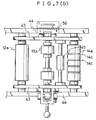
- the separating device 11 comprises first rollers 12a, 12b, second rollers 13a, 13b both of which are rotated at the same speed as that of the first rollers 12a, 12b, third rollers 14a, 14b both of which are rotated at a speed higher than that of the first and second rollers 12a, 12b, 13a, 13b, and shock blocks 15c for hitting the film-containing continuous sheet 2d so as to separate the sheet 2d.
- Reference numeral 16 denotes a discharge conveyor for forwardly conveying th produced postcards which are piled.
- reference numeral 26 denotes the base of the folding device, a frame 17 being erectly provided on the base 26, and a support plate 18 being provided on the upper portion of the frame 17.
- Reference numeral 19 denotes a conveying roll for conveying the continuous sheet 2 folded; reference numeral 20, a bottom roll for upwardly transferring the continuous sheet 2 which is downwardly conveyed by the conveying roll 19; and reference numeral 21, folding starting rods which are provided slightly above the bottom roll 20.
- Referenc numeral 22 denotes a double folding rod for folding the continuous sheet 2 in two after folding has been started by the folding starting rods 21, and reference numeral 23 denotes an upper roll which is provided slightly above the double folding rod 22, the upper roll 23 and the double folding rod 22 being rotatably supported by the support plate 18.
- Reference numeral 24 denotes treble folding rods for folding, in three, the continuous sheet 2 which is transferred by the upper roll 23, a direction changing roll 25 being provided below the treble folding rods 24.
- the treble folding rods 24 and the direction changing rod 25 are rotatably supported by the L-shaped plate 27 provided on a side of the support plate 18.
- reference numeral 28 denotes a roll on which one film 6 to be inserted is wound
- reference numeral 29 denotes a roll on which the other film 7 is wound.
- Reference numerals 4, 5 denote guide means for guiding the films supplied from the rolls 28, 29, respectively, into the continuous sheet 2.
- Reference numeral 30 denotes a guide roller for conveying the continuous sheet supplied from the folding device 1 to the side of the guide means 4, 5.
- reference numeral 31 denotes a first roller
- reference numeral 32 denotes second rollers which are provided at a distance from the first roller 31 on the same plane as the first roller 31
- Reference numeral 33 denotes a third roller which is provided below the first roller 31 for holding the continuous sheet 2 between the first and third rollers 31, 33
- reference numeral 34 denotes edge cutting rollers provided at a position below the first and second rollers 31, 32 between them for cutting the edges of the continuous sheet 2.
- a round belt 35 is wound around the first roller 31, each of the second rollers 32 and each of the edge cutting rollers 34.
- Each of the edge cutting rollers 34 has a groove 36 formed therein so that the round belt 35 is inserted into the groove 36.
- reference numeral 38 denotes an upper heater
- reference numeral 39 denotes a lower heater.
- the upper heater 38 is provided on a base 40 through an air cylinder 41 and a rod 41a so that it can be moved upward and downward.
- the lower heater 39 is provided on the base 40 through an air cylinder 42 and a rod 42a so that it can be moved upward and downward.
- reference numeral 10 denotes upper and lower press rolls provided for bonding the continuous sheet 2 heated by the heating device to the films 6, 7 by heating them, in which each roll are placed above and below the continuous sheet 2, being respectively provided in pairs.
- reference numerals 12a, 12b denote upper and lower first rollers; reference numerals 13a, 13b, upper and lower second rollers; and reference numeral 14a, 14b, upper and lower third rollers, the three types of rollers being respectively provided in pairs.
- the three upper rollers 12a, 13a, 14a are supported by right and left support plates 43, and the three lower rollers 12b, 13b, 14b are supported by right and left support plates 44.
- the support plates 43 for supporting the upper rollers 12a, 13a, 14a are rotated with respect to the support plates 44 for supporting the lower rollers 12b, 13b, 14b so that the upper rollers 12a, 13a, 14a being in contact with the lower rollers 12b, 13b, 14b, respectively, in a normal state can be rotated around a shaft 56 with respect to the lower rollers 12b, 13b, 14b.
- Each of the upper and lower third rollers 14a, 14b has a plurality of slits 14c formed thereon.
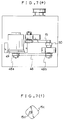
- Reference numeral 15 denotes a vibration rod which is provided with two shock blocks 15c at both sides thereof for hitting the film-containing continuous sheet 2d and which has both ends 15a, 15b, and the one end 15b is moved upward and downward around the other end 15a serving as a center.
- Reference numeral 45 denotes a retainer provided above the center of the shock blocks 15c and the vibration rod 15 opposite to these members so as to hold the upper side of the film-containing continuous sheet 2d when the sheet 2d is hit by the shock blocks 15c.
- the shock blocks 15c are eccentrically provided on a shaft 15d.
- Reference numeral 46 denotes a belt wound around the lower third roller 14b and a motor for driving the third roller 14b.
- Reference numeral 48 denotes a belt wound around a pulley 48b and a pulley 48a which is coaxially provided on a motor 49 for driving the vibration rod 15.
- Reference numeral 50 denotes a connecting plate provided at one end 50a on the vibration rod 15, the other end 50b being eccentrically rotatably provided on the pulley 48b.
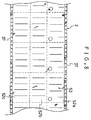
- the continuous sheet 2 comprising a plurality of postcard-forming sheets 53 each of which has sheet portions 52a, 52b, 52c and which are connected in series, as shown in Fig. 8, is folded into three by the folding device 1 shown in Fig. 2.
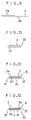
- the continuous sheet 2 After the folding of the continuous sheet 2 which is passed through the conveying roll 19 and the bottom roll 20 has been started by the folding starting rods 21, the continuous sheet 2 is folded into two by the double folding rod 22 so that the width of one leaf 2e of the continuous sheet 2 is about twice the width of the other leaf 2a, as shown in Fig. 9.
- the continuous sheet 2 folded in two is then conveyed to the treble folding rods 24 through the upper roll 23 and folded by the treble folding rods 24 to form three sheet portions 2a, 2b, 2c, as shown in Fig. 10.
- the continuous sheet 2 folded in three is then transferred to the next process through the direction changing roll 25.
- the continuous sheet 2 is folded while being conveyed and guided by a plurality of rods and rolls, the continuous sheet 2 is not subjected to concentrated tension. It is also an important point that during the folding operation, since the continuous sheet 2 is first folded in two by the double folding rod 22 so that the width of one sheet leaf 2e of the continuous sheet 2 is about twice the width of the other sheet leaf 2a, and the other sheet leaf 2c of the continuous sheet 2 is folded in the reverse direction to form the sheet 2 folded in three, no stress along a curved surface occurs, but only stress along the sheet surface mainly occurs during double folding and treble folding. It is therefore possible to effectively relieve the tension applied to the continuous sheet 2, without carelessly separating the continuous sheet 2 at a position of perforations.
- the continuous sheet 2 folded in three as described above is then sent to the process of inserting the two films 6, 7 by using the film inserting device 3.
- the continuous sheet 2 transferred from the folding device 1 is moved straight by the guide roller 30.
- the film 6 conveyed from one roll 28 is first inserted between the first and second sheet portions 2a and 2b of the continuous sheet 2 through the guide means 4, as shown in Fig. 11.
- the other film 7 conveyed from the other roll 29 is then inserted between the second and third sheet portions 2b and 2c of the continuous sheet 2 through the guide means 5, as shown in Fig. 12.
- Each of the films 6, 7 is changed in its moving direction at about 90° by a triangular guide plate (not shown) when being inserted between the respective sheet portions of the continuous sheet 2, as shown in Fig. 3(b).
- the edge cutting work is performed by the edge cutting device 8.
- the third rollers 33 are first driven by driving a motor (not shown). When the third rollers 33 are driven, the third rollers 33 are rotated, accompanied by the rotation of the first roller 31. The rotation of the first roller 31 causes the rotation of the second roller 32 and the edge cutting rollers 34, on both of which the belt 35 is wound.
- the edge cutting device 8 is operated.
- edges 37 of the film-containing continuous sheet 2d which is conveyed after the films are inserted therein by the film inserting device 3 are respectively downwardly pressed while being held by the first roller 31, the third rollers 33, the round belts 35 and the edge cutting rollers 34, whereby the edges 37 are cut.
- the round belts 35 are respectively inserted into the grooves 36 of the edge cutting rollers 34, the round belts 35 are not deviated from the edge cutting rollers 34 regardless of the pressure of the edges 37 acting on the round belts 35.
- heating is performed by the heating device 9.
- the upper heater 38 is separated from the lower heater 39 so that the heating work is stopped. Namely, if the air cylinders 41, 42 are operated, the upper heater 38 is upwardly moved through the rod 41a in the direction of arrow A in Fig. 5, and the lower heater 39 is downwardly moved through the rod 42a in the direction of arrow B so that the upper and lower heaters 38, 39 are separated from the film-containing continuous sheet 2d. This can rapidly prevent the characters or the like printed on the continuous sheet from being burnt.
- the continuous sheet 2d is bonded to the films 6, 7 by the press rollers 10.
- the film-containing continuous sheet 2d which is heated and bonded as described above is then separated in each predetermined size of postcard.
- the film-containing continuous sheet 2d is easily smoothly separated at each position of perforations 51 by virtue of the tensile force generated among the first rollers 12a, 12b, the second rollers 13a, 13b and the third rollers 14a, 14b corresponding to the transfer speeds thereof, as shown in Fig. 13, to produce postcards 52 each having a standard size.
- the film-containing continuous sheet 2d is hit by the shock blocks 15c provided on the vibration rod 15, while being held within a predetermined central region thereof by the upper retainer 45, as shown in Fig. 14(b).
- the film-containing continuous sheet 2d is thus torn at the portion of perforastions 50 from the both ends thereof to the center so that the film-containing sheet 2d can be smoothly separated.
- the interference amount of the vertical movement of the shock blocks 15c can be adjusted by adjusting the distance between the retainer 45 and the shock blocks 15c.
- the interference amount can also be adjusted by replacing the shock blocks 15c provided on the shaft 15d by other blocks.
- the terms "interference amount” represents the distance between the lower end of the retainer 45 and the upper end of each of the shock blocks 15c when the lower end of the retainer 45 is placed below the upper end of each of the shock blocks 15c.
- the interference amount is preferably adjusted so that the holding function of the retainer 45 and the hitting function of the shock blocks 15c are made effective.
- the stress applied to the film-containing continuous sheet 2d can be concentrated in the lengthwise direction thereof.
- the number of contacts between the film-containing continuous sheet 2d and the shock blocks 15c can be changed by changing the speed of the motor 47 in correspondence with the transfer velocity of the film-containing continuous sheet 2d, the difficulty in tearing the film material or the like, whereby the hitting force can be adjusted.
- the support plates 43 for supporting the upper rollers 12a, 13a, 14a is rotated, by using a lever 57, around the shaft 56 with respect to the support plates 44 for supporting the lower rollers 12b, 13b, 14b to create the open state shown in the drawings.
- the upper rollers 12a, 13a, 14a are separated from the lower rollers 12b, 13b, 14b, and the state where the film-containing continuous sheet 2d is held by the rollers is thus released. It is thus possible to discharge the film-containing continuous sheet 2d without damaging the sheet 2d and reproduce this portion.
- the film-containing continuous sheet 2d can be extracted with good workability, and the operation after the reproduction can be smoothly performed.
- the upper press roller 10 is rotated relative to the lower press roller 10 by using a lever 58 to produce an open state in the same way as in the separating device 11 in which each of the upper rollers is put into an open state.
- the upper heater 38 in the heating device 9 is rotated with respect to the lower heater 39 by using a lever 59 to create an open state
- the first roller 31, the second rollers 32, and the edge cutting rollers 34 are rotated with respect to the third roller 33 by using a lever 60 to produce an open state.
- the upper portion is put into an open state with respect the lower portion in each of the separating device 11, the press roller 10, the heating device 9 and the edge cutting device 8 so that the film-containing continuous sheet 2d can be smoothly easily discharged even if a trouble occurs in any place.
- the postcards 52 produced are successively piled on the discharge conveyor 16 and then forwardly slowly moved.
- the conveying velocity of the discharge conveyor 16 can be freely adjusted, whereby the piling amount can be adjusted.
- the postcards each of which is folded in three and has the films 6, 7 inserted therein are continuously automatically produced by the above-described method.
- the postcards produced need not to be folded in three, for example, the postcards may be folded in two. In a word, the postcards may be folded in at least two.
- the folding device 1 for postcards is also not limited to the structure above described in the embodiment, and the folding device 1 may have any structure suitable for folding in two.
- the structure of the film inserting device 3 is not limited to the structure provided with the guide means 4, 5 in the above embodiment, and the design can be changed arbitrarily.
- the edge cutting device 8 comprises the round belts 35 and the edge cutting rollers 34 so that the edges 37 can be cut by the pressure of both members, the embodiment has the preferable effect of easily cutting the edges 37.
- the structure of the edge cutting device 8 is not limited to that in the embodiment.
- edge cutting device 8 is dispensable in the invention.
- the structure of the heating device 9 is not limited to that in the embodiment, and the structure in which the upper heater 38 and the lower heater 39 can be separated by the function of the air cylinders 41, 42, as in the above embodiment, is also dispensable in the invention.
- press rollers 10 are independently provided in the embodiment, for example, the first roller 12 of the separating device 11 may also be used as the press rollers 10.
- the press device is not limited to the rollers in the embodiment, and any device can be employed so far as it is capable of pressing the film-containing continuous sheet 2d after heating.
- the structure of the separating device is not limited to that in the above embodiment, and any device having a structure which allows the sheet to be separated by the tensile force of at least two rollers which transfer the sheet at different speeds and a hitting mechanism can be used.
- the above embodiment has the preferable effect that the hitting force can be changed by changing the rotational speed of the motor 49 because the hitting mechanism is a link mechanism comprising the connecting plate 50, the vibration rod 15 and so on, such a link mechanism is a dispensable condition in the invention, and any hitting mechanism can be employed.
- each of the shock blocks 15c has a substantially square form , as shown in Fig. 7(b), the embodiment has the preferable effect that the separating effect can be further improved by attaching each of the shock blocks 15c in such a manner that the corner portion thereof contacts with the film-containing continuous sheet 2d.
- the shape of the each of the shock blocks 15c is not limited to the substantially square form, and, for example, the shock blocks may be formed into a roll.
- films 6, 7 are inserted after the continuous film 2 has been folded in the production method according to the embodiment, these operations may be simultaneously performed, regardless of the procedures thereof.
- the present invention can be applied to the postcards as well as envelopes.
- the present invention can be applied to any communicatin articles such as postcards, envelopes and the like.
- communication articles such as postcards, envelopes or the like are produced through a series of processes of folding, inserting films, heating, bonding by press and separating, the whole process of producing communicatin articles with films can be continuously automatically performed, and an attepmt can be made to perform the mass production of communication articles with films.
- the continuous sheet is not separated by simply employing only the tensile force caused by the speed difference between two rolls, as conventional apparatus, but the continuous sheet is separated by employing the tensile force and hitting the perforations at the bondaries between respective communication article-forming portions.
- the invention thus has the effect of easily, smoothly, securely separating the sheet into respective communicatin article-foring portions regardless of the interposition of the films in the continuous sheet.
- the invention thus has the effect of preventing the films from extruding from the edges of the communication articles produced and thus preferably preventing the occurence of defective products.
- the film since a film is not inserted between separate two sheets, as in conventional apparatuses, but a film is inserted between the sheet portions produced by folding the continuous sheet in at least two, the film can securely inserted between the sheet portions of the continuous sheet folded, without producing any positional deviation.
- the invention thus has no danger of producing a postional deviation between the continuous sheet and the films and the advantage of more preferably preventing the occurrence of defective products.
Landscapes
- Making Paper Articles (AREA)
- Credit Cards Or The Like (AREA)
- Perforating, Stamping-Out Or Severing By Means Other Than Cutting (AREA)
Applications Claiming Priority (2)
| Application Number | Priority Date | Filing Date | Title |
|---|---|---|---|
| JP2274520A JPH0790676B2 (ja) | 1990-10-12 | 1990-10-12 | 葉書、封書等の通信体の製造方法とその装置 |
| JP274520/90 | 1990-10-12 |
Publications (2)
| Publication Number | Publication Date |
|---|---|
| EP0480449A2 true EP0480449A2 (fr) | 1992-04-15 |
| EP0480449A3 EP0480449A3 (en) | 1992-08-05 |
Family
ID=17542848
Family Applications (1)
| Application Number | Title | Priority Date | Filing Date |
|---|---|---|---|
| EP19910117366 Withdrawn EP0480449A3 (en) | 1990-10-12 | 1991-10-11 | Method and apparatus for producing communication article such as postcard and envelope |
Country Status (5)
| Country | Link |
|---|---|
| US (1) | US5403428A (fr) |
| EP (1) | EP0480449A3 (fr) |
| JP (1) | JPH0790676B2 (fr) |
| KR (1) | KR950000714B1 (fr) |
| CA (1) | CA2053337C (fr) |
Cited By (1)
| Publication number | Priority date | Publication date | Assignee | Title |
|---|---|---|---|---|
| EP0941869A1 (fr) * | 1998-03-03 | 1999-09-15 | Miyakoshi Printing Machinery Co., Ltd. | Méthode pour la fabrication des documents scellés |
Families Citing this family (8)
| Publication number | Priority date | Publication date | Assignee | Title |
|---|---|---|---|---|
| DE19847644A1 (de) * | 1997-10-17 | 1999-04-22 | Fuji Photo Film Co Ltd | Verfahren und Vorrichtung zum Herstellen von Postkarten-Photos und von photographischen Abzügen |
| US6190298B1 (en) | 1998-04-01 | 2001-02-20 | Press Products (Proprietary) Limited | Manufacture of file folders |
| US6761677B1 (en) * | 2000-09-22 | 2004-07-13 | Eastman Kodak Company | Album leaf and method and apparatus for making an album leaf |
| US6746051B1 (en) | 2000-10-10 | 2004-06-08 | Eastman Kodak Company | Two sided image product |
| US6562171B1 (en) * | 2000-10-10 | 2003-05-13 | Eastman Kodak Company | Method for making a two sided image |
| KR20020092094A (ko) * | 2001-06-02 | 2002-12-11 | 이창연 | 엽서 및 카드류의 제조 방법 |
| US7435209B2 (en) * | 2002-06-26 | 2008-10-14 | Kdk Co., Ltd. | Contact-bonding film insertion means included in contact-bonding paper manufacturing apparatus |
| FR3030352B1 (fr) * | 2014-12-19 | 2018-09-07 | Holweg Group | Procede et machine de fabrication de sacs |
Family Cites Families (21)
| Publication number | Priority date | Publication date | Assignee | Title |
|---|---|---|---|---|
| US2347439A (en) * | 1939-09-21 | 1944-04-25 | Us Envelope Co | Method of and apparatus for making containers |
| US2405598A (en) * | 1944-06-23 | 1946-08-13 | Elliott Bay Mill Co | Resiliently supported shear block |
| US2888860A (en) * | 1955-01-27 | 1959-06-02 | Baumgartner John Robert | Blank forming apparatus |
| GB962485A (en) * | 1962-03-05 | 1964-07-01 | Waddington Ltd J | Method of and apparatus for processing continuous stationery |
| US3133479A (en) * | 1962-06-07 | 1964-05-19 | Nat Distillers Chem Corp | Pneumatic de-blocker |
| US3956049A (en) * | 1974-01-15 | 1976-05-11 | Johnsen Edward L | Continuous business form or the like adapted for subsequent processing into original indicia bearing lottery tickets, envelopes or the like |
| US4063641A (en) * | 1975-03-05 | 1977-12-20 | Philip Morris Industrial Incorporated | Two-side legible packaging film and package made therefrom |
| US4019937A (en) * | 1976-04-05 | 1977-04-26 | The Holson Company | Sleeved photo album page and means and method for making same |
| US4261497A (en) * | 1979-01-18 | 1981-04-14 | Pitney Bowes Inc. | Bursting apparatus |
| JPS5723178U (fr) * | 1980-07-17 | 1982-02-05 | ||
| ATE7123T1 (de) * | 1980-11-04 | 1984-05-15 | Herve Et Fils Sa (Societe Anonyme) | Verfahren und vorrichtung zum herstellen einer endlosen briefumschlagbahn oder dergleichen. |
| SE8107227L (sv) * | 1981-12-03 | 1983-06-04 | Hans Asklund & Co Ab | Sett och anordning for delning av materialbanan i falsapparaten i en rotationstryckpress |
| JPH0422995Y2 (fr) * | 1986-02-28 | 1992-05-27 | ||
| DE3816219A1 (de) * | 1988-05-11 | 1989-11-23 | Greenland Gmbh & Co Kg | Grossballenpresse |
| JPH01166561U (fr) * | 1988-05-13 | 1989-11-22 | ||
| JP2787452B2 (ja) * | 1988-10-14 | 1998-08-20 | トッパン・フォームズ株式会社 | 重ね合わせシートの作成方法 |
| US4913693A (en) * | 1988-12-02 | 1990-04-03 | Cello Bag Co. | Method of manufacturing a top gusset bag with integral handle |
| JPH0285181U (fr) * | 1988-12-16 | 1990-07-03 | ||
| JP2662592B2 (ja) * | 1988-12-17 | 1997-10-15 | 義和 木村 | 情報積層体の製造方法 |
| EP0402307A3 (fr) * | 1989-06-05 | 1991-05-29 | Kenji Shibahara | Carte postale et son procédé de fabrication |
| DE9003137U1 (de) * | 1990-03-17 | 1990-05-17 | Benz, Michael, 6930 Eberbach | Schneidvorrichtung |
-
1990
- 1990-10-12 JP JP2274520A patent/JPH0790676B2/ja not_active Expired - Fee Related
-
1991
- 1991-10-11 CA CA002053337A patent/CA2053337C/fr not_active Expired - Fee Related
- 1991-10-11 EP EP19910117366 patent/EP0480449A3/en not_active Withdrawn
- 1991-10-11 US US07/774,807 patent/US5403428A/en not_active Expired - Fee Related
- 1991-10-12 KR KR1019910017991A patent/KR950000714B1/ko not_active Expired - Fee Related
Cited By (2)
| Publication number | Priority date | Publication date | Assignee | Title |
|---|---|---|---|---|
| EP0941869A1 (fr) * | 1998-03-03 | 1999-09-15 | Miyakoshi Printing Machinery Co., Ltd. | Méthode pour la fabrication des documents scellés |
| US6042672A (en) * | 1998-03-03 | 2000-03-28 | Miyakoshi Printing Machinery Co., Ltd. | Sealed paper making method |
Also Published As
| Publication number | Publication date |
|---|---|
| CA2053337C (fr) | 1995-09-26 |
| KR950000714B1 (ko) | 1995-01-28 |
| JPH04148996A (ja) | 1992-05-21 |
| CA2053337A1 (fr) | 1992-04-13 |
| US5403428A (en) | 1995-04-04 |
| EP0480449A3 (en) | 1992-08-05 |
| JPH0790676B2 (ja) | 1995-10-04 |
| KR920007790A (ko) | 1992-05-27 |
Similar Documents
| Publication | Publication Date | Title |
|---|---|---|
| US6273411B1 (en) | Booklet forming method and apparatus | |
| JP2977437B2 (ja) | 郵便用封筒の自動形成方法とその装置 | |
| US5403428A (en) | Apparatus for producing communication articles including postcards and envelopes | |
| JPH08503441A (ja) | マルチ・パネル再折り畳み転送システム | |
| US4091987A (en) | Carrier sheet business form assembly | |
| US6837290B2 (en) | Informational item bonding machine | |
| US5095682A (en) | Mailer and method and apparatus for making | |
| US7247130B2 (en) | Method of forming composite informational item | |
| US5064115A (en) | Mailer and method and apparatus for making | |
| EP0703867B1 (fr) | Procede et dispositif de production de brochures | |
| JP4122146B2 (ja) | シート折曲げ装置とその方法 | |
| JP3236632B2 (ja) | 密着書簡の連続製造装置 | |
| JPH0530052Y2 (fr) | ||
| JP2551731B2 (ja) | カレンダー帳の自動綴じ装置 | |
| JP4248762B2 (ja) | パーセル包装体 | |
| JPH04148997A (ja) | 葉書、封書等の通信体の製造装置における長尺シートの裂断装置 | |
| JP3437795B2 (ja) | 包装材の加工装置 | |
| JPH0712372Y2 (ja) | 葉書、封書等の通信体の製造装置における開閉機構 | |
| JP2004268579A (ja) | 情報通信体の製造方法 | |
| JP3396599B2 (ja) | 紙製ウエ−ブクッション入り封筒の製造方法及びその製造装置 | |
| JP2517460B2 (ja) | 隠蔽葉書の製造装置 | |
| JPS628972A (ja) | インラインシ−ト折込み方法 | |
| US6098382A (en) | Set of document envelopes, method and device for using thereof and method for making the set | |
| JPS6034835A (ja) | 帳票用プレス型シ−ラ− | |
| JPH0616725Y2 (ja) | 葉書、封書等の通信体の製造装置における折込装置 |
Legal Events
| Date | Code | Title | Description |
|---|---|---|---|
| PUAI | Public reference made under article 153(3) epc to a published international application that has entered the european phase |
Free format text: ORIGINAL CODE: 0009012 |
|
| AK | Designated contracting states |
Kind code of ref document: A2 Designated state(s): BE DE FR GB IT |
|
| RIN1 | Information on inventor provided before grant (corrected) |
Inventor name: KII, YUKIO 3-1-37 MIKURIYAMINAMI Inventor name: MURAKAMI, ITARU 4-14-604 WAKABADAI ASAHI-KU Inventor name: SHINGO, HIROMICHI, 2225-46 KAMIGOCHO Inventor name: YONEKURA, EIJI Inventor name: SASAYAMA, YUKIO 4-12-27 KITAZAWA |
|
| PUAL | Search report despatched |
Free format text: ORIGINAL CODE: 0009013 |
|
| AK | Designated contracting states |
Kind code of ref document: A3 Designated state(s): BE DE FR GB IT |
|
| 17P | Request for examination filed |
Effective date: 19930112 |
|
| 17Q | First examination report despatched |
Effective date: 19940708 |
|
| STAA | Information on the status of an ep patent application or granted ep patent |
Free format text: STATUS: THE APPLICATION IS DEEMED TO BE WITHDRAWN |
|
| 18D | Application deemed to be withdrawn |
Effective date: 19941119 |