EP0480654A2 - Identifizierung eines Prozesssystems - Google Patents
Identifizierung eines Prozesssystems Download PDFInfo
- Publication number
- EP0480654A2 EP0480654A2 EP91309163A EP91309163A EP0480654A2 EP 0480654 A2 EP0480654 A2 EP 0480654A2 EP 91309163 A EP91309163 A EP 91309163A EP 91309163 A EP91309163 A EP 91309163A EP 0480654 A2 EP0480654 A2 EP 0480654A2
- Authority
- EP
- European Patent Office
- Prior art keywords
- parameters
- network
- equation
- input
- values
- Prior art date
- Legal status (The legal status is an assumption and is not a legal conclusion. Google has not performed a legal analysis and makes no representation as to the accuracy of the status listed.)
- Granted
Links
- 238000000034 method Methods 0.000 title claims abstract description 119
- 230000008569 process Effects 0.000 title claims abstract description 86
- 238000013528 artificial neural network Methods 0.000 claims abstract description 32
- 238000012549 training Methods 0.000 claims description 39
- 238000012545 processing Methods 0.000 claims description 17
- 230000004044 response Effects 0.000 claims description 15
- 238000004422 calculation algorithm Methods 0.000 claims description 3
- 238000004590 computer program Methods 0.000 claims description 3
- 238000013459 approach Methods 0.000 abstract description 9
- 230000006870 function Effects 0.000 description 17
- 238000010438 heat treatment Methods 0.000 description 10
- 238000004088 simulation Methods 0.000 description 6
- 238000004458 analytical method Methods 0.000 description 5
- 230000001934 delay Effects 0.000 description 5
- 238000010586 diagram Methods 0.000 description 5
- 230000008901 benefit Effects 0.000 description 4
- 230000000694 effects Effects 0.000 description 4
- 238000013178 mathematical model Methods 0.000 description 4
- 238000013461 design Methods 0.000 description 3
- 230000000630 rising effect Effects 0.000 description 3
- 238000005070 sampling Methods 0.000 description 3
- 238000012360 testing method Methods 0.000 description 3
- KHMVXSQLPUNRCF-UHFFFAOYSA-N DL-Adalin Natural products C1CCC2CC(=O)CC1(CCCCC)N2 KHMVXSQLPUNRCF-UHFFFAOYSA-N 0.000 description 2
- 238000011161 development Methods 0.000 description 2
- 238000012905 input function Methods 0.000 description 2
- 238000013507 mapping Methods 0.000 description 2
- 230000007704 transition Effects 0.000 description 2
- 230000004913 activation Effects 0.000 description 1
- 125000002015 acyclic group Chemical group 0.000 description 1
- 230000003044 adaptive effect Effects 0.000 description 1
- 230000006399 behavior Effects 0.000 description 1
- 235000014121 butter Nutrition 0.000 description 1
- 230000000739 chaotic effect Effects 0.000 description 1
- 238000001311 chemical methods and process Methods 0.000 description 1
- 238000005094 computer simulation Methods 0.000 description 1
- 238000010924 continuous production Methods 0.000 description 1
- 238000003745 diagnosis Methods 0.000 description 1
- 238000009826 distribution Methods 0.000 description 1
- 238000002474 experimental method Methods 0.000 description 1
- 239000012530 fluid Substances 0.000 description 1
- 238000009434 installation Methods 0.000 description 1
- 239000007788 liquid Substances 0.000 description 1
- 238000003062 neural network model Methods 0.000 description 1
- 238000013021 overheating Methods 0.000 description 1
- 238000012805 post-processing Methods 0.000 description 1
- 238000011160 research Methods 0.000 description 1
- 238000013519 translation Methods 0.000 description 1
- 238000009827 uniform distribution Methods 0.000 description 1
Images


Classifications
-
- G—PHYSICS
- G05—CONTROLLING; REGULATING
- G05B—CONTROL OR REGULATING SYSTEMS IN GENERAL; FUNCTIONAL ELEMENTS OF SUCH SYSTEMS; MONITORING OR TESTING ARRANGEMENTS FOR SUCH SYSTEMS OR ELEMENTS
- G05B17/00—Systems involving the use of models or simulators of said systems
- G05B17/02—Systems involving the use of models or simulators of said systems electric
-
- Y—GENERAL TAGGING OF NEW TECHNOLOGICAL DEVELOPMENTS; GENERAL TAGGING OF CROSS-SECTIONAL TECHNOLOGIES SPANNING OVER SEVERAL SECTIONS OF THE IPC; TECHNICAL SUBJECTS COVERED BY FORMER USPC CROSS-REFERENCE ART COLLECTIONS [XRACs] AND DIGESTS
- Y10—TECHNICAL SUBJECTS COVERED BY FORMER USPC
- Y10S—TECHNICAL SUBJECTS COVERED BY FORMER USPC CROSS-REFERENCE ART COLLECTIONS [XRACs] AND DIGESTS
- Y10S706/00—Data processing: artificial intelligence
- Y10S706/902—Application using ai with detail of the ai system
-
- Y—GENERAL TAGGING OF NEW TECHNOLOGICAL DEVELOPMENTS; GENERAL TAGGING OF CROSS-SECTIONAL TECHNOLOGIES SPANNING OVER SEVERAL SECTIONS OF THE IPC; TECHNICAL SUBJECTS COVERED BY FORMER USPC CROSS-REFERENCE ART COLLECTIONS [XRACs] AND DIGESTS
- Y10—TECHNICAL SUBJECTS COVERED BY FORMER USPC
- Y10S—TECHNICAL SUBJECTS COVERED BY FORMER USPC CROSS-REFERENCE ART COLLECTIONS [XRACs] AND DIGESTS
- Y10S706/00—Data processing: artificial intelligence
- Y10S706/902—Application using ai with detail of the ai system
- Y10S706/903—Control
-
- Y—GENERAL TAGGING OF NEW TECHNOLOGICAL DEVELOPMENTS; GENERAL TAGGING OF CROSS-SECTIONAL TECHNOLOGIES SPANNING OVER SEVERAL SECTIONS OF THE IPC; TECHNICAL SUBJECTS COVERED BY FORMER USPC CROSS-REFERENCE ART COLLECTIONS [XRACs] AND DIGESTS
- Y10—TECHNICAL SUBJECTS COVERED BY FORMER USPC
- Y10S—TECHNICAL SUBJECTS COVERED BY FORMER USPC CROSS-REFERENCE ART COLLECTIONS [XRACs] AND DIGESTS
- Y10S706/00—Data processing: artificial intelligence
- Y10S706/902—Application using ai with detail of the ai system
- Y10S706/903—Control
- Y10S706/906—Process plant
Definitions
- the invention relates to a neural network tool for process system identification and a method for making the tool.
- the invention relates more specifically to a general purpose approach for process system identification.
- System identification is viewed as a function approximation problem, where the inputs to the function are the input and output of the process, and the outputs of the function are estimates of model parameters.
- This approach which requires no mathematical analysis, utilizes the learning capabilities of neural networks, and can be used for a wide variety of applications.
- model parameters for an unknown or incompletely known process system is important for both control and diagnosis. The more accurately a plant or process can be identified, the better it can be controlled. Estimates of system parameters are an essential aspect of adaptive/predictive control and auto-tuning. In addition, changes in system parameters can be valuable diagnostic indicators. A sudden increase in the delay of a transport process, for example, could imply a blocked pipe.
- System identification is the object of extensive research in control theory and a number of techniques have been developed. Most current approaches to system identification can be characterized as hard knowledge approaches derived through extensive mathematical analysis.
- a main object of the invention herein is to provide a system identification tool having generality of application.
- a general purpose technique can be used for a large variety of system identification problems with little or no mathematical effort required.
- the short development time that a general purpose technique would allow while still satisfying performance requirements would be a significant advantage.
- System identification is an extensively researched area of control theory with innumerable applications.
- the character of the problem might vary widely depending on the nature of the control problem. In some cases it might be sufficient to have a fairly crude model of the system dynamics. Other cases might require a fairly accurate model of the system dynamics or even a model of the environment of the system.
- a neural network of the type utilized by the invention herein in constructed from two primitive elements which are processing units and directed connections between the processing units.
- the processing units are densely interconnected with each connection typically having a real valued weight associated with it which determines the effect of the source unit on the destination unit.
- the output of a processing unit is some function of the weighted sum of its inputs: where o j is the output of unit j, w ij is the weight from unit i to unit j, and b j is the "threshold" or bias weight for unit j.
- the quantity is usually referred to as the net input to unit j, symbolized net j .
- Processing units are often arranged in layers.
- the networks are constrained to be acyclic and the connections are constrained to lie between adjacent layers.
- a multilayer feed forward network of this type can realize any mapping from a multidimensional continuous input space to a multidimensional continuous output space with arbitrarily high accuracy.
- a further object of the invention herein is to provide a new technique for process delay identification which is an open loop identification technique based on a learning neural network approach.
- a major advantage of the technique herein is that it uses a general purpose neural network learning architecture for which no mathematical analysis of the problem is needed before implementing a neural network delay identifier.
- Fig. 1 shows a schematic representation of a prior art heating system 8 which is a type of system for which parameters thereof such as the time delay parameter may be identified with the use of a parameter identification tool to which the invention pertains.
- the illustrated heating system comprises a heating plant 10 such as a gas furnace, at least one enclosure 12 to be heated by the furnace, and conduit means 14 for conveying a heated gas or liquid from the furnace to the enclosure.
- Fig. 2 shows a prior art type closed loop temperature control system 20 for controlling the temperature of the enclosure 12.
- the control system 20 has a thermostat 22 and an on/off type switch 24 in the loop with the heating plant 10.
- a heating system 8 can be approximated with a first order process with delay which includes a number of operating parameters including a time constant ⁇ p , a process gain K p and a time delay ⁇ .
- the time constant ⁇ p which may be on the order of 10 to 200 seconds, relates to the rate at which the enclosure 12 is heated and depends primarily on the sizes of the heating plant 10 and the characteristics of the enclosure.
- the process gain K p may be on the order of 0.5 to 1.5, which is the ratio of process output to process input at steady state.
- the delay ⁇ which may be on the order of 0 to 500 seconds, relates to the transport time of the heating medium in the conduit means 14 as it flows from the heating plant 10 to the enclosure 12 and depends mainly on the length and flow resistance of the conduit means 14.
- the controller 20 of Fig. 2 will not be appropriate because erratic operation will occur by reason of the controller not being responsive to the time delay parameter. What would happen is that there would be a lagging effect wherein the heated medium would not reach the enclosure until a substantial time after the thermostat begins calling for heat. After the desired temperature is reached, the plant 10 would be turned off but thereafter there would be an overshoot of the set point temperature wherein the heated medium (air, for example) would continue to be supplied to the enclosure. This would cause overheating.
- a preferred model is a three-layer feed-forward network 30 as shown in Fig. 3 and a preferred learning rule is the back-propagation learning rule.
- Back-propagation is a supervised learning procedure for feed-forward networks wherein training examples provided to the network indicate the desired network output or target for each example input.
- Feed-forward networks as used with back-propagation, comprise an input layer of processing units 32, zero or more hidden layers of processing units 33, and an output layer which may have only one processing unit 36.
- the output processing unit 36 outputs the process delay value ⁇ computed by the network 30. All the processing units output real values.
- the back-propagation learning technique performs gradient descent in a quadratic error measure to modify network weights.
- Fig. 3 is an example of a three-layer network 30 with one output unit.
- ⁇ j is defined differently for output and hidden units.
- ⁇ j o j ′(t j -o j ) where o j ′ is the derivative of o j with respect to its net input (for the activation function of Eq. (2), this quantity is o j (l-o j )) and t j is the target value (the "desired output") for unit j.
- the target value is not known and the error term is computed from the error terms of the next "higher" layer:
- Fig. 4 shows a prior art adaline type processing element which could be the general design for the hidden and output processing elements 33 and 36 of the network of Fig. 3.
- the processing element 36 has a series of trainable weights w l to w n with a threshold or bias weight b being connected to a fixed input of +1.
- Fig. 4 shows an arrangement for an output processing element whore the desired or target output pursuant to equation (4) is available for the learning algorithm.
- the arrangement for hidden units for which the desired or target output is not available is pursuant to equation (5).
- a mathematical model of a system containing one or more parameters, is necessary (Fig. 1). It is assumed that the processes for which the system identification tool is intended can be modeled with appropriate accuracy for the intended use by the mathematical model, for some specific assignments of the model parameters. It is also assumed that ranges for all model parameters can be specified. This assumption is not expected to pose practical problems, since extremely broad ranges can be used. Even it some parameter value that may be encountered are excluded, the robustness properties of neural networks render it likely that any resulting loss of accuracy will be small. In simple cases, or when little is known about the target processes, a range can consist of a lower limit and an upper limit, and all values within the range can be considered equally probable. In more complex cases and when adequate process knowledge exists, the ranges can be more sophisticated--the probability distribution over the range need not be uniform, or even unimodal.
- the tool and method development herein is based on a neural network approach having a two phase procedure.
- a mathematical model of the systems shown in Fig. 1 is utilized for generating training data.
- the mathematical model is implemented as a computer program.
- the training data comprises examples of open loop responses to a step input given to the system model. (Equivalent procedures with impulse or ramp input functions, or even arbitrary input functions, could also be utilized.)
- Each example is generated with a unique set of parameter values, each value within the set being chosen from the range specified for the parameter.
- the training data is applied in a teaching or learning mode to a neural network of an appropriate type, such as the network 30, to transform or convert the network into a tool for identifying at least one of the parameters such as the time delay parameter ⁇ .
- the learning rule is "supervised” learning in which it is assumed that the “desired output” for every training input is known.
- Supervised learning can be used to train an appropriately configured neural network such as network 30 for some specific task by providing examples of desired behavior.
- neural network based system identification is illustrated herein as being embodied in a prototype delay identification tool 30. More specifically, it is a neural network delay identifier for the open loop estimation of process delays for a linear first order process model.
- the modeling equation may be a linear or nonlinear differential equation, or an algebraic polynomial equation, within the scope of the invention.
- training examples are generated using a process model 40 as shown in Fig. 5.
- the process model with its parameters assigned to values within predetermined ranges, is given a step input S.
- the process temperature response output R or x(t) is sampled at some predetermined rate and the resulting real valued vector and the respective values of the time delay ⁇ are used as the training input for the neural network 30 as shown in Fig. 6.
- Fig. 6 designates a process input S, it will be understood that such input may be omitted in cases where S is a constant because it would only be varying values of S that would affect the output of the neural network.
- Identification is in terms of samples, not absolute units of time. By changing the sampling rate, the range of delays that can be identified (by the same trained network) can be controlled. If the minimum delay is known to be n seconds, sampling may start n seconds after the step input is given. The desired network output would then be ⁇ -n and n would be added to the output of the trained network to obtain the estimated process delay.
- the training data for the network 30 consisted of 6,000,000 dynamically generated examples.
- the ranges of parameters considered were ⁇ p from 10 to 200 seconds; ⁇ from 0 to 500 seconds; and K p from 0.5 to 1.5. Uniform distributions were used for all ranges.
- Training on a range of K p values is not strictly necessary it the correct value is available in operation.
- the process model is linear, the process output can easily be normalized.
- the noise in training inputs was gaussian with 99% (3 standard deviations) falling within ⁇ 5% of the range of process output values, which was normalized between 0 and 1.
- the output of the process was sampled every 10 seconds after the step input was given. 50 samples were collected and used as input to the network.
- each vector of 50 samples had one set of values of the parameters ⁇ p , ⁇ and K p associated with it.
- each such vector of 50 samples had the respective value of the time delay ⁇ associated with it, which in each case was the target value for adjusting the weights of the network.
- the network 30 had 50 input units (one for each sample), 15 hidden units and 1 output unit (the delay estimate).
- the value of the learning rate parameter ⁇ was 0.1 for the first 1,000,000 training iterations, and 0.01 thereafter.
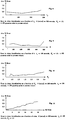
- the network 30 was tested on new (also randomly generated) data. Tests were performed to determine the effectiveness of delay identification as a function of delay, as a function of ⁇ p , and a function of K p , and as a function of the amount of noise.
- a noise figure of, say, 5 percent implies that 99 percent of the gaussian noise ( ⁇ 3 standard deviations) was within ⁇ 5 percent of the range of process output for that simulation.
- FIGS 8 through 11 depict the results of various tests. Each of these graphs shows the estimation error over a range of values of a particular parameter. The remaining parameters were held constant at or near the midpoints of their ranges.
- the network 30 After the network 30 has been trained, it can be used for on-line delay identification.
- the input to the network is now actual (not simulated) process output but the output of the network is again a delay estimate.
- This delay estimate can then be used for control and/or diagnostics. For example, it the process controller incorporates a Smith Predictor or other delay compensation technique, the delay estimate can be given as input to it.
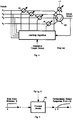
- Fig. 7 depicts how delay identifier 50 embodying the network 30 can be applied to a unit 52 which comprises a PID controller having an associated Smith Predictor.
- the control loop is broken via a switch 54 and a (small) step input perturbation is applied to a process 56 thereof being controlled, by unit 52, via step input generator 58.
- the response of the process 56 to the perturbation is sampled and stored in a butter 60.
- the vector of samples (scaled appropriately) is used as input to the trained neural network 30.
- the output of the network is subjected to some post processing (scaling and/or translation) in a post processor 62 to obtain a delay estimate ⁇ est .
- switch 54 may be closed again and the process put back under closed loop control.
- the process delay is just one process parameter. Although estimates of time constants, gains, etc. are also required for control, it has been found that the process delay is the most critical parameter. Significant over or under estimates in process delay can cause worse control than proportionately poor estimates in the process time constant or the process gain.
- the approach herein for developing system identification tools is extremely general-purpose. It can be used for closed loop or open loop identification, for estimating any and all model parameters, and for linear and non-linear process models. For specific applications, simplification may be possible.
- the identification technique is an open loop one, the input perturbation can be identical for all training examples. It then need not be provided as input to the network 30. The constraint this imposes is that the same input perturbation, or (if the process model is linear) a scaled version of it, must be used during the operation.
- the essence of the invention is the approximation of a function from process input/output to parameter value estimates.
- estimates have to be produced given continuously (and unpredictably) varying inputs.
- neural network have been used to approximate functions as complex as chaotic time series.
- a simulation of the process under closed loop control could be used.
Landscapes
- Physics & Mathematics (AREA)
- General Physics & Mathematics (AREA)
- Engineering & Computer Science (AREA)
- Automation & Control Theory (AREA)
- Feedback Control In General (AREA)
- Selective Calling Equipment (AREA)
- Maintenance And Management Of Digital Transmission (AREA)
- Control By Computers (AREA)
- Image Analysis (AREA)
- Medicines That Contain Protein Lipid Enzymes And Other Medicines (AREA)
Applications Claiming Priority (2)
| Application Number | Priority Date | Filing Date | Title |
|---|---|---|---|
| US59492790A | 1990-10-10 | 1990-10-10 | |
| US594927 | 1990-10-10 |
Publications (3)
| Publication Number | Publication Date |
|---|---|
| EP0480654A2 true EP0480654A2 (de) | 1992-04-15 |
| EP0480654A3 EP0480654A3 (en) | 1993-04-14 |
| EP0480654B1 EP0480654B1 (de) | 1998-03-04 |
Family
ID=24380998
Family Applications (1)
| Application Number | Title | Priority Date | Filing Date |
|---|---|---|---|
| EP91309163A Expired - Lifetime EP0480654B1 (de) | 1990-10-10 | 1991-10-07 | Identifizierung eines Prozesssystems |
Country Status (7)
| Country | Link |
|---|---|
| US (2) | US5740324A (de) |
| EP (1) | EP0480654B1 (de) |
| JP (1) | JPH0628007A (de) |
| AT (1) | ATE163777T1 (de) |
| CA (1) | CA2053056A1 (de) |
| DE (1) | DE69128996T2 (de) |
| ES (1) | ES2112853T3 (de) |
Cited By (3)
| Publication number | Priority date | Publication date | Assignee | Title |
|---|---|---|---|---|
| EP0496570B1 (de) * | 1991-01-22 | 1998-06-03 | Honeywell Inc. | Zweistufige Systemidentifikationsvorrichtung mit Optimierung |
| DE19729187C1 (de) * | 1997-07-08 | 1999-04-29 | Siemens Ag | Testverfahren für einen Funktionsapproximator in einer Prozeßsteuerung |
| DE4338607B4 (de) * | 1993-11-11 | 2005-10-06 | Siemens Ag | Verfahren und Vorrichtung zur Führung eines Prozesses in einem geregelten System |
Families Citing this family (139)
| Publication number | Priority date | Publication date | Assignee | Title |
|---|---|---|---|---|
| JPH07335552A (ja) * | 1994-06-08 | 1995-12-22 | Tel Varian Ltd | 処理装置 |
| US5659666A (en) * | 1994-10-13 | 1997-08-19 | Thaler; Stephen L. | Device for the autonomous generation of useful information |
| US6092919A (en) * | 1995-08-01 | 2000-07-25 | Guided Systems Technologies, Inc. | System and method for adaptive control of uncertain nonlinear processes |
| US8290721B2 (en) | 1996-03-28 | 2012-10-16 | Rosemount Inc. | Flow measurement diagnostics |
| US7630861B2 (en) | 1996-03-28 | 2009-12-08 | Rosemount Inc. | Dedicated process diagnostic device |
| US7254518B2 (en) | 1996-03-28 | 2007-08-07 | Rosemount Inc. | Pressure transmitter with diagnostics |
| US6017143A (en) * | 1996-03-28 | 2000-01-25 | Rosemount Inc. | Device in a process system for detecting events |
| US7085610B2 (en) | 1996-03-28 | 2006-08-01 | Fisher-Rosemount Systems, Inc. | Root cause diagnostics |
| US7949495B2 (en) | 1996-03-28 | 2011-05-24 | Rosemount, Inc. | Process variable transmitter with diagnostics |
| US6654697B1 (en) | 1996-03-28 | 2003-11-25 | Rosemount Inc. | Flow measurement with diagnostics |
| US6539267B1 (en) | 1996-03-28 | 2003-03-25 | Rosemount Inc. | Device in a process system for determining statistical parameter |
| US6907383B2 (en) | 1996-03-28 | 2005-06-14 | Rosemount Inc. | Flow diagnostic system |
| US7623932B2 (en) | 1996-03-28 | 2009-11-24 | Fisher-Rosemount Systems, Inc. | Rule set for root cause diagnostics |
| US6449574B1 (en) | 1996-11-07 | 2002-09-10 | Micro Motion, Inc. | Resistance based process control device diagnostics |
| US6754601B1 (en) | 1996-11-07 | 2004-06-22 | Rosemount Inc. | Diagnostics for resistive elements of process devices |
| US6434504B1 (en) | 1996-11-07 | 2002-08-13 | Rosemount Inc. | Resistance based process control device diagnostics |
| US6519546B1 (en) | 1996-11-07 | 2003-02-11 | Rosemount Inc. | Auto correcting temperature transmitter with resistance based sensor |
| US6601005B1 (en) | 1996-11-07 | 2003-07-29 | Rosemount Inc. | Process device diagnostics using process variable sensor signal |
| CA2276299A1 (en) * | 1996-12-31 | 1998-07-09 | Rosemount Inc. | Device in a process system for validating a control signal from a field device |
| JP4611517B2 (ja) | 1997-10-13 | 2011-01-12 | ローズマウント インコーポレイテッド | 流体のプロセス装置 |
| US6556980B1 (en) * | 1998-08-28 | 2003-04-29 | General Cyberation Group, Inc. | Model-free adaptive control for industrial processes |
| US6415272B1 (en) * | 1998-10-22 | 2002-07-02 | Yamaha Hatsudoki Kabushiki Kaisha | System for intelligent control based on soft computing |
| US6611775B1 (en) | 1998-12-10 | 2003-08-26 | Rosemount Inc. | Electrode leakage diagnostics in a magnetic flow meter |
| US6615149B1 (en) | 1998-12-10 | 2003-09-02 | Rosemount Inc. | Spectral diagnostics in a magnetic flow meter |
| US8044793B2 (en) | 2001-03-01 | 2011-10-25 | Fisher-Rosemount Systems, Inc. | Integrated device alerts in a process control system |
| US7206646B2 (en) | 1999-02-22 | 2007-04-17 | Fisher-Rosemount Systems, Inc. | Method and apparatus for performing a function in a plant using process performance monitoring with process equipment monitoring and control |
| US6975219B2 (en) * | 2001-03-01 | 2005-12-13 | Fisher-Rosemount Systems, Inc. | Enhanced hart device alerts in a process control system |
| US7346404B2 (en) | 2001-03-01 | 2008-03-18 | Fisher-Rosemount Systems, Inc. | Data sharing in a process plant |
| US7562135B2 (en) | 2000-05-23 | 2009-07-14 | Fisher-Rosemount Systems, Inc. | Enhanced fieldbus device alerts in a process control system |
| US6356191B1 (en) | 1999-06-17 | 2002-03-12 | Rosemount Inc. | Error compensation for a process fluid temperature transmitter |
| US7010459B2 (en) | 1999-06-25 | 2006-03-07 | Rosemount Inc. | Process device diagnostics using process variable sensor signal |
| DK1247268T4 (da) | 1999-07-01 | 2009-11-16 | Rosemount Inc | Selvvaliderende totråd-temperaturtransmitter med lav effekt |
| US6505517B1 (en) | 1999-07-23 | 2003-01-14 | Rosemount Inc. | High accuracy signal processing for magnetic flowmeter |
| US6505475B1 (en) | 1999-08-20 | 2003-01-14 | Hudson Technologies Inc. | Method and apparatus for measuring and improving efficiency in refrigeration systems |
| US6701274B1 (en) | 1999-08-27 | 2004-03-02 | Rosemount Inc. | Prediction of error magnitude in a pressure transmitter |
| US6556145B1 (en) | 1999-09-24 | 2003-04-29 | Rosemount Inc. | Two-wire fluid temperature transmitter with thermocouple diagnostics |
| US6684112B1 (en) * | 2000-04-11 | 2004-01-27 | George Shu-Xing Cheng | Robust model-free adaptive control |
| WO2002003152A2 (en) * | 2000-06-29 | 2002-01-10 | Aspen Technology, Inc. | Computer method and apparatus for constraining a non-linear approximator of an empirical process |
| US6701193B1 (en) * | 2000-08-18 | 2004-03-02 | Ford Motor Company | Method of adaptively controlling paint system |
| US6735484B1 (en) | 2000-09-20 | 2004-05-11 | Fargo Electronics, Inc. | Printer with a process diagnostics system for detecting events |
| FR2818742B1 (fr) * | 2000-12-22 | 2003-02-14 | Inst Francais Du Petrole | Methode pour former un module a reseaux neuronaux optimise, destine a simuler le mode d'ecoulement d'une veine de fluides polyphasiques |
| US6795798B2 (en) | 2001-03-01 | 2004-09-21 | Fisher-Rosemount Systems, Inc. | Remote analysis of process control plant data |
| US7720727B2 (en) | 2001-03-01 | 2010-05-18 | Fisher-Rosemount Systems, Inc. | Economic calculations in process control system |
| US6954713B2 (en) * | 2001-03-01 | 2005-10-11 | Fisher-Rosemount Systems, Inc. | Cavitation detection in a process plant |
| US8073967B2 (en) | 2002-04-15 | 2011-12-06 | Fisher-Rosemount Systems, Inc. | Web services-based communications for use with process control systems |
| DE60232711D1 (de) | 2001-03-01 | 2009-08-06 | Fisher Rosemount Systems Inc | Bezugsmarkierungtechnik zur schätzung und benutzung von abbau-niveaux in einer prozessanlage |
| US7389204B2 (en) * | 2001-03-01 | 2008-06-17 | Fisher-Rosemount Systems, Inc. | Data presentation system for abnormal situation prevention in a process plant |
| US6970003B2 (en) | 2001-03-05 | 2005-11-29 | Rosemount Inc. | Electronics board life prediction of microprocessor-based transmitters |
| US6629059B2 (en) | 2001-05-14 | 2003-09-30 | Fisher-Rosemount Systems, Inc. | Hand held diagnostic and communication device with automatic bus detection |
| US7162534B2 (en) * | 2001-07-10 | 2007-01-09 | Fisher-Rosemount Systems, Inc. | Transactional data communications for process control systems |
| US6772036B2 (en) | 2001-08-30 | 2004-08-03 | Fisher-Rosemount Systems, Inc. | Control system using process model |
| US7117045B2 (en) * | 2001-09-08 | 2006-10-03 | Colorado State University Research Foundation | Combined proportional plus integral (PI) and neural network (nN) controller |
| US6701236B2 (en) | 2001-10-19 | 2004-03-02 | Yamaha Hatsudoki Kabushiki Kaisha | Intelligent mechatronic control suspension system based on soft computing |
| KR100979071B1 (ko) * | 2002-02-22 | 2010-08-31 | 에이저 시스템즈 인크 | 이중 배향 다결정성 재료의 화학 기계적 연마 |
| NZ540685A (en) * | 2002-12-09 | 2008-11-28 | Hudson Technologies Inc | Method and apparatus for optimizing refrigeration systems |
| US8463441B2 (en) | 2002-12-09 | 2013-06-11 | Hudson Technologies, Inc. | Method and apparatus for optimizing refrigeration systems |
| US7600234B2 (en) * | 2002-12-10 | 2009-10-06 | Fisher-Rosemount Systems, Inc. | Method for launching applications |
| US7493310B2 (en) | 2002-12-30 | 2009-02-17 | Fisher-Rosemount Systems, Inc. | Data visualization within an integrated asset data system for a process plant |
| US8935298B2 (en) | 2002-12-30 | 2015-01-13 | Fisher-Rosemount Systems, Inc. | Integrated navigational tree importation and generation in a process plant |
| US7152072B2 (en) | 2003-01-08 | 2006-12-19 | Fisher-Rosemount Systems Inc. | Methods and apparatus for importing device data into a database system used in a process plant |
| US20040158474A1 (en) * | 2003-02-06 | 2004-08-12 | Karschnia Robert J. | Service facility for providing remote diagnostic and maintenance services to a process plant |
| US7953842B2 (en) | 2003-02-19 | 2011-05-31 | Fisher-Rosemount Systems, Inc. | Open network-based data acquisition, aggregation and optimization for use with process control systems |
| US7103427B2 (en) | 2003-02-28 | 2006-09-05 | Fisher-Rosemont Systems, Inc. | Delivery of process plant notifications |
| US6915235B2 (en) * | 2003-03-13 | 2005-07-05 | Csi Technology, Inc. | Generation of data indicative of machine operational condition |
| US7634384B2 (en) * | 2003-03-18 | 2009-12-15 | Fisher-Rosemount Systems, Inc. | Asset optimization reporting in a process plant |
| US20040230328A1 (en) * | 2003-03-21 | 2004-11-18 | Steve Armstrong | Remote data visualization within an asset data system for a process plant |
| US7299415B2 (en) * | 2003-06-16 | 2007-11-20 | Fisher-Rosemount Systems, Inc. | Method and apparatus for providing help information in multiple formats |
| US7290450B2 (en) | 2003-07-18 | 2007-11-06 | Rosemount Inc. | Process diagnostics |
| US7018800B2 (en) | 2003-08-07 | 2006-03-28 | Rosemount Inc. | Process device with quiescent current diagnostics |
| US7627441B2 (en) | 2003-09-30 | 2009-12-01 | Rosemount Inc. | Process device with vibration based diagnostics |
| US7523667B2 (en) | 2003-12-23 | 2009-04-28 | Rosemount Inc. | Diagnostics of impulse piping in an industrial process |
| CA2496661C (en) * | 2004-02-19 | 2009-05-19 | Oz Optics Ltd. | Light source control system |
| US7030747B2 (en) * | 2004-02-26 | 2006-04-18 | Fisher-Rosemount Systems, Inc. | Method and system for integrated alarms in a process control system |
| US7079984B2 (en) * | 2004-03-03 | 2006-07-18 | Fisher-Rosemount Systems, Inc. | Abnormal situation prevention in a process plant |
| US7251638B2 (en) | 2004-03-03 | 2007-07-31 | Yamaha Hatsudoki Kabushiki Kaisha | Intelligent robust control system for motorcycle using soft computing optimizer |
| US7676287B2 (en) * | 2004-03-03 | 2010-03-09 | Fisher-Rosemount Systems, Inc. | Configuration system and method for abnormal situation prevention in a process plant |
| US7515977B2 (en) | 2004-03-30 | 2009-04-07 | Fisher-Rosemount Systems, Inc. | Integrated configuration system for use in a process plant |
| US6920799B1 (en) | 2004-04-15 | 2005-07-26 | Rosemount Inc. | Magnetic flow meter with reference electrode |
| US7046180B2 (en) | 2004-04-21 | 2006-05-16 | Rosemount Inc. | Analog-to-digital converter with range error detection |
| US20050267709A1 (en) * | 2004-05-28 | 2005-12-01 | Fisher-Rosemount Systems, Inc. | System and method for detecting an abnormal situation associated with a heater |
| US7536274B2 (en) * | 2004-05-28 | 2009-05-19 | Fisher-Rosemount Systems, Inc. | System and method for detecting an abnormal situation associated with a heater |
| WO2005124491A1 (en) | 2004-06-12 | 2005-12-29 | Fisher-Rosemount Systems, Inc. | System and method for detecting an abnormal situation associated with a process gain of a control loop |
| US7181654B2 (en) * | 2004-09-17 | 2007-02-20 | Fisher-Rosemount Systems, Inc. | System and method for detecting an abnormal situation associated with a reactor |
| US20060218108A1 (en) * | 2005-03-24 | 2006-09-28 | Sergey Panfilov | System for soft computing simulation |
| US20060224547A1 (en) * | 2005-03-24 | 2006-10-05 | Ulyanov Sergey V | Efficient simulation system of quantum algorithm gates on classical computer based on fast algorithm |
| US8005647B2 (en) | 2005-04-08 | 2011-08-23 | Rosemount, Inc. | Method and apparatus for monitoring and performing corrective measures in a process plant using monitoring data with corrective measures data |
| US9201420B2 (en) | 2005-04-08 | 2015-12-01 | Rosemount, Inc. | Method and apparatus for performing a function in a process plant using monitoring data with criticality evaluation data |
| US8112565B2 (en) | 2005-06-08 | 2012-02-07 | Fisher-Rosemount Systems, Inc. | Multi-protocol field device interface with automatic bus detection |
| US20060293817A1 (en) * | 2005-06-23 | 2006-12-28 | Takahide Hagiwara | Intelligent electronically-controlled suspension system based on soft computing optimizer |
| US7272531B2 (en) * | 2005-09-20 | 2007-09-18 | Fisher-Rosemount Systems, Inc. | Aggregation of asset use indices within a process plant |
| US20070068225A1 (en) | 2005-09-29 | 2007-03-29 | Brown Gregory C | Leak detector for process valve |
| US7840287B2 (en) * | 2006-04-13 | 2010-11-23 | Fisher-Rosemount Systems, Inc. | Robust process model identification in model based control techniques |
| US7657399B2 (en) * | 2006-07-25 | 2010-02-02 | Fisher-Rosemount Systems, Inc. | Methods and systems for detecting deviation of a process variable from expected values |
| US8145358B2 (en) * | 2006-07-25 | 2012-03-27 | Fisher-Rosemount Systems, Inc. | Method and system for detecting abnormal operation of a level regulatory control loop |
| US8606544B2 (en) | 2006-07-25 | 2013-12-10 | Fisher-Rosemount Systems, Inc. | Methods and systems for detecting deviation of a process variable from expected values |
| US7912676B2 (en) * | 2006-07-25 | 2011-03-22 | Fisher-Rosemount Systems, Inc. | Method and system for detecting abnormal operation in a process plant |
| US7953501B2 (en) | 2006-09-25 | 2011-05-31 | Fisher-Rosemount Systems, Inc. | Industrial process control loop monitor |
| US8788070B2 (en) | 2006-09-26 | 2014-07-22 | Rosemount Inc. | Automatic field device service adviser |
| JP5197610B2 (ja) * | 2006-09-28 | 2013-05-15 | フィッシャー−ローズマウント システムズ,インコーポレイテッド | 熱交換器における異常状態の防止 |
| EP2074385B2 (de) | 2006-09-29 | 2022-07-06 | Rosemount Inc. | Magnetischer flussmesser mit verifikationsfunktion |
| US7853431B2 (en) * | 2006-09-29 | 2010-12-14 | Fisher-Rosemount Systems, Inc. | On-line monitoring and diagnostics of a process using multivariate statistical analysis |
| US7321846B1 (en) | 2006-10-05 | 2008-01-22 | Rosemount Inc. | Two-wire process control loop diagnostics |
| US20080188972A1 (en) * | 2006-10-11 | 2008-08-07 | Fisher-Rosemount Systems, Inc. | Method and System for Detecting Faults in a Process Plant |
| US20080147361A1 (en) * | 2006-12-15 | 2008-06-19 | Miller Daniel H | Methods and apparatus to monitor system health |
| US8032341B2 (en) * | 2007-01-04 | 2011-10-04 | Fisher-Rosemount Systems, Inc. | Modeling a process using a composite model comprising a plurality of regression models |
| US8032340B2 (en) | 2007-01-04 | 2011-10-04 | Fisher-Rosemount Systems, Inc. | Method and system for modeling a process variable in a process plant |
| US7827006B2 (en) * | 2007-01-31 | 2010-11-02 | Fisher-Rosemount Systems, Inc. | Heat exchanger fouling detection |
| US10410145B2 (en) * | 2007-05-15 | 2019-09-10 | Fisher-Rosemount Systems, Inc. | Automatic maintenance estimation in a plant environment |
| US8898036B2 (en) | 2007-08-06 | 2014-11-25 | Rosemount Inc. | Process variable transmitter with acceleration sensor |
| US8301676B2 (en) | 2007-08-23 | 2012-10-30 | Fisher-Rosemount Systems, Inc. | Field device with capability of calculating digital filter coefficients |
| US7702401B2 (en) | 2007-09-05 | 2010-04-20 | Fisher-Rosemount Systems, Inc. | System for preserving and displaying process control data associated with an abnormal situation |
| US9323247B2 (en) | 2007-09-14 | 2016-04-26 | Fisher-Rosemount Systems, Inc. | Personalized plant asset data representation and search system |
| US7590511B2 (en) | 2007-09-25 | 2009-09-15 | Rosemount Inc. | Field device for digital process control loop diagnostics |
| US8055479B2 (en) | 2007-10-10 | 2011-11-08 | Fisher-Rosemount Systems, Inc. | Simplified algorithm for abnormal situation prevention in load following applications including plugged line diagnostics in a dynamic process |
| CN101571705B (zh) * | 2008-04-29 | 2012-01-11 | 北京航空航天大学 | 位置伺服系统与方法 |
| DE102008036968A1 (de) * | 2008-08-08 | 2010-02-11 | Endress + Hauser Gmbh + Co. Kg | Diagnoseverfahren eines Prozessautomatisierungssystem |
| US7921734B2 (en) | 2009-05-12 | 2011-04-12 | Rosemount Inc. | System to detect poor process ground connections |
| US9207670B2 (en) | 2011-03-21 | 2015-12-08 | Rosemount Inc. | Degrading sensor detection implemented within a transmitter |
| US9110453B2 (en) * | 2011-04-08 | 2015-08-18 | General Cybernation Group Inc. | Model-free adaptive control of advanced power plants |
| US9927788B2 (en) | 2011-05-19 | 2018-03-27 | Fisher-Rosemount Systems, Inc. | Software lockout coordination between a process control system and an asset management system |
| US9529348B2 (en) | 2012-01-24 | 2016-12-27 | Emerson Process Management Power & Water Solutions, Inc. | Method and apparatus for deploying industrial plant simulators using cloud computing technologies |
| US9052240B2 (en) | 2012-06-29 | 2015-06-09 | Rosemount Inc. | Industrial process temperature transmitter with sensor stress diagnostics |
| US9207129B2 (en) | 2012-09-27 | 2015-12-08 | Rosemount Inc. | Process variable transmitter with EMF detection and correction |
| US9602122B2 (en) | 2012-09-28 | 2017-03-21 | Rosemount Inc. | Process variable measurement noise diagnostic |
| JP2014153949A (ja) * | 2013-02-08 | 2014-08-25 | Hiroshima Univ | Gmdhを用いた非線形pidコントローラおよびgmdh重み係数決定方法 |
| US20160267503A1 (en) * | 2013-07-01 | 2016-09-15 | Salespredict Sw Ltd. | System and method for predicting sales |
| US9721204B2 (en) | 2013-10-28 | 2017-08-01 | Qualcomm Incorporated | Evaluation of a system including separable sub-systems over a multidimensional range |
| US10839302B2 (en) | 2015-11-24 | 2020-11-17 | The Research Foundation For The State University Of New York | Approximate value iteration with complex returns by bounding |
| US9599499B1 (en) * | 2015-12-21 | 2017-03-21 | International Business Machines Corporation | Linepack delay measurement in fluid delivery pipeline |
| EP3239626A1 (de) * | 2016-04-27 | 2017-11-01 | PLUM spólka z ograniczona odpowiedzialnoscia | Verfahren zur wärmepumpenbetriebssteuerung |
| US10985951B2 (en) | 2019-03-15 | 2021-04-20 | The Research Foundation for the State University | Integrating Volterra series model and deep neural networks to equalize nonlinear power amplifiers |
| CN110174841A (zh) * | 2019-04-30 | 2019-08-27 | 杭州意能电力技术有限公司 | 基于参数优化的工业过程大滞后惯性系统平行控制方法 |
| CN110824922B (zh) * | 2019-11-22 | 2020-12-18 | 电子科技大学 | 基于六阶b-样条小波神经网络的史密斯预估补偿方法 |
| CN111523662B (zh) * | 2020-04-22 | 2023-07-07 | 北京航空航天大学 | 基于adaline神经网络的动态过程控制限确定方法及设备 |
| US12572807B2 (en) | 2020-06-05 | 2026-03-10 | PassiveLogic, Inc. | Neural network methods for defining system topology |
| CN112198789B (zh) * | 2020-09-11 | 2024-08-23 | 匙慧(北京)科技有限公司 | 闭环系统中的对象辨识方法、电子设备和计算机可读存储介质 |
| CN114137827B (zh) * | 2021-12-01 | 2023-06-02 | 电子科技大学 | 基于多点并行随机梯度下降的pid控制器参数自动整定方法 |
| CN117450688B (zh) * | 2023-12-26 | 2024-03-29 | 山东历控能源有限公司 | 一种基于物联网的烟气余热回收能源调度管理方法及系统 |
| WO2026038203A1 (en) * | 2025-10-06 | 2026-02-19 | NOURI RODSARI, Alireza | System for diagnosing and detecting blockages in direct-fired process furnace tubes |
Family Cites Families (21)
| Publication number | Priority date | Publication date | Assignee | Title |
|---|---|---|---|---|
| FR2233662B1 (de) * | 1973-06-18 | 1977-07-29 | Snecma | |
| EP0241286B2 (de) * | 1986-04-11 | 1994-11-09 | Mitsubishi Denki Kabushiki Kaisha | Selbsteinstellender Regler |
| US5014219A (en) * | 1988-05-06 | 1991-05-07 | White James A | Mask controled neural networks |
| JPH02132502A (ja) * | 1988-07-28 | 1990-05-22 | Omron Tateisi Electron Co | ファジィ制御装置における動作方法および調整装置 |
| US4912647A (en) * | 1988-12-14 | 1990-03-27 | Gte Laboratories Incorporated | Neural network training tool |
| US4941122A (en) * | 1989-01-12 | 1990-07-10 | Recognition Equipment Incorp. | Neural network image processing system |
| JP2755644B2 (ja) * | 1989-01-20 | 1998-05-20 | 株式会社東芝 | 制御系の設計方法及び設計支援装置 |
| JPH0660826B2 (ja) * | 1989-02-07 | 1994-08-10 | 動力炉・核燃料開発事業団 | プラントの異常診断方法 |
| US5119468A (en) * | 1989-02-28 | 1992-06-02 | E. I. Du Pont De Nemours And Company | Apparatus and method for controlling a process using a trained parallel distributed processing network |
| US5111531A (en) * | 1990-01-08 | 1992-05-05 | Automation Technology, Inc. | Process control using neural network |
| US5394322A (en) * | 1990-07-16 | 1995-02-28 | The Foxboro Company | Self-tuning controller that extracts process model characteristics |
| US5212765A (en) * | 1990-08-03 | 1993-05-18 | E. I. Du Pont De Nemours & Co., Inc. | On-line training neural network system for process control |
| US5159660A (en) * | 1990-08-09 | 1992-10-27 | Western Thunder | Universal process control using artificial neural networks |
| US5175678A (en) * | 1990-08-15 | 1992-12-29 | Elsag International B.V. | Method and procedure for neural control of dynamic processes |
| US5471381A (en) * | 1990-09-20 | 1995-11-28 | National Semiconductor Corporation | Intelligent servomechanism controller |
| US5372015A (en) * | 1991-07-05 | 1994-12-13 | Kabushiki Kaisha Toshiba | Air conditioner controller |
| US5467883A (en) * | 1992-12-14 | 1995-11-21 | At&T Corp. | Active neural network control of wafer attributes in a plasma etch process |
| US5513098A (en) * | 1993-06-04 | 1996-04-30 | The Johns Hopkins University | Method for model-free control of general discrete-time systems |
| US5486998A (en) * | 1993-06-14 | 1996-01-23 | Amax Coal West, Inc. | Process stabilizing process controller |
| US5586221A (en) * | 1994-07-01 | 1996-12-17 | Syracuse University | Predictive control of rolling mills using neural network gauge estimation |
| US5608843A (en) * | 1994-08-01 | 1997-03-04 | The United States Of America As Represented By The Secretary Of The Air Force | Learning controller with advantage updating algorithm |
-
1991
- 1991-10-07 AT AT91309163T patent/ATE163777T1/de active
- 1991-10-07 EP EP91309163A patent/EP0480654B1/de not_active Expired - Lifetime
- 1991-10-07 DE DE69128996T patent/DE69128996T2/de not_active Expired - Fee Related
- 1991-10-07 ES ES91309163T patent/ES2112853T3/es not_active Expired - Lifetime
- 1991-10-09 CA CA002053056A patent/CA2053056A1/en not_active Abandoned
- 1991-10-11 JP JP3290441A patent/JPH0628007A/ja not_active Withdrawn
-
1996
- 1996-07-11 US US08/678,130 patent/US5740324A/en not_active Expired - Fee Related
-
1997
- 1997-03-13 US US08/816,470 patent/US5924086A/en not_active Expired - Fee Related
Cited By (3)
| Publication number | Priority date | Publication date | Assignee | Title |
|---|---|---|---|---|
| EP0496570B1 (de) * | 1991-01-22 | 1998-06-03 | Honeywell Inc. | Zweistufige Systemidentifikationsvorrichtung mit Optimierung |
| DE4338607B4 (de) * | 1993-11-11 | 2005-10-06 | Siemens Ag | Verfahren und Vorrichtung zur Führung eines Prozesses in einem geregelten System |
| DE19729187C1 (de) * | 1997-07-08 | 1999-04-29 | Siemens Ag | Testverfahren für einen Funktionsapproximator in einer Prozeßsteuerung |
Also Published As
| Publication number | Publication date |
|---|---|
| DE69128996D1 (de) | 1998-04-09 |
| US5740324A (en) | 1998-04-14 |
| JPH0628007A (ja) | 1994-02-04 |
| ES2112853T3 (es) | 1998-04-16 |
| US5924086A (en) | 1999-07-13 |
| EP0480654A3 (en) | 1993-04-14 |
| EP0480654B1 (de) | 1998-03-04 |
| CA2053056A1 (en) | 1992-04-11 |
| DE69128996T2 (de) | 1998-09-10 |
| ATE163777T1 (de) | 1998-03-15 |
Similar Documents
| Publication | Publication Date | Title |
|---|---|---|
| EP0480654B1 (de) | Identifizierung eines Prozesssystems | |
| US7117045B2 (en) | Combined proportional plus integral (PI) and neural network (nN) controller | |
| Dı́az et al. | Dynamic prediction and control of heat exchangers using artificial neural networks | |
| Tan et al. | Neural-network-based d-step-ahead predictors for nonlinear systems with time delay | |
| Yu et al. | A recursive orthogonal least squares algorithm for training RBF networks | |
| Ismeal et al. | DC motor identification based on Recurrent Neural Networks | |
| Witczak | Toward the training of feed-forward neural networks with the D-optimum input sequence | |
| Chen et al. | Particle swarm optimization neural network and its application in soft-sensing modeling | |
| Mulyana | NNARX model structure for the purposes of controller design and optimization of heat exchanger process control training system operation | |
| Chovan et al. | Neural network architecture for process control based on the RTRL algorithm | |
| Mehta et al. | Feedforward Neural Networks for Process Identification and Prediction | |
| Frątczak et al. | Component-based simulation tool for virtual commissioning of control systems for heat exchange and distribution processes | |
| Himmelblau et al. | Rectification of data in a dynamic process using artificial neural networks | |
| Mohamed et al. | Modelling of induction motor using non-linear neural network system identification | |
| PARLOS et al. | Parameter estimation in space systems using recurrent neural networks | |
| Yan et al. | Model based control using artificial neural networks | |
| Deventer et al. | Control of dynamic systems using bayesian networks | |
| Mulyana | Identification of Heat Exchanger by Neural Network Autoregressive with Exogenous Input Model | |
| Hedjar | A laboratory-level control experiment for introducing predictive control to undergraduates | |
| Fischer et al. | Nonlinear predictive control based on the extraction of step-response models from Takagi-Sugeno fuzzy systems | |
| Poznyak et al. | Robust adaptive nonlinear system identification and trajectory tracking by dynamic neural networks | |
| Al-Akhras et al. | Neural network learning approach of intelligent multimodel controller | |
| Sridharan et al. | Approaches to Parameter Identification for Hybrid Multilinear Time Invariant Systems. | |
| Madsen | Neural network for optimization of existing control systems | |
| Kuttisupakorn et al. | Studies on the use of neural networks in nonlinear control strategies |
Legal Events
| Date | Code | Title | Description |
|---|---|---|---|
| PUAI | Public reference made under article 153(3) epc to a published international application that has entered the european phase |
Free format text: ORIGINAL CODE: 0009012 |
|
| AK | Designated contracting states |
Kind code of ref document: A2 Designated state(s): AT BE CH DE DK ES FR GB GR IT LI LU NL SE |
|
| PUAL | Search report despatched |
Free format text: ORIGINAL CODE: 0009013 |
|
| AK | Designated contracting states |
Kind code of ref document: A3 Designated state(s): AT BE CH DE DK ES FR GB GR IT LI LU NL SE |
|
| 17P | Request for examination filed |
Effective date: 19930922 |
|
| 17Q | First examination report despatched |
Effective date: 19950317 |
|
| GRAG | Despatch of communication of intention to grant |
Free format text: ORIGINAL CODE: EPIDOS AGRA |
|
| GRAG | Despatch of communication of intention to grant |
Free format text: ORIGINAL CODE: EPIDOS AGRA |
|
| GRAH | Despatch of communication of intention to grant a patent |
Free format text: ORIGINAL CODE: EPIDOS IGRA |
|
| GRAH | Despatch of communication of intention to grant a patent |
Free format text: ORIGINAL CODE: EPIDOS IGRA |
|
| GRAA | (expected) grant |
Free format text: ORIGINAL CODE: 0009210 |
|
| AK | Designated contracting states |
Kind code of ref document: B1 Designated state(s): AT BE CH DE DK ES FR GB GR IT LI LU NL SE |
|
| PG25 | Lapsed in a contracting state [announced via postgrant information from national office to epo] |
Ref country code: CH Free format text: LAPSE BECAUSE OF FAILURE TO SUBMIT A TRANSLATION OF THE DESCRIPTION OR TO PAY THE FEE WITHIN THE PRESCRIBED TIME-LIMIT Effective date: 19980304 Ref country code: BE Free format text: LAPSE BECAUSE OF FAILURE TO SUBMIT A TRANSLATION OF THE DESCRIPTION OR TO PAY THE FEE WITHIN THE PRESCRIBED TIME-LIMIT Effective date: 19980304 Ref country code: GR Free format text: LAPSE BECAUSE OF FAILURE TO SUBMIT A TRANSLATION OF THE DESCRIPTION OR TO PAY THE FEE WITHIN THE PRESCRIBED TIME-LIMIT Effective date: 19980304 Ref country code: LI Free format text: LAPSE BECAUSE OF FAILURE TO SUBMIT A TRANSLATION OF THE DESCRIPTION OR TO PAY THE FEE WITHIN THE PRESCRIBED TIME-LIMIT Effective date: 19980304 Ref country code: AT Free format text: LAPSE BECAUSE OF FAILURE TO SUBMIT A TRANSLATION OF THE DESCRIPTION OR TO PAY THE FEE WITHIN THE PRESCRIBED TIME-LIMIT Effective date: 19980304 |
|
| REF | Corresponds to: |
Ref document number: 163777 Country of ref document: AT Date of ref document: 19980315 Kind code of ref document: T |
|
| ITF | It: translation for a ep patent filed | ||
| REG | Reference to a national code |
Ref country code: CH Ref legal event code: EP |
|
| REF | Corresponds to: |
Ref document number: 69128996 Country of ref document: DE Date of ref document: 19980409 |
|
| ET | Fr: translation filed | ||
| REG | Reference to a national code |
Ref country code: ES Ref legal event code: FG2A Ref document number: 2112853 Country of ref document: ES Kind code of ref document: T3 |
|
| PG25 | Lapsed in a contracting state [announced via postgrant information from national office to epo] |
Ref country code: SE Free format text: LAPSE BECAUSE OF FAILURE TO SUBMIT A TRANSLATION OF THE DESCRIPTION OR TO PAY THE FEE WITHIN THE PRESCRIBED TIME-LIMIT Effective date: 19980604 Ref country code: DK Free format text: LAPSE BECAUSE OF FAILURE TO SUBMIT A TRANSLATION OF THE DESCRIPTION OR TO PAY THE FEE WITHIN THE PRESCRIBED TIME-LIMIT Effective date: 19980604 |
|
| REG | Reference to a national code |
Ref country code: CH Ref legal event code: PL |
|
| PG25 | Lapsed in a contracting state [announced via postgrant information from national office to epo] |
Ref country code: LU Free format text: LAPSE BECAUSE OF NON-PAYMENT OF DUE FEES Effective date: 19981007 |
|
| PLBE | No opposition filed within time limit |
Free format text: ORIGINAL CODE: 0009261 |
|
| STAA | Information on the status of an ep patent application or granted ep patent |
Free format text: STATUS: NO OPPOSITION FILED WITHIN TIME LIMIT |
|
| 26N | No opposition filed | ||
| REG | Reference to a national code |
Ref country code: GB Ref legal event code: IF02 |
|
| PGFP | Annual fee paid to national office [announced via postgrant information from national office to epo] |
Ref country code: GB Payment date: 20070918 Year of fee payment: 17 |
|
| PGFP | Annual fee paid to national office [announced via postgrant information from national office to epo] |
Ref country code: ES Payment date: 20071026 Year of fee payment: 17 Ref country code: DE Payment date: 20071031 Year of fee payment: 17 |
|
| PGFP | Annual fee paid to national office [announced via postgrant information from national office to epo] |
Ref country code: IT Payment date: 20071013 Year of fee payment: 17 |
|
| PGFP | Annual fee paid to national office [announced via postgrant information from national office to epo] |
Ref country code: FR Payment date: 20071004 Year of fee payment: 17 |
|
| PGFP | Annual fee paid to national office [announced via postgrant information from national office to epo] |
Ref country code: NL Payment date: 20080915 Year of fee payment: 18 |
|
| GBPC | Gb: european patent ceased through non-payment of renewal fee |
Effective date: 20081007 |
|
| REG | Reference to a national code |
Ref country code: FR Ref legal event code: ST Effective date: 20090630 |
|
| PG25 | Lapsed in a contracting state [announced via postgrant information from national office to epo] |
Ref country code: IT Free format text: LAPSE BECAUSE OF NON-PAYMENT OF DUE FEES Effective date: 20081007 Ref country code: DE Free format text: LAPSE BECAUSE OF NON-PAYMENT OF DUE FEES Effective date: 20090501 |
|
| PG25 | Lapsed in a contracting state [announced via postgrant information from national office to epo] |
Ref country code: FR Free format text: LAPSE BECAUSE OF NON-PAYMENT OF DUE FEES Effective date: 20081031 |
|
| PG25 | Lapsed in a contracting state [announced via postgrant information from national office to epo] |
Ref country code: GB Free format text: LAPSE BECAUSE OF NON-PAYMENT OF DUE FEES Effective date: 20081007 |
|
| REG | Reference to a national code |
Ref country code: ES Ref legal event code: FD2A Effective date: 20081008 |
|
| PG25 | Lapsed in a contracting state [announced via postgrant information from national office to epo] |
Ref country code: ES Free format text: LAPSE BECAUSE OF NON-PAYMENT OF DUE FEES Effective date: 20081008 |
|
| REG | Reference to a national code |
Ref country code: NL Ref legal event code: V1 Effective date: 20100501 |
|
| PG25 | Lapsed in a contracting state [announced via postgrant information from national office to epo] |
Ref country code: NL Free format text: LAPSE BECAUSE OF NON-PAYMENT OF DUE FEES Effective date: 20100501 |