EP0480912A2 - Dispositif de mesure de couple - Google Patents
Dispositif de mesure de couple Download PDFInfo
- Publication number
- EP0480912A2 EP0480912A2 EP92100636A EP92100636A EP0480912A2 EP 0480912 A2 EP0480912 A2 EP 0480912A2 EP 92100636 A EP92100636 A EP 92100636A EP 92100636 A EP92100636 A EP 92100636A EP 0480912 A2 EP0480912 A2 EP 0480912A2
- Authority
- EP
- European Patent Office
- Prior art keywords
- torque
- shaft
- coils
- detecting
- detecting coils
- Prior art date
- Legal status (The legal status is an assumption and is not a legal conclusion. Google has not performed a legal analysis and makes no representation as to the accuracy of the status listed.)
- Withdrawn
Links
- 230000005291 magnetic effect Effects 0.000 claims abstract description 19
- 238000001514 detection method Methods 0.000 claims abstract description 10
- 230000002093 peripheral effect Effects 0.000 claims abstract description 10
- 230000035699 permeability Effects 0.000 claims abstract description 5
- 238000000034 method Methods 0.000 claims description 9
- 230000008569 process Effects 0.000 claims description 7
- 238000005259 measurement Methods 0.000 claims description 5
- 230000000694 effects Effects 0.000 claims 1
- 238000012937 correction Methods 0.000 description 51
- 230000035945 sensitivity Effects 0.000 description 23
- 230000008859 change Effects 0.000 description 12
- 230000036962 time dependent Effects 0.000 description 6
- 238000004519 manufacturing process Methods 0.000 description 5
- 230000015572 biosynthetic process Effects 0.000 description 3
- 230000007423 decrease Effects 0.000 description 3
- 238000010586 diagram Methods 0.000 description 3
- XEEYBQQBJWHFJM-UHFFFAOYSA-N Iron Chemical compound [Fe] XEEYBQQBJWHFJM-UHFFFAOYSA-N 0.000 description 2
- 230000003321 amplification Effects 0.000 description 2
- 230000005540 biological transmission Effects 0.000 description 2
- 230000003247 decreasing effect Effects 0.000 description 2
- 230000004907 flux Effects 0.000 description 2
- 239000000463 material Substances 0.000 description 2
- 238000003199 nucleic acid amplification method Methods 0.000 description 2
- 238000007747 plating Methods 0.000 description 2
- 238000012545 processing Methods 0.000 description 2
- 229910000976 Electrical steel Inorganic materials 0.000 description 1
- 101100128278 Mus musculus Lins1 gene Proteins 0.000 description 1
- 239000003990 capacitor Substances 0.000 description 1
- 125000004122 cyclic group Chemical group 0.000 description 1
- 230000007613 environmental effect Effects 0.000 description 1
- 230000005294 ferromagnetic effect Effects 0.000 description 1
- 239000003302 ferromagnetic material Substances 0.000 description 1
- 230000006870 function Effects 0.000 description 1
- 229910052742 iron Inorganic materials 0.000 description 1
- 230000007774 longterm Effects 0.000 description 1
- 239000000696 magnetic material Substances 0.000 description 1
- 230000004048 modification Effects 0.000 description 1
- 238000012986 modification Methods 0.000 description 1
- 238000012546 transfer Methods 0.000 description 1
- 229910000859 α-Fe Inorganic materials 0.000 description 1
Images



Classifications
-
- G—PHYSICS
- G01—MEASURING; TESTING
- G01L—MEASURING FORCE, STRESS, TORQUE, WORK, MECHANICAL POWER, MECHANICAL EFFICIENCY, OR FLUID PRESSURE
- G01L3/00—Measuring torque, work, mechanical power, or mechanical efficiency, in general
- G01L3/02—Rotary-transmission dynamometers
- G01L3/04—Rotary-transmission dynamometers wherein the torque-transmitting element comprises a torsionally-flexible shaft
- G01L3/10—Rotary-transmission dynamometers wherein the torque-transmitting element comprises a torsionally-flexible shaft involving electric or magnetic means for indicating
-
- G—PHYSICS
- G01—MEASURING; TESTING
- G01L—MEASURING FORCE, STRESS, TORQUE, WORK, MECHANICAL POWER, MECHANICAL EFFICIENCY, OR FLUID PRESSURE
- G01L3/00—Measuring torque, work, mechanical power, or mechanical efficiency, in general
- G01L3/02—Rotary-transmission dynamometers
- G01L3/04—Rotary-transmission dynamometers wherein the torque-transmitting element comprises a torsionally-flexible shaft
- G01L3/10—Rotary-transmission dynamometers wherein the torque-transmitting element comprises a torsionally-flexible shaft involving electric or magnetic means for indicating
- G01L3/101—Rotary-transmission dynamometers wherein the torque-transmitting element comprises a torsionally-flexible shaft involving electric or magnetic means for indicating involving magnetic or electromagnetic means
- G01L3/102—Rotary-transmission dynamometers wherein the torque-transmitting element comprises a torsionally-flexible shaft involving electric or magnetic means for indicating involving magnetic or electromagnetic means involving magnetostrictive means
-
- G—PHYSICS
- G01—MEASURING; TESTING
- G01L—MEASURING FORCE, STRESS, TORQUE, WORK, MECHANICAL POWER, MECHANICAL EFFICIENCY, OR FLUID PRESSURE
- G01L3/00—Measuring torque, work, mechanical power, or mechanical efficiency, in general
- G01L3/02—Rotary-transmission dynamometers
- G01L3/04—Rotary-transmission dynamometers wherein the torque-transmitting element comprises a torsionally-flexible shaft
- G01L3/10—Rotary-transmission dynamometers wherein the torque-transmitting element comprises a torsionally-flexible shaft involving electric or magnetic means for indicating
- G01L3/101—Rotary-transmission dynamometers wherein the torque-transmitting element comprises a torsionally-flexible shaft involving electric or magnetic means for indicating involving magnetic or electromagnetic means
- G01L3/105—Rotary-transmission dynamometers wherein the torque-transmitting element comprises a torsionally-flexible shaft involving electric or magnetic means for indicating involving magnetic or electromagnetic means involving inductive means
Definitions
- the present invention relates to a torque measuring device and particularly to a torque measuring device capable of non-contact measurement of torque in the shafts of engines, motors, industrial machines and the like.
- a shaft having soft magnetic and magnetostrictive properties is formed on its outer periphery with a pair of knurled regions inclined in opposite directions to form angles of 45 degrees with respect to the axis of rotation of the shaft, each knurled region having an exciting coil and a detecting coil wound along the outer periphery thereof.
- the knurled regions provide magnetic anisotropy, and a change in permeability occurring in each knurled region according to transmission torque is detected by the detecting coil.
- a compressive force acts on one of the knurled regions in the knurling direction
- a tensile force acts on the other knurled region since the knurled regions are inclined in opposite directions.
- the detection voltage on one of the detecting coils increases with increasing torque while the detection voltage on the other detecting coil decreases. If the detection voltages on these detecting coils are differentiated, a torque detection voltage indicating a change in torque can be obtained.
- an object of the invention is to prevent error from being produced in measured torque values owing to changes in the balance, zero point and sensitivity.
- the present invention is directed to an arrangement comprising: first and second magnetically anisotropic regions formed on the outer peripheral surface of a torque transmitting shaft and provided with magnetic anisotropy such that the regions are inclined in opposite directions to form angles with respect to the axis of rotation of said shaft, first and second detecting coils capable of detecting changes in permeability in said magnetically anisotropic regions, and control means ensuring that the detection signal values from the two detecting coils when no torque acts on said shaft are equal to each other.
- the shifting of the balance between the two detecting sections due to temperature changes and time-dependent changes can be eliminated by the control means without being influenced by torque acting on the shaft, and production of error due to said shifting can be prevented.
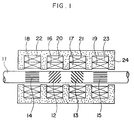
- the numeral 11 denotes a torque transmitting the output of an engine to a working apparatus.
- the outer peripheral surface of the shaft 11 is formed with torque transmitting magnetically anisotropic regions 12 and 13 provided with magnetic anisotropy such that it is inclined in opposite directions to form angles of 20-60 degrees, preferably 45 degrees with respect to the axis of rotation of the shaft 11, and axially spaced a predetermined distance from each other.
- These detecting magnetically anisotropic regions 12 and 13, as described above, can be formed by knurling the outer peripheral surface of the shaft 11 or by forming amorphous ferromagnetic layers on the surface of the shaft 11 by bonding, plating or other method.
- correcting magnetically anistropic regions 14 and 15 formed on the outer peripheral surface of the shaft 11 in the vicinity of said torque detecting magnetically anisotropic regions 12 and 13.
- These correcting magnetically anisotropic regions 14 and 15 are provided with magnetic anisotropy in a direction parallel with the axis of rotation of the shaft 11 and are created by the axial magnetic anisotropy formation using the same process, such as knurling or amorphous layer formation, as in the torque detecting magnetically anisotropic regions 12 and 13.
- Exciting coils 16, 17, 18 and 19 are positioned around the outer peripheries of the magnetically anisotropic regions 12, 13, 14 and 15. Disposed on the respective outer sides of the exciting coils 16, 17, 18 and 19 are detecting coils 20 and 21 associated with the torque detecting magnetically anisotropic regions 12 and 13 and correcting coils 22 and 23 associated with the correcting magnetically anistropic regions 14 and 15.
- the numeral 24 denotes a core made of a ferromagnetic material such as silicon steel sheet or ferrite and defining a passage for magnetic flux and also serving as a casing for accommodating the coils 16 through 23.
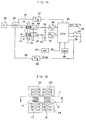
- Fig. 2 shows a torque measuring circuit.
- the numeral 25 denotes an oscillator connected to a first AC power source 26 in the form of a power amplifier. Connected to the output terminal of the oscillator 25 in parallel with the first power source 26 is the input terminal of a second power source 27 also in the form of a power amplifier.
- the exciting coils 16 and 18 are combined in series and connected to the second power source 27, while the exciting coils 17 and 19, also connected in series, are connected to the first power source 26.
- the detecting coils 20 and 21 and the correcting coils 22 and 23 are connected to a CPU 40 respectively through rectifiers 28, 29, 30 and 31, filters 32, 33, 34 and 35 each formed of a resistor and a capacitor, and AD converters 36, 37, 38 and 39.
- a power source cut-off signal line 41 for cutting off the outputs of the two power sources 26 and 27 is connected, together with an DA converter 42, to the CPU 40. Also connected to the CPU 40 are power source controlling signal lines 43 and 44 for adjusting the amplification factors of the power amplifiers constituting the two power sources 26 and 27 to control their outputs.
- the numerals 45 and 46 denote DA converters placed in the signal lines 43 and 44.
- the numeral 47 denotes a reference value setting device adapted to transfer a reference value Es digitally set or software-wise set to the CPU 40.
- the CPU 40 has a timing circuit 48 connected thereto to set the operation timing for the present circuit.
- the numeral 49 denotes an output terminal of a torque signal.
- the numerals 50, 51 and 52 denote manual switches used to correct various errors, as will be later described, irrespectively of the operation timing for the present circuit.
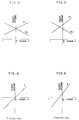
- V1 and V2 When a torque acts on the shaft 11, the output voltages from the detecting coils 20 and 21, after passing through the AD converters, are V1 and V2 shown in Fig. 3. These values V1 and V2 are processed in the CPU 40, as will be later described, and thereby converted into values V1 'and V2 '. The difference (V1 '- V2 ') is multiplied by a suitable value k, and the value k(V1 '- V2 ') is outputted as a torque signal from the output terminal 49.
- Fig. 4 shows an example of a torque signal T based on the outputs V1 and V2 of Fig. 3.
- the zero point adjustment is made.
- the outputs from the two power sources 26 and 27 are cut off with predetermined timing, for example, once in every 1 minute, through the power source cut-off signal line 41.
- the exciting voltages for the exciting coils 16, 17, 18 and 19 become zero
- the balance between the detecting coils 20 and 21 can be upset as the magnetic properties of the shaft are influenced by temperature changes or by long-term alternate torque or as the temperature in the interior of the torque measuring device changes.
- the balance between the detecting coils 20 and 21 is upset, the detected voltages V1 and V2 are as shown in Fig. 5, and the torque signal T corresponding thereto changes from the normal state, as shown in Fig. 6; thus, this is corrected.
- the exciting voltages for the series-connected exciting coils 16 and 18 are simultaneously adjusted, the outputs S1 and V1 are corrected, and the balance between S1 and S2 , that is, the balance between V1 and V2 is simultaneously corrected.
- correction is effected to bring Em' back to the predetermined value Em and restore the predetermined inclination to ensure that the sensitivity characteristic is constant.
- the first and second power sources 26 and 27 are adjusted by the power source control signal line 44 so as to increase or decrease their output levels.
- the two power simultaneously sources 26 and 27 increase or decrease in output level, and control is effected to ensure that V1 ' + V2 ' is equal to Es without upsetting the balance between the two detecting sections.
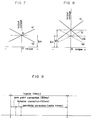
- the aforesaid zero point correction, balance correction and sensitivity correction are effected in this order with predetermined timing by the timing circuit 48. For example, with 1 cycle assumed to be 1 minute, the zero point correction is made in the first 50 milliseconds, followed by the balance correction in the next 50 milliseconds, and the sensitivity correction is made at all times, that is, many times in the remaining time. Such cycle is performed repeatedly. During the zero point correction and balance correction, the torque signal at the end of the time of the preceding cycle is outputted from the terminal 49.
- the signal therefrom is taken into the CPU 40 and during the time this switch is being operated, the aforesaid zero point correcting operation is repeatedly performed. At this time, it is possible to inform the operator by a suitable method that the correcting operation is going on.
- the switch operation is completed, the measured torque value k(V1 ' - V2 ') according to the data after correction is outputted.
- the rated reference torque is applied to the shaft 11 as by a lever and a weight and the reference value setting device 47 is adjusted so that the indicated value coincides with the rated value.
- the temperature change, time-dependent change and zero point change of the torque output signal can all be automatically corrected.
- the sensitivity change and zero point change due to temperature change during torque loading can be automatically corrected.
- the electronically processing circuit is very simple in that only the CPU 40 exists except for the AD converters 36, 37, 38 and 39 and the DA converters 42, 45 and 46. This is due to the fact that the automatic correction of various errors is made by software.
- a torque transmitting shaft 11 is provided with a pair of inclined, torque detecting magnetically anisotropic regions 12 and 13 alone unlike the first embodiment.
- a correcting shaft 55 free from torque is provided in a location where it is subjected to substantially the same environmental conditions including temperature.
- the outer peripheral surface of this correcting shaft 55 is provided with correcting magnetically anisotropic regions 56 and 57 inclined in opposite directions at an angle of 20-60 degrees, preferably 45 degrees with respect to the axis of the shaft 55, as in the case of the torque detecting magnetically anisotropic regions 12 and 13 on the shaft 11.
- the magnetically anisotropic regions 12, 13, 56 and 57 have exciting coils 16, 17, 18 and 19 disposed around their respective outer peripheries. Further, disposed around the respective outer peripheries of the exciting coils 16, 17, 18 and 19 are detecting coils 20 and 21 associated with the torque detecting magnetically anisotropic regions 12 and 13 and correcting coils 22 and 23 associated with the correcting magnetically anisotropic regions 56 and 57.
- the numerals 24 and 54 denote cores made of soft magnetic material and providing a passage for the magnetic flux and utilized as a casing for accommodating the coils.
- the torque detecting section around the shaft 11 and the correcting section around the shaft 55 are manufactured so that they have substantially the same magnetic properties as by providing the magnetically anisotropic regions with the same characteristics.
- Fig. 10 shows the entire arrangement of the present device including an electronic circuit.
- the same members as those shown in Fig. 2 are indicated by the same reference numerals.
- the exciting coils 16 and 18 are combined in series and connected to a first power source 26, while the exciting coils 19 and 17 are also combined in series and connected to a second power source 27.
- Fig. 12 shows a device having a modified shaft 55.
- the shaft 55 has no magnetically anisotropic region formed thereon. Even if the magnetically anisotropic region is omitted, there will be no trouble in practice unless the coincidence between the magnetic properties of the torque detecting section around the shaft 11 and the correcting section around the shaft 55 is degraded. In other words, if changes in the magnetic properties corresponding to temperature changes are substantially the same for both shafts 11 and 55, then the omission of formation of magnetically anisotropic region on the shaft 55 is allowed.
- a magnetically anisotropic region which extends parallel with the axis of the shaft 55 may be formed on the shaft 55, as in the case of the correcting magnetically anisotropic regions 14 and 15 shown in Fig. 1.
- the outer peripheral surface of the torque transmitting shaft 11 is formed with a pair of torque detecting magnetically anisotropic regions 12 and 13 alone, as in the second embodiment. Disposed around the respective outer peripheries of the magnetically anisotropic regions 12 and 13 are exciting coils 16 and 17. Similarly, disposed around the respective outer peripheries of these exciting coils 16 and 17 are detecting coils 20 and 21.
- Fig. 13 shows the detail of the entire device including an electronic circuit.
- the numeral 25 denotes an oscillator
- 26 and 27 denotes first and second power sources, these being the same as in the first and second embodiments.
- the exciting coil 16 is connected to the second power source 27, while the exciting coil 17 is connected to the first power source 26.
- the detecting coils 20 and 21 are connected to the CPU 40 respectively through rectifiers 29 and 30, filters 33 and 34, and AD converters 37 and 38.
- a power source cut-off signal line 41 for cutting out the outputs of the two power sources 26 and 27 is connected to the CPU 40 together with a DA converter 42.
- power source control signal lins 43 and 44 for adjusting the amplification factors of power amplifiers constituting said two power sources 26 and 27 to adjust their outputs;
- the numerals 45 and 46 denote DA converters places in the signal lines 43 and 44.
- the numeral 47 denotes a reference value setting device which inputs into the CPU 40 a reference value Es which is set digitally or in a software manner using memory.
- a timing circuit 48 which generates operation timing for the present circuit.
- the numeral 49 denotes an output terminal for torque signals.
- the numerals 50, 51 and 52 denote manual switches.
- the zero point correction and sensitivity correction are the same as in the first and second embodiments; therefore, a description thereof is omitted.
- the graphs in which the balance is upset as shown in Figs. 5 and 6 are corrected to the graphs shown in Figs. 3 and 4, as in the case of the first embodiment.
- the reason why the balance correction should be made only when the value of the torque signal k(V1 ' - V2 ') is 0 or less than 1% of the rated torque is that when torque is acting on the shaft 11, since torque components are included in the signals V1 ' and V2 ' (see Figs. 3-6), the balance correction cannot be made.
- the reason for less than 1% of the rated torque is that normally when any torque is imposed on the shaft 11, a torque signal of above at least a certain level should naturally be outputted in view of mechanical efficiency; it may safely be said that within the range of 1%, there is substantially no torque.
- no balance correction will be made.
- the aforesaid zero point correction, sensitivity correction and balance correction are made in the same manner as in the first and second embodiments according to the timing shown in Fig. 9.
- the arrangement is also the same in that manual switches 50, 51 and 52 are provided for making said corrections according to the need.
- the outer peripheral surface of a shaft 11 is provided with a torque detecting magnetically anisotropic region 12 forming an angle with respect to the axis of the shaft 11, and a correcting magnetically anisotropic region 14 which is located in the vicinity of said detecting magnetically anisotropic region 12 and extending parallel with the axis.
- Exciting coils 16 and 17 are disposed around the magnetically anisotropic regions 12 and 14. Further, disposed around the outer peripheries of the exciting coils 16 and 17 are a detecting coil 20 corresponding to the torque detecting magnetically anisotropic region 12 and a correcting coil 22 corresponding to the correcting magnetically anisotropic region 14.
- the numeral 24 denotes a core.
- Fig. 15 shows the entire arrangement of the present device including an electronic circuit.
- the numeral 25 denotes an oscillator
- 26 denotes an AC power source.
- the exciting coils 16 and 17 are combined in series and connected to the power source 26.
- the detecting coil 20 and correcting coil 22 are connected to the CPU 40 respectively through rectifiers 29 and 28, filters 33 and 32, and AD converters 37 and 36.
- a power source cut-off signal line 41 for cutting off the output of the power source 26 is connected to the CPU 40 together with an DA converter 42.
- a power source control signal line 44 for controlling the output of the power source 26 is connected to the CPU 40 through a DA converter 42.
- the numeral 47 denotes a timing circuit; 49 denotes an output terminal for torque signals; and 50 and 52 denote manual switches.
- the indication value k(V1 ' - V2 ') obtained after re-throwing (returning) the power source 26 does not necessarily indicate zero, even if there is no torque.
- the detecting and correcting sections are not necessarily magnetically balanced.
- This value B is stored in the CPU 40 until the next manual correction is made. Thereafter, the value k(V1 ' - V2 ') - B is used as the indication value.
- Such processing corresponds to the "balance correction" in the first through third embodiments in that the operation is manual.
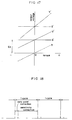
- sensitivity correction is made. If the characteristics of the device change owing to temperature changes or the like, the signals V' and S' vertically displace as indicated by two-dot-and-dash lines in Fig. 17 (the zero point correction value B being omitted), and the gradient of the calibrated value V' based on the signal from the detecting coil 20 also changes. As a result, the angle of inclination of the torque signal T indicated by k(V' - S') changes.
- the calibrated value S' based on the output of the correcting coil 22 is constant as shown in Fig. 17 irrespectively of the amount of the torque. Therefore, the torque measuring sensitivity can be corrected irrespectively of the presence or absence and the amount of the torque.
- Fig. 18 shows an operation timing for the circuit shown in Fig. 15, said timing being similar to the one shown in Fig. 9. However, only the zero point correction and sensitivity correction are automatically made by the CPU 40, as described above.
- electronic circuit described in the preceding embodiments may be used with some of the functions of said circuit omitted.
- the circuit for controlling the zero point the circuit for controlling the sensitivity or the circuit for controlling the balance may be utilized.
- These circuits are suitable where it is desired to control only changes in the zero point with high accuracy, where it is desired to control the sensitivity with high accuracy though allowing coarse control of the zero point, or in other cases.
- Such arrangement is advantageous in that the control circuit and control process can be simplified.
- An analogue electronic circuit which does not contain CPU can also be utilized.
Landscapes
- Physics & Mathematics (AREA)
- General Physics & Mathematics (AREA)
- Electromagnetism (AREA)
- Force Measurement Appropriate To Specific Purposes (AREA)
- Power Steering Mechanism (AREA)
Applications Claiming Priority (8)
| Application Number | Priority Date | Filing Date | Title |
|---|---|---|---|
| JP334862/87 | 1987-12-28 | ||
| JP334864/87 | 1987-12-28 | ||
| JP334863/87 | 1987-12-28 | ||
| JP87334864A JPH01173845A (ja) | 1987-12-28 | 1987-12-28 | トルク測定装置 |
| JP62334863A JPH01173844A (ja) | 1987-12-28 | 1987-12-28 | トルク測定装置 |
| JP62334862A JPH01173843A (ja) | 1987-12-28 | 1987-12-28 | トルク測定装置 |
| JP62334861A JPH07117463B2 (ja) | 1987-12-28 | 1987-12-28 | トルク測定装置 |
| JP334861/87 | 1987-12-28 |
Related Parent Applications (1)
| Application Number | Title | Priority Date | Filing Date |
|---|---|---|---|
| EP88116294.5 Division | 1988-10-01 |
Publications (2)
| Publication Number | Publication Date |
|---|---|
| EP0480912A2 true EP0480912A2 (fr) | 1992-04-15 |
| EP0480912A3 EP0480912A3 (en) | 1992-07-01 |
Family
ID=27480525
Family Applications (2)
| Application Number | Title | Priority Date | Filing Date |
|---|---|---|---|
| EP88116294A Expired - Lifetime EP0321662B1 (fr) | 1987-12-28 | 1988-10-01 | Dispositif de mesure de couple |
| EP19920100636 Withdrawn EP0480912A3 (en) | 1987-12-28 | 1988-10-01 | Torque measuring device |
Family Applications Before (1)
| Application Number | Title | Priority Date | Filing Date |
|---|---|---|---|
| EP88116294A Expired - Lifetime EP0321662B1 (fr) | 1987-12-28 | 1988-10-01 | Dispositif de mesure de couple |
Country Status (4)
| Country | Link |
|---|---|
| US (4) | US4920809A (fr) |
| EP (2) | EP0321662B1 (fr) |
| KR (1) | KR930011087B1 (fr) |
| DE (1) | DE3887853T2 (fr) |
Cited By (6)
| Publication number | Priority date | Publication date | Assignee | Title |
|---|---|---|---|---|
| WO1994028385A1 (fr) * | 1993-05-27 | 1994-12-08 | Asea Brown Boveri Ab | Transducteur de couple sans contact, magnetoelastique, pourvu d'un arbre a microstructure anisotrope double |
| EP1752750A1 (fr) * | 2005-08-12 | 2007-02-14 | Siemens VDO Automotive Corporation | Transducteur de couple magnéto-élastique |
| EP1752752A1 (fr) | 2005-08-12 | 2007-02-14 | Siemens VDO Automotive Corporation | Procédé d'étalonnage d'un capteur de force magnéto-élastique |
| EP1895283A2 (fr) | 2006-08-30 | 2008-03-05 | HONDA MOTOR CO., Ltd. | Procédé de fabrication d'un dispositif capteur de couple magnétostrictif et appareil de direction assistée électrique |
| EP2065691A1 (fr) * | 2007-11-29 | 2009-06-03 | Honda Motor Co., Ltd. | Capteur de couple magnétostrictif et système de direction électrique |
| EP3745080A4 (fr) * | 2018-01-23 | 2021-10-06 | Amiteq Co., Ltd. | Dispositif de détection de rotation inductif |
Families Citing this family (33)
| Publication number | Priority date | Publication date | Assignee | Title |
|---|---|---|---|---|
| EP0321662B1 (fr) | 1987-12-28 | 1994-02-16 | Kubota Corporation | Dispositif de mesure de couple |
| US5062062A (en) * | 1988-12-30 | 1991-10-29 | Kabushiki Kaisha Toyota Chuo Kenkyusho | Torque detecting apparatus |
| GB9100736D0 (en) * | 1991-01-14 | 1991-02-27 | Adwest Eng Ltd | Power assisted steering mechanism |
| US5307690A (en) * | 1991-07-29 | 1994-05-03 | Kubota Corporation | Temperature compensating device for torque measuring apparatus |
| JP3131667B2 (ja) * | 1992-09-07 | 2001-02-05 | 光洋精工株式会社 | トルクセンサ |
| US5412998A (en) * | 1992-10-08 | 1995-05-09 | Kubota Corporation | Torque measuring system |
| US5412999A (en) * | 1993-02-26 | 1995-05-09 | Sensorteck L.P. | Position sensing with magnetostrictive stress sensor |
| KR100313101B1 (ko) * | 1994-04-23 | 2001-12-28 | 김순택 | 음극선관 |
| JP2983434B2 (ja) * | 1994-06-13 | 1999-11-29 | 本田技研工業株式会社 | センサの温度特性補償構造 |
| US5816599A (en) * | 1995-06-14 | 1998-10-06 | Koyo Electronics Industries Co., Ltd | Bicycle torque detection apparatus and bicycle including the same |
| JP3216982B2 (ja) * | 1996-01-24 | 2001-10-09 | 株式会社ユニシアジェックス | 磁歪式トルク検出装置 |
| GB9808792D0 (en) * | 1998-04-23 | 1998-06-24 | Effective Torque Technologies | Magnetising arrangements for torque/force sensor |
| JP4026247B2 (ja) * | 1998-10-01 | 2007-12-26 | 日本精工株式会社 | トルクセンサ |
| GB9906735D0 (en) | 1999-03-23 | 1999-05-19 | Fet Applic Limited | Magnoelastic transducers |
| US6467360B1 (en) * | 1999-04-23 | 2002-10-22 | Trw Inc. | Torque sensing apparatus and method |
| GB9919065D0 (en) * | 1999-08-12 | 1999-10-13 | Fast Technology Gmbh | Transducer Element |
| US6289748B1 (en) * | 1999-11-23 | 2001-09-18 | Delphi Technologies, Inc. | Shaft torque sensor with no air gap |
| US6698299B2 (en) * | 2001-05-05 | 2004-03-02 | Methode Electronics, Inc. | Magnetoelastic torque sensor |
| WO2003071231A1 (fr) | 2002-02-22 | 2003-08-28 | Fast Technology Ag | Transducteur de deplacement (couple) magnetiquement neutre pour element ferromagnetique dote d'une ou de plusieurs bobine(s) et d'un ou de plusieurs capteurs de champ magnetique |
| GB0204213D0 (en) | 2002-02-22 | 2002-04-10 | Fast Technology Ag | Pulsed torque measurement |
| US7478567B2 (en) * | 2002-05-15 | 2009-01-20 | The Timken Company | Eddy current sensor assembly for shaft torque measurement |
| AU2003237277A1 (en) * | 2002-05-29 | 2003-12-19 | The Timken Company | In-bearing torque sensor assembly |
| US6823746B2 (en) * | 2002-07-11 | 2004-11-30 | Visteon Global Technologies, Inc. | Magnetoelastic torque sensor for mitigating non-axisymmetric inhomogeneities in emanating fields |
| US7098658B2 (en) * | 2004-04-01 | 2006-08-29 | Visteon Global Technologies, Inc. | Digital signal conditioning solution for a magnetometer circuit |
| JP3964414B2 (ja) * | 2004-08-25 | 2007-08-22 | 本田技研工業株式会社 | 磁歪式トルクセンサと電動ステアリング装置 |
| US7506554B2 (en) * | 2004-08-25 | 2009-03-24 | Honda Motor Co., Ltd. | Magnetostrictive torque sensor system and electric steering system |
| US7409878B2 (en) * | 2005-04-08 | 2008-08-12 | Honeywell International Inc. | Torqueshaft magnetic field measurement systems for gas turbine engines |
| US7622918B2 (en) | 2005-09-23 | 2009-11-24 | Continental Automotive Systems Us, Inc. | Solenoid magentometer |
| JP4908904B2 (ja) * | 2006-04-17 | 2012-04-04 | 本田技研工業株式会社 | 磁歪式トルクセンサ |
| US7752921B2 (en) * | 2006-04-19 | 2010-07-13 | Honda Motor Co., Ltd. | Magnetostrictive torque sensor |
| DE102006054663B4 (de) * | 2006-11-17 | 2008-11-27 | Siemens Vdo Automotive Corp., Auburn Hills | Spulenmagnetometer |
| DE102007044471A1 (de) * | 2007-09-18 | 2009-04-02 | Fraunhofer-Gesellschaft zur Förderung der angewandten Forschung e.V. | Verfahren zur abschnittsweisen Bestimmung eines parameterabhängigen Korrekturwertnäherungsverlaufs und Sensoranordnung |
| CN102401708A (zh) * | 2011-11-24 | 2012-04-04 | 北京科技大学 | 一种基于磁致伸缩效应的扭矩传感器及扭矩测量方法 |
Citations (3)
| Publication number | Priority date | Publication date | Assignee | Title |
|---|---|---|---|---|
| JPS59166827A (ja) | 1983-03-11 | 1984-09-20 | Kosuke Harada | 差動方式による磁気ひずみ形トルクセンサ |
| JPS59169326A (ja) | 1983-03-15 | 1984-09-25 | 株式会社東芝 | 配電系統の地絡検出装置 |
| EP0321662A2 (fr) | 1987-12-28 | 1989-06-28 | Kubota Corporation | Dispositif de mesure de couple |
Family Cites Families (14)
| Publication number | Priority date | Publication date | Assignee | Title |
|---|---|---|---|---|
| US2553833A (en) * | 1947-07-11 | 1951-05-22 | Morgan Rifenbergh C | Stress measuring apparatus |
| FR2032215A5 (fr) * | 1969-02-21 | 1970-11-20 | Inst Werkzeugmaschin | |
| SU667836A1 (ru) * | 1977-12-22 | 1979-06-15 | Фрунзенский политехнический институт | Магнитоупругий датчик крут щего момента |
| DE3031997C2 (de) * | 1980-08-25 | 1986-01-16 | Licentia Patent-Verwaltungs-Gmbh, 6000 Frankfurt | Anordnung zur berührungslosen Messung statischer und dynamischer Drehmomente |
| DE3206503C1 (de) * | 1982-02-24 | 1983-08-25 | Licentia Patent-Verwaltungs-Gmbh, 6000 Frankfurt | Verfahren zur Kompensation der bei der Drehmomentmessung nach dem Wirbelstromprinzip an Wellen auftretenden durch die Inhomogenität der Permeabilität der Oberfläche der Welle erzeugten elektr. Störspannung |
| JPS59166828A (ja) * | 1983-03-11 | 1984-09-20 | Aisin Seiki Co Ltd | トルク検出器 |
| US4627298A (en) * | 1983-08-30 | 1986-12-09 | Kabushiki Kaisha Toshiba | Torque sensor of the noncontact type |
| JPS60173433A (ja) * | 1984-02-20 | 1985-09-06 | Mitsubishi Electric Corp | トルク検出装置 |
| JPS60243526A (ja) * | 1984-05-18 | 1985-12-03 | Japanese National Railways<Jnr> | レ−ル軸力測定装置 |
| JPS60244828A (ja) * | 1984-05-21 | 1985-12-04 | Nissan Motor Co Ltd | 磁歪式トルク検出装置 |
| DE3511442C2 (de) * | 1985-03-29 | 1987-03-19 | Internationale Fluggeräte und Motoren GmbH, 6940 Weinheim | Verfahren und Vorrichtung zur berührungslosen Messung statischer und dynamischer Drehmomente |
| JPH0641889B2 (ja) * | 1985-04-23 | 1994-06-01 | 三菱電機株式会社 | トルク検出装置 |
| US4823620A (en) * | 1986-02-10 | 1989-04-25 | Nissan Motor Company, Ltd. | Magnetostrictive device for measuring torsional torque |
| JPS62206421A (ja) * | 1986-03-07 | 1987-09-10 | Hitachi Ltd | トルクセンサ |
-
1988
- 1988-10-01 EP EP88116294A patent/EP0321662B1/fr not_active Expired - Lifetime
- 1988-10-01 EP EP19920100636 patent/EP0480912A3/en not_active Withdrawn
- 1988-10-01 DE DE3887853T patent/DE3887853T2/de not_active Expired - Fee Related
- 1988-10-20 KR KR1019880013679A patent/KR930011087B1/ko not_active Expired - Fee Related
- 1988-10-21 US US07/260,990 patent/US4920809A/en not_active Expired - Fee Related
-
1989
- 1989-11-20 US US07/439,344 patent/US4972727A/en not_active Expired - Fee Related
- 1989-11-20 US US07/439,343 patent/US4972726A/en not_active Expired - Fee Related
- 1989-11-20 US US07/439,347 patent/US4972728A/en not_active Expired - Fee Related
Patent Citations (3)
| Publication number | Priority date | Publication date | Assignee | Title |
|---|---|---|---|---|
| JPS59166827A (ja) | 1983-03-11 | 1984-09-20 | Kosuke Harada | 差動方式による磁気ひずみ形トルクセンサ |
| JPS59169326A (ja) | 1983-03-15 | 1984-09-25 | 株式会社東芝 | 配電系統の地絡検出装置 |
| EP0321662A2 (fr) | 1987-12-28 | 1989-06-28 | Kubota Corporation | Dispositif de mesure de couple |
Cited By (9)
| Publication number | Priority date | Publication date | Assignee | Title |
|---|---|---|---|---|
| WO1994028385A1 (fr) * | 1993-05-27 | 1994-12-08 | Asea Brown Boveri Ab | Transducteur de couple sans contact, magnetoelastique, pourvu d'un arbre a microstructure anisotrope double |
| EP1752750A1 (fr) * | 2005-08-12 | 2007-02-14 | Siemens VDO Automotive Corporation | Transducteur de couple magnéto-élastique |
| EP1752752A1 (fr) | 2005-08-12 | 2007-02-14 | Siemens VDO Automotive Corporation | Procédé d'étalonnage d'un capteur de force magnéto-élastique |
| EP1895283A2 (fr) | 2006-08-30 | 2008-03-05 | HONDA MOTOR CO., Ltd. | Procédé de fabrication d'un dispositif capteur de couple magnétostrictif et appareil de direction assistée électrique |
| EP1895283A3 (fr) * | 2006-08-30 | 2008-12-03 | HONDA MOTOR CO., Ltd. | Procédé de fabrication d'un dispositif capteur de couple magnétostrictif et appareil de direction assistée électrique |
| EP2065691A1 (fr) * | 2007-11-29 | 2009-06-03 | Honda Motor Co., Ltd. | Capteur de couple magnétostrictif et système de direction électrique |
| US7938026B2 (en) | 2007-11-29 | 2011-05-10 | Honda Motor Co., Ltd. | Magnetostrictive torque sensor and electric steering system |
| EP3745080A4 (fr) * | 2018-01-23 | 2021-10-06 | Amiteq Co., Ltd. | Dispositif de détection de rotation inductif |
| US11359909B2 (en) | 2018-01-23 | 2022-06-14 | Amiteq Co., Ltd. | Induction-type rotation detection device |
Also Published As
| Publication number | Publication date |
|---|---|
| KR890010546A (ko) | 1989-08-09 |
| KR930011087B1 (ko) | 1993-11-20 |
| US4972726A (en) | 1990-11-27 |
| US4920809A (en) | 1990-05-01 |
| US4972727A (en) | 1990-11-27 |
| EP0321662A3 (en) | 1990-09-12 |
| EP0321662B1 (fr) | 1994-02-16 |
| EP0321662A2 (fr) | 1989-06-28 |
| US4972728A (en) | 1990-11-27 |
| EP0480912A3 (en) | 1992-07-01 |
| DE3887853T2 (de) | 1994-05-19 |
| DE3887853D1 (de) | 1994-03-24 |
Similar Documents
| Publication | Publication Date | Title |
|---|---|---|
| EP0321662B1 (fr) | Dispositif de mesure de couple | |
| EP3311131B1 (fr) | Dispositifs et procédés pour améliorer la précision de capteurs de couple magnéto-élastique | |
| EP1403648B1 (fr) | Detecteur magnetique | |
| JP2007052017A (ja) | ヒステリシス補正を含む自動較正アルゴリズム | |
| US4833926A (en) | Magnetostrictive stress measurement apparatus | |
| US5412998A (en) | Torque measuring system | |
| JPH01173842A (ja) | トルク測定装置 | |
| JP2000121423A (ja) | 校正適否の判断機構を有する電子秤 | |
| JPH01173844A (ja) | トルク測定装置 | |
| JPH01173843A (ja) | トルク測定装置 | |
| JP2842466B2 (ja) | トルク測定装置 | |
| JPH07159258A (ja) | 磁歪式トルクセンサ | |
| CN1016731B (zh) | 扭矩测量装置 | |
| JPH01173845A (ja) | トルク測定装置 | |
| JPH0739974B2 (ja) | トルク測定装置のための温度補償装置 | |
| JPH05149804A (ja) | 磁歪式トルクセンサの製造方法 | |
| JPH06317493A (ja) | トルクセンサ | |
| JPH04329327A (ja) | トルクセンサ | |
| JP2806731B2 (ja) | トルクセンサの零点誤差の補正方法 | |
| JP2001074572A (ja) | パワーステアリング用トルク検出装置 | |
| JPH03103737A (ja) | トルク測定装置 | |
| JPS6056215A (ja) | 測定・制御における検出器の検出値補正方法 | |
| JPS63302336A (ja) | トルク検出回路 | |
| JPH02128129A (ja) | トルクセンサ | |
| JP2002303555A (ja) | 磁歪式トルクセンサ |
Legal Events
| Date | Code | Title | Description |
|---|---|---|---|
| PUAI | Public reference made under article 153(3) epc to a published international application that has entered the european phase |
Free format text: ORIGINAL CODE: 0009012 |
|
| AC | Divisional application: reference to earlier application |
Ref document number: 321662 Country of ref document: EP |
|
| AK | Designated contracting states |
Kind code of ref document: A2 Designated state(s): DE ES FR GB IT SE |
|
| PUAL | Search report despatched |
Free format text: ORIGINAL CODE: 0009013 |
|
| AK | Designated contracting states |
Kind code of ref document: A3 Designated state(s): DE ES FR GB IT SE |
|
| 17P | Request for examination filed |
Effective date: 19920731 |
|
| STAA | Information on the status of an ep patent application or granted ep patent |
Free format text: STATUS: THE APPLICATION HAS BEEN WITHDRAWN |
|
| 18W | Application withdrawn |
Withdrawal date: 19930726 |