EP0481010B1 - Verfahren zur herstellung einer li(a1)-anode für eine lithiumbatterie - Google Patents
Verfahren zur herstellung einer li(a1)-anode für eine lithiumbatterie Download PDFInfo
- Publication number
- EP0481010B1 EP0481010B1 EP90911981A EP90911981A EP0481010B1 EP 0481010 B1 EP0481010 B1 EP 0481010B1 EP 90911981 A EP90911981 A EP 90911981A EP 90911981 A EP90911981 A EP 90911981A EP 0481010 B1 EP0481010 B1 EP 0481010B1
- Authority
- EP
- European Patent Office
- Prior art keywords
- anode
- lithium
- alloy
- battery
- aluminium
- Prior art date
- Legal status (The legal status is an assumption and is not a legal conclusion. Google has not performed a legal analysis and makes no representation as to the accuracy of the status listed.)
- Expired - Lifetime
Links
- 229910052744 lithium Inorganic materials 0.000 title claims abstract description 57
- 229910007008 Li(Al) Inorganic materials 0.000 title claims abstract description 32
- 238000004519 manufacturing process Methods 0.000 title claims abstract description 12
- WHXSMMKQMYFTQS-UHFFFAOYSA-N Lithium Chemical compound [Li] WHXSMMKQMYFTQS-UHFFFAOYSA-N 0.000 title claims description 51
- 229910045601 alloy Inorganic materials 0.000 claims abstract description 42
- 239000000956 alloy Substances 0.000 claims abstract description 42
- 229910052782 aluminium Inorganic materials 0.000 claims abstract description 28
- 239000000463 material Substances 0.000 claims abstract description 21
- 239000000843 powder Substances 0.000 claims abstract description 10
- PXHVJJICTQNCMI-UHFFFAOYSA-N Nickel Chemical compound [Ni] PXHVJJICTQNCMI-UHFFFAOYSA-N 0.000 claims description 21
- 238000000034 method Methods 0.000 claims description 13
- 229910052759 nickel Inorganic materials 0.000 claims description 10
- 238000001816 cooling Methods 0.000 claims description 3
- 238000010924 continuous production Methods 0.000 claims description 2
- 230000001681 protective effect Effects 0.000 claims description 2
- 238000003825 pressing Methods 0.000 abstract description 6
- 238000005275 alloying Methods 0.000 abstract 1
- RAHZWNYVWXNFOC-UHFFFAOYSA-N Sulphur dioxide Chemical compound O=S=O RAHZWNYVWXNFOC-UHFFFAOYSA-N 0.000 description 34
- 239000004411 aluminium Substances 0.000 description 22
- XAGFODPZIPBFFR-UHFFFAOYSA-N aluminium Chemical compound [Al] XAGFODPZIPBFFR-UHFFFAOYSA-N 0.000 description 22
- 239000003792 electrolyte Substances 0.000 description 16
- 210000004027 cell Anatomy 0.000 description 14
- 229910001537 lithium tetrachloroaluminate Inorganic materials 0.000 description 11
- 239000000835 fiber Substances 0.000 description 9
- 238000002844 melting Methods 0.000 description 9
- 230000008018 melting Effects 0.000 description 9
- 230000008901 benefit Effects 0.000 description 8
- -1 for example V2S5 Inorganic materials 0.000 description 7
- 229910052751 metal Inorganic materials 0.000 description 7
- 239000002184 metal Substances 0.000 description 7
- 239000010405 anode material Substances 0.000 description 6
- 230000008859 change Effects 0.000 description 6
- OKTJSMMVPCPJKN-UHFFFAOYSA-N Carbon Chemical compound [C] OKTJSMMVPCPJKN-UHFFFAOYSA-N 0.000 description 5
- 229910003092 TiS2 Inorganic materials 0.000 description 5
- 238000006243 chemical reaction Methods 0.000 description 5
- 239000007788 liquid Substances 0.000 description 5
- 230000008569 process Effects 0.000 description 5
- 239000004743 Polypropylene Substances 0.000 description 4
- 229910052799 carbon Inorganic materials 0.000 description 4
- 239000006229 carbon black Substances 0.000 description 4
- 229920001155 polypropylene Polymers 0.000 description 4
- 229920006362 Teflon® Polymers 0.000 description 3
- JFBZPFYRPYOZCQ-UHFFFAOYSA-N [Li].[Al] Chemical compound [Li].[Al] JFBZPFYRPYOZCQ-UHFFFAOYSA-N 0.000 description 3
- 230000015572 biosynthetic process Effects 0.000 description 3
- 210000001787 dendrite Anatomy 0.000 description 3
- 230000004927 fusion Effects 0.000 description 3
- 238000005245 sintering Methods 0.000 description 3
- 235000010269 sulphur dioxide Nutrition 0.000 description 3
- 239000004291 sulphur dioxide Substances 0.000 description 3
- 229910000838 Al alloy Inorganic materials 0.000 description 2
- XKRFYHLGVUSROY-UHFFFAOYSA-N Argon Chemical compound [Ar] XKRFYHLGVUSROY-UHFFFAOYSA-N 0.000 description 2
- KFZMGEQAYNKOFK-UHFFFAOYSA-N Isopropanol Chemical compound CC(C)O KFZMGEQAYNKOFK-UHFFFAOYSA-N 0.000 description 2
- 229910000733 Li alloy Inorganic materials 0.000 description 2
- 239000004809 Teflon Substances 0.000 description 2
- 229920006355 Tefzel Polymers 0.000 description 2
- 239000011149 active material Substances 0.000 description 2
- VSCWAEJMTAWNJL-UHFFFAOYSA-K aluminium trichloride Chemical compound Cl[Al](Cl)Cl VSCWAEJMTAWNJL-UHFFFAOYSA-K 0.000 description 2
- 239000010406 cathode material Substances 0.000 description 2
- 239000004020 conductor Substances 0.000 description 2
- 238000010276 construction Methods 0.000 description 2
- 230000001351 cycling effect Effects 0.000 description 2
- 238000005323 electroforming Methods 0.000 description 2
- QHSJIZLJUFMIFP-UHFFFAOYSA-N ethene;1,1,2,2-tetrafluoroethene Chemical compound C=C.FC(F)=C(F)F QHSJIZLJUFMIFP-UHFFFAOYSA-N 0.000 description 2
- 239000003273 ketjen black Substances 0.000 description 2
- KWGKDLIKAYFUFQ-UHFFFAOYSA-M lithium chloride Chemical compound [Li+].[Cl-] KWGKDLIKAYFUFQ-UHFFFAOYSA-M 0.000 description 2
- 238000011068 loading method Methods 0.000 description 2
- 150000002739 metals Chemical class 0.000 description 2
- 239000004033 plastic Substances 0.000 description 2
- 229920003023 plastic Polymers 0.000 description 2
- 230000002441 reversible effect Effects 0.000 description 2
- 239000007787 solid Substances 0.000 description 2
- 229920013683 Celanese Polymers 0.000 description 1
- 229910000552 LiCF3SO3 Inorganic materials 0.000 description 1
- 229910012761 LiTiS2 Inorganic materials 0.000 description 1
- 229910016003 MoS3 Inorganic materials 0.000 description 1
- 239000004698 Polyethylene Substances 0.000 description 1
- 239000000654 additive Substances 0.000 description 1
- 229910052786 argon Inorganic materials 0.000 description 1
- 239000011230 binding agent Substances 0.000 description 1
- 239000003575 carbonaceous material Substances 0.000 description 1
- 238000005266 casting Methods 0.000 description 1
- 239000007795 chemical reaction product Substances 0.000 description 1
- 239000003795 chemical substances by application Substances 0.000 description 1
- 230000009918 complex formation Effects 0.000 description 1
- 230000006835 compression Effects 0.000 description 1
- 238000007906 compression Methods 0.000 description 1
- 229920001577 copolymer Polymers 0.000 description 1
- 238000000151 deposition Methods 0.000 description 1
- 230000008021 deposition Effects 0.000 description 1
- 238000009792 diffusion process Methods 0.000 description 1
- 238000007599 discharging Methods 0.000 description 1
- 238000001035 drying Methods 0.000 description 1
- 239000007772 electrode material Substances 0.000 description 1
- 238000004070 electrodeposition Methods 0.000 description 1
- 230000005496 eutectics Effects 0.000 description 1
- 238000001125 extrusion Methods 0.000 description 1
- 238000011049 filling Methods 0.000 description 1
- 238000009830 intercalation Methods 0.000 description 1
- 230000002687 intercalation Effects 0.000 description 1
- 239000010416 ion conductor Substances 0.000 description 1
- 239000011244 liquid electrolyte Substances 0.000 description 1
- 239000001989 lithium alloy Substances 0.000 description 1
- 229910001947 lithium oxide Inorganic materials 0.000 description 1
- 238000005259 measurement Methods 0.000 description 1
- 229910052976 metal sulfide Inorganic materials 0.000 description 1
- 239000000203 mixture Substances 0.000 description 1
- TVWWSIKTCILRBF-UHFFFAOYSA-N molybdenum trisulfide Chemical compound S=[Mo](=S)=S TVWWSIKTCILRBF-UHFFFAOYSA-N 0.000 description 1
- 239000012457 nonaqueous media Substances 0.000 description 1
- 230000003647 oxidation Effects 0.000 description 1
- 238000007254 oxidation reaction Methods 0.000 description 1
- 230000035515 penetration Effects 0.000 description 1
- 239000002985 plastic film Substances 0.000 description 1
- 229920006255 plastic film Polymers 0.000 description 1
- 229920000573 polyethylene Polymers 0.000 description 1
- 239000000047 product Substances 0.000 description 1
- 230000036647 reaction Effects 0.000 description 1
- 230000009467 reduction Effects 0.000 description 1
- 230000003014 reinforcing effect Effects 0.000 description 1
- 150000003839 salts Chemical class 0.000 description 1
- 238000007789 sealing Methods 0.000 description 1
- 238000000926 separation method Methods 0.000 description 1
- 238000005476 soldering Methods 0.000 description 1
- 125000006850 spacer group Chemical group 0.000 description 1
- 239000010935 stainless steel Substances 0.000 description 1
- 229910001220 stainless steel Inorganic materials 0.000 description 1
- 239000000126 substance Substances 0.000 description 1
- 239000000725 suspension Substances 0.000 description 1
- XLYOFNOQVPJJNP-UHFFFAOYSA-N water Substances O XLYOFNOQVPJJNP-UHFFFAOYSA-N 0.000 description 1
- 238000003466 welding Methods 0.000 description 1
Images
Classifications
-
- H—ELECTRICITY
- H01—ELECTRIC ELEMENTS
- H01M—PROCESSES OR MEANS, e.g. BATTERIES, FOR THE DIRECT CONVERSION OF CHEMICAL ENERGY INTO ELECTRICAL ENERGY
- H01M10/00—Secondary cells; Manufacture thereof
- H01M10/05—Accumulators with non-aqueous electrolyte
-
- H—ELECTRICITY
- H01—ELECTRIC ELEMENTS
- H01M—PROCESSES OR MEANS, e.g. BATTERIES, FOR THE DIRECT CONVERSION OF CHEMICAL ENERGY INTO ELECTRICAL ENERGY
- H01M4/00—Electrodes
- H01M4/02—Electrodes composed of, or comprising, active material
- H01M4/04—Processes of manufacture in general
-
- H—ELECTRICITY
- H01—ELECTRIC ELEMENTS
- H01M—PROCESSES OR MEANS, e.g. BATTERIES, FOR THE DIRECT CONVERSION OF CHEMICAL ENERGY INTO ELECTRICAL ENERGY
- H01M4/00—Electrodes
- H01M4/02—Electrodes composed of, or comprising, active material
- H01M4/04—Processes of manufacture in general
- H01M4/0402—Methods of deposition of the material
- H01M4/0404—Methods of deposition of the material by coating on electrode collectors
-
- H—ELECTRICITY
- H01—ELECTRIC ELEMENTS
- H01M—PROCESSES OR MEANS, e.g. BATTERIES, FOR THE DIRECT CONVERSION OF CHEMICAL ENERGY INTO ELECTRICAL ENERGY
- H01M4/00—Electrodes
- H01M4/02—Electrodes composed of, or comprising, active material
- H01M4/04—Processes of manufacture in general
- H01M4/0402—Methods of deposition of the material
- H01M4/0409—Methods of deposition of the material by a doctor blade method, slip-casting or roller coating
-
- H—ELECTRICITY
- H01—ELECTRIC ELEMENTS
- H01M—PROCESSES OR MEANS, e.g. BATTERIES, FOR THE DIRECT CONVERSION OF CHEMICAL ENERGY INTO ELECTRICAL ENERGY
- H01M4/00—Electrodes
- H01M4/02—Electrodes composed of, or comprising, active material
- H01M4/04—Processes of manufacture in general
- H01M4/0402—Methods of deposition of the material
- H01M4/0411—Methods of deposition of the material by extrusion
-
- H—ELECTRICITY
- H01—ELECTRIC ELEMENTS
- H01M—PROCESSES OR MEANS, e.g. BATTERIES, FOR THE DIRECT CONVERSION OF CHEMICAL ENERGY INTO ELECTRICAL ENERGY
- H01M4/00—Electrodes
- H01M4/02—Electrodes composed of, or comprising, active material
- H01M4/04—Processes of manufacture in general
- H01M4/043—Processes of manufacture in general involving compressing or compaction
-
- H—ELECTRICITY
- H01—ELECTRIC ELEMENTS
- H01M—PROCESSES OR MEANS, e.g. BATTERIES, FOR THE DIRECT CONVERSION OF CHEMICAL ENERGY INTO ELECTRICAL ENERGY
- H01M4/00—Electrodes
- H01M4/02—Electrodes composed of, or comprising, active material
- H01M4/04—Processes of manufacture in general
- H01M4/0438—Processes of manufacture in general by electrochemical processing
- H01M4/0459—Electrochemical doping, intercalation, occlusion or alloying
- H01M4/0461—Electrochemical alloying
-
- H—ELECTRICITY
- H01—ELECTRIC ELEMENTS
- H01M—PROCESSES OR MEANS, e.g. BATTERIES, FOR THE DIRECT CONVERSION OF CHEMICAL ENERGY INTO ELECTRICAL ENERGY
- H01M4/00—Electrodes
- H01M4/02—Electrodes composed of, or comprising, active material
- H01M4/04—Processes of manufacture in general
- H01M4/0471—Processes of manufacture in general involving thermal treatment, e.g. firing, sintering, backing particulate active material, thermal decomposition, pyrolysis
-
- H—ELECTRICITY
- H01—ELECTRIC ELEMENTS
- H01M—PROCESSES OR MEANS, e.g. BATTERIES, FOR THE DIRECT CONVERSION OF CHEMICAL ENERGY INTO ELECTRICAL ENERGY
- H01M4/00—Electrodes
- H01M4/02—Electrodes composed of, or comprising, active material
- H01M4/04—Processes of manufacture in general
- H01M4/0483—Processes of manufacture in general by methods including the handling of a melt
- H01M4/0488—Alloying
-
- H—ELECTRICITY
- H01—ELECTRIC ELEMENTS
- H01M—PROCESSES OR MEANS, e.g. BATTERIES, FOR THE DIRECT CONVERSION OF CHEMICAL ENERGY INTO ELECTRICAL ENERGY
- H01M4/00—Electrodes
- H01M4/02—Electrodes composed of, or comprising, active material
- H01M4/36—Selection of substances as active materials, active masses, active liquids
- H01M4/38—Selection of substances as active materials, active masses, active liquids of elements or alloys
-
- H—ELECTRICITY
- H01—ELECTRIC ELEMENTS
- H01M—PROCESSES OR MEANS, e.g. BATTERIES, FOR THE DIRECT CONVERSION OF CHEMICAL ENERGY INTO ELECTRICAL ENERGY
- H01M4/00—Electrodes
- H01M4/02—Electrodes composed of, or comprising, active material
- H01M4/36—Selection of substances as active materials, active masses, active liquids
- H01M4/38—Selection of substances as active materials, active masses, active liquids of elements or alloys
- H01M4/40—Alloys based on alkali metals
-
- H—ELECTRICITY
- H01—ELECTRIC ELEMENTS
- H01M—PROCESSES OR MEANS, e.g. BATTERIES, FOR THE DIRECT CONVERSION OF CHEMICAL ENERGY INTO ELECTRICAL ENERGY
- H01M50/00—Constructional details or processes of manufacture of the non-active parts of electrochemical cells other than fuel cells, e.g. hybrid cells
- H01M50/40—Separators; Membranes; Diaphragms; Spacing elements inside cells
- H01M50/409—Separators, membranes or diaphragms characterised by the material
- H01M50/411—Organic material
- H01M50/414—Synthetic resins, e.g. thermoplastics or thermosetting resins
- H01M50/417—Polyolefins
-
- H—ELECTRICITY
- H01—ELECTRIC ELEMENTS
- H01M—PROCESSES OR MEANS, e.g. BATTERIES, FOR THE DIRECT CONVERSION OF CHEMICAL ENERGY INTO ELECTRICAL ENERGY
- H01M50/00—Constructional details or processes of manufacture of the non-active parts of electrochemical cells other than fuel cells, e.g. hybrid cells
- H01M50/40—Separators; Membranes; Diaphragms; Spacing elements inside cells
- H01M50/463—Separators, membranes or diaphragms characterised by their shape
- H01M50/469—Separators, membranes or diaphragms characterised by their shape tubular or cylindrical
-
- H—ELECTRICITY
- H01—ELECTRIC ELEMENTS
- H01M—PROCESSES OR MEANS, e.g. BATTERIES, FOR THE DIRECT CONVERSION OF CHEMICAL ENERGY INTO ELECTRICAL ENERGY
- H01M50/00—Constructional details or processes of manufacture of the non-active parts of electrochemical cells other than fuel cells, e.g. hybrid cells
- H01M50/40—Separators; Membranes; Diaphragms; Spacing elements inside cells
- H01M50/489—Separators, membranes, diaphragms or spacing elements inside the cells, characterised by their physical properties, e.g. swelling degree, hydrophilicity or shut down properties
- H01M50/491—Porosity
-
- H—ELECTRICITY
- H01—ELECTRIC ELEMENTS
- H01M—PROCESSES OR MEANS, e.g. BATTERIES, FOR THE DIRECT CONVERSION OF CHEMICAL ENERGY INTO ELECTRICAL ENERGY
- H01M6/00—Primary cells; Manufacture thereof
- H01M6/26—Cells without oxidising active material, e.g. Volta cells
-
- H—ELECTRICITY
- H01—ELECTRIC ELEMENTS
- H01M—PROCESSES OR MEANS, e.g. BATTERIES, FOR THE DIRECT CONVERSION OF CHEMICAL ENERGY INTO ELECTRICAL ENERGY
- H01M2300/00—Electrolytes
- H01M2300/0017—Non-aqueous electrolytes
- H01M2300/002—Inorganic electrolyte
-
- Y—GENERAL TAGGING OF NEW TECHNOLOGICAL DEVELOPMENTS; GENERAL TAGGING OF CROSS-SECTIONAL TECHNOLOGIES SPANNING OVER SEVERAL SECTIONS OF THE IPC; TECHNICAL SUBJECTS COVERED BY FORMER USPC CROSS-REFERENCE ART COLLECTIONS [XRACs] AND DIGESTS
- Y02—TECHNOLOGIES OR APPLICATIONS FOR MITIGATION OR ADAPTATION AGAINST CLIMATE CHANGE
- Y02E—REDUCTION OF GREENHOUSE GAS [GHG] EMISSIONS, RELATED TO ENERGY GENERATION, TRANSMISSION OR DISTRIBUTION
- Y02E60/00—Enabling technologies; Technologies with a potential or indirect contribution to GHG emissions mitigation
- Y02E60/10—Energy storage using batteries
-
- Y—GENERAL TAGGING OF NEW TECHNOLOGICAL DEVELOPMENTS; GENERAL TAGGING OF CROSS-SECTIONAL TECHNOLOGIES SPANNING OVER SEVERAL SECTIONS OF THE IPC; TECHNICAL SUBJECTS COVERED BY FORMER USPC CROSS-REFERENCE ART COLLECTIONS [XRACs] AND DIGESTS
- Y10—TECHNICAL SUBJECTS COVERED BY FORMER USPC
- Y10T—TECHNICAL SUBJECTS COVERED BY FORMER US CLASSIFICATION
- Y10T29/00—Metal working
- Y10T29/49—Method of mechanical manufacture
- Y10T29/49002—Electrical device making
- Y10T29/49108—Electric battery cell making
- Y10T29/49115—Electric battery cell making including coating or impregnating
Definitions
- This invention relates to a method for producing a Li(Al) anode for a lithium battery, in which Li and Al are Pyrometallurgically alloyed in inert atmosphere and the formed alloy after cooling is ground to a homogeneous powder.
- Lithium metal is attractive as a battery anode material because of its light weight, high voltage, high electrochemical equivalence, and good conductivity.
- the present invention accordingly relates to a new and improved method for producing a Li(Al) anode for use in a primary or secondary battery.
- Li(Al) powder in the way set forth in the introduction above is known from GB-A-1 484 650, but this powder is then pressed on a current conductive mesh.
- DE-A-1 049 949 regarding the production of a certain electrode by pressing active lead paste on a lead thread, followed by the step of providing the electrode with a separator should be mentioned as another example of the prior art.
- Such a method is according to the invention obtained in that the Li(Al) powder produced in the way set forth above is pressed or extruded to an elongated anode element around a current conductive thread, preferably of nickel, and that the anode element is provided with an enclosure of microporous separator material.
- the enclosure can according to a further aspect of the invention be provided in a least two different ways:
- a separator material sheet can be placed at either side of an anode complex, comprising anode elements and connector rails, and pressed and line welded around the separate anode elements.
- a plurality of separate anode elements at certain intervals on a current conductive thread is formed in a continuous process, including the provision of the enclosures of microporous separator material.
- each anode element may be provided with a protective web or net outside the separator material, especially when the anodes are to be used for a secondary battery.
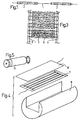
- Fig 1 illustrates a thread length with anode elements according to the invention thereon
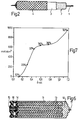
- Fig 2 shows an anode element to a larger scale
- Fig 3 is a plan view of an embodiment of an anode according to the invention
- Fig 4 is an exploded view illustrating the formation of a certain battery
- Fig 5 illustrates this battery with two lids prior to their attachment
- Fig 6 is a cross-sectional view of another battery
- Fig 7 is a graph showing the volumetric capacity of lithium versus the relative volume change of an aluminium host.
- the invention is described in its application to a liquid electrolyte lithium battery and especially a battery based on either of the following two lithium/sulphur dioxide systems: 1) Li / SO2 + LiAlCl4 + C / C 2) Li / SO2 + LiAlCl4 / TiS2
- the first mentioned system is best suited for a primary battery, whereas the second one can also well be used for a secondary, i.e. rechargeable battery.
- the reversible chemical reaction in a respective battery of any of these types has the following overall scheme: 1) 3 Li + 3 C + 3 SO2 + LiAlCl4 ⁇ LiCl-Al(SO2)3-3C + 3LiCl 2) Li + TiS2 ⁇ LiTiS2 (in this case SO2 + LiAlCl4 is a pure electrolyte not participating in the reaction)
- the cathode or positive electrode in a battery in the first system is a high surface carbon black in combination with the liquid SO2-LiAlCl4 complex.
- Carbon black has a two-fold function in the battery: it acts as a complex binder for the reduced form of SO2 (cf the reaction formula above) and as an adsorbing agent for the SO2-LiAlCl4 complex but also as the current collector in the cathode.
- the carbon material should have a high surface area, high density, a great number of active sites for the complex binding and a good electric conductivity. It should further have a high porosity providing space for the reaction products.
- Carbon black materials have been found to fulfil these requirements, and the presently preferred material is the commercially available product Ketjen Black from Akzo.
- the cathode is electrically conducting TiS2 or any other suitable metal sulphide, for example V2S5, MoS3 etc.
- the electrolyte is 6SO2-LiAlCl4, which requires a pressure of some 2 atmospheres about 2x10² kPa to become liquid.
- the electrolyte functions as an ion conductor in both systems and also as a depolarizer in the primary system, which poses special stoichiometric and physical-chemical requirements.
- the quantity of SO2 is stoichiometrically twice as big as that of LiAlCl4, which is necessary both to ensure that the electrolyte is liquid down to -30°C and has an adequately low viscosity and can avoid drying out at discharge in a primary system.
- the separator in the battery shall effectively prevent electrical contact between anode and cathode but shall allow penetration of electrolyte and depolarizer. It shall in this case be able to contain or store certain amounts of electrolyte.
- the separator has the form of hollow fibres in the anode complex of the battery. Hollow fibres can also be used for the cathode.
- the battery according to the invention works in the Li(Al)/SO2 system. It has an anode of Li(Al) alloy in hollow fibre separator.
- the electrolyte/cathode is LiAlCl4, SO2 and C.
- the discharge process for this battery system comprises oxidation of lithium, reduction of sulphur dioxide and complex formation between electrolyte salt, sulphur dioxide and carbon.
- the cathode is TiS2 or the like, whereas the electrolyte, which does not take part in the reaction, is SO2 and LiAlCl4.
- the capacity of the first mentioned system is higher than that of the second one, but due to a certain risk for thermal run-away during charging of the first system it is only used for primary batteries.
- a critical factor for the utilization of the anode electrode material in a battery is the active electrode surface.
- the cell power increases with increasing contact surface between electrode and electrolyte.
- a large surface has been accomplished by the use of the so called "hollow fibre"-concept for the anode.
- This concept is revealed in WO-A-87/01516 and can be characterized in that the anode material is shaped as a cylinder or similar elongated body with optional cross-section and is encapsulated in an elastical, microporous separator material forming a hollow tube and that the anode elements are connected to an electrically conductive material (for example nickel) not taking part in the cell reaction.
- the cross-sectional dimension of the hollow tube or fibre is preferably less than 3 mm.
- the anode material can be manufactured in at least two different ways, namely either electrochemical loading of lithium into aluminium (electroforming) or pyrometallurgical fusion together of lithium and aluminium at a temperature of about 700°C or more.
- the fusion together of lithium and aluminium at 700°C requires an inert atmosphere (argon), as both metals are aggressive relative to O2 and H2O and to a lesser extent N2.
- the molten alloy is cooled off, whereafter it is ground in dry atmosphere (preferably less than 2 % humidity).
- the resulting powder can then be pressed (at a pressure of 6-10 ton/cm2) in a hydraulic press around a central nickel wire to a parallelepipedical or cylindrical shape.
- An example of practical measurements are 1.4 x 1.8 x 50.0 mm.
- the anode is thereafter enclosed in a hollow fibre separator.
- carbon black is mixed with Teflon ® in proportions appr 80:20.
- Teflon ® isopropanol, water and Teflon suspension is mixed. The mixture is extruded, dried and sintered. After finely dividing the cathode material it is pressed or rolled onto a current collecting net or the like, for example of nickel. The finished cathodes are enclosed in separator material of the same kind as used for the anodes.
- carbon cathodes with dimensions 50 x 15 mm and a thickness of 1 - 2 mm are made. They contain some 0.3 - 0.5 g carbon each and have a porosity of 75 %.
- the electrolyte as described above can be prepared in that equimolar amounts of LiCl and AlCl3 are mixed in a pressure vessel, whereupon SO2 is added.
- Lithium may be deposited on metallic aluminium by electrochemical loading. As has already been stated, pyrometallurgical fusion together of lithium and aluminium into Li(Al) alloy is however preferred.
- a conductive wire 1 (Fig 1) can be stepwise fed through a press or sinter equipment and provided with anode elements 2 at intervals suitable for the following creation of complete anodes.
- each anode element 2 may be provided with a separator 3 according to the "hollow fibre"-concept. Due to the comparatively low physical strength of the Tefzel ® separator material it may be advantageous, especially if the battery is to be of the secondary type, to cover each anode element enclosed in separator material with a reinforcing web or net 4, preferably but not necessarily of the same material. In a practical case a number of filaments are braided directly on each element. The number of filaments may be fourteen.
- anode elements 2 may be placed as cross-bars betwen two collector rails 5, as shown in Fig 3, and their conductive wires 1 are attached to the collector rails 5 by soldering or the like. If the anode elements 2 are not already provided with separators time has now come to do so by pressing and line welding.
- the hollow fibre separators are indicated in Fig 3 by reference numeral 6. Hereafter the formed anode ladder can be cut into desired lengths for the intended purpose.
- a certain length of a thread 1 provided with anode elements 2 can be laid in S-loops with the anode elements in parallel between the bends, whereupon two connector rails 5 are attached at the bends. Also, such a length of thread 1 provided with anode elements 2 can be wound around two connector rails 5 (placed at the desired distance from each other) and attached thereto so as to form the anode ladder of the type shown in Fig 3.
- a hollow fibre anode 7 and a carbon cathode 8 are placed in a suitable cavity in a carrier 9.
- a carrier 9 with its contents is placed in a battery container 10 with lids, to which the current connectors of the electrodes are connected. Prior to sealing electrolyte under pressure is added to the container.
- FIG. 6 A practical embodiment of a secondary battery according to the invention is shown in Fig 6.
- a metal can or container 11 a shaped cathode 12 (of for example TiS2) is placed.
- a number of Li(Al) anodes 13, for example of the type depicted in Fig 2, are inserted in the cathode.
- the number of anodes may be seven: one central and six peripherically arranged.
- the threads or current connectors from the anodes 13 extend through a plastic spacer 14 to a metal lid or terminal 15, which is electrically parted from the container 11 by a plastic isolator 16.
- After mounting electrolyte may be introduced through a filling port 17 in the container 11; this port is thereafter permanently closed.
- Lithium forms alloys with aluminium in different metallurgical phases with different properties and patterns. Generally the different phases are as follows: alpha 0-10 atom%, alpha-beta 10-48 atom%, beta 48-60 atom%, and gamma 60-70 atom% of lithium in aluminium.
- Aluminium as host material for lithium has some advantages and disadvantages (which are most relevant for a secondary battery but also to a certain extent for a primary battery).
- Fig 7 is a graph showing the volumetric capacity of lithium stated in mAh/cm3 of the mixed alpha beta phase of Li(Al) alloy versus the relative volume change of the aluminium host.
- the graph shows that up to appr. 30 atom% lithium in the alloy the capacity rises very quickly, whereas the volume change is modest; the inclination is in other words rather steep. Thereafter, especially up to appr. 40 atom% Li, the curve is much more level, which means that the capacity change is relatively low in comparison to the volume change.
- Li(Al) alloy At discharge of a Li(Al) alloy anode it is left in a more or less porous state depending on the discharge degree or depth. In other words the outer dimensions of the alloy do not change during discharge.
- the physical integrity of the discharged electrode is essential for the following charge and discharge steps, which means that volume changes should be minimized to ensures host integrity and electrical conductivity. Optimum conditions would be no volume changes combined with a high intercalation degree of lithium.
- a compromise is a mixed alpha beta phase between 6 and 50 atom%, the preferred range being 10-32 atom% lithium, where the first figures indicate discharged state and the second ones charged state and where the remainder of the anode is essentially aluminium. Differently speaking it is not possible - using the mixed alpha beta phase of Li(Al) alloy - to obtain smaller volume changes with a corresponding Li-capacity than between 32 and 10 atom%.
- An electrochemical cell (7 cm3) consisting of 2.7 g of 30 atom% Li(Al) alloy (surface area ca 65 cm2) anode covered with a microporous polypropylene separator, 8 g electrolyte (LiAlCl4, SO2 1:6) and 1.5 g Ketjen black (15 weight% Teflon) cathode was assembled in sandwich fashion in an SS battery container. Leads and collectors were all nickel.
- the cell delivered 300 cycles of 300 mAh (40 % depth of discharge) at the discharge rate 500 mA; closed cell voltage 2.6 V, open cell voltage 2.8 V.
- the anode was disintegrated.
- the anode was disintegrated.
- a comparable cell with a 20 atom% lithium anode replacing the 30 atom% anode of example 1 delivered under the same conditions 300 discharges with a reduced depth of discharge.
- Li(Al) alloys containing a mixed alpha beta phase is made by melting appropriate amounts of metals in a closed container. The alloy is solidified by cooling and then ground to 200 mesh, making the alloy fully homogeneous.
- the last example describes an alternative to the manufacture of the alloys of the first four examples.
- the Li(Al) alloy containing a mixed alpha beta phase is made by an electroforming process.
- Aluminium Merck, 99.9%
- a polypropylene separator (Celanese, Hoechst)
- lithium Lithco, 99%
- anhydrous electrolyte i.e. 1 M LiCF3SO3 in THF, tetra-hydroforan
- the anode is washed in anhydrous THF and is then ready for use in any of the examples 1-4.
- the lithium contents of the Li(Al) anode are more important than those referred to above. Accordingly, in such a battery the lithium contents may be as high as 80 atom%.
Landscapes
- Chemical & Material Sciences (AREA)
- Chemical Kinetics & Catalysis (AREA)
- Electrochemistry (AREA)
- General Chemical & Material Sciences (AREA)
- Engineering & Computer Science (AREA)
- Manufacturing & Machinery (AREA)
- Battery Electrode And Active Subsutance (AREA)
- Secondary Cells (AREA)
Claims (4)
- Verfahren zum Herstellen einer Li (Al)-Anode für eine Lithium-Batterie, wobei Li und Al pyrometallurgisch in inerter Atmosphäre legiert werden und die ausgebildete Legierung nach dem Abkühlen zu einem homogenen Pulver vermahlen wird,
dadurch gekennzeichnet,
daß das Pulver um eine stromleitende Ader (1), vorzugsweise aus Nickel, zu einem langgestreckten Anodenelement (2) gepreßt oder extrudiert und daß das Anodenelement mit einer Umhüllung (3) aus mikroporösem Separatormaterial versehen wird. - Verfahren nach Anspruch 1, dadurch gekennzeichnet, daß eine Bahn aus Separatormaterial auf beiden Seiten einer Anodenanordnung, umfassend Anodenelemente (2) und Anschlußschienen (5), angeordnet, zusammengedrückt und um die getrennten Anodenelemente eine Schweißlinie angebracht wird.
- Verfahren nach Anspruch 1, dadurch gekennzeichnet, daß eine Anzahl von getrennten Anodenelementen (2) in bestimmten Intervallen auf einer stromleitenden Ader (1) in einem kontinuierlichen Vorgang ausgebildet wird, einschließlich des Anbringens der Umhüllungen (3) aus mikroporösem Separatormaterial.
- Verfahren nach Anspruch 1, dadurch gekennzeichnet, daß jedes Anodenelement (2) auf der Außenseite des Separatormaterials (3) mit einem Schutzstoff oder- netz (4) versehen wird.
Applications Claiming Priority (3)
| Application Number | Priority Date | Filing Date | Title |
|---|---|---|---|
| SE8902461 | 1989-07-06 | ||
| SE8902461A SE8902461D0 (sv) | 1989-07-06 | 1989-07-06 | Method for producing a li(a1) anode for a lithium battery |
| PCT/SE1990/000473 WO1991001046A1 (en) | 1989-07-06 | 1990-07-02 | METHOD FOR PRODUCING A Li(Al) ANODE FOR A LITHIUM BATTERY |
Publications (2)
| Publication Number | Publication Date |
|---|---|
| EP0481010A1 EP0481010A1 (de) | 1992-04-22 |
| EP0481010B1 true EP0481010B1 (de) | 1994-11-02 |
Family
ID=20376503
Family Applications (1)
| Application Number | Title | Priority Date | Filing Date |
|---|---|---|---|
| EP90911981A Expired - Lifetime EP0481010B1 (de) | 1989-07-06 | 1990-07-02 | Verfahren zur herstellung einer li(a1)-anode für eine lithiumbatterie |
Country Status (9)
| Country | Link |
|---|---|
| US (1) | US5484461A (de) |
| EP (1) | EP0481010B1 (de) |
| JP (1) | JPH04506724A (de) |
| AT (1) | ATE113760T1 (de) |
| AU (1) | AU6156890A (de) |
| CA (1) | CA2058431C (de) |
| DE (1) | DE69013919T2 (de) |
| SE (1) | SE8902461D0 (de) |
| WO (1) | WO1991001046A1 (de) |
Families Citing this family (4)
| Publication number | Priority date | Publication date | Assignee | Title |
|---|---|---|---|---|
| US7211348B2 (en) * | 2000-08-10 | 2007-05-01 | University Of Virginia Patent Foundation | Multifunctional battery and method of making the same |
| US9138831B2 (en) * | 2008-06-27 | 2015-09-22 | Lincoln Global, Inc. | Addition of rare earth elements to improve the performance of self shielded electrodes |
| RU2589742C1 (ru) * | 2015-06-04 | 2016-07-10 | Федеральное государственное бюджетное образовательное учреждение высшего профессионального образования "Саратовский государственный технический университет имени Гагарина Ю.А." | Литий-алюминиевый анод |
| US10199635B2 (en) * | 2016-09-22 | 2019-02-05 | Grst International Limited | Method of drying electrode assemblies |
Family Cites Families (5)
| Publication number | Priority date | Publication date | Assignee | Title |
|---|---|---|---|---|
| DE1049949B (de) * | 1959-02-05 | Gottfried Hagen A.G., Köln-Kalk | Verfahren zum Herstellen eines mit aktiver Masse gefüllten Röhrchens für Akkumulatoren-Röhrenplatten und Verfahren zum Herstellen dieser Platten | |
| US2251913A (en) * | 1938-04-01 | 1941-08-12 | Joseph B Brennan | Electrode for storage batteries |
| BE525687A (de) * | 1953-01-14 | |||
| US3957532A (en) * | 1974-06-20 | 1976-05-18 | The United States Of America As Represented By The United States Energy Research And Development Administration | Method of preparing an electrode material of lithium-aluminum alloy |
| US4011372A (en) * | 1975-12-09 | 1977-03-08 | The United States Of America As Represented By The United States Energy Research And Development Administration | Method of preparing a negative electrode including lithium alloy for use within a secondary electrochemical cell |
-
1989
- 1989-07-06 SE SE8902461A patent/SE8902461D0/xx unknown
-
1990
- 1990-07-02 JP JP2511248A patent/JPH04506724A/ja active Pending
- 1990-07-02 WO PCT/SE1990/000473 patent/WO1991001046A1/en not_active Ceased
- 1990-07-02 EP EP90911981A patent/EP0481010B1/de not_active Expired - Lifetime
- 1990-07-02 AU AU61568/90A patent/AU6156890A/en not_active Abandoned
- 1990-07-02 US US07/778,875 patent/US5484461A/en not_active Expired - Fee Related
- 1990-07-02 CA CA002058431A patent/CA2058431C/en not_active Expired - Fee Related
- 1990-07-02 AT AT90911981T patent/ATE113760T1/de not_active IP Right Cessation
- 1990-07-02 DE DE69013919T patent/DE69013919T2/de not_active Expired - Fee Related
Also Published As
| Publication number | Publication date |
|---|---|
| DE69013919T2 (de) | 1995-05-24 |
| US5484461A (en) | 1996-01-16 |
| SE8902461D0 (sv) | 1989-07-06 |
| WO1991001046A1 (en) | 1991-01-24 |
| CA2058431A1 (en) | 1991-01-07 |
| EP0481010A1 (de) | 1992-04-22 |
| JPH04506724A (ja) | 1992-11-19 |
| DE69013919D1 (de) | 1994-12-08 |
| ATE113760T1 (de) | 1994-11-15 |
| AU6156890A (en) | 1991-02-06 |
| CA2058431C (en) | 2000-12-05 |
Similar Documents
| Publication | Publication Date | Title |
|---|---|---|
| JPH0626138B2 (ja) | 二次電池 | |
| EP0140693A2 (de) | Aus ungeordnetem aktivem Material verfertigte Elektroden und Verfahren zu ihrer Herstellung | |
| EP1794829A2 (de) | Verbesserte lithiumzelle und verfahren zu ihrer bildung | |
| US4792505A (en) | Electrodes made from mixed silver-silver oxides | |
| US4861690A (en) | Lightweight battery construction | |
| JP2025081759A (ja) | リチウムイオン二次電気化学セル | |
| EP1218957A1 (de) | Aufladbare nickel-zink zellen | |
| JP2004508687A (ja) | リチウム粉末陰極、これを用いたリチウム電池及びこれらの製造方法 | |
| EP0284063B1 (de) | Elektrode aus wasserstoffspeichernder Legierung und Verfahren zu ihrer Herstellung | |
| US5484461A (en) | Method for producing a Li(Al) anode for a lithium battery | |
| JP3499924B2 (ja) | 金属−水素化物アルカリ蓄電池用の水素吸蔵合金電極 | |
| EP0537266B1 (de) | Sekundäre oder primäre lithiumbatterie | |
| CN1290407A (zh) | 棱柱形电化学电池 | |
| JP2020515721A (ja) | 金属イオンバッテリ用電極、ならびに関連する材料、バッテリおよび方法 | |
| US6221529B1 (en) | Positive electrode for lithium battery and lithium battery | |
| JP3403858B2 (ja) | 有機電解質電池 | |
| JPS63308868A (ja) | 二次電池 | |
| JPH0536401A (ja) | リチウム二次電池 | |
| JPS6342819B2 (de) | ||
| US20240290942A1 (en) | Free standing 3d anode arrangement having continuous ion-conducting shell or cage | |
| CA2173330C (en) | Bipolar electrochemical battery of stacked wafer cells | |
| JPH0218876A (ja) | 密閉電気化学的電池の製造方法 | |
| JP3432866B2 (ja) | アルカリ蓄電池用の水素吸蔵合金電極 | |
| JPS634554A (ja) | 有機電解質二次電池 | |
| JPH0470744B2 (de) |
Legal Events
| Date | Code | Title | Description |
|---|---|---|---|
| PUAI | Public reference made under article 153(3) epc to a published international application that has entered the european phase |
Free format text: ORIGINAL CODE: 0009012 |
|
| 17P | Request for examination filed |
Effective date: 19911223 |
|
| AK | Designated contracting states |
Kind code of ref document: A1 Designated state(s): AT BE CH DE FR GB IT LI NL SE |
|
| 17Q | First examination report despatched |
Effective date: 19931210 |
|
| GRAA | (expected) grant |
Free format text: ORIGINAL CODE: 0009210 |
|
| AK | Designated contracting states |
Kind code of ref document: B1 Designated state(s): AT BE CH DE FR GB IT LI NL SE |
|
| PG25 | Lapsed in a contracting state [announced via postgrant information from national office to epo] |
Ref country code: NL Effective date: 19941102 Ref country code: LI Effective date: 19941102 Ref country code: CH Effective date: 19941102 Ref country code: BE Effective date: 19941102 Ref country code: AT Effective date: 19941102 |
|
| REF | Corresponds to: |
Ref document number: 113760 Country of ref document: AT Date of ref document: 19941115 Kind code of ref document: T |
|
| REF | Corresponds to: |
Ref document number: 69013919 Country of ref document: DE Date of ref document: 19941208 |
|
| ET | Fr: translation filed | ||
| ITF | It: translation for a ep patent filed | ||
| EAL | Se: european patent in force in sweden |
Ref document number: 90911981.0 |
|
| REG | Reference to a national code |
Ref country code: CH Ref legal event code: PL |
|
| NLV1 | Nl: lapsed or annulled due to failure to fulfill the requirements of art. 29p and 29m of the patents act | ||
| PLBE | No opposition filed within time limit |
Free format text: ORIGINAL CODE: 0009261 |
|
| STAA | Information on the status of an ep patent application or granted ep patent |
Free format text: STATUS: NO OPPOSITION FILED WITHIN TIME LIMIT |
|
| 26N | No opposition filed | ||
| PGFP | Annual fee paid to national office [announced via postgrant information from national office to epo] |
Ref country code: GB Payment date: 20010625 Year of fee payment: 12 |
|
| PGFP | Annual fee paid to national office [announced via postgrant information from national office to epo] |
Ref country code: SE Payment date: 20010710 Year of fee payment: 12 |
|
| PGFP | Annual fee paid to national office [announced via postgrant information from national office to epo] |
Ref country code: FR Payment date: 20010719 Year of fee payment: 12 |
|
| PGFP | Annual fee paid to national office [announced via postgrant information from national office to epo] |
Ref country code: DE Payment date: 20010907 Year of fee payment: 12 |
|
| REG | Reference to a national code |
Ref country code: GB Ref legal event code: IF02 |
|
| PG25 | Lapsed in a contracting state [announced via postgrant information from national office to epo] |
Ref country code: GB Free format text: LAPSE BECAUSE OF NON-PAYMENT OF DUE FEES Effective date: 20020702 |
|
| PG25 | Lapsed in a contracting state [announced via postgrant information from national office to epo] |
Ref country code: SE Free format text: LAPSE BECAUSE OF NON-PAYMENT OF DUE FEES Effective date: 20020703 |
|
| PG25 | Lapsed in a contracting state [announced via postgrant information from national office to epo] |
Ref country code: DE Free format text: LAPSE BECAUSE OF NON-PAYMENT OF DUE FEES Effective date: 20030201 |
|
| GBPC | Gb: european patent ceased through non-payment of renewal fee |
Effective date: 20020702 |
|
| EUG | Se: european patent has lapsed | ||
| PG25 | Lapsed in a contracting state [announced via postgrant information from national office to epo] |
Ref country code: FR Free format text: LAPSE BECAUSE OF NON-PAYMENT OF DUE FEES Effective date: 20030331 |
|
| REG | Reference to a national code |
Ref country code: FR Ref legal event code: ST |
|
| PG25 | Lapsed in a contracting state [announced via postgrant information from national office to epo] |
Ref country code: IT Free format text: LAPSE BECAUSE OF NON-PAYMENT OF DUE FEES;WARNING: LAPSES OF ITALIAN PATENTS WITH EFFECTIVE DATE BEFORE 2007 MAY HAVE OCCURRED AT ANY TIME BEFORE 2007. THE CORRECT EFFECTIVE DATE MAY BE DIFFERENT FROM THE ONE RECORDED. Effective date: 20050702 |