EP0481084A1 - Memoire a acces selectif dynamique dans laquelle la synchronisation de fin de la lecture de donnees s'effectue plus t t que d'habitude - Google Patents
Memoire a acces selectif dynamique dans laquelle la synchronisation de fin de la lecture de donnees s'effectue plus t t que d'habitude Download PDFInfo
- Publication number
- EP0481084A1 EP0481084A1 EP91906569A EP91906569A EP0481084A1 EP 0481084 A1 EP0481084 A1 EP 0481084A1 EP 91906569 A EP91906569 A EP 91906569A EP 91906569 A EP91906569 A EP 91906569A EP 0481084 A1 EP0481084 A1 EP 0481084A1
- Authority
- EP
- European Patent Office
- Prior art keywords
- voltage
- bli
- data bus
- reading
- line
- Prior art date
- Legal status (The legal status is an assumption and is not a legal conclusion. Google has not performed a legal analysis and makes no representation as to the accuracy of the status listed.)
- Granted
Links
Images





Classifications
-
- G—PHYSICS
- G11—INFORMATION STORAGE
- G11C—STATIC STORES
- G11C7/00—Arrangements for writing information into, or reading information out from, a digital store
- G11C7/10—Input/output [I/O] data interface arrangements, e.g. I/O data control circuits, I/O data buffers
- G11C7/1051—Data output circuits, e.g. read-out amplifiers, data output buffers, data output registers, data output level conversion circuits
- G11C7/1057—Data output buffers, e.g. comprising level conversion circuits, circuits for adapting load
-
- G—PHYSICS
- G11—INFORMATION STORAGE
- G11C—STATIC STORES
- G11C11/00—Digital stores characterised by the use of particular electric or magnetic storage elements; Storage elements therefor
- G11C11/21—Digital stores characterised by the use of particular electric or magnetic storage elements; Storage elements therefor using electric elements
- G11C11/34—Digital stores characterised by the use of particular electric or magnetic storage elements; Storage elements therefor using electric elements using semiconductor devices
- G11C11/40—Digital stores characterised by the use of particular electric or magnetic storage elements; Storage elements therefor using electric elements using semiconductor devices using transistors
- G11C11/401—Digital stores characterised by the use of particular electric or magnetic storage elements; Storage elements therefor using electric elements using semiconductor devices using transistors forming cells needing refreshing or charge regeneration, i.e. dynamic cells
- G11C11/4063—Auxiliary circuits, e.g. for addressing, decoding, driving, writing, sensing or timing
- G11C11/407—Auxiliary circuits, e.g. for addressing, decoding, driving, writing, sensing or timing for memory cells of the field-effect type
-
- G—PHYSICS
- G11—INFORMATION STORAGE
- G11C—STATIC STORES
- G11C11/00—Digital stores characterised by the use of particular electric or magnetic storage elements; Storage elements therefor
- G11C11/21—Digital stores characterised by the use of particular electric or magnetic storage elements; Storage elements therefor using electric elements
- G11C11/34—Digital stores characterised by the use of particular electric or magnetic storage elements; Storage elements therefor using electric elements using semiconductor devices
- G11C11/40—Digital stores characterised by the use of particular electric or magnetic storage elements; Storage elements therefor using electric elements using semiconductor devices using transistors
- G11C11/401—Digital stores characterised by the use of particular electric or magnetic storage elements; Storage elements therefor using electric elements using semiconductor devices using transistors forming cells needing refreshing or charge regeneration, i.e. dynamic cells
- G11C11/4063—Auxiliary circuits, e.g. for addressing, decoding, driving, writing, sensing or timing
- G11C11/407—Auxiliary circuits, e.g. for addressing, decoding, driving, writing, sensing or timing for memory cells of the field-effect type
- G11C11/4076—Timing circuits
-
- G—PHYSICS
- G11—INFORMATION STORAGE
- G11C—STATIC STORES
- G11C11/00—Digital stores characterised by the use of particular electric or magnetic storage elements; Storage elements therefor
- G11C11/21—Digital stores characterised by the use of particular electric or magnetic storage elements; Storage elements therefor using electric elements
- G11C11/34—Digital stores characterised by the use of particular electric or magnetic storage elements; Storage elements therefor using electric elements using semiconductor devices
- G11C11/40—Digital stores characterised by the use of particular electric or magnetic storage elements; Storage elements therefor using electric elements using semiconductor devices using transistors
- G11C11/401—Digital stores characterised by the use of particular electric or magnetic storage elements; Storage elements therefor using electric elements using semiconductor devices using transistors forming cells needing refreshing or charge regeneration, i.e. dynamic cells
- G11C11/4063—Auxiliary circuits, e.g. for addressing, decoding, driving, writing, sensing or timing
- G11C11/407—Auxiliary circuits, e.g. for addressing, decoding, driving, writing, sensing or timing for memory cells of the field-effect type
- G11C11/409—Read-write [R-W] circuits
- G11C11/4096—Input/output [I/O] data management or control circuits, e.g. reading or writing circuits, I/O drivers or bit-line switches
-
- G—PHYSICS
- G11—INFORMATION STORAGE
- G11C—STATIC STORES
- G11C7/00—Arrangements for writing information into, or reading information out from, a digital store
- G11C7/10—Input/output [I/O] data interface arrangements, e.g. I/O data control circuits, I/O data buffers
- G11C7/1006—Data managing, e.g. manipulating data before writing or reading out, data bus switches or control circuits therefor
-
- G—PHYSICS
- G11—INFORMATION STORAGE
- G11C—STATIC STORES
- G11C7/00—Arrangements for writing information into, or reading information out from, a digital store
- G11C7/10—Input/output [I/O] data interface arrangements, e.g. I/O data control circuits, I/O data buffers
- G11C7/1048—Data bus control circuits, e.g. precharging, presetting, equalising
-
- G—PHYSICS
- G11—INFORMATION STORAGE
- G11C—STATIC STORES
- G11C7/00—Arrangements for writing information into, or reading information out from, a digital store
- G11C7/10—Input/output [I/O] data interface arrangements, e.g. I/O data control circuits, I/O data buffers
- G11C7/1051—Data output circuits, e.g. read-out amplifiers, data output buffers, data output registers, data output level conversion circuits
Definitions
- the present invention relates to a semiconductor memory device, and in particular, to a dynamic random access memory (DRAM).
- DRAM dynamic random access memory
- the present invention further relates to a control signal generation circuit for the dynamic random access memory.
- Some semiconductor memory devices having a large capacity have a divided cell array structure wherein each bit line (array) is divided, and a sense amplifier is provided for each of the divided bit arrays. Further, the present invention relates to control of a signal transmission between bit lines and data bus lines, and timing of control signals for the control of the data reading and writing operations.
- Figure 1 is a diagram indicating an example of the dynamic random access memory having the divided cell array structure.
- a sense amplifier SA is connected to each pair of bit lines BLi, BLi ⁇ , and the bit lines BLi, BLi ⁇ in each pair are respectively connected to data bus lines DBj, DBj ⁇ forming a pair, where the pair of data bus lines DBj, DBj ⁇ are provided for each memory cell array MCAm.
- each pair of data bus lines DBj, DBj ⁇ are connected to a data bus amplifier DBA and a writing amplifier WA.
- Fig. 1 Although the construction of Fig. 1 is well known, the operation thereof is briefly reviewed below.
- a word line (not shown) is selected, voltages caused by data memorized in memory cells corresponding to the selected word line, are respectively output on the pairs of bit lines BLi, BLi ⁇ , and then the voltages on the pairs of bit lines BLi, BLi ⁇ are respectively amplified by the sense amplifiers SA.
- the column selection switches Q1' to Q8' turn ON, and voltages of the bit lines BL1, BL1 ⁇ , to BL4, BL4 ⁇ are output on the corresponding data bus lines DB1, DB1 ⁇ , to DB4, DB4 ⁇ , respectively.
- the voltages on the data bus lines are amplified by the data bus amplifiers DBA, and then only one amplified voltage is selected to be output to outside of the dynamic random access memory when the dynamic random access memory is a one bit output type.
- the above amplified voltages on the bit lines BL1, BL1 ⁇ , to BL4, BL4 ⁇ are applied to the memory cells corresponding to the selected word line, and the contents of the memory cells are refreshed.
- the writing amplifier WA When writing data, the writing amplifier WA operates, and outputs of the writing amplifier WA are applied to the memory cell corresponding to the selected word line, through a pair of data bus lines DBj, DBj ⁇ , the column selection switches Q n ' turned ON by the selection, and the pair of bit lines BLi, BLi ⁇ connected to the pair of data bus lines DBj, DBj ⁇ by the selected column selection switches Q n ', and thus the above data is written in the memory cell.
- the means for selecting a column in a conventional dynamic random access memory connects an output of the column decoder to the column selection switch Q n ' provided for each divided block of the memory cell array.
- the column selection switch Q n ' driven by the column decoder, connects a pair of data bus lines DBj, DBj ⁇ with a pair of bit lines BLi, BLi ⁇ or a sense amplifier SA.
- the electric charge which has been pre-charged on the pair of data bus lines DBj, DBj ⁇ is discharged by the sense amplifier SA to generate an appropriate output signal to be applied to a load element connected to the pair of data bus lines DBj, DBj ⁇ .
- flip flop circuits constituting the sense amplifier SA are driven with a large amplitude applied to the pair of data bus lines DBj, DBj ⁇ .
- the column selection line CSL1 is driven by the column decoder CD, and therefore, the column selection switches Q1' and Q2' turn ON, and thus the sense amplifier SA and the pair of data bus lines DB1, DB1 ⁇ are connected to each other.
- the other bit line in the pair (for example, DB1 ⁇ ) is connected to the other input/output terminal of the sense amplifier SA to thereby balance stray capacities on the bit lines connected to both the input/output terminals.
- the sense amplifier SA draws out a voltage of one bit line of the pair of data bus lines DBj, DBj ⁇ according to whether the data to be read is "0" or "1".
- the voltage amplitude on the pair of data bus lines is about 0.5V.
- the writing amplifier WA connected to the pair of data bus lines DBj, DBj ⁇ , supplies a maximum amplitude, allowed from the source voltage, to the pair of data bus lines DBj, DBj ⁇ , and thus the outputs of the sense amplifier SA, which receive the amplitude through the column selection switch Q1' and Q2' (turned ON), is inverted according to the data to be written.
- the selected memory cell receives the applied voltage through a transfer gate (constituted by a MOS transistor having a gate connected to the word line), and stores the applied voltage in a capacitor thereof.
- the above conventional dynamic random access memory has the following two problems. Note, these problems will not appear if the timing of signals in the dynamic random access memory is ideal, but a sufficient time margin is necessary at any time for the adjustment, and when a fast access to the memory is required, such a sufficient margin cannot be obtained.
- the column selection line cannot be driven until a predetermined time (margin) has elapsed after the sense amplifier begins to operate.
- this margin is to short, the sense amplifier malfunctions because the output voltage (about 200mV) of a memory cell has not been sufficiently amplified at the beginning of the operation of the sense amplifier, and if the column selection switches Q n ' are turned ON at this stage, the voltages of the data bus lines are applied to the sense amplifier, and thus the sense amplifier becomes unstable. Therefore, the column selection switches Q n ' are driven 15 to 20 nsec after the sense amplifier begins to operate. Namely, conventionally, this time margin is necessary.
- Second problem Since a large amplitude voltage remains on the data bus lines after the data writing operation is completed, the following reading operation must be started after completely resetting the voltages of the data bus lines, to prevent a malfunction of the sense amplifier due to an affect of the previously written data.
- Unexamined Japanese Patent Publication No.59-140692 discloses an example of a dynamic random access memory wherein a column selection line CLW for writing data and a column selection line CLR for reading data are provided separately, and bit lines and data bus lines are connected to each other through transistors.
- Figure 2 is a diagram showing a construction in a region corresponding to a column in a memory cell array in a dynamic random access memory having a plurality of memory cell arrays, as in the construction of Fig. 1.
- Fig. 2 only one memory cell among a plurality of memory cells connected to a pair of bit lines BLi, BLi ⁇ is indicated.
- a column selection line CLW for writing data and a column selection line CLR for reading data are provided separately.
- the pair of bit lines BLi, BLi ⁇ and the pair of data bus lines DBj, DBj ⁇ are electrically connected to each other by controlling transistors Q1 and Q2 connected between the pair of bit lines BLi, BLi ⁇ and the pair of data bus lines DBj, DBj ⁇ , by a column selection signal for writing, which signal is supplied to the transistors through the column selection line CLW for writing.
- a column selection signal for reading which signal is supplied through the column selection line CLR for reading, controls the transistors Q6 and Q7 where source terminals of transistors Q6 and Q7 are respectively connected to the pair of data bus lines DBj, DBj ⁇ . Drain terminals of the transistors Q6 and Q7 are respectively connected to source terminals of transistors Q8 and Q9, and gate terminals of the transistors Q8 and Q9 are respectively connected to the pair of bit lines BLi, BLi ⁇ .
- an electric charge is pre-charged at the pair of data bus lines DBj, DBj ⁇ from a source V cc through transistors Q3 and Q4, and the voltage levels of the pair of data bus lines DBj, DBj ⁇ are maintained at a predetermined level to turn OFF the transistors Q3 and Q4. Then, a voltage corresponding to one bit data and memorized in a capacitor C in a memory cell, is output on one of the pair of bit lines BLi, BLi ⁇ connected to the capacitor C.
- another construction similar to the construction on the side of the bit line BLi is provided on the side of the bit line BLi ⁇ .
- the above voltages output to the pair of bit lines BLi, BLi ⁇ are applied to the sense amplifier SA, and gradually amplified within 15 to 20 nsec.
- the amplified voltage is applied to the gate terminals of the transistors Q8 and Q9, and thus, according to the voltages memorized in the memory cells respectively connected to the pair of bit lines BLi, BLi ⁇ , only one of the transistors Q8 and Q9 is turned ON.
- transistors Q6 and Q7 are turned ON by setting the column selection signal for reading, which signal is supplied through the above column selection line CLR for reading, and therefore, the electric charge pre-charged to one of the pair of data bus lines DBj, DBj ⁇ connected to the above transistor Q8 or Q9 now turned ON, is drawn out to the side of the low voltage source V ss .
- the voltage of the data bus line from which the electric charge is drawn out is lowered, and a difference voltage between the pair of data bus lines DBj, DBj ⁇ is amplified in the data bus amplifier DBA and then latched to detect the above one bit data memorized in the above memory cell.
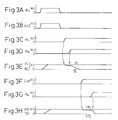
- Figures 3A to 3H are timing charts indicating the timing of a data reading operation in the construction of Fig. 2.
- a gate voltage ⁇ R applied to the gate terminals of the transistors Q3, Q4, and Q5 is changed to V cc (Fig. 3A) while the RAS ⁇ signal is inactive (H) as shown in Fig. 3B, the transistors Q3 and Q4 are turned ON, and therefore, currents are supplied from the high voltage source V cc to the pair of data bus lines DBj, DBj ⁇ through the transistor Q3 and Q4 to pre-charge the pair of data bus lines DBj, DBj ⁇ (Fig. 3H).
- the gate voltage ⁇ R applied to the gate terminals of the transistors Q3, Q4, and Q5 is changed to 0V, to turn OFF all the transistors Q3, Q4, and Q5.
- the pair of data bus lines DBj, DBj ⁇ is maintained as pre-charged to the high voltage V cc , isolated from both the high voltage source V cc and from each other data bus line DBj.
- the word line WL is driven in the above condition (Fig. 3C)
- the transistor Q c connected to the word line WL at a gate terminal thereof is turned ON, and therefore, the voltage of the bit line BLi connected to the above capacitor C through the transistor Q c is lowered, for example, by about 100 mV (Fig. 3E) due to the influence of the terminal voltage of the capacitor C in the memory cell.
- a source voltage ⁇ B supplied to the sense amplifier SA is changed to V cc (Fig.
- the voltage (a difference from the high voltage V cc ) of the bit line BLi is amplified (Fig. 3E).
- the amplified voltage is applied to the gate terminals of the transistors Q8 and Q9, and only one of the transistors Q8 and Q9 is turned ON according to the voltages memorized in the memory cells respectively connected to the pair of bit lines BLi, BLi ⁇ .
- the transistors Q6 and Q7 are turned ON in the construction of Fig.
- the object of the present invention is to provide a dynamic random access memory wherein a signal transmission between bit lines and a data bus is carried out so that data memorized in a memory cell can be read out in a short time after a word line is activated, and a sense amplifier is not affected by a voltage remaining on the data bus after writing data.
- a dynamic random access memory characterized in that said dynamic random access memory comprises: a sense amplifier connected to a bit line, a data bus line, and a reading voltage output means for changing a voltage of the data bus line according to the voltage change occurred on the bit line, the sense amplifier being activated after the reading voltage output means is activated.
- a dynamic random access memory characterized in that said dynamic random access memory comprises: a capacitor provided in at least one memory cell each for memorizing one bit digital data; at least one bit line provided corresponding to the at least one memory cell; gate means, provided for each capacitor in the memory cell, for controlling an electric connection/disconnection between a terminal of the capacitor in the memory cell and the bit line corresponding to the memory cell; at least one data bus line, each provided for at least one of the bit line, a current being continuously supplied to each of the at least one data bus line from a predetermined source through a predetermined resistor; and a reading voltage output means, provided for each of the bit line, and connecting a current input terminal thereof with a data bus corresponding to the bit line, for changing a voltage of the data bus according to the voltage change at the bit line, the sense amplifier being activated after the reading voltage output means is activated.
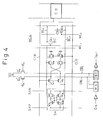
- Figure 4 is a diagram indicating a construction of an embodiment of the present invention.
- Figure 4 shows a construction in a region corresponding to a column in a memory cell array in a dynamic random access memory having a plurality of memory cell arrays as in the construction of Fig. 1.
- Fig. 4 only one pair of memory cells among a plurality of pairs of memory cells connected to a pair of bit lines BLi, BLi ⁇ is indicated.
- the data bus lines DBj, DBj ⁇ are connected to a high voltage source V cc through transistors Q3' and Q4' respectively functioning as a resistor having a constant resistance to receive a supply of a current.
- the data bus lines are not pre-charged before a data reading operation.
- a column selection line CLW for writing data and a column selection line CLR for reading data are separately provided.
- the pair of bit lines BLi, BLi ⁇ and the pair of data bus lines DBj, DBj ⁇ are electrically connected to each other by controlling transistors Q1 and Q2 connected between the pair of bit lines BLi, BLi ⁇ and the pair of data bus lines DBj, DBj ⁇ , by a column selection signal for writing, which signal is supplied to the transistors through the column selection line CLW for writing.
- a column selection signal for reading which signal is supplied through the column selection line CLR for reading, controls the transistors Q6 and Q7, where source terminals of transistors Q6 and Q7 are respectively connected to the pair of data bus lines DBj, DBj ⁇ .
- Drain terminals of the transistors Q6 and Q7 are respectively connected to source terminals of transistors Q8'' and Q9'', and gate terminals of the transistors Q8'' and Q9'' are respectively connected to the pair of bit lines BLi, BLi ⁇ .
- the level of the word lines WL1 and WL2 connected to objective memory cells are made H (high), and the corresponding transfer gates Q c1 and Q c2 are turned ON, whereby voltages according to one bit data memorized in capacitors C1 and C2 in the memory cells are output at the pair of bit lines BLi, BLi ⁇ .
- the above voltages output at the pair of bit lines BLi, BLi ⁇ are applied to the sense amplifier SA, and at the same time, are applied to the gate terminals of the transistors Q8'' and Q9''.
- the level of the column selection signal for reading which signal is supplied through the column selection line for reading CLR, is at the H level
- the voltage at an input point of the data bus amplifier DBA whereat one of the data bus lines connected to the above transistor is connected to the data bus amplifier DBA falls.
- a difference voltage on the pair of data bus lines DBj, DBj ⁇ generated due to the above voltage fall, is amplified by the data bus amplifier DBA and then latched to detect the one bit data memorized in the memory cells.
- the difference voltage corresponding to the one bit data memorized in the memory cells appears at the input point to the data buffer DBA on the data bus line, and the appeared difference voltage is detected by the data buffer DBA.
- transfer conductances g m of the transistors Q8'' and Q9'' are made larger (in particular, larger than transfer conductances g m of the transistors Q17 and Q18 constituting the sense amplifier SA)
- the driving of the pair of data bus lines DBj, DBj ⁇ in response to the voltages of the pair of bit lines BLi, BLi ⁇ is made faster, and the access speed of the dynamic random access memory is greatly increased.
- the transfer conductances g m of the transistors Q17 and Q18 in the sense amplifier SA are too large, the flip flop circuit in the sense amplifier SA cannot be inverted, to make the data writing operation difficult.
- the sense amplifier SA in the construction of Fig. 4 is exclusively used for refreshing the content of the memory cells after the data in the memory cells have been read out, as in the construction of Fig. 2, and for amplifying the voltages output on the pair of bit lines BLi, BLi ⁇ through the pair of data bus lines DBj, DBj ⁇ from the writing amplifier WA to write the amplified voltages in the memory cells when writing data.
- the voltages on the pair of bit lines BLi, BLi ⁇ are applied through the pair of data bus lines DBj, DBj ⁇ to the data buffer DBA to be detected by the data buffer DBA before the voltages are amplified by the sense amplifier SA.
- SAP and SAN denote a high voltage and a low voltage power supply line to the sense amplifier SA, respectively.
- Figure 6 is a timing diagram indicating a conventional read modify write operation in the construction of Fig. 2. Since, according to the conventional construction, the column selection signal for reading on the column selection line CLR for reading must be maintained at the H level until the voltages on the pair of bit lines BLi, BLi ⁇ are amplified by the sense amplifier SA, and then the amplified difference voltage on the pair of bit lines BLi, BLi ⁇ is detected through the pair of data bus lines DBj, DBj ⁇ , the activation of the column selection signal for writing, which signal is supplied through the column selection line CLW for writing, can be carried out after the above operation is completed as indicated in Fig. 6. On the other hand, according to the construction of Fig.
- the data reading operation can be completed without waiting for the amplification by the sense amplifier SA after the column selection signal for reading is applied through the column selection line CLR for reading. Therefore, as indicated in Fig. 7, the data writing operation can be started by changing the level of the column selection signal for writing, which signal is supplied through the column selection line CLW for writing, to the H level, immediately after the above data reading operation is completed (time t2 in Fig. 7), to carry out a read modify write operation wherein a data writing operation follows a data reading operation.
- a write enable signal WE which signal is supplied to the dynamic random access memory, is also changed from an inactive level to an active level, and thus the read modify write operation can be carried out faster.
- Figure 8 is a diagram indicating a whole construction of the dynamic random access memory having a construction as Fig. 2, together with a control circuit generating a control signal.
- reference numerals 1, 2, 3, 4, and 10 each denote a clock generation circuit
- 5 denotes a row address buffer RAB
- 6 denotes an OR gate
- 7 denotes an AND gate
- 8 denotes a column address buffer CAB
- 9 denotes an address transition detection circuit
- 11 denotes a memory cell array
- 12 denotes a column decoder
- 13 denotes a row decoder
- 14 denotes a sense amplifier
- 15 denotes a sense amplifier driving transistor.
- a RAS ⁇ (row address strobe) clock, applied from outside, is converted to an in-chip clock signal RAS by the clock generation circuit CG1, and the in-chip clock signal is applied to the clock generation circuits CG2 and CG4, and the row address buffer RAB.
- An row address Ai is applied to the row address buffer RAB from a CPU, not shown, and the row address Ai is latched in the row address buffer RAB when (t0) the RAS clock signal transits to an active state (rises).
- the latched row address Ai is supplied to the row decoder 13, and the row decoder 13 decodes the row address Ai.
- the clock generation circuit CG2 When the clock generation circuit CG2 receives the above RAS clock signal, the clock generation circuit CG2 outputs a word line driving pulse which rises at the time t1.
- the word line driving pulse is applied to the row decoder 13 and one input terminal of the AND gate 7.
- the row decoder 13 decodes the above row address Ai to drive the aforementioned word line in the memory cell array 11 (Fig. 4) according to the decoded result, synchronized with a leading edge of the above word line driving pulse.
- the output of the clock generation circuit CG2 is also supplied to the clock generation circuit CG3 through a word line simulator which simulates a delay caused in the operation of driving the word lines in the actual memory cell arrays.
- the clock generation circuit CG3 outputs a sense amplifier driving pulse which rises (at t5 in Fig. 8) in response to a leading edge of the output of the clock generation circuit CG2 after being delayed by the word line simulator.
- the sense amplifier driving transistor 15 is driven by the sense amplifier driving pulse, and an electric power for the memory cell array 11 is supplied through the above-mentioned high voltage supply line SAP and the low voltage supply line SAN to the sense amplifier 14, to drive the sense amplifier SA.
- a row address Ai is supplied from an address bus and then, after a predetermined time has elapsed, (one or more) column addresses Ai' are supplied in turn.
- a change in addresses supplied from the address bus is detected by the address transition detection circuit 9, and an ATD pulse is output from the address transition detection circuit 9 for each detection of the change of the address.
- the width of the ATD pulse is widened in the clock generation circuit CG5, and then the widened pulse is applied to one input terminal of the OR gate 6. In Fig. 8, the ATD pulse rises at time t3.
- the clock generation circuit CG4 is provided for detecting a lapse of a constant time. Namely, the clock generation circuit CG4 outputs a column address latch pulse rising at the time t2, which is a predetermined time after the time t0 of the rising of the above RAS clock signal, corresponding to the above constant time.
- the column address latch pulse is applied to the other input terminal of the OR gate 6.
- the OR gate 6 outputs a pulse rising at timing when the address value supplied from the address bus changes, or when the address supplied from the address bus is changed from a row address Ai to a column address Ai'. Therefore, this pulse provides a timing when each column address Ai' is latched.
- the above pulse is applied to the other input terminal of the AND gate 7.
- the AND gate 7 is provided for adjusting the timing when a column address Ai' is to be latched, so that the timing is not too early compared with the timing of the driving of the word line, and the output of the AND gate 7 is supplied to the column decoder 12 as a timing signal (column gate driving pulse) for latching a column address.
- the column address buffer CAB after receiving a CAS ⁇ (column address strobe) clock signal supplied from outside, latches in turns the column addresses Ai' supplied from the address bus through the above address transition detection circuit 9, and supplies the latched addresses to the column decoder 12.
- the column decoder 12 decodes the column address Ai' supplied from the column address buffer CAB, and drives the column selection line CLW for writing, or the column selection line CLR for reading, at the timing of the leading edge of the above output of the AND gate 7.
- the column decoder 12 drives the column selection line CLW for writing, or the column selection line CLR for reading according to whether or not the write enable signal WE supplied from outside is active.
- the memory cell array 11 having a construction as shown in Fig. 4, is controlled so that the timing when driving the word lines and the timing when driving the column selection line CLW for writing, or the column selection line CLR for reading, are approximately the same, and the voltages on the pair of bit lines BLi, BLi ⁇ can be read through the pair of data bus lines DBj, DBj ⁇ before the voltages on the pair of bit lines BLi, BLi ⁇ , are amplified by the sense amplifier SA.
- Figure 9 is a diagram indicating example constructions of the data bus amplifier DBA and a data latch circuit provided on the output side of the data bus amplifier DBA.
- the data bus amplifier 21 is constituted by a well known differential amplifier
- the data latch circuit is constituted by two NAND circuits 22 and 23.
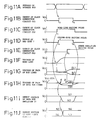
- Figures 10A to 10I are timing diagrams indicating waveforms and timing of the signals used in the data reading operation in the constructions of Figs. 4, 8, and 9.
- Figures 11A to 11J are more detailed timing diagrams indicating waveforms and timing of the signals used in the data reading operation in the constructions of Figs. 4, 8, and 9.
- the address transition detection circuit 9 of Fig. 9 detects the change and outputs an ATD pulse.
- the clock generation circuit CG5 outputs a pulse having a predetermined width (rising at the time t3 and falling at the time t6 in the example of Fig. 11B).
- a word line driving pulse output from the clock generation circuit CG2 rises at the time t1, (Fig. 11C) in response to a transition of the above-mentioned RAS ⁇ signal to the L level at the time t0.
- the row decoder 13 drives a word line corresponding to an row address applied from the row address buffer 5 to the row decoder 13.
- the transistor Q c which is connected with the word line WL at a gate terminal thereof, turns ON.
- the voltage of the bit line BLi ⁇ connected to the capacitor C through the transistor Q c is lowered by, for example, about 100mV (Fig. 11G), affected by the terminal voltage of the capacitor C in the memory cell.
- the voltages of the bit lines BLi and BLi forming a pair are respectively applied to the gate terminals of the transistors Q8'' and Q9'', and thereby the source-drain resistances of the transistors Q8'' and Q9'', are respectively lowered in response to the voltages of the corresponding bit lines BLi, BLi ⁇ .
- both the inputs of the AND gate 7, i.e., both the word line driving pulse and the output of the OR gate 6 (which transits to the H level in response to the output of the clock generation circuit CG5) transit to the H level (at the time t4) as indicated in Fig. 11D, the output of the AND gate transits to the H level.
- the column decoder 12 changes a voltage level of a column selection line CLR for reading, or a column selection line CLW for writing, corresponding to an column address which is applied from the column address buffer 8 to the column decoder 12, to the H level.
- a write enable signal WE indicating which of a data writing or data reading is to be carried out in the dynamic random access memory
- the column decoder 12 drives the column selection line CLW for writing, or the column selection line CLR for reading according to whether or not the write enable signal WE supplied from outside is active. Since, in Figs. 11A to 11J, the data reading operation is indicated, the column selection line CLR for reading is driven in response to the transition of the output of the AND gate 7 to the H level, to turn ON the transistors Q6 and Q7.
- the transistors Q8'' and Q9'' which receive the voltages of the bit lines BLi, BLi ⁇ at their gate terminals, respectively, amplify the voltages of the bit lines BLi, BLi ⁇ ,.
- the voltage on the bit lines are, for example, BL1 1.3V and BL1 ⁇ 1.2V, where the output voltage of the memory cell is assumed to be 1000mV.
- both the transistors Q8'' and Q9'' are ON, and currents according to the voltages of the bit lines BLi, BLi ⁇ , flow in the pair of data bus lines DBj, DBj ⁇ , respectively.
- the data bus amplifier 21, which is a differential amplifier, detects a difference current between the currents flowing the data bus lines DBj, DBj ⁇ , and thereby the output N2 of the data bus amplifier 21 falls.
- transistors Q31 and Q32 in the input stage of the data bus amplifier 21 supplies the currents to the data bus lines DBj, DBj ⁇ .
- the transistors Q31 and Q32 function in the same way as the transistors Q3 and Q4 in Fig. 4, the transistors Q3 and Q4, and the high voltage source V cc are dispensable when the data bus amplifier DBA in Fig. 4 has the construction as indicated in Fig. 9.
- parasitic resistances due to wiring exist between the transistors Q8'' and Q9'' and the above transistors Q31 and Q32, as indicated between ⁇ and ⁇ in Fig. 1, the voltage of the data bus line DB1 corresponding to the bit line on the side of the memory cell having a lower output voltage, momentarily falls, and recovers immediately after the momentary fall.
- the sense amplifier SA when the sense amplifier SA is driven at the time t5, the voltage of the bit line BL1 ⁇ is further lowered, and when the voltage falls below a threshold level of the transistor Q14, the transistor Q14 is cut off to stop the current on the data bus line DB1. Thereby, the voltage of the data bus line DB1 increases toward V cc -V th .
- the outputs N1 and N2 of the data bus amplifier 21 are controlled by the currents flowing in the data bus lines DBj , DBj ⁇ , and the voltage of the data bus line DB1 ⁇ reaches V cc -V th when the current in the data bus line DB1 ⁇ stops ( ⁇ in Fig. 11H).
- the column decoder in a data reading operation the column decoder is driven to drive a column selection line CLR for reading, without waiting for an amplification of voltages of bit lines by a sense amplifier. Therefore, the voltages of the bit lines before amplified by the sense amplifier, are amplified by the transistors Q8'' and Q9'' to reflect the voltages of the pair of bit lines on the voltages of the corresponding pair of data bus lines. Then, the digital data in the memory cell is read based on a difference of the voltages on the data bus lines. Since the data can be read without waiting for the amplification of the voltages of the bit lines by the sense amplifier, the data reading time is greatly reduced.
- a pair of bit lines are pre-charged before the word line is driven, and then the pre-charged lines are isolated from the voltage source, and from each other line. Thereafter, an electric charge in one of the data bus lines is drawn out by a transistor (one of the transistors Q8 and Q9 in Fig. 2) driven by the voltages of the bit lines after the voltages of the bit lines are amplified by the sense amplifier.
- a transistor one of the transistors Q8 and Q9 in Fig. 2 driven by the voltages of the bit lines after the voltages of the bit lines are amplified by the sense amplifier.
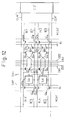
- Figure 12 is a diagram indicating a construction of another embodiment of the present invention.
- a called shared sense amplifier structure is applied to the construction of Fig. 12, wherein a sense amplifier in each column is shared by the memory cell arrays MCA1' and MCA2' on the right and left sides of the sense amplifier. Therefore, control is carried out regarding which of the memory cell arrays MCA1' and MCA2' is to be selected, by providing block selection lines B1 and B2.
- the transistors Q33' to Q36', and Q37' to Q40' are arranged between the memory cell side of the bit lines and the reading/writing control circuit side of the bit lines, for the block selection lines on the right and left sides, respectively, whereby, it is determined which of the memory cell arrays MCA1' and MCA2' is to be connected to the reading/writing control circuit side.
- two pairs of bit lines pair of bit lines BL1, BL1 ⁇ , BL2, BL2 ⁇ corresponding to two column addresses are simultaneously selected by a column selection line CLW' for writing, and a column selection line CLR for reading.
- the data bus lines DBj, DBj ⁇ are provided for the respective bit lines BL1, BL1 ⁇ , BL2, BL2 ⁇ . Since the sense amplifier SA in each column is shared by the memory cell arrays on the right and left sides, and bit lines in two columns can be simultaneously accessed by the column selection line CLW for writing, and the column selection line CLR for reading, the number of the column selection lines is the same as the construction of Fig. 2, although column selection lines are separately provided for writing and for reading.
- Figure 13 is a diagram indicating a construction of a variation of the construction of Fig. 12.
- data bus lines DB1W, DB1W ⁇ for writing, and data bus lines DB1R, DB1R ⁇ for reading are separately provided for each bit line BLi, BLi ⁇ .
- the data bus lines for writing and reading are respectively connected through two pairs of global data bus lines GDB1, GDB1 ⁇ , GDB2, GDB2 ⁇ to a writing amplifier WA and a data bus amplifier DBA.
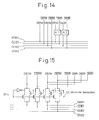
- Figure 14 is a diagram indicating a construction of a variation of the construction of Fig. 13.
- preamplifiers A1 and A2 are provided between the data bus lines DB2, DB2 ⁇ for reading, and the global data bus lines for reading data GDB2, GDB2 ⁇ , and thereby the signals read from the data bus lines are amplified.
- the above preamplifiers between the data bus lines and the global data bus lines may or may not be provided when a powerful writing amplifier WA is provided to drive the data bus lines.
- FIG. 15 is a diagram indicating a construction of another variation of the construction of Fig. 13.
- switching transistors ST are provided at the respective connection points of the data bus lines for writing data DB1W, DB1W ⁇ , and the data bus lines for reading data DB2R, DB2R ⁇ with the global data bus lines GDB1, GDB1 ⁇ , GDB2, GDB2 ⁇ .
- a switch control signal BSn selecting four pairs of bit lines BLi, BLi ⁇ as indicated in Fig. 13, is applied to the switching transistors ST.
- clock generation circuit 5 row address buffer 8: column address buffer 9: address transition detection circuit 11: memory cell array 12: column decoder 13: row decoder 14, SA: sense amplifier 21, DBA: data bus amplifier WA: writing amplifier CD: column decoder MCA: memory cell array CLW: column selection lines for writing CLR: column selection lines for reading WL: word line C1, C2: memory cell BLi, BLi ⁇ : bit line Q c1 , Q c2 : transfer gate DB1, DB2: data bus line Q1, Q2, ... , Q1', Q2', ... , Q3'', Q4'', Q8'', Q9', ... : transistor
Landscapes
- Engineering & Computer Science (AREA)
- Microelectronics & Electronic Packaging (AREA)
- Computer Hardware Design (AREA)
- Databases & Information Systems (AREA)
- Dram (AREA)
- Semiconductor Memories (AREA)
Abstract
Applications Claiming Priority (3)
| Application Number | Priority Date | Filing Date | Title |
|---|---|---|---|
| JP83758/90 | 1990-03-30 | ||
| JP2083758A JPH03283179A (ja) | 1990-03-30 | 1990-03-30 | 半導体記憶装置 |
| PCT/JP1991/000424 WO1991015852A1 (fr) | 1990-03-30 | 1991-03-30 | Memoire a acces selectif dynamique dans laquelle la synchronisation de fin de la lecture de donnees s'effectue plus tôt que d'habitude |
Publications (3)
| Publication Number | Publication Date |
|---|---|
| EP0481084A1 true EP0481084A1 (fr) | 1992-04-22 |
| EP0481084A4 EP0481084A4 (en) | 1993-07-21 |
| EP0481084B1 EP0481084B1 (fr) | 1997-05-14 |
Family
ID=13811464
Family Applications (1)
| Application Number | Title | Priority Date | Filing Date |
|---|---|---|---|
| EP91906569A Expired - Lifetime EP0481084B1 (fr) | 1990-03-30 | 1991-03-30 | Memoire a acces selectif dynamique dans laquelle la synchronisation de fin de la lecture de donnees s'effectue plus t t que d'habitude |
Country Status (5)
| Country | Link |
|---|---|
| EP (1) | EP0481084B1 (fr) |
| JP (1) | JPH03283179A (fr) |
| KR (1) | KR960000891B1 (fr) |
| DE (1) | DE69126087T2 (fr) |
| WO (1) | WO1991015852A1 (fr) |
Cited By (3)
| Publication number | Priority date | Publication date | Assignee | Title |
|---|---|---|---|---|
| GB2260839A (en) * | 1991-10-25 | 1993-04-28 | Samsung Electronics Co Ltd | Data transmission circuit for a semiconductor memory |
| EP0579862A1 (fr) * | 1992-07-24 | 1994-01-26 | Siemens Aktiengesellschaft | Dispositif de mémoire intégrée à semi-conducteurs |
| EP0637033A3 (fr) * | 1993-07-27 | 1996-12-04 | Nec Corp | Dispositif de mémoire dynamique à accès aléatoire avec circuit de sélection de colonne à basse consommation. |
Families Citing this family (5)
| Publication number | Priority date | Publication date | Assignee | Title |
|---|---|---|---|---|
| JPH07147086A (ja) * | 1993-11-02 | 1995-06-06 | Nec Corp | ダイナミック型半導体記憶装置 |
| US5742544A (en) | 1994-04-11 | 1998-04-21 | Mosaid Technologies Incorporated | Wide databus architecture |
| JP2817836B2 (ja) * | 1995-11-30 | 1998-10-30 | 日本電気株式会社 | 半導体メモリ装置 |
| JP4748828B2 (ja) * | 1999-06-22 | 2011-08-17 | ルネサスエレクトロニクス株式会社 | 半導体記憶装置 |
| JP5571871B2 (ja) * | 2007-10-30 | 2014-08-13 | ピーエスフォー ルクスコ エスエイアールエル | 半導体装置 |
Family Cites Families (5)
| Publication number | Priority date | Publication date | Assignee | Title |
|---|---|---|---|---|
| JPS57167186A (en) * | 1981-04-08 | 1982-10-14 | Nec Corp | Memory circuit |
| JPS63209094A (ja) * | 1987-02-25 | 1988-08-30 | Mitsubishi Electric Corp | 半導体記憶装置 |
| JP2638046B2 (ja) * | 1988-03-14 | 1997-08-06 | 三菱電機株式会社 | I/o線負荷回路 |
| JP2633645B2 (ja) * | 1988-09-13 | 1997-07-23 | 株式会社東芝 | 半導体メモリ装置 |
| JPH02146180A (ja) * | 1988-11-28 | 1990-06-05 | Nec Corp | 半導体メモリ装置 |
-
1990
- 1990-03-30 JP JP2083758A patent/JPH03283179A/ja active Pending
-
1991
- 1991-03-30 DE DE69126087T patent/DE69126087T2/de not_active Expired - Fee Related
- 1991-03-30 EP EP91906569A patent/EP0481084B1/fr not_active Expired - Lifetime
- 1991-03-30 WO PCT/JP1991/000424 patent/WO1991015852A1/fr not_active Ceased
- 1991-03-30 KR KR1019910701732A patent/KR960000891B1/ko not_active Expired - Fee Related
Cited By (5)
| Publication number | Priority date | Publication date | Assignee | Title |
|---|---|---|---|---|
| GB2260839A (en) * | 1991-10-25 | 1993-04-28 | Samsung Electronics Co Ltd | Data transmission circuit for a semiconductor memory |
| FR2683077A1 (fr) * | 1991-10-25 | 1993-04-30 | Samsung Electronics Co Ltd | Circuit de transmission de donnees, et plus particulierement pour circuit de transmission de donnees hautement integre pour traiter des donnees a grande vitesse. |
| EP0579862A1 (fr) * | 1992-07-24 | 1994-01-26 | Siemens Aktiengesellschaft | Dispositif de mémoire intégrée à semi-conducteurs |
| US5537352A (en) * | 1992-07-24 | 1996-07-16 | Siemens Aktiengesellschaft | Integrated semiconductor memory configuration |
| EP0637033A3 (fr) * | 1993-07-27 | 1996-12-04 | Nec Corp | Dispositif de mémoire dynamique à accès aléatoire avec circuit de sélection de colonne à basse consommation. |
Also Published As
| Publication number | Publication date |
|---|---|
| DE69126087T2 (de) | 1997-08-28 |
| KR960000891B1 (ko) | 1996-01-13 |
| KR920701978A (ko) | 1992-08-12 |
| DE69126087D1 (de) | 1997-06-19 |
| EP0481084A4 (en) | 1993-07-21 |
| EP0481084B1 (fr) | 1997-05-14 |
| JPH03283179A (ja) | 1991-12-13 |
| WO1991015852A1 (fr) | 1991-10-17 |
Similar Documents
| Publication | Publication Date | Title |
|---|---|---|
| KR920007440B1 (ko) | 반도체 기억장치 및 액세스방법 | |
| JP3101298B2 (ja) | 半導体メモリ装置 | |
| KR970001340B1 (ko) | 다이나믹형 랜덤억세스메모리 | |
| KR940006994B1 (ko) | 다이나믹 랜덤액세스메모리와 그 데이터 기록방법 | |
| US5640355A (en) | Semiconductor memory device | |
| JP4118364B2 (ja) | 半導体記憶装置 | |
| US5719814A (en) | Semiconductor memory device capable of storing high potential level of data | |
| CN100472651C (zh) | 半导体存储装置 | |
| US6275429B1 (en) | Memory device and equalizing circuit for memory device | |
| US20030067833A1 (en) | Bit line selection circuit having hierarchical structure | |
| US4433393A (en) | Semiconductor memory device | |
| EP0481084B1 (fr) | Memoire a acces selectif dynamique dans laquelle la synchronisation de fin de la lecture de donnees s'effectue plus t t que d'habitude | |
| EP1143453B1 (fr) | Dispositif de mémoire à semi-conducteurs | |
| US5594681A (en) | Dynamic random access memory wherein timing of completion of data reading is advanced | |
| US6198681B1 (en) | Sense amplifier for low voltage memory arrays | |
| KR100456990B1 (ko) | 반도체기억장치 및 이를 사용한 정보기기 | |
| US6067264A (en) | High speed semiconductor memory device | |
| US5553032A (en) | Dynamic random access memory wherein timing of completion of data reading is advanced | |
| KR101317874B1 (ko) | 불휘발성 기억장치 및 그 판독방법 | |
| US20090003038A1 (en) | Capacitor supported precharching of memory digit lines | |
| US5365488A (en) | Data reading circuit having a clamping circuit for clamping a pair of data buses to predetermined potentials | |
| KR20010062736A (ko) | 반도체 기억장치 | |
| EP0462866B1 (fr) | Dispositif de mémoire à semi-conducteurs | |
| JP3230435B2 (ja) | 半導体記憶装置 | |
| KR100780633B1 (ko) | 반도체 메모리 소자의 오버 드라이버 제어신호 생성회로 |
Legal Events
| Date | Code | Title | Description |
|---|---|---|---|
| PUAI | Public reference made under article 153(3) epc to a published international application that has entered the european phase |
Free format text: ORIGINAL CODE: 0009012 |
|
| 17P | Request for examination filed |
Effective date: 19911220 |
|
| AK | Designated contracting states |
Kind code of ref document: A1 Designated state(s): DE FR GB IT NL |
|
| RHK1 | Main classification (correction) |
Ipc: G11C 11/409 |
|
| A4 | Supplementary search report drawn up and despatched |
Effective date: 19930604 |
|
| AK | Designated contracting states |
Kind code of ref document: A4 Designated state(s): DE FR GB IT NL |
|
| 17Q | First examination report despatched |
Effective date: 19941107 |
|
| GRAG | Despatch of communication of intention to grant |
Free format text: ORIGINAL CODE: EPIDOS AGRA |
|
| GRAH | Despatch of communication of intention to grant a patent |
Free format text: ORIGINAL CODE: EPIDOS IGRA |
|
| ITF | It: translation for a ep patent filed | ||
| GRAH | Despatch of communication of intention to grant a patent |
Free format text: ORIGINAL CODE: EPIDOS IGRA |
|
| GRAA | (expected) grant |
Free format text: ORIGINAL CODE: 0009210 |
|
| AK | Designated contracting states |
Kind code of ref document: B1 Designated state(s): DE FR GB IT NL |
|
| PG25 | Lapsed in a contracting state [announced via postgrant information from national office to epo] |
Ref country code: NL Free format text: LAPSE BECAUSE OF FAILURE TO SUBMIT A TRANSLATION OF THE DESCRIPTION OR TO PAY THE FEE WITHIN THE PRESCRIBED TIME-LIMIT Effective date: 19970514 |
|
| REF | Corresponds to: |
Ref document number: 69126087 Country of ref document: DE Date of ref document: 19970619 |
|
| ET | Fr: translation filed | ||
| NLV1 | Nl: lapsed or annulled due to failure to fulfill the requirements of art. 29p and 29m of the patents act | ||
| PLBE | No opposition filed within time limit |
Free format text: ORIGINAL CODE: 0009261 |
|
| STAA | Information on the status of an ep patent application or granted ep patent |
Free format text: STATUS: NO OPPOSITION FILED WITHIN TIME LIMIT |
|
| 26N | No opposition filed | ||
| REG | Reference to a national code |
Ref country code: GB Ref legal event code: IF02 |
|
| PGFP | Annual fee paid to national office [announced via postgrant information from national office to epo] |
Ref country code: GB Payment date: 20070328 Year of fee payment: 17 |
|
| PGFP | Annual fee paid to national office [announced via postgrant information from national office to epo] |
Ref country code: FR Payment date: 20070308 Year of fee payment: 17 |
|
| GBPC | Gb: european patent ceased through non-payment of renewal fee |
Effective date: 20080330 |
|
| REG | Reference to a national code |
Ref country code: FR Ref legal event code: ST Effective date: 20081125 |
|
| PG25 | Lapsed in a contracting state [announced via postgrant information from national office to epo] |
Ref country code: FR Free format text: LAPSE BECAUSE OF NON-PAYMENT OF DUE FEES Effective date: 20080331 |
|
| PG25 | Lapsed in a contracting state [announced via postgrant information from national office to epo] |
Ref country code: GB Free format text: LAPSE BECAUSE OF NON-PAYMENT OF DUE FEES Effective date: 20080330 |
|
| PGFP | Annual fee paid to national office [announced via postgrant information from national office to epo] |
Ref country code: IT Payment date: 20090321 Year of fee payment: 19 Ref country code: DE Payment date: 20090327 Year of fee payment: 19 |
|
| PG25 | Lapsed in a contracting state [announced via postgrant information from national office to epo] |
Ref country code: DE Free format text: LAPSE BECAUSE OF NON-PAYMENT OF DUE FEES Effective date: 20101001 |
|
| PG25 | Lapsed in a contracting state [announced via postgrant information from national office to epo] |
Ref country code: IT Free format text: LAPSE BECAUSE OF NON-PAYMENT OF DUE FEES Effective date: 20100330 |