EP0481174A2 - Recycling von Lösungsmitteln, von Farb- und Lackkoagulaten und -schlämmen - Google Patents
Recycling von Lösungsmitteln, von Farb- und Lackkoagulaten und -schlämmen Download PDFInfo
- Publication number
- EP0481174A2 EP0481174A2 EP91111800A EP91111800A EP0481174A2 EP 0481174 A2 EP0481174 A2 EP 0481174A2 EP 91111800 A EP91111800 A EP 91111800A EP 91111800 A EP91111800 A EP 91111800A EP 0481174 A2 EP0481174 A2 EP 0481174A2
- Authority
- EP
- European Patent Office
- Prior art keywords
- phosphoric acid
- worked
- added
- binder
- solvents
- Prior art date
- Legal status (The legal status is an assumption and is not a legal conclusion. Google has not performed a legal analysis and makes no representation as to the accuracy of the status listed.)
- Granted
Links
Images

Classifications
-
- C—CHEMISTRY; METALLURGY
- C08—ORGANIC MACROMOLECULAR COMPOUNDS; THEIR PREPARATION OR CHEMICAL WORKING-UP; COMPOSITIONS BASED THEREON
- C08J—WORKING-UP; GENERAL PROCESSES OF COMPOUNDING; AFTER-TREATMENT NOT COVERED BY SUBCLASSES C08B, C08C, C08F, C08G or C08H
- C08J11/00—Recovery or working-up of waste materials
-
- B—PERFORMING OPERATIONS; TRANSPORTING
- B01—PHYSICAL OR CHEMICAL PROCESSES OR APPARATUS IN GENERAL
- B01D—SEPARATION
- B01D21/00—Separation of suspended solid particles from liquids by sedimentation
-
- B—PERFORMING OPERATIONS; TRANSPORTING
- B01—PHYSICAL OR CHEMICAL PROCESSES OR APPARATUS IN GENERAL
- B01D—SEPARATION
- B01D21/00—Separation of suspended solid particles from liquids by sedimentation
- B01D21/01—Separation of suspended solid particles from liquids by sedimentation using flocculating agents
-
- B—PERFORMING OPERATIONS; TRANSPORTING
- B01—PHYSICAL OR CHEMICAL PROCESSES OR APPARATUS IN GENERAL
- B01D—SEPARATION
- B01D21/00—Separation of suspended solid particles from liquids by sedimentation
- B01D21/02—Settling tanks with single outlets for the separated liquid
Definitions
- the invention relates to a process for the recovery of color and varnish constituents from solvents and coagulates loaded with these substances as well as residues of sludge-like consistency and of varnishes and paints with complete separation into the individual pure products.
- a disadvantage of previously presented methods for the chemical or chemical-physical processing of the aforementioned mixtures is the impairment of pigment and binder properties due to the prolonged exposure to an excess of concentrated mineral acids in the separation process. Due to the risk of acid corrosion combined with high heat of reaction during chemical treatment, complex stainless steel equipment with a cooling device is required.
- a disadvantage of this process is an unavoidable chemical attack on the binder and an incomplete solid-liquid separation, so that repeated treatment with acid and alkali is necessary, as well as a preliminary additional separation in a centrifugal separator.
- the object of the present invention is to create a method with which the contaminated products can be worked up and the separated ingredients can be recycled without further processing.
- the focus is on gentle and residue-free recycling technology, which eliminates the aforementioned disadvantages of the prior art and leads to end products of high purity.
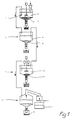
- the object is achieved according to the main claim in that the products to be treated are subjected to a sequence of physical and chemical treatments, and a residue-free work-up for unrestricted recycling of the pigments, fillers, binders and solvents is achieved solely by the procedure described in more detail below.
- the starting material is adjusted to a solids content (binder, pigments, fillers and auxiliaries) of 10-20% by weight, preferably 15%, if necessary by dilution with solvent. Then gravity sedimentation removes coarse solid particles with a particle diameter> 5 ⁇ m.
- the decanted suspension with the finely divided dissolved particles and suspended particles is sent to the chemical treatment, which consists in first precipitating the remaining solid particles as large-flocculent hydoxides, with a pH of 8.0 not being exceeded, and this pH Value is adjusted to pH 5.5 to 7.5 after less than 30, preferably 10 minutes with concentrated mineral acid.
- the alkali attack in particular on the binders, is time-dependent and essentially does not occur less than 30 minutes after addition of the alkali at room temperature, but the pigments and fillers are completely precipitated within this period.
- the suspended solid particles present are precipitated by the addition of the phosphoric acid.
- the amount of phosphoric acid required is so small that it does not affect the quality of the end products when reused.
- the formation of precipitates by the phosphoric acid can be supported by adding flocculants, the amount and type also having to be selected such that the end products remain feedable for direct reuse.
- the Flocculants can be added initially or preferably together with the phosphoric acid.
- Aluminum sulfate, iron (III) chloride and polyelectrolytes are preferably added.
- This chemical treatment surprisingly achieves a quantitative separation of all suspended particles from the liquid phase, consisting of solvent and binder, without the properties of the binder being impaired by the addition of alkali and acid.
- the decanted liquid is directly or after intermediate storage without further intermediate steps, e.g. Centrifugation, which can be fed to the distillation, the solvent being gently separated from the binder in vacuo at temperatures between 80 and 140 ° C.
- the resulting pigment-filler mixtures can be used directly or after drying and grinding for the production of new products, which results in a residue-free recycling process.
Landscapes
- Chemical & Material Sciences (AREA)
- Chemical Kinetics & Catalysis (AREA)
- Polymers & Plastics (AREA)
- Sustainable Development (AREA)
- Health & Medical Sciences (AREA)
- Medicinal Chemistry (AREA)
- Life Sciences & Earth Sciences (AREA)
- Organic Chemistry (AREA)
- Separation Of Suspended Particles By Flocculating Agents (AREA)
- Paints Or Removers (AREA)
- Separation, Recovery Or Treatment Of Waste Materials Containing Plastics (AREA)
- Processing Of Solid Wastes (AREA)
- Treatment Of Sludge (AREA)
Abstract
Description
- Die Erfindung betrifft ein Verfahren zur Rückgewinnung von Farb- und Lackinhaltsstoffen aus mit diesen Stoffen befrachteten Lösungsmitteln und Koagulaten sowie Rückständen schlammartiger Konsistenz und von Lacken und Farben bei vollkommener Auftrennung in die einzelnen reinen Produkte.
- Bekannte physikalische Verfahren zur Rückgewinnung basieren auf rein mechanischer Aufbereitung und/oder destillativer Abtrennung der Lösungsmittel von den Feststoffen. Dabei tritt durch thermische Belastung während der Destillation eine starke Wertminderung der Inhaltsstoffe ein und der Destillationsrückstand muß verworfen werden.
- Ein Nachteil bisher vorgestellter Methoden zur chemischen oder chemisch-physikalischen Aufarbeitung vorgenannter Gemische besteht in der Beeinträchtigung von Pigment- und Bindemitteleigenschaften durch die längere Einwirkung eines Überschusses konzentrierter Mineralsäuren im Trennungsgang. Aufgrund der Gefahr einer Säurekorrosion in Verbindung mit einer hohen Reaktionswärme während der chemischen Behandlung sind aufwendige Apparaturen aus Edelstahl mit Kühleinrichtung erforderlich.
- Aus der Deutschen Patentanmeldung P 38 21 761 ist weiterhin ein Verfahren zum Rückgewinnen von Pigmenten, Bindemitteln und Lösemitteln aus mit Lack verschmutzten Spülverdünnern bekannt, bei welchem man die Verdünner zunächst mit einer konzentrierten Säure versetzt und danach unter Rühren Lauge zufügt. Danach wird die Flüssigkeit einer Schwerkraftabscheidung unterworfen.
- Nachteilig bei diesem Verfahren ist ein nicht zu vermeidender chemischer Angriff auf das Bindemittel und eine unvollständige Fest-Flüssigseparation, so daß eine nochmalige Behandlung mit Säure und Lauge erforderlich ist ebenso wie eine vorausgehende zusätzliche Abscheidung in einem Zentrifugalseparator.
- Vorliegender Erfindung liegt demgegenüber die Aufgabe zugrunde, ein Verfahren zu schaffen, mit dem die belasteten Produkte aufgearbeitet und die getrennten Inhaltsstoffe ohne weitere Aufarbeitung einer Wiederverwertung zugeführt werden können. Dabei wird auf eine schonende und rückstandsfreie Recycling-Technologie orientiert, die vorgenannte Nachteile des Standes der Technik beseitigt und zu Endprodukten hoher Reinheit führt.
- Die Aufgabe wird nach dem Hauptanspruch dadurch gelöst, daß die zu behandelnden Produkte einer Abfolge physikalischer und chemischer Behandlungen unterworfen werden, und ausschließlich durch die nachfolgend näher beschriebene Vorgehensweise eine rückstandsfreie Aufarbeitung zur uneingeschränkten Wiederverwertung der Pigmente, Füllstoffe, Bindemittel und Lösungsmittel erreicht wird.
- Zu Beginn der Behandlung wird das Ausgangsmaterial gegebenenfalls durch Abverdünnen mit Lösungsmittel auf einen Feststoffgehalt (Bindemittel, Pigemente, Füll- und Hilfsstoffe) von 10 - 20 Gew.-%, vorzugsweise 15 %, eingestellt. Danach erfolgt durch eine Schwerkraftsedimentation die Abtrennung grober Festkörperteilchen mit einem Teilchendurchmesser > 5 µm. Die abdekantierte Suspension mit den feinstverteilten gelösten Teilchen und Schwebeteilchen wird der chemischen Behandlung zugeführt, die darin besteht, daß zuerst mit Lauge die restlichen Festkörperteilchen als großflockige Hydoxide ausgefällt werden, wobei ein pH-Wert von 8,0 nicht überschritten wird, und dieser pH-Wert nach weniger als 30, vorzugsweise 10 Minuten mit konzentrierter Mineralsäure auf pH-Werte von 5,5 bis 7,5 eingestellt wird.
- Es hat sich nämlich herausgestellt, daß der Laugenangriff insbesondere auf die Bindemittel zeitabhängig ist und unterhalb von 30 Minuten nach Laugezugabe bei Raumtemperatur im wesentlichen unterbleibt, die Pigmente und Füllstoffe innerhalb dieser Zeitdauer aber vollständig ausgefällt werden.
- Durch die Zugabe der Phosphorsäure werden die vorhandenen suspendierten Feststoffteilchen niedergeschlagen. Die erforderliche Phosphorsäuremenge ist dabei so gering, daß sie die Qualität der Endprodukte bei der Wiederverwendung nicht beeinträchtigt.
- Die Niederschlagsbildung durch die Phosphorsäure kann durch Zugabe von Flokkulationsmitteln unterstützt werden, wobei Menge und Art ebenfalls so auszuwählen sind, daß die Endprodukte der direkten Wiederverwendung zuführbar bleiben. Die Flokkulationsmittel können anfänglich oder vorzugsweise zusammen mit der Phosphorsäure zugegeben werden. Vorzugsweise werden Aluminiumsulfat, Eisen (III)-chlorid und Polyelektrolyte zugesetzt.
- Durch diese chemische Behandlungsweise wird überraschenderweise erreicht, daß eine quantitative Abtrennung aller Schwebeteilchen aus der flüssigen Phase, bestehend aus Lösungsmittel und Bindemittel, erfolgt , ohne daß die Bindemittel durch die Lauge- und Säurezugabe in ihren Eigenschaften beeinträchtigt werden. Die abdekantierte Flüssigkeit ist direkt oder nach Zwischenlagerung ohne weitere Zwischenschritte, wie z.B. Zentrifugieren, der Destillation zuführbar, wobei im Vakuum bei Temperaturen zwischen 80 und 140°C das Lösungsmittel schonend vom Bindemittel abgetrennt wird.
- Die anfallenden Pigment-Füllstoff-Gemische sind direkt oder nach Trocknen und Aufmahlen für die Fertigung neuer Produkte einsetzbar, wodurch ein rückstandsfreier Recycling-Prozeß erreicht wird.
- Ein mit Lackresten belasteter Spülverdünner der Zusammensetzung
- 3 Gew.-%
- Pigmente und Füllstoffe (Titandioxid, Talkum)
- 8 Gew.-%
- Bindemittel (Alkydharz, Melaminharz) und
- 89 Gew.-%
- Lösungsmittel (Xylen, Butylacetat)
-
- 1
- Extraktionsanlage
- 2
- Lösungsmittel
- 3
- Koagulat
- 4
- Sedimentationsanlage
- 5
- Suspension (Lösungsmittel + Bindemittel + dispergierte Festkörper)
- 6
- Sediment (Pigment + Füllstoff)
- 7
- chemische Behandlung
- 8
- klare Lösung (Lösungsmittel + Bindemittel)
- 9
- Niederschlag (Pigment + Füllstoff)
- 10
- Destillation
- 11
- Destillat (Lösungsmittel)
- 12
- Bindemittel
-
- 13
- pH-Kurve der Originalware ohne Zusätze
- 14
- NaOH-Zugabe
- 15
- pH-Kurve der Fällungsreaktion
- 16
- H₃PO₄-Zugabe
- 17
- pH-Kurve der Neutralisation und Stabilisierung
Claims (7)
- Verfahren zum Aufarbeiten von Farben und Lacken oder von mit Farb- und Lackanteilen versetzten organischen und anorganischen Lösemitteln oder Lösemittelgemischen durch Sinkscheiden und Behandlung mit Säure und Laugen dadurch gekennzeichnet, daß man zunächst die aufzuarbeitende Flüssigkeit auf Feststoffgehalte von 10 bis 20 Gew.-% einstellt, grobteilige Partikel absitzen läßt und dekantiert, danach das Dekantat mit Lauge auf einen pH-Wert von etwa 8 innerhalb eines Zeitraumes ≦ 30 Minuten einstellt, anschließend durch Zugabe von Phosphorsäure den pH-Wert auf 5,5 bis 7,5 bringt, anschließend den dadurch gebildeten Niederschlag in an sich bekannter Weise abtrennt und die Lösung durch Destillation unter Erhalt des Bindemittels aufarbeitet.
- Verfahren nach Anspruch 1, dadurch gekennzeichnet, daß als Lauge Natronlauge verwendet wird.
- Verfahren nach den Ansprüchen 1 oder 2, gekennzeichnet durch eine Einwirkzeit der Lauge auf das Dekantat von 10 Minuten.
- Verfahren nach mindestens einem der Ansprüche 1 bis 3, dadurch gekennzeichnet, daß die Laugezugabe kontinuierlich erfolgt.
- Verfahren nach mindestens einem der Ansprüche 1 bis 4, dadurch gekennzeichnet, daß Phosphorsäure bis zum Erreichen eines pH-Wertes von 6,0 zugegeben wird.
- Verfahren nach mindestens einem der Ansprüche 1 bis 5, dadurch gekennzeichnet, daß der anfängliche Feststoffgehalt auf 15 Gew.-% eingestellt wird.
- Verfahren nach mindestens einem der Ansprüche 1 bis 6, dadurch gekennzeichnet, daß man Flokkulationsmittel, wie vorzugsweise Aluminiumsulfat, Eisen(III)-chlorid und/oder Polyelektrolyte anfänglich oder zusammen mit der Phosphorsäure zufügt.
Applications Claiming Priority (2)
| Application Number | Priority Date | Filing Date | Title |
|---|---|---|---|
| DE4028905A DE4028905C1 (en) | 1990-09-12 | 1990-09-12 | High purity recycling of paints, lacquers or solvents contg. impurity - is by adjusting solid content, sedimenting coarse, particles, basifying supernatant, acidifying, pptn., etc. |
| DE4028905 | 1990-09-12 |
Publications (3)
| Publication Number | Publication Date |
|---|---|
| EP0481174A2 true EP0481174A2 (de) | 1992-04-22 |
| EP0481174A3 EP0481174A3 (en) | 1992-06-17 |
| EP0481174B1 EP0481174B1 (de) | 1995-07-19 |
Family
ID=6414092
Family Applications (1)
| Application Number | Title | Priority Date | Filing Date |
|---|---|---|---|
| EP91111800A Expired - Lifetime EP0481174B1 (de) | 1990-09-12 | 1991-07-16 | Recycling von Lösungsmitteln, von Farb- und Lackkoagulaten und -schlämmen |
Country Status (4)
| Country | Link |
|---|---|
| EP (1) | EP0481174B1 (de) |
| AT (1) | ATE125280T1 (de) |
| DE (2) | DE4028905C1 (de) |
| ES (1) | ES2076425T3 (de) |
Cited By (3)
| Publication number | Priority date | Publication date | Assignee | Title |
|---|---|---|---|---|
| DE4331674C1 (de) * | 1993-09-17 | 1995-01-26 | Herberts Gmbh | Verfahren zur Herstellung von wäßrigen Überzugsmitteln unter Wiederverwertung von Lackschlamm, die dabei erhaltenen Überzugsmittel und deren Verwendung |
| EP1031365A1 (de) * | 1999-02-24 | 2000-08-30 | Basf Aktiengesellschaft | Verfahren zur Herstellung von Teilchenagglomeraten durch Umbenetzen |
| CN100528946C (zh) * | 2006-11-13 | 2009-08-19 | 徐友志 | 一种废溶剂漆的再生工艺 |
Families Citing this family (2)
| Publication number | Priority date | Publication date | Assignee | Title |
|---|---|---|---|---|
| DE4238692C2 (de) * | 1992-11-17 | 1995-06-14 | Audi Ag | Verfahren zur Identifizierung von Kunststoffen |
| GB201100626D0 (en) * | 2011-01-14 | 2011-03-02 | Newlife Paints Ltd | Method for manufacturing paint |
Family Cites Families (9)
| Publication number | Priority date | Publication date | Assignee | Title |
|---|---|---|---|---|
| FR2044887A5 (de) * | 1969-05-09 | 1971-02-26 | Hunter Douglas International | |
| US4071449A (en) * | 1975-02-19 | 1978-01-31 | Nippon Paint Co., Ltd. | Process for treatment of waste water exhausted from water-wash spray booth using water-soluble paint |
| GB1577378A (en) * | 1978-01-10 | 1980-10-22 | Drew Chem Corp | Recovery and reuse of paint solids from waste water |
| BE885003A (fr) * | 1980-08-29 | 1980-12-16 | Dulux Australia Ltd | Procede de recuperation de solvants |
| IT1178862B (it) * | 1984-02-24 | 1987-09-16 | Irfin Spa | Procedimento per il recupero dei componenti da miscele reflue comprendenti residui di vernice e sol venti per detti residui |
| DE3516965C1 (de) * | 1985-05-10 | 1986-11-06 | Audi AG, 8070 Ingolstadt | Verfahren zum Aufbereiten kolloider Lackschlammlösungen bzw. Lack-Overspray aus der Kraftfahrzeug-Lackierung |
| DE3821760A1 (de) * | 1988-06-28 | 1990-02-22 | Kluthe Gmbh Chem Werke | Verfahren zur rueckgewinnung von pigmenten und bindemitteln aus lack-koagulaten |
| DE3821761A1 (de) * | 1988-06-28 | 1990-02-22 | Kluthe Gmbh Chem Werke | Verfahren zur rueckgewinnung von pigmenten, bindemitteln und loesungsmitteln aus mit lack verschmutzten spuelverduennern |
| US4814092A (en) * | 1988-10-03 | 1989-03-21 | Nalco Chemical Company | Centrifuge processing of spent emulsion from paint spray booths |
-
1990
- 1990-09-12 DE DE4028905A patent/DE4028905C1/de not_active Expired - Fee Related
-
1991
- 1991-07-16 AT AT91111800T patent/ATE125280T1/de not_active IP Right Cessation
- 1991-07-16 EP EP91111800A patent/EP0481174B1/de not_active Expired - Lifetime
- 1991-07-16 DE DE59106020T patent/DE59106020D1/de not_active Expired - Fee Related
- 1991-07-16 ES ES91111800T patent/ES2076425T3/es not_active Expired - Lifetime
Cited By (3)
| Publication number | Priority date | Publication date | Assignee | Title |
|---|---|---|---|---|
| DE4331674C1 (de) * | 1993-09-17 | 1995-01-26 | Herberts Gmbh | Verfahren zur Herstellung von wäßrigen Überzugsmitteln unter Wiederverwertung von Lackschlamm, die dabei erhaltenen Überzugsmittel und deren Verwendung |
| EP1031365A1 (de) * | 1999-02-24 | 2000-08-30 | Basf Aktiengesellschaft | Verfahren zur Herstellung von Teilchenagglomeraten durch Umbenetzen |
| CN100528946C (zh) * | 2006-11-13 | 2009-08-19 | 徐友志 | 一种废溶剂漆的再生工艺 |
Also Published As
| Publication number | Publication date |
|---|---|
| EP0481174B1 (de) | 1995-07-19 |
| EP0481174A3 (en) | 1992-06-17 |
| DE59106020D1 (de) | 1995-08-24 |
| ATE125280T1 (de) | 1995-08-15 |
| DE4028905C1 (en) | 1991-11-21 |
| ES2076425T3 (es) | 1995-11-01 |
Similar Documents
| Publication | Publication Date | Title |
|---|---|---|
| DE3402357C2 (de) | ||
| DE2445156A1 (de) | Verfahren zur gewinnung von fettsaeuren und/oder harzsaeuren | |
| DE4421454C2 (de) | Verfahren zur Herstellung von Polyamid-Feinstpulvern und deren Verwendung | |
| EP0481174B1 (de) | Recycling von Lösungsmitteln, von Farb- und Lackkoagulaten und -schlämmen | |
| DE10223283C1 (de) | Verfahren zur Herstellung von epoxidierten Polysulfiden | |
| WO2002072205A2 (de) | Verfahren zur erhöhung des trockenrückstandes bei nass aufgearbeitetem zyklonstaub der chlorierung von titanerz | |
| DE10106539A1 (de) | Verfahren zur Gewinnung von Titandioxid aus Aufschlussrückständen eines Sulfatverfahrens | |
| EP0429920B1 (de) | Verfahren zur Herstellung von TiO2-Pigmenten | |
| DE4027105A1 (de) | Verfahren zur aufarbeitung von aufschlussrueckstaenden aus der titandioxidproduktion | |
| DE2258484C3 (de) | Verfahren zum Reinigen von rohem 2-Mercaptobenzothiazol | |
| EP0488449B1 (de) | Verfahren und Vorrichtung zur Aufbereitung von Lack-Koagulat | |
| DE2633468A1 (de) | Verfahren zur herstellung von hochreinem sio tief 2 | |
| WO1992021612A1 (de) | Verfahren zur herstellung von hoch-quellfähigen schichtsilikaten | |
| EP0348555A2 (de) | Verfahren zur Rückgewinnung von Pigmenten und Bindemitteln aus Lack-Koagulaten | |
| EP0392211B1 (de) | Verfahren zur Wiederverwendung von Abfallschwefelsäure | |
| DE3736568A1 (de) | Verfahren zur rueckgewinnung von phosphor aus phosphorhaltigem schlamm | |
| DE2022569A1 (de) | Verfahren zur Reinigung von rohem 2-Mercaptobenzothiazol | |
| DE3821761C2 (de) | ||
| DE10303287A1 (de) | Verfahren zur Neutralisation und Wiederverwendung von bei der Herstellung von Titandioxid nach dem Sulfatverfahren entstehenden Aufschlussrückständen | |
| DE69112987T2 (de) | Polyhalogenphthalocyanine, Verfahren zu ihrer Herstellung und ihre Verwendung. | |
| EP1847587B1 (de) | Verfahren zur Aufarbeitung von Altölen zu Schmierölen mit hohem Viskositätsindex | |
| DE10026800C2 (de) | Verwendung von Dünnsäure als Mittel zur Spaltung von Emulsionen | |
| EP1805189B1 (de) | Verfahren zur herstellung von organosilazanen | |
| EP0306872A2 (de) | Polycaprolactame mit einem Gehalt an Titandioxid und dessen Verwendung | |
| WO1988008405A1 (fr) | Procede de precipitation du chrome et/ou vanadium contenu dans des dechets a l'acide sulphurique |
Legal Events
| Date | Code | Title | Description |
|---|---|---|---|
| PUAI | Public reference made under article 153(3) epc to a published international application that has entered the european phase |
Free format text: ORIGINAL CODE: 0009012 |
|
| AK | Designated contracting states |
Kind code of ref document: A2 Designated state(s): AT BE DE ES FR GB IT NL SE |
|
| PUAL | Search report despatched |
Free format text: ORIGINAL CODE: 0009013 |
|
| AK | Designated contracting states |
Kind code of ref document: A3 Designated state(s): AT BE DE ES FR GB IT NL SE |
|
| 17P | Request for examination filed |
Effective date: 19920527 |
|
| 17Q | First examination report despatched |
Effective date: 19940427 |
|
| RAP1 | Party data changed (applicant data changed or rights of an application transferred) |
Owner name: CHEMISCHE WERKE KLUTHE GMBH |
|
| GRAA | (expected) grant |
Free format text: ORIGINAL CODE: 0009210 |
|
| ITF | It: translation for a ep patent filed | ||
| AK | Designated contracting states |
Kind code of ref document: B1 Designated state(s): AT BE DE ES FR GB IT NL SE |
|
| REF | Corresponds to: |
Ref document number: 125280 Country of ref document: AT Date of ref document: 19950815 Kind code of ref document: T |
|
| REF | Corresponds to: |
Ref document number: 59106020 Country of ref document: DE Date of ref document: 19950824 |
|
| GBT | Gb: translation of ep patent filed (gb section 77(6)(a)/1977) |
Effective date: 19950731 |
|
| REG | Reference to a national code |
Ref country code: ES Ref legal event code: FG2A Ref document number: 2076425 Country of ref document: ES Kind code of ref document: T3 |
|
| ET | Fr: translation filed | ||
| PLBE | No opposition filed within time limit |
Free format text: ORIGINAL CODE: 0009261 |
|
| STAA | Information on the status of an ep patent application or granted ep patent |
Free format text: STATUS: NO OPPOSITION FILED WITHIN TIME LIMIT |
|
| 26N | No opposition filed | ||
| PGFP | Annual fee paid to national office [announced via postgrant information from national office to epo] |
Ref country code: FR Payment date: 20010618 Year of fee payment: 11 |
|
| PGFP | Annual fee paid to national office [announced via postgrant information from national office to epo] |
Ref country code: GB Payment date: 20010627 Year of fee payment: 11 |
|
| PGFP | Annual fee paid to national office [announced via postgrant information from national office to epo] |
Ref country code: DE Payment date: 20010720 Year of fee payment: 11 |
|
| PGFP | Annual fee paid to national office [announced via postgrant information from national office to epo] |
Ref country code: SE Payment date: 20010723 Year of fee payment: 11 Ref country code: NL Payment date: 20010723 Year of fee payment: 11 |
|
| PGFP | Annual fee paid to national office [announced via postgrant information from national office to epo] |
Ref country code: BE Payment date: 20010724 Year of fee payment: 11 |
|
| PGFP | Annual fee paid to national office [announced via postgrant information from national office to epo] |
Ref country code: ES Payment date: 20010730 Year of fee payment: 11 Ref country code: AT Payment date: 20010730 Year of fee payment: 11 |
|
| REG | Reference to a national code |
Ref country code: GB Ref legal event code: IF02 |
|
| PG25 | Lapsed in a contracting state [announced via postgrant information from national office to epo] |
Ref country code: GB Free format text: LAPSE BECAUSE OF NON-PAYMENT OF DUE FEES Effective date: 20020716 Ref country code: AT Free format text: LAPSE BECAUSE OF NON-PAYMENT OF DUE FEES Effective date: 20020716 |
|
| PG25 | Lapsed in a contracting state [announced via postgrant information from national office to epo] |
Ref country code: SE Free format text: LAPSE BECAUSE OF NON-PAYMENT OF DUE FEES Effective date: 20020717 Ref country code: ES Free format text: LAPSE BECAUSE OF NON-PAYMENT OF DUE FEES Effective date: 20020717 |
|
| PG25 | Lapsed in a contracting state [announced via postgrant information from national office to epo] |
Ref country code: BE Free format text: LAPSE BECAUSE OF NON-PAYMENT OF DUE FEES Effective date: 20020731 |
|
| BERE | Be: lapsed |
Owner name: CHEMISCHE WERKE *KLUTHE G.M.B.H. Effective date: 20020731 |
|
| PG25 | Lapsed in a contracting state [announced via postgrant information from national office to epo] |
Ref country code: NL Free format text: LAPSE BECAUSE OF NON-PAYMENT OF DUE FEES Effective date: 20030201 Ref country code: DE Free format text: LAPSE BECAUSE OF NON-PAYMENT OF DUE FEES Effective date: 20030201 |
|
| EUG | Se: european patent has lapsed | ||
| GBPC | Gb: european patent ceased through non-payment of renewal fee |
Effective date: 20020716 |
|
| PG25 | Lapsed in a contracting state [announced via postgrant information from national office to epo] |
Ref country code: FR Free format text: LAPSE BECAUSE OF NON-PAYMENT OF DUE FEES Effective date: 20030331 |
|
| NLV4 | Nl: lapsed or anulled due to non-payment of the annual fee |
Effective date: 20030201 |
|
| REG | Reference to a national code |
Ref country code: FR Ref legal event code: ST |
|
| REG | Reference to a national code |
Ref country code: ES Ref legal event code: FD2A Effective date: 20030811 |
|
| PG25 | Lapsed in a contracting state [announced via postgrant information from national office to epo] |
Ref country code: IT Free format text: LAPSE BECAUSE OF NON-PAYMENT OF DUE FEES;WARNING: LAPSES OF ITALIAN PATENTS WITH EFFECTIVE DATE BEFORE 2007 MAY HAVE OCCURRED AT ANY TIME BEFORE 2007. THE CORRECT EFFECTIVE DATE MAY BE DIFFERENT FROM THE ONE RECORDED. Effective date: 20050716 |