EP0481204A2 - Einstellgerät mit Selbstüberwachung für einen Regler mit Rückkopplung - Google Patents
Einstellgerät mit Selbstüberwachung für einen Regler mit Rückkopplung Download PDFInfo
- Publication number
- EP0481204A2 EP0481204A2 EP91114924A EP91114924A EP0481204A2 EP 0481204 A2 EP0481204 A2 EP 0481204A2 EP 91114924 A EP91114924 A EP 91114924A EP 91114924 A EP91114924 A EP 91114924A EP 0481204 A2 EP0481204 A2 EP 0481204A2
- Authority
- EP
- European Patent Office
- Prior art keywords
- tuner
- effectiveness
- consistency
- gain value
- steady
- Prior art date
- Legal status (The legal status is an assumption and is not a legal conclusion. Google has not performed a legal analysis and makes no representation as to the accuracy of the status listed.)
- Granted
Links
- 238000012544 monitoring process Methods 0.000 title abstract description 26
- 238000013016 damping Methods 0.000 claims abstract description 27
- 230000004044 response Effects 0.000 claims abstract description 21
- 238000000034 method Methods 0.000 claims description 15
- 238000013507 mapping Methods 0.000 claims description 4
- 238000005259 measurement Methods 0.000 claims 3
- 230000001131 transforming effect Effects 0.000 claims 2
- 230000007246 mechanism Effects 0.000 abstract description 12
- 238000004458 analytical method Methods 0.000 abstract description 5
- 238000012546 transfer Methods 0.000 description 8
- 230000008859 change Effects 0.000 description 6
- 238000010586 diagram Methods 0.000 description 6
- 230000008569 process Effects 0.000 description 4
- 238000004088 simulation Methods 0.000 description 4
- 230000001052 transient effect Effects 0.000 description 4
- 230000006978 adaptation Effects 0.000 description 3
- 230000003044 adaptive effect Effects 0.000 description 2
- 230000007423 decrease Effects 0.000 description 2
- 238000012986 modification Methods 0.000 description 2
- 230000004048 modification Effects 0.000 description 2
- 230000009471 action Effects 0.000 description 1
- 230000003213 activating effect Effects 0.000 description 1
- 230000032683 aging Effects 0.000 description 1
- 230000015572 biosynthetic process Effects 0.000 description 1
- 238000004364 calculation method Methods 0.000 description 1
- 230000015556 catabolic process Effects 0.000 description 1
- 238000001311 chemical methods and process Methods 0.000 description 1
- 230000001276 controlling effect Effects 0.000 description 1
- 238000006731 degradation reaction Methods 0.000 description 1
- 230000002939 deleterious effect Effects 0.000 description 1
- 238000013461 design Methods 0.000 description 1
- 230000003467 diminishing effect Effects 0.000 description 1
- 230000000694 effects Effects 0.000 description 1
- 230000007613 environmental effect Effects 0.000 description 1
- 238000011156 evaluation Methods 0.000 description 1
- 230000005284 excitation Effects 0.000 description 1
- 239000000203 mixture Substances 0.000 description 1
- 230000001105 regulatory effect Effects 0.000 description 1
- 230000035945 sensitivity Effects 0.000 description 1
- 238000010206 sensitivity analysis Methods 0.000 description 1
- 238000003786 synthesis reaction Methods 0.000 description 1
- 238000012360 testing method Methods 0.000 description 1
- 230000009466 transformation Effects 0.000 description 1
Images


Classifications
-
- G—PHYSICS
- G05—CONTROLLING; REGULATING
- G05B—CONTROL OR REGULATING SYSTEMS IN GENERAL; FUNCTIONAL ELEMENTS OF SUCH SYSTEMS; MONITORING OR TESTING ARRANGEMENTS FOR SUCH SYSTEMS OR ELEMENTS
- G05B13/00—Adaptive control systems, i.e. systems automatically adjusting themselves to have a performance which is optimum according to some preassigned criterion
- G05B13/02—Adaptive control systems, i.e. systems automatically adjusting themselves to have a performance which is optimum according to some preassigned criterion electric
- G05B13/0265—Adaptive control systems, i.e. systems automatically adjusting themselves to have a performance which is optimum according to some preassigned criterion electric the criterion being a learning criterion
- G05B13/0275—Adaptive control systems, i.e. systems automatically adjusting themselves to have a performance which is optimum according to some preassigned criterion electric the criterion being a learning criterion using fuzzy logic only
-
- Y—GENERAL TAGGING OF NEW TECHNOLOGICAL DEVELOPMENTS; GENERAL TAGGING OF CROSS-SECTIONAL TECHNOLOGIES SPANNING OVER SEVERAL SECTIONS OF THE IPC; TECHNICAL SUBJECTS COVERED BY FORMER USPC CROSS-REFERENCE ART COLLECTIONS [XRACs] AND DIGESTS
- Y10—TECHNICAL SUBJECTS COVERED BY FORMER USPC
- Y10S—TECHNICAL SUBJECTS COVERED BY FORMER USPC CROSS-REFERENCE ART COLLECTIONS [XRACs] AND DIGESTS
- Y10S706/00—Data processing: artificial intelligence
- Y10S706/90—Fuzzy logic
-
- Y—GENERAL TAGGING OF NEW TECHNOLOGICAL DEVELOPMENTS; GENERAL TAGGING OF CROSS-SECTIONAL TECHNOLOGIES SPANNING OVER SEVERAL SECTIONS OF THE IPC; TECHNICAL SUBJECTS COVERED BY FORMER USPC CROSS-REFERENCE ART COLLECTIONS [XRACs] AND DIGESTS
- Y10—TECHNICAL SUBJECTS COVERED BY FORMER USPC
- Y10S—TECHNICAL SUBJECTS COVERED BY FORMER USPC CROSS-REFERENCE ART COLLECTIONS [XRACs] AND DIGESTS
- Y10S706/00—Data processing: artificial intelligence
- Y10S706/902—Application using ai with detail of the ai system
- Y10S706/903—Control
- Y10S706/906—Process plant
Definitions
- the present invention relates to feedback control systems for dynamic processes and, in particular, to a continuous, on-line, self-monitoring tuner for a proportional, integral, and derivative (PID) controller of a system having a time-varying or nonlinear transfer function.
- PID proportional, integral, and derivative
- PID controllers are commonly used for feedback control of dynamic systems, such as for regulating temperature in chemical processes and speed in servo motor.
- PID controllers provide three gain values: proportional gain, derivative gain, and integral gain. Good closed-loop performance of a controlled system is achieved by appropriate selection of these gain values, which are functions of the system's input-output transfer function.
- PID tuners incorporate either conventional control theory or intelligent control techniques, such as expert systems and fuzzy logic.
- Conventional control theory requires a priori knowledge of the dynamics of the controlled system.
- the controlled parameters change over time as a result of factors such as frictional wear, aging of components, and variations in temperature and pressure.
- traditional non-adaptive control techniques do not correct for variations in system parameters.
- system response degrades with time because control is based on a predetermined model of the system that becomes outdated. Response degradation is particularly undesirable for systems that must perform reliably under extreme environmental conditions, or with high duty cycles, or where manual adjustments may not be immediately available.
- Adaptive control techniques based on conventional control theory are well-known for tuning slowly varying systems where the coefficients of the system transfer function remain within prescribed bounds.
- conventional control theory can not provide stable tuning algorithms to compensate for changes in the order or structure of the system model caused, for example, by excitation of unmodeled modes in the dynamic system.
- control techniques based on expert systems can require a large number of rules for precise tuning under various changes in the system dynamics.
- Fuzzy logic has also been applied to PID controller systems, as described in U.S. Patent No. 4,903,192 issued to Saito et al. Fuzzy inferencing is based on a set of rules or heuristics, as in expert systems, but it also provides the ability to interpolate between the rules. This is important because a fundamental problem for PID tuners is the deleterious effect of incorrect rules or heuristics. A rule or heuristic may be correct initially, but as the system dynamics change over time the same rule or heuristic may become invalid or incorrect. Therefore, to maintain a desired level of performance in time-varying and nonlinear systems, the PID controller gains must be adapted to changes in the system parameters.
- the present invention comprises an automatic tuner for feedback controllers, such as proportional, integral, and derivative (PID) controllers.
- the tuner of the present invention incorporates features for self-monitoring and on-line adaptation to avoid catastrophic behavior in time-varying dynamic systems.
- the tuner compares the signals input to the controlled system with the output response to generate an estimate, or system model, of output parameters such as rise time, overshoot, settling time, damping, frequency, and steady-state error.
- the tuner uses specified if-then rules based on a minimum set of variables, such as the estimates of system damping, frequency, and steady-state error.
- the set of if-then rules can be derived from a mathematical analysis of the sensitivity of the system to variations in controller gain and/or from prior experience of system response to changes in controller gain. These internal heuristics are continuously monitored by a Lyapunov function in the state-space of the tuner.
- the tuner of the present invention represents each parameter of the rule-set by a "fuzzy" membership function, and an inference mechanism uses fuzzy logic for computing tuner output from the input values.
- fuzzy logic provides continuous gain values rather than the discrete values generated by conventional expert systems.
- the tuner of the present invention incorporates a self-monitoring mechanism that adjusts the tuner output based on past performance. At each tuning cycle, the tuner computes a Euclidean distance between present values and target values in the parameter-space represented by damping, frequency, and steady-state error. The output of the tuner is then scaled by a "reward factor" to adjust the tuner output based on prior performance.
- the reward factor is a function of tuner effectiveness and consistency.
- Tuner "effectiveness" is defined as the difference between successive distances to the target values divided by a moving average of the incremental distance. If tuner effectiveness degrades, the reward factor decreases and the self-monitoring mechanism diminishes the output of the tuner. If the tuner is operating with "consistency,” which is defined as a function of the variance in effectiveness in the preceding three tuning cycles, the reward factor increases and the self-monitoring mechanism boosts the output of the tuner.
- the self-monitoring mechanism improves the performance and robustness of the tuner by reducing tuner output in response to poor performance and by scaling the output to produce even faster slew rates in response to good performance.
- the continuous scaling of the tuner output by the reward factor provides high performance for a conservative tuner design based on robust heuristics.
- FIG. 1 is a block diagram of a PID controller 10, which provides feedback control for controlled system 12, and a tuner 14 of the present invention, which provides inputs to controller 10.
- Tuner 14 determines appropriate values for controller gains K p , K d , and K i based on its analysis of monitored parameters.
- Tuner 14 is connected to controller 10 to provide incremental adjustment for gains K p , K d , and K i , as indicated by diagonal arrows passing through the respective gains.
- Tuner 14 determines the incremental adjustments to gains K p , K d , and K i , represented by the vector dK , as a function of the transient response characteristics of controlled system 12: where ⁇ is a nonlinear, time-varying function. Determination of ⁇ by conventional control theory techniques would require on-line system identification. Most such techniques are computationally complex and limited by rigid assumptions concerning parametric and dynamic uncertainty. In contrast, tuner 14 uses fuzzy logic so that complex functions such as ⁇ can be transformed into a fuzzy "domain" and evaluated as compositions of nonlinear input-output set mappings. Fuzzy logic controllers, which are not based on any specific model, are able to tolerate greater system uncertainties.
- Figure 3 presents a simplified logic flow diagram of the self-monitoring and gain value adjustment functions of tuner 14.
- the first step in using fuzzy logic is termed fuzzification , in which input variables (i.e., response parameters of system 12) are transformed into equivalent fuzzy representations. As described below, membership functions are defined for each fuzzy variable.
- the second step in using fuzzy logic is termed inferencing , in which specific if-then rules are executed to determine the incremental gain values.
- defuzzification in which the fuzzy variables are converted back to numerical values.
- a complex nonlinear input-output transformation such as ⁇
- ⁇ can be decoupled into linear, discrete mappings of the input set to the output set in the fuzzy domain.
- Defuzzification then combines the individual maps created by the rules of the inferencing procedure to generate the incremental gain values adjustments.
- a summing junction 16 receives the system input signal 18 as well as the output response 20 of controlled system 12 to generate an error signal for PID controller 10. Controller 10 processes the error signal to generate three values: error multiplied by proportional gain, K p ; derivative of error multiplied by derivative gain, K d ; and integral of error multiplied by integral gain, K i . These three values are then summed at summing junction 22 and applied to controlled system 12.
- prior art controllers there is no provision for determining an optimum set of input parameters for a PID controller in a time-varying system.
- prior controllers use some or all of the response characteristics of rise time, overshoot, settling time, damping ratio, steady-state error, and frequency.
- an ad hoc selection of transient response parameters for the tuner can lead to conflicting rules or objectives because the transient response parameters are not all independent of each other. For example, overshoot and rise time are functions of damping. Therefore, it is important that the input parameters of a PID tuner be carefully selected.
- Tuner 14 determines a fixed, minimal set of tuning parameters, based on an approximation of the system model, so that conflicting objectives are avoided. By activating tuner 14 at closely spaced time intervals (e.g., every 250 ms), the transfer function of controlled system 12 can be approximated at each sample time by a second-order time-invariant model. Extensive simulation and testing have shown that the tuner's estimate of the system model will be close to the actual model if the approximations are closely spaced in time. Within this framework, tuner 14 operates with a minimal set of the following three parameters: damping ratio, frequency, and steady-state error.
- Tuner 14 comprises a computer processor that receives signals 18 and 20 as inputs and provides incremental gain adjustments (delK p , delK d , and delK i ) to PID controller 10 as its output.
- a second-order approximator 24 of tuner 14 is connected to receive the system input signal 18 and the output response 20 of system 12. As explained above, approximator 24 provides an estimate of the system model and enables a tuning parameter processor 26 to calculate appropriate values for the tuning parameters.
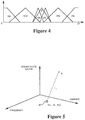
- the tuning parameters are input to a fuzzifier 30, which provides the first step in the fuzzy logic process, and to a self-monitoring processor 40. Fuzzy membership functions 31 are defined for each tuning parameter and provided to fuzzifier 30.
- Typical membership functions 31 are illustrated in Figure 4.
- the range of values of the fuzzy variables is normalized as 0 to 255 along the abscissa of the membership function.
- General heuristics for tuner 14 can be derived from a mathematical sensitivity analysis of system transfer functions and/or from actual experience with system behavior. In the preferred embodiment of the present invention, if-then rules 33 are based on the following four general heuristics:
- These general heuristics can be transformed into sets of if-then rules 33 that comprise instructions used by an inference generator 32 to determine the incremental gain values.
- the sets of if-then rules 33 for computing the incremental values of the proportional, integral, and derivative gains are developed as functions of damping ratio, frequency, and steady-state error. After the incremental gain values have been determined, they are converted from their fuzzy state by defuzzifier 36.
- an incremental change in a gain value (e.g., "delK p ") is determined based on the desired incremental damping (i.e., "delzeta"), the magnitude of the frequency (“freq”), and/or the magnitude of the steady-state error (“sserror”), all expressed in terms of the fuzzy membership functions described above.
- Rules 33 may be stated as follows:
- tuner 14 incorporates self-monitoring processor 40, which compensates for system uncertainties by dynamically scaling the output of the tuner as a function of performance and performance history.
- Self-monitoring processor 40 is used to scale the incremental gain value adjustments output by defuzzifier 36. Stated simply, processor 40 amplifies the gain adjustments when tuner 14 is effective and diminishes the gain adjustments when tuner 14 becomes ineffective. Self-monitoring is accomplished by successive evaluation of a function in the "state-space" of tuner 14. As described above, the state-space of tuner 14 comprises the three variables of damping ratio, frequency, and steady-state error. The state-space equilibrium point (d0, f0, s0) 60 is defined as the desired values of the three state variables.
- Figure 5 illustrates the 3-dimensional state-space, the equilibrium point 60 at (I, 0.5, 0), and a point p i located in the state-space at coordinates (d i , f i , s i ) a distance r i from equilibrium point 60.
- the objective of the self-monitoring mechanism of tuner 14 is to move the parameters (coordinates) of point p i toward equilibrium point 60.
- Self-monitoring processor 40 computes a Lyapunov function in the state-space comprising the Euclidian distance r i between the current values of damping, frequency, and steady-state error and the equilibrium point 60. If the distance r i decreases between successive tuning cycles, tuner 14 is accomplishing its objective. However, because approximator 24 is estimating the state of system 12 from analysis of output response 20, factors such as noise and time-varying behavior of system 12 may produce an increase in r i even when tuner 14 is performing effectively. Therefore, self-monitoring processor 40 measures both "effectiveness" 42 and "consistency" 44 of tuner 14 to prevent tuner-induced gain changes based on transient anomalies such as noise spikes.
- An estimate of tuner effectiveness 42 can be obtained from the incremental change in the distance (i.e., r i-1 - r i ) toward equilibrium point 60 in the state-space of tuner 14.
- the magnitude of this incremental change in distance is a measure of the tuner's effectiveness in moving the output of system 12 toward equilibrium point 60.
- the preferred measure of effectiveness 42 is computed as the difference between two successive distances to equilibrium point 60 (i.e., the incremental change) divided by a moving average of the incremental changes in the distance.
- effectiveness 42 provides a quantitative estimate of the performance of tuner 14 in the most recent tuning cycle as compared to the average of the preceding cycles.
- tuner consistency 44 is defined as the inverse of the variance of tuner effectiveness 42 over three tuning cycles. Consistency 44 is a measure of how uniformly tuner 14 has performed in the i th cycle as compared to the preceding two cycles.
- a reward factor calculator 46 computes a "reward factor" used for scaling the incremental gain adjustments before they are applied to controller 10.
- the reward factor is based on the measures of effectiveness 42 and consistency 44.
- a conservative reward factor scheme allows tuner 14 to effect only small changes to the gain values of controller 10 during a given tuner cycle.
- the actual value of the reward factor computed by reward factor calculator 46 is determined by a set of rules based on the following three heuristics: If consistency AND effectiveness are high, then reward factor is high. If consistency AND effectiveness are med, then reward factor is med. If consistency OR effectiveness is low, then reward factor is low. Thus, the reward factor is high if tuner 14 consistently and effectively moves the output of system 12 toward equilibrium point 60. If effectiveness and consistency degrade, the reward factor is reduced. In the preferred embodiment, the reward factor ranges between 1 and 1.5.
- the reward factor can be combined with effectiveness 42 to diminish the output of tuner 14 when it becomes ineffective or starts to degrade the output response 20.
- An effectiveness multiplier can be derived from effectiveness 42 by using fuzzy rules. For example, the multiplier can range from a value of zero, if effectiveness is consistently negative for three tuner cycles, to a value of 1.5, if effectiveness is consistently greater than unity.
- multiplier 50 scales the incremental gain adjustments received from defuzzifier 36 by multiplying them by the reward factor and the effectiveness multiplier to yield the final incremental gain value adjustments applied to controller 10.
- alternative embodiments of the present invention may use separate reward factors for the individual gains, other valid measures of effectiveness and consistency, and other sets of if-then rules or heuristics.
- the self-monitoring function of the present invention improves the performance as well as the robustness of tuner 14 by scaling the output to produce faster slew rates when performance is good and gracefully diminishing the output when performance is poor. If the effectiveness of tuner 14 becomes negative, it is likely that the controlled system is unstable. To provide for this contingency, the self-monitoring mechanism can be programmed to respond to detected unstable behavior by downloading a predetermined set of controller gain values that are known to provide a stable output response.
- tuner 14 is effective in controlling systems having large parametric and dynamic uncertainties by scaling its output in real-time based on a continuous reevaluation of its own performance.
Landscapes
- Engineering & Computer Science (AREA)
- Artificial Intelligence (AREA)
- Software Systems (AREA)
- Physics & Mathematics (AREA)
- Health & Medical Sciences (AREA)
- Mathematical Physics (AREA)
- Fuzzy Systems (AREA)
- Computer Vision & Pattern Recognition (AREA)
- Evolutionary Computation (AREA)
- Medical Informatics (AREA)
- General Physics & Mathematics (AREA)
- Automation & Control Theory (AREA)
- Feedback Control In General (AREA)
Applications Claiming Priority (2)
| Application Number | Priority Date | Filing Date | Title |
|---|---|---|---|
| US07/598,488 US5159547A (en) | 1990-10-16 | 1990-10-16 | Self-monitoring tuner for feedback controller |
| US598488 | 1990-10-16 |
Publications (3)
| Publication Number | Publication Date |
|---|---|
| EP0481204A2 true EP0481204A2 (de) | 1992-04-22 |
| EP0481204A3 EP0481204A3 (en) | 1993-04-28 |
| EP0481204B1 EP0481204B1 (de) | 1996-11-06 |
Family
ID=24395748
Family Applications (1)
| Application Number | Title | Priority Date | Filing Date |
|---|---|---|---|
| EP91114924A Expired - Lifetime EP0481204B1 (de) | 1990-10-16 | 1991-09-04 | Einstellgerät mit Selbstüberwachung für einen Regler mit Rückkopplung |
Country Status (4)
| Country | Link |
|---|---|
| US (1) | US5159547A (de) |
| EP (1) | EP0481204B1 (de) |
| JP (1) | JPH04259004A (de) |
| DE (1) | DE69123026T2 (de) |
Cited By (10)
| Publication number | Priority date | Publication date | Assignee | Title |
|---|---|---|---|---|
| EP0622716A3 (de) * | 1993-04-30 | 1995-02-01 | American Auto Matrix Inc | Verfahren und Vorrichtung zur Aufrechterhaltung einer gewünschten Luftdurchflussmenge durch einen Abzug. |
| EP1471397A3 (de) * | 2003-04-25 | 2006-01-25 | Falmer Investments Limited | Adaptive Temperaturregelung mit Fuzzy-Logik |
| GB2420424A (en) * | 2004-11-22 | 2006-05-24 | Japan Aerospace Exploration | Automatic adjustment of control parameters for a wind tunnel magnetic suspension system |
| WO2006065612A2 (en) | 2004-12-17 | 2006-06-22 | Texaco Development Corporation | Method and system for controlling a process in a plant |
| US7817712B2 (en) | 2006-05-30 | 2010-10-19 | Fujitsu Limited | System and method for independently adjusting multiple compensations applied to a signal |
| WO2013064602A1 (en) * | 2011-11-04 | 2013-05-10 | Empa Eidgenössische Materialprüfungs- Und Forschungsanstalt | Adaptive helmholtz resonator |
| EP3904971A1 (de) * | 2020-04-29 | 2021-11-03 | Honeywell International Inc. | Autotuner für pid-steuergerät mit verwendung von maschinenlernansätzen |
| CN115903565A (zh) * | 2022-09-27 | 2023-04-04 | 华北电力科学研究院有限责任公司 | 一种控制器参数调节方法及装置 |
| CN116766198A (zh) * | 2023-07-12 | 2023-09-19 | 西南科技大学 | 摆式球形机器人姿态扰动补偿控制方法及其系统 |
| CN120143628A (zh) * | 2025-05-13 | 2025-06-13 | 莱阳千宝新材料制造有限公司 | 一种水性树脂脱溶过程的控制方法 |
Families Citing this family (48)
| Publication number | Priority date | Publication date | Assignee | Title |
|---|---|---|---|---|
| US5295061A (en) * | 1990-04-20 | 1994-03-15 | Sanyo Electric Co., Ltd. | Control parameter tuning unit and a method of tuning parameters for a control unit |
| JPH06187160A (ja) * | 1992-12-15 | 1994-07-08 | Ricoh Co Ltd | メンバーシップ関数のチューニング装置 |
| US5410495A (en) * | 1993-07-20 | 1995-04-25 | Texas Instruments Incorporated | Apparatus, systems, and methods for diagnosing anomalous mass flow controller operation |
| US6041320A (en) * | 1993-08-23 | 2000-03-21 | Fisher Controls International, Inc. | Multi-region fuzzy logic control system with auxiliary variables |
| US5397973A (en) * | 1993-09-16 | 1995-03-14 | Allen-Bradley Company, Inc. | Gain control for fuzzy logic controller |
| US5497063A (en) * | 1993-09-16 | 1996-03-05 | Allen-Bradley Company, Inc. | Fuzzy logic servo controller |
| US5544256A (en) * | 1993-10-22 | 1996-08-06 | International Business Machines Corporation | Automated defect classification system |
| US5587899A (en) * | 1994-06-10 | 1996-12-24 | Fisher-Rosemount Systems, Inc. | Method and apparatus for determining the ultimate gain and ultimate period of a controlled process |
| US5748467A (en) * | 1995-02-21 | 1998-05-05 | Fisher-Rosemont Systems, Inc. | Method of adapting and applying control parameters in non-linear process controllers |
| US5691896A (en) * | 1995-08-15 | 1997-11-25 | Rosemount, Inc. | Field based process control system with auto-tuning |
| US5847952A (en) * | 1996-06-28 | 1998-12-08 | Honeywell Inc. | Nonlinear-approximator-based automatic tuner |
| US5818714A (en) * | 1996-08-01 | 1998-10-06 | Rosemount, Inc. | Process control system with asymptotic auto-tuning |
| US6112301A (en) * | 1997-01-15 | 2000-08-29 | International Business Machines Corporation | System and method for customizing an operating system |
| DE19734208A1 (de) * | 1997-08-07 | 1999-02-11 | Heidenhain Gmbh Dr Johannes | Verfahren und Schaltungsanordnung zur Ermittlung optimaler Reglerparamter für eine Drehzahlregelung |
| US6128541A (en) * | 1997-10-15 | 2000-10-03 | Fisher Controls International, Inc. | Optimal auto-tuner for use in a process control network |
| US6665410B1 (en) | 1998-05-12 | 2003-12-16 | John Warren Parkins | Adaptive feedback controller with open-loop transfer function reference suited for applications such as active noise control |
| US6430544B1 (en) * | 1998-08-11 | 2002-08-06 | Ronald Childress | Single variable priority constraint fuzzy control system |
| US6442534B1 (en) * | 1999-02-23 | 2002-08-27 | Rockwell Automation Technologies, Inc. | Hydraulic controller using multiple regime specific controllers combined with fuzzy logic |
| US6654649B2 (en) * | 1999-12-22 | 2003-11-25 | Aspen Technology, Inc. | Computer method and apparatus for optimized controller in a non-linear process |
| US8280533B2 (en) * | 2000-06-20 | 2012-10-02 | Fisher-Rosemount Systems, Inc. | Continuously scheduled model parameter based adaptive controller |
| US7113834B2 (en) * | 2000-06-20 | 2006-09-26 | Fisher-Rosemount Systems, Inc. | State based adaptive feedback feedforward PID controller |
| US6577908B1 (en) | 2000-06-20 | 2003-06-10 | Fisher Rosemount Systems, Inc | Adaptive feedback/feedforward PID controller |
| US6507798B1 (en) | 2000-10-12 | 2003-01-14 | The United States Of America As Represented By The Secretary Of The Navy | Time-frequency dependent damping via Hilbert damping spectrum |
| US7376472B2 (en) | 2002-09-11 | 2008-05-20 | Fisher-Rosemount Systems, Inc. | Integrated model predictive control and optimization within a process control system |
| DE10254392A1 (de) * | 2002-11-18 | 2004-05-27 | Volkswagen Ag | Verfahren und Vorrichtung zur Fahrdynamikregelung |
| US7317953B2 (en) * | 2003-12-03 | 2008-01-08 | Fisher-Rosemount Systems, Inc. | Adaptive multivariable process controller using model switching and attribute interpolation |
| US8615314B1 (en) * | 2004-09-02 | 2013-12-24 | Advanced Micro Devices, Inc. | Process control using analysis of an upstream process |
| US20060271661A1 (en) * | 2005-05-27 | 2006-11-30 | International Business Machines Corporation | Method for adaptively modifying the observed collective behavior of individual sensor nodes based on broadcasting of parameters |
| JP2007094395A (ja) * | 2005-08-31 | 2007-04-12 | Nippon Telegr & Teleph Corp <Ntt> | 可変光減衰器 |
| US7451004B2 (en) * | 2005-09-30 | 2008-11-11 | Fisher-Rosemount Systems, Inc. | On-line adaptive model predictive control in a process control system |
| US7444191B2 (en) | 2005-10-04 | 2008-10-28 | Fisher-Rosemount Systems, Inc. | Process model identification in a process control system |
| US7738975B2 (en) | 2005-10-04 | 2010-06-15 | Fisher-Rosemount Systems, Inc. | Analytical server integrated in a process control network |
| US8036760B2 (en) | 2005-10-04 | 2011-10-11 | Fisher-Rosemount Systems, Inc. | Method and apparatus for intelligent control and monitoring in a process control system |
| US8509926B2 (en) * | 2005-12-05 | 2013-08-13 | Fisher-Rosemount Systems, Inc. | Self-diagnostic process control loop for a process plant |
| CN101083642B (zh) * | 2006-05-30 | 2010-10-20 | 富士通株式会社 | 用于调节施加给信号的偏移补偿的系统和方法 |
| US8942111B2 (en) * | 2006-08-29 | 2015-01-27 | Nokia Corporation | Network configuration |
| US7840500B2 (en) * | 2006-11-30 | 2010-11-23 | Corning Incorporated | Fuzzy logic control for process with large dead time |
| US20090136052A1 (en) * | 2007-11-27 | 2009-05-28 | David Clark Company Incorporated | Active Noise Cancellation Using a Predictive Approach |
| US8797199B1 (en) | 2013-05-16 | 2014-08-05 | Amazon Technologies, Inc. | Continuous adaptive digital to analog control |
| CN110520803B (zh) * | 2018-08-10 | 2022-10-18 | 曾喆昭 | 一种智慧pid控制方法 |
| CN110443003B (zh) * | 2019-08-19 | 2023-04-18 | 合肥工业大学 | 一种主动稳定杆系统的控制及优化设计方法 |
| CN112859585B (zh) * | 2021-01-12 | 2024-03-08 | 中控技术股份有限公司 | 一种pid控制器动态调整控制周期的方法 |
| CN113515037B (zh) * | 2021-08-03 | 2023-06-30 | 成都航空职业技术学院 | 一种改进的无模型系统的pid控制器参数整定方法 |
| CN114153138B (zh) * | 2021-10-27 | 2024-04-12 | 共享智能装备有限公司 | 一种agv多轮系统及其同步控制方法 |
| CN115576200B (zh) * | 2022-09-30 | 2024-09-24 | 嘉应学院 | 一种下推式磁悬浮系统的自适应控制方法 |
| CN117434988B (zh) * | 2023-12-18 | 2024-04-26 | 杭州泰恩智达装备科技有限公司 | 水平衡控制方法、装置及系统 |
| CN117937224B (zh) * | 2024-01-24 | 2024-07-09 | 中国计量科学研究院 | 一种稳频激光器的自动化pid整定方法及系统 |
| CN118466224B (zh) * | 2024-07-15 | 2024-09-13 | 北京易动宇航科技有限公司 | 用于电推进系统的流量控制方法及系统 |
Family Cites Families (7)
| Publication number | Priority date | Publication date | Assignee | Title |
|---|---|---|---|---|
| SE427508B (sv) * | 1981-08-24 | 1983-04-11 | Naf Ab | Forfarande for instellning av en pid-regulator for en process |
| DE3330233A1 (de) * | 1983-08-22 | 1985-03-21 | Deutsche Forschungs- und Versuchsanstalt für Luft- und Raumfahrt e.V., 5000 Köln | Verfahren und vorrichtung zur einstellung des pid-verhaltens von reglerkompensationsnetzwerken, insbesondere bei hydropulsmaschinen |
| DE3811086A1 (de) * | 1987-04-03 | 1988-10-20 | Hitachi Ltd | Pid-reglersystem |
| US4860215A (en) * | 1987-04-06 | 1989-08-22 | California Institute Of Technology | Method and apparatus for adaptive force and position control of manipulators |
| JPH0272404A (ja) * | 1988-09-08 | 1990-03-12 | Yokogawa Electric Corp | メンバーシップ関数決定方法 |
| EP0360206A3 (de) * | 1988-09-21 | 1990-12-19 | Hitachi, Ltd. | Selbsteinstellender Regler und Prozesssteuerungsvorrichtung |
| JPH0283703A (ja) * | 1988-09-21 | 1990-03-23 | Hitachi Ltd | プロセス制御システム |
-
1990
- 1990-10-16 US US07/598,488 patent/US5159547A/en not_active Expired - Fee Related
-
1991
- 1991-09-04 DE DE69123026T patent/DE69123026T2/de not_active Expired - Fee Related
- 1991-09-04 EP EP91114924A patent/EP0481204B1/de not_active Expired - Lifetime
- 1991-10-15 JP JP3265998A patent/JPH04259004A/ja active Pending
Cited By (14)
| Publication number | Priority date | Publication date | Assignee | Title |
|---|---|---|---|---|
| EP0622716A3 (de) * | 1993-04-30 | 1995-02-01 | American Auto Matrix Inc | Verfahren und Vorrichtung zur Aufrechterhaltung einer gewünschten Luftdurchflussmenge durch einen Abzug. |
| EP1471397A3 (de) * | 2003-04-25 | 2006-01-25 | Falmer Investments Limited | Adaptive Temperaturregelung mit Fuzzy-Logik |
| US7328075B2 (en) | 2004-11-22 | 2008-02-05 | Japan Aerospace Exploration Agency | Method of automatic adjustment of the control parameters of a magnetic suspension system |
| GB2420424A (en) * | 2004-11-22 | 2006-05-24 | Japan Aerospace Exploration | Automatic adjustment of control parameters for a wind tunnel magnetic suspension system |
| GB2420424B (en) * | 2004-11-22 | 2007-09-05 | Japan Aerospace Exploration | Method of automatic adjustment of the control parameters of a magnetic suspension system |
| EP1825338A4 (de) * | 2004-12-17 | 2009-04-08 | Texaco Development Corp | Verfahren und system zur steuerung eines prozesses in einer anlage |
| WO2006065612A2 (en) | 2004-12-17 | 2006-06-22 | Texaco Development Corporation | Method and system for controlling a process in a plant |
| US7817712B2 (en) | 2006-05-30 | 2010-10-19 | Fujitsu Limited | System and method for independently adjusting multiple compensations applied to a signal |
| WO2013064602A1 (en) * | 2011-11-04 | 2013-05-10 | Empa Eidgenössische Materialprüfungs- Und Forschungsanstalt | Adaptive helmholtz resonator |
| EP3904971A1 (de) * | 2020-04-29 | 2021-11-03 | Honeywell International Inc. | Autotuner für pid-steuergerät mit verwendung von maschinenlernansätzen |
| US11796977B2 (en) | 2020-04-29 | 2023-10-24 | Honeywell International Inc. | PID controller autotuner using machine learning approaches |
| CN115903565A (zh) * | 2022-09-27 | 2023-04-04 | 华北电力科学研究院有限责任公司 | 一种控制器参数调节方法及装置 |
| CN116766198A (zh) * | 2023-07-12 | 2023-09-19 | 西南科技大学 | 摆式球形机器人姿态扰动补偿控制方法及其系统 |
| CN120143628A (zh) * | 2025-05-13 | 2025-06-13 | 莱阳千宝新材料制造有限公司 | 一种水性树脂脱溶过程的控制方法 |
Also Published As
| Publication number | Publication date |
|---|---|
| US5159547A (en) | 1992-10-27 |
| EP0481204A3 (en) | 1993-04-28 |
| DE69123026D1 (de) | 1996-12-12 |
| EP0481204B1 (de) | 1996-11-06 |
| JPH04259004A (ja) | 1992-09-14 |
| DE69123026T2 (de) | 1997-03-06 |
Similar Documents
| Publication | Publication Date | Title |
|---|---|---|
| US5159547A (en) | Self-monitoring tuner for feedback controller | |
| EP0710901B1 (de) | Mehrgrössen-/nichtlineare Prozesssteuerung | |
| US5748467A (en) | Method of adapting and applying control parameters in non-linear process controllers | |
| EP0710902B1 (de) | Verfahren und Vorrichtung zur Steuerung von Mehrgrössen-/nichtlinearen Systemen | |
| US5909370A (en) | Method of predicting overshoot in a control system response | |
| EP0712060B1 (de) | Verfahren und Vorrichtung zur Erzeugung einer Mehrgrössen-/nichtlinearen Steuerung | |
| US4768143A (en) | Apparatus and method using adaptive gain scheduling algorithm | |
| JPH0774961B2 (ja) | オートチユーニングpid調節計 | |
| KR20000010791A (ko) | 예측, 제어 및 최적화를 위한 동적 및 정상-상태 프로세스를 모델링하는 방법 및 장치 | |
| JPH09504628A (ja) | 補助変数を用いた多重領域ファジー論理制御システム | |
| JP3144612B2 (ja) | ファジイ推論によるpid制御方法 | |
| US6847954B1 (en) | Control-loop auto-tuner with nonlinear tuning rules estimators | |
| JP3864781B2 (ja) | 温度調節器 | |
| EP1288470B1 (de) | Gerät zur Steuerung der Drehzahl eines Motors | |
| US5251124A (en) | Fuzzy controller apparatus and method for steady state control | |
| CN119994945A (zh) | 一种变参数电力系统自适应调频方法及系统 | |
| US5410470A (en) | Process control method and system with employment of fuzzy inference | |
| CN118589618A (zh) | 一种水电机组lcu有功与调速系统频率协调控制优化方法及系统 | |
| Alyoussef et al. | Novel tuning rules for adjusting the parameters of the pi-pd controller for controlling unstable processes | |
| CN118433981A (zh) | 一种用于提高大束流回旋加速器电压幅值稳定度的装置 | |
| US6847851B1 (en) | Apparatus for improved general-purpose PID and non-PID controllers | |
| KR970005555B1 (ko) | 리셋 기능을 이용한 퍼지 피아이(pi) 제어기 | |
| JPH05284771A (ja) | Pi制御器のオートチューニング方法 | |
| Kammer et al. | Direct iterative tuning via spectral analysis | |
| CN120658148A (zh) | 一种船舶动力转换装置的模糊控制方法及系统 |
Legal Events
| Date | Code | Title | Description |
|---|---|---|---|
| PUAI | Public reference made under article 153(3) epc to a published international application that has entered the european phase |
Free format text: ORIGINAL CODE: 0009012 |
|
| AK | Designated contracting states |
Kind code of ref document: A2 Designated state(s): DE FR GB |
|
| PUAL | Search report despatched |
Free format text: ORIGINAL CODE: 0009013 |
|
| AK | Designated contracting states |
Kind code of ref document: A3 Designated state(s): DE FR GB |
|
| 17P | Request for examination filed |
Effective date: 19931022 |
|
| 17Q | First examination report despatched |
Effective date: 19931130 |
|
| GRAH | Despatch of communication of intention to grant a patent |
Free format text: ORIGINAL CODE: EPIDOS IGRA |
|
| GRAH | Despatch of communication of intention to grant a patent |
Free format text: ORIGINAL CODE: EPIDOS IGRA |
|
| GRAA | (expected) grant |
Free format text: ORIGINAL CODE: 0009210 |
|
| AK | Designated contracting states |
Kind code of ref document: B1 Designated state(s): DE FR GB |
|
| REF | Corresponds to: |
Ref document number: 69123026 Country of ref document: DE Date of ref document: 19961212 |
|
| ET | Fr: translation filed | ||
| PLBE | No opposition filed within time limit |
Free format text: ORIGINAL CODE: 0009261 |
|
| STAA | Information on the status of an ep patent application or granted ep patent |
Free format text: STATUS: NO OPPOSITION FILED WITHIN TIME LIMIT |
|
| 26N | No opposition filed | ||
| PGFP | Annual fee paid to national office [announced via postgrant information from national office to epo] |
Ref country code: FR Payment date: 20000822 Year of fee payment: 10 |
|
| PGFP | Annual fee paid to national office [announced via postgrant information from national office to epo] |
Ref country code: GB Payment date: 20000825 Year of fee payment: 10 |
|
| PGFP | Annual fee paid to national office [announced via postgrant information from national office to epo] |
Ref country code: DE Payment date: 20000828 Year of fee payment: 10 |
|
| PG25 | Lapsed in a contracting state [announced via postgrant information from national office to epo] |
Ref country code: GB Free format text: LAPSE BECAUSE OF NON-PAYMENT OF DUE FEES Effective date: 20010904 |
|
| PG25 | Lapsed in a contracting state [announced via postgrant information from national office to epo] |
Ref country code: DE Free format text: LAPSE BECAUSE OF NON-PAYMENT OF DUE FEES Effective date: 20020501 |
|
| PG25 | Lapsed in a contracting state [announced via postgrant information from national office to epo] |
Ref country code: FR Free format text: LAPSE BECAUSE OF NON-PAYMENT OF DUE FEES Effective date: 20020531 |
|
| REG | Reference to a national code |
Ref country code: FR Ref legal event code: ST |