EP0481319A2 - Zweikomponenten-Polyurethanklebstoffe - Google Patents
Zweikomponenten-Polyurethanklebstoffe Download PDFInfo
- Publication number
- EP0481319A2 EP0481319A2 EP91117033A EP91117033A EP0481319A2 EP 0481319 A2 EP0481319 A2 EP 0481319A2 EP 91117033 A EP91117033 A EP 91117033A EP 91117033 A EP91117033 A EP 91117033A EP 0481319 A2 EP0481319 A2 EP 0481319A2
- Authority
- EP
- European Patent Office
- Prior art keywords
- weight
- parts
- polyol
- molecular weight
- component
- Prior art date
- Legal status (The legal status is an assumption and is not a legal conclusion. Google has not performed a legal analysis and makes no representation as to the accuracy of the status listed.)
- Granted
Links
- 239000004814 polyurethane Substances 0.000 title claims abstract description 29
- 229920002635 polyurethane Polymers 0.000 title claims abstract description 27
- 230000001070 adhesive effect Effects 0.000 title claims abstract description 22
- 239000000853 adhesive Substances 0.000 title claims abstract description 21
- 150000001875 compounds Chemical class 0.000 claims abstract description 30
- 125000002887 hydroxy group Chemical group [H]O* 0.000 claims description 21
- 239000012948 isocyanate Substances 0.000 claims description 21
- 150000002513 isocyanates Chemical class 0.000 claims description 21
- 239000004970 Chain extender Substances 0.000 claims description 17
- 239000003054 catalyst Substances 0.000 claims description 8
- 150000004985 diamines Chemical class 0.000 claims description 7
- 238000006243 chemical reaction Methods 0.000 claims description 6
- 239000000654 additive Substances 0.000 claims description 5
- 125000003178 carboxy group Chemical group [H]OC(*)=O 0.000 claims description 4
- 125000001931 aliphatic group Chemical group 0.000 claims description 2
- 125000003118 aryl group Chemical group 0.000 claims description 2
- 229920005862 polyol Polymers 0.000 abstract description 81
- 150000003077 polyols Chemical class 0.000 abstract description 80
- 239000000203 mixture Substances 0.000 abstract description 56
- 238000004519 manufacturing process Methods 0.000 abstract description 6
- LYCAIKOWRPUZTN-UHFFFAOYSA-N Ethylene glycol Chemical compound OCCO LYCAIKOWRPUZTN-UHFFFAOYSA-N 0.000 description 27
- 239000005056 polyisocyanate Substances 0.000 description 23
- 229920001228 polyisocyanate Polymers 0.000 description 23
- 229920000570 polyether Polymers 0.000 description 21
- 239000004721 Polyphenylene oxide Substances 0.000 description 18
- 238000003860 storage Methods 0.000 description 16
- -1 polypropylene Polymers 0.000 description 15
- 229920005903 polyol mixture Polymers 0.000 description 13
- 238000000926 separation method Methods 0.000 description 13
- PEDCQBHIVMGVHV-UHFFFAOYSA-N Glycerine Chemical compound OCC(O)CO PEDCQBHIVMGVHV-UHFFFAOYSA-N 0.000 description 12
- 238000000034 method Methods 0.000 description 12
- UPMLOUAZCHDJJD-UHFFFAOYSA-N 4,4'-Diphenylmethane Diisocyanate Chemical compound C1=CC(N=C=O)=CC=C1CC1=CC=C(N=C=O)C=C1 UPMLOUAZCHDJJD-UHFFFAOYSA-N 0.000 description 11
- 239000010457 zeolite Substances 0.000 description 11
- 229910021536 Zeolite Inorganic materials 0.000 description 10
- HNPSIPDUKPIQMN-UHFFFAOYSA-N dioxosilane;oxo(oxoalumanyloxy)alumane Chemical compound O=[Si]=O.O=[Al]O[Al]=O HNPSIPDUKPIQMN-UHFFFAOYSA-N 0.000 description 10
- 150000001412 amines Chemical class 0.000 description 9
- WERYXYBDKMZEQL-UHFFFAOYSA-N butane-1,4-diol Chemical compound OCCCCO WERYXYBDKMZEQL-UHFFFAOYSA-N 0.000 description 9
- 230000008569 process Effects 0.000 description 9
- IAYPIBMASNFSPL-UHFFFAOYSA-N Ethylene oxide Chemical compound C1CO1 IAYPIBMASNFSPL-UHFFFAOYSA-N 0.000 description 7
- GOOHAUXETOMSMM-UHFFFAOYSA-N Propylene oxide Chemical group CC1CO1 GOOHAUXETOMSMM-UHFFFAOYSA-N 0.000 description 7
- WSFSSNUMVMOOMR-UHFFFAOYSA-N Formaldehyde Chemical compound O=C WSFSSNUMVMOOMR-UHFFFAOYSA-N 0.000 description 6
- 239000000945 filler Substances 0.000 description 6
- IQPQWNKOIGAROB-UHFFFAOYSA-N isocyanate group Chemical group [N-]=C=O IQPQWNKOIGAROB-UHFFFAOYSA-N 0.000 description 6
- 229920000515 polycarbonate Polymers 0.000 description 6
- 239000004417 polycarbonate Substances 0.000 description 6
- 229920005906 polyester polyol Polymers 0.000 description 6
- 229920000642 polymer Polymers 0.000 description 6
- 239000002904 solvent Substances 0.000 description 6
- DNIAPMSPPWPWGF-UHFFFAOYSA-N Propylene glycol Chemical compound CC(O)CO DNIAPMSPPWPWGF-UHFFFAOYSA-N 0.000 description 5
- 125000003277 amino group Chemical group 0.000 description 5
- 125000004432 carbon atom Chemical group C* 0.000 description 5
- 150000002009 diols Chemical class 0.000 description 5
- 239000003365 glass fiber Substances 0.000 description 5
- 125000006353 oxyethylene group Chemical group 0.000 description 5
- 229920003023 plastic Polymers 0.000 description 5
- 239000004033 plastic Substances 0.000 description 5
- 239000000047 product Substances 0.000 description 5
- 238000005204 segregation Methods 0.000 description 5
- PAYRUJLWNCNPSJ-UHFFFAOYSA-N Aniline Chemical compound NC1=CC=CC=C1 PAYRUJLWNCNPSJ-UHFFFAOYSA-N 0.000 description 4
- PPBRXRYQALVLMV-UHFFFAOYSA-N Styrene Chemical compound C=CC1=CC=CC=C1 PPBRXRYQALVLMV-UHFFFAOYSA-N 0.000 description 4
- ZJCCRDAZUWHFQH-UHFFFAOYSA-N Trimethylolpropane Chemical compound CCC(CO)(CO)CO ZJCCRDAZUWHFQH-UHFFFAOYSA-N 0.000 description 4
- 239000010425 asbestos Substances 0.000 description 4
- 239000007795 chemical reaction product Substances 0.000 description 4
- 125000005442 diisocyanate group Chemical group 0.000 description 4
- 239000000839 emulsion Substances 0.000 description 4
- 239000011521 glass Substances 0.000 description 4
- NIMLQBUJDJZYEJ-UHFFFAOYSA-N isophorone diisocyanate Chemical compound CC1(C)CC(N=C=O)CC(C)(CN=C=O)C1 NIMLQBUJDJZYEJ-UHFFFAOYSA-N 0.000 description 4
- 229920001225 polyester resin Polymers 0.000 description 4
- 239000004645 polyester resin Substances 0.000 description 4
- 229920003225 polyurethane elastomer Polymers 0.000 description 4
- 229910052895 riebeckite Inorganic materials 0.000 description 4
- 238000012360 testing method Methods 0.000 description 4
- NLHHRLWOUZZQLW-UHFFFAOYSA-N Acrylonitrile Chemical compound C=CC#N NLHHRLWOUZZQLW-UHFFFAOYSA-N 0.000 description 3
- IJGRMHOSHXDMSA-UHFFFAOYSA-N Atomic nitrogen Chemical compound N#N IJGRMHOSHXDMSA-UHFFFAOYSA-N 0.000 description 3
- VYPSYNLAJGMNEJ-UHFFFAOYSA-N Silicium dioxide Chemical class O=[Si]=O VYPSYNLAJGMNEJ-UHFFFAOYSA-N 0.000 description 3
- 150000001298 alcohols Chemical class 0.000 description 3
- MTHSVFCYNBDYFN-UHFFFAOYSA-N diethylene glycol Chemical compound OCCOCCO MTHSVFCYNBDYFN-UHFFFAOYSA-N 0.000 description 3
- 239000003995 emulsifying agent Substances 0.000 description 3
- 239000012530 fluid Substances 0.000 description 3
- 229910052739 hydrogen Inorganic materials 0.000 description 3
- 239000001257 hydrogen Substances 0.000 description 3
- 239000000463 material Substances 0.000 description 3
- 229910052751 metal Chemical class 0.000 description 3
- 239000002184 metal Chemical class 0.000 description 3
- 238000002156 mixing Methods 0.000 description 3
- 238000002360 preparation method Methods 0.000 description 3
- 239000000758 substrate Substances 0.000 description 3
- NWZSZGALRFJKBT-KNIFDHDWSA-N (2s)-2,6-diaminohexanoic acid;(2s)-2-hydroxybutanedioic acid Chemical compound OC(=O)[C@@H](O)CC(O)=O.NCCCC[C@H](N)C(O)=O NWZSZGALRFJKBT-KNIFDHDWSA-N 0.000 description 2
- VOZKAJLKRJDJLL-UHFFFAOYSA-N 2,4-diaminotoluene Chemical compound CC1=CC=C(N)C=C1N VOZKAJLKRJDJLL-UHFFFAOYSA-N 0.000 description 2
- QGZKDVFQNNGYKY-UHFFFAOYSA-N Ammonia Chemical compound N QGZKDVFQNNGYKY-UHFFFAOYSA-N 0.000 description 2
- 239000004215 Carbon black (E152) Substances 0.000 description 2
- PIICEJLVQHRZGT-UHFFFAOYSA-N Ethylenediamine Chemical compound NCCN PIICEJLVQHRZGT-UHFFFAOYSA-N 0.000 description 2
- VZCYOOQTPOCHFL-OWOJBTEDSA-N Fumaric acid Chemical compound OC(=O)\C=C\C(O)=O VZCYOOQTPOCHFL-OWOJBTEDSA-N 0.000 description 2
- 239000005057 Hexamethylene diisocyanate Substances 0.000 description 2
- UFHFLCQGNIYNRP-UHFFFAOYSA-N Hydrogen Chemical compound [H][H] UFHFLCQGNIYNRP-UHFFFAOYSA-N 0.000 description 2
- 239000005058 Isophorone diisocyanate Substances 0.000 description 2
- GLUUGHFHXGJENI-UHFFFAOYSA-N Piperazine Chemical compound C1CNCCN1 GLUUGHFHXGJENI-UHFFFAOYSA-N 0.000 description 2
- KKEYFWRCBNTPAC-UHFFFAOYSA-N Terephthalic acid Chemical compound OC(=O)C1=CC=C(C(O)=O)C=C1 KKEYFWRCBNTPAC-UHFFFAOYSA-N 0.000 description 2
- WNLRTRBMVRJNCN-UHFFFAOYSA-N adipic acid Chemical compound OC(=O)CCCCC(O)=O WNLRTRBMVRJNCN-UHFFFAOYSA-N 0.000 description 2
- OHJMTUPIZMNBFR-UHFFFAOYSA-N biuret Chemical compound NC(=O)NC(N)=O OHJMTUPIZMNBFR-UHFFFAOYSA-N 0.000 description 2
- BMRWNKZVCUKKSR-UHFFFAOYSA-N butane-1,2-diol Chemical compound CCC(O)CO BMRWNKZVCUKKSR-UHFFFAOYSA-N 0.000 description 2
- 239000004359 castor oil Substances 0.000 description 2
- 235000019438 castor oil Nutrition 0.000 description 2
- 230000003197 catalytic effect Effects 0.000 description 2
- 229920001577 copolymer Polymers 0.000 description 2
- CZZYITDELCSZES-UHFFFAOYSA-N diphenylmethane Chemical compound C=1C=CC=CC=1CC1=CC=CC=C1 CZZYITDELCSZES-UHFFFAOYSA-N 0.000 description 2
- 230000000694 effects Effects 0.000 description 2
- DYDNPESBYVVLBO-UHFFFAOYSA-N formanilide Chemical compound O=CNC1=CC=CC=C1 DYDNPESBYVVLBO-UHFFFAOYSA-N 0.000 description 2
- ZEMPKEQAKRGZGQ-XOQCFJPHSA-N glycerol triricinoleate Natural products CCCCCC[C@@H](O)CC=CCCCCCCCC(=O)OC[C@@H](COC(=O)CCCCCCCC=CC[C@@H](O)CCCCCC)OC(=O)CCCCCCCC=CC[C@H](O)CCCCCC ZEMPKEQAKRGZGQ-XOQCFJPHSA-N 0.000 description 2
- 150000002334 glycols Chemical class 0.000 description 2
- RRAMGCGOFNQTLD-UHFFFAOYSA-N hexamethylene diisocyanate Chemical compound O=C=NCCCCCCN=C=O RRAMGCGOFNQTLD-UHFFFAOYSA-N 0.000 description 2
- NAQMVNRVTILPCV-UHFFFAOYSA-N hexane-1,6-diamine Chemical compound NCCCCCCN NAQMVNRVTILPCV-UHFFFAOYSA-N 0.000 description 2
- IKDUDTNKRLTJSI-UHFFFAOYSA-N hydrazine monohydrate Substances O.NN IKDUDTNKRLTJSI-UHFFFAOYSA-N 0.000 description 2
- 229930195733 hydrocarbon Natural products 0.000 description 2
- 238000011065 in-situ storage Methods 0.000 description 2
- ZFSLODLOARCGLH-UHFFFAOYSA-N isocyanuric acid Chemical compound OC1=NC(O)=NC(O)=N1 ZFSLODLOARCGLH-UHFFFAOYSA-N 0.000 description 2
- 239000007788 liquid Substances 0.000 description 2
- 230000004048 modification Effects 0.000 description 2
- 238000012986 modification Methods 0.000 description 2
- UHOVQNZJYSORNB-UHFFFAOYSA-N monobenzene Natural products C1=CC=CC=C1 UHOVQNZJYSORNB-UHFFFAOYSA-N 0.000 description 2
- 229910052757 nitrogen Inorganic materials 0.000 description 2
- 150000004010 onium ions Chemical class 0.000 description 2
- 150000002894 organic compounds Chemical class 0.000 description 2
- 239000012766 organic filler Substances 0.000 description 2
- 150000002989 phenols Chemical class 0.000 description 2
- XNGIFLGASWRNHJ-UHFFFAOYSA-N phthalic acid Chemical compound OC(=O)C1=CC=CC=C1C(O)=O XNGIFLGASWRNHJ-UHFFFAOYSA-N 0.000 description 2
- 229920000768 polyamine Polymers 0.000 description 2
- 238000007665 sagging Methods 0.000 description 2
- 150000003839 salts Chemical class 0.000 description 2
- 229920006395 saturated elastomer Polymers 0.000 description 2
- 239000007787 solid Substances 0.000 description 2
- 239000007858 starting material Substances 0.000 description 2
- 239000000126 substance Substances 0.000 description 2
- 150000005846 sugar alcohols Polymers 0.000 description 2
- 150000003512 tertiary amines Chemical class 0.000 description 2
- 239000012974 tin catalyst Substances 0.000 description 2
- DVKJHBMWWAPEIU-UHFFFAOYSA-N toluene 2,4-diisocyanate Chemical compound CC1=CC=C(N=C=O)C=C1N=C=O DVKJHBMWWAPEIU-UHFFFAOYSA-N 0.000 description 2
- RUELTTOHQODFPA-UHFFFAOYSA-N toluene 2,6-diisocyanate Chemical compound CC1=C(N=C=O)C=CC=C1N=C=O RUELTTOHQODFPA-UHFFFAOYSA-N 0.000 description 2
- XLYOFNOQVPJJNP-UHFFFAOYSA-N water Substances O XLYOFNOQVPJJNP-UHFFFAOYSA-N 0.000 description 2
- DNIAPMSPPWPWGF-GSVOUGTGSA-N (R)-(-)-Propylene glycol Chemical compound C[C@@H](O)CO DNIAPMSPPWPWGF-GSVOUGTGSA-N 0.000 description 1
- GEYOCULIXLDCMW-UHFFFAOYSA-N 1,2-phenylenediamine Chemical compound NC1=CC=CC=C1N GEYOCULIXLDCMW-UHFFFAOYSA-N 0.000 description 1
- PCHXZXKMYCGVFA-UHFFFAOYSA-N 1,3-diazetidine-2,4-dione Chemical compound O=C1NC(=O)N1 PCHXZXKMYCGVFA-UHFFFAOYSA-N 0.000 description 1
- ALQLPWJFHRMHIU-UHFFFAOYSA-N 1,4-diisocyanatobenzene Chemical compound O=C=NC1=CC=C(N=C=O)C=C1 ALQLPWJFHRMHIU-UHFFFAOYSA-N 0.000 description 1
- CBCKQZAAMUWICA-UHFFFAOYSA-N 1,4-phenylenediamine Chemical compound NC1=CC=C(N)C=C1 CBCKQZAAMUWICA-UHFFFAOYSA-N 0.000 description 1
- RNFJDJUURJAICM-UHFFFAOYSA-N 2,2,4,4,6,6-hexaphenoxy-1,3,5-triaza-2$l^{5},4$l^{5},6$l^{5}-triphosphacyclohexa-1,3,5-triene Chemical compound N=1P(OC=2C=CC=CC=2)(OC=2C=CC=CC=2)=NP(OC=2C=CC=CC=2)(OC=2C=CC=CC=2)=NP=1(OC=1C=CC=CC=1)OC1=CC=CC=C1 RNFJDJUURJAICM-UHFFFAOYSA-N 0.000 description 1
- UCUPHRPMBXOFAU-UHFFFAOYSA-N 2,4,6-tri(propan-2-yl)benzene-1,3-diamine Chemical compound CC(C)C1=CC(C(C)C)=C(N)C(C(C)C)=C1N UCUPHRPMBXOFAU-UHFFFAOYSA-N 0.000 description 1
- JGYUBHGXADMAQU-UHFFFAOYSA-N 2,4,6-triethylbenzene-1,3-diamine Chemical compound CCC1=CC(CC)=C(N)C(CC)=C1N JGYUBHGXADMAQU-UHFFFAOYSA-N 0.000 description 1
- ZVDSMYGTJDFNHN-UHFFFAOYSA-N 2,4,6-trimethylbenzene-1,3-diamine Chemical group CC1=CC(C)=C(N)C(C)=C1N ZVDSMYGTJDFNHN-UHFFFAOYSA-N 0.000 description 1
- PISLZQACAJMAIO-UHFFFAOYSA-N 2,4-diethyl-6-methylbenzene-1,3-diamine Chemical compound CCC1=CC(C)=C(N)C(CC)=C1N PISLZQACAJMAIO-UHFFFAOYSA-N 0.000 description 1
- LCZVSXRMYJUNFX-UHFFFAOYSA-N 2-[2-(2-hydroxypropoxy)propoxy]propan-1-ol Chemical compound CC(O)COC(C)COC(C)CO LCZVSXRMYJUNFX-UHFFFAOYSA-N 0.000 description 1
- BSVPHYUAWSNFGV-UHFFFAOYSA-N 2-ethyl-4,6-dimethylbenzene-1,3-diamine Chemical compound CCC1=C(N)C(C)=CC(C)=C1N BSVPHYUAWSNFGV-UHFFFAOYSA-N 0.000 description 1
- RNLHGQLZWXBQNY-UHFFFAOYSA-N 3-(aminomethyl)-3,5,5-trimethylcyclohexan-1-amine Chemical compound CC1(C)CC(N)CC(C)(CN)C1 RNLHGQLZWXBQNY-UHFFFAOYSA-N 0.000 description 1
- WUPHOULIZUERAE-UHFFFAOYSA-N 3-(oxolan-2-yl)propanoic acid Chemical compound OC(=O)CCC1CCCO1 WUPHOULIZUERAE-UHFFFAOYSA-N 0.000 description 1
- YBRVSVVVWCFQMG-UHFFFAOYSA-N 4,4'-diaminodiphenylmethane Chemical compound C1=CC(N)=CC=C1CC1=CC=C(N)C=C1 YBRVSVVVWCFQMG-UHFFFAOYSA-N 0.000 description 1
- RQEOBXYYEPMCPJ-UHFFFAOYSA-N 4,6-diethyl-2-methylbenzene-1,3-diamine Chemical compound CCC1=CC(CC)=C(N)C(C)=C1N RQEOBXYYEPMCPJ-UHFFFAOYSA-N 0.000 description 1
- DZIHTWJGPDVSGE-UHFFFAOYSA-N 4-[(4-aminocyclohexyl)methyl]cyclohexan-1-amine Chemical compound C1CC(N)CCC1CC1CCC(N)CC1 DZIHTWJGPDVSGE-UHFFFAOYSA-N 0.000 description 1
- HRPVXLWXLXDGHG-UHFFFAOYSA-N Acrylamide Chemical compound NC(=O)C=C HRPVXLWXLXDGHG-UHFFFAOYSA-N 0.000 description 1
- PNEYBMLMFCGWSK-UHFFFAOYSA-N Alumina Chemical class [O-2].[O-2].[O-2].[Al+3].[Al+3] PNEYBMLMFCGWSK-UHFFFAOYSA-N 0.000 description 1
- 239000005995 Aluminium silicate Substances 0.000 description 1
- QGZKDVFQNNGYKY-UHFFFAOYSA-O Ammonium Chemical class [NH4+] QGZKDVFQNNGYKY-UHFFFAOYSA-O 0.000 description 1
- FBPFZTCFMRRESA-FSIIMWSLSA-N D-Glucitol Natural products OC[C@H](O)[C@H](O)[C@@H](O)[C@H](O)CO FBPFZTCFMRRESA-FSIIMWSLSA-N 0.000 description 1
- FBPFZTCFMRRESA-JGWLITMVSA-N D-glucitol Chemical compound OC[C@H](O)[C@@H](O)[C@H](O)[C@H](O)CO FBPFZTCFMRRESA-JGWLITMVSA-N 0.000 description 1
- 101100295776 Drosophila melanogaster onecut gene Proteins 0.000 description 1
- CERQOIWHTDAKMF-UHFFFAOYSA-N Methacrylic acid Chemical class CC(=C)C(O)=O CERQOIWHTDAKMF-UHFFFAOYSA-N 0.000 description 1
- 229920003171 Poly (ethylene oxide) Polymers 0.000 description 1
- 239000004743 Polypropylene Substances 0.000 description 1
- CZMRCDWAGMRECN-UGDNZRGBSA-N Sucrose Chemical compound O[C@H]1[C@H](O)[C@@H](CO)O[C@@]1(CO)O[C@@H]1[C@H](O)[C@@H](O)[C@H](O)[C@@H](CO)O1 CZMRCDWAGMRECN-UGDNZRGBSA-N 0.000 description 1
- 229930006000 Sucrose Natural products 0.000 description 1
- XSTXAVWGXDQKEL-UHFFFAOYSA-N Trichloroethylene Chemical compound ClC=C(Cl)Cl XSTXAVWGXDQKEL-UHFFFAOYSA-N 0.000 description 1
- 239000005083 Zinc sulfide Substances 0.000 description 1
- 238000005299 abrasion Methods 0.000 description 1
- 239000002253 acid Substances 0.000 description 1
- 150000007513 acids Chemical class 0.000 description 1
- 239000011149 active material Substances 0.000 description 1
- 239000013543 active substance Substances 0.000 description 1
- 239000001361 adipic acid Substances 0.000 description 1
- 235000011037 adipic acid Nutrition 0.000 description 1
- 230000001476 alcoholic effect Effects 0.000 description 1
- 229940045714 alkyl sulfonate alkylating agent Drugs 0.000 description 1
- WYTGDNHDOZPMIW-RCBQFDQVSA-N alstonine Natural products C1=CC2=C3C=CC=CC3=NC2=C2N1C[C@H]1[C@H](C)OC=C(C(=O)OC)[C@H]1C2 WYTGDNHDOZPMIW-RCBQFDQVSA-N 0.000 description 1
- 235000012211 aluminium silicate Nutrition 0.000 description 1
- 150000001414 amino alcohols Chemical class 0.000 description 1
- 229910021529 ammonia Inorganic materials 0.000 description 1
- 229910052612 amphibole Inorganic materials 0.000 description 1
- 150000008064 anhydrides Chemical class 0.000 description 1
- 229910052898 antigorite Inorganic materials 0.000 description 1
- 150000004984 aromatic diamines Chemical class 0.000 description 1
- 239000011324 bead Substances 0.000 description 1
- 230000008901 benefit Effects 0.000 description 1
- 239000006085 branching agent Substances 0.000 description 1
- RDHPKYGYEGBMSE-UHFFFAOYSA-N bromoethane Chemical compound CCBr RDHPKYGYEGBMSE-UHFFFAOYSA-N 0.000 description 1
- CDQSJQSWAWPGKG-UHFFFAOYSA-N butane-1,1-diol Chemical compound CCCC(O)O CDQSJQSWAWPGKG-UHFFFAOYSA-N 0.000 description 1
- OWBTYPJTUOEWEK-UHFFFAOYSA-N butane-2,3-diol Chemical compound CC(O)C(C)O OWBTYPJTUOEWEK-UHFFFAOYSA-N 0.000 description 1
- 229910052980 cadmium sulfide Inorganic materials 0.000 description 1
- 150000001718 carbodiimides Chemical class 0.000 description 1
- 229910052799 carbon Inorganic materials 0.000 description 1
- 150000001735 carboxylic acids Chemical class 0.000 description 1
- 230000008859 change Effects 0.000 description 1
- 239000003795 chemical substances by application Substances 0.000 description 1
- 239000004927 clay Chemical class 0.000 description 1
- 238000004140 cleaning Methods 0.000 description 1
- 239000008119 colloidal silica Substances 0.000 description 1
- 238000009833 condensation Methods 0.000 description 1
- 230000005494 condensation Effects 0.000 description 1
- IFDVQVHZEKPUSC-UHFFFAOYSA-N cyclohex-3-ene-1,2-dicarboxylic acid Chemical compound OC(=O)C1CCC=CC1C(O)=O IFDVQVHZEKPUSC-UHFFFAOYSA-N 0.000 description 1
- QSAWQNUELGIYBC-UHFFFAOYSA-N cyclohexane-1,2-dicarboxylic acid Chemical compound OC(=O)C1CCCCC1C(O)=O QSAWQNUELGIYBC-UHFFFAOYSA-N 0.000 description 1
- VKIRRGRTJUUZHS-UHFFFAOYSA-N cyclohexane-1,4-diamine Chemical compound NC1CCC(N)CC1 VKIRRGRTJUUZHS-UHFFFAOYSA-N 0.000 description 1
- KORSJDCBLAPZEQ-UHFFFAOYSA-N dicyclohexylmethane-4,4'-diisocyanate Chemical compound C1CC(N=C=O)CCC1CC1CCC(N=C=O)CC1 KORSJDCBLAPZEQ-UHFFFAOYSA-N 0.000 description 1
- 239000003085 diluting agent Substances 0.000 description 1
- 239000004815 dispersion polymer Substances 0.000 description 1
- 239000000975 dye Substances 0.000 description 1
- 229910001651 emery Inorganic materials 0.000 description 1
- 238000005516 engineering process Methods 0.000 description 1
- RTZKZFJDLAIYFH-UHFFFAOYSA-N ether Substances CCOCC RTZKZFJDLAIYFH-UHFFFAOYSA-N 0.000 description 1
- 238000007046 ethoxylation reaction Methods 0.000 description 1
- 125000001495 ethyl group Chemical group [H]C([H])([H])C([H])([H])* 0.000 description 1
- 239000002657 fibrous material Substances 0.000 description 1
- 239000003063 flame retardant Substances 0.000 description 1
- 235000013312 flour Nutrition 0.000 description 1
- 238000009472 formulation Methods 0.000 description 1
- 239000001530 fumaric acid Substances 0.000 description 1
- 238000010559 graft polymerization reaction Methods 0.000 description 1
- XXMIOPMDWAUFGU-UHFFFAOYSA-N hexane-1,6-diol Chemical compound OCCCCCCO XXMIOPMDWAUFGU-UHFFFAOYSA-N 0.000 description 1
- 229910052892 hornblende Inorganic materials 0.000 description 1
- 150000002431 hydrogen Chemical class 0.000 description 1
- AVXURJPOCDRRFD-UHFFFAOYSA-N hydroxylamine group Chemical group NO AVXURJPOCDRRFD-UHFFFAOYSA-N 0.000 description 1
- 229910010272 inorganic material Inorganic materials 0.000 description 1
- 239000011147 inorganic material Substances 0.000 description 1
- 229910052500 inorganic mineral Inorganic materials 0.000 description 1
- 239000001023 inorganic pigment Substances 0.000 description 1
- INQOMBQAUSQDDS-UHFFFAOYSA-N iodomethane Chemical compound IC INQOMBQAUSQDDS-UHFFFAOYSA-N 0.000 description 1
- UQSXHKLRYXJYBZ-UHFFFAOYSA-N iron oxide Inorganic materials [Fe]=O UQSXHKLRYXJYBZ-UHFFFAOYSA-N 0.000 description 1
- 235000013980 iron oxide Nutrition 0.000 description 1
- VBMVTYDPPZVILR-UHFFFAOYSA-N iron(2+);oxygen(2-) Chemical class [O-2].[Fe+2] VBMVTYDPPZVILR-UHFFFAOYSA-N 0.000 description 1
- NLYAJNPCOHFWQQ-UHFFFAOYSA-N kaolin Chemical compound O.O.O=[Al]O[Si](=O)O[Si](=O)O[Al]=O NLYAJNPCOHFWQQ-UHFFFAOYSA-N 0.000 description 1
- 150000002596 lactones Chemical class 0.000 description 1
- 150000002689 maleic acids Chemical class 0.000 description 1
- 229910044991 metal oxide Inorganic materials 0.000 description 1
- 150000004706 metal oxides Chemical class 0.000 description 1
- 150000002739 metals Chemical class 0.000 description 1
- 125000002496 methyl group Chemical group [H]C([H])([H])* 0.000 description 1
- 239000011707 mineral Substances 0.000 description 1
- 239000000178 monomer Substances 0.000 description 1
- 125000004123 n-propyl group Chemical group [H]C([H])([H])C([H])([H])C([H])([H])* 0.000 description 1
- QJGQUHMNIGDVPM-UHFFFAOYSA-N nitrogen group Chemical group [N] QJGQUHMNIGDVPM-UHFFFAOYSA-N 0.000 description 1
- SOQBVABWOPYFQZ-UHFFFAOYSA-N oxygen(2-);titanium(4+) Chemical class [O-2].[O-2].[Ti+4] SOQBVABWOPYFQZ-UHFFFAOYSA-N 0.000 description 1
- WXZMFSXDPGVJKK-UHFFFAOYSA-N pentaerythritol Chemical compound OCC(CO)(CO)CO WXZMFSXDPGVJKK-UHFFFAOYSA-N 0.000 description 1
- 229910052615 phyllosilicate Inorganic materials 0.000 description 1
- 239000000049 pigment Substances 0.000 description 1
- 229920000233 poly(alkylene oxides) Polymers 0.000 description 1
- 238000006068 polycondensation reaction Methods 0.000 description 1
- 229920000728 polyester Polymers 0.000 description 1
- 229920006149 polyester-amide block copolymer Polymers 0.000 description 1
- 238000006116 polymerization reaction Methods 0.000 description 1
- 230000000379 polymerizing effect Effects 0.000 description 1
- 229920006324 polyoxymethylene Polymers 0.000 description 1
- 229920001155 polypropylene Polymers 0.000 description 1
- 229920001451 polypropylene glycol Polymers 0.000 description 1
- 229920006295 polythiol Polymers 0.000 description 1
- DJEHXEMURTVAOE-UHFFFAOYSA-M potassium bisulfite Chemical compound [K+].OS([O-])=O DJEHXEMURTVAOE-UHFFFAOYSA-M 0.000 description 1
- 235000010259 potassium hydrogen sulphite Nutrition 0.000 description 1
- 159000000001 potassium salts Chemical class 0.000 description 1
- 239000002244 precipitate Substances 0.000 description 1
- 235000013772 propylene glycol Nutrition 0.000 description 1
- 150000003254 radicals Chemical class 0.000 description 1
- 239000011541 reaction mixture Substances 0.000 description 1
- 239000012763 reinforcing filler Substances 0.000 description 1
- 238000007788 roughening Methods 0.000 description 1
- 229910052604 silicate mineral Inorganic materials 0.000 description 1
- 239000000377 silicon dioxide Substances 0.000 description 1
- 239000000600 sorbitol Substances 0.000 description 1
- 239000003381 stabilizer Substances 0.000 description 1
- 230000000087 stabilizing effect Effects 0.000 description 1
- 230000003068 static effect Effects 0.000 description 1
- 239000004575 stone Substances 0.000 description 1
- 239000005720 sucrose Substances 0.000 description 1
- 239000000725 suspension Substances 0.000 description 1
- 239000000454 talc Substances 0.000 description 1
- 229910052623 talc Inorganic materials 0.000 description 1
- UFDHBDMSHIXOKF-UHFFFAOYSA-N tetrahydrophthalic acid Natural products OC(=O)C1=C(C(O)=O)CCCC1 UFDHBDMSHIXOKF-UHFFFAOYSA-N 0.000 description 1
- OGIDPMRJRNCKJF-UHFFFAOYSA-N titanium oxide Inorganic materials [Ti]=O OGIDPMRJRNCKJF-UHFFFAOYSA-N 0.000 description 1
- VZCYOOQTPOCHFL-UHFFFAOYSA-N trans-butenedioic acid Natural products OC(=O)C=CC(O)=O VZCYOOQTPOCHFL-UHFFFAOYSA-N 0.000 description 1
- 150000004072 triols Chemical class 0.000 description 1
- AVWRKZWQTYIKIY-UHFFFAOYSA-N urea-1-carboxylic acid Chemical compound NC(=O)NC(O)=O AVWRKZWQTYIKIY-UHFFFAOYSA-N 0.000 description 1
- 150000003673 urethanes Chemical class 0.000 description 1
- 229920002554 vinyl polymer Polymers 0.000 description 1
- ZTWTYVWXUKTLCP-UHFFFAOYSA-N vinylphosphonic acid Chemical class OP(O)(=O)C=C ZTWTYVWXUKTLCP-UHFFFAOYSA-N 0.000 description 1
- 239000010456 wollastonite Substances 0.000 description 1
- 229910052882 wollastonite Inorganic materials 0.000 description 1
- 239000002023 wood Substances 0.000 description 1
- 229910052984 zinc sulfide Inorganic materials 0.000 description 1
- DRDVZXDWVBGGMH-UHFFFAOYSA-N zinc;sulfide Chemical compound [S-2].[Zn+2] DRDVZXDWVBGGMH-UHFFFAOYSA-N 0.000 description 1
Classifications
-
- C—CHEMISTRY; METALLURGY
- C08—ORGANIC MACROMOLECULAR COMPOUNDS; THEIR PREPARATION OR CHEMICAL WORKING-UP; COMPOSITIONS BASED THEREON
- C08G—MACROMOLECULAR COMPOUNDS OBTAINED OTHERWISE THAN BY REACTIONS ONLY INVOLVING UNSATURATED CARBON-TO-CARBON BONDS
- C08G18/00—Polymeric products of isocyanates or isothiocyanates
- C08G18/06—Polymeric products of isocyanates or isothiocyanates with compounds having active hydrogen
- C08G18/28—Polymeric products of isocyanates or isothiocyanates with compounds having active hydrogen characterised by the compounds used containing active hydrogen
- C08G18/67—Unsaturated compounds having active hydrogen
- C08G18/675—Low-molecular-weight compounds
-
- C—CHEMISTRY; METALLURGY
- C08—ORGANIC MACROMOLECULAR COMPOUNDS; THEIR PREPARATION OR CHEMICAL WORKING-UP; COMPOSITIONS BASED THEREON
- C08G—MACROMOLECULAR COMPOUNDS OBTAINED OTHERWISE THAN BY REACTIONS ONLY INVOLVING UNSATURATED CARBON-TO-CARBON BONDS
- C08G18/00—Polymeric products of isocyanates or isothiocyanates
- C08G18/06—Polymeric products of isocyanates or isothiocyanates with compounds having active hydrogen
- C08G18/08—Processes
- C08G18/088—Removal of water or carbon dioxide from the reaction mixture or reaction components
- C08G18/0885—Removal of water or carbon dioxide from the reaction mixture or reaction components using additives, e.g. absorbing agents
-
- C—CHEMISTRY; METALLURGY
- C08—ORGANIC MACROMOLECULAR COMPOUNDS; THEIR PREPARATION OR CHEMICAL WORKING-UP; COMPOSITIONS BASED THEREON
- C08G—MACROMOLECULAR COMPOUNDS OBTAINED OTHERWISE THAN BY REACTIONS ONLY INVOLVING UNSATURATED CARBON-TO-CARBON BONDS
- C08G18/00—Polymeric products of isocyanates or isothiocyanates
- C08G18/06—Polymeric products of isocyanates or isothiocyanates with compounds having active hydrogen
- C08G18/08—Processes
- C08G18/16—Catalysts
- C08G18/18—Catalysts containing secondary or tertiary amines or salts thereof
- C08G18/1841—Catalysts containing secondary or tertiary amines or salts thereof having carbonyl groups which may be linked to one or more nitrogen or oxygen atoms
-
- C—CHEMISTRY; METALLURGY
- C08—ORGANIC MACROMOLECULAR COMPOUNDS; THEIR PREPARATION OR CHEMICAL WORKING-UP; COMPOSITIONS BASED THEREON
- C08G—MACROMOLECULAR COMPOUNDS OBTAINED OTHERWISE THAN BY REACTIONS ONLY INVOLVING UNSATURATED CARBON-TO-CARBON BONDS
- C08G18/00—Polymeric products of isocyanates or isothiocyanates
- C08G18/06—Polymeric products of isocyanates or isothiocyanates with compounds having active hydrogen
- C08G18/28—Polymeric products of isocyanates or isothiocyanates with compounds having active hydrogen characterised by the compounds used containing active hydrogen
- C08G18/30—Low-molecular-weight compounds
- C08G18/36—Hydroxylated esters of higher fatty acids
-
- C—CHEMISTRY; METALLURGY
- C08—ORGANIC MACROMOLECULAR COMPOUNDS; THEIR PREPARATION OR CHEMICAL WORKING-UP; COMPOSITIONS BASED THEREON
- C08G—MACROMOLECULAR COMPOUNDS OBTAINED OTHERWISE THAN BY REACTIONS ONLY INVOLVING UNSATURATED CARBON-TO-CARBON BONDS
- C08G18/00—Polymeric products of isocyanates or isothiocyanates
- C08G18/06—Polymeric products of isocyanates or isothiocyanates with compounds having active hydrogen
- C08G18/28—Polymeric products of isocyanates or isothiocyanates with compounds having active hydrogen characterised by the compounds used containing active hydrogen
- C08G18/65—Low-molecular-weight compounds having active hydrogen with high-molecular-weight compounds having active hydrogen
- C08G18/6505—Low-molecular-weight compounds having active hydrogen with high-molecular-weight compounds having active hydrogen the low-molecular compounds being compounds of group C08G18/32 or polyamines of C08G18/38
- C08G18/6523—Compounds of group C08G18/3225 or C08G18/3271 or polyamines of C08G18/38
- C08G18/6529—Compounds of group C08G18/3225 or polyamines of C08G18/38
-
- C—CHEMISTRY; METALLURGY
- C08—ORGANIC MACROMOLECULAR COMPOUNDS; THEIR PREPARATION OR CHEMICAL WORKING-UP; COMPOSITIONS BASED THEREON
- C08G—MACROMOLECULAR COMPOUNDS OBTAINED OTHERWISE THAN BY REACTIONS ONLY INVOLVING UNSATURATED CARBON-TO-CARBON BONDS
- C08G18/00—Polymeric products of isocyanates or isothiocyanates
- C08G18/06—Polymeric products of isocyanates or isothiocyanates with compounds having active hydrogen
- C08G18/28—Polymeric products of isocyanates or isothiocyanates with compounds having active hydrogen characterised by the compounds used containing active hydrogen
- C08G18/67—Unsaturated compounds having active hydrogen
- C08G18/675—Low-molecular-weight compounds
- C08G18/679—Acetylenic compounds
-
- C—CHEMISTRY; METALLURGY
- C09—DYES; PAINTS; POLISHES; NATURAL RESINS; ADHESIVES; COMPOSITIONS NOT OTHERWISE PROVIDED FOR; APPLICATIONS OF MATERIALS NOT OTHERWISE PROVIDED FOR
- C09J—ADHESIVES; NON-MECHANICAL ASPECTS OF ADHESIVE PROCESSES IN GENERAL; ADHESIVE PROCESSES NOT PROVIDED FOR ELSEWHERE; USE OF MATERIALS AS ADHESIVES
- C09J175/00—Adhesives based on polyureas or polyurethanes; Adhesives based on derivatives of such polymers
- C09J175/04—Polyurethanes
-
- C—CHEMISTRY; METALLURGY
- C08—ORGANIC MACROMOLECULAR COMPOUNDS; THEIR PREPARATION OR CHEMICAL WORKING-UP; COMPOSITIONS BASED THEREON
- C08G—MACROMOLECULAR COMPOUNDS OBTAINED OTHERWISE THAN BY REACTIONS ONLY INVOLVING UNSATURATED CARBON-TO-CARBON BONDS
- C08G2130/00—Compositions of compatibilising agents used in mixtures of high-molecular-weight compounds having active hydrogen with other compounds having active hydrogen
-
- Y—GENERAL TAGGING OF NEW TECHNOLOGICAL DEVELOPMENTS; GENERAL TAGGING OF CROSS-SECTIONAL TECHNOLOGIES SPANNING OVER SEVERAL SECTIONS OF THE IPC; TECHNICAL SUBJECTS COVERED BY FORMER USPC CROSS-REFERENCE ART COLLECTIONS [XRACs] AND DIGESTS
- Y10—TECHNICAL SUBJECTS COVERED BY FORMER USPC
- Y10S—TECHNICAL SUBJECTS COVERED BY FORMER USPC CROSS-REFERENCE ART COLLECTIONS [XRACs] AND DIGESTS
- Y10S521/00—Synthetic resins or natural rubbers -- part of the class 520 series
- Y10S521/905—Hydrophilic or hydrophobic cellular product
-
- Y—GENERAL TAGGING OF NEW TECHNOLOGICAL DEVELOPMENTS; GENERAL TAGGING OF CROSS-SECTIONAL TECHNOLOGIES SPANNING OVER SEVERAL SECTIONS OF THE IPC; TECHNICAL SUBJECTS COVERED BY FORMER USPC CROSS-REFERENCE ART COLLECTIONS [XRACs] AND DIGESTS
- Y10—TECHNICAL SUBJECTS COVERED BY FORMER USPC
- Y10S—TECHNICAL SUBJECTS COVERED BY FORMER USPC CROSS-REFERENCE ART COLLECTIONS [XRACs] AND DIGESTS
- Y10S528/00—Synthetic resins or natural rubbers -- part of the class 520 series
- Y10S528/905—Polymer prepared from isocyanate reactant has adhesive property
Definitions
- the invention relates to compatible, storage-stable mixtures containing higher molecular weight polyhydroxyl compounds and short-chain polyols and their use for the production of polyurethanes.
- the invention also relates to the use of these storage-stable mixtures in two-component polyurethane adhesives.
- the stopping of the phases can e.g. according to the teaching of US Pat. No. 3,945,939 by adding colloidal silica or a clay modified with an onium compound.
- DE-A 2 341 294 teaches the use of inert, surface-active materials that have a specific. Have surface areas of 10 - 800 m2 / g, such as silica agglomerate and / or a cyrysotile asbestos and / or an inorganic material corresponding in its mineral structure to crysotile asbestos.
- a stable emulsion of a high molecular weight polyol and ethylene glycol or 1,4-butanediol is prepared in accordance with US Pat. No. 4,273,884 by using an ethylene oxide / propylene oxide copolymer (molecular weight 12,000).
- DE-B 2 759 398 describes mixtures of poly (oxypropylene / oxyethylene) polyols (OH number 20-60) with certain oxyethylene contents and ethylene glycol or butanediol.
- the polyols used have an oxyethylene end termination of 10 to 30% by weight and an internal oxyethylene content of 5 to 60% by weight. It is preferred that the polyols contain as much ethylene oxide as possible incorporated inside.
- US-B 471 405 discloses mixtures of high molecular weight polyoxyalkylene polyols having OH equivalent weights of 650-3000 and e.g. Ethylene glycol is protected from segregation by using soluble diol compounds such as 1,2-butylene glycol, di- (1,2-butylene glycol), di- (1,2-propylene glycol) and tri- (1,2-propylene glycol).
- two-phase mixtures of mutually incompatible polyols can also be stabilized in a single phase by adding emulsifiers, such as, for example, long-chain benzene alkyl sulfonates etc.
- emulsifiers for single-phase adjustment suffers from a number of disadvantages. Over time, the emulsifiers can precipitate out of the polyol mixture in crystalline form or e.g. accumulate on the surface, they can change the catalytic system balance in an uncontrollable manner, they can exude from the finished polyurethane and thus drastically reduce its useful properties.
- DE-A 3 219 759 teaches the compatibility of (i) higher molecular weight polyoxyalkylene polyols in the OH number range 20-210, which have at least 5% by weight of predominantly terminal oxyethylene segments with (ii) ethylene glycol in that modified the ethylene glycol with 0.1 to 0.5 moles of propylene oxide per mole of ethylene glycol.
- EP-0 150 427 describes the use of potassium salts as a compatibilizer.
- the addition product of potassium hydrogen sulfite to 2-cis-butenediol-1,4 with subsequent reaction with propylene oxide is proposed as a solubilizer.
- the use of 2-cis-butenediol-1,4 itself is not taught as a solubilizer.
- US 4,839,087 teaches the use of urethanes as a compatibilizer for RIM systems.
- U.S. 4,673,696 describes the use of unsaturated esterols such as e.g. Fumaric acid or maleic acid esters as compatibilizers. Their use in RIM systems is taught.
- EP-A 0 341 375 describes the use of mixtures of polyoxypropylene triols in storage-stable RIM systems. The mixtures can be free of polyoxyethylene components in the polyether.
- US 4,385,133 describes compatible mixtures of glycols and propylene oxide-ethylene oxide polyols, where a high minimum proportion of ethylene oxide groups is necessary. The mixtures can be used in RIM systems.
- US 4,319,973 describes polyurethane elastomers which are produced using mixtures of certain polymer polyols with glycols which are stable in storage. The applicability is limited to certain ethylene oxide proportions and certain composition of the polymer polyols.
- US-A-3 577 295 describes polyurethane elastomers for drive belts using polyol mixtures which contain polymers of unsaturated monomers, organic polyisocyanates and amines as curing agents.
- US Pat. No. 4,182,898 describes polyurethanes made from polyester polyol prepolymers which are reacted with diisocyanates in a mixture with low molecular weight polyols.
- US-A-4 193 832 describes the reaction of polyisocyanates with isocyanate-reactive hydrogen, in which tertiary amines can act as catalysts.
- US-A-4,487,909 describes an adhesive based on a polyol, for example a polyether polyol and glycerol as branching agent.
- a polyol for example a polyether polyol and glycerol as branching agent.
- US Pat. No. 4,530,941 describes a RIM polyurethane mixture which is composed of a high molecular weight polyol, a chain extender, a polyoxyalkylene provided with amine end groups and a polyisocyanate.
- US-A-4 554 340 describes the polyol mixture for the production of polyurethanes from high molecular weight polyalkylene oxide and low molecular weight diol, optionally also isocyanate-reactive compounds such as glycerol and diamine.
- US-A-4 568 717 describes the preparation of polyols from organic polyisocyanates with a terephthalic acid polyester polyol.
- US Pat. No. 3,714,127 describes two-component polyurethane adhesives based on an isocyanate prepolymer to which an amine is added for the purpose of increasing the viscosity and to ensure non-sagging behavior.
- EP-A-0 068 209 describes a two-component polyurethane adhesive with a polyol component which contains a polyester or polyether triol, a phenylenediamine and a tin catalyst. This mixture is reacted with an aromatic diisocyanate.
- EP-A-248 254 describes a two-component polyurethane adhesive which is the reaction product of a hydroxyl-functional material, a di- or triamine and an organic isocyanate.
- the adhesives produced in this way are notable for excellent properties, but they do not yet meet all the requirements with regard to the storage stability of the polyol component.
- the invention was therefore based on the object of providing compatible mixtures of higher molecular weight polyhydroxy compounds and short-chain polyols and polyamines which, when mixed with isocyanates, represent powerful two-component adhesive systems.
- the invention relates to a two-component polyurethane adhesive containing an isocyanate component a), active hydrogen-containing component b) which is stable against segregation and optionally catalysts for the reaction of a) with b) and optionally further auxiliaries and additives, characterized in that component b) which is stable against segregation and contains active hydrogen and contains at least one hydroxyl group-containing, low molecular weight, at least one CC double bond or one CC triple bond Chain extender with a molecular weight of at least 86 and a functionality of at least 2, which contains no carboxyl groups, contains.
- sub-components a) and b) further contain customary auxiliaries and additives.
- a catalyst is contained in component b).
- the catalyst is preferably used in an amount such that at least 0.005 g of tertiary amine nitrogen is contained per 100 g in component b), taking into account the tertiary nitrogen which may be present as component b1).
- Q isocyanate components
- Q is an aliphatic hydrocarbon radical with 2-18, preferably 6-10, carbon atoms, a cycloaliphatic hydrocarbon radical having 4-15, preferably 5-10, carbon atoms, an aromatic hydrocarbon radical with 6-15, preferably 6-13 C atoms, or an araliphatic hydrocarbon radical having 8-15, preferably 8-13, carbon atoms.
- Particularly preferred polyisocyanates are hexamethylene diisocyanate, 1,12-dodecane diisocyanate, cyclobutane-1,3-diisocyanate, Cyclohexane-1,3- and -1,4-diisocyanate and any mixtures of these isomers, 1-isocyanato-3,3,5-trimethyl-5-isocyanatomethylcyclohexane, hexahydro-1,3- and / or -1,4-phenylene diisocyanate , Perhydro-2,4'- and / or -4,4'-diphenylmethane diisocyanate, 1,3- and 1,4-phenylene diisocyanate, 2,4- and 2,6-tolylene diisocyanate and any mixtures of these isomers, diphenylmethane 2,4'- and / or -4,4'-diisocyanate, naphthylene-1,5-diisocyan
- Suitable higher molecular weight polyisocyanates are modification products of simple polyisocyanates of this type, ie polyisocyanates with, for example, isocyanurate, carbodiimide, allophanate, biuret or uretdione structural units, such as those obtained by known processes of the prior art from the exemplified simple polyisocyanates of the above general Formula can be made.
- the prepolymers known from polyurethane chemistry with terminal isocyanate groups in the molecular weight range 400 to 10,000, preferably 600 to 8,000 and in particular 800 to 5,000 are of particular interest.
- These compounds are made in a manner known per se by reacting excess amounts of simple polyisocyanates of the type mentioned by way of example with organic compounds having at least two reactive towards isocyanate groups Groups, especially organic polyhydroxyl compounds.
- Suitable polyhydroxyl compounds of this type are both simple polyhydric alcohols in the molecular weight range 62 to 599, preferably 62 to 200, such as, for example, ethylene glycol, trimethylolpropane, 1,2-propanediol or 1,4-butanediol, or 2,3-butanediol, but in particular higher molecular weight polyether polyols and / or Polyester polyols of the type known per se from polyurethane chemistry with molecular weights of 600 to 8,000, preferably 800 to 4,000, which have at least two, generally 2 to 8, but preferably 2 to 4, primary and / or secondary hydroxyl groups.
- NCO prepolymers which have been obtained, for example, from low molecular weight polyisocyanates of the type mentioned by way of example and less preferred compounds with groups which are reactive toward isocyanate groups, such as, for example, polythioether polyols, hydroxyl group-containing polyacetals, polyhydroxy polycarbonates, hydroxyl group-containing polyester amides or hydroxyl group-containing copolymers containing olefinically unsaturated compounds are.
- Compounds suitable for the preparation of the NCO prepolymers and having groups which are reactive toward isocyanate groups, in particular hydroxyl groups are, for example, the compounds disclosed by way of example in US Pat. No.
- NCO prepolymers 4,218,543, column 7, line 29 to column 9, line 25.
- these compounds with groups that are reactive toward isocyanate groups are used with simple polyisocyanates of the examples mentioned above Art implemented in compliance with an NCO / OH equivalent ratio of about 1.5: 1 to 20: 1, preferably 5: 1 to 15: 1.
- the NCO prepolymers generally have an NCO content of 2.5 to 25, preferably 6 to 22,% by weight.
- Polyisocyanate components a1) which are particularly preferred for the process according to the invention are the technical polyisocyanates customary in polyurethane chemistry, ie hexamethylene diisocyanate, 1-isocyanato-3,3,5-trimethyl-5-isocyanatomethyl-cyclohexane (isophorone diisocyanate, abbreviated: IPDI), 4,4 ' Diisocyanatodicyclohexylmethane, 2,4-diisocyanatotoluene, its technical mixtures with 2,6-diisocyanatotoluene, 4,4'-diisocyanatodiphenylmethane, its mixtures with the corresponding 2,4'- and 2,2'-isomers, polyisocyanate mixtures of the diphenylmethane series, how they can be obtained by phosgenation of aniline / formaldehyde condensates in a manner known per se, the modification products of these technical
- auxiliaries and additives that may be used include, for example, fillers, dyes, zeolites and pigments.
- fillers in particular reinforcing fillers, are: silicate minerals, for example sheet silicates such as antigorite, serpentine, hornblende, amphibole, chrisotile, talc; Metal oxides such as kaolin, aluminum oxides, titanium oxides and iron oxides, metal salts such as chalk, heavy spar and inorganic pigments such as cadmium sulfide, zinc sulfide as well as glass, asbestos flour and others. Natural and synthetic fibrous materials such as asbestos, wollastonite and in particular glass fibers of various lengths, which can optionally be sized, are preferably used.
- silicate minerals for example sheet silicates such as antigorite, serpentine, hornblende, amphibole, chrisotile, talc
- Metal oxides such as kaolin, aluminum oxides, titanium oxides and iron oxides, metal salts such as chalk, heavy spar and inorganic pigments such as cadmium sulfide, zinc sulfide
- Fillers can be used individually or as a mixture.
- the fillers are advantageously added to the reaction mixture in amounts of up to 50% by weight, preferably up to 30% by weight, based on the weight of components a) and b).
- Component b1) of the system according to the invention is preferably at least one organic compound with a molecular weight of 400-12,000, preferably 400-6,000, with 2-8, preferably 2-5, hydroxyl functions.
- the molecular weights given here can be calculated from the OH number of the substance using the following relationship:
- polyhydroxy polyethers of the type known per se from polyurethane chemistry can be used, as are accessible by alkoxylation of suitable starter molecules such as ethylene glycol, diethylene glycol, 1,4-dihydroxybutane, 1,6-dihydroxyhexane, trimethylolpropane, glycerol, pentaerythritol, sorbitol or sucrose.
- suitable starter molecules such as ethylene glycol, diethylene glycol, 1,4-dihydroxybutane, 1,6-dihydroxyhexane, trimethylolpropane, glycerol, pentaerythritol, sorbitol or sucrose.
- the following can also act as starters: ammonia or amines such as ethylenediamine, hexamethylenediamine, 2,4-diaminotoluene, aniline or amino alcohols.
- the alkoxylation is carried out in any order using propylene oxide and / or ethylene oxide.
- polyester polyols as are obtainable in a manner known per se by reacting the low molecular weight alcohols mentioned by way of example with polybasic carboxylic acids such as adipic acid, phthalic acid, hexahydrophthalic acid, tetrahydrophthalic acid or the anhydrides of these acids.
- polybasic carboxylic acids such as adipic acid, phthalic acid, hexahydrophthalic acid, tetrahydrophthalic acid or the anhydrides of these acids.
- High molecular weight polyhydroxy polyethers in which high molecular weight polyadducts or polycondensates or polymers are present in finely dispersed, dissolved or grafted form are also suitable.
- modified polyhydroxyl compounds are e.g. obtained when polyaddition reactions (e.g. reactions between polyisocyanates and amino-functional compounds) or polycondensation reactions (e.g. between formaldehyde and phenols and / or amines) are carried out in situ in the compounds containing hydroxyl groups.
- polyhydroxyl compounds such as those obtained by polymerizing styrene and acrylonitrile in the presence of polyethers (US-A-3 383 351, 3 304 273, 3 523 093, 3 110 695; DE-A-1 152 536) or polycarbonate polyols (DE-PS 1 769 795; US-A-3 637 909) are suitable for the process according to the invention as component b).
- polyether polyols which have been modified according to DE-A-2 442 101, 2 644 922 and 2 646 141 by graft polymerization with vinylphosphonic acid esters and optionally (meth) acrylonitrile, (meth) acrylamide or OH-functional (meth) acrylic acid esters Particularly flame retardant plastics.
- Representatives of the compounds mentioned to be used according to the invention as compounds b1) are e.g. in High Polymers, Vol. XVI, "Polyurethanes, Chemistry and Technology", written by Saunders-Frisch, Interscience Publishers, New York, London, Volume I, 1962, pages 32-42 and pages 44-54 and Volume II, 1964, Pages 5-6 and 198-199, as well as in the plastics manual, volume VII, Vieweg-Höchtlen, Carl-Hanser-Verlag, Kunststoff, 1966, e.g. on pages 45-71.
- Preferred amines b2) have a molecular weight of 60-300.
- diamines such as 1,4-diaminobenzene, 2,4-diaminotoluene, 2,4'- and / or 4,4'-diaminodiphenylmethane or preferably those diamines which have an alkyl substituent at least in one ortho position to the amino groups, in particular those which have at least one alkyl substituent in the ortho position to the first amino group and two alkyl substituents in the ortho position to the second amino group each have 1 to 3 carbon atoms, particularly preferably those which have an ethyl, n-propyl and / or isopropyl substituent in at least one ortho position to the amino groups and, if appropriate, methyl substituents in further ortho positions to the amino groups.
- diamines include 2,4-diaminomesitylene, 1,3,5-triethyl-2,4-diaminobenzene, 1,3,5-triisopropyl-2,4-diaminobenzene, 1-methyl-3,5 -diethyl-2,4-diaminobenzene, its technical mixtures with 1-methyl-3,5-diethyl-2,6-diaminobenzene, 4,6-dimethyl-2-ethyl-1,3-diaminobenzene, 3,5,3 ', 5'-tetraethyl-4,4'-diaminodiphenylmethane, 3,5,3', 5'-tetraisopropyl-4,4'-diaminodiphenylmethane or 3,5-diethyl-3 ', 5'-diisopropyl-4,4 '-diaminodiphenylmethane. Any mixtures of such
- Particularly preferred aliphatic diamines are isophoronediamine, bis (4-aminocyclohexyl) methane, 1,4-diaminocyclohexane, ethylenediamine and its homologues and piperazine.
- Preferred polyols b3) are low molecular weight, unsaturated polyhydric alcohols with a molecular weight in the range from 86 to 400.
- the unsaturated alcohols can contain CC double bonds and / or CC triple bonds, such as 3-butenediol-1,2 or 2-butynediol-1,4 .
- the unsaturated alcohols can be present as liquids or as solids at room temperature.
- the compounds of formula V are encompassed by formula I. They are new and can be produced as described in methods 2a) and 2b). Compounds of the formula V are preferably used in which X, Y, R1, R2, R3, R4, R5 have the preferred meanings given for the compounds of the formula I.
- Process 2c) is carried out as described under 2b).
- the new compounds of the formula II can be prepared by the processes indicated under (4).
- the compounds of the formula IV are known or can be prepared by known methods. Methyl iodide, ethyl bromide should be mentioned in particular.
- the present invention also relates to a method for bonding substances to the system according to the invention.
- the system according to the invention is particularly suitable for bonding plastics, metals, wood, stone and glass.
- the two-component polyurethane adhesive is preferably used by continuously mixing the two components a) and b) either in a stirrer mixer, in a static mixer or in a countercurrent mixer and immediately applying the finished adhesive as a bead to at least one of the substrates to be bonded. Pretreatment of the substrate surfaces in terms of cleaning, roughening or other pretreatment is often not necessary.
- the quantitative ratios of isocyanate to polyol components follow the principles generally applicable in isocyanate chemistry; a slight excess of isocyanate is used (index range: 100-125, preferably: 100-115).
- the substrates provided with adhesive are folded together, fixed and either cured at room temperature left or subjected to a curing process at elevated temperature.
- the handling strength can be reached more quickly at elevated temperature than at room temperature.
- the desired open time or curing time can be varied within wide limits by the choice of the curing temperature and the choice of the catalyst.
- Another advantage of the adhesive according to the invention is that it can be processed without solvents.
- a 50% zeolite suspension in castor oil H12-MDA aliphatic diamine of the structure
- Crude MDI 4,4'-diisocyanatodiphenylmethane in a mixture with its isomers and higher homologs, as obtained by phosgenation of aniline-formaldehyde condensates, NCO content 30.4%, viscosity at about 25 ° C: 80 mPas.
- the following examples show that the unsaturated chain extenders can be used to formulate polyol components which are mixtures which are stable in storage both at elevated and at reduced temperature.
- the following examples show that the unsaturated chain extenders can be used to formulate adhesives which achieve a good level of performance in the adhesive properties and whose polyol component is stable against segregation.
- the polyol component obtained was stored for 14 days at -20 ° C. and then brought to room temperature. No signs of separation were found.
- the polyol component was then mixed with the isocyanate component.
- Isocyanate component 100.0 parts by weight
- Raw MDI The tensile shear strength at room temperature was 6.2 N / mm2, the fracture showed complete failure of the part to be joined.
- the polyol component obtained was stored for 14 days at + 50 ° C. and then brought to room temperature. No signs of separation were found.
- the polyol component was then mixed with the isocyanate component.
- Isocyanate component 100.0 parts by weight
- Raw MDI The tensile shear strength at room temperature was 8.3 N / mm2, the fracture showed complete failure of the part to be joined.
- the tensile shear strength at + 85 ° C was 5.9 N / mm2, the fracture showed complete failure of the part to be joined.
- the polyol component obtained was stored for 14 days at + 50 ° C. and then brought to room temperature. No signs of separation were found.
- the polyol component was then mixed with the isocyanate component.
- Isocyanate component 100.0 parts by weight
- Raw MDI The tensile shear strength at -40 ° C was 12.0 N / mm2, the fracture showed complete failure of the part to be joined.
- the polyol component obtained was stored for 14 days at -20 ° C. and then brought to room temperature. No signs of separation were found.
- the polyol component was then mixed with the isocyanate component.
- Isocyanate component 100.0 parts by weight
- Raw MDI The bonded test specimens were stored in water for 14 days at a temperature of + 60 ° C. Then a tensile shear strength at -40 ° C of 10.9 N / mm2 was determined, the fracture showed complete failure of the part to be joined.
- the tensile shear strength was 6.2 N / mm2, the fracture showed complete failure of the part to be joined.
- the tensile shear strength was 7.4 N / mm2, the fracture showed complete failure of the part to be joined.
- the tensile shear strength at room temperature was 5.6 N / mm2.
Landscapes
- Chemical & Material Sciences (AREA)
- Organic Chemistry (AREA)
- Health & Medical Sciences (AREA)
- Chemical Kinetics & Catalysis (AREA)
- Medicinal Chemistry (AREA)
- Polymers & Plastics (AREA)
- Polyurethanes Or Polyureas (AREA)
- Adhesives Or Adhesive Processes (AREA)
Abstract
Description
- Die Erfindung betrifft verträgliche, lagerstabile Mischungen enthaltend höhermolekulare Polyhydroxylverbindungen und kurzkettige Polyole und deren Verwendung zur Herstellung von Polyurethanen. Die Erfindung betrifft auch die Verwendung dieser lagerstabilen Mischungen in Zweikomponenten-Polyurethanklebstoffen.
- Es ist aus der DE-B-1 770 703 bekannt, zur Herstellung von Polyurethanen Gemische von miteinander unverträglichen Polyolen einzusetzen. Auf diese Weise sind Endprodukte mit verbessertem Eigenschaftsniveau wie beispielsweise guter Wärmebeständigkeit und hoher Schlagzähigkeit zugänglich.
- Die Verwendung einer Mischung unverträglicher Polyole hat jedoch eine Reihe lager- und verarbeitungstechnischer Nachteile. Bereits eine kurzfristige Lagerhaltung, d.h. einige Stunden bis 3 Tage, derartiger gut durchgemischter Polyolsysteme führt zur Auftrennung des Gemisches in 2 Phasen, so daß vor jedem Abfüllen die Polyolmischungen wieder sehr intensiv durchmischt werden bzw. ständig gemischt oder im Kreislauf gefahren werden müssen, um zu gewährleisten, daß das Mischungsverhältnis der Komponenten erhalten bleibt.
- Es sind verschiedene Wege bekannt geworden, solche Mischungen phasenstabil einzustellen.
- Das Absetzen der Phasen kann z.B. gemäß der Lehre der US-PS 3 945 939 durch den Zusatz von kolloidaler Kieselsäure oder eines mit einer Oniumverbindung modifizierten Tons erfolgen. Ähnlich lehrt die DE-A 2 341 294 die Mitverwendung von inerten, oberflächenaktiven Materialien, die eine spez. Oberfläche von 10 - 800 m²/g aufweisen, wie Kieselsäureagglomerat und/oder ein Cyrysotil-Asbest und/oder ein in seinem mineralischen Aufbau Crysotil-Asbest entsprechendes anorganisches Material.
- Eine andere Möglichkeit, mehrere miteinander unverträgliche Polyole zu homogenisieren, besteht in der Mitverwendung von flüssigen oder löslichen Lösungsvermittlern. So werden gemäß US-PS 4 141 952 Gemische aus monomeren Polyolen mit einer Molmasse < 500 und Polyetherpolyolen mit einer Molmasse von 1800-7000 dadurch vor der Separation bewährt, daß sogenannte Pfropfpolypropylenetherglykole der Molmasse 1500-3500 mitverwendet werden.
- Eine stabile Emulsion aus einem hochmolekularen Polyol und Ethylenglykol oder Butandiol-1,4 wird gemäß US-PS 4 273 884 dadurch hergestellt, daß ein Ethylenoxid/Propylenoxid-Copolymer (Molmasse 12000) mitverwendet wird.
- In der DE-B 2 759 398 werden Mischungen aus Poly(oxypropylen/oxyethylen)-polyolen (OH-Zahl 20-60) mit bestimmten Oxyethylengehalten und Ethylenglykol oder Butandiol beschrieben. Die verwendeten Polyole weisen dabei zwingend einen Oxyethylenendabschluß von 10 bis 30 Gew.-% und einen inneren Oxyethylengehalt von 5 bis 60 Gew.-% auf. Dabei ist es bevorzugt, daß die Polyole möglichst viel Ethylenoxid im Inneren einverleibt enthalten.
- In US-B 471 405 werden Gemische aus hochmolekularen Polyoxyalkylenpolyolen, die OH-Äquivalentgewichte von 650-3000 aufweisen, und z.B. Ethylenglykol dadurch vor der Entmischung bewahrt, daß lösliche Diolverbindungen wie 1,2-Butylenglykol, Di-(1,2-butylenglykol), Di-(1,2-propylenglykol) und Tri-(1,2-propylenglykol) mitverwendet werden.
- Weiterhin ist es dem Fachmann bekannt, daß zweiphasige Gemische aus miteinander unverträglichen Polyolen auch durch Zugabe von Emulgatoren wie z.B. langkettiger Benzolalkylsulfonate etc. einphasig stabilisiert werden können.
- Alle diese Lehren gemäß des Standes der Technik können nicht voll befriedigen. So kann die Verwendung von Feststoffen als Emulsionsstabilisatoren die Abrasion von Dosier- und Mischeinrichtungen bewirken, auch läßt die Stabilisierungswirkung im allgemeinen nach einigen Tagen schon stark nach. Außerdem werden gegen asbestöse Materialien physiologische Bedenken ins Feld geführt. Zu berücksichtigen ist bei der Verwendung solcher oberflächenaktiven Substanzen deren katalytische Eigenaktivität insbesondere bei Beladung mit Onium-Verbindungen.
- Die Mitverwendung von sog. "Pfropfpolyolen", wie sie die US-PS 4 141 852 vorschlägt, hat den Nachteil, daß solche "Pfropfpolyole" teuer sind und so die Wirtschaftlichkeit des Verfahrens beeinträchtigen.
- Die Lehre der US-PS 4 273 884 vermag ebenfalls nicht die Wünsche nach einem einphasig lagerstabilen Polyolgemisch zu befriedigen. Die herstellbaren Emulsionen zeigen nämlich schon zumindest teilweise innerhalb der ersten 6-8 Wochen eine Separation der Phasen. Die obige Patentschrift beschreibt im übrigen, daß "ziemlich stabile" Emulsionen erhalten werden.
- Die Mitverwendung von Di- und Tripropylenglykol vermag zwar, wie in US-B 471 405 gelehrt wird, solche einphasig stabilen Polyolmischungen zu erzeugen, doch ist es jedem Fachmann bekannt, daß die Mitverwendung dieser Verbindungen zu einem scharfen Abfall der mechanischen Werte daraus hergestellter Polyurethankunststoffteile führt; insbesondere leidet die Wärmeformbeständigkeit.
- Die Verwendung üblicher Emulgatoren zur Einphaseneinstellung leidet an einer Reihe von Nachteilen. Die Emulgatoren können mit der Zeit aus der Polyolmischung kristallin ausfallen oder sich z.B. an der Oberfläche anreichern, sie können die katalytische Systembalance in unkontrollierbarer Weise verändern, sie können aus dem fertigen Polyurethan ausschwitzen und damit dessen Gebrauchseigenschaften drastisch mindern.
- Es besteht also weiterhin ein dringendes technisches Interesse an für einen genügend langen Zeitraum lagerstabilen Polyol- bzw. Polyol-Polyamin-Formulierungen, die eine hohe Misch-Hydroxyl-, gegebenenfalls Hydroxyl/Amin-Zahl haben und gegebenenfalls einen hohen Anteil an bevorzugt niedermolekularen Kettenverlängerern aufweisen.
- Die DE-A 3 219 759 vermittelt die Lehre, die Verträglichkeit von (i) höhermolekularen Polyoxyalkylen-polyolen des OH-Zahlbereichs 20 - 210, die mindestens 5 Gew.-% überwiegend endständiger Oxyethylensegmente aufweisen mit (ii) Ethylenglykol dadurch herzustellen, daß man das Ethylenglykol mit 0,1 bis 0,5 Mol Propylenoxid pro Mol Ethylenglykol modifiziert.
- Die DE-A 3 219 822 (= EP-A-0 095 635) vermittelt die Lehre, daß die verträglichkeitsmachende Wirkung der Propoxylierung des Ethylenglykols (und/oder des ebenfalls als niedermolekulares Diol in Betracht gezogenen 1,4-Butandiols) noch verstärkt werden kann, wenn man den Gemischen bestimmte Ammonium- oder Metallsalze der auch erfindungsgemäß einzusetztenden Art einverleibt.
- EP-0 150 427 beschreibt die Verwendung von Kaliumsalzen als Verträglichkeitsvermittler. Unter anderen wird auch das Additionsprodukt von Kaliumhydrogensulfit an 2-cis-Butendiol-1,4 mit anschließender Umsetzung mit Propylenoxid als Lösungsvermittler vorgeschlagen. Die Verwendung von 2-cis-Butendiol-1,4 selbst wird nicht als Löslichkeitsvermittler gelehrt.
- US 4 786 435 beschreibt die Verwendung von Phenolen als Verträglichkeitsvermittler für RIM-Systeme.
- US 4 839 087 lehrt die Verwendung von Urethanen als Verträglichkeitsvermittler für RIM-Systeme. US 4 673 696 beschreibt die Verwendung von ungesättigten Esterolen wie z.B. Fumarsäure oder Maleinsäureestern als Verträglichkeitsvermittler. Deren Verwendung in RIM-Systemen wird gelehrt. Die EP-A 0 341 375 beschreibt die Verwendung von Gemischen von Polyoxypropylentriolen in lagerstabilen RIM-Systemen. Die Mischungen können frei von Polyoxyethylen-Anteilen im Polyether sein.
- US 4 385 133 beschreibt verträgliche Mischungen von Glycolen und Propylenoxid-Ethylenoxid-Polyolen, wobei ein hoher Mindestanteil von Ethylenoxid-Gruppen notwendig ist. Die Mischungen können in RIM-Systemen eingesetzt werden. US 4 319 973 beschreibt Polyurethan-Elastomere, die unter Verwendung lagerstabiler Mischungen bestimmter Polymer-Polyole mit Glycolen hergestellt werden. Die Anwendbarkeit ist auf bestimmte Ethylenoxid-Anteile und bestimmte Zusammensetzung der Polymer-Polyole beschränkt.
- US 4 576 731 beschreibt Mischungen von Polyolen, die durch Umsetzung mit Isocyanaten eine verbesserte Verträglichkeit aufweisen.
- Zweikomponenten-Polyurethanklebstoffe sind seit langem bekannt. So werden in den US-A-3 274 160 die Reaktionsprodukte von Polyisocyanaten mit einem Gemisch beschrieben, welches alkoholische Hydroxylfunktionen besitzt. Die US-A-3 591 561 und 3 725 355 beschreiben die Herstellung von Polyurethanelastomeren. Im ersten Fall werden ein Lactonpolyesterpolyol und ein niedermolekulares Diol mit einem organischen Diisocyanat umgesetzt und mittels Diamin oder Polyol wie z.B. Glycerin vernetzt. Im zweiten Fall wird das Polyurethanelastomer aus einem Polyetherpolyol, einem Kettenverlängerer und einem Isocyanatprepolymeren unter Verwendung eines Zinnkatalysators gewonnen. US-A-3 577 295 beschreibt Polyurethanelastomere für Treibriemen unter Verwendung von Polyolgemischen, welche Polymerisate ungesättigter Monomerer enthalten, organischen Polyisocyanaten und Aminen als Härtungsmittel. In US-A-4 182 898 sind Polyurethane beschrieben aus Polyesterpolyol-Prepolymeren, die im Gemisch mit niedermolekularen Polyolen Mit Diisocyanaten umgesetzt werden. US-A-4 193 832 beschreibt die Reaktion von Polyisocyanaten mit isocyanatreaktivem Wasserstoff, bei der tertiäre Amine als Katalysatoren fungieren können. Ein Herstellungsverfahren für Polyurethanklebstoffe unter Verwendung überschüssigen Diisocyanates, Polyolen und gegebenenfalls Kettenverlängerern wie z.B. Aminen wird in US-A-4 156 064 beschrieben. Speziell die Verwendung von Aminen zur Bewirkung des "non-sagging"-Charakters von Klebstoffen wird beschrieben in US-A-3 979 364, 4 336 298 und 4 444 976 sowie EP-A-63 534.
- US-A-4.487.909 beschreibt einen Klebstoff auf der Basis eines Polyols, z.B. eines Polyetherpolyols und Glycerin als Verzweiger. In US-A-4 530 941 wird eine RIM-Polyurethanmischung beschrieben, die sich zusammensetzt aus einem hochmolekularen Polyol, einem Kettenverlängerer, einem mit Aminendgruppen versehenen Polyoxyalkylen und einem Polyisocyanat. US-A-4 554 340 beschreibt die Polyolmischung zur Herstellung von Polyurethanen aus hochmolekularem Polyalkylenoxid und niedermolekularem Diol, gegebenenfalls auch isocyanatreaktiven Verbindungen wie Glycerin und Diamin. US-A-4 568 717 beschreibt die Herstellung von Polyolen aus organischen Polyisocyanaten mit einem Terephthalsäurepolyesterpolyol. US-A-3 714 127 beschreibt Zweikomponenten-Polyurethanklebstoffe auf Basis eines Isocyanatprepolymeren, dem zum Zwecke der Viskositätserhöhung und zur Gewährleistung von non-sagging Verhalten ein Amin zugesetzt wird.
- EP-A-0 068 209 beschreibt einen Zweikomponenten-Polyurethanklebstoff mit einer Polyolkomponente, welche ein Polyester- oder Polyethertriol, ein Phenylendiamin und einen Zinnkatalysator enthält. Diese Mischung wird mit einem aromatischen Diisocyanat zur Reaktion gebracht.
- EP-A-248 254 beschreibt einen Zweikomponenten-Polyurethanklebstoff, der das Reaktionsprodukt ist aus einem hydroxylfunktionellen Material, einem Di- oder Triamin und einem organischen Isocyanat. Die so hergestellten Klebstoffe zeichnen sich durch hervorragende Eigenschaften aus, jedoch befriedigen sie noch nicht alle Ansprüche hinsichtlich der Lagerstabilität der Polyolkomponente.
- Der Erfindung lag daher die Aufgabe zugrunde, verträgliche Mischungen höhermolekularer Polyhydroxidverbindungen und kurzkettiger Polyole und Polyamine bereitzustellen, die in Abmischung mit Isocyanaten leistungsfähige Zweikomponenten-Klebstoffsysteme darstellen.
- Gegenstand der Erfindung ist ein Zweikomponenten-Polyurethan-Klebstoff, enthaltend eine Isocyanatkomponente a), gegen Entmischung stabile, aktiven Wasserstoffenthaltende Komponente b) sowie gegebenenfalls Katalysatoren für die Umsetzung von a) mit b) und gegebenenfalls weiteren Hilfs- und Zusatzstoffen, dadurch gekennzeichnet, daß die gegen Entmischung stabile, aktiven Wasserstoffenthaltende Komponente b) wenigstens einen hydroxylgruppenhaltigen, wenigstens eine C-C-Doppelbindung oder eine C-C-Dreifachbindung enthaltenden, niedermolekularen Kettenverlängerer mit einem Molekulargewicht von mindestens 86 und einer Funktionalität von wenigstens 2, der keine Carboxylgruppen aufweist, enthält.
- In einer bevorzugten Ausführungsform sind in der Komponente b) enthalten
- b1) 100 Gew.-Teile wenigstens einer hydroxylgruppenhaltigen Verbindung mit einem Molekulargewicht von mindestens 400 und einer Hydroxylfunktionalität von mindestens 2,
- b2) 2-20 Gew.-Teile wenigtens eines aliphatischen, aromatischen oder cycloaliphatischen Diamins oder Triamins mit einem Molekulargewicht von mindestens 60
- b3) 5-40 Gew.-Teile wenigstens eines hydroxylgruppenhaltigen, wenigstens eine C-C-Doppelbindung oder eine C-C-Dreifachbindung enthaltenden, niedermolekularen Kettenverlängerers mit einem Molekulargewicht von mindestens 86 und einer Funktionalität von mindestens 2, der keine Carboxylgruppen aufweist,
- b4) 0-35 Gew.-Teile wenigstens eines hydroxylgruppenhaltigen, niedermolekuaren Kettenverlängerers mit einem Molekulargewicht von mindestens 62 und einer Funktionalität von mindestens 2.
- In einer bevorzugten Ausführungsform sind in den Teilkomponenten a) und b) weiter übliche Hilfs- und Zusatzstoffe enthalten. In einer besonders bevorzugten Ausführungsform ist ein Katalysator in der Komponente b) enthalten. Der Katalysator wird vorzugsweise in einer solchen Menge eingesetzt, daß pro 100 g in der Komponente b) mindestens 0,005 g tertiärer Aminstickstoff enthalten ist unter Berücksichtigung des gegebenenfalls als Komponente b1) enthaltenen tertiären Stickstoffs.
- Als Isocyanatkomponenten kommen vor allen Dingen Verbindungen der folgenden Formel in Frage:
Q (NCO)n,
in der
n = 2-4, vorzugsweise 2, und
Q einen aliphatischen Kohlenwasserstoffrest mit 2-18, vorzugsweise 6-10 C-Atomen,
einen cycloaliphatischen Kohlenwasserstoffrest mit 4-15, vorzugsweise 5-10 C-Atomen,
einen aromatischen Kohlenwasserstoffrest mit 6-15, vorzugsweise 6-13 C-Atomen,
oder einen araliphatischen Kohlenwasserstoffrest mit 8-15, vorzugsweise 8-13 C-Atomen bedeuten. - Besonders bevorzugte Polyisocyanate sind Hexamethylendiisocyanat, 1,12-Dodecandiisocyanat, Cyclobutan-1,3-diisocyanat, Cyclohexan-1,3- und -1,4-diisocyanat sowie beliebige Gemische dieser Isomeren, 1-Isocyanato-3,3,5-trimethyl-5-isocyanatomethylcyclohexan, Hexahydro-1,3- und/oder -1,4-phenylendiisocyanat, Perhydro-2,4'- und/oder -4,4'-diphenylmethan-diisocyanat, 1,3- und 1,4-Phenylendiisocyanat, 2,4- und 2,6-Toluylendiisocyanat sowie beliebige Gemische dieser Isomeren, Diphenylmethan-2,4'- und/oder -4,4'-diisocyanat, Naphthylen-1,5-diisocyanat, Triphenylmethan-4,4',4''-triisocyanat oder Polyphenyl-polymethylenpolyisocyanate, wie sie durch Anilin-Formaldehyd-Kondensation und anschließende Phosgenierung erhalten werden.
- Geeignete höhermolekulare Polyisocyanate sind Modifizierungsprodukte derartiger einfacher Polyisocyanate, d.h. Polyisocyanate mit z.B. Isocyanurat-, Carbodiimid-, Allophanat-, Biuret- oder Uretdion-Struktureinheiten, wie sie nach an sich bekannten Verfahren des Standes der Technik aus den beispielhaft genannten einfachen Polyisocyanaten der oben genannten allgemeinen Formel hergestellt werden können. Unter den höhermolekularen, modifizierten Polyisocyanaten sind insbesondere die aus der Polyurethanchemie bekannten Prepolymeren mit endständigen Isocyanatgruppen des Molekulargewichtsbereichs 400 bis 10.000, vorzugsweise 600 bis 8.000 und insbesondere 800 bis 5.000 von Interesse. Diese Verbindungen werden in an sich bekannter Weise durch Umsetzung von überschüssigen Mengen an einfachen Polyisocyanaten der beispielhaft genannten Art mit organischen Verbindungen mit mindestens zwei gegenüber Isocyanatgruppen reaktionsfähigen Gruppen, insbesondere organischen Polyhydroxylverbindungen hergestellt. Geeignete derartige Polyhydroxylverbindungen sind sowohl einfache mehrwertige Alkohole des Molekulargewichtsbereichs 62 bis 599, vorzugsweise 62 bis 200 wie z.B. Ethylenglykol, Trimethylolpropan, Propandiol-1,2 oder Butandiol-1,4, oder Butandiol-2,3, insbesondere jedoch höhermolekulare Polyetherpolyole und/oder Polyesterpolyole der aus der Polyurethanchemie an sich bekannten Art mit Molekulargewichten von 600 bis 8.000, vorzugsweise 800 bis 4.000, die mindestens zwei, in der Regel 2 bis 8, vorzugsweise aber 2 bis 4 primäre und/oder sekundäre Hydroxylgruppen aufweisen. Selbstverständlich können auch solche NCO-Prepolymere eingesetzt werden, die beispielsweise aus niedermolekularen Polyisocyanaten der beispielhaft genannten Art und weniger bevorzugten Verbindungen mit gegenüber Isocyanatgruppen reaktionsfähigen Gruppen wie z.B. Polythioetherpolyolen, Hydroxylgruppen aufweisenden Polyacetalen, Polyhydroxypolycarbonaten, Hydroxylgruppen aufweisenden Polyesteramiden oder Hydroxylgruppen aufweisenden Copolymerisaten olefinisch ungesättigter Verbindungen erhalten worden sind. Zur Herstellung der NCO-Prepolymeren geeignete Verbindungen mit gegenüber Isocyanatgruppen reaktionsfähigen Gruppen, insbesondere Hydroxylgruppen, sind beispielsweise die in US-PS 4 218 543, Kolonne 7, Zeile 29 bis Kolonne 9, Zeile 25 beispielhaft offenbarten Verbindungen. Bei der Herstellung der NCO-Prepolymeren werden diese Verbindungen mit gegenüber Isocyanatgruppen reaktionsfähigen Gruppen mit einfachen Polyisocyanaten der oben beispielhaft genannten Art unter Einhaltung eines NCO/OH-Äquivalentverhältnisses von ca. 1,5:1 bis 20:1, vorzugsweise 5:1 bis 15:1 zur Umsetzung gebracht. Die NCO-Prepolymeren weisen im allgemeinen einen NCO-Gehalt von 2,5 bis 25, vorzugsweise 6 bis 22, Gew.-% auf. Hieraus geht bereits hervor, daß im Rahmen der vorliegen Erfindung unter "NCO-Prepolymeren" bzw. unter "Prepolymeren mit endständigen Isocyanatgruppen" sowohl die Umsetzungsprodukte als solche als auch ihre Gemische mit überschüssigen Mengen an nicht umgesetzten Ausgangspolyisocyanaten, die oft auch als "Semiprepolymere" bezeichnet werden, zu verstehen sind.
- Für das erfindungsgemäße Verfahren besonders bevorzugte Polyisocyanatkomponenten a1) sind die in der Polyurethanchemie üblichen technischen Polyisocyanate, d.h. Hexamethylendiisocyanat, 1-Isocyanato-3,3,5-trimethyl-5-isocyanatomethyl-cyclohexan (Isophorondiisocyanat, abgekürzt: IPDI), 4,4'-Diisocyanato-dicyclohexylmethan, 2,4-Diisocyanatotoluol, dessen technische Gemische mit 2,6-Diisocyanatotoluol, 4,4'-Diisocyanatodiphenylmethan, dessen Gemische mit den entsprechenden 2,4'- und 2,2'-Isomeren, Polyisocyanatgemische der Diphenylmethanreihe, wie sie durch Phosgenierung von Anilin/Formaldehyd-Kondensaten in an sich bekannter Weise gewonnen werden können, die Biuret- oder Isocyanuratgruppen aufweisenden Modifizierungsprodukte dieser technischen Polyisocyanate und insbesondere NCO-Prepolymere der genannten Art auf Basis dieser technischen Polyisocyanate einerseits und den beispielhaft genannten einfachen Polyolen und/oder Polyetherpolyolen und/oder Polyesterpolyolen andererseits, sowie beliebige Gemische derartiger Polyisocyanate.
- Zu den gegebenenfalls mitzuverwendenden Hilfs- und Zusatzstoffen zählen beispielsweise Füllstoffe, Farbstoffe, Zeolithe und Pigmente.
- Als Füllstoffe, insbesondere verstärkend wirkende Füllstoffe, seien beispielhaft genannt: silikatische Mineralien, beispielsweise Schichtsilikate wie Antigorit, Serpentin, Hornblenden, Amphibole, Chrisotil, Talkum; Metalloxide wie Kaolin, Aluminiumoxide, Titanoxide und Eisenoxide, Metallsalze wie Kreide, Schwerspat und anorganische Pigmente, wie Cadmiumsulfid, Zinksulfid sowie Glas, Asbestmehl u.a. Vorzugsweise verwendet werden natürliche und synthetische faserförmige Materialien wie Asbest, Wollastonit und insbesondere Glasfasern verschiedener Länge, die gegebenenfalls geschlichtet sein können.
- Füllstoffe können einzeln oder als Gemisch verwendet werden.
- Die Füllstoffe werden, falls überhaupt, der Reaktionsmischung vorteilhafterweise in Mengen von bis zu 50 Gew.-%, vorzugsweise bis zu 30 Gew.-%, bezogen auf das Gewicht der Komponenten a) und b), zugegeben.
- Nähere Angaben über die üblichen Hilfs- und Zusatzstoffe sind der Fachliteratur, beispielsweise der Monographie von J.H. Saunders und K.C. Frisch "High Polymers" Band XVI, Polyurethanes, Teil 2 und 7, Verlag Interscience Publishers 1962 bzw. 1964, zu entnehmen.
- Bei der Komponente b1) des erfindungsgemäßen Systems handelt es sich vorzugsweise um mindestens eine organische Verbindung mit einem Molekulargewicht von 400 - 12.000, vorzugsweise 400 - 6.000, mit 2 - 8, vorzugsweise 2 - 5, Hydroxylfunktionen. Die hier angegebenen Molekulargewichte sind aus der OH-Zahl der Substanz über folgende Beziehung zu errechnen:

- Es können beispielsweise Polyhydroxypolyether der aus der Polyurethanchemie an sich bekannten Art verwendet werden, wie sie durch Alkoxylierung geeigneter Startermoleküle wie Ethylenglykol, Diethylenglykol, 1,4-Dihydroxybutan, 1,6-Dihydroxyhexan, Trimethylolpropan, Glycerin, Pentaerythrit, Sorbit oder Saccharose zugänglich sind. Als Starter können ebenfalls fungieren: Ammoniak oder Amine wie Ethylendiamin, Hexamethylendiamin, 2,4-Diaminotoluol, Anilin oder Aminoalkohole. Die Alkoxylierung erfolgt unter Verwendung von Propylenoxid und/oder Ethylenoxid in beliebiger Reihenfolge.
- Ferner geeignet sind Polyesterpolyole, wie sie durch Umsetzung der beispielhaft genannten niedermolekularen Alkohole mit mehrwertigen Carbonsäuren wie Adipinsäure, Phthalsäure, Hexahydrophthalsäure, Tetrahydrophthalsäure oder den Anhydriden dieser Säuren in an sich bekannter Weise zugänglich sind.
- Ebenfalls geeignet sind solche höhermolekularen Polyhydroxypolyether, in denen hochmolekulare Polyaddukte bzw. Polykondensate oder Polymerisate in feindisperser, gelöster oder aufgepfropfter Form vorliegen. Derartige modifizierte Polyhydroxylverbindungen werden z.B. erhalten, wenn man Polyadditionsreaktionen (z.B. Umsetzungen zwischen Polyisocyanaten und aminofunktionellen Verbindungen) bzw. Polykondensationsreaktionen (z.B. zwischen Formaldehyd und Phenolen und/oder Aminen) in situ in den Hydroxylgruppen aufweisenden Verbindungen ablaufen läßt. Derartige Verfahren sind beispielsweise in DE-AS 1 168 075 und 1 260 142, sowie DE-A-2 324 134, 2 423 984, 2 512 385, 2 513 815, 2 550 796, 2 550 797, 2 550 833, 2 550 862, 2 633 293 und 2 639 254 beschrieben. Es ist aber auch möglich gemäß US-A-3 869 413 bzw. DE-A-2 550 860 eine fertige wäßrige Polymerdispersion mit einer Polyhydroxylverbindung zu vermischen und anschließend aus dem Gemisch das Wasser zu entfernen.
- Auch durch Vinylpolymerisate modifizierte Polyhydroxylverbindungen, wie sie z.B. durch Polymerisation von Styrol und Acrylnitril in Gegenwart von Polyethern (US-A-3 383 351, 3 304 273, 3 523 093, 3 110 695; DE-A-1 152 536) oder Polycarbonatpolyolen (DE-PS 1 769 795; US-A-3 637 909) erhalten werden, sind für das erfindungsgemäße Verfahren als Komponente b) geeignet. Bei Verwendung von Polyetherpolyolen, welche gemäß DE-A-2 442 101, 2 644 922 und 2 646 141 durch Pfropfpolymerisation mit Vinylphosphonsäureestern sowie gegebenenfalls (Meth)acrylnitril, (Meth)acrylamid oder OH-funktionellen (Meth)acrylsäureestern modifiziert wurden, erhält man Kunststoffe von besonderer Flammwidrigkeit.
- Vertreter der genannten erfindungsgemäß als Verbindungen b1) zu verwendenden Verbindungen sind z.B. in High Polymers, Vol. XVI, "Polyurethanes, Chemistry and Technology", verfaßt von Saunders-Frisch, Interscience Publishers, New York, London, Band I, 1962, Seiten 32-42 und Seiten 44-54 und Band II, 1964, Seiten 5-6 und 198-199, sowie im Kunststoff-Handbuch, Band VII, Vieweg-Höchtlen, Carl-Hanser-Verlag, München, 1966, z.B. auf den Seiten 45-71, beschrieben.
- Bevorzugte Amine b2) haben ein Molekulargewicht von 60 - 300. Besonders bevorzugt sind dabei Diamine wie 1,4-Diaminobenzol, 2,4-Diaminotoluol, 2,4'-und/oder 4,4'-Diaminodiphenylmethan oder vorzugsweise solche Diamine, die zumindest in jeweils einer ortho-Stellung zu den Aminogruppen einen Alkylsubstituenten aufweisen, insbesondere um solche, die in ortho-Stellung zu der ersten Aminogruppe mindestens einen Alkylsubstituenten und in ortho-Stellung zur zweiten Aminogruppe zwei Alkylsubstituenten mit jeweils 1 bis 3 Kohlenstoffatomen aufweisen, besonders bevorzugt um solche, die in jeweils mindestens einer ortho-Stellung zu den Aminogruppen einen Ethyl-, n-Propyl- und/oder Isopropylsubstituenten und gegebenenfalls in weiteren ortho-Stellungen zu den Aminogruppen Methylsubstituenten aufweisen. Zu diesen bevorzugten bzw. besonders bevorzugten Diaminen gehören 2,4-Diaminomesitylen, 1,3,5-Triethyl-2,4-diaminobenzol, 1,3,5-Triisopropyl-2,4-diaminobenzol, 1-Methyl-3,5-diethyl-2,4-diaminobenzol, dessen technischen Gemische mit 1-Methyl-3,5-diethyl-2,6-diaminobenzol, 4,6-Dimethyl-2-ethyl-1,3-diaminobenzol, 3,5,3',5'-Tetraethyl-4,4'-diaminodiphenylmethan, 3,5,3',5'-Tetraisopropyl-4,4'-diaminodiphenylmethan oder 3,5-Diethyl-3',5'-diisopropyl-4,4'-diaminodiphenylmethan. Beliebige Gemische derartiger aromatischer Diamine können ebenfalls eingesetzt werden.
- Besonders bevorzugte aliphatische Diamine sind Isophorondiamin, Bis-(4-aminocyclohexyl)-methan, 1,4-Diaminocyclohexan, Ethylendiamin und seine Homologen und Piperazin.
- Bevorzugte Polyole b3) sind niedermolekulare, ungesättigte mehrwertige Alkohole mit einem Molekulargewichtsbereich von 86 bis 400. Die ungesättigten Alkohole können C-C-Doppelbindungen und/oder C-C-Dreifachbindungen enthalten, wie z.B. 3-Butendiol-1,2 oder 2-Butindiol-1,4. Die ungesättigten Alkohole können bei Raumtemperatur als Flüssigkeiten oder als Feststoffe vorliegen.
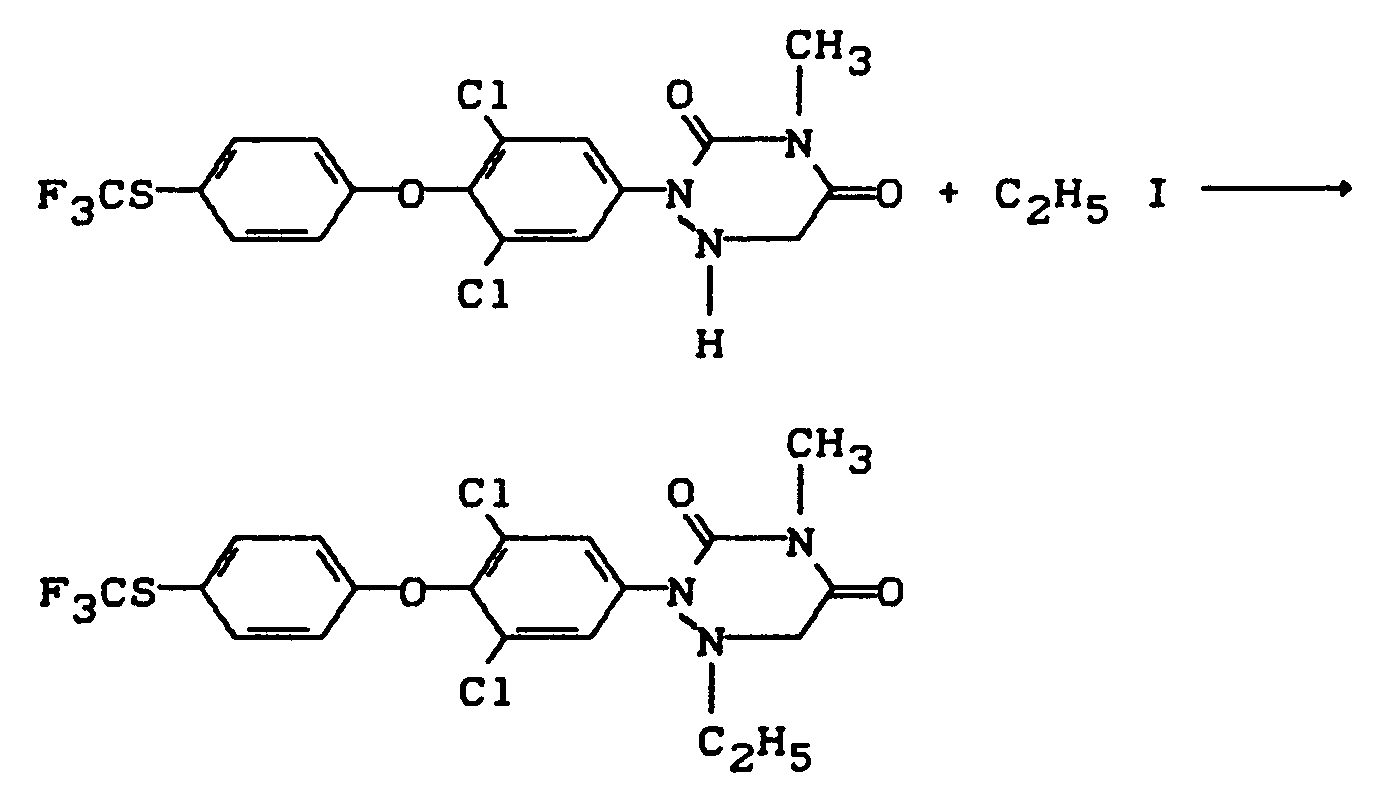
- Die Verbindungen der Formel V werden von Formel I umfaßt. Sie sind neu und können wie bei Verfahren 2a) und 2b) beschrieben hergestellt werden. Bevorzugt werden Verbindungen der Formel V eingesetzt, in denen X, Y, R¹, R², R³, R⁴, R⁵ die bei den Verbindungen der Formel I angegebenen bevorzugten Bedeutungen besitzen.
- Das Verfahren 2c) wird wie unter 2b) beschrieben durchgeführt.
- Die neuen Verbindungen der Formel II können nach den unter (4) angegebenen Verfahren hergestellt werden.
- Die Verbindungen der Formel IV sind bekannt oder lassen sich nach bekannten Methoden darstellen. Besonders genannt sei Methyliodid, Ethylbromid.
- Das Verfahren wird durchgeführt, imdem man eine Verbindung der Formel IIa in Gegenwart einer Base und eines Verdünnungsmittels mit Verbindungen der Formel IV umsetzt.

mit R = CHO oder H. - Gegenstand der vorliegenden Erfindung ist auch ein Verfahren zum Verkleben von Substanzen mit dem erfindungsgemäßen System. Das erfindungsgemäße System eignet sich insbesondere zum Verkleben von Kunststoffen, Metallen, Holz, Stein und Glas.
- Die Anwendung des Zweikomponenten-Polyurethanklebstoffes erfolgt vorzugsweise durch kontinuierliches Mischen der beiden Komponenten a) und b) entweder in einem Rührermischer, in einem statischen Mischer oder in einem Gegenstrom-Mischer und sofortigen Auftrag des fertigen Klebstoffes als Raupe auf mindestens eines der zu verklebenden Substrate. Eine Vorbehandlung der Substratoberflächen im Sinne einer Reinigung, Aufrauhung oder einer sonstigen Vorbehandlung ist häufig nicht erforderlich. Die Mengenverhältnisse von Isocyanat- zu Polyolkomponenten folgen den allgemein in der Isocyanatchemie geltenden Prinzipien; es wird mit geringfügigem Isocyanatüberschuß gearbeitet (Kennzahlbereich: 100 - 125, bevorzugt: 100 - 115).
- Die mit Klebstoff versehenen Substrate werden zusammengelegt, fixiert und entweder bei Raumtemperatur aushärten gelassen bzw. einem Härtungsprozeß bei erhöhter Temperatur unterworfen. Bei erhöhter Temperatur kann der Zustand der Handhabungsfestigkeit schneller erreicht werden als bei Raumtemperatur.
- Die gewünschte offene Zeit bzw. Aushärtezeit kann durch die Wahl der Aushärtetemperatur und Wahl des Katalysators in weiten Grenzen variiert werden.
- Ein weiterer Vorteil des erfindungsgemäßen Klebstoffs besteht darin, daß er lösungsmittelfrei verarbeitet werden kann.
- Der Gegenstand der Erfindung soll anhand der folgenden Beispiele noch näher erläutert werden (%-Angaben sind, soweit nicht anders vermerkt ist, Gew.-%).
- Katalysator: Kat. 1 = tert. Aminkatalysator der Struktur

- Eine 50 %ige Zeolith-Suspension in Ricinusöl
H12-MDA: Aliphatisches Diamin der Struktur
Roh-MDI: 4,4'-Diisocyanatodiphenylmethan im Gemisch mit seinen Isomeren und höheren Homologen, wie sie durch Phosgenierung von Anilin-Formaldehyd-Kondensaten erhalten werden, NCO-Gehalt 30,4 %, Viskosität bei etwa 25°C: 80 mPas. -
- cis-BD =
- 2 cis-Butendiol-1,4
- 3-BD =
- 2-Butindiol-1,4
- ges-BD =
- Butandiol-1,4
-
- A = trifunktionelles Polyetherpolyol, 83 % Propylenoxid, 17 % Ethylenoxid-Endgruppen, [Mn] ca. 4800 g/Mol, OH-Zahl 35 mg KOH/g
- B = In Analogie zu Beispiel 1 der DE-A-263 759 wird ein Füllstoffpolyether hergestellt, wobei als "Lösungsmittel" 5077 Gew.-Teile eines Polyetherpolyols der OH-Zahl 35 mg KOH/g, hergestellt durch Propoxylierung von Trimethylolpropan und Ethoxylierung des Propoxylierungsprodukts (PO:EO-Verhältnis = 83:17), an Stelle der 670 Gew.-Teile Hydrazinhydrat lediglich 380 Gew.-Teile Hydrazinhydrat und an Stelle der 2310 Gew.-Teile Toluylendiisocyanat lediglich 1320 Gew.-Teile des Diisocyanates umgesetzt werden.
Es resultiert ein Polyether mit einem Gehalt an organischem Füllstoff von 20 Gew.-% und einer Hydroxyzahl von 28 mg KOH/g. - C = Es wird ein Füllstoffpolyether hergestellt, wobei als "Lösungsmittel" 780 Gew.-Tl. eines Polyetherpolyols der OH-Zahl 35 mg KOH/g, hergestellt durch Propoxylierung von Trimethylolpropan und Ethoxylierung des Propoxylierungsprodukts (PO:EO-Verhältnis = 83:17), eingesetzt werden.
Durch die radikalische in situ Polymerisation von 120 Gew.-Tl. eines Gemischs aus Acrylnitril und Styrol im Gewichtsverhältnis von 60 zu 40 im Polyether resultiert ein Polyether mit einem Gehalt an organischem Füllstoff von 20 Gew.-% und einer Hydroxyzahl von 28 mg KOH/g. - D = difunktionelles Polyetherpolyol, nur Propylenoxid-Addukt, [Mn] ca. 2000 g/Mol, OH-Zahl 56 mg KOH/g
- E = trifunktionelles Polyetherpolyol, 83 % Propylenoxid, 17 % Ethylenoxid-Endgruppen, [Mn] ca. 6000 g/Mol, OH-Zahl 28 mg KOH/g
- F = Ricinusöl, OH-Zahl ca. 160 mg KOH/g.
- Die folgenden Beispiele verdeutlichen die verbesserte Verträglichkeit von ungesättigten Kettenverlängerern im Vergleich zu den gesättigten Kettenverlängerern mit unterschiedlichen Polyolen bei Raumtemperatur.


- Die nachfolgenden Beispiele zeigen, daß auch Mischungen der ungesättigten Kettenverlängerer mit gesättigten Kettenverlängerern homogene, lagerstabile Mischungen mit Polyolen ergeben.
Bsp. Diol-typ 1 -Masse Gew.-Tl. Diol-typ 2 -Masse Gew.-Tl. Polotyp -Masse Gew.-Tl. Verträgl. 7 cis-BD 15 ges-BD 10 A 80 homogen 8 3-BD 15 ges-BD 10 A 80 homogen - Die nachfolgenden Beispiele zeigen, daß sich unter Verwendung der ungesättigten Kettenverlängerer Polyolkomponenten formulieren lassen, die sowohl bei erhöhter als auch bei erniedrigter Temperatur lagerstabile Mischungen darstellen.
-
- Polyolmischung:
- 100,0 Gew.-Tl. Polyol B
25,0 Gew.-Tl. cis-BD
2,5 Gew.-Tl. H₁₂-MDA - Die Mischung zeigt nach 5 Wochen Lagerung bei +6°C, bzw. 2 Wochen Lagerung bei +50°C keine Separationserscheinungen.
-
- Polyolmischung:
- 100,0 Gew.-Tl. Polyol B
15,0 Gew.-Tl. cis-BD
10,0 Gew.-Tl. ges-BD
2,5 Gew.-Tl. H₁₂-MDA - Die Mischung zeigt nach 5 Wochen Lagerung bei +6°C, bzw. 2 Wochen Lagerung bei +50°C keine Separationserscheinungen.
-
- Polyolmischung:
- 100,0 Gew.-Tl. Polyol C
15,0 Gew.-Tl. cis-BD
10,0 Gew.-Tl. ges-BD
2,5 Gew.-Tl. H₁₂-MDA - Die Mischung zeigt nach 5 Wochen Lagerung bei +6°C, bzw. 2 Wochen Lagerung bei +50°C keine Separationserscheinungen.
- Die nachfolgenden Beispiele zeigen, daß sich unter Verwendung der ungesättigten Kettenverlängerer Klebstoffe formulieren lassen, die ein gutes Leistungsniveau in den klebtechnischen Eigenschaften erreichen und deren Polyol-Komponente stabil gegen Entmischung ist.
- Für die Prüfung der Zugscherfestigkeiten in Anlehnung an DIN 53 283 wurden einschnittig überlappte Verbindungen aus dem zu verklebenden Kunststoffmaterial hergestellt. Die Klebfugendichte betrug 0,8 mm, sofern nicht anders angegeben, die Prüfkörperbreite 20 mm, die Prüfkörperstärke 4 mm (Baydur STR 3 mm), die Überlappungslänge 10 mm. Die Zugscherfestigkeit wird als Mittelwert von 5 Proben angegeben. Die Fügeteile wurden keiner besonderen Vorbehandlung unterzogen. Baydur STR wurde mit Schmirgelpapier aufgerauht.
- Fügeteile: Ungesättigtes, glasfaserverstärktes Polyesterharz (SMC)
Abbindebedingungen: 20 min bei 140°C (Laborumluftofen)
Klebefugendicke: 0,15 mm - Polyol-Komponente:
- 100,0 Gew.-Tl. Polyol F
15,0 Gew.-Tl. cis-BD
5,0 Gew.-Tl. H₁₂-MDA
6,0 Gew.-Tl. Zeolith-Paste - Fügeteile: Ein Polycarbonat-ABS-Blend mit 85 % Polycarbonat-Anteil
Abbindebedingungen: 24 h bei Raumtemperatur - Polyol-Komponente:
- 127,5 Gew.-Tl. der Polyolmischung aus Bsp. 10
6,0 Gew.-Tl. Zeolith-Paste
0,39 Gew.-Tl. Kat. 1 - Die erhaltene Polyol-Komponente wurde 14 d bei -20°C gelagert und dann auf Raumtemperatur gebracht. Dabei wurden keine Separationserscheinungen festgestellt. Die Polyol-Komponente wurde dann mit der Isocyanat-Komponente abgemischt.
Isocyanat-Komponente : 100,0 Gew.-Tl. Roh-MDI
Die Zugscherfestigkeit bei Raumtemperatur betrug 6,2 N/mm², das Bruchbild zeigte vollständiges Fügeteilversagen. - Fügeteile : Ein Polycarbonat-ABS-Blend mit 85 % Polycarbonat-Anteil
Abbindebedingungen: 24 h bei Raumtemperatur - Polyol-Komponente:
-
127,5 Gew.-Tl. der Polyolmischung aus Bsp. 10
6,0 Gew.-Tl. Zeolith-Paste
0,39 Gew.-Tl. Kat. 1 - Die erhaltene Polyol-Komponente wurde 14 d bei +50°C gelagert und dann auf Raumtemperatur gebracht. Dabei wurden keine Separationserscheinungen festgestellt. Die Polyol-Komponente wurde anschließend mit der Isocyanat-Komponente abgemischt.
Isocyanat-Komponente: 100,0 Gew.-Tl. Roh-MDI
Die Zugscherfestigkeit bei Raumtemperatur betrug 8,3 N/mm², das Bruchbild zeigte vollständiges Fügeteilversagen. - Die Zugscherfestigkeit bei +85°C betrug 5,9 N/mm², das Bruchbild zeigte vollständiges Fügeteilversagen.
- Fügeteile: Ein PUR-RIM des Typs Baydur STR 1300 (Dichte: 1000 kg/m³, 10 Vol.-% Glas)
Abbindebedingungen: 24 h bei Raumtemperatur - Polyol-Komponente:
-
127,5 Gew.-Tl. der Polyolmischung aus Bsp. 10
6,0 Gew.-Tl. Zeolith-Paste
0,39 Gew.-Tl. Kat. 1 - Die erhaltene Polyol-Komponente wurde 14 d bei +50°C gelagert und dann auf Raumtemperatur gebracht. Dabei wurden keine Separationserscheinungen festgestellt. Die Polyol-Komponente wurde anschließend mit der Isocyanat-Komponente abgemischt.
Isocyanat-Komponente: 100,0 Gew.-Tl. Roh-MDI
Die Zugscherfestigkeit bei -40°C betrug 12,0 N/mm², das Bruchbild zeigte vollständiges Fügeteilversagen. - Fügeteile: Ein PUR-RIM des Typs Baydur STR 1300 (Dichte: 1000 kg/m³, 10 Vol.-% Glas)
Abbindebedingungen: 24 h bei Raumtemperatur - Polyol-Komponente:
-
127,5 Gew.-Tl. der Polyolmischung aus Bsp. 10
6,0 Gew.-Tl. Zeolith-Paste
0,39 Gew.-Tl. Kat. 1 - Die erhaltene Polyol-Komponente wurde 14 d bei -20°C gelagert und dann auf Raumtemperatur gebracht. Dabei wurden keine Separationserscheinungen festgestellt. Die Polyol-Komponente wurde anschließend mit der Isocyanat-Komponente abgemischt.
Isocyanat-Komponente: 100,0 Gew.-Tl. Roh-MDI
Die verklebten Prüfkörper wurden 14 d bei einer Temperatur von +60°C im Wasser gelagert. Danach wurde eine Zugscherfestigkeit bei -40°C von 10,9 N/mm² ermittelt, das Bruchbild zeigte vollständiges Fügeteilversagen. -
- Polyolmischung:
- 100,0 Gew.-Tl. Polyol B
40,0 Gew.-Tl. cis-BD
5,0 Gew.-Tl. H₁₂-MDA - Die Mischung bleibt nach 2 Wochen Lagerung bei +6°C fließfähig und zeigt keine Separationserscheinungen.
Fügeteile: Ungesättigtes, glasfaserverstärktes Polyesterharz (SMC)
Abbindebedingungen: 20 min bei 140°C (Laborumluftofen)
Eine Polyol-Komponente aus der o.g. Polyolmischung und zusätzlich 6,0 Gew.-Tl. Zeolith-Paste wird mit 152,4 Gew.-Tl. Roh-MDI abgemischt. - Die Zugscherfestigkeit betrug 6,2 N/mm², das Bruchbild zeigte vollständiges Fügeteilversagen.
-
- Polyolmischung:
- 100,0 Gew.-Tl. Polyol B
30,0 Gew.-Tl. cis-BD
10,0 Gew.-Tl. ges-BD
5,0 Gew.-Tl. H₁₂-MDA - Die Mischung bleibt nach 2 Wochen Lagerung bei +6°C fließfähig und zeigt keine Separationserscheinungen.
Fügeteile: Ungesättigtes, glasfaserverstärktes Polyesterharz (SMC)
Abbindebedingungen: 20 min bei 140°C (Laborumluftofen)
Eine Polyol-Komponente aus der o.g. Polyolmischung und zusätzlich 6,0 Gew.-Tl. Zeolith-Paste wird mit 152,4 Gew.-Tl. Roh-MDI abgemischt. - Die Zugscherfestigkeit betrug 7,4 N/mm², das Bruchbild zeigte vollständiges Fügeteilversagen.
-
- Polyolmischung:
- 100,0 Gew.-Tl. Polyol C
30,0 Gew.-Tl. cis-BD
2,5 Gew.-Tl. H₁₂-MDA - Die Mischung bleibt nach 2 Wochen Lagerung bei +6°C fließfähig und zeigt keine Separationserscheinungen. Bei einer Lagertemperatur von +50°C werden nach 2 Wochen ebenfalls keine Entmischungserscheinungen beobachtet.
Fügeteile: Ungesättigtes, glasfaserverstärktes Polyesterharz (SMC)
Abbindebedingungen: 20 min bei 140°C (Laborumluftofen)
Eine Polyol-Komponente aus der o.g. Polyolmischung und zusätzlich 0,3 Gew.-Tl. Kat. 1 sowie 6,0 Ge.-Tl. Zeolithpaste wird mit 118,5 Gew.-Tl. Roh-MDI abgemischt. - Die Zugscherfestigkeit bei Raumtemperatur betrug 5,6 N/mm².
Die Zugscherfestigkeit betrug 9,1 N/mm².
Claims (3)
- Zweikomponenten-Polyurethane, enthaltend eine Isocyanatkomponente a), eine verträgliche, mit Isocyanat reaktive Komponente b) sowie gegebenenfalls Katalysatoren für die Umsetzung von a) mit b) und gegebenenfalls weiteren Hilfs- und Zusatzstoffen, dadurch gekennzeichnet, daß die verträgliche, isocyanatreaktive Komponente b) wenigstens einen hydroxylgruppenhaltigen, wenigstens eine C-C-Doppelbindung oder eine C-C-Dreifachbindung enthaltenden, niedermolekularen Kettenverlängerer mit einem Molekulargewicht von mindestens 86 und einer Funktionalität von wenigstens 2, der keine Carboxylgruppen aufweist, enthält.
- Zweikomponenten-Polyurethane gemäß Anspruch 1, dadurch gekennzeichnet, daß die Komponente b folgende Bestandteile enthält:b1) 100 Gew.-Teile wenigstens einer Hydroxylgruppen-haltigen Verbindung mit einem Molekulargewicht von mindestens 400 und einer Hydroxylfunktionalität von mindestens 2b2) 2-20 Gew.-Teile wenigstens eines aliphatischen, aromatischen oder cyclialiphatischen Diamins oder Triamins mit einem Molekulargewicht von mindestens 60b3) 5-40 Gew.-Teile wenigstens einer hydroxylgruppen-haltigen, wenigstens eine C-C-Doppelbindung oder eine C-C-Dreifachbindung enthaltenden, niedermolekularen Kettenverlängerern mit einem Molekulargewicht von mindestens 86 und einer Funktionalität von mindestens 2, der keine Carboxylgruppen aufweist,b4) 0-35 Gew.-Teile wenigstens eines hydroxylgruppenhaltigen, niedermolekularen Kettenverlängers mit einem Molekulargewicht von mindestens 62 und einer Funktionalität von mindestens 2.
- Verwendung von Polyurethanen gemäß Ansprüche 1 oder 2 als Klebstoffe.
Applications Claiming Priority (2)
| Application Number | Priority Date | Filing Date | Title |
|---|---|---|---|
| DE4033221 | 1990-10-19 | ||
| DE4033221A DE4033221A1 (de) | 1990-10-19 | 1990-10-19 | Zweikomponenten-polyurethanklebstoffe |
Publications (3)
| Publication Number | Publication Date |
|---|---|
| EP0481319A2 true EP0481319A2 (de) | 1992-04-22 |
| EP0481319A3 EP0481319A3 (en) | 1992-09-30 |
| EP0481319B1 EP0481319B1 (de) | 1995-05-17 |
Family
ID=6416623
Family Applications (1)
| Application Number | Title | Priority Date | Filing Date |
|---|---|---|---|
| EP91117033A Expired - Lifetime EP0481319B1 (de) | 1990-10-19 | 1991-10-07 | Zweikomponenten-Polyurethanklebstoffe |
Country Status (6)
| Country | Link |
|---|---|
| US (1) | US5349040A (de) |
| EP (1) | EP0481319B1 (de) |
| JP (1) | JPH04272985A (de) |
| CA (1) | CA2053564C (de) |
| DE (2) | DE4033221A1 (de) |
| ES (1) | ES2073640T3 (de) |
Cited By (7)
| Publication number | Priority date | Publication date | Assignee | Title |
|---|---|---|---|---|
| WO1998010030A1 (en) * | 1996-09-06 | 1998-03-12 | H.B. Fuller Licensing & Financing, Inc. | Two-component polyurethane adhesive composition used in bonded structural element of limestone and similar materials |
| WO2012080397A2 (de) | 2010-12-17 | 2012-06-21 | Bayer Materialscience Ag | Polymer-zusammensetzung mit wärme-absorbierenden eigenschaften und hoher stabilität gegen bewitterung |
| WO2012080395A1 (de) | 2010-12-17 | 2012-06-21 | Bayer Materialscience Ag | Polymer-zusammensetzung mit wärme-absorbierenden eigenschaften und hoher stabilität gegen bewitterung |
| US8641784B2 (en) | 2010-12-17 | 2014-02-04 | Bayer Materialscience Ag | Organic colouring agents and coloured polymer compositions with a high stability to weathering |
| US8716374B2 (en) | 2010-12-17 | 2014-05-06 | Bayer Materialscience Ag | Colour-stable LED substrates |
| EP1624012B2 (de) † | 2003-05-12 | 2015-09-02 | Teijin Chemicals, Ltd. | Flächenförmiges fensterelement und fensteraufbau |
| BE1024001B1 (nl) * | 2016-05-30 | 2017-10-26 | Vandersanden Steenfabrieken N.V. | Geprefabriceerd wandpaneel |
Families Citing this family (31)
| Publication number | Priority date | Publication date | Assignee | Title |
|---|---|---|---|---|
| DE4228178A1 (de) * | 1992-08-25 | 1994-03-03 | Bergwerksverband Gmbh | Verfahren zur Anwendung eines Kunstharzsystems |
| US5551197A (en) | 1993-09-30 | 1996-09-03 | Donnelly Corporation | Flush-mounted articulated/hinged window assembly |
| US7838115B2 (en) | 1995-04-11 | 2010-11-23 | Magna Mirrors Of America, Inc. | Method for manufacturing an articulatable vehicular window assembly |
| US5853895A (en) | 1995-04-11 | 1998-12-29 | Donnelly Corporation | Bonded vehicular glass assemblies utilizing two-component urethanes, and related methods of bonding |
| US5866656A (en) * | 1995-06-07 | 1999-02-02 | National Starch And Chemical Investment Holding Corporation | Polyurethane hotmelt adhesives with reactive acrylic copolymers |
| US5719252A (en) * | 1996-12-18 | 1998-02-17 | Bayer Corporation | Unfilled two-component polyurethane adhesive |
| WO1998044016A1 (en) * | 1997-04-02 | 1998-10-08 | Sanyo Chemical Industries, Ltd. | Polyurethane foam, process for producing the same, and foam forming composition |
| US6146495A (en) * | 1998-08-31 | 2000-11-14 | Nalco Chemical Company | Kraft process for the production of wood pulp by adding a copolymer of 1,2-dihydroxy-3-butene antiscalant |
| US6906147B2 (en) | 2002-03-20 | 2005-06-14 | Cyclics Corporation | Catalytic systems |
| US7256241B2 (en) | 2000-01-21 | 2007-08-14 | Cyclics Corporation | Methods for polymerizing macrocyclic polyester oligomers using catalyst promoters |
| DE10010934C2 (de) * | 2000-03-06 | 2003-10-16 | Eads Deutschland Gmbh | Kabelhalter zur Befestigung von Kabeln in Fahrzeugen |
| US7767781B2 (en) * | 2000-09-01 | 2010-08-03 | Cyclics Corporation | Preparation of low-acid polyalkylene terephthalate and preparation of macrocyclic polyester oligomer therefrom |
| AU2001288663A1 (en) | 2000-09-01 | 2002-03-13 | Cyclics Corporation | Methods for converting linear polyesters to macrocyclic oligoester compositions and macrocyclic oligoesters |
| US7750109B2 (en) | 2000-09-01 | 2010-07-06 | Cyclics Corporation | Use of a residual oligomer recyclate in the production of macrocyclic polyester oligomer |
| DE10062415A1 (de) * | 2000-12-14 | 2002-06-20 | Bayer Ag | Holzklebstoffe |
| US7071291B2 (en) | 2001-06-27 | 2006-07-04 | Cyclics Corporation | Isolation, formulation and shaping of macrocyclic oligoesters |
| US7304123B2 (en) | 2001-06-27 | 2007-12-04 | Cyclics Corporation | Processes for shaping macrocyclic oligoesters |
| US6787632B2 (en) | 2001-10-09 | 2004-09-07 | Cyclics Corporation | Organo-titanate catalysts for preparing pure macrocyclic oligoesters |
| US20050197416A1 (en) * | 2004-03-04 | 2005-09-08 | Nippon Polyurethane Industry Co., Ltd. | Composition for forming rigid polyurethane foam and method of preparing rigid polyurethane foam with said composition |
| CN1325594C (zh) * | 2004-06-22 | 2007-07-11 | 姜堰鼎盛特种化工有限公司 | 聚氨酯胶粘剂 |
| DE102004057699A1 (de) * | 2004-11-30 | 2006-06-01 | Henkel Kgaa | Zwei-Komponenten-Polyurethanklebstoffe, Additive für Zwei-Komponenten-Polyurethanklebstoffe und Verwendung der Additive |
| US7834123B2 (en) * | 2006-05-19 | 2010-11-16 | Henkel Ag & Co. Kgaa | Two component polyurethane adhesive |
| CN101631810B (zh) | 2006-12-29 | 2013-07-24 | 江森自控科技公司 | 聚氨酯泡沫组成、产品及方法 |
| JP5391410B2 (ja) * | 2008-10-20 | 2014-01-15 | 名古屋市 | 内部アルキン含有樹脂を用いたひずみセンサ |
| US20100107497A1 (en) * | 2008-11-05 | 2010-05-06 | Magna Mirrors Of America, Inc. | Full view storm door |
| US8410213B2 (en) * | 2009-01-26 | 2013-04-02 | Michael James Barker | Primerless two-part polyurethane adhesive |
| US8276409B2 (en) * | 2009-11-05 | 2012-10-02 | Magna Mirrors Of America, Inc. | Glass appliance cover with bonded hardware |
| JP5757959B2 (ja) * | 2010-01-22 | 2015-08-05 | ルブリゾル アドバンスド マテリアルズ, インコーポレイテッド | 架橋可能な熱可塑性ポリウレタン |
| JP5648155B2 (ja) * | 2010-10-26 | 2015-01-07 | 名古屋市 | アリールアセチレン含有樹脂およびその製造方法、および当該樹脂を用いたひずみセンサ |
| DE102011002809A1 (de) | 2011-01-18 | 2012-07-19 | Henkel Ag & Co. Kgaa | 2K-PU-Zusammensetzung mit verzögerter Vernetzung |
| DE102014226277A1 (de) * | 2014-12-17 | 2016-06-23 | Henkel Ag & Co. Kgaa | Zwei-Komponenten-Polyurethan-Klebstoff zum Verkleben von Faserformteilen |
Family Cites Families (19)
| Publication number | Priority date | Publication date | Assignee | Title |
|---|---|---|---|---|
| GB776979A (en) * | 1954-06-30 | 1957-06-12 | Ici Ltd | Synthetic rubber-like materials prepared from polyesters or polyesteramides, and polyisocyanates |
| DE1124686B (de) * | 1960-09-02 | 1962-03-01 | Bayer Ag | Verfahren zur Herstellung kautschukelastischer Kunststoffe |
| GB1131885A (en) * | 1966-08-29 | 1968-10-30 | Takeda Chemical Industries Ltd | A process for the production of polyurethane elastomer |
| US3558529A (en) * | 1967-05-03 | 1971-01-26 | Union Carbide Corp | Urethane polymers having improved stiffness-temperature properties |
| US3577295A (en) * | 1968-04-10 | 1971-05-04 | Goodyear Tire & Rubber | Method of bonding textile fabric belts |
| BE755513A (fr) * | 1970-07-17 | 1971-02-01 | Witco Chemical Corp | Procede de fabrication et d'emballage d'un elastomere solide non vulcanise de polyurethane et produit obtenu |
| US3725355A (en) * | 1971-10-21 | 1973-04-03 | Dow Chemical Co | Rapid setting polyurethane elastomer compositions |
| US3714124A (en) * | 1971-11-17 | 1973-01-30 | Commercial Solvents Corp | Dimethylol propionic acid-urea-aldehyde resins |
| US3945939A (en) * | 1974-05-20 | 1976-03-23 | The Dow Chemical Company | Mixtures of high and low molecular weight polyols resistant to phase separation |
| SE398983B (sv) * | 1974-06-07 | 1978-01-30 | Bofors Ab | Genom tillsats av en katalysator herdbar ytbeleggnings- och bindemedelskomposition, speciellt lempad for beleggning av partikelformigt material sasom sand |
| DE2637690A1 (de) * | 1976-08-21 | 1978-02-23 | Bayer Ag | Verfahren zur herstellung von waessrigen dispersionen bzw. loesungen von polyurethanen und deren verwendung |
| US4336298A (en) * | 1981-06-12 | 1982-06-22 | The B. F. Goodrich Company | Adhesive composition and composite made therewith |
| US4413111A (en) * | 1982-09-29 | 1983-11-01 | Mobay Chemical Corporation | Isocyanate-terminated prepolymers with low free monomer contents |
| US4568717A (en) * | 1984-10-09 | 1986-02-04 | Texaco, Inc. | Polymer polyols from liquid terephthalic polyester polyols |
| US4628092A (en) * | 1985-06-21 | 1986-12-09 | Air Products And Chemicals, Inc. | Triethylenediamine containing acetylenic alcohols as flow aids |
| DE3529251A1 (de) * | 1985-08-16 | 1987-02-26 | Bayer Ag | Kalthaertende zusammensetzungen, ein verfahren zu ihrer herstellung und ihre verwendung zur polyurethanherstellung |
| US4954199A (en) * | 1986-05-30 | 1990-09-04 | Mobay Corporation | Two component polyurethane adhesive |
| US4673696A (en) * | 1986-07-03 | 1987-06-16 | Ashland Oil, Inc. | Thermoset molding compositions |
| US4743628A (en) * | 1986-08-06 | 1988-05-10 | Air Products And Chemicals, Inc. | Polyurethane foams incorporating alkoxylated aromatic diamine and acetylenic glycol |
-
1990
- 1990-10-19 DE DE4033221A patent/DE4033221A1/de not_active Withdrawn
-
1991
- 1991-10-07 DE DE59105511T patent/DE59105511D1/de not_active Expired - Fee Related
- 1991-10-07 EP EP91117033A patent/EP0481319B1/de not_active Expired - Lifetime
- 1991-10-07 ES ES91117033T patent/ES2073640T3/es not_active Expired - Lifetime
- 1991-10-11 US US07/776,517 patent/US5349040A/en not_active Expired - Lifetime
- 1991-10-16 CA CA002053564A patent/CA2053564C/en not_active Expired - Fee Related
- 1991-10-17 JP JP3296590A patent/JPH04272985A/ja not_active Ceased
Cited By (10)
| Publication number | Priority date | Publication date | Assignee | Title |
|---|---|---|---|---|
| WO1998010030A1 (en) * | 1996-09-06 | 1998-03-12 | H.B. Fuller Licensing & Financing, Inc. | Two-component polyurethane adhesive composition used in bonded structural element of limestone and similar materials |
| EP1624012B2 (de) † | 2003-05-12 | 2015-09-02 | Teijin Chemicals, Ltd. | Flächenförmiges fensterelement und fensteraufbau |
| WO2012080397A2 (de) | 2010-12-17 | 2012-06-21 | Bayer Materialscience Ag | Polymer-zusammensetzung mit wärme-absorbierenden eigenschaften und hoher stabilität gegen bewitterung |
| WO2012080395A1 (de) | 2010-12-17 | 2012-06-21 | Bayer Materialscience Ag | Polymer-zusammensetzung mit wärme-absorbierenden eigenschaften und hoher stabilität gegen bewitterung |
| US8641784B2 (en) | 2010-12-17 | 2014-02-04 | Bayer Materialscience Ag | Organic colouring agents and coloured polymer compositions with a high stability to weathering |
| US8716374B2 (en) | 2010-12-17 | 2014-05-06 | Bayer Materialscience Ag | Colour-stable LED substrates |
| US8968610B2 (en) | 2010-12-17 | 2015-03-03 | Bayer Materialscience Ag | Polymer composition having heat-absorbing properties and high stability to weathering |
| US9029440B2 (en) | 2010-12-17 | 2015-05-12 | Bayer Materialscience Ag | Polymer composition having heat-absorbing properties and high stability to weathering |
| US9212272B2 (en) | 2010-12-17 | 2015-12-15 | Bayer Materialscience Ag | Organic colouring agents and coloured polymer compositions with a high stability to weathering |
| BE1024001B1 (nl) * | 2016-05-30 | 2017-10-26 | Vandersanden Steenfabrieken N.V. | Geprefabriceerd wandpaneel |
Also Published As
| Publication number | Publication date |
|---|---|
| CA2053564C (en) | 2002-12-10 |
| DE4033221A1 (de) | 1992-04-23 |
| JPH04272985A (ja) | 1992-09-29 |
| CA2053564A1 (en) | 1992-04-20 |
| DE59105511D1 (de) | 1995-06-22 |
| EP0481319A3 (en) | 1992-09-30 |
| ES2073640T3 (es) | 1995-08-16 |
| EP0481319B1 (de) | 1995-05-17 |
| US5349040A (en) | 1994-09-20 |
Similar Documents
| Publication | Publication Date | Title |
|---|---|---|
| EP0481319B1 (de) | Zweikomponenten-Polyurethanklebstoffe | |
| DE69006711T2 (de) | Zweikomponenten-Polyurethanklebstoff. | |
| EP0543250A1 (de) | Zweikomponenten-Polyurethan-Reaktivmassen | |
| DE69207808T2 (de) | Feuchtigkeitshartbare Polyurethanzusammensetzung | |
| EP0261409B1 (de) | Verfarhen zur herstellung von Alkoxysilanterminierten, feuchtigkeitsärtenden Polyurethanen sowie ihre Verwendung für Klebe- und Dichtungsmassen | |
| DE60212894T2 (de) | Die Verwendung von Polyurethanpräpolymeren mit kontrollierter Struktur für Polyurethan-Struktur-Klebstoffe | |
| EP2038360B1 (de) | Feuchtigkeitsreaktiver schmelzklebstoff mit erhöhter offenzeit | |
| DE69520928T2 (de) | Feuchtigkeitshärtende Urethanklebstoffzusammensetzung | |
| EP1619215B1 (de) | Niedrigviskose Polyurethan-Prepolymere auf Basis von 2,4'-MDI | |
| EP0022497B1 (de) | Verfahren zur Herstellung von elastischen, gegebenenfalls zellförmigen, Polyurethanharnstoffen | |
| EP0085365B1 (de) | Verfahren zur Herstellung von Überzügen | |
| EP0411432B1 (de) | Zweikomponenten-Polyurethanklebstoff | |
| CH673842A5 (de) | ||
| WO2002090411A1 (de) | Klebstoff, gefüllt mit oberflächenbehandelter kreide und russ | |
| EP0095116B1 (de) | Einphasig lagerstabile Polyolkompositionen mit hohem Ethylenglykol-Anteil und ihre Verwendung zur Herstellung von Polyurethanen | |
| DE3940273A1 (de) | Heisshaertbare polyether-polyester-polyurethanharnstoffe | |
| EP0399311B1 (de) | Verwendung eines Epoxidhaltigen Zweikomponenten-Polyurethan-Systems als Klebstoff. | |
| DE69109734T2 (de) | Expandierbare Polyurethanzusammensetzungen mit Standvermögen. | |
| EP0504681A1 (de) | Verfahren zur Verklebung von Substraten aus glasfaserverstärktem Polyesterharz | |
| EP1072621B1 (de) | Faserhaltige Klebstoffzusammensetzung | |
| DE102004009740A1 (de) | Zinn- und Übergangsmetallfreie Polyurethanschaumstoffe | |
| EP0676427A2 (de) | Im Volumenverhältnis von 1:1 dosierbare 2 Komponentenpolyurethan-Reaktivklebstoffmassen | |
| DE19935489A1 (de) | Klebstoffzusammensetzung für Keilzinkenverleimung | |
| EP1199319B1 (de) | Faserhaltige Klebstoffzusammensetzung | |
| EP4206251A1 (de) | Polyurethanzusammensetzung geeignet als bodenbeschichtung mit einstellbarer topfzeit |
Legal Events
| Date | Code | Title | Description |
|---|---|---|---|
| PUAI | Public reference made under article 153(3) epc to a published international application that has entered the european phase |
Free format text: ORIGINAL CODE: 0009012 |
|
| AK | Designated contracting states |
Kind code of ref document: A2 Designated state(s): BE CH DE ES FR GB IT LI NL |
|
| PUAL | Search report despatched |
Free format text: ORIGINAL CODE: 0009013 |
|
| AK | Designated contracting states |
Kind code of ref document: A3 Designated state(s): BE CH DE ES FR GB IT LI NL |
|
| 17P | Request for examination filed |
Effective date: 19921215 |
|
| 17Q | First examination report despatched |
Effective date: 19940706 |
|
| GRAA | (expected) grant |
Free format text: ORIGINAL CODE: 0009210 |
|
| AK | Designated contracting states |
Kind code of ref document: B1 Designated state(s): BE CH DE ES FR GB IT LI NL |
|
| PG25 | Lapsed in a contracting state [announced via postgrant information from national office to epo] |
Ref country code: NL Free format text: LAPSE BECAUSE OF NON-PAYMENT OF DUE FEES Effective date: 19950517 Ref country code: BE Effective date: 19950517 |
|
| REF | Corresponds to: |
Ref document number: 59105511 Country of ref document: DE Date of ref document: 19950622 |
|
| ITF | It: translation for a ep patent filed | ||
| GBT | Gb: translation of ep patent filed (gb section 77(6)(a)/1977) |
Effective date: 19950616 |
|
| REG | Reference to a national code |
Ref country code: ES Ref legal event code: FG2A Ref document number: 2073640 Country of ref document: ES Kind code of ref document: T3 |
|
| ET | Fr: translation filed | ||
| NLV1 | Nl: lapsed or annulled due to failure to fulfill the requirements of art. 29p and 29m of the patents act | ||
| PLBE | No opposition filed within time limit |
Free format text: ORIGINAL CODE: 0009261 |
|
| STAA | Information on the status of an ep patent application or granted ep patent |
Free format text: STATUS: NO OPPOSITION FILED WITHIN TIME LIMIT |
|
| 26N | No opposition filed | ||
| REG | Reference to a national code |
Ref country code: GB Ref legal event code: IF02 |
|
| PGFP | Annual fee paid to national office [announced via postgrant information from national office to epo] |
Ref country code: DE Payment date: 20030916 Year of fee payment: 13 |
|
| PGFP | Annual fee paid to national office [announced via postgrant information from national office to epo] |
Ref country code: GB Payment date: 20031001 Year of fee payment: 13 |
|
| PGFP | Annual fee paid to national office [announced via postgrant information from national office to epo] |
Ref country code: CH Payment date: 20031008 Year of fee payment: 13 |
|
| PGFP | Annual fee paid to national office [announced via postgrant information from national office to epo] |
Ref country code: ES Payment date: 20031010 Year of fee payment: 13 |
|
| PGFP | Annual fee paid to national office [announced via postgrant information from national office to epo] |
Ref country code: FR Payment date: 20031014 Year of fee payment: 13 |
|
| PG25 | Lapsed in a contracting state [announced via postgrant information from national office to epo] |
Ref country code: GB Free format text: LAPSE BECAUSE OF NON-PAYMENT OF DUE FEES Effective date: 20041007 |
|
| PG25 | Lapsed in a contracting state [announced via postgrant information from national office to epo] |
Ref country code: ES Free format text: LAPSE BECAUSE OF NON-PAYMENT OF DUE FEES Effective date: 20041008 |
|
| PG25 | Lapsed in a contracting state [announced via postgrant information from national office to epo] |
Ref country code: LI Free format text: LAPSE BECAUSE OF NON-PAYMENT OF DUE FEES Effective date: 20041031 Ref country code: CH Free format text: LAPSE BECAUSE OF NON-PAYMENT OF DUE FEES Effective date: 20041031 |
|
| PG25 | Lapsed in a contracting state [announced via postgrant information from national office to epo] |
Ref country code: DE Free format text: LAPSE BECAUSE OF NON-PAYMENT OF DUE FEES Effective date: 20050503 |
|
| GBPC | Gb: european patent ceased through non-payment of renewal fee |
Effective date: 20041007 |
|
| REG | Reference to a national code |
Ref country code: CH Ref legal event code: PL |
|
| PG25 | Lapsed in a contracting state [announced via postgrant information from national office to epo] |
Ref country code: FR Free format text: LAPSE BECAUSE OF NON-PAYMENT OF DUE FEES Effective date: 20050630 |
|
| REG | Reference to a national code |
Ref country code: FR Ref legal event code: ST |
|
| PG25 | Lapsed in a contracting state [announced via postgrant information from national office to epo] |
Ref country code: IT Free format text: LAPSE BECAUSE OF NON-PAYMENT OF DUE FEES;WARNING: LAPSES OF ITALIAN PATENTS WITH EFFECTIVE DATE BEFORE 2007 MAY HAVE OCCURRED AT ANY TIME BEFORE 2007. THE CORRECT EFFECTIVE DATE MAY BE DIFFERENT FROM THE ONE RECORDED. Effective date: 20051007 |
|
| REG | Reference to a national code |
Ref country code: ES Ref legal event code: FD2A Effective date: 20041008 |