EP0481502A2 - Procédé pour la production des anticorps chimériques - Google Patents
Procédé pour la production des anticorps chimériques Download PDFInfo
- Publication number
- EP0481502A2 EP0481502A2 EP91117772A EP91117772A EP0481502A2 EP 0481502 A2 EP0481502 A2 EP 0481502A2 EP 91117772 A EP91117772 A EP 91117772A EP 91117772 A EP91117772 A EP 91117772A EP 0481502 A2 EP0481502 A2 EP 0481502A2
- Authority
- EP
- European Patent Office
- Prior art keywords
- antibody
- region
- gene
- primer
- primers
- Prior art date
- Legal status (The legal status is an assumption and is not a legal conclusion. Google has not performed a legal analysis and makes no representation as to the accuracy of the status listed.)
- Granted
Links
- 0 CCC(C)*(C(CC1C2)CC2C1=C[N+]([O-])=C)[*+]=P Chemical compound CCC(C)*(C(CC1C2)CC2C1=C[N+]([O-])=C)[*+]=P 0.000 description 1
Images


Classifications
-
- C—CHEMISTRY; METALLURGY
- C07—ORGANIC CHEMISTRY
- C07K—PEPTIDES
- C07K16/00—Immunoglobulins [IG], e.g. monoclonal or polyclonal antibodies
- C07K16/46—Hybrid immunoglobulins
- C07K16/461—Igs containing Ig-regions, -domains or -residues form different species
- C07K16/462—Igs containing a variable region (Fv) from one specie and a constant region (Fc) from another
-
- C—CHEMISTRY; METALLURGY
- C07—ORGANIC CHEMISTRY
- C07K—PEPTIDES
- C07K16/00—Immunoglobulins [IG], e.g. monoclonal or polyclonal antibodies
- C07K16/18—Immunoglobulins [IG], e.g. monoclonal or polyclonal antibodies against material from animals or humans
- C07K16/28—Immunoglobulins [IG], e.g. monoclonal or polyclonal antibodies against material from animals or humans against receptors, cell surface antigens or cell surface determinants
- C07K16/2803—Immunoglobulins [IG], e.g. monoclonal or polyclonal antibodies against material from animals or humans against receptors, cell surface antigens or cell surface determinants against the immunoglobulin superfamily
- C07K16/2812—Immunoglobulins [IG], e.g. monoclonal or polyclonal antibodies against material from animals or humans against receptors, cell surface antigens or cell surface determinants against the immunoglobulin superfamily against CD4
-
- C—CHEMISTRY; METALLURGY
- C07—ORGANIC CHEMISTRY
- C07K—PEPTIDES
- C07K2317/00—Immunoglobulins specific features
- C07K2317/20—Immunoglobulins specific features characterized by taxonomic origin
- C07K2317/24—Immunoglobulins specific features characterized by taxonomic origin containing regions, domains or residues from different species, e.g. chimeric, humanized or veneered
Definitions
- Chimeric antibodies i.e. antibodies in which the murine or the constant regions originating from another animal species are replaced by human constant regions, are substantially less immunogenic when used therapeutically in humans than the non-human antibodies and thus show a dramatic improvement in the therapeutic effect (Lo Buglio, AF et al, Proc. Natl. Acad. Sci. USA 86 (1989) 4220-4224).
- Antibodies that can be used therapeutically should also have defined effector functions (eg fixation of complement, binding of Staphylococcus protein A, competence with regard to ADCC (antibody-dependent cell-mediated cytotoxicity) and CDC (cell dependent cytotoxicity). Reproducible effector functions can be achieved by Use of defined constant (human) regions can be obtained.
- Chimeric antibodies can be produced by genetic engineering methods (see, for example, Verhoeyen, M. and Riechmann, L .: Bio Essays 8 (1988) 74-78). Chimeric antibodies are against a number of haptens (Boulliane, N. et al., Nature 312, 643 (1984); Neuberger, M. et al., Nature 312 (1984) 604; Morrison, SL et al., Proc. Nat Acad. Sci. USA 81, 6851 (1984)) and tumor-specific antigens (Liu, AY et al., Proc. Natl. Acad. Sci. USA 84 (1987) 3439-3443; Nishimura, Y. et al. , Cancer Research 47 (1987) 999-1005).
- haptens Bovinee, N. et al., Nature 312, 643 (1984); Neuberger, M. et al., Nature 312 (1984) 604; Morrison, SL
- screening of a genomic or cDNA library should no longer be necessary.
- An antibody is composed of at least two polypeptide chains, the heavy (H) and the light (L) chain. Each of these chains consists of a constant and a variable region, the variable regions of an antibody determining its antigen specificity.
- the chimerization of the antibody means the exchange of a preferably non-human constant region by another preferably human constant region.
- a DNA fragment which codes for the variable region of the L chain and is isolated by the method according to the invention contains the regions which can be seen from FIG. 1a and which lie between the primers (1) and (2).
- Such a DNA fragment contains the following regions of an antibody gene: a part of the 5'-untranslated region which is complementary to primer (1), the signal sequence interrupted by an intron, the variable (V) region and that for the respective Gen used joining (J) region.
- At the 3 'end of the fragment is the untranslated part of the J region with a sequence complementary to primer (2).
- FIG. 1a shows a DNA fragment obtained by the method according to the invention after amplification with primers (1) and (2).
- a DNA fragment coding for the variable region of an H chain contains essentially the same functional elements, with the difference that the variable region of the H chain between the V region and the J region still has a diversity (D) Region contains. It can also be seen here from FIG. 1b that the DNA fragment lying between the primers (1) and (2) is obtained by the method according to the invention after amplification with the primers (1) and (2).
- a prerequisite for carrying out the method according to the invention is the synthesis of suitable primers (1) and (2).
- Certain knowledge of the DNA sequence of the light and heavy chain of the antibody to be chimerized is required for this, ie the sequence complementary to primers (1) and (2) on the antibody gene must be in the region of the 5 'untranslated region or in the untranslated region (3 ') of the J region used.
- This information can be obtained directly or indirectly by sequencing the mRNA of the antibody genes or a cDNA made from the mRNA, as described in detail below.
- the primers (1) and (2) contain an area which is at least 10 nucleotides long and which is complementary to the chromosomal DNA of the antibody. This region is preferably 10 to 50 nucleotides long in order to give good hybridization to the single-stranded DNA.
- Primer (1) contains sequences from the 5'-untranslated region of the antibody gene, the exact location in this region being arbitrary per se. Primer (1) can also partially contain nucleotides from the signal sequence which adjoins the 5 'untranslated region in the 3' direction. However, primer (1) is preferably not on the 5 'side of the transcription start site of the antibody gene.
- Primer (2) contains sequences from the 3'-untranslated region of the J region of the antibody gene, ie sequences on the 3 'side of the J region translated in the respective antibody gene.
- primer (2) can contain sequences from the areas of J2, J3, J4 or J5, the exact location of primer (2) being arbitrary in this area.
- the primer (2) contains parts of the sequence the sequence of the respective J region following the intron.
- the orientation of the two primers ensures that, in step (c) of the method according to the invention, the primers are elongated towards one another, so that a DNA fragment is formed whose double-stranded region comprises the variable region of the antibody gene.
- this fragment is amplified by the PCR reaction known per se in several cycles, preferably 10 to 30 cycles.
- the end product of the process according to the invention is a DNA fragment at the ends of which there are primers (1) and (2).
- the primers (1) and (2) on the 5 'side of the region which is complementary to the antibody gene still contain a restriction endonuclease site which, of course, need not be complementary to the antibody gene.
- Primers (1) and (2) preferably contain interfaces for restriction endonucleases with a recognition sequence of 6 to 8 nucleotides, particularly preferably of those enzymes whose recognition sites are rarely located on eukaryotic DNA (e.g. SalI, NotI).
- the restriction endonuclease sites are particularly preferably different from primers (1) and (2).
- the primers can contain any sequences (from 1 to 30 nucleotides) between the complementary sequence and the recognition sequence for the restriction endonuclease.
- the primers (1) and (2) on the 5 'side of the restriction endonuclease site still contain an overhang of at least two nucleotides in order to isolate the DNA fragment by two cleavages with restriction endonucleases at the sites of the primers ( 1) and (2).
- the DNA fragment isolated according to the invention can be cloned more easily into a vector.
- the primers are elongated when the method according to the invention is carried out by the PCR reaction known per se to the person skilled in the art (EP-A 0 201 184).
- Taq polymerase is preferably used as the DNA polymerase and the double-stranded DNA is denatured after each cycle by heating.
- the prerequisite for the method according to the invention is firstly the determination of sequence information of the antibody gene to be chimerized. Without this information, the construction of primers (1) and (2) is not possible.
- the sequencing of partial regions of the antibody gene is carried out by the following method: From the hybridoma cell line of the antibody to be chimerized, the 5 'untranslated sequence of the messenger RNA for the light and heavy chain is to be determined and for which it is to be determined which J regions are used for the light and heavy chain, mRNA is isolated and a primer, which is complementary to the 5 'end of the constant region, elongated with reverse transcriptase.
- the sequence of the constant regions is known from the literature (Kabat, EA, Wu, TT, Reid-Miller, M., Perry, HM and Gottesman, KS; Sequences of Proteins of Immunological Interest, 4th Edition, US Department of Health and Human Services (1987 ), National Institute of Health) and the constant region present in the respective antibody gene can easily be determined immunologically.
- oligonucleotides e.g. oligo-G
- first primer (3) oligo-C preferably with a first restriction endonuclease interface
- second primer (4) from the literature-known sequence of the constant region of the antibody to be chimerized (see above) an amplification reaction performed, the amplified cDNA subcloned and sequenced in the required regions (5 'untranslated region, J region).
- the sequence information for primer (1) is obtained in this way.
- the sequence information for primer (2) is obtained indirectly by determining the J region which is translated in the respective antibody gene. This is possible because the genomic organization of the J regions for the mouse light chain (K) with the associated intron sequences is described (Max, EE et al., J. Biol. Chem. 256 (1981) 5116-5120) . The equivalent information for the coding and intron sequences for the J regions of the mouse heavy chains is described in: Sakano, H. et al .: Nature 286 (1980) 676-683. The amplification reaction is carried out as described in Saiki, RK et al .: Science 230 (1985) 1350 or EP-A 0 201 184.
- the sequence can be obtained by direct sequencing of the light and heavy chain mRNA (Hamlyn, P.H. et al, Cell 15 (1978) 1067-1075).
- polyA+ RNA are isolated and synthetic oligonucleotides which hybridize to the 5 'regions of the known constant regions for the light and heavy chain are extended with reverse transcriptase.
- the sequence of the cDNA is determined by the method of Sanger and Coulson (J. Mol. Biol. 94 (1975) 441-448).
- 2 ', 3'-dideoxyribonucleotides are used for chain termination.
- variable antibody regions isolated by the method according to the invention can be used directly for the expression of antibody fragments (Fab, F (ab) 2) or to other genes (for example for enzymes, toxins and for constant antibody regions). be coupled. Chimeric antibodies are preferably produced.
- chimerized antibodies of the isotypes IgG 2, IgG 3, IgG 4, IgM, IgA, IgD and IgE can be constructed by choosing the respective constant region.
- Isolation of a DNA fragment encoding the variable region of an antibody gene is a first step in chimerizing antibodies.
- the next step is a method for producing chimeric antibody genes, wherein a DNA fragment isolated according to the method according to the invention is introduced into a vector which contains a DNA fragment which codes for a desired constant region of an antibody gene, wherein A chimeric antibody gene consisting of a variable and constant region in operative linkage is created.
- a vector is preferably used which contains the gene segment for a human constant region. If one wants to express the gene segment for the L chain of a chimeric antibody, one uses a vector which contains the gene segment for the constant region of an L chain.
- a vector which contains the gene segment for the constant region of an H chain.
- a vector is preferably used which contains the elements necessary for later expression of the antibody gene, in particular a promoter and a polyadenylation site in the correct location.
- Preferred base vectors are pSV2-neo (Southern, P. and Berg, PJ, Mol. Appl. Genet. 1 (1982) 327-341 or pSV2-Eco gpt (Mulligan, RC and Berg, P., Proc. Natl. Acad. Sci, USA 78 (1981) 2072-2076)
- Preferred promoters are immunoglobulin promoters, the early or late promoter of Simian Virus 40, the murine or human cytomegalovirus promoter or the metallothionein promoter of the mouse or human.
- the expression vector preferably contains additionally enhancer elements which are active in lymphoid cells, for example of immunoglobulin genes, of Simian Virus 40, Polyoma, murine or human cytomegalovirus.
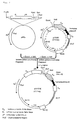
- Particularly preferred base vectors are the vectors pUHWk (contains the human constant shown in FIGS. 2 and 3) K region of the L chain) or pUHW ⁇ 1 (contains the human constant region).
- the vector pUHW-CD4K (DSM 6156) is obtained.
- the vector pUHW-CD4 ⁇ 1 (DSM 6155) is obtained.
- Another example of an antibody-producing cell line from which the DNA fragments coding for the variable regions of the antibody could be obtained by the method according to the invention is the cell line 3.10-1 / 5B10 (ECACC 90090702).
- the antibody secreted by this cell line recognizes another epitope on the CD4 antigen.
- variable regions which have been isolated by the method according to the invention and which originate from any antibodies can be cloned into suitable base vectors in the same way.
- genomic fragments of light and heavy chains of antibodies which thus contain the intron of the signal sequence and partial regions of the intron of the J sequence, can be isolated in a simple manner.
- vectors containing these genomic fragments a significantly higher yield of chimeric antibodies is obtained than if only the cDNA of the chimeric antibody is used for expression.
- the method according to the invention can be used to carry out isotype switching on human hybridoma lines.
- the antibodies here are almost all clones of the IgM isotype that occur. Since this isotype has crucial effector functions, such as ADCC (antibody-dependent cell-mediated cytotoxicity) are absent and the pentameric IgM molecule tends to multimerize and aggregate, the implementation of an isotype switch (defined changing of the constant chain of the antibody) according to the method of the invention is advantageous for binding - Evaluate properties and effector functions of the respective isotypes.
- the known methods for performing an isotype switch using cell biological methods (Rothman, P. et al., Mol. Cell. Biol.
- the present invention furthermore relates to a method for obtaining chimeric antibodies, a suitable cell being transfected with two vectors produced according to a method according to the invention, one of these vectors containing the gene for the H chain of a chimeric antibody and the other a gene contains for the L chain of this chimeric antibody, selects the transfected cells for stable transfectants and extracts the active antibody from the cell medium in the usual way.
- Suitable cells in the sense of the invention are preferably so-called non-immunoglobulin producer hybridoma cell lines, that is hybridoma lines which do not secrete antibodies.
- the transfection into these cells can be carried out in a manner known per se to the person skilled in the art.
- Examples of such hybridoma lines are, for example, Sp2 / 0-Ag14 (Ochi, A. et al, Proc. Natl. Acad. Sci. USA 80 (1983) 6351-6355 or P3X63-Ag8.653 (Kearney, JF et al, J. Immunol. 123 ( 1979) 1548-1550)
- the selection of stable transfectants is carried out according to Lenz, H. and Weidle, UH: Gene 87 (1990) 213-218.
- the antibody-producing cell lines 15-1 / P3 / 14 (ECACC 90090705) and 3.10-1 / 5B10 (ECACC 90090702) were deposited with the European Collection of Animal Cell Cultures, GB-Salisbury, Wiltshire SP4 OJG.
- a murine hybridoma line which secretes antibodies (type IgG1) and recognizes an epitope on the extracellular region of the T-lymphocyte receptor (human) CD4.
- the light chain is of type k (kappa), the heavy chain of type ⁇ 1.
- the hybridoma line is called 15-1 / P3 / 14. This antibody has therapeutic potential in the treatment of autoimmune diseases such as rheumatoid arthritis.
- RNA from total RNA was isolated from 10 15 cells of the hybridoma line 15-1 / P3 / 14 by chromatography on oligo-dT cellulose as described (Maniatis et al., Molecular Cloning. A Laboratory Manual. Cold Spring Harbor Laboratory, Cold Spring Harbor, NY, 1982, page 283).
- the cDNA synthesis was carried out in a reaction volume of 10 ul.
- Suitable primers (1) (see Example 2.1 a) and c)) can be selected from these sequences.
- the areas to be amplified for the light and heavy chain are shown in FIG. 1 .
- Primers a and b were used to amplify the L chain and primers c and d were used to amplify the H chain.
- Chromosomal DNA was isolated from the hybridoma line 15-1 / P3 / 14 by standard methods (Maniatis, T. et al., Molecular Cloning. A Laboratory Manual. Cold Spring Harbor Laboratory, Cold Spring Harbor, NY 1982, page 283 ). The PCR reaction was carried out in a Perkin-Elmer Cetus thermal cycler (number of cycles: 26).
- reaction volume 100 ⁇ l. It was overlaid with 100 ul "mineral oil light" (Sigma). Response time per cycle: 2 min Reaction temperature per cycle: 72 ° C Before the 1st cycle, the reaction mixture is kept at 92 ° C.
- reaction mixture was kept at the above-mentioned temperatures for 2 min each.
- a 2.5 kb fragment from the mouse urokinase gene was amplified in a further approach. After the reaction, an aliquot (10% of the reaction mixture) was removed and examined on a 1% agarose gel (with 0.5 ⁇ g / ml ethidium bromide).
- the remaining reaction mixture was phenolized, the aqueous phase precipitated with ethanol, the DNA dissolved in the appropriate buffer and then cleaved with the restriction endonucleases SalI and NotI.
- the amplified fragments were purified on a 0.8% low-melting agarose gel and the yield was determined.
- VJ and VDJ regions of the antibody 15-1 / P3 / 14 produced and amplified according to Example 2 were ligated as SalI-NotI fragments into the cassette expression vectors cut with SalI and NotI for the chimerized antibodies.
- pUC18 The corresponding plasmid is called pUC18 (NotI).
- pUC18 (NotI) was cut in the multiple cloning site with the enzymes EcoRI and KpnI and a 2 kb EcoRI-KpnI fragment from plasmid pIg ⁇ Ecogpt (Weidle et al., Gene 60 (1987) 205-216) was ligated in.
- the fragment described contains the enhancer of a ⁇ gene as a 0.6 kb fragment (Banerji et al., Cell 33 (1983) 729-740) and the 1.4 kb promoter fragment of a mouse ⁇ gene (Neuberger, M: EMBO J. 2 (1983) 1373-1378) arranged one behind the other (Fig. 2).
- Plasmid p10195 (produced according to EP-A 0 378 175) is required for the further construction.
- the plasmid contains a chimeric intron of intron sequences of the mouse and human light chain, the constant region of the human k chain and an expression cassette for the phosphotransferase neo.
- pUHWk was obtained after the 2 kb EcoRI-NotI fragment (containing heavy chain enhancer-promoter combination) from pEP ⁇ had been ligated into the plasmid p10195 opened with EcoRI and NotI (FIG. 2).
- the isolated amplified genomic VJ fragments described in Example 2 with overhanging SalI and NotI cleavage sites are ligated into the plasmid pUHWk opened with SalI and NotI in order to create expression vectors for the chimerized light chains of the respective antibody.
- the expression plasmid for the chimerized light chain of the antibody 15-1 / P3 / 14 obtained in the example described here is designated pUHW-CD4k.
- the plasmid p11201 used here is described in EP-A 0 378 175. It contains a chimeric intron from intron sequences of the heavy immunoglobulin chains of mice and humans and the genomic structure of the constant region of the human ⁇ 1 gene. p11201 was cut with NotI and BamHI and the ends blunted with nuclease S1. NotI linkers (GCGGCCGC) were then ligated (T4 ligase) and the fragment identified in the figure was isolated on a low-melting agarose gel. The fragment described was ligated into the unique NotI site of plasmid pEP ⁇ , transfected in E.
- plasmid pUHW * ⁇ 1 was obtained. This plasmid contains the genomic human ⁇ 1 constant region in the desired orientation with regard to the immunoglobulin-promoter-enhancer combination, but has two NotI sites, which complicates the directional cloning of the VDJ SalI-NotI fragments obtained by PCR (FIG. 3).
- pUHW * ⁇ 1 was partially cleaved with NotI, the overhanging ends blunted with nuclease S1, the fragment purified on a low-melting agarose gel, religated, transfected in E. coli HB 101 and ampicillin-resistant colonies (50 ⁇ g / ml) selected on agar plates.
- the plasmid in which the undesired NotI site had been deleted after the 3 ′ untranslated region of the constant region was determined by analysis with restriction endonucleases. The resulting plasmid is referred to as pUHW ⁇ 1 (see Fig. 3).
- the SalI-NotI fragments of heavy chains of immunoglobulin genes containing PCR-amplified VDJ regions are directed into the plasmid pUHW ⁇ 1 cut with SalI and NotI in order to create expression vectors for the chimerized heavy chain of an antibody cloned.
- the chimerized heavy chain expression vector obtained in the case of the antibody 15-1 / P3 / 14 is called pUHW-CD4 ⁇ 1.
- the plasmids pUHW-CD4k and pUHW-CD4 ⁇ 1 were electroporation (Gene Pulser from Biorad) into the immunoglobulin non-producer hybridoma cell line Sp2 / 0-Ag14 (ATCC CRL 1581) (Ochi, A. et al., Proc. Natl Acad. Sci. USA 80 (1983) 6351-6355) as described in Nucleic Acids Res. 15 (1987) 1311-1326 and Bio Techniques 6 (1988) 742-751. 10 ⁇ g plasmid and 106 cells were used per pulse.
- the cells are washed with cold HeBs buffer (20 mmol / l HEPES, pH 7.05, 137 mmol / l NaCl, 5 mmol / l KCl, 0.7 mmol / l Na2HPO4, 6 mmol / l dextrose), with HeBs Buffer resuspended, adjusted to a concentration of 106 cells per ml and placed on ice. After addition of plasmid, pulsing was carried out (conditions: capacitance 160 ⁇ F and 200 to 260 V).
- the cells After pulsing, the cells are kept on ice for about 10 minutes and then in medium (RPMI 1640, 10% fetal calf serum, 2 mmol / L glutamine, 1 mmol / l sodium pyruvate, 0.1 mol / l non-essential amino acids) at 37 ° C incubated.
- medium RPMI 1640, 10% fetal calf serum, 2 mmol / L glutamine, 1 mmol / l sodium pyruvate, 0.1 mol / l non-essential amino acids
- Stable transformants were isolated by "limited dilution” and could be identified after about 14 days. They secreted the chimerized CD4 antibody (IgG1) in high yield.
- the wells of a microtiter plate are each charged with 0.2 ml of a solution of 2.5 ⁇ g / ml sheep anti-human Fc ⁇ -IgG in 0.2 mol / l bicarbonate / carbonate buffer, pH 9.5 and for 1 hour incubated.
- Examples 1 to 3 The method described in Examples 1 to 3 was used analogously to the chimerization of a second antibody directed against the CD4 antigen, which is secreted by the cell line 3.10-1 / 5B10 (ECACC 90090702). This antibody recognizes an epitope different from antibody 15-1 / P3 / 14 on the extracellular portion of human CD4.
- variable regions (VJ region for the light chain or VDJ region for the heavy chain) were amplified according to Example 3 by PCR and, as described in Example 4, cloned into the corresponding expression base vectors pUHWk and pUHW ⁇ 1.
- Suitable 5 'primers can be selected from these sequences (see e.g. a) and c) above.
Landscapes
- Health & Medical Sciences (AREA)
- Chemical & Material Sciences (AREA)
- Immunology (AREA)
- Organic Chemistry (AREA)
- Medicinal Chemistry (AREA)
- Biophysics (AREA)
- General Health & Medical Sciences (AREA)
- Genetics & Genomics (AREA)
- Biochemistry (AREA)
- Molecular Biology (AREA)
- Proteomics, Peptides & Aminoacids (AREA)
- Life Sciences & Earth Sciences (AREA)
- Preparation Of Compounds By Using Micro-Organisms (AREA)
- Peptides Or Proteins (AREA)
- Medicines Containing Antibodies Or Antigens For Use As Internal Diagnostic Agents (AREA)
- Micro-Organisms Or Cultivation Processes Thereof (AREA)
Applications Claiming Priority (2)
| Application Number | Priority Date | Filing Date | Title |
|---|---|---|---|
| DE4033120 | 1990-10-18 | ||
| DE4033120A DE4033120A1 (de) | 1990-10-18 | 1990-10-18 | Verfahren zur herstellung von chimaeren antikoerpern |
Publications (3)
| Publication Number | Publication Date |
|---|---|
| EP0481502A2 true EP0481502A2 (fr) | 1992-04-22 |
| EP0481502A3 EP0481502A3 (en) | 1992-11-19 |
| EP0481502B1 EP0481502B1 (fr) | 1995-05-03 |
Family
ID=6416577
Family Applications (1)
| Application Number | Title | Priority Date | Filing Date |
|---|---|---|---|
| EP91117772A Expired - Lifetime EP0481502B1 (fr) | 1990-10-18 | 1991-10-17 | Procédé pour la production des anticorps chimériques |
Country Status (6)
| Country | Link |
|---|---|
| EP (1) | EP0481502B1 (fr) |
| JP (1) | JPH0584082A (fr) |
| AT (1) | ATE122095T1 (fr) |
| DE (2) | DE4033120A1 (fr) |
| DK (1) | DK0481502T3 (fr) |
| ES (1) | ES2073089T3 (fr) |
Family Cites Families (5)
| Publication number | Priority date | Publication date | Assignee | Title |
|---|---|---|---|---|
| JPS6147500A (ja) * | 1984-08-15 | 1986-03-07 | Res Dev Corp Of Japan | キメラモノクロ−ナル抗体及びその製造法 |
| GB8608068D0 (en) * | 1986-04-02 | 1986-05-08 | Cobbold S P | Monoclonal antibodies |
| EP0368684B2 (fr) * | 1988-11-11 | 2004-09-29 | Medical Research Council | Clonage de séquences d'immunoglobulines de domaines variables. |
| DE3900534A1 (de) * | 1989-01-10 | 1990-07-12 | Boehringer Mannheim Gmbh | Diagnostischer nachweis unter verwendung von chimaeren antikoerpern |
| DE3909799A1 (de) * | 1989-03-24 | 1990-09-27 | Behringwerke Ag | Monoklonale antikoerper (mak) gegen tumorassoziierte antigene, ihre herstellung und verwendung |
-
1990
- 1990-10-18 DE DE4033120A patent/DE4033120A1/de not_active Withdrawn
-
1991
- 1991-10-17 AT AT91117772T patent/ATE122095T1/de not_active IP Right Cessation
- 1991-10-17 EP EP91117772A patent/EP0481502B1/fr not_active Expired - Lifetime
- 1991-10-17 DK DK91117772.3T patent/DK0481502T3/da active
- 1991-10-17 ES ES91117772T patent/ES2073089T3/es not_active Expired - Lifetime
- 1991-10-17 DE DE59105378T patent/DE59105378D1/de not_active Expired - Lifetime
- 1991-10-18 JP JP3270665A patent/JPH0584082A/ja active Pending
Also Published As
| Publication number | Publication date |
|---|---|
| ATE122095T1 (de) | 1995-05-15 |
| ES2073089T3 (es) | 1995-08-01 |
| EP0481502B1 (fr) | 1995-05-03 |
| JPH0584082A (ja) | 1993-04-06 |
| DE59105378D1 (de) | 1995-06-08 |
| EP0481502A3 (en) | 1992-11-19 |
| DK0481502T3 (da) | 1995-10-02 |
| DE4033120A1 (de) | 1992-04-23 |
Similar Documents
| Publication | Publication Date | Title |
|---|---|---|
| DE69229482T2 (de) | Rekombinierte humane antikörper gegen den humanen interleukin 6-rezeptor | |
| JP3854306B2 (ja) | ヒト化及びキメラモノクローナル抗体 | |
| DE69129896T2 (de) | Gegen cd3 gerichtete antikörper | |
| DE69124387T2 (de) | Rahmenbau-mutierte antikörper und ihre herstellung | |
| DE69233104T2 (de) | Herstellung von Antikörpern | |
| DE69333088T2 (de) | Humanisierte antikörper gegen fc rezeptoren für immunglobulin g auf menschlichen mononuklearen phagozyten | |
| DE68909441T2 (de) | Modifizierte Antikörper. | |
| DE69030579T2 (de) | Verfahren zur herstellung von fusionsproteinen | |
| DE3750304T2 (de) | Rekombinante Antikörper und Verfahren zu deren Herstellung. | |
| DE69131930T2 (de) | Herstellung schimärer antikörper durch die rekombinante pcr-strategie | |
| DE69321218T2 (de) | Klonierung und expression von humanisierten monoklonalen antikörpern gegen menschliches interleukin-4 | |
| DE69000338T2 (de) | Expressionssystem zur herstellung von chimaeren monoklonalen antikoerpern. | |
| DE69308573T2 (de) | Bispezifische immunoadhesine | |
| DE69127627T2 (de) | Produktion und Nützung nicht-menschliche transgentiere zur Produktion heterologe Antikörper | |
| DE69031591T2 (de) | Cd4-spezifischer rekombinanter antikörper | |
| Maeda et al. | Construction of reshaped human antibodies with HIV-neutralizing activity | |
| DE68929167T2 (de) | Genexpressions-Elemente und Herstellung von chimären Maus-Mensch-Antikörpern | |
| DE3751004T2 (de) | Chimärer Antikörper mit Spezifität für menschliches Tumor-Antigen. | |
| DE69230545T2 (de) | Antikörperderivate | |
| DE69330031T2 (de) | Rekombinanter antikörper gerichtet gegen das feline herpesvirus-1 und dafür kodierendes genfragment | |
| IE83807B1 (en) | Humanized monoclonal antibodies | |
| DE69333627T2 (de) | Rekombinanter anti-hiv antikörper und seine herstellung | |
| Hoogenboom et al. | Cloning and expression of a chimeric antibody directed against the human transferrin receptor. | |
| DE69504959T2 (de) | Humanisierte monoklonale antikörper gegen humanes interleukin - 4 | |
| DE68907735T2 (de) | Genfragmente, die die variable Region eines Anti-HIV-Antikörpers codieren, von diesen exprimierte chimäre Anti-HIV-Antikörper und Verfahren zu deren Herstellung. |
Legal Events
| Date | Code | Title | Description |
|---|---|---|---|
| PUAI | Public reference made under article 153(3) epc to a published international application that has entered the european phase |
Free format text: ORIGINAL CODE: 0009012 |
|
| 17P | Request for examination filed |
Effective date: 19911017 |
|
| AK | Designated contracting states |
Kind code of ref document: A2 Designated state(s): AT BE CH DE DK ES FR GB GR IT LI LU NL SE |
|
| PUAL | Search report despatched |
Free format text: ORIGINAL CODE: 0009013 |
|
| AK | Designated contracting states |
Kind code of ref document: A3 Designated state(s): AT BE CH DE DK ES FR GB GR IT LI LU NL SE |
|
| 17Q | First examination report despatched |
Effective date: 19940215 |
|
| GRAA | (expected) grant |
Free format text: ORIGINAL CODE: 0009210 |
|
| AK | Designated contracting states |
Kind code of ref document: B1 Designated state(s): AT BE CH DE DK ES FR GB GR IT LI LU NL SE |
|
| REF | Corresponds to: |
Ref document number: 122095 Country of ref document: AT Date of ref document: 19950515 Kind code of ref document: T |
|
| GBT | Gb: translation of ep patent filed (gb section 77(6)(a)/1977) |
Effective date: 19950504 |
|
| REF | Corresponds to: |
Ref document number: 59105378 Country of ref document: DE Date of ref document: 19950608 |
|
| ITF | It: translation for a ep patent filed | ||
| REG | Reference to a national code |
Ref country code: GR Ref legal event code: FG4A Free format text: 3016119 |
|
| REG | Reference to a national code |
Ref country code: ES Ref legal event code: FG2A Ref document number: 2073089 Country of ref document: ES Kind code of ref document: T3 |
|
| ET | Fr: translation filed | ||
| REG | Reference to a national code |
Ref country code: DK Ref legal event code: T3 |
|
| NLT2 | Nl: modifications (of names), taken from the european patent patent bulletin |
Owner name: BOEHRINGER MANNHEIM GMBH |
|
| PLBE | No opposition filed within time limit |
Free format text: ORIGINAL CODE: 0009261 |
|
| STAA | Information on the status of an ep patent application or granted ep patent |
Free format text: STATUS: NO OPPOSITION FILED WITHIN TIME LIMIT |
|
| 26N | No opposition filed | ||
| REG | Reference to a national code |
Ref country code: GB Ref legal event code: IF02 |
|
| PGFP | Annual fee paid to national office [announced via postgrant information from national office to epo] |
Ref country code: AT Payment date: 20060915 Year of fee payment: 16 |
|
| PGFP | Annual fee paid to national office [announced via postgrant information from national office to epo] |
Ref country code: DK Payment date: 20060919 Year of fee payment: 16 |
|
| PGFP | Annual fee paid to national office [announced via postgrant information from national office to epo] |
Ref country code: NL Payment date: 20060921 Year of fee payment: 16 |
|
| PGFP | Annual fee paid to national office [announced via postgrant information from national office to epo] |
Ref country code: LU Payment date: 20060927 Year of fee payment: 16 |
|
| PGFP | Annual fee paid to national office [announced via postgrant information from national office to epo] |
Ref country code: SE Payment date: 20061005 Year of fee payment: 16 |
|
| PGFP | Annual fee paid to national office [announced via postgrant information from national office to epo] |
Ref country code: GR Payment date: 20061016 Year of fee payment: 16 |
|
| PGFP | Annual fee paid to national office [announced via postgrant information from national office to epo] |
Ref country code: BE Payment date: 20061103 Year of fee payment: 16 |
|
| BERE | Be: lapsed |
Owner name: *BOEHRINGER MANNHEIM G.M.B.H. Effective date: 20071031 |
|
| REG | Reference to a national code |
Ref country code: DK Ref legal event code: EBP |
|
| EUG | Se: european patent has lapsed | ||
| REG | Reference to a national code |
Ref country code: CH Ref legal event code: PFA Owner name: BOEHRINGER MANNHEIM GMBH Free format text: BOEHRINGER MANNHEIM GMBH#SANDHOFERSTRASSE 112-132 POSTFACH 31 01 20#D-68298 MANNHEIM (DE) -TRANSFER TO- BOEHRINGER MANNHEIM GMBH#SANDHOFERSTRASSE 112-132 POSTFACH 31 01 20#D-68298 MANNHEIM (DE) |
|
| NLV4 | Nl: lapsed or anulled due to non-payment of the annual fee |
Effective date: 20080501 |
|
| PG25 | Lapsed in a contracting state [announced via postgrant information from national office to epo] |
Ref country code: AT Free format text: LAPSE BECAUSE OF NON-PAYMENT OF DUE FEES Effective date: 20071017 |
|
| PG25 | Lapsed in a contracting state [announced via postgrant information from national office to epo] |
Ref country code: BE Free format text: LAPSE BECAUSE OF NON-PAYMENT OF DUE FEES Effective date: 20071031 |
|
| PG25 | Lapsed in a contracting state [announced via postgrant information from national office to epo] |
Ref country code: DK Free format text: LAPSE BECAUSE OF NON-PAYMENT OF DUE FEES Effective date: 20071031 Ref country code: SE Free format text: LAPSE BECAUSE OF NON-PAYMENT OF DUE FEES Effective date: 20071018 Ref country code: NL Free format text: LAPSE BECAUSE OF NON-PAYMENT OF DUE FEES Effective date: 20080501 |
|
| PG25 | Lapsed in a contracting state [announced via postgrant information from national office to epo] |
Ref country code: GR Free format text: LAPSE BECAUSE OF NON-PAYMENT OF DUE FEES Effective date: 20080505 |
|
| PG25 | Lapsed in a contracting state [announced via postgrant information from national office to epo] |
Ref country code: LU Free format text: LAPSE BECAUSE OF NON-PAYMENT OF DUE FEES Effective date: 20071017 |
|
| PGFP | Annual fee paid to national office [announced via postgrant information from national office to epo] |
Ref country code: GB Payment date: 20090914 Year of fee payment: 19 |
|
| PGFP | Annual fee paid to national office [announced via postgrant information from national office to epo] |
Ref country code: ES Payment date: 20091014 Year of fee payment: 19 Ref country code: CH Payment date: 20091026 Year of fee payment: 19 Ref country code: DE Payment date: 20091030 Year of fee payment: 19 |
|
| PGFP | Annual fee paid to national office [announced via postgrant information from national office to epo] |
Ref country code: IT Payment date: 20091013 Year of fee payment: 19 Ref country code: FR Payment date: 20091020 Year of fee payment: 19 |
|
| REG | Reference to a national code |
Ref country code: CH Ref legal event code: PL |
|
| GBPC | Gb: european patent ceased through non-payment of renewal fee |
Effective date: 20101017 |
|
| PG25 | Lapsed in a contracting state [announced via postgrant information from national office to epo] |
Ref country code: CH Free format text: LAPSE BECAUSE OF NON-PAYMENT OF DUE FEES Effective date: 20101031 Ref country code: LI Free format text: LAPSE BECAUSE OF NON-PAYMENT OF DUE FEES Effective date: 20101031 Ref country code: FR Free format text: LAPSE BECAUSE OF NON-PAYMENT OF DUE FEES Effective date: 20101102 |
|
| REG | Reference to a national code |
Ref country code: FR Ref legal event code: ST Effective date: 20110630 |
|
| REG | Reference to a national code |
Ref country code: DE Ref legal event code: R119 Ref document number: 59105378 Country of ref document: DE Effective date: 20110502 |
|
| PG25 | Lapsed in a contracting state [announced via postgrant information from national office to epo] |
Ref country code: GB Free format text: LAPSE BECAUSE OF NON-PAYMENT OF DUE FEES Effective date: 20101017 |
|
| REG | Reference to a national code |
Ref country code: ES Ref legal event code: FD2A Effective date: 20111118 |
|
| PG25 | Lapsed in a contracting state [announced via postgrant information from national office to epo] |
Ref country code: IT Free format text: LAPSE BECAUSE OF NON-PAYMENT OF DUE FEES Effective date: 20101017 |
|
| PG25 | Lapsed in a contracting state [announced via postgrant information from national office to epo] |
Ref country code: ES Free format text: LAPSE BECAUSE OF NON-PAYMENT OF DUE FEES Effective date: 20101018 |
|
| PG25 | Lapsed in a contracting state [announced via postgrant information from national office to epo] |
Ref country code: DE Free format text: LAPSE BECAUSE OF NON-PAYMENT OF DUE FEES Effective date: 20110502 |