EP0482647A2 - Appareil pour la stérilisation par le formaldéhyde - Google Patents
Appareil pour la stérilisation par le formaldéhyde Download PDFInfo
- Publication number
- EP0482647A2 EP0482647A2 EP91118173A EP91118173A EP0482647A2 EP 0482647 A2 EP0482647 A2 EP 0482647A2 EP 91118173 A EP91118173 A EP 91118173A EP 91118173 A EP91118173 A EP 91118173A EP 0482647 A2 EP0482647 A2 EP 0482647A2
- Authority
- EP
- European Patent Office
- Prior art keywords
- formalin
- heating chamber
- ammonia
- formaldehyde
- room
- Prior art date
- Legal status (The legal status is an assumption and is not a legal conclusion. Google has not performed a legal analysis and makes no representation as to the accuracy of the status listed.)
- Ceased
Links
Images

Classifications
-
- A—HUMAN NECESSITIES
- A61—MEDICAL OR VETERINARY SCIENCE; HYGIENE
- A61L—METHODS OR APPARATUS FOR STERILISING MATERIALS OR OBJECTS IN GENERAL; DISINFECTION, STERILISATION OR DEODORISATION OF AIR; CHEMICAL ASPECTS OF BANDAGES, DRESSINGS, ABSORBENT PADS OR SURGICAL ARTICLES; MATERIALS FOR BANDAGES, DRESSINGS, ABSORBENT PADS OR SURGICAL ARTICLES
- A61L2/00—Disinfection or sterilisation of materials or objects, in general; Accessories therefor
- A61L2/16—Disinfection or sterilisation of materials or objects, in general; Accessories therefor using chemical substances
- A61L2/20—Gaseous substances, e.g. vapours
- A61L2/204—Formaldehyde
Definitions
- the present invention relates to a formalin sterilization apparatus for sterilizing, using formalin, an entire room such as an operation room or a patient's room in a hospital, for example.
- a formalin sterilization apparatus of the type mentioned above is disclosed, for example, in Japanese Utility Model Publication sho 64-928.
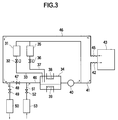
- this apparatus has a formalin container(31) and an ammonia water cotainer(35) which are connected to a heating chamber(34) by respective lines(33,37) provided with respective solenoid valves(32,36).
- Said heating chamber(34) is provided with a heater(38) and a vaporizing heater(39) for generating formaldehyde or ammonia gas.
- the heating chamber(34) is connected to a room(43) to be sterilized by a line(41) having a fan(40) and a bellows(42), and connected to said room(43) by another line(46) having a valve(47) and another bellows(45).
- a line(48) is divided from said line(46) at an upstream point of said valve(47) and communicated with the atmosphere via a valve(49) and an activated carbon container(50);
- a line(51) is divided from the line(46) at a downstream point of the valve(47) and communicated with the atmosphere via a valve(52) and a filter(53).
- the solenoid valve(36) and the valves(49,52) are closed and the solenoid valve(32) and the valve(47) are opened in order to feed formalin from the formalin cotainer(31) to the heating chamber(34).
- Formalin in the heating chamber(34) is then heated by the heaters(38,39) and vaporized into formaldehyde.
- This formaldehyde is fed by the fan(40) into the room(43) to be sterilized through the line(41) and the bellows(42) and is circulated to the heating chamber(34) through the bellows (45) and the line(46), thereby sterilizing the room(43) (sterilizing process).
- the solenoid valve(32) and the valve(47) are then closed and the valves(49,52) are opened to feed clean air through the filter(53) into the the room(43), so that the formaldehyde in the room(43) is replaced by clean air.
- the exiting formaldehyde is passed through the activated carbon container(50) to be made harmless, and to be exhausted into the atmosphere (exhausting process).
- valves(49,52) are then closed and the solenoid valve(32) and the valve(47) are opened to feed ammonia water from the ammonia water cotainer(35) into the heating chamber(34), where the ammonia water is vaporized into ammonia gas by the heaters(38,39).
- this ammonia gas is fed, by the fan (40), into the room(34), through the line(41) and the bellows(42), and then circulated to the heating chamber(34) through the bellows(45) and the line(46), thereby neutralizing formaldehyde remaining in the room(34) and in objects therein (neutralizing process).
- the ammonia gas is then exhausted into the atmosphere in the same way as in the previously mentioned exhausting process.
- the apparatus as described above is, however, adapted to replace, in the exhausting process (after the formaldehyde sterilization process), formaldehyde in the room to be sterilized by clean air containing no bacterium or the like. For this reason the apparatus must have, in addition to a system for generating and circulating formaldehyde, a separate system including a filter and a line for intrducing clean air, and valves for switching these systems; it is therefore complicated in structure.
- the prior apparatus is not adapted to precisely control the amount of formalin and ammonia water in the heating chamber, and the vaporizing temperature thereof, the formalin and ammonia water can overflow the heating chamber, or the amounts and temperatures of the generated formaldehyde and ammonia gas, for example, are not uniform and this has an adverse effect on the sterilizing and neutralizing actions.
- a formalin sterilization apparatus which comprises a heating chamber connected to a room to be sterilized by an inlet line and an outlet line; a formalin container and an ammonia water container for selectively supplying formalin or ammonia water to the heating chamber; a heater for heating the formalin or ammonia water selectively supplied to the heating chamber to generate formaldehyde or ammonia gas; a fan for circulating the generated formaldehyde and ammonia gas between the room or the heating chamber; a reaction chamber between the heating chamber and the outlet line for performing the reaction of the ammonia gas vaporized in the heating chamber with the formaldehyde circulated from the room; and a filter disposed between the reaction chamber and the outlet line.
- Fig. 1 shows a formalin sterilization apparatus according to the present invention (hereinafter merely referred as "apparatus").
- the apparatus is, as indicated at 1, adapted to be connected, to an inlet of a room 4 to be sterilized, by an outlet line 2 and a flexible bellows 3, and to an outlet of the room 4, by an inlet line 5 and a flexible bellows 6.
- the apparatus 1 has a heating chamber 7.
- a formalin container 8 and an ammonia water container 11 are connected to the heating chamber 7 through a solenoid valve 9 and a line 10, and through a solenoid valve 12 and a line 13, respectively, so that formalin and ammonia water can be selectively supplied from these containers 8 and 11 to said heating chamber 7.
- a primary heater 14 is provided on the bottom of the heating chamber 7 and heats and vaporizes the formalin or ammonia water supplied to the heating chamber 7 to generate formaldehyde or ammonia gas. This primary heater 14 is provided with an overheat-preventing sensor 15.
- This sensor 15 is adapted to stop the primary heater 14 when sensing a temperature higher than a predetermined temperature (for example, 150 ° C), thereby preventing the primary heater 14 from overheating. Said overheat-preventing sensor 15 is also adapted to sense a temperature rise due to that the heating chamber 7 becomes near empty, thereby preventing the heating chamber 7 from being heated in the empty state. Also, a temperature control sensor 16 for ammonia water is disposed on the heating chamber 7 at a lower portion of the outside thereof. This sensor 16 is variable in preset temperature and is adapted to actuate/stop the primary heater 14 based on the preset temperature, so as to maintain the vaporizing temperature of the ammonia water at a predetermined temperature slightly higher than the boiling point of ammonia.
- a predetermined temperature for example, 150 ° C
- the intermediate sensor 17 is a float level sensor for formalin.
- the sensor 17 closes the solenoid valve 9 for the formalin container 8 so as to maintain the formalin at the preset level H1.
- the lower sensor 18 controls the solenoid valve 12 for the ammonia water container 11 so that ammonia water is maintained at a second preset level H 2 lower than the preset level H1.
- the upper sensor 19 backs up the sensors 17 and 18 by maintaining the formalin and the ammonia water in the heating chamber 7 at a third preset level H3, thereby preventing them from overflowing the heating chamber 7.
- a reaction chamber 20 is defined at the upper portion of the heating chamber 7 by radially enlarging this heating chamber portion.
- Said inlet line 5 is connected to an inlet of the reaction chamber 20.
- a plurality of baffle plates 21 are alternatingly disposed near the outlet of the reaction chamber 20 opposite to the inlet thereof. As described below, in this reaction chamber 20, the ammonia gas generated in the heating chamber 7 is made to react with the formaldehyde circulated from the room 4 in the neutralizing process.
- a secondary heater 22, a fan 23, a filter 24 and a tertiary heater 25 are disposed between an outlet of the reaction chamber 20 and said outlet line 2.
- the secondary heater 22 re-heats, to a predetermined temperature, the gas discharged from the heating chamber 7 and is provided with an overheat-preventing sensor 26 for preventing overheating of said secondary heater 22.
- the fan 23 is heat-resistant. Between this fan 23 and the secondary heater 22 is disposed a temperature control sensor 27 for protecting the fan 23 and for preventing the filter 24 from clogging.
- the filter 24 is mounted removably in the apparatus 1 and heat-resistant to temperatures lower than, for example, 250 ° C.
- Said filter 24 is a conventional filter referred to as an absolute filter or an HPEA filter, which can eliminate particles larger than 0.3 ⁇ m so as to eliminate bacterium.
- the tertiary heater 25 is provided with a temperature control sensor 28 variable in preset temperature and a overheat-preventing sensor 29 for preventing overheating of said tertiary heater 25.
- the tertiary heater 25 controls the final temperature of the gas blowing into the room 4 to a predetermined temperature.
- the apparatus thus constituted operates in the following order: formalin vaporizing process, rataining process and neutralizing process, as described below.
- the formalin and the ammonia water containers 8 and 11 Prior to opration, the formalin and the ammonia water containers 8 and 11 are filled with a predetermined amount of formalin and ammonia water, respectively and the bellows 3 and 6 are connected to the inlet and to the outlet of the room 4 to be sterilized, respectively.
- the solenoid valve 9 is opened, the solenoid valve 12 is closed, and the heaters 14, 22 and 25 and the fan 25 are actuated. Additionally, the float level sensors 17 and 19 are actuated and the float level sensor 18 is stopped. In this manner, formalin is caused to flow from the formalin container 8 through the solenoid valve 9 and the line 10 into the heating chamber 7, where it is heated by the primary heater 14 in order for the formalin to be vaporized into formaldehyde.
- This formaldehyde is then fed by the fan 23 through the reaction chamber 20, the secondary heater 22, the filter 24, the tertiary heater 25, the outlet line 2, the bellows 3 and lastly into the room 4 . The formaldehyde is then returned to the heating chamber 7, via the bellows 6 and the line 5, and recirculated together with new formaldehyde generated in the heating chamber 7.
- the vaporizing temperature of formalin can be maintained at a desired temperature (for example, 80 ⁇ 95° C) slightly higher than the boiling point of formalin due to the fact that the formalin in the heating chamber 7 is maintained at preset level H1 and to the relationship between preset level H1 and the capability of the primary heater 14.
- a desired temperature for example, 80 ⁇ 95° C
- the filter 24 is prevented from being clogged as a result of condensation of formaldehyde.
- the filter 24 captures non-sterilized bacterium and the like, contained in the air circulated from the room 4, so as to prevent such bacterium from flowing into the room 4.
- the temperature of the formaldehyde blowing into the room 4 is maintained, by the tertiary heater 25 and the temperature control sensor 28, at an optimal temperature range (for example, 60 ⁇ 80° C) so that the formaldehyde can permeate the room 4 and can not be condensed by cooling.
- an optimal temperature range for example, 60 ⁇ 80° C
- the state of operation of the apparatus 1, as described above, is retained for a predetermined time. That is, by continuing to operate the fan 23 and the secondary and tertiary heaters 22 and 23, circulation of formaldehyde is continued so that formaldehyde in the room 4 can be maintained at a high concentration and thus sterilize the room 4.
- the solenoid valve 12 is then opened and the primary heater 14 is actuated. Also, the float level sensors 18 and 19 are actuated and the float level sensor 17 is stopped. In this manner, ammonia water is caused to flow from the ammonia water container 11 through the solenoid valve 12 and the line 13 into the heating chamber 7, where it is heated by the primary heater 14 in order to be vaporized into ammonia gas. This ammonia gas is then mixed, in the reaction chamber 20, with the formaldehyde circulated from the room 4 in order to neutralize the formaldehyde.
- the baffle plates 21 of the reaction chamber 20 serve to promote the neutralization reaction since they ensure longer residence time of the formaldehyde and ammonia gases in the reaction chamber 20, and promote turbulence thereof.
- This mixed gas together with neutralization reaction products are then heated to a predetermined temperature, when passing through the secondary heater 22, and fed to the filter 24. If reaction products such as urotropin, cinders and the like are produced by the neutralization, they are captured by the filter 24 and prevented from flowing into the room 4. In this manner, because the neutralization of formaldehyde with ammonia is performed in the reaction chamber 20 rather than in the room 4 to be sterilized, the amount of urotropin produced in the room 4 can be significantly reduced.
- Said mixed gas is then heated to a predetermined temperature by the tertiary heater 25 and fed through the outlet line 2 and the bellows 3 into the room 4, where a portion of the gas neutralizes a portion of the formaldehyde and the remaining gas is replaced by the formaldehyde.
- This formaldehyde is returned through the bellows 6 and the inlet line 5 to the heating chamber 7 and neutralized with new ammonia gas generated in the heating chamber 7.
- ammonia water in the heating chamber 7 is maintained, by the float level sensor 18, at preset level H2 lower than preset level H1 for formalin in the vaporizing process, that is, an amount of heated ammonia water is small and constant, ammonia gas can be rapidly generated by heating and the amount thereof can be made constant.
- the vaporizing temperature of ammonia is maintained, by the temperature control sensor 16, at a predetermined temperature (for example, 50 ° C) which is lower than the vaporizing temperature of formalin and slightly higher than the boiling point of ammonia, ammonia gas is generated little by little so that it can sufficiently react with formaldehyde in the reaction chamber 20 before being fed to the filter 24.
- the present process is similar to the formalin vaporizing process described above in that overflowing is prevented by the float level sensor 17 and that a final temperature of the circulating gas is maintained at a predetermined temperature by the tertiary heater 25.
- the overheat-preventing sensor 15 senses the resuling rise in temperature and stops the primary heater 14 and closes the solenoid valve 12, thus completing the present process.
- the present invention can be carried out in various manners other than as specifically described herein.
- the heating chamber for formalin and the heating chamber for ammonia water are common to one another, these chambers may be separately provided and the reaction chamber may be defined to be at the upper portion of the heating chamber for ammonia water.
- a formalin sterilization apparatus has a comparatively simple structure for maintaining a room to be sterilized in a clean state and can also precisely control the amounts and temperatures of generated formaldehyde and ammonia gases.
Landscapes
- Health & Medical Sciences (AREA)
- Chemical & Material Sciences (AREA)
- Chemical Kinetics & Catalysis (AREA)
- General Chemical & Material Sciences (AREA)
- Epidemiology (AREA)
- Life Sciences & Earth Sciences (AREA)
- Animal Behavior & Ethology (AREA)
- General Health & Medical Sciences (AREA)
- Public Health (AREA)
- Veterinary Medicine (AREA)
- Apparatus For Disinfection Or Sterilisation (AREA)
Applications Claiming Priority (2)
| Application Number | Priority Date | Filing Date | Title |
|---|---|---|---|
| JP2289487A JPH04161160A (ja) | 1990-10-26 | 1990-10-26 | ホルマリン燻蒸滅菌装置 |
| JP289487/90 | 1990-10-26 |
Publications (2)
| Publication Number | Publication Date |
|---|---|
| EP0482647A2 true EP0482647A2 (fr) | 1992-04-29 |
| EP0482647A3 EP0482647A3 (en) | 1993-02-17 |
Family
ID=17743917
Family Applications (1)
| Application Number | Title | Priority Date | Filing Date |
|---|---|---|---|
| EP19910118173 Ceased EP0482647A3 (en) | 1990-10-26 | 1991-10-24 | Formalin sterilization apparatus |
Country Status (3)
| Country | Link |
|---|---|
| US (1) | US5252304A (fr) |
| EP (1) | EP0482647A3 (fr) |
| JP (1) | JPH04161160A (fr) |
Cited By (5)
| Publication number | Priority date | Publication date | Assignee | Title |
|---|---|---|---|---|
| DE4312004A1 (de) * | 1993-04-13 | 1995-01-05 | Muenchner Medizin Mechanik | Sterilisierverfahren unter Einsatz eines gas- oder dampfförmigen Sterilisiermediums |
| EP1064983A4 (fr) * | 1998-09-25 | 2004-12-29 | Mediate Co Ltd | Procede et dispositif de detoxification et de desodorisation de gaz de sterilisation |
| EP1785149A4 (fr) * | 2004-08-10 | 2008-03-26 | Bio Media Co Ltd | Procédé de stérilisation et appareil de stérilisation |
| CN102716504A (zh) * | 2012-06-26 | 2012-10-10 | 杨克亮 | 多功能智能消毒柜 |
| CN111520605A (zh) * | 2020-05-26 | 2020-08-11 | 东光县华宇纸箱机械有限公司 | 印刷模切用油位平衡机构 |
Families Citing this family (12)
| Publication number | Priority date | Publication date | Assignee | Title |
|---|---|---|---|---|
| US5685987A (en) * | 1996-09-24 | 1997-11-11 | Tresco, Llc | Method for recycling formalin |
| US5961936A (en) * | 1996-12-12 | 1999-10-05 | Johnson & Johnson | Arrangement for adapting a gas generation and recovery system to a target volume |
| US6815206B2 (en) * | 1997-09-19 | 2004-11-09 | Ethicon, Inc. | Container monitoring system |
| US20060039518A1 (en) * | 2002-05-16 | 2006-02-23 | Hornkohl Jason L | Thermal cavitation focusing, inertial containment test equipment |
| WO2007036000A1 (fr) * | 2005-09-29 | 2007-04-05 | Asiaworld Shipping Services Pty Ltd | Conteneur maritime |
| US20070098591A1 (en) * | 2005-10-31 | 2007-05-03 | Georg Frinke | Method and apparatus for low energy vaporization of liquid oxidizing agents or solutions |
| CN103690979B (zh) * | 2013-12-23 | 2015-11-04 | 北京克力爱尔生物实验室工程有限公司 | 福尔马林中和箱 |
| DE202014001720U1 (de) | 2014-02-27 | 2015-03-02 | Gerhard Brugger | Spender |
| CN108708104A (zh) * | 2018-04-20 | 2018-10-26 | 浙江洁呈新材料科技有限公司 | 一种纺织废料处理装置 |
| CN108803734B (zh) * | 2018-05-29 | 2020-06-09 | 重庆市机电设计研究院 | 一种医疗超声波清洗仪器的工作方法 |
| CN109125767A (zh) * | 2018-09-17 | 2019-01-04 | 中国电子系统工程第二建设有限公司 | 一种实验室自动熏蒸系统 |
| DE102024100311A1 (de) * | 2024-01-08 | 2025-07-10 | Khs Gmbh | Verfahren zum Kühlen mindestens einer Verdampfervorrichtung für ein Sterilisations-Gemisch, Sterilisationssystem und Maschine zum Herstellen und/oder Behandeln von Behältern |
Family Cites Families (14)
| Publication number | Priority date | Publication date | Assignee | Title |
|---|---|---|---|---|
| GB737893A (en) * | 1952-12-02 | 1955-10-05 | Douglas Frederic Hext | Improvements relating to disinfecting, disinfesting or the like |
| BE773391A (fr) * | 1971-09-30 | 1972-01-17 | Gentil Albert | Dispositif d'evaporation de liquide a debit et a niveau d'alimentation constants. |
| GB1350301A (en) * | 1971-10-12 | 1974-04-18 | Gentil A | Liquid evaporators |
| DE2331359A1 (de) * | 1973-06-20 | 1975-01-23 | Draegerwerk Ag | Verfahren zum desinfizieren von begehbaren raeumen, insbesondere von hochsterilen raeumen, wie operationsraeumen |
| US3898038A (en) * | 1973-12-13 | 1975-08-05 | Southwest Res Inst | Method and apparatus for sterilizing a biologically contaminated enclosure |
| FR2335240A1 (fr) * | 1975-12-16 | 1977-07-15 | Detec Sa | Installation pour la desinfection par le formol |
| FR2352551A1 (fr) * | 1976-05-26 | 1977-12-23 | Ciet Inter G | Bloc de desinfection |
| US4241020A (en) * | 1978-06-16 | 1980-12-23 | Certek, Inc. | Apparatus for biological decontamination and subsequent neutralization of a space |
| JPS58152563A (ja) * | 1982-03-03 | 1983-09-10 | 泉工医科工業株式会社 | 医用機器のホルマリン自動消毒方法 |
| FR2555452B1 (fr) * | 1983-11-25 | 1986-05-16 | Paragerm France | Appareil et procede de desinfection de l'atmosphere et des surfaces d'un local |
| GB2164258B (en) * | 1984-08-23 | 1988-01-27 | Doyle Ltd C F | Formaldehyde sterilizers |
| US4973449A (en) * | 1986-03-10 | 1990-11-27 | Mdt Corporation | Sterilization method |
| FR2612780B1 (fr) * | 1987-03-27 | 1989-06-23 | Paragerm | Procede et appareil de desinfection des surfaces par voie aerienne dans les enceintes closes, a partir d'un aerosol d'une solution aqueuse de formaldehyde |
| JPS64928A (en) * | 1987-06-24 | 1989-01-05 | Alps Electric Co Ltd | Liquid crystal element |
-
1990
- 1990-10-26 JP JP2289487A patent/JPH04161160A/ja active Pending
-
1991
- 1991-10-23 US US07/781,382 patent/US5252304A/en not_active Expired - Fee Related
- 1991-10-24 EP EP19910118173 patent/EP0482647A3/en not_active Ceased
Cited By (6)
| Publication number | Priority date | Publication date | Assignee | Title |
|---|---|---|---|---|
| DE4312004A1 (de) * | 1993-04-13 | 1995-01-05 | Muenchner Medizin Mechanik | Sterilisierverfahren unter Einsatz eines gas- oder dampfförmigen Sterilisiermediums |
| EP1064983A4 (fr) * | 1998-09-25 | 2004-12-29 | Mediate Co Ltd | Procede et dispositif de detoxification et de desodorisation de gaz de sterilisation |
| EP1785149A4 (fr) * | 2004-08-10 | 2008-03-26 | Bio Media Co Ltd | Procédé de stérilisation et appareil de stérilisation |
| CN102716504A (zh) * | 2012-06-26 | 2012-10-10 | 杨克亮 | 多功能智能消毒柜 |
| CN102716504B (zh) * | 2012-06-26 | 2014-12-10 | 杨克亮 | 多功能智能消毒柜 |
| CN111520605A (zh) * | 2020-05-26 | 2020-08-11 | 东光县华宇纸箱机械有限公司 | 印刷模切用油位平衡机构 |
Also Published As
| Publication number | Publication date |
|---|---|
| EP0482647A3 (en) | 1993-02-17 |
| JPH04161160A (ja) | 1992-06-04 |
| US5252304A (en) | 1993-10-12 |
Similar Documents
| Publication | Publication Date | Title |
|---|---|---|
| EP0482647A2 (fr) | Appareil pour la stérilisation par le formaldéhyde | |
| JP4094680B2 (ja) | 一体化気相除染剤生成システムを備えた気相式除染アイソレーター装置 | |
| CN113924447A (zh) | 用于加热烹饪物品的装置 | |
| EP1378248B1 (fr) | Système et procédé de décontamination fonctionnant en continu et en boucle fermée | |
| CA1249213A (fr) | Methode et materiel d'incineration ou de decomposition de polluants | |
| KR100813609B1 (ko) | 특정 영역에서 소독제의 농도를 증가시키는 장치 및 방법 | |
| EP0326227A1 (fr) | Sécheur pour une bande continue | |
| US4734268A (en) | Clean air system | |
| EP0522231A1 (fr) | Procédé et appareil pour le traitement de déchets médicaux infectieux | |
| US7803317B2 (en) | Method for decontaminating temperature-sensitive objects | |
| US6397766B1 (en) | Evaporative and regenerative waste water incineration system | |
| CN1325386C (zh) | 具有包括加热元件的盛装已处理水的容器的自动消毒水处理设备 | |
| EP3876810A1 (fr) | Appareil de nettoyage et de désinfection | |
| JPS59501723A (ja) | 天火及び燻蒸併用焼却炉とその操作方法 | |
| CA1240475A (fr) | Appareil pour la production d'air sterile | |
| JPWO1999061137A1 (ja) | 有害ガス浄化装置及び浄化方法 | |
| US4452671A (en) | Oil separation and heat recovery system | |
| JP2006308162A (ja) | 過熱蒸気循環型乾燥システム | |
| SE425717B (sv) | Sett vid steriliserng av madrasser, tvettseckar och liknande gods i en steriliseringsapparat, samt apparat for genomforande av settet | |
| JP2537753B2 (ja) | 室内燻蒸方法及び装置 | |
| WO2000056194A1 (fr) | Perfectionnements relatifs a un appareil de cuisson | |
| JPS62254826A (ja) | 触媒燃焼式の排ガス処理装置 | |
| JP2024101253A (ja) | 除染システムおよび除染方法 | |
| JPS59136200A (ja) | 微生物を含む汚物等の処理方法及びその装置 | |
| JPH0654891A (ja) | 加熱水による滅菌処理装置 |
Legal Events
| Date | Code | Title | Description |
|---|---|---|---|
| PUAI | Public reference made under article 153(3) epc to a published international application that has entered the european phase |
Free format text: ORIGINAL CODE: 0009012 |
|
| AK | Designated contracting states |
Kind code of ref document: A2 Designated state(s): DE FR GB IT |
|
| PUAL | Search report despatched |
Free format text: ORIGINAL CODE: 0009013 |
|
| AK | Designated contracting states |
Kind code of ref document: A3 Designated state(s): DE FR GB IT |
|
| 17P | Request for examination filed |
Effective date: 19930518 |
|
| 17Q | First examination report despatched |
Effective date: 19950807 |
|
| STAA | Information on the status of an ep patent application or granted ep patent |
Free format text: STATUS: THE APPLICATION HAS BEEN REFUSED |
|
| 18R | Application refused |
Effective date: 19960129 |