EP0482709B1 - Fettarmes Imbissprodukt - Google Patents
Fettarmes Imbissprodukt Download PDFInfo
- Publication number
- EP0482709B1 EP0482709B1 EP91202706A EP91202706A EP0482709B1 EP 0482709 B1 EP0482709 B1 EP 0482709B1 EP 91202706 A EP91202706 A EP 91202706A EP 91202706 A EP91202706 A EP 91202706A EP 0482709 B1 EP0482709 B1 EP 0482709B1
- Authority
- EP
- European Patent Office
- Prior art keywords
- oil
- snack
- dough
- mold
- pieces
- Prior art date
- Legal status (The legal status is an assumption and is not a legal conclusion. Google has not performed a legal analysis and makes no representation as to the accuracy of the status listed.)
- Expired - Lifetime
Links
Images
Classifications
-
- A—HUMAN NECESSITIES
- A23—FOODS OR FOODSTUFFS; TREATMENT THEREOF, NOT COVERED BY OTHER CLASSES
- A23L—FOODS, FOODSTUFFS OR NON-ALCOHOLIC BEVERAGES, NOT OTHERWISE PROVIDED FOR; PREPARATION OR TREATMENT THEREOF
- A23L19/00—Products from fruits or vegetables; Preparation or treatment thereof
- A23L19/10—Products from fruits or vegetables; Preparation or treatment thereof of tuberous or like starch containing root crops
- A23L19/12—Products from fruits or vegetables; Preparation or treatment thereof of tuberous or like starch containing root crops of potatoes
- A23L19/18—Roasted or fried products, e.g. snacks or chips
- A23L19/19—Roasted or fried products, e.g. snacks or chips from powdered or mashed potato products
-
- A—HUMAN NECESSITIES
- A23—FOODS OR FOODSTUFFS; TREATMENT THEREOF, NOT COVERED BY OTHER CLASSES
- A23L—FOODS, FOODSTUFFS OR NON-ALCOHOLIC BEVERAGES, NOT OTHERWISE PROVIDED FOR; PREPARATION OR TREATMENT THEREOF
- A23L7/00—Cereal-derived products; Malt products; Preparation or treatment thereof
- A23L7/10—Cereal-derived products
- A23L7/117—Flakes or other shapes of ready-to-eat type; Semi-finished or partly-finished products therefor
-
- A—HUMAN NECESSITIES
- A23—FOODS OR FOODSTUFFS; TREATMENT THEREOF, NOT COVERED BY OTHER CLASSES
- A23L—FOODS, FOODSTUFFS OR NON-ALCOHOLIC BEVERAGES, NOT OTHERWISE PROVIDED FOR; PREPARATION OR TREATMENT THEREOF
- A23L7/00—Cereal-derived products; Malt products; Preparation or treatment thereof
- A23L7/10—Cereal-derived products
- A23L7/117—Flakes or other shapes of ready-to-eat type; Semi-finished or partly-finished products therefor
- A23L7/122—Coated, filled, multilayered or hollow ready-to-eat cereals
-
- Y—GENERAL TAGGING OF NEW TECHNOLOGICAL DEVELOPMENTS; GENERAL TAGGING OF CROSS-SECTIONAL TECHNOLOGIES SPANNING OVER SEVERAL SECTIONS OF THE IPC; TECHNICAL SUBJECTS COVERED BY FORMER USPC CROSS-REFERENCE ART COLLECTIONS [XRACs] AND DIGESTS
- Y10—TECHNICAL SUBJECTS COVERED BY FORMER USPC
- Y10S—TECHNICAL SUBJECTS COVERED BY FORMER USPC CROSS-REFERENCE ART COLLECTIONS [XRACs] AND DIGESTS
- Y10S426/00—Food or edible material: processes, compositions, and products
- Y10S426/808—Starch base snack product
Definitions
- This application relates to an improved snack product which is lower in fat than other fried snacks made from doughs.
- this application relates to a process for preparing such products from a farinaceous dough.
- the dough is sheeted, cut into pieces, coated with oil, and then dehydrated and cooked using superheated steam or other heat source while being held in a mold.
- a wide variety of farinaceous (starch and protein-based) snack food products are presently available to the consumer. Many of these products are in the form of chips, strips, and extruded pieces. Some of these products are expanded or puffed and contain a cellular or honeycombed internal structure. Most of the present-day snack products contain a fairly high level of fat, either in the form of separately added ingredients, such as cheese, or in the form of fats absorbed by the product during frying, as in the case of corn or potato chips. While fat improves the flavor and palatability of these products, it also increases the caloric value of the product. Accordingly, it would be desirable to provide low fat snack products which have an attractive appearance, texture and taste.
- U. S. 3,402,049 to Mancuso et al (assigned General foods, 1968) describes a process for making potato chips having a total fat content of 20-30% by weight.
- Raw potato slices are soaked in an edible fat, drained to remove excess fat and then heated to elevated temperatures to surface fry and dehydrate the potato slices.
- U. S. 4,283,425 to Yuan et al (General Foods, 1981) describes a potato chip having a fat content of up to 10%.
- This chip is prepared by coating raw potato slices with a globular protein, applying a layer of edible oil on top of the protein coating, and then subjecting the raw coated slices to microwave heating.
- U. S. 4,721,625 to Lee et al (Borden, 1988) describes a process for preparing low fat potato chips in which peeled raw potato chips are fried in oil to a moisture content of 10-25% by weight. The partially fried potato slices are protected against oxidation, and the oil is removed from the surface. The chips are then dried to a moisture content of 1.5-3%. Superheated steam is used to remove the fat from the chips. The superheated steam can be used as a drying agent also.
- Canadian Patent 1,151,945 issued to Mehta et al (General Foods, 1983) describes a potato chip having a low fat content which is prepared by microwave heating. Before microwave heating, the raw potato slices are coated with an edible oil sufficient to bring the fat content to 20%.
- U. S. 4,537,786 issued to Bernard describes a process for manufacturing a low oil fried potato chip wherein the potato slices are fried in oil to a temperature of about 280-320°F (138°C-160°C), removed from the oil, and then contacted with an oil removing blast of hot air for from 1-10 minutes. This hot air removes the excess oil as well as finishes cooking the chip.
- Canadian Patent 957,896 issued to Hai et al describes a process for decreasing the fat content of fried chip-type potato products.
- the fried food product is centrifuged at at least 352G of force while being contacted with superheated steam or saturated steam. The heat and steam remove the fat and finish cooking the chips.
- the present invention relates to an improved lower fat snack product and a process for making it.
- This process comprises the steps of:
- the dough can be formed into a sheet and then cut into snack pieces, or the snack pieces formed, preferably by extrusion.
- the snack pieces are cooked at a temperature sufficient to form snack products having a light, crispy, crunchy texture, improved flavor and a fat content of from about 10% to about 25%. This is a lower fat content than most conventional fried snacks. If desired, the lubricity of the snack can be further enhanced by increasing the fat content of the snack to 35% by spraying oil on the snack.
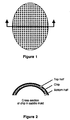
- Figure 1 is a mold for holding the dough during cooking.
- the mold is perforated.
- Figure 2 shows a side view of the mold containing the dough.
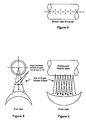
- Figure 3 is a pipe showing the steam outlets;
- Figure 4 shows a front view of the steam impinging on the mold;
- Figure 5 shows an end view.
- Figures 4 and 5 the fixtures which fasten the molds together and attach the molds to a conveyance are not shown.
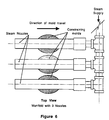
- Figure 6 demonstrates the nozzle and manifold arrangement of the preferred system.
- the dough is prepared from starch based flour and water. Hydrolyzed starches, emulsifiers, and other optional ingredients described hereafter can be added.
- the composition of the dough controls the ease with which the dough is processed into a sheet or molded pieces and the textural and flavor features of the resulting cooked snack product.
- Potato flour is the most preferred flour. Suitable sources of potato flour include dehydrated potato flakes and granules, mashed potato materials, and dried potato products. Other tuber and grain flours such as yellow corn, white corn, popcorn, tapioca, peanut, wheat, oat, rice, and soy meal can be used in the dough. These starch based flours can be blended to make snacks of different composition and flavor.
- Suitable starches can be used in combination with the potato flour.
- examples of such materials are potato starch, tapioca starch, cornstarch, oat starch, rice starch and wheat starch.
- Hydrolyzed starches are also useful for the processability of doughs which have relatively low water levels.
- the hydrolyzed starches for inclusion in the dough have Dextrose Equivalent (D.E.) values of from about 5 to about 30, preferably from about 10 to about 20.
- Maltrin® M050, M100, M150, M180, M200, and M250 are preferred maltodextrins.
- the D.E. value is a measure of the reducing equivalence of the hydrolyzed starch referenced to dextrose and expressed as a percent (on a dry basis). The higher the D.E. value, the more reducing sugars are present.
- Hydrolyzed starches can be included in an amount of from about 3% to about 15%, and preferably, from about 5% to about 12%.
- the term “added” refers to water which has been added to the dry dough ingredients. Water which is inherently present in the dry dough ingredients is not included in the added water. The level of water in flours and starches is usually from about 3% to about 8%. If maltodextrin or corn syrup solids are added as a solution or syrup, the water in this syrup or solution must be accounted for as "added water”.
- the doughs of the present invention can comprise from about 20% to about 50% added water, preferably from 25% to 41% added water. This low level of water in the dough along with the addition of hydrolyzed starches to the doughs provides doughs which can form cohesive sheets and which are easily extruded as thin pieces.
- Emulsifiers can be included in the doughs, typically in minor amounts up to about 5% by weight, preferably from about 0.5% to about 3%, and most preferably from about 1.5% to about 2.5%. Emulsifiers are used as a sheeting aid to avoid overworked sticky doughs and to reduce puffing and blistering in the cooked product. Lower moisture doughs, when cooked, typically yield harder snack products. To make products with textures similar to those made from higher moisture doughs, the level of emulsifier is typically reduced.
- Preferred emulsifiers are mono- and diglycerides of saturated and unsaturated fatty acids, and in particular mono- and diglycerides of stearic and palmitic acids. Sucrose mono- and diesters of saturated and unsaturated long chain fatty acids can also be used as can other emulsifiers such as polyglycerol esters or polyethoxysorbitan esters.
- Salt, flavorings, and/or seasonings can also be optionally included in the dough or sprinkled on the surface of the snack after cooking.
- Flavors and flavor precursors can also be added to the dough. Reducing sugars, i.e. fructose, glucose and maltose add browned notes to the cooked dough. Sucrose can also be used to provide added flavor as can high fructose corn syrup solids.
- the dough can be prepared by any suitable method for combining together the previously described ingredients.
- a loose, dry dough is prepared by thoroughly mixing the flour, emulsifier, flavoring (optional) with sufficient added water to obtain the required added water levels.
- Preferred devices for mixing together these dough ingredients are conventional mixers. Hobart® mixers are used for batch operations and Turbolizer® mixers can be used for continuous mixing operations. However, extruders can also be used to mix the dough and to form sheets for cutting or for forming shaped dough pieces.
- the dough is then formed into a relatively flat, thin sheet or thin snack pieces.
- thick herein is meant from about 0.015 to about 0.1 inches (0.038 cm to 0.25 cm).
- Any method suitable for forming sheets from starch based doughs can be used.
- the sheet can be rolled out between two counter-rotating cylindrical rollers to obtain a uniform, relatively thin sheet of dough material. Any conventional sheeting, milling and gauging equipment can be used.
- Doughs of the present invention are usually formed into a sheet having a thickness of from about 0.015 to about 0.10 inches (from about 0.038 to about 0.25 cm), and preferably to a thickness of from about 0.015 to about 0.025 inches (from about 0.038 to about 0.062 cm).
- the dough sheet is then cut into snack pieces of a predetermined size and shape using any suitable stamping or cutting equipment.
- the snack pieces can be cut or formed into a variety of shapes. For example, in the shape of ovals, squares, circles, a bowtie, a star wheel, or a pin wheel.
- the dough can be formed into thin snack pieces by extruding through a shaped die.
- Conventional extruders can be used for this purpose.
- Twin screen extruders such as those available from Werner Pfleiderer (Germany), are preferred because the dough moves through more uniformly and doesn't stick to the screw flights.
- Single screw extruders can also be used. Single screw extruders are available from Wenger in the U. S.
- the dough can also be mixed in the extruder.
- the dry ingredients are added to the hopper and water is added in the extruder barrel. This is also a conventional forming process in snack foods.
- the snack pieces are coated with oil and then cooked. This can be done in two ways: the sheet is coated with oil and then cut into pieces. Alternatively, the individual pieces can be coated with oil and then cooked. Preferably, the mold is coated with oil, and this oil is then transferred to the snack piece on contact. From about 10% to about 25% oil is used to coat the snack pieces.
- Typical coating oils include fats and oils derived from animal and vegetable sources. Any number of unhydrogenated or partially hydrogenated oils, such as soybean, cottonseed, peanut, corn, palm oil, cottonseed oil, canola oil, rapeseed oil, sunflower seed oil, lard, tallow, peanut oil, among others, can be sprayed or otherwise applied onto the snack pieces. Lower molecular weight oils, i.e. those containing short chain fatty acids can also be used for this purpose. These lower molecular weight oils are not ordinarily used in frying because of their low volatility and flash points. Polyol polyesters of fatty acids can also be used, as can synthetic triglycerides. These include low calorie and nonabsorbable fats such as sucrose polyesters. See for example, Mattson et al U.S. 3,600,186 and Jandacek U.S. 4,005,195 which describe these fats.
- the snacks are constrained during cooking.
- An apparatus as described in U.S. 3,626,466 (Liepa, 1971) can be used.
- the dough pieces are shaped using a movable, apertured mold half (as depicted in Figure 1) to shape the cut dough pieces and then held during subsequent cooking by a second apertured mold half. (See Figure 2.)
- the molds contain holes or apertures. These holes, along with the oil coating on the mold or the snack piece, control the water release during cooking and moderate the rate of evaporation.
- the structure developed in the cooked snack when there is a thin oil coating is very different than that without the oil coating.
- the exact number of holes and their size depends on the size, thickness and shape of the snack piece. Usually from 25% to 50%, and preferably from 35% to 45% of the mold surface area is holes about 1/8 inch (0.3 cm) in diameter.
- the mold is preheated to a temperature of between 300°F (148°C) to about 420°F (215°C). This is most easily accomplished by passing the mold through a heated oil bath and then draining it. This is sufficient to oil the molds and coat the snack pieces with the appropriate amount of oil and also to heat the mold.
- the shaped, constrained pieces are passed through superheated steam or hot air or inert gas until they are cooked, i.e. they are crisp and crunchy with a final moisture content of about 0.5% to about 4% water.
- crunchy texture refers to a snack that exhibits a crisp and crunching sensation for the first of several chews.
- the snack pieces can be cooked to moisture contents of 10% or less with superheated steam and then heated with inert gas, or superheated steam to lower the moisture level to 4% or less.
- Inert gases include nitrogen, carbon dioxide and helium. This is a combined cooking/baking step.
- An alternative to the second baking step is the use of microwave or radiant heating to reduce the final moisture content to the 0.5 to 4% range.
- the snack pieces are cooked at temperatures between about 300°F (148°C) and 450°F (232°C).
- the exact time is controlled by the temperature of the hot air or steam and the starting water content. The cooking time and temperature is easily determined by one skilled in the art.
- the constraining, apertured molds are passed under steam or hot inert gas vents at a distance of from about 1.25 cm to 10 centimeters (1/2-4 inches). (See Figures 3, 4 and 5). While it is not possible to calculate the exact velocity with which the steam or inert gas impels the mold containing the dough pieces, in general it has been found that when steam is passed through a pipe at pressures of from about 20685.5 Pa to 137903.3 Pa (3 to 20 pounds per square inch), said pipe having holes of from about 1/32" to 1/8" diameter, an adequate hot gas or steam supply is directed onto the pieces for cooking. The velocity of the steam cannot be measured directly, but it approaches a high level. The velocity of the steam tapers off as the product gets farther from the hole.
- a preferred arrangement has three rows of holes in the pipe.
- the rows are spaced at 10-25 degree angles as measured from the center of the pipe. That is, as to a vertical plane in the center of the pipe, the holes are alternately 10°-25° on both sides of the center plane.
- the holes are from about (3/8 to 9/16 inches) apart 0.9 to 1.4 cm , preferably (7/16 to 9/16 inches) 1.09 to 1.4 cm apart.
- the rows are staggered with respect to each other (see Figure 3).
- Other arrangements for the vent holes in the pipe include a linear arrangement. Spray nozzles can be used to control the steam spray instead of the pipe system.
- the hot steam or air at a temperature of from (350°F) 177°C to (450°F) 232°C heats the molds which then transfers the heat to the dough piece. Therefore, it is essential that the mold pieces which are used to constrain the dough be of a heat conductive material. Stainless or carbon steel work well.
- the thin oil film allows the product to cook or bake faster and is necessary for giving the fried texture to the product.
- the oil improves the heat transfer probably through improved conduction, while serving as a moisture barrier. It also provides more uniform moisture distribution and expansion of the product.
- the dough is cooked twice as fast with the oil present than without the oil coating present.
- the molds should be made of carbon steel or other magnetic responsive material.
- the snack products made from this process typically have from about 10% to about 25% fat.
- the cooked snacks will have from about 15% to about 20% fat content (dry weight basis).
- oil can be sprayed onto the snack product when it emerges from the fryer, or when it is removed from the mold used in constrained cooking.
- Oils with characteristic flavors or highly unsaturated oils can be sprayed on the snack product.
- Oils such as olive oil, avocado oil, safflower oil, sesame oil, walnut oil, rice oil, rice bran oil or peanut oils can be used.
- oils with added flavors can be used. These include butter flavored oils, natural or artificial flavored oils, herb oils and oils with garlic or onion flavors added. This is a way to introduce a variety of flavors without having the flavor undergo browning reactions during the cooking. It also avoids adding a flavor to the dough. This method can be used to introduce healthier oils which would ordinarily undergo polymerization or oxidation on heating.
- Oil spray can be used to increase the oil content from the 10% to 25% fat content as the snack product emerges from the cooking step to as high as 35% oil.
- a snack product having from 20% to 35% fat can be made using this additional step.
- a mix consisting of approximately 58.6% potato flour, 40.4% water and 1.0% Duex® emulsifier (a mixture of mono-, di-, and triglycerides available from Procter & Gamble, Cincinnati, Ohio) is prepared by mixing the ingredients for two minutes in a single speed domestic food processor, forming a loose, dry dough.
- the dough is sheeted by feeding the dough through a pair of commercial 8" mill rolls forming a smooth elastic sheet controlled to a thickness of about (0.020 inches) 0.05 cm . The dough sheet is then cut into oval shaped pieces.
- a constrained cooking mold consisting of 6 pairs of perforated stainless steel halves is preheated in cottonseed oil at (375°F) 190°C for a time sufficient to raise the mold temperature to about that of the oil (within 5°F).
- the molds are then removed from the oil and drained for 30 seconds in a hot atmosphere of superheated steam, air, or inert gas held at (375°F) 190°C so as not to cool the mold during draining.
- the molds are then removed from the hot atmosphere and opened for the immediate placement of the pre-cut oval dough pieces. After loading with the dough piece, the molds are immediately closed and the fixture placed under superheated steam. The steps which take place out of the heated environment are performed in the shortest time possible to prevent loss of heat from the mold.
- Superheated steam is sprayed over the molds by nozzles constructed from schedule 10S stainless steel pipe.
- Each pipe is drilled with three rows of #55 holes (0.052 inches), 0.13 cm running the length of the pipe. The rows are spaced 13° apart as measured from the center of the pipe. The pitch between the holes within a row is (7/16 inches) 1.09 cm .
- the holes of the two outside rows are in line with each other but are staggered relative to the middle row.
- a pipe is centered above each of the six molds in the apparatus oriented with the middle row of holes pointing straight down and located such that the pipes are parallel to each other and in the same plane.
- the molds can be moved along the axis of the pipes providing an even spray of steam for the entire length of the pipes. This simulates a commercial scale device in which molds are held in a fixture and attached to a continuous chain under long lengths of parallel nozzles (pipes). (See Figure 6 for an illustration of such an arrangement).
- the steam pressure supplied to the nozzles is 68951 Pa (10 psig); steam temperature in the pipe is (360°F) 182°C . Exposure time under the steam is 14.5 seconds or sufficient to lower moisture to 2% or less without over-browning.
- the fat level of the finished product is 18%. The fat comes from a transference of oil from the mold to the chip.
- the product has a light, crisp texture and flavor quite close to a deep fried version of the chip, the small differences originating from the two-fold difference in fat level.
- a product is made according to Example I except that the dough pieces are sprayed with oil instead of dipping the molds in oil. Similar results are achieved. In this case the molds are preheated with steam.
Landscapes
- Health & Medical Sciences (AREA)
- Nutrition Science (AREA)
- Life Sciences & Earth Sciences (AREA)
- Chemical & Material Sciences (AREA)
- Engineering & Computer Science (AREA)
- Food Science & Technology (AREA)
- Polymers & Plastics (AREA)
- Confectionery (AREA)
- Preparation Of Fruits And Vegetables (AREA)
Claims (10)
- Verfahren zur Herstellung eines fettarmen mehlhaltigen Imbißprodukts, umfassend die Schritte:(a) Bilden eines Teigs, umfassend:(1) 50 % bis 80 % einer Mehlquelle auf Stärkebasis;(2) 0 % bis 5 % Emulgiermittel, vorzugsweise 0.5 bis 5 %;(3) 20 % bis 50 % zugesetztes Wasser;(b) Formen des Teigs zu einem dünnen Imbißstück;(c) Überdecken des Imbißstücks mit 10 % bis 25 % Öl; und(d) Kochen bzw. Zubereiten des Imbißstücks in einer Form bis zu einem Feuchtigkeitsgehalt von 4 % bis 10 % bei einer Temperatur von 148°C (300°F) bis 232°C (450°F), wobei die Form vorzugsweise perforiert und aus unlegiertem oder nichtrostendem Stahl hergestellt ist, und wobei die Form durch Eintauchen in ein pflanzliches Öl bei einer Temperatur von 148°C (300°F) bis 218°C (425°F) vorerhitzt wird.
- Verfahren nach Anspruch 1, wobei die Stücke durch überhitzten Dampf bei einer Temperatur von 162°C bis 232°C gekocht bzw. zubereitet werden.
- Verfahren nach Anspruch 1 oder 2, wobei die Imbißstücke durch Extrusion geformt werden.
- Verfahren nach Anspruch 1, 2 oder 3, wobei der Dampf über die gehaltenen bzw. zusammengepreßten Imbißstücke aus einem Rohr bei einem Druck von 218 bis 1451 g/cm² geleitet wird, wobei das Rohr Löcher mit einem Durchmesservon 0,078 bis 0.31 cm bei einem Winkelvon 10 bis 25° bezüglich der Mittelebene des Rohrs aufweist.
- Verfahren nach Anspruch 4, wobei das Imbißstück dadurch mit Öl bedeckt wird, daß eine Form mit Öl bedeckt und das Imbißstück in der Form gehalten bzw. zusammengepreßt wird, wobei vorzugsweise das Öl aus der pflanzliche Öle und teilweise hydrierte pflanzliche Öle umfassenden Gruppe gewählt wird.
- Verfahren nach Anspruch 1, 2 oder 4, wobei der Teig zu einem Blatt mit einer Dicke von 0,038 cm bis 0,088 cm (von 0,015 bis 0.035 inches) geformt wird und das Imbißstück aus dem Blatt geschnitten wird.
- Verfahren nach Anspruch 1, 2, 3 oder 6, wobei der Teig weiterhin 0,5 % bis 12 % Zucker umfaßt, gewählt aus der Saccharose, Glukose, Fructose, Maltodextrine und Mischungen davon umfassenden Gruppe.
- Verfahren nach Anspruch 7, wobei das Mehl Kartoffelmehl ist, gewählt aus der Kartoffelflocken, Kartoffelgranulate und Mischungen davon umfassenden Gruppe.
- Verfahren nach Anspruch 8, wobei der Teig 3 % bis 15 % Maltodextrin mit einem D.E. von 10 bis 20 umfaßt.
- Verfahren nach Anspruch 9, umfassend den weiteren Schritt des Sprühens von 1 % bis 10 % eines Sprühöls auf das gekochte bzw. zubereitete Imbißprodukt, wobei das Sprühöl vorzugsweise aus der Olivenöl, Avocadoöl, Safloröl, Sesamöl, Walnußöl, Erdnußöl, Baumwollsamenöl, Sojabohnenöl, Sonnenblumenöl, Canolaöl, Reisöl, mit Aromastoffenversetzten Ölen und Mischungen davon umfassenden Gruppe gewählt wird.
Applications Claiming Priority (2)
| Application Number | Priority Date | Filing Date | Title |
|---|---|---|---|
| US07/603,580 US5188859A (en) | 1990-10-25 | 1990-10-25 | Low fat snack |
| US603580 | 1990-10-25 |
Publications (2)
| Publication Number | Publication Date |
|---|---|
| EP0482709A1 EP0482709A1 (de) | 1992-04-29 |
| EP0482709B1 true EP0482709B1 (de) | 1995-07-19 |
Family
ID=24416050
Family Applications (1)
| Application Number | Title | Priority Date | Filing Date |
|---|---|---|---|
| EP91202706A Expired - Lifetime EP0482709B1 (de) | 1990-10-25 | 1991-10-18 | Fettarmes Imbissprodukt |
Country Status (4)
| Country | Link |
|---|---|
| US (1) | US5188859A (de) |
| EP (1) | EP0482709B1 (de) |
| CA (1) | CA2053637C (de) |
| DE (1) | DE69111366T2 (de) |
Cited By (3)
| Publication number | Priority date | Publication date | Assignee | Title |
|---|---|---|---|---|
| RU2116732C1 (ru) * | 1995-08-11 | 1998-08-10 | Альберт Миниянович Султанов | Способ производства мучного продукта |
| US6572910B2 (en) | 2000-05-27 | 2003-06-03 | The Procter & Gamble Co. | Process for making tortilla chips with controlled surface bubbling |
| US8241689B2 (en) | 2005-04-08 | 2012-08-14 | Kraft Foods Global Brands Llc | Production of baked snack chips with irregular shape having notched edges |
Families Citing this family (69)
| Publication number | Priority date | Publication date | Assignee | Title |
|---|---|---|---|---|
| US5652010A (en) | 1984-12-14 | 1997-07-29 | Nabisco, Inc. | Production of masa corn-based products |
| US6001409A (en) | 1984-12-14 | 1999-12-14 | Nabisco Technology Company | Masa corn-based food products and method of preparing |
| US5344663A (en) * | 1992-01-15 | 1994-09-06 | Anne M. Jewell | Process for producing a fat-substitute bakery dough and the fat substitute bakery products |
| US5302410A (en) * | 1993-07-12 | 1994-04-12 | Nestec S.A. | Process for producing frozen par-fried potato strips |
| US5393552A (en) * | 1993-07-12 | 1995-02-28 | Nestec S.A. | Process for producing french fries having an extended holding quality |
| US5464642A (en) * | 1993-08-16 | 1995-11-07 | The Procter & Gamble Company | Process for making reduced-fat fried snacks with lighter, more expanded snack structures |
| US5695804A (en) | 1994-03-24 | 1997-12-09 | Nabisco Technology Company | Production of chip-like durum wheat-based snacks |
| US5505978A (en) * | 1994-05-16 | 1996-04-09 | Apv Baker, Inc. | Baked corn-based product and process |
| US5750168A (en) * | 1995-06-06 | 1998-05-12 | Penwest Foods Co. | Tapioca starch containing french fry formulations and method of making |
| DK0770335T3 (da) * | 1995-09-28 | 1998-09-28 | Nestle Sa | Fremgangsmåde til fremstilling af en snack ved kogning-ekstrudering af en blanding på basis af mel eller semulje |
| US5747092A (en) | 1996-04-25 | 1998-05-05 | Nabisco Technology Company | Production of crispy wheat-based snacks having surface bubbles |
| US5922386A (en) * | 1996-05-10 | 1999-07-13 | The Procter & Gamble Company | Fried snack pieces and process for preparing |
| US5928700A (en) * | 1996-05-10 | 1999-07-27 | The Procter & Gamble Company | Fried snack pieces and process for preparing |
| US5925396A (en) * | 1996-05-10 | 1999-07-20 | The Procter & Gamble Company | Fried snack pieces and process for preparing |
| ATE224148T1 (de) | 1996-07-01 | 2002-10-15 | Procter & Gamble | Teigzusammensetzungen |
| US5897898A (en) * | 1997-01-31 | 1999-04-27 | Penwest Foods Co. | Process for preparing starch hydrolyzate coated potato products |
| US5849351A (en) * | 1997-05-14 | 1998-12-15 | Kerry Ingredients, Inc. | Water dispersible coating composition for fat-fried foods |
| US6558730B1 (en) | 1997-07-01 | 2003-05-06 | The Procter & Gamble Co. | Potato-based fabricated snacks made from continuously sheeted doughs and methods for controlling the texture and organoleptical properties thereof |
| US6022569A (en) * | 1997-08-15 | 2000-02-08 | Penford Corporation | Process for preparing a starch coated potato product and product thereof |
| US5945022A (en) * | 1997-09-12 | 1999-08-31 | Nabisco Technology Company | Continuous microwave assisted baking process |
| US5965186A (en) * | 1997-09-24 | 1999-10-12 | The Pillsbury Company | Crisp dough structure and method for imparting crispness to dough |
| US5947010A (en) * | 1997-09-30 | 1999-09-07 | Recot, Inc. | Chip de-oiler apparatus |
| JP3233885B2 (ja) * | 1997-10-02 | 2001-12-04 | ハウス食品株式会社 | スナック食品の製造方法 |
| ES2201550T3 (es) | 1997-10-20 | 2004-03-16 | THE PROCTER & GAMBLE COMPANY | Composiciones de masa hechas con fanulos de patata deshidratados. |
| US6706298B1 (en) | 1999-04-26 | 2004-03-16 | The Procter & Gamble Co. | Method for preparing dehydrated potato products |
| US6777020B2 (en) | 1999-04-26 | 2004-08-17 | The Procter & Gamble Co. | Potato flakes |
| US6696095B1 (en) | 1999-04-26 | 2004-02-24 | The Procter & Gamble Co. | Method for preparing dehydrated starch containing food products |
| US6808734B2 (en) | 1999-04-26 | 2004-10-26 | The Procter & Gamble Co. | Potato dough |
| US6890580B1 (en) | 1999-04-26 | 2005-05-10 | Procter + Gamble Co. | Method for preparing dehydrated starch products |
| US6599547B1 (en) | 1999-04-26 | 2003-07-29 | The Procter & Gamble Co. | Method for preparing dehydrated food products |
| US6703065B2 (en) | 1999-04-26 | 2004-03-09 | The Procter & Gamble Co. | Fabricated potato chips |
| AU1099901A (en) | 1999-10-20 | 2001-04-30 | Grain Processing Corporation | Compositions including reduced malto-oligosaccharide preserving agents, and methods for preserving a material |
| US6251465B1 (en) | 1999-11-17 | 2001-06-26 | Recot, Inc. | Process for producing sheetable potato dough from raw potato stock |
| BR0108156A (pt) * | 2000-02-07 | 2003-01-21 | Recot Inc | Aparelho e método para fazer salgadinhos para lanche empilháveis |
| AU2001236873A1 (en) * | 2000-02-25 | 2001-09-03 | Recot, Inc | Highly seasoned snack chips products and process for making them by coating withseasoned oil and dry seasoning |
| US6412399B1 (en) * | 2000-04-24 | 2002-07-02 | Recot, Inc. | Apparatus for form-frying snack food product |
| US6830767B2 (en) * | 2000-05-27 | 2004-12-14 | The Procter & Gamble Co. | Method for constrain-frying snack pieces having intact surface features |
| US6491959B1 (en) | 2000-10-13 | 2002-12-10 | Kraft Foods Holdings, Inc. | Production of crispy corn-based snacks having surface bubbles |
| US6746700B1 (en) | 2001-09-19 | 2004-06-08 | Land O'lakes, Inc. | Caramel corn product and a method of making the caramel corn product |
| US7794765B2 (en) * | 2002-01-25 | 2010-09-14 | James Edward Maguire | Method and apparatus for cooking low fat french fries |
| AU1355302A (en) * | 2002-01-25 | 2003-07-31 | James Edward Maguire | Low fat potato chips |
| AU2002247923A1 (en) * | 2002-03-26 | 2003-10-08 | Council Of Scientific And Industrial Research | A process for the preparation of soy based low-fat and high protein snack |
| US20040022909A1 (en) * | 2002-08-01 | 2004-02-05 | Pyramid Food Processing Equipment Manufacturing Inc. | Method and apparatus for browing and cooking food products with superheated steam |
| US20050053708A1 (en) * | 2002-08-09 | 2005-03-10 | Mihalos Mihaelos N. | Production of thin, irregular chips with scalloped edges and surface bubbles |
| US20040035859A1 (en) * | 2002-08-21 | 2004-02-26 | Rickey Childress | Method and products for microwave roasting |
| AT412051B (de) * | 2002-11-22 | 2004-09-27 | Schwarzhans Peter | Verfahren zur herstellung eines fettfreien bzw. fettarmen snackproduktes |
| US20050074537A1 (en) * | 2003-10-01 | 2005-04-07 | Bakos Benjamin L. | Sandwich sized chips |
| JP3827013B2 (ja) * | 2004-03-19 | 2006-09-27 | シャープ株式会社 | 蒸気調理器 |
| JP4510513B2 (ja) | 2004-05-20 | 2010-07-28 | 株式会社セントラル物産 | 加工食品、該加工食品の製造システム及び製造方法 |
| US20060088633A1 (en) * | 2004-10-26 | 2006-04-27 | Barber Keith A | Process to produce a reduced fat potato chip |
| US7560128B2 (en) * | 2005-02-07 | 2009-07-14 | Conagra Foods Lamb Weston, Inc. | Process for preparing reduced fat frozen potato strips |
| US20060188638A1 (en) * | 2005-02-18 | 2006-08-24 | Joseph Ponnattu K | Fabricated food product made from fresh potato mash |
| US20060188639A1 (en) * | 2005-02-18 | 2006-08-24 | Joseph Ponnattu K | Fabricated food product made from fresh potato mash |
| WO2007105947A1 (en) * | 2006-03-10 | 2007-09-20 | Nederlandse Organisatie Voor Toegepast-Natuurwetenschappelijk Onderzoek Tno | Method for finish-frying doughnuts |
| EP1700526A1 (de) * | 2005-03-10 | 2006-09-13 | Nederlandse Organisatie voor toegepast-natuurwetenschappelijk Onderzoek TNO | Verfahren zum Fritieren von Lebensmittelpartikeln |
| JP2009530126A (ja) | 2006-03-17 | 2009-08-27 | コナグラ フーズ ラム ウエストン,インコーポレイティド | 凹状に先細りの食品、このような製品を製造するための方法及び装置 |
| USD581627S1 (en) * | 2006-04-11 | 2008-12-02 | Conagra Foods Lamb Weston, Inc. | Potato product |
| US7993693B2 (en) * | 2006-07-19 | 2011-08-09 | Frito-Lay Trading Company Gmbh | Process for making a healthy snack food |
| US7695746B2 (en) * | 2006-07-19 | 2010-04-13 | Frito-Lay Trading Company Gmbh | Process for making a healthy snack food |
| US7867533B2 (en) * | 2006-07-19 | 2011-01-11 | Frito-Lay Trading Compnay GmbH | Process for making a healthy snack food |
| US8808779B2 (en) * | 2007-07-13 | 2014-08-19 | Frito-Lay North America, Inc. | Method for reducing the oil content of potato chips |
| AU322215S (en) * | 2008-02-20 | 2008-11-17 | Nestle Sa | Chocolate |
| US7867535B2 (en) * | 2008-05-07 | 2011-01-11 | Frito-Lay North America, Inc. | Process for producing baked potato slices with expanded texture |
| US20100080868A1 (en) * | 2008-09-26 | 2010-04-01 | Frito-Lay North America, Inc. | Mash Process Offering Better Control |
| GB2481469B (en) | 2011-01-31 | 2013-02-13 | Frito Lay Trading Co Gmbh | De-oiling apparatus and method in the manufacture of low oil potato chips |
| BR112014030490A2 (pt) | 2012-06-05 | 2017-06-27 | Intercontinental Great Brands Llc | produção de produtos fragmentados com inclusões |
| JP6153317B2 (ja) * | 2012-11-27 | 2017-06-28 | 日清食品ホールディングス株式会社 | ノンフライポテトチップス及びその製造方法 |
| KR20140079272A (ko) * | 2012-12-18 | 2014-06-26 | 씨제이제일제당 (주) | 김과 곡물 시트를 이용한 김스낵 및 이의 제조방법 |
| JP7296195B2 (ja) * | 2018-04-25 | 2023-06-22 | 月島食品工業株式会社 | 焼菓子の製造方法 |
Family Cites Families (18)
| Publication number | Priority date | Publication date | Assignee | Title |
|---|---|---|---|---|
| US3402049A (en) * | 1964-11-02 | 1968-09-17 | Gen Foods Corp | Process for preparing low fat potato chips |
| US3502479A (en) * | 1966-06-20 | 1970-03-24 | Lipton Inc Thomas J | Process of making a snack product |
| CA957896A (en) * | 1970-03-18 | 1974-11-19 | Atta M. Hai | Low fat snack and process |
| US3998975A (en) * | 1970-08-07 | 1976-12-21 | The Procter & Gamble Company | Potato chip products and process for making same |
| USRE27531E (en) * | 1971-10-04 | 1972-12-12 | Amylose coated, fried potato product and process for preparing the same | |
| US4058631A (en) * | 1972-08-30 | 1977-11-15 | Gb Fermentation Industries, Inc. | Enzyme-treated fried food |
| GB1523700A (en) * | 1976-06-21 | 1978-09-06 | Heat Control Inc | Method and apparatus for processing food products |
| US4283425A (en) * | 1980-05-19 | 1981-08-11 | General Foods Corporation | Process for preparing low fat content potato chips and product thereof |
| CA1151945A (en) * | 1980-06-27 | 1983-08-16 | Surendra P. Mehta | Low fat content potato chips |
| US4510165A (en) * | 1981-12-21 | 1985-04-09 | Heat And Control, Inc. | Taco shell forming and cooking method |
| GB2111816B (en) * | 1981-12-23 | 1985-07-17 | Ranks Hovis Mcdougall Plc | Starch-based snack products |
| US4511583A (en) * | 1983-07-18 | 1985-04-16 | General Mills, Inc. | Fried foods of reduced oil absorption and methods of preparation employing spray of film forming agent |
| US4535688A (en) * | 1983-11-18 | 1985-08-20 | Amco Corporation | Tortilla basket fryer |
| US4537786A (en) * | 1983-12-05 | 1985-08-27 | Frito-Lay, Inc. | Method of preparing low oil fried potato chips |
| US4530275A (en) * | 1984-03-29 | 1985-07-23 | Louis Sabatasso | Taco boat fryer |
| US4721625A (en) * | 1985-11-01 | 1988-01-26 | Borden, Inc. | Process for preparing low oil potato chips |
| US4756916A (en) * | 1987-09-30 | 1988-07-12 | Frito-Lay, Inc. | Process for producing low oil potato chips |
| US4933199A (en) * | 1989-02-01 | 1990-06-12 | Frito-Lay, Inc. | Process for preparing low oil potato chips |
-
1990
- 1990-10-25 US US07/603,580 patent/US5188859A/en not_active Expired - Fee Related
-
1991
- 1991-10-17 CA CA002053637A patent/CA2053637C/en not_active Expired - Fee Related
- 1991-10-18 EP EP91202706A patent/EP0482709B1/de not_active Expired - Lifetime
- 1991-10-18 DE DE69111366T patent/DE69111366T2/de not_active Expired - Fee Related
Cited By (3)
| Publication number | Priority date | Publication date | Assignee | Title |
|---|---|---|---|---|
| RU2116732C1 (ru) * | 1995-08-11 | 1998-08-10 | Альберт Миниянович Султанов | Способ производства мучного продукта |
| US6572910B2 (en) | 2000-05-27 | 2003-06-03 | The Procter & Gamble Co. | Process for making tortilla chips with controlled surface bubbling |
| US8241689B2 (en) | 2005-04-08 | 2012-08-14 | Kraft Foods Global Brands Llc | Production of baked snack chips with irregular shape having notched edges |
Also Published As
| Publication number | Publication date |
|---|---|
| DE69111366D1 (de) | 1995-08-24 |
| CA2053637A1 (en) | 1992-04-26 |
| EP0482709A1 (de) | 1992-04-29 |
| DE69111366T2 (de) | 1996-03-07 |
| CA2053637C (en) | 1996-07-09 |
| US5188859A (en) | 1993-02-23 |
Similar Documents
| Publication | Publication Date | Title |
|---|---|---|
| EP0482709B1 (de) | Fettarmes Imbissprodukt | |
| US5171600A (en) | Process for making low fat snack | |
| EP0418955B1 (de) | Gebratenes Snackprodukt mit niedrigem Fettgehalt | |
| EP0714239B1 (de) | Verfahren zur herstellung von fettarmen fritierten snackprodukte mit leichterte, mehr expandierter snackstuktur | |
| US4879126A (en) | Method for preventing distortion in the shape of fried strand-like expanded snacks | |
| EP0184964B1 (de) | Stärkehaltige Snackprodukte und Verfahren | |
| US5690982A (en) | Baked potato-based chip-like snack foods and method of preparing | |
| US5104673A (en) | Extruded starch snack foods | |
| US6491959B1 (en) | Production of crispy corn-based snacks having surface bubbles | |
| US5925396A (en) | Fried snack pieces and process for preparing | |
| US5928700A (en) | Fried snack pieces and process for preparing | |
| US5922386A (en) | Fried snack pieces and process for preparing | |
| CA1192077A (en) | Method for preventing distortion in the shape of fried strand-like expanded snacks | |
| PL183412B1 (pl) | Sposób wytwarzania przekąsek | |
| EP1538915B1 (de) | Verfahren zur steuerung von snack-produkt-blasenbildung durch verwendung von festen lipidteilchen | |
| US6165530A (en) | Hollow corn-base snack food products | |
| CA2776864C (en) | Production of thin, irregular chips with scalloped edges and surface bubbles | |
| AU7656694A (en) | Expanded coating material | |
| US6419973B1 (en) | Process for preparing corn based french fry strips | |
| EP1198175A1 (de) | Pommes frittes auf maisbasis | |
| JPH1189516A (ja) | 焼菓子の製造方法 |
Legal Events
| Date | Code | Title | Description |
|---|---|---|---|
| PUAI | Public reference made under article 153(3) epc to a published international application that has entered the european phase |
Free format text: ORIGINAL CODE: 0009012 |
|
| AK | Designated contracting states |
Kind code of ref document: A1 Designated state(s): AT BE CH DE DK ES FR GB GR IT LI LU NL SE |
|
| 17P | Request for examination filed |
Effective date: 19921028 |
|
| 17Q | First examination report despatched |
Effective date: 19931115 |
|
| RBV | Designated contracting states (corrected) |
Designated state(s): DE FR GB IT |
|
| GRAA | (expected) grant |
Free format text: ORIGINAL CODE: 0009210 |
|
| AK | Designated contracting states |
Kind code of ref document: B1 Designated state(s): DE FR GB IT |
|
| REF | Corresponds to: |
Ref document number: 69111366 Country of ref document: DE Date of ref document: 19950824 |
|
| ET | Fr: translation filed | ||
| ITF | It: translation for a ep patent filed | ||
| PLBE | No opposition filed within time limit |
Free format text: ORIGINAL CODE: 0009261 |
|
| STAA | Information on the status of an ep patent application or granted ep patent |
Free format text: STATUS: NO OPPOSITION FILED WITHIN TIME LIMIT |
|
| 26N | No opposition filed | ||
| REG | Reference to a national code |
Ref country code: GB Ref legal event code: IF02 |
|
| PGFP | Annual fee paid to national office [announced via postgrant information from national office to epo] |
Ref country code: GB Payment date: 20020913 Year of fee payment: 12 |
|
| PGFP | Annual fee paid to national office [announced via postgrant information from national office to epo] |
Ref country code: FR Payment date: 20021003 Year of fee payment: 12 |
|
| PGFP | Annual fee paid to national office [announced via postgrant information from national office to epo] |
Ref country code: DE Payment date: 20021031 Year of fee payment: 12 |
|
| PG25 | Lapsed in a contracting state [announced via postgrant information from national office to epo] |
Ref country code: GB Free format text: LAPSE BECAUSE OF NON-PAYMENT OF DUE FEES Effective date: 20031018 |
|
| PG25 | Lapsed in a contracting state [announced via postgrant information from national office to epo] |
Ref country code: DE Free format text: LAPSE BECAUSE OF NON-PAYMENT OF DUE FEES Effective date: 20040501 |
|
| GBPC | Gb: european patent ceased through non-payment of renewal fee |
Effective date: 20031018 |
|
| PG25 | Lapsed in a contracting state [announced via postgrant information from national office to epo] |
Ref country code: FR Free format text: LAPSE BECAUSE OF NON-PAYMENT OF DUE FEES Effective date: 20040630 |
|
| REG | Reference to a national code |
Ref country code: FR Ref legal event code: ST |
|
| PG25 | Lapsed in a contracting state [announced via postgrant information from national office to epo] |
Ref country code: IT Free format text: LAPSE BECAUSE OF NON-PAYMENT OF DUE FEES;WARNING: LAPSES OF ITALIAN PATENTS WITH EFFECTIVE DATE BEFORE 2007 MAY HAVE OCCURRED AT ANY TIME BEFORE 2007. THE CORRECT EFFECTIVE DATE MAY BE DIFFERENT FROM THE ONE RECORDED. Effective date: 20051018 |