EP0482836B1 - Flüssigkeiten absorbierende, durchsichtige Materialien - Google Patents
Flüssigkeiten absorbierende, durchsichtige Materialien Download PDFInfo
- Publication number
- EP0482836B1 EP0482836B1 EP91309630A EP91309630A EP0482836B1 EP 0482836 B1 EP0482836 B1 EP 0482836B1 EP 91309630 A EP91309630 A EP 91309630A EP 91309630 A EP91309630 A EP 91309630A EP 0482836 B1 EP0482836 B1 EP 0482836B1
- Authority
- EP
- European Patent Office
- Prior art keywords
- composition
- water
- substituted
- group
- carbon atoms
- Prior art date
- Legal status (The legal status is an assumption and is not a legal conclusion. Google has not performed a legal analysis and makes no representation as to the accuracy of the status listed.)
- Expired - Lifetime
Links
- IVSZLXZYQVIEFR-UHFFFAOYSA-N Cc1cccc(C)c1 Chemical compound Cc1cccc(C)c1 IVSZLXZYQVIEFR-UHFFFAOYSA-N 0.000 description 1
Classifications
-
- B—PERFORMING OPERATIONS; TRANSPORTING
- B41—PRINTING; LINING MACHINES; TYPEWRITERS; STAMPS
- B41M—PRINTING, DUPLICATING, MARKING, OR COPYING PROCESSES; COLOUR PRINTING
- B41M5/00—Duplicating or marking methods; Sheet materials for use therein
- B41M5/50—Recording sheets characterised by the coating used to improve ink, dye or pigment receptivity, e.g. for ink-jet or thermal dye transfer recording
- B41M5/52—Macromolecular coatings
-
- B—PERFORMING OPERATIONS; TRANSPORTING
- B41—PRINTING; LINING MACHINES; TYPEWRITERS; STAMPS
- B41M—PRINTING, DUPLICATING, MARKING, OR COPYING PROCESSES; COLOUR PRINTING
- B41M5/00—Duplicating or marking methods; Sheet materials for use therein
- B41M5/50—Recording sheets characterised by the coating used to improve ink, dye or pigment receptivity, e.g. for ink-jet or thermal dye transfer recording
- B41M5/52—Macromolecular coatings
- B41M5/5227—Macromolecular coatings characterised by organic non-macromolecular additives, e.g. UV-absorbers, plasticisers, surfactants
-
- B—PERFORMING OPERATIONS; TRANSPORTING
- B41—PRINTING; LINING MACHINES; TYPEWRITERS; STAMPS
- B41M—PRINTING, DUPLICATING, MARKING, OR COPYING PROCESSES; COLOUR PRINTING
- B41M5/00—Duplicating or marking methods; Sheet materials for use therein
- B41M5/50—Recording sheets characterised by the coating used to improve ink, dye or pigment receptivity, e.g. for ink-jet or thermal dye transfer recording
- B41M5/52—Macromolecular coatings
- B41M5/5245—Macromolecular coatings characterised by the use of polymers containing cationic or anionic groups, e.g. mordants
-
- B—PERFORMING OPERATIONS; TRANSPORTING
- B41—PRINTING; LINING MACHINES; TYPEWRITERS; STAMPS
- B41M—PRINTING, DUPLICATING, MARKING, OR COPYING PROCESSES; COLOUR PRINTING
- B41M5/00—Duplicating or marking methods; Sheet materials for use therein
- B41M5/50—Recording sheets characterised by the coating used to improve ink, dye or pigment receptivity, e.g. for ink-jet or thermal dye transfer recording
- B41M5/52—Macromolecular coatings
- B41M5/5254—Macromolecular coatings characterised by the use of polymers obtained by reactions only involving carbon-to-carbon unsaturated bonds, e.g. vinyl polymers
Definitions
- This invention relates to transparent materials that are capable of absorbing liquids, and, more particularly, to materials that can be used as ink-receptive layers for transparent imageable materials.
- Transparent materials that are capable of absorbing significant quantities of liquid, while maintaining some degree of durability and transparency, are useful in contact lenses, priming layers for aqueous coatings, fog-resistant coatings, and transparent imageable materials for use in mechanized ink depositing devices, such as pen plotters and ink-jet printers.
- Transparent imageable materials are used as overlays in technical drawings and as transparencies for overhead projection. It is desirable that the surface of liquid absorbent materials for use in transparent graphical applications be tack free to the touch even after absorption of significant quantities of ink.
- ink formulations typically utilize solvents of very low volatility, such as water, ethylene glycol, propylene glycol, and other like solvents.
- solvents such as these, which contain water and water-miscible solvents, will hereinafter be called aqueous inks, and the solvents used therein will hereinafter be called aqueous liquids.
- Materials that are receptive to aqueous liquids will hereinafter be called hydrophilic compositions.
- compositions useful as transparent liquid absorbent materials have been formed by blending a liquid-insoluble polymeric material with a liquid-soluble polymeric material.
- the liquid-insoluble material is presumed to form a matrix, within which the liquid soluble material resides.
- Examples of such blends are the transparent water absorbent polymeric materials disclosed in U.S. Patent Nos. 4,300,820 and 4,369,229, wherein the matrix forming polymer is a terpolymer comprised of hydrophobic monomeric units, hydrophilic monomeric units, and acid-containing monomeric units, with the water-soluble portions of the compositions being polyvinyl lactams.
- blends comprising water-soluble and water-insoluble polymeric compositions are disclosed in European Patent Application No. EP 0 233 703, wherein water-insoluble acrylic polymers having acid functionality are blended with polyvinyl pyrrolidone for use as ink-receptive layers on films to be imaged by ink-jet printers or pen plotters.
- Compatibility between two or more polymers in a blend can often be improved by incorporating into the liquid-insoluble matrix-forming polymer chains monomeric units that exhibit some affinity for the liquid-soluble polymer.
- Polymeric materials having even a small amount of acid functionality, as in the patents cited previously, are more likely to exhibit compatibility with polyvinyl lactams.
- the compatibility of polymers being blended is improved if the polymers are capable of hydrogen bonding to one another.
- a second form of incompatibility noted in using blends of liquid-absorbent polymers is the incompatibility of the matrix forming insoluble polymer with the liquid being absorbed.
- the liquid being absorbed is water
- the water-insoluble polymers are hydrophobic, some inhibition of water absorption ability can be expected.
- One method of overcoming this difficulty is to utilize hydrophilic matrix polymers that are not water soluble at the temperatures at which they are to be used, though they may be water soluble at a different temperature.
- ink-receptive coatings comprising either polyvinyl alcohol or gelatin blended with polyvinyl pyrrolidone are disclosed.
- Both polyvinyl alcohol and gelatin being water-insoluble at room temperature, are able to act as matrix forming polymers for these coatings, and the coatings are quite receptive to aqueous inks. However, the coatings do exhibit a tendency to become tacky, either because of imaging, or because of high humidity.
- This invention provides a liquid-absorbent composition
- a liquid-absorbent composition comprising (a) a polymeric matrix component comprising crosslinked tertiary amino moieties, and (b) a liquid-absorbent component comprising a water-absorbent polymer, preferably a water-soluble polymer.
- This composition is capable of forming liquid-absorbent, semi-interpenetrating polymeric networks, hereinafter called SIPNs.
- the SIPNs disclosed herein are polymeric blends wherein at least one of the polymeric components is crosslinked after blending to form a continuous network throughout the bulk of the material, and through which the uncrosslinked polymeric components are intertwined in such a way as to form a macroscopically homogeneous composition.
- SIPNs of this invention are capable of absorbing significant quantities of those liquids that are solvents for the uncrosslinked portion of the SIPN without loss of physical integrity and without leaching or other forms of phase separation. In cases where the SIPNs are initially transparent, they remain transparent after absorption of significant quantities of liquids.
- crosslinking used in the formation of the matrix components of the SIPNs is such that it combines durability in the presence of the liquids encountered during use with compatibility toward the absorbent component.
- the nature of the crosslinking should also be such that it does not interfere with pot-life and curing properties that are associated with commonly available methods of processing. More particularly, crosslinking should be limited to the matrix component of the SIPN, and should not cause phase separation or other inhomogeneity in the SIPN.
- the present invention provides polymeric matrices which result in transparent compositions capable of providing improved combinations of ink absorption and durability, while at the same time retaining transparency and being amenable to the types of processing commonly used in producing transparent graphical materials.
- the crosslinked portion of the SIPN will hereinafter be called the matrix component, and the liquid-absorbent portion will hereinafter be called the absorbent component.
- the matrix component of the SIPN of the present invention uses crosslinkable polymers incorporating tertiary amino groups therein.
- Such tertiary amino groups can be provided as part of the monomeric units used in the formation of the polymer, or they can be grafted into the polymer after the formation of the polymeric backbone.
- Crosslinking can be performed by means of multi-functional alkylating agents, each functional part of which forms a bond with a polymer chain through a tertiary amino group by quaternization of the trivalent nitrogen of the tertiary amino group.
- Difunctional alkylating agents are suitable for this purpose.
- R1 represents a group selected from substituted and unsubstituted alkyl, amide, or ester group, preferably having no more than 10 carbon atoms, more preferably no more than 5 carbon atoms, substituted and unsubstituted aryl group, preferably having no more than 14 carbon atoms
- R2, R3, and R4 independently represent a group selected from the group consisting of substituted and unsubstituted alkyl groups, preferably having no more than 10 carbon atoms, more preferably no more than 5 carbon atoms, and substituted and unsubstituted aryl groups, preferably having no more than 14 carbon atoms.
- R2 and R3 can be connected to form the substituted or unsubstituted cyclic structure -R2-R3-, and n represents a number preferably ranging from about 100 to about 600.
- the symbol represents a plurality of unsubstituted or substituted -CH2- groups linked together to form the backbone of the chain.
- X ⁇ can be a halide, an alkyl sulfonate, preferably having no more than 5 carbon atoms, or any aryl sulfonate, preferably having no more than 14 carbon atoms.
- R7 represents a substituted or unsubstituted divalent alkyl group, preferably having no more than 10 carbon atoms, more preferably no more than 5 carbon atoms.
- a polymeric material particularly useful for this purpose is a copolymer of polymethyl vinyl ether and maleic anhydride, wherein these two monomeric units are present in approximately equimolar amounts. This polymer reacts in the following manner: wherein R2, R3, R7, and n are as described previously.
- Reaction (II) can be conveniently performed by dissolving the polymethyl vinyl ether/maleic anhydride copolymer (reactant (d)) in methyl ethyl ketone, dissolving the amine (reactant (e)) in an alcohol, such as methanol or ethanol, and mixing the two solutions. This reaction proceeds rapidly at room temperature, with agitation. The product of this reaction may begin to form a cloudy suspension, which can be cleared by the addition of water to the solution.
- an alcohol such as methanol or ethanol
- the polymer (f) formed in reaction (II) is particularly useful for SIPNs that utilize a polyvinyl lactam or other water-soluble amide-containing polymer as the absorbent component.
- the amine (e) and the product (f) in reaction (II) are soluble in the solvent medium of this reaction. Because this solvent medium comprises primarily methyl ethyl ketone, alcohol, and water, all of which are strongly hydrogen bonding, the incorporation of hydrogen bonding moieties into R2, R3, and R7 for purposes of liquid absorption in the SIPN is also helpful in promoting solubility of the reactants in reaction (II). Solubility of amine (e) and product (f) in hydrogen bonding media is further enhanced by limiting the number of unsubstituted alkyl carbons in R2, R3, and R7 to the lowest value practicable.
- Reaction (III) can be conveniently performed by dissolving polymer (d) in methyl ethyl ketone, dissolving compound (h) in a separate vessel in methyl ethyl ketone, and mixing the two solutions. This reaction proceeds rapidly at room temperature, with agitation. Reaction product (i) may form a cloudy suspension, which can be cleared by adding water to the mixture.
- Alkylating agents that have been found useful for quaternization of the matrix component (product (f) of reaction (II) or product (i) or reaction (III)) include:
- the absorbent component of the SIPN While it is the primary function of the matrix component of the SIPN to impart physical integrity and durability to the SIPN, it is the primary function of the absorbent component to promote liquid absorbency.
- the absorbent component of the SIPN When aqueous liquids are to be absorbed, the absorbent component of the SIPN must be water absorbent, and preferably, water soluble.
- a particularly preferred class of water-soluble polymers is the polyvinyl lactams, the most readily available and economically suitable of which is polyvinyl pyrrolidone (PVP).
- PVP polyvinyl pyrrolidone
- non-cyclic, amide-containing, water-soluble polymers such as polyethyl oxazoline, can comprise the absorbent component of the SIPN.
- PVP When PVP is used as the absorbent component of the SIPN and polymer (f) is used as the matrix component of the SIPN, good absorption of aqueous inks is obtained at room temperature if the PVP comprises at least about 30% by weight of the SIPN, more preferably at least about 50% by weight of the SIPN. Higher absorption can be obtained, at the expense of durability, when PVP is present in greater amounts.
- PVP comprises more than about 80% of the SIPN, the matrix component is not able to form a complete network, and the entire composition loses its physical integrity when washed with water.
- a coatable liquid composition can be prepared by adding to the solution formed in reaction (II) or (III) a solution of an amide-containing, water-soluble polymer, such as a polyvinyl lactam or polyethyl oxazoline, along with a suitable alkylating agent, and mixing until a uniform solution is obtained.
- This solution can then be coated onto a transparent substrate, such as, for example, a polymeric film, and dried. It has been found that the amount of heat required to accomplish the drying in a reasonable time is usually sufficient for causing crosslinking of the matrix component to occur.
- Coating can be conducted by any suitable means, such as a knife coater, rotogravure coater, reverse roll coater, or other conventional means, as would be apparent to one of ordinary skill in the art. Drying can be accomplished by means of heated air. If preferred, an adhesion promoting priming layer can be interposed between the applied coating and the substrate. Such priming layers can include primer coatings or surface treatments such as corona treatment, or other appropriate treatment as would be apparent to one of ordinary skill in the art. Adhesion of the SIPN layer can also be promoted by interposing a gelatin sublayer of the type used in photographic film backing between the priming layer and the SIPN layer. Film backings having both a priming layer and a gelatin sublayer are commercially available, and are frequently designated as primed and subbed film backings.
- the backing of the film have a caliper in the range of about 50 to about 125 micrometers. Films having calipers below about 50 micrometers tend to be too fragile for graphic arts films, while films having calipers over about 125 micrometers tend to be too stiff for easy feeding through many of the imaging machines currently in use.
- Backing materials suitable for graphic arts films include polyethylene terephthalate, cellulose acetates, polycarbonate, polyvinyl chloride, polystyrene, and polysulfone.
- the SIPN layer may further be overcoated with an ink-permeable anti-tack protective layer, such as, for example, a layer comprising polyvinyl alcohol in which starch particles have been dispersed, or a semi-interpenetrating polymer network in which polyvinyl alcohol is the absorbent component.
- an ink-permeable anti-tack protective layer such as, for example, a layer comprising polyvinyl alcohol in which starch particles have been dispersed, or a semi-interpenetrating polymer network in which polyvinyl alcohol is the absorbent component.
- a solution of matrix component of the present invention was prepared by first dissolving 1.3 g of a copolymer of methyl vinyl ether and maleic anhydride ("Gantrez" AN-169, available from GAF Chemicals Corporation) in 24.6 g of methyl ethyl ketone. In a separate vessel, 1.3 g of aminopropyl morpholine (available from Aldrich Chemical Company, Inc.) were dissolved in 11.6 g of methanol. The previously prepared solution of copolymer was then added, dropwise, to the aminopropyl morpholine/methanol solution, after which 36.6 g of distilled water were added to the resulting combined solutions. The resulting solution will hereinafter be called matrix component Solution A.
- blend Solution A In yet another vessel, 2.5 g of polyvinyl pyrrolidone (K90, available from GAF Chemicals Corporation) were dissolved in 22.1 g of distilled water. This solution was then added to matrix component Solution A and agitated until a uniform solution was obtained. The resulting solution, hereinafter called blend Solution A, was then divided into 5 samples of 20.0 g each.
- K90 polyvinyl pyrrolidone
- the dihalo compound 3,3-bis-(iodomethyl)-oxetane was prepared according to the procedure described in Sorenson, W.R., and Campbell, T.W., Preparative Methods of Polymer Chemistry , 2nd Edition, New York, Interscience Publishers, Inc., 1968, p. 376, incorporated herein by reference.
- a solution of 10 parts by weight of this compound and 90 parts by weight of dimethyl formamide (DMF) was prepared for use as an alkylating agent for crosslinking the matrix component.
- Crosslinkable solutions according to the present invention were prepared by adding 0.35 g of the 3,3-bis-(iodomethyl)-oxetane/DMF solution to one of the 20.0 g samples of blend Solution A, 0.70 g of the 3,3-bis-(iodomethyl)-oxetane/DMF solution to a second 20.0 g sample of blend Solution A, and 1.4 g of the 3,3-bis-(iodomethyl)-oxetane/DMF solution to a third 20.0 g sample of blend Solution A.
- a solution of 10.0 parts by weight of ⁇ , ⁇ ′-m-dibromoxylene (available from Aldrich Chemical Company, Inc.) dissolved in 90.0 parts by weight of dimethyl formamide was prepared for use as an alkylating agent for crosslinking of the matrix component of blend Solution A prepared in Example I.
- This solution was added, in the amount of 0.5 g, to one of the 20.0 g samples of blend Solution A prepared in Example I.
- the resulting solution was coated, to a wet thickness of 75 micrometers, onto a sheet of the primed and subbed polyethylene terephthalate film of the type described in Example I.
- drying was carried out by exposure to circulating heated air at a temperature of 90°C for five minutes.
- the resulting coating retained its physical integrity when washed with a moving stream of water at room temperature, and was hydrophilic, as indicated by increased thickness in the selected areas exposed to water.
- dihalo compound ⁇ , ⁇ ′-m-dibromoxylene is a suitable alkylating agent for crosslinking of the matrix component in the formation of hydrophilic SIPNs of the present invention.
- a solution of 10.0 parts by weight of dibromoneopentyl glycol (available from The Dow Chemical Company) dissolved in 90.0 parts by weight of dimethyl formamide was prepared. This solution was added, in the amount of 0.4 g, to one of the 20.0 g samples of blend Solution A prepared in Example I.
- the resulting solution was coated by means of a knife coater, onto a sheet of the "Scotchpar" Type PH primed and subbed film of the type described in Example I, to a wet thickness of 75 micrometers, and dried by exposure to circulating air at a temperature of 90°C for five minutes. The resulting coating did not retain its physical integrity when washed with running water at room temperature, but dissolved and washed away readily.
- a second sample was prepared in the same manner as the first, except that drying temperature was increased to 125°C for five minutes. This coating did retain its physical integrity when washed with running water, and was hydrophilic, as indicated by swelling of the coated layer in selected areas exposed to water.
- This solution was coated onto a sheet of primed and subbed polyethylene terephthalate film of the type described in Example I. Coating was carried out by means of a #20 Mayer rod, followed by drying at a temperature of 90°C for five minutes. The resulting dried layer was hazy and dissolved readily in a moving stream of water at room temperature.
- Example II This example is similar to Example I, except that the polyvinyl pyrrolidone was not present. While the crosslinkable polymer was very similar to the matrix component in Example I, the alkylating agent (3,3-bis-(iodomethyl)-oxetane) was the same one used in Example I, and the reaction conditions (90°C for five minutes) were the same as in Example I, a clear, water-insoluble coating was not formed. It can therefore be concluded that polyvinyl pyrrolidone plays an essential role in the crosslinking reaction of this example.
- a solution of a crosslinkable matrix component was prepared by first dissolving 0.9 g of aminopropyl morpholine (available from Aldrich Chemical Company, Inc.) in 10.0 g of methanol at room temperature. In a separate vessel, 1.0 g of a copolymer of polymethyl vinyl ether and maleic anhydride ("Gantrez" AN-169, available from GAF Chemicals Corporation) was dissolved in 19.0 g of methyl ethyl ketone. The resulting copolymer solution was added, along with 15.0 g of distilled water, to the aminopropyl morpholine/methanol solution. To this solution was then added 0.5 g of 3,3-bis-(iodomethyl)-oxetane, prepared as described in Example I. The resulting solution will hereinafter be called crosslinkable matrix component Solution B.
- an absorbent component for the SIPN was prepared by dissolving 1.0 g of polyethyl oxazoline (PEOX, High Molecular Weight Grade, available from The Dow Chemical Company) in 19.0 g of distilled water at room temperature. This solution was then added to crosslinkable matrix component B, and agitated at room temperature, until a clear solution was obtained.
- PEOX polyethyl oxazoline
- the solution was coated onto the primed and subbed polyethylene terephthalate film of the type described in Example I. Coating was conducted by means of a #20 Mayer rod, and drying was conducted by means of circulating air at a temperature of 90°C, for five minutes.
- the haze of the resulting SIPN layer was too high for use in overhead projection.
- the layer can be used in cases wherein viewing is performed in the direct mode, rather than the projected mode.
- the coating was hydrophilic but retained its physical integrity when subjected to a stream of water at room temperature. This example illustrates that SIPN layers prepared according to the present invention can exhibit a range of haze levels, some of which are suitable for use in applications where images can be viewed in a projection mode.
- a solution of a matrix component suitable for the present invention was prepared by first dissolving 1.0 g of a copolymer of methyl vinyl ether and maleic anhydride ("Gantrez" AN-169, available from GAF Chemicals Corporation) in 19.0 of methyl ethyl ketone. In a separate vessel, 0.83 g of 3-dimethylamino-1-propanol (available from Aldrich Chemical Company, Inc.) was dissolved in 16.6 g of methyl ethyl ketone. The copolymer (“Gantrez” AN-169) solution was then added to the 3-dimethylamino-1-propanol/methyl ethyl ketone solution and stirred for 30 minutes.
- Gantrez a copolymer of methyl vinyl ether and maleic anhydride
- a second 20.0 g sample of blend Solution C was placed in a separate vessel, and 0.025 g of ⁇ , ⁇ ′-p-dichloroxylene was added. This mixture was agitated until a homogeneous solution was obtained. This solution was coated onto the primed and subbed polyethylene terephthalate backing described in Example I by means of a #20 Mayer rod, and dried for five minutes with circulating air at a temperature of 90°C. The resulting SIPN layer was clear and hydrophilic, and retained its physical integrity when subjected to a stream of water at room temperature.
- a monofunctional polyoxyalkyleneamine based on predominantly propylene oxide (0.6 g, "Jeffamine” M-2005, Texaco Chemical Co.) was dissolved in 5 g of acetone. The solution was added to 5 g of a 10% solution of styrene-maleic anhydride copolymer ("Scripset" 540, Monsanto Company) in methyl ethyl ketone. The reaction mixture was stirred for 15 minutes, then 0.2 g of 1-amino-3-methoxypropane (Texaco Chemical Co.) dissolved in 5 g of acetone was added. A slightly hazy solution resulted. (When this polymeric solution was poured into water, it coagulated into a white lump.)
- a second solution was prepared by adding a solution of 0.75 g of a monofunctional polyoxyalkyleneamine based on predominantly ethylene oxide ("Jeffamine” M-2070, Texaco Chemical Co.) in 5 g of acetone to 5 g of a 10% solution of maleic anhydride/methyl vinyl ether copolymer ("Gantrez" AN-139, GAF Chemicals Corporation) in methyl ethyl ketone. The mixture was stirred for 15 minutes and then a solution of 0.08 g of 1-amino-3-methoxypropane and 0.12 g of 2-dimethylaminoethanol (Aldrich Chemical Co.) dissolved in 5 g of acetone was added. After the solution stood for 15 minutes, 5 g of water was added thereto.
- a monofunctional polyoxyalkyleneamine based on predominantly ethylene oxide (“Jeffamine” M-2070, Texaco Chemical Co.) in 5 g of acetone
- the solution containing the crosslinking agent was coated onto primed and subbed polyethylene terephthalate film of the type described in Example I at a wet thickness of 125 micrometers, and the coating was dried at a temperature of 95°C for 10 minutes, thereby providing a very slightly hazy film which, when immersed in water, swelled but did not dissolve. In the water-swollen state, the film was quite hazy.
- Example VI The procedure of Example VI was repeated, with the exception that the 3,3-bis(iodomethyl)-oxetane crosslinking agent was omitted from the formulation. A coating of this material was clear and also did not wash away in water. The difference in the degree of swelling between the film of this example was much less than in films in which the uncrosslinked polymer was water-soluble. Polymeric films incorporating water-soluble resins swell to a much greater degree than do water-swellable resins.
- a terpolymer consisting of 85 parts by weight of methyl methacrylate, 15 parts by weight of hydroxyethyl methacrylate, and 5 parts by weight of acrylic acid was dissolved in a mixture containing 14% ethanol and 86% ethyl acetate to give a solution containing 26% dry solids. This solution was diluted to 10% solids by the addition of methyl acetate.
- a second polymeric solution was prepared by first reacting 0.75 g of a monofunctional polyoxyalkyleneamine based on predominantly ethylene oxide ("Jeffamine” M-2070, Texaco Chemical Co.) dissolved in 5 g of methyl acetate with 5 g of a 10% solution of maleic anhydride/methyl vinyl ether copolymer ("Gantrez" AN-139, GAF Corp.) in methyl acetate. This mixture was stirred for 15 minutes; then a solution containing 0.1 g of 1-amino-3-methoxypropane and 0.1 g of 2-dimethylaminoethanol dissolved in 5 g of acetone was added to the mixture.
- N-methyl pyrrolidone (2 g) was added to the solution, which was then coated at a wet thickness of 125 micrometers onto primed and subbed polyethylene terephthalate film of the type described in Example I.
- the mixture was dried for 10 minutes at a temperature of 95°C, giving a clear film which swelled with water when immersed in a water bath, but did not dissolve or delaminate from the polyester film.
- a solution was prepared by mixing 6 g of the solution of Example VII that contained the 3,3-bis-(iodomethyl)-oxetane with 6 g of the 10% solution of polyvinyl pyrrolidone in the methanol/methyl acetate solvent. N-methyl pyrrolidone (2 g) was added, and the mixture was coated at a wet thickness of 125 micrometers onto primed and subbed polyethylene terephthalate film of the type described in Example I. The mixture was dried for 10 minutes at a temperature of 95°C to give a clear film. When this film was immersed in a water bath, it swelled to a much greater degree than did the corresponding film containing the water-insoluble terpolymer. It did not dissolve or delaminate from the polyester film.
- Examples VI and VII show that the interpenetrating polymeric networks can be formed with polymers that are water-swellable but not water-soluble. In these cases, it is necessary to apply the coatings from non-aqueous solvents (or at least from mixtures of organic solvents and water). The presence of the water-insoluble polymer will usually improve the durability of the polymeric film in the water-swollen state, but at the expense of the level of water absorption capability that can be achieved.
Landscapes
- Ink Jet Recording Methods And Recording Media Thereof (AREA)
- Compositions Of Macromolecular Compounds (AREA)
- Addition Polymer Or Copolymer, Post-Treatments, Or Chemical Modifications (AREA)
- Manufacture Of Macromolecular Shaped Articles (AREA)
- Laminated Bodies (AREA)
Claims (22)
- Transparente, flüssigkeitabsorbierende Zusammensetzung, umfassend:(a) eine polymere Matrixkomponente mit vernetzten tert-Amino-Teilen und(b) eine flüssigkeitabsorbierende Komponente mit einem wasserabsorbierenden Polymer.
- Zusammensetzung nach Anspruch 1, bei welcher das wasserabsorbierende Polymer wasserlöslich ist.
- Zusammensetzung nach Anspruch 1, bei welcher das wasserabsorbierende Polymer wasserquellfähig ist.
- Zusammensetzung nach Anspruch 1, bei welcher sich die tert-Amino-Teile in Seitengruppen der Matrixkomponente befinden.
- Zusammensetzung nach Anspruch 1, bei welcher die tert-Amino-Teile durch ein Alkylierungsmittel vernetzt sind.
- Zusammensetzung nach Anspruch 5, bei welcher das Alkylierungsmittel ausgewählt wird aus der Gruppe, bestehend aus Dihalogeniden und Disulfonaten.
- Zusammensetzung nach Anspruch 6, bei welcher das Alkylierungsmittel ausgewählt wird aus der Gruppe, bestehend aus 3,3-Bis-(iodmethyl)-oxetan, α,α'-m-Dibromxylol und Dibromneopentylglykol.
- Zusammensetzung nach Anspruch 1, bei welcher in dem wasserabsorbierenden Polymer Amid-Gruppen vorhanden sind.
- Zusammensetzung nach Anspruch 2, bei welcher das wasserlösliche Polymer Vinyllactam-Gruppen enthält.
- Zusammensetzung nach Anspruch 9, bei welcher das Vinyllactam Polyvinylparrolidon ist.
- Zusammensetzung nach Anspruch 1, bei welcher das Matrixpolymer die Struktur hat:
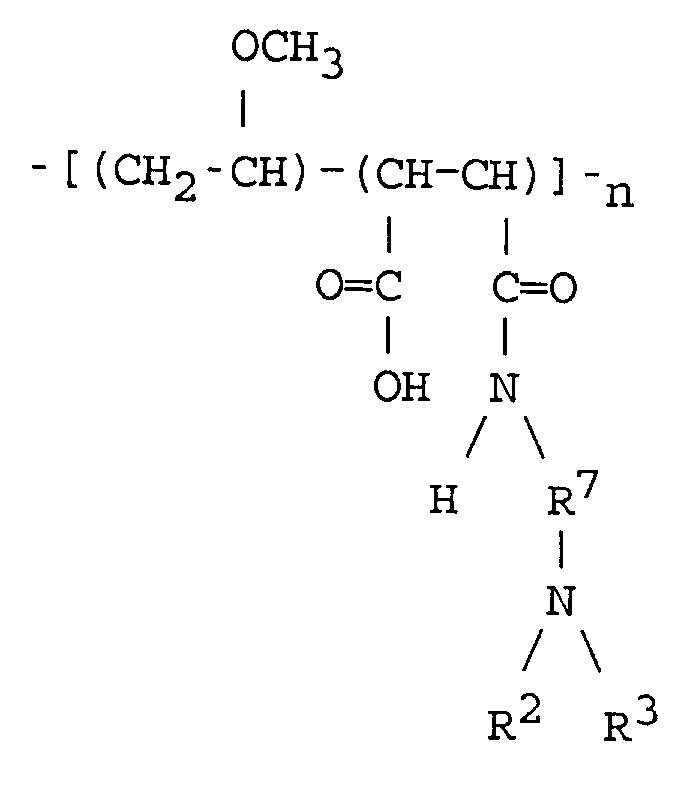
R² und R³ unabhängig eine Gruppe, ausgewählt aus der Gruppe, bestehend aus substituierten und nichtsubstituierten Alkyl-Gruppen mit bis zu 10 Kohlenstoffatomen und substituierten und nichtsubstituierten Aryl-Gruppen mit bis zu 14 Kohlenstoffatomen, oder R² und R³ können unter Bildung der substituierten oder nichtsubstituierten cyclischen Struktur -R²-R³- verbunden sein,
R⁷ eine substituierte oder nichtsubstituierte zweiwertige Alkyl-Gruppe mit bis zu 10 Kohlenstoffatomen und
n eine Zahl von etwa 100 bis etwa 600. - Zusammensetzung nach Anspruch 1, bei welcher das Matrixpolymer die Struktur hat:

- Zusammensetzung nach Anspruch 1, bei welcher das Matrixpolymer die Struktur hat:

R² und R³ unabhängig eine Gruppe, ausgewählt aus der Gruppe, bestehend aus substituierten und nichtsubstituierten Alkyl-Gruppen mit bis zu 10 Kohlenstoffatomen und substituierten und nichtsubstituierten Aryl-Gruppen mit bis zu 14 Kohlenstoffatomen, oder
R² und R³ können unter Bildung der substituierten oder nichtsubstituierten cyclischen Struktur -R²-R³-verbunden sein,
R⁷ eine substituierte oder nichtsubstituierte zweiwertige Alkyl-Gruppe mit bis zu 10 Kohlenstoffatomen und
n eine Zahl von etwa 100 bis etwa 600. - Zusammensetzung nach Anspruch 13, bei welcher das Matrixpolymer die Struktur hat:

- Zusammensetzung nach Anspruch 1, bei welcher die Matrixkomponente erzeugt wird, indem ein Copolymer, das Maleinsäureanhydrid enthält, umgesetzt wird mit einem Amin, ausgewählt aus der Gruppe, bestehend aus Verbindungen mit den Strukturen:

R² und R³ unabhängig ausgewählte Vertreter aus der Gruppe, bestehend aus substituierten und nichtsubstituierten Alkyl-Gruppen mit bis zu 10 Kohlenstoffatomen, substituierten und nichtsubstituierten Ester-Gruppen mit bis zu 10 Kohlenstoffatomen und substituierten und nichtsubstituierten Aryl-Gruppen mit bis zu 14 Kohlenstoffatomen,
R⁷ eine substituierte oder nichtsubstituierte zweiwertige Alkyl-Gruppe mit bis zu 10 Kohlenstoffatomen, worin die Substituenten ausgewählt werden aus der Gruppe, bestehend aus Halogeniden, -COOH, -CN und -NO₂. - Zusammensetzung nach Anspruch 15, bei welcher R², R³ und R⁷ ferner Teile enthalten, die ausgewählt werden aus der Gruppe, bestehend aus -CO-, -O- und -S=O.
- Zusammensetzung nach Anspruch 15 oder 16, bei welcher die Amino-, Alkyl- und Ester-Gruppen bis zu 5 Kohlenstoffatome haben.
- Zusammensetzung nach einem der Ansprüche 15 bis 17, bei welcher R² und R³ unter Bildung einer Ringstruktur verbunden sind.
- Zusammensetzung nach einem der Ansprüche 1 bis 18, bei welcher das vernetzte Polymer mindestens 20 Gewichtsprozent der Zusammensetzung umfaßt.
- Zusammensetzung nach einem der Ansprüche 1 bis 19, ferner einschließend einen Netzbildner.
- Transparenter Film, umfassend einen transparenten Träger, der auf mindestens einer seiner größeren Oberflächen eine Schicht trägt, die aus der Zusammensetzung nach einem der Ansprüche 1 bis 20 gebildet wird.
- Film nach Anspruch 21, bei welchem die Schicht ferner mit einer farbdurchlässigen, klebfreien Schutzschicht überzogen wird.
Applications Claiming Priority (2)
| Application Number | Priority Date | Filing Date | Title |
|---|---|---|---|
| US602481 | 1990-10-24 | ||
| US07/602,481 US5134198A (en) | 1990-10-24 | 1990-10-24 | Transparent liquid absorbent materials |
Publications (2)
| Publication Number | Publication Date |
|---|---|
| EP0482836A1 EP0482836A1 (de) | 1992-04-29 |
| EP0482836B1 true EP0482836B1 (de) | 1995-03-15 |
Family
ID=24411519
Family Applications (1)
| Application Number | Title | Priority Date | Filing Date |
|---|---|---|---|
| EP91309630A Expired - Lifetime EP0482836B1 (de) | 1990-10-24 | 1991-10-18 | Flüssigkeiten absorbierende, durchsichtige Materialien |
Country Status (4)
| Country | Link |
|---|---|
| US (1) | US5134198A (de) |
| EP (1) | EP0482836B1 (de) |
| JP (1) | JP3095479B2 (de) |
| DE (1) | DE69108168T2 (de) |
Cited By (5)
| Publication number | Priority date | Publication date | Assignee | Title |
|---|---|---|---|---|
| US6834955B2 (en) | 1999-11-01 | 2004-12-28 | Praful Doshi | Tinted lenses and methods of manufacture |
| US7048375B2 (en) | 1999-11-01 | 2006-05-23 | Praful Doshi | Tinted lenses and methods of manufacture |
| US7267846B2 (en) | 1999-11-01 | 2007-09-11 | Praful Doshi | Tinted lenses and methods of manufacture |
| US9052529B2 (en) | 2006-02-10 | 2015-06-09 | Johnson & Johnson Vision Care, Inc. | Comfortable ophthalmic device and methods of its production |
| US9395559B2 (en) | 2005-02-14 | 2016-07-19 | Johnson & Johnson Vision Care, Inc. | Comfortable ophthalmic device and methods of its production |
Families Citing this family (52)
| Publication number | Priority date | Publication date | Assignee | Title |
|---|---|---|---|---|
| US5192617A (en) * | 1990-10-24 | 1993-03-09 | Minnesota Mining And Manufacturing Company | Transparent liquid absorbent materials |
| US5219928A (en) * | 1990-10-24 | 1993-06-15 | Minnesota Mining And Manufacturing Company | Transparent liquid absorbent materials |
| US5241006A (en) * | 1990-10-24 | 1993-08-31 | Minnesota Mining And Manufacturing Company | Printable transparency |
| JPH05204402A (ja) * | 1992-01-23 | 1993-08-13 | Toyota Autom Loom Works Ltd | 各種装置のコントロールボックス |
| US5354813A (en) * | 1993-03-12 | 1994-10-11 | Minnesota Mining And Manufacturing Company | Polymeric mordants for dyes and the like |
| US5589269A (en) * | 1993-03-12 | 1996-12-31 | Minnesota Mining And Manufacturing Company | Ink receptive sheet |
| US5342688A (en) * | 1993-03-12 | 1994-08-30 | Minnesota Mining And Manufacturing Company | Ink-receptive sheet |
| US6180238B1 (en) * | 1993-03-19 | 2001-01-30 | Xerox Corporation | Recording sheets containing oxazole, isooxazole, oxazolidinone, oxazoline salt, morpholine, thiazole, thiazolidine, thiadiazole, and phenothiazine compounds |
| CA2151780A1 (en) | 1994-07-08 | 1996-01-09 | Joseph C. Carls | Removable nonporous opaque thin film layer |
| JPH08230313A (ja) * | 1994-12-12 | 1996-09-10 | Arkwright Inc | インクジェット媒体用ポリマーマトリックスコーティング |
| US6211304B1 (en) | 1995-02-23 | 2001-04-03 | 3M Innovative Properties Company | Mordants for ink-jet receptors and the like |
| US6015624A (en) * | 1995-02-28 | 2000-01-18 | 3M Innovative Properties Company | Ink-receptive sheet |
| US5567507A (en) * | 1995-02-28 | 1996-10-22 | Minnesota Mining And Manufacturing Company | Ink-receptive sheet |
| CA2234232A1 (en) * | 1995-10-26 | 1997-05-01 | Mohammed Iqbal | Composition for an ink-jet recording sheet |
| AU7157396A (en) * | 1995-10-26 | 1997-05-15 | Minnesota Mining And Manufacturing Company | Ink-jet recording sheet |
| DE69604643T2 (de) | 1995-12-07 | 2000-06-15 | E.I. Du Pont De Nemours And Co., Wilmington | Empfangsschicht für Tintenstrahlaufzeichnung |
| US5807624A (en) * | 1996-04-16 | 1998-09-15 | Minnesota Mining And Manufacturing Company | Electrostatically charged imaging manifold |
| US5932355A (en) * | 1997-02-07 | 1999-08-03 | Minnesota Mining And Manufacturing Company | Ink-jet recording sheet |
| US6153288A (en) * | 1997-07-24 | 2000-11-28 | Avery Dennison Corporation | Ink-receptive compositions and coated products |
| JP2000052647A (ja) | 1998-08-04 | 2000-02-22 | Esprit Chemical Co | インクジェット記録材料用コ―ティング剤およびインクジェット記録材料 |
| BE1013227A3 (nl) * | 2000-01-12 | 2001-11-06 | Den Abbeele Henk Van | Werkwijze voor het vervaardigen van een coating voor een substraat voor bedrukking met een printer. |
| WO2001058698A2 (en) * | 2000-02-08 | 2001-08-16 | 3M Innovative Properties Company | Improved media for cold image transfer |
| JP2003522304A (ja) * | 2000-02-08 | 2003-07-22 | スリーエム イノベイティブ プロパティズ カンパニー | インク定着材料およびインク定着方法 |
| US6465081B2 (en) | 2000-04-17 | 2002-10-15 | 3M Innovative Properties Company | Image receptor sheet |
| US6555213B1 (en) | 2000-06-09 | 2003-04-29 | 3M Innovative Properties Company | Polypropylene card construction |
| US6506478B1 (en) | 2000-06-09 | 2003-01-14 | 3M Innovative Properties Company | Inkjet printable media |
| CN1454140A (zh) | 2000-06-09 | 2003-11-05 | 3M创新有限公司 | 用于生产防水耐用的水性喷墨接受介质的材料和方法 |
| US6979480B1 (en) * | 2000-06-09 | 2005-12-27 | 3M Innovative Properties Company | Porous inkjet receptor media |
| US6811259B2 (en) | 2000-06-12 | 2004-11-02 | Novartis Ag | Printing colored contact lenses |
| US6809158B2 (en) | 2000-10-20 | 2004-10-26 | Nippon Shokubai Co., Ltd. | Water-absorbing agent and process for producing the same |
| US20030085934A1 (en) | 2001-11-07 | 2003-05-08 | Tucker Robert Carey | Ink-jet printing system for printing colored images on contact lenses |
| US7411008B2 (en) | 2001-11-07 | 2008-08-12 | Novartis Ag | Ink formulations and uses thereof |
| GB0130316D0 (en) * | 2001-12-19 | 2002-02-06 | Clariant Int Ltd | Composition for printing recording materials |
| US7153332B2 (en) * | 2001-12-19 | 2006-12-26 | Clariant Finance (Bvi) Limited | Use of a dyestuff for ink jet printing recording materials |
| GB0208444D0 (en) | 2002-04-12 | 2002-05-22 | Clariant Int Ltd | Composition for printing recording materials |
| US20030232210A1 (en) * | 2002-06-18 | 2003-12-18 | 3M Innovative Properties Company | Ink-receptive foam article |
| TWI306467B (en) * | 2002-11-13 | 2009-02-21 | Clariant Int Ltd | Mono azo dyes |
| US7820282B2 (en) * | 2003-04-10 | 2010-10-26 | 3M Innovative Properties Company | Foam security substrate |
| US7655296B2 (en) | 2003-04-10 | 2010-02-02 | 3M Innovative Properties Company | Ink-receptive foam article |
| CA2527134A1 (en) * | 2004-11-15 | 2006-05-15 | Lawrence N. Nadeau | Printable substrate, processes and compositions for preparation thereof |
| JP4701715B2 (ja) * | 2004-12-28 | 2011-06-15 | Jsr株式会社 | 光学フィルムの製造方法および光学フィルム |
| US20070059613A1 (en) | 2005-09-15 | 2007-03-15 | Kitchin Jonathan P | Repositionable photo card |
| US20080003383A1 (en) * | 2005-09-15 | 2008-01-03 | 3M Innovative Properties Company | Repositionable photo paper |
| US20070059631A1 (en) * | 2005-09-15 | 2007-03-15 | Kitchin Jonathan P | Repositionable glossy photo media |
| US20070089832A1 (en) * | 2005-09-15 | 2007-04-26 | Kitchin Jonathan P | Repositionable matte photo media |
| US20070059472A1 (en) * | 2005-09-15 | 2007-03-15 | 3M Innovative Properties Company | Repositionable photo media and photographs |
| US20070059652A1 (en) * | 2005-09-15 | 2007-03-15 | Kitchin Jonathan P | Repositionable glossy photo media |
| US7467873B2 (en) * | 2005-10-14 | 2008-12-23 | 3M Innovative Properties Company | Privacy film |
| US7326504B2 (en) * | 2005-10-14 | 2008-02-05 | 3M Innovative Properties Company | Imaged anti-copy film |
| US8673419B2 (en) * | 2008-03-14 | 2014-03-18 | 3M Innovative Properties Company | Stretch releasable adhesive tape |
| US8420069B2 (en) * | 2008-09-26 | 2013-04-16 | 3M Innovative Properties Company | Antimicrobial and antifouling polymeric materials |
| GB201804233D0 (en) | 2018-03-16 | 2018-05-02 | Univ Warwick | Cryopreserving processes |
Family Cites Families (25)
| Publication number | Priority date | Publication date | Assignee | Title |
|---|---|---|---|---|
| US3859096A (en) * | 1973-11-05 | 1975-01-07 | Eastman Kodak Co | Crosslinking polymeric dye mordants |
| SU1243627A3 (ru) * | 1979-12-05 | 1986-07-07 | Дзе Кендалл Компани (Фирма) | Гелеобразующа композици |
| US4369229A (en) * | 1981-01-29 | 1983-01-18 | The Kendall Company | Composite hydrogel-forming article and method of making same |
| US4578285A (en) * | 1983-03-16 | 1986-03-25 | Polaroid Corporation | Ink jet printing substrate |
| US4503111A (en) * | 1983-05-09 | 1985-03-05 | Tektronix, Inc. | Hydrophobic substrate with coating receptive to inks |
| US4636805A (en) * | 1984-03-23 | 1987-01-13 | Canon Kabushiki Kaisha | Record-bearing member and ink-jet recording method by use thereof |
| US4554181A (en) * | 1984-05-07 | 1985-11-19 | The Mead Corporation | Ink jet recording sheet having a bicomponent cationic recording surface |
| US4642247A (en) * | 1984-06-29 | 1987-02-10 | Canon Kabushiki Kaisha | Recording medium |
| US4555437A (en) * | 1984-07-16 | 1985-11-26 | Xidex Corporation | Transparent ink jet recording medium |
| US4592951A (en) * | 1984-07-18 | 1986-06-03 | Polaroid Corporation | Ink jet recording sheet |
| US4547405A (en) * | 1984-12-13 | 1985-10-15 | Polaroid Corporation | Ink jet transparency |
| JPS61230978A (ja) * | 1985-04-08 | 1986-10-15 | Canon Inc | 被記録材 |
| JPS61235183A (ja) * | 1985-04-11 | 1986-10-20 | Teijin Ltd | 水中没入型熱交換器 |
| JPS61235182A (ja) * | 1985-04-11 | 1986-10-20 | Teijin Ltd | 記録シ−ト |
| JPS61261089A (ja) * | 1985-05-15 | 1986-11-19 | Teijin Ltd | 記録シ−ト |
| JPS61293886A (ja) * | 1985-06-21 | 1986-12-24 | Sanyo Chem Ind Ltd | インクジエツト紙用薬剤 |
| JPS6232079A (ja) * | 1985-08-05 | 1987-02-12 | Asia Genshi Kk | プロツタ用ohpフイルム |
| JPS61135788A (ja) * | 1985-09-18 | 1986-06-23 | Canon Inc | インクジエツト記録方法 |
| GB8602593D0 (en) * | 1986-02-03 | 1986-03-12 | Ici Plc | Inkable sheet |
| GB8602594D0 (en) * | 1986-02-03 | 1986-03-12 | Ici Plc | Inkable sheet |
| US4649064A (en) * | 1986-03-10 | 1987-03-10 | Eastman Kodak Company | Rapid-drying recording element for liquid ink marking |
| US4910084A (en) * | 1987-05-01 | 1990-03-20 | Mitsubishi Paper Mills, Ltd. | Ink jet recording medium |
| DE3921498A1 (de) * | 1988-09-28 | 1990-03-29 | Bayer Ag | Polymer-gebundene-farbstoffe, verfahren zu deren herstellung und verwendung |
| US4935307A (en) * | 1988-10-21 | 1990-06-19 | Minnesota Mining And Manufacturing Company | Transparent coatings for graphics applications |
| DE3842202C1 (de) * | 1988-12-15 | 1990-05-03 | Th. Goldschmidt Ag, 4300 Essen, De |
-
1990
- 1990-10-24 US US07/602,481 patent/US5134198A/en not_active Expired - Lifetime
-
1991
- 1991-10-18 JP JP03270851A patent/JP3095479B2/ja not_active Expired - Fee Related
- 1991-10-18 EP EP91309630A patent/EP0482836B1/de not_active Expired - Lifetime
- 1991-10-18 DE DE69108168T patent/DE69108168T2/de not_active Expired - Fee Related
Cited By (10)
| Publication number | Priority date | Publication date | Assignee | Title |
|---|---|---|---|---|
| US6834955B2 (en) | 1999-11-01 | 2004-12-28 | Praful Doshi | Tinted lenses and methods of manufacture |
| US7048375B2 (en) | 1999-11-01 | 2006-05-23 | Praful Doshi | Tinted lenses and methods of manufacture |
| US7267846B2 (en) | 1999-11-01 | 2007-09-11 | Praful Doshi | Tinted lenses and methods of manufacture |
| US7549742B2 (en) | 1999-11-01 | 2009-06-23 | Praful Doshi | Tinted lenses and methods of manufacture |
| US9395559B2 (en) | 2005-02-14 | 2016-07-19 | Johnson & Johnson Vision Care, Inc. | Comfortable ophthalmic device and methods of its production |
| US10267952B2 (en) | 2005-02-14 | 2019-04-23 | Johnson & Johnson Vision Care, Inc. | Comfortable ophthalmic device and methods of its production |
| US11150383B2 (en) | 2005-02-14 | 2021-10-19 | Johnson & Johnson Vision Care, Inc. | Comfortable ophthalmic device and methods of its production |
| US11953651B2 (en) | 2005-02-14 | 2024-04-09 | Johnson & Johnson Vision Care, Inc. | Comfortable ophthalmic device and methods of its production |
| US12461280B2 (en) | 2005-02-14 | 2025-11-04 | Johnson & Johnson Vision Care, Inc. | Comfortable ophthalmic device and methods of its production |
| US9052529B2 (en) | 2006-02-10 | 2015-06-09 | Johnson & Johnson Vision Care, Inc. | Comfortable ophthalmic device and methods of its production |
Also Published As
| Publication number | Publication date |
|---|---|
| JPH04306263A (ja) | 1992-10-29 |
| DE69108168T2 (de) | 1995-10-12 |
| EP0482836A1 (de) | 1992-04-29 |
| JP3095479B2 (ja) | 2000-10-03 |
| DE69108168D1 (de) | 1995-04-20 |
| US5134198A (en) | 1992-07-28 |
Similar Documents
| Publication | Publication Date | Title |
|---|---|---|
| EP0482836B1 (de) | Flüssigkeiten absorbierende, durchsichtige Materialien | |
| US5192617A (en) | Transparent liquid absorbent materials | |
| EP0482838B1 (de) | Flüssigkeitabsorbierende durchsichtige Materialien für Tinte-aufnehmende Schichten | |
| US5472789A (en) | Transparent liquid absorbent materials for use as ink receptive layers | |
| EP0482837B1 (de) | Flüssigkeiten absorbierende durchsichtige Materialien | |
| US5241006A (en) | Printable transparency | |
| EP0688265B1 (de) | Verbesserte tintenaufnahmestreifen | |
| EP0365307B1 (de) | Transparente Beschichtungen für graphische Anwendungen | |
| US5863662A (en) | Terpolymer for ink jet recording | |
| EP0914961B1 (de) | Wasserfestes tintenaufnehmendes Material | |
| EP0554370B1 (de) | Überzug für hydrophile durchdringende netzwerke | |
| US20040071900A1 (en) | Binding substrate for inkjet inks |
Legal Events
| Date | Code | Title | Description |
|---|---|---|---|
| PUAI | Public reference made under article 153(3) epc to a published international application that has entered the european phase |
Free format text: ORIGINAL CODE: 0009012 |
|
| AK | Designated contracting states |
Kind code of ref document: A1 Designated state(s): CH DE FR GB IT LI |
|
| 17P | Request for examination filed |
Effective date: 19921028 |
|
| 17Q | First examination report despatched |
Effective date: 19940503 |
|
| GRAA | (expected) grant |
Free format text: ORIGINAL CODE: 0009210 |
|
| AK | Designated contracting states |
Kind code of ref document: B1 Designated state(s): CH DE FR GB IT LI |
|
| REF | Corresponds to: |
Ref document number: 69108168 Country of ref document: DE Date of ref document: 19950420 |
|
| ITF | It: translation for a ep patent filed | ||
| ET | Fr: translation filed | ||
| PLBE | No opposition filed within time limit |
Free format text: ORIGINAL CODE: 0009261 |
|
| STAA | Information on the status of an ep patent application or granted ep patent |
Free format text: STATUS: NO OPPOSITION FILED WITHIN TIME LIMIT |
|
| 26N | No opposition filed | ||
| REG | Reference to a national code |
Ref country code: GB Ref legal event code: IF02 |
|
| PGFP | Annual fee paid to national office [announced via postgrant information from national office to epo] |
Ref country code: DE Payment date: 20071130 Year of fee payment: 17 |
|
| PGFP | Annual fee paid to national office [announced via postgrant information from national office to epo] |
Ref country code: IT Payment date: 20071030 Year of fee payment: 17 Ref country code: CH Payment date: 20071030 Year of fee payment: 17 |
|
| PGFP | Annual fee paid to national office [announced via postgrant information from national office to epo] |
Ref country code: GB Payment date: 20071029 Year of fee payment: 17 Ref country code: FR Payment date: 20071017 Year of fee payment: 17 |
|
| REG | Reference to a national code |
Ref country code: CH Ref legal event code: PL |
|
| GBPC | Gb: european patent ceased through non-payment of renewal fee |
Effective date: 20081018 |
|
| REG | Reference to a national code |
Ref country code: FR Ref legal event code: ST Effective date: 20090630 |
|
| PG25 | Lapsed in a contracting state [announced via postgrant information from national office to epo] |
Ref country code: IT Free format text: LAPSE BECAUSE OF NON-PAYMENT OF DUE FEES Effective date: 20081018 Ref country code: DE Free format text: LAPSE BECAUSE OF NON-PAYMENT OF DUE FEES Effective date: 20090501 |
|
| PG25 | Lapsed in a contracting state [announced via postgrant information from national office to epo] |
Ref country code: LI Free format text: LAPSE BECAUSE OF NON-PAYMENT OF DUE FEES Effective date: 20081031 Ref country code: CH Free format text: LAPSE BECAUSE OF NON-PAYMENT OF DUE FEES Effective date: 20081031 Ref country code: FR Free format text: LAPSE BECAUSE OF NON-PAYMENT OF DUE FEES Effective date: 20081031 |
|
| PG25 | Lapsed in a contracting state [announced via postgrant information from national office to epo] |
Ref country code: GB Free format text: LAPSE BECAUSE OF NON-PAYMENT OF DUE FEES Effective date: 20081018 |