EP0483388A1 - Mémoire optique à accès aléatoire - Google Patents
Mémoire optique à accès aléatoire Download PDFInfo
- Publication number
- EP0483388A1 EP0483388A1 EP90120141A EP90120141A EP0483388A1 EP 0483388 A1 EP0483388 A1 EP 0483388A1 EP 90120141 A EP90120141 A EP 90120141A EP 90120141 A EP90120141 A EP 90120141A EP 0483388 A1 EP0483388 A1 EP 0483388A1
- Authority
- EP
- European Patent Office
- Prior art keywords
- light
- matrix
- multiplexer
- memory
- optical
- Prior art date
- Legal status (The legal status is an assumption and is not a legal conclusion. Google has not performed a legal analysis and makes no representation as to the accuracy of the status listed.)
- Granted
Links
- 230000003287 optical effect Effects 0.000 title claims abstract description 106
- 239000011159 matrix material Substances 0.000 claims abstract description 85
- 239000013078 crystal Substances 0.000 claims description 50
- 239000003365 glass fiber Substances 0.000 claims description 22
- 230000008859 change Effects 0.000 claims description 9
- 239000011248 coating agent Substances 0.000 claims description 4
- 238000000576 coating method Methods 0.000 claims description 4
- 230000001419 dependent effect Effects 0.000 claims 1
- 238000011161 development Methods 0.000 description 6
- 230000018109 developmental process Effects 0.000 description 6
- 230000000694 effects Effects 0.000 description 6
- 230000008901 benefit Effects 0.000 description 5
- 239000007787 solid Substances 0.000 description 4
- 238000000034 method Methods 0.000 description 3
- 230000008569 process Effects 0.000 description 3
- 230000009471 action Effects 0.000 description 2
- 230000006870 function Effects 0.000 description 2
- 230000010287 polarization Effects 0.000 description 2
- 238000011144 upstream manufacturing Methods 0.000 description 2
- 230000005374 Kerr effect Effects 0.000 description 1
- 238000006243 chemical reaction Methods 0.000 description 1
- 230000001427 coherent effect Effects 0.000 description 1
- 238000010276 construction Methods 0.000 description 1
- 230000002349 favourable effect Effects 0.000 description 1
- 238000010438 heat treatment Methods 0.000 description 1
- 230000005415 magnetization Effects 0.000 description 1
- 230000000717 retained effect Effects 0.000 description 1
- 238000000926 separation method Methods 0.000 description 1
- 230000002123 temporal effect Effects 0.000 description 1
Images

Classifications
-
- G—PHYSICS
- G11—INFORMATION STORAGE
- G11B—INFORMATION STORAGE BASED ON RELATIVE MOVEMENT BETWEEN RECORD CARRIER AND TRANSDUCER
- G11B7/00—Recording or reproducing by optical means, e.g. recording using a thermal beam of optical radiation by modifying optical properties or the physical structure, reproducing using an optical beam at lower power by sensing optical properties; Record carriers therefor
Definitions
- the invention relates to an optical memory having an optical storage medium which has a multiplicity of memory fields arranged in matrix form, each memory field of this memory field matrix containing a memory location matrix which consists of a number of memory locations arranged in matrix form and having an X / Y deflection device for the optional addressing of a memory location of a memory field of the memory field matrix, which is controlled with an X control signal and with a Y control signal, so that a light beam impinging on the X / Y deflection device is a function of the light source Positioning of the X / Y deflection device effected with both control signals is directed to a storage location of a storage field of the optical storage medium corresponding to this positioning.
- optical memory is known from US Pat. No. 3,996,570.
- a disadvantage of the known optical memory which is apparent at first glance is that two separate optical devices are required for reading and writing data to the storage medium.
- the use of an optical reading device and an optical writing device which is separate from the optical reading device in terms of its structure and its function disadvantageously requires a complex structure of the optical memory.
- the writing device used to write data to the optical storage medium has a laser acting as a light source, which emits a spatially coherent and collimated laser beam. After passing through an electro-optical modulator, the laser beam is fed to the two-stage X / Y deflection device which is used for the optional addressing of the individual storage locations of the storage medium: A memory field deflection device of the X / Y deflection device effects a selection of a memory field from the large number of those on the storage medium storage fields arranged in matrix form.
- One of the Memory field deflection device upstream of the acousto-optical memory location deflection device of the X / Y deflection device serves for the optional addressing of a specific memory location of the memory field determined by the memory field deflection device.
- the deflected laser beam After passing through this two-stage X / Y deflection device, the deflected laser beam is guided to a semi-transparent mirror and reflected there.
- the reflected light beam is guided to the storage medium via a matrix lens arrangement which serves to focus the laser beam.
- the action of the laser beam on a selected memory location of a memory field causes a change in the physical state of the respective memory location, which can be detected by the reading device of the optical memory during reading.
- the optical reading device has a matrix light-diode arrangement arranged behind the storage medium, in which a light diode is provided for each storage field of the storage medium.
- the individual light diodes of the matrix light diode arrangement are controlled by the control device of the optical memory, so that an optional addressing of a memory field of the storage medium is achieved.
- the light emitted by a light diode of the matrix light diode arrangement passes through the illuminated memory field of the storage medium and is emitted by the matrix lens arrangement arranged in front of the storage medium focused and is guided through the semi-transparent mirror to a lens system. This lens system enlarges the image of the illuminated memory field of the storage medium generated by the light diode of the matrix light-diode arrangement.
- This complex lens arrangement is necessary in order to then be able to detect the individual storage locations of the depicted storage field of the storage medium in a detector arrangement of the optical reading device:
- the detector arrangement has a large number of detectors arranged in matrix form, their number and arrangement of the configuration of the storage locations corresponds to one of the memory fields.
- this known optical memory also has a large number of unfavorable properties, so that the known optical memory does not meet the requirements that arise in modern data processing systems: the memory field deflection device of the optical one Writing device is formed by two mechanically rotatable mirrors, which are adjusted by stepper motors. Such mechanical positioning of the rotating mirrors used for optional storage field deflection disadvantageously results in slow access to a specific storage area of the storage medium.
- the mechanical positioning of the rotating mirrors of the Memory field deflection device brings with it positioning tolerances which have a negative influence on the storage location density of the storage medium:
- the individual storage locations of the storage medium must be spatially separated so far that the laser beam, taking the positioning tolerances into account, is always within the range of a storage location on the Storage medium occupied area remains. Due to the tolerances that occur during mechanical beam positioning, it is therefore not possible to use a highly integrated storage medium in which two adjacent storage locations are spatially closely spaced: The positioning errors that occur in the known X / Y deflection device of the optical memory would then be in one incorrect location access results, which leads to data errors.
- the known optical memory for data processing systems has the disadvantage that it only allows a bit-serial writing of the data to be stored into the individual storage locations of the storage medium: it is disadvantageously possible in each case only by a corresponding control of the storage location deflection device and / or access the memory array deflector to a single memory location.
- Such a temporal serial access to the storage locations of the storage medium is the Requirements that the high operational speed of modern data processing systems place on the optical memory interacting with them do not grow.
- the object of the invention is to develop an optical memory with random access of the type mentioned at the outset in such a way that particularly rapid access to the storage locations of the storage medium is made possible.
- a beam multiplexer is arranged between the light source and the optical storage medium, which fans out an incident light beam into a number of light beams forming a light beam matrix such that each light beam of the light beam matrix corresponds to a memory field of the memory field matrix is assigned to the optical storage medium and that, depending on the control of the X / Y deflection device by the X and Y control signals, each light beam of the light beam matrix strikes the memory location of the memory field matrix associated with this control, of the memory field matrix assigned to it, so that one memory location of all memory fields is acted upon simultaneously by the assigned light beam of the light beam matrix.
- the measures according to the invention result in a particularly advantageous manner that bit-parallel access to several storage locations of the storage medium is made possible.
- the two-dimensional splitting of the light beam emitted by the light source into the light beams of the light beam matrix, which is carried out in the beam multiplexer of the optical memory according to the invention with random access, has the effect in a particularly advantageous manner that at the same time one memory location of each memory field of the memory field matrix of the optical storage medium One light beam impinges on each:
- This bit-parallel access which simultaneously scans a plurality of memory locations, achieves an extremely high operating speed of the optical memory according to the invention in a particularly advantageous manner.
- the bit-parallel access to a memory location of each memory field of the memory array matrix of the optical storage medium caused by the beam multiplexer of the optical memory according to the invention also has the advantage that in the known optical memory the one required for addressing the individual memory fields of the optical storage medium slow and inexact access with the associated memory array deflection device can be dispensed with: it is no longer the case with the optical memory according to the invention necessary to select a specific storage field of the storage field matrix of the optical storage medium by mechanically positioning the rotatable mirrors, since a light beam generated in the beam multiplexer is assigned to the light beam matrix simultaneously to all storage fields of the optical storage medium.
- the optical memory according to the invention also has the advantage that it can be designed for an extremely high storage location density, since there is no disadvantageous positioning error with mechanical positioning of the rotatable mirrors of the memory field deflection device provided in the known optical memory.
- the beam multiplexer of the optical memory according to the invention consists of an X-beam multiplexer and a Y-beam multiplexer connected downstream of the X-beam multiplexer in the beam path of the light beam.
- the X-beam multiplexer splits the light beam emitted by the light source into a number of parallel light beams that are fanned out in an X direction.
- the parallel light beams emerging from the X-beam multiplexer strike the Y-beam multiplexer. Each of these parallel light beams fanned out in the X direction is then split in the Y beam multiplexer into a number of parallel light beams fanned out in a Y direction.
- the measures according to the invention have the effect that simultaneous, bit-parallel access to all memory fields of the memory field matrix of the storage medium is made possible in a particularly simple manner.
- the X-beam multiplexer and / or the Y-beam multiplexer consists of a number of optically birefringent crystals.
- the optically birefringent crystals which preferably consist of double spar, form in a particularly simple manner a beam multiplexer for the two-dimensional splitting of a light beam, which is distinguished by its particularly cost-effective structure.
- a further advantageous development of the invention provides that an alternative embodiment of the beam multiplexer is formed by the X-beam multiplexer, by a reversing prism arranged on the output side of the X-beam multiplexer and by three mirrors arranged on the input side of the X-beam multiplexer.
- the parallel light beams emerging from the X-beam multiplexer and fanned out in the X-direction are returned to the first mirror through the reversing prism.
- the parallel light rays reflected from the first mirror become the second and third mirrors headed. These are arranged such that the parallel light beams striking them, fanned out in the X direction, enter the X beam multiplexer offset in the Y direction.
- Each of these light beams offset in the Y direction is in turn fanned out in the X direction in the X direction, so that the light beam matrix emerges at the output of the beam multiplexer.
- a beam multiplexer constructed in this way is distinguished in a particularly advantageous manner by a simple and compact construction, since the inverting prism and the three mirrors replace the Y beam multiplexer.
- a further advantageous development of the invention provides that a further alternative embodiment of the beam multiplexer is formed by a glass fiber bundle which has a large number of glass fibers.
- the beam multiplexer is arranged between the light source and the X / Y deflection device and converts the light beam that occurs at the entrance of the glass fiber bundle and is emitted by the light source into the light beam matrix, the light beams of which are then guided to the mirroring of the X / Y deflection device.
- the outstanding property of such a beam multiplexer is its extremely simple implementation, since only conventional glass fibers are necessary.
- a further advantageous development of the invention provides before that the X / Y deflection device, which is controlled by a control device of the optical memory with an X control signal and with a Y control signal, of the optical memory according to the invention is formed by two mirrored piezo crystals.
- the use of piezo crystals for the optional addressing of the storage locations of the optical storage medium has the advantage that an extremely fast access time is achieved.
- the piezo crystals are deformed as a result of the reciprocal piezoelectric effect, which occurs due to the application of voltage by means of the X or Y control signals, and follow a change in these control signals almost without delay: the access time is essentially only increased by the electronic signal processing in the control device of the optical memory determined.
- Such a two-dimensional beam deflection by means of the piezoelectric crystals is also characterized by an extremely high reproducibility of the deflection values and by an extremely high spatial resolution when positioning the beam on the optical storage medium, so that storage media with an extremely high storage location density can be used.
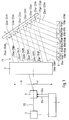
- the exemplary embodiment of an optical memory with random access shown in FIG. 1 has a laser serving as light source 2, which emits a collimated and polarized light beam 20.
- the light beam 20 is guided via an X / Y deflection device 3 and via a beam multiplexer 5 to an optical storage medium 1.
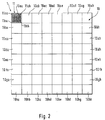
- the optical storage medium 1 shown in more detail in FIG. 2 has a large number in matrix form arranged storage fields 10aa-10ah, 10ba-10bh, ..., 10ha-10hh.
- Each storage field of a storage field matrix 10 of the optical storage medium 1 formed in this way has a multiplicity of storage locations 11aa-11hh arranged in matrix form.
- the values for k, l, m, n used here have only an exemplary character and were chosen for the sake of a more concise description of the exemplary embodiment. However, it is not necessary for the number m or k of the rows of the memory fields or of the memory locations of the memory array 10 or of the memory array 11 to correspond to the number n or 1 of the columns thereof.
- optical storage medium 1 described here into a storage field matrix 10 and into storage location matrices 11 has only a formal character, since — as will be explained further below — the division of the optical storage medium 1 essentially by the components of the optical storage described below itself and is not to be regarded as an externally specified subdivision
- the storage medium 1 is in a known manner magneto-optical storage medium formed, which is coated with a thin layer of a magnetic coating.
- the action of a light beam on one of the storage locations 11aa-11hh causes the magnetized layer of the optical storage medium 1 to be heated in this region above the Curie point, so that the applied magnetic layer of the storage location of the storage medium loses its original magnetization.
- an electromagnet (not shown) which is controlled by a control device 4 of the optical storage device. This magnet generates a magnetic field, the orientation of which corresponds to the binary state of the binary data bit to be stored in this memory location.
- the external magnetic field generated by the electromagnet forces the atoms of the magnetized layer of the heated storage location of the storage medium in a defined direction, which is retained after the storage location has cooled.
- a polarized light beam is used, the energy of which is insufficient for heating the magnetized layer of the optical storage medium via the Curie point.
- the direction of polarization of the incident light beam is rotated by the magneto-optical Kerr effect. This rotation of the polarization direction is converted by an analyzer into a fluctuation in the light intensity, which is then detected in a detector.
- the light source 2 is controlled by the control device 4 of the optical memory in such a way that the pulse duration and the pulse amplitude of the emitted light beam 20 correspond to the different, o.g. Corresponds to requirements regarding the pulse power during the writing and reading processes.
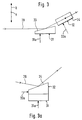
- the light beam 20 emitted by the light source 2 is guided to the X / Y deflection device 3, which is shown in FIG. 3.
- This causes a two-dimensional deflection of the light beam 20 in an X direction and / or in a Y direction (see also FIG. 1).
- the two-dimensional deflection of the light beam 20 is carried out by two mirrored piezocrystals.
- a second piezo crystal 32 provided with a mirror coating 34 deflects the light beam 20 reflected by a mirror coating 33 of the first piezo crystal 31 in the Y direction.
- the first and the second piezo crystal 31 and 32 are each electrically conductively connected to the control device 4 of the optical memory via a first and a second control line 31a and 32a. This generates - in accordance with the desired deflection of the light beam 20 - an X control signal and a Y control signal.
- a discrete change in the X / Y control signal results in a defined manner in a specific change in position of the mirroring 33 or 34 of the first or second piezo crystal 31 or 32, which causes a change in the angle of incidence of the light beam 20 emitted by the light source 2.
- Appropriate addressing of a memory location 11aa-11hh of the memory location matrix is achieved in a particularly simple manner by correspondingly controlling the first and / or the second piezo crystal 31, 32 with the X and Y control signals generated by the control device 4 of the optical memory 11 reached.
- the dimensions k and l of the memory location matrix 11 are essentially determined by how many discrete, reproducible voltage values can be generated within a total voltage range: the number k of memory locations 11aa-11ah in a row or the number 1 of memory locations 11aa-11ha in a column one
- the memory field 11 of the memory field matrix 10 is essentially determined by the number of these discrete voltage values of the X or Y control signal, which result in a defined and discriminatory deflection of the first or second piezo crystal 31 or 32 of the X / Y deflection device 3 result.
- the different ones Voltage application with two adjacent discrete voltage values of the X or Y control signal resulting change in position of the light beam impingement point on the optical storage medium 1 must be slightly larger than the extent of a storage location on the storage medium 1, this extent being essentially due to the beam diameter of the optical storage medium 1 incident light beam is determined.
- the use of mirrored piezo crystals 31, 32 for two-dimensional beam deflection also has the advantage that an extremely fast access time to the individual storage locations of the optical storage medium 1 is achieved in a particularly advantageous manner: the first piezo crystal 31 or the second piezo crystal 32 follow one Change of the X control signal or the Y control signal without delay, so that the access time essentially only by the electronic signal processing in the control device 4 - for the X / Y deflection essentially a digital / analog conversion - the optical Memory is determined.
- Another advantage of two-dimensional beam deflection by means of piezo crystals is that the deflection is extremely reproducible.
- the described memory can also be used with storage media which are characterized by an extremely high storage capacity Mark storage location density.
- FIG. 3a An alternative embodiment of the X / Y deflection device 3 of the optical storage medium is shown in FIG. 3a.
- the functioning of this X / Y deflection device consisting of the rigidly interconnected piezo crystals 31 and 32 can be clearly seen by the person skilled in the art from the above description, so that further explanations for this point are unnecessary.
- the two-dimensionally deflected light beam 20 in the X / Y deflection device 3 is guided to a beam multiplexer 5 in which it is split into a plurality of parallel light beams.
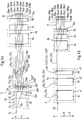
- the beam multiplexer 5 shown in FIG. 4 is essentially divided into an X-beam multiplexer 5a and a Y-beam multiplexer 5b.
- the X-beam multiplexer 5a has a first, a second and a third optically birefringent crystal 51, 52 and 53, in which the light beam 20 impinging on the X-beam multiplexer 5a is fanned out in the X direction.
- the Y-beam multiplexer 5b is formed by a fourth, a fifth and a sixth optically birefringent crystal 54, 55 and 56, in which those emerging from the X-beam multiplexer are already in FIG X-direction fanned light rays are fanned in the Y-direction.
- the optically birefringent crystals 51-56 of the beam multiplexer 5 advantageously consist of double spar, which is distinguished by its particularly favorable birefringence properties.
- the optical birefringence taking place in the crystals 51-53 causes the light beam 20 incident on the beam multiplexer 5 in the first optically birefringent crystal 51 to be split into two separate beams, namely into a first ordinary light beam 21o and into a first extraordinary light beam 21e.
- the first ordinary beam 21o emerging from the first optically birefringent crystal 51 and the extraordinary light beam 21e impinge on the second optical crystal 52 and become in an analogous manner in the two second ordinary light beams 22o and 22o 'and in the two second ones extraordinary light beams 22e and 22e 'split.
- the four light beams 22o, 22o ', 22e and 22e' generated in the second optically birefringent crystal 52 then arrive at the third optically birefringent crystal 53 of the X-beam multiplexer 5a and are converted into four third ordinary light beams 23o, 23o ', 23o'',23o'' and split into four third extraordinary light beams 23e, 23e ', 23e'',23e'''.
- the person skilled in the art can clearly see the mode of operation of the X-beam multiplexer 5a, as described by a series arrangement of a plurality of appropriately aligned optically birefringent crystals achieves a splitting of a light beam 20 occurring on the X-beam multiplexer 5a into a multiplicity of parallel light beams 20a-20h: the number of parallel light beams 20a-20h emerging from the X-beam multiplexer 5a is 2 x , where x denotes the number of optically birefringent crystals arranged in the X-ray multiplexer 5a.
- the number of light beams 20a-20h emerging from the X-multiplexer thus determines the number n of memory fields 10aa-10ha of a column of memory field matrix 10.
- the thickness d1, d2 and d3 of the optically birefringent crystals 51-53 are matched to one another such that the thickness of a crystal - e.g. of the second crystal 52 - half the thickness of the crystal preceding in the beam path of the light beam 20 through the X-beam multiplexer 5a (here: the first crystal 51).
- the thicknesses d1, d2 and d3 of the first, the second and the third optically birefringent crystal 51 behave -53 according to the ratio 4: 2: 1.
- the parallel light beams 20a-20h that are already fanned out in the X-direction are split in the Y-direction.
- the beam multiplication taking place in the Y-beam multiplexer 5b is shown in FIG. 4b and is clearly understandable for the person skilled in the art from the beam multiplication in the X-beam multiplexer 5a described above. A detailed description of the beam multiplication in the Y-beam multiplexer is therefore no longer necessary at this point.
- An essential requirement that the beam multiplexer 5 must meet is that an angle correlation between the solid angle of the light beam 20 incident on the beam multiplexer 5 and the solid angle of the parallel light beams 20aa-20hh emerging therefrom, forming a light beam matrix 25.
- This angular correlation ensures that a certain deflection of the light beam 20 in the X / Y deflection device 3 results in a precisely definable deflection of the parallel light beams 20aa-20hh of the light beam matrix 25, so that the X / Y- Deflection device 3 by means of the control device 4 random access to a specific storage location of the storage location matrix 11 of each storage field 10aa-10hh of the storage field matrix 10 of the optical storage medium 1 is achieved.
- the beam multiplexer 5 described above fulfills this requirement in a particularly advantageous manner.
- FIGS. 5a-5c An alternative embodiment of the beam multiplexer is shown in FIGS. 5a-5c.
- This second embodiment 5 ' is distinguished in a particularly advantageous manner by its greatly simplified structure: only one X-beam multiplexer 5a is required.
- the Y-beam multiplexer 5b is replaced by a reversing prism 5c and three mirrors 5d, 5e and 5f.
- FIGS. 5a-5c shows a side view from the Y direction of FIG. 1.
- FIG. 5b shows a top view of the beam multiplexer from the X direction of FIG. 1
- FIG. 5c shows the beam multiplexer 5 'from the point of view of the light beam 20 striking it.
- the light beam 20 is - as was described analogously above - in X-beam multiplexer 5a is split into a number of parallel light beams 20a-20h fanned out in the X direction. After the exit of the parallel light beams 20a-20h from the X-beam multiplexer 5a, these light beams 20a-20h are guided to the reversing prism 5c, which returns the light beams 20a-20h from the output side of the beam multiplexer 5a to its input side.
- the first mirror 5d is arranged at an incline such that the light beams 20a-20h diverted by the reversing prism 5c undergo a change in direction, so that they run essentially parallel to the input side of the X-beam multiplexer 5a.
- the second mirror 5e following the first mirror 5d in the beam path deflects the light rays 20a-20h reflected by the first mirror 5d in such a way that their X-fanning is converted into a Y-fanning: the third mirror 5f guides the rays from the mirror that run parallel to the input side second mirrors 5e reflected light beams in such a way that they fanned out in the Y direction and entered the X-beam multiplexer 5a parallel to the light beam 20 emitted by the light source 2.
- the light beams 20a-20h consequently strike the input side of the beam multiplexer 5a offset in the Y direction. This causes everyone the light beams 20a-20h is in turn split in the X direction, so that the light beam matrix 25 formed by the light beams 20aa-20hh emerges at the output side of the beam multiplexer 5a.
- Such a two-dimensional splitting of the light beam 20 into the parallel light beams 20aa-20hh of the light beam matrix 25 has the effect, in a particularly advantageous manner, that bit-parallel access to one memory location of each memory field 10aa-10hh of the memory field matrix 10 of the optical Storage medium 1 is reached. It is therefore particularly advantageously possible to simultaneously store or read m x n (here: 8 x 8) bits in the corresponding storage locations of the optical storage medium. This bit-parallel access considerably reduces the processing time required to process the corresponding number of bits, as a result of which a particularly high operating speed of the optical memory is achieved.
- the reading of the data stored on the optical storage medium 1 takes place in an analogous manner to the writing, whereby - as already mentioned at the beginning - a light beam 20 with lower energy is used, so that the optical storage medium 1 is not heated via the Curie point .
- Light rays 22aa-22hh reflected from the memory array matrix 10 are directed to a detector arrangement 6 which has a multiplicity of detectors 61aa-61hh arranged in matrix form.
- the number of detectors 61aa-61hh corresponds to the number of parallel light beams 20aa-20hh generated by the beam multiplexer 5 and forming the light beam matrix 25.
- Each of the detectors 61aa-61hh of the detector arrangement 6 is assigned to exactly one of the reflected light beams 22aa-22hh and registers its intensity, which - as already described above - represents the binary occupancy of the relevant storage location.
- FIG. 6 shows a second exemplary embodiment of the optical memory with random access.
- This is essentially identical to the exemplary embodiment described above, so that the same parts are designated with the same reference numerals.
- the essential difference between these two exemplary embodiments of an optical memory is that in the second exemplary embodiment the beam multiplexer 5 or 5 'is connected upstream of the X / Y deflection device 3.
- the light beam 20 emitted by the light source 2 is therefore only two-dimensionally deflected after its splitting into the light beam matrix 25 consisting of the parallel light beams 20aa-20hh.
- the beam multiplexer 5, 5 ' can be made simpler because it is on it incident light beam 20 always falls in the same direction: it is therefore not necessary for the beam multiplexer 5 or 5 'to have a clear angle correlation between the incident solid angle of the incident light beam 20 and the exit solid angle of the emerging parallel light beams 20aa-20hh the light beam -Matrix 25 is given.
- a glass fiber bundle consisting of m x n glass fibers can therefore be used as the beam multiplexer, the input of which is acted upon by the light beam 20 emitted by the light source 2.
- the individual glass fibers of the glass fiber bundle are then spatially arranged in such a way that m x n parallel light beams emerge at the output side of the glass fiber bundle, each of which is at a certain spatial distance from one another.
- the light beams of the light beam matrix 25 thus formed are then fed to the X / Y deflection device 3.
- the two embodiments of the above described optical storage assumed that the light beams 20aa-20ah of the light beam matrix 25 are equidistant and parallel to each other. This assumption is not absolutely necessary: on the contrary, it is possible to design the beam multiplexer in such a way that the light beams 20aa-20hh emerging from its output side of the light beam matrix 25 are divergent, ie the individual light beams 20aa-20hh of the light beam matrix 25 form one Beam pyramid, the tip of which is directed to the light source 2.
- the beam multiplexer just described which consists of mxn glass fibers, is particularly suitable for generating such a beam path:
- the individual glass fibers of the glass fiber bundle are then arranged spatially and / or ground at their exit ends so that the emerging light beams as a whole have the aforementioned light beams - Form pyramid.
- the term “light beams of the light beam matrix 25” is intended to include both parallel and divergent light beams forming a light beam pyramid in the following claims.
Landscapes
- Optical Recording Or Reproduction (AREA)
- Optical Head (AREA)
Priority Applications (4)
| Application Number | Priority Date | Filing Date | Title |
|---|---|---|---|
| DE9090120141T DE59002405D1 (de) | 1990-10-20 | 1990-10-20 | Optischer speicher mit wahlfreiem zugriff. |
| EP90120141A EP0483388B1 (fr) | 1990-10-20 | 1990-10-20 | Mémoire optique à accès aléatoire |
| US07/776,147 US5311474A (en) | 1990-10-20 | 1991-10-15 | Random access optical storage |
| JP3294799A JPH04263123A (ja) | 1990-10-20 | 1991-10-16 | 光学式ランダム・アクセス記憶装置 |
Applications Claiming Priority (1)
| Application Number | Priority Date | Filing Date | Title |
|---|---|---|---|
| EP90120141A EP0483388B1 (fr) | 1990-10-20 | 1990-10-20 | Mémoire optique à accès aléatoire |
Publications (2)
| Publication Number | Publication Date |
|---|---|
| EP0483388A1 true EP0483388A1 (fr) | 1992-05-06 |
| EP0483388B1 EP0483388B1 (fr) | 1993-08-18 |
Family
ID=8204635
Family Applications (1)
| Application Number | Title | Priority Date | Filing Date |
|---|---|---|---|
| EP90120141A Expired - Lifetime EP0483388B1 (fr) | 1990-10-20 | 1990-10-20 | Mémoire optique à accès aléatoire |
Country Status (4)
| Country | Link |
|---|---|
| US (1) | US5311474A (fr) |
| EP (1) | EP0483388B1 (fr) |
| JP (1) | JPH04263123A (fr) |
| DE (1) | DE59002405D1 (fr) |
Families Citing this family (7)
| Publication number | Priority date | Publication date | Assignee | Title |
|---|---|---|---|---|
| US5926411A (en) * | 1991-12-30 | 1999-07-20 | Ioptics Incorporated | Optical random access memory |
| KR19990028735A (ko) * | 1995-07-05 | 1999-04-15 | 모리슨 그랜트 | 광 저장 시스템 |
| SE9503062L (sv) * | 1995-09-05 | 1997-06-24 | Peter Toth | Sätt och anordning vid informationslagring |
| JP2905739B2 (ja) * | 1996-04-24 | 1999-06-14 | 株式会社エイ・ティ・アール光電波通信研究所 | 全光型半導体画像記憶装置とその画像記憶及び消去方法、及び全光型半導体論理演算装置とその論理演算方法 |
| US5838607A (en) * | 1996-09-25 | 1998-11-17 | Motorola, Inc. | Spin polarized apparatus |
| US6034883A (en) * | 1998-01-29 | 2000-03-07 | Tinney; Charles E. | Solid state director for beams |
| KR102048251B1 (ko) * | 2013-03-14 | 2019-11-25 | 삼성전자주식회사 | 메모리 칩 패키지, 그것을 포함하는 메모리 시스템, 그것의 구동 방법 |
Citations (3)
| Publication number | Priority date | Publication date | Assignee | Title |
|---|---|---|---|---|
| US3582183A (en) * | 1967-12-01 | 1971-06-01 | Philips Corp | Optical mass store |
| US3721965A (en) * | 1971-11-22 | 1973-03-20 | Honeywell Inf Systems | Apparatus for forming a multiple image laser optical memory |
| FR2293035A1 (fr) * | 1974-11-26 | 1976-06-25 | Thomson Csf | Systeme de lecture d'un enregistrement optique de donnees numeriques binaires |
Family Cites Families (6)
| Publication number | Priority date | Publication date | Assignee | Title |
|---|---|---|---|---|
| US3391970A (en) * | 1964-06-30 | 1968-07-09 | Ibm | Optical memory in which a digital light deflector is used in a bi-directional manner |
| US3438005A (en) * | 1965-03-08 | 1969-04-08 | Bell Telephone Labor Inc | Word organized optical memory |
| US3475738A (en) * | 1966-05-26 | 1969-10-28 | Ibm | Magneto-optical data storage |
| US3582877A (en) * | 1969-05-02 | 1971-06-01 | Bell & Howell Co | Thermal magnetic information recording |
| US3651504A (en) * | 1969-10-17 | 1972-03-21 | Sperry Rand Corp | Magneto-optic information storage apparatus |
| US3996570A (en) * | 1975-08-01 | 1976-12-07 | Ncr Corporation | Optical mass memory |
-
1990
- 1990-10-20 EP EP90120141A patent/EP0483388B1/fr not_active Expired - Lifetime
- 1990-10-20 DE DE9090120141T patent/DE59002405D1/de not_active Expired - Fee Related
-
1991
- 1991-10-15 US US07/776,147 patent/US5311474A/en not_active Expired - Fee Related
- 1991-10-16 JP JP3294799A patent/JPH04263123A/ja active Pending
Patent Citations (3)
| Publication number | Priority date | Publication date | Assignee | Title |
|---|---|---|---|---|
| US3582183A (en) * | 1967-12-01 | 1971-06-01 | Philips Corp | Optical mass store |
| US3721965A (en) * | 1971-11-22 | 1973-03-20 | Honeywell Inf Systems | Apparatus for forming a multiple image laser optical memory |
| FR2293035A1 (fr) * | 1974-11-26 | 1976-06-25 | Thomson Csf | Systeme de lecture d'un enregistrement optique de donnees numeriques binaires |
Also Published As
| Publication number | Publication date |
|---|---|
| US5311474A (en) | 1994-05-10 |
| DE59002405D1 (de) | 1993-09-23 |
| JPH04263123A (ja) | 1992-09-18 |
| EP0483388B1 (fr) | 1993-08-18 |
Similar Documents
| Publication | Publication Date | Title |
|---|---|---|
| DE69116437T2 (de) | Optisches Spurfolgesystem | |
| DE69915648T2 (de) | Strahlablenker und Abtastvorrichtung | |
| DE3137031C2 (de) | Mehrfachstrahlenbündel-Abtastoptiksystem | |
| DE2462835C2 (de) | Vorrichtung zur Speicherung von Informationen auf einem Speicherelement | |
| DE19511393B4 (de) | Gerät zur Substratbehandlung, insbesondere zum Perforieren von Papier | |
| DE2922459C2 (de) | Optische Aufzeichnungsvorrichtung | |
| DE1806763C3 (de) | Vorrichtung zur steuerbaren Veränderung der Lage von Lichtstrahlen | |
| DE2652790C2 (de) | Optisches Lesegerät | |
| DE69407370T2 (de) | Mikronetzlichtverschluss | |
| DE19827423C2 (de) | Zweidimensionale Laserdiodenanordnung | |
| DE3382774T2 (de) | Gerät zum Kontrollieren des Fokuszustands eines Aufzeichnungslichtstrahls. | |
| DE69805913T2 (de) | Druckkopf mit individuell adressierbarem Laser-Diodenarray | |
| DE3445751A1 (de) | Einrichtung zum halten mehrerer lichtstrahlen in vorbestimmten relativen lagen | |
| EP0205940B1 (fr) | Système optique pour guider le faisceau de lecture dans une mémoire magnéto-optique | |
| DE1942648A1 (de) | Aufzeichnungs- und Wiedergabesystem | |
| EP0028585B1 (fr) | Procédé et dispositif pour l'irradiation corpusculaire | |
| EP0483388B1 (fr) | Mémoire optique à accès aléatoire | |
| DE2245398A1 (de) | Holographische einrichtung | |
| EP0550827A1 (fr) | Méthode et dispositif pour la correction d'erreur d'une déflexion acousto-optique d'un faisceau lumineux, notamment pour lumière laser | |
| EP0257188A1 (fr) | Capteur sensible à la position pour la détection des éclairs individuels | |
| DE1274365B (de) | Verfahren und Einrichtung zur Darstellung und/oder Aufzeichnung des gleichzeitigen Verlaufes der waehrend eines sehr kurzen Zeitintervalls auftretenden Intensitaetsaenderung an mehreren Punkten einer linienfoermigen Strahlungsquelle | |
| DE2102635B2 (de) | System zur Aufzeichnung und Wiedergabe von Informationen | |
| DE2417000A1 (de) | Elektrisch gesteuertes lichtablenksystem | |
| DE2103044A1 (de) | Speicheranordnung fur Informationen | |
| DE2515373A1 (de) | Holographische speichervorrichtung |
Legal Events
| Date | Code | Title | Description |
|---|---|---|---|
| PUAI | Public reference made under article 153(3) epc to a published international application that has entered the european phase |
Free format text: ORIGINAL CODE: 0009012 |
|
| 17P | Request for examination filed |
Effective date: 19901113 |
|
| AK | Designated contracting states |
Kind code of ref document: A1 Designated state(s): DE FR GB |
|
| GRAA | (expected) grant |
Free format text: ORIGINAL CODE: 0009210 |
|
| AK | Designated contracting states |
Kind code of ref document: B1 Designated state(s): DE FR GB |
|
| PG25 | Lapsed in a contracting state [announced via postgrant information from national office to epo] |
Ref country code: GB Effective date: 19930818 Ref country code: FR Effective date: 19930818 |
|
| REF | Corresponds to: |
Ref document number: 59002405 Country of ref document: DE Date of ref document: 19930923 |
|
| EN | Fr: translation not filed | ||
| GBV | Gb: ep patent (uk) treated as always having been void in accordance with gb section 77(7)/1977 [no translation filed] |
Effective date: 19930818 |
|
| PLBE | No opposition filed within time limit |
Free format text: ORIGINAL CODE: 0009261 |
|
| STAA | Information on the status of an ep patent application or granted ep patent |
Free format text: STATUS: NO OPPOSITION FILED WITHIN TIME LIMIT |
|
| 26N | No opposition filed | ||
| PGFP | Annual fee paid to national office [announced via postgrant information from national office to epo] |
Ref country code: DE Payment date: 20001007 Year of fee payment: 11 |
|
| PG25 | Lapsed in a contracting state [announced via postgrant information from national office to epo] |
Ref country code: DE Free format text: LAPSE BECAUSE OF NON-PAYMENT OF DUE FEES Effective date: 20020702 |