EP0483447A2 - Pulsbreitenmoduliertes Motorregelungssystem - Google Patents
Pulsbreitenmoduliertes Motorregelungssystem Download PDFInfo
- Publication number
- EP0483447A2 EP0483447A2 EP91105050A EP91105050A EP0483447A2 EP 0483447 A2 EP0483447 A2 EP 0483447A2 EP 91105050 A EP91105050 A EP 91105050A EP 91105050 A EP91105050 A EP 91105050A EP 0483447 A2 EP0483447 A2 EP 0483447A2
- Authority
- EP
- European Patent Office
- Prior art keywords
- voltage
- circuit
- direct current
- pulse width
- coil
- Prior art date
- Legal status (The legal status is an assumption and is not a legal conclusion. Google has not performed a legal analysis and makes no representation as to the accuracy of the status listed.)
- Granted
Links
- 239000003990 capacitor Substances 0.000 claims description 32
- 230000005669 field effect Effects 0.000 claims description 30
- 230000001939 inductive effect Effects 0.000 claims description 7
- 230000008878 coupling Effects 0.000 claims description 6
- 238000010168 coupling process Methods 0.000 claims description 6
- 238000005859 coupling reaction Methods 0.000 claims description 6
- 230000004044 response Effects 0.000 claims description 6
- 230000008859 change Effects 0.000 claims description 4
- 238000007599 discharging Methods 0.000 claims 1
- 238000004804 winding Methods 0.000 abstract description 4
- 238000000034 method Methods 0.000 description 6
- 239000002826 coolant Substances 0.000 description 4
- 230000005520 electrodynamics Effects 0.000 description 2
- 238000012360 testing method Methods 0.000 description 2
- XUIMIQQOPSSXEZ-UHFFFAOYSA-N Silicon Chemical compound [Si] XUIMIQQOPSSXEZ-UHFFFAOYSA-N 0.000 description 1
- 230000003466 anti-cipated effect Effects 0.000 description 1
- 238000013459 approach Methods 0.000 description 1
- 238000001816 cooling Methods 0.000 description 1
- 238000012937 correction Methods 0.000 description 1
- 238000011161 development Methods 0.000 description 1
- 238000010586 diagram Methods 0.000 description 1
- 238000010438 heat treatment Methods 0.000 description 1
- 238000005086 pumping Methods 0.000 description 1
- 230000009467 reduction Effects 0.000 description 1
- 230000033458 reproduction Effects 0.000 description 1
- 230000000630 rising effect Effects 0.000 description 1
- 229910052710 silicon Inorganic materials 0.000 description 1
- 239000010703 silicon Substances 0.000 description 1
- 230000001360 synchronised effect Effects 0.000 description 1
- 238000012546 transfer Methods 0.000 description 1
Images


Classifications
-
- F—MECHANICAL ENGINEERING; LIGHTING; HEATING; WEAPONS; BLASTING
- F04—POSITIVE - DISPLACEMENT MACHINES FOR LIQUIDS; PUMPS FOR LIQUIDS OR ELASTIC FLUIDS
- F04B—POSITIVE-DISPLACEMENT MACHINES FOR LIQUIDS; PUMPS
- F04B35/00—Piston pumps specially adapted for elastic fluids and characterised by the driving means to their working members, or by combination with, or adaptation to, specific driving engines or motors, not otherwise provided for
- F04B35/04—Piston pumps specially adapted for elastic fluids and characterised by the driving means to their working members, or by combination with, or adaptation to, specific driving engines or motors, not otherwise provided for the means being electric
- F04B35/045—Piston pumps specially adapted for elastic fluids and characterised by the driving means to their working members, or by combination with, or adaptation to, specific driving engines or motors, not otherwise provided for the means being electric using solenoids
-
- H—ELECTRICITY
- H02—GENERATION; CONVERSION OR DISTRIBUTION OF ELECTRIC POWER
- H02P—CONTROL OR REGULATION OF ELECTRIC MOTORS, ELECTRIC GENERATORS OR DYNAMO-ELECTRIC CONVERTERS; CONTROLLING TRANSFORMERS, REACTORS OR CHOKE COILS
- H02P7/00—Arrangements for regulating or controlling the speed or torque of electric DC motors
- H02P7/06—Arrangements for regulating or controlling the speed or torque of electric DC motors for regulating or controlling an individual DC dynamo-electric motor by varying field or armature current
- H02P7/18—Arrangements for regulating or controlling the speed or torque of electric DC motors for regulating or controlling an individual DC dynamo-electric motor by varying field or armature current by master control with auxiliary power
- H02P7/24—Arrangements for regulating or controlling the speed or torque of electric DC motors for regulating or controlling an individual DC dynamo-electric motor by varying field or armature current by master control with auxiliary power using discharge tubes or semiconductor devices
- H02P7/28—Arrangements for regulating or controlling the speed or torque of electric DC motors for regulating or controlling an individual DC dynamo-electric motor by varying field or armature current by master control with auxiliary power using discharge tubes or semiconductor devices using semiconductor devices
- H02P7/285—Arrangements for regulating or controlling the speed or torque of electric DC motors for regulating or controlling an individual DC dynamo-electric motor by varying field or armature current by master control with auxiliary power using discharge tubes or semiconductor devices using semiconductor devices controlling armature supply only
- H02P7/29—Arrangements for regulating or controlling the speed or torque of electric DC motors for regulating or controlling an individual DC dynamo-electric motor by varying field or armature current by master control with auxiliary power using discharge tubes or semiconductor devices using semiconductor devices controlling armature supply only using pulse modulation
-
- F—MECHANICAL ENGINEERING; LIGHTING; HEATING; WEAPONS; BLASTING
- F04—POSITIVE - DISPLACEMENT MACHINES FOR LIQUIDS; PUMPS FOR LIQUIDS OR ELASTIC FLUIDS
- F04B—POSITIVE-DISPLACEMENT MACHINES FOR LIQUIDS; PUMPS
- F04B2201/00—Pump parameters
- F04B2201/02—Piston parameters
- F04B2201/0206—Length of piston stroke
-
- F—MECHANICAL ENGINEERING; LIGHTING; HEATING; WEAPONS; BLASTING
- F04—POSITIVE - DISPLACEMENT MACHINES FOR LIQUIDS; PUMPS FOR LIQUIDS OR ELASTIC FLUIDS
- F04B—POSITIVE-DISPLACEMENT MACHINES FOR LIQUIDS; PUMPS
- F04B2203/00—Motor parameters
- F04B2203/04—Motor parameters of linear electric motors
- F04B2203/0402—Voltage
Definitions
- This invention relates to variable duty cycle, pulse width modulated direct current voltage powered electrodynamic systems.
- direct current powered electrodynamic control systems such as control systems for motors
- variations in the voltage of the direct current power supply causes variations in the motor output.
- a temperature feedback signal in the motor control loop is used to regulate operation of the motor.
- voltage variations in the direct current power supply for the motor interfere with and degrade the closed loop regulation function, and require separate and independent correction.
- two pulse width modulation techniques are described to provide power from a supply of direct current voltage for the coil of the linear motor.
- One technique comprises a variable amplitude, substantially sinusoidal current of a constant frequency, at or near the resonant frequency of the compressor, produced by pulse width modulation, which determines the length of the stroke of the piston.
- the second technique comprises a square or rectangular wave signal of constant amplitude, constant frequency, and of variable time duration (duty cycle).
- the invention of the referenced co-pending application provides excellent control of the linear motor for the cryogenic cooler compressor, improved performance and simplification is realized with the power control concept of the present invention which provides faster response to supply voltage fluctuations.
- the improved circuit achieves faster response by using the supply voltage for the motor in a pulse width modulation circuit for controlling the motor, to set the duty cycle of the pulse width modulated voltage which is developed inversely proportionally to the magnitude of the supply voltage for the motor.
- This power control concept is useful in any power control application employing pulse width modulation. It is particularly useful, however, in a temperature control system, for controlling the power supplied to a linear motor which drives a resonant linear compressor for a cryogenic cooler, in the presence of fluctuations of voltage in the direct current power supply for the motor.
- this improved control corrects the duty cycle (pulse width) for the pulse width modulated power control circuit from the input or supply voltage directly, which reduces response time, and does so accurately over the full range of variation of that supply voltage.
- the reference voltage which indicates the required duty cycle to control the power supplied to the motor is a voltage proportional to the temperature error. Even though the temperature error voltage, functioning as the reference voltage, may vary, any variation of the supply voltage to the motor always results in an inverse change in the duty cycle of the pulse width modulated voltage in a degree to compensate that voltage variation.
- a chopping circuit for controlling the duty cycle comprises a differential amplifier having a pair of input circuits.
- a direct current reference voltage is coupled to one input circuit and direct current ramp voltage from a ramp voltage circuit, comprising a capacitor in a series RC charging circuit connected between the supply voltage and ground, is coupled to the other input circuit.
- the input terminal of the capacitor is repetitively grounded by an oscillator driven reset circuit, at a rate which is high or fast compared to the inductive time constant of the circuit, such as a motor control circuit, the power to which is controlled by the pulse width modulated voltage.
- the differential amplifier of the chopping circuit produces a chopped voltage of constant magnitude which is interrupted or chopped whenever the ramp voltage equals the reference voltage. This sets the pulse duty cycle within the reset intervals.
- the reset interval is set by the reset circuit which grounds the capacitor.
- the capacitor charging cycle and the constant magnitude output voltage cycle of the differential amplifier begin again. This generates a train of constant amplitude, rectangular wave voltages, individually having a time duration which is inversely proportional to the magnitude of the input or supply voltage which exists during that capacitor charging cycle and directly proportional to the magnitude of the reference voltage.
- V CC is the direct current supply voltage which is chopped at the motor 2 at the frequency of a reset signal V RS , FIG. 2A, in successive time intervals T, FIG. 2B, at a rate which is fast compared to the inductive time constant of the linear motor.
- D is the time interval of the "on" duty cycle or existence of each output voltage pulse within each time interval T of the output voltage V B . This voltage is a rectangular voltage of constant amplitude.
- R L is the effective electrical load resistance of the compressor drive.
- a reset circuit RE has an N-channel field-effect transistor TR connected across the capacitor C1, between the terminal A and ground.
- a differential amplifier DA comprising a chopping circuit CH, has one input I1 connected to a terminal A between the resistor R1 and the capacitor C1. The other input terminal I2 is connected to a reference voltage source V TE , which may be fixed or variable, as the application requires.
- V TE This reference voltage is identified V TE since it is derived as a temperature error voltage herein, in the application of this circuit in a control system for controlling the temperature of a cryogenic cooler.
- the reference voltage may represent other physical parameters of other physical systems.
- V TE must be significantly less than the smallest value of V CC that will be encountered.
- the voltage V B FIG. 2B, of constant magnitude appears on the output circuit B of the differential amplifier DA, as long as the terminal A at the capacitor (the voltage V A ) is not at ground potential and the voltage V A is less than the reference voltage V TE .
- V A V TE
- V B V B is cut off.
- the resistor R1 is fixed in ohmic value, so the charging rate of the capacitor is controlled as a direct function of the magnitude of the supply voltage V CC .
- the capacitor voltage is plotted in FIG. 2A as a ramp voltage V A .
- An oscillator generated (oscillator 29, FIGS. 5 and 6), reset voltage pulse V RS shown in FIG. 2A, is coupled to the gate of the field-effect transistor TR.
- the field-effect transistor TR In its brief conducting state, controlled by the reset voltage V RS , the field-effect transistor TR discharges the capacitor C1 by connecting its input terminal A to ground. Thereafter the capacitor charging cycle begins again, generating the ramp voltage V A .
- the time interval T is established by the reset signal, V RS . Switching of the reset field-effect transistor TR sets the charging time interval t of the capacitor C1.
- FIGS. 2A and 2B assume a constant reference voltage V TE and a constant direct current supply voltage V CC , in the time period or interval of the plotted cycles.
- the capacitor voltage V A equals the reference voltage V TE , as seen in FIG. 2A
- the constant magnitude output voltage V B at terminal B of the differential amplifier DA, is cut off, as seen in FIG. 2B, producing the rectangular wave voltage V B , which for the conditions depicted, has a duty cycle D of lesser time duration than the time interval T produced by the reset voltage V RS .
- the "on" time duty cycle D is inversely proportional to the magnitude of the supply voltage V CC and directly proportional to the reference voltage V TE .
- the charge or voltage of the capacitor C1 is directly proportional to the product of the supply voltage V CC and the time duration, t, of its application.
- the time constant of this circuit is fixed by the ohmic value of the resistor R1.
- Any change in the direct current supply voltage V CC always changes the charging rate of the capacitor C1 and inversely changes the duty cycle D.
- Any change in the reference voltage V TE changes the trip level of the circuit and changes the time interval D of the duty cycle as a direct function of the temperature error voltage V TE .
- FIGS. 3 and 4 are copies of voltage traces, derived from tests of a circuit of the type of FIG. 1, for two different magnitudes of direct current voltage which represent the anticipated upper and lower limits of supply voltage variations, in an application of this power supply circuit in a linear resonant compressor of a Stirling cycle cryogenic cooler.
- the direct current power supply voltages V CC and the reference voltage V TE were held constant at 17 volts and 32 volts, respectively, in the tests, producing the results shown in FIGS. 3 and 4, respectively.
- the ordinates in each of FIGS. 3 and 4 are scaled at 5 volts/scale division.
- the different charging rates of the capacitor C1, in response to the different magnitudes of the supply voltage V CC are evident.
- the duty cycle time interval D in FIG. 3, is significantly greater than that of FIG. 4, because of the lower supply voltage V CC at which the circuit was tested.
- the circuit of FIG. 1 demonstrated power control in the output voltage V B , better than 3% over the range, 17V DC -32
- the cryogenic cooler system 1, illustrated in FIG. 5, is a linear resonant cooler in which temperature is controlled by varying the volume rate of coolant transfer, using a linear motor drive 2 to drive a compressor system 3 coupled to a cryocooler expander.
- the linear motor 2 comprises a stator 7 and an armature 9 mounted for linear movement relative to the stator 7.
- the stator 7 mounts a coil 11. Efficiency is obtained by driving the moving parts of the compressor system 3, which comprises a piston 13 in a compressor cylinder 14, and the armature 9 of the linear motor 2, at resonant frequency.
- Temperature control of the cryogenic cooler system 1 is achieved by varying the stroke of the piston 13 as a function of the temperature error, V TE , measured as the variation of the coolant temperature, V TC , for example, at the cryocooler expander 5, from a reference temperature, V TR .
- the armature 9 of the linear motor 2 is a permanent magnet.
- the armature 9 may mount the coil 11 and the stator 7 is a permanent magnet.
- the direction of stroke of the armature 9 depends upon the polarity of the voltage coupled to the coil 11.
- the armature is caused to reciprocate, which bi-directionally strokes the piston 13 in the compressor cylinder 10 for pumping the coolant.
- the piston 13 is reciprocated at resonant frequency of the compressor system by reversing the connection of the supply voltage V CC to the coil and by using a pulse width modulated voltage to chop the voltage V CC to control the electric power coupled to the coil. This controls the length of the piston's stroke and, hence, the volume rate at which the coolant is pumped to control the temperature.
- This control of the piston 13 is accomplished in a circuit in which the coil 11 of the linear motor 2 is connected across the output terminals 15 of a bridge circuit 17, comprising an active circuit element, such as a field-effect transistor, in each of its four legs.
- the field-effect transistors being well known, are not detailed here, but instead are shown as individual blocks SW1-SW4, one in each of the four legs of the bridge circuit. These embody the well known switching and control functions of the individual field-effect transistors in controlling the incremental duration and the direction of flow of the current coupled to the coil 11 of the linear motor 2.
- the direct current supply voltage V CC is coupled to a pair of input terminals 19 of the bridge circuit 17 via a filter 21.
- the voltage coupled to the coil 11 of the linear motor 2 is reversed at the frequency of an oscillator 23 which is the resonant frequency of the moving parts of the compressor system 3.
- the oscillator 23 controls the switching rates of the commutating switches CS1 and CS2, the electrical outputs of which commutate the bridge circuit 17.
- These commutating switches CS1 and CS2 are enabled on opposite half cycles of the oscillator frequency so that when one commutating switch is on, that is conducting, the other is cut off.
- the commutating switch CS1 controls switching of the field-effect transistor SW1.
- the corresponding output of the commutating switch CS2 controls switching of the field-effect transistor SW4.
- a second output of the commutating switch CS1 enables a gate circuit G2, the output circuit of which is coupled to the field-effect transistor SW3.
- the gate G2 is enabled synchronously with the switching of the field-effect transistor SW1.
- the corresponding second output of the other commutating switching circuit CS2 enables a gate G1, the output circuit of which is connected to the field-effect transistor SW2.
- the gate G1 is enabled synchronously with switching of the field-effect transistor SW4.
- the field-effect transistors SW2 and SW3 are in the remaining adjacent legs of the bridge circuit 17.
- the pulse width modulated voltage V B is coupled by the circuit B to the remaining input terminals of the gates G1 and G2 and is coupled to the field-effect transistor SW2 and SW3 during the intervals in which the gates are alternately enabled.
- the voltage V B controls the conductivity intervals of transistors SW2 and SW3 and, hence, controls the power on the coil 11 to control the piston stroke.
- the power to be applied to the coil 11 of the linear motor 2 is determined by the temperature error voltage V TE which is derived from the difference between a reference voltage V TR , which represents the desired temperature of the cryogenic cooler system 1, and the actual temperature of the cryogenic cooler system represented by a voltage V TC which is developed by a temperature sensing diode 26, typically a silicon pn junction device, 1N914, which is located on the detector DEWAR or expander 5.
- the voltages V TR and V TC are coupled as inputs to a temperature error circuit 27 which, as will be seen in FIG. 6, comprises a differential amplifier, which produces the temperature error voltage V TE .
- the temperature error voltage V TE is coupled to one input I2 of the chopping circuit CH which comprises the differential amplifier DA, described in FIG. 1.
- the output voltage of this chopping circuit CH as described in connection with FIGS. 1 and 2 is the pulse width modulated voltage V B appearing on the circuit B and designated V B .
- the chopping frequency of the chopping circuit CH is controlled by an oscillator 29 which produces the reset signal V RS which switches the reset circuit RE at a high frequency with respect to the inductive time constant of the linear motor 2.
- a sealed poortion of the supply voltage V CC is coupled as input to the ramp circuit RA.
- the reset circuit cycles the ramp voltage V A at the input of the chopping circuit where it is differentially compared with the voltage V TE and compensates the voltage V B , for variations in the supply voltage V CC , as described above in connection with FIGS. 1, 2A and 2B.
- the duty cycle of the signal V B which is coupled to the field-effect transistors in the bridge circuit during the enabled periods of the gates G1 and G2 is varied.
- the coil voltage is reversed at or near the resonant frequency of the compressor and electric power is applied to the coil, as required by the temperature error V TE , compensated for voltage variations in the power supply V CC .
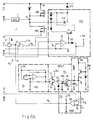
- FIG. 6 diagrammatically illustrates this invention in substantially the detail in which it was constructed and tested.
- the two oscillators 23 and 29 are triangular wave oscillators, although oscillators having other output wave forms may be utilized.
- the frequency of the oscillator 29 is much higher than that of the oscillator 23 and does not have to be synchronized therewith since it has a frequency intended to chop the current at the coil of the linear motor 2 at a rate which is high with respect to the motor's inductive time constant.
- the output of the oscillator 23 independently commutates the bridge circuit 17.
- the output of the oscillator 29 is connected to the base circuit of each of an NPN transistor T3 and a PNP transistor T4. These transistors are connected in a series circuit between the supply voltage V CC and ground.
- the transistors T3 and T4 are switched on in opposite half cycles of the oscillator output. When switched on, the transistor T3 provides a charging interval for a capacitor C2 and the transistor T4 when switched on, discharges the capacitor C2.
- the voltage of the capacitor C2 is the voltage V RS which is discussed in FIG. 1, and is coupled to the gate of the field-effect transistor TR. The transistor TR thus periodically grounds the capacitor C1 in the ramp circuit RA, which controls its charging interval.
- the capacitor C1 is connected in series with a resistor R1 between the supply voltage V CC and ground.
- the chopping circuit CH receives the temperature error voltage V TE from the temperature error circuit 27 on one of the input terminals I2 of the differential amplifier DA.
- the output voltage V A of the ramp circuit RA is coupled to the other input circuit I2 of this differential amplifier.
- the output of the chopping circuit CH again, is the variable duty cycle pulse width modulated voltage V B which is coupled to the coil 11 of the linear motor 2 via the gate circuits G1 and G2.
- the temperature error voltage V TE is derived from the temperature circuit 27.
- the temperature sensing diode 25 is connected to the input terminals of a signal amplifying circuit generally designated 27a which produces a signal V TC which is suitable for application to one input terminal of a differential amplifier DA3.
- the reference voltage V TR is coupled to the other input terminal.
- the output of the amplifier DA3 is the temperature error voltage V TE .
- the bridge circuit 17 is shown in greater detail. N-channel field-effect transistors SW1, SW2, SW3 and SW4 are used, respectively, in all four legs of the bridge 17.
- the coil 11 of the linear motor is connected between the terminals 15 which constitute the output terminals of the bridge circuit 17.
- a unique "bootstrap" technique is employed to switch the N-channel transistors SW1 and SW4 in the upper legs of this bridge circuit. This is accomplished in the connection of PNP transistors T1 and T2, respectively, across the gate and drain terminals of each of the N-channel field-effect transistors SW1 and SW4.
- the transistors T1 and T2, as tested, were 2N2907 transistors.
- the outputs of respective amplifiers A1 and A2 are connected to the base electrodes of the respective transistors T1 and T2.
- the amplifiers A1 and A2 have positive and negative input terminals marked + and -.
- An adjustable offset voltage V O is coupled as input to the negative terminal of the amplifier A1 and as input to the positive terminal of the amplifier A2, polarizing these amplifiers to operate on alternate half cycles of input from the commutating oscillator 23, to the remaining input terminal of each amplifier.
- Switching of these N-channel field-effect transistors SW1 and SW4 requires a switching voltage higher than the power supply voltage V CC , which, in this case is a voltage which is about 12 volts above that of the voltage V CC .
- the voltage V CC is coupled as input to the circuit, particularly the bridge circuit 17 at the input terminals 19 via the filter 21 which is a four pole, capacitor terminated, LC filter, as illustrated.
- Development of the commutating switching voltage required, is achieved by making each of the transistors T1 and T2 do double duty. First, the transistors T1 and T2, when conducting, respectively short the gate electrode of the N-channel field-effect transistor SW1 or SW4 to which it is connected, preventing conduction.
- the transistor T1, and alternately the transistor T2 are turned off the gate circuit of the connected N-channel field-effect transistor SW1 or SW4 is released and allows the gate capacitor C11 or C14 to hold that field-effect transistor in a conductive state throughout the commutating cycle therefor.
- the output of the amplifier A2 goes low.
- the transistor T1 is therefore switched off, and the transistor T2 conducts.
- the N-channel field-effect transistor switch SW1 is gated on by the rising voltage at its gate electrode, produced at the base-emitter junction of the transistor T1, and the N-channel field-effect transistor SW4 is short-circuited and is switched off by the conducting transistor T2.
- the voltage at the input of an isolating diode D1 connected between the output of the amplifier A2 and 12V, rises, which enables the gate G2.
- the output voltage of the amplifier A2 being low lowers the voltage at the input of the isolating diode D2, which disables the gate G1.
- variable duty cycle, pulse width modulation voltage V B is now gated by the enabled gate G2, which switches the N-channel field-effect transistor SW3 to conduct at the pulse rate V B for the duration D of each pulse, throughout this gated interval of the bridge commutation cycle determined by the oscillator 23.
- the voltage V D across the output terminals 15 of the bridge is chopped at the frequency of the oscillator 25 and now causes current to flow through the coil 11 of the linear motor 2 in one direction within this interval.
- control principles of this invention may be applied to electromagnetic systems other than motors.
- a commutated direct current voltage may be applied to a transformer winding, the other winding of which provides a voltage for controlling a parameter of a physical system.
- the direct current voltage on that one winding is then controllable by a variable duty cycle, pulse width modulated voltage having a pulse width which is proportional to a reference voltage representing an error in that parameter, and further compensated as to width as an inverse function of variations in the magnitude of the direct current voltage during each pulse interval.
Landscapes
- Engineering & Computer Science (AREA)
- Power Engineering (AREA)
- Mechanical Engineering (AREA)
- General Engineering & Computer Science (AREA)
- Control Of Linear Motors (AREA)
- Control Of Direct Current Motors (AREA)
Applications Claiming Priority (2)
| Application Number | Priority Date | Filing Date | Title |
|---|---|---|---|
| US604293 | 1984-04-26 | ||
| US07/604,293 US5017854A (en) | 1990-10-29 | 1990-10-29 | Variable duty cycle pulse width modulated motor control system |
Publications (3)
| Publication Number | Publication Date |
|---|---|
| EP0483447A2 true EP0483447A2 (de) | 1992-05-06 |
| EP0483447A3 EP0483447A3 (en) | 1992-06-17 |
| EP0483447B1 EP0483447B1 (de) | 1995-11-15 |
Family
ID=24419032
Family Applications (1)
| Application Number | Title | Priority Date | Filing Date |
|---|---|---|---|
| EP91105050A Expired - Lifetime EP0483447B1 (de) | 1990-10-29 | 1991-03-28 | Pulsbreitenmoduliertes Motorregelungssystem |
Country Status (4)
| Country | Link |
|---|---|
| US (1) | US5017854A (de) |
| EP (1) | EP0483447B1 (de) |
| DE (1) | DE69114669T2 (de) |
| IL (1) | IL97346A0 (de) |
Cited By (5)
| Publication number | Priority date | Publication date | Assignee | Title |
|---|---|---|---|---|
| WO2000022298A3 (en) * | 1998-10-13 | 2000-07-27 | Liquid Metronics Inc | Stroke control of a reciprocating pump |
| US6280147B1 (en) | 1998-10-13 | 2001-08-28 | Liquid Metronics Incorporated | Apparatus for adjusting the stroke length of a pump element |
| EP1188221A4 (de) * | 1999-06-21 | 2003-09-24 | Fisher & Paykel | Linearmotor |
| WO2004046550A1 (en) * | 2002-11-19 | 2004-06-03 | Empresa Brasileira De Compressores S.A.-Embraco | A control system for the movement of a piston |
| US8231355B2 (en) | 2003-09-02 | 2012-07-31 | Fisher & Paykel Appliances Limtied | Linear motor controller improvements |
Families Citing this family (22)
| Publication number | Priority date | Publication date | Assignee | Title |
|---|---|---|---|---|
| JP2526442B2 (ja) * | 1991-07-11 | 1996-08-21 | ティアック株式会社 | ディスク装置 |
| US5388176A (en) * | 1992-04-06 | 1995-02-07 | Briggs & Stratton Corp. | DC motor speed control system |
| US5289560A (en) * | 1992-11-03 | 1994-02-22 | Abney Harold W | DC motor control using frequency and pulsewidth modulation |
| GB2303719B (en) * | 1995-07-26 | 2000-01-26 | Black & Decker Inc | An energy management system for a cordless vegetation cutter |
| US6324339B1 (en) | 1999-11-29 | 2001-11-27 | Eveready Battery Company, Inc. | Battery pack including input and output waveform modification capability |
| CN1503971A (zh) * | 2000-11-27 | 2004-06-09 | �����ι�˾ | 控制马达启动电流的装置和方法 |
| KR100432225B1 (ko) * | 2002-05-02 | 2004-05-20 | 삼성전자주식회사 | 공기조화기 및 그 운전방법 |
| DE10224270C1 (de) * | 2002-05-31 | 2003-10-02 | Fujitsu Siemens Computers Gmbh | Verfahren zur Erfassung von Kommutierungsimpulsen eines Lüftermotors und Schaltungsanordnung zur Durchführung des Verfahrens |
| SE529328C2 (sv) * | 2005-11-15 | 2007-07-10 | Johan Stenberg | Styrsystem samt metod för styrning av elektromagnetiskt drivna pumpar |
| JP4955705B2 (ja) * | 2006-02-02 | 2012-06-20 | エルジー エレクトロニクス インコーポレイティド | リニア圧縮機の制御装置 |
| JP4990049B2 (ja) * | 2007-07-02 | 2012-08-01 | 株式会社リコー | 温度検出回路 |
| US8604709B2 (en) | 2007-07-31 | 2013-12-10 | Lsi Industries, Inc. | Methods and systems for controlling electrical power to DC loads |
| US8903577B2 (en) | 2009-10-30 | 2014-12-02 | Lsi Industries, Inc. | Traction system for electrically powered vehicles |
| US7598683B1 (en) | 2007-07-31 | 2009-10-06 | Lsi Industries, Inc. | Control of light intensity using pulses of a fixed duration and frequency |
| US20090058327A1 (en) * | 2007-08-28 | 2009-03-05 | Vladimir Maron | Pumping driver for linear motor with constant battery power/current |
| CN201905046U (zh) * | 2010-12-06 | 2011-07-27 | 全栋(南京)太阳能光伏有限公司 | 带电池终端保护装置的皮带塑料盘割草机 |
| CN102324880B (zh) * | 2011-06-14 | 2013-04-17 | 合肥威师智能电子电器厂 | 无刷直流电机微弱反电动势信号的随机共振检测方法 |
| GB2543832B (en) * | 2015-10-30 | 2020-03-11 | Aspen Pumps Ltd | Pump driver |
| US10920768B2 (en) * | 2017-09-14 | 2021-02-16 | Milton Roy, Llc | Pump drive that minimizes a pulse width based on voltage data to improve intake and discharge strokes |
| KR102350512B1 (ko) * | 2020-08-14 | 2022-01-11 | 엘지전자 주식회사 | 압축기의 제어 장치 및 방법 |
| DE102020214810B3 (de) * | 2020-11-25 | 2022-02-03 | Conti Temic Microelectronic Gmbh | Verfahren zum Betreiben eines Gleichstrommotors |
| KR102658401B1 (ko) * | 2021-06-15 | 2024-04-17 | 엘지전자 주식회사 | 압축기의 제어 장치, 압축기 및 압축기의 제어 방법 |
Family Cites Families (10)
| Publication number | Priority date | Publication date | Assignee | Title |
|---|---|---|---|---|
| GB1571681A (en) * | 1978-04-25 | 1980-07-16 | Itt Creed Ltd Dc Ac | Inverter |
| US4345442A (en) * | 1980-06-17 | 1982-08-24 | Mechanical Technology Incorporated | Control system for resonant free-piston variable stroke compressor for load-following electric heat pumps and the like |
| DE3116342A1 (de) * | 1981-04-24 | 1982-11-18 | Brown, Boveri & Cie Ag, 6800 Mannheim | "regelanordnung fuer einen selbstgefuehrten wechselrichter mit gleichspannungszwischenkreis" |
| US4409535A (en) * | 1982-03-18 | 1983-10-11 | Vee Arc Corporation | Gated asynchronous carrier modulation |
| JPS59188386A (ja) * | 1983-04-08 | 1984-10-25 | Hitachi Ltd | モ−タの速度制御におけるパルス幅制御方法及びそのパルス幅制御装置 |
| US4536700A (en) * | 1984-03-28 | 1985-08-20 | United Technologies Corporation | Boost feedforward pulse width modulation regulator |
| JPS60257773A (ja) * | 1984-05-31 | 1985-12-19 | Shinano Denki Kk | インバ−タの制御回路 |
| JPS61185087A (ja) * | 1985-02-13 | 1986-08-18 | Nippon Denso Co Ltd | 電動機制御装置 |
| US4710686A (en) * | 1986-08-04 | 1987-12-01 | Guzik Technical Enterprises | Method and apparatus for control of current in a motor winding |
| JP2715473B2 (ja) * | 1988-09-19 | 1998-02-18 | アイシン精機株式会社 | 電動パワーステアリング装置のフエイルセイフ装置 |
-
1990
- 1990-10-29 US US07/604,293 patent/US5017854A/en not_active Expired - Fee Related
-
1991
- 1991-02-24 IL IL97346A patent/IL97346A0/xx not_active IP Right Cessation
- 1991-03-28 EP EP91105050A patent/EP0483447B1/de not_active Expired - Lifetime
- 1991-03-28 DE DE69114669T patent/DE69114669T2/de not_active Expired - Fee Related
Cited By (7)
| Publication number | Priority date | Publication date | Assignee | Title |
|---|---|---|---|---|
| WO2000022298A3 (en) * | 1998-10-13 | 2000-07-27 | Liquid Metronics Inc | Stroke control of a reciprocating pump |
| US6174136B1 (en) | 1998-10-13 | 2001-01-16 | Liquid Metronics Incorporated | Pump control and method of operating same |
| US6280147B1 (en) | 1998-10-13 | 2001-08-28 | Liquid Metronics Incorporated | Apparatus for adjusting the stroke length of a pump element |
| EP1188221A4 (de) * | 1999-06-21 | 2003-09-24 | Fisher & Paykel | Linearmotor |
| EP1487091A3 (de) * | 1999-06-21 | 2005-03-23 | Fisher & Paykel Appliances Limited | Linearmotor |
| WO2004046550A1 (en) * | 2002-11-19 | 2004-06-03 | Empresa Brasileira De Compressores S.A.-Embraco | A control system for the movement of a piston |
| US8231355B2 (en) | 2003-09-02 | 2012-07-31 | Fisher & Paykel Appliances Limtied | Linear motor controller improvements |
Also Published As
| Publication number | Publication date |
|---|---|
| EP0483447B1 (de) | 1995-11-15 |
| DE69114669T2 (de) | 1996-06-27 |
| DE69114669D1 (de) | 1995-12-21 |
| IL97346A0 (en) | 1992-05-25 |
| EP0483447A3 (en) | 1992-06-17 |
| US5017854A (en) | 1991-05-21 |
Similar Documents
| Publication | Publication Date | Title |
|---|---|---|
| US5017854A (en) | Variable duty cycle pulse width modulated motor control system | |
| US5032772A (en) | Motor driver circuit for resonant linear cooler | |
| CA1303675C (en) | Current source for a variable load with an inductive component | |
| EP0343005B1 (de) | Antriebsschaltung zum Antreiben eines piezoelektrischen Vibrators | |
| US6483226B1 (en) | Impact actuator and equipment using the impact actuator | |
| US2867762A (en) | Commutatorless electric motor | |
| EP1117176A2 (de) | Selbstschwingendes System zur Ansteuerung eines linearen schwingenden Aktuators um seine Resonanzfrequenz | |
| US3402333A (en) | Electronically controlled synchronous motor | |
| US4542323A (en) | Direct current motor without commutator | |
| US4427931A (en) | Speed control apparatus for direct current motor | |
| US4574228A (en) | Current controlled motor drive circuit | |
| US6809485B2 (en) | Driving device for oscillatory actuator | |
| JPH082189B2 (ja) | 直流ブラシレスモ−タの制御装置 | |
| US3886419A (en) | Electrical refrigerating compressor | |
| JP2716105B2 (ja) | 交番定電流回路 | |
| EP0299267A2 (de) | Leistungsrückgewinnungsschaltung | |
| JP3893795B2 (ja) | 振動型アクチュエータの駆動回路 | |
| AU691432B2 (en) | Method of driving vibrating compressors | |
| US4486821A (en) | Power source for a developing bias | |
| US3855552A (en) | Oscillator utilizing complementary transistors in a push-pull circuit | |
| USRE29510E (en) | High efficiency switching drive for a resonate power transformer | |
| SU1444104A1 (ru) | Устройство дл электроэрозионного легировани | |
| JP4496330B2 (ja) | 超音波発振回路 | |
| JPH0110573Y2 (de) | ||
| GB1590286A (en) | Electric motor control circuits |
Legal Events
| Date | Code | Title | Description |
|---|---|---|---|
| PUAI | Public reference made under article 153(3) epc to a published international application that has entered the european phase |
Free format text: ORIGINAL CODE: 0009012 |
|
| PUAL | Search report despatched |
Free format text: ORIGINAL CODE: 0009013 |
|
| AK | Designated contracting states |
Kind code of ref document: A2 Designated state(s): DE FR GB IT NL |
|
| AK | Designated contracting states |
Kind code of ref document: A3 Designated state(s): DE FR GB IT NL |
|
| 17P | Request for examination filed |
Effective date: 19921208 |
|
| 17Q | First examination report despatched |
Effective date: 19940325 |
|
| GRAA | (expected) grant |
Free format text: ORIGINAL CODE: 0009210 |
|
| AK | Designated contracting states |
Kind code of ref document: B1 Designated state(s): DE FR GB IT NL |
|
| REF | Corresponds to: |
Ref document number: 69114669 Country of ref document: DE Date of ref document: 19951221 |
|
| ITF | It: translation for a ep patent filed | ||
| ET | Fr: translation filed | ||
| PLBE | No opposition filed within time limit |
Free format text: ORIGINAL CODE: 0009261 |
|
| STAA | Information on the status of an ep patent application or granted ep patent |
Free format text: STATUS: NO OPPOSITION FILED WITHIN TIME LIMIT |
|
| 26N | No opposition filed | ||
| REG | Reference to a national code |
Ref country code: GB Ref legal event code: 732E |
|
| NLS | Nl: assignments of ep-patents |
Owner name: RAYTHEON COMPANY;HE HOLDINGS, INC. |
|
| REG | Reference to a national code |
Ref country code: FR Ref legal event code: TP Ref country code: FR Ref legal event code: CD Ref country code: FR Ref legal event code: CA |
|
| REG | Reference to a national code |
Ref country code: GB Ref legal event code: IF02 |
|
| PGFP | Annual fee paid to national office [announced via postgrant information from national office to epo] |
Ref country code: FR Payment date: 20020211 Year of fee payment: 12 |
|
| PGFP | Annual fee paid to national office [announced via postgrant information from national office to epo] |
Ref country code: GB Payment date: 20020220 Year of fee payment: 12 |
|
| PGFP | Annual fee paid to national office [announced via postgrant information from national office to epo] |
Ref country code: DE Payment date: 20020221 Year of fee payment: 12 |
|
| PGFP | Annual fee paid to national office [announced via postgrant information from national office to epo] |
Ref country code: NL Payment date: 20020225 Year of fee payment: 12 |
|
| PG25 | Lapsed in a contracting state [announced via postgrant information from national office to epo] |
Ref country code: GB Free format text: LAPSE BECAUSE OF NON-PAYMENT OF DUE FEES Effective date: 20030328 |
|
| PG25 | Lapsed in a contracting state [announced via postgrant information from national office to epo] |
Ref country code: NL Free format text: LAPSE BECAUSE OF NON-PAYMENT OF DUE FEES Effective date: 20031001 Ref country code: DE Free format text: LAPSE BECAUSE OF NON-PAYMENT OF DUE FEES Effective date: 20031001 |
|
| GBPC | Gb: european patent ceased through non-payment of renewal fee |
Effective date: 20030328 |
|
| PG25 | Lapsed in a contracting state [announced via postgrant information from national office to epo] |
Ref country code: FR Free format text: LAPSE BECAUSE OF NON-PAYMENT OF DUE FEES Effective date: 20031127 |
|
| NLV4 | Nl: lapsed or anulled due to non-payment of the annual fee |
Effective date: 20031001 |
|
| REG | Reference to a national code |
Ref country code: FR Ref legal event code: ST |
|
| PG25 | Lapsed in a contracting state [announced via postgrant information from national office to epo] |
Ref country code: IT Free format text: LAPSE BECAUSE OF NON-PAYMENT OF DUE FEES;WARNING: LAPSES OF ITALIAN PATENTS WITH EFFECTIVE DATE BEFORE 2007 MAY HAVE OCCURRED AT ANY TIME BEFORE 2007. THE CORRECT EFFECTIVE DATE MAY BE DIFFERENT FROM THE ONE RECORDED. Effective date: 20050328 |