EP0483485A1 - Verfahren zur Herstellung von feinteiligen, wasserquellbaren Polysaccharid-Pfropfpolymeren - Google Patents
Verfahren zur Herstellung von feinteiligen, wasserquellbaren Polysaccharid-Pfropfpolymeren Download PDFInfo
- Publication number
- EP0483485A1 EP0483485A1 EP91114800A EP91114800A EP0483485A1 EP 0483485 A1 EP0483485 A1 EP 0483485A1 EP 91114800 A EP91114800 A EP 91114800A EP 91114800 A EP91114800 A EP 91114800A EP 0483485 A1 EP0483485 A1 EP 0483485A1
- Authority
- EP
- European Patent Office
- Prior art keywords
- parts
- polymerization
- added
- water
- polysaccharide
- Prior art date
- Legal status (The legal status is an assumption and is not a legal conclusion. Google has not performed a legal analysis and makes no representation as to the accuracy of the status listed.)
- Withdrawn
Links
- 229920001282 polysaccharide Polymers 0.000 title claims abstract description 23
- 238000000034 method Methods 0.000 title claims description 20
- 230000008569 process Effects 0.000 title claims description 8
- 238000002360 preparation method Methods 0.000 title claims description 3
- XLYOFNOQVPJJNP-UHFFFAOYSA-N water Substances O XLYOFNOQVPJJNP-UHFFFAOYSA-N 0.000 title description 38
- 239000002245 particle Substances 0.000 title description 7
- 239000007864 aqueous solution Substances 0.000 claims abstract description 22
- 150000004676 glycans Chemical class 0.000 claims abstract description 22
- 229920000578 graft copolymer Polymers 0.000 claims abstract description 22
- 239000005017 polysaccharide Substances 0.000 claims abstract description 22
- 150000001732 carboxylic acid derivatives Chemical class 0.000 claims abstract description 15
- 238000010557 suspension polymerization reaction Methods 0.000 claims abstract description 14
- 239000000725 suspension Substances 0.000 claims abstract description 12
- MTNDZQHUAFNZQY-UHFFFAOYSA-N imidazoline Chemical group C1CN=CN1 MTNDZQHUAFNZQY-UHFFFAOYSA-N 0.000 claims abstract description 9
- 238000004132 cross linking Methods 0.000 claims abstract description 8
- 150000003868 ammonium compounds Chemical class 0.000 claims abstract description 7
- 239000003495 polar organic solvent Substances 0.000 claims abstract description 3
- 229920002472 Starch Polymers 0.000 claims description 26
- 235000019698 starch Nutrition 0.000 claims description 25
- 239000000178 monomer Substances 0.000 claims description 23
- 239000002270 dispersing agent Substances 0.000 claims description 22
- 239000008107 starch Substances 0.000 claims description 21
- 239000000203 mixture Substances 0.000 claims description 15
- 125000004432 carbon atom Chemical group C* 0.000 claims description 14
- 239000003431 cross linking reagent Substances 0.000 claims description 7
- 239000002736 nonionic surfactant Substances 0.000 claims description 7
- 239000003505 polymerization initiator Substances 0.000 claims description 6
- KWIUHFFTVRNATP-UHFFFAOYSA-O N,N,N-trimethylglycinium Chemical group C[N+](C)(C)CC(O)=O KWIUHFFTVRNATP-UHFFFAOYSA-O 0.000 claims description 3
- 125000000217 alkyl group Chemical group 0.000 claims description 3
- JZMJDSHXVKJFKW-UHFFFAOYSA-M methyl sulfate(1-) Chemical compound COS([O-])(=O)=O JZMJDSHXVKJFKW-UHFFFAOYSA-M 0.000 claims description 2
- WSNMPAVSZJSIMT-UHFFFAOYSA-N COc1c(C)c2COC(=O)c2c(O)c1CC(O)C1(C)CCC(=O)O1 Chemical compound COc1c(C)c2COC(=O)c2c(O)c1CC(O)C1(C)CCC(=O)O1 WSNMPAVSZJSIMT-UHFFFAOYSA-N 0.000 claims 1
- 150000001450 anions Chemical class 0.000 claims 1
- 229920000642 polymer Polymers 0.000 description 22
- 238000006116 polymerization reaction Methods 0.000 description 22
- 239000000243 solution Substances 0.000 description 21
- HEMHJVSKTPXQMS-UHFFFAOYSA-M Sodium hydroxide Chemical compound [OH-].[Na+] HEMHJVSKTPXQMS-UHFFFAOYSA-M 0.000 description 15
- 239000003999 initiator Substances 0.000 description 14
- 239000000047 product Substances 0.000 description 13
- NIXOWILDQLNWCW-UHFFFAOYSA-N acrylic acid group Chemical group C(C=C)(=O)O NIXOWILDQLNWCW-UHFFFAOYSA-N 0.000 description 12
- 229920001223 polyethylene glycol Polymers 0.000 description 11
- SMZOUWXMTYCWNB-UHFFFAOYSA-N 2-(2-methoxy-5-methylphenyl)ethanamine Chemical compound COC1=CC=C(C)C=C1CCN SMZOUWXMTYCWNB-UHFFFAOYSA-N 0.000 description 10
- IJGRMHOSHXDMSA-UHFFFAOYSA-N Atomic nitrogen Chemical compound N#N IJGRMHOSHXDMSA-UHFFFAOYSA-N 0.000 description 10
- 239000002202 Polyethylene glycol Substances 0.000 description 10
- XDTMQSROBMDMFD-UHFFFAOYSA-N Cyclohexane Chemical compound C1CCCCC1 XDTMQSROBMDMFD-UHFFFAOYSA-N 0.000 description 9
- ROOXNKNUYICQNP-UHFFFAOYSA-N ammonium persulfate Chemical compound [NH4+].[NH4+].[O-]S(=O)(=O)OOS([O-])(=O)=O ROOXNKNUYICQNP-UHFFFAOYSA-N 0.000 description 9
- 239000012071 phase Substances 0.000 description 9
- 238000003756 stirring Methods 0.000 description 7
- UWFRVQVNYNPBEF-UHFFFAOYSA-N 1-(2,4-dimethylphenyl)propan-1-one Chemical compound CCC(=O)C1=CC=C(C)C=C1C UWFRVQVNYNPBEF-UHFFFAOYSA-N 0.000 description 6
- RTZKZFJDLAIYFH-UHFFFAOYSA-N Diethyl ether Chemical compound CCOCC RTZKZFJDLAIYFH-UHFFFAOYSA-N 0.000 description 6
- 235000014113 dietary fatty acids Nutrition 0.000 description 6
- 239000000194 fatty acid Substances 0.000 description 6
- 229930195729 fatty acid Natural products 0.000 description 6
- 238000004519 manufacturing process Methods 0.000 description 6
- 238000002156 mixing Methods 0.000 description 6
- -1 starch Chemical class 0.000 description 6
- 244000060011 Cocos nucifera Species 0.000 description 5
- 235000013162 Cocos nucifera Nutrition 0.000 description 5
- KCXVZYZYPLLWCC-UHFFFAOYSA-N EDTA Chemical compound OC(=O)CN(CC(O)=O)CCN(CC(O)=O)CC(O)=O KCXVZYZYPLLWCC-UHFFFAOYSA-N 0.000 description 5
- 238000010521 absorption reaction Methods 0.000 description 5
- 230000000052 comparative effect Effects 0.000 description 5
- 238000009826 distribution Methods 0.000 description 5
- 150000004665 fatty acids Chemical class 0.000 description 5
- 239000010419 fine particle Substances 0.000 description 5
- 238000010438 heat treatment Methods 0.000 description 5
- 229910052757 nitrogen Inorganic materials 0.000 description 5
- 239000012074 organic phase Substances 0.000 description 5
- AOBIOSPNXBMOAT-UHFFFAOYSA-N 2-[2-(oxiran-2-ylmethoxy)ethoxymethyl]oxirane Chemical compound C1OC1COCCOCC1CO1 AOBIOSPNXBMOAT-UHFFFAOYSA-N 0.000 description 4
- XZIIFPSPUDAGJM-UHFFFAOYSA-N 6-chloro-2-n,2-n-diethylpyrimidine-2,4-diamine Chemical compound CCN(CC)C1=NC(N)=CC(Cl)=N1 XZIIFPSPUDAGJM-UHFFFAOYSA-N 0.000 description 4
- NIXOWILDQLNWCW-UHFFFAOYSA-M Acrylate Chemical compound [O-]C(=O)C=C NIXOWILDQLNWCW-UHFFFAOYSA-M 0.000 description 4
- 239000002253 acid Substances 0.000 description 4
- 229910001870 ammonium persulfate Inorganic materials 0.000 description 4
- 150000001735 carboxylic acids Chemical class 0.000 description 4
- 235000013339 cereals Nutrition 0.000 description 4
- VLKZOEOYAKHREP-UHFFFAOYSA-N n-Hexane Chemical compound CCCCCC VLKZOEOYAKHREP-UHFFFAOYSA-N 0.000 description 4
- 239000003960 organic solvent Substances 0.000 description 4
- 239000007787 solid Substances 0.000 description 4
- 239000002904 solvent Substances 0.000 description 4
- 229940035044 sorbitan monolaurate Drugs 0.000 description 4
- 239000002250 absorbent Substances 0.000 description 3
- 230000002745 absorbent Effects 0.000 description 3
- 238000009835 boiling Methods 0.000 description 3
- 238000006243 chemical reaction Methods 0.000 description 3
- 239000007795 chemical reaction product Substances 0.000 description 3
- 239000012153 distilled water Substances 0.000 description 3
- 229940071106 ethylenediaminetetraacetate Drugs 0.000 description 3
- 239000011521 glass Substances 0.000 description 3
- 239000007788 liquid Substances 0.000 description 3
- 230000003472 neutralizing effect Effects 0.000 description 3
- 239000007858 starting material Substances 0.000 description 3
- IUQJDHJVPLLKFL-UHFFFAOYSA-N 2-(2,4-dichlorophenoxy)acetate;dimethylazanium Chemical compound CNC.OC(=O)COC1=CC=C(Cl)C=C1Cl IUQJDHJVPLLKFL-UHFFFAOYSA-N 0.000 description 2
- OZAIFHULBGXAKX-UHFFFAOYSA-N 2-(2-cyanopropan-2-yldiazenyl)-2-methylpropanenitrile Chemical compound N#CC(C)(C)N=NC(C)(C)C#N OZAIFHULBGXAKX-UHFFFAOYSA-N 0.000 description 2
- GOHZKUSWWGUUNR-UHFFFAOYSA-N 2-(4,5-dihydroimidazol-1-yl)ethanol Chemical compound OCCN1CCN=C1 GOHZKUSWWGUUNR-UHFFFAOYSA-N 0.000 description 2
- SYEWHONLFGZGLK-UHFFFAOYSA-N 2-[1,3-bis(oxiran-2-ylmethoxy)propan-2-yloxymethyl]oxirane Chemical compound C1OC1COCC(OCC1OC1)COCC1CO1 SYEWHONLFGZGLK-UHFFFAOYSA-N 0.000 description 2
- HRPVXLWXLXDGHG-UHFFFAOYSA-N Acrylamide Chemical compound NC(=O)C=C HRPVXLWXLXDGHG-UHFFFAOYSA-N 0.000 description 2
- CIWBSHSKHKDKBQ-JLAZNSOCSA-N Ascorbic acid Chemical compound OC[C@H](O)[C@H]1OC(=O)C(O)=C1O CIWBSHSKHKDKBQ-JLAZNSOCSA-N 0.000 description 2
- 229920002261 Corn starch Polymers 0.000 description 2
- LFQSCWFLJHTTHZ-UHFFFAOYSA-N Ethanol Chemical compound CCO LFQSCWFLJHTTHZ-UHFFFAOYSA-N 0.000 description 2
- IAYPIBMASNFSPL-UHFFFAOYSA-N Ethylene oxide Chemical group C1CO1 IAYPIBMASNFSPL-UHFFFAOYSA-N 0.000 description 2
- MHAJPDPJQMAIIY-UHFFFAOYSA-N Hydrogen peroxide Chemical compound OO MHAJPDPJQMAIIY-UHFFFAOYSA-N 0.000 description 2
- XEEYBQQBJWHFJM-UHFFFAOYSA-N Iron Chemical compound [Fe] XEEYBQQBJWHFJM-UHFFFAOYSA-N 0.000 description 2
- CERQOIWHTDAKMF-UHFFFAOYSA-M Methacrylate Chemical compound CC(=C)C([O-])=O CERQOIWHTDAKMF-UHFFFAOYSA-M 0.000 description 2
- CERQOIWHTDAKMF-UHFFFAOYSA-N Methacrylic acid Chemical compound CC(=C)C(O)=O CERQOIWHTDAKMF-UHFFFAOYSA-N 0.000 description 2
- FAPWRFPIFSIZLT-UHFFFAOYSA-M Sodium chloride Chemical compound [Na+].[Cl-] FAPWRFPIFSIZLT-UHFFFAOYSA-M 0.000 description 2
- 240000008042 Zea mays Species 0.000 description 2
- 235000005824 Zea mays ssp. parviglumis Nutrition 0.000 description 2
- 235000002017 Zea mays subsp mays Nutrition 0.000 description 2
- 125000001931 aliphatic group Chemical group 0.000 description 2
- 238000010533 azeotropic distillation Methods 0.000 description 2
- 238000010923 batch production Methods 0.000 description 2
- 239000001913 cellulose Substances 0.000 description 2
- 229920002678 cellulose Polymers 0.000 description 2
- 235000010980 cellulose Nutrition 0.000 description 2
- 230000008859 change Effects 0.000 description 2
- 239000011362 coarse particle Substances 0.000 description 2
- 150000001875 compounds Chemical class 0.000 description 2
- 235000005822 corn Nutrition 0.000 description 2
- 239000002274 desiccant Substances 0.000 description 2
- GPLRAVKSCUXZTP-UHFFFAOYSA-N diglycerol Chemical compound OCC(O)COCC(O)CO GPLRAVKSCUXZTP-UHFFFAOYSA-N 0.000 description 2
- 230000000694 effects Effects 0.000 description 2
- 150000002148 esters Chemical class 0.000 description 2
- 150000002170 ethers Chemical class 0.000 description 2
- 239000000499 gel Substances 0.000 description 2
- LEQAOMBKQFMDFZ-UHFFFAOYSA-N glyoxal Chemical compound O=CC=O LEQAOMBKQFMDFZ-UHFFFAOYSA-N 0.000 description 2
- 238000010559 graft polymerization reaction Methods 0.000 description 2
- 239000003906 humectant Substances 0.000 description 2
- 229930195733 hydrocarbon Natural products 0.000 description 2
- 238000010348 incorporation Methods 0.000 description 2
- 239000002609 medium Substances 0.000 description 2
- POULHZVOKOAJMA-UHFFFAOYSA-N methyl undecanoic acid Natural products CCCCCCCCCCCC(O)=O POULHZVOKOAJMA-UHFFFAOYSA-N 0.000 description 2
- 230000000379 polymerizing effect Effects 0.000 description 2
- USHAGKDGDHPEEY-UHFFFAOYSA-L potassium persulfate Chemical compound [K+].[K+].[O-]S(=O)(=O)OOS([O-])(=O)=O USHAGKDGDHPEEY-UHFFFAOYSA-L 0.000 description 2
- 239000000843 powder Substances 0.000 description 2
- 238000012673 precipitation polymerization Methods 0.000 description 2
- 239000011541 reaction mixture Substances 0.000 description 2
- 150000003839 salts Chemical class 0.000 description 2
- 230000008961 swelling Effects 0.000 description 2
- 239000002562 thickening agent Substances 0.000 description 2
- 210000002700 urine Anatomy 0.000 description 2
- 125000000391 vinyl group Chemical group [H]C([*])=C([H])[H] 0.000 description 2
- JNYAEWCLZODPBN-JGWLITMVSA-N (2r,3r,4s)-2-[(1r)-1,2-dihydroxyethyl]oxolane-3,4-diol Chemical class OC[C@@H](O)[C@H]1OC[C@H](O)[C@H]1O JNYAEWCLZODPBN-JGWLITMVSA-N 0.000 description 1
- ZORQXIQZAOLNGE-UHFFFAOYSA-N 1,1-difluorocyclohexane Chemical compound FC1(F)CCCCC1 ZORQXIQZAOLNGE-UHFFFAOYSA-N 0.000 description 1
- 229920000536 2-Acrylamido-2-methylpropane sulfonic acid Polymers 0.000 description 1
- XHZPRMZZQOIPDS-UHFFFAOYSA-N 2-Methyl-2-[(1-oxo-2-propenyl)amino]-1-propanesulfonic acid Chemical compound OS(=O)(=O)CC(C)(C)NC(=O)C=C XHZPRMZZQOIPDS-UHFFFAOYSA-N 0.000 description 1
- TWJNQYPJQDRXPH-UHFFFAOYSA-N 2-cyanobenzohydrazide Chemical compound NNC(=O)C1=CC=CC=C1C#N TWJNQYPJQDRXPH-UHFFFAOYSA-N 0.000 description 1
- CKSAKVMRQYOFBC-UHFFFAOYSA-N 2-cyanopropan-2-yliminourea Chemical compound N#CC(C)(C)N=NC(N)=O CKSAKVMRQYOFBC-UHFFFAOYSA-N 0.000 description 1
- OMIGHNLMNHATMP-UHFFFAOYSA-N 2-hydroxyethyl prop-2-enoate Chemical compound OCCOC(=O)C=C OMIGHNLMNHATMP-UHFFFAOYSA-N 0.000 description 1
- OVBPDLSTPAOUAI-UHFFFAOYSA-N 3-[(1-carboxy-4-cyanopentan-2-yl)diazenyl]-5-cyanohexanoic acid Chemical compound N#CC(C)CC(CC(O)=O)N=NC(CC(O)=O)CC(C)C#N OVBPDLSTPAOUAI-UHFFFAOYSA-N 0.000 description 1
- SVYPQURSUBDSIQ-UHFFFAOYSA-N 4-methyl-3-oxopent-4-ene-1-sulfonic acid Chemical compound CC(=C)C(=O)CCS(O)(=O)=O SVYPQURSUBDSIQ-UHFFFAOYSA-N 0.000 description 1
- NLHHRLWOUZZQLW-UHFFFAOYSA-N Acrylonitrile Chemical compound C=CC#N NLHHRLWOUZZQLW-UHFFFAOYSA-N 0.000 description 1
- QGZKDVFQNNGYKY-UHFFFAOYSA-O Ammonium Chemical compound [NH4+] QGZKDVFQNNGYKY-UHFFFAOYSA-O 0.000 description 1
- VHUUQVKOLVNVRT-UHFFFAOYSA-N Ammonium hydroxide Chemical compound [NH4+].[OH-] VHUUQVKOLVNVRT-UHFFFAOYSA-N 0.000 description 1
- 229920001685 Amylomaize Polymers 0.000 description 1
- 244000061520 Angelica archangelica Species 0.000 description 1
- OMPJBNCRMGITSC-UHFFFAOYSA-N Benzoylperoxide Chemical compound C=1C=CC=CC=1C(=O)OOC(=O)C1=CC=CC=C1 OMPJBNCRMGITSC-UHFFFAOYSA-N 0.000 description 1
- UXVMQQNJUSDDNG-UHFFFAOYSA-L Calcium chloride Chemical compound [Cl-].[Cl-].[Ca+2] UXVMQQNJUSDDNG-UHFFFAOYSA-L 0.000 description 1
- 229920002134 Carboxymethyl cellulose Polymers 0.000 description 1
- BRLQWZUYTZBJKN-UHFFFAOYSA-N Epichlorohydrin Chemical compound ClCC1CO1 BRLQWZUYTZBJKN-UHFFFAOYSA-N 0.000 description 1
- LYCAIKOWRPUZTN-UHFFFAOYSA-N Ethylene glycol Chemical compound OCCO LYCAIKOWRPUZTN-UHFFFAOYSA-N 0.000 description 1
- 235000001287 Guettarda speciosa Nutrition 0.000 description 1
- WOBHKFSMXKNTIM-UHFFFAOYSA-N Hydroxyethyl methacrylate Chemical compound CC(=C)C(=O)OCCO WOBHKFSMXKNTIM-UHFFFAOYSA-N 0.000 description 1
- DGAQECJNVWCQMB-PUAWFVPOSA-M Ilexoside XXIX Chemical compound C[C@@H]1CC[C@@]2(CC[C@@]3(C(=CC[C@H]4[C@]3(CC[C@@H]5[C@@]4(CC[C@@H](C5(C)C)OS(=O)(=O)[O-])C)C)[C@@H]2[C@]1(C)O)C)C(=O)O[C@H]6[C@@H]([C@H]([C@@H]([C@H](O6)CO)O)O)O.[Na+] DGAQECJNVWCQMB-PUAWFVPOSA-M 0.000 description 1
- YIVJZNGAASQVEM-UHFFFAOYSA-N Lauroyl peroxide Chemical compound CCCCCCCCCCCC(=O)OOC(=O)CCCCCCCCCCC YIVJZNGAASQVEM-UHFFFAOYSA-N 0.000 description 1
- 240000003183 Manihot esculenta Species 0.000 description 1
- 235000016735 Manihot esculenta subsp esculenta Nutrition 0.000 description 1
- 229920000881 Modified starch Polymers 0.000 description 1
- 235000021360 Myristic acid Nutrition 0.000 description 1
- TUNFSRHWOTWDNC-UHFFFAOYSA-N Myristic acid Natural products CCCCCCCCCCCCCC(O)=O TUNFSRHWOTWDNC-UHFFFAOYSA-N 0.000 description 1
- 240000007594 Oryza sativa Species 0.000 description 1
- 235000007164 Oryza sativa Nutrition 0.000 description 1
- 229920001744 Polyaldehyde Polymers 0.000 description 1
- 239000004721 Polyphenylene oxide Substances 0.000 description 1
- 229920001213 Polysorbate 20 Polymers 0.000 description 1
- 229920001214 Polysorbate 60 Polymers 0.000 description 1
- ZLMJMSJWJFRBEC-UHFFFAOYSA-N Potassium Chemical compound [K] ZLMJMSJWJFRBEC-UHFFFAOYSA-N 0.000 description 1
- DWAQJAXMDSEUJJ-UHFFFAOYSA-M Sodium bisulfite Chemical compound [Na+].OS([O-])=O DWAQJAXMDSEUJJ-UHFFFAOYSA-M 0.000 description 1
- 229920002125 Sokalan® Polymers 0.000 description 1
- 244000061456 Solanum tuberosum Species 0.000 description 1
- 235000002595 Solanum tuberosum Nutrition 0.000 description 1
- IYFATESGLOUGBX-YVNJGZBMSA-N Sorbitan monopalmitate Chemical compound CCCCCCCCCCCCCCCC(=O)OC[C@@H](O)[C@H]1OC[C@H](O)[C@H]1O IYFATESGLOUGBX-YVNJGZBMSA-N 0.000 description 1
- HVUMOYIDDBPOLL-XWVZOOPGSA-N Sorbitan monostearate Chemical compound CCCCCCCCCCCCCCCCCC(=O)OC[C@@H](O)[C@H]1OC[C@H](O)[C@H]1O HVUMOYIDDBPOLL-XWVZOOPGSA-N 0.000 description 1
- 229910000831 Steel Inorganic materials 0.000 description 1
- 235000021307 Triticum Nutrition 0.000 description 1
- 244000098338 Triticum aestivum Species 0.000 description 1
- XSQUKJJJFZCRTK-UHFFFAOYSA-N Urea Chemical compound NC(N)=O XSQUKJJJFZCRTK-UHFFFAOYSA-N 0.000 description 1
- HVVWZTWDBSEWIH-UHFFFAOYSA-N [2-(hydroxymethyl)-3-prop-2-enoyloxy-2-(prop-2-enoyloxymethyl)propyl] prop-2-enoate Chemical compound C=CC(=O)OCC(CO)(COC(=O)C=C)COC(=O)C=C HVVWZTWDBSEWIH-UHFFFAOYSA-N 0.000 description 1
- LXEKPEMOWBOYRF-UHFFFAOYSA-N [2-[(1-azaniumyl-1-imino-2-methylpropan-2-yl)diazenyl]-2-methylpropanimidoyl]azanium;dichloride Chemical compound Cl.Cl.NC(=N)C(C)(C)N=NC(C)(C)C(N)=N LXEKPEMOWBOYRF-UHFFFAOYSA-N 0.000 description 1
- 150000007513 acids Chemical class 0.000 description 1
- 239000012190 activator Substances 0.000 description 1
- 239000000654 additive Substances 0.000 description 1
- 238000005054 agglomeration Methods 0.000 description 1
- 230000002776 aggregation Effects 0.000 description 1
- 239000003513 alkali Substances 0.000 description 1
- 150000008044 alkali metal hydroxides Chemical class 0.000 description 1
- 239000000908 ammonium hydroxide Substances 0.000 description 1
- 239000012935 ammoniumperoxodisulfate Substances 0.000 description 1
- 230000000844 anti-bacterial effect Effects 0.000 description 1
- 239000012736 aqueous medium Substances 0.000 description 1
- 125000003118 aryl group Chemical group 0.000 description 1
- 235000010323 ascorbic acid Nutrition 0.000 description 1
- 229960005070 ascorbic acid Drugs 0.000 description 1
- 239000011668 ascorbic acid Substances 0.000 description 1
- 235000019400 benzoyl peroxide Nutrition 0.000 description 1
- 230000015572 biosynthetic process Effects 0.000 description 1
- ZPOLOEWJWXZUSP-WAYWQWQTSA-N bis(prop-2-enyl) (z)-but-2-enedioate Chemical compound C=CCOC(=O)\C=C/C(=O)OCC=C ZPOLOEWJWXZUSP-WAYWQWQTSA-N 0.000 description 1
- 210000001124 body fluid Anatomy 0.000 description 1
- 239000010839 body fluid Substances 0.000 description 1
- 239000001110 calcium chloride Substances 0.000 description 1
- 235000011148 calcium chloride Nutrition 0.000 description 1
- 229910001628 calcium chloride Inorganic materials 0.000 description 1
- 239000004202 carbamide Substances 0.000 description 1
- 239000001768 carboxy methyl cellulose Substances 0.000 description 1
- 235000010948 carboxy methyl cellulose Nutrition 0.000 description 1
- 239000008112 carboxymethyl-cellulose Substances 0.000 description 1
- 239000003054 catalyst Substances 0.000 description 1
- 125000002091 cationic group Chemical group 0.000 description 1
- 238000005119 centrifugation Methods 0.000 description 1
- 239000003795 chemical substances by application Substances 0.000 description 1
- 239000008139 complexing agent Substances 0.000 description 1
- 239000008120 corn starch Substances 0.000 description 1
- 229920006037 cross link polymer Polymers 0.000 description 1
- LDHQCZJRKDOVOX-NSCUHMNNSA-N crotonic acid Chemical compound C\C=C\C(O)=O LDHQCZJRKDOVOX-NSCUHMNNSA-N 0.000 description 1
- BLCKNMAZFRMCJJ-UHFFFAOYSA-N cyclohexyl cyclohexyloxycarbonyloxy carbonate Chemical compound C1CCCCC1OC(=O)OOC(=O)OC1CCCCC1 BLCKNMAZFRMCJJ-UHFFFAOYSA-N 0.000 description 1
- LSXWFXONGKSEMY-UHFFFAOYSA-N di-tert-butyl peroxide Chemical compound CC(C)(C)OOC(C)(C)C LSXWFXONGKSEMY-UHFFFAOYSA-N 0.000 description 1
- MTHSVFCYNBDYFN-UHFFFAOYSA-N diethylene glycol Chemical compound OCCOCCO MTHSVFCYNBDYFN-UHFFFAOYSA-N 0.000 description 1
- 238000004821 distillation Methods 0.000 description 1
- 238000001035 drying Methods 0.000 description 1
- 239000003792 electrolyte Substances 0.000 description 1
- 238000005265 energy consumption Methods 0.000 description 1
- 150000002118 epoxides Chemical class 0.000 description 1
- 239000000706 filtrate Substances 0.000 description 1
- 238000001914 filtration Methods 0.000 description 1
- 125000003055 glycidyl group Chemical group C(C1CO1)* 0.000 description 1
- 229940015043 glyoxal Drugs 0.000 description 1
- 239000008187 granular material Substances 0.000 description 1
- 238000000227 grinding Methods 0.000 description 1
- 150000002430 hydrocarbons Chemical class 0.000 description 1
- 230000002209 hydrophobic effect Effects 0.000 description 1
- 230000006872 improvement Effects 0.000 description 1
- 239000012442 inert solvent Substances 0.000 description 1
- 230000000977 initiatory effect Effects 0.000 description 1
- 229910052742 iron Inorganic materials 0.000 description 1
- WRUGWIBCXHJTDG-UHFFFAOYSA-L magnesium sulfate heptahydrate Chemical compound O.O.O.O.O.O.O.[Mg+2].[O-]S([O-])(=O)=O WRUGWIBCXHJTDG-UHFFFAOYSA-L 0.000 description 1
- FQPSGWSUVKBHSU-UHFFFAOYSA-N methacrylamide Chemical compound CC(=C)C(N)=O FQPSGWSUVKBHSU-UHFFFAOYSA-N 0.000 description 1
- JZMJDSHXVKJFKW-UHFFFAOYSA-N methyl sulfate Chemical compound COS(O)(=O)=O JZMJDSHXVKJFKW-UHFFFAOYSA-N 0.000 description 1
- AWIZNFPXOGMGHN-UHFFFAOYSA-N methyl sulfate N-[2-(3-methyl-2-undecylimidazolidin-3-ium-1-yl)ethyl]undecanamide Chemical compound COS(=O)(=O)[O-].C[NH+]1C(N(CC1)CCNC(CCCCCCCCCC)=O)CCCCCCCCCCC AWIZNFPXOGMGHN-UHFFFAOYSA-N 0.000 description 1
- 235000019426 modified starch Nutrition 0.000 description 1
- YWFWDNVOPHGWMX-UHFFFAOYSA-N n,n-dimethyldodecan-1-amine Chemical compound CCCCCCCCCCCCN(C)C YWFWDNVOPHGWMX-UHFFFAOYSA-N 0.000 description 1
- MGFYIUFZLHCRTH-UHFFFAOYSA-N nitrilotriacetic acid Chemical compound OC(=O)CN(CC(O)=O)CC(O)=O MGFYIUFZLHCRTH-UHFFFAOYSA-N 0.000 description 1
- HLERILKGMXJNBU-UHFFFAOYSA-N norvaline betaine Chemical compound CCCC(C([O-])=O)[N+](C)(C)C HLERILKGMXJNBU-UHFFFAOYSA-N 0.000 description 1
- 229940049964 oleate Drugs 0.000 description 1
- ZQPPMHVWECSIRJ-KTKRTIGZSA-N oleic acid Chemical compound CCCCCCCC\C=C/CCCCCCCC(O)=O ZQPPMHVWECSIRJ-KTKRTIGZSA-N 0.000 description 1
- QPCDCPDFJACHGM-UHFFFAOYSA-K pentetate(3-) Chemical compound OC(=O)CN(CC([O-])=O)CCN(CC([O-])=O)CCN(CC(O)=O)CC([O-])=O QPCDCPDFJACHGM-UHFFFAOYSA-K 0.000 description 1
- 229920000058 polyacrylate Polymers 0.000 description 1
- 239000004584 polyacrylic acid Substances 0.000 description 1
- 229920000447 polyanionic polymer Polymers 0.000 description 1
- 229920000647 polyepoxide Polymers 0.000 description 1
- 229920000570 polyether Polymers 0.000 description 1
- 229920000151 polyglycol Polymers 0.000 description 1
- 239000010695 polyglycol Substances 0.000 description 1
- 229920001444 polymaleic acid Polymers 0.000 description 1
- 229920002959 polymer blend Polymers 0.000 description 1
- 239000000256 polyoxyethylene sorbitan monolaurate Substances 0.000 description 1
- 235000010486 polyoxyethylene sorbitan monolaurate Nutrition 0.000 description 1
- 239000000244 polyoxyethylene sorbitan monooleate Substances 0.000 description 1
- 235000010482 polyoxyethylene sorbitan monooleate Nutrition 0.000 description 1
- 229920000053 polysorbate 80 Polymers 0.000 description 1
- 229910052700 potassium Inorganic materials 0.000 description 1
- 239000011591 potassium Substances 0.000 description 1
- 235000012015 potatoes Nutrition 0.000 description 1
- 239000011164 primary particle Substances 0.000 description 1
- FBCQUCJYYPMKRO-UHFFFAOYSA-N prop-2-enyl 2-methylprop-2-enoate Chemical compound CC(=C)C(=O)OCC=C FBCQUCJYYPMKRO-UHFFFAOYSA-N 0.000 description 1
- 239000002994 raw material Substances 0.000 description 1
- 230000009467 reduction Effects 0.000 description 1
- 238000010992 reflux Methods 0.000 description 1
- 229920005989 resin Polymers 0.000 description 1
- 239000011347 resin Substances 0.000 description 1
- 235000009566 rice Nutrition 0.000 description 1
- 239000000565 sealant Substances 0.000 description 1
- 239000002453 shampoo Substances 0.000 description 1
- 239000002002 slurry Substances 0.000 description 1
- 229910052708 sodium Inorganic materials 0.000 description 1
- 239000011734 sodium Substances 0.000 description 1
- 239000011780 sodium chloride Substances 0.000 description 1
- 229940079827 sodium hydrogen sulfite Drugs 0.000 description 1
- 235000010267 sodium hydrogen sulphite Nutrition 0.000 description 1
- 159000000000 sodium salts Chemical class 0.000 description 1
- GEHJYWRUCIMESM-UHFFFAOYSA-L sodium sulfite Chemical compound [Na+].[Na+].[O-]S([O-])=O GEHJYWRUCIMESM-UHFFFAOYSA-L 0.000 description 1
- LYPGDCWPTHTUDO-UHFFFAOYSA-M sodium;methanesulfinate Chemical compound [Na+].CS([O-])=O LYPGDCWPTHTUDO-UHFFFAOYSA-M 0.000 description 1
- 239000001593 sorbitan monooleate Substances 0.000 description 1
- 235000011069 sorbitan monooleate Nutrition 0.000 description 1
- 229940035049 sorbitan monooleate Drugs 0.000 description 1
- 239000001570 sorbitan monopalmitate Substances 0.000 description 1
- 235000011071 sorbitan monopalmitate Nutrition 0.000 description 1
- 229940031953 sorbitan monopalmitate Drugs 0.000 description 1
- 239000001587 sorbitan monostearate Substances 0.000 description 1
- 235000011076 sorbitan monostearate Nutrition 0.000 description 1
- 229940035048 sorbitan monostearate Drugs 0.000 description 1
- 239000010959 steel Substances 0.000 description 1
- 238000003860 storage Methods 0.000 description 1
- 239000000126 substance Substances 0.000 description 1
- 239000004094 surface-active agent Substances 0.000 description 1
- 229920001059 synthetic polymer Polymers 0.000 description 1
- 239000003760 tallow Substances 0.000 description 1
- GJBRNHKUVLOCEB-UHFFFAOYSA-N tert-butyl benzenecarboperoxoate Chemical compound CC(C)(C)OOC(=O)C1=CC=CC=C1 GJBRNHKUVLOCEB-UHFFFAOYSA-N 0.000 description 1
- LDHQCZJRKDOVOX-UHFFFAOYSA-N trans-crotonic acid Natural products CC=CC(O)=O LDHQCZJRKDOVOX-UHFFFAOYSA-N 0.000 description 1
- 238000001291 vacuum drying Methods 0.000 description 1
- 229920002554 vinyl polymer Polymers 0.000 description 1
- 230000000007 visual effect Effects 0.000 description 1
Classifications
-
- C—CHEMISTRY; METALLURGY
- C08—ORGANIC MACROMOLECULAR COMPOUNDS; THEIR PREPARATION OR CHEMICAL WORKING-UP; COMPOSITIONS BASED THEREON
- C08F—MACROMOLECULAR COMPOUNDS OBTAINED BY REACTIONS ONLY INVOLVING CARBON-TO-CARBON UNSATURATED BONDS
- C08F251/00—Macromolecular compounds obtained by polymerising monomers on to polysaccharides or derivatives thereof
Definitions
- the invention relates to a new process for the production of finely divided, porous and rapidly water-swellable polysaccharide graft polymers. These polymers are made by semi-continuous reverse phase suspension polymerization, partial dewatering and post-crosslinking.
- the invention relates to a suspension polymerization in which a suspension of 5 to 40 parts of polysaccharide and 0 to 2 parts of polymerization initiator in a non-polar organic solvent is a dispersant mixture of 50 to 100 percent by weight of nonionic surfactant with a hydrophile-lipophile balance (HLB Value) of 0.5 to 10 and 0 to 50 percent by weight of nonionic surfactant with an HLB value of 10.5 to 20, an aqueous solution at 40 to 100 ° C in 0.5 to 5 hours is added continuously.
- HLB Value hydrophile-lipophile balance
- This aqueous solution contains 60 to 95 parts of a 50 to 100% neutralized, olefinically unsaturated carboxylic acid, 0 to 50 parts of other olefinically unsaturated monomers, 0 to 2 parts of crosslinking agent and 0.005 to 5 parts of polymerization initiator.
- Water-absorbing polymers are widely used in the sanitary and hygiene sector as water absorbents in paper diapers and towels, as tampons, medical pads, electrolyte thickeners in dry cell batteries, as humectants or water storage in agriculture and as drying agents.
- Suitable polymers are derivatized polysaccharides, usually grafted with water-soluble vinyl monomers, such as carboxymethyl cellulose, hydrolyzed starch-acrylonitrile graft polymers, acrylic acid-starch graft polymers, or fully synthetic, weakly crosslinked polymers, such as partially crosslinked polyacrylic acid salts or partially crosslinked polymaleic acid derivatives.
- starch in water-swellable graft polymers enables the setting of special ones in comparison to fully synthetic polymers Product characteristics. This increases the porosity of the polymer particles, increases the rate of absorption and improves biodegradability.
- the preparation of the graft polymers by direct grafting of starch with acrylate in aqueous solution is not technically easy.
- a previous swelling of the starch is necessary. This increases the viscosity of the monomer solution considerably, whereby a paste-like consistency is obtained when more than approx. 10% starch is used.
- DE-C 26 12 846 discloses the production of water-absorbing graft polymers by grafting water-soluble monomers, such as acrylic acid, onto starch in the presence of a crosslinking agent.
- the grafting reaction is carried out in aqueous solution or in an aqueous-alcoholic medium as a so-called precipitation polymerization.
- grafting in aqueous solution gives rise to gummy, non-stirrable gels, from which pulverulent end products are only obtained by drying and grinding.
- the grafting is carried out as a precipitation polymerization in the presence of an approximately 20-fold excess of alcohol as a precipitant, fine-particle products with only moderate liquid absorption capacity are obtained.
- a graft polymer can be prepared by polymerizing acrylonitrile in an aqueous medium in the presence of starch and can then be hydrolyzed and crosslinked. A powder with a water absorption capacity of 150 to 180 ml / g is obtained.
- Fine-particle water-absorbing polymers can be produced by polymerizing partially neutralized acrylic acid in inverse suspension, also called reverse phase suspension.
- a water-soluble monomer in the form of an aqueous solution is emulsified in a hydrophobic medium in the presence of a dispersant and polymerized to a finely divided end product.
- a polysaccharide such as starch
- water-soluble or water-insoluble, swellable Graft polymers can be obtained.
- Graft polymerization in inverse suspension is given in Japanese Patent 80/161,813.
- a mixture of n-hexane with sorbitan monostearate, starch, water, acrylic acid, sodium hydroxide solution and water-soluble initiator is first prepared before the polymerization is initiated by heating.
- the reaction product tends to clump here during the polymerization and does not accumulate in fine particles.
- water-soluble polysaccharide graft polymers can be prepared by inverse suspension polymerization, a batch process being preferred.
- a polysaccharide is first suspended in a water-immiscible solvent in the presence of a surfactant.
- An aqueous monomer solution which predominantly contains acrylamide or a cationic monomer and may also contain acrylic acid in small amounts, is then added at room temperature. After adding an initiator, the mixture is heated and polymerized. The solids content, based on the aqueous polymerization mixture, is over 50%.
- acrylic acid is polymerized in the presence of starch in aqueous solution.
- the products can then be crosslinked in an inert solvent in the presence of 0.01 to 1.3 parts water per part resin.
- starch graft polymers are produced at a solids content of only 20%.
- starch graft polymers - crosslinked or uncrosslinked - have only a low water absorption capacity.
- polysaccharide graft polymers are inverse Suspension polymerization, partial drainage and crosslinking.
- the inverse suspension polymerization is carried out in one stage and batchwise by first combining all the reaction components and then initiating the polymerization by heating in the presence of an initiator. This releases heat suddenly at the start of the polymerization.
- the manufacturing process for polysaccharide graft polymers is further improved in the German patent application with the file number P 40 14 628.6.
- a semi-continuous reverse phase suspension polymerization is carried out, in which an aqueous solution of an unsaturated carboxylic acid and an initiator is metered in continuously to a suspension of a polysaccharide in an organic solvent which contains a dispersant combination.
- This process enables the polymer heat to be dissipated safely.
- an increase in viscosity occurs which is associated with an increased energy consumption by the stirrer.
- the high viscosity increases the tendency to stick to the swollen polymer particles.
- the object is achieved in that, after adding 75 to 100% of the aqueous solution containing the olefinically unsaturated carboxylic acid, an amphoteric ammonium compound with an alkyl radical having 6 to 20 carbon atoms, a quaternary imidazolinium salt with an alkyl radical as additional dispersant with 6 to 20 carbon atoms or mixtures thereof.
- polysaccharide graft polymers produced by the present invention are to be regarded as electrically negatively charged polyanions, it is surprising that the additional dispersants according to the invention are particularly effective. There was no effect from the addition of amphoteric ammonium compounds with a positive and negative charge, and the addition of quaternary imidazolinium salts with a positive charge was even expected to have the opposite effect, i.e. agglomeration and increased viscosity.
- amphoteric ammonium compounds suitable as additional dispersants have an electropositive and electronegative group in the same molecule. So you are betaines. Alkyl betaines of structure I are preferably used and structure II alkyl sulfobetaines where R is an alkyl radical with 6 to 20 carbon atoms.
- Examples of such compounds are lauryldimethylammonium propyl betaine, Palmityldimethylammoniumpropylbetain, Lauryldimethylammoniumpropylsulfobetaine and coconut fat dimethylammoniumpropylsulfobetaine.
- Distearylmethylammoniumpropylsulfobetaine, N-alkylaminopropylaminoacetic acid with betaine structure are also suitable R - ⁇ NH2 - C3H6 - NH - CH2 - COO ⁇ and N-alkylamidopropylbetaine of the structure where R can be, for example, the alkyl radical of coconut fatty acid.
- R can be, for example, the alkyl radical of coconut fatty acid.
- coconut fatty acid is a mixture of carboxylic acids with 8 to 18 carbon atoms, 2/3 of which consists of lauric and myristic acid.
- Another group of preferably used additional dispersants are quaternary imidazolinium salts with the betaine structure III where R is an alkyl radical having 6 to 20 carbon atoms.
- coconut imidazoline with the main component which is produced using coconut fatty acid
- Quaternary imidazolinium salts of structure IV are also preferred wherein R is an alkyl having 6 to 20 carbon atoms and X ⁇ is preferably the methyl sulfate anion.
- 1-methyl-2-undecyl-3-undecylamidoethylimidazolinium methyl sulfate of the following structure, which is formed when coconut fatty acid and methyl sulfuric acid are used as the main product
- the additional dispersant is preferably used in an amount of 0.2 to 4 percent by weight, based on the olefinically unsaturated carboxylic acid. Amounts of 0.4 to 2 percent by weight are particularly preferred.
- the total amount of additional dispersant can be added when 75% of the olefinically unsaturated carboxylic acid has been added. Until the end of the carboxylic acid addition, several portions of the additional dispersant can also be added. However, the additional dispersant is preferably added after the end of the addition of the olefinically unsaturated carboxylic acid or after the end of the polymerization.
- Polysaccharides suitable for the process according to the invention are starches, starch derivatives and cellulose derivatives. Strengths are preferred. Native starches from potatoes, corn, wheat, rice or tapioca roots, furthermore waxy corn or high-amylose starch and their derivatives, such as starch ether and ester, can be used. Thin-boiling starches, which mostly consist of starches that are weakly hydrolytically or oxidatively degraded, are particularly suitable. Starches with a viscosity of 20 to 25,000 mPa s, measured on a 10% strength paste at 20 ° C., are preferred, viscosities of 40 to 500 mPa s being particularly preferred.
- Hydrocarbons with 6 to 12 carbon atoms are used as solvents for the organic phase.
- nonionic surfactant with an HLB value of 0.5 to 10
- lipophilic sorbitan esters such as. B. sorbitan monolaurate, sorbitan monopalmitate or sorbitan monooleate used.
- polyether esters such as polyethylene glycol (200) monooleate, polyethylene glycol (200) monolaurate or polyethylene glycol (300) oleate, are also very suitable.
- a predominantly water-soluble, nonionic dispersant with an HLB value of 10.5 to 20.
- Such substances are, for example, water-soluble polyethylene glycols with a molecular weight of 200 to 20,000, in particular from 400 to 5,000, and also polyethylene glycol ether from an aliphatic monovalent Alcohol with 6 to 20 carbon atoms and a polyethylene glycol with 3 to 30, in particular with 4 to 20 ethylene oxide units.
- Commercially available C12 fatty alcohol polyglycol ethers with 7 to 19 ethylene oxide units and an HLB value of 13 to 18 are also suitable.
- Polyoxyethylene sorbitan fatty acid esters are also suitable, such as polyoxyethylene sorbitan monolaurate or polyoxyethylene sorbitan monooleate.
- the dispersant mixture consists of 50 to 90 percent by weight of nonionic surfactant with an HLB value of 4 to 10 and 10 to 50 percent by weight of nonionic surfactant with an HLB value of 12 to 18.
- the proportion of the dispersant mixture is 1 to 10 percent by weight, preferably 2 to 5 percent by weight, based on the weight of the olefinically unsaturated carboxylic acid.
- the olefinically unsaturated carboxylic acids have 3 to 10 carbon atoms. Examples include acrylic acid, methacrylic acid, crotonic acid, tiglinic or angelica acid. Acrylic and methacrylic acid are preferably used.
- the acids can be neutralized or partially neutralized with alkali or ammonium hydroxide solutions. Sodium hydroxide solution is preferably used.
- the aqueous solutions of the unsaturated carboxylic acids usually have a solids content in the range from 20 to 45%. 75 to 90 parts of unsaturated carboxylic acid are preferably used.
- olefinically unsaturated monomers such as acrylamide, methacrylamide, sodium salt of 2-acrylamido-2-methylpropanesulfonic acid, 2-methacryloylethanesulfonic acid, 2-hydroxyethyl acrylate, 2-hydroxyethyl methacrylate, NN-dimethylaminoethyl acrylate or methacrylate or its methacrylate or its quaternary acid be used in the form of their aqueous solution for the polymerization.
- the aqueous solution which is added for the polymerization of the polysaccharide suspension presented can also contain completely or predominantly water-soluble crosslinking agents.
- Vinyl compounds such as NN-methylene-bis-acrylamide, butanediol-1,4-di (meth) acrylate, ethanediol di (meth) acrylate, diallyl maleate, glycidyl (meth) acrylate, allyl methacrylate, polyethylene glycol (450) dimethacrylate, or polyepoxides, for example, are suitable Ethylene glycol diglycidyl ether, polyethylene glycol diglycidyl ether, glycerol triglycidyl ether or diglycerol tetraglycidyl ether.
- Conventional polymerization initiators are used for the graft polymerization.
- -butyl peroxide, hydrogen peroxide and redox catalysts with ascorbic acid, sodium methyl sulfinate, disodium sulfite and sodium hydrogen sulfite being suitable as reducing components.
- azo starters such as azo-bis-isobutyronitrile, 2,2-azo-bis (2-amidinopropane) dihydrochloride, 2,2'-azo-bis (4-cyanopentane carboxylic acid) and 2-carbamoylazoisobutyronitrile are suitable.
- the initiators can be added to the polysaccharide suspension in the solution of the unsaturated carboxylic acid. However, they can also be metered in as a separate aqueous solution. Part of the initiator can also be initially introduced into the organic phase and another part can be introduced with the aqueous solution of the unsaturated carboxylic acid. Preferably 0.03 to 0.5 parts of initiator are placed in the organic phase and 0.05 to 1.5 parts of initiator are metered in in an aqueous solution.
- Potassium and ammonium peroxodisulfate are preferably used.
- Polysaccharide suspension and aqueous solution can also contain conventional auxiliaries and additives, such as defoamers and complexing agents.
- auxiliaries and additives such as defoamers and complexing agents.
- nitrilotriacetate, ethylenediaminetetraacetate or diethylenetriaminepentaacetate can be added to complex iron traces.
- the polymerization is preferably carried out at 50 to 75 ° C.
- an aqueous polymer mixture which preferably has a solids content of 30 to 50%, based on the buzzer of polymer and water.
- partial dewatering is carried out, preferably a residual water content of 5 to 30%, based on the sum of polymer and water.
- the partial dewatering is generally carried out at 50 to 100 ° C. by azeotropic distillation, in which a vacuum can also be applied.
- Usual dewatering equipment can be used, in which the organic phase is recycled.
- crosslinking agent based on the graft polymer
- the content is preferably 0.05 to 0.5 percent by weight, epoxides being preferred.
- polyglycidyl ethers such as, for example, ethylene glycol diglycidyl ether, polyethylene glycol diglycidyl ether, glycerol triglycidyl ether and diglycerol tetraglycidyl ether, are suitable.
- Polyaldehydes such as glyoxal, or haloepoxy compounds, such as epichlorohydrin, can also be used.
- crosslinking agents are expediently added in aqueous or organic solution.
- the post-crosslinking is carried out by heating to 50 to 100 ° C, preferably heating to 60 to 80 ° C.
- the crosslinking reaction is terminated after 0.5 to 4 hours.
- the starch graft polymers are obtained in the form of powdery, porous grains composed of very fine primary particles with good flow properties.
- the granules can easily be separated from the continuous organic phase, for example by filtration or centrifugation. They can then be dried to powdery product by customary methods, for example under vacuum or using a fluidized bed, tumble or paddle dryer. The filtrate can be reused in the next batch of polymerization. Solvents and water can also be separated from the polymer powder by distillation.
- the polymerization leads to a uniformly fine product with a narrow particle size distribution and high suction power for water and body fluids.
- Products with grain sizes are considered to be finely divided in the sense of this invention understood to be less than 2 mm, with over 85 percent by weight of the products being said to have grain sizes of less than 1,000 ⁇ m.
- the products are particularly suitable for incorporation into cellulose-containing, absorbent hygiene articles such as disposable diapers, sanitary napkins, wipes and medical pads. They can be used as desiccants, as swelling agents in sealants, as thickeners and as water reservoirs or humectants in agriculture.
- the viscosity of the inverse suspension is spontaneously reduced to the level at the start of the polymerization. Mixing is significantly improved and caking of the swollen polymer particles during the azeotropic partial drainage is prevented.
- amphoteric ammonium compounds and quaternary imidazolinium salts used according to the invention are toxicologically harmless. They are very kind to the skin. They are raw materials for baby shampoos that do not irritate the skin and eyes, and they have a weak antibacterial effect. For these reasons, they are particularly suitable for use in the manufacture of swellable polymers for absorbent hygiene articles.
- the process is generally carried out by dispersing the polysaccharide in the organic solvent with stirring in a stirred kettle and heating to the desired polymerization temperature.
- An aqueous solution with the unsaturated carboxylic acid and the polymerization initiator is then metered in, a polymerization with grafting.
- partial dewatering is carried out by azeotropic distillation on a water separator.
- Post-crosslinking is then carried out and the polymer can then be separated off as a finely divided product.
- 0.050 g of polymer (when using distilled water) or 0.100 g of polymer (when using synthetic urine) are sprinkled on a glass frit (type G3, diameter 3 cm), which is connected to a liquid-filled burette and leveled to the level of the glass frit. The amount of liquid absorbed is measured on the burette after 0.5 and 5 minutes.
- the yields in g given in the examples always relate to products which were dried for 24 hours at 50 ° C. in a vacuum drying cabinet (15 mbar vacuum) to a residual moisture content of 7 percent by weight.
- the viscosities given relate to 10% aqueous pastes at 20 ° C.
- the mixture is stirred at 70 ° C. for a further half hour.
- the stirrer power increases from 2 kW at the beginning of the monomer feed to 3.5 kW after the end of the monomer feed.
- the reaction mixture has a creamy consistency and is mixed incompletely.
- 95 kg of water are distilled off azeotropically at 600 mbar, the stirrer power consumption falling to 2 kW (initial value).
- 76 g of ethylene glycol diglycidyl ether, dissolved in 1.7 l of water are added.
- the mixture is stirred for a further 2 hours.
- the polymer is then filtered off from the cyclohexane and dried at 60 ° C. in a paddle dryer to a residual moisture content of less than 5%. 136 kg of predominantly finely divided starch graft polymer are obtained.
- Example 1 With regard to the type and amount of the starting materials, the procedure is as in Example 1, but immediately after 100% monomer and activator metering, 3 l of a commercially available 40% solution of coconut imidazoline (SERVO-AMFOLYT JA 140 from Servo) are added. The stirrer output drops spontaneously from 2.4 kW to 2 kW and does not change during azeotropic dewatering. The visually observed mixing of the reactor contents is significantly improved.
- SERVO-AMFOLYT JA 140 from Servo
- Example 2 The type and amount of the starting materials are introduced as in Example 1 in the polymerization reactor.
- the mixture is then heated to 70 ° C. with stirring and flushed with nitrogen.
- a monomer solution which is obtained by neutralizing 95 kg of acrylic acid with 147 kg of 25% sodium hydroxide solution and addition of 30 g of pentaerythritol triacrylate, and an initiator solution of 80 g of potassium persulfate in 4.5 l of water are metered in within one hour.
- the stirrer power increases from 2 to 2.4 kW.
Landscapes
- Chemical & Material Sciences (AREA)
- Health & Medical Sciences (AREA)
- Chemical Kinetics & Catalysis (AREA)
- Medicinal Chemistry (AREA)
- Polymers & Plastics (AREA)
- Organic Chemistry (AREA)
- Graft Or Block Polymers (AREA)
- Polymerisation Methods In General (AREA)
Abstract
Polysaccharid-Pfropfpolymere können durch halbkontinuierliche Umkehrphasen-Suspensionspolymerisation, Teilentwässerung und Vernetzung hergestellt werden.
Während und nach der Suspensionspolymerisation, bei der man eine wäßrige Lösung einer zumindest teilneutralisierten, olefinisch ungesättigten Carbonsäure zu einer Suspension eines Polysaccharids in einem unpolaren organischen Lösemittel gibt, wird nun die Viskosität durch Zusatz von amphoteren Ammoniumverbindungen oder von quaternären Imidazoliniumsalzen erniedrigt.
Description
- Die Erfindung betrifft ein neues Verfahren zur Herstellung von feinteiligen, porösen und schnell wasserquellbaren Polysaccharid-Pfropfpolymeren. Diese Polymere werden durch halbkontinuierliche Umkehrphasen-Suspensionspolymerisation, Teilentwässerung und Nachvernetzung hergestellt.
- Im besonderen betrifft die Erfindung eine Suspensionspolymerisation, bei der zu einer Suspension von 5 bis 40 Teilen Polysaccharid und 0 bis 2 Teilen Polymerisationsinitiator in einem unpolaren organischen Lösemittel, das eine Dispergiermittelmischung aus 50 bis 100 Gewichtsprozent nichtionischem Tensid mit einem Hydrophil-Lipophil-Gleichgewicht (HLB-Wert) von 0,5 bis 10 und 0 bis 50 Gewichtsprozent nichtionischem Tensid mit einem HLB-Wert von 10,5 bis 20 enthält, eine wäßrige Lösung bei 40 bis 100 °C in 0,5 bis 5 Stunden kontinuierlich zugegeben wird. Dabei enthält diese wäßrige Lösung 60 bis 95 Teile einer zu 50 bis 100 % neutralisierten, olefinisch ungesättigten Carbonsäure, 0 bis 50 Teile weitere, olefinisch ungesättigte Monomere, 0 bis 2 Teile Quervernetzungsmittel und 0,005 bis 5 Teile Polymerisationsinitiator.
- Wasserabsorbierende Polymere finden vielfältige Verwendung auf dem Sanitär- und Hygienesektor als Wasserabsorptionsmittel in Papierwindeln und -tüchern, als Tampons, Krankenunterlagen, Elektrolytverdickern in Trockenbatterien, als Feuchthaltemittel oder Wasserspeicher in der Landwirtschaft und als Trocknungsmittel.
- Geeignete Polymere sind derivatisierte, meist mit wasserlöslichen Vinylmonomeren gepfropfte Polysaccharide, wie Carboxymethylcellulose, hydrolysierte Stärke-Acrylnitril-Pfropfpolymere, Acrylsäure-Stärke-Pfropfpolymere, oder vollsynthetische, schwach vernetzte Polymere, wie teilvernetzte Polyacrylsäuresalze oder teilvernetzte Polymaleinsäurederivate.
- Der Einbau von Stärke in wasserquellbare Pfropfpolymere ermöglicht im Vergleich zu vollsynthetischen Polymeren die Einstellung von besonderen Produkteigenschaften. So werden die Porosität der Polymerteilchen erhöht, die Absorptionsgeschwindigkeit gesteigert und die biologische Abbaubarkeit verbessert.
- Die Herstellung der Pfropfpolymeren durch Direktpfropfung von Stärke mit Acrylat in wäßriger Lösung ist technisch nicht einfach. Um die für die Pfropfung erforderliche, möglichst homogene Verteilung von Stärke in der wäßrigen Monomerlösung zu erzielen, ist eine vorangehende Quellung der Stärke erforderlich. Hierdurch steigt die Viskosität der Monomerlösung erheblich, wobei man beim Einsatz von mehr als ca. 10 % Stärke eine pastenähnliche Konsistenz erhält.
- Aus der DE-C 26 12 846 ist die Herstellung von wasserabsorbierenden Pfropfpolymeren durch Aufpfropfen von wasserlöslichen Monomeren, wie Acrylsäure, auf Stärke in Gegenwart eines Quervernetzungsmittels bekannt. Die Pfropfreaktion wird in wäßriger Lösung oder in wäßrig-alkoholischem Medium als sogenannte Fällungspolymerisation durchgeführt. Bei diesem Verfahren entstehen bei der Pfropfung in wäßriger Lösung gummiartige, nicht rührfähige Gele, aus denen erst durch Trocknung und Mahlung pulverförmige Endprodukte erhalten werden. Führt man dagegen die Pfropfung als Fällungspolymerisation in Gegenwart eines etwa 20fachen Überschusses an Alkohol als Fällmittel durch, entstehen feinteilige Produkte mit nur mäßigem Flüssigkeitsabsorptionsvermögen.
- Nach der japanischen Patentschrift 80/139 408 kann durch Polymerisation von Acrylnitril in wäßrigem Medium in Gegenwart von Stärke ein Pfropfpolymer hergestellt werden, das anschließend hydrolysiert und vernetzt werden kann. Man erhält ein Pulver mit einer Wasserabsorptionsfähigkeit von 150 bis 180 ml/g.
- Feinteilige wasserabsorbierende Polymere können durch Polymerisation von teilneutralisierter Acrylsäure in inverser Suspension, auch Umkehrphasen-Suspension genannt, hergestellt werden. Hierbei wird ein wasserlösliches Monomeres in Form einer wäßrigen Lösung in einem hydrophoben Medium in Gegenwart eines Dispergiermittels emulgiert und zu einem feinteiligen Endprodukt polymerisiert. Bei Anwesenheit eines Polysaccharids, wie Stärke, können dabei wasserlösliche oder wasserunlösliche, quellfähige Pfropfpolymere erhalten werden.
- Eine Pfropfpolymerisation in inverser Suspension wird in der japanischen Patentschrift 80/161 813 angegeben. Dabei wird zunächst eine Mischung aus n-Hexan mit Sorbitanmonostearat, Stärke, Wasser, Acrylsäure, Natronlauge und wasserlöslichem Initiator angesetzt, bevor man durch Erwärmen die Polymerisation einleitet. Das Reaktionsprodukt neigt hier jedoch während der Polymerisation zur Verklumpung und fällt nicht feinteilig an.
- Nach DE-C-28 40 010 können wasserlösliche Polysaccharid-Pfropfpolymere durch inverse Suspensionspolymerisation hergestellt werden, wobei man einen batch-Prozeß bevorzugt. Dabei wird zunächst ein Polysaccharid in Gegenwart eines grenzflächenaktiven Mittels in einem mit Wasser nicht mischbaren Lösemittel suspendiert. Anschließend wird eine wäßrige Monomerlösung, die überwiegend Acrylamid oder ein kationisches Monomer enthält und in geringen Mengen auch Acrylsäure aufweisen kann, bei Raumtemperatur zugegeben. Nach Zusatz eines Initiators wird erwärmt und polymerisiert. Die Feststoffgehalte, bezogen auf die wäßrige Polymerisationsmischung, liegen bei über 50 %.
- Hier werden keine Vernetzungsmittel eingesetzt und keine wasserquellbaren gelartigen Polymere erhalten. Das angegebene ansatzweise Herstellverfahren führt zu Beginn der Polymerisation zu Temperaturspitzen, die bei großen Ansätzen schwer zu beherrschen sind.
- In EP-B-0 083 022 wird Acrylsäure in Gegenwart von Stärke in wäßriger Lösung polymerisiert. Die Produkte können dann in einem inerten Lösemittel in Gegenwart von 0,01 bis 1,3 Teilen Wasser pro Teil Harz vernetzt werden.
- Die Herstellung der Stärke-Pfropfpolymere erfolgt bei einem Feststoffgehalt von nur 20 %. Außerdem weisen diese Stärke-Pfropfpolymere - vernetzt oder unvernetzt - nur eine geringe Wasserabsorptionsfähigkeit auf.
- Gemäß DE-A-38 01 633 werden Polysaccharid-Pfropfpolymere durch inverse Suspensionspolymerisation, Teilentwässerung und Vernetzung hergestellt. Die inverse Suspensionspolymerisation wird jedoch einstufig und diskontinuierlich durchgeführt, indem zunächst alle Reaktionskomponenten zusammengegeben werden und dann die Polymerisation durch Erhitzen in Gegenwart eines Initiators eingeleitet wird. Dabei wird zu Beginn der Polymerisation Wärme schlagartig frei. In technischen Produktionsreaktoren ist eine ausreichend schnelle Abfuhr der Polymerisationswärme oft nur schwer zu gewährleisten.
- In der deutschen Patentanmeldung mit dem Aktenzeichen P 40 14 628.6 wird das Herstellverfahren für Polysaccharid-Pfropfpolymere weiter verbessert. Hier wird eine halbkontinuierliche Umkehrphasen-Suspensionspolymerisation durchgeführt,bei der zu einer Suspension eines Polysaccharids in einem organischen Lösemittel, das eine Dispergiermittelkombination enthält, eine wäßrige Lösung einer ungesättigten Carbonsäure und eines Initiators kontinuierlich zudosiert werden. Dieses Verfahren ermöglicht eine sichere Abfuhr der Polymerisatioswärme. Nach dem Ende des Zulaufs der wäßrigen Lösung und zu Beginn der hier folgenden azeotropen Teilentwässerung tritt jedoch eine Viskositätserhöhung auf, die mit einer erhöhten Energieaufnahme des Rührers verbunden ist. Die hohe Viskosität verstärkt bei den gequollenen Polymerteilchen die Neigung zum Verkleben.
- Es bestand daher die Aufgabe, die Viskositätserhöhung bei der Herstellung von Polysaccharid-Pfropfpolymeren durch halbkontinuierliche Umkehrphasen-Suspensionspolymerisation zu vermindern oder vollständig zu unterdrücken.
- Die Aufgabe wird erfindungsgemäß dadurch gelöst, daß man nach Zugabe von 75 bis 100 % der wäßrigen Lösung, die die olefinisch ungesättigte Carbonsäure enthält, als zusätzliches Dispergiermittel eine amphotere Ammoniumverbindung mit einem Alkylrest mit 6 bis 20 C-Atomen, ein quaternäres Imidazoliniumsalz mit einem Alkylrest mit 6 bis 20 C-Atomen oder Mischungen davon zugibt.
- Diese Lösung ist überraschend, da eine Nachdosierung von nichtionischen Dispergiermitteln, wie sie in DE-A-38 23 729 bei der Umkehrphasen-Suspensionspolymerisation von Polyacrylaten erfolgt und wo sie zu einer verbesserten Teilchengrößenverteilung führt, bei der Umkehrphasen-Suspensionspolymerisation von Polysaccharid-Pfropfpolymeren weder eine bessere Teilchengrößenverteilung noch eine Viskositätserniedrigung bewirkt.
- Da die durch die vorliegende Erfindung hergestellten Polysaccharid-Pfropfpolymeren als elektrisch negativ geladene Polyanionen anzusehen sind, überrascht außerdem, daß gerade die erfindungsgemäßen zusätzlichen Dispergiermittel wirksam sind. Vom Zusatz von amphoteren Ammoniumverbindungen mit einer positiven und negativen Ladung war kein Effekt, vom Zusatz von quaternären Imidazoliniumsalzen mit einer positiven Ladung war sogar der entgegengesetzte Effekt, also Agglomeration und erhöhte Viskosität, zu erwarten.
- Die als zusätzliche Dispergiermittel geeigneten amphoteren Ammoniumverbindungen haben eine elektropositive und elektronegative Gruppe im gleichen Molekül. Sie sind also Betaine. Vorzugsweise verwendet man Alkylbetaine der Struktur I

und Alkylsulfobetaine der Struktur II
wobei R jeweils ein Alkylrest mit 6 bis 20 C-Atomen ist. - Beispiele für derartige Verbindungen sind Lauryldimethylammoniumpropylbetain, Palmityldimethylammoniumpropylbetain, Lauryldimethylammoniumpropylsulfobetain und Kokosfettdimethylammoniumpropylsulfobetain.
- Geeignet sind ferner Distearylmethylammoniumpropylsulfobetain, N-Alkylaminopropylaminoessigsäure mit Betainstruktur
R - ⊕NH₂ - C₃H₆ - NH - CH₂ - COO⊖ und
N-Alkylamidopropylbetain der Struktur
wobei R beispielsweise der Alkylrest der Kokosfettsäure sein kann. Kokosfettsäure ist nach Fieser und Fieser, Organische Chemie, 1965, 1208, eine Mischung aus Carbonsäuren mit 8 bis 18 C-Atomen, die zu 2/3 aus Laurin- und Myristinsäure besteht. - Eine weitere Gruppe von vorzugsweise eingesetzten zusätzlichen Dispergiermitteln sind quaternäre Imidazoliniumsalze mit der Betainstruktur III

wobei R ein Alkylrest mit 6 bis 20 C-Atomen ist. - Ein Beispiel dafür ist das unter Einsatz von Kokosfettsäure hergestellte sogenannte Kokosimidazolin mit dem Hauptbestandteil

- Bevorzugt werden außerdem auch quaternäre Imidazoliniumsalze der Struktur IV

worin R ein Alkyl mit 6 bis 20 C-Atomen und X⊖ vorzugsweise das Methylsulfat-Anion ist, eingesetzt. - Ein Beispiel dafür ist das bei Einsatz von Kokosfettsäure und Schwefelsäuremethylester als Hauptprodukt entstehende 1-Methyl-2-undecyl-3-undecylamidoethylimidazolinium-methylsulfat der folgenden Struktur

Das zusätzliche Dispergiermittel wird vorzugsweise in einer Menge von 0,2 bis 4 Gewichtsprozent, bezogen auf die olefinisch ungesättigte Carbonsäure, eingesetzt. Dabei werden Mengen von 0,4 bis 2 Gewichtsprozent besonders bevorzugt. - Die Gesamtmenge an zusätzlichem Dispergiermittel kann bereits zugegeben werden, wenn 75 % der olefinisch ungesättigten Carbonsäure zudosiert sind. Bis zum Ende der Carbonsäurezugabe können auch mehrere Teilmengen des zusätzlichen Dispergiermittels zugefügt werden. Vorzugsweise wird das zusätzliche Dispergiermittel jedoch nach dem Ende der Zugabe der olefinisch ungesättigten Carbonsäure oder nach dem Ende der Polymerisation zugegeben.
- Für das erfindungsgemäße Verfahren geeignete Polysaccharide sind Stärken, Stärkederivate sowie Cellulosederivate. Dabei werden Stärken bevorzugt. Es können native Stärken aus Kartoffeln, Mais, Weizen, Reis oder Tapiocawurzeln, ferner Wachsmais oder High-Amylose-Stärke sowie deren Derivate, wie beispielsweise Stärkeether und -ester, eingesetzt werden. Besonders geeignet sind dünnkochende Stärken, die meist aus schwach hydrolytisch oder oxidativ abgebauten Stärken bestehen. Dabei werden Stärken mit einer Viskosität von 20 bis 25 000 mPa s, gemessen an einer 10%igen Paste bei 20 °C, bevorzugt, wobei Viskositäten von 40 bis 500 mPa s besonders bevorzugt werden.
- Besonders bevorzugt werden 10 bis 25 Teile Stärke in dem organischen Lösemittel suspendiert.
- Als Lösemittel für die organische Phase werden Kohlenwasserstoffe mit 6 bis 12 C-Atomen eingesetzt. Man kann aliphatische oder alicyclische Kohlenwasserstoffe, wie Cyclohexan, n-Hexan, C₈-Isoparaffine oder technische Benzinfraktionen, wie Normalbenzin, Ligroin, Testbenzin oder Solventnaphtha, mit einem Aromatenanteil bis zu 20 % und einem Siedepunkt im Bereich von 50 bis 200 °C verwenden.
- Als nichtionisches Tensid mit einem HLB-Wert von 0,5 bis 10, das in dem organischen Lösemittel mindestens teilweise löslich sein soll, werden vorzugsweise lipophile Sorbitanester, wie z. B. Sorbitanmonolaurat, Sorbitanmonopalmitat oder Sorbitanmonooleat, eingesetzt. Außerdem sind auch Polyetherester, wie Polyethylenglykol(200)-monooleat, Polyethylenglykol(200)-monolaurat oder Polyethylenglykol(300)-oleat, gut geeignet.
- Vorteilhaft ist die Mitverwendung eines überwiegend wasserlöslichen, nichtionischen Dispergiermittels mit einem HLB-Wert von 10,5 bis 20. Derartige Stoffe sind beispielsweise wasserlösliche Polethylenglykole mit einem Molekulargewicht von 200 bis 20 000, insbesondere von 400 bis 5 000, ferner Polyethylenglykolether aus einem aliphatischen einwertigen Alkohol mit 6 bis 20 C-Atomen und einem Polyethylenglykol mit 3 bis 30, insbesondere mit 4 bis 20 Ethylenoxideinheiten. Geeignet sind auch handelsübliche C₁₂-Fettalkoholpolyglykolether mit 7 bis 19 Ethylenoxideinheiten und einem HLB-Wert von 13 bis 18. Geeignet sind ferner Polyoxyethylen-Sorbitanfettsäureester, wie beispielsweise Polyoxyethylen-Sorbitanmonolaurat oder Polyoxyethylen-Sorbitanmonooleat.
- In einer bevorzugten Ausführungsform besteht die Dispergiermittelmischung aus 50 bis 90 Gewichtsprozent nichtionischem Tensid mit einem HLB-Wert von 4 bis 10 und aus 10 bis 50 Gewichtsprozent nichtionischem Tensid mit einem HLB-Wert von 12 bis 18.
- Der Anteil der Dispergiermittelmischung beträgt 1 bis 10 Gewichtsprozent, vorzugsweise 2 bis 5 Gewichtsprozent, bezogen auf das Gewicht der olefinisch ungesättigten Carbonsäure.
- Die olefinisch ungesättigten Carbonsäuren weisen 3 bis 10 Kohlenstoffatome auf. Beispiele dafür sind Acrylsäure, Methacrylsäure, Crotonsäure, Tiglin- oder Angelicasäure. Vorzugsweise werden Acryl- und Methacrylsäure eingesetzt. Die Säuren können mit Alkali- oder Ammoniumhydroxidlösungen neutralisiert oder teilneutralisiert sein. Dabei wird vorzugsweise Natronlauge eingesetzt. Die wäßrigen Lösungen der ungesättigten Carbonsäuren weisen meist einen Feststoffgehalt im Bereich von 20 bis 45 % auf. Vorzugsweise werden 75 bis 90 Teile ungesättigte Carbonsäure eingesetzt.
- Neben den ungesättigten Carbonsäuren können weitere, olefinisch ungesättigte Monomere, wie Acrylamid, Methacrylamid, Na-Salz von 2-Acrylamido-2-methylpropansulfonsäure, 2-Methacryloylethansulfonsäure, 2-Hydroxyethylacrylat, 2-Hydroxyethylmethacrylat, N.N-Dimethylaminoethylacrylat oder -methacrylat oder dessen quaternäre Ammoniumsalze in Form ihrer wäßrigen Lösung für die Polymerisation verwendet werden.
- Die wäßrige Lösung, die zur Polymerisation der vorgelegten Polysaccharid-Suspension zugegeben wird, kann auch vollständig oder überwiegend wasserlösliche Quervernetzungsmittel enthalten. Geeignet sind Vinylverbindungen, wie N.N-Methylen-bis-acrylamid, Butandiol-1.4-di(meth)acrylat, Ethandioldi(meth)acrylat, Diallylmaleinat, Glycidyl(meth)acrylat, Allylmethacrylat, Polyethylenglykol(450)dimethacrylat, oder Polyepoxide, wie beispielsweise Ethylenglykoldiglycidylether, Polyethylenglykoldiglycidylether, Glycerintriglycidylether oder Diglycerintetraglycidylether.
- Für die Pfropfpolymerisation werden übliche Polymerisationsinitiatoren verwendet. Geeignet sind beispielsweise Ammonium-, Natrium- oder Kaliumperoxodisulfat und entsprechende Peroxomonosulfate, Dibenzoylperoxid, Dilauroylperoxid, Di-2-ethylhexylperoxodicarbonat, Dicyclohexylperoxodicarbonat, tert.-Butylperpivalat, tert.-Butylperbenzoat, tert.-Butylpermaleinat, tert.-Butylhydroperoxid, Di-tert.-butylperoxid, Wasserstoffperoxid sowie Redox-Katalysatoren, wobei als reduzierende Komponente Ascorbinsäure, Natriummethylsulfinat, Dinatriumsulfit und Natriumhydrogensulfit in Betracht kommen. Außerdem eignen sich Azostarter, wie Azo-bis-isobutyronitril, 2.2-Azo-bis-(2-amidinopropan)-dihydrochlorid, 2.2'-Azo-bis-(4-cyanopentancarbonsäure) und 2-Carbamoylazoisobutyronitril.
- Die Initiatoren können in der Lösung der ungesättigten Carbonsäure zu der Polysaccharid-Suspension zugegeben werden. Sie können aber auch als getrennte wäßrige Lösung zudosiert werden. Man kann auch einen Teil des Initiators in der organischen Phase vorlegen und einen anderen Teil mit der wäßrigen Lösung der ungesättigten Carbonsäure zuführen. Vorzugsweise werden 0,03 bis 0,5 Teile Initiator in der organischen Phase vorgelegt und 0,05 bis 1,5 Teile Initiator in einer wäßrigen Lösung zudosiert.
- Kalium- und Ammoniumperoxodisulfat werden vorzugsweise eingesetzt.
- Polysaccharid-Suspension und wäßrige Lösung können außerdem übliche Hilfs- und Zusatzstoffe, wie Entschäumer und Komplexierungsmittel, enthalten. So kann man zur Komplexierung von Eisenspuren beispielsweise Nitrilotriacetat, Ethylendiamintetraacetat oder Diethylentriaminpentaacetat zusetzen.
- Die Polymerisation wird vorzugsweise bei 50 bis 75 °C durchgeführt.
- Bei der Umkehrphasen-Suspensionspolymerisation wird eine wäßrige Polymermischung erhalten, die vorzugsweise einen Feststoffgehalt von 30 bis 50 %, bezogen auf die Summer aus Polymer und Wasser, aufweist.
- Nach beendeter Polymerisation führt man eine Teilentwässerung durch, wobei man vorzugsweise einen Restwassergehalt von 5 bis 30 %, bezogen auf die Summe von Polymer und Wasser, einstellt. Die Teilentwässerung wird im allgemeinen bei 50 bis 100 °C durch azeotrope Destillation, bei der man auch Vakuum anlegen kann, durchgeführt. Dabei können übliche Entwässerungsapparaturen verwendet werden, bei denen die organische Phase zurückgeführt wird.
- Nach der Teilentwässerung werden vorzugsweise 0,005 bis 5 Gewichtsprozent Quervernetzungsmittel, bezogen auf das Pfropfpolymer, zugesetzt. Vorzugsweise liegt der Gehalt bei 0,05 bis 0,5 Gewichtsprozent, wobei man Epoxide bevorzugt. Dabei sind unter anderem Polyglycidylether, wie beispielsweise Ethylenglykoldiglycidylether, Polyethylenglykoldiglycidylether, Glycerintriglycidylether und Diglycerintetraglycidylether, geeignet. Außerdem sind auch Polyaldehyde, wie Glyoxal, oder Haloepoxyverbindungen, wie Epichlorhydrin, verwendbar. Diese Quervernetzungsmittel werden zweckmäßigerweise in wäßriger oder organischer Lösung zugegeben. Die Nachvernetzung erfolgt durch Erhitzen auf 50 bis 100 °C, wobei vorzugsweise auf 60 bis 80 °C erwärmt wird. Die Vernetzungsreaktion wird nach 0,5 bis 4 Stunden beendet.
- Nach der Vernetzung fallen die Stärke-Pfropfpolymere in Form pulverförmiger, poröser, aus feinstteiligen Primärteilchen zusammengesetzten Körnern mit guter Rieselfähigkeit an. Die Körner können leicht von der kontinuierlichen, organischen Phase, beispielsweise durch Filtrieren oder Zentrifugieren, getrennt werden. Anschließend können sie nach üblichen Verfahren, beispielsweise unter Vakuum oder unter Anwendung eines Wirbelschicht-, Taumel- oder Schaufel-Trockners, zu pulverförmigem Produkt getrocknet werden. Das Filtrat kann in der nächsten Polymerisationscharge wiederverwendet werden. Lösemittel und Wasser lassen sich auch destillativ vom Polymerpulver abtrennen.
- Die Polymerisation führt zu einem einheitlich feinen Produkt mit einer engen Korngrößenverteilung und einer hohen Saugkraft für Wasser- und Körperflüssigkeiten.
- Als feinteilig werden im Sinne dieser Erfindung Produkte mit Korngrößen unter 2 mm verstanden, wobei über 85 Gewichtsprozent der Produkte Korngrößen unter 1 000 µm aufweisen sollen.
- Die Bildung von grobteiligen Agglomeraten und Anbackungen ist sehr gering.
- Die Produkte eignen sich in besonderem Maße zur Einarbeitung in zellstoffhaltige, saugfähige Hygieneartikel, wie Wegwerfwindeln, Damenbinden, Wischtüchern und Krankenunterlagen. Sie können als Trockenmittel, als Quellmittel in Dichtungsmassen, als Eindickmittel sowie als Wasserspeicher oder Feuchthaltemittel in der Landwirtschaft verwendet werden.
- Da die zudosierten ungesättigten Monomere sofort polymerisiert werden, kann die Wärmeentwicklung bei der Polymerisation sehr gut kontrolliert und beherrscht werden. Bei kontinuierlicher Zugabe wird stetig Wärme entwickelt, die gut abgeführt werden kann. Temperaturspitzen treten nicht auf.
- Durch Zugabe der erfindungsgemäßen zusätzlichen Dispergiermittel wird die Viskosität der inversen Suspension spontan auf das Niveau zu Beginn der Polymerisation erniedrigt. Die Durchmischung wird deutlich verbessert, und Verbackungen der gequollenen Polymerteilchen während der azeotropen Teilentwässerung werden verhindert.
- Die erfindungsgemäß eingesetzten amphoteren Ammoniumverbindungen und quaternären Imidazoliniumsalze sind toxikologisch unbedenklich. Sie sind in hohem Maße hautverträglich. Sie sind Rohstoffe für nicht haut- und augenreizende Babyshampoos, und sie wirken schwach antibakteriell. Aus diesen Gründen sind sie besonders geeignet für eine Verwendung bei der Herstellung von quellfähigen Polymeren für saugfähige Hygieneartikel.
- Das Verfahren wird allgemein so durchgeführt, daß man in einem Rührkessel das Polysaccharid in dem organischen Lösemittel unter Rühren dispergiert und auf die gewünschte Polymerisationstemperatur erwärmt. Anschließend wird eine wäßrige Lösung mit der ungesättigten Carbonsäure und dem Polymerisationsinitiator zudosiert, wobei eine Polymerisation mit Pfropfung stattfindet. Nach der Polymerisation wird durch azeotrope Destillation am Wasserabscheider teilentwässert. Man führt dann eine Nachvernetzung durch und kann danach das Polymer als feinteiliges Produkt abtrennen.
- Für die Beispiele, die die Erfindung verdeutlichen sollen, werden folgende Bestimmungen durchgeführt:
- In einem 100-ml-Zentrifugenglas werden 0,050 g Polymer mit 70 ml destilliertem Wasser oder 0,500 g Polymer mit 70 ml synthetischem Urin (Mischung aus 3 883 g destilliertem Wasser, 33,2 g NaCl, 4,0 g MgSO₄ · 7H₂O, 2,4 g CaCl₂ und 77,6 g Harnstoff) versetzt und eine Stunde unter schwachem Rühren gequollen. Danach wird die Gelphase 0,5 Stunden bei 4 500 UpM von der Solphase abzentrifugiert und gewogen.

- 0,050 g Polymer (bei Verwendung von destilliertem Wasser) oder 0,100 g Polymer (bei Verwendung von synthetischem Urin) werden auf eine Glasfritte (Typ G3, Durchmesser 3 cm) gestreut, die mit einer flüssigkeitsgefüllten Bürette verbunden und auf das Niveau der Glasfritte nivelliert ist. Die absorbierte Flüssigkeitsmenge wird nach 0,5 und 5 Minuten an der Bürette gemessen.

- Die in den Beispielen angegebenen Ausbeuten in g beziehen sich stets auf Produkte, die 24 Stunden bei 50 °C im Vakuumtrockenschrank (15 mbar Vakuum) bis zu einem Restfeuchtegehalt von 7 Gewichtsprozent getrocknet wurden. Die angegebenen Viskositäten beziehen sich auf 10%ige wäßrige Pasten bei 20 °C.
- In einem 1 200 l fassenden Polymerisationskessel aus V4A-Stahl, der mit einem zweiflügligen Intermig-Rührer, Rührerleistungsschreiber mit einem Meßbereich von 0 bis 10 kW, Rückflußkühler, Wasserauskreiser und Zulaufeinrichtungen ausgestattet ist, wird eine Suspension aus
- 660 kg
- Cyclohexan
- 23 kg
- einer dünnkochenden Stärke mit einer Viskositätszahl von 127 mPa s (AMISOLR 05515 der Fa. Cerestar, D-4150 Krefeld)
- 5,3 kg
- Sorbitanmonolaurat
- 1,5 kg
- Polyethylenglykol mit einer Molmasse von 1 550 (POLYDIOL 1550 der Fa. Hüls AG, D-4370 Marl)
- 23 g
- Ethylendiamintetraacetat, gelöst in 1 l Wasser und
- 38 g
- Ammoniumpersulfat, gelöst in 1 l Wasser
- Nachdem die gesamte Monomer- und Initiatorlösung unter ständigem Rühren des Reaktionsgemisches mit 100 UpM zugegeben ist, wird noch eine halbe Stunde bei 70 °C nachgerührt. Die Rührerleistung steigt von 2 kW zu Beginn des Monomerzulaufs auf 3,5 kW nach dem Ende des Monomerzulaufs. Das Reaktionsgemisch hat eine sämige Konsistenz und wird unvollständig durchmischt. Dann werden 95 kg Wasser azeotrop bei 600 mbar abdestilliert, wobei die Rührerleistungsaufnahme auf 2 kW (Anfangswert) abfällt. Dann werden 76 g Ethylenglykoldiglycidylether, gelöst in 1,7 l Wasser, zugesetzt. Man rührt noch 2 Stunden nach. Das Polymer wird dann vom Cyclohexan abfiltriert und bei 60 °C im Schaufeltrockner auf einen Restfeuchtegehalt von weniger als 5 % getrocknet. Man erhält 136 kg überwiegend feinteiliges Stärke-Pfropfpolymer.
- Es wird wie im Vergleichsbeispiel A verfahren. Unmittelbar nach der Monomer- und Initiatordosierung wird jedoch bei einer Rührerleistungsaufnahme von 2,4 kW eine Lösung von 1-kg Sorbitanmonolaurat in 2 kg Cyclohexan zugesetzt. Die Rührerleistung wird nicht gesenkt und die Durchmischung des Reaktorinhalts nicht verbessert.
- Es wird wie im Vergleichsbeispiel A verfahren. Unmittelbar nach der Monomer- und Initiatordosierung werden jedoch 3,5 l einer handelsüblichen, 30%igen wäßrigen Lösung eines N-Alkylamidopropylbetains (SERVO-AMFOLYT JB 130, Fa. Servo, NL-7490 Delden) zugesetzt. Durch dieses zusätzliche Dispergiermittel erfolgt ein spontaner Abfall der Rührerleistung auf 2 kW, die auch während der azeotropen Entwässerung konstant niedrig bleibt. Die visuelle Beobachtung des Reaktorinhalts zeigt eine deutliche Verbesserung der Durchmischung.
- In dem im Vergleichsbeispiel A beschriebenen Polymerisationskessel werden
- 450 kg
- Cyclohexan,
- 23 kg
- einer nativen Maisstärke (Typ Cerestar GL 03402 der Fa. Cerestar, D-4150 Krefeld),
- 1,5 kg
- Sorbitanmonolaurat (SPANR 20 der Fa. Atlas, Wilmington, Del., USA),
- 1,0 kg
- Polyethylenglykol mit einer Molmasse von 1 550,
- 23 g
- Ethylendiamintetraacetat, gelöst in 1 l Wasser, und
- 38 g
- Ammoniumpersulfat, gelöst in 1 l Wasser,
- Es wird hinsichtlich Art und Menge der Einsatzstoffe wie im Beispiel 1 verfahren, jedoch unmittelbar nach 100%iger Monomer- und Aktivatordosierung 3 l einer handelsüblichen, 40%igen Lösung von Kokosimidazolin (SERVO-AMFOLYT JA 140 der Fa. Servo) zugesetzt. Die Rührerleistung fällt spontan von 2,4 kW auf 2 kW ab und ändert sich während der azeotropen Entwässerung nicht. Die visuell beobachtete Durchmischung des Reaktorinhalts wird deutlich verbessert.
- Es werden die Einsatzstoffe nach Art und Menge wie im Beispiel 1 im Polymerisationsreaktor vorgelegt. Dann wird unter Rühren auf 70 °C aufgeheizt und mit Stickstoff gespült. Innerhalb einer Stunde wird eine Monomerlösung, die durch Neutralisieren von 95 kg Acrylsäure mit 147 kg 25%iger Natronlauge und Zusatz von 30 g Pentaerythrittriacrylat erhalten wird, sowie eine Initiatorlösung aus 80 g Kaliumpersulfat in 4,5 l Wasser zudosiert. Während des Monomerzulaufs steigt die Rührerleistung von 2 auf 2,4 kW.
- Nach der Monomerdosierung werden 3 l einer Aufschlämmung von 1,2 kg eines unter Verwendung von C₁₆-C₁₈-Talgfettsäure hergestellten 1-Methyl-2-alkyl-3-alkylamidoethylimidazoliniumsalzes (MARLOSOFT IQ 75 der Fa. Hüls AG) in 1,8 l Cyclohexan zugesetzt. Die Rührerleistung fällt auf 2 kW und ändert sich während der azeotropen Entwässerung nicht. Die Reaktordurchmischung wird deutlich verbessert. Es werden 95 kg Wasser bei einem auf 600 mbar verminderten Druck abdestilliert. Dann werden 70 g Ethylenglykoldiglycidylether, gelöst in 1,7 l Wasser, zugesetzt. 2 Stunden wird nachgerührt. Dann wird das Polymer vom Cyclohexan abfiltriert und im Schaufeltrockner getrocknet. Man erhält 135 kg feinteiliges Produkt ohne Grob- und Feinstanteile.
- In der folgenden Tabelle 1 sind die Korngrößenverteilungen und die Wasserabsorptionswerte der Produkte zusammengestellt.

Claims (9)
- Verfahren zur Herstellung feinteiliger, poröser und schnell wasserquellbarer Polysaccharid-Pfropfpolymerer durch halbkontinuierliche Umkehrphasen-Suspensionspolymerisation, Teilentwässerung und Vernetzung, wobei man bei der Suspensionspolymerisation- zu einer Suspension von 5 bis 40 Teilen Polysaccharid und 0 bis 2 Teilen Polymerisationsinitiator in einem unpolaren organischen Lösemittel, das eine Dispergiermittelmischung aus(a) 50 bis 100 Gewichtsprozent nichtionischem Tensid mit einem Hydrophil-Lipophil-Gleichgewicht von 0,5 bis 10 und(b) 0 bis 50 Gewichtsprozent nichtionischem Tensid mit einem Hydrophil-Lipophil-Gleichgewicht von 10,5 bis 20 enthält,- eine wäßrige Lösung, diebei 40 bis 100 °C in 0,5 bis 5 Stunden kontinuierlich zugibt,
60 bis 95 Teile einer zu 50 bis 100 % neutralisierten, olefinisch ungesättigten Carbonsäure,
0 bis 50 Teile weitere, olefinisch ungesättigte Monomere,
0 bis 2 Teile Quervernetzungsmittel und
0,005 bis 5 Teile Polymerisationsinitiator enthält,
dadurch gekennzeichnet,
daß man nach Zugabe von 75 bis 100 % der wäßrigen Lösung als zusätzliches Dispergiermittel eine amphotere Ammoniumverbindung mit einem Alkylrest mit 6 bis 20 C-Atomen, ein quaternäres Imidazoliniumsalz mit einem Alkylrest mit 6 bis 20 C-Atomen oder Mischungen davon zugibt. - Verfahren nach Anspruch 1,
dadurch gekennzeichnet,
daß man eine amphotere Ammoniumverbindung der Struktur I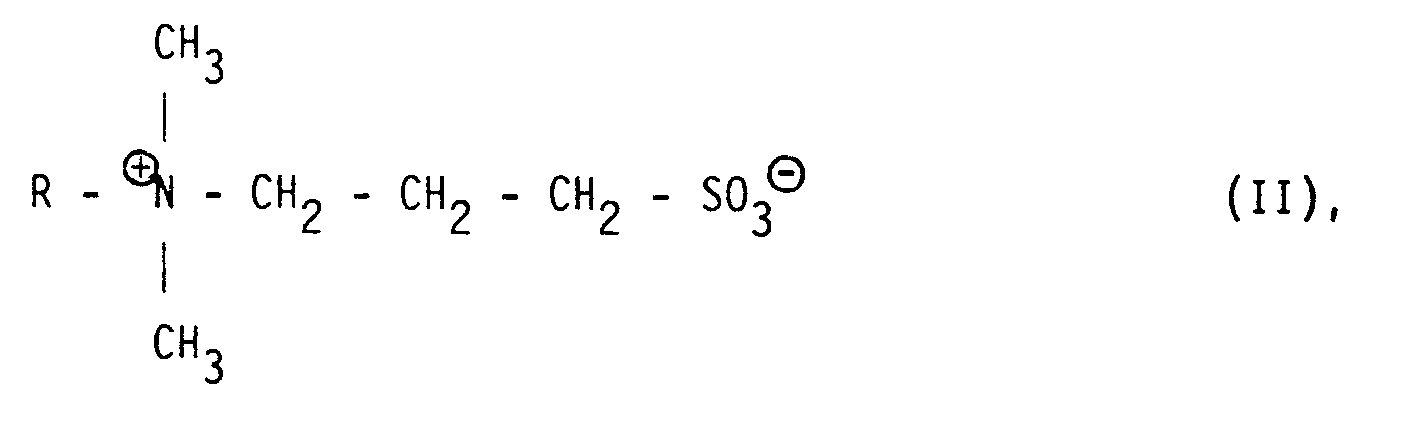
- Verfahren nach Anspruch 1,
dadurch gekennzeichnet,
daß man ein quaternäres Imidazoliniumsalz mit Betainstruktur III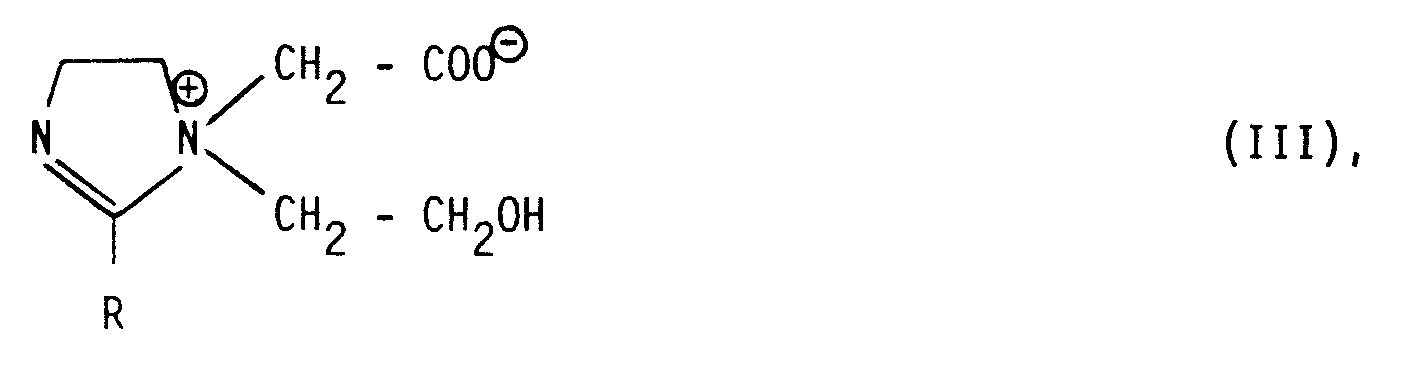
- Verfahren nach Anspruch 1,
dadurch gekennzeichnet,
daß man ein quaternäres Imidazoliniumsalz der Struktur IV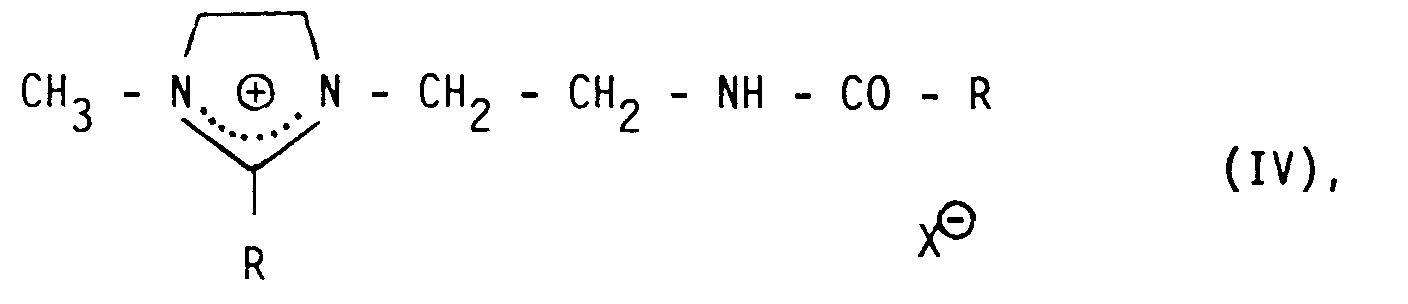
- Verfahren nach Anspruch 4,
dadurch gekennzeichnet,
daß das Anion X⊖ das Methylsulfat-Anion ist. - Verfahren nach Anspruch 1,
dadurch gekennzeichnet,
daß man das zusätzliche Dispergiermittel in einer Menge von 0,2 bis 4 %, bezogen auf die olefinisch ungesättigte Carbonsäure, zusetzt. - Verfahren nach Anspruch 6,
dadurch gekennzeichnet,
daß 0,4 bis 2 % zusätzliches Dispergiermittel zugegeben werden. - Verfahren nach Anspruch 1,
dadurch gekennzeichnet,
daß als Polysaccharid eine Stärke suspendiert wird. - Verfahren nach Anspruch 8,
dadurch gekennzeichnet,
daß 10 bis 25 Teile Stärke suspendiert werden.
Applications Claiming Priority (2)
| Application Number | Priority Date | Filing Date | Title |
|---|---|---|---|
| DE4034882A DE4034882A1 (de) | 1990-11-02 | 1990-11-02 | Verfahren zur herstellung von feinteiligen, wasserquellbaren polysaccharid-pfropfpolymeren |
| DE4034882 | 1990-11-02 |
Publications (1)
| Publication Number | Publication Date |
|---|---|
| EP0483485A1 true EP0483485A1 (de) | 1992-05-06 |
Family
ID=6417533
Family Applications (1)
| Application Number | Title | Priority Date | Filing Date |
|---|---|---|---|
| EP91114800A Withdrawn EP0483485A1 (de) | 1990-11-02 | 1991-09-03 | Verfahren zur Herstellung von feinteiligen, wasserquellbaren Polysaccharid-Pfropfpolymeren |
Country Status (5)
| Country | Link |
|---|---|
| US (1) | US5183872A (de) |
| EP (1) | EP0483485A1 (de) |
| JP (1) | JPH04266913A (de) |
| CA (1) | CA2054649A1 (de) |
| DE (1) | DE4034882A1 (de) |
Cited By (1)
| Publication number | Priority date | Publication date | Assignee | Title |
|---|---|---|---|---|
| RU2318830C2 (ru) * | 2005-11-18 | 2008-03-10 | Институт нефтехимии и катализа РАН | Способ получения модифицированного дерматансульфата |
Families Citing this family (14)
| Publication number | Priority date | Publication date | Assignee | Title |
|---|---|---|---|---|
| US5416198A (en) * | 1993-02-05 | 1995-05-16 | Research Medical, Inc. | Selective sorbent removal system using polycation activated substrates |
| DE19619680A1 (de) * | 1996-05-15 | 1997-11-20 | Buna Sow Leuna Olefinverb Gmbh | Verfahren zur Herstellung von superabsorbierenden Polymeren auf Stärkebasis |
| US6358651B1 (en) | 1999-02-26 | 2002-03-19 | Reveo, Inc. | Solid gel membrane separator in rechargeable electrochemical cells |
| US6849702B2 (en) | 1999-02-26 | 2005-02-01 | Robert W. Callahan | Polymer matrix material |
| US6605391B2 (en) * | 1999-02-26 | 2003-08-12 | Reveo, Inc. | Solid gel membrane |
| US20020012848A1 (en) * | 1999-02-26 | 2002-01-31 | Callahan Robert W. | Electrochemical cell incorporating polymer matrix material |
| US6215038B1 (en) * | 1999-05-28 | 2001-04-10 | Kimberly-Clark Worldwide, Inc. | Diaper with osmotic pressure control |
| US6281407B1 (en) * | 1999-05-28 | 2001-08-28 | Kimberly-Clark Worldwide, Inc. | Personal care product containing a product agent |
| US8101196B2 (en) * | 2001-06-26 | 2012-01-24 | Biointeractions, Ltd. | Polysaccharide biomaterials and methods of use thereof |
| EP1928918B1 (de) * | 2005-09-27 | 2011-11-16 | UNIVERSITE JOSEPH FOURIER - Grenoble 1 | Mit einer polymerisierbaren gruppierung funktionalisiertes hydrogel und anwendungen davon als biosensoren oder bioreaktoren |
| US8292863B2 (en) | 2009-10-21 | 2012-10-23 | Donoho Christopher D | Disposable diaper with pouches |
| US9567357B2 (en) | 2011-06-24 | 2017-02-14 | Biointeractions Ltd. | Biocompatible, biomimetic ampholyte materials |
| JP6454325B2 (ja) | 2013-04-26 | 2019-01-16 | バイオインタラクションズ・リミテッドBioInteractions Ltd | 生物活性被覆 |
| USRE49528E1 (en) | 2013-04-26 | 2023-05-16 | Biointeractions Ltd. | Bioactive coatings |
Citations (2)
| Publication number | Priority date | Publication date | Assignee | Title |
|---|---|---|---|---|
| US4506062A (en) * | 1982-08-09 | 1985-03-19 | Allied Colloids Limited | Inverse suspension polymerization process |
| DE3613309A1 (de) * | 1986-04-19 | 1987-10-22 | Huels Chemische Werke Ag | Verfahren zur herstellung von wasserabsorbierenden und wasserquellfaehigen polysaccharidpfropfpolymeren |
Family Cites Families (3)
| Publication number | Priority date | Publication date | Assignee | Title |
|---|---|---|---|---|
| US4131576A (en) * | 1977-12-15 | 1978-12-26 | National Starch And Chemical Corporation | Process for the preparation of graft copolymers of a water soluble monomer and polysaccharide employing a two-phase reaction system |
| US4464523A (en) * | 1983-05-16 | 1984-08-07 | National Starch And Chemical Corporation | Process for the preparation of graft copolymers of cellulose derivatives and diallyl, dialkyl ammonium halides |
| DE3801633A1 (de) * | 1988-01-21 | 1989-07-27 | Starchem Gmbh | Verfahren zur herstellung von wasserabsorbierenden und wasserquellbaren polysaccharid-pfropfpolymeren |
-
1990
- 1990-11-02 DE DE4034882A patent/DE4034882A1/de not_active Withdrawn
-
1991
- 1991-09-03 EP EP91114800A patent/EP0483485A1/de not_active Withdrawn
- 1991-10-25 US US07/782,805 patent/US5183872A/en not_active Expired - Fee Related
- 1991-10-31 CA CA002054649A patent/CA2054649A1/en not_active Abandoned
- 1991-11-01 JP JP3288133A patent/JPH04266913A/ja not_active Withdrawn
Patent Citations (2)
| Publication number | Priority date | Publication date | Assignee | Title |
|---|---|---|---|---|
| US4506062A (en) * | 1982-08-09 | 1985-03-19 | Allied Colloids Limited | Inverse suspension polymerization process |
| DE3613309A1 (de) * | 1986-04-19 | 1987-10-22 | Huels Chemische Werke Ag | Verfahren zur herstellung von wasserabsorbierenden und wasserquellfaehigen polysaccharidpfropfpolymeren |
Cited By (1)
| Publication number | Priority date | Publication date | Assignee | Title |
|---|---|---|---|---|
| RU2318830C2 (ru) * | 2005-11-18 | 2008-03-10 | Институт нефтехимии и катализа РАН | Способ получения модифицированного дерматансульфата |
Also Published As
| Publication number | Publication date |
|---|---|
| US5183872A (en) | 1993-02-02 |
| DE4034882A1 (de) | 1992-05-07 |
| CA2054649A1 (en) | 1992-05-03 |
| JPH04266913A (ja) | 1992-09-22 |
Similar Documents
| Publication | Publication Date | Title |
|---|---|---|
| EP0324985A2 (de) | Verfahren zur Herstellung von wasserabsorbierenden und wasserquellbaren Polysaccharid-Pfropfpolymeren | |
| EP1165638B1 (de) | Vernetzte, hydrophile, hochquellfähige hydrogele, verfahren zu ihrer herstellung und ihre verwendung | |
| DE2653135C2 (de) | ||
| DE19529348C2 (de) | Absorptionsmittel für Wasser und wäßrige Flüssigkeiten auf Polyacrylatbasis sowie Verfahren zu ihrer Herstellung und Verwendung | |
| DE19646484C2 (de) | Flüssigkeitsabsorbierende Polymere, Verfahren zu deren Herstellung und deren Verwendung | |
| EP0536128B1 (de) | Pulverförmige, vernetzte, wässrige flüssigkeiten sowie blut absorbierende polymere, verfahren zu ihrer herstellung und ihre verwendung als absorptionsmittel in hygieneartikeln | |
| EP0483485A1 (de) | Verfahren zur Herstellung von feinteiligen, wasserquellbaren Polysaccharid-Pfropfpolymeren | |
| DE2612846C3 (de) | Verfahren zur Herstellung eines wasserabsorbierenden Harzes | |
| DE19807992C1 (de) | Verfahren zur Vernetzung von Hydrogelen mit Bis- und Poly-2-oxazolidinonen | |
| DE3887258T2 (de) | Verfahren zur Herstellung absorbierender Polymere. | |
| EP0627225A2 (de) | Superabsorbentien und ein Verfahren zu ihrer Herstellung | |
| EP0873187A1 (de) | Mit ungesättigten aminoalkoholen vernetzte, wasserquellbare polymerisate, deren herstellung und verwendung | |
| WO1997018890A1 (de) | Wasserabsorbierende polymere mit verbesserten eigenschaften, verfahren zu deren herstellung und deren verwendung | |
| CH413811A (de) | Verfahren zur Herstellung von hydrophilen Erzeugnissen von hohem Molekulargewicht aus Dextransubstanzen | |
| EP0242529A2 (de) | Verfahren zur Herstellung von wasserabsorbierenden und wasserquellfähigen Polysaccharidpfropfpolymeren | |
| US5258448A (en) | Absorbent polymers, manufacturing process and their use in particular for sanitary articles | |
| DE3544909A1 (de) | Copolymere aus acrylamid und dimethylaminopropylacrylamid als flockungsmittel und verfahren zum entwaessern von klaerschlaemmen unter verwendung dieser flockungsmittel | |
| DE3628482A1 (de) | Verfahren zur herstellung eines harzes mit hohem absorptionsvermoegen | |
| EP0499774A1 (de) | Verfahren zur Herstellung von feinteiligen, wasserquellbaren Polysaccharid-Pfropfpolymeren | |
| EP0455965A2 (de) | Verfahren zur Herstellung von feinteiligen, wasserquellbaren Polysaccharid-Pfropfpolymeren | |
| DE19813443A1 (de) | Wasser- und wäßrige Flüssigkeiten absorbierende Polymerisatteilchen, Verfahren zu ihrer Herstellung und ihre Verwendung | |
| WO1991018031A1 (de) | Vernetztes, wasserabsorbierendes polymer und verwendung zur herstellung von hygieneartikeln | |
| DE3427441C2 (de) | ||
| DE19628863A1 (de) | Verfahren zur Herstellung von wasserabsorbierendem Harz | |
| WO2002058841A2 (de) | Wasserabsorbierendes mittel, verfahren zu seiner herstellung und seine verwendung |
Legal Events
| Date | Code | Title | Description |
|---|---|---|---|
| PUAI | Public reference made under article 153(3) epc to a published international application that has entered the european phase |
Free format text: ORIGINAL CODE: 0009012 |
|
| AK | Designated contracting states |
Kind code of ref document: A1 Designated state(s): AT BE CH DE ES FR GB IT LI NL SE |
|
| 17P | Request for examination filed |
Effective date: 19920415 |
|
| 17Q | First examination report despatched |
Effective date: 19940607 |
|
| STAA | Information on the status of an ep patent application or granted ep patent |
Free format text: STATUS: THE APPLICATION IS DEEMED TO BE WITHDRAWN |
|
| 18D | Application deemed to be withdrawn |
Effective date: 19950331 |