EP0484763A2 - Verfahren und Vorrichtung zur Herstellung von Transportkästen, insbesondere Flaschenkästen - Google Patents
Verfahren und Vorrichtung zur Herstellung von Transportkästen, insbesondere Flaschenkästen Download PDFInfo
- Publication number
- EP0484763A2 EP0484763A2 EP91118210A EP91118210A EP0484763A2 EP 0484763 A2 EP0484763 A2 EP 0484763A2 EP 91118210 A EP91118210 A EP 91118210A EP 91118210 A EP91118210 A EP 91118210A EP 0484763 A2 EP0484763 A2 EP 0484763A2
- Authority
- EP
- European Patent Office
- Prior art keywords
- injection
- box
- compressed gas
- cross
- crates
- Prior art date
- Legal status (The legal status is an assumption and is not a legal conclusion. Google has not performed a legal analysis and makes no representation as to the accuracy of the status listed.)
- Granted
Links
Images

Classifications
-
- B—PERFORMING OPERATIONS; TRANSPORTING
- B29—WORKING OF PLASTICS; WORKING OF SUBSTANCES IN A PLASTIC STATE IN GENERAL
- B29C—SHAPING OR JOINING OF PLASTICS; SHAPING OF MATERIAL IN A PLASTIC STATE, NOT OTHERWISE PROVIDED FOR; AFTER-TREATMENT OF THE SHAPED PRODUCTS, e.g. REPAIRING
- B29C45/00—Injection moulding, i.e. forcing the required volume of moulding material through a nozzle into a closed mould; Apparatus therefor
- B29C45/17—Component parts, details or accessories; Auxiliary operations
- B29C45/26—Moulds
- B29C45/27—Sprue channels ; Runner channels or runner nozzles
- B29C45/2725—Manifolds
-
- B—PERFORMING OPERATIONS; TRANSPORTING
- B29—WORKING OF PLASTICS; WORKING OF SUBSTANCES IN A PLASTIC STATE IN GENERAL
- B29C—SHAPING OR JOINING OF PLASTICS; SHAPING OF MATERIAL IN A PLASTIC STATE, NOT OTHERWISE PROVIDED FOR; AFTER-TREATMENT OF THE SHAPED PRODUCTS, e.g. REPAIRING
- B29C45/00—Injection moulding, i.e. forcing the required volume of moulding material through a nozzle into a closed mould; Apparatus therefor
- B29C45/17—Component parts, details or accessories; Auxiliary operations
- B29C45/1703—Introducing an auxiliary fluid into the mould
- B29C45/1704—Introducing an auxiliary fluid into the mould the fluid being introduced into the interior of the injected material which is still in a molten state, e.g. for producing hollow articles
-
- B—PERFORMING OPERATIONS; TRANSPORTING
- B29—WORKING OF PLASTICS; WORKING OF SUBSTANCES IN A PLASTIC STATE IN GENERAL
- B29L—INDEXING SCHEME ASSOCIATED WITH SUBCLASS B29C, RELATING TO PARTICULAR ARTICLES
- B29L2031/00—Other particular articles
- B29L2031/712—Containers; Packaging elements or accessories, Packages
- B29L2031/7134—Crates, e.g. for bottles
Definitions
- the invention relates to a method and a device for the production of transport boxes, in particular bottle boxes, in the injection molding process with injection of molten plastic at several points, preferably in the bottom area.
- Usual transport crates and here again bottle crates have long been manufactured in large numbers by injection molding from plastic.
- plastic is usually pressed into a two-part mold under high pressure from several injection points in the hot, molten state and then the cavity between the two mold halves is filled. After cooling sufficiently, the two molded parts are moved apart and the finished box can then be removed.
- the present invention is based on the object of making available a method and a device for carrying out the method, with or with which, in a simple and effective manner in the case of transport boxes and in particular bottle boxes, large-volume cross-sectional areas of the box, in particular in the area of the handles and the Corner posts can be provided with internal cavities.
- the solution to the problem is characterized in claim 1.
- a device for performing the method provides a heated injection channel distributor which, in addition to the normal injection nozzles for the plastic material, has special nozzles which open into the large-volume cross-sectional areas of the box and have injection nozzles for the central introduction of compressed gas into the plastic stream.
- the injection channel distributor is cruciform and has an injection nozzle in the bottom region of the bottle crate at the ends of the cross arms.
- the special nozzles are arranged laterally projecting at the ends of the cross arms so that they open at the bottom of the box in the bottom area of an inner rib arranged on each of the four box sides, which lead vertically and on one side of an engagement opening to a handle arranged above the opening for the box .
- a compressed gas channel leads into the area of the handle and creates an internal cavity there.
- a further vertical inner rib can also be provided on the other side of the engagement openings, which leads from the box bottom to the handle. If the process is carried out correctly, this will flow Compressed gas inside the further inner rib back towards the box bottom, so that the further inner rib also contains a cavity.
- the compressed gas can be vented at the end of the flow path for the compressed gas, for example at the lower end of the further vertical inner rib.
- the bottle crate according to FIG. 1 has in the usual way an only partially visible, ribbed bottom 1 and is divided into four compartments with the aid of two intersecting inner walls 2 for receiving a six-pack of bottles each.
- protruding spacers 3 are provided on the floor, of which only two are visible.
- the box also has corner bars 4, which are connected to one another by walls 5, in the usual way.
- engagement openings 6 are provided on all four sides of the box.
- the wall areas below the engaging openings 6 are also referred to as advertising spaces because the respective brewery and the type of beverage are usually specified here.
- handles 7 are formed by additional ribs, which because of the relatively large weight of a filled box must have both a wide contact surface for the hand and relatively high strength. Nevertheless, the box should remain as light as possible, so that not too much dead weight is transported unnecessarily and material is saved as much as possible.
- the hollow design of the handles 7, each with an inner cavity 8, is achieved in that inner stiffening ribs 9 lead from the bottom to the handle 7 on both sides of the engagement openings 7. Compressed gas flows through one of these stiffening ribs 9 together with the molten plastic to the handle 7 and forms the inner cavity 8. The compressed gas then flows further over the respective other inner rib 9 in the direction of the floor and can later be relaxed there by piercing.
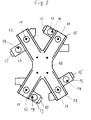
- FIG. 2 shows an injection channel distributor which is used to manufacture the bottle crate according to FIG. 1 using the injection molding process.
- the distributor 10 is heated during operation so that the plastic material supplied under high pressure in the middle area remains molten. It is then pressed into the injection mold at the bottom in a conventional manner at four injection points 11, which are arranged at the ends of the arms 12 of the cross-shaped distributor 10.
- the distributor 10 has at the ends of the arms 12 laterally arranged special nozzles 13, each of which has additional injection points 14.
- a pressure gas, preferably nitrogen, is also fed to the special nozzles via connections 15, which is then directed into the mold approximately in the central region of the plastic strand emerging from the injection points 14, namely at the lower end of one of the inner ribs 9 on each side of the box. In this way, the inner cavities are then formed in the area of the inner ribs 9 and the handles 7.
Landscapes
- Engineering & Computer Science (AREA)
- Manufacturing & Machinery (AREA)
- Mechanical Engineering (AREA)
- Details Of Rigid Or Semi-Rigid Containers (AREA)
- Containers Having Bodies Formed In One Piece (AREA)
- Refuse Collection And Transfer (AREA)
- Injection Moulding Of Plastics Or The Like (AREA)
- Rigid Containers With Two Or More Constituent Elements (AREA)
- Lubricants (AREA)
Abstract
Description
- Die Erfindung betrifft ein Verfahren und eine Vorrichtung zur Herstellung von Transportkästen, insbesondere Flaschenkästen, im Spritzgußverfahren unter Einspritzen von schmelzflüssigem Kunststoff an mehreren Punkten, vorzugsweise im Bodenbereich.
- Übliche Transportkästen und hier wiederum Flaschenkästen werden schon seit langem in großen Stückzahlen im Spritzgußverfahren aus Kunststoff hergestellt. Dazu wird in eine zweiteilige Form unter hohem Druck Kunststoff meist von mehreren Anspritzstellen her im heißen, schmelzflüssigen Zustand eingepreßt und dann der Hohlraum zwischen den beiden Formhälften ausgefüllt. Nach ausreichendem Abkühlen fährt man die beiden Formteile auseinander und kann dann den fertigen Kasten entnehmen.
- Bekannt ist seit einiger Zeit auch das Herstellen von Kunststoffteilen im Spritzgußverfahren, wobei zur Material- und Gewichtseinsparung Hohlräume im Spritzgußteil erzeugt werden. Dazu wird entweder nach dem Füllen der jeweiligen Form mit dem schmelzflüssigen Kunststoff Druckgas mittels einer oder mehrerer Injektionsnadeln an die entsprechenden Stellen in der Form eingepreßt, das dann Teile des Kunststoffes unter Erzeugung eines Hohlraums verdrängt. Hierzu wird beispielsweise verwiesen auf EP-A-283 207. Bei einem anderen Verfahren wird das Druckgas direkt in den Strom des in den Formhohlraum eingepreßten, schmelzflüssigen Kunststoffes eingeführt (EP-A-298 631).
- Der vorliegenden Erfindung liegt nun die Aufgabe zugrunde, ein Verfahren und eine Vorrichtung zur Durchführung des Verfahrens verfügbar zu machen, mit dem bzw. mit der auf einfache und wirksame Weise bei Transportkästen und insbesondere Flaschenkästen großvolumige Querschnittsbereiche des Kastens, insbesondere im Bereich der Handgriffe und der Eckholme mit inneren Hohlräumen versehen werden können. Die Lösung der Aufgabe ist im Patentanspruch 1 gekennzeichnet.
- Eine Vorrichtung zur Durchführung des Verfahrens sieht einen geheizten Einspritzkanalverteiler vor, der außer den normalen Einspritzdüsen für das Kunststoffmaterial Sonderdüsen aufweist, die in die großvolumigen Querschnittsbereiche des Kastens münden und Injektionsdüsen zur mittigen Einführung von Druckgas in den Kunststoffstrom aufweisen.
- Zur Herstellung von Flaschenkästen sieht eine Weiterbildung der Erfindung vor, daß der Einspritzkanalverteiler kreuzförmig ausgebildet ist und an den Enden der Kreuzarme je eine Einspritzdüse im Bodenbereich des Flaschenkastens aufweist. Die Sonderdüsen sind dabei an den Enden der Kreuzarme seitlich abstehend so angeordnet, daß sie am Kastenrand je im Bodenbereich einer an jeder der vier Kastenseiten angeordneten Innenrippe münden, die senkrecht und auf einer Seite einer Eingriffsöffnung zu einem oberhalb der Eingriffsöffnung angeordneten Handgriff für den Kasten führen. Etwa im Zentrum der Innenrippen führt dann ein Druckgaskanal in den Bereich des Handgriffs und sorgt dort für einen inneren Hohlraum. Zusätzlich kann nach einer weiteren Empfehlung der Erfindung auch auf der anderen Seite der Eingriffsöffnungen jeweils eine weitere senkrechte Innenrippe vorgesehen sein, die vom Kastenboden zum Handgriff führt. Bei richtiger Verfahrensführung strömt dann das Druckgas im Inneren der weiteren Innenrippe wieder zurück in Richtung zum Kastenboden, so daß auch die weitere Innenrippe einen Hohlraum enthält. Die Entlüftung des Druckgases kann jeweils am Ende des Fließweges für das Druckgas erfolgen, also beispielsweise am unteren Ende der weiteren senkrechten Innenrippe.
- Nachfolgend wird ein Ausführungsbeispiel der Erfindung anhand der Zeichnung beschrieben. Es zeigen:
- Fig. 1
- die perspektivische Ansicht eines Flaschenkastens, der nach dem erfindungsgemäßen Verfahren und unter Verwendung einer entsprechenden Vorrichtung hergestellt worden ist;
- Fig. 2
- eine Aufsicht des Einspritzkanalverteilers zur Herstellung des Kastens nach Fig. 1
- Der Flaschenkasten nach Fig. 1 besitzt in üblicher Weise einen nur teilweise sichtbaren, verrippten Boden 1 und ist mit Hilfe von zwei sich kreuzenden Innenwänden 2 in vier Fächer zur Aufnahme von je einem Sechser-Pack von Flaschen unterteilt. Zur Lagesicherung der später in den Kasten zurückgestellten, leeren Flaschen sind in bekannter Weise im Bereich zwischen je vier Flaschen hochragende Abstandshalter 3 auf dem Boden vorgesehen, von denen nur zwei sichtbar sind. Zur Versteifung und Lastübertragung im Stapel besitzt der Kasten in ebenfalls üblicher Weise Eckholme 4, die durch Wände 5 miteinander verbunden sind. Im oberen Bereich der Wände 5 sind Eingrifföffnungen 6 an allen vier Kastenseiten vorgesehen. Die Wandbereiche unterhalb der Eingrifföffnungen 6 werden auch als Werbeflächen bezeichnet, weil hier üblicherweise die jeweilige Brauerei und die Getränkeart angegeben ist. Oberhalb der Eingrifföffnungen 6 sind durch zusätzliche Rippen Handgriffe 7 ausgebildet, die wegen des verhältnismäßig großen Gewichtes eines gefüllten Kastens sowohl eine breite Auflagefläche für die Hand als auch verhältnismäßig hohe Festigkeit besitzen müssen. Trotzdem soll insgesamt der Kasten möglichst leicht bleiben, damit nicht unnötig viel totes Gewicht transportiert und außerdem möglichst Material eingespart wird.
- Die hohle Ausbildung der Handgriffe 7 mit jeweils einem inneren Hohlraum 8 gelingt dadurch, daß jeweils beiderseits der Eingriffsöffnungen 7 innere Versteifungsrippen 9 vom Boden zum Handgriff 7 führen. Durch jeweils eine dieser Versteifungsrippen 9 strömt zusammen mit dem schmelzflüssigen Kunststoff Druckgas zum Handgriff 7 und bildet den inneren Hohlraum 8. Das Druckgas strömt dann weiter über die jeweils andere Innenrippe 9 in Richtung zum Boden und kann später dort durch Einstechen entspannt werden.
- In Fig. 2 ist ein Einspritzkanalverteiler dargestellt, der zur Herstellung des Flaschenkastens gemäß Fig. 1 im Spritzgußverfahren dient. Der Verteiler 10 wird im Betrieb so geheizt, daß das unter hohem Druck im mittleren Bereich zugeführte Kunststoffmaterial schmelzflüssig bleibt. Es wird dann in an sich üblicher Weise an vier Anspritzpunkten 11, die an den Enden der Arme 12 des kreuzförmig ausgebildeten Verteilers 10 angeordnet sind, bodenseitig in die spritzgußform eingepreßt. Zusätzlich weist der Verteiler 10 an den Enden der Arme 12 seitlich angeordnete Sonderdüsen 13 auf, die jeweils zusätzliche Anspritzpunkte 14 besitzen. Den Sonderdüsen wird außerdem über Anschlüsse 15 ein Druckgas, vorzugsweise Stickstoff, zugeführt, das dann etwa im mittleren Bereich des aus den Anspritzpunkten 14 austretenden Kunststoffstrangs in die Form geleitet wird, und zwar jeweils am unteren Ende einer der Innenrippen 9 auf jeder Kastenseite. Auf diese Weise werden dann die inneren Hohlräume im Bereich der Innenrippen 9 und der Handgriffe 7 gebildet.
Claims (5)
- Verfahren zur Herstellung von Transportkästen, insbesondere Flaschenkästen, im Spritzgußverfahren mit dem Verfahrensschritt:a) Einspritzen von schmelzflüssigem Kunststoff an mehreren Punkten, vorzugsweise im Bodenbereich,
gekennzeichnet durch die Verfahrensschritte:b) Einspritzen von schmelzflüssigem Kunststoff an weiteren Anspritzpunkten (14), die mit großvolumigen Querschnittsbereichen (7, 9) des Kastens, beispielsweise den Griff- und Eckholmbereichen, in Verbindung stehen,c) zentrales Einführen von Druckgas in den Kunststoffstrom an den weiteren Anspritzpunkten,d) Entlüften des Druckgases im zentralen Bereich der großvolumigen Querschnitte. - Verfahren nach Anspruch 1,
dadurch gekennzeichnet, daß das Entlüften des Druckgases am Ende des Fließweges erfolgt. - Vorrichtung zur Durchführung des Verfahrens nach Anspruch 1 oder 2,
gekennzeichnet durch einen geheizten Einspritzkanalverteiler (10), der neben den normalen Einspritzdüsen (11) für das Kunststoffmaterial Sonderdüsen (14) aufweist, die in die großvolumigen Querschnittsbereiche (9) des Kastens münden und Injektionsdüsen zur mittigen Einführung von Druckgas (15) in den Kunststoffstrom aufweisen. - Vorrichtung nach Anspruch 3,
dadurch gekennzeichnet, daß der Einspritzkanalverteiler (10) für einen Flaschenkasten kreuzförmig ausgebildet ist und an den Enden der Kreuzarme (12) je eine Einspritzdüse (11) im Bodenbereich des Flaschenkastens aufweist, und daß die Sonderdüsen (13, 14) an den Enden der Kreuzarme (12) seitlich abstehend so angeordnet ist, daß sie am Kastenrand je im Bodenbereich einer an jeder der vier Kastenseiten angeordneten Innenrippe (9) münden, die senkrecht und auf einer Seite einer Eingriffsöffnung (6) zu einem oberhalb der Eingriffsöffnung angeordneten Handgriff (7) für den Kasten führen. - Vorrichtung nach Anspruch 4,
dadurch gekennzeichnet, daß auf der anderen Seite der Eingriffsöffnungen (6) jeweils eine weitere, senkrechte Innenrippe (9) vorgesehen ist, die vom Kastenboden zum Handgriff führt.
Applications Claiming Priority (2)
| Application Number | Priority Date | Filing Date | Title |
|---|---|---|---|
| DE4035497A DE4035497C2 (de) | 1990-11-08 | 1990-11-08 | Vorrichtung zur Herstellung von Transportkästen, insbesondere Flaschenkästen |
| DE4035497 | 1990-11-08 |
Publications (3)
| Publication Number | Publication Date |
|---|---|
| EP0484763A2 true EP0484763A2 (de) | 1992-05-13 |
| EP0484763A3 EP0484763A3 (en) | 1992-08-12 |
| EP0484763B1 EP0484763B1 (de) | 1995-01-04 |
Family
ID=6417863
Family Applications (1)
| Application Number | Title | Priority Date | Filing Date |
|---|---|---|---|
| EP91118210A Expired - Lifetime EP0484763B1 (de) | 1990-11-08 | 1991-10-25 | Verfahren und Vorrichtung zur Herstellung von Transportkästen, insbesondere Flaschenkästen |
Country Status (3)
| Country | Link |
|---|---|
| EP (1) | EP0484763B1 (de) |
| AT (1) | ATE116595T1 (de) |
| DE (2) | DE4035497C2 (de) |
Cited By (2)
| Publication number | Priority date | Publication date | Assignee | Title |
|---|---|---|---|---|
| EP0687630A1 (de) * | 1994-06-17 | 1995-12-20 | Wilhelm Götz | Im Spritzgiessverfahren hergestelltes Kunstoffteil |
| EP0770552A1 (de) * | 1995-10-26 | 1997-05-02 | Wilhelm Götz | Kasten, insbesondere Flaschenkasten und Verfahren zum Herstellen eines solchen Kastens |
Family Cites Families (8)
| Publication number | Priority date | Publication date | Assignee | Title |
|---|---|---|---|---|
| DE2501314A1 (de) * | 1975-01-15 | 1976-07-22 | Roehm Gmbh | Spritzgiessen hohler formteile aus thermoplastischen kunststoffen, insbesondere fuer den bausektor |
| DE2734746A1 (de) * | 1977-08-02 | 1979-02-08 | Koose Rudolf | Verteiler fuer eine kunststoffmasse |
| GB8706204D0 (en) * | 1987-03-16 | 1987-04-23 | Peerless Cinpres Ltd | Injection moulding apparatus |
| US4781554A (en) * | 1987-07-09 | 1988-11-01 | Michael Ladney | Apparatus for the injection molding of thermoplastics |
| AU4640489A (en) * | 1988-11-08 | 1990-06-12 | Schoeller International Engineering Kg | Plastic bottle-case |
| DE3839087C2 (de) * | 1988-11-08 | 2002-04-04 | Schoeller Plast Ag | Flaschenkasten aus Kunststoff sowie Verfahren zur Herstellung desselben |
| NL8901550A (nl) * | 1989-06-20 | 1991-01-16 | Wavin Bv | Werkwijze voor het door spuitgieten vervaardigen van een kunststof krat en kunststof krat vervaardigd volgens deze werkwijze. |
| NL8903105A (nl) * | 1989-12-19 | 1991-07-16 | Wavin Bv | Kunststofkrat met holle kolommen voorzien van een gasinjektieopening, alsmede werkwijze en inrichting voor het vervaardigen van een dergelijke kunststofkrat. |
-
1990
- 1990-11-08 DE DE4035497A patent/DE4035497C2/de not_active Expired - Fee Related
-
1991
- 1991-10-25 AT AT91118210T patent/ATE116595T1/de active
- 1991-10-25 DE DE59104144T patent/DE59104144D1/de not_active Expired - Fee Related
- 1991-10-25 EP EP91118210A patent/EP0484763B1/de not_active Expired - Lifetime
Cited By (2)
| Publication number | Priority date | Publication date | Assignee | Title |
|---|---|---|---|---|
| EP0687630A1 (de) * | 1994-06-17 | 1995-12-20 | Wilhelm Götz | Im Spritzgiessverfahren hergestelltes Kunstoffteil |
| EP0770552A1 (de) * | 1995-10-26 | 1997-05-02 | Wilhelm Götz | Kasten, insbesondere Flaschenkasten und Verfahren zum Herstellen eines solchen Kastens |
Also Published As
| Publication number | Publication date |
|---|---|
| DE59104144D1 (de) | 1995-02-16 |
| EP0484763B1 (de) | 1995-01-04 |
| DE4035497A1 (de) | 1992-05-21 |
| DE4035497C2 (de) | 1994-08-11 |
| ATE116595T1 (de) | 1995-01-15 |
| EP0484763A3 (en) | 1992-08-12 |
Similar Documents
| Publication | Publication Date | Title |
|---|---|---|
| DE69219157T2 (de) | Spritzgiessen von kunststoffgegenständen die hohlförmige rippen aufweisen | |
| DE3331449A1 (de) | Verfahren und vorrichtung zum spritzgiessen eines verbund-vorformlings | |
| DE3006338A1 (de) | Spritzblasmaschine | |
| DE3856347T2 (de) | Rotierende einspritzblasgiessvorrichtung | |
| EP0799683A2 (de) | Verfahren zum Spritzgiessen von dreischichtigen Spritzlingen und Vorrichtung für die Durchführung des Verfahrens | |
| CH426219A (de) | Verfahren zur Herstellung einer Plastikflasche und nach dem Verfahren hergestellte Flasche | |
| EP1396329A1 (de) | Verfahren und Anlage zum Ausbilden eines Abschnitts eines kastenförmigen Behältnisses sowie kastenförmiges Behältnis | |
| EP0770552B1 (de) | Kasten, insbesondere Flaschenkasten und Verfahren zum Herstellen eines solchen Kastens | |
| EP0484763B1 (de) | Verfahren und Vorrichtung zur Herstellung von Transportkästen, insbesondere Flaschenkästen | |
| DE69003882T2 (de) | Verfahren zum Herstellen eines Kunststoffkastens durch Spritzgiessen und durch dieses Verfahren hergestellter Kunststoffkasten. | |
| DE2614707A1 (de) | Spritzgiessanlage, insbesondere zur herstellung von thermoplast-strukturschaum-formteilen | |
| DE4439431A1 (de) | Verfahren und Vorrichtung zur Herstellung von Bürstenkörpern aus mindestens zwei Kunststoffkomponenten | |
| EP0678370B1 (de) | Verfahren zur Serienherstellung von Artikeln im Gasformverfahren sowie Vorrichtung zur Durchführung des Verfahrens | |
| DE2142881C3 (de) | Vorrichtung zum Herstellen, Füllen und Verschließen von Kunststoffflaschen | |
| EP0687630B1 (de) | Im Spritzgiessverfahren hergestelltes Kunstoffteil | |
| DE69229058T2 (de) | Verfahren zum blasformen von rohrfoermigen behaeltern | |
| DE69628164T2 (de) | Verfahren zur Herstellung von spritzgegossenen Gegenständen, Vorrichtung zur Durchführung dieses Verfahrens und neue geformte Gegenstände | |
| DE3839087C2 (de) | Flaschenkasten aus Kunststoff sowie Verfahren zur Herstellung desselben | |
| EP0189906B1 (de) | Werkzeug zum Spritzgiessen von stapelbaren Behältern | |
| AT884U1 (de) | Einrichtung zum spritzgiessen von kunststoff | |
| EP0881012B1 (de) | Vorrichtung und Verfahren zum Paketieren von Kernen | |
| EP4135962B1 (de) | Spritzgiesswerkzeug mit optimierter spritzgiesswerkzeugplatte | |
| AT506116B1 (de) | Verfahren zum betreiben einer spritzgiesseinrichtung | |
| DE10319025A1 (de) | Korkenwerkzeug sowie Verfahren zur Herstellung hierfür | |
| DE10016973A1 (de) | Verfahren zum Herstellen eines Handgriffs, danach hergestellte Handgriffe und Flaschenkasten mit einem Handgriff |
Legal Events
| Date | Code | Title | Description |
|---|---|---|---|
| PUAI | Public reference made under article 153(3) epc to a published international application that has entered the european phase |
Free format text: ORIGINAL CODE: 0009012 |
|
| AK | Designated contracting states |
Kind code of ref document: A2 Designated state(s): AT BE CH DE DK ES FR GB GR IT LI LU NL SE |
|
| PUAL | Search report despatched |
Free format text: ORIGINAL CODE: 0009013 |
|
| AK | Designated contracting states |
Kind code of ref document: A3 Designated state(s): AT BE CH DE DK ES FR GB GR IT LI LU NL SE |
|
| 17P | Request for examination filed |
Effective date: 19930206 |
|
| 17Q | First examination report despatched |
Effective date: 19940622 |
|
| GRAA | (expected) grant |
Free format text: ORIGINAL CODE: 0009210 |
|
| ITF | It: translation for a ep patent filed | ||
| AK | Designated contracting states |
Kind code of ref document: B1 Designated state(s): AT BE CH DE DK ES FR GB GR IT LI LU NL SE |
|
| PG25 | Lapsed in a contracting state [announced via postgrant information from national office to epo] |
Ref country code: GR Free format text: LAPSE BECAUSE OF FAILURE TO SUBMIT A TRANSLATION OF THE DESCRIPTION OR TO PAY THE FEE WITHIN THE PRESCRIBED TIME-LIMIT Effective date: 19950104 Ref country code: ES Free format text: THE PATENT HAS BEEN ANNULLED BY A DECISION OF A NATIONAL AUTHORITY Effective date: 19950104 Ref country code: DK Effective date: 19950104 |
|
| REF | Corresponds to: |
Ref document number: 116595 Country of ref document: AT Date of ref document: 19950115 Kind code of ref document: T |
|
| GBT | Gb: translation of ep patent filed (gb section 77(6)(a)/1977) |
Effective date: 19950118 |
|
| REF | Corresponds to: |
Ref document number: 59104144 Country of ref document: DE Date of ref document: 19950216 |
|
| ET | Fr: translation filed | ||
| PG25 | Lapsed in a contracting state [announced via postgrant information from national office to epo] |
Ref country code: LU Free format text: LAPSE BECAUSE OF NON-PAYMENT OF DUE FEES Effective date: 19951031 |
|
| PLBE | No opposition filed within time limit |
Free format text: ORIGINAL CODE: 0009261 |
|
| STAA | Information on the status of an ep patent application or granted ep patent |
Free format text: STATUS: NO OPPOSITION FILED WITHIN TIME LIMIT |
|
| 26N | No opposition filed | ||
| PGFP | Annual fee paid to national office [announced via postgrant information from national office to epo] |
Ref country code: GB Payment date: 19961025 Year of fee payment: 6 |
|
| PGFP | Annual fee paid to national office [announced via postgrant information from national office to epo] |
Ref country code: SE Payment date: 19961029 Year of fee payment: 6 |
|
| PGFP | Annual fee paid to national office [announced via postgrant information from national office to epo] |
Ref country code: AT Payment date: 19961030 Year of fee payment: 6 |
|
| PGFP | Annual fee paid to national office [announced via postgrant information from national office to epo] |
Ref country code: NL Payment date: 19961031 Year of fee payment: 6 Ref country code: FR Payment date: 19961031 Year of fee payment: 6 |
|
| PGFP | Annual fee paid to national office [announced via postgrant information from national office to epo] |
Ref country code: CH Payment date: 19961104 Year of fee payment: 6 |
|
| PGFP | Annual fee paid to national office [announced via postgrant information from national office to epo] |
Ref country code: BE Payment date: 19961128 Year of fee payment: 6 |
|
| PGFP | Annual fee paid to national office [announced via postgrant information from national office to epo] |
Ref country code: DE Payment date: 19961224 Year of fee payment: 6 |
|
| PG25 | Lapsed in a contracting state [announced via postgrant information from national office to epo] |
Ref country code: GB Free format text: LAPSE BECAUSE OF NON-PAYMENT OF DUE FEES Effective date: 19971025 Ref country code: AT Free format text: LAPSE BECAUSE OF NON-PAYMENT OF DUE FEES Effective date: 19971025 |
|
| PG25 | Lapsed in a contracting state [announced via postgrant information from national office to epo] |
Ref country code: SE Free format text: LAPSE BECAUSE OF NON-PAYMENT OF DUE FEES Effective date: 19971026 |
|
| PG25 | Lapsed in a contracting state [announced via postgrant information from national office to epo] |
Ref country code: LI Free format text: LAPSE BECAUSE OF NON-PAYMENT OF DUE FEES Effective date: 19971031 Ref country code: FR Free format text: THE PATENT HAS BEEN ANNULLED BY A DECISION OF A NATIONAL AUTHORITY Effective date: 19971031 Ref country code: CH Free format text: LAPSE BECAUSE OF NON-PAYMENT OF DUE FEES Effective date: 19971031 Ref country code: BE Free format text: LAPSE BECAUSE OF NON-PAYMENT OF DUE FEES Effective date: 19971031 |
|
| BERE | Be: lapsed |
Owner name: PEGUFORM-WERKE G.M.B.H. Effective date: 19971031 |
|
| PG25 | Lapsed in a contracting state [announced via postgrant information from national office to epo] |
Ref country code: NL Free format text: LAPSE BECAUSE OF NON-PAYMENT OF DUE FEES Effective date: 19980501 |
|
| REG | Reference to a national code |
Ref country code: CH Ref legal event code: PL |
|
| GBPC | Gb: european patent ceased through non-payment of renewal fee |
Effective date: 19971025 |
|
| NLV4 | Nl: lapsed or anulled due to non-payment of the annual fee |
Effective date: 19980501 |
|
| PG25 | Lapsed in a contracting state [announced via postgrant information from national office to epo] |
Ref country code: DE Free format text: LAPSE BECAUSE OF NON-PAYMENT OF DUE FEES Effective date: 19980701 |
|
| EUG | Se: european patent has lapsed |
Ref document number: 91118210.3 |
|
| REG | Reference to a national code |
Ref country code: FR Ref legal event code: ST |
|
| PG25 | Lapsed in a contracting state [announced via postgrant information from national office to epo] |
Ref country code: IT Free format text: LAPSE BECAUSE OF NON-PAYMENT OF DUE FEES;WARNING: LAPSES OF ITALIAN PATENTS WITH EFFECTIVE DATE BEFORE 2007 MAY HAVE OCCURRED AT ANY TIME BEFORE 2007. THE CORRECT EFFECTIVE DATE MAY BE DIFFERENT FROM THE ONE RECORDED. Effective date: 20051025 |