EP0484944A2 - Appareil de calcul pour des vecteurs capable d'exécuter rapidement un calcul sur deux vecteurs d'entrée - Google Patents
Appareil de calcul pour des vecteurs capable d'exécuter rapidement un calcul sur deux vecteurs d'entrée Download PDFInfo
- Publication number
- EP0484944A2 EP0484944A2 EP91118995A EP91118995A EP0484944A2 EP 0484944 A2 EP0484944 A2 EP 0484944A2 EP 91118995 A EP91118995 A EP 91118995A EP 91118995 A EP91118995 A EP 91118995A EP 0484944 A2 EP0484944 A2 EP 0484944A2
- Authority
- EP
- European Patent Office
- Prior art keywords
- adder
- vector
- signal
- zeroth
- selecting
- Prior art date
- Legal status (The legal status is an assumption and is not a legal conclusion. Google has not performed a legal analysis and makes no representation as to the accuracy of the status listed.)
- Granted
Links
Images




Classifications
-
- G—PHYSICS
- G06—COMPUTING OR CALCULATING; COUNTING
- G06F—ELECTRIC DIGITAL DATA PROCESSING
- G06F17/00—Digital computing or data processing equipment or methods, specially adapted for specific functions
- G06F17/10—Complex mathematical operations
- G06F17/16—Matrix or vector computation, e.g. matrix-matrix or matrix-vector multiplication, matrix factorization
Definitions
- This invention relates to a vector calculation apparatus for carrying out vector calculation on a plurality of vectors. It is to be noted throughout the instant specification that each of the vectors is composed of a plurality of vector components or elements which are given in the form of electrical signals for electrical processing, although a specific description will not be made hereinafter.
- a recent requirement for an electronic digital computer is to process vector calculation at a high speed.
- the vector calculation is, for example, vector addition of calculating a sum of a pair of vectors.
- addition of components of the respective vectors must be repeated a great number of times. This is because each of the vectors is usually composed of a lot of components.
- One of the conventional vector calculation apparatus includes a two-input vector adder for carrying out addition of two adder input signals. Supplied with the vectors as the adder input signals, the two-input vector adder carries out the addition to produce an adder output signal representative of the sum of vectors.
- This vector calculation apparatus requires a relatively long time as will later be described in detail.
- a different one of the conventional vector calculation apparatus includes a three-input vector adder and a selecting circuit.
- the three-input vector adder is for carrying out addition of three adder input signals to produce an adder output signal.
- the selecting circuit is for selecting, as a selected signal, a selected one of the adder output signal and a predetermined value, such as zero. Supplied with the vectors and the selected signal as the adder input signals, the three-input vector adder carries out the addition to produce the adder output signal.
- the different one of the vector calculation apparatus has a disadvantage in that a very long time is necessary to calculate the sum in case where the vectors are composed of an enormous number of components.
- an apparatus for calculating a result of vector calculation in response to a first vector composed of a plurality of first-set components and a second vector composed of a plurality of second-set components includes a vector adder for carrying out addition of a first, a second, and a third adder input signal to produce an adder output signal as the result and zeroth selecting means connected to the vector adder for selecting, as a zeroth selected signal, a selected one of the adder output signal and a predetermined value.
- the apparatus comprises first selecting, second selecting, supplying, and control means.
- the first selecting means is connected to the vector adder and is for selecting, as a first selected signal, a selected one of the first-set components and the adder output signal.
- the second selecting means is connected to the vector adder and is for selecting, as a second selected signal, a selected one of the second-set components and the adder output signal.
- the supplying means is connected to the first, the second, and the zeroth selecting means and is for supplying the vector adder with the first selected signal as the first adder input signal, with said second selected signal as the second adder input signal, and with the zeroth selected signal as the third adder input signal.
- the control means is connected to the vector adder, the first, the second, and the zeroth selecting means, and the supplying means and is for controlling the vector adder, the first, the second, and the zeroth selecting means, and the supplying means.
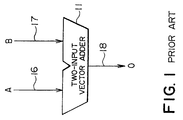
- the conventional vector calculation apparatus is for use in carrying out vector addition of two vectors.
- the illustrated vector calculation apparatus comprises a two-input vector adder 11 which is connected to first and second input lines 16 and 17.
- the vectors are supplied as a first and a second adder input signal to the vector adder 11 through the first and the second input lines 16 and 17, respectively, and may be called first and second input vectors A and B (such vectors being denoted herein by ordinal letters rather than either by thick letters or by the ordinal letters with horizontal arrows over them).
- the first input vector A is composed of a sequence of first-set components or elements (a1, a2, ..., a n ) which may be called first through n-th components of the first input vector A, respectively.
- the second input vector B is composed of a sequence of second-set components (b1, b2, ..., b n ) which may be referred to as first through n-th components of the second input vector B. It is assumed in this manner in the illustrated example that the first input vector A has the same number of components as the second input vector B.
- the vector addition of the first and the second input vectors A and B is for calculating an output vector O composed of a sequence of output components (o1, o2, ..., o n ) which may be called first through n-th output components.
- the vector adder 11 successively sums up the first-set and the second-set components (a1, a2, ..., a n ) and (b1, b2, ..., b n ) to produce the first through the n-th output components (o1, o2, ..., o n ) which appear on an adder output line 18.
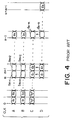
- Fig. 2 in addition to Fig. 1, the description will be made as regards calculation of a total sum of 2 k components of the first and the second input vectors A and B, where k represents a predetermined number, 2 k being not greater than n.
- a calculation time will be assumed to be equal to mT, where m is an integer and T is representative of a clock cycle which is determined by a sequence of clock pulses.
- the clock cycle is illustrated along a first or top row labelled CLK.
- the first-set components are depicted along a second row labelled A.
- the second-set components are illustrated along a third row labelled B.
- the adder output signal is shown along a fourth or bottom row labelled O.
- the 2 k component are divided at first into the first-set and the second-set components.
- the first-set components are 2 k-1 in number.
- the second-set components are also 2 k-1 in number.
- First ones a1 and b1 of the components of the first and the second input vectors A and B are supplied through the first and the second input lines 16 and 17 to the vector adder 11 in timed relation to a zeroth one of the clock pulses.
- second through 2 k-1 -th components of the first and the second input vectors A and B are successively supplied to the vector adder 11 in synchronism with first through (2 k-1 - 1)-th clock pulses, respectively.
- a simplified symbol r is substituted for 2 k-1 merely for simplification of illustration.
- a simplified symbol s is substituted for 2 k-2 merely for simplification of illustration.
- the simplified symbols will be used also in the following.
- the different one of the conventional vector calculation apparatus comprises similar parts designated by like reference numerals.
- the vector calculation apparatus comprises a three-input vector adder 21 which is for carrying out vector addition of three vectors.
- the vector adder 21 is connected to a third input line 23 in addition to the first and the second input lines 16 and 17. Two of the vectors are supplied as the first and the second input vectors A and B to the vector adder 21 through the first and the second input lines 16 and 17.
- the remaining one of the three vectors is supplied as a third adder input signal to the vector adder 21 through the third input line 23 and may be called a third vector C (such a vector being also denoted herein by ordinal letters rather than by thick letters).
- the third vector C is composed of a sequence of third-set components and is assumed to have the same number of components as each of the first and the second vectors A and B.
- the vector adder 21 carries out the vector addition to produce an output vector D as an adder output signal representative of a result of the vector addition.
- the output vector D is composed of a sequence of output components (d1, d2, ..., d n ) which may be called first through n-th output components.
- the vector adder 21 successively sums up the first-set, the second-set, and the third-set components to produce the first through the n-th output components (d1, d2, ..., d n ) which appear on the output line 18.
- the vector calculation apparatus further comprises a selecting circuit 24 which is connected to the output and the third input lines 18 and 23 and to an additional input line 25.
- the selecting circuit 24 is for selecting, as a selected signal, one of the adder output signal and a predetermined value which may be "0" and is supplied through the additional input line 25.
- the selected signal is supplied as the third vector C to the vector adder 21 through the third input line 23. Therefore, the third vector C is composed of one of the predetermined value and the first through the n-th output components (d1, d2, ..., d n ).
- the first-set components are depicted along a first or top row labelled A.
- the second-set components are illustrated along a second row labelled B.
- the adder output signal is shown along a third row labelled C.
- the operation of the vector calculation apparatus is controlled in accordance with each of successive timing cycles which comprises zeroth, first through (m - 1)-th, m-th, (m + 1)-th through (n - 1)-th, and n-th through (n + m - 1)-th cycle times 0, 1 to (m - 1), m, (m + 1) to (n - 1), n to (n + m - 1).
- the selecting circuit 24 selects the first output component d1 as the selected signal in the manner indicated by an upwardly directed arrow drawn from a fourth of bottom row labelled D to the third row C. The first output component d1 is supplied to the vector adder 21.
- the vector adder 21 produces first local addition results m times, when i varies from (2 k-1 - m + 1) to 2 k-1 through (2 k-1 - m + 2), ..., and so forth.
- the first local addition results are divided into a first and a second group.
- the operation of the vector calculation apparatus is carried out again with the first and the second groups supplied to the vector adder 21 as the first and the second input vectors A and B.
- the vector adder 21 produces second local addition results for use as the first and the second input vectors A and B. In this manner, the second local addition results are repeatedly obtained to result in the total sum of 2 k components.
- the calculation time of (2 k-1 + m - 1)T is required in order to obtain the first local addition results.
- the calculation time of ⁇ 2 p - 1 + p(m - 1) ⁇ T is required to obtain the second local addition results m times, where p represents a predetermined number, and m being as follows: 2 p > m > 2 p-1 . Accordingly, the total calculation time TCT is given by:
- the total calculation time TCT is as follows: Namely, the vector calculation apparatus has a disadvantage in that a very long time is necessary to calculate the total calculation time in case where m is relatively great.
- the vector calculation apparatus comprises similar parts designated by like reference numerals.
- the selecting circuit 24 is referred to as a zeroth selecting arrangement.
- the vector calculation apparatus comprises first and second selecting circuits 26 and 27.
- the first selecting circuit 26 is connected to the first input line 16 and the three-input vector adder 21 and is for selecting, as a first selected signal, a selected one of the first-set components and the adder output signal.
- the second selecting circuit 27 is connected to the second input line 16, the vector adder 21, and a supplementary input line 28 and is for selecting, as a second selected signal, a selected one of the second-set components, the adder output signal, and the predetermined value that is supplied through the supplementary input line 28.
- the vector calculation apparatus further comprises a control circuit 29, a first register 31, a second register 32, and a third register 33.
- the control circuit 29 is connected to the vector adder 21 and the first through the third registers 31 to 33 and to the zeroth, the first, and the second selecting circuits 24, 26, and 27 through the first through the third registers 31 to 33 and is for controlling the vector adder 21, the first through the third registers 31 to 33 and the zeroth, the first, and the second selecting circuits 24, 27, and 28 as will later be described in detail.
- the first register 31 is connected to the vector adder 21 and the first selecting circuit 26 and is for memorizing the first selected signal as a first memorized signal to supply the first memorized signal as the first adder input signal to the vector adder 21 under control of the control circuit 29.
- the second register 32 is connected to the vector adder 21 and the second selecting circuit 27 and is for memorizing the second selected signal as a second memorized signal to supply the second memorized signal as the second adder input signal to the vector adder 21 under control of the control circuit 29.
- the third register 33 is connected to the vector adder 21 and the zeroth selecting circuit 24 and is for memorizing the zeroth selected signal as a zeroth memorized signal to supply the zeroth memorized signal as the third adder input signal to the vector adder 21 under control of the control circuit 29.
- a combination of the first through the third registers 31 to 33 is referred to as a supplying arrangement.
- the clock cycle is illustrated along a first or top row labelled CLK.
- the first-set components are depicted along a second row labelled A.
- the second-set components are illustrated along a third row labelled B.
- the first memorized signal is shown along a fourth row labelled 26.
- the second memorized signal is depicted along a fifth row labelled 27.
- the zeroth memorized signal is illustrated along a sixth row labelled 24.
- the adder output signal is shown along a seventh or bottom row labelled E.
- the operation of the vector calculation apparatus is controlled in accordance with each of successive timing cycles which comprise zeroth, first through ninth, tenth through seventeenth, eighteenth through twenty-sixth, twenty-seventh through n-th, (n + 1)-th, (n + 2)-th, (n + 3)-th through (n + 8)-th, (n + 9)-th through (n + 11)-th, (n + 12)-th through (n + 14)-th, (n + 15)-th through (n + 17)-th, and (n + 18)-th through (n + 26)-th cycle times 0, 1 to 9, 10 to 17, 18 to 26, 27 to 35, 36 to (n - 1), n, (n + 1), (n + 2), (n + 3) to (n + 8), (n + 9) to (n + 11), (n + 12) to (n + 14), (n + 15) to (n + 17), and (n + 18) to (n + 26).
- the first selecting circuit 26 selects the first-set components (a1, a2, ..., a n ) as the first selected signal, one component in each of the timing cycles.
- the second selecting circuit 27 selects the second-set components (b1, b2, ..., b n ) as the second selected signal.
- the control circuit 29 makes the zeroth selecting circuit 24 select the predetermined value as the zeroth selected signal although illustration is not made in Fig. 6. Accordingly, the control circuit 29 will be herein referred to as a first select-making arrangement.
- the first-set components (a1, a2, ..., a n ) and the second-set components (b1, b2, ..., b n ) are memorized as the first and the second memorized signals in the first and the second registers 31 and 32, respectively, during the first through the n-th cycle times 1 to n.
- the predetermined value is memorized as the zeroth memorized signal in the third register 33 at the first through the ninth cycle times 1 to 9.
- the first, the second, and the zeroth memorized signals are supplied as the first, the second, and the third adder input signals to the vector adder 21.
- the vector adder 21 carries out addition of the first, the second, and the third adder input signals at each of the first through the ninth cycle times 1 to 9 and produces first through ninth output components (e1, e2, ..., e9) as the adder output signal at the ninth through the seventeenth cycle times 9 to 17.
- the zeroth selecting circuit 24 selects the adder output signal, namely, the first through the ninth output components (e1, e2, ..., e9), one component in each of the timing cycles.
- the first through the ninth output components (e1, e2, ..., e9) are memorized as the zeroth memorized signal in the third register 33.
- the first, the second, and the zeroth memorized signals are supplied as the first, the second, and the third adder input signals to the vector adder 21.
- the vector adder 21 carries out the addition of the first, the second, and the third adder input signals at each of the tenth through the eighteenth cycle times 10 to 18 and produces tenth through eighteenth output components (e10, e11, ..., e18) as the adder output signal at the eighteenth through the twenty-sixth cycle times 18 to 26.
- the tenth through the eighteenth output components (e10, e11, ..., e18) are memorized as the zeroth memorized signal in the third register 33.
- the vector adder 21 repeatedly carries out the addition to produce the first through the n-th output components (e1, e2, ..., e n ) as the adder output signal at the ninth through the (n + 8)-th cycle times 9 to n + 8.
- the control circuit 29 makes the zeroth selecting circuit 24 select the adder output signal as the selected signal to store the first through the n-th output components (e1, e2, ..., e n ) in the third register 33. Accordingly, the control circuit 29 will be referred to herein as a second select-making arrangement.
- the first selecting circuit 26 selects (n - 8)-th output component e n-8 to store the (n - 8)-th output component e n-8 in the first register 31.
- the second selecting circuit 27 selects the predetermined value to store the predetermined value in the second register 32.
- the zeroth selecting circuit 24 selects the predetermined value to store the predetermined value in the third register 33.
- the control circuit 29 controls the first register 31 to make the first register 31 hold the (n - 8)-th output component e n-8 .
- the second selecting circuit 27 selects (n - 7)-th output component e n-7 to store the (n - 7)-th output component e n-7 in the second register 32.
- the zeroth selecting circuit 24 selects the predetermined value to store the predetermined value in the third register 33.
- the control circuit 29 controls the first and the second registers 31 and 32 to hold the (n - 8)-th and the (n - 7)-th output components e n-8 and e n-7 in the first and the second registers 31 and 32.
- the zeroth selecting circuit 24 selects (n - 6)-th output component e n-6 to store the (n - 6)-th output component e n-6 in the third register 33.
- the (n - 8)-th, the (n - 7)-th, and the (n - 6)-th output components e n-8 , e n-7 , and e n-6 are supplied to the vector adder 21 and summed up in the vector adder 21 to produce (n + 3)-th output components e n+3 at the (n + 11)-th cycle time n + 11 under control of the control circuit 29.
- (n + 6)-th and (n + 9)-th output components e n+6 and e n+9 are produced from the vector adder 21 at the (n + 14)-th and (n + 17)-th cycle times n + 14 and n + 17 under control of the control circuit 29.
- the control circuit 29 makes the first, the second, and the zeroth selecting circuits 26, 27, and 24 select the adder output signal as each of the first, the second, and the zeroth selected signals in predetermined order. Accordingly, the control circuit 29 will be referred to herein as a third select-making arrangement.
- the first selecting circuit 26 selects the (n + 3)-th output component e n+3 to store the (n + 3)-th output component e n+3 in the first register 31.
- the second selecting circuit 27 selects the predetermined value to store the predetermined value in the second register 32.
- the zeroth selecting circuit 24 selects the predetermined value to store the predetermined value in the third register 33.
- the control circuit 29 controls the first register 31 to make the first register 31 hold the (n + 3)-th output component e n+3 .
- the control circuit 29 controls the second and the third registers 32 and 33 to make the second and the third registers 32 and 33 hold the predetermined value.
- the second selecting circuit 27 selects the (n + 6)-th output component e n+6 to store the (n + 6)-th output component e n+6 in the second register 32.
- the zeroth selecting circuit 24 selects again the predetermined value to store the predetermined value in the third register 33.
- the control circuit 29 controls the second register 32 to make the second register 32 hold the (n + 6)-th output component e n+6 .
- the zeroth selecting circuit 24 selects the (n + 9)-th output component e n+9 to store the (n + 9)-th output component e n+9 in the third register 33.
- the control circuit 29 controls the third register 33 to make the third register 33 hold the (n + 9)-th output component e n+9 .
- the (n + 3)-th, the (n + 6)-th, and the (n + 9)-th output components e n+3 , e n+6 , and e n+9 are supplied to the vector adder 21 and summed up in the vector adder 21 to produce (n + 18)-th output components e n+18 at the (n + 26)-th cycle time n + 26 under control of the control circuit 29.
- TCT (2 k-1 + 26)T.
- the vector calculation apparatus can carry out a vector calculation of two vectors at a high speed.
- control circuit 29 may be designed in such a manner that the vector adder 21 produces the adder output signal when less or more than eight cycle times lapse after the vector adder 21 is supplied with the first and the second adder input signals.
Landscapes
- Engineering & Computer Science (AREA)
- Physics & Mathematics (AREA)
- General Physics & Mathematics (AREA)
- Mathematical Physics (AREA)
- Pure & Applied Mathematics (AREA)
- Mathematical Analysis (AREA)
- Mathematical Optimization (AREA)
- Computational Mathematics (AREA)
- Data Mining & Analysis (AREA)
- Theoretical Computer Science (AREA)
- Computing Systems (AREA)
- Algebra (AREA)
- Databases & Information Systems (AREA)
- Software Systems (AREA)
- General Engineering & Computer Science (AREA)
- Complex Calculations (AREA)
Applications Claiming Priority (3)
| Application Number | Priority Date | Filing Date | Title |
|---|---|---|---|
| JP303504/90 | 1990-11-08 | ||
| JP30350490 | 1990-11-08 | ||
| JP2303504A JPH04177462A (ja) | 1990-11-08 | 1990-11-08 | ベクトル総和演算装置 |
Publications (3)
| Publication Number | Publication Date |
|---|---|
| EP0484944A2 true EP0484944A2 (fr) | 1992-05-13 |
| EP0484944A3 EP0484944A3 (en) | 1993-05-05 |
| EP0484944B1 EP0484944B1 (fr) | 1999-09-15 |
Family
ID=17921771
Family Applications (1)
| Application Number | Title | Priority Date | Filing Date |
|---|---|---|---|
| EP91118995A Expired - Lifetime EP0484944B1 (fr) | 1990-11-08 | 1991-11-07 | Appareil de calcul pour des vecteurs capable d'exécuter rapidement un calcul sur deux vecteurs d'entrée |
Country Status (6)
| Country | Link |
|---|---|
| US (1) | US5493521A (fr) |
| EP (1) | EP0484944B1 (fr) |
| JP (1) | JPH04177462A (fr) |
| AU (1) | AU650068B2 (fr) |
| CA (1) | CA2055144C (fr) |
| DE (1) | DE69131613T2 (fr) |
Cited By (1)
| Publication number | Priority date | Publication date | Assignee | Title |
|---|---|---|---|---|
| US8188384B2 (en) | 2008-05-09 | 2012-05-29 | Rademaker B.V. | Weighing conveyor belt with flexible transition area to pre-tension the belt |
Families Citing this family (6)
| Publication number | Priority date | Publication date | Assignee | Title |
|---|---|---|---|---|
| KR970002394B1 (ko) * | 1994-05-09 | 1997-03-05 | 삼성전자 주식회사 | 산술 논리 연산장치와 다중 가산기들 사이의 데이타 전송회로 |
| JPH08241301A (ja) * | 1995-03-07 | 1996-09-17 | Nec Corp | 直交変換処理装置 |
| US5984515A (en) * | 1995-12-15 | 1999-11-16 | Intel Corporation | Computer implemented method for providing a two dimensional rotation of packed data |
| AU1465497A (en) * | 1995-12-19 | 1997-07-28 | Intel Corporation | A computer system performing a two-dimensional rotation of packed data representing multimedia information |
| US12592470B2 (en) | 2023-10-30 | 2026-03-31 | Tas Lobe Invest As | Analog vector summing device |
| NO20231156A1 (en) * | 2023-10-30 | 2025-05-01 | Tas Lobe Invest As | Analogue Vector Summing |
Family Cites Families (8)
| Publication number | Priority date | Publication date | Assignee | Title |
|---|---|---|---|---|
| US3331954A (en) * | 1964-08-28 | 1967-07-18 | Gen Precision Inc | Computer performing serial arithmetic operations having a parallel-type static memory |
| JPS55103642A (en) * | 1979-02-01 | 1980-08-08 | Tetsunori Nishimoto | Division unit |
| JPS60136875A (ja) * | 1983-12-26 | 1985-07-20 | Hitachi Ltd | ベクトル演算器 |
| US4748580A (en) * | 1985-08-30 | 1988-05-31 | Advanced Micro Devices, Inc. | Multi-precision fixed/floating-point processor |
| JPH0746351B2 (ja) * | 1987-03-04 | 1995-05-17 | 日本電気株式会社 | ベクトル演算装置 |
| EP0281132B1 (fr) * | 1987-03-04 | 1995-10-25 | Nec Corporation | Circuit de calcul pour des vecteurs capable d'exécuter rapidement un calcul sur trois vecteurs d'entrée |
| EP0314809B1 (fr) * | 1987-05-14 | 1993-07-21 | Fujitsu Limited | Processeur vectoriel pour le traitement a haute vitesse d'equations recurrentes |
| JP2512778B2 (ja) * | 1988-01-13 | 1996-07-03 | 株式会社日立製作所 | 演算処理方法 |
-
1990
- 1990-11-08 JP JP2303504A patent/JPH04177462A/ja active Pending
-
1991
- 1991-11-07 CA CA002055144A patent/CA2055144C/fr not_active Expired - Fee Related
- 1991-11-07 EP EP91118995A patent/EP0484944B1/fr not_active Expired - Lifetime
- 1991-11-07 DE DE69131613T patent/DE69131613T2/de not_active Expired - Fee Related
- 1991-11-08 AU AU87711/91A patent/AU650068B2/en not_active Ceased
-
1994
- 1994-03-09 US US08/208,081 patent/US5493521A/en not_active Expired - Fee Related
Cited By (1)
| Publication number | Priority date | Publication date | Assignee | Title |
|---|---|---|---|---|
| US8188384B2 (en) | 2008-05-09 | 2012-05-29 | Rademaker B.V. | Weighing conveyor belt with flexible transition area to pre-tension the belt |
Also Published As
| Publication number | Publication date |
|---|---|
| EP0484944A3 (en) | 1993-05-05 |
| JPH04177462A (ja) | 1992-06-24 |
| CA2055144C (fr) | 1997-08-19 |
| DE69131613D1 (de) | 1999-10-21 |
| EP0484944B1 (fr) | 1999-09-15 |
| DE69131613T2 (de) | 2000-03-02 |
| AU650068B2 (en) | 1994-06-09 |
| AU8771191A (en) | 1992-05-14 |
| US5493521A (en) | 1996-02-20 |
| CA2055144A1 (fr) | 1992-05-09 |
Similar Documents
| Publication | Publication Date | Title |
|---|---|---|
| US4790026A (en) | Programmable pipelined image processor | |
| US4354249A (en) | Processing unit for multiplying two mathematical quantities including at least one complex multiplier | |
| EP0045596A2 (fr) | Filtre pour traitement d'image | |
| US4747157A (en) | Spatial product sum calculating unit | |
| EP0281132B1 (fr) | Circuit de calcul pour des vecteurs capable d'exécuter rapidement un calcul sur trois vecteurs d'entrée | |
| EP0484944A2 (fr) | Appareil de calcul pour des vecteurs capable d'exécuter rapidement un calcul sur deux vecteurs d'entrée | |
| US4692888A (en) | Method and apparatus for generating and summing the products of pairs of numbers | |
| JP2645213B2 (ja) | 離散余弦変換回路 | |
| EP0182243A2 (fr) | Filtrage de signal d'image | |
| JP2870756B2 (ja) | 空間フィルタ画像処理装置 | |
| EP0554836A2 (fr) | Dispositif de production de forme d'onde parabolique | |
| US5668895A (en) | Digital filter for image processing | |
| US4336600A (en) | Binary word processing method using a high-speed sequential adder | |
| US6240062B1 (en) | Fast fourier transform calculating apparatus and fast fourier transform calculating method | |
| US5331584A (en) | Discrete cosine transformation processor | |
| US4701874A (en) | Digital signal processing apparatus | |
| US5781462A (en) | Multiplier circuitry with improved storage and transfer of booth control coefficients | |
| US3973243A (en) | Digital image processor | |
| US5561725A (en) | Image processing method and apparatus | |
| EP0426296A2 (fr) | Appareil ayant une architecture d'interpolation linéaire | |
| US5309385A (en) | Vector division processing method and system | |
| JPS60220466A (ja) | 高速フ−リエ変換装置 | |
| KR950008961B1 (ko) | 실시간 이산 코사인 변환기 | |
| WO1988007722A3 (fr) | Ameliorations apportees a des processeurs vectoriels cellulaires | |
| US20050213851A1 (en) | Scaling device and method for scaling a digital picture |
Legal Events
| Date | Code | Title | Description |
|---|---|---|---|
| PUAI | Public reference made under article 153(3) epc to a published international application that has entered the european phase |
Free format text: ORIGINAL CODE: 0009012 |
|
| 17P | Request for examination filed |
Effective date: 19911204 |
|
| AK | Designated contracting states |
Kind code of ref document: A2 Designated state(s): BE DE FR GB IT NL SE |
|
| PUAL | Search report despatched |
Free format text: ORIGINAL CODE: 0009013 |
|
| AK | Designated contracting states |
Kind code of ref document: A3 Designated state(s): BE DE FR GB IT NL SE |
|
| 17Q | First examination report despatched |
Effective date: 19960102 |
|
| GRAG | Despatch of communication of intention to grant |
Free format text: ORIGINAL CODE: EPIDOS AGRA |
|
| GRAG | Despatch of communication of intention to grant |
Free format text: ORIGINAL CODE: EPIDOS AGRA |
|
| GRAG | Despatch of communication of intention to grant |
Free format text: ORIGINAL CODE: EPIDOS AGRA |
|
| GRAH | Despatch of communication of intention to grant a patent |
Free format text: ORIGINAL CODE: EPIDOS IGRA |
|
| GRAH | Despatch of communication of intention to grant a patent |
Free format text: ORIGINAL CODE: EPIDOS IGRA |
|
| GRAA | (expected) grant |
Free format text: ORIGINAL CODE: 0009210 |
|
| AK | Designated contracting states |
Kind code of ref document: B1 Designated state(s): BE DE FR GB IT NL SE |
|
| REF | Corresponds to: |
Ref document number: 69131613 Country of ref document: DE Date of ref document: 19991021 |
|
| ITF | It: translation for a ep patent filed | ||
| ET | Fr: translation filed | ||
| PLBE | No opposition filed within time limit |
Free format text: ORIGINAL CODE: 0009261 |
|
| STAA | Information on the status of an ep patent application or granted ep patent |
Free format text: STATUS: NO OPPOSITION FILED WITHIN TIME LIMIT |
|
| 26N | No opposition filed | ||
| REG | Reference to a national code |
Ref country code: GB Ref legal event code: IF02 |
|
| PGFP | Annual fee paid to national office [announced via postgrant information from national office to epo] |
Ref country code: BE Payment date: 20021021 Year of fee payment: 12 |
|
| PGFP | Annual fee paid to national office [announced via postgrant information from national office to epo] |
Ref country code: GB Payment date: 20021106 Year of fee payment: 12 |
|
| PGFP | Annual fee paid to national office [announced via postgrant information from national office to epo] |
Ref country code: DE Payment date: 20021107 Year of fee payment: 12 |
|
| PGFP | Annual fee paid to national office [announced via postgrant information from national office to epo] |
Ref country code: FR Payment date: 20021108 Year of fee payment: 12 |
|
| PGFP | Annual fee paid to national office [announced via postgrant information from national office to epo] |
Ref country code: SE Payment date: 20021112 Year of fee payment: 12 |
|
| PGFP | Annual fee paid to national office [announced via postgrant information from national office to epo] |
Ref country code: NL Payment date: 20021129 Year of fee payment: 12 |
|
| PG25 | Lapsed in a contracting state [announced via postgrant information from national office to epo] |
Ref country code: GB Free format text: LAPSE BECAUSE OF NON-PAYMENT OF DUE FEES Effective date: 20031107 |
|
| PG25 | Lapsed in a contracting state [announced via postgrant information from national office to epo] |
Ref country code: SE Free format text: LAPSE BECAUSE OF NON-PAYMENT OF DUE FEES Effective date: 20031108 |
|
| PG25 | Lapsed in a contracting state [announced via postgrant information from national office to epo] |
Ref country code: BE Free format text: LAPSE BECAUSE OF NON-PAYMENT OF DUE FEES Effective date: 20031130 |
|
| BERE | Be: lapsed |
Owner name: *NEC CORP. Effective date: 20031130 |
|
| PG25 | Lapsed in a contracting state [announced via postgrant information from national office to epo] |
Ref country code: NL Free format text: LAPSE BECAUSE OF NON-PAYMENT OF DUE FEES Effective date: 20040601 |
|
| PG25 | Lapsed in a contracting state [announced via postgrant information from national office to epo] |
Ref country code: DE Free format text: LAPSE BECAUSE OF NON-PAYMENT OF DUE FEES Effective date: 20040602 |
|
| EUG | Se: european patent has lapsed | ||
| GBPC | Gb: european patent ceased through non-payment of renewal fee |
Effective date: 20031107 |
|
| PG25 | Lapsed in a contracting state [announced via postgrant information from national office to epo] |
Ref country code: FR Free format text: LAPSE BECAUSE OF NON-PAYMENT OF DUE FEES Effective date: 20040730 |
|
| NLV4 | Nl: lapsed or anulled due to non-payment of the annual fee |
Effective date: 20040601 |
|
| REG | Reference to a national code |
Ref country code: FR Ref legal event code: ST |
|
| PG25 | Lapsed in a contracting state [announced via postgrant information from national office to epo] |
Ref country code: IT Free format text: LAPSE BECAUSE OF NON-PAYMENT OF DUE FEES;WARNING: LAPSES OF ITALIAN PATENTS WITH EFFECTIVE DATE BEFORE 2007 MAY HAVE OCCURRED AT ANY TIME BEFORE 2007. THE CORRECT EFFECTIVE DATE MAY BE DIFFERENT FROM THE ONE RECORDED. Effective date: 20051107 |