EP0485824A2 - Dispositif de chauffage et procédé pour la production de filaments filés à haute vitesse - Google Patents
Dispositif de chauffage et procédé pour la production de filaments filés à haute vitesse Download PDFInfo
- Publication number
- EP0485824A2 EP0485824A2 EP91118683A EP91118683A EP0485824A2 EP 0485824 A2 EP0485824 A2 EP 0485824A2 EP 91118683 A EP91118683 A EP 91118683A EP 91118683 A EP91118683 A EP 91118683A EP 0485824 A2 EP0485824 A2 EP 0485824A2
- Authority
- EP
- European Patent Office
- Prior art keywords
- spun
- cross
- sectional area
- filaments
- interior
- Prior art date
- Legal status (The legal status is an assumption and is not a legal conclusion. Google has not performed a legal analysis and makes no representation as to the accuracy of the status listed.)
- Withdrawn
Links
Images
Classifications
-
- D—TEXTILES; PAPER
- D01—NATURAL OR MAN-MADE THREADS OR FIBRES; SPINNING
- D01F—CHEMICAL FEATURES IN THE MANUFACTURE OF ARTIFICIAL FILAMENTS, THREADS, FIBRES, BRISTLES OR RIBBONS; APPARATUS SPECIALLY ADAPTED FOR THE MANUFACTURE OF CARBON FILAMENTS
- D01F6/00—Monocomponent artificial filaments or the like of synthetic polymers; Manufacture thereof
- D01F6/58—Monocomponent artificial filaments or the like of synthetic polymers; Manufacture thereof from homopolycondensation products
- D01F6/62—Monocomponent artificial filaments or the like of synthetic polymers; Manufacture thereof from homopolycondensation products from polyesters
-
- D—TEXTILES; PAPER
- D01—NATURAL OR MAN-MADE THREADS OR FIBRES; SPINNING
- D01D—MECHANICAL METHODS OR APPARATUS IN THE MANUFACTURE OF ARTIFICIAL FILAMENTS, THREADS, FIBRES, BRISTLES OR RIBBONS
- D01D5/00—Formation of filaments, threads, or the like
- D01D5/08—Melt spinning methods
-
- D—TEXTILES; PAPER
- D01—NATURAL OR MAN-MADE THREADS OR FIBRES; SPINNING
- D01D—MECHANICAL METHODS OR APPARATUS IN THE MANUFACTURE OF ARTIFICIAL FILAMENTS, THREADS, FIBRES, BRISTLES OR RIBBONS
- D01D5/00—Formation of filaments, threads, or the like
- D01D5/08—Melt spinning methods
- D01D5/088—Cooling filaments, threads or the like, leaving the spinnerettes
- D01D5/092—Cooling filaments, threads or the like, leaving the spinnerettes in shafts or chimneys
Definitions
- the present invention relates to a selected heating device and a selected method for producing spun filaments, in particular so-called highly or completely oriented spin filaments, in which said heating device can be used.
- Spun filaments are bundled and thermally treated in various stages of their manufacture.
- the spun filament bundle initially precipitates with a cross-sectional area which corresponds to the hole distribution on the spinneret and is then combined, usually by means of preparation applicators or swirling nozzles, to form a yarn-like spun filament bundle with a smaller cross-sectional area.
- Spinning processes are already known in which the spinning filaments first pass through a cooling zone in which they solidify after leaving the spinneret, and then also pass through a conditioning zone in the spinning shaft in which they are heated to temperatures above the solidification temperature and below the melting temperature. Due to the friction of the spun filaments with the atmosphere surrounding them, a tension builds up in the filament and the spinning filaments are partially stretched and oriented in the spinning shaft.
- Such methods are known for example from DE-A-2,117,659, US-A-4,415,521 and DE-A-2,445,477.
- the processes are generally characterized by high take-off speeds of the spun filaments, for example by take-off speeds of more than 2000 m / min.
- the filaments obtained are partial oriented and are - depending on the spinning conditions - known as partially, highly or completely oriented filaments (POY, HOY or FOY; see also chemical fibers / textile industry 6/1985 , p. 411-2).
- Non-contact and tubular heating devices are known from the prior art, in which, for purely geometrical reasons, the distance of the spun filaments from the heated walls of the heating device increases continuously in the thread running direction.
- the uniformity of the threads depends on the design of the heating device.
- the color uniformity of the spun filaments is influenced by the termination of the heating device.
- the object of the present invention is therefore to improve the quality of partially, highly or fully oriented spun filaments and at the same time to simplify the process for producing such spun filaments.
- the present invention relates to a device for contactless heating of spun filaments as defined in claim 1.
- the inside diameter of the heating device decreases continuously over its entire length, i.e. the heating device is conical.
- this conical heating device is complex to produce, but leads to spun filaments of excellent quality and works very trouble-free.
- the area of the inlet cross section of this preferred embodiment generally exceeds the area of the cross section of the spun filament bundle at this point by less than 50%, preferably even only by 20%. In many cases, an excess of 10% is sufficient, since the spun filament bundle runs extremely quietly in the room in this preferred embodiment.
- the inner walls of the heating device are preferably designed such that they run largely parallel to the outer surface of the spun filament bundle.
- a technically particularly simple embodiment of the heating device in the running direction of the spun filaments consists of a cylinder whose inside diameter at the thread entry point only slightly exceeds the maximum diameter of the bundle, and towards the thread exit end of a conical part that tapers to an inside diameter that is the smallest diameter of the filament bundle only slightly exceeds at the exit point.
- the conical part of this embodiment of the heating device is 5 to 50% of the length of the heating device, the absolute length of this device is usually between 20 and 200 mm, preferably between 40 and 100 mm.
- this partially conical heating device also leads to threads of the desired quality.
- the lower conical part is designed to be replaceable, so that the heating device is more easily accessible for cleaning and maintenance work.
- the heating device according to the invention can consist of any suitable material; as a rule, these will be metals, for example steel, aluminum, brass or other suitable materials.
- the spinning filaments in the heating device can be heated in any conventional manner, for example by heat transfer due to convection of the gas in the device and / or by radiation from the hot inner walls of the device.
- the heating device can e.g. can also be heated by passing a heating fluid or by resistance heating or by induction heating.
- the spun filaments can be inserted more easily when starting up the system, i.e.
- the threads from the spinneret are first spun into the tubular heating device without any pulling devices and then pulled off from the lower end of this device by means of a suction gun and placed on the following thread transport devices.
- the invention also relates to a method for producing spun filaments as defined in claims 10 and 11.
- All synthetic, linear polymers that are suitable for carrying out the process according to the invention are suitable let the melt spin into filaments.
- examples of such polymers are polyamides, polyolefins or preferably polyesters.
- polyesters polyethylene terephthalate or copolyesters containing recurring structural units of ethylene terephthalate are particularly suitable.
- the take-off speed in the process according to the invention is at least 2000 m / min. Different preferred withdrawal speeds are to be selected for the individual polymer classes. This is known to the person skilled in the field of fast spinning. For polyethylene terephthalate or its copolyester, the preferred range is about 3000 to 5000 m / min.
- the temperature to be selected in the heating device depends in particular on the type of polymer to be spun and can be determined by a person skilled in the art on the basis of routine tests.
- wall temperatures of the heating device of 150 to 250.degree. C., preferably 180 to 210.degree.
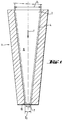
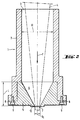
- FIGS. 1 and 2 The invention is described by way of example in FIGS. 1 and 2.
- the embodiment shown in Fig. 1 represents a device according to the invention according to claim 4.
- the heating device (1) is traversed by the spun filament bundle (4) in the direction of movement (F).
- the spun filament bundle (4) enters and leaves the heating device (1) through the inlet opening (3) through the outlet opening (7), which preferably has an extension (10).
- the circular cross-sectional area continuously decreases over the entire length (L) of the device from the inlet opening (3) to the outlet opening (7) and thus forms a conical interior (6).
- (D1) is the diameter of the inlet opening (3)
- (D2) is the diameter of the outlet opening (7).
- the embodiment shown in Fig. 2 represents the heating device (1) provided with a tapered lower end.
- the upper part (2) is tubular and has at its upper end the inlet opening (3) for the spun filament bundle (4).
- the lower conical end part (5) has an interior (6) with a cross section tapering in the filament running direction (F). On the lower side of the end part (5) there is the outlet opening (7) for the spun filament bundle (4).
- the end part (5) can be rotatably mounted and / or can be removed from the upper tubular part (2).
- the end part (5) is preferably removable.
- the end part (5) has bores (8).
- the bores (8) can also be used for attaching various additional devices, such as Thread guide holders, resistance or induction heaters or devices for pulling off the thread bundle are used or for receiving a replacement tool.
- the inner diameter (D1) of the heating device on the inlet opening (3) is approximately 6 cm
- the length (2) of the lower conical part shown in the filament running direction is approximately 4 to 5 cm
- the inner diameter (D2) of the outlet opening (7) about 1 cm.
- the outlet opening (7) can be slightly expanded (extension (10)) (as shown in FIG. 2) to improve the sealing of the gas located in the interior of the heating device from the gas space adjoining it in the filament running direction.
Landscapes
- Engineering & Computer Science (AREA)
- Textile Engineering (AREA)
- Mechanical Engineering (AREA)
- Chemical & Material Sciences (AREA)
- Chemical Kinetics & Catalysis (AREA)
- General Chemical & Material Sciences (AREA)
- Spinning Methods And Devices For Manufacturing Artificial Fibers (AREA)
Applications Claiming Priority (2)
| Application Number | Priority Date | Filing Date | Title |
|---|---|---|---|
| DE4036070 | 1990-11-13 | ||
| DE19904036070 DE4036070A1 (de) | 1990-11-13 | 1990-11-13 | Erhitzungsvorrichtung und verfahren zur herstellung schnellgesponnener filamente |
Publications (2)
| Publication Number | Publication Date |
|---|---|
| EP0485824A2 true EP0485824A2 (fr) | 1992-05-20 |
| EP0485824A3 EP0485824A3 (en) | 1993-03-10 |
Family
ID=6418160
Family Applications (1)
| Application Number | Title | Priority Date | Filing Date |
|---|---|---|---|
| EP19910118683 Withdrawn EP0485824A3 (en) | 1990-11-13 | 1991-11-01 | Heating device and process for the production of high speed spun filaments |
Country Status (5)
| Country | Link |
|---|---|
| EP (1) | EP0485824A3 (fr) |
| JP (1) | JPH04263608A (fr) |
| BR (1) | BR9104898A (fr) |
| DE (1) | DE4036070A1 (fr) |
| MX (1) | MX9102012A (fr) |
Family Cites Families (4)
| Publication number | Priority date | Publication date | Assignee | Title |
|---|---|---|---|---|
| US3611485A (en) * | 1968-12-30 | 1971-10-12 | Monsanto Co | Spinning chimney |
| DE2115312C3 (de) * | 1971-03-30 | 1975-06-26 | Hoechst Ag, 6000 Frankfurt | Beheizbarer Spinnschacht |
| US3946100A (en) * | 1973-09-26 | 1976-03-23 | Celanese Corporation | Process for the expeditious formation and structural modification of polyester fibers |
| JPS60134009A (ja) * | 1983-12-23 | 1985-07-17 | Toray Ind Inc | 合成繊維の溶融紡糸方法 |
-
1990
- 1990-11-13 DE DE19904036070 patent/DE4036070A1/de not_active Withdrawn
-
1991
- 1991-11-01 EP EP19910118683 patent/EP0485824A3/de not_active Withdrawn
- 1991-11-11 MX MX9102012A patent/MX9102012A/es unknown
- 1991-11-12 BR BR9104898A patent/BR9104898A/pt unknown
- 1991-11-12 JP JP29589591A patent/JPH04263608A/ja active Pending
Also Published As
| Publication number | Publication date |
|---|---|
| JPH04263608A (ja) | 1992-09-18 |
| MX9102012A (es) | 1992-07-08 |
| DE4036070A1 (de) | 1992-05-14 |
| EP0485824A3 (en) | 1993-03-10 |
| BR9104898A (pt) | 1992-06-23 |
Similar Documents
| Publication | Publication Date | Title |
|---|---|---|
| EP1102878B1 (fr) | Dispositif et procede permettant de filer un fil synthetique | |
| DE3781313T3 (de) | Verfahren und Vorrichtung. | |
| EP0613966B1 (fr) | Dispositif de filage au fondu de fils multifilaments et son utilisation | |
| DE19535143B4 (de) | Vorrichtung und Verfahren zur thermischen Behandlung von Fasern | |
| EP1090170A1 (fr) | Dispositif de filage pour filer un fil synthetique | |
| EP2283174A2 (fr) | Procédé de filage à l'état fondu, d'étirage et d'enroulement d'un fil multifilament, et dispositif destiné à la réalisation du procédé | |
| EP2318577A1 (fr) | Procédé de filage par fusion, d'étirage et d'enroulement un fil multifilament et dispositif de mise en oeuvre de ce procédé | |
| DE2256247A1 (de) | Verfahren und vorrichtung zur herstellung von verbund-gespinst | |
| DE19653451C2 (de) | Verfahren zur Herstellung eines Polyester-Multifilamentgarnes | |
| EP0530652B1 (fr) | Dispositif de filage à grande vitesse de fils multifilaments et son utilisation | |
| CH645139A5 (de) | Verfahren zur herstellung schmelzgesponnener und molekularorientierend verstreckter, kristalliner filamente. | |
| EP1543184B1 (fr) | Procede de production de fibres de polypropylene a haute tenacite | |
| EP1583855B1 (fr) | Procede et dispositif pour filer et onduler un fil synthetique | |
| DE4220915A1 (de) | Verfahren und Vorrichtung zur Herstellung synthetischer Endlosfilamente | |
| DE10139228A1 (de) | Verstreckvorrichtung und Verfahren zur Herstellung verstreckter Kunststoffilamente | |
| DE1914556A1 (de) | Verfahren und Vorrichtung zum Herstellen eines synthetischen multifilen Endlosgarns gleichmaessiger Beschaffenheit | |
| DE19506369A1 (de) | Verfahren und Vorrichtung zum Heizen eines synthetischen Fadens | |
| DE2211395A1 (de) | Verfahren zum herstellen von dreidimensional gekraeuselten faeden und fasern | |
| EP1352114A1 (fr) | Procede de filage-etirage de fils files a chaud | |
| DE2632082C2 (de) | Verfahren zur thermischen Nachbehandlung von gekräuselten thermoplastischen, multifilen Chemiefäden und Vorrichtung zum Durchführen des Verfahrens | |
| DE2512457C2 (de) | Verfahren zum Kräuseln von Fäden | |
| EP0731196A1 (fr) | Procédé pour le filage, l'étirage et le bobinage d'un fil synthétique | |
| DE2741193A1 (de) | Verfahren und vorrichtung zur herstellung von thermoplastischen faeden | |
| DE69128046T2 (de) | Schnellspinnverfahren | |
| DE4036070A1 (de) | Erhitzungsvorrichtung und verfahren zur herstellung schnellgesponnener filamente |
Legal Events
| Date | Code | Title | Description |
|---|---|---|---|
| PUAI | Public reference made under article 153(3) epc to a published international application that has entered the european phase |
Free format text: ORIGINAL CODE: 0009012 |
|
| AK | Designated contracting states |
Kind code of ref document: A2 Designated state(s): AT BE CH DE DK ES FR GB GR IT LI LU NL SE |
|
| PUAL | Search report despatched |
Free format text: ORIGINAL CODE: 0009013 |
|
| AK | Designated contracting states |
Kind code of ref document: A3 Designated state(s): AT BE CH DE DK ES FR GB GR IT LI LU NL SE |
|
| STAA | Information on the status of an ep patent application or granted ep patent |
Free format text: STATUS: THE APPLICATION HAS BEEN WITHDRAWN |
|
| 18W | Application withdrawn |
Withdrawal date: 19930705 |
|
| R18W | Application withdrawn (corrected) |
Effective date: 19930705 |