EP0485837A2 - Polycarbonat-Siloxan-Copolymere mit Fluoralkylphenoxy-Endgruppen - Google Patents
Polycarbonat-Siloxan-Copolymere mit Fluoralkylphenoxy-Endgruppen Download PDFInfo
- Publication number
- EP0485837A2 EP0485837A2 EP19910118729 EP91118729A EP0485837A2 EP 0485837 A2 EP0485837 A2 EP 0485837A2 EP 19910118729 EP19910118729 EP 19910118729 EP 91118729 A EP91118729 A EP 91118729A EP 0485837 A2 EP0485837 A2 EP 0485837A2
- Authority
- EP
- European Patent Office
- Prior art keywords
- hydroxyphenyl
- bis
- polycarbonate
- block copolymers
- alkyl
- Prior art date
- Legal status (The legal status is an assumption and is not a legal conclusion. Google has not performed a legal analysis and makes no representation as to the accuracy of the status listed.)
- Withdrawn
Links
Classifications
-
- C—CHEMISTRY; METALLURGY
- C08—ORGANIC MACROMOLECULAR COMPOUNDS; THEIR PREPARATION OR CHEMICAL WORKING-UP; COMPOSITIONS BASED THEREON
- C08G—MACROMOLECULAR COMPOUNDS OBTAINED OTHERWISE THAN BY REACTIONS ONLY INVOLVING UNSATURATED CARBON-TO-CARBON BONDS
- C08G64/00—Macromolecular compounds obtained by reactions forming a carbonic ester link in the main chain of the macromolecule
- C08G64/04—Aromatic polycarbonates
- C08G64/06—Aromatic polycarbonates not containing aliphatic unsaturation
- C08G64/14—Aromatic polycarbonates not containing aliphatic unsaturation containing a chain-terminating or -crosslinking agent
-
- C—CHEMISTRY; METALLURGY
- C08—ORGANIC MACROMOLECULAR COMPOUNDS; THEIR PREPARATION OR CHEMICAL WORKING-UP; COMPOSITIONS BASED THEREON
- C08G—MACROMOLECULAR COMPOUNDS OBTAINED OTHERWISE THAN BY REACTIONS ONLY INVOLVING UNSATURATED CARBON-TO-CARBON BONDS
- C08G63/00—Macromolecular compounds obtained by reactions forming a carboxylic ester link in the main chain of the macromolecule
- C08G63/64—Polyesters containing both carboxylic ester groups and carbonate groups
-
- C—CHEMISTRY; METALLURGY
- C08—ORGANIC MACROMOLECULAR COMPOUNDS; THEIR PREPARATION OR CHEMICAL WORKING-UP; COMPOSITIONS BASED THEREON
- C08G—MACROMOLECULAR COMPOUNDS OBTAINED OTHERWISE THAN BY REACTIONS ONLY INVOLVING UNSATURATED CARBON-TO-CARBON BONDS
- C08G64/00—Macromolecular compounds obtained by reactions forming a carbonic ester link in the main chain of the macromolecule
- C08G64/18—Block or graft polymers
- C08G64/186—Block or graft polymers containing polysiloxane sequences
-
- C—CHEMISTRY; METALLURGY
- C08—ORGANIC MACROMOLECULAR COMPOUNDS; THEIR PREPARATION OR CHEMICAL WORKING-UP; COMPOSITIONS BASED THEREON
- C08G—MACROMOLECULAR COMPOUNDS OBTAINED OTHERWISE THAN BY REACTIONS ONLY INVOLVING UNSATURATED CARBON-TO-CARBON BONDS
- C08G77/00—Macromolecular compounds obtained by reactions forming a linkage containing silicon with or without sulfur, nitrogen, oxygen or carbon in the main chain of the macromolecule
- C08G77/42—Block-or graft-polymers containing polysiloxane sequences
- C08G77/448—Block-or graft-polymers containing polysiloxane sequences containing polycarbonate sequences
Definitions
- the invention relates to polycarbonate (including polyester carbonate) siloxane block copolymers having fluoroalkylphenoxy end groups.
- Polycarbonate-siloxane block copolymers are known (cf. US Pat. No. 3,189,662, 3,419,634, DE-OS 3,334,782, 3,506,472, EP-A 122,535, 135,794 and also polyestercarbonate-siloxane block copolymers (cf. DE-OS 3 344 911, 2 640 241 and 3 929 401).
- the polycarbonate-siloxane copolymers according to the invention contain structural units -AB-, where A is polycarbonate blocks based on the following diphenols: Hydroquinone, Resorcinol, Dihydroxydiphenylene, Bis (hydroxyphenyl) alkanes, Bis (hydroxyphenyl) cycloalkanes, Bis (hydroxyphenyl) sulfides, Bis (hydroxyphenyl) ether, Bis (hydroxyphenyl) ketones, Bis (hydroxyphenyl) sulfones, Bis (hydroxyphenyl) sulfoxides, ⁇ , ⁇ '-bis (hydroxyphenyl) diisopropylbenzenes, and their nuclear alkylated and nuclear halogenated compounds.
- A is polycarbonate blocks based on the following diphenols: Hydroquinone, Resorcinol, Dihydroxydiphenylene, Bis (hydroxyphenyl) alkanes, Bis (hydroxyphenyl) cycloalkanes, Bis (hydroxyphenyl)
- the diphenols are known or can be prepared by known processes.
- small amounts, preferably 0.05 to 2.0 mol%, based on moles of diphenols used, of tri- or more than trifunctional compounds, in particular those with three or more than, can also be used to build up the structural unit -A- three phenolic hydroxyl groups, have also been used as branching agents.
- Some of the compounds that can be used with three or more than three phenolic hydroxyl groups are, for example Phloroglucin, 4,6-dimethyl-2,4,6-tri- (4-hydroxphenyl) -hepten-2, 4,6-dimethyl-2,4,6-tri- (4-hydroxyphenyl) heptane, 1,3,5-tri- (4-hydroxyphenyl) benzene, 1,1,1-tri- (4-hydroxyphenyl) ethane, Tri- (4-hydroxyphenyl) phenylmethane, 2,2-bis- [4,4-bis- (4-hydroxyphenyl) cyclohexyl] propane, 2,4-bis (4-hydroxyphenyl-isopropyl) phenol, 2,6-bis (2-hydroxy-5'-methylbenzyl) -4-methylphenol, 2- (4-hydroxyphenyl) -2- (2,4-dihydroxyphenyl) propane, Hexa- (4- (4-hydroxyphenyl-isopropyl) pheny
- branching agents are 2,4-dihydroxybenzoic acid, trimesic acid, cyanuric chloride and 3,3-bis (3-methyl-4-hydroxyphenyl) -2-oxo-2,3-dihydroindole.
- -A- are used to build up the structural unit, they can either be introduced with the diphenols in the aqueous alkaline phase, or added in an organic solvent, dissolved before the phosgenation.
- Alkyl is preferably C1-C20 alkyl; Alkenyl preferably C2-C6 alkenyl, aryl preferably C6-C14 aryl.
- Halogenated means partially or completely chlorinated, brominated or fluorinated. Examples of radicals R are methyl, ethyl, propyl, n-butyl, tert-butyl, vinyl, phenyl, naphthyl, chloromethyl, trifluoropropyl, perfluorobutyl and perfluorooctyl.
- Polyester carbonate-siloxane block copolymers for the purposes of the invention correspond to those described in DE-OS 3 929 401, 3 344 911 and 2 640 241, but contain end groups which are derived from phenols of the formula II.
- the following phenols are preferred: Hydroxyditrifluoromethylbenzenes, Hydroxymethyltrifluoromethylbenzenes, Hydroxydifluoromethylmethylbenzenes, Hydroxytrifluoromethylbenzenes, are particularly preferred: 1-hydroxy-3,5-ditrifluoromethylbenzene, 1-hydroxy-4-trifluoromethylbenzene.
- the phenols are known or can be prepared by known processes.
- molecular weight regulators are, for example, phenol, 4-alkylphenols and 4-cumylphenol and others (cf. DE-OS 2 555 366, DE-OS 2 842 005, DE-OS 2 843 154, DE-OS 2 940 024, DE-OS 3 007,934, U.S. 3,697,481, U.S. 4,677,184, U.S. 4,788,265, U.S. 4,788,276).
- the polycarbonate-siloxane block copolymers according to the invention can be prepared according to DE-OS 3 842 931, 3 917 041 and 3 928 097, with the difference that, instead of the molecular weight regulators specified there, the phenols of the formula II are preferably used in an amount of 0.1 to 10 Mol%, based on diphenols, are used.
- polycarbonate-siloxane copolymers and polyestercarbonate-siloxane copolymers according to the invention can be mixed with other aromatic polycarbonates, polycarbonate-siloxane block copolymers and polyestercarbonate-siloxane block copolymers. They can contain the usual additives such as fillers, UV stabilizers, thermal stabilizers, flow and mold release agents, flame retardant additives as well as pigments and dyes.
- Relative solution viscosity of the block copolymer (measured on a 0.5% strength by weight solution in dichloromethane at 25 ° C.) 1.298.
- Relative solution viscosity of the block copolymer (measured on a 0.5% strength by weight solution in dichloromethane at 25 ° C.) 1,253.
- Relative solution viscosity (measured on a 0.5 wt .-% solution in dichloromethane at 25 ° C) 1.327.
Landscapes
- Chemical & Material Sciences (AREA)
- Health & Medical Sciences (AREA)
- Chemical Kinetics & Catalysis (AREA)
- Medicinal Chemistry (AREA)
- Polymers & Plastics (AREA)
- Organic Chemistry (AREA)
- Polyesters Or Polycarbonates (AREA)
- Silicon Polymers (AREA)
- Compositions Of Macromolecular Compounds (AREA)
Abstract
Polycarbonat-Siloxan-Blockcopolymere und Polyestercarbonat-Siloxan-Blockcopolymere, enthaltend als Endgruppen Reste von Verbindungen der Formel (II) <IMAGE> worin X: Sauerstoff oder eine einfache Bindung, Y: Wasserstoff oder -CF2R¹, R¹: C1- bis C7-Alkyl, fluoriertes C1-C7-Alkyl oder Fluor bedeuten.
Description
- Gegenstand der Erfindung sind Polycarbonat-(einschließlich Polyestercarbonat-)-Siloxan-Blockcopolymere mit Fluoralkylphenoxyendgruppen.
- Insbesondere sind Gegenstand der Erfindung Polycarbonat-Siloxan-Blockcopolymere und Polyestercarbonat-Siloxan-Blockcopolymere enthaltend als Endgruppen Reste von Verbindungen der Formel (II)
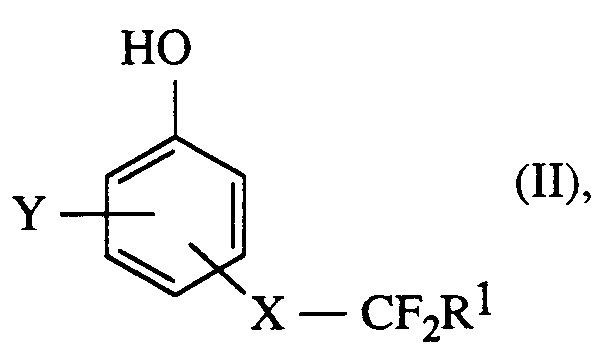
worin - X
- Sauserstoff oder eine einfache Bindung,
- Y
- Wasserstoff oder -CF₂R¹,
- R¹
- C₁-bis C₇-Alkyl, fluoriertes C₁-C₇-Alkyl oder Fluor bedeuten.
- Diese Polycarbonat-Siloxan-Copolymere und Polyestercarbonat-Siloxan-Blockcopolymere besitzen Molekulargewichte

- Polycarbonat-Siloxan-Blockcopolymere sind bekannt (vgl. US-PS 3 189 662, 3 419 634, DE-OS 3 334 782, 3 506 472, EP-A 122 535, 135 794 und ebenso Polyestercarbonat-Siloxan-Blockcopolymere (vgl. DE-OS 3 344 911, 2 640 241 und 3 929 401).
- Die erfindungsgemäßen Polycarbonat-Siloxan-Copolymeren enthalten Struktureinheiten -A-B-, worin A Polycarbonatblöcke auf Basis folgender Diphenole darstellt:
Hydrochinon,
Resorcin,
Dihydroxydiphenylen,
Bis-(hydroxyphenyl)-alkane,
Bis-(hydroxyphenyl)-cycloalkane,
Bis-(hydroxyphenyl)-sulfide,
Bis-(hydroxyphenyl)-ether,
Bis-(hydroxyphenyl)-ketone,
Bis-(hydroxyphenyl)-sulfone,
Bis-(hydroxyphenyl)-sulfoxide,
α,α'-Bis-(hydroxyphenyl)-diisopropylbenzole,
sowie deren kernalkylierte und kernhalogenierte Verbindungen. - Bevorzugt sind:
4,4'-Dihydroxydiphenyl,
2,2-Bis-(4-hydroxyphenyl)-propan,
2,4-Bis-(4-hydroxphenyl)-2-methylbutan,
1,1-Bis-(4-hydroxyphenyl)-p-diisopropylbenzol,
2,2-Bis-(3-methyl-4-hydroxyphenyl)-propan,
2,2-Bis-(3-chlor-4-hydroxyphenyl)-propan,
Bis-(3,5-dimethyl-4-hydroxyphenyl)-methan,
2,2-Bis-(3,5-dimethyl-4-hydroxyphenyl)-propan,
Bis-(3,5-dimethyl-4-hydroxyphenyl)-sulfon,
2,4-Bis-(3,5-dimethyl-4-hydroxyphenyl)-2-methylbutan,
1,1-Bis-(3,5-dimethyl-4-hydroxyphenyl)-p-diisopropylbenzol,
2,2-Bis-(3,5-dichlor-4-hydroxyphenyl)-propan,
2,2-Bis-(3,5-dibrom-4-hydroxyphenyl)-propan,
1,1-Bis-(4-hydroxyphenyl)-3,3,5-trimethylcyclohexan und
besonders bevorzugt
2,2-Bis-(4-hydroxyphenyl)-propan,
2,2-Bis-(3,5-dimethyl-4-hydroxyphenyl)-propan,
2,2-Bis-(3,5-dichlor-4-hydroxyphenyl)-propan,
2,2-Bis-(3,5-dibrom-4-hydroxyphenyl)-propan,
1,1-Bis-(4-hydroxyphenyl)-cyclohexan und
1,1-Bis-(4-hydroxyphenyl)-3,3,5-trimethylcyclohexan. - Die Diphenole sind bekannt oder nach bekannten Verfahren herstellbar.
- Es können neben diesen Diphenolen zum Aufbau der Struktureinheit -A- auch geringe Mengen, vorzugsweise 0,05 bis 2,0 Mol-%, bezogen auf Mole eingesetzter Diphenole, an tri- oder mehr als trifunktioneller Verbindungen, insbesondere solchen mit drei oder mehr als drei phenolischen Hydroxylgruppen, als Verzweiger mitverwendet worden sein. Einige der verwendbaren Verbindungen mit drei oder mehr als drei phenolischen Hydroxylgruppen sind beispielsweise
Phloroglucin,
4,6-Dimethyl-2,4,6-tri-(4-hydroxphenyl)-hepten-2,
4,6-Dimethyl-2,4,6-tri-(4-hydroxyphenyl)-heptan,
1,3,5-Tri-(4-hydroxyphenyl)-benzol,
1,1,1-Tri-(4-hydroxyphenyl)-ethan,
Tri-(4-hydroxyphenyl)-phenylmethan,
2,2-Bis-[4,4-bis-(4-hydroxyphenyl)-cyclohexyl]-propan,
2,4-Bis-(4-hydroxyphenyl-isopropyl)-phenol,
2,6-Bis-(2-hydroxy-5'-methyl-benzyl)-4-methylphenol,
2-(4-Hydroxyphenyl)-2-(2,4-dihydroxyphenyl)-propan,
Hexa-(4-(4-hydroxyphenyl-isopropyl)-phenyl)-orthoterephthalsäureester,
Tetra-(4-hydroxyphenyl)-methan,
Tetra-(4-(4-hydroxyphenyl-isopropyl)-phenoxy)-methan und
1,4-Bis-(4',4''-dihydroxytriphenyl)-methyl)-benzol. - Weitere geeignete Verzweiger sind 2,4-Dihydroxybenzoesäure, Trimesinsäure, Cyanurchlorid und 3,3-Bis-(3-methyl-4-hydroxyphenyl)-2-oxo-2,3-dihydroindol.
- Wenn zum Aufbau der Struktureinheit -A- Verzweiger verwendet werden, dann können sie entweder mit den Diphenolen in der wäßrigen alkalischen Phase vorgelegt werden, oder in einem organischen Lösungsmittel, gelöst vor der Phosgenierung, zugegeben werden.
- Die Struktureinheit -B- der erfindungsgemäßen Polycarbonat-Siloxan-Blockcopolymeren besteht aus Siloxanblöcken der Formel (I)

worin - Ar
- gleiche oder verschiedene Arylenreste aus den obengenannten Diphenolen bedeuten
- n=
- 200, vorzugsweise 20 bis 160.
- Alkyl ist bevorzugt C₁-C₂₀-Alkyl; Alkenyl bevorzugt C₂-C₆-Alkenyl, Aryl bevorzugt C₆-C₁₄-Aryl. Halogeniert bedeutet teilweise oder vollständig chloriert, bromiert oder fluoriert Beispiele für Reste R sind Methyl, Ethyl, Propyl, n-Butyl, tert.-Butyl, Vinyl, Phenyl, Naphthyl, Chlormethyl, Trifluorpropyl, Perfluorbutyl und Perfluoroctyl.
- Polycarbonat-(bzw. Polyestercarbonat-)Siloxan-Copolymere im Sinne der Erfindung haben bevorzugt Molekulargewichte

- Polyestercarbonat-Siloxan-Blockcopolymere im Sinne der Erfindung entsprechen denen, die in den DE-OS 3 929 401, 3 344 911 und 2 640 241 beschrieben sind, enthalten aber Endgruppen, die von Phenolen der Formel II abgeleitet sind.
Bevorzugt sind folgende Phenole:
Hydroxyditrifluormethylbenzole,
Hydroxymethyltrifluormethylbenzole,
Hydroxydifluormethylmethylbenzole,
Hydroxytrifluormethylbenzole,
besonders bevorzugt sind:
1-Hydroxy-3,5-ditrifluormethylbenzol,
1-Hydroxy-4-trifluormethylbenzol. - Die Phenole sind bekannt oder nach bekannten Verfahren herstellbar.
- Es können auch mehrere Verbindungen der Formeln (II) nebeneinander und/oder Verbindungen der Formel (II) zusammen mit anderen bei der Polycarbonatherstellung üblichen Monophenolen (Molekulargewichtsreglern) verwendet werden. Solche Molekulargewichtsregler sind beispielsweise Phenol, 4-Alkylphenole und 4-Cumylphenol und andere (vgl. DE-OS 2 555 366, DE-OS 2 842 005, DE-OS 2 843 154, DE-OS 2 940 024, DE-OS 3 007 934, US 3 697 481, US 4 677 184, US 4 788 265, US 4 788 276).
- Die erfindungsgemäßen Polycarbonat-Siloxan-Blockcopolymere können gemäß DE-OS 3 842 931, 3 917 041 und 3 928 097 hergestellt werden mit dem Unterschied, daß anstelle der dort angegebenen Molekulargewichtsregler die Phenole der Formel II bevorzugt in einer Menge von 0,1 bis 10 Mol-%, bezogen auf Diphenole, verwendet werden.
- Die erfindungsgemäßen Polycarbonat-Siloxan-Copolymere und Polyestercarbonat-Siloxan-Copolymere können mit anderen aromatischen Polycarbonaten, Polycarbonat-Siloxan-Blockcopolymeren sowie Polyestercarbonat-Siloxan-Blockcopolymeren gemischt werden. Sie können die üblichen Additive wie Füllstoffe, UV-Stabilisatoren, Thermostabilisatoren, Fließ- und Entformungshilfsmittel, Flammschutz-Additive sowie Pigmente und Farbstoffe enthalten.
- Sie lassen sich besser verarbeiten und entformen und sind flammfest.
- In einer Lösung von 13,5 g (0,338 Mol) Natriumhydroxid in 0,38 l destilliertem Wasser werden 18,97 g (0,0831 Mol) Bisphenol A unter gleichzeitigem Einleiten von Stickstoff gelöst. Man fügt eine Lösung von 0,6810 g (0,0029 Mol) 1-Hydroxy-3,5-ditrifluormethylbenzol und 4,08 g (0,0034 Mol) eines Polydimethylsiloxans (Polymerisationsgrad Pn= 10) mit Bisphenol A-Endgruppen in 0,19 l Dichlormethan hinzu und leitet unter starkem Rühren bei 20°C innerhalb von 5 Minuten 15,9 g (0,16 Mol) Phosgen ein. Danach rührt man noch weitere 5 Minuten und versetzt die Lösung mit 0,14 ml (0,001 Mol) N-Ethylpiperidin. Nach weiterem 45-minütigem Rühren trennt man die organische Phase von der wäßrigen ab, wäscht die organische Phase zunächst zweimal mit 10 %iger Phosphorsäure und wäscht anschließend mit destilliertem Wasser neutral.
- Nach der Trocknung über Molekularsieb entfernt man das Lösungsmittel bei 120°C im Vakuum.
- Relative Lösungsviskosität des Blockcopolymerisats (gemessen an einer 0,5 gew.-%igen Lösung in Dichlormethan bei 25°C) 1,298.
- wie Beispiel 1, aber mit 0,8626 g (0,0037 Mol) 1-Hydroxy-3,5-ditrifluormethylbenzol.
- Relative Lösungsviskosität des Blockcopolymerisats (gemessen an einer 0,5 gew.-%igen Lösung in Dichlormethan bei 25°C) 1,253.
- wie Beispiel 1, aber mit 0,5675 g (0,0024 Mol) 1-Hydroxy-3,5-ditrifluormethylbenzol.
- Relative Lösungsviskosität (gemessen an einer 0,5 gew.-%igen Lösung in Dichlormethan bei 25°C) 1,327.
- In einer Lösung von 13,5 g (0,338 Mol) Natriumhydroxid in 0,38 l destilliertem Wasser werden 21,57 g (0,0945 Mol) Bisphenol A unter gleichzeitigem Einleiten von Stickstoff gelöst. Man fügt eine Lösung von 0,6810 g (0,0029 Mol) 1-Hydroxy-3,5-ditrifluormethylbenzol und 1,37 g (0,00026 Mol) eines Polydimethylsiloxans (Polymerisationsgrad Pn = 65) mit Bisphenol A-Endgruppen in 0,19 l Dichlormethan hinzu und leitet unter starkem Rühren bei 20°C innerhalb von 5 Minuten 15,9 g (0,16 Mol) Phosgen ein. Danach rührt man noch weitere 5 Minuten und versetzt die Lösung mit 0,14 ml (0,001 Mol) N-Ethylpiperidin. Nach weiterem 45-minütigem Rühren trennt man die organische Phase von der wäßrigen ab, wäscht die organische Phase zunächst zweimal mit 10 %iger Phosphorsäure und wäscht anschließend mit destilliertem Wasser neutral.
- Nach der Trocknung über Molekularsieb entfernt man das Lösungsmittel bei 120°C im Vakuum.
- Relative Lösungsviskosität des Blockcopolymerisats (gemessen an einer 0,5 gew.-%igen Lösung in Dichlormethan bei 25°C) 1,300.
Schmelzviskositäten (η) (in Pa·s gemessen bei 300°C; γ̇ [s⁻¹]; Schergeschwindigkeit) η(γ̇=100) η(γ̇=1000) η(γ̇= 1500) Beispiel 1 (ηrel= 1,298) mit 1-Hydroxy-3,5-ditrifluormethylbenzol 487,1 246,4 203,3 Vergleich (ηrel= 1,307) Polymer wie Beispiel 1 mit Isooctylphenol (als Molmassenregler) 1465,1 489,5 381,4 Beispiel 2 (ηrel= 1,253) mit 1-Hydroxy-3,5-ditrifluormethylbenzol 160,4 Vergleich (ηrel= 1,255) Polymer wie Beispiel 2 mit Isooctylphenol 204,5 Beispiel 4 (ηrel= 1,300) mit 1-Hydroxy-3,5-ditrifluormethylbenzol 459 232 198 Vergleich (ηrel= 1,293) Polymer wie Beispiel 4 mit Isooctylphenol 860 442 358
die Reste R gleich oder verschieden sind und lineares Alkyl, verzweigtes Alkyl, Alkylen, halogeniertes lineares Alkyl, Aryl oder halogeniertes Aryl, vorzugsweise aber Methyl, bedeuten
und
Claims (3)
- Polycarbonat-Siloxan-Blockcopolymere und Polyestercarbonat-Siloxan-Blockcopolymere, enthaltend als Endgruppen Reste von Verbindungen der Formel (II)
 X Sauerstoff oder eine einfache Bindung,Y Wasserstoff oder -CF₂R¹,R¹ C₁- bis C₇-Alkyl, fluoriertes C₁-C₇-Alkyl oder Fluor bedeuten.
 - Polycarbonat-Siloxan-Copolymere und Polyestercarbonat-Siloxan-Blockcopolymere gemäß Anspruch 1 mit einem Molekulargewicht

- Verwendung der Polycarbonat-Siloxan-Blockcopolymeren und der Polyestercarbonat-Siloxan-Blockcopolymeren gemäß Anspruch 1 zur Herstellung von Formteilen.
Applications Claiming Priority (2)
| Application Number | Priority Date | Filing Date | Title |
|---|---|---|---|
| DE4036415 | 1990-11-15 | ||
| DE19904036415 DE4036415A1 (de) | 1990-11-15 | 1990-11-15 | Polycarbonat-siloxan-copolymere mit perfluoralkylphenoxy-endgruppen |
Publications (1)
| Publication Number | Publication Date |
|---|---|
| EP0485837A2 true EP0485837A2 (de) | 1992-05-20 |
Family
ID=6418327
Family Applications (1)
| Application Number | Title | Priority Date | Filing Date |
|---|---|---|---|
| EP19910118729 Withdrawn EP0485837A2 (de) | 1990-11-15 | 1991-11-04 | Polycarbonat-Siloxan-Copolymere mit Fluoralkylphenoxy-Endgruppen |
Country Status (3)
| Country | Link |
|---|---|
| EP (1) | EP0485837A2 (de) |
| JP (1) | JPH04323263A (de) |
| DE (1) | DE4036415A1 (de) |
Cited By (1)
| Publication number | Priority date | Publication date | Assignee | Title |
|---|---|---|---|---|
| WO2004061004A1 (en) * | 2002-12-30 | 2004-07-22 | General Electric Company | Polycarbonate molding compositions and articles with improved surface aesthetics |
Families Citing this family (1)
| Publication number | Priority date | Publication date | Assignee | Title |
|---|---|---|---|---|
| JP5990522B2 (ja) | 2011-08-19 | 2016-09-14 | 出光興産株式会社 | ポリカーボネート樹脂、それを含有する塗工液、及びそれを用いて成形してなる成形体 |
-
1990
- 1990-11-15 DE DE19904036415 patent/DE4036415A1/de not_active Withdrawn
-
1991
- 1991-11-04 EP EP19910118729 patent/EP0485837A2/de not_active Withdrawn
- 1991-11-11 JP JP32147191A patent/JPH04323263A/ja active Pending
Cited By (2)
| Publication number | Priority date | Publication date | Assignee | Title |
|---|---|---|---|---|
| WO2004061004A1 (en) * | 2002-12-30 | 2004-07-22 | General Electric Company | Polycarbonate molding compositions and articles with improved surface aesthetics |
| US6825266B2 (en) | 2002-12-30 | 2004-11-30 | General Electric Company | Polycarbonate molding compositions and articles with improved surface aesthetics |
Also Published As
| Publication number | Publication date |
|---|---|
| JPH04323263A (ja) | 1992-11-12 |
| DE4036415A1 (de) | 1992-05-21 |
Similar Documents
| Publication | Publication Date | Title |
|---|---|---|
| EP0010602B1 (de) | Polycarbonate mit Alkylphenyl-Endgruppen und ihre Herstellung | |
| EP0374635A2 (de) | Polydiorganosiloxan-Polycarbonat-Blockcokondensate auf Basis spezieller Dihydroxydiphenylcycloalkane | |
| EP0162245A1 (de) | UV-stabilisierte Polycarbonatformkörper | |
| EP0691364B1 (de) | Epoxigruppen enthaltende Siloxane und ihre Mischungen mit Polycarbonaten | |
| DE69023937T2 (de) | Gammastrahlung widerstandsfähige Polycarbonat-Zusammensetzung. | |
| EP0040863A1 (de) | Polycarbonatgemische mit verbesserter Flammwidrigkeit | |
| EP0611797B1 (de) | Strahlungsbeständige Polycarbonate | |
| EP0078943A1 (de) | Verfahren zur Herstellung von Polycarbonaten mit verbessertem Alterungsverhalten | |
| DE68922931T2 (de) | Gammastrahlenbeständige Polycarbonatzusammensetzungen. | |
| EP0413205A2 (de) | Polysiloxan-Polycarbonat-Blockcopolymere auf Basis spezieller Dihydroxydiphenylcycloalkane | |
| EP0411370B1 (de) | Spezielle Polydiorganosiloxanblockcopolycarbonate | |
| EP1155073A1 (de) | Röntgenkontrastierbare kunststofformmassen | |
| EP0566952B1 (de) | Thermostabilisierung von aromatischen Polycarbonaten | |
| EP0327951B1 (de) | Polycarbonate mit Aralkylphenylendgruppen, ihre Herstellung und Verwendung | |
| DE68910746T2 (de) | Hydrolysestabile Polycarbonatzusammensetzungen. | |
| EP0432580B1 (de) | Zweistufen-Verfahren zur Herstellung von Polycarbonaten auf Basis von speziellen Dihydroxydiphenylalkanen | |
| DE4036415A1 (de) | Polycarbonat-siloxan-copolymere mit perfluoralkylphenoxy-endgruppen | |
| DE3928097A1 (de) | Polyorganosiloxan-polycarbonat-blockcopolymere und ihre verwendung zur herstellung optischer datenspeicher | |
| DE4236142A1 (de) | Gegen gamma-strahlung bestaendige polycarbonat-zusammensetzungen | |
| EP0099990A1 (de) | Verfahren zur Herstellung von Polycarbonaten mit N-Alkyl-perfluoralkylsulfonamid-Endgruppen | |
| EP1203043B1 (de) | Oligomere bischlorkohlensäureester aus ausgewählten cycloaliphatischen bisphenolen und anderen bisphenolen | |
| EP0423562B1 (de) | Polycarbonate mit verbesserter Wärmeformbeständigkeit | |
| EP0643096B1 (de) | Stabilisierte, flammwidrige Polycarbonatformmassen | |
| EP0732365A1 (de) | Gegen Gamma-Strahlung stabilisierte (Co)Polycarbonate | |
| EP0442062B1 (de) | Monofunktionelle Polyacrylate, ihre Herstellung und Verwendung zur Herstellung von Polycarbonaten |
Legal Events
| Date | Code | Title | Description |
|---|---|---|---|
| PUAI | Public reference made under article 153(3) epc to a published international application that has entered the european phase |
Free format text: ORIGINAL CODE: 0009012 |
|
| AK | Designated contracting states |
Kind code of ref document: A2 Designated state(s): DE FR GB IT NL |
|
| STAA | Information on the status of an ep patent application or granted ep patent |
Free format text: STATUS: THE APPLICATION HAS BEEN WITHDRAWN |
|
| 18W | Application withdrawn |
Withdrawal date: 19920506 |