EP0485857B1 - Système de senseur et son application - Google Patents
Système de senseur et son application Download PDFInfo
- Publication number
- EP0485857B1 EP0485857B1 EP91118808A EP91118808A EP0485857B1 EP 0485857 B1 EP0485857 B1 EP 0485857B1 EP 91118808 A EP91118808 A EP 91118808A EP 91118808 A EP91118808 A EP 91118808A EP 0485857 B1 EP0485857 B1 EP 0485857B1
- Authority
- EP
- European Patent Office
- Prior art keywords
- unit
- sensor system
- output
- logic stage
- signal
- Prior art date
- Legal status (The legal status is an assumption and is not a legal conclusion. Google has not performed a legal analysis and makes no representation as to the accuracy of the status listed.)
- Expired - Lifetime
Links
Images


Classifications
-
- B—PERFORMING OPERATIONS; TRANSPORTING
- B60—VEHICLES IN GENERAL
- B60S—SERVICING, CLEANING, REPAIRING, SUPPORTING, LIFTING, OR MANOEUVRING OF VEHICLES, NOT OTHERWISE PROVIDED FOR
- B60S1/00—Cleaning of vehicles
- B60S1/02—Cleaning windscreens, windows or optical devices
- B60S1/04—Wipers or the like, e.g. scrapers
- B60S1/06—Wipers or the like, e.g. scrapers characterised by the drive
- B60S1/08—Wipers or the like, e.g. scrapers characterised by the drive electrically driven
- B60S1/0818—Wipers or the like, e.g. scrapers characterised by the drive electrically driven including control systems responsive to external conditions, e.g. by detection of moisture, dirt or the like
-
- B—PERFORMING OPERATIONS; TRANSPORTING
- B60—VEHICLES IN GENERAL
- B60S—SERVICING, CLEANING, REPAIRING, SUPPORTING, LIFTING, OR MANOEUVRING OF VEHICLES, NOT OTHERWISE PROVIDED FOR
- B60S1/00—Cleaning of vehicles
- B60S1/02—Cleaning windscreens, windows or optical devices
- B60S1/04—Wipers or the like, e.g. scrapers
- B60S1/06—Wipers or the like, e.g. scrapers characterised by the drive
- B60S1/08—Wipers or the like, e.g. scrapers characterised by the drive electrically driven
- B60S1/0818—Wipers or the like, e.g. scrapers characterised by the drive electrically driven including control systems responsive to external conditions, e.g. by detection of moisture, dirt or the like
- B60S1/0822—Wipers or the like, e.g. scrapers characterised by the drive electrically driven including control systems responsive to external conditions, e.g. by detection of moisture, dirt or the like characterized by the arrangement or type of detection means
- B60S1/0833—Optical rain sensor
-
- G—PHYSICS
- G01—MEASURING; TESTING
- G01S—RADIO DIRECTION-FINDING; RADIO NAVIGATION; DETERMINING DISTANCE OR VELOCITY BY USE OF RADIO WAVES; LOCATING OR PRESENCE-DETECTING BY USE OF THE REFLECTION OR RERADIATION OF RADIO WAVES; ANALOGOUS ARRANGEMENTS USING OTHER WAVES
- G01S17/00—Systems using the reflection or reradiation of electromagnetic waves other than radio waves, e.g. lidar systems
- G01S17/02—Systems using the reflection of electromagnetic waves other than radio waves
- G01S17/04—Systems determining the presence of a target
-
- G—PHYSICS
- G01—MEASURING; TESTING
- G01V—GEOPHYSICS; GRAVITATIONAL MEASUREMENTS; DETECTING MASSES OR OBJECTS; TAGS
- G01V8/00—Prospecting or detecting by optical means
- G01V8/10—Detecting, e.g. by using light barriers
-
- G—PHYSICS
- G01—MEASURING; TESTING
- G01S—RADIO DIRECTION-FINDING; RADIO NAVIGATION; DETERMINING DISTANCE OR VELOCITY BY USE OF RADIO WAVES; LOCATING OR PRESENCE-DETECTING BY USE OF THE REFLECTION OR RERADIATION OF RADIO WAVES; ANALOGOUS ARRANGEMENTS USING OTHER WAVES
- G01S7/00—Details of systems according to groups G01S13/00, G01S15/00, G01S17/00
- G01S7/48—Details of systems according to groups G01S13/00, G01S15/00, G01S17/00 of systems according to group G01S17/00
- G01S7/483—Details of pulse systems
- G01S7/484—Transmitters
-
- G—PHYSICS
- G01—MEASURING; TESTING
- G01S—RADIO DIRECTION-FINDING; RADIO NAVIGATION; DETERMINING DISTANCE OR VELOCITY BY USE OF RADIO WAVES; LOCATING OR PRESENCE-DETECTING BY USE OF THE REFLECTION OR RERADIATION OF RADIO WAVES; ANALOGOUS ARRANGEMENTS USING OTHER WAVES
- G01S7/00—Details of systems according to groups G01S13/00, G01S15/00, G01S17/00
- G01S7/48—Details of systems according to groups G01S13/00, G01S15/00, G01S17/00 of systems according to group G01S17/00
- G01S7/483—Details of pulse systems
- G01S7/486—Receivers
Definitions
- the invention relates to a sensor system according to the preamble of claim 1; such a sensor system is known from GB-A-2 227 093.
- Optical sensors in sensor systems contain a transmitting and receiving unit which are coupled to one another via an optical link; Changes in the ambient conditions of the sensor can lead to a change in the optical path and thus to a variation of the received signal, which can be detected and further processed by an evaluation unit of the sensor system.
- the changes in the optical properties caused by precipitation on the windshield can be registered by a sensor system and the windshield wipers can be actuated.
- the sensor system In order to be able to reliably detect changes in the optical properties, the sensor system must be set to a specific output value - for example by specifying the transmission current or by adapting the evaluation circuit.
- the sensitivity of the optical sensor must be adapted to the changed optical properties; either the transmitter or the receiver gain must be varied manually.
- the invention has for its object to provide an optical sensor system according to the preamble of claim 1, which can be used in different environmental conditions without adaptation problems. This object is achieved by the features in the characterizing part of patent claim 1. Advantageous developments of the invention result from the subclaims.
- the optical sensor system according to the invention can be used with a single embodiment or with a single fixed setting of the basic sensitivity in all different environmental conditions.
- An automatic adaptation of the sensor system when used under different environmental conditions is achieved by first specifying a fixed value for the receiver current regardless of the ambient conditions when the optical sensor is set; For this purpose, the amplitude of the transmission current is first increased to a maximum value and then successively reduced until a threshold value determined by the receiver base current is reached. If the optical properties in the vicinity of the sensor change, the optical coupling between the transmitter and receiver is disturbed and the current detected by the receiving unit is consequently reduced; this is evaluated by a sensor electronics unit by means of further threshold switches and, if necessary, a corresponding reaction is triggered by the sensor system.
- the sensor system is reset to the basic setting by means of further switching means, so that it can reliably detect subsequent further changes in the ambient conditions.
- the optical sensor system is preferably operated in alternating voltage mode, with pulses of different lengths and widths being generated and evaluated in the sensor electronics unit, depending on the ambient conditions.
- FIG. 1 shows the block diagram of an optical sensor system
- FIG. 2 shows the temporal course of the signals at various points on the circuit diagram
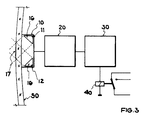
- FIG. 3 shows the schematic structure of a digital precipitation sensor system.
- the sensor system consists of the optical sensor with optical unit 10 and sensor electronics unit 20, of the evaluation unit 30 and of the control unit 40.
- the optical unit 10 comprises the transmitter unit 11 with a current source and the transmitter element 14, the receiver unit 12 with the receiver element 15 and an oscillating circuit, and the optical path 13 between the transmitter element 14 and the receiver element 15.
- the oscillator circuit filters that signal from the frequency mixture emitted by the transmitter element 14 out that corresponds to its resonance frequency; this signal is amplified and used to feed the transmission element 14.
- the evaluation unit 30, for example a computer or microprocessor, recognizes the different pulse sequences and can trigger corresponding reactions by the control unit 40.
- FIG. 2 shows the time sequences at various points on the circuit diagram in FIG. 1;
- Figure 2a shows the received signal U E with the threshold values given by the comparators K1 to K3 S1, S2 and S3, in Figure 2b are from top to bottom the signals at the output of the comparators K1, K2 and K3 and the clock signal at the output of the clock oscillator OSZ are shown.
- the D / A converter 23 is set to the maximum value when the sensor system is switched on (time t 1) by the first logic stage L 1, so that the value of the D / A Converter predetermined transmission current of the transmission element and thus also the received signal U E at the output of the receiving unit assumes the maximum value ( Figure 2a) and thus exceeds the threshold value S1.
- a pulse sequence ( Figure 2b), which gradually resets the D / A converter 23 controlled via the second logic stage L2 and the first counter Z1 and thus reduces the amplitude of the transmission current.
- the first counter is also counted up by the second counter Z2 Z1 and the D / A converter 23 increases the amplitude of the transmitted signal until the received signal U E again reaches the threshold S1 and the sensor has reached its basic setting (time t4).
- the third comparator K3 is provided which, when there is a large change in the received signal U E (time t5) - falling below the threshold value S3 at time t6 - no longer delivers output pulses to the first logic stage L1. This is recognized and evaluated by the evaluation unit 30 and a faster or stronger reaction of the control unit 40 to the signal change is initiated.
- the transmission current is ramped up to its maximum value and then reduced by the logic level L 3 and the D / A converter 23, as in the switch-on process, and then reduced, as a result of which the sensor quickly reaches its basic setting.
- a precipitation sensor is shown in FIG. 3, which consists of the optical unit 10 operating in the infrared range, the sensor electronics unit 20 and a microprocessor as evaluation unit 30.
- the precipitation sensor is intended to detect the wetting of the windshield 50 of a motor vehicle, which is caused, for example, by a film of moisture or by falling raindrops, and to control the wiper system by the control unit 40 in accordance with the degree of wetting or the amount of precipitation.
- the precipitation sensor can work with different windscreens 50 - white glass, thermal insulation glass, anti-glare glass - Which have different optical properties, are used, the control of the windshield wiper system being carried out by the microprocessor as evaluation unit 30 as a function of the moisture or the degree of wetting of the windshield 50 - from the slow interval wiping in the case of a film of moisture or individual raindrops to the quick wiping permanently in rainstorms or Water splash.
- the precipitation sensor can be activated manually by pressing a switch, which can be displayed optically if necessary; if the activated sensor does not detect any raindrops, a wiping process can be triggered automatically after a predetermined time, for example 60 seconds.
- the optical unit 10 consists, for example, of an IR transmitter diode as the transmitter unit 11, a lens system 16 and an IR receiver diode as the receiver unit 12, the sensor being fastened to the inside of the windshield 50 and the lens system 16 at an angle of 45 ° to the windshield 50 stands.
- the change in the light reflected on the outside of the windshield within the sensor region 17 - due to the presence of water drops - is detected by the sensor electronics unit 20 and this change in reflection is evaluated by the microprocessor.
- AC voltages are used, the frequency of which is, for example, 50 kHz.
- the sensor delivers an output pulse with a defined width, the frequency of which depends on the degree of wetting or the number of drops detected on the windshield.
- a fixed threshold value S 1 - for example 700 mV - is specified for all different windshields 50 for the received signal. If individual raindrops hit the windshield 50, the received signal becomes reduced and the threshold falls below S2; Since the threshold value S3 is not fallen below, slow control of the wipers - for example after an adjustable response time - is specified. With large amounts of water on the windshield - for example splashing water or continuous rain - the reception signal is reduced so much that the threshold value S3 is not reached. This triggers an immediate actuation of the wipers; by subsequently initializing the precipitation sensor by specifying the basic setting, the sensor system can be addressed again immediately.
- optical sensor system Another possible application of the optical sensor system is to detect bubbles or contaminants in liquids. For example, in the case of colored liquids in pipes with a continuous flow rate, signal changes occur which can be recognized by the sensor in the case of impurities or gas bubbles.
Landscapes
- Engineering & Computer Science (AREA)
- Physics & Mathematics (AREA)
- General Physics & Mathematics (AREA)
- Mechanical Engineering (AREA)
- Automation & Control Theory (AREA)
- Electromagnetism (AREA)
- Life Sciences & Earth Sciences (AREA)
- General Life Sciences & Earth Sciences (AREA)
- Geophysics (AREA)
- Computer Networks & Wireless Communication (AREA)
- Radar, Positioning & Navigation (AREA)
- Remote Sensing (AREA)
- Investigating Or Analysing Materials By Optical Means (AREA)
Claims (9)
- Système de senseur comprenant une unité optique (10) composée d'une unité d'émission (11), possédant un élément d'émission (14), et d'une unité de réception (12), possédant un élément de réception (15), qui sont couplées par un trajet optique (13), une unité électronique (20) du senseur, laquelle, pour commencer, prédétermine un réglage de base de l'unité optique (10), réglage qui est indépendant des conditions d'environnement, l'unité électronique (20) du senseur comportant une partie (21) de préparation du signal pour la comparaison du signal de réception de l'unité optique (10) avec des conditions d'environnement déterminées, ainsi que des moyens de couplage supplémentaires qui, en fonction de cette comparaison, détectent et exploitent des changements des conditions d'environnement, et prédéterminent le réglage de base de l'unité optique (10) de nouveau de manière que le système de senseur réagisse de manière sûre à des changements consécutifs des conditions d'environnement, caractérisé en ce que la partie (21) de préparation du signal de l'unité électronique (20) du senseur comporte plusieurs comparateurs (K₁, K₂, K₃) définisant plusieurs seuils (S₁, S₂, S₃) différents qui correspondent à des conditions d'environnement différentes, un oscillateur générateur d'horloge (OSZ) et un premier étage logique (L₁), et que, en tant que moyens de couplage supplémentaires de l'unité électronique (20) du senseur, on a prévu une partie logique (22) servant au réglage d'amplitude du courant d'émission de l'élément d'émission (14) de l'unité d'émission (11), ainsi qu'à l'exploitation, unité logique qui comporte un deuxième et un troisième étage logique (L₂, L₃) et un premier et un deuxième compteur (Z₁, Z₂), ainsi qu'un convertisseur N/A (23) servant à prédéterminer l'amplitude du courant d'émission de l'élément d'émission (14) de l'unité d'émission (11), avec prédétermination d'une valeur de base fixe pour le réglage de base, indépendant des conditions d'environnement, du signal de réception (UE) de l'unité de réception (12), le convertisseur N/A (23), dont l'entrée est connectée à la fois au premier compteur (Z₁) et au premier étage logique (L₁), étant réglé tout d'abord par le premier étage logique (L₁) à une valeur correspondant à sa valeur maximale, laquelle est ensuite réduite, au moyen du deuxième éage logique (L₂) et du premier compteur (Z₁), jusqu'à ce que le signal de réception (UE) descende au-dessous d'un premier seuil (S₁) fixé par le premier comparateur (K₁), lequel est relié à la sortie de l'unité de réception (12).
- Système de senseur selon la revendication 1, caractérisé en ce que les deuxième et troisième comparateurs (K₂, K₃) de la partie (21) de préparation du signal, dont les entrées sont reliées à la sortie de l'unité de réception (12), présentent des seuils (S₂, S₃) différents et délivrent des signaux de sortie différents, et qu'un troisième étage logique (L₃) dont les entrées sont reliées à la sortie du deuxième compteur (Z₂) et à la sortie du premier étage logique (L₁), détecte et exploite l'absence des signaux de sortie de comparateur lorsque le signal de réception (UE) descend sous les deuxième et troisième seuils (S₂, S₃).
- Système de senseur selon la revendication 1 ou 2, caractérisé en ce que la sortie du troisième étage logique (L₃) est reliée à une unité d'exploitation (30) déclenchant, en fonction des signaux de sortie des comparateurs, une réaction par l'intermédiaire d'une unité de commande (40) reliée à l'unité d'exploitation (30), et que l'abaissement du signal de réception (UE) au-dessous du deuxième et du troisième seuil (S₂, S₃) est exploité différemment par l'unité d'exploitation (30) et conduit à des réactions différentes de l'unité de commande (40).
- Système de senseur selon une des revendications 1 à 3, caractérisé en ce que, après l'abaissement du signal de réception (UE) sous les seuils (S₁, S₂, S₃), le réglage de base de l'unité optique (10) est prédéterminé de nouveau au moyen de la partie logique (22), et que ce processus s'effectue différemment suivant le seuil sous lequel est descendu le signal de réception.
- Système de senseur selon la revendication 4, caractérisé en ce que le deuxième étage logique (L₂) est raccordé à la sortie du deuxième comparateur (K₂) et relié par sa sortie au premier compteur (Z₁), et que, lorsque le signal de réception (UE) descend sous le deuxième seuil (S₂), le deuxième étage logique (L₂) produit le comptage en avant du premier compteur (Z₁), de sorte que l'amplitude du courant d'émission de l'élément d'émission (14) est augmentée, par l'intermédiaire du convertisseur N/A (23), jusqu'à ce que le signal de réception (UE) atteigne de nouveau le premier seuil (S₁).
- Système de senseur selon la revendication 4, caractérisé en ce que le premier étage logique (L₁), raccordé à la sortie du troisième comparateur (K₃), ajuste le convertisseur N/A (23), et par suite l'amplitude du courant d'émission de l'élément d'émission (14), à la valeur maximale lorsque le signal de réception (UE) descend sous le troisième seuil (S₃).
- Système de senseur selon une des revendications 1 à 6, caractérisé en ce que l'unité optique (10) est actionnée par un signal à tension alternative et que la sortie de l'unité de réception (12) est reliée à l'oscillateur générateur d'horloge (OSZ), lequel génère une suite d'impulsions périodiques.
- Système de senseur selon la revendication 7, caractérisé en ce que les comparateurs (K₁, K₂, K₃) fournissent, en fonction du signal de réception (UE), des impulsions de sortie de différentes largeurs et amplitudes et que l'exploitation au moyen de l'unité d'exploitation (30) et la réaction de l'unité de commande (40) s'effectuent en fonction du nombre et de l'amplitude des impulsions de sortie des comparateurs.
- Utilisation du système de senseur selon une ou plusieurs des revendications 1 à 8 comme système de senseur de précipitation pour commander les essuie-glaces d'un véhicule automobile à différents degrés de mouillage du pare-brise.
Applications Claiming Priority (2)
| Application Number | Priority Date | Filing Date | Title |
|---|---|---|---|
| DE4036407 | 1990-11-15 | ||
| DE4036407A DE4036407C2 (de) | 1990-11-15 | 1990-11-15 | Sensorsystem |
Publications (3)
| Publication Number | Publication Date |
|---|---|
| EP0485857A2 EP0485857A2 (fr) | 1992-05-20 |
| EP0485857A3 EP0485857A3 (fr) | 1992-12-30 |
| EP0485857B1 true EP0485857B1 (fr) | 1995-08-30 |
Family
ID=6418322
Family Applications (1)
| Application Number | Title | Priority Date | Filing Date |
|---|---|---|---|
| EP91118808A Expired - Lifetime EP0485857B1 (fr) | 1990-11-15 | 1991-11-05 | Système de senseur et son application |
Country Status (4)
| Country | Link |
|---|---|
| US (1) | US5225669A (fr) |
| EP (1) | EP0485857B1 (fr) |
| JP (1) | JPH04299235A (fr) |
| DE (1) | DE4036407C2 (fr) |
Families Citing this family (36)
| Publication number | Priority date | Publication date | Assignee | Title |
|---|---|---|---|---|
| DE4217390C2 (de) * | 1991-06-24 | 1994-06-16 | Kostal Leopold Gmbh & Co Kg | Einrichtung zur Steuerung einer Scheibenwischanlage |
| DE4142529C2 (de) * | 1991-12-21 | 1994-08-25 | Hirschmann Richard Gmbh Co | Sicherungseinrichtung |
| US5237249A (en) * | 1992-05-26 | 1993-08-17 | Leopold Kostal Gmbh & Co. | Apparatus for controlling a windscreen wiping system |
| DK172428B1 (da) * | 1993-01-25 | 1998-06-08 | Telco As | Fremgangsmåde til indstilling af en elektrooptisksignalvej og apparat til udøvelse af fremgangsmåden |
| DE9301124U1 (de) * | 1993-01-28 | 1993-03-25 | Wolle, Rudi, 5442 Mendig | Feuchtigkeitsmelder als Sicherheitselement in Verbindung mit Scheibenwischeranlagen von Fahrzeugen |
| US5313072A (en) * | 1993-02-16 | 1994-05-17 | Rockwell International Corporation | Optical detector for windshield wiper control |
| KR100302088B1 (ko) * | 1993-07-02 | 2001-12-28 | 게르트 라이메 | 배면방사요소의 변동검지장치 |
| DE4339572A1 (de) * | 1993-11-19 | 1995-05-24 | Gerd Reime | Vorrichtung mit einer Meßanordnung |
| US5726547A (en) * | 1993-07-02 | 1998-03-10 | Reime; Gerd | Windshield wiper arrangement including wiper control system |
| DE4324590C2 (de) * | 1993-07-22 | 1995-06-08 | Leuze Electronic Gmbh & Co | Lichtschrankenanordnung mit geregelter Ansprechempfindlichkeit |
| JPH09503068A (ja) * | 1994-07-15 | 1997-03-25 | バウマー エレクトリック アーゲー | 不要光を抑制する光センサ |
| FR2723448B1 (fr) * | 1994-08-02 | 1996-10-31 | Valeo Electronique | Dispositif de detection d'eau ou analogue sur une glace de vehicule automobile |
| JP3903189B2 (ja) * | 1995-03-07 | 2007-04-11 | マイクロン・テクノロジー・インコーポレーテッド | Dram半導体装置 |
| DE19519485C2 (de) * | 1995-05-27 | 1998-01-29 | Bosch Gmbh Robert | Vorrichtung zum Betreiben eines Scheibenwischers |
| DE19601805C2 (de) * | 1996-01-19 | 2003-02-13 | Bosch Gmbh Robert | Vorrichtung zum Betreiben eines Scheibenwischers |
| DE19601781C2 (de) * | 1996-01-19 | 2001-06-21 | Bosch Gmbh Robert | Vorrichtung zum Betreiben eines Scheibenwischers mit einer automatischen Wischersteuerung |
| DE19606675A1 (de) * | 1996-02-22 | 1997-08-28 | Siemens Ag | Verfahren und Vorrichtung zum Detektieren eines Objekts in einem zu überwachenden Bereich |
| DE19729103A1 (de) * | 1997-07-08 | 1999-01-14 | Bosch Gmbh Robert | Vorrichtung und Verfahren zum Betreiben eines Regensensors |
| DE19729638A1 (de) * | 1997-07-10 | 1999-01-14 | Sick Ag | Verfahren zum Betrieb eines opto-elektronischen Sensors |
| EP0926512B1 (fr) * | 1997-12-17 | 2006-03-08 | Inter Company Computer, Engineering, Design Services, in het kort : " Concept Design", naamloze vennootschap | Dispositif de détection de proximité |
| JP2002511568A (ja) * | 1998-04-08 | 2002-04-16 | ローベルト ボツシユ ゲゼルシヤフト ミツト ベシユレンクテル ハフツング | 雨センサ |
| DE19842064A1 (de) * | 1998-09-15 | 2000-03-16 | Bosch Gmbh Robert | Vorrichtung zur automatischen Ansteuerung einer Einrichtung |
| US6078056A (en) * | 1998-12-30 | 2000-06-20 | Libbey-Owens-Ford Co. | Moisture sensor with autobalance control |
| US6091065A (en) * | 1998-12-31 | 2000-07-18 | Libbey-Owens-Ford Co. | Moisture sensor with digital signal processing filtering |
| US6262407B1 (en) | 1998-12-31 | 2001-07-17 | Libbey-Owens-Ford Co. | Moisture sensor with automatic emitter intensity control |
| GB2355523B (en) * | 1999-10-21 | 2004-03-10 | Notetry Ltd | Detection system |
| JP2001180447A (ja) * | 1999-12-28 | 2001-07-03 | Nippon Sheet Glass Co Ltd | 検出装置およびそれを用いたワイパー制御装置 |
| US7050949B2 (en) * | 1999-12-28 | 2006-05-23 | Niles Co., Ltd. | Signal processing method and device |
| JP2004165215A (ja) * | 2002-11-08 | 2004-06-10 | Hosiden Corp | 光電センサ |
| JP4134967B2 (ja) | 2004-08-20 | 2008-08-20 | 株式会社デンソー | 装置間の通信装置 |
| EP1686026A1 (fr) * | 2005-01-31 | 2006-08-02 | IEE INTERNATIONAL ELECTRONICS & ENGINEERING S.A. | Capteur capacitif différentiel de pluie |
| US7896196B2 (en) * | 2007-06-27 | 2011-03-01 | Joseph S. Kanfer | Fluid dispenser having infrared user sensor |
| US20090153860A1 (en) * | 2007-12-17 | 2009-06-18 | Quality Vision International, Inc. | Optical comparator using light- emitting diode light sources |
| EP2265827B1 (fr) * | 2008-03-31 | 2013-04-03 | Parker-Hannifin Corporation | Vanne de prélèvement d'air réacteur automatique pour un système hydraulique fermé |
| ES2573684T3 (es) * | 2012-08-31 | 2016-06-09 | Carefusion Switzerland 317 Sarl | Estación de almacenamiento y dosificación para almacenar y dispensar cantidades dosificadas de porciones de fármaco sólido |
| CN112612028B (zh) * | 2020-12-28 | 2024-01-23 | 珠海格力电器股份有限公司 | 红外接近感应方法和装置、空调和存储介质 |
Family Cites Families (23)
| Publication number | Priority date | Publication date | Assignee | Title |
|---|---|---|---|---|
| JPS5713327A (en) * | 1980-06-27 | 1982-01-23 | Laurel Bank Mach Co Ltd | Optical detector |
| DE3203091C2 (de) * | 1982-01-30 | 1985-06-13 | Vdo Adolf Schindling Ag, 6000 Frankfurt | Einrichtung zum Steuern der Scheibenreinigungsanlage eines Kraftfahrzeugs |
| US4708482A (en) * | 1982-02-22 | 1987-11-24 | Armco Inc. | Method and apparatus for measuring wear in the lining of refractory furnaces |
| DE3314770A1 (de) * | 1983-04-23 | 1984-10-31 | Sidler GmbH & Co, 7400 Tübingen | Einrichtung zum steuern eines scheibenwischermotors |
| DE3409818A1 (de) * | 1984-03-16 | 1985-09-26 | Siemens AG, 1000 Berlin und 8000 München | Optoelektronisches abtastsystem mit automatischem abgleich |
| JPS60252045A (ja) * | 1984-05-28 | 1985-12-12 | Toyota Motor Corp | 車両用オ−トワイパの制御方法 |
| US4680462A (en) * | 1984-12-11 | 1987-07-14 | Baxter Travenol Laboratories, Inc. | Fluid drop detection system |
| EP0191639A3 (fr) * | 1985-02-15 | 1989-07-12 | Toyota Jidosha Kabushiki Kaisha | Appareil et méthode pour commander un essuie-glace |
| US4620141A (en) * | 1985-07-03 | 1986-10-28 | Vericom Corp. | Rain-controlled windshield wipers |
| DE3538553A1 (de) * | 1985-10-30 | 1987-05-07 | Philips Patentverwaltung | Anordnung zur steuerung einer scheibenwischanlage |
| JPS62179637A (ja) * | 1986-02-01 | 1987-08-06 | Fujitsu Ten Ltd | バッテリ式産業車両の走行制御装置 |
| DE3619209A1 (de) * | 1986-06-07 | 1987-12-10 | Bosch Gmbh Robert | Vorrichtung zum optischen erfassen von fremdkoerpern |
| US4836682A (en) * | 1986-07-02 | 1989-06-06 | E. I. Dupont De Nemours And Company | Method and apparatus for calibrating optical sensors |
| KR910001269B1 (ko) * | 1986-07-11 | 1991-02-26 | 로우렐 뱅크 머시인 가부시끼가이샤 | 광센서 조정용 장치 |
| DE3627074A1 (de) * | 1986-08-09 | 1988-02-11 | Bosch Gmbh Robert | Einrichtung zur beobachtung und auswertung von verbrennungsvorgaengen in brennkraftmaschinen |
| DE3715798A1 (de) * | 1987-05-12 | 1988-01-07 | Erich Ing Grad Huber | Opto-elektronische einrichtung zum erkennen von verschmutzung transparenter schutzscheiben und ausloesen der reinigungsmassnahmen |
| IT212332Z2 (it) * | 1987-07-31 | 1989-07-04 | Veglia Borletti Srl | Dispositivo sensore della presenza di gocce d acqua su un cristallo di un veicolo e apparecchiatura dicomando di un tergicristallo provvista del detto dispositivo |
| IT212441Z2 (it) * | 1987-07-31 | 1989-07-04 | Veglia Borletti Srl | Dispositivo sensore della presenza di gocce di acqua su un cristallo di un veicolo e apparecchiatura dicomando di un tergicristallo provvista del detto dispositivo |
| DE3733762A1 (de) * | 1987-10-06 | 1989-04-20 | Karl Gerhard | Scheibenverschmutzungsmelder |
| BG47531A1 (en) * | 1987-12-15 | 1990-08-15 | Vissh Inst Khranitelno Vkusova | Device for automatic sorting of fruits, vegetables and tuberiferous plants according to their quality |
| DE3806881A1 (de) * | 1988-03-03 | 1989-09-07 | Kostal Leopold Gmbh & Co Kg | Sensoreinrichtung |
| JPH01257227A (ja) * | 1988-04-06 | 1989-10-13 | Chinon Ind Inc | 光検知装置 |
| JPH0524071Y2 (fr) * | 1988-08-11 | 1993-06-18 |
-
1990
- 1990-11-15 DE DE4036407A patent/DE4036407C2/de not_active Expired - Fee Related
-
1991
- 1991-10-08 US US07/772,940 patent/US5225669A/en not_active Expired - Fee Related
- 1991-11-05 EP EP91118808A patent/EP0485857B1/fr not_active Expired - Lifetime
- 1991-11-14 JP JP3298704A patent/JPH04299235A/ja active Pending
Also Published As
| Publication number | Publication date |
|---|---|
| DE4036407A1 (de) | 1992-05-21 |
| EP0485857A3 (fr) | 1992-12-30 |
| JPH04299235A (ja) | 1992-10-22 |
| US5225669A (en) | 1993-07-06 |
| EP0485857A2 (fr) | 1992-05-20 |
| DE4036407C2 (de) | 1994-06-01 |
Similar Documents
| Publication | Publication Date | Title |
|---|---|---|
| EP0485857B1 (fr) | Système de senseur et son application | |
| EP0871579B2 (fr) | Dispositif de commande pour un capteur optique | |
| DE69011100T2 (de) | Auf regen reagierende scheibenwischersteuerung. | |
| EP1468401B1 (fr) | Procede et dispositif de detection d'obstacles a la visibilite dans le cas de systemes de detection d'images | |
| EP0682611B1 (fr) | Dispositif pour l'utilisation d'un detecteur de pluie | |
| EP1747484B1 (fr) | Dispositif et procede pour reconnaitre un objet dans ou sur une ouverture refermable | |
| EP0482006B1 (fr) | Detecteur d'impuretes pour vitres d'automobiles | |
| EP2558336B1 (fr) | Procédé et dispositif d'assistance au conducteur lors de la conduite d'un véhicule consistant à détecter une visibilité réduite due aux conditions atmosphériques | |
| DE19614100A1 (de) | Vorrichtung zur Ermittlung des Zustandes eines Wischerblattes | |
| EP0112498A2 (fr) | Appareil pour le nettoyage automatique des fenêtres | |
| DE4217391C2 (de) | Verfahren zum Betreiben einer Einrichtung zur Steuerung einer Scheibenwischanlage | |
| DE10308544A1 (de) | Regentropfen/Lichtstrahl detektierender Sensor und automatische Wischervorrichtung | |
| EP0537471A1 (fr) | Procédé pour adapter la sensibilité de réaction d'un système détecteur de pluie à des conditions ambiantes et système détecteur avec un détecteur de pluie | |
| EP0705186B1 (fr) | Dispositif de commande d'un systeme d'essuie-glace | |
| DE19704793A1 (de) | Optische Sende- und Empfangseinrichtung | |
| DE4324590C2 (de) | Lichtschrankenanordnung mit geregelter Ansprechempfindlichkeit | |
| EP1049609B1 (fr) | Dispositif pour la surveillance de l'etat d'une vitre de fenetre | |
| DE4312590A1 (de) | Optoelektronische Einrichtung für Klarsichtscheiben zum Erkennen der Benetzung und Verschmutzungen und zur automatischen Betätigung von Warn- und/oder Reinigungsanlagen | |
| DE4229491A1 (de) | Vorrichtung zur steuerung einer scheibenwischeranlage fuer kraftfahrzeuge | |
| DE4217390C2 (de) | Einrichtung zur Steuerung einer Scheibenwischanlage | |
| EP2209675B1 (fr) | Procede pour faire fonctionner un detecteur de pluie, en particulier pour des vehicules automobiles | |
| DE19519471C2 (de) | Vorrichtung zum Betreiben eines Scheibenwischers | |
| DE102004047215A1 (de) | Verfahren und Vorrichtung zur Detektion von Wasser auf einer Fahrzeugscheibe | |
| WO2002016167A1 (fr) | Procede et dispositif de commande automatique de systemes d'eclairage | |
| DE19822180B4 (de) | Vorrichtung zur Ansteuerung einer Scheibenwischanlage, insbesondere für Kraftfahrzeuge |
Legal Events
| Date | Code | Title | Description |
|---|---|---|---|
| PUAI | Public reference made under article 153(3) epc to a published international application that has entered the european phase |
Free format text: ORIGINAL CODE: 0009012 |
|
| AK | Designated contracting states |
Kind code of ref document: A2 Designated state(s): FR GB IT SE |
|
| PUAL | Search report despatched |
Free format text: ORIGINAL CODE: 0009013 |
|
| AK | Designated contracting states |
Kind code of ref document: A3 Designated state(s): FR GB IT SE |
|
| RAP1 | Party data changed (applicant data changed or rights of an application transferred) |
Owner name: TEMIC TELEFUNKEN MICROELECTRONIC GMBH |
|
| 17P | Request for examination filed |
Effective date: 19930319 |
|
| 17Q | First examination report despatched |
Effective date: 19940621 |
|
| GRAA | (expected) grant |
Free format text: ORIGINAL CODE: 0009210 |
|
| AK | Designated contracting states |
Kind code of ref document: B1 Designated state(s): FR GB IT SE |
|
| GBT | Gb: translation of ep patent filed (gb section 77(6)(a)/1977) |
Effective date: 19950829 |
|
| ITF | It: translation for a ep patent filed | ||
| PGFP | Annual fee paid to national office [announced via postgrant information from national office to epo] |
Ref country code: GB Payment date: 19951018 Year of fee payment: 5 |
|
| PGFP | Annual fee paid to national office [announced via postgrant information from national office to epo] |
Ref country code: FR Payment date: 19951107 Year of fee payment: 5 |
|
| PGFP | Annual fee paid to national office [announced via postgrant information from national office to epo] |
Ref country code: SE Payment date: 19951114 Year of fee payment: 5 |
|
| ET | Fr: translation filed | ||
| PLBE | No opposition filed within time limit |
Free format text: ORIGINAL CODE: 0009261 |
|
| STAA | Information on the status of an ep patent application or granted ep patent |
Free format text: STATUS: NO OPPOSITION FILED WITHIN TIME LIMIT |
|
| 26N | No opposition filed | ||
| PG25 | Lapsed in a contracting state [announced via postgrant information from national office to epo] |
Ref country code: GB Effective date: 19961105 |
|
| PG25 | Lapsed in a contracting state [announced via postgrant information from national office to epo] |
Ref country code: SE Effective date: 19961106 |
|
| GBPC | Gb: european patent ceased through non-payment of renewal fee |
Effective date: 19961105 |
|
| PG25 | Lapsed in a contracting state [announced via postgrant information from national office to epo] |
Ref country code: FR Effective date: 19970731 |
|
| EUG | Se: european patent has lapsed |
Ref document number: 91118808.4 |
|
| REG | Reference to a national code |
Ref country code: FR Ref legal event code: ST |
|
| PG25 | Lapsed in a contracting state [announced via postgrant information from national office to epo] |
Ref country code: IT Free format text: LAPSE BECAUSE OF NON-PAYMENT OF DUE FEES Effective date: 20051105 |