EP0485883B1 - Lauffläche für Winterreifen - Google Patents
Lauffläche für Winterreifen Download PDFInfo
- Publication number
- EP0485883B1 EP0485883B1 EP91118959A EP91118959A EP0485883B1 EP 0485883 B1 EP0485883 B1 EP 0485883B1 EP 91118959 A EP91118959 A EP 91118959A EP 91118959 A EP91118959 A EP 91118959A EP 0485883 B1 EP0485883 B1 EP 0485883B1
- Authority
- EP
- European Patent Office
- Prior art keywords
- tread
- tire
- equatorial plane
- grooves
- footprint
- Prior art date
- Legal status (The legal status is an assumption and is not a legal conclusion. Google has not performed a legal analysis and makes no representation as to the accuracy of the status listed.)
- Expired - Lifetime
Links
- 230000003252 repetitive effect Effects 0.000 claims abstract description 3
- 230000001154 acute effect Effects 0.000 claims description 3
- 239000000126 substance Substances 0.000 claims 1
- 239000011295 pitch Substances 0.000 description 4
- 229910000831 Steel Inorganic materials 0.000 description 3
- 239000011324 bead Substances 0.000 description 3
- 239000010959 steel Substances 0.000 description 3
- 230000002787 reinforcement Effects 0.000 description 2
- 150000001875 compounds Chemical class 0.000 description 1
- 230000001419 dependent effect Effects 0.000 description 1
- 230000003292 diminished effect Effects 0.000 description 1
- 230000000694 effects Effects 0.000 description 1
- 230000002349 favourable effect Effects 0.000 description 1
- 238000012986 modification Methods 0.000 description 1
- 230000004048 modification Effects 0.000 description 1
- 229920000728 polyester Polymers 0.000 description 1
- 239000011800 void material Substances 0.000 description 1
Images

Classifications
-
- B—PERFORMING OPERATIONS; TRANSPORTING
- B60—VEHICLES IN GENERAL
- B60C—VEHICLE TYRES; TYRE INFLATION; TYRE CHANGING; CONNECTING VALVES TO INFLATABLE ELASTIC BODIES IN GENERAL; DEVICES OR ARRANGEMENTS RELATED TO TYRES
- B60C11/00—Tyre tread bands; Tread patterns; Anti-skid inserts
- B60C11/03—Tread patterns
- B60C11/0302—Tread patterns directional pattern, i.e. with main rolling direction
-
- B—PERFORMING OPERATIONS; TRANSPORTING
- B60—VEHICLES IN GENERAL
- B60C—VEHICLE TYRES; TYRE INFLATION; TYRE CHANGING; CONNECTING VALVES TO INFLATABLE ELASTIC BODIES IN GENERAL; DEVICES OR ARRANGEMENTS RELATED TO TYRES
- B60C11/00—Tyre tread bands; Tread patterns; Anti-skid inserts
- B60C11/03—Tread patterns
- B60C11/11—Tread patterns in which the raised area of the pattern consists only of isolated elements, e.g. blocks
-
- B—PERFORMING OPERATIONS; TRANSPORTING
- B60—VEHICLES IN GENERAL
- B60C—VEHICLE TYRES; TYRE INFLATION; TYRE CHANGING; CONNECTING VALVES TO INFLATABLE ELASTIC BODIES IN GENERAL; DEVICES OR ARRANGEMENTS RELATED TO TYRES
- B60C11/00—Tyre tread bands; Tread patterns; Anti-skid inserts
- B60C11/03—Tread patterns
- B60C11/12—Tread patterns characterised by the use of narrow slits or incisions, e.g. sipes
-
- B—PERFORMING OPERATIONS; TRANSPORTING
- B60—VEHICLES IN GENERAL
- B60C—VEHICLE TYRES; TYRE INFLATION; TYRE CHANGING; CONNECTING VALVES TO INFLATABLE ELASTIC BODIES IN GENERAL; DEVICES OR ARRANGEMENTS RELATED TO TYRES
- B60C11/00—Tyre tread bands; Tread patterns; Anti-skid inserts
- B60C11/03—Tread patterns
- B60C2011/0337—Tread patterns characterised by particular design features of the pattern
- B60C2011/0339—Grooves
- B60C2011/0341—Circumferential grooves
- B60C2011/0346—Circumferential grooves with zigzag shape
-
- B—PERFORMING OPERATIONS; TRANSPORTING
- B60—VEHICLES IN GENERAL
- B60C—VEHICLE TYRES; TYRE INFLATION; TYRE CHANGING; CONNECTING VALVES TO INFLATABLE ELASTIC BODIES IN GENERAL; DEVICES OR ARRANGEMENTS RELATED TO TYRES
- B60C11/00—Tyre tread bands; Tread patterns; Anti-skid inserts
- B60C11/03—Tread patterns
- B60C11/12—Tread patterns characterised by the use of narrow slits or incisions, e.g. sipes
- B60C11/1204—Tread patterns characterised by the use of narrow slits or incisions, e.g. sipes with special shape of the sipe
- B60C2011/1213—Tread patterns characterised by the use of narrow slits or incisions, e.g. sipes with special shape of the sipe sinusoidal or zigzag at the tread surface
-
- Y—GENERAL TAGGING OF NEW TECHNOLOGICAL DEVELOPMENTS; GENERAL TAGGING OF CROSS-SECTIONAL TECHNOLOGIES SPANNING OVER SEVERAL SECTIONS OF THE IPC; TECHNICAL SUBJECTS COVERED BY FORMER USPC CROSS-REFERENCE ART COLLECTIONS [XRACs] AND DIGESTS
- Y10—TECHNICAL SUBJECTS COVERED BY FORMER USPC
- Y10S—TECHNICAL SUBJECTS COVERED BY FORMER USPC CROSS-REFERENCE ART COLLECTIONS [XRACs] AND DIGESTS
- Y10S152/00—Resilient tires and wheels
- Y10S152/03—Slits in threads
Definitions
- the present invention relates to directional winter type tire treads as well as to pneumatic radial tires comprising such a tread.
- a tire having a directional tread is a tire having properties, such as aquaplaning behavior, traction or handling, which depend on its direction of rotation.
- the tread portion of a pneumatic tire generally comprises a plurality of grooves defining ground engaging rubber elements.
- the particular size and shape of these elements contribute significantly to the overall performance of the tire.
- Tires designed to provide excellent winter performance have wide grooves so as to provide a number of upstanding isolated blocks standing out like teeth which are intended to press into snow.
- the elastomeric blocks are provided with a plurality of sipes.
- the achievement of excellent properties on roads covered with snow or ice is however obtained at the cost of a reduction of other performance characteristics of the tire, such as handling on dry and braking on wet roads.
- the isolated blocks often generate on dry roads a noise level which exceeds the latest standards on tire noise emission.
- the aim of the invention is to create a directional winter type tire tread having good braking and cornering properties on wet surfaces as well as low and regular wear.
- a further aim of the invention is to provide a tire having a low noise emission.
- a still further aim of the invention is to provide a pneumatic tire behaving in a uniform manner, irrespective of the road surface conditions.
- a pneumatic radial tire shall be considered a tire wherein the cords of the carcass reinforcement which extend from bead to bead are laid at cord angles between 75° and 90° with respect to the equatorial plane (EP) of the tire.
- EP equatorial plane
- an equatorial plane means a plane perpendicular to a tire's axis of rotation and passing through the center of its tread, midway between the sidewalls of the tire.
- radial and radially are understood to refer to directions that are perpendicular to the axis of rotation of a tire
- axial and axially are used herein to refer to lines or directions that are parallel to the axis of rotation of a tire
- lateral and “laterally” are understood to refer to directions going from one sidewall of a tire towards the other sidewall of a tire.
- “Groove” means an elongated void area in a tread that may extend circumferentially or laterally in the tread in a straight, curved or zig-zag manner.
- a “sipe” is a groove having a width in the range from about 0.2 % to 0.8 % of the tread width.
- Sipes are typically formed by steel blades inserted into a cast or machined mold; inasmuch as sipes are so narrow, they are illustrated by single lines.
- TW Transmission width
- Axial widths and other widths of other tread features or components are measured under the same condition as the tread width.
- footprint is meant the contact patch or area of contact of the tire tread with a flat surface under normal load, pressure and speed conditions.
- the invention applies to new tires, to retreaded tires as well as to tire treads in strip form being at least partly vulcanized and having a pattern of grooves and raised elements integral therewith.
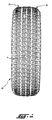
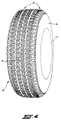
- a pneumatic tire 10 having a ground contacting tread 11.
- the treads are flanked by a pair of shoulders 12 which are in turn joined to a pair of sidewalls 13 that extend radially inwardly from the tread and each terminates in a bead 14.
- FIG 3 there is represented an enlarged fragmentary view of the tread of the tire shown in Figures 1 and 2.
- the tread 11 has three circumferentially extending straight grooves 4-6 therein, spaced axially apart across the surface of the tread and dividing the tread into four circumferentially extending rows 30-33 (hereafter respectively referred to as central rows 31, 32 and shoulder rows 30, 33) of elastomeric blocks 20-23.
- circumferentially extending “straight groove” is meant a groove for which the groove edges at the outer surface of the tread are disposed such that a plane which is perpendicular to the axis of rotation of the tire could be located between said groove edges without intersecting any edge of the groove; that is to say the groove edges need not be parallel to one another, neither need the centerline of the groove be straight in order for a circumferentially extending groove to be a straight groove.
- the axial widths RW1-RW4 of the central and of the shoulder rows delimited by the axial mean position of the centerline of the bordering circumferentially extending straight grooves, range respectively from about 20 % to 25 % and 25 % to 30 % of the tread width TW of the ground engaging portion.
- a plurality of zig-zag shaped grooves 36, 37 extend across the tread 11 from the equatorial plane EP towards respectively the lateral edges TE1 and TE2 of the tire.
- the zig-zag shaped grooves situated on one side of the equatorial plane are substantially symmetrical to those situated on the opposite side of the equatorial plane, the plane of symmetry being the equatorial plane. It is however preferred to circumferentially offset zig-zag shaped grooves situated on opposite sides of the equatorial plane.
- the laterally extending grooves 36,37 are disposed circumferentially about the tire in a repetitive manner, their widths and inclinations depending on the pitch variation, as is practiced in the industry for tire noise reduction.
- each zig-zag groove has a first leg, originating in the circumferentially extending center groove; a second leg, substantially coincident with the respective circumferentially extending groove; and a third and fourth leg.
- the centerlines of the first, second and third leg form with the equatorial plane angles having a magnitude below 85°; the different angles ranging respectively between 50° and 70°; 5° and 20°; 60° and 80° on one side of the equatorial plane and angles ranging respectively between -50° and -70°; -5° and -20°; and -60° and -80° on the other side of the equatorial plane.
- the centerlines of the fourth leg form with the equatorial plane angles having a magnitude comprised between 90° and 100°; such an inclination is important because it provides a higher axial stiffness in the shoulders than in the central part of the tire, so as to improve handling.
- the widths of the first, second, third and fourth leg range respectively between 2% and 4%; 4% and 9%; 3% and 6%; 4% and 8% of the tread width TW, as measured in a tire footprint.
- the groove widths are measured perpendicular to the centerline of the groove.
- the exact number of circumferentially extending grooves and of laterally extending zig-zag grooves may vary in accordance with the size of a tire. A minimum of three circumferentially extending grooves is, however, considered important to obtain a tread having the required properties.
- the number of laterally extending grooves 36, 37 on either side of the equatorial plane is preferably in the range of 60 to 80. The exact number of grooves depends upon the size of the tire. For example a tire of size 175/70 R 13 has 3 circumferentially extending zig-zag grooves and 136 laterally extending grooves.
- the circumferentially and laterally extending grooves define block elements 20-23, having in a row substantially the same geometric shape.
- the block elements of the central rows have, in a front view of the tire, the shape of a parallelogram with a large and a small diagonal.
- the large diagonal of a parallelogram situated on one side of the equatorial plane forms with the equatorial plane an angle comprised between 30° and 60° and an angle comprised between -30° and -60° if situated on the opposite side of the equatorial plane.
- the block elements 20, 23 of the shoulder rows 30, 33 comprise each two portions, an axially innermost main portion 25 and an axially outermost shoulder portion 26.
- the main portion 25 has substantially the same geometric aspect as the block elements 21 or 22 of the central rows 31 respectively 32, i.e. the shape of a parallelogram.
- the shoulder portion 26 is separated from the main portion 25 by a sipe 27 defining one of its four sides, the remaining three sides being delimited by the tread edge, TE1 or TE2, and by the fourth legs of two adjacent laterally extending grooves 36 or 37.
- the sipe 27 can have a depth equal or lower than the depth of the adjacent laterally extending grooves 36 or 37, a depth of about half the depth of the adjacent laterally extending grooves being preferred.
- the axially outermost parts of the shoulder portions 26 extend past the tread edges TE1 or TE2 into the sidewalls 13 but have mainly an appearance or aesthetic function. It is to be understood that providing the shoulder blocks 23 with an extra shoulder portion 26 confers a high lateral stiffness to the tire tread, improving thereby handling and that a tire tread comprising only parallelogram shaped block elements has still good winter properties.
- the acute angles of the parallelograms are cut off. This feature, together with the inclination of the sides of the parallelograms bordering the circumferentially extending grooves 4-6 relatively to the equatorial plane, provides additional traction on snow and ice.
- the grooves are arranged on the tread, so that the total area of grooves to the total area of interposed blocks is substantially equal on each side of the equatorial plane. In this particular embodiment the total areas of the block portions are equal to about 65 % of the tread surface.
- One important aspect of the invention consists in designing the sipes so as to take advantage of the increased traction they provide on ice and snow and to reduce the negative effect they have on wet braking, cornering properties and tire wear.
- the different elastomeric blocks 21, 22 of the central rows 31, 32 as well as the main portions 25 of the elastomeric blocks of the shoulder rows 30, 33 are each provided with a plurality of sipes 15 extending from the upper or wearing surface of the tread towards the tire interior.
- the sipes have a first, a middle and a second portion 18, 17 and 16.
- the first and second portions 18, 16 intersect the sides of the elastomeric blocks. The first portion enters the footprint of the tire before the middle and the second portion, the second portion leaving the footprint of the tire after the first and middle portion.
- the first portions 18 of the different sipes form with the footprint edge when entering the footprint of the tire an angle below 45° and preferably below 30°.
- the second portions 16 of the different sipes form with the footprint edge when leaving the footprint of the tire an angle above 45° and preferably above 60°.
- the middle portions 17 have a zig-zag shape.
- each first portion 18 of the sipe should form with the front edge of the footprint of the tire, when entering the footprint, an angle of at most 40° preferably of at most 20°.
- the second portion 16 of the sipe should form with the rear edge an angle of at least 50° and preferably of at least 70°.
- Such an inclination is also favorable to an optimal circumferential wiping and digging action of the sipe during its stay in the footprint of the tire.
- the second portion of the sipe should point towards the nearest tread edge. It is believed that sipes having such an inclination with respect to the nearest tread edge confer to the tread an excellent cornering performance.
- Said inclinations of the first and second portion 18, 16 of the sipes are in the instant tread layout subject to fine tuning with a view to the parallelogram shaped elastomeric blocks, to the inclination of the front and rear sides of the blocks with respect to the equatorial plane of the tire and regular tread wear.
- the inclination of the first and second portions of neighboring sipes changes progressively so as to maintain the angle, which is formed by the sipe edges and the flanking block sides, substantially constant.
- the shoulder portions 26 of the shoulder block elements 20, 23 comprise at least one, preferably two sipes 28, originating in the sipe 27, separating the shoulder portion 26 from the main portion 25, and extending parallel to the adjacent fourth legs of the laterally extending grooves 36, 37 beyond the tread edges TE1 or TE2, into the sidewall.
- the sipes 28 in the shoulder portions 26 have a depth which varies between half the depth of the adjacent grooves, near the main portion 25 and the tread edge TE1 or TE2, up to full depth between.
- a steel belted radial carcass tire of size 175/70 R 13 has a tread width of about 130 mm and the rows of blocks have axial widths RW1 and RW2 of about 36 and 29 mm respectively.
- the pitch ratios are 18, 21 and 25 and the tread includes 68 circumferentially spaced pitches.
- the grooves have radial depths of about 8.3 mm and their widths depend on the axial position of the different grooves in the tread and they depend also on the pitch variation.
- the laterally extending zig-zag grooves have their widths ranging between about 4 and 9 mm.
- sipes in each parallelogram shaped block there are five sipes in each parallelogram shaped block and they are located and oriented as shown on Figure 3, their radial depths being substantially equal to 70 % of the radial depths of the surrounding grooves.
- the depth of the sipe 27 separating the main portion 25 from the shoulder portion 26 of the blocks of the shoulder rows 30, 33 is about 50% of the radial groove depth.
- the single carcass ply comprises polyester reinforcement cords.
- the belt structure comprises two single cut plies reinforced by 2 x 0.25 mm steel cords, having a density of about 20 ends per inch and forming angles of about 22° with the equatorial plane, the angles of the cables in different plies extending in opposite directions.
- the tread comprises an elastomeric compound having a modulus ranging between 5 and 7 MPa, a Shore A hardness ranging between 53 and 60, an elongation of about 600 % and a tensile strength ranging between 15 and 20 MPa.
Landscapes
- Engineering & Computer Science (AREA)
- Mechanical Engineering (AREA)
- Tires In General (AREA)
- Addition Polymer Or Copolymer, Post-Treatments, Or Chemical Modifications (AREA)
- Processing Of Solid Wastes (AREA)
- Chemical Or Physical Treatment Of Fibers (AREA)
- Motorcycle And Bicycle Frame (AREA)
- Regulating Braking Force (AREA)
Claims (8)
- Winterreifenrichtprofil (11), umfaßend eine elastomere Substanz, welche sich umfänglich um die Rotationsachse des Reifens (10) erstreckt, wobei das Profil (11) umfaßt:
Ein Paar von Schultern (12), welche die lateralen Kanten einer bodeneingreifbaren Oberfläche flankieren;
eine ungerade Zahl, jedoch mindestens drei, von sich umfänglich erstreckenden, axial beabstandeten, geraden Rillen (4-6);
eine Vielzahl von zickzackgeformten Rillen 36, 37, welche in einer wiederholenden Art umfänglich um den Reifen (10) angeordnet sind, und welche sich quer durch das Profil (11) von der Äquatorialebene (EP) zu den lateralen Kanten des Reifens (TE1, TE2) erstrecken, wobei die zickzackgeformten Rillen (36, 37), welche auf einer Seite der Äquatorialebene (EP) angeordnet sind, im wesentlichen symmetrisch zu jenen sind, welche auf der gegenüberliegenden Seite der Äquatorialebene angeordnet sind, wobei jede zickzackgeformte Rille eine erste Teilstrecke aufweist, beginnend in einer sich umfänglich erstreckenden Mittelrille, und jede zweite Teilstrecke im wesentlichen zusammenfällt mit der jeweiligen, sich umfänglich erstreckenden Rille, und zwar beabstandet von den schulternahesten Teilstrecken, wobei die Mittellinien von verschiedenen Teilstrecken mit der Äquatorialebene Winkel bilden mit einer Größe unterhalb oder gleich 80°, beabstandet von den Mittellinien der schulternahesten Teilstrecken, welche Größen in einem Bereich zwischen 90° und 100° aufweisen, wobei die sich umfänglich erstreckenden und die sich lateral erstreckenden Rillen (4-6, 36, 37) Klotzelemente (20-23) definieren, welche in sich umfänglich erstreckenden, axial innersten Mittelreihen (31, 32) und axial äußersten Schulterreihen (30, 33) angeordnet sind; und
eine Vielzahl von Feinschnitten (15), umfaßt in jedem Klotzelement (20-23), wobei jeder Feinschnitt (15) einen ersten (18), einen zweiten (16) und einen mittleren Abschnitt (17), welcher sie verbindet, aufweist, wobei der erste Abschnitt (18) den Abdruck des Reifens (10) vor dem mittleren Abschnitt (17) und dem zweiten Abschnitt (16) erreicht, wobei der zweite Abschnitt (16) den Abdruck des Reifens nach dem ersten Abschnitt (18) und dem mittleren Abschnitt (17) verläßt, dadurch gekennzeichnet,
daß die Klotzelemente (21, 22) in den Mittelreihen (31, 32) im wesentlichen die Form von einem Parallelogramm aufweisen, wobei jedes Parallelogramm zwei spitze und zwei stumpfe Winkel aufweist, welche jeweils durch eine große und eine kleine Diagonale verbunden sind, wobei die große Diagonale der Parallelogramme mit der Äquatorialebene (EP) einen Winkel bilden, umfaßt zwischen 30° und 60° auf einer Seite der Äquatorialebene und einen Winkel umfaßt zwischen -30° und -60° auf der gegenüberliegenden Seite der Äquatorialebene, und
daß die Klotzelemente (20, 23) in den Schulterreihen (30, 33) jeweils zwei Abschnitte (25, 26) umfassen, die durch einen Feinschnitt (27) getrennt sind, einen axialinnersten Hauptabschnitt (25), welcher die Form eines Parallelogramms aufweist und einen axialäußersten Schulterabschnitt (26), dessen vier Seiten begrenzt sind durch den Feinschnitt (27), die naheste Profilkante (TE1, TE2) und durch die schulternahesten Teilstrecken von zwei benachbarten, sich lateral erstreckenden Rillen (36, 37). - Profil gemäß Anspruch 1, worin die Werte der Winkel ansteigen, wenn die Parallelogramme in einer Reihe sind, welche näher angeordnet ist in Richtung der nahesten Profilkante (TE1, TE2).
- Profil gemäß Anspruch 2, worin die spitzen Winkel der Parallelogramme abgeschnitten sind.
- Profil gemäß Anspruch 1, worin die ersten Abschnitte (18) von zumindest 50 % und bevorzugt zumindest 70 % der Feinschnitte (15) mit der vorderen Kante des Abdruckes beim Erreichen des Abdruckes einen Winkel von maximal 30° bilden.
- Profil gemäß Anspruch 1, worin die zweiten Abschnitte (16) von zumindest 50 % und bevorzugt zumindest 70 % der Feinschnitte (15) mit der hinteren Kante des Abdruckes beim Verlassen des Abdruckes einen Winkel von zumindest 60° bilden.
- Profil gemäß Anspruch 1, worin die zweiten Abschnitte (16) von zumindest 50 % der Feinschnitte (15) ausgerichtet sind in Richtung der nahesten Profilkante (TE1, TE2).
- Profil gemäß Anspruch 1, worin die mittleren Abschnitte (17) der Feinschnitte (15) zickzack- oder wellenförmig sind.
- Profil gemäß Anspruch 1, umfassend drei sich umfänglich erstreckende, gerade Rillen (4-6), axial beabstandet durch eine Entfernung in einem Bereich zwischen 20 % und 30 % der Profilbreite (TW) und worin die Mittellinien der ersten, zweiten und dritten Teilstrecken Winkel mit der Äquatorialebene (EP) bilden, welche jeweils in einem Bereich liegen zwischen 50° und 70° bzw. 5° und 20° bzw. 60° und 80° auf der einen Seite der Äquatorialebene und Winkel mit der Äquatorialebene bilden, welche in einem Bereich liegen zwischen -50° und -70° bzw. -5° und -20° bzw. -60° und -80° auf der anderen Seite der Äquatorialebene.
Applications Claiming Priority (2)
| Application Number | Priority Date | Filing Date | Title |
|---|---|---|---|
| US07/612,366 US5198047A (en) | 1990-11-14 | 1990-11-14 | Winter type tire tread |
| US612366 | 1990-11-14 |
Publications (2)
| Publication Number | Publication Date |
|---|---|
| EP0485883A1 EP0485883A1 (de) | 1992-05-20 |
| EP0485883B1 true EP0485883B1 (de) | 1995-05-17 |
Family
ID=24452855
Family Applications (1)
| Application Number | Title | Priority Date | Filing Date |
|---|---|---|---|
| EP91118959A Expired - Lifetime EP0485883B1 (de) | 1990-11-14 | 1991-11-07 | Lauffläche für Winterreifen |
Country Status (8)
| Country | Link |
|---|---|
| US (1) | US5198047A (de) |
| EP (1) | EP0485883B1 (de) |
| JP (1) | JPH04266504A (de) |
| AT (1) | ATE122616T1 (de) |
| CA (1) | CA2039199C (de) |
| DE (1) | DE69109811T2 (de) |
| DK (1) | DK0485883T3 (de) |
| NO (1) | NO175575C (de) |
Cited By (1)
| Publication number | Priority date | Publication date | Assignee | Title |
|---|---|---|---|---|
| DE102013225299A1 (de) | 2013-12-09 | 2015-06-11 | Continental Reifen Deutschland Gmbh | Fahrzeugluftreifen |
Families Citing this family (78)
| Publication number | Priority date | Publication date | Assignee | Title |
|---|---|---|---|---|
| USD348863S (en) | 1992-05-13 | 1994-07-19 | The Yokohama Rubber Co., Ltd. | Automobile tire |
| DE4300695A1 (de) * | 1993-01-13 | 1994-07-14 | Sp Reifenwerke Gmbh | Lauffläche für Fahrzeugluftreifen |
| US5580404A (en) * | 1993-08-30 | 1996-12-03 | The Goodyear Tire & Rubber Company | Tread including tie bars and sipes |
| AT402178B (de) * | 1994-02-25 | 1997-02-25 | Semperit Ag | Laufstreifen für einen fahrzeugluftreifen |
| EP0688686B1 (de) * | 1994-06-21 | 1998-07-22 | Bridgestone Corporation | Luftreifen |
| AT404338B (de) * | 1994-11-24 | 1998-10-27 | Semperit Ag | Fahrzeugreifen |
| IT1275552B (it) * | 1995-07-14 | 1997-08-07 | Pirelli | Pneumatico polivalente per autoveicoli |
| IT1276118B1 (it) * | 1995-11-13 | 1997-10-24 | Pirelli | Pneumatico per autoveicoli con disegno battistrada particolarmente adatto per la marcia su fondi innevati |
| AT404339B (de) * | 1995-11-24 | 1998-10-27 | Semperit Ag | Fahrzeugluftreifen |
| USD384309S (en) * | 1995-11-28 | 1997-09-30 | The Goodyear Tire & Rubber Company | Tire tread |
| US5647926A (en) * | 1995-12-12 | 1997-07-15 | The Goodyear Tire & Rubber Company | Winter automobile or light truck tire |
| US5833779A (en) * | 1995-12-12 | 1998-11-10 | The Goodyear Tire & Rubber Company | Winter automobile or light truck tire including sipes |
| DE19604727A1 (de) * | 1996-02-09 | 1997-08-14 | Continental Ag | Fahrzeugluftreifen |
| AT404341B (de) * | 1996-02-12 | 1998-10-27 | Semperit Ag | Fahrzeugluftreifen |
| USD379448S (en) * | 1996-03-19 | 1997-05-27 | The Goodyear Tire & Rubber Company | Tire tread |
| DE19635147A1 (de) * | 1996-08-30 | 1998-03-05 | Continental Ag | Fahrzeugluftreifen |
| USD387714S (en) * | 1996-11-04 | 1997-12-16 | The Goodyear Tire & Rubber Company | Tire tread |
| USD403993S (en) | 1997-02-20 | 1999-01-12 | Michelin Recherche Et Technique S.A. | Tire tread |
| USD402598S (en) | 1997-02-20 | 1998-12-15 | Michelin Recherche Et Technique, S.A. | Tire tread |
| USD405397S (en) | 1997-02-20 | 1999-02-09 | Michelin Recherche Et Technique | Tire tread |
| USD400131S (en) | 1997-09-05 | 1998-10-27 | The Goodyear Tire & Rubber Company | Tire tread |
| DE19829038C2 (de) * | 1998-07-01 | 2002-07-25 | Continental Ag | Fahrzeugreifen |
| US6412531B1 (en) * | 1999-07-15 | 2002-07-02 | Michelin Recherche Et Technique S.A. | Tire tread having groove walls with compound contours |
| US6796347B1 (en) | 1999-07-30 | 2004-09-28 | Bridgestone Corporation | Pneumatic tire including auxiliary grooves |
| DE19957915B4 (de) * | 1999-12-02 | 2005-08-11 | Continental Aktiengesellschaft | Fahrzeugluftreifen |
| USD450652S1 (en) | 1999-12-27 | 2001-11-20 | Michelin Recherche Et Technique, S.A. | Tread of a tire |
| JP3367927B2 (ja) * | 2000-01-24 | 2003-01-20 | 住友ゴム工業株式会社 | 空気入りタイヤ |
| USD441695S1 (en) | 2000-01-31 | 2001-05-08 | The Goodyear Tire & Rubber Company | Tire tread |
| EP1167084B1 (de) * | 2000-06-22 | 2006-08-02 | Bridgestone Corporation | Luftreifen |
| USD451856S1 (en) | 2000-08-29 | 2001-12-11 | The Goodyear Tire & Rubber Company | Tire tread |
| USD451446S1 (en) | 2000-11-13 | 2001-12-04 | The Goodyear Tire & Rubber Company | Tire tread |
| EP1215055B1 (de) * | 2000-12-12 | 2006-04-05 | Continental Aktiengesellschaft | Fahrzeugreifen mit Laufflächenprofil für guten Schnee- und Eisgriff |
| USD451452S1 (en) | 2001-02-19 | 2001-12-04 | The Goodyear Tire & Rubber Company | Tire tread |
| JP4104982B2 (ja) * | 2001-02-28 | 2008-06-18 | ピレリ・タイヤ・ソチエタ・ペル・アツィオーニ | 冬用タイヤ用の方向性トレッドパターン |
| US7270163B2 (en) * | 2001-02-28 | 2007-09-18 | Pirelli Pneumatici S.P.A. | Tyre for a vehicle wheel including specific tread patterns |
| PT1363790E (pt) * | 2001-02-28 | 2007-11-05 | Pirelli | Banda de rodagem de pneu para veículos a motor, em particular para pisos cobertos de neve |
| US6631746B2 (en) * | 2001-04-25 | 2003-10-14 | Bridgestone/Firestone North American Tire, Llc | Undercut tie bar for pneumatic tire |
| USD457126S1 (en) | 2001-05-18 | 2002-05-14 | The Goodyear Tire & Rubber Company | Tire tread |
| USD464312S1 (en) | 2001-07-09 | 2002-10-15 | Michelin Recherche Et Technique S.A. | Tread of a tire |
| JP3917406B2 (ja) * | 2001-11-08 | 2007-05-23 | 株式会社ブリヂストン | 空気入りタイヤ |
| USD481989S1 (en) | 2002-09-27 | 2003-11-11 | The Goodyear Tire & Rubber Company | Tire tread |
| DE10312488A1 (de) * | 2003-03-20 | 2004-09-30 | Continental Aktiengesellschaft | Fahrzeugreifen, insbesondere Winterreifen mit einem Laufstreifenprofil |
| USD487054S1 (en) | 2003-05-20 | 2004-02-24 | The Goodyear Tire & Rubber Company | Tire tread |
| USD503375S1 (en) * | 2004-04-23 | 2005-03-29 | The Goodyear Tire & Rubber Company | Tire tread |
| US7188650B2 (en) * | 2004-12-28 | 2007-03-13 | The Goodyear Tire & Rubber Company | Siped tire tread with high transverse stiffness |
| JP5194365B2 (ja) * | 2006-02-03 | 2013-05-08 | 横浜ゴム株式会社 | 空気入りタイヤ |
| JP5012357B2 (ja) * | 2007-09-20 | 2012-08-29 | 横浜ゴム株式会社 | 空気入りタイヤ |
| US8056592B2 (en) * | 2007-10-31 | 2011-11-15 | The Goodyear Tire + Rubber Company, Inc. | Grip tire with added puncture protection |
| US7926533B2 (en) | 2007-10-31 | 2011-04-19 | The Goodyear Tire & Rubber Company, Inc. | Pneumatic tire with increased lower sidewall durability |
| JP4156018B1 (ja) * | 2007-12-12 | 2008-09-24 | 横浜ゴム株式会社 | 空気入りタイヤ |
| DE102007061148A1 (de) | 2007-12-17 | 2009-06-18 | Continental Aktiengesellschaft | Fahrzeugluftreifen |
| DE202007019375U1 (de) | 2007-12-17 | 2012-04-04 | Continental Reifen Deutschland Gmbh | Fahrzeugluftreifen |
| KR100913597B1 (ko) * | 2008-05-15 | 2009-08-26 | 금호타이어 주식회사 | 스노우 타이어 |
| USD606484S1 (en) * | 2008-09-04 | 2009-12-22 | Michelin Recherche Et Technique S.A. | Pneumatic tire |
| USD606005S1 (en) | 2009-07-07 | 2009-12-15 | Bridgestone Bandag, Llc | Tire tread |
| JP5473054B2 (ja) * | 2009-09-07 | 2014-04-16 | 株式会社ブリヂストン | タイヤ |
| JP4996661B2 (ja) * | 2009-10-15 | 2012-08-08 | 住友ゴム工業株式会社 | 空気入りタイヤ |
| JP5081264B2 (ja) * | 2010-03-01 | 2012-11-28 | 住友ゴム工業株式会社 | 空気入りタイヤ |
| FR2965512B1 (fr) * | 2010-09-30 | 2012-09-21 | Michelin Soc Tech | Bande de roulement perfectionnee pour pneumatique. |
| US8863795B2 (en) * | 2010-10-29 | 2014-10-21 | The Goodyear Tire & Rubber Company | Gripping edges for winter tire |
| USD649927S1 (en) | 2010-12-15 | 2011-12-06 | Bridgestone Bandag, Llc | Tire tread |
| US9914329B2 (en) * | 2010-12-23 | 2018-03-13 | Pirelli Tyre S.P.A. | Tyre for heavy load vehicle wheels |
| RU2742112C2 (ru) | 2011-09-21 | 2021-02-02 | Пирелли Тайр С.П.А. | Зимняя шина |
| FR2984802B1 (fr) * | 2011-12-22 | 2014-01-10 | Michelin Soc Tech | Bande de roulement comportant des blocs obliques |
| JP5647646B2 (ja) * | 2012-06-08 | 2015-01-07 | 住友ゴム工業株式会社 | タイヤの加硫金型及び空気入りタイヤの製造方法 |
| JP6002032B2 (ja) * | 2012-12-28 | 2016-10-05 | 株式会社ブリヂストン | タイヤ |
| US10259268B2 (en) * | 2013-12-24 | 2019-04-16 | Bridgestone Americas Tire Operations, Llc | Tire with grooves having variable depth |
| JP6278843B2 (ja) * | 2014-06-12 | 2018-02-14 | 株式会社ブリヂストン | タイヤ |
| CN107405962B (zh) * | 2015-03-18 | 2019-08-23 | 株式会社普利司通 | 轮胎 |
| US20180043739A1 (en) * | 2015-03-23 | 2018-02-15 | Bridgestone Corporation | Tire |
| EP3176006B1 (de) * | 2015-11-24 | 2018-06-20 | Sumitomo Rubber Industries Limited | Reifen |
| JP6834190B2 (ja) * | 2016-06-27 | 2021-02-24 | 住友ゴム工業株式会社 | タイヤ |
| USD858425S1 (en) * | 2017-08-30 | 2019-09-03 | Bridgestone Americas Tire Operations, Llc | Tire |
| EP3527407B1 (de) | 2018-02-15 | 2022-05-04 | Nokian Renkaat Oyj | Laufflächenblockanordnung mit einer stützlamelle |
| FR3108562B1 (fr) * | 2020-03-26 | 2022-03-11 | Michelin & Cie | Pneumatique comportant une bande de roulement optimisée en adhérence sur sol enneigé |
| US20220144018A1 (en) * | 2020-11-06 | 2022-05-12 | The Goodyear Tire & Rubber Company | Tire with one or more recesses in the lateral grooves of at least one shoulder portion |
| USD996348S1 (en) * | 2022-01-26 | 2023-08-22 | Bridgestone Americas Tire Operations, Llc | Tire |
| USD1073587S1 (en) * | 2023-04-17 | 2025-05-06 | American Kenda Rubber Industrial Co., Ltd. | Vehicle tire tread |
Family Cites Families (10)
| Publication number | Priority date | Publication date | Assignee | Title |
|---|---|---|---|---|
| US4456046A (en) * | 1981-05-11 | 1984-06-26 | Miller Timothy I | High-speed tires |
| EP0112533B1 (de) * | 1982-12-22 | 1988-09-21 | Uniroyal Englebert Reifen GmbH | M+S-Laufflächenprofil für Fahrzeugluftreifen |
| JPS60234005A (ja) * | 1984-05-02 | 1985-11-20 | Bridgestone Corp | ウエツト性能に優れる空気入りタイヤ |
| USD294134S (en) | 1985-02-05 | 1988-02-09 | Goodyear Tire & Rubber Co. | Tire |
| JPS61261109A (ja) * | 1985-05-14 | 1986-11-19 | Bridgestone Corp | 牽引,制動性能にすぐれる空気入りタイヤ |
| AT387753B (de) * | 1986-11-19 | 1989-03-10 | Semperit Ag | Laufflaechenprofil fuer fahrzeugluftreifen |
| JPS63162308A (ja) * | 1986-12-26 | 1988-07-05 | Bridgestone Corp | 高速走行に供せられる偏平空気入りラジアルタイヤ |
| DE3877642T2 (de) * | 1987-07-15 | 1993-05-13 | Sumitomo Rubber Ind | Luftreifen. |
| AT390916B (de) * | 1988-02-24 | 1990-07-25 | Semperit Ag | Laufflaechenprofil fuer einen fahrzeugluftreifen |
| USD316387S (en) | 1988-06-15 | 1991-04-23 | Nokia Tyres Limited | Tire |
-
1990
- 1990-11-14 US US07/612,366 patent/US5198047A/en not_active Expired - Fee Related
-
1991
- 1991-03-27 CA CA002039199A patent/CA2039199C/en not_active Expired - Fee Related
- 1991-11-07 EP EP91118959A patent/EP0485883B1/de not_active Expired - Lifetime
- 1991-11-07 DE DE69109811T patent/DE69109811T2/de not_active Expired - Fee Related
- 1991-11-07 DK DK91118959.5T patent/DK0485883T3/da active
- 1991-11-07 AT AT91118959T patent/ATE122616T1/de not_active IP Right Cessation
- 1991-11-13 NO NO914451A patent/NO175575C/no not_active IP Right Cessation
- 1991-11-14 JP JP3298801A patent/JPH04266504A/ja active Pending
Cited By (1)
| Publication number | Priority date | Publication date | Assignee | Title |
|---|---|---|---|---|
| DE102013225299A1 (de) | 2013-12-09 | 2015-06-11 | Continental Reifen Deutschland Gmbh | Fahrzeugluftreifen |
Also Published As
| Publication number | Publication date |
|---|---|
| DE69109811D1 (de) | 1995-06-22 |
| DE69109811T2 (de) | 1995-11-23 |
| ATE122616T1 (de) | 1995-06-15 |
| NO175575C (no) | 1994-11-02 |
| CA2039199A1 (en) | 1992-05-15 |
| US5198047A (en) | 1993-03-30 |
| DK0485883T3 (da) | 1995-07-10 |
| NO175575B (no) | 1994-07-25 |
| NO914451D0 (no) | 1991-11-13 |
| CA2039199C (en) | 2002-09-10 |
| JPH04266504A (ja) | 1992-09-22 |
| EP0485883A1 (de) | 1992-05-20 |
| NO914451L (no) | 1992-05-15 |
Similar Documents
| Publication | Publication Date | Title |
|---|---|---|
| CA2039199C (en) | Winter type tire tread | |
| EP0455925B1 (de) | Ganz-Jahr-Lauffläche | |
| EP0466998B1 (de) | Reifenlaufflächen | |
| CA2127970C (en) | Tread for pneumatic tire and tire comprising such a tread | |
| US5361816A (en) | Tread for pneumatic tire and tire comprising such a tread | |
| US5538060A (en) | Pneumatic tire having tread portion including blocks | |
| EP0508090B1 (de) | Luftreifen mit besonderer Bodenberührungsfläche | |
| EP0093071B1 (de) | Luftreifen | |
| US6439284B1 (en) | Tread for a pneumatic tire including aquachannel | |
| EP1127716B1 (de) | Ausgleich der Abnutzung von Spitzen und Fersen | |
| US5211781A (en) | Tire tread for large motor vehicles | |
| EP3820719B1 (de) | Reifen für fahrzeugräder | |
| WO2020012279A1 (en) | Tyre for vehicle wheels | |
| EP0485884B1 (de) | Feineinschnitte für Reifenlauffläche | |
| EP1021306B1 (de) | Lauffläche für luftreifen | |
| EP0427417B1 (de) | Lauffläche für LKW-Gürtelreifen | |
| RU2791336C1 (ru) | Шина |
Legal Events
| Date | Code | Title | Description |
|---|---|---|---|
| PUAI | Public reference made under article 153(3) epc to a published international application that has entered the european phase |
Free format text: ORIGINAL CODE: 0009012 |
|
| 17P | Request for examination filed |
Effective date: 19911107 |
|
| AK | Designated contracting states |
Kind code of ref document: A1 Designated state(s): AT BE CH DE DK FR GB IT LI LU NL SE |
|
| 17Q | First examination report despatched |
Effective date: 19940310 |
|
| GRAA | (expected) grant |
Free format text: ORIGINAL CODE: 0009210 |
|
| AK | Designated contracting states |
Kind code of ref document: B1 Designated state(s): AT BE CH DE DK FR GB IT LI LU NL SE |
|
| REF | Corresponds to: |
Ref document number: 122616 Country of ref document: AT Date of ref document: 19950615 Kind code of ref document: T |
|
| REF | Corresponds to: |
Ref document number: 69109811 Country of ref document: DE Date of ref document: 19950622 |
|
| ET | Fr: translation filed | ||
| REG | Reference to a national code |
Ref country code: DK Ref legal event code: T3 |
|
| ITF | It: translation for a ep patent filed | ||
| PLBE | No opposition filed within time limit |
Free format text: ORIGINAL CODE: 0009261 |
|
| STAA | Information on the status of an ep patent application or granted ep patent |
Free format text: STATUS: NO OPPOSITION FILED WITHIN TIME LIMIT |
|
| 26N | No opposition filed | ||
| PGFP | Annual fee paid to national office [announced via postgrant information from national office to epo] |
Ref country code: NL Payment date: 20000929 Year of fee payment: 10 |
|
| PGFP | Annual fee paid to national office [announced via postgrant information from national office to epo] |
Ref country code: GB Payment date: 20001004 Year of fee payment: 10 |
|
| PGFP | Annual fee paid to national office [announced via postgrant information from national office to epo] |
Ref country code: FR Payment date: 20001107 Year of fee payment: 10 |
|
| PGFP | Annual fee paid to national office [announced via postgrant information from national office to epo] |
Ref country code: DE Payment date: 20001124 Year of fee payment: 10 |
|
| PGFP | Annual fee paid to national office [announced via postgrant information from national office to epo] |
Ref country code: LU Payment date: 20001201 Year of fee payment: 10 |
|
| PGFP | Annual fee paid to national office [announced via postgrant information from national office to epo] |
Ref country code: BE Payment date: 20001214 Year of fee payment: 10 |
|
| PG25 | Lapsed in a contracting state [announced via postgrant information from national office to epo] |
Ref country code: LU Free format text: LAPSE BECAUSE OF NON-PAYMENT OF DUE FEES Effective date: 20011107 Ref country code: GB Free format text: LAPSE BECAUSE OF NON-PAYMENT OF DUE FEES Effective date: 20011107 |
|
| PG25 | Lapsed in a contracting state [announced via postgrant information from national office to epo] |
Ref country code: BE Free format text: LAPSE BECAUSE OF NON-PAYMENT OF DUE FEES Effective date: 20011130 |
|
| REG | Reference to a national code |
Ref country code: GB Ref legal event code: IF02 |
|
| BERE | Be: lapsed |
Owner name: THE GOODYEAR TIRE & RUBBER CY Effective date: 20011130 |
|
| PG25 | Lapsed in a contracting state [announced via postgrant information from national office to epo] |
Ref country code: NL Free format text: LAPSE BECAUSE OF NON-PAYMENT OF DUE FEES Effective date: 20020601 |
|
| GBPC | Gb: european patent ceased through non-payment of renewal fee |
Effective date: 20011107 |
|
| PG25 | Lapsed in a contracting state [announced via postgrant information from national office to epo] |
Ref country code: DE Free format text: LAPSE BECAUSE OF NON-PAYMENT OF DUE FEES Effective date: 20020702 |
|
| PG25 | Lapsed in a contracting state [announced via postgrant information from national office to epo] |
Ref country code: FR Free format text: LAPSE BECAUSE OF NON-PAYMENT OF DUE FEES Effective date: 20020730 |
|
| NLV4 | Nl: lapsed or anulled due to non-payment of the annual fee |
Effective date: 20020601 |
|
| REG | Reference to a national code |
Ref country code: FR Ref legal event code: ST |
|
| REG | Reference to a national code |
Ref country code: FR Ref legal event code: ST |
|
| PGFP | Annual fee paid to national office [announced via postgrant information from national office to epo] |
Ref country code: DK Payment date: 20020916 Year of fee payment: 12 |
|
| PGFP | Annual fee paid to national office [announced via postgrant information from national office to epo] |
Ref country code: AT Payment date: 20021002 Year of fee payment: 12 |
|
| PGFP | Annual fee paid to national office [announced via postgrant information from national office to epo] |
Ref country code: SE Payment date: 20021106 Year of fee payment: 12 |
|
| PGFP | Annual fee paid to national office [announced via postgrant information from national office to epo] |
Ref country code: CH Payment date: 20021223 Year of fee payment: 12 |
|
| PG25 | Lapsed in a contracting state [announced via postgrant information from national office to epo] |
Ref country code: AT Free format text: LAPSE BECAUSE OF NON-PAYMENT OF DUE FEES Effective date: 20031107 |
|
| PG25 | Lapsed in a contracting state [announced via postgrant information from national office to epo] |
Ref country code: SE Free format text: LAPSE BECAUSE OF NON-PAYMENT OF DUE FEES Effective date: 20031108 |
|
| PG25 | Lapsed in a contracting state [announced via postgrant information from national office to epo] |
Ref country code: LI Free format text: LAPSE BECAUSE OF NON-PAYMENT OF DUE FEES Effective date: 20031130 Ref country code: CH Free format text: LAPSE BECAUSE OF NON-PAYMENT OF DUE FEES Effective date: 20031130 |
|
| PG25 | Lapsed in a contracting state [announced via postgrant information from national office to epo] |
Ref country code: DK Free format text: LAPSE BECAUSE OF NON-PAYMENT OF DUE FEES Effective date: 20040101 |
|
| EUG | Se: european patent has lapsed | ||
| REG | Reference to a national code |
Ref country code: DK Ref legal event code: EBP |
|
| REG | Reference to a national code |
Ref country code: CH Ref legal event code: PL |
|
| PG25 | Lapsed in a contracting state [announced via postgrant information from national office to epo] |
Ref country code: IT Free format text: LAPSE BECAUSE OF NON-PAYMENT OF DUE FEES;WARNING: LAPSES OF ITALIAN PATENTS WITH EFFECTIVE DATE BEFORE 2007 MAY HAVE OCCURRED AT ANY TIME BEFORE 2007. THE CORRECT EFFECTIVE DATE MAY BE DIFFERENT FROM THE ONE RECORDED. Effective date: 20051107 |