EP1127716B1 - Ausgleich der Abnutzung von Spitzen und Fersen - Google Patents
Ausgleich der Abnutzung von Spitzen und Fersen Download PDFInfo
- Publication number
- EP1127716B1 EP1127716B1 EP01103768A EP01103768A EP1127716B1 EP 1127716 B1 EP1127716 B1 EP 1127716B1 EP 01103768 A EP01103768 A EP 01103768A EP 01103768 A EP01103768 A EP 01103768A EP 1127716 B1 EP1127716 B1 EP 1127716B1
- Authority
- EP
- European Patent Office
- Prior art keywords
- block
- tread
- tire
- heel
- blocks
- Prior art date
- Legal status (The legal status is an assumption and is not a legal conclusion. Google has not performed a legal analysis and makes no representation as to the accuracy of the status listed.)
- Expired - Lifetime
Links
- 210000003371 toe Anatomy 0.000 claims description 38
- 239000011800 void material Substances 0.000 claims description 18
- 230000007423 decrease Effects 0.000 claims description 4
- 239000011324 bead Substances 0.000 description 8
- 230000002829 reductive effect Effects 0.000 description 4
- 230000003247 decreasing effect Effects 0.000 description 2
- 230000001788 irregular Effects 0.000 description 2
- 229910000831 Steel Inorganic materials 0.000 description 1
- 230000002411 adverse Effects 0.000 description 1
- 239000013536 elastomeric material Substances 0.000 description 1
- 230000008014 freezing Effects 0.000 description 1
- 238000007710 freezing Methods 0.000 description 1
- 230000000670 limiting effect Effects 0.000 description 1
- 230000036961 partial effect Effects 0.000 description 1
- 230000002787 reinforcement Effects 0.000 description 1
- 239000010959 steel Substances 0.000 description 1
- 238000009827 uniform distribution Methods 0.000 description 1
Images
Classifications
-
- B—PERFORMING OPERATIONS; TRANSPORTING
- B60—VEHICLES IN GENERAL
- B60C—VEHICLE TYRES; TYRE INFLATION; TYRE CHANGING; CONNECTING VALVES TO INFLATABLE ELASTIC BODIES IN GENERAL; DEVICES OR ARRANGEMENTS RELATED TO TYRES
- B60C11/00—Tyre tread bands; Tread patterns; Anti-skid inserts
- B60C11/01—Shape of the shoulders between tread and sidewall, e.g. rounded, stepped or cantilevered
-
- B—PERFORMING OPERATIONS; TRANSPORTING
- B60—VEHICLES IN GENERAL
- B60C—VEHICLE TYRES; TYRE INFLATION; TYRE CHANGING; CONNECTING VALVES TO INFLATABLE ELASTIC BODIES IN GENERAL; DEVICES OR ARRANGEMENTS RELATED TO TYRES
- B60C11/00—Tyre tread bands; Tread patterns; Anti-skid inserts
- B60C11/03—Tread patterns
- B60C11/0302—Tread patterns directional pattern, i.e. with main rolling direction
-
- B—PERFORMING OPERATIONS; TRANSPORTING
- B60—VEHICLES IN GENERAL
- B60C—VEHICLE TYRES; TYRE INFLATION; TYRE CHANGING; CONNECTING VALVES TO INFLATABLE ELASTIC BODIES IN GENERAL; DEVICES OR ARRANGEMENTS RELATED TO TYRES
- B60C11/00—Tyre tread bands; Tread patterns; Anti-skid inserts
- B60C11/03—Tread patterns
- B60C11/0327—Tread patterns characterised by special properties of the tread pattern
- B60C11/033—Tread patterns characterised by special properties of the tread pattern by the void or net-to-gross ratios of the patterns
-
- B—PERFORMING OPERATIONS; TRANSPORTING
- B60—VEHICLES IN GENERAL
- B60C—VEHICLE TYRES; TYRE INFLATION; TYRE CHANGING; CONNECTING VALVES TO INFLATABLE ELASTIC BODIES IN GENERAL; DEVICES OR ARRANGEMENTS RELATED TO TYRES
- B60C11/00—Tyre tread bands; Tread patterns; Anti-skid inserts
- B60C11/03—Tread patterns
- B60C11/11—Tread patterns in which the raised area of the pattern consists only of isolated elements, e.g. blocks
-
- B—PERFORMING OPERATIONS; TRANSPORTING
- B60—VEHICLES IN GENERAL
- B60C—VEHICLE TYRES; TYRE INFLATION; TYRE CHANGING; CONNECTING VALVES TO INFLATABLE ELASTIC BODIES IN GENERAL; DEVICES OR ARRANGEMENTS RELATED TO TYRES
- B60C11/00—Tyre tread bands; Tread patterns; Anti-skid inserts
- B60C11/03—Tread patterns
- B60C11/12—Tread patterns characterised by the use of narrow slits or incisions, e.g. sipes
-
- B—PERFORMING OPERATIONS; TRANSPORTING
- B60—VEHICLES IN GENERAL
- B60C—VEHICLE TYRES; TYRE INFLATION; TYRE CHANGING; CONNECTING VALVES TO INFLATABLE ELASTIC BODIES IN GENERAL; DEVICES OR ARRANGEMENTS RELATED TO TYRES
- B60C11/00—Tyre tread bands; Tread patterns; Anti-skid inserts
- B60C11/03—Tread patterns
- B60C11/13—Tread patterns characterised by the groove cross-section, e.g. for buttressing or preventing stone-trapping
Definitions
- the present invention generally relates to tread patterns for pneumatic tires, particularly to a variation of block tread patterns designed to balance the rate of wear between the leading edge or heel and the training edge or toe of the tread blocks.
- a pneumatic tire includes a ground contacting portion or tread, the tread having a pattern designed to provide the tire with a desirable combination of traction, durability, ride comfort and quiet operation. It is also desirable that the tread pattern provide the tire with an all-weather capability, that is a set of characteristics providing adequate performance under a variety of adverse road conditions including snowing, freezing, raining, etc.
- Tire tread patterns designed for traction on wet surfaces, snow and ice often feature a block type tread pattern.
- a block type tread pattern is characterized by a plurality of main grooves extending in a circumferential direction and a number of lateral grooves extending in a more or less axial direction. The areas of tread between the circumferential and lateral grooves are referred to a tread blocks.
- Tread blocks may also be defined by the edges of the tread and by grooves having other orientations.
- rib-type tread patterns are characterized primarily by circumferential grooves separating circumferentially continuous ribs. Tread designs may also combine rib and block patterns.
- blocks as elements of a tread pattern tends to increase the level of noise generated by such tires as compared to rib-type tires. Also, as noted by US-A-5,538,060, such blocks have a tendency towards irregular wear due primarily to their lack of stiffness in the circumferential direction of the tread.
- heel-and-toe wear It is known in pneumatic tires having a block tread pattern that normal operation of the tire produces uneven wear of the tread blocks called heel-and-toe wear.
- heel-and-toe wear the rate of wear at the toe or trailing edge of the blocks exceeds the rate of wear at the heel or leading edge of the blocks.
- heel-and-toe wear increases the level of noise generated by the operation of the tire.
- cornering and braking performance of a tire with heel-and-toe wear may be degraded.
- US-A- 5,891,276 discloses a variation of the block tread pattern designed to suppress heel-and-toe wear wherein a narrow block is provided outside each block, the narrow block having a surface formed to be a circular arc by setting both end parts of the narrow block to be lower than he adjacent tread block by 1.5 to 2.5 mm.
- EP 0 847 878 discloses a tire according to the preamble of claim 1.
- the present invention to provides an improvement that is generally applicable to the design of block tread patterns for pneumatic tires and particularly applicable to directional block tread patterns having the capability of balancing heel-and-toe wear.
- the leading edge or heel of one or more blocks are provided with one or more notches, the notches having a variable width in the axial direction, the width generally decreasing from a maximum at the toe to a minimum in the direction of the heel.
- Said notches provide the tread blocks with a variable net to gross void space where the void space decreases from the heel to the toe of the blocks.
- the variation of net to gross void space from the heel to the toe of a block can be provided by a wide range in the number shape and dimensions of the notches that can be applied to the toes of a blocks.
- the notches may be rectangular, triangular, trapezoidal or curved in shape.
- the notches may also have variable depth, having a maximum depth at the heel of the block.
- a pneumatic tire has a directional tread with blocks.
- Each block has a leading edge or toe and a trailing edge or heel extending from a ground contacting tread surface.
- One or more of the blocks is characterized by one or more notches originating at the heel and extending into the block from the tread surface.
- the notches are rectangular, triangular, trapezoidal or curved in shape.
- the notches extend in the circumferential direction toward the toe whereby the area of the tread surface has a variable net to gross void space that decreases from the leading edge to the trailing edge of the one or more blocks.
- the notches have a length ranging from 40% to 70% of the length of the block and a variable width in the circumferential direction with the greatest width being at the heel and ranging from 10% to 30% of the width of the block.
- the notches also have a variable depth in the radial direction with the depth being greatest at the heal.
- the toe of the blocks are sometimes provided with one or more sipes.
- the sipes have a circumferential orientation and a length equal ranging from 5% to 35% of the length of the block.
- Axial and “Axially” means the lines or directions that are parallel to the axis of rotation of the tire.
- Bead or “Bead Core” generally means that part of the tire comprising an annular tensile member of radially inner beads that are associated with holding the tire to the rim.
- Belt Structure or “Reinforcement Belts” or “Belt Package” means at least two annular layers or plies'of parallel cords, woven or unwoven, underlying the tread, unanchored to the bead, and having both left and right cord angles in the range from 18 degrees to 30 degrees relative to the equatorial plane of the tire.
- Carcass means the tire structure apart from the belt structure, tread, undertread over the plies, but including the beads.
- “Circumferential” most often means circular lines or directions extending along the perimeter of the surface of the annular tread perpendicular to the axial direction; it can also refer to the direction of the sets of adjacent circular curves whose radii define the axial curvature of the tread, as viewed in cross section.
- Directional Tread Pattern means a tread pattern designed for specific direction of rotation.
- Equatorial Plane means the plane perpendicular to the tire's axis of rotation and passing through the center of its tread; or the plane containing the circumferential centerline of the tread.
- “Footprint” means the contact patch or area of contact of the tire tread with a flat surface under normal load pressure and speed conditions.
- “Groove” means an elongated void area in a tread that may extend circumferentially or laterally in the tread in a straight, curved or zigzag manner. It is understood that all groove widths are measured perpendicular to the centerline of the groove.
- “Lateral” means a direction going from one sidewall of the tire towards the other sidewall of the tire.
- Net to gross void space means the ratio of the net ground contacting tread surface to the gross area of the tread including the ground contacting tread surface and void spaces comprising grooves, notches and sipes.
- Notch means a void area of limited length that may be used to modify the variation of net to gross void area at the edges of blocks.
- Ply means a cord-reinforced layer of rubber coated radially deployed or otherwise parallel cords.
- Ring and radially mean directions radially toward or away from the axis of rotation of the tire.
- Ring Ply Tire means a belted or circumferentially-restricted pneumatic tire in which at least one ply has cords which extend from bead to bead are laid at cord angles between 65 degrees and 90 degrees with respect to the equatorial plane of the tire.
- Shader means the upper portion of sidewall just below the tread edge.
- “Sidewall” means that portion of a tire between the tread and the bead.
- Sipe means a groove having a width in the range of 0.2% to 0.8% of the tread width. Sipes are typically formed by steel blades having a 0.4 to 1.6 mm, inserted into a cast or machined mold.
- Tangential and “Tangentially” refer to segments of circular curves that intersect at a point through which can be drawn a single line that is mutually tangential to both circular segments.
- Thread means the ground contacting portion of a tire.
- TW Thread width
- Vehicle Space means areas of the tread surface comprising grooves, notches and sipes.
- the present invention relates to new tires, retreaded tires, and tire treads in strip form being at least partially vulcanized and having a pattern of grooves and blocks integral therewith.
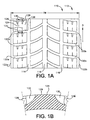
- a first embodiment of the present invention is represented as a developed view showing a partial tread pattern.
- the tire 110 has a directional tread 112 designed for normal operation in direction of rotation D indicated on the drawing.
- the tread 112 has three circumferentially extending grooves 114,116,118 having a width ranging between 3% and 8% of the tread width (TW).
- TW tread width
- they have preferably a width of about 6% for the center groove 116 and about 4% for the other grooves 114,118.
- circumferentially extending grooves 114,116,118 there are three circumferentially extending grooves 114,116,118 in the illustrated embodiments, the number of circumferential grooves embodying the present invention may vary, for example with the size of the tire 110. Similarly it is understood that although the circumferentially extending grooves 114,116,118 are straight and parallel, the grooves may vary in direction and width.
- a plurality of lateral grooves 120a,120b extend from center groove 116 to the lateral edges of the tread 122a,122b. These lateral grooves 120a,120b follow a curved path having a more or less axial direction at the lateral edge of the tread 122a,122b with a curvature inclined toward the direction of travel (D) and tending toward a direction more parallel with the equatorial plane of the tire 110 as the grooves extend to the center of the tread. It is understood that although the lateral grooves 120a,120b are shown inclined and curved in the illustrated embodiments, neither the inclination or the curvature is an essential feature of the present invention.
- the lateral grooves 120a,120b have a width ranging between 2% and 6% of the tread width (TW). In the embodiment of the present invention shown in FIGURE 1A, they have preferably a width of about 3.5%. It is understood the number of lateral grooves 120a,120, may vary depending on the size of the tire.
- the tread 112 is divided into a plurality of elastomeric blocks 124 by the circumferential grooves 114,116,118 and the plurality of lateral grooves 120a, 120b.
- the elastomeric blocks 124 are more or less rectangular in shape as defined and separated from each other by the circumferential grooves 114,116,118 and the plurality of lateral grooves 120a, 120b. It is understood that a variety of block shapes can be formed by varying the number, width, curvature and orientation of the circumferential grooves 114,116,118 and the plurality of lateral grooves 120a,120b.
- Each block 124 has a width measured in the axial direction and a length measured in the circumferential direction as the distance between the leading edge of the block or heel 126 and trailing edge of the block or toe 128.
- the blocks 124 have a length ranging from 25% to 100% of their width. In the embodiment of the present invention shown in FIGURE 1A the blocks have preferably a length equal to about 50% of their width.
- the heel 126 of the blocks 124 is provided with one or more notches 130 extending from tread surface 129. As illustrated by FIGURE 1A, only the two rows of blocks 124 nearest the tread edges 122a, 122b are provided with notches 130. However, it is understood that present invention includes the provision of notches 130 originating at the heel 126 of a block 124 regardless of the location of the block in the overall tread pattern. By providing the heel 126 with notches 130, the net to gross void space at the heel is decreased relative to the net to gross void space at the toe 128. The net to gross void space is the ratio of the area of ground contacting elastomeric tread surface 129 to the area of void tread surface comprising grooves or notches 130.
- each notch 130 has a length in the circumferential direction ranging from 40% to 70% of the length of the block 124. In the embodiment of the present invention shown in FIGURE 1A, the each notch 130 has preferably a length equal to about 30% of the length a block. Each notch has a width measured in the axial direction that may vary over its length. In general, the maximum width of a notch 130 is located at heel 126 of a block 124 and becomes progressively narrower in the direction toward the toe 128 of a block.
- the variation of the width of the notch 130 over its length relative to the heel 126 and toe 128 of the block 124 provide the block with a variable net to gross void space where the void space decreases from the heel to the toe of the block. It is understood that notches with a variety of shapes and dimension could be applied to the heel of a block to achieve the variation of net to gross void space.
- the combined maximum width of the notches 130 measured at the heel 126 of a block 124 ranges from 10% to 30% of the width of the block. In the first embodiment of the present invention shown in FIGURE 1A the notches 130 have preferably a maximum combined width equal to about 20% of the width of the block 124.
- the toe 128 of a block 124 may be provided with sipes 132 having a circumferential orientation and a length equal ranging from 5% to 35% of the length of the block.
- each block 124 that is adjacent to a tread edges 122a,122b is provided with two sipes 132, each sipe having a length of about 30% of the length of each block.
- the present invention includes the provision of sipes in the toe 128 of a block 124 regardless of location of the block.
- FIGURE 1B shows a cross-sectional view of a typical block 124 of the tread 112 of the first embodiment of the present invention as illustrated by FIGURE 1A.
- the notch 130 has a depth measured in the radial direction that varies with its length in a circumferential direction.
- the notch 130 has a maximum depth at the heel 126 of the block 124 that is about equal to the depth of the adjacent lateral grooves 120a or 120b, the depth being measured radially inward from the ground contacting surface of the tread.
- FIGURE 1B also shows one of the sipes 132, having a depth that varies over its length with a maximum depth at the toe 128 of the block 124.
- a sipe 132 can have a depth equal to or less than the nominal depth of the tread.
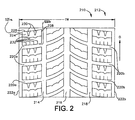
- FIGURE 2 a second embodiment of the present invention is illustrated.
- the features of the embodiment of FIGURE 2 are substantially similar to those illustrated for the first embodiment of FIGURES 1A and 1B, the difference being that in the embodiment shown in FIGURE 2, the blocks 224 are provided with notches 230 having curved sides.
- the blocks 224 are provided with a sipe 232 extending between the lateral edges 225a, 225b of each block and with four sipes 232 having a circumferential orientation located in the toe 228 of each block 224.
- the sipes 232 located in the toe 228 of the block 224 increase the lateral flexibility of the of the block in the area of the toe. Such an increase in lateral flexibility allows the block toe 228 to comply with lateral forces with less slippage and reduced wear.
- Such an embodiment is believed to provide a reduced heel and toe wear differential as well as a more uniform distribution of heel-toe wear.
- the leading edge or heel 126 and the trailing edge toe 128 of the blocks 124 that make up a block-type tread 112 patterns are subject to differing rates of wear in normal use.
- the rate of wear at the toe 126 of the blocks 124 exceeds the rate of wear at the heel 128.
- This differential pattern of wear in tires with conventional block tread patterns results in a tire having an irregular ground contacting tread surface 129 that increases the noise generated by the tire in normal operation.
- Providing the block heels 126 with notches 130 reduces the surface area of elastomeric material in the vicinity of the heel causing the rate of wear in the heel area to be increased to a rate that equals the rate of wear at the toe 128 of the blocks 124.
- toe 128 with sipes 132 increases the lateral flexibility of block in the toe area where such flexibility reduces lateral forces and slippage which are a cause of the increased rate of wear in the area of toe.
- rate of wear at the heel 126 and toe 128 of the blocks 124 the uniformity of the ground contacting surface 129 of the tread 112 is maintained over the life of the tire 110 with a reduction in vibration and noise as compared to convention block tread patterns.
Landscapes
- Engineering & Computer Science (AREA)
- Mechanical Engineering (AREA)
- Tires In General (AREA)
Claims (9)
- Ein Pneumatikreifen (110,210), der ein gerichtetes Profil (112,212) mit Blöcken (124,224) umfasst, wobei jeder Block eine vorlaufende Kante oder Vorderkante (126,226) und eine nachlaufende Kante oder Hinterkante (128,228) aufweist, die sich von einer den Boden berührenden Profiloberfläche (129) erstrecken, wobei einer oder mehr der Blöcke durch eine Kerbe (130) gekennzeichnet sind, die an der Hinterkante beginnt und sich von der Profiloberfläche in den Block erstreckt, wobei sich die Kerbe in der Umfangsrichtung zur Vorderkante hin erstreckt, wobei das Gebiet der Profiloberfläche einen variablen Netto- zu Brutto-Leerraum aufweist, der von der vorlaufenden Kante zur nachlaufenden Kante des einen oder mehr Blocks bzw. Blöcke abnimmt.
- Der Reifen (110,210) gemäß Anspruch 1, dadurch gekennzeichnet, dass die Kerbe (130) eine Länge hat, die sich auf 40% bis 70% der Länge des Blocks (124) beläuft.
- Der Reifen (110, 210) gemäß Anspruch 2, dadurch gekennzeichnet, dass die Kerbe (130) eine an der Hinterkante (128) gemessene Breite im Bereich von 10% bis 30% der Breite des Blocks (124) aufweist.
- Der Reifen (110, 210) gemäß Anspruch 1, dadurch gekennzeichnet, dass die Blöcke (124) eine Vielzahl von Kerben (130, 230) in der Hinterkante (126, 226) aufweisen.
- Der Reifen (110, 210) gemäß Anspruch 1, dadurch gekennzeichnet, dass die Kerben (130, 230) von rechteckiger, dreieckiger, trapezförmiger oder gekrümmter Form sind.
- Der Reifen (110, 210) gemäß Anspruch 2, dadurch gekennzeichnet, dass die Kerben (130, 230) eine variable Breite in der Umfangsrichtung haben, wobei die Breite an dem am dichtesten bei der Hinterkante (126, 226) gelegenen Teil am größten ist.
- Der Reifen (110, 210) gemäß Anspruch 2, dadurch gekennzeichnet, dass die Kerben (130, 230) eine variable Tiefe in radialer Richtung haben, wobei die Tiefe an der Hinterkante (126, 226) am größten ist.
- Der Reifen (110, 210) gemäß Anspruch 1, dadurch gekennzeichnet, dass Vorderkanten (128, 228) von einem oder mehr Blöcken (124, 224) mit ein oder mehr Lamellen (132, 232) versehen sind.
- Der Reifen (110, 210) gemäß Anspruch 8, dadurch gekennzeichnet, dass die Lamellen (132) in Umfangsrichtung ausgerichtet sind und eine Länge haben, die sich auf 5% bis 35% der Länge des Blocks beläuft.
Applications Claiming Priority (2)
| Application Number | Priority Date | Filing Date | Title |
|---|---|---|---|
| US514780 | 2000-02-28 | ||
| US09/514,780 US6378583B1 (en) | 2000-02-28 | 2000-02-28 | Heel and toe wear balancing |
Publications (2)
| Publication Number | Publication Date |
|---|---|
| EP1127716A1 EP1127716A1 (de) | 2001-08-29 |
| EP1127716B1 true EP1127716B1 (de) | 2005-04-06 |
Family
ID=24048661
Family Applications (1)
| Application Number | Title | Priority Date | Filing Date |
|---|---|---|---|
| EP01103768A Expired - Lifetime EP1127716B1 (de) | 2000-02-28 | 2001-02-15 | Ausgleich der Abnutzung von Spitzen und Fersen |
Country Status (4)
| Country | Link |
|---|---|
| US (1) | US6378583B1 (de) |
| EP (1) | EP1127716B1 (de) |
| BR (1) | BR0100619A (de) |
| DE (1) | DE60109839T2 (de) |
Cited By (1)
| Publication number | Priority date | Publication date | Assignee | Title |
|---|---|---|---|---|
| US8997810B2 (en) | 2007-05-11 | 2015-04-07 | Toyo Tire & Rubber Co., Ltd. | Pneumatic tire with tread having notch portions in shoulder block |
Families Citing this family (24)
| Publication number | Priority date | Publication date | Assignee | Title |
|---|---|---|---|---|
| CN1270908C (zh) * | 2001-02-28 | 2006-08-23 | 倍耐力轮胎公司 | 特别用于雪地的机动车轮胎胎面 |
| US7270163B2 (en) * | 2001-02-28 | 2007-09-18 | Pirelli Pneumatici S.P.A. | Tyre for a vehicle wheel including specific tread patterns |
| WO2005023564A1 (ja) * | 2003-09-05 | 2005-03-17 | Bridgest0Ne Corporation | 空気入りタイヤ |
| USD496327S1 (en) | 2003-10-06 | 2004-09-21 | The Goodyear Tire & Rubber Company | Tire tread |
| KR100666203B1 (ko) | 2005-04-15 | 2007-01-09 | 한국타이어 주식회사 | 롤오버 성능을 개선한 공기입 타이어 |
| US7950426B2 (en) * | 2007-06-08 | 2011-05-31 | Bridgestone Americas Tire Operations, Llc | Tread blocks having reduced edge stiffness |
| JP4397954B2 (ja) * | 2008-06-13 | 2010-01-13 | 横浜ゴム株式会社 | 空気入りタイヤ |
| US8261790B2 (en) * | 2008-08-18 | 2012-09-11 | The Goodyear Tire & Rubber Company | Directional tread for a tire |
| JP4367965B1 (ja) * | 2009-03-16 | 2009-11-18 | 横浜ゴム株式会社 | 空気入りタイヤ |
| IT1396282B1 (it) * | 2009-09-22 | 2012-11-16 | Bridgestone Corp | Pneumatico invernale con aumentata capacita' di trazione su fondi innevati. |
| JP5591013B2 (ja) * | 2010-08-03 | 2014-09-17 | 株式会社ブリヂストン | 空気入りタイヤ |
| US20130206294A1 (en) * | 2010-10-19 | 2013-08-15 | Bridgestone Corporation | Tire |
| US9616716B2 (en) | 2011-12-14 | 2017-04-11 | Bridgestone Americas Tire Operations, Llc | Three dimensional sipe |
| US10336140B2 (en) * | 2012-01-31 | 2019-07-02 | Compagnie Generale Des Etablissements Michelin | Projecting features molded within submerged tread voids |
| US10124629B2 (en) | 2014-10-24 | 2018-11-13 | The Goodyear Tire & Rubber Company | Pneumatic tire with sipe activation boosters |
| JP2016109644A (ja) * | 2014-12-10 | 2016-06-20 | 横浜ゴム株式会社 | タイヤの摩耗評価方法 |
| JP6393208B2 (ja) * | 2015-02-16 | 2018-09-19 | 住友ゴム工業株式会社 | 空気入りタイヤ |
| JP6698329B2 (ja) * | 2015-12-10 | 2020-05-27 | Toyo Tire株式会社 | 空気入りタイヤ |
| JP6819251B2 (ja) * | 2016-12-02 | 2021-01-27 | 住友ゴム工業株式会社 | タイヤ |
| US10279633B2 (en) | 2016-12-12 | 2019-05-07 | The Goodyear Tire & Rubber Company | Tread for a snow tire |
| US10682889B2 (en) * | 2017-03-06 | 2020-06-16 | The Goodyear Tire & Rubber Company | Tire for autonomous vehicle |
| USD858425S1 (en) | 2017-08-30 | 2019-09-03 | Bridgestone Americas Tire Operations, Llc | Tire |
| CN110539592A (zh) * | 2018-05-29 | 2019-12-06 | 北京橡胶工业研究设计院有限公司 | 港口作业机械用变花纹胎面轮胎 |
| EP3941729B1 (de) * | 2019-03-20 | 2023-08-30 | Bridgestone Americas Tire Operations, LLC | Gegenmassnahme gegen ungleichmässigen verschleiss und lärm |
Family Cites Families (34)
| Publication number | Priority date | Publication date | Assignee | Title |
|---|---|---|---|---|
| US2505137A (en) | 1949-02-23 | 1950-04-25 | Lee Rubber & Tire Corp | Vehicle tire |
| FR1519649A (fr) | 1967-01-02 | 1968-04-05 | Michelin & Cie | Perfectionnements aux enveloppes de pneumatiques |
| FR2235811B1 (de) | 1973-07-05 | 1976-05-07 | Michelin & Cie | |
| JPS52115001A (en) | 1976-03-24 | 1977-09-27 | Bridgestone Corp | Pneumatic radial tire for heavy load |
| EP0172974B1 (de) * | 1984-08-28 | 1988-04-27 | The Goodyear Tire & Rubber Company | Luftreifen |
| JPS62255203A (ja) | 1986-04-30 | 1987-11-07 | Bridgestone Corp | 空気入りラジアルタイヤ |
| JPS63149204A (ja) * | 1986-12-11 | 1988-06-22 | Yokohama Rubber Co Ltd:The | 空気入りタイヤ |
| USD309442S (en) | 1987-07-02 | 1990-07-24 | The Ohtsu Tire & Rubber Co., Ltd. | Vehicle tire |
| JP2619045B2 (ja) | 1988-03-29 | 1997-06-11 | 株式会社ブリヂストン | タイヤ用プレキュアトレッドおよびこれを用いたタイヤ |
| JP2824645B2 (ja) * | 1988-04-28 | 1998-11-11 | 横浜ゴム株式会社 | 空気入りタイヤ |
| JPH0257407A (ja) | 1988-05-19 | 1990-02-27 | Sumitomo Rubber Ind Ltd | 空気入りタイヤ |
| JPH0253608A (ja) | 1988-08-12 | 1990-02-22 | Sumitomo Rubber Ind Ltd | 空気入りラジアルタイヤ |
| JPH02102802A (ja) | 1988-10-12 | 1990-04-16 | Yokohama Rubber Co Ltd:The | 乗用車用空気入りタイヤ |
| JPH02182502A (ja) | 1989-01-06 | 1990-07-17 | Yokohama Rubber Co Ltd:The | 空気入りタイヤ |
| JP2795378B2 (ja) | 1989-10-02 | 1998-09-10 | 住友ゴム工業 株式会社 | 空気入りオールシーズンタイヤ |
| US5088536A (en) | 1990-05-10 | 1992-02-18 | The Goodyear Tire & Rubber Company | All season type tire tread |
| USD335111S (en) | 1990-10-05 | 1993-04-27 | Compagnie Generale Des Etablissements Michelin - Michelin & Cie | Tire |
| JPH04274907A (ja) * | 1991-03-01 | 1992-09-30 | Sumitomo Rubber Ind Ltd | 空気入りタイヤ |
| DE4300695A1 (de) | 1993-01-13 | 1994-07-14 | Sp Reifenwerke Gmbh | Lauffläche für Fahrzeugluftreifen |
| DE4306483C2 (de) | 1993-03-02 | 2000-05-04 | Pirelli Reifenwerke | Laufflächenprofil für Winterreifen |
| JPH06305307A (ja) * | 1993-04-23 | 1994-11-01 | Bridgestone Corp | 空気入り冬用タイヤ |
| JP3533246B2 (ja) | 1993-11-05 | 2004-05-31 | 株式会社ブリヂストン | 空気入りタイヤ |
| US5538060A (en) | 1994-12-27 | 1996-07-23 | The Goodyear Tire & Rubber Company | Pneumatic tire having tread portion including blocks |
| USD377329S (en) | 1995-02-27 | 1997-01-14 | The Yokohama Rubber Co., Ltd. | Automobile tire |
| JPH08318708A (ja) * | 1995-05-26 | 1996-12-03 | Bridgestone Corp | 傾斜溝を備えた空気入りタイヤ |
| IT1276118B1 (it) * | 1995-11-13 | 1997-10-24 | Pirelli | Pneumatico per autoveicoli con disegno battistrada particolarmente adatto per la marcia su fondi innevati |
| JP3079026B2 (ja) | 1995-11-15 | 2000-08-21 | 住友ゴム工業株式会社 | スタッドレスタイヤ |
| JP3631559B2 (ja) * | 1996-06-13 | 2005-03-23 | 株式会社ブリヂストン | 空気入りタイヤ |
| JP3515296B2 (ja) | 1996-10-28 | 2004-04-05 | 横浜ゴム株式会社 | 重荷重用空気入りタイヤ |
| DE19651792A1 (de) | 1996-12-12 | 1998-06-18 | Continental Ag | Fahrzeugreifen mit einer Lauffläche mit Einschnitten |
| USD388039S (en) | 1996-12-18 | 1997-12-23 | The Goodyear Tire & Rubber Company | Tire tread |
| JP3158061B2 (ja) | 1996-12-19 | 2001-04-23 | 住友ゴム工業株式会社 | 重荷重用ラジアルタイヤ |
| JP3822338B2 (ja) | 1997-11-19 | 2006-09-20 | 株式会社ブリヂストン | 空気入りタイヤ |
| JPH11334319A (ja) * | 1999-05-10 | 1999-12-07 | Bridgestone Corp | 空気入りタイヤ |
-
2000
- 2000-02-28 US US09/514,780 patent/US6378583B1/en not_active Expired - Fee Related
-
2001
- 2001-02-15 DE DE60109839T patent/DE60109839T2/de not_active Expired - Fee Related
- 2001-02-15 EP EP01103768A patent/EP1127716B1/de not_active Expired - Lifetime
- 2001-02-19 BR BR0100619-3A patent/BR0100619A/pt active Search and Examination
Cited By (1)
| Publication number | Priority date | Publication date | Assignee | Title |
|---|---|---|---|---|
| US8997810B2 (en) | 2007-05-11 | 2015-04-07 | Toyo Tire & Rubber Co., Ltd. | Pneumatic tire with tread having notch portions in shoulder block |
Also Published As
| Publication number | Publication date |
|---|---|
| BR0100619A (pt) | 2001-10-09 |
| DE60109839D1 (de) | 2005-05-12 |
| EP1127716A1 (de) | 2001-08-29 |
| DE60109839T2 (de) | 2006-05-04 |
| US6378583B1 (en) | 2002-04-30 |
Similar Documents
| Publication | Publication Date | Title |
|---|---|---|
| US6378583B1 (en) | Heel and toe wear balancing | |
| EP0508090B1 (de) | Luftreifen mit besonderer Bodenberührungsfläche | |
| CN111347826B (zh) | 用于车辆车轮的轮胎 | |
| EP0904960B1 (de) | Spikeloser luftreifen | |
| EP0688685B1 (de) | Luftreifen | |
| US6000450A (en) | Studless tire | |
| JP2555238Y2 (ja) | 空気入りタイヤ | |
| CA2024201C (en) | S or z shaped groove pattern with mini blind grooves in an all season tire tread | |
| US9751365B2 (en) | High mileage truck tire tread | |
| US5538060A (en) | Pneumatic tire having tread portion including blocks | |
| EP0602989A1 (de) | Luftreifen | |
| US20160121658A1 (en) | Tread for a snow tire | |
| EP2546075A1 (de) | Lauffläche für einen Luftreifen | |
| US20020000278A1 (en) | Tyre for vehicle wheels | |
| US6343636B1 (en) | Pneumatic tire including non-directional tread pattern | |
| US8261790B2 (en) | Directional tread for a tire | |
| US6564839B1 (en) | Pneumatic tire having a load dependent adaptive footprint shape | |
| GB2253817A (en) | Ribbed tire tread having high density siping zones in the rib regions | |
| US10279633B2 (en) | Tread for a snow tire | |
| EP3444128A1 (de) | Lauffläche für geländegängige reifen | |
| EP3894236B1 (de) | Reifen für fahrzeugräder | |
| US20040112493A1 (en) | Truck steer tire | |
| EP2230104A1 (de) | Reifen mit Profilblöcken mit gemischten Wandformen | |
| CN112423997A (zh) | 用于车辆车轮的嵌钉轮胎 | |
| US20260097611A1 (en) | Vehicle wheel tyre |
Legal Events
| Date | Code | Title | Description |
|---|---|---|---|
| PUAI | Public reference made under article 153(3) epc to a published international application that has entered the european phase |
Free format text: ORIGINAL CODE: 0009012 |
|
| AK | Designated contracting states |
Kind code of ref document: A1 Designated state(s): DE FR GB Kind code of ref document: A1 Designated state(s): AT BE CH CY DE DK ES FI FR GB GR IE IT LI LU MC NL PT SE TR |
|
| AX | Request for extension of the european patent |
Free format text: AL;LT;LV;MK;RO;SI |
|
| 17P | Request for examination filed |
Effective date: 20020228 |
|
| AKX | Designation fees paid |
Free format text: DE FR GB |
|
| GRAP | Despatch of communication of intention to grant a patent |
Free format text: ORIGINAL CODE: EPIDOSNIGR1 |
|
| GRAS | Grant fee paid |
Free format text: ORIGINAL CODE: EPIDOSNIGR3 |
|
| GRAA | (expected) grant |
Free format text: ORIGINAL CODE: 0009210 |
|
| AK | Designated contracting states |
Kind code of ref document: B1 Designated state(s): DE FR GB |
|
| REG | Reference to a national code |
Ref country code: GB Ref legal event code: FG4D |
|
| REF | Corresponds to: |
Ref document number: 60109839 Country of ref document: DE Date of ref document: 20050512 Kind code of ref document: P |
|
| ET | Fr: translation filed | ||
| PLBE | No opposition filed within time limit |
Free format text: ORIGINAL CODE: 0009261 |
|
| STAA | Information on the status of an ep patent application or granted ep patent |
Free format text: STATUS: NO OPPOSITION FILED WITHIN TIME LIMIT |
|
| 26N | No opposition filed |
Effective date: 20060110 |
|
| PGFP | Annual fee paid to national office [announced via postgrant information from national office to epo] |
Ref country code: GB Payment date: 20070105 Year of fee payment: 7 |
|
| REG | Reference to a national code |
Ref country code: FR Ref legal event code: ST Effective date: 20061031 |
|
| PG25 | Lapsed in a contracting state [announced via postgrant information from national office to epo] |
Ref country code: FR Free format text: LAPSE BECAUSE OF NON-PAYMENT OF DUE FEES Effective date: 20060228 |
|
| PGFP | Annual fee paid to national office [announced via postgrant information from national office to epo] |
Ref country code: DE Payment date: 20080229 Year of fee payment: 8 |
|
| GBPC | Gb: european patent ceased through non-payment of renewal fee |
Effective date: 20080215 |
|
| PG25 | Lapsed in a contracting state [announced via postgrant information from national office to epo] |
Ref country code: GB Free format text: LAPSE BECAUSE OF NON-PAYMENT OF DUE FEES Effective date: 20080215 |
|
| PG25 | Lapsed in a contracting state [announced via postgrant information from national office to epo] |
Ref country code: DE Free format text: LAPSE BECAUSE OF NON-PAYMENT OF DUE FEES Effective date: 20090901 |