EP0485943B1 - Pelote pour la cheville, chevillère et bandage de la cheville les contenant - Google Patents
Pelote pour la cheville, chevillère et bandage de la cheville les contenant Download PDFInfo
- Publication number
- EP0485943B1 EP0485943B1 EP91119250A EP91119250A EP0485943B1 EP 0485943 B1 EP0485943 B1 EP 0485943B1 EP 91119250 A EP91119250 A EP 91119250A EP 91119250 A EP91119250 A EP 91119250A EP 0485943 B1 EP0485943 B1 EP 0485943B1
- Authority
- EP
- European Patent Office
- Prior art keywords
- ankle
- area
- profiled
- inlay
- pad
- Prior art date
- Legal status (The legal status is an assumption and is not a legal conclusion. Google has not performed a legal analysis and makes no representation as to the accuracy of the status listed.)
- Expired - Lifetime
Links
- 210000003423 ankle Anatomy 0.000 title claims abstract description 69
- 210000002683 foot Anatomy 0.000 claims abstract description 35
- 210000001361 achilles tendon Anatomy 0.000 claims abstract description 9
- 239000000463 material Substances 0.000 claims description 18
- 229920001296 polysiloxane Polymers 0.000 claims description 17
- 210000000544 articulatio talocruralis Anatomy 0.000 claims description 15
- 239000003190 viscoelastic substance Substances 0.000 claims description 7
- 230000006835 compression Effects 0.000 claims description 4
- 238000007906 compression Methods 0.000 claims description 4
- 230000003247 decreasing effect Effects 0.000 claims description 3
- 230000006641 stabilisation Effects 0.000 claims description 3
- 238000011105 stabilization Methods 0.000 claims description 3
- 238000003825 pressing Methods 0.000 claims description 2
- 238000009825 accumulation Methods 0.000 claims 2
- 230000035508 accumulation Effects 0.000 claims 2
- 210000004744 fore-foot Anatomy 0.000 claims 1
- 230000003014 reinforcing effect Effects 0.000 claims 1
- 210000004233 talus Anatomy 0.000 abstract 1
- 210000000988 bone and bone Anatomy 0.000 description 4
- 230000000087 stabilizing effect Effects 0.000 description 3
- 206010030113 Oedema Diseases 0.000 description 2
- 230000000694 effects Effects 0.000 description 2
- 210000004872 soft tissue Anatomy 0.000 description 2
- 206010018852 Haematoma Diseases 0.000 description 1
- 238000010521 absorption reaction Methods 0.000 description 1
- 210000003484 anatomy Anatomy 0.000 description 1
- 238000001266 bandaging Methods 0.000 description 1
- 230000017531 blood circulation Effects 0.000 description 1
- 239000000872 buffer Substances 0.000 description 1
- 239000013013 elastic material Substances 0.000 description 1
- 230000009969 flowable effect Effects 0.000 description 1
- 239000003292 glue Substances 0.000 description 1
- 210000000474 heel Anatomy 0.000 description 1
- 210000000281 joint capsule Anatomy 0.000 description 1
- 210000000452 mid-foot Anatomy 0.000 description 1
- 230000002093 peripheral effect Effects 0.000 description 1
- 239000011505 plaster Substances 0.000 description 1
- 230000002787 reinforcement Effects 0.000 description 1
- 238000009877 rendering Methods 0.000 description 1
- 239000012858 resilient material Substances 0.000 description 1
- 230000000284 resting effect Effects 0.000 description 1
- 230000001020 rhythmical effect Effects 0.000 description 1
- 238000005096 rolling process Methods 0.000 description 1
- 239000003351 stiffener Substances 0.000 description 1
- 230000008961 swelling Effects 0.000 description 1
- 210000002435 tendon Anatomy 0.000 description 1
- 230000001225 therapeutic effect Effects 0.000 description 1
Images




Classifications
-
- A—HUMAN NECESSITIES
- A61—MEDICAL OR VETERINARY SCIENCE; HYGIENE
- A61F—FILTERS IMPLANTABLE INTO BLOOD VESSELS; PROSTHESES; DEVICES PROVIDING PATENCY TO, OR PREVENTING COLLAPSING OF, TUBULAR STRUCTURES OF THE BODY, e.g. STENTS; ORTHOPAEDIC, NURSING OR CONTRACEPTIVE DEVICES; FOMENTATION; TREATMENT OR PROTECTION OF EYES OR EARS; BANDAGES, DRESSINGS OR ABSORBENT PADS; FIRST-AID KITS
- A61F5/00—Orthopaedic methods or devices for non-surgical treatment of bones or joints; Nursing devices ; Anti-rape devices
- A61F5/01—Orthopaedic devices, e.g. long-term immobilising or pressure directing devices for treating broken or deformed bones such as splints, casts or braces
- A61F5/0102—Orthopaedic devices, e.g. long-term immobilising or pressure directing devices for treating broken or deformed bones such as splints, casts or braces specially adapted for correcting deformities of the limbs or for supporting them; Ortheses, e.g. with articulations
- A61F5/0104—Orthopaedic devices, e.g. long-term immobilising or pressure directing devices for treating broken or deformed bones such as splints, casts or braces specially adapted for correcting deformities of the limbs or for supporting them; Ortheses, e.g. with articulations without articulation
- A61F5/0111—Orthopaedic devices, e.g. long-term immobilising or pressure directing devices for treating broken or deformed bones such as splints, casts or braces specially adapted for correcting deformities of the limbs or for supporting them; Ortheses, e.g. with articulations without articulation for the feet or ankles
Definitions
- the invention initially relates to a viscoelastic ankle pad with the features of the preamble of claim 1.
- Such pads formed by a viscoelastic profile insert are known as a component of ankle supports, for example. They are designed to apply an intermittent compression pressure to the soft tissues of the joint. For this purpose, they are designed so that they only derive the compression pressure from the ankle protrusions on both sides in the ankle furrows, i.e. only in the peripheral relief area of the ankle, and exert a rhythmic massage effect on soft tissues, joint capsules and tendon boxes.
- the constantly massaging effect of the silicone buffers is intended to promote blood circulation and rapid swelling, pain relief and functional improvement for the rapid absorption of edema and hematoma.
- a medically oriented insert is known from EP-A-0 350 517, in which two shafts with pads made of a resilient material are attached to the side of a shoe insole.
- the shafts are connected to the sole by a hem.
- the pads are disc-shaped and designed with L-shaped pads. The pads grip the ankle of the ankle.
- the object of the invention is to further develop such a pad for an even broader range of indications.
- This object is achieved by the characterizing features of claim 1.
- this pad When used on both sides, this pad is suitable for at least partially stabilizing the ankle joint and in some cases even rendering plaster immobilization superfluous. It is capable of decongesting and thus decompressing the inner ankle area (tarsal tunnel under the ligamentum laciniatum).
- the pad does not have to be part of an ankle brace. It can also be used for bandages, for example. As a rule, a pad is placed on both sides of the foot, regardless of whether this is done with a bandage or with a prefabricated, elastic bandage.
- the pad On one side, the pad has a flat outer surface on the outside of the foot and a slightly convex, sloping wall with decreasing wall thickness towards the edges, facing the foot in the worn state.
- the respective wall thickness is adapted to the relief structures, namely the anatomy of the foot, especially in the edge region.
- the outline of a pad to be placed on the ankle area of a foot from the left and from the right side is mirror-inverted, with the only difference that the convex side faces the foot.
- the pad For at least partial coverage of the heel area as well, the pad has a tongue-like protruding, clearly recognizable projection.
- the pads according to the invention Due to the design of the pads according to the invention, their viscoelastic material flows more or less into the ankle area and / or into the Achilles tendon area and / or into the heel area, depending on the relief shape of the foot and the pressure exerted, for example, by a bandage or a shoe lacing and / or into the sole area and there exerts pressure on an existing edema. This is possible due to the significantly larger surface area of the pelotte according to the invention compared to known such pelotte.
- the pad according to the invention also extends, for example, into the particularly pressure-sensitive ankle area, it is furthermore expedient to make it from silicone materials of different consistency to produce that, for example, a relatively soft silicone material is used in the ankle overlap region and a comparatively hard silicone material in the ankle groove or relief region.
- Another feature of the invention provides for a profile insert made of a comparatively hard, less elastic material in the pad for stabilization in the bone groove or relief area. It is designed in such a way that, when the pad is in contact, it lies in the bone furrow area of the foot, that is to say it surrounds the ankle area from behind and below.
- This stiffening consists of an L-shaped surface part, in particular of a PVC. This material makes it possible to bond or glue to the silicone material of the pad.
- the stabilizing insert serves to immobilize the ankle and ensures lateral stabilization of the ankle joint. Because it lies in the area of the ankle, there is already a mass of the flowable silicone material there. The flow of the silicone material is dampened by the insert of the stiffener. This favors the application of contact pressure on the part of a bandage, a bandage or a lace. This in turn ensures a constant contact pressure, which - as desired - is also effective in the ankle, Achilles tendon, heel and sole areas.
- Another feature of the invention connects two ankle pads in the region of their edges on the sole of the foot by a thin-walled web.
- This web expediently extends over at least one third of the length of the pad edge on the sole of the foot.
- This configuration has several advantages. On the one hand, it binds the two pads that usually come into contact with one another, so that there is greater security against loss. It also makes it easier to put on the foot when bandaging.
- the connecting web When inserted in an anatomically elongated two-pull bandage in the form of an elastic knitted tube, the connecting web has the advantage that the same bandage with the pads can be used in the same way for use on the left as on the right foot, while in such conventional ankle bandages because of the different Elevation of the inner and outer ankles on the human foot, separate left and right ankle bandages were required.
- the thin-walled, elastic connecting web is also able to dampen rolling and treading as well as correcting the rearfoot and midfoot position by applying pressure to the sole of the foot.
- This connecting bridge means a further therapeutic enrichment.
- the use of this connecting web between the two pads is not necessarily bound to the pad shape according to claim 1. Rather, this connecting web can also be used advantageously in conventional ankle pads that fill only the ankle groove in the applied state.
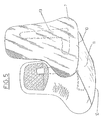
- the viscoelastic profile insert for generating an intermittent compression pressure in the ankle area is characterized by a large-area design such that, in addition to the bone furrow or the relief area between the ankle on the one hand and the Achilles tendon, heel and sole area, on the other hand Ankle area 1 of the foot itself and / or its Achilles tendon area 2, and / or its heel area 3 and / or its sole area 4 at least partially covers.
- the pad has on one side a flat outer side 5 on the foot side in the worn state.
- the pad In its area partially covering the heel area 3 of the foot, the pad has a tongue-like projection 7.
- the pad is made of differently consistent silicone materials.
- a comparatively soft silicone material shown in dotted lines in FIG. 1 is used, which is characterized by an easier sliding flowability, but nevertheless exerts sufficient pressure on the ankle area, but in this particularly pressure-sensitive area because it protrudes a lighter area Balance creates.
- a comparatively harder silicone material is used, where mainly the bone groove area of the foot is present when it is worn.
- a special feature is a comparatively less elastic profile insert 9 for stabilizing the relief area of the foot.
- the profile insert essentially has an L-shape for inserting in said Ankle groove or relief area. It is a thin-walled, flat molded body and consists of a PVC.
- the silicone material of the pad is an addition silion.
- a further peculiarity consists in the joining together of two pelottes intended for bearing against the same foot to form a pelotte unit in that their edges 10 on the sole of the foot are connected to one another by a thin-walled web 11 made of the silicone material.
- the web 11 extends over at least one third of the length of the pad edges 10 on the sole of the foot.
- Two pads or a pad unit of the type described above consisting of two pads can be components of an ankle brace made of an anatomically knitted two-pull brace. In the same way, however, it is possible to make them part of an ankle bandage, which is designed in the manner of a lace-up shaft that is also pulled up over the ankle.
Landscapes
- Health & Medical Sciences (AREA)
- Vascular Medicine (AREA)
- Animal Behavior & Ethology (AREA)
- Engineering & Computer Science (AREA)
- Biomedical Technology (AREA)
- Heart & Thoracic Surgery (AREA)
- Nursing (AREA)
- Life Sciences & Earth Sciences (AREA)
- Orthopedic Medicine & Surgery (AREA)
- General Health & Medical Sciences (AREA)
- Public Health (AREA)
- Veterinary Medicine (AREA)
- Orthopedics, Nursing, And Contraception (AREA)
- Prostheses (AREA)
- Professional, Industrial, Or Sporting Protective Garments (AREA)
Claims (12)
- Pelote malléolaire (8) pour produire une compression intermittent dans la zone de l'articulation tibio-tarsienne (14) d'un pied (15), comportant
un insert profilé (9) fabriqué d'un matériau visco-élastique pour chaque côté de l'articulation tibio-tarsienne (14), chaque insert profilé (9) étant attaché à un élément tendeur qui le tient et le serre contre l'articulation tibio-tarsienne (14) et l'insert profilé respectif recouvrant, au moins partiellement, la malléole (16, 17) y appartenant de l'articulation tibio-tarsienne (14),
caractérisée en ce
que chaque insert profilé (9) de la pelote malléolaire (8) a la forme d'une languette et ses surfaces (18, 19) en regard de l'articulation tibio-tarsienne (14) ont une courbure convexe et recouvrent, en plus de la zone en relief entre la malléole (16, 17) d'un côté et le zone du tendon d'Achille (2) d'un autre côté, la zone du talon (3) et la zone de la plante du pied (4) sur une large surface, ainsi que, du moins partiellement, la zone de la malléole (1),
et en ce que chaque insert profilé (9) possède des éléments de paroi enrobables dans l'insert sur son côté en regard de l'articulation tibio-tarsienne (14) dans les parties anatomiquement creuses respectives de la zone en forme de sillon autour de la malléole (16, 17) respective, afin de remplir ces parties creuses de cette zone, les éléments de parois étant enrobées dans ces parties lorsque la pelote malléolaire (8) est portée et lorsqu'elle est en contact avec l'articulation tibio-tarsienne (14) en maintenant là la malléole elle-même ainsi que la zone autour de la malléole (16, 17) remplies et comprimées, et suivant là, de plus, le relief anatomique de l'articulation tibio-tarsienne (14) moyennant une accumulation plus ou moins importante du matériau de l'insert profilé (9), de telle sorte que ces accumulations de matériau s'étendent, en diminuant, de la zone du talon (3) jusqu'à la zone de la partie de devant du pied. - Pelote malléolaire (8) selon la revendication 1,
caractérisée en ce
chacun de ses inserts profilés (9) possède un relief qui est incliné de la zone du tendon d'Achille (2) vers le côté intérieur (6) du pied (15), et en ce que ce relief a une courbure convexe, son côté intérieur convexe (6) se trouvant en regard de l'articulation tibio-tarsienne (14) et ses bords en regard vers l'extérieur se terminant, tout en s'aplatissant, vers les côtés extérieurs (5) des inserts. - Pelote malléolaire (8) selon les revendications 1 et 2,
caractérisée en ce
chaque insert profilé (9) est pourvu dans sa zone s'étenddant jusqu'à la zone du talon (3) du pied (15) d'une projecture (7) faisant saillie. - Pelote malléolaire (8) selon la revendication 1,
caractérisée en ce
le matériau visco-élastique de chaque insert profilé (9) est un matériau silicone et que la dureté de ce matériau diffère le long du profil de l'insert profilé (9), commençant dans la zone du tendon d'Achille (2) et se terminant vers le côté intérieur du pied (15), de façon qu'autour de la zone de la malléole (16, 17) le matériau est moins dur, tandis que dans le reste de la zone de l'insert profilé (9), il a une plus grande dureté. - Pelote malléolaire (8) selon la revendication 4,
caractérisée en ce
l'un des deux inserts profilés (9) dans son ensemble est fabriqué d'un matériau visco élastique moins dur que l'autre insert profilé (9). - Pelote malléolaire (8) selon la revendication 1,
caractérisée en ce
qu'au moins l'un des inserts profilés (9) est pourvu, pour encore mieux stabiliser l'articulation tibio-tarsienne (14), d'un élément de renforcement (13) en forme d'une L qui se trouve le long d'une partie anatomiquement creuse (sillon) entre la malléole (16) et la zone du talon (3). - Pelote malléolaire (8) selon la revendication 4,
caractérisée en ce
que le matériau visco-élastique de chaque insert profilé (9) est un PVC. - Pelote malléolaire (8) selon la revendication 4,
caractérisée en ce
que le matériau visco-élastique de chaque insert profilé (9) est une silicone d'addition. - Pelote malléolaire (8) selon une ou plusieurs des revendications 1-8,
caractérisée en ce
les bords (10) respectifs situés dans la zone de la plante du pied (4) des deux inserts profilés (9) sont connectés l'un avec l'autre au moyen d'une traverse (11), et en ce que cette traverse, lorsque la pelote malléolaire (8) est portée, se trouve, au-dessous de la plante du pied entre la zone du talon (3) et l'éminence du gros orteil. - Pelote malléolaire (8) selon la revendication 9,
caractérisée en ce
la traverse (11) s'étend sur du moins un tiers de la longueur du bord (10) en regard de la plante du pied, de l' insert profilé (9). - Pelote malléolaire (8) selon du moins l'un des revendications 1-10, les inserts profilés (9) étant tenues par un bandage élastique, tricoté de forme, autour de la malléole (16, 17) respective de l'articulation tibio-tarsienne (14),
caractérisée en ce
la force de compression de leurs éléments de paroi (surfaces 18, 19) agissant sur l'articulation tibio-tarsienne (14) est dépendant du degré d'élasticité du bandage. - Pelote malléolaire (8) selon du moins l'un des revendications 1-10,
caractérisée en ce
les inserts profilés (9) sont fixés aux côtés intérieurs d'une tige (12) en forme de demi-botte et en ce que la force de compression de leurs éléments de paroi (surfaces 18, 19) agissant sur l'articulation tibio-tarsienne (14) est dépendant de la fermeté du laçage.
Applications Claiming Priority (2)
| Application Number | Priority Date | Filing Date | Title |
|---|---|---|---|
| DE9015508U | 1990-11-13 | ||
| DE9015508U DE9015508U1 (de) | 1990-11-13 | 1990-11-13 | Knöchelpelotte, Pelotteneinheit und diese enthaltende Knöchelbandage |
Publications (2)
| Publication Number | Publication Date |
|---|---|
| EP0485943A1 EP0485943A1 (fr) | 1992-05-20 |
| EP0485943B1 true EP0485943B1 (fr) | 1997-02-05 |
Family
ID=6859289
Family Applications (1)
| Application Number | Title | Priority Date | Filing Date |
|---|---|---|---|
| EP91119250A Expired - Lifetime EP0485943B1 (fr) | 1990-11-13 | 1991-11-12 | Pelote pour la cheville, chevillère et bandage de la cheville les contenant |
Country Status (3)
| Country | Link |
|---|---|
| EP (1) | EP0485943B1 (fr) |
| AT (1) | ATE148621T1 (fr) |
| DE (2) | DE9015508U1 (fr) |
Families Citing this family (14)
| Publication number | Priority date | Publication date | Assignee | Title |
|---|---|---|---|---|
| DE4104930C2 (de) * | 1991-02-18 | 2000-05-04 | Beiersdorf Ag | Sprunggelenk-Bandage |
| DE4219698C2 (de) * | 1992-06-16 | 1998-12-24 | Dieter H Prof Dr Ing Mueller | Vorrichtung zur Druckbeaufschlagung von Körperstellen oder Körperteilen |
| IES61382B2 (en) * | 1993-04-14 | 1994-11-02 | Eamonn James Godfrey | Improvements in and relating to ankle protectors |
| DE9319990U1 (de) * | 1993-12-24 | 1994-03-10 | Medi Bayreuth GmbH & Co. KG, 95448 Bayreuth | Sprunggelenkorthese |
| DE4430493A1 (de) * | 1994-08-27 | 1996-02-29 | Bock Orthopaed Ind | Fußorthese |
| AT368U1 (de) * | 1994-10-31 | 1995-09-25 | Beiersdorf Ag | Sprunggelenk-bandage |
| DE20115104U1 (de) | 2001-09-13 | 2002-03-07 | Schrödel, Bodo, 96049 Bamberg | Sprunggelenkorthese |
| DE102004019007A1 (de) * | 2004-04-20 | 2005-11-24 | Ortho-Vital Gmbh | Orthese |
| EP1845909A2 (fr) * | 2005-02-04 | 2007-10-24 | Beiersdorf, Inc. | Mousse viscoelastique pour supports orthopediques et son procede d'utilisation |
| DE202006003245U1 (de) * | 2006-02-27 | 2007-08-02 | Thuasne Deutschland Gmbh & Co. Kg | Sprunggelenkbandage |
| DE102010046796B4 (de) * | 2010-09-28 | 2014-02-13 | Panagiotis Bouliopoulos | Orthopädische Fußbandage und Verfahren zu deren Herstellung |
| US9125787B2 (en) | 2011-09-30 | 2015-09-08 | Covidien Lp | Compression garment having a foam layer |
| US9402779B2 (en) | 2013-03-11 | 2016-08-02 | Covidien Lp | Compression garment with perspiration relief |
| DE102016000490A1 (de) | 2016-01-13 | 2017-07-13 | Bauerfeind Ag | Epicondylitis-Pelotte |
Family Cites Families (18)
| Publication number | Priority date | Publication date | Assignee | Title |
|---|---|---|---|---|
| DE820706C (de) * | 1948-10-02 | 1951-11-12 | Franz Strasser | Skistiefel u. dgl. und Verfahren zur Herstellung desselben |
| GB740621A (en) * | 1952-11-25 | 1955-11-16 | Pneuma Jact Soc | Improvements in or relating to footwear, leggings and other ankle supports for the prevention and correction of malformations |
| US2774152A (en) * | 1954-10-02 | 1956-12-18 | Alcosa Ets | Article of footwear |
| DE3441496C1 (de) * | 1984-11-09 | 1986-04-24 | Gernulf Dr.med. 3005 Hemmingen Garbe | Vorrichtung zur Stützung erschlaffter Gewölbe und insuffizienter Muskel- und Bandführungen des menschlichen Fußes |
| US4705025A (en) * | 1986-06-20 | 1987-11-10 | Dedo Richard G | Heel padding |
| US4762123A (en) * | 1986-06-20 | 1988-08-09 | Dedo Richard G | Heel padding |
| FR2606630B1 (fr) * | 1986-11-19 | 1992-10-16 | Richard Freres Sa | Chevillere |
| FR2607383A1 (fr) * | 1986-11-28 | 1988-06-03 | Bertheas Michel | Appareil de reeducation fonctionnelle autorisant la contention du tendon d'achille chez l'individu |
| DE3640915A1 (de) * | 1986-11-29 | 1988-06-01 | Wilhelm Josef Hefele | Sprunggelenkstuetze |
| US4875476A (en) * | 1986-12-01 | 1989-10-24 | Prevent Products, Inc. | Ankle support bandage for prevention of ankle injury |
| DE8700201U1 (de) * | 1987-01-05 | 1987-02-19 | Rau, Roland, Dr.med., 7614 Gengenbach | Stütze für den Sprunggelenkbereich |
| DE3729197C1 (de) * | 1987-09-01 | 1988-12-01 | Arthur Thanner | Fussgelenk-Stuetzmanschette mit seitlichen Versteifungsteilen in Aufnahmetaschen |
| DE3803304A1 (de) * | 1988-02-04 | 1989-08-10 | Martin Skov Kg | Profileinlage |
| US4825856A (en) * | 1988-02-05 | 1989-05-02 | Nelson Ronald E | Reinforced ankle and foot brace |
| DE3873080D1 (de) * | 1988-07-12 | 1992-08-27 | Horst Kleylein | Medizinisch orientierte einlage fuer schuhe, insb. sportschuhe. |
| DE3823513A1 (de) * | 1988-07-12 | 1990-01-18 | Horst Kleylein | Medizinisch orientierte einlage fuer schuhe, insb. sportschuhe, wie tennisschuhe, basketballschuhe u. a. |
| US4964402A (en) * | 1988-08-17 | 1990-10-23 | Royce Medical Company | Orthopedic device having gel pad with phase change material |
| DE8907464U1 (de) * | 1989-05-17 | 1989-09-14 | Saniwey medizinische Lagerungstechnik GmbH, 7080 Aalen | Vorrichtung zum Stützen der Sprunggelenke |
-
1990
- 1990-11-13 DE DE9015508U patent/DE9015508U1/de not_active Expired - Lifetime
-
1991
- 1991-11-12 EP EP91119250A patent/EP0485943B1/fr not_active Expired - Lifetime
- 1991-11-12 DE DE59108531T patent/DE59108531D1/de not_active Expired - Fee Related
- 1991-11-12 AT AT91119250T patent/ATE148621T1/de not_active IP Right Cessation
Also Published As
| Publication number | Publication date |
|---|---|
| DE9015508U1 (de) | 1992-03-19 |
| EP0485943A1 (fr) | 1992-05-20 |
| DE59108531D1 (de) | 1997-03-20 |
| ATE148621T1 (de) | 1997-02-15 |
Similar Documents
| Publication | Publication Date | Title |
|---|---|---|
| EP1531768B1 (fr) | Dispositif orthopedique pour corriger des malpositions des orteils | |
| DE69922518T2 (de) | Orthese zur behandlung von hallux valgus | |
| DE3525753A1 (de) | Fuss-stuetzbandage | |
| EP0485943A1 (fr) | Pelote pour la cheville, chevillère et bandage de la cheville les contenant | |
| EP0305999A1 (fr) | Support pour la cheville | |
| DE102013215776A1 (de) | Orthopädischer Schuh zur Vermeidung von überhöhten Druckbelastungen | |
| DE102012206739A1 (de) | Hallux-valgus-sandale | |
| DE10034354A1 (de) | Fußbandage | |
| DE102011051083A1 (de) | Orthopädische Vorrichtung, insbesondere zur Korrektur von Zehenfehlstellungen | |
| EP0275543B1 (fr) | Dispositif de soutien pour la cheville | |
| EP4312902B1 (fr) | Orthèse de pied avec segment d'orteil en forme de support pour corriger les malpositions du pied | |
| EP2648659B1 (fr) | Bas de contention pour voûte plantaire | |
| DE4291109C2 (de) | Stützverband für ein Fußgelenk mit Hauptstützteil, Unterschenkel- und Fußteil sowie beidseitigen Stützteilen | |
| EP0350517A1 (fr) | Insert orthopédique pour chaussures, en particulier pour chaussures de sport | |
| DE202010013804U1 (de) | Vorrichtung zur Korrektur einer Zehenfehlstellung | |
| DE3537360A1 (de) | Orthopaedisches stuetzelement | |
| DE20005742U1 (de) | Sprunggelenkbandage | |
| EP3417838B1 (fr) | Bande de correction élastique et système de correction des mauvaises positions des orteils d'un pied humain | |
| DE2852894C3 (de) | Schuhwerkseinlage | |
| EP4312645A1 (fr) | Article chaussant ayant une bande de correction élastique pour le traitement et la prophylaxie de déformations du pied | |
| EP0350784A2 (fr) | Insert orthopédique pour chaussures, en particulier chaussure de sport | |
| DE4224827A1 (de) | Verfahren zur Herstellung eines Abdruckes eines Teiles des menschlichen oder tierischen Körpers | |
| DE202025101576U1 (de) | Mehrteiliges Schuhwerk zur Behandlung, zur Korrektur und/oder zur Vorbeugung von Fußfehlstellungen | |
| EP4652973A1 (fr) | Orthèse pour le traitement, la correction et/ou la prévention de malpositions du pied | |
| DE19748836C2 (de) | Orthese-Manschette, die den Unterschenkel proximal des oberen Sprunggelenkes umgibt |
Legal Events
| Date | Code | Title | Description |
|---|---|---|---|
| PUAI | Public reference made under article 153(3) epc to a published international application that has entered the european phase |
Free format text: ORIGINAL CODE: 0009012 |
|
| AK | Designated contracting states |
Kind code of ref document: A1 Designated state(s): AT CH DE FR GB IT LI NL SE |
|
| 17P | Request for examination filed |
Effective date: 19921110 |
|
| 17Q | First examination report despatched |
Effective date: 19950406 |
|
| GRAG | Despatch of communication of intention to grant |
Free format text: ORIGINAL CODE: EPIDOS AGRA |
|
| GRAH | Despatch of communication of intention to grant a patent |
Free format text: ORIGINAL CODE: EPIDOS IGRA |
|
| GRAH | Despatch of communication of intention to grant a patent |
Free format text: ORIGINAL CODE: EPIDOS IGRA |
|
| GRAA | (expected) grant |
Free format text: ORIGINAL CODE: 0009210 |
|
| RIN1 | Information on inventor provided before grant (corrected) |
Inventor name: KLEYLEIN, HORST |
|
| AK | Designated contracting states |
Kind code of ref document: B1 Designated state(s): AT CH DE FR GB IT LI NL SE |
|
| PG25 | Lapsed in a contracting state [announced via postgrant information from national office to epo] |
Ref country code: GB Effective date: 19970205 |
|
| REF | Corresponds to: |
Ref document number: 148621 Country of ref document: AT Date of ref document: 19970215 Kind code of ref document: T |
|
| REG | Reference to a national code |
Ref country code: CH Ref legal event code: EP |
|
| REF | Corresponds to: |
Ref document number: 59108531 Country of ref document: DE Date of ref document: 19970320 |
|
| ITF | It: translation for a ep patent filed | ||
| REG | Reference to a national code |
Ref country code: CH Ref legal event code: NV Representative=s name: ROTTMANN, ZIMMERMANN + PARTNER AG |
|
| ET | Fr: translation filed | ||
| GBV | Gb: ep patent (uk) treated as always having been void in accordance with gb section 77(7)/1977 [no translation filed] |
Effective date: 19970205 |
|
| PLBE | No opposition filed within time limit |
Free format text: ORIGINAL CODE: 0009261 |
|
| STAA | Information on the status of an ep patent application or granted ep patent |
Free format text: STATUS: NO OPPOSITION FILED WITHIN TIME LIMIT |
|
| 26N | No opposition filed | ||
| PGFP | Annual fee paid to national office [announced via postgrant information from national office to epo] |
Ref country code: NL Payment date: 19991124 Year of fee payment: 9 |
|
| PGFP | Annual fee paid to national office [announced via postgrant information from national office to epo] |
Ref country code: SE Payment date: 19991125 Year of fee payment: 9 |
|
| PGFP | Annual fee paid to national office [announced via postgrant information from national office to epo] |
Ref country code: FR Payment date: 20001124 Year of fee payment: 10 |
|
| PG25 | Lapsed in a contracting state [announced via postgrant information from national office to epo] |
Ref country code: SE Free format text: THE PATENT HAS BEEN ANNULLED BY A DECISION OF A NATIONAL AUTHORITY Effective date: 20001129 |
|
| PG25 | Lapsed in a contracting state [announced via postgrant information from national office to epo] |
Ref country code: NL Free format text: LAPSE BECAUSE OF NON-PAYMENT OF DUE FEES Effective date: 20010601 |
|
| EUG | Se: european patent has lapsed |
Ref document number: 91119250.8 |
|
| NLV4 | Nl: lapsed or anulled due to non-payment of the annual fee |
Effective date: 20010601 |
|
| PG25 | Lapsed in a contracting state [announced via postgrant information from national office to epo] |
Ref country code: FR Free format text: LAPSE BECAUSE OF NON-PAYMENT OF DUE FEES Effective date: 20020730 |
|
| REG | Reference to a national code |
Ref country code: FR Ref legal event code: ST |
|
| REG | Reference to a national code |
Ref country code: FR Ref legal event code: ST |
|
| PGFP | Annual fee paid to national office [announced via postgrant information from national office to epo] |
Ref country code: AT Payment date: 20021230 Year of fee payment: 12 |
|
| PGFP | Annual fee paid to national office [announced via postgrant information from national office to epo] |
Ref country code: CH Payment date: 20030121 Year of fee payment: 12 |
|
| PGFP | Annual fee paid to national office [announced via postgrant information from national office to epo] |
Ref country code: DE Payment date: 20030130 Year of fee payment: 12 |
|
| PG25 | Lapsed in a contracting state [announced via postgrant information from national office to epo] |
Ref country code: AT Free format text: LAPSE BECAUSE OF NON-PAYMENT OF DUE FEES Effective date: 20031112 |
|
| PG25 | Lapsed in a contracting state [announced via postgrant information from national office to epo] |
Ref country code: LI Free format text: LAPSE BECAUSE OF NON-PAYMENT OF DUE FEES Effective date: 20031130 Ref country code: CH Free format text: LAPSE BECAUSE OF NON-PAYMENT OF DUE FEES Effective date: 20031130 |
|
| PG25 | Lapsed in a contracting state [announced via postgrant information from national office to epo] |
Ref country code: DE Free format text: LAPSE BECAUSE OF NON-PAYMENT OF DUE FEES Effective date: 20040602 |
|
| REG | Reference to a national code |
Ref country code: CH Ref legal event code: PL |
|
| PG25 | Lapsed in a contracting state [announced via postgrant information from national office to epo] |
Ref country code: IT Free format text: LAPSE BECAUSE OF NON-PAYMENT OF DUE FEES;WARNING: LAPSES OF ITALIAN PATENTS WITH EFFECTIVE DATE BEFORE 2007 MAY HAVE OCCURRED AT ANY TIME BEFORE 2007. THE CORRECT EFFECTIVE DATE MAY BE DIFFERENT FROM THE ONE RECORDED. Effective date: 20051112 |