EP0486099B1 - Device and method for removing abdominal fat from a slaughtered bird - Google Patents
Device and method for removing abdominal fat from a slaughtered bird Download PDFInfo
- Publication number
- EP0486099B1 EP0486099B1 EP91202908A EP91202908A EP0486099B1 EP 0486099 B1 EP0486099 B1 EP 0486099B1 EP 91202908 A EP91202908 A EP 91202908A EP 91202908 A EP91202908 A EP 91202908A EP 0486099 B1 EP0486099 B1 EP 0486099B1
- Authority
- EP
- European Patent Office
- Prior art keywords
- mandrel
- scraping
- fat
- bird
- scraping edge
- Prior art date
- Legal status (The legal status is an assumption and is not a legal conclusion. Google has not performed a legal analysis and makes no representation as to the accuracy of the status listed.)
- Expired - Lifetime
Links
Images


Classifications
-
- A—HUMAN NECESSITIES
- A22—BUTCHERING; MEAT TREATMENT; PROCESSING POULTRY OR FISH
- A22C—PROCESSING MEAT, POULTRY, OR FISH
- A22C21/00—Processing poultry
- A22C21/06—Eviscerating devices for poultry
Definitions
- the invention relates to a device for removing abdominal fat from a slaughtered bird, comprising a scraper element which is movable to and partially into the bird through an abdominal opening between the legs, and which has a scraping edge which is movable along the fat on the inside of the skin around the abdominal opening, and a discharge device for discharging the fat scraped off by the scraper element.
- the invention also relates to an installation which comprises a number of such devices, and to a method for operating the device.
- a device such as that described above is known from European Patent Application No. 0 258 499.
- the scraper element is formed by an elongated screw spindle which is rotatable about its longitudinal axis and is fitted with a radial clearance in a cylindrical bush and projects partially therefrom.
- the part of the screw spindle projecting from the bush is passed through an opening between the legs of the bird into the belly cavity of the bird.
- the screw spindle is rotated in such a way that the rib of the screw spindle moves towards and into the bush, viewed in the axial direction.
- the skin present around the opening, on the inside of which the fat to be gained is situated, is carried along by the screw spindle rib towards and into the bush, the skin coming to rest against the inside wall of the bush, which is possible thanks to the clearance with the width of the skin thickness between the periphery of the screw spindle rib and the inside wall of the bush.
- the fat is scraped off the inside of the skin through the radial and axial displacement of the rib of the rotary screw spindle.
- the ends of the bush and the screw spindle facing away from the bird the fat scraped off and collected in the grooves of the screw spindle is extracted through a pipe placed under partial vacuum.
- a disadvantage of this known device lies in the fact that the screw spindle at the beginning of the fat removal operation generally finds few gripping points on the skin around the opening between the legs of the bird. This opening has an arbitrary contour, and a first gripping point on the skin will therefore generally be found along only a part of said contour, following which the remaining part of the skin is conveyed gradually towards and into the bush by the rotary screw spindle.
- the object of the invention is to eliminate the above-mentioned disadvantages and to provide a device which removes the abdominal fat from a slaughtered bird with great certainty, without the skin under which said fat is situated being damaged or torn off.
- the invention provides a device which is characterised by an elongated hollow mandrel having at an end a suction aperture for sucking the skin with the adhering abdominal fat into the mandrel, said suction aperture leading to at least a part of the interior space of the mandrel being connectable to a vacuum source; fixing means for fitting the scraper element at a distance from the suction aperture of the mandrel, the scraping edge of the scraper element facing the suction aperture; and a supporting element having an edge facing said scraping edge, being shaped generally complementary to said scraping edge and being movable to and from said scraping edge for interacting with said scraping edge during a movement of the scraper element away from the bird.
- the invention also provides an installation which comprises a number of such devices, and a method for operating the device with two preferred embodiments.
- the skin with the abdominal fat can be sucked by the vacuum source into the suction aperture between the open end of the mandrel and the scraper element, and into the hollow mandrel.
- a suitable selection of the suction force makes it possible to suck the skin with the abdominal fat past the scraping edge of the scraper element into the hollow mandrel.
- the supporting element, and in particular the edge thereof, can then be moved towards the scraping edge, a narrow gap remaining between the two edges.
- This gap which is the width of the thickness of the skin of the bird, is maintained during a movement of the scraper element interacting with the supporting element away from the bird.
- the skin sucked into the mandrel here is withdrawn through the gap, and the scraping edge of the scraper element scrapes the abdominal fat from the inside of the skin.
- the scraping edge of the scraper element is advantageous to provide with an oval shape, since this shape best matches the contour of the opening between the legs of the bird, as a result of which the skin with the abdominal fat can spread as well as possible around the scraping edge and the scraping action is as effective as possible.
- the shape of the cross-section of the belly cavity can also best be approximated with the oval shape.
- the scraping edge preferably forms part of an essentially conical guide head, the tip of the guide head facing away from the mandrel. The insertion of the scraper element into the bird is facilitated through this design, while the edge of the base of the cone acts as a scraping edge.
- the scraper element is fixed to the mandrel by means of at least one strip.
- Said strip can be situated, for example, on the peripheral part of the scraping edge which moves in the belly cavity of the bird along the kidneys or other entrails.
- the strip then provides a simple and efficient safeguard against the kidneys or other entrails being undesirably sucked up by the mandrel from the belly cavity of the bird. If, on the other hand, the latter is desired, the strip or another fixing means must, of course, preferably not be fitted in the region of the kidneys or other entrails.
- the mandrel is preferably provided with one or more channels of which one end is open and opens out at the suction aperture of the mandrel, while the other end is also open and is connected to the environmental atmosphere.
- the channels maintain an air flow in the mandrel even when the suction aperture of the mandrel is shut off, with the result that the skin with the abdominal fat is sucked into the desired position in the mandrel prior to the scraping off.
- the supporting element shuts off the suction aperture of the mandrel at least partially during the scraping off of the abdominal fat. This leads to an increase in the suction force of the device during the discharge of the scraped-off fat if this is obtained with the aid of vacuum.
- the fat gained can be sucked off by vacuum during and after scraping off.
- the fat collected along the scraping edge during scraping off is removed by mechanical means, for example by knocking against the scraper element or setting it into vibration, so that the fat falls off.
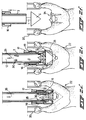
- Figs. 1a - 1c show a hollow mandrel 2 with an oval cross-section, to which an oval conical guide head 6, forming a scraper element, is fixed by means of two strips 4.
- the guide head 6 has an oval scraping edge 8 which is rounded.
- Two channels 10 are formed opposite each other in the mandrel 2 by placing strips 12 against the inside wall of the mandrel 2. Situated between the mandrel 2 and the guide head 6 is a gap through which air can be sucked to a space 14 bounded by the walls of the mandrel 2 and the strips 12, by connecting said space 14 to a vacuum source.
- a supporting element 16 can be moved in the axial direction from a rest position shown in Figs.
- the scraping position of the supporting element 16 is such that a gap with a width the thickness of the skin of the bird to be processed is left between the bottom edge of the supporting element 16 and the scraping edge 8 of the guide head 6.
- Both the mandrel 2 with the guide head 6 connected thereto and the supporting element 16 can be moved independently of each other in the axial direction by means of the drive devices to be described in greater detail below with reference to Fig. 3.
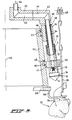
- Fig. 2a shows the back side of a bird 22 suspended by the tarsal joints of the legs in hooks 20. Between the two legs of the bird 22 is an abdominal opening 24, which has been produced for removal of the entrails from the belly cavity of the bird. The skin on the inside of which the abdominal fat to be extracted is situated lies around said opening 24, hanging partially into the belly cavity.
- the device already described with reference to Fig. 1c is positioned above the opening 24.
- the first stage of the operation comprises inserting the guide head 6 and a part of the mandrel 2 into the belly cavity of the bird 22, the insertion being symbolised by the arrow 25.
- the air is then sucked out of the space 14 of the mandrel 2 by means of a vacuum source, e.g. a pump, which is symbolised by the arrow 26 in Fig. 2c.
- a vacuum source e.g. a pump
- the mandrel is withdrawn (symbolised by the arrow 27) so far out of the bird 22 relative to the position shown in Fig. 2b that the scraping edge 8 of the guide head 6 lies approximately at the level of the edge of the opening 24.
- the skin 28 with the abdominal fat 30 is sucked into the mandrel 2. It is ensured here that the channels formed by means of the strips 12 on either side of the space 14 in the mandrel 2 at the side facing away from the guide head 6 are connected to the environmental atmosphere, so that the air sucked off in the direction of the arrow 26 does not come only from the gap between the mandrel end and the guide head 6, but also comes from the above-mentioned channels.
- the supporting element 16 which is slidable along the outside of the mandrel 2, is then moved downwards by moving a ring 17 in the direction of the guide head 6 along the mandrel 2.
- the ring 17 is coupled by schematically shown spring means 19 to the supporting element 16, as a result of which the bottom edge of the supporting element 16 presses the skin of the bird 22 against the scraping edge 8 of the guide head 6.
- the spring means 19 can be designed in such a way that the pressure exerted on the skin and the scraping edge 8 is accurately known.
- Fig. 2e shows the next stage of the fat removal operation, in which the guide head 6 is moved away from the bird 22, while the supporting element 16 continues to exert pressure on the scraping edge 8 of the guide head 6. In this way the scraping edge 8 scrapes the abdominal fat 30 from the inside of the skin 28.
- the fat 30 collects here on the top side of the guide head 6.
- the suction aperture of the mandrel 2 is shut off in this stage of the operation by the supporting element 16 and the skin 28, an air flow is still present in the space 14 of the mandrel 2 in the direction of the arrow 26, thanks to the channels 10 inside the mandrel in communication with the environmental atmosphere.
- the fat 30 obtained is carried along in the air flow and can be collected at a suitable point and processed further.
- the supporting element 16 When it has moved a predetermined distance from the opening 24 of the bird 22, the supporting element 16 is moved back to its rest position.
- the above-mentioned distance is selected in such a way that the fat 30 in this position is scraped completely from the skin 28.
- the skin from which the fat has been removed falls back around the opening 24 of the bird 22, which is shown in Fig. 2f.
- the bird can now be discharged for possible further processing operations, and the device is ready for the next operation.
- Fig. 3 shows a bush 34 which is connected to the strips 12 and the mandrel 2, and which is fixed in a follow-on element 36 which is movable in the axial direction of the mandrel 2 along guides (not shown).
- the follow-on element 36 is slidable by means of a bearing bush 38 onto a coaxial tube 40 projecting deep into the mandrel 2, and being open at its end projecting into the mandrel.
- the other end of the tube 40 is also open and is fixed in a mounting 42 in which a channel 44 which connects to the interior space of the tube 40 is provided.
- Both the follow-on element 36 and the ring 17 carry follow-on wheels 46 and 48, respectively, which can move in curve tracks 52 and 54, respectively, provided on the outer periphery of a stationary tapering drum 50.
- the mounting 42, the follow-on element 36, the ring 17 and the elements connected thereto can be moved along the external surface of the drum 50 about a vertical axis 56 in such a way that they move in synchronism with a bird 22 hanging from hooks 20 in a conveyor 58 and moved about the axis 56.
- the curved tracks 52 and 54 run in such a way that the mandrel 2 and the ring 17 carry out the movements relative to the bird 22 shown in Figs. 2a - 2f.
- the vacuum desired here in the mandrel 2 during certain stages of the fat removal operation can be created by connecting the aperture of mounting 42, directed radially towards the axis 56, to a suction aperture of a channel 62, facing radially away from the axis 56, and fitted in a stationary suction part 60, which aperture extends in the tangential direction over a part of the path of the mounting 42 about the axis 56, and from which channel 62 the air can be extracted in the direction of arrow 64 by means of a vacuum source, for example a pump.
- a vacuum source for example a pump.
- an essentially U-shaped bracket 66 which moves with the fat removal device on a ring 68 is provided above the position of the opening 24 of the bird 22, which bracket extends, viewed from the top side, around the boundaries of the opening 24 between the legs and supports the bird 22 in the upward direction during the scraping off of the fat.
- the distance in the radial direction between the hook 20 and the mandrel 2 is set by means of a spacer ring 70 which is fitted concentrically with the axis 56.
Landscapes
- Life Sciences & Earth Sciences (AREA)
- Engineering & Computer Science (AREA)
- Wood Science & Technology (AREA)
- Zoology (AREA)
- Food Science & Technology (AREA)
- Processing Of Meat And Fish (AREA)
Applications Claiming Priority (2)
| Application Number | Priority Date | Filing Date | Title |
|---|---|---|---|
| NL9002471 | 1990-11-12 | ||
| NL9002471A NL9002471A (nl) | 1990-11-12 | 1990-11-12 | Inrichting en werkwijze voor het verwijderen van abdominaal vet uit een geslachte vogel. |
Publications (2)
| Publication Number | Publication Date |
|---|---|
| EP0486099A1 EP0486099A1 (en) | 1992-05-20 |
| EP0486099B1 true EP0486099B1 (en) | 1996-03-27 |
Family
ID=19857969
Family Applications (1)
| Application Number | Title | Priority Date | Filing Date |
|---|---|---|---|
| EP91202908A Expired - Lifetime EP0486099B1 (en) | 1990-11-12 | 1991-11-07 | Device and method for removing abdominal fat from a slaughtered bird |
Country Status (6)
| Country | Link |
|---|---|
| US (1) | US5135431A (da) |
| EP (1) | EP0486099B1 (da) |
| JP (1) | JP3213353B2 (da) |
| DE (1) | DE69118320T2 (da) |
| DK (1) | DK0486099T3 (da) |
| NL (1) | NL9002471A (da) |
Families Citing this family (9)
| Publication number | Priority date | Publication date | Assignee | Title |
|---|---|---|---|---|
| NL9401695A (nl) * | 1994-10-13 | 1996-05-01 | Stork Rms Bv | Inrichting voor het verwijderen van de buikvet- of reuzellaag uit een geslacht dier. |
| US6186881B1 (en) | 1996-09-20 | 2001-02-13 | Foodcraft Equipment Co., Ltd. | Method and apparatus for venting/opening, eviscerating/cropping, inspecting and cleaning of poultry |
| US5993308A (en) | 1996-09-20 | 1999-11-30 | Foodcraft Equipment Company | Machine for eviscerating and displaying poultry for inspection |
| NL1014994C2 (nl) | 2000-01-17 | 2001-07-18 | Stork Pmt | Werkwijze en inrichting voor het scheiden van buikvet van buikvel van gevogelte. |
| NL1017057C2 (nl) * | 2001-01-09 | 2002-07-11 | Tieleman Food Equipment B V | Werkwijze en inrichting voor het spoelen van de lichaamsholte van geslacht gevogelte. |
| US7959499B2 (en) * | 2008-01-23 | 2011-06-14 | Davis Poultry Equipment, Inc. | Machine for lung removal in poultry and method and use thereof |
| NL2015513B1 (en) | 2015-09-28 | 2017-04-20 | Meyn Food Proc Technology Bv | Device and method for removing abdominal fat from abdominal skin of a slaughtered bird suspended by the legs. |
| ES3010368T3 (en) | 2020-11-17 | 2025-04-02 | Marel Red Meat B V | Device and method for removing leaf lard from slaughtered animals |
| CN114304238B (zh) * | 2022-01-10 | 2023-01-20 | 河北玖兴农牧发展有限公司 | 一种家禽内脏取出装置及方法 |
Family Cites Families (14)
| Publication number | Priority date | Publication date | Assignee | Title |
|---|---|---|---|---|
| US2943346A (en) * | 1957-10-10 | 1960-07-05 | Melvin J Jensen | Eviscerating tool |
| US3137031A (en) * | 1960-11-15 | 1964-06-16 | Mohr & Sons John | Method for cleaning poultry cloaca during evisceration procedure |
| US4024603A (en) * | 1972-01-12 | 1977-05-24 | Gainesville Machine Company, Inc. | Low noise vacuum lung machine |
| US3802028A (en) * | 1972-04-10 | 1974-04-09 | Johnson Co Gordon | Method and apparatus for use in evisceration of poultry |
| US4004320A (en) * | 1972-04-10 | 1977-01-25 | Gordon Johnson Company | Apparatus for use in evisceration of poultry |
| NL156025B (nl) * | 1975-04-29 | 1978-03-15 | Meyn Pieter | Inrichting voor het uitsnijden van de aars van een vogel. |
| US4208764A (en) * | 1976-12-17 | 1980-06-24 | Kjeld Loth | Poultry eviscerating method |
| US4564977A (en) * | 1983-09-15 | 1986-01-21 | Simon-Johnson, Inc. | Poultry vent removal machine |
| US4739539A (en) * | 1986-01-23 | 1988-04-26 | Lacy Simmons | Method and apparatus for removing fecal matter from poultry |
| NL8602219A (nl) * | 1986-09-02 | 1988-04-05 | Tno | Inrichting voor het opensnijden van het karkas van een slachtdier. |
| EP0258499B1 (en) * | 1986-09-02 | 1989-11-23 | Linco Holland Engineering B.V. | Apparatus and assembly to remove fat from slaughtered poultry |
| NZ223600A (en) * | 1988-02-23 | 1990-06-26 | Elastrator Co Ltd | Gun for internally sealing body conduit of animal carcass by application of sealing ring: vacuum applied |
| US4876767A (en) * | 1988-06-29 | 1989-10-31 | Harben Iii Grover S | Vent cleaning apparatus and method for poultry |
| US4899421A (en) * | 1988-08-08 | 1990-02-13 | Stork-Gamco, Inc. | Method and apparatus for removing fecal matter in poultry |
-
1990
- 1990-11-12 NL NL9002471A patent/NL9002471A/nl not_active Application Discontinuation
-
1991
- 1991-11-07 DE DE69118320T patent/DE69118320T2/de not_active Expired - Fee Related
- 1991-11-07 DK DK91202908.9T patent/DK0486099T3/da active
- 1991-11-07 EP EP91202908A patent/EP0486099B1/en not_active Expired - Lifetime
- 1991-11-08 US US07/789,745 patent/US5135431A/en not_active Expired - Lifetime
- 1991-11-12 JP JP29596191A patent/JP3213353B2/ja not_active Expired - Fee Related
Also Published As
| Publication number | Publication date |
|---|---|
| US5135431A (en) | 1992-08-04 |
| EP0486099A1 (en) | 1992-05-20 |
| JPH0530894A (ja) | 1993-02-09 |
| JP3213353B2 (ja) | 2001-10-02 |
| DE69118320T2 (de) | 1996-10-10 |
| DK0486099T3 (da) | 1996-04-22 |
| NL9002471A (nl) | 1992-06-01 |
| DE69118320D1 (de) | 1996-05-02 |
Similar Documents
| Publication | Publication Date | Title |
|---|---|---|
| US6726556B2 (en) | Method and device for separating abdominal fat from abdominal skin of poultry | |
| US4899421A (en) | Method and apparatus for removing fecal matter in poultry | |
| US5135431A (en) | Device and method for removing abdominal fat from a slaughtered bird | |
| EP2347657B1 (en) | Method and device for processing a carcass part of slaughtered poultry | |
| EP0460740B1 (en) | Device for cutting out the vent of slaughtered poultry | |
| EP0695506B2 (en) | Method and apparatus for filleting the body of slaughtered poultry | |
| EP0545040B1 (en) | Keel bone cutter with fat remover | |
| US5133686A (en) | Cloaca cutter | |
| EP0162154B1 (en) | A device for extracting the crop, the vent and the gullet of slaughtered poultry | |
| EP1322173B1 (en) | Device and method for separating meat from bone parts | |
| WO2016002628A1 (ja) | ササミ採取装置 | |
| US20160007621A1 (en) | Apparatus for carrying out an operation on slaughtered poultry | |
| AU2007247547A2 (en) | Tool, device, and method for gutting fish opened at the stomach cavity | |
| NL1000798C2 (nl) | Inrichting voor het in losse onderdelen verdelen van een samenstel uit hart en longen. | |
| US5152715A (en) | Method and device for separating heart, lungs and liver from the viscera of a bird | |
| US6383067B1 (en) | Device for deboning of poultry parts | |
| EP2218333A1 (en) | Filleting device and method for harvesting fillets | |
| CA1238159A (en) | Device for processing fillets of fish | |
| EP2189070A1 (en) | Leek peeling machine | |
| EP3146849A1 (en) | Device and method for removing abdominal fat from abdominal skin of a slaughtered bird suspended by the legs | |
| US4325165A (en) | Gizzard splitter | |
| IL37961A (en) | Machine and method for processing slaughtered poultry | |
| CN219249087U (zh) | 一种鸭胗附件自动分离去除机构 | |
| EP4434347A1 (en) | Poultry processing device | |
| KR890003178Y1 (ko) | 누애고치 채취기의 채취로울러 |
Legal Events
| Date | Code | Title | Description |
|---|---|---|---|
| PUAI | Public reference made under article 153(3) epc to a published international application that has entered the european phase |
Free format text: ORIGINAL CODE: 0009012 |
|
| AK | Designated contracting states |
Kind code of ref document: A1 Designated state(s): DE DK ES FR GB IT NL |
|
| 17P | Request for examination filed |
Effective date: 19921027 |
|
| 17Q | First examination report despatched |
Effective date: 19931117 |
|
| GRAH | Despatch of communication of intention to grant a patent |
Free format text: ORIGINAL CODE: EPIDOS IGRA |
|
| GRAA | (expected) grant |
Free format text: ORIGINAL CODE: 0009210 |
|
| AK | Designated contracting states |
Kind code of ref document: B1 Designated state(s): DE DK ES FR GB IT NL |
|
| PG25 | Lapsed in a contracting state [announced via postgrant information from national office to epo] |
Ref country code: FR Effective date: 19960327 Ref country code: ES Free format text: THE PATENT HAS BEEN ANNULLED BY A DECISION OF A NATIONAL AUTHORITY Effective date: 19960327 Ref country code: IT Free format text: LAPSE BECAUSE OF FAILURE TO SUBMIT A TRANSLATION OF THE DESCRIPTION OR TO PAY THE FEE WITHIN THE PRE;WARNING: LAPSES OF ITALIAN PATENTS WITH EFFECTIVE DATE BEFORE 2007 MAY HAVE OCCURRED AT ANY TIME BEFORE 2007. THE CORRECT EFFECTIVE DATE MAY BE DIFFERENT FROM THE ONE RECORDED.SCRIBED TIME-LIMIT Effective date: 19960327 |
|
| REG | Reference to a national code |
Ref country code: DK Ref legal event code: T3 |
|
| REF | Corresponds to: |
Ref document number: 69118320 Country of ref document: DE Date of ref document: 19960502 |
|
| EN | Fr: translation not filed | ||
| PG25 | Lapsed in a contracting state [announced via postgrant information from national office to epo] |
Ref country code: GB Effective date: 19961107 |
|
| PLBE | No opposition filed within time limit |
Free format text: ORIGINAL CODE: 0009261 |
|
| STAA | Information on the status of an ep patent application or granted ep patent |
Free format text: STATUS: NO OPPOSITION FILED WITHIN TIME LIMIT |
|
| 26N | No opposition filed | ||
| GBPC | Gb: european patent ceased through non-payment of renewal fee |
Effective date: 19961107 |
|
| PGFP | Annual fee paid to national office [announced via postgrant information from national office to epo] |
Ref country code: DE Payment date: 20081125 Year of fee payment: 18 Ref country code: DK Payment date: 20081124 Year of fee payment: 18 |
|
| REG | Reference to a national code |
Ref country code: DK Ref legal event code: EBP |
|
| PG25 | Lapsed in a contracting state [announced via postgrant information from national office to epo] |
Ref country code: DE Free format text: LAPSE BECAUSE OF NON-PAYMENT OF DUE FEES Effective date: 20100601 |
|
| PG25 | Lapsed in a contracting state [announced via postgrant information from national office to epo] |
Ref country code: DK Free format text: LAPSE BECAUSE OF NON-PAYMENT OF DUE FEES Effective date: 20091130 |
|
| PGFP | Annual fee paid to national office [announced via postgrant information from national office to epo] |
Ref country code: NL Payment date: 20101129 Year of fee payment: 20 |
|
| REG | Reference to a national code |
Ref country code: NL Ref legal event code: V4 Effective date: 20111107 |
|
| PG25 | Lapsed in a contracting state [announced via postgrant information from national office to epo] |
Ref country code: NL Free format text: LAPSE BECAUSE OF EXPIRATION OF PROTECTION Effective date: 20111107 |