EP0486686A1 - Verfahren zur herstellung von supraleitenden oxyden - Google Patents
Verfahren zur herstellung von supraleitenden oxyden Download PDFInfo
- Publication number
- EP0486686A1 EP0486686A1 EP88905427A EP88905427A EP0486686A1 EP 0486686 A1 EP0486686 A1 EP 0486686A1 EP 88905427 A EP88905427 A EP 88905427A EP 88905427 A EP88905427 A EP 88905427A EP 0486686 A1 EP0486686 A1 EP 0486686A1
- Authority
- EP
- European Patent Office
- Prior art keywords
- oxide
- superconducting
- preparing
- film
- powder
- Prior art date
- Legal status (The legal status is an assumption and is not a legal conclusion. Google has not performed a legal analysis and makes no representation as to the accuracy of the status listed.)
- Granted
Links
Images













Classifications
-
- B—PERFORMING OPERATIONS; TRANSPORTING
- B82—NANOTECHNOLOGY
- B82Y—SPECIFIC USES OR APPLICATIONS OF NANOSTRUCTURES; MEASUREMENT OR ANALYSIS OF NANOSTRUCTURES; MANUFACTURE OR TREATMENT OF NANOSTRUCTURES
- B82Y30/00—Nanotechnology for materials or surface science, e.g. nanocomposites
-
- C—CHEMISTRY; METALLURGY
- C01—INORGANIC CHEMISTRY
- C01B—NON-METALLIC ELEMENTS; COMPOUNDS THEREOF; METALLOIDS OR COMPOUNDS THEREOF NOT COVERED BY SUBCLASS C01C
- C01B13/00—Oxygen; Ozone; Oxides or hydroxides in general
- C01B13/14—Methods for preparing oxides or hydroxides in general
- C01B13/32—Methods for preparing oxides or hydroxides in general by oxidation or hydrolysis of elements or compounds in the liquid or solid state or in non-aqueous solution, e.g. sol-gel process
-
- C—CHEMISTRY; METALLURGY
- C01—INORGANIC CHEMISTRY
- C01G—COMPOUNDS CONTAINING METALS NOT COVERED BY SUBCLASSES C01D OR C01F
- C01G29/00—Compounds of bismuth
- C01G29/006—Compounds containing bismuth, with or without oxygen or hydrogen, and containing two or more other elements
-
- C—CHEMISTRY; METALLURGY
- C01—INORGANIC CHEMISTRY
- C01G—COMPOUNDS CONTAINING METALS NOT COVERED BY SUBCLASSES C01D OR C01F
- C01G3/00—Compounds of copper
- C01G3/006—Compounds containing copper, with or without oxygen or hydrogen, and containing two or more other elements
-
- C—CHEMISTRY; METALLURGY
- C04—CEMENTS; CONCRETE; ARTIFICIAL STONE; CERAMICS; REFRACTORIES
- C04B—LIME, MAGNESIA; SLAG; CEMENTS; COMPOSITIONS THEREOF, e.g. MORTARS, CONCRETE OR LIKE BUILDING MATERIALS; ARTIFICIAL STONE; CERAMICS; REFRACTORIES; TREATMENT OF NATURAL STONE
- C04B35/00—Shaped ceramic products characterised by their composition; Ceramics compositions; Processing powders of inorganic compounds preparatory to the manufacturing of ceramic products
- C04B35/01—Shaped ceramic products characterised by their composition; Ceramics compositions; Processing powders of inorganic compounds preparatory to the manufacturing of ceramic products based on oxide ceramics
- C04B35/45—Shaped ceramic products characterised by their composition; Ceramics compositions; Processing powders of inorganic compounds preparatory to the manufacturing of ceramic products based on oxide ceramics based on copper oxide or solid solutions thereof with other oxides
-
- C—CHEMISTRY; METALLURGY
- C04—CEMENTS; CONCRETE; ARTIFICIAL STONE; CERAMICS; REFRACTORIES
- C04B—LIME, MAGNESIA; SLAG; CEMENTS; COMPOSITIONS THEREOF, e.g. MORTARS, CONCRETE OR LIKE BUILDING MATERIALS; ARTIFICIAL STONE; CERAMICS; REFRACTORIES; TREATMENT OF NATURAL STONE
- C04B35/00—Shaped ceramic products characterised by their composition; Ceramics compositions; Processing powders of inorganic compounds preparatory to the manufacturing of ceramic products
- C04B35/01—Shaped ceramic products characterised by their composition; Ceramics compositions; Processing powders of inorganic compounds preparatory to the manufacturing of ceramic products based on oxide ceramics
- C04B35/45—Shaped ceramic products characterised by their composition; Ceramics compositions; Processing powders of inorganic compounds preparatory to the manufacturing of ceramic products based on oxide ceramics based on copper oxide or solid solutions thereof with other oxides
- C04B35/4504—Shaped ceramic products characterised by their composition; Ceramics compositions; Processing powders of inorganic compounds preparatory to the manufacturing of ceramic products based on oxide ceramics based on copper oxide or solid solutions thereof with other oxides containing rare earth oxides
-
- C—CHEMISTRY; METALLURGY
- C04—CEMENTS; CONCRETE; ARTIFICIAL STONE; CERAMICS; REFRACTORIES
- C04B—LIME, MAGNESIA; SLAG; CEMENTS; COMPOSITIONS THEREOF, e.g. MORTARS, CONCRETE OR LIKE BUILDING MATERIALS; ARTIFICIAL STONE; CERAMICS; REFRACTORIES; TREATMENT OF NATURAL STONE
- C04B35/00—Shaped ceramic products characterised by their composition; Ceramics compositions; Processing powders of inorganic compounds preparatory to the manufacturing of ceramic products
- C04B35/01—Shaped ceramic products characterised by their composition; Ceramics compositions; Processing powders of inorganic compounds preparatory to the manufacturing of ceramic products based on oxide ceramics
- C04B35/45—Shaped ceramic products characterised by their composition; Ceramics compositions; Processing powders of inorganic compounds preparatory to the manufacturing of ceramic products based on oxide ceramics based on copper oxide or solid solutions thereof with other oxides
- C04B35/4521—Shaped ceramic products characterised by their composition; Ceramics compositions; Processing powders of inorganic compounds preparatory to the manufacturing of ceramic products based on oxide ceramics based on copper oxide or solid solutions thereof with other oxides containing bismuth oxide
-
- C—CHEMISTRY; METALLURGY
- C04—CEMENTS; CONCRETE; ARTIFICIAL STONE; CERAMICS; REFRACTORIES
- C04B—LIME, MAGNESIA; SLAG; CEMENTS; COMPOSITIONS THEREOF, e.g. MORTARS, CONCRETE OR LIKE BUILDING MATERIALS; ARTIFICIAL STONE; CERAMICS; REFRACTORIES; TREATMENT OF NATURAL STONE
- C04B35/00—Shaped ceramic products characterised by their composition; Ceramics compositions; Processing powders of inorganic compounds preparatory to the manufacturing of ceramic products
- C04B35/622—Forming processes; Processing powders of inorganic compounds preparatory to the manufacturing of ceramic products
- C04B35/624—Sol-gel processing
-
- H—ELECTRICITY
- H10—SEMICONDUCTOR DEVICES; ELECTRIC SOLID-STATE DEVICES NOT OTHERWISE PROVIDED FOR
- H10N—ELECTRIC SOLID-STATE DEVICES NOT OTHERWISE PROVIDED FOR
- H10N60/00—Superconducting devices
- H10N60/01—Manufacture or treatment
- H10N60/0268—Manufacture or treatment of devices comprising copper oxide
- H10N60/0296—Processes for depositing or forming copper oxide superconductor layers
- H10N60/0324—Processes for depositing or forming copper oxide superconductor layers from a solution
-
- H—ELECTRICITY
- H10—SEMICONDUCTOR DEVICES; ELECTRIC SOLID-STATE DEVICES NOT OTHERWISE PROVIDED FOR
- H10N—ELECTRIC SOLID-STATE DEVICES NOT OTHERWISE PROVIDED FOR
- H10N60/00—Superconducting devices
- H10N60/01—Manufacture or treatment
- H10N60/0268—Manufacture or treatment of devices comprising copper oxide
- H10N60/0296—Processes for depositing or forming copper oxide superconductor layers
- H10N60/0352—Processes for depositing or forming copper oxide superconductor layers from a suspension or slurry, e.g. screen printing or doctor blade casting
-
- C—CHEMISTRY; METALLURGY
- C01—INORGANIC CHEMISTRY
- C01P—INDEXING SCHEME RELATING TO STRUCTURAL AND PHYSICAL ASPECTS OF SOLID INORGANIC COMPOUNDS
- C01P2002/00—Crystal-structural characteristics
- C01P2002/70—Crystal-structural characteristics defined by measured X-ray, neutron or electron diffraction data
- C01P2002/72—Crystal-structural characteristics defined by measured X-ray, neutron or electron diffraction data by d-values or two theta-values, e.g. as X-ray diagram
-
- C—CHEMISTRY; METALLURGY
- C01—INORGANIC CHEMISTRY
- C01P—INDEXING SCHEME RELATING TO STRUCTURAL AND PHYSICAL ASPECTS OF SOLID INORGANIC COMPOUNDS
- C01P2004/00—Particle morphology
- C01P2004/01—Particle morphology depicted by an image
- C01P2004/03—Particle morphology depicted by an image obtained by SEM
-
- C—CHEMISTRY; METALLURGY
- C01—INORGANIC CHEMISTRY
- C01P—INDEXING SCHEME RELATING TO STRUCTURAL AND PHYSICAL ASPECTS OF SOLID INORGANIC COMPOUNDS
- C01P2004/00—Particle morphology
- C01P2004/60—Particles characterised by their size
- C01P2004/64—Nanometer sized, i.e. from 1-100 nanometer
-
- C—CHEMISTRY; METALLURGY
- C01—INORGANIC CHEMISTRY
- C01P—INDEXING SCHEME RELATING TO STRUCTURAL AND PHYSICAL ASPECTS OF SOLID INORGANIC COMPOUNDS
- C01P2004/00—Particle morphology
- C01P2004/80—Particles consisting of a mixture of two or more inorganic phases
-
- C—CHEMISTRY; METALLURGY
- C01—INORGANIC CHEMISTRY
- C01P—INDEXING SCHEME RELATING TO STRUCTURAL AND PHYSICAL ASPECTS OF SOLID INORGANIC COMPOUNDS
- C01P2006/00—Physical properties of inorganic compounds
- C01P2006/12—Surface area
-
- C—CHEMISTRY; METALLURGY
- C01—INORGANIC CHEMISTRY
- C01P—INDEXING SCHEME RELATING TO STRUCTURAL AND PHYSICAL ASPECTS OF SOLID INORGANIC COMPOUNDS
- C01P2006/00—Physical properties of inorganic compounds
- C01P2006/32—Thermal properties
-
- C—CHEMISTRY; METALLURGY
- C01—INORGANIC CHEMISTRY
- C01P—INDEXING SCHEME RELATING TO STRUCTURAL AND PHYSICAL ASPECTS OF SOLID INORGANIC COMPOUNDS
- C01P2006/00—Physical properties of inorganic compounds
- C01P2006/40—Electric properties
-
- Y—GENERAL TAGGING OF NEW TECHNOLOGICAL DEVELOPMENTS; GENERAL TAGGING OF CROSS-SECTIONAL TECHNOLOGIES SPANNING OVER SEVERAL SECTIONS OF THE IPC; TECHNICAL SUBJECTS COVERED BY FORMER USPC CROSS-REFERENCE ART COLLECTIONS [XRACs] AND DIGESTS
- Y10—TECHNICAL SUBJECTS COVERED BY FORMER USPC
- Y10S—TECHNICAL SUBJECTS COVERED BY FORMER USPC CROSS-REFERENCE ART COLLECTIONS [XRACs] AND DIGESTS
- Y10S505/00—Superconductor technology: apparatus, material, process
- Y10S505/725—Process of making or treating high tc, above 30 k, superconducting shaped material, article, or device
- Y10S505/734—From organometallic precursors, e.g. acetylacetonates
- Y10S505/735—From organometallic precursors, e.g. acetylacetonates by sol-gel process
Definitions
- the present invention relates to a process for preparing oxide powders which are used for starting materials of high temperature superconducting ceramics and a process for fabricating the superconducting oxide ceramics.
- the present invention also relates to processes for producing c-axis oriented superconducting film and bulk materials.
- superconducting oxide ceramics which shows superconductivity at or above the liquid nitrogen temperature have been found.
- YBa2Cu3O 7-x and LnBa2Cu3O 7-x (Ln:a lanthanoid) are reported as superconductors having a superconducting transition temperature (T c ) at about 90K.
- T c superconducting transition temperature
- These high-T c superconducting oxides are favorable for wide commercial application, because the price of liquid nitrogen used for a cooling medium is about 1/10 or that of liquid helium.
- These superconductors are fabricated from oxide powders as starting materials. Since the properties of the superconductors themselves are strongly influenced by the starting materials, not only the fabrication process of superconductors but also the producing method of starting oxide powders are widely investigated.
- a solid phase reaction method and a coprecipitation method are known as the techniques for producing oxide powders for superconductors.
- the fabrication processes in the solid phase reaction method are as follows; the mixture of oxides such as CuO, Y2O3 (or Ln2O3) and BacO3 in a certain ratio is sintered at a temperature at 950-1000 °C to make YBa2Cu3O 7-x or YLn2Cu3O 7-x through a solid phase reaction at a high temperature, and then the sintered product is slowly cooled to room temperature and is ground into powder.
- the fabrication processes in the coprecipitation method are as follows; oxalic acid is added into Cu(NO3)2, Ba(NO3)3 and Y(NO3)3 or Ln(NO3)3 water solution to percipitate metallic ions as oxalates, and then the resultant percipitants are dried and calcinated at a temperature of 900-1000°C to decompose the oxalates into oxides, and the products are slowly cooled and ground into powder.
- non-superconducting phase (tetragonal phase) appears by 900-100°C sintering at the first stage. Then the tetragonal phase is transformed into superconducting phase (orthorhombic phase) by absorption of oxygen during the subsequent slow cooling process in an oxygen-rich atmosphere.
- superconducting phase orthorhombic phase
- the particle size of the powder is in the order of few micrometers and the size distribution is not so sharp. Therefore, to make a dense product from the powder made by these techniques, higher than 1000°C temperature re-sintering is required. Since such a high temperature sintering often generates other crystal phases (not the YBa2Cu3O 7-x or LnBa2Cu3O 7-x phase), sometimes the T c or the sample was lower than the liquid nitrogen temperature.
- the screen printing technique also has such a problem that a dense film cannot be obtained easily because of a large particle size of starting powder, and that a critical current density of the film made by this technique is lower than that of a film formed by the sputtering.
- Another technique for producing superconducting film is proposed; organometallic compounds such as yttrium stearate, barium naphthenate and cupper naphthenate dissolved into a suitable solvent is coated on a substrate and heated to decompose into oxide film.
- This technique also has a problem that carbon is remained in the film because of the strong reducing atmosphere in the sintering process.
- An object of the present invention is to provide a process for producing a homogeneous superconducting oxide powder which has a small particle size and can be sintered at a low temperature by solving the above-mentioned problems.
- Another object of the present invention is to provide a process for making a high T c superconducting oxide by sintering at a low temperature.
- a further object of the present invention is to provide a layered superconducting structure formed on a substrate showing good superconducting properties without any particular limitation of a substrate material.
- a still further object of the present invention is to provide a process for forming a superconducting oxide film or bulk products having a high degree of c-axis orientation.
- a process for preparing an oxide powder comprises the steps of: separately dissolving corresponding raw material alkoxides of a plurality of elements to constitute a superconducting oxide by bonding thereof to oxygen in a solvent; mixing a plurality of the resulting solutions together; subjecting the resulting mixed solution to hydrolysis to give a sol; and evaporating the solvent in the sol.
- a process for preparing an oxide powder comprises the steps of: separately dissolving corresponding raw material alkoxides of a plurality of elements to constitute a superconducting oxide by bonding thereof to oxygen in a solvent; mixing the resulting solutions, subjecting the resulting mixed solution to hydrolysis to give a sol, and evaporating the solvent in the sol to prepare a condensed solution; forming the concentrated solution into a continuous body; and sintering the continuous body.
- the plurality of elements may be yttrium or at least one lanthanoid, at least one alkali earth metal and copper.
- a dilute solution of an alkoxide of yttrium or a lanthanoid prepared by an exchange reaction of its chloride with a sodium alkoxide may be used as the raw material of yttrium or lanthanoid.
- the plurality of elements may be at least one alkali earth metal, bismuth and copper.
- At least one operation out of the dissolution and the hydrolysis may be conducted while refluxing the solution or suspension.
- the solution or suspension after the hydrolysis may be kept at a given temperature to effect the aging thereof.
- a powder of the oxide may be mixed with an oxide(s) or carbonate(s) of individual element(s) to constitute a superconducting oxide, followed by forming and baking.
- the continuous body may be a bulk.
- the continuous body may be a film.
- the film may be formed on a substrate through a buffer layer.
- the buffer layer may be a layer comprising zirconia as the main component.
- a layered superconducting oxide structure is characterized by comprising: a substrate; a buffer layer formed on the substrate and having a low reactivity with the material of the substrate; and a superconducting oxide film formed on the buffer layer.
- the buffer layer may be an oxide film consisting of zirconia or comprising zirconia as the main component.
- a process for preparing a superconducting oxide comprises the steps of: sintering an oxide powder to develop a superconducting phase; grinding the resulting sinter into a fine powder; and pressing the fine powder to develop c-axis orientation in a direction parallel with the pressing direction.
- alkoxides are dissolved into solvents and mixed. Then, they are hydrolyzed and dried.
- M(OR) n (where M is metal, OR is an alkoxyl group and n is valence state of metal M) is hydrolyzed by water into metallic oxides (or their hydrates) and an alcohol, as shown in the following reaction formula.
- fine double or triple complex oxide particles can be formed at a temperature below the boiling point of the solvent.
- the powders prepared by hydrolysis of alkoxides have small size of 0.001 to 0.01 ⁇ m. It means that the powder has a large surface energy and shows a good packing ability. Therefore, a dense product can be obtained by sintering at relatively low temperature.
- solubility of the alkoxides into organic solvents is one of the key point in selection. If the solubility of the alkoxide is very low, an enormous amount of solvent is necessary to hydrolyze and polymerize uniformly, which means it far from the economical application.
- the solubilities of alkoxide powders into 1 liter of various solvents are determined by the experiments (Table 1).
- the solubilities of barium and yttrium alkoxides in 1 liter solvents are several ten mg order; which is one hundredth of that of copper alkoxides.
- the solubilities of lanthanoids are the same order as those of yttrium alkoxides.
- alkoxides can be dissolved in a solvent just after the synthesis.
- barium alkoxide which can be obtained by a direct reaction of metallic barium with an alcohol using an reflux technique as shown in the following reaction formula, can be dissolved several tens of grams in 1 liter alcohol solvent before cooling.
- Yttrium or lanthanoid alkoxides which can be synthesized by an exchange reaction of yttrium or lanthanoid chlorides with a sodium alkoxide using reflux technique in an alcohol solvent (given in the following reaction formula), are also dissolved several grams in 1 liter alcohol solvent before cooling.
- the starting solution involving alkoxides should be refluxed more than 10 minutes.
- the refluxing make a chance for dispersed alkoxides to meet one another in solution and enables them to make a polynuclear complex or multialkoxides which have similar coordination state as that of the oxides.
- Oxide powder of multicomponent single phase can be obtained through hydrolysis of polynuclear complexes or multialkoxides.
- reflux in alkoxide synthesizing and mixing is carried out under dry atmosphere not to hydrolyze with moisture in air.
- Deionized water with high purity should be used, because dissociation of copper or barium from the complex compounds is caused by impurities such as chlorine ion in water and hence the change of the compositions is brought. Furthermore, water diluted with the solvent is recommended for uniform hydrolysis reaction.
- the dried powder which was obtained from the solution just after hydrolysis, has a small particle size and a high surface activity.
- the powder has several problems such that: (1) low crystallinity, (2) primary particles easily aggregate, (3) remarkable adsorption of water on particle surface in air, (4) abnormal grain growth and bubble formation in sintering process.
- powders with 0.01 to 0.1 ⁇ m in diameter can be prepared by refluxing or holding a solution at a temperature close to the boiling point of the solvent after hydrolysis.
- a partially dried or condensed solution after aging is close to gel state, and in it, copper, barium and yttrium exist almostly oxide from with a size of less than 1 ⁇ m.
- Available drying methods are; keeping the suspension involved fine particles at a temperature lower than the boiling point of the solvent, or under reduced pressure for evaporating the solvent, and spraying the suspension into small droplet form and dried rapidly in hot air.
- the powders, produced as described above, have a size of 1 ⁇ m or less and a single phase for superconducting oxides. Thus, they can be sintered at a temperature lower than that of the conventional processes.
- the resultant powder sample was heated at 200°C for 1 hour and specific surface area was measured by BET method.
- the specific surface area value corresponds to the average particle size of 0.005 ⁇ m.
- the powder was pressed into pellets and heated at various temperatures for 1 hour in a furnace under oxygen atmosphere, followed by slow cooling to room temperature.
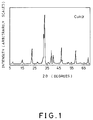
- Fig. 1 an X-ray diffraction pattern of the sample heated at 750°C is shown.
- the sample shows a single phase of YBa2Cu3O 7-x .
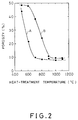
- Porosity change was measured against treated temperature (Curve A in Fig. 2).
- the porosity was about 10 % and sintering of the sample was completed.
- the electrical resistance of the sample heated at 750°C was measured by DC four-probe technique and the temperature of zero resistance was about 90 K.
- Powder yttrium barium and copper isopropoxides of 0.01, 0.02 and 0.03 mole, respectively, were added into 1 liter of isopropanol and refluxed with stirring at 83°C for 8 hours.
- the alkoxides were not perfectly dissolved into the solvent and black percipitates were remained.
- Water of 0.6 mole was added into the suspension while refluxing and the reflux was continued for 2 hours. Thereafter, the solvent was evaporated at 70°C under reduced pressure and powder sample was obtained.
- the crystal phase of the powder was identified by X-ray diffraction pattern as that it was a mixture of CuO, Y2O3 and BaCO3.
- the powder was heated at 400°C for 5 hours to evolve solvent and adsorbed water, and then the specific surface area was measured by BET method.
- the average particle size was calculated from the surface area value as 0.012 ⁇ m assuming that spherical particles.
- the powder was pressed into pellet and heated in a furnace at various temperature in oxygen atmosphere, followed by slow cooling to room temperature. Crystal phase of the samples were determined by X-ray diffraction method. As a result, it was found that 750°C heating gave an mixed phase of CuO or BaCO3 and YBa2Cu3O 7-x . On the other hand, 900°C heating gave a single phase of YBa2Cu3O 7-x . Porosity change after heating was measured against treated temperatures (Curve B in Fig. 2). by a mercury injection method. The result indicates that shrinkage began from 600° and finished at 900°C. The porosity after 900°C heating was 11 %. Resistance was measured by a conventional four-probe method. The zero resistance temperature after 900°C heating was about 88 K.
- Powder was produced by the similar process described in example 1 except the refluxing time after hydrolysis. After 24 hours refluxing, powder was heated at 200°C for 1 hour and the specific surface area was measured by BET method. The average particle size corresponds to the surface area value was 0.09 ⁇ m. Thus, by controlling the reflux time, particles within 0.05 ⁇ m to 0.09 ⁇ m can be obtained by this technique.
- powders with a small particle size and a single phase of a superconducting oxide can be obtained.
- Dense superconducting sintered oxides which shows superconducting state above the boiling temperature of nitrogen can be obtained by a treatment at a relatively low temperature, 750°C.
- a very fine powder can be prepared by the sol-gel method in the invention.
- the powder has some problems such as adsorption of water in air and bubbling in sintering process. These problems of the sol-gel powder can be improved when they were mixed with superconducting oxide crystals of micron or submicron particle size which were prepared by treating a commercially available reagents or commercially available oxide powders at high temperatures.
- mixture of Y2O3, CuO, BaCO3, etc. mixed at a predetermined ratio can be used for mixing with the sol-gel powders.
- powder in superconducting phase which was prepared from commercially available reagents by sintering at 900-950°C in an oxygen atmosphere, followed by slow cooling to room temperature, can be used for mixing with the sol-gel powders.
- the resultant solution was refluxed at about 120°C for 10 hours and distilled water of 5 to 10 times of the total molar amount of Y, Ba and Cu was added. Then, the solution was refluxed for about 10 hours to complete hydrolysis and fine particles were generated in the solution.
- the solution involving fine particles was kept at about 120°C to evaporate the solvent. Dry sol-gel powder was obtained and stored in a dry box.
- commercially available reagents of Y2O3, BaCO3 and CuO were weighed to make a 1:2:3 mole ratio and mixed.
- sol-gel powder and the mixture of the commercially available reagents were heated at a temperature from 250 to 900°C and specific surface areas of the samples were measured by BET method (Fig. 3).
- the commercially available powder mixture was sintered at 950°C in an oxygen atmosphere and slowly cooled (hereinafter called as "commercially available sintered powder").
- the sol-gel powder was mixed with the commercially available sintered powder in a weight ratio of 1:1.
- the resultant mixture powder was sintered at various temperatures of 400, 500, 750, 800 and 950°C and their X-ray diffraction patterns were measured. The results in X-ray diffraction patterns of the samples heated at 750, 800 and 950°C are shown in Figs. 4A, 4B and 4C.
- Peaks which can be assigned to the superconducting phase appeared in the samples heated at or higher more than 750°C.
- the diffraction pattern was almost the same in 950°C sample.
- the superconducting phase appeared from 800°C.
- Powders prepared by mixing the sol-gel powder with the commercially available sintered powders at the ratios of 1:1, 1:05. and 0.5:1 were pressed into pellets and sintered.
- the electrical resistance vs temperature curves of these samples were measured by a conventional four-probe technique. They showed zero resistance temperatures at about 80 to 90 K.
- a method for preventing a reaction of a superconducting oxide film and a substrate in sintering process will be described below; A buffer layer is formed on a substrate, and superconducting oxide film is formed on it.
- zirconia which has the transition point at about 1100°C, shows a large volume change when it is transformed from a tetragonal (high-temperature form) to rhombic phase (low-temperature form).
- a heating higher than the phase transition point often cause a breakage of a film during the course of temperature rise and fall. Therefore, it is more preferable to use zirconia containing yttrium, calcium etc. of 20 % or less, because addition of these elements is useful to stabilize a cubic phase to low temperature region and suppress the tetragonal-rhombic phase transition.
- more than 0.1 ⁇ m thickness of zirconia buffer is necessary. A method for forming a zirconia buffer layer will be described in detail below.
- Procedures for forming a zirconia film are; (1) washing a substrate, (2) preparing a sol, (3) coating, (4) drying and (5) sintering.
- Substrates such as silicon, SiO2 glasses, alumina etc. are washed with an acid, pure water, an organic solvent, and dried.
- Acids for example, nitric acid and hydrofluoric acid can be used for removing foreign matters from a substrate surface. Sufficient drying of a substrate is required, because water or something like that on the surface prevent the formation of homogeneous buffer film.
- Desirable conditions for preparing a sol depend on the main starting materials of the film. Cases where zirconia alkoxides and organometallic acids are used respectively are described. Zirconium alkoxides: the zirconium alkoxide is diluted with a solvent containing hydrolysis-suppresser. Often compounds of the elements for stabilizing a cubic phase of zirconia, such as yttrium or calcium are added in a solvent. Zirconium propoxide and butoxide are recommended since they are mildly hydrolyzed (when compared with methoxide or ethoxide). The hydrolysis-suppressor is used to suppress the rate of hydrolysis of high-active alkoxides and to make a homogeneous sol.
- the suppressors include carboxylic acid such as acetic acid, and polyhydric alcohols such as ethyleneglycol, and acetylacetone and so on. More than 0.01 mole suppressor are needed for 1 more alkoxide.
- the solvent organic materials which have boiling points of 200°C or below are preferable, because they can be evaporated easily. The ratio of the solvent is more than 1 mole and less than 1000 mole for 1 mole alkoxide. Alkoxides are also preferable for the starting reagents of yttrium and calcium. Addition of water containing an acid catalyst such as diluted hydrochloric acid into the sol is useful to keep the properties of the sol for a long period of time because the addition moderates a polycondensation reaction.
- Organometallic acid for example, when zirconium acetate is used, hydrolysis-suppresser or even water is not necessary. The other conditions are the same in the case of zirconium alkoxide.
- Sol is uniformly coated on a clean substrate.
- Adequate coating methods include the dipping method, spin-coating method, spray coating and die coating.
- the thickness of the film can be controlled by choosing the concentration of raw materials, speed of pulling up in the dipping technique, rotation speed in the spin-coating technique, spray rate in the spray coating technique and pulling speed in the die coating technique. Since formation of a thick film by one-step coating results in cracking in the film during drying process, the thickness of the film by one-step coating must be restricted within 0.5 ⁇ m.
- the sol films on substrates are put in an air. Then, hydrolysis and evaporation of the solvent proceed and dry films can be obtained. Drying should be done in an atmosphere where the humidity and vapor pressure is controlled to be constant.
- a ZrO2 film on a substrate can be obtained by sintering at a temperature of 500°C or higher.
- the sintering atmosphere desirably contains an oxygen.
- the film fabricated in the above-mentioned manner is a dense and homogeneous film with fine rhombic or cubic zirconia phase, of 0.01 to 0.5 ⁇ m in thickness.
- a thick zirconia film can be produced by repeating the sol coating and drying followed sintering or repeating all procedures from sol coating to sintering.
- a superconducting oxide film on the buffer layer can be formed on the buffer layer.
- the liquid-phase technique gave an oriented superconducting film on a zirconia-coated substrate.
- a homogeneous solution with high concentration can be prepared by dissolving alkoxide starting materials in a polyhydric alcohol solvent or a mixed solvent of a polyhydric alcohol and acetic acid.
- the coating film made from this solution by dipping, spin coating, spray coating technique,followed by drying and sintering processes, is characterized by excellent smooth surface.
- a silicon wafer with a polished surface was washed with hydrofluoric acid and used as a substrate.
- a zirconium alkoxide, Zr(n-OC4H9)4, was diluted with isopropanol and mixed with a small amount of acetic acid (starting sol).
- the substrate was dipped into the starting sol and pulled up at a certain rate.
- the sol coating on the substrate was hydrolyzed and dried in an air.
- the sol coated substrate was sintered in an electrical furnace at 500°C in an oxygen atmosphere. The procedures from dipping to sintering was repeated several times and zirconia-coated Si substrate was prepared.
- the zirconia film was examined by X-ray diffraction and scanning electron microscope (SEM). The thickness of the film was measured by the contact method.
- the sintered Y-Ba-Cu-O coating film was examined by X-ray diffraction, and the resistance of the film was measured by DC four-probe technique.
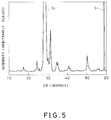
- X-ray diffraction pattern of the zirconia film on Si substrate is shown in Fig. 5. Since the intensities of the diffraction peaks are low and their half width values are large, zirconia coat seems to be microcrystals. High homogeneity was achieved in the zirconia film, and the surface of the zirconia film was so smooth which was observed by SEM.
- the X-ray diffraction pattern of the Y-ba-Cu-O sintered film on a zirconia film of 2.1 ⁇ m in thickness is shown in Fig. 6.
- the film was a single phase of YBa2Cu3O 7-x . Since (002), (003), (005) and (006) peaks are strong, it can be said that the film is c-axis-oriented perpendicular to the substrate surface.
- a pure silica glass plate after washing with a hydrofluoric acid was used for a substrate.
- Zr(n-OC4H9)4 of 0.9 mole and Y(n-OC4H9)3 of 0.1 mole was mixed in isopropanol solvent and small amount of acetic acid was added in it to make a starting sol.
- the sol film was fabricated by spin coating technique and hydrolyzed, dried in an air. The film was sintered in the same manner in example 5 and the procedures from coating to sintering were repeated 50 times.
- Cu(OC2H5)2 of 0.03 mole, Ba(n-OC4H9)2 of 0.02 mole and Y(n-OC4H9)3 of 0.01 mole were diluted with ethyleneglycol containing acetic acid and a transparent solution was prepared.
- the film made by spin coating technique was dried and sintered at 900°C.
- the Y-Ba-Cu-O superconducting film was obtained on the Y-stabilized zirconia buffer layer. The procedures from spin coating to sintering was repeated 50 times.
- the yttrium-added zirconia film was confirmed as a dense and homogeneous film by SEM observation, and it is composed of cubic zirconia which was determined by X-ray diffraction pattern.
- the cubic zirconia was stabilized by addition of yttrium down to room temperature.
- the film had a thickness of 1.6 ⁇ m.
- the Y-Ba-Cu-O film had 1.0 ⁇ m thickness and a smooth surface.
- the film was c-axis-oriented YBa2Cu3O 7-x which was determined by the X-ray diffraction pattern.
- the film showed the onset temperature of 90 K and zero resistance temperature of 85 K.
- a silicon wafer with polished surface was used for a substrate.
- a solution of Zr(n-OC4H9)4 which was prepared in the same manner as in example 6 was sprayed on the substrate heated at 400°C, and the solvent dried rapidly. The procedures from spraying to drying were repeated 20 times.
- the zirconia film was obtained by sintering the film at 900°C.
- the zirconia film and the sintered Y-Ba-Cu-O film were examined by X-ray diffraction and scanning electron microscope (SEM) and the thickness of the films were measured by the contact method.
- the resistance of the Y-Ba-Cu-O film was measured by DC four-probe technique.
- the zirconia film made by the above-mentioned process was rhombic phase and with a thickness of 1.5 ⁇ m.
- the sintered Y-Ba-Cu-O film was composed of an oriented (YBa2Cu3O 7-x crystal and with a thickness of 0.9 ⁇ 0.2 ⁇ m. The film showed the onset temperature of 90 K and the zero resistance temperature of 84 K.
- a silica glass optical fiber was drawn from the preform in a carbon resistance furnace and immediately coated with the starting sol of zirconia (prepared in the same manner in the example 6) using die coating technique.
- the coated fiber was sintered at 500°C in the furnace installed just under the drawing furnace.
- the resultant zirconia-coated fiber was coated with a Y-Ba-Cu alkoxide mixed solution by die coating technique, followed by sintering at 900°C to make an oxide-coated optical fiber.
- the oxide coating layer was removed and identified as the YBa2Cu3O 7-x phase by powder X-ray diffraction method.
- a superconducting oxide-coated optical fiber can be produced by the present invention, which suggest a possibility of power supply to an optical communication system using a superconducting line.
- the sol solution which was made from zirconium alkoxide by hydrolysis was used for forming a buffer layer
- a buffer layer can also be produced by the pyrolysis technique using an organic acid salt, or a chemical or physical vapor deposition method and so on.
- the present invention can be applied to various shaped and material's substrates, for example, such as a cylinder or a tape-shaped substrate and alumina or InP or other materials.
- Ln-Ae-Cu-O Ln: yttrium or a lanthanoid, Ae: at least one alkali earth metal
- Bi-Ae-Cu-O superconducting oxide the use of the starting materials within a particular composition region can enhance the degree of c-axis orientation.
- a copper alkoxide, Cu(OC2H5)2, a barium alkoxide, Ba(OC4H9)2, and an yttrium alkoxide, Y(OC4H9)3 were mixed together in such a ratio as will provide an oxide composition of 66 mole % Cu, 27 mole % Ba and 7 mole % Y, and added into n-butanol solvent.
- the resultant mixed solution was refluxed for 20 hours and pure water of 5 to 10 times of total Cu, Ba and Y was titrated into the solution with ultrasonic vibration.
- the solution was refluxed again for 10 hours to complete a hydrolysis reaction.
- the homogeneous solution was partially dried to increase the viscosity to make an appropriate paste for painting onto a substrate. A part of the solution was dried perfectly and subjected to a composition analysis.
- the paste was painted on a yttrium-stabilized zirconia (YSZ) substrate and heated at 950°C for 30 minutes. Then, the sample was slowly cooled to 600°C at a rate of 1°C/min, kept at 600°C for 10 hours, and slowly cooled again to room temperature under oxygen gas flow condition.
- YSZ yttrium-stabilized zirconia
- Fig. 8 The X-ray diffraction pattern of the resultant film on YSZ is shown in Fig. 8. Since peaks of (002), (003), (004), (005), (006) and (007) are very strong, it can be said that the film was c-axis-oriented perpendicular to the substrate.
- Fig. 9 shows electrcial resistance of the film was measured by a conventional four-probe technique.
- the onset temperature was 95 K and the zero resistance temperature was 90 K.
- the results are comparable to the T c value of bulk samples.
- compositions of the film were determined by an X-ray fluorescence analysis.
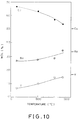
- the change of the composition of the film by heating is shown in Fig. 10, wherein the abscissa represents the treatment temperature while ordinate represents mole percentage.
- the arrows at the right end of the figure shows the mole percentages of a superconducting phase of YBa2Cu3O 7-x (Y: 16.7 mole %, Ba: 33.3 mole %, Cu: 50.05 mole %).
- the starting composition of the compound was chosen to be located in a Cu-rich and Y-poor side, the Cu content decreased remarkably during the heat treatment when the temperature is increased. Therefore, consequently, Ba and Y contents increased relatively and approached to a 1-2-3 composition which indicated by the arrows.
- the composition deviation of the starting compound toward the Cu-rich side from the 1-2-3 composition is naturally corrected by heating, and the Cu-rich starting composition can make a strong c-axis-oriented film on a ceramic substrate. The reason why the c-axis orientation can be achieved from the Cu-rich starting composition has not yet clear.
- the melting points of CuO, BaO and Y2O3 are known to be 1232°C, 1923°C and 2440°C, respectively. Therefore, it can be expected that the element which shows lowest melting point, CuO, first react at a low temperature and then the rearrangement of atoms results in the orientation.
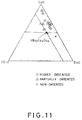
- compositions of the starting Y-Ba-Cu-O compounds (made from alkoxides) are plotted in a ternary system graph in Fig. 11. Sintering was carried out at 950°C for 30 minutes.
- Circles in this figure shows a highly oriented sample as shown in the X-ray diffraction pattern in Fig. 8.
- Triangles shows a partially oriented samples, of which X-ray duffraction pattern is shown in Fig. 12.
- the corsses stand for non-oriented sample.
- the 1-2-3 starting composition which is shown as closed circle in Fig. 11 gave non-oriented sample. It can be confirmed from Fig. 11 that the suitable starting compositions for the orientation are less than 16.6 mole % Y and more than 50 mole % Cu.
- the above-mentioned phenomenon is expected to be notable when a film is formed from fine oxide particles less than submicron order, such particles made by the sol-gel method as in this example.
- the same orientation experiments by heating was carried out using commercially available reagents such as Y2O3, BaCO3 and CuO of large particle sizes (1 to several ⁇ m) as starting materials. Since a higher temperature is necessary for achieving an orientation in such reagents of large particles, the temperature was set at 1000°C for 30 minutes.
- the region which shows the orientation is slightly narrower than that in Fig. 11 (in the case of sol-gel powder) and the degree of the orientation is lower. Consequently, fine particles prepared by the sol-gel method are more suitable than the commercially available reagents in terms of the orientation.
- a copper alkoxide, Cu(OC2H5)2, a barium alkoxide, Ba(OC4H9)2, and neodymium alkoxide, Nd(OC4H9)3 were mixed together in such a ratio as will give a Cu-rich and Nd-poor composition oxide (Cu: 60.2 mole %, Ba: 30.8 mole %, Nd: 9.0 mole %) and added into n-butanol as a solvent.
- the same procedures of reflux and hydrolysis as in the example 10 were carried out.
- the resultant solution was condensed to have suitable viscosities for screen printing or spray coating techniques.
- the films were formed on YSZ substrates by these techniques.
- the film on a YSZ substrate was heated at 950°C for 30 minutes in an oxygen gas flow condition, and then slowly cooled to room temperature.
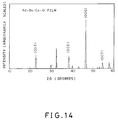
- the X-ray diffraction pattern for thus obtained Nd-Ba-Cu-O film is shown in Fig. 14.
- a Y-Nd-Ba-Cu-O superconducting film was produced from alkoxides as starting materials on a YSZ substrate in the similar manner to examples 10 and 11.
- the starting composition was 7.8 mole % Y, 5.3 mole % Nd, 17.9 mole % Ba and 69 mole % Cu; Cu-rich and Y, Nd-poor composition.
- the X-ray diffraction pattern for the Y-Nd-Ba-Cu-O superconducting film sample is shown in Fig. 15.
- the film in an Ln-Ba-Cu-O (Ln: lanthanoid) system and a mixed system can also be c-axis-oriented when the suitable starting composition is chosen.
- the shape of the substrate in the examples are plate-like, the present invention can also be applied various shaped substrates.
- the ceramics such as YSZ is known to show superplasticity, fiber or other shapes can be produced.
- a Y-Ba-Cu-O powder was prepared by the sol-gel method and mixed with ethylene glycol to make a paste.
- the paste was painted on an Al2O3 substrate and heated at 900-950°C for 10-30 minutes to make a superconducting film. Since an Al2O3 substrate generally tends to show a slightly higher reactivity with a superconducting material at high temperature than a YSZ substrate, the heating temperature for films on Al2O3 substrates must be a little lower than that for YSZ substrates. Nevertheless, a c-axis-oriented film was obtained from a Cu-rich and Y-poor starting composition as shown in examples 10 to 12. Therefore, it can be said that basically there is no limitation about the selection rule of substrate to form a oriented superconducting oxide on it.
- the reactivities of substrates with a superconducting material at a high temperature depend on the material of the substrate.
- a c-axis-oriented film on a buffer layer such as CuO, Y2O3, ZrO2 etc., which can be prepared by, for example, using the sol-gel method.
- a c-axis-oriented superconducting oxide film in Bi-Ae-cu-O system (where Ae is at least one alkali earth metal) can also be made in the same manner as described above.
- Crystal structure and the degree of orientation of the films were measured by X-ray diffraction. Electrical resistances of the films were measured by DC four-probe technique.
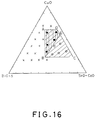
- the ratio of SrO/(CaO+SrO) 0.25-0.75, c-axis-oriented samples were also obtained.
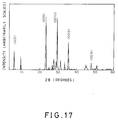
- the X-ray diffraction pattern of the film made from the starting composition in the region surrounded by A-B-E-D lines is shown in Fig. 17. Strong diffraction peaks which are assigned to (00N) of Bi2(Sr, Ca)3Cu2O x (c-axis length: 30.6 ⁇ ) are observed in this pattern, which indicates the c-axis orientation perpendicular to the substrate.
- Alkoxides were used as the starting materials to make a superconducting film as in the example 14.
- Bi(OC4H9)3, Sr(OC4H9)2, Ca(OC3H7)2 and Cu(OC3H7)2, in respective n-butanol solution were mixed and hydrolyzed, followed by refluxing for 10 hours to form fine oxide particles.
- the solvent was evaporated to make a paste.
- the paste was screen-printed on a YSZ substrate and after drying was sintered at 850°C.
- the Bi-Sr-Ca-Cu-O superconducting oxide film was obtained.
- the superconducting phase of Bi2(Sr, Ca)3Cu2O x also appeared in the composition region surrounded by A-B-C-D lines and the c-axis orientation was also observed in the sample whose composition belong to the region surrounded A-B-E-D lines in Fig. 16.
- the X-ray diffraction pattern for the oriented film whose starting composition is within the region surrounded by A-B-E-D lines is shown in Fig. 19.
- the degree of the orientation of the film is higher than that of the sample in Fig. 17, that is, of the sample prepared by using commercially available reagents.
- the oneset temperature and the zero resistance temperature were 88 K and 87 K, respectively.
- the transition from normal to superconducting phase was very sharp.
- a superconducting film in Bi-based system was formed on a zirconia-coated silicon substrate.
- a silicon wafer with a polished surface was used for the substrate.
- a starting sol for zirconia coating was prepared from a zirconium alkoxide, Zr(n-OC4H9)4 diluted with isopropanol. A small amount of acetic acid was also added in the starting sol.
- the silicon wafer was dipped into the sol and pulled up at a constant rate.
- the coated substrate was dried in an air and sintered at 900°C in an oxygen atmosphere. The procedures from dipping to sintering were repeated 50 times to obtain a zirconia-coated silicon substrate.
- a Bi-Sr-Ca-Cu-O paste, in the composition region A-B-E-D, prepared by the alkoxide hydrolysis was screen-printed on the zirconia-coated silicon substrate and sintered at 875 °C in oxygen atmosphere.
- the crystal structures of the zirconia-coated substrate and the sintered Bi-Sr-Ca-Cu-O film were identified by X-ray diffraction and the resistance vs temperature curve of the oxide film was measured by DC four-probe technique.
- the surface of the zirconia coating was very smooth by optical observation and the film had a high homogeneity.
- the film thickness measured by X-ray diffraction was 2.5 ⁇ m.
- the X-ray diffraction pattern of the sintered Bi-Sr-Ca-Cu-O film showed a formation of c-axis-oriented Bi2(Sr, Ca)3Cu2O x phase.
- the onset and zero resistance temperatures of the film were 88 K and 80 K with a transition temperature width of 8 K.
- the mixtures were pre-sintered at 950°C for 5 hours in an oxygen atmosphere and ground to make powder samples.
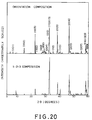
- X-ray diffraction patterns for the sample with the compositions of the orientation and the 1-2-3 are shown in Fig. 20.
- the degree of the orientation can be estimated roughly by comparing intensities of the (00N) peaks (N is an integer) and the other peaks, for example, (006)/(110)(103).
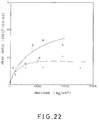
- the two kinds of composition powders were pressed into pellets with various pressures and examined by X-ray diffraction.
- the direction of the pressure is parallel with the c-axis as shown in Fig. 21.
- the degrees of the orientation (estimated by (006)/(110)(103) peak ratio) are plotted against applied pressure.
- Curve E shows the peak ratios for the pellet samples made from the powder with the orientation composition
- curve F shows those for the sample from the powder with the 1-2-3 composition.
- the powder with the orientation composition shows higher orientation than that with the 1-2-3 composition.
- the powder sample with the orientation composition contain a large amount of plate-like crystals which can be easily oriented by pressing. Thus, after pressing, the sample shows an excellent degree of the orientation.
- compositions were changed to attain a high orientation by pressing.
- Mixtures of the reagents were sintered at 950°C in an oxygen atmosphere (the same condition in the example 17).
- Pellets were made by pressing of 19000 kg/cm2.
- the results are shown in Fig. 23.
- open circles stand for the samples which show the same order of orientation as that of the orientation composition, and closed circles for the samples which shows the same order of orientation as that of the 1-2-3 composition or less than that.
- the composition region of open circles agrees well with that in the oriented film (see Fig. 11).
- the high orientation region is Y/(Y+Ba+Cu) ⁇ 16.6 mole % and Cu/(Y+Ba+Cu)>50 mole %, which is located to Y-poor and Cu-rich side.
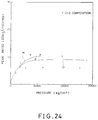
- the powder samples with the 1-2-3 composition are pressed into pellets at various pressures and are re-sintered at 875°C for 40 hours in an oxygen atmosphere.
- the pellets are checked by X-ray diffraction.
- the peak ratios of (006)/(110)(103) in the 1-2-3 composition samples are plotted against pressures in pressing process.
- Curve G shows the degrees for the samples subjected to only pressing, and curve H those for the samples subjected to pressing and re-sintering at 875°C. No noticeable change in the degrees of orientation were not observed after re-sintering at that temperature.
- the results in the samples with the orientation composition are not shown here, but almost the same results are obtained; no decrease was observed after re-sintering at 875°C.
- a copper alkoxide, Cu(i-OC3H7)2 in isopropanol, a barium alkoxide, Ba(n-OC4H9)2 in butanol and Y(n-OC4H9)3 in butanol were mixed in such a ratio as give an oxide with composition, 60 mole % Cu, 30 mole % Ba and 10 mole % Y.
- the resultant mixed solution was refluxed for 20 hours, and about 5 to 20 times of pure water to the total molar amount of Cu, Ba and Y was titrated into the solution with ultrasonic vibration. Then, the solution was refluxed again for about 10 hours to ensure the complete hydrolysis.
- the solvent in the solution was evaporated at 120-150°C for 2 or 3 days.
- the dried sample was sintered at 900°C for 5 hours in an oxygen atmosphere.
- Reagents of Bi2O3, SrCO3, CaCO3 and CuO were mixed to make a various compositions respectively shown by open circles, closed circles and crosses in Fig. 16, and pre-sintered at 875 °C for 10 hours in a platinum boat in an oxygen atmosphere.
- the sintered samples were ground into powders. Then, using a pressing plate, the powders were pressed on the sample plate by a vertical pressure of 1 kg/cm2 or less and X-ray diffraction patterns (CuK ⁇ ) were measured.
- compositions in the region surrounded by B-C-E lines in Fig. 16 showed superconducting phases but did not show an high orientation.
- X-ray diffraction pattern for the sample of BiSrCaCu3O x is shown in Fig. 26.
- (00N) peaks show higher intensities than the other peaks even at a pressure of 1 kg/cm2 or less.
- the composition BiSrCaCu3O x has a tendency to be highly c-axis oriented.
- the 5.8° peak is commonly observed in the compositions within the region surrounded by A-B-E-D lines.
- Reagents of Bi2O3, SrCO3, CaCO3 and CuO were mixed in a mole ratio of Bi2Sr 1.5 Ca 1.5 Cu2O x and pre-sintered at 875°C for 10 hours in a platinum boat in an oxygen atmosphere.
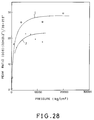
- the samples were ground into powders and pressed into pellets at various pressures to examine a pressure dependency of the degree of the orientation.
- X-ray diffraction patters for these samples are shown in Fig. 27. At a pressure of 1 kg/cm2 or less, no orientation was observed. At 190 kg/cm2, c-axis orientation was observed, and at 950 kg/cm2 the degree of the orientation was enhanced.
- curve I the peak ratio increased with increasing pressure and reached a constant value 28 at 10000 kg/cm2 pressure.
- curve J shows peak ratio of sample which is re-sintered at 850°C for 40 hours in air after pressing: Sintering is often necessary for using superconducting powders. From comparison with curve I, it is seen that although by re-sintering degree of orientation is slightly decreased the pressure dependency was almost same.
- the Bi-Sr-Ca-Cu-O samples is known to have two superconducting phases of 110 K and 80 K.
- the sample showed a 80 K-class superconducting property.
- the solution was refluxed for 20 hours and 5 to 10 times pure water to total mole of Bi, Sr, Ca, Cu was titrated into it with ultrasonic vibration. Then, the solution was refluxed again for 10 hours to ensure the complete hydrolysis.
- the oxide powder sample was obtained by drying the solution.
- the powder was pre-sintered at 800°C for 10 hours, and ground into powder again.
- the resultant powder was pressed into pellet at a pressure of 4000 kg/cm2 and examined by X-ray diffraction.
- the degree of the orientation was slightly higher than that in the example 22.
- a buffer layer between a substrate and a superconducting film to suppress the reaction of superconductor with a substrate in sintering process materials which ordinarily cannot be used, such as silicon, silica glass or other ceramics can be used as a substrate, and on the buffer-coated substrate, c-axis oriented YBa2Cu3O 7-x superconducting oxide film with good superconducting properties can be fabricated.
- Hihgly c-axis oriented superconducting film and bulk products can be fabricated from the compounds with the starting compositions of Cu>50 mole % and Ln ⁇ 16.6 mole % in Ln-Ae-Cu-O system.
- c-axis oriented products are advantageous for superconducting film and bulk in terms of high critical current density.
Landscapes
- Chemical & Material Sciences (AREA)
- Engineering & Computer Science (AREA)
- Organic Chemistry (AREA)
- Ceramic Engineering (AREA)
- Manufacturing & Machinery (AREA)
- Materials Engineering (AREA)
- Structural Engineering (AREA)
- Inorganic Chemistry (AREA)
- Nanotechnology (AREA)
- Physics & Mathematics (AREA)
- Condensed Matter Physics & Semiconductors (AREA)
- General Physics & Mathematics (AREA)
- Crystallography & Structural Chemistry (AREA)
- Composite Materials (AREA)
- Dispersion Chemistry (AREA)
- Inorganic Compounds Of Heavy Metals (AREA)
- Compositions Of Oxide Ceramics (AREA)
Applications Claiming Priority (15)
| Application Number | Priority Date | Filing Date | Title |
|---|---|---|---|
| JP150784/87 | 1987-06-17 | ||
| JP15078487A JPS63315517A (ja) | 1987-06-17 | 1987-06-17 | 酸化物粉体の製造方法 |
| JP293950/87 | 1987-11-24 | ||
| JP62293950A JPH01138121A (ja) | 1987-11-24 | 1987-11-24 | 酸化物体の製造方法 |
| JP8473/88 | 1988-01-20 | ||
| JP63008473A JPH01184966A (ja) | 1988-01-20 | 1988-01-20 | 超伝導酸化物皮膜を有する積層体および超伝導酸化物皮膜の形成方法 |
| JP25605/88 | 1988-02-08 | ||
| JP63025605A JPH01203217A (ja) | 1988-02-08 | 1988-02-08 | 超伝導酸化物薄膜の製造方法 |
| JP135653/88 | 1988-06-03 | ||
| JP63135655A JPH01305846A (ja) | 1988-06-03 | 1988-06-03 | 超伝導酸化物体の製造方法 |
| JP63135653A JPH01305845A (ja) | 1988-06-03 | 1988-06-03 | 超伝導酸化物体の製造方法 |
| JP63135654A JPH01305819A (ja) | 1988-06-03 | 1988-06-03 | 超伝導酸化物皮膜の形成方法 |
| JP135655/88 | 1988-06-03 | ||
| JP135654/88 | 1988-06-03 | ||
| PCT/JP1988/000585 WO1988010233A1 (fr) | 1987-06-17 | 1988-06-16 | Procede de production d'une poudre d'oxyde et d'un supraconducteur a base d'oxyde |
Related Child Applications (2)
| Application Number | Title | Priority Date | Filing Date |
|---|---|---|---|
| EP93117398.3 Division-Into | 1988-06-16 | ||
| EP19930117398 Division EP0587198A1 (de) | 1987-06-17 | 1988-06-16 | Schichtstruktur mit einem Supraleitenden Oxid |
Publications (4)
| Publication Number | Publication Date |
|---|---|
| EP0486686A4 EP0486686A4 (de) | 1990-12-14 |
| EP0486686A1 true EP0486686A1 (de) | 1992-05-27 |
| EP0486686B1 EP0486686B1 (de) | 1995-08-30 |
| EP0486686B2 EP0486686B2 (de) | 1999-03-24 |
Family
ID=27563454
Family Applications (1)
| Application Number | Title | Priority Date | Filing Date |
|---|---|---|---|
| EP88905427A Expired - Lifetime EP0486686B2 (de) | 1987-06-17 | 1988-06-16 | Verfahren zur herstellung von supraleitenden oxyden |
Country Status (4)
| Country | Link |
|---|---|
| US (1) | US5294599A (de) |
| EP (1) | EP0486686B2 (de) |
| DE (1) | DE3854400T3 (de) |
| WO (1) | WO1988010233A1 (de) |
Cited By (2)
| Publication number | Priority date | Publication date | Assignee | Title |
|---|---|---|---|---|
| EP0826432A3 (de) * | 1996-09-02 | 1998-07-22 | Forschungszentrum Jülich Gmbh | Verfahren zur Herstellung von hochporösen Schichten |
| FR2881133A1 (fr) * | 2005-01-27 | 2006-07-28 | Commissariat Energie Atomique | Procede de preparation de solutions sol-gel stable precurseurs de ceramiques oxydes a base de plomb, de titane, de zirconium et de lanthanide(s) et procede de preparation de ladite ceramique |
Families Citing this family (5)
| Publication number | Priority date | Publication date | Assignee | Title |
|---|---|---|---|---|
| US5728599A (en) * | 1993-10-28 | 1998-03-17 | Lsi Logic Corporation | Printable superconductive leadframes for semiconductor device assembly |
| US5662737A (en) * | 1996-05-13 | 1997-09-02 | Quantum Group, Inc. | Method for making rare earth metal oxide ceramic precursor compounds and use thereof |
| JP4240423B2 (ja) * | 1998-04-24 | 2009-03-18 | 中部キレスト株式会社 | 金属酸化物薄膜形成用ターゲット材およびその製造方法、並びに該ターゲット材を使用した金属酸化物薄膜の形成法 |
| US8632843B2 (en) * | 2008-11-24 | 2014-01-21 | Promimic Ab | Methods and systems of controlled coating of nanoparticles onto micro-rough implant surfaces and associated implants |
| US8361931B2 (en) * | 2012-01-04 | 2013-01-29 | Masoud Salavati-Niasari | Method for preparing yttrium barium copper oxide (YBCO) superconducting nanoparticles |
Family Cites Families (14)
| Publication number | Priority date | Publication date | Assignee | Title |
|---|---|---|---|---|
| US4608215A (en) * | 1983-12-23 | 1986-08-26 | Allied Corporation | Preparation of ceramics |
| JPS61194786A (ja) * | 1985-02-22 | 1986-08-29 | Nippon Telegr & Teleph Corp <Ntt> | 酸化物超伝導体薄膜の熱処理方法 |
| FR2594821B1 (fr) * | 1986-02-24 | 1988-05-20 | Solvay | Procede de fabrication d'oxydes metalliques vitreux |
| EP0237081B1 (de) * | 1986-03-14 | 1992-01-22 | Matsushita Electric Industrial Co., Ltd. | Verfahren zur Herstellung von komplexen Perovskittypverbindungen |
| US4741894A (en) * | 1986-06-03 | 1988-05-03 | Morton Thiokol, Inc. | Method of producing halide-free metal and hydroxides |
| JPS63139006A (ja) * | 1986-11-28 | 1988-06-10 | Mitsubishi Heavy Ind Ltd | 複合酸化物の合成方法 |
| CA1288644C (en) * | 1987-02-26 | 1991-09-10 | Noriyuki Yoshida | Oxide superconductive material and method of manufacturing the same |
| US4764357A (en) * | 1987-03-09 | 1988-08-16 | Akzo America Inc. | Process for producing finely divided powdery metal oxide compositions |
| WO1988008609A1 (en) * | 1987-04-24 | 1988-11-03 | General Atomics | Manufacture of high purity superconducting ceramic |
| AU607219B2 (en) * | 1987-05-29 | 1991-02-28 | Toray Industries, Inc. | Method of forming superconductive thin films and solutions for forming the same |
| US5106828A (en) * | 1987-07-20 | 1992-04-21 | North American Philips Corporation | Method for fabricating superconductors by sol-gel process |
| US4902655A (en) * | 1987-11-16 | 1990-02-20 | Westinghouse Electric Corp. | Preparation of precursors for yttrium-containing advanced ceramics |
| US4950643A (en) * | 1988-03-25 | 1990-08-21 | Eastman Kodak Company | Metalorganic deposition process for preparing heavy pnictide superconducting oxide films |
| US4959346A (en) * | 1988-05-09 | 1990-09-25 | General Electric Company | Composite with Y-BA-CU-O superconductive film |
-
1988
- 1988-06-16 DE DE3854400T patent/DE3854400T3/de not_active Expired - Fee Related
- 1988-06-16 EP EP88905427A patent/EP0486686B2/de not_active Expired - Lifetime
- 1988-06-16 WO PCT/JP1988/000585 patent/WO1988010233A1/ja not_active Ceased
- 1988-06-16 US US07/313,965 patent/US5294599A/en not_active Expired - Fee Related
Cited By (3)
| Publication number | Priority date | Publication date | Assignee | Title |
|---|---|---|---|---|
| EP0826432A3 (de) * | 1996-09-02 | 1998-07-22 | Forschungszentrum Jülich Gmbh | Verfahren zur Herstellung von hochporösen Schichten |
| FR2881133A1 (fr) * | 2005-01-27 | 2006-07-28 | Commissariat Energie Atomique | Procede de preparation de solutions sol-gel stable precurseurs de ceramiques oxydes a base de plomb, de titane, de zirconium et de lanthanide(s) et procede de preparation de ladite ceramique |
| WO2006079757A1 (fr) * | 2005-01-27 | 2006-08-03 | Commissariat A L'energie Atomique | Procede de preparation de solutions sol-gel stable precurseurs de ceramiques oxydes a base de plomb, de titane, de zirconium et de lanthanide(s) et procede de preparation de ladite ceramique |
Also Published As
| Publication number | Publication date |
|---|---|
| EP0486686B1 (de) | 1995-08-30 |
| DE3854400T3 (de) | 1999-09-16 |
| EP0486686A4 (de) | 1990-12-14 |
| WO1988010233A1 (fr) | 1988-12-29 |
| EP0486686B2 (de) | 1999-03-24 |
| DE3854400T2 (de) | 1996-03-07 |
| DE3854400D1 (de) | 1995-10-05 |
| US5294599A (en) | 1994-03-15 |
Similar Documents
| Publication | Publication Date | Title |
|---|---|---|
| US5231074A (en) | Preparation of highly textured oxide superconducting films from mod precursor solutions | |
| McIntyre et al. | Metalorganic deposition of high‐J c Ba2YCu3O7− x thin films from trifluoroacetate precursors onto (100) SrTiO3 | |
| EP0280292A2 (de) | Verfahren zur Herstellung einer Schicht aus supraleitendem Oxidmaterial | |
| EP0292967A2 (de) | Verfahren zum Herstellen von supraleitenden Dünnschichten und Lösungen für deren Herstellung | |
| CA1305259C (en) | Crystalline rare earth alkaline earth copper oxide thick film conductor | |
| EP0300561B1 (de) | Verfahren zur Herstellung von supraleitenden Oxiden und dünne Schichten aus diesen Oxiden | |
| US4950643A (en) | Metalorganic deposition process for preparing heavy pnictide superconducting oxide films | |
| US5135907A (en) | Manufacture of high purity superconducting ceramic | |
| US5294599A (en) | Processes for preparing oxide powders and superconducting oxides | |
| Sun et al. | Preparation of high purity 110 K phase in the Bi (Pb)-Sr-Ca-Cu-O superconductor using the modified citrate process | |
| EP0356722A1 (de) | Oxidischer Supraleiter und Methode zu dessen Herstellung | |
| EP0423241B1 (de) | Verfahren zur herstellung von supraleitern und deren vorläufern | |
| Kullberg et al. | A sol-gel method for preparing oriented YBa2Cu3O7-delta films on silver substrates | |
| EP0283197B1 (de) | Apparat mit einem supraleitenden Teil und Verfahren zu seiner Herstellung | |
| EP0587198A1 (de) | Schichtstruktur mit einem Supraleitenden Oxid | |
| US5087607A (en) | Process for preparing superconductive thick films | |
| US5210069A (en) | Preparation method of high purity 115 K Tl-based superconductor | |
| US5189010A (en) | Process for preparing superconductive thick films | |
| US6559103B1 (en) | Method for producing superconducting oxide compounds | |
| Admaiai et al. | Synthesis of bulk and film YBa2Cu3O7− x high-temperature superconductor by the sol-gel method | |
| CN1258618C (zh) | 一种在金属基底上形成织构外延膜的方法 | |
| US5260263A (en) | Superconductive ceramic wire and method for producing the same | |
| US5041417A (en) | Conductive articles and intermediates containing heavy pnictide mixed alkaline earth oxide layers | |
| JP3548802B2 (ja) | 特定の金属種に特定の配位子を配位させた金属錯体を含む溶液組成物、希土類超電導膜製造用溶液組成物、特定金属錯体の非結晶固形物、特定の金属種に特定の配位子を配位させた金属錯体を含む溶液の製造方法、希土類超電導膜製造用溶液の製造方法、及び超電導薄膜の製造方法。 | |
| EP0349444A2 (de) | Dünnschicht-Supraleiter mit hohem Tc aus Y-Ba-Cu-O |
Legal Events
| Date | Code | Title | Description |
|---|---|---|---|
| PUAI | Public reference made under article 153(3) epc to a published international application that has entered the european phase |
Free format text: ORIGINAL CODE: 0009012 |
|
| 17P | Request for examination filed |
Effective date: 19890215 |
|
| AK | Designated contracting states |
Kind code of ref document: A1 Designated state(s): DE FR GB NL |
|
| 17Q | First examination report despatched |
Effective date: 19921019 |
|
| GRAA | (expected) grant |
Free format text: ORIGINAL CODE: 0009210 |
|
| AK | Designated contracting states |
Kind code of ref document: B1 Designated state(s): DE FR GB NL |
|
| PG25 | Lapsed in a contracting state [announced via postgrant information from national office to epo] |
Ref country code: NL Free format text: LAPSE BECAUSE OF FAILURE TO SUBMIT A TRANSLATION OF THE DESCRIPTION OR TO PAY THE FEE WITHIN THE PRESCRIBED TIME-LIMIT Effective date: 19950830 |
|
| XX | Miscellaneous (additional remarks) |
Free format text: TEILANMELDUNG 93117398.3 EINGEREICHT AM 16/06/88. |
|
| REF | Corresponds to: |
Ref document number: 3854400 Country of ref document: DE Date of ref document: 19951005 |
|
| ET | Fr: translation filed | ||
| PLBI | Opposition filed |
Free format text: ORIGINAL CODE: 0009260 |
|
| PLBF | Reply of patent proprietor to notice(s) of opposition |
Free format text: ORIGINAL CODE: EPIDOS OBSO |
|
| REG | Reference to a national code |
Ref country code: FR Ref legal event code: CA |
|
| 26 | Opposition filed |
Opponent name: HOECHST AG Effective date: 19960530 |
|
| NLR1 | Nl: opposition has been filed with the epo |
Opponent name: HOECHST AG |
|
| PLBF | Reply of patent proprietor to notice(s) of opposition |
Free format text: ORIGINAL CODE: EPIDOS OBSO |
|
| PLBF | Reply of patent proprietor to notice(s) of opposition |
Free format text: ORIGINAL CODE: EPIDOS OBSO |
|
| PLBF | Reply of patent proprietor to notice(s) of opposition |
Free format text: ORIGINAL CODE: EPIDOS OBSO |
|
| PLAW | Interlocutory decision in opposition |
Free format text: ORIGINAL CODE: EPIDOS IDOP |
|
| PGFP | Annual fee paid to national office [announced via postgrant information from national office to epo] |
Ref country code: GB Payment date: 19980527 Year of fee payment: 11 |
|
| PGFP | Annual fee paid to national office [announced via postgrant information from national office to epo] |
Ref country code: FR Payment date: 19980617 Year of fee payment: 11 |
|
| PGFP | Annual fee paid to national office [announced via postgrant information from national office to epo] |
Ref country code: NL Payment date: 19980625 Year of fee payment: 11 |
|
| PGFP | Annual fee paid to national office [announced via postgrant information from national office to epo] |
Ref country code: DE Payment date: 19980731 Year of fee payment: 11 |
|
| PLAW | Interlocutory decision in opposition |
Free format text: ORIGINAL CODE: EPIDOS IDOP |
|
| PUAH | Patent maintained in amended form |
Free format text: ORIGINAL CODE: 0009272 |
|
| STAA | Information on the status of an ep patent application or granted ep patent |
Free format text: STATUS: PATENT MAINTAINED AS AMENDED |
|
| 27A | Patent maintained in amended form |
Effective date: 19990324 |
|
| AK | Designated contracting states |
Kind code of ref document: B2 Designated state(s): DE FR GB NL |
|
| DX | Miscellaneous (deleted) | ||
| ET3 | Fr: translation filed ** decision concerning opposition | ||
| NLR2 | Nl: decision of opposition | ||
| PG25 | Lapsed in a contracting state [announced via postgrant information from national office to epo] |
Ref country code: GB Free format text: LAPSE BECAUSE OF NON-PAYMENT OF DUE FEES Effective date: 19990616 |
|
| PG25 | Lapsed in a contracting state [announced via postgrant information from national office to epo] |
Ref country code: FR Free format text: THE PATENT HAS BEEN ANNULLED BY A DECISION OF A NATIONAL AUTHORITY Effective date: 19990630 |
|
| NLV1 | Nl: lapsed or annulled due to failure to fulfill the requirements of art. 29p and 29m of the patents act | ||
| GBPC | Gb: european patent ceased through non-payment of renewal fee |
Effective date: 19990616 |
|
| PG25 | Lapsed in a contracting state [announced via postgrant information from national office to epo] |
Ref country code: DE Free format text: LAPSE BECAUSE OF NON-PAYMENT OF DUE FEES Effective date: 20000503 |
|
| REG | Reference to a national code |
Ref country code: FR Ref legal event code: ST |