EP0486934A2 - Fibres échangeuses d'ions et procédé pour leur fabrication - Google Patents
Fibres échangeuses d'ions et procédé pour leur fabrication Download PDFInfo
- Publication number
- EP0486934A2 EP0486934A2 EP91119365A EP91119365A EP0486934A2 EP 0486934 A2 EP0486934 A2 EP 0486934A2 EP 91119365 A EP91119365 A EP 91119365A EP 91119365 A EP91119365 A EP 91119365A EP 0486934 A2 EP0486934 A2 EP 0486934A2
- Authority
- EP
- European Patent Office
- Prior art keywords
- ion exchange
- fibers
- groups
- sheath
- butadiene
- Prior art date
- Legal status (The legal status is an assumption and is not a legal conclusion. Google has not performed a legal analysis and makes no representation as to the accuracy of the status listed.)
- Granted
Links
Images



Classifications
-
- D—TEXTILES; PAPER
- D01—NATURAL OR MAN-MADE THREADS OR FIBRES; SPINNING
- D01F—CHEMICAL FEATURES IN THE MANUFACTURE OF ARTIFICIAL FILAMENTS, THREADS, FIBRES, BRISTLES OR RIBBONS; APPARATUS SPECIALLY ADAPTED FOR THE MANUFACTURE OF CARBON FILAMENTS
- D01F8/00—Conjugated, i.e. bi- or multicomponent, artificial filaments or the like; Manufacture thereof
- D01F8/04—Conjugated, i.e. bi- or multicomponent, artificial filaments or the like; Manufacture thereof from synthetic polymers
- D01F8/10—Conjugated, i.e. bi- or multicomponent, artificial filaments or the like; Manufacture thereof from synthetic polymers with at least one other macromolecular compound obtained by reactions only involving carbon-to-carbon unsaturated bonds as constituent
-
- D—TEXTILES; PAPER
- D01—NATURAL OR MAN-MADE THREADS OR FIBRES; SPINNING
- D01F—CHEMICAL FEATURES IN THE MANUFACTURE OF ARTIFICIAL FILAMENTS, THREADS, FIBRES, BRISTLES OR RIBBONS; APPARATUS SPECIALLY ADAPTED FOR THE MANUFACTURE OF CARBON FILAMENTS
- D01F11/00—Chemical after-treatment of artificial filaments or the like during manufacture
- D01F11/04—Chemical after-treatment of artificial filaments or the like during manufacture of synthetic polymers
- D01F11/06—Chemical after-treatment of artificial filaments or the like during manufacture of synthetic polymers of macromolecular compounds obtained by reactions only involving carbon-to-carbon unsaturated bonds
-
- D—TEXTILES; PAPER
- D01—NATURAL OR MAN-MADE THREADS OR FIBRES; SPINNING
- D01F—CHEMICAL FEATURES IN THE MANUFACTURE OF ARTIFICIAL FILAMENTS, THREADS, FIBRES, BRISTLES OR RIBBONS; APPARATUS SPECIALLY ADAPTED FOR THE MANUFACTURE OF CARBON FILAMENTS
- D01F6/00—Monocomponent artificial filaments or the like of synthetic polymers; Manufacture thereof
- D01F6/02—Monocomponent artificial filaments or the like of synthetic polymers; Manufacture thereof from homopolymers obtained by reactions only involving carbon-to-carbon unsaturated bonds
- D01F6/24—Monocomponent artificial filaments or the like of synthetic polymers; Manufacture thereof from homopolymers obtained by reactions only involving carbon-to-carbon unsaturated bonds from polymers of aliphatic compounds with more than one carbon-to-carbon double bond
-
- Y—GENERAL TAGGING OF NEW TECHNOLOGICAL DEVELOPMENTS; GENERAL TAGGING OF CROSS-SECTIONAL TECHNOLOGIES SPANNING OVER SEVERAL SECTIONS OF THE IPC; TECHNICAL SUBJECTS COVERED BY FORMER USPC CROSS-REFERENCE ART COLLECTIONS [XRACs] AND DIGESTS
- Y10—TECHNICAL SUBJECTS COVERED BY FORMER USPC
- Y10T—TECHNICAL SUBJECTS COVERED BY FORMER US CLASSIFICATION
- Y10T428/00—Stock material or miscellaneous articles
- Y10T428/29—Coated or structually defined flake, particle, cell, strand, strand portion, rod, filament, macroscopic fiber or mass thereof
- Y10T428/2913—Rod, strand, filament or fiber
-
- Y—GENERAL TAGGING OF NEW TECHNOLOGICAL DEVELOPMENTS; GENERAL TAGGING OF CROSS-SECTIONAL TECHNOLOGIES SPANNING OVER SEVERAL SECTIONS OF THE IPC; TECHNICAL SUBJECTS COVERED BY FORMER USPC CROSS-REFERENCE ART COLLECTIONS [XRACs] AND DIGESTS
- Y10—TECHNICAL SUBJECTS COVERED BY FORMER USPC
- Y10T—TECHNICAL SUBJECTS COVERED BY FORMER US CLASSIFICATION
- Y10T428/00—Stock material or miscellaneous articles
- Y10T428/29—Coated or structually defined flake, particle, cell, strand, strand portion, rod, filament, macroscopic fiber or mass thereof
- Y10T428/2913—Rod, strand, filament or fiber
- Y10T428/2929—Bicomponent, conjugate, composite or collateral fibers or filaments [i.e., coextruded sheath-core or side-by-side type]
Definitions
- This invention relates to novel and improved ion exchange fibers and a method for manufacturing the same.
- Ion exchange polymers are useful in many industrial fields such as electrical engineering, electronics, semiconductors, precision engineering, food industries, medicine, nuclear power and water treatment.
- Conventional ion exchange resins include styrene-divinyl benzene copolymer, acrylic acid- or methacrylic acid-divinyl benzene copolymer.
- conjugate fibers in which a polymer of aromatic monovinyl compounds constitutes a sheath component, are used as base fibers, as disclosed in Japanese Published Patent Application (Kokai) No. 186/1974, Japanese Published Patent Application (Kokai) No. 94,233/1975, Japanese Published Patent Application (Kokai) No. 12,985/1977 and Japanese Published Patent Application (Kokai) No. 120,986/1977.
- Other conventional techniques involving melt spun fibers of styrene-divinyl benzene copolymer are disclosed in Japanese Published Patent Application (Kokai) No. 81,169/1973.
- Dry spun fibers of baked polyvinyl alcohol are disclosed in Japanese Published Patent Application (Kokai) No. 71,815/1980 and Japanese Published Patent Application (Kokai) No. 184,113/1987, and acrylonitrile fibers are disclosed in Japanese Published Patent Application (Kokai) No. 50,032/1980.
- baked polyvinyl alcohol fibers or the like are hard and fragile, and it is difficult to subject them to the usual processing of fibers such as carding, webbing, spinning to spun yarns, fabrication, knitting and producing non-woven fabrics, etc.
- this invention provides ion exchange fibers at least partially containing a polymer component having a main chain of a syndiotactic poly(1,2-butadiene) structure and having ion exchange functional groups introduced into at least part of the side chain ethylene groups.
- the above mentioned polymer has a unit represented by the following formula: wherein X and Y are the same or different and denote a member selected from the group consisting of sulfonic acid groups or an alkali metal salt groups thereof, carboxyl groups or alkali metal salt groups thereof, phosphine groups or alkali metal salt groups thereof, amino groups, alkylamino groups, alkoxyamino groups, halogenated alkylamino groups and polyamine groups or derivative groups from the afore-said groups.
- the fibers are sheath-core type conjugated fibers wherein a polymer component of the sheath part comprises a polymer having a main chain of a syndiotactic poly(1,2-butadiene) structure and having ion exchange functional groups introduced into at least part of the side chain ethylene groups and wherein a polymer component of the core part comprises polypropylene polymers.
- the ion exchange fibers are core-sheath type ion exchange fibers formed into non-woven fabrics through a thermal fusion bonding integration treatment.
- the present invention relates to a method for manufacturing ion exchange fibers comprising the steps of forming fibers by melt spinning syndiotactic poly(1,2-butadiene) having a melting point (Tm °C) of 75 ⁇ Tm ⁇ 150, preferably carrying out a cross-linking treatment on said fibers with ultraviolet rays or radioactive rays, and subsequently carrying out a chemical treatment or physicochemical treatment on said fibers to introduce ion exchange functional groups thereinto.
- Tm °C melting point
- melt spinning produces melt spinning core-sheath type conjugate fibers comprising the syndiotactic poly(1,2-butadiene) as a sheath part and a polypropylene polymer as a core part.
- Figure 1 is a sectional view showing ion exchange conjugate fibers of one of the embodiments of the invention.
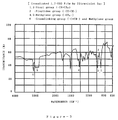
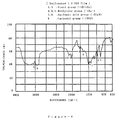
- Figure 2 is a chart of an Infrared absorption spectrum of a film of a syndiotactic poly(1,2-butadiene).
- Figure 3 is a chart of an Infrared absorption spectrum of a film obtained by ultraviolet ray irradiation of the polymer film shown in Figure 2.
- Figure 4 is a chart of an Infrared absorption spectrum of a film obtained by sulfonation of the polymer film shown in Figure 2.
- Figure 5 is a chart of an Infrared absorption spectrum of a film obtained by sulfonation of the polymer film shown in Figure 3.
- the ion exchange fibers of the invention comprise an ion exchange polymer, which has a main chain of a syndiotactic poly(1,2-butadiene) structure, and in which ion exchange functional groups are introduced into at least part of the side chain ethylene groups.
- the polymer having this structure preferably has at least the units represented by the following formulas [A], [B] and [C]: wherein X and Y are the same or different and denotes a member selected from the group consisting of sulfonic acid groups or alkali metal salt groups thereof, carboxyl groups or alkali metal salt groups thereof, phosphine groups or alkali metal salt groups thereof, amino groups, alkylamino groups, alkoxyamino groups, halogenated alkylamino groups and polyamine groups and groups derived from the afore-mentioned groups.
- alkylamino group an alkylamino group having 1 to 10 carbon atoms is usually used.
- alkoxyamino group an alkoxyamino group having 1 to 10 carbon atoms is usually used.
- halogenated alkylamino group a halogenated alkylamino group having 1 to 10 carbon atoms is usually used.
- polyamine group a group having 20 or fewer carbon atoms is usually used.
- chloride or bromide are usually used as the halogen component.
- sodium or potassium salts are preferable.
- the ion exchange polymer noted above according to the invention is soft and has sufficient mechanical strength, and the fibers comprising the ion exchange polymer can be processed as usual fibers for woven and knitted fabrics and non-woven fabrics. Thus, their ion exchange polymer can find very extensive applications. In addition, its ion exchange performance may be made practically sufficient. Of course, it may be used not only for fibers but also for films, sheets, moldings and particles. This is so because ion exchange functional groups can be introduced in a treatment subsequent to the melt molding (including melt spinning) of syndiotactic poly(1,2-butadiene).
- the polymer has at least the units represented by the formulas [A],[B] and [C] noted above, it is possible to make the ion exchange capability sufficient and provide a soft polymer.
- the unit of formula [A] mainly provides for the flexibility of the polymer, and it is preferably contained in amounts of 5 to 99 mol %, more preferably 15 to 90 mol % of entire polymer.
- the unit of formula [B] has ion exchange capability (X and Y are the same or different and representing an ion exchange functional group as mentioned above), and it is peferably contained in amount of 1 to 85 mol %, more preferably 5 to 70 mol % of the entire polymer.
- the unit of formula [C] serves as a cross-linking part.
- This unit may be absent in gas ion exchange application, but in liquid ion exchange application it is preferably present for preventing the dissolving of the main chain skelton of the polymer. For this reason, this unit is suitably contained by 0 to 10 mol % of the entire polymer, especially 2 to 9 mol % in liquid ion exchange application.
- copolymer units or additives may be contained in ranges permitting the attainment of the function and effects of the invention.
- a unit of polymer may be contained a side chain carboxyl group represented by the following formula [D]
- the fibers according to the invention may be provided as usual single component fibers or conjugate fibers.
- the cost of manufacturing can be reduced.
- the ion exchange single component fibers according to the invention may be produced by usual melt spinning of the polymer having a repeating unit represented by the formula [A], preferably syndiotactic poly(1,2-butadiene) having a melting point (Tm °C) of 75 ⁇ Tm ⁇ 150, then if necessary and preferably subjected to a cross-linking treatment with ultraviolet rays or radioactive rays and then subjected to a chemical or physico-chemical treatment for introduction of ion exchange functional groups.
- the fibers are applicable to any application as usual fibers, such as for woven or knitted fabrics and for non-woven fabrics.
- high mechanical strength fibers may be obtained by using a high mechanical strength polymer such as polypropylene or copolymers thereof for the core of the fibers.
- a high mechanical strength polymer such as polypropylene or copolymers thereof for the core of the fibers.
- the ion exchange polymer according to the invention is used for the sheath component, the ion exchange capability is maintained owing to ion exchange functional groups present in a portion in contact with liquid or gas.
- sheath-core conjugated fibers are produced by melt spinning a polymer having a repeating unit represented by the formula [A], preferably syndiotactic poly(1,2-butadiene) having a melting point (Tm °C) of 75 ⁇ Tm ⁇ 150, as a sheath component, and polypropyrene polymers as core component by using bi-component spinning machine, then if necessary and preferably subjected to a cross-linking treatment with ultraviolet rays or radioactive rays and then subjected to a chemical or physicochemical treatment for introduction of ion exchange functional groups.
- A a polymer having a repeating unit represented by the formula [A], preferably syndiotactic poly(1,2-butadiene) having a melting point (Tm °C) of 75 ⁇ Tm ⁇ 150, as a sheath component, and polypropyrene polymers as core component by using bi-component spinning machine, then if necessary and preferably subjected to a cross
- the conjugate ratio of the sheath part to the core part is preferaby in the range of 30/70 to 30/70 in the cross sectional area ratio of the sheath part to the core part.
- the ion exchange fibers according to the invention has characteristics like those of usual synthetic fibers such as mechanical strength, elongation, flexibility and processing properties.
- cut fibers when cut fibers are prepared, they may be smoothly passed through a card to obtain spun yarns, or they may be formed into a web which is to be processed to obtain non-woven fabrics.
- the ion exchange non-woven fabric according to the invention which uses the ion exchange fibers noted above for at least part of it and is obtained by thermal fusion bonding integration, can be suitably used for, for instance, cartridge filters and fiber-filled filters.
- the ion exchange non-woven fabrics according to the invention may be composed of the ion exchange fibers according to the invention or a mixture of the ion exchanging fibers and usual fibers such as polypropylene fibers, polyester fibers, polyamide fibers or cellulose fibers etc.
- syndiotactic poly(1,2-butadiene) is abbreviated as 1,2-SBD.
- conjugate fibers composed of 1,2-SBD as a sheath (referred to as sheath component) and polypropylene as a core (referred to as core component) could be readily obtained by melt spinning and is readily capable of being thermally stretched, that staples of these fibers could be used to manufacture thermally bonded non-woven fabrics by producing a card web of the staples and causing thermal bonding with 1,2-SBD of the sheath component at the temperature of fusion of 1,2-SBD, and that 1,2-SBD could be readily cross-linked to produce larger molecules by irradiating it with ultraviolet rays or radioactive rays such as gamma rays.
- the fibers and non-woven fabrics could have ion exchange functional groups introduced into them with a sulfonation reaction etc. to unsaturated groups such as side chain ethylene groups with thermal concentrated sulfuric acid without damage and were also chemically stable in other ion exchange group introduction reactions because the main chain of the molecule was constituted by carbon-to-carbon bonds.
- 1,2-SBD which is possible to be crosslinked and introduced ion exchange group
- 1,2-SBD having a melting point (Tm °C) of 75 ⁇ Tm ⁇ 150 is preferable.
- 1,2-SBD having the above mentioned melting point can be easily melt spun, and especially it is possible to carry out stable melt spinning in manufacturing sheath-core type conjugated fibers comprising 1,2-SBD as the sheath component and polyolefin as the core component. And also easy thermal bonding is possible in producing thermally bonded non-woven fabrics.
- the 1,2-SBD more preferably has a melting point of 75 to 120 °C, a crystallization degree of 15 to 50 %, 90% or above of 1,2 bonding, and a melt index (MI as measured at 190 °C and with a load of 2,169 g in accordance with JIS K 7210) of 20 to 150 g per 10 minutes.
- the thermally meltable resin used as the core component is preferably polyolefin having a melting point of 180 °C or below; PP (polypropylene polymers) is used conveniently.
- PP is a homopolymer, a binary copolymer or a ternary copolymer of propylene and preferably has a melting point of 170 °C or below and MI of 20 to 150 g per 10 minutes as defined above.
- the PP/1,2-SBD conjugate fibers are preferred combinations of 1,2-SBD having a melting point of 80 to 110 °C and a MI of 40 to 120 g per 10 minutes and PP having a melting point of 150 to 165 °C and a MI of 30 to 70 g per 10 minutes.
- melt spinning temperature T °C
- T ⁇ 180 a melt spinning temperature of 165 ⁇ T ⁇ 200, more preferably T ⁇ 180. If the melt spinning temperature is over 200 °C, gelation of 1,2-SBD is liable to occur.
- the fiber structure is preferably sheath-core type conjugate fibers with 1,2-SBD as the sheath and PP as the core.
- 1,2-SBD is used as a thermal bonding component to obtain a thermally bonded non-woven fabric
- it is suitable to incorporate at least 30 wt. % of PP/1,2-SBD conjugate fibers based on the total weight of fibers which make up the non-woven fabric. This provides sufficient thermal bonding properties. Particularly the use of 100 % conjugate fibers is preferable.
- the thermal bonding temperature (T °C) at this process is preferably in a range of Tm(SBD) + 10 ⁇ T ⁇ Tm(pp) - 10 where Tm(SBD) °C and Tm(pp) °C are respectively the melting points of 1,2-SBD and PP.
- Fibers with the surface thereof constituted by 1,2-SBD obtained in the above way or non-woven fabrics thermally bonded with these fibers may be irradiated with ultraviolet rays or gamma rays to cause a cross-linking reaction of 1,2-SBD.
- the resultant fibers and non-woven fabrics have properly increased rigidity but not so far as improper rigidity of the conventional ion exchange fibers, increased melting and softening points as represented by the thermally severing temperature ( ⁇ °C) which will be described later and reduced tensile breaking strength and tensile elongation.
- the cross-linking is conveniently carried out by irradiating the fibers or non-woven fabric with ultraviolet rays emitted from a 800-W high pressure mercury lamp held at a distance of 20 to 30 cm for 5 to 20 minutes.
- ion exchange functional groups such as sulfonic acid groups etc. are introduced by a chemical treatment or physicochemical treatment such as dipping the fibers or non-woven fabrics in a diluted fuming sulfuric acid cooled to 10 °C or below, or in a 80 to 90 % concentrated sulfuric acid heated to 80 °C or above.
- a chemical treatment or physicochemical treatment such as dipping the fibers or non-woven fabrics in a diluted fuming sulfuric acid cooled to 10 °C or below, or in a 80 to 90 % concentrated sulfuric acid heated to 80 °C or above.
- the ion exchange group introduction is not limited to the above reactions, and it is possible to introduce any ion exchange functional group such as amino group, amide group, carboxyl group, phosphinic acid group, alkylamino group, alkoxyamino group, halogenated alkylamino group and polyamine group etc.
- the ethylene groups which have not undergone the cross-linking reaction are highly chemically active and permit ready introduction of ion exchange groups such as sulfonic acid groups. When the introduced ion exchange groups are used for salt removal or like purpose, the ion exchange groups change into the form of salt type but the ion exchange fibers retain their insolubility in water since the fibers have enlarged giant molecular weight by the cross-linking.
- the 1,2-SBD used in the examples has a melting point (Tm °C) of 75 ⁇ T ⁇ 150, preferably 75 ⁇ T ⁇ 120, and can be used to readily manufacture a thermally bonded non-woven fabric using a usual hot air penetration type thermal bonding machine.
- Tm °C melting point
- sheath-core type conjugate fibers containing the 1,2-SBD a non-woven fabric, the fiber surface of which is occupied by the 1,2- SBD, can be obtained. This is convenient in that it is possible to obtain a non-woven fabric comprising the fibers having ion exchange capacity in at least the surface thereof by introduction of ion exchange groups.
- preferable fibers with the surface thereof constituted by low-melting 1,2-SBD with the side chain thereof having high density of unsaturated ethylene groups readily capable of a cross-linking reaction are irradiated with ultraviolet rays or radioactive rays to cause cross-linking of 1,2-SBD into enlarged giant molecules.
- the fibers are thus rendered insoluble to water even with introduction of a large quantity of hydrophilic groups, and then they are subjected to a chemical or physicochemical treatment to introduce a great quantity of hydrophilic functional groups having ion exchange capacity into a part of the ethylene groups of the fibers.
- Examples of the physicochemical treatment are generating radicals by photochemical treatment, low temperature plasma treatment, corona discharge treatment and so forth under the presence of such agents as ammonia, amines etc. and reacting these radicals with the unsaturated ethylene groups.
- Ammonia gas is directly introduced to the unsaturated etylene group by addition reaction under the irradiation of a low pressure mercury lamp as the typical physicochemical treatment.
- the fineness of the ion exchange fibers are not restricted, but fibers having deniers of from 0.5 to 100 are usually used. In production of non-woven fabrics, fibers having deniers of 0.5 to 10 are preferable, and deniers of 1 to 4 are more preferable.
- Polymer of 1,2-SBD ("JSR-RB T-871" manufactured by Japan Synthetic Rubber Co., Ltd.) having a melting point of 90 °C and an MI of 145 g per 10 minutes was used for melt spinning using a spinneret with a spin hole number of 700, with a discharge rate of 240 g/min. and at a spinning temperature of 180 °C.
- the obtained fibers were stretched to 3.6 times in hot water at 60 °C , then given mechanical crimp in a cooled stuffer box, then dried in a net conveyor type hot air penetration drier at 50 °C and cut to 51 mm to obtain staple fibers.
- the fibers after the cross-linking were treated in concentrated sulfuric acid having a concentration of 92.5 % for 5 hours at a temperature of 92 °C to obtain sulfonated fibers.
- the weight increase was measured.
- the measuring of the melting or softening point of fibers is shown in terms of the fiber breaking temperature ( ⁇ °C).
- This temperature of ⁇ °C is measured in accordance with a thermal shrinkage temperature measurement method of JIS L-10157-16-2 by increasing the ambient temperature around fibers at a rate of 1 °C/min. under an applied load of 1 mg/d. It is a temperature, at which the fibers are broken as a result of softening, and is closely related to the melting point.
- the sulfonation percentage (mol %) is represented as that of the ethylene group and calculated by using the following equation.
- Solfonation percentage (mol %) ⁇ weight increasing (%) / 97 ⁇ / ⁇ 100 / 56 ⁇
- High density polyethylene (HDPE) having a melting point of 130 °C and a MI of 145 g per 10 minutes and polypropylene(PP) were used individually for spinning under the same conditions as in Example 1, and the obtained fibers were stretched to four times in hot water at 80 °C to obtain comparative staple fibers. It is apparent from these comparative examples that ion exchange groups were not introduced, in despite of the treatment with the concentrated sulfulic acid.
- Sheath-core type conjugate fibers composed of a polymer of 1,2-SBD ("JSR-RB T-871" manufactured by Japan Synthetic Rubber Co. ,Ltd.) having a melting point of 90 °C and a MI of 145 g per 10 minutes as sheath component and of polypropylene (PP) having a melting point of 160 °C and a MI of 145 g per 10 minutes as core component, were obtained by melt spinning using bi-component fiber spinning machine and a spinneret having a spin hole number of 700 and setting the discharge rate to 240 g/min., the spinning temperature to 180 °C and conjugate ratio of the sheath part to the core part given as conjugate fiber sectional area ratio to 1 : 1, and they were stretched to 3.6 times in hot water at 60 °C, then given mechanical crimp using a cooled stuffer box, then dried in a net conveyer type hot air penetration drier at 50 °C and then cut to 51 mm to obtain staple fibers.
- the fibers before introduction of ion exchange groups disclosed in Example 5 were treated using 3 % fuming sulfuric acid at 5 °C for 3 minutes. A sulfonation percentage of 57 % was obtained.
- the PP/1,2-SBD core-sheath type conjugate fibers in Example 5 and single component polypropylene fibers in Comparative example 2 were used to form webs by passing them through a roller card.
- the webs were then heat treated for one minute in a hot air penetration type thermal processor at 110 °C to melt 1,2-SBD as the sheath component and thus fibers of the webs were heat bonded one another.
- the obtained non-woven fabrics have a thickness of 2 mm and a weight of 40 g/m2 These non-woven fabrics were subjected to cross-linking by ultraviolet ray irradiation and subsequent sulfonation in the manner described before in connection with Example 5.
- the mechanical strength of the non-woven fabrics was measured by carrying out a tensile test of a non-woven fabric sample having a width of 50 mm and a test length of 100 mm and was measured at a tensile speed of 300 mm/min. It is represented as a breaking length calculated using the following equation.
- Breaking length (km) tensile breaking strength (g) / ⁇ 50 ⁇ weight (g/m2 ) ⁇
- Sole 1,2-SBD (“JSD-RB T-871” manufactured by Japan Synthetic Rubber Co., Ltd.) having a melting point of 90 °C and a MI of 145 g per 10 minutes was used for melt spinning using a spinneret having a spin hole number of 700 and by setting a discharge rate of 240 g per min. and a spinning temperature of 180°C.
- core-sheath type conjugate fibers composed of the above resin as sheath component and polypropylene having a melting point of 160 °C and a MI of 145 g per 10 min. as core component were obtained by melt spinning under the same conditions and also setting the fiber sectional area ratio to 1 : 1 in the conjugate ratio.
- High density polyethylene (HDPE) having a melting point of 130°C and a MI of 145 g per 10 min. and polypropylene(PP) were used individually for spinning under the same conditions as in Example 20.
- the fibers obtained were stretched to 4 times in hot water at 80 °C to obtain comparative staple fibers.
- Example 24 The PP/1,2-SBD core-sheath type conjugate fibers of Example 24 and sole polypropylene fibers of Comparative example 4 were used and passed through a roller card to obtain webs. These webs were then heat treated for one minute in a hot air penetration type thermal processor at 110 °C to obtain a non-woven fabrics having a thickness of 2 mm and a weight of 40 g/m2. These non-woven fabrics were sulfonated in the manner as described before in connection with Example 24. The data of the results are disclosed in Table 6.
- FIG. 1 is a sectional view showing ion exchange conjugate fibers of one of embodiment of the invention.
- a conjugate fiber 11 comprises an ion exchange polymer layer 12 (or seath component layer), and a polypropyrene layer 13 (or a core component layer).
- the ion exchange polymer layer i.e., seath component layer
- a polymer component having ion exchange groups as mentioned above.
- the ion exchange polymer is present on its surface that will be in contact with liquid or gas, thus permitting efficient ion exchange.
- Figures 2 to 5 show charts of infrared ray (IR) absorption spectrum analyses of the film of the ion exchange polymer according to the invention and the film of the polymer material before the introduction of the ion exchange functional groups.
- IR infrared ray
- Figure 2 is a chart of the IR absorption of a film of poly(1,2-butadiene) where the main chain is syndiotactic.
- Figure 3 is a chart of the IR absorption of a film obtained as a result of ultraviolet ray irradiation cross-linking of the polymer film in case of Figure 2. It will be seen that absorption based on cross-linked groups designated at 6 are increased.
- Figure 4 is a chart of the IR absorption of a film as a result of sulfonation of the polymer films shown in Figure 2. It will be seen that compared to the IR absorption chart of Figure 2, vinyl groups designated at 1 and 3 are reduced and also that there are absorption based on sulfonic acid groups designated at 7 and 8 and absorption based on carboxyl groups designated at 9.
- Figure 5 is a chart for the IR absorption of a film as a result of sulfonation of the polymer film as shown in Figure 3. Compared to the chart of Figure 3, it will be seen that vinyl groups designated at 1 and 3 are reduced. In addition, it will be seen that there are absorption based on sulfonic acid groups designated at 7 and 8 and absorption of carboxyl groups designated at 9.
- the polymer according to the invention has a main chain having a syndiotactic poly(1,2-butadiene) structure, as shown in Figures 4 and 5, and that ion exchange functional groups are introduced into at least part of side chain ethylene groups.
- the fibers according to the examples described above are rich in flexibility and have not so heigh rigidity comparable with those of the conventional ion exchange fibers.
- they can be handled in the same way as the usual fibers. Namely, they can be processed into woven and knitted fabrics and non-woven fabrics easily. And also they can be used in combination with other fiber materials or by winding them on cartridge filters. That is, they can be handled in the same way as the usual non-woven fabrics and are thus applicable to various uses.
- melt extrusion apparatuses such as melt spinning machines and be formed into non-woven fabrics using usual thermal processors. That is, they permit ready manufacture compared to the conventional ion exchange fibers, and their products can be provided at economical prices.
Landscapes
- Chemical & Material Sciences (AREA)
- Chemical Kinetics & Catalysis (AREA)
- General Chemical & Material Sciences (AREA)
- Engineering & Computer Science (AREA)
- Textile Engineering (AREA)
- Manufacture Of Macromolecular Shaped Articles (AREA)
- Multicomponent Fibers (AREA)
- Chemical Or Physical Treatment Of Fibers (AREA)
- Addition Polymer Or Copolymer, Post-Treatments, Or Chemical Modifications (AREA)
- Nonwoven Fabrics (AREA)
- Artificial Filaments (AREA)
- Woven Fabrics (AREA)
Applications Claiming Priority (2)
| Application Number | Priority Date | Filing Date | Title |
|---|---|---|---|
| JP2313716A JP2522601B2 (ja) | 1990-11-19 | 1990-11-19 | イオン交換性ポリマ、イオン交換繊維およびその製造方法並びにイオン交換不織布 |
| JP313716/90 | 1990-11-19 |
Publications (3)
| Publication Number | Publication Date |
|---|---|
| EP0486934A2 true EP0486934A2 (fr) | 1992-05-27 |
| EP0486934A3 EP0486934A3 (en) | 1992-12-09 |
| EP0486934B1 EP0486934B1 (fr) | 1998-07-15 |
Family
ID=18044658
Family Applications (1)
| Application Number | Title | Priority Date | Filing Date |
|---|---|---|---|
| EP91119365A Expired - Lifetime EP0486934B1 (fr) | 1990-11-19 | 1991-11-13 | Fibres échangeuses d'ions et procédé pour leur fabrication |
Country Status (5)
| Country | Link |
|---|---|
| US (2) | US5314922A (fr) |
| EP (1) | EP0486934B1 (fr) |
| JP (1) | JP2522601B2 (fr) |
| CA (1) | CA2055733C (fr) |
| DE (1) | DE69129787T2 (fr) |
Cited By (1)
| Publication number | Priority date | Publication date | Assignee | Title |
|---|---|---|---|---|
| EP1990319A2 (fr) | 2003-07-07 | 2008-11-12 | Reckitt Benckiser N.V. | Procédé d'adoucissement de l'eau |
Families Citing this family (16)
| Publication number | Priority date | Publication date | Assignee | Title |
|---|---|---|---|---|
| JP3379559B2 (ja) * | 1994-08-12 | 2003-02-24 | チッソ株式会社 | 熱プレス成形用シート |
| TW288051B (fr) * | 1994-11-22 | 1996-10-11 | Ebara Corp | |
| US5552056A (en) * | 1995-01-17 | 1996-09-03 | Graver Chemical Company | Filter element having an ion exchange yarn winding layer |
| CA2296477A1 (fr) * | 1998-08-05 | 2000-02-05 | Toray Industries, Inc. | Dispositif de filtre chimique et systeme d'epuration des gaz |
| EP1175863A4 (fr) * | 1999-11-30 | 2002-06-05 | Unitika Ltd | Chiffon d'essuyage a base de textile non-tisse et son procede de fabrication |
| US6287689B1 (en) | 1999-12-28 | 2001-09-11 | Solutia Inc. | Low surface energy fibers |
| US6630087B1 (en) | 2001-11-16 | 2003-10-07 | Solutia Inc. | Process of making low surface energy fibers |
| US20080070274A1 (en) * | 2001-12-10 | 2008-03-20 | William Lee | High capacity, methods for separation, purification, concentration, immobilization and synthesis of compounds and applications based thereupon |
| KR100412203B1 (ko) * | 2002-01-18 | 2003-12-24 | 한국과학기술연구원 | 고기능 pan계 이온교환섬유 및 이의 제조방법 |
| US20060118420A1 (en) * | 2004-12-03 | 2006-06-08 | Macdonald Russell J | Ion exchange element, spacer component and devices made therefrom |
| JP2008019530A (ja) * | 2006-07-13 | 2008-01-31 | Toyota Boshoku Corp | イオン交換フィルター用繊維 |
| DE102007003410B4 (de) | 2007-01-23 | 2012-07-12 | Produktions- Und Umweltservice Gmbh | Ionenaustausch-Filterpatrone aus modifizierten Naturfasergarnen zur Entfernung von Partikeln, Schwermetallen und Härtebildnern in der Wasseraufbreitung und deren Herstellung |
| KR20150013662A (ko) * | 2012-05-28 | 2015-02-05 | 가부시키가이샤 구라레 | 비수계 전지용 세퍼레이터 및 비수계 전지 |
| WO2014103992A1 (fr) | 2012-12-26 | 2014-07-03 | 株式会社クラレ | Séparateur pour condensateurs électriques à double couche et condensateur électrique à double couche |
| EP3508273A4 (fr) * | 2016-08-31 | 2020-04-15 | Toray Industries, Inc. | Fibre d'échange d'ions, filtre de purification d'eau et procédé de traitement de l'eau |
| US20250129518A1 (en) * | 2022-01-11 | 2025-04-24 | 3Dbiofibr Inc. | Core-sheath polymer strand and processes for producing same |
Family Cites Families (8)
| Publication number | Priority date | Publication date | Assignee | Title |
|---|---|---|---|---|
| JPS54132904A (en) * | 1978-04-06 | 1979-10-16 | Bridgestone Corp | Pneumatic tire with improved heating property |
| JPS5550032A (en) * | 1978-10-04 | 1980-04-11 | Kanegafuchi Chem Ind Co Ltd | Manufacturing of ion exchange fiber |
| JPS5571815A (en) * | 1978-11-22 | 1980-05-30 | Nichibi:Kk | Production of ultra-fine fiber having metal chelating ability |
| US4264670A (en) * | 1979-11-21 | 1981-04-28 | Uniroyal, Inc. | Non-woven fabric made from polybutadiene |
| JPS62184113A (ja) * | 1985-08-13 | 1987-08-12 | Nichibi:Kk | 機能性繊維の製造法 |
| JPS62131004A (ja) * | 1985-12-03 | 1987-06-13 | Japan Synthetic Rubber Co Ltd | スルホン化樹脂組成物の製造方法 |
| US4645809A (en) * | 1986-01-23 | 1987-02-24 | The Goodyear Tire & Rubber Company | Direct method for preparing syndiotactic 1,2-polybutadiene |
| JP2672589B2 (ja) * | 1988-08-31 | 1997-11-05 | 出光興産株式会社 | スチレン系重合体成形品およびその製造方法 |
-
1990
- 1990-11-19 JP JP2313716A patent/JP2522601B2/ja not_active Expired - Fee Related
-
1991
- 1991-11-13 US US07/791,240 patent/US5314922A/en not_active Expired - Fee Related
- 1991-11-13 DE DE69129787T patent/DE69129787T2/de not_active Expired - Fee Related
- 1991-11-13 EP EP91119365A patent/EP0486934B1/fr not_active Expired - Lifetime
- 1991-11-18 CA CA002055733A patent/CA2055733C/fr not_active Expired - Fee Related
-
1993
- 1993-07-30 US US08/099,568 patent/US5356572A/en not_active Expired - Fee Related
Cited By (1)
| Publication number | Priority date | Publication date | Assignee | Title |
|---|---|---|---|---|
| EP1990319A2 (fr) | 2003-07-07 | 2008-11-12 | Reckitt Benckiser N.V. | Procédé d'adoucissement de l'eau |
Also Published As
| Publication number | Publication date |
|---|---|
| EP0486934B1 (fr) | 1998-07-15 |
| US5356572A (en) | 1994-10-18 |
| US5314922A (en) | 1994-05-24 |
| DE69129787T2 (de) | 1998-11-19 |
| DE69129787D1 (de) | 1998-08-20 |
| JPH04187248A (ja) | 1992-07-03 |
| CA2055733C (fr) | 1998-05-26 |
| JP2522601B2 (ja) | 1996-08-07 |
| EP0486934A3 (en) | 1992-12-09 |
| CA2055733A1 (fr) | 1992-05-20 |
Similar Documents
| Publication | Publication Date | Title |
|---|---|---|
| EP0486934B1 (fr) | Fibres échangeuses d'ions et procédé pour leur fabrication | |
| CN101821438B (zh) | 高线密度、高模量、高韧度纱线以及制造此类纱线的方法 | |
| US4440710A (en) | Process for the preparation of high Young's modulus poly-p-phenylene-terephthalamide | |
| CN103419447A (zh) | 亲水性多孔基底 | |
| KR20030077572A (ko) | 섬유 및 필름 제조용 열가소성 조성물 | |
| US3847842A (en) | Metal-chelating and solvent-resistant filamentary structure and process for its production | |
| US3305603A (en) | Method of improving acid dyeability of fibre-forming polymers | |
| EP0525204B1 (fr) | Procede de production de fibres et membranes hydrophiliques et poreuses | |
| JPH10130947A (ja) | 親水性に優れたポリオレフィン系繊維およびその製造方法 | |
| US5109028A (en) | Cation exchange fibers | |
| JPH0473271A (ja) | 合成繊維用親水性付与剤 | |
| JP3487968B2 (ja) | スルホン化複合繊維および不織布 | |
| US5800740A (en) | Antimony pentoxide dispersions and method of making | |
| JPH022983B2 (fr) | ||
| CA1047196A (fr) | Copolymere sequence de poly(dioxamide) et de polyamide en alternance | |
| JPH0434055A (ja) | 親水性ポリオレフィン系不織布 | |
| JPH0418121A (ja) | 熱融着性繊維 | |
| JPH05279911A (ja) | 特殊中空繊維および該繊維からなる繊維集合体の製造方法 | |
| JPH09255853A (ja) | ポリエステル組成物、モノフィラメントおよび工業用織物 | |
| CA1288917C (fr) | Fibres et filtres correspondants | |
| GB1585399A (en) | Polyester filaments with a high water retention capacity | |
| JPS63315607A (ja) | 多孔質ポリエステル系繊維およびその製造方法 | |
| JPS5857527B2 (ja) | 帯電防止性熱可塑性合成繊維の製造方法 | |
| US3386797A (en) | Fibrous textile products | |
| JP2942597B2 (ja) | 吸放湿性スプリット繊維の製造法 |
Legal Events
| Date | Code | Title | Description |
|---|---|---|---|
| PUAI | Public reference made under article 153(3) epc to a published international application that has entered the european phase |
Free format text: ORIGINAL CODE: 0009012 |
|
| AK | Designated contracting states |
Kind code of ref document: A2 Designated state(s): BE CH DE FR GB IT LI NL |
|
| PUAL | Search report despatched |
Free format text: ORIGINAL CODE: 0009013 |
|
| AK | Designated contracting states |
Kind code of ref document: A3 Designated state(s): BE CH DE FR GB IT LI NL |
|
| 17P | Request for examination filed |
Effective date: 19930113 |
|
| RAP1 | Party data changed (applicant data changed or rights of an application transferred) |
Owner name: DAIWABOSEKI CO., LTD. |
|
| 17Q | First examination report despatched |
Effective date: 19951221 |
|
| GRAG | Despatch of communication of intention to grant |
Free format text: ORIGINAL CODE: EPIDOS AGRA |
|
| GRAG | Despatch of communication of intention to grant |
Free format text: ORIGINAL CODE: EPIDOS AGRA |
|
| GRAG | Despatch of communication of intention to grant |
Free format text: ORIGINAL CODE: EPIDOS AGRA |
|
| GRAH | Despatch of communication of intention to grant a patent |
Free format text: ORIGINAL CODE: EPIDOS IGRA |
|
| GRAH | Despatch of communication of intention to grant a patent |
Free format text: ORIGINAL CODE: EPIDOS IGRA |
|
| GRAA | (expected) grant |
Free format text: ORIGINAL CODE: 0009210 |
|
| AK | Designated contracting states |
Kind code of ref document: B1 Designated state(s): BE CH DE FR GB IT LI NL |
|
| REG | Reference to a national code |
Ref country code: CH Ref legal event code: NV Representative=s name: HUG INTERLIZENZ AG Ref country code: CH Ref legal event code: EP |
|
| ITF | It: translation for a ep patent filed | ||
| REF | Corresponds to: |
Ref document number: 69129787 Country of ref document: DE Date of ref document: 19980820 |
|
| ET | Fr: translation filed | ||
| PLBE | No opposition filed within time limit |
Free format text: ORIGINAL CODE: 0009261 |
|
| STAA | Information on the status of an ep patent application or granted ep patent |
Free format text: STATUS: NO OPPOSITION FILED WITHIN TIME LIMIT |
|
| 26N | No opposition filed | ||
| REG | Reference to a national code |
Ref country code: GB Ref legal event code: IF02 |
|
| PGFP | Annual fee paid to national office [announced via postgrant information from national office to epo] |
Ref country code: GB Payment date: 20041102 Year of fee payment: 14 |
|
| PGFP | Annual fee paid to national office [announced via postgrant information from national office to epo] |
Ref country code: DE Payment date: 20041105 Year of fee payment: 14 |
|
| PGFP | Annual fee paid to national office [announced via postgrant information from national office to epo] |
Ref country code: CH Payment date: 20041109 Year of fee payment: 14 |
|
| PGFP | Annual fee paid to national office [announced via postgrant information from national office to epo] |
Ref country code: NL Payment date: 20041111 Year of fee payment: 14 |
|
| PGFP | Annual fee paid to national office [announced via postgrant information from national office to epo] |
Ref country code: FR Payment date: 20041112 Year of fee payment: 14 |
|
| PGFP | Annual fee paid to national office [announced via postgrant information from national office to epo] |
Ref country code: BE Payment date: 20041201 Year of fee payment: 14 |
|
| PG25 | Lapsed in a contracting state [announced via postgrant information from national office to epo] |
Ref country code: IT Free format text: LAPSE BECAUSE OF NON-PAYMENT OF DUE FEES;WARNING: LAPSES OF ITALIAN PATENTS WITH EFFECTIVE DATE BEFORE 2007 MAY HAVE OCCURRED AT ANY TIME BEFORE 2007. THE CORRECT EFFECTIVE DATE MAY BE DIFFERENT FROM THE ONE RECORDED. Effective date: 20051113 Ref country code: GB Free format text: LAPSE BECAUSE OF NON-PAYMENT OF DUE FEES Effective date: 20051113 |
|
| PG25 | Lapsed in a contracting state [announced via postgrant information from national office to epo] |
Ref country code: LI Free format text: LAPSE BECAUSE OF NON-PAYMENT OF DUE FEES Effective date: 20051130 Ref country code: CH Free format text: LAPSE BECAUSE OF NON-PAYMENT OF DUE FEES Effective date: 20051130 Ref country code: BE Free format text: LAPSE BECAUSE OF NON-PAYMENT OF DUE FEES Effective date: 20051130 |
|
| PG25 | Lapsed in a contracting state [announced via postgrant information from national office to epo] |
Ref country code: NL Free format text: LAPSE BECAUSE OF NON-PAYMENT OF DUE FEES Effective date: 20060601 Ref country code: DE Free format text: LAPSE BECAUSE OF NON-PAYMENT OF DUE FEES Effective date: 20060601 |
|
| REG | Reference to a national code |
Ref country code: CH Ref legal event code: PL |
|
| GBPC | Gb: european patent ceased through non-payment of renewal fee |
Effective date: 20051113 |
|
| PG25 | Lapsed in a contracting state [announced via postgrant information from national office to epo] |
Ref country code: FR Free format text: LAPSE BECAUSE OF NON-PAYMENT OF DUE FEES Effective date: 20060731 |
|
| NLV4 | Nl: lapsed or anulled due to non-payment of the annual fee |
Effective date: 20060601 |
|
| REG | Reference to a national code |
Ref country code: FR Ref legal event code: ST Effective date: 20060731 |
|
| BERE | Be: lapsed |
Owner name: *DAIWABOSEKI CO. LTD Effective date: 20051130 |