EP0486940A1 - Alpinskischuh - Google Patents
Alpinskischuh Download PDFInfo
- Publication number
- EP0486940A1 EP0486940A1 EP91119394A EP91119394A EP0486940A1 EP 0486940 A1 EP0486940 A1 EP 0486940A1 EP 91119394 A EP91119394 A EP 91119394A EP 91119394 A EP91119394 A EP 91119394A EP 0486940 A1 EP0486940 A1 EP 0486940A1
- Authority
- EP
- European Patent Office
- Prior art keywords
- rear cover
- notch
- ski boot
- boot according
- segment
- Prior art date
- Legal status (The legal status is an assumption and is not a legal conclusion. Google has not performed a legal analysis and makes no representation as to the accuracy of the status listed.)
- Granted
Links
- 238000005452 bending Methods 0.000 claims description 22
- 239000000463 material Substances 0.000 claims description 14
- 238000007789 sealing Methods 0.000 claims description 8
- 210000003423 ankle Anatomy 0.000 claims description 7
- 230000000717 retained effect Effects 0.000 claims description 4
- 238000010276 construction Methods 0.000 description 9
- 238000004026 adhesive bonding Methods 0.000 description 2
- 210000002683 foot Anatomy 0.000 description 2
- 239000012528 membrane Substances 0.000 description 2
- 230000011218 segmentation Effects 0.000 description 2
- 230000006978 adaptation Effects 0.000 description 1
- 210000000544 articulatio talocruralis Anatomy 0.000 description 1
- 239000000470 constituent Substances 0.000 description 1
- 239000013013 elastic material Substances 0.000 description 1
- 230000008595 infiltration Effects 0.000 description 1
- 238000001764 infiltration Methods 0.000 description 1
- 241000238565 lobster Species 0.000 description 1
- 238000012423 maintenance Methods 0.000 description 1
- 238000004519 manufacturing process Methods 0.000 description 1
- 238000000034 method Methods 0.000 description 1
- XLYOFNOQVPJJNP-UHFFFAOYSA-N water Substances O XLYOFNOQVPJJNP-UHFFFAOYSA-N 0.000 description 1
- 238000003466 welding Methods 0.000 description 1
Images



Classifications
-
- A—HUMAN NECESSITIES
- A43—FOOTWEAR
- A43B—CHARACTERISTIC FEATURES OF FOOTWEAR; PARTS OF FOOTWEAR
- A43B7/00—Footwear with health or hygienic arrangements
- A43B7/14—Footwear with health or hygienic arrangements with foot-supporting parts
- A43B7/18—Joint supports, e.g. instep supports
- A43B7/20—Ankle-joint supports or holders
-
- A—HUMAN NECESSITIES
- A43—FOOTWEAR
- A43B—CHARACTERISTIC FEATURES OF FOOTWEAR; PARTS OF FOOTWEAR
- A43B5/00—Footwear for sporting purposes
- A43B5/04—Ski or like boots
- A43B5/0427—Ski or like boots characterised by type or construction details
- A43B5/0452—Adjustment of the forward inclination of the boot leg
- A43B5/0454—Adjustment of the forward inclination of the boot leg including flex control; Dampening means
- A43B5/0464—Adjustment of the forward inclination of the boot leg including flex control; Dampening means with exchangeable parts
-
- A—HUMAN NECESSITIES
- A43—FOOTWEAR
- A43B—CHARACTERISTIC FEATURES OF FOOTWEAR; PARTS OF FOOTWEAR
- A43B5/00—Footwear for sporting purposes
- A43B5/04—Ski or like boots
- A43B5/0427—Ski or like boots characterised by type or construction details
- A43B5/048—Rear-entry skiboots
Definitions
- the present invention relates to ski boots of the "rear entry” type, the rear cover of the upper of which can be locked in the skiing position on the latter and relates in particular to a device for controlling flexion. of the rod relative to the bottom of the hull.
- Known ski boots of this type generally have a rear cover articulated on the bottom of the shell in the zone corresponding to the heel and lockable in the skiing practice position on the upper to maintain the lower leg of the skier, closing means such as "tensioner cable” connecting it to the front part of the rod.
- closing means such as "tensioner cable” connecting it to the front part of the rod.
- it is the anterior part of the upper which makes it possible to control in force and in amplitude the bending movements inflicted on the upper and directed in the longitudinal axis of the shoe; thus, when the upper is biased to bend, the front part moves and / or deforms by a certain amplitude in the direction of flexion while simultaneously driving the rear cover which then pivots on its articulation located in the heel area.
- This articulation being offset downward relative to the flexible and / or deformable zone of the front part of the rod, which extends at the instep and the flexion fold of the skier's foot, it then a relative sliding between the rear cover and the front part of the rod.
- This slip is most significant at the upper edge of the rod and in particular at that of the rear cover in contact with the rear part of the lower leg of the skier because it is the most distant part of the rear cover. of the articulation of the latter.
- This sliding occurring while the closure means ensure close contact of the rear cover against the lower leg, it results in friction felt more or less painful by the skier.
- ski boots with rear entry which include a rear cover provided with means which allow relatively large forward bending and which prevent any rearward bending. Mention may be made, for example, the ski boot described in the French patent application No. 2 358 119. As is taught, thanks to a segmentation of the rear cover that it can track down of the skier's leg when bending forward and retaining the latter backwards from its initial position of closure of the rod, the rear cover behaving "in the manner of a lobster tail".
- this type of shoe has certain drawbacks described above; in fact, on the one hand, the relative sliding of the rear cover relative to the posterior part of the lower leg of the skier during flexions of the latter is not avoided because the segmentation of the rear cover is not centered on the pivot axis of the ankle and on the other hand, the pivot axis of the rod does not respect that of the skier's ankle. Also, the fact that the holding of the rear cover relative to the front part of the rod is carried out essentially by means of the closing means which connect this front part to the rear cover, the resistance of the rod in rear bending lacks firmness and, at the very least, varies depending on the force of closing the rod on the lower leg of the skier.
- the present invention proposes to overcome these drawbacks in a simple and effective manner, by reducing the relative sliding of the rear cover relative to the rear part of the lower leg of the skier, by centering the axis of rotation of the rod substantially with that of the ankle in the area of the malleoli, and by ensuring a firm rear support having no incidence tending to limit the amplitude of the forward bending of the rod.
- the ski boot is of the rear boot type, the upper of which has a rear cover connected to the bottom of the shell by means of a joint located in the heel area.
- This rear cover has two wings which are each provided with a locking means cooperating with the sides of the rod in the zone corresponding to the malleoli.
- a closing device keeps the wings of the rear cover on the sides of the rod in engagement with the locking means and connects said rear cover with the front part of the rod in the manner of a belt.
- the shoe, object of the invention is characterized in that the rear cover has at least one transverse notch open towards the outside of the shoe, on the side constituting the rear part of the upper and in that this notch s' extends over a certain depth along a plane intersecting that passing through the locking means and the articulation of said rear cover on the bottom of the hull; the notch is thus oriented towards the lower edge of the wings of the rear cover and, depending on its depth, leaves a wall length of said wings more or less between its bottom and said lower edge thereof; this remaining wall length thus forms a "bridge" of material which is located in the extension of the notch, which thus determines, on the one hand, an upper segment centered on the locking means in the region of the malleoli and, on the other hand, a lower segment focused on the articulation of the rear cover in the heel area, the two segments remaining connected to each other by said bridge of material.
- the lower segment constitutes, by its upper edge contiguous to that lower of the upper segment, a stop stop preventing any pivoting towards the rear of said upper segment, as soon as the edges are in contact.
- the means for locking the wings on the flanks of the upper of the shoe is provided with an arrangement allowing its rotation on itself relative to said flanks of the upper, or allowing the rotation of the upper segment on him ; in the two cases of constructions mentioned, the locking means serves as a pivot for the upper segment relative to and on the sides of the rod.
- the shell bottom of the ski boot has two relatively rigid vertical extensions which rise on either side of the upper of the boot and which form the sides of said upper with which cooperates.
- the means for locking the wings of the rear cover In this way, when the upper of the boot is closed for skiing, the rear cover is locked in the anteroposterior position by means of its hinge pin located in the heel area, by its locking means on extensions vertical from the bottom of the hull and by the abutment of its upper and lower segments along their contiguous edges; the closure device of said upper ensuring the assembly and the maintenance of the constituent parts of the latter between them, it is the upper of the shoe as a whole which is thus prohibited from any possibility of bending in the anteroposterior direction.
- the limiting member is constituted by a rigid closed ring extending on either side of the side of the opening of the notch in the rear part of the rear cover; this ring is provided on the one hand, retained on each of the upper and lower segments thus connected together by the latter, and on the other hand, mounted sliding in a lumen on at least one of these segments; the light in this case has a predetermined length fixing the maximum authorized spacing of the edges of the notch when the rod is bent on the front, the latter thus being limited in movement in the same direction.
- the notch has its edges spaced from one another and a filling element is provided to be engaged therein to fill the space left free between its edges.
- the filling element is provided rigid or, on the contrary, elastically compressible; in the first case of construction, a rear cover is obtained which is prohibited from any possibility of anteroposterior bending and in the second case, a rear cover in which the upper segment is provided with a possibility of bending as a function of the compressibility of the filling element.
- this filling element is advantageously provided with means for fitting and / or retaining on the rear cover allowing it to be removable for replacement.
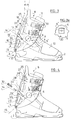
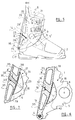
- the ski boot object of the invention is of the rear entry type and its upper 8 includes in particular a rear cover 1 which is connected to the bottom of the shell 2 in the heel area 3 by means of an articulation 4.
- This rear cover 1 has two wings 5 which are each provided with a locking means 6 cooperating with the sides 7 of the rod 8 in the zone 9 corresponding approximately to the malleoli of the skier.
- a closure device 10 holds the wings 5 of the rear cover 1 on the sides 7 of the rod 8 in engagement with the locking means 6 and connects said rear cover 1 with the front part 11 of the rod 8.
- the wings 5 of the rear cover 1 extend towards the front of the rod 8 and at least partially cover the front part 11 of the latter, which they enclose in the manner of a collar by means of the closure device 10.
- This front part 11 of the rod 8 is here obtained from a front cover 12 which covers the top of the foot, but can also be obtained in one piece with the bottom of the shell 2.
- the rear cover 1 is produced with a notch 13 called "flexion"; this flexion notch 13 is open towards the outside of the shoe on the side 8 ′ constituting the rear part of the upper 8 and extends along a plane 14 intersecting that 15 which passes through the locking means 6 on each side 7 of the rod and by the articulation 4 of the rear cover 1.
- the notch 13 is thus oriented towards the edge lower 5 'of the wings 5 and leaves, depending on its depth, a wall length of said wings more or less between its bottom 16 and said edge 5'.
- This wall length constitutes a bridge 17 of material which is located in the extension of the notch 13, which notch thus determines, on the one hand, an upper segment 18 centered on the locking means 6 and, on the other hand, a lower segment 19 centered on the articulation 4 of the rear cover 1.
- the rear cover 1 is operated in opening and closing on the rod 8 of the shoe in the same way as if it were not segmented, that is to say as on a shoe with traditional rear entry of the type comprising a locking of rear cover on the upper. Furthermore, when the rod 8 is closed for skiing with the closure device 10, the rear cover 1 is blocked in the anteroposterior position by means of its hinge pin 4 and of its locking means 6 on the sides 7 of the rod, and by the abutment of its upper 18 and lower 19 segments along their contiguous edges, respectively 18 'and 19'.
- the upper segment 18 is capable of pivoting in the postero-anterior direction; in fact, in FIG. 3, when the rod 8 is urged forward under the action of the skier's leg, the rear cover 1 is pulled in the same direction and, because its lower segment 19 is completely immobilized by the hinge 4 and the locking means 6, only the upper segment 18 is subjected to bending. The latter then pivots on the locking means 6, causing the edges 18 'and 19' of the notch 13 to move apart against the more or less elastic resistance of the material bridge 17 which remains between the notch bottom and the edge. lower 5 'of the wings 5.
- the locking means 6 advantageously consists of two interlocking parts, the outline of which is circular, one being projecting and the other recessed, and, on the other hand, said means of locking 6 cooperates with two relatively rigid vertical extensions 20 coming from the bottom of the shell 2 and which form the sides of the rod 8.
- the upper segment 18 is thus capable of turning on the locking means 6 which acts as a pivot , which, cooperating with the extensions 20 of the bottom of the shell 2, remains practically fixed in position despite the bending forces which tend to lower it.
- interlocking parts of circular outline for the locking means 6 it is also envisaged, as visible in FIG.
- the notch 23 has its edges 28 ′, 29 ′ relatively spaced apart from one another when the rear cover 21 is in the initial locking position on the upper 8 of the shoe.
- the upper segment 28 is thus capable of a certain rearward bending relative to the lower segment 29 as a function of the spacing of the edges 28 ′ and 29 ′ and limited by the positioning abutment thereof, as shown in Figure 5; as in the case of forward bending, the upper segment 28 remains centered on the locking means 6 located in the zone corresponding approximately to the malleoli.
- the notch 23 may be provided to receive a filling element 30 filling the space left free between its edges 28 'and 29'.
- a rear cover 21 is obtained capable of offering a more or less firm anteroposterior support: in fact, when the filling element 30 is made of a material rigid, a rear cover 21 is obtained, the upper segment 28 of which is prohibited from pivoting backwards.
- the filling element 30 is made of an elastically compressible material, the upper segment 28 is authorized to a certain pivoting depending on the compressibility of the material.
- this filling element 30 is removably adapted on the rear cover 21 and has means for retaining by interlocking, gluing, etc.; thus, for a given ski boot, comprising a rear cover 21, its possibilities of anteroposterior flexion can be varied according to the ski technique of the skier.
- FIG. 6 shows a rear cover 1, seen in longitudinal section, provided with a sealing membrane 40.
- the notch 13 being intended to open more or less, this membrane 40 is advantageously provided in a elastic material and fixed by any known suitable retaining means, such as by gluing, welding, riveting, etc.
- the notch 23 with spaced edges 28 '- 29' is closed by a filling element 30 provided with a flange 31 for covering the notch 23 extending from the inside of the rear cover 21, which flange advantageously constitutes the means for retaining said element on the cover.
- this flange 31 can be fixed by any known means mentioned above.
- these parts and sealing means 40 and 31 can be made to fit into corresponding parts obtained on the rear cover.
- the sealing means 50 consists of a flexible gutter-shaped plate which is integral with the lower segment 19 and which extends inside the upper segment 18. This type of construction makes it possible to produce the seal and also, depending on the flexibility chosen of the means 50, to change the resistance to forward bending of the upper segment 18 without modifying the initial characteristics of the notch 13.
- notches 13 and / or 23 can be produced in the rear cover 1, 21 provided that they are located between the joint 4 of said cover and the locking means 6, in order to guarantee the pivoting of the upper segment 18 and / or 28 on said locking means 6.
- FIGS. 1 to 7 that the rear cover 1, 21 can be provided with a stiffening element 35 which extends in the vertical direction on the rear part 8 ′ of said cover, of the upper segment 18, 28 up to the lower segment 19, 29, on either side of the notch 13, 23, still according to the invention.
- this member 55 for limiting the possible spacing of its edges 18 ', 19' delimiting the upper segments 18 and Lower 19.
- this member 55 consists of a closed rigid ring which extends on either side of the edges 18 ', 19' of the notch 13, and which is retained on the segments 18, 19 in the area of the stiffening element 35.
- the stiffening element 35 has two slots or longitudinal recesses 36, 36 'closed by a shoulder 38, 39 at least on the side corresponding to the edges 18', 19 '; the ring 55 is thus capable of sliding in one and / or the other of these recesses 36, 36 'until it comes into abutment on the shoulder 38 and 39 thereof, as illustrated in the Figure 10, and thus limit the amplitude of the pivoting of the upper segment 18 on its locking means 6 in the postero-anterior direction.
Landscapes
- Health & Medical Sciences (AREA)
- General Health & Medical Sciences (AREA)
- Physical Education & Sports Medicine (AREA)
- Epidemiology (AREA)
- Public Health (AREA)
- Footwear And Its Accessory, Manufacturing Method And Apparatuses (AREA)
- Addition Polymer Or Copolymer, Post-Treatments, Or Chemical Modifications (AREA)
- Processes Of Treating Macromolecular Substances (AREA)
Applications Claiming Priority (2)
| Application Number | Priority Date | Filing Date | Title |
|---|---|---|---|
| FR9014838 | 1990-11-22 | ||
| FR9014838A FR2669515B1 (fr) | 1990-11-22 | 1990-11-22 | Chaussure de ski alpin a chaussage par l'arriere. |
Publications (2)
| Publication Number | Publication Date |
|---|---|
| EP0486940A1 true EP0486940A1 (de) | 1992-05-27 |
| EP0486940B1 EP0486940B1 (de) | 1994-09-07 |
Family
ID=9402656
Family Applications (1)
| Application Number | Title | Priority Date | Filing Date |
|---|---|---|---|
| EP91119394A Expired - Lifetime EP0486940B1 (de) | 1990-11-22 | 1991-11-14 | Alpinskischuh |
Country Status (6)
| Country | Link |
|---|---|
| US (1) | US5216826A (de) |
| EP (1) | EP0486940B1 (de) |
| JP (1) | JPH04266702A (de) |
| AT (1) | ATE110938T1 (de) |
| DE (1) | DE69103868T2 (de) |
| FR (1) | FR2669515B1 (de) |
Cited By (3)
| Publication number | Priority date | Publication date | Assignee | Title |
|---|---|---|---|---|
| EP0968665A1 (de) * | 1998-07-03 | 2000-01-05 | Lange International S.A. | Skischuh |
| US6530161B1 (en) | 1998-07-03 | 2003-03-11 | Lange International S.A. | Ski boot |
| US9241532B2 (en) | 2012-01-04 | 2016-01-26 | K-2 Corporation | Ski/walk mechanism |
Families Citing this family (18)
| Publication number | Priority date | Publication date | Assignee | Title |
|---|---|---|---|---|
| FR2688662B1 (fr) * | 1992-03-23 | 1994-06-10 | Salomon Sa | Perfectionnement pour chaussures de ski alpin. |
| US5426872A (en) * | 1993-02-16 | 1995-06-27 | Tetra Sports Corporation | Ski boot closure system |
| FR2714270B1 (fr) * | 1993-12-24 | 1996-03-01 | Salomon Sa | Chausure de ski à capot avant suspendu. |
| US5957479A (en) * | 1995-03-02 | 1999-09-28 | Items International, Inc. | Snowboard binding assembly |
| US6109643A (en) * | 1995-03-02 | 2000-08-29 | Airwalk International Llc | Snowboard binding assembly |
| FR2755584B1 (fr) * | 1996-11-08 | 1999-01-15 | Salomon Sa | Chaussure de sport comportant un collier mobile |
| US5832635A (en) * | 1997-01-17 | 1998-11-10 | Items International, Inc. | Apparatus for adjusting the forward lean and flexibility of footwear |
| US6231057B1 (en) | 1998-10-09 | 2001-05-15 | The Burton Corporation | Highback with an adjustable shape |
| US6557865B1 (en) | 1998-10-09 | 2003-05-06 | The Burton Corporation | Highback with adjustable stiffness |
| US6554296B1 (en) | 2000-04-28 | 2003-04-29 | The Burton Corporation | Highback with independent forward lean adjustment |
| US6613411B2 (en) * | 2001-01-25 | 2003-09-02 | 3M Innovative Properties Company | Conformable multi-layer sheet materials |
| US6857185B2 (en) * | 2002-05-24 | 2005-02-22 | Iap Research, Inc. | Method for electromagnetically joining tubes to sheets in a tubular heat transfer system |
| US7293372B2 (en) * | 2004-10-08 | 2007-11-13 | Wolverine World Wide, Inc. | Footwear upper with flexible collar assembly |
| US20060237920A1 (en) * | 2005-04-25 | 2006-10-26 | K-2 Corporation | Virtual forward lean snowboard binding |
| US7992888B2 (en) * | 2007-12-07 | 2011-08-09 | K-2 Corporation | Blockless highback binding |
| ITUB20152591A1 (it) * | 2015-07-15 | 2017-01-15 | Ober Alp Spa | Scarpa sportiva, in particolare da trekking o hiking, e relativo metodo di realizzazione |
| CN112823045B (zh) * | 2018-12-27 | 2023-03-14 | 王雷 | 基于弧形弹簧而具有弹性转动机制的滑雪靴 |
| AT525999B1 (de) * | 2022-04-07 | 2023-10-15 | Atomic Austria Gmbh | Sportschuh mit Gelenksverbindung |
Citations (5)
| Publication number | Priority date | Publication date | Assignee | Title |
|---|---|---|---|---|
| DE1964370A1 (de) * | 1969-12-23 | 1971-07-01 | Rieker & Co Dr Justus | Skistiefel |
| DE2404447A1 (de) * | 1973-01-31 | 1974-08-08 | Polyair Maschinenbau Gmbh Kitt | Schuh, insbesondere skischuh mit einem mehrteiligen schaft |
| US3832792A (en) * | 1973-02-20 | 1974-09-03 | M Kastinger | Skiing boot |
| DE2404233A1 (de) * | 1973-10-04 | 1975-04-17 | Garmont Calzaturificio | Schistiefel aus kunststoffmaterial od. dgl. |
| FR2358119A1 (fr) * | 1976-07-12 | 1978-02-10 | Olin Corp | Chaussure de ski notamment de descente |
Family Cites Families (3)
| Publication number | Priority date | Publication date | Assignee | Title |
|---|---|---|---|---|
| CH656292A5 (fr) * | 1983-05-30 | 1986-06-30 | Salomon Sa | Chaussure de ski. |
| EP0259721B1 (de) * | 1986-09-08 | 1993-09-01 | NORDICA S.p.A. | Schistiefel |
| US5054215A (en) * | 1987-08-06 | 1991-10-08 | Nordica S.P.A. | Adjustment device particularly for ski boots |
-
1990
- 1990-11-22 FR FR9014838A patent/FR2669515B1/fr not_active Expired - Fee Related
-
1991
- 1991-11-14 EP EP91119394A patent/EP0486940B1/de not_active Expired - Lifetime
- 1991-11-14 DE DE69103868T patent/DE69103868T2/de not_active Expired - Fee Related
- 1991-11-14 AT AT91119394T patent/ATE110938T1/de not_active IP Right Cessation
- 1991-11-20 JP JP3304601A patent/JPH04266702A/ja not_active Withdrawn
- 1991-11-21 US US07/795,529 patent/US5216826A/en not_active Expired - Fee Related
Patent Citations (5)
| Publication number | Priority date | Publication date | Assignee | Title |
|---|---|---|---|---|
| DE1964370A1 (de) * | 1969-12-23 | 1971-07-01 | Rieker & Co Dr Justus | Skistiefel |
| DE2404447A1 (de) * | 1973-01-31 | 1974-08-08 | Polyair Maschinenbau Gmbh Kitt | Schuh, insbesondere skischuh mit einem mehrteiligen schaft |
| US3832792A (en) * | 1973-02-20 | 1974-09-03 | M Kastinger | Skiing boot |
| DE2404233A1 (de) * | 1973-10-04 | 1975-04-17 | Garmont Calzaturificio | Schistiefel aus kunststoffmaterial od. dgl. |
| FR2358119A1 (fr) * | 1976-07-12 | 1978-02-10 | Olin Corp | Chaussure de ski notamment de descente |
Cited By (4)
| Publication number | Priority date | Publication date | Assignee | Title |
|---|---|---|---|---|
| EP0968665A1 (de) * | 1998-07-03 | 2000-01-05 | Lange International S.A. | Skischuh |
| CH692122A5 (fr) * | 1998-07-03 | 2002-02-28 | Lange Int Sa | Chaussure de ski. |
| US6530161B1 (en) | 1998-07-03 | 2003-03-11 | Lange International S.A. | Ski boot |
| US9241532B2 (en) | 2012-01-04 | 2016-01-26 | K-2 Corporation | Ski/walk mechanism |
Also Published As
| Publication number | Publication date |
|---|---|
| FR2669515B1 (fr) | 1993-01-08 |
| ATE110938T1 (de) | 1994-09-15 |
| DE69103868T2 (de) | 1995-01-26 |
| DE69103868D1 (de) | 1994-10-13 |
| EP0486940B1 (de) | 1994-09-07 |
| JPH04266702A (ja) | 1992-09-22 |
| FR2669515A1 (fr) | 1992-05-29 |
| US5216826A (en) | 1993-06-08 |
Similar Documents
| Publication | Publication Date | Title |
|---|---|---|
| EP0486940B1 (de) | Alpinskischuh | |
| EP0644730B1 (de) | Ski- oder schlittschuh | |
| EP1162898B1 (de) | Schuh mit einer kippgestängelasche zur versteifung von der vorderseite des schuhs, insbesondere eines snowboardstiefels | |
| EP1166668A2 (de) | Sportschuh mit einer an einer flexiblen Fersenkappe befestigten steifen Fersenkappe | |
| CH670190A5 (de) | ||
| FR2713052A1 (fr) | Chausson intérieur pour chaussure de sport. | |
| FR2672189A1 (fr) | Chaussure de ski a capot arriere articule sur le bras de coque. | |
| FR2640123A1 (fr) | Chaussure de ski alpin | |
| FR2754462A1 (fr) | Ensemble chaussure-fixation pour planche de glisse sur neige | |
| FR2635014A1 (fr) | Fixation de ski de fond a fermeture automatique | |
| FR2617380A1 (fr) | Chaussure comportant un dispositif de reglage de l'inclinaison de l'axe d'articulation de la tige sur la coque | |
| EP0479123A1 (de) | Skischuhe mit schwenkbarem Vorderschaft | |
| EP0504769B1 (de) | Alpin-Skischuh mit einer am Schalenunterteil schwenkbaren Energiedämpfungsklappe | |
| CH667977A5 (fr) | Chaussure de ski a entree arriere. | |
| FR2657504A1 (fr) | Chaussure de ski alpin, a collier de serrage arriere articule. | |
| EP0470383B1 (de) | Skischuh | |
| FR2674106A1 (fr) | Chaussure de ski alpin a etrier d'energie articule sur le capot arriere. | |
| FR2714270A1 (fr) | Chausure de ski à capot avant suspendu. | |
| EP1104251A1 (de) | Langlaufskischuh | |
| EP0648439B1 (de) | Schischuh | |
| EP0793919A1 (de) | Schuh mit Verstärkungselement zur Übertragung der Kräfte | |
| FR2726977A1 (fr) | Chaussure de ski | |
| FR2657503A1 (fr) | Chaussure de ski a entree arriere. | |
| EP0470384B1 (de) | Skischuh | |
| FR2682570A1 (fr) | Chaussure de ski comportant un dispositif de reglage de la tige. |
Legal Events
| Date | Code | Title | Description |
|---|---|---|---|
| PUAI | Public reference made under article 153(3) epc to a published international application that has entered the european phase |
Free format text: ORIGINAL CODE: 0009012 |
|
| AK | Designated contracting states |
Kind code of ref document: A1 Designated state(s): AT CH DE FR IT LI |
|
| 17P | Request for examination filed |
Effective date: 19921029 |
|
| 17Q | First examination report despatched |
Effective date: 19921222 |
|
| GRAA | (expected) grant |
Free format text: ORIGINAL CODE: 0009210 |
|
| AK | Designated contracting states |
Kind code of ref document: B1 Designated state(s): AT CH DE FR IT LI |
|
| REF | Corresponds to: |
Ref document number: 110938 Country of ref document: AT Date of ref document: 19940915 Kind code of ref document: T |
|
| ITF | It: translation for a ep patent filed | ||
| REF | Corresponds to: |
Ref document number: 69103868 Country of ref document: DE Date of ref document: 19941013 |
|
| PLBE | No opposition filed within time limit |
Free format text: ORIGINAL CODE: 0009261 |
|
| STAA | Information on the status of an ep patent application or granted ep patent |
Free format text: STATUS: NO OPPOSITION FILED WITHIN TIME LIMIT |
|
| 26N | No opposition filed | ||
| PGFP | Annual fee paid to national office [announced via postgrant information from national office to epo] |
Ref country code: AT Payment date: 19961105 Year of fee payment: 6 |
|
| PGFP | Annual fee paid to national office [announced via postgrant information from national office to epo] |
Ref country code: FR Payment date: 19961108 Year of fee payment: 6 |
|
| PGFP | Annual fee paid to national office [announced via postgrant information from national office to epo] |
Ref country code: DE Payment date: 19961227 Year of fee payment: 6 |
|
| PGFP | Annual fee paid to national office [announced via postgrant information from national office to epo] |
Ref country code: CH Payment date: 19970217 Year of fee payment: 6 |
|
| PG25 | Lapsed in a contracting state [announced via postgrant information from national office to epo] |
Ref country code: AT Free format text: LAPSE BECAUSE OF NON-PAYMENT OF DUE FEES Effective date: 19971114 |
|
| PG25 | Lapsed in a contracting state [announced via postgrant information from national office to epo] |
Ref country code: LI Free format text: LAPSE BECAUSE OF NON-PAYMENT OF DUE FEES Effective date: 19971130 Ref country code: FR Free format text: THE PATENT HAS BEEN ANNULLED BY A DECISION OF A NATIONAL AUTHORITY Effective date: 19971130 Ref country code: CH Free format text: LAPSE BECAUSE OF NON-PAYMENT OF DUE FEES Effective date: 19971130 |
|
| REG | Reference to a national code |
Ref country code: CH Ref legal event code: PL |
|
| PG25 | Lapsed in a contracting state [announced via postgrant information from national office to epo] |
Ref country code: DE Free format text: LAPSE BECAUSE OF NON-PAYMENT OF DUE FEES Effective date: 19980801 |
|
| REG | Reference to a national code |
Ref country code: FR Ref legal event code: ST |
|
| PG25 | Lapsed in a contracting state [announced via postgrant information from national office to epo] |
Ref country code: IT Free format text: LAPSE BECAUSE OF NON-PAYMENT OF DUE FEES;WARNING: LAPSES OF ITALIAN PATENTS WITH EFFECTIVE DATE BEFORE 2007 MAY HAVE OCCURRED AT ANY TIME BEFORE 2007. THE CORRECT EFFECTIVE DATE MAY BE DIFFERENT FROM THE ONE RECORDED. Effective date: 20051114 |