EP0486973B1 - Système pour la sécurité de passagers et le contrÔle de bagages - Google Patents
Système pour la sécurité de passagers et le contrÔle de bagages Download PDFInfo
- Publication number
- EP0486973B1 EP0486973B1 EP91119559A EP91119559A EP0486973B1 EP 0486973 B1 EP0486973 B1 EP 0486973B1 EP 91119559 A EP91119559 A EP 91119559A EP 91119559 A EP91119559 A EP 91119559A EP 0486973 B1 EP0486973 B1 EP 0486973B1
- Authority
- EP
- European Patent Office
- Prior art keywords
- passenger
- data
- luggage
- bar code
- boarding
- Prior art date
- Legal status (The legal status is an assumption and is not a legal conclusion. Google has not performed a legal analysis and makes no representation as to the accuracy of the status listed.)
- Expired - Lifetime
Links
Images




Classifications
-
- G—PHYSICS
- G06—COMPUTING OR CALCULATING; COUNTING
- G06K—GRAPHICAL DATA READING; PRESENTATION OF DATA; RECORD CARRIERS; HANDLING RECORD CARRIERS
- G06K7/00—Methods or arrangements for sensing record carriers, e.g. for reading patterns
-
- G—PHYSICS
- G06—COMPUTING OR CALCULATING; COUNTING
- G06K—GRAPHICAL DATA READING; PRESENTATION OF DATA; RECORD CARRIERS; HANDLING RECORD CARRIERS
- G06K7/00—Methods or arrangements for sensing record carriers, e.g. for reading patterns
- G06K7/10—Methods or arrangements for sensing record carriers, e.g. for reading patterns by electromagnetic radiation, e.g. optical sensing; by corpuscular radiation
- G06K7/10544—Methods or arrangements for sensing record carriers, e.g. for reading patterns by electromagnetic radiation, e.g. optical sensing; by corpuscular radiation by scanning of the records by radiation in the optical part of the electromagnetic spectrum
- G06K7/10821—Methods or arrangements for sensing record carriers, e.g. for reading patterns by electromagnetic radiation, e.g. optical sensing; by corpuscular radiation by scanning of the records by radiation in the optical part of the electromagnetic spectrum further details of bar or optical code scanning devices
- G06K7/10861—Methods or arrangements for sensing record carriers, e.g. for reading patterns by electromagnetic radiation, e.g. optical sensing; by corpuscular radiation by scanning of the records by radiation in the optical part of the electromagnetic spectrum further details of bar or optical code scanning devices sensing of data fields affixed to objects or articles, e.g. coded labels
-
- G—PHYSICS
- G06—COMPUTING OR CALCULATING; COUNTING
- G06Q—INFORMATION AND COMMUNICATION TECHNOLOGY [ICT] SPECIALLY ADAPTED FOR ADMINISTRATIVE, COMMERCIAL, FINANCIAL, MANAGERIAL OR SUPERVISORY PURPOSES; SYSTEMS OR METHODS SPECIALLY ADAPTED FOR ADMINISTRATIVE, COMMERCIAL, FINANCIAL, MANAGERIAL OR SUPERVISORY PURPOSES, NOT OTHERWISE PROVIDED FOR
- G06Q10/00—Administration; Management
- G06Q10/02—Reservations, e.g. for tickets, services or events
- G06Q10/028—Reservations, e.g. for tickets, services or events for seating or spaces in a venue
- G06Q10/0283—Reservations, e.g. for tickets, services or events for seating or spaces in a venue for travel seating
-
- G—PHYSICS
- G06—COMPUTING OR CALCULATING; COUNTING
- G06Q—INFORMATION AND COMMUNICATION TECHNOLOGY [ICT] SPECIALLY ADAPTED FOR ADMINISTRATIVE, COMMERCIAL, FINANCIAL, MANAGERIAL OR SUPERVISORY PURPOSES; SYSTEMS OR METHODS SPECIALLY ADAPTED FOR ADMINISTRATIVE, COMMERCIAL, FINANCIAL, MANAGERIAL OR SUPERVISORY PURPOSES, NOT OTHERWISE PROVIDED FOR
- G06Q10/00—Administration; Management
- G06Q10/08—Logistics, e.g. warehousing, loading or distribution; Inventory or stock management
- G06Q10/087—Inventory or stock management, e.g. order filling, procurement or balancing against orders
-
- G—PHYSICS
- G07—CHECKING-DEVICES
- G07B—TICKET-ISSUING APPARATUS; FARE-REGISTERING APPARATUS; FRANKING APPARATUS
- G07B15/00—Arrangements or apparatus for collecting fares, tolls or entrance fees at one or more control points
Definitions
- the present invention relates to apparatus for utilizing scanners (e.g., contact scanners or laser-beam scanners) in conjunction with optical read-only memories (e.g., "bar codes") to achieve various useful results in the travel industry.
- scanners e.g., contact scanners or laser-beam scanners
- optical read-only memories e.g., "bar codes”
- the invention relates to a boarding security system as referred to in claim 1.
- a bar code is used to identify a traveler's luggage, permitting the luggage to be tracked and, if desired, to be delivered to the traveler's ultimate destination (e.g., a hotel). If the traveler is traveling on an airline, a corresponding bar code is applied to the traveler's boarding pass.
- a bar code reader is used to read the boarding-pass bar code of each emplaning passenger; comparison of these bar codes with luggage bar-code data permits an alarm to be raised if each item of checked luggage is not matched by an emplaned passenger.
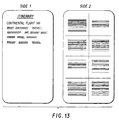
- the boarding-pass bar code may take the form of an integrated passenger identification code for use by, e.g., rental car companies, hotels, and the like.
- Figure 1 is an electrical diagram in block form of a communication system featured in certain embodiments of the invention.
- Figure 2 is a timing diagram showing events (RF transmission) vs. time for a data transmission sequence in the illustrative system of Figure 1.
- Figure 3 is a more detailed electrical schematic diagram in block form of the host computer and one of the base stations in the illustrative system of Figure 1.
- FIG 4 is a more detailed electrical diagram in block form of one of the remote terminals in the system of Figure 1.
- Figure 5 is a sectional view of a hand-held bar code scanner unit which may be used as a remote terminal in certain embodiments of the invention.
- Figure 5a is a pictorial view of another type of bar code reader which may be used as a remote terminal instead of or in addition to the scanner of Figure 5.
- Figure 6 is a view of a part of a bar code symbol that may be read by the remote unit of Figures 4 and 5 or 5a, and a timing diagram of the electrical signal produced thereby.
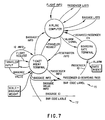
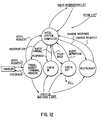
- Figures 7 through 12 are logic diagrams outlining certain logical functions performed by systems and subsystems in accordance with the invention.
- Figure 13 is a depiction of an integrated customer identification device used in an embodiment of the invention.
- Airline security may be promoted using one embodiment of the invention.
- One security problem with which airlines must attempt to contend is that of the terrorist who checks luggage for a flight but who does not board the flight because he or she knows that the checked luggage contains a bomb set to explode in flight.
- One known approach to combatting this threat is to refuse to check luggage except from ticketed passengers.
- the ticketing system may include a terminal 15 generally of the kind described above and located, e.g., at an airline ticket counter.
- a ticketing agent may use the terminal 15 to enter information relating to e.g., the passenger's origination and destination points, scheduled departure and arrival times, and the like.
- the terminal 15 is used to enter a passenger identification code that may be assigned by the airline or other carrier at check-in time.
- the passenger identification code may be the next available number from a convenient series of number, or it may be derived in any convenient manner, e.g., by using a suitable hashing function that takes as inputs one or more of the flight information, the passenger's name or social security number, and the like.
- the memory 31 of the base station 12, 13, or 14 may include instructions for the CPU 30 to generate a passenger identification code; the information used in the generation process may be obtained from the remote unit 15 and/or from a flight-information data file 74, for example, maintained by the host computer 10 in disk storage 24.
- the printer 33 is used to print a bar code label 70 on a boarding pass or alternatively on a stick-on label to be applied to a boarding pass.
- the bar code label 70 includes the aforementioned passenger identification code as well as any other desired information, e.g., the passenger's name, address, seat assignment, advance beverage orders, information about any special handling required for the passenger (e.g., special meals), connecting-flight information, and the like.
- the aforementioned 2D bar code symbology is particularly useful in such applications.
- the passenger identification code is also printed in a bar code 72 on a luggage tag (or on a stick-on label to be applied to a luggage tag) that is attached (e.g., at the ticket counter) to any luggage being checked by the passenger.
- the bar code 72 may also include the passenger's name, address, and the like for quick identification and passenger notification in the event the luggage goes astray. If the bar code is of sufficient capacity, the ticket agent may additionally enter a brief description of each piece of luggage at the terminal, perhaps using appropriate menus of luggage descriptions. This information may be included in the boarding-pass bar code 70 as well as in the luggage bar code 72.
- the information stored in the bar codes 70 and 72 referred to above can be encrypted, and/or the bar codes can include a checksum or similar code, in any convenient manner, to make forgery and/or unauthorized information access more difficult.
- the boarding passes are preprinted with bar-coded passenger identification codes 70 (e.g., boarding pass serial numbers).
- passenger identification codes 70 e.g., boarding pass serial numbers
- numbered ticket-counter luggage tags of the kind customarily fastened on bags when the bags are checked, may be preprinted with bar-code serial numbers 72.
- the ticket agent may use a fixed counter-mounted scanner (not shown) or a hand-held reader such as those shown in Figures 5 or 5a to scan a boarding pass bar code 70 and all associated luggage tag bar codes 72; the host computer 10 may be programmed to receive the data from these scans and to create an association between the passenger and his or her checked bags in one or more data files such as, for example, a passenger ID file 76 and/or a baggage ID file 78.
- the ticket agent may be equipped with peel-off/stick-on bar code labels of two kinds.
- the first kind includes bar codes of passenger identification codes 70, to be peeled off and applied to boarding passes that did not already have a passenger identification code printed thereon.
- the second kind includes bar codes of luggage identification codes 72, to be peeled off and applied to luggage tags that did not already have such bar code labels.
- the specific bar codes allocated to a given passenger are scanned as described above to create an association between the passenger and his or her checked bags in the data files 76, 78 maintained by the host computer 10.
- a single kind of peel-off/stick-on bar code labels 70 are used.
- numbered in a convenient sequential series e.g., consecutive numbers, odd numbers, even numbers, every five numbers, etc.
- numbered bar code label are applied in numerical sequence to each bag being checked by that passenger or to a luggage tag fastened thereto as described above; and (3) when all of that passenger's bags have been so labeled, the next available numbered bar code label is applied to the boarding pass.
- the serial numbers of the two bar codes on the passenger's boarding pass thus bracket (and thereby define a list of) the serial numbers of the bar codes applied to that passenger's checked luggage.
- the ticket agent may therefore scan the two boarding-pass bar codes 70 in the manner described above to identify the bags checked by the passenger in the data filers maintained by the host computer 10; alternatively, each bag's bar code can be scanned for the same reason.
- this alternative embodiment is referred to below as the "bracketing boarding-pass bar codes" embodiment.
- the "boarding pass” can be any convenient carrier for the bar codes described above.
- a boarding verification system includes a remote terminal unit 15 that is linked to the host computer 10.
- Each passenger presents his or her boarding pass to a gate agent/operator who scans the bar code 70 using a reader such as shown in Figure 5 or 5a in conjunction with e.g., a terminal unit 15 and, e.g., a base station 12, 13, or 14 (or alternatively using a fixed terminal 15 that has a landline-type link to the host computer 10).
- the terminal 15 transmits the passenger identification codes of boarded passenger to the host computer 10 either individually or in batch, as convenient. For example, the terminal 15 may be used to transmit this information in a batch after all passengers have boarded but just prior to closing up the aircraft for departure.
- the host computer 10 compares those codes 70 with a list of passenger identification codes 70 associated with checked luggage for the flight in question in the computer's data files, e.g., in data files 76 and 78. If the computer 10 determines that some piece of checked luggage is not associated with a boarded passenger, a security alarm is transmitted, possibly to the display 49 of the terminal 15 and/or to a security station and/or to the luggage handling office.
- the alarm may include the above-mentioned description of the luggage in question to facilitate identification and segregation of the luggage (e.g., for examination by bomb-squad personnel).
- the host computer 10 retrieves data from its data files and builds a list of all serial numbers 70 and 72 assigned to passengers and bags that were checked for the flight in question as described above. Each consecutive series of serial numbers 72 assigned to checked bags should be matched by bracketing serial numbers 70 assigned to a boarding pass. If any boarding-pass serial numbers 70 are missing from the list at departure time, it follows that a passenger may have checked his or her bags but failed to have his or her boarding pass scanned at the boarding gate. The host computer 10 may then generate an appropriate alarm signal as described above.
- a distributed-processing embodiment may also be used, as will be appreciated by those of ordinary skill having the benefit of this disclosure.
- the functions of the host computer 10 may be carried out by a base station 12, 13, or 14 at the boarding gate.
- the host computer 10 may download passenger and baggage data for the flight in question to the base station for temporary storage, e.g., in the memory 31 (or alternatively in disk storage, not shown in the Figure).
- the CPU 30, suitably programmed, may then perform the checking described above to determine whether any unaccompanied baggage was checked aboard the aircraft.
- the remote terminal 15 used at the boarding gate may conveniently be carried on the aircraft itself and operated by the flight attendants or other personnel.
- Information scanned from boarding-pass bar codes 70 at the boarding gate may be stored in the memory 41 of the terminal 15; with suitable programming the terminal 15 may in turn be conveniently used as a stand-alone unit by flight attendants in flight to determine the names, meal preferences, advance beverage orders, connecting flight information, etc., of passengers sitting in various seats.
- the aircraft may carry its own base station 12, 13, or 14. While the aircraft is parked at the gate, the base station may be linked with an airline host computer 10 via the link 11. Information of the kind described above may be downloaded to the base station directly from the host computer for storage in the memory 31 of the base station; the terminal 15 may then be used in flight by the flight attendants in conjunction with the base station in a manner similar to that described above.
- such a security guard may be equipped with a suitably programmed terminal 15 and/or with a base station 12, 13, or 14. Instead of attempting to read serial numbers the guard can scan the bar code 70 on an arriving passenger's boarding pass and the bar code(s) 72 on the luggage being carried out by the passenger. If the bracketing boarding-pass bar code embodiment is used, the scanner/terminal need only determine whether the luggage bar codes 72 are bracketed by the two boarding-pass bar codes 70. In the event of a mismatch, an alarm signal is generated, e.g., on the display 49 of the terminal 15, allowing the security guard to investigate further.
- Unclaimed luggage can conveniently be identified by airport or airline personnel, without opening the luggage, by scanning the luggage bar code 72. If the bar code 72 includes the passenger's name and address, it can be read by scanning it with a remote terminal 15; alternatively, the luggage identification information encoded into the bar code 72 may be passed on to a host computer 10, e.g., via a base station 12, 13, or 14 if used; the host computer 10 then identifies the passenger in question through a conventional lookup into its data files, e.g., files 76 and 78. This information can enable the owner to be contacted (or, if the luggage has been misrouted to the wrong airport, to redirect it to the proper destination).
- a passenger who checks luggage at a ticket counter may desire to have the luggage delivered to his or her hotel, office, home, or other destination. This could present an attractive alternative to carrying on large hanging bags, for example, or to checking luggage and being forced to wait 30 minutes to an hour at the destination airport to reclaim the checked luggage.
- Information about the desired delivery destination may be entered by the ticket agent using the ticketing terminal 15; alternatively, this information may be taken by a travel agency and entered using a travel agency terminal 15 as described below.
- the destination information may be included in the luggage bar code 72, which may be printed on a readily distinguishable stock (e.g., stock of a particular color or an especially bright color, etc.) to facilitate sorting at the destination airport.
- luggage to be delivered is separated from luggage to be reclaimed at the baggage-claim area and placed temporarily in a receiving area.
- the luggage bar codes 72 for the various luggage pieces are scanned to obtain their delivery-destination information, e.g., by a remote terminal 15 upon arrival in the receiving area.
- a host computer 10 linked to the terminal 15 maintains a current list of luggage to be delivered and the destinations thereof, e.g., in a data file system such as data files 76 and 78, possibly keyed to destination identifying data such as nine-digit ZIP codes, hotel names, or similar identifiers. If desired, a human-readable notation about the destination may be made by hand on the luggage tag for convenience.
- the host computer 10 Periodically (say, once per hour), the host computer 10 causes one or more lists to be printed of luggage to be delivered, sorted by destination into delivery groups. Each delivery group may be assigned to a van or other vehicle, in all likelihood several delivery groups to a vehicle. Using the lists as pick lists, delivery personnel load luggage into the appropriate vehicle.
- a terminal 15 is used to scan each bag's bar code 72 and transmit its identifying information to the host computer 10, which notes the fact that the bag has left the airport.
- the terminal's display 49 may be used to view the bag's destination as encoded in the bar code 72, thus providing a check that the bag is about to be taken to the correct destination.
- delivery personnel or hotel service personnel e.g., a bellman
- a terminal 15 is used as described above to verify that each bag is being unloaded at the correct destination. This information may be transmitted by the terminal 15 to a host computer 10 in the delivery vehicle, or alternatively through an appropriate radio, cellular, or other link to the host computer 10 at the airport.
- service personnel may use a terminal 15 to scan a bag's bar code 72 to obtain the passenger identification code of the bag's owner.
- the terminal 15 is linked with a hotel host computer 10, e.g., via a base station 12, 13, or 14 if used. If the owner has checked into the hotel using his or her passenger identification code as described below, the bellman may use the terminal's display 49 to display the bag owner's room number; he may make a hand-written notation on the bag's luggage tag, and the bag may be delivered directly to the room.
- the functions performed by the host computer 10 may equally well be performed by the CPU 30 and associated equipment of the base station 12, 13, or 14, with downloading of data as needed from the host computer 10.
- Lost or damaged luggage is sometimes valued for compensation purposes as a function of the weight of the luggage unless the passenger declares a higher value and pays a fee.
- the ticket agent can query the passenger at check-in time about any higher value which the passenger wishes to declare for the luggage.
- This information and the weight of each bag (which may be obtained from a scale, not shown) may be included in the printed bar codes 72 and 70 on both the luggage and the passenger's boarding pass.
- the declared value information maybe printed solely in the boarding-pass bar code 70.
- the ticket agent may of course collect additional fees from passengers who declare luggage values in excess of predetermined limits.
- Passenger claims for lost luggage can be processed expeditiously by using a terminal 15 to scan the boarding-pass bar code 70 and thereby ascertain the previously recorded weight of each bag and the value declared by the passenger as well as the passenger's name and address.
- Passengers can conveniently make such claims by mail by sending the original boarding pass to an airline claim office.
- the passenger may retain a photocopy of the boarding pass, including the bar code 70, for his or her records in case a dispute arises; the bar code 70 will of course be duplicated on the photocopy and thus can be scanned in the same manner as on the original boarding pass.
- Colored stocks and inks can be used in the usual manner to distinguish original boarding passes from photocopies.
- Traveler security and luggage control system described above can be expanded to provide improved convenience for travelers.
- travel agencies are frequently used by business travelers to make advanced booking of airline flights, rental cars, and hotel rooms. Travel agencies typically provide their traveler-customers with pocket-sized folders containing airline tickets and a detailed itinerary including rent car and hotel information. Boarding passes are often included in such folders.
- Such a guard may be equipped with and use a terminal 15 in much the same manner as described above in connection with baggage-claim area security guards described above.
- the guard may utilize the terminal to scan the bar code on the customer's boarding pass and a vehicle identification code inscribed or mounted on the rental car (e.g., etched onto the windshield or body or printed on a label permanently affixed to the windshield or body).
- An RF link transmits these data to a rental car host computer 10.
- the host computer 10 sends a signal to cause a gate to be opened; otherwise, an alarm signal may be generated.
Landscapes
- Engineering & Computer Science (AREA)
- Business, Economics & Management (AREA)
- Physics & Mathematics (AREA)
- General Physics & Mathematics (AREA)
- Theoretical Computer Science (AREA)
- Tourism & Hospitality (AREA)
- Economics (AREA)
- Human Resources & Organizations (AREA)
- Operations Research (AREA)
- Artificial Intelligence (AREA)
- Computer Vision & Pattern Recognition (AREA)
- Electromagnetism (AREA)
- General Business, Economics & Management (AREA)
- Development Economics (AREA)
- Finance (AREA)
- Entrepreneurship & Innovation (AREA)
- Quality & Reliability (AREA)
- Strategic Management (AREA)
- Marketing (AREA)
- General Health & Medical Sciences (AREA)
- Health & Medical Sciences (AREA)
- Toxicology (AREA)
- Accounting & Taxation (AREA)
- Management, Administration, Business Operations System, And Electronic Commerce (AREA)
- Devices For Checking Fares Or Tickets At Control Points (AREA)
- Time Recorders, Dirve Recorders, Access Control (AREA)
- Lock And Its Accessories (AREA)
- Warehouses Or Storage Devices (AREA)
- Burglar Alarm Systems (AREA)
Claims (4)
- Système de sécurité d'embarquement comprenant:(a) un moyen d'enregistrement pour introduire des données d'identification (ID) dans un moyen de stockage de données de passager enregistré;(b) lesdites données ID comportant:(1) des données ID de passager, codées dans au moins une carte d'embarquement, et(2) des données ID de bagages, codées dans au moins une étiquette de bagage, chaque étiquette de bagage correspondant à une carte d'embarquement;(c) un moyen de stockage de données de passager embarqué, relié audit moyen de stockage pour passager enregistré;(d) un moyen formant lecteur de cartes d'embarquement pour lire un ou plusieurs desdites cartes d'embarquement et stocker les données ID de passager codées dans celles-ci, dans ledit moyen de stockage de données de passager embarqué,(e) un moyen pour comparer les données ID de passager, stockées dans ledit moyen de stockage de données de passager embarqué, avec les données ID de bagage stockées dans ledit moyen de stockage pour passager enregistré, et(f) un moyen pour générer un signal d'alarme si les données ID de passager, correspondant à l'une quelconque desdites étiquettes de bagage, ne sont pas présentes dans ledit moyen de stockage de données de passager embarquédans lequellesdites données ID de passager et lesdites données ID de bagage sont codées en codes à barres,au moins l'un desdits codes à barres est un code à barres à deux dimensionsledit moyen d'enregistrement comporte un moyen pour accéder à une base de données d'informations de trajet de déplacement, etledit moyen d'enregistrement comporte un moyen pour générer un code à barres.
- Système selon la revendication 1, dans lequel ledit moyen d'enregistrement comporte un moyen pour lire un code à barres pré-existant.
- Système selon la revendication 1 ou 2, dans lequel ledit moyen formant lecteur de cartes d'embarquement comprend un émetteur de rayonnement laser.
- Dispositif d'enregistrement de données ID de passager destiné à être utilisé dans le système de sécurité d'embarquement de l'une quelconque des revendications 1-3, ledit dispositif comprenant:(a) une mémoire électro-optique exploitable par une machine, configurée en fonction d'un schéma de codage pour coder des données identifiant un passager;(b) ledit schéma de codage étant conforme à un schéma d'organisation de données d'un système de gestion de données de passager,dans lequel ladite mémoire électro-optique comprend un code à barres, etcomprenant en outre une mémoire électro-optique exploitable par une machine, configurée en fonction d'un schéma de codage pour coder des données d'itinéraire de passager, etconfigurée en fonction d'un schéma de codage pour coder des données de traitement de passager.
Applications Claiming Priority (2)
| Application Number | Priority Date | Filing Date | Title |
|---|---|---|---|
| US61602690A | 1990-11-20 | 1990-11-20 | |
| US616026 | 1990-11-20 |
Publications (3)
| Publication Number | Publication Date |
|---|---|
| EP0486973A2 EP0486973A2 (fr) | 1992-05-27 |
| EP0486973A3 EP0486973A3 (en) | 1993-05-26 |
| EP0486973B1 true EP0486973B1 (fr) | 1996-09-18 |
Family
ID=24467760
Family Applications (1)
| Application Number | Title | Priority Date | Filing Date |
|---|---|---|---|
| EP91119559A Expired - Lifetime EP0486973B1 (fr) | 1990-11-20 | 1991-11-15 | Système pour la sécurité de passagers et le contrÔle de bagages |
Country Status (6)
| Country | Link |
|---|---|
| EP (1) | EP0486973B1 (fr) |
| JP (1) | JPH0573572A (fr) |
| AT (1) | ATE143158T1 (fr) |
| CA (1) | CA2055854A1 (fr) |
| DE (1) | DE69122214T2 (fr) |
| ES (1) | ES2093061T3 (fr) |
Cited By (3)
| Publication number | Priority date | Publication date | Assignee | Title |
|---|---|---|---|---|
| DE10007127A1 (de) * | 2000-02-17 | 2001-08-23 | Hugues Edwin Luedi | Verfahren zur Abfertigung von Passagieren und/oder Gepäckstücken |
| DE102005012933B3 (de) * | 2005-03-15 | 2006-10-26 | Dahlmann, Rainer | Verfahren und Vorrichtung zum Orten, Verfolgen und Wiederauffinden von Gepäckstücken |
| US10696422B2 (en) | 2012-04-05 | 2020-06-30 | Sita Ypenburg B.V. | Method and system for depositing and checking of baggage into airline flights |
Families Citing this family (21)
| Publication number | Priority date | Publication date | Assignee | Title |
|---|---|---|---|---|
| US5401944A (en) * | 1990-11-20 | 1995-03-28 | Symbol Technologies, Inc. | Traveler security and luggage control system |
| JPH06318277A (ja) * | 1993-05-06 | 1994-11-15 | Chuo Denshi Kk | 空港における乗客と預り荷物の出入管理方法 |
| GB2282906B (en) | 1993-10-13 | 1996-11-06 | Dataquill Ltd | Data enty systems |
| CA2195681A1 (fr) * | 1994-07-26 | 1996-02-08 | Dennis G. Priddy | Procedes et systemes de creation et d'authentification d'articles inalterables a auto-verification |
| WO1997013685A1 (fr) * | 1995-10-06 | 1997-04-17 | The Adi Group Limited | Systeme de surveillance |
| US5793639A (en) * | 1995-10-24 | 1998-08-11 | Toyota Jidosha Kabushiki Kaisha | Baggage receiving and handling method in airport, baggage receiving and handling system in airport, and baggage automatic handling apparatus |
| FR2741858A1 (fr) * | 1995-11-30 | 1997-06-06 | Bine Claude | Procede et appareil de gestion d'un dispositif de protection de bagages individuels |
| GB9620708D0 (en) * | 1996-10-04 | 1996-11-20 | Hunter Geoffrey S | Passenger/luggage movement control security systems |
| JPH1185858A (ja) * | 1997-09-05 | 1999-03-30 | Hitachi Ltd | 物品管理システム |
| DE19823907B4 (de) * | 1998-05-28 | 2005-02-10 | Fraunhofer-Gesellschaft zur Förderung der angewandten Forschung e.V. | Verfahren zur Bereitstellung und Überprüfung von Berechtigungsnachweisen |
| DE19824323B4 (de) * | 1998-06-02 | 2004-01-29 | Mvs-Imci Maschinen- Und Verpackungs-Service Gmbh | Verfahren zur Überwachung des Durchgangs einer Gruppe unabhängiger Objekte durch einen Durchgangsbereich sowie Überwachungssystem |
| DE20013649U1 (de) * | 2000-08-09 | 2001-12-13 | Ahrens, Hans-Joachim, Dipl.-Phys., 38855 Wernigerode | Elektronisches Mobilgerät mit Kartenleser |
| US20060115109A1 (en) * | 2001-10-01 | 2006-06-01 | L-3 Communications Security And Detection Systems, Inc. | Ensuring airline safety while safeguarding personal passenger information |
| JP3807496B2 (ja) | 2002-03-18 | 2006-08-09 | 富士通株式会社 | 荷物配送先管理方法、装置及びプログラム |
| WO2003096282A1 (fr) * | 2002-05-13 | 2003-11-20 | Lyngso Industri A/S | Systeme de mesure du traitement des bagages et des voyageurs dans un aeroport |
| EP1570438A1 (fr) * | 2002-12-06 | 2005-09-07 | Koninklijke Philips Electronics N.V. | Systeme et procede pratique pour la securite des passagers dans une aerogare |
| WO2006001442A1 (fr) * | 2004-06-28 | 2006-01-05 | Tokyo Mechatronics Co., Ltd | Système de sécurité faisant appel à des données capacitives |
| JP2006293988A (ja) | 2005-03-16 | 2006-10-26 | Fuji Xerox Co Ltd | 情報保持方法 |
| ES2388263B1 (es) * | 2011-03-14 | 2013-09-02 | Atem Nuevas Tecnologias S L | Sistema de seguimiento de equipajes en el trafico aereo. |
| JP7464276B2 (ja) * | 2018-12-21 | 2024-04-09 | 株式会社Ark | 二次元コード生成方法、二次元コード生成システム、二次元コード評価方法、二次元コード評価システム及び二次元コード管理システム |
| CN113673638B (zh) * | 2021-07-19 | 2024-12-10 | 江汉大学 | 机场行李分拣方法和系统 |
Family Cites Families (2)
| Publication number | Priority date | Publication date | Assignee | Title |
|---|---|---|---|---|
| EP0065056A1 (fr) * | 1981-05-19 | 1982-11-24 | Josef Stipsicz | Bâtiment de cock pour aéroport |
| US4711994A (en) * | 1986-01-17 | 1987-12-08 | Princeton Synergetics, Inc. | Security system for correlating passengers and their baggage |
-
1991
- 1991-11-15 EP EP91119559A patent/EP0486973B1/fr not_active Expired - Lifetime
- 1991-11-15 DE DE69122214T patent/DE69122214T2/de not_active Expired - Lifetime
- 1991-11-15 ES ES91119559T patent/ES2093061T3/es not_active Expired - Lifetime
- 1991-11-15 AT AT91119559T patent/ATE143158T1/de not_active IP Right Cessation
- 1991-11-19 CA CA002055854A patent/CA2055854A1/fr not_active Abandoned
- 1991-11-20 JP JP30499691A patent/JPH0573572A/ja active Pending
Cited By (3)
| Publication number | Priority date | Publication date | Assignee | Title |
|---|---|---|---|---|
| DE10007127A1 (de) * | 2000-02-17 | 2001-08-23 | Hugues Edwin Luedi | Verfahren zur Abfertigung von Passagieren und/oder Gepäckstücken |
| DE102005012933B3 (de) * | 2005-03-15 | 2006-10-26 | Dahlmann, Rainer | Verfahren und Vorrichtung zum Orten, Verfolgen und Wiederauffinden von Gepäckstücken |
| US10696422B2 (en) | 2012-04-05 | 2020-06-30 | Sita Ypenburg B.V. | Method and system for depositing and checking of baggage into airline flights |
Also Published As
| Publication number | Publication date |
|---|---|
| EP0486973A3 (en) | 1993-05-26 |
| ES2093061T3 (es) | 1996-12-16 |
| JPH0573572A (ja) | 1993-03-26 |
| CA2055854A1 (fr) | 1992-05-21 |
| DE69122214D1 (de) | 1996-10-24 |
| ATE143158T1 (de) | 1996-10-15 |
| DE69122214T2 (de) | 1997-04-24 |
| EP0486973A2 (fr) | 1992-05-27 |
Similar Documents
| Publication | Publication Date | Title |
|---|---|---|
| EP0486973B1 (fr) | Système pour la sécurité de passagers et le contrÔle de bagages | |
| US5401944A (en) | Traveler security and luggage control system | |
| US5866888A (en) | Traveler security and luggage control system | |
| US6158658A (en) | System and method for matching passengers and their baggage | |
| US6698653B1 (en) | Identification method, especially for airport security and the like | |
| US20040124982A1 (en) | Method for tracking and processing passengers and their transported articles | |
| US9159181B2 (en) | Method and system for automatically depositing objects for the purpose of their transportation | |
| US20050258231A1 (en) | Cruise ship passenger and baggage processing system | |
| US20040098276A1 (en) | Method and system for passenger and baggage security control in a tansportation system | |
| EP2410468B1 (fr) | Document sécurisé, systèmes sécurisés et procédé pour contrôler l'accès à une région | |
| US6108636A (en) | Luggage handling and reconciliation system using an improved security identification document including contactless communication insert unit | |
| US20100223245A1 (en) | Universal lost and found tracking system and method | |
| US20050258230A1 (en) | Processing passengers, baggage and cargo | |
| US20010032034A1 (en) | Baggage managing system in airport | |
| US20030141411A1 (en) | Novel method to secure airline travel | |
| US20030225612A1 (en) | Method and system for implementing security in the travel industry | |
| US20020040928A1 (en) | Luggage-to-passenger match verification device | |
| US20170270477A1 (en) | Improved baggage drop system | |
| JP2005525930A (ja) | 無線周波数の識別技術を用いてパッケージを分類及び配送するシステム及び方法 | |
| US20050056696A1 (en) | Automated ticket collection system and method of collecting ticket information | |
| US7401732B2 (en) | Apparatus for reading standardized personal identification credentials for integration with automated access control systems | |
| US20190206011A1 (en) | Luggage management system | |
| GB2418511A (en) | Automated passenger handling system | |
| WO2012012840A1 (fr) | Système de gestion des passagers et des bagages | |
| JP2004359027A (ja) | 旅客手荷物引受管理システム |
Legal Events
| Date | Code | Title | Description |
|---|---|---|---|
| PUAI | Public reference made under article 153(3) epc to a published international application that has entered the european phase |
Free format text: ORIGINAL CODE: 0009012 |
|
| AK | Designated contracting states |
Kind code of ref document: A2 Designated state(s): AT DE ES FR GB IT |
|
| PUAL | Search report despatched |
Free format text: ORIGINAL CODE: 0009013 |
|
| AK | Designated contracting states |
Kind code of ref document: A3 Designated state(s): AT DE ES FR GB IT |
|
| 17P | Request for examination filed |
Effective date: 19931125 |
|
| 17Q | First examination report despatched |
Effective date: 19940711 |
|
| GRAG | Despatch of communication of intention to grant |
Free format text: ORIGINAL CODE: EPIDOS AGRA |
|
| GRAH | Despatch of communication of intention to grant a patent |
Free format text: ORIGINAL CODE: EPIDOS IGRA |
|
| GRAH | Despatch of communication of intention to grant a patent |
Free format text: ORIGINAL CODE: EPIDOS IGRA |
|
| GRAA | (expected) grant |
Free format text: ORIGINAL CODE: 0009210 |
|
| AK | Designated contracting states |
Kind code of ref document: B1 Designated state(s): AT DE ES FR GB IT |
|
| REF | Corresponds to: |
Ref document number: 143158 Country of ref document: AT Date of ref document: 19961015 Kind code of ref document: T |
|
| ITF | It: translation for a ep patent filed | ||
| REF | Corresponds to: |
Ref document number: 69122214 Country of ref document: DE Date of ref document: 19961024 |
|
| ET | Fr: translation filed | ||
| REG | Reference to a national code |
Ref country code: ES Ref legal event code: FG2A Ref document number: 2093061 Country of ref document: ES Kind code of ref document: T3 |
|
| PLBE | No opposition filed within time limit |
Free format text: ORIGINAL CODE: 0009261 |
|
| STAA | Information on the status of an ep patent application or granted ep patent |
Free format text: STATUS: NO OPPOSITION FILED WITHIN TIME LIMIT |
|
| 26N | No opposition filed | ||
| REG | Reference to a national code |
Ref country code: GB Ref legal event code: IF02 |
|
| PGFP | Annual fee paid to national office [announced via postgrant information from national office to epo] |
Ref country code: FR Payment date: 20101109 Year of fee payment: 20 Ref country code: AT Payment date: 20101022 Year of fee payment: 20 |
|
| PGFP | Annual fee paid to national office [announced via postgrant information from national office to epo] |
Ref country code: DE Payment date: 20101130 Year of fee payment: 20 |
|
| PGFP | Annual fee paid to national office [announced via postgrant information from national office to epo] |
Ref country code: IT Payment date: 20101118 Year of fee payment: 20 Ref country code: GB Payment date: 20101022 Year of fee payment: 20 |
|
| PGFP | Annual fee paid to national office [announced via postgrant information from national office to epo] |
Ref country code: ES Payment date: 20101119 Year of fee payment: 20 |
|
| REG | Reference to a national code |
Ref country code: DE Ref legal event code: R071 Ref document number: 69122214 Country of ref document: DE |
|
| REG | Reference to a national code |
Ref country code: DE Ref legal event code: R071 Ref document number: 69122214 Country of ref document: DE |
|
| REG | Reference to a national code |
Ref country code: GB Ref legal event code: PE20 Expiry date: 20111114 |
|
| REG | Reference to a national code |
Ref country code: AT Ref legal event code: MK07 Ref document number: 143158 Country of ref document: AT Kind code of ref document: T Effective date: 20111115 |
|
| PG25 | Lapsed in a contracting state [announced via postgrant information from national office to epo] |
Ref country code: GB Free format text: LAPSE BECAUSE OF EXPIRATION OF PROTECTION Effective date: 20111114 |
|
| PG25 | Lapsed in a contracting state [announced via postgrant information from national office to epo] |
Ref country code: DE Free format text: LAPSE BECAUSE OF EXPIRATION OF PROTECTION Effective date: 20111116 |
|
| REG | Reference to a national code |
Ref country code: ES Ref legal event code: FD2A Effective date: 20140827 |
|
| PG25 | Lapsed in a contracting state [announced via postgrant information from national office to epo] |
Ref country code: ES Free format text: LAPSE BECAUSE OF EXPIRATION OF PROTECTION Effective date: 20111116 |